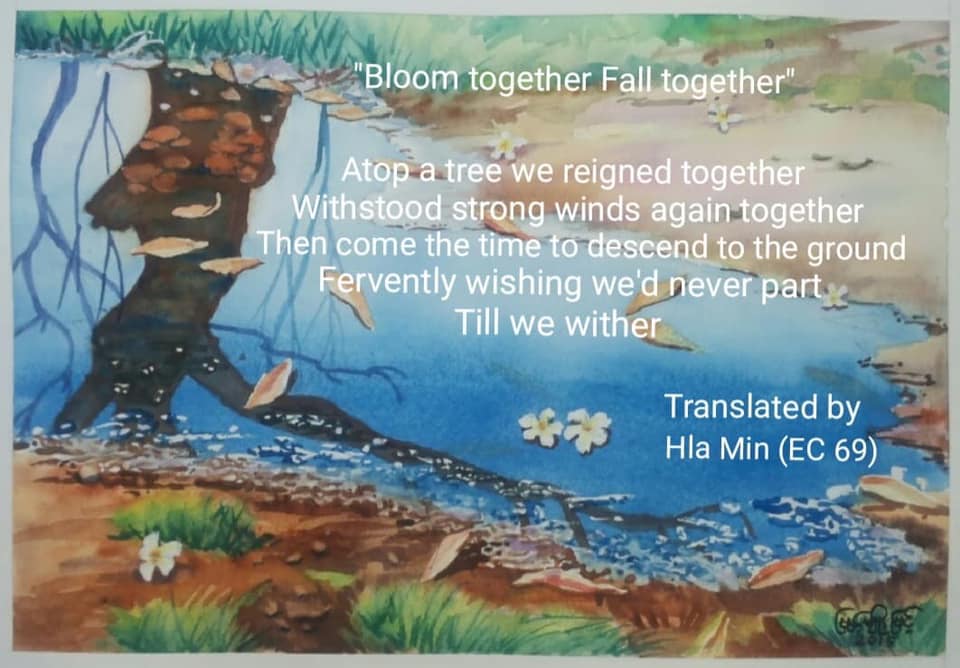
Translation is done from a Source Language into a Target Language.
Burma Translation Society was formed primarily to translate reference and text from English to Burmese.
Pali Text Society in the UK publishes selected English translations of Pali texts.
One of the Objectives of the Sixth Buddhist Council was to translate the Scriptures (including Commentaries and selected Sub-commentaries) from Pali into Burmese. Mahasi Sayadaw and his team (including Sayadaw U Silananda) compiled a Pali-Burmese Abhidan (Dictionary) to aid the translation of the Tipitaka.
Lexicographers
Reverend Judson and his team compiled the “English to Burmese” and “Burmese to English” dictionaries. They translated the Bible into Burmese.
There are several Dictionaries compiled by Burmese. The early works were done by
U Tun Nyein
Dr. Ba Han
Tet Toe (U Ohn Pe)
U Hoke Sein took two decades to complete his Pali-English-Burmese Dictionary.
Lost in Translation?
Some meaning can be lost in Translation.
Grapevine says that the Japanese were given an ultimatum by the US. The response supposedly had two meanings : (a) We will consider (b) We don’t care Due to miscommunication or “wrong” translation, the second meaning was taken, and the first A-bomb was released over Hiroshima.
Interpreters find it difficult to translate jokes or puns. One interpreter pleaded : “The dignitary is making a joke. If you want to help me retain my job, please applaud loudly and laugh heartily.” His job was saved.
WPD Sunday Supplement
Working People’s Daily (WPD) carried a Sunday Supplement. It carried the translation of renowned authors and scholars.
They include
MMT (former Chief Justice U Myint Thein)
Tet Toe (U Ohn Pe)
ZMT (former Ambassador U Zaw Myint Thein)
Sao Hso Holm (English First Class Honors, son of Arzani Sao San Htun)
The Assistant Editor Daw Khin Swe Hla (formerly “Dawlay” at Guardian) wanted some fresh blood. She assigned me to translate a short story “Nge Thay Lo” by Sayagyi U Thu Kha. I tried my best to come up with “Still So Young” and received a remuneration of fifty kyats. Sayagyi was given fifty kyats.
My experience
Translator and Interpreter at Meditation Retreats and selected events
Loose rendition of articles and poems by Sayas and alumni
This morning “AMAY” [my beloved mother-in-law who I fondly address as mother] nearly slipped and fell while stepping out of her bedroom. To regain balance, she tried to reach and hold the cabinet beside her bed as support. In the process, she accidentally hit and broke the glass of the cabinet. When AMAY came out of the room, I immediately held her hand and examined for bruises and cuts. Fortunately, there was none and I was relieved.
These days I hear about several accidents due to carelessness and loss of attention for a short while. The other day, a friend was walking in front of his house and noticed some ongoing repair work for the drain. He tried to avoid hitting the repair area, but slipped and fell into the drain. Luckily, he escaped disaster with a few scratches on his hand.
In a village in Thone Gwa Township, an electrical accident occurred. A person was bathing in front of his house when he touched a wire connected to the water pump. He had a shock and fainted, and eventually passed away.
This nation has seen numerous lives being lost by “electrocution”. The main cause is poverty. If someone retorted with “What’s the connection?”, I will present hard facts. Use of outdated and dangerous electrical appliances to this very day, reliance on low-quality and obsolete electrical systems and standards, and lack of knowledge and basic education of the users contribute to the accidents and often loss of lives. Broken power lines also have caused deaths by striking people in the way.
Accidents happen daily and in numbers, so it is somewhat miraculous for AMAY not to be injured by broken glass.
AMAY is really not that old. She is one year away from celebrating her 100th birthday.
She can walk, but needs someone to assist her. She likes to frequent her bedroom by herself. So we have to watch her movements closely. After she is helped to sit at the dinner table, she does not need further assistance. She eagerly reads the newspapers and journals (ahead of me) and has interest in the latest news. Due to a slight eyesight problem, she cannot read the fine print. She reads aloud the headlines and the large print. One can say that AMAY is well informed and that she stays abreast of the changing times.
Since I displayed special attention of her hand, AMAY took a thousand Kyat note from her pocket and gave me as a reward. She added, “Spend as you wish”. I gave a lightweight smile.
After AMAY had her lunch, we had a general conversation. I mentioned that there have been two car thefts in Kamayut and Hlaing lately, and that some poor people might have to steal to survive. AMAY replied, “The government is responsible. High officials also steal, isn’t it? [May be not directly.] Their subordinates steal and …”
“AMAY. Making car owners sad and tearful is definitely not good. The case of the other thefts is somewhat different, AMAY.”
“Now, look. A man from Dagon Seik Kan Township committed suicide by hanging. He is supposedly addicted to alcohol.” AMAY said.
“Drinking has become a fashion and fad. What’s wrong with that?”
“In our days, people stay away from alcohol. The other day, my nephew came to see me and told about Bama girls drinking beer (or similar) in the pub with the men. OMG.”
“But, AMAY. It’s their KHIT (era).”
“What KHIT? Why does the government allowing everyone to become drunkards? Does it not have laws to prohibit drinking?”
I dare not continue the conversation. I decided to shut my mouth.
“Sigh … sigh … So ruthless. Supposedly happened on THAN THU MA street. Near the fowl (hens, ducks) market. Every month, at least one patient (sick person) is disposed there. The families who left them could no longer take care of them. So ruthless. Have people lost their compassion?”
I did not know what to say.
AMAY who can keep abreast of the modern times. AMAY still possesses an active brain and acute reasoning.
So, what was AMAY thinking when she, out of Metta and Cetana, rewarded me with a thousand Kyat note to buy and eat whatever I wish? In this case, I believe AMAY is unaware of the economics [high cost of living, inflation, poverty, …] of the present era. Her mind must have regressed several decades back to the good, old times. Si Chet [noodles] cost Nga Mu (50 pyas). Bei Oo Pauk Si [bun with meat and duck egg] cost Ta Mutt (25 pyas). A cup of tea Ta Mutt. Khauk Swel Kyaw [Fried noodles] cost Thone Mutt (75 pyas). And so on. AMAY might be thinking of the prices that we knew in our younger days.
The [diminishing economic] status of our nation has been shown by the One Thousand Kyat Note that AMAY rewarded me. I would remark that the Note had written a piece of history [of our once golden land].
Why worry? A plate of Khauk Swe Kyaw (Fried noodles) sells at Two Thousand Kyats. To please AMAY, I will order half a plate [to the surprise of the owner] and eat to my delight without showing any guilt or shame.
String of attachment — then in its infancy grew beyond proportion — on her birthday to express my deepest feelings — while courting her I gave “Sho Whet The Pho” (Mystery/Thriller) Magazine as a birthday gift to my beloved.
We shared our metta with true devotion
I presented a golden ring to my yee-sar as a birthday gift.
Hand in hand we entered the “married” land on her birthday past the Honeymoon I presented Goya fragrance as a birthday gift
Traveling together Often facing dark nights Yonder looked thick and rough
Goal seemed distant [and not straight] [Tired and] weary [Often] look but could not see
Struggle just to keep alive Despite the challenges I feel I owe my beloved a nice birthday gift
But … Precious jewels are out of reach I can only offer a gift from my heart
Kabyar inexpensive — not meaning to underrate her love
“Chamber’s Cyclopaedia” was one of the earliest encyclopedias. It covered 40+ subjects.
In our younger days, we had “Pear’s Soap” and “Pear’s Cyclopaedia”. The company was probably building its brand name by supporting the publication of an encyclopedia.
Encyclopedia Britannica
My uncle had a set of “Encyclopedia Britannica”. It covers many topics written by SME (Subject Matter Experts). Yearly supplements were published. The final supplement came out a couple of years ago. There will no longer be printed editions. There will only be on-line subscription.
Wikipedia
Wikipedia is a collection of encyclopedias in multiple languages.
The English edition of the Wikipedia is the largest.
The accuracy of the Wikipedia is comparable to that of the “Encyclopedia” thanks to the countless volunteer contributors and editors.
I was a volunteer to correct discrepancies (mostly entries on Burmese/Myanmar). For example, a young author wrote that St. Paul’s High School was the first among the De La Salle Schools in Burma. He was unaware that St. Patrick’s High School in Mawlamyaing was the first (and was established a few months earlier than St. Paul’s).
No Absolute Perfection
There is a slight chance that there are errors in an encyclopedia (or an equivalent “book of knowledge”). One author was unaware that Rajiv Gandhi was the elder son of Indira Gandhi. He was a pilot and entered politics only when his younger brother Sanjay Gandhi (touted as Indira’s confidante and successor) died in a plane crash.
Collaboration
The advent of Internet and the rise of “Collaborative Work” have lowered the time and cost to maintain encyclopedias.
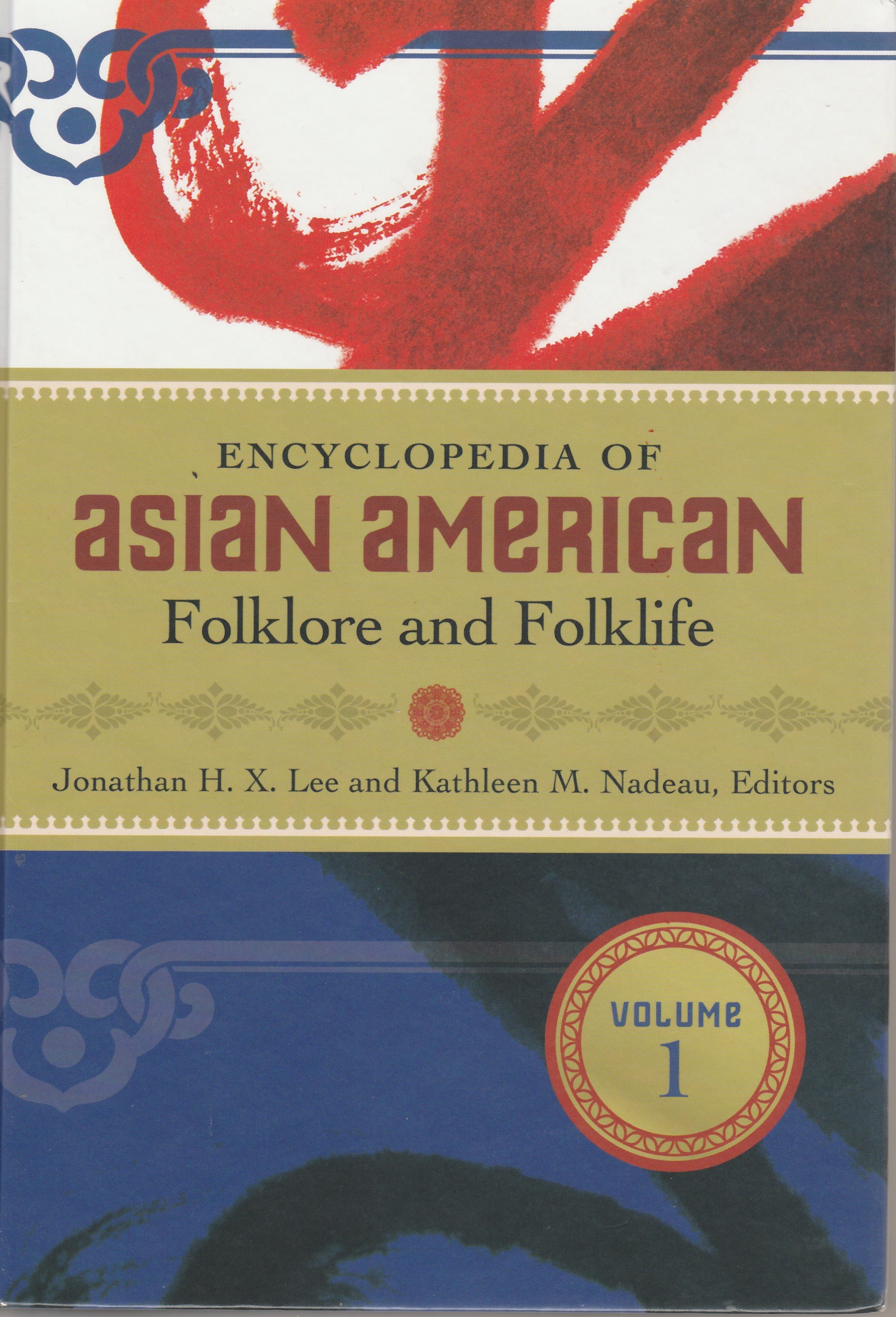
A few years back, I received a call to submit entries to “Encyclopedia of Asian American Folklore and Folklife”. I emailed to the editors that I was willing to help them on the Burmese section. They sent me four samples and asked me to send back one short article (not exceeding 500 words and with two or more references) on a chosen Head Word (e.g. Burmese American Festivals). They reviewed my article and accepted me. The remuneration was $10. I replied that I would like to have a copy of the 2-volume encyclopedia. A deal was struck. They would give me the encyclopedia if I submit at least 8 articles. Nine articles were accepted. Two articles were merged with the work of other authors. One author was a Burmese College Professor. Another was probably a graduate student, who inserted the wrong date for Martyr’s Day. The Editors promised to correct his error in another edition. I received a 3-volume encyclopedia (initially projected to be 2-volume) and an additional $10.
Google Books
Some are not aware of “Google Books”.
If one goes to “Google Books” and search for my name, one can find the nine articles.
Burmese Encyclopedia
In my younger days, my parents bought me “Myanmar Swel Sone Kyan” (Burmese Encyclopedia).
I heard that the “Myanmar Swel Sone Kyan” is under re-development with the help of SME (Subject Matter Experts).
First club founded at Santa Ana, California, USA in 1924.
My journey to DTM
Hla Min (DTM)
Every new member is provided a mentor.
I was fortunate to have a Double DTM as my mentor.
I completed both the Communication track and Leadership track to become a DTM.
Communication track
CC (Competent Communicator)
ACB (Advanced Communicator Bronze)
ACS (Advanced Communicator Silver)
ACG (Advanced Communicator Gold)
Leadership track
CL (Competent Leader)
ALB (Advanced Leader Bronze)
ALS (Advanced Leader Silver)
DTM (Distinguished Toastmaster)
Requirements include
Completion of speeches and projects, serving as an officer in club and beyond (area, division, district), mentor or club coach, and organizer of contests.
Still So Young (Translation) “Nge Thay Loh” — Short story by Thu Kha (Author, Director, Actor) I received fifty kyats for the translation. U Thu Kha was given fifty kyats.
Men on the Moon (Poem) Honoring the Apollo 11 Mission in July 1969 Mr. Hall (USIA) forwarded my poem to NASA.
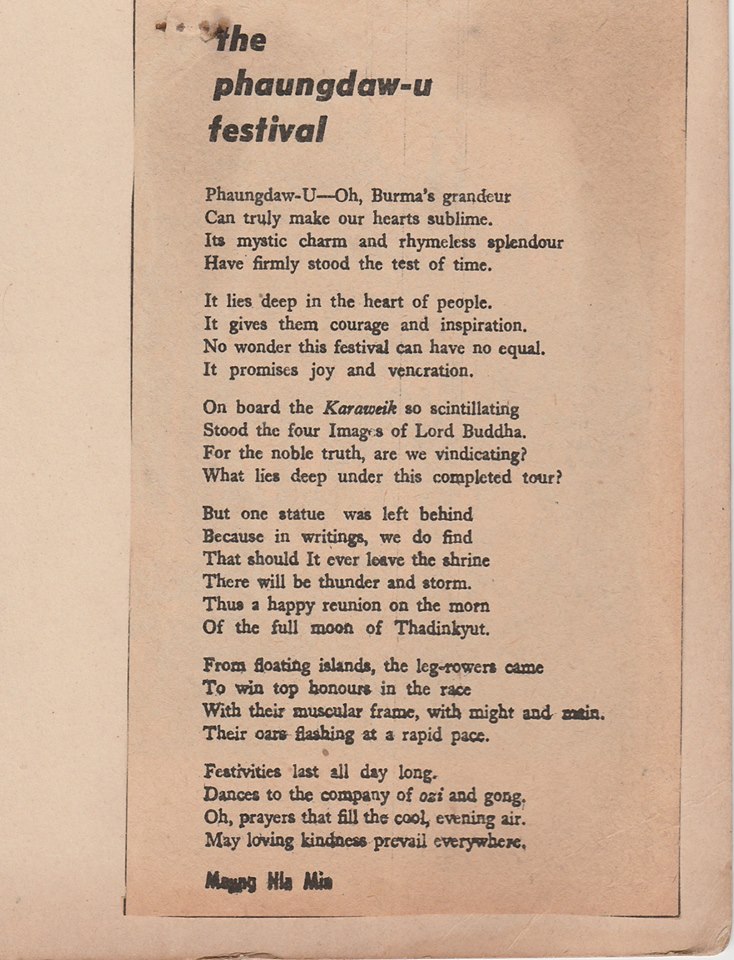
Phaungdaw-uFestival (Poem) Thadinkyut Festival at Inlay Lake, Shan State Inlay is known for the floating islands and leg rowers. Inlay Khaung Daing Camp hosted Luyechuns.
The Great Gandhiji (Poem) Centennial of the Apostle of Non-violence Born Mohandas Gandhi, he was also called “Mahatma”
To The Fallen Warrior (Poem) Honoring the writers who fought for Burma’s Independence
Calendars (Concept) There are various Calendars. The Burmese Calendar is luni-solar, socio-religious calendar.
Sea Burial for Dr. Htay Lwin Nyo (Event) Part-time Professor of Electrical Engineering, San Jose State University passed away alone at his home. Per request from the Professor and Head of EE Department, the Burmese Community in the San Francisco Bay Area helped with the Final Journey. I had the honor to push the incinerator and also to join Dr. Swe Aye and Dr. Khin Nyo Thet to scatter the ashes in the waters off Santa Cruz.
Still So Young (Translation)
Still So Young
Short story : “Nge Thay Loh” by Thu Kha
Translation : “Still So Young” by Maung Hlaing Phyo (Hla Min)
Publication : Modern Burmese Writings, Working People’s Daily
Men On The Moon (Poem)
Author : Hla Min
Honoring the Apollo 11 Mission in July 1969
Astronauts : Neil Armstrong (Mission Commander) Edwin “Buzz” Aldrin (Lunar Module Pilot) Michael Collins (Command Module Pilot)
Landing : Tranquility Bay (on the Moon)
Publication : Guardian Daily Newspaper
Men on the Moon
Phaungdaw-uFestival (Poem)
Author : Hla Min
Thadinkyut Festival at Inlay Lake, Shan State
Publication : Thadinkyut Supplement Working Peoples’ Daily
Phaungdaw-u Poem about Phaungdaw-u Festival
The Great Gandhiji (Poem)
Author : Hla Min
Centennial of the Apostle of Non-violence
Publication : Working Peoples’ Daily October 1, 1969
Gandhi
To The Fallen Warrior (Poem)
Auhor : Hla Min
In honor of the Sarsodaes / Writers who fought for Burma’s Independence
Publication : Forward Magazine
To the Fallen Warrior
Calendars (Concept)
Article by Hla Min
Publication : BAPS Newsletter
Article on Calendars
Sea Burial for Dr. Htay Lwin Nyo (Event)
Author : Hla Min
Publications :
BAPS Newsletter and RIT Alumni International Newsletter
နိုင်ငံရေး စီးပွားရေး အတ္တဘီလူးများကို RIT ကျောင်းသားဟောင်းတစုက သနားကြင်နာစွာ သတိပေးလိုက်တဲ့ ကဗျာသရုပ်ဖေါ် တစ်ခုပါ။
Here is a clear and kind reminder to “every politically and economically greedy giant-headed monster” from a group of alumni of Rangoon Institute of Technology, Myanmar.