If one is inattentive for a few seconds, then one can trip or fall.
Take 30 seconds to 2 minutes to change posture.
Don’t climb up a foot or higher without something to hang on to.
Maintain balance and moderation. With control, you can enjoy good food and even wine (or beer).
Enjoy BFF (Best Friends Forever). Meet, greet, eat and be merry.
Laughter is the best medicine.
If you perform good deeds, you get merit every time you rejoice about those deeds.
Be imperfectly perfect.
Better to get a thing done than waiting for perfection (which may never come as in Charles Babbage’s projects).
Que sera sera (What will be will be).
Do not have great expectations.
Buzz Aldrin became depressed after the Apollo 11 trip, because he was only the second person to land on the moon.
Remember the things you learned as a kid.
“I had the blues because I had no shoes Till upon a street I met a man without feet.”
“Brighten in your corner.”
“In life’s rosy morning In manhood’s firm pride Let this be the motto Your footsteps to guide In storm or in sunshine Whatever assail We’ll go onward and conquer And never sail FAIL.”
U Thein Aung (M72) presents the differentiation with U Thein Aung (Met72).
I am Set Hmu — Maung Thein Aung. (I am Maung Thein Aung studying Mechanical Engineering.)
He is Set Hmu Maung — Thein Aung. (He is Thein Aung, who won Mr. RIT award and Sa Lwei Thaing in 1968).
Ba La Gyi vs. Ba Lar Gyi
During his RIT days, U Thein Aung (Met72) was “Ba La Gyi” (full of strength and prowess).
Lately, he has become “Ba Lar Gyi” (nothing notable left).
Khin Maung Win (EP69)
At a 69er gathering, Daw Saw Yu Tint (T69) greeted U Khin Maung Win (EP69) as Sargalay (“sparrow”).
He replied, “I am no longer Sargalay. I have became a La Da (“vulture”).
Kar Ku La Thin Char
Saya U Aung Myint (Pet69, Kyant Ba Hone) drew a cartoon:
“Ah Ba, Kar Ku La Thin Char (Calculus) is fascinating. If you differentiate a La Da, you get a Sargalay. If you integrate a Sargalay, you get back a La Da.”
Palindrome
A palindrome reads the same when read forward or backward.
There are palindromes in languages, music and art. The Pulitzer Prize winning book on Escher (Painter), Godel (Mathematician) and Bach (Composer) discusses threads that are common to Mathematics and Computer Science, Arts and Music. One such thread is a palindrome. For example, a musical composition (which is a palindrome) can be played from the front to back, and vice versa.
The earliest palindrome supposedly occurred in the Garden of Eden. MADAM I’M ADAM and the reply EVE
Napoleon Bonaparte is the first Corsican to attend the French Military Academy. He rose to be a young General, and then an Emperor. He supposedly lamented as follows: ABLE WAS I ERE I SAW ELBA .
There were two early Canals (Suez and Panama) to shorten the sea routes. The degree of difficulty was not the same. It took meticulous planning to build the Panama Canal. It gave rise to the palindrome : A MAN, A PLAN, PANAMA
Parent #1: My son’s only four and he can already spell his name backwards. Parent #2: Oh? And what’s his name? Parent #1: Otto.
Einstein Jokes
In our younger days, there were Newton jokes. Later, there were Einstein jokes.
It is possible that someone processed a joke about an absent minded professor and then attributed to a famous person.
Einstein (1)
It was raining. Einstein took off his hat and hid it in his coat. A student asked “Why?” The reply : “My hat is new and can be damaged. But my head cannot be damaged by the rain.”
Einstein (2)
A ticket inspector boarded a train. Einstein searched for his pockets. The inspector said, “You need not show me the ticket. You are Einstein.” The reply : “I do not know which stop I should get down.”
Einstein (3)
Einstein was carrying a stack of books. He collided with a lovely student. The books fell down. The student collected the books and returned them to Einstein.
Einstein asked, “Which way was I going?” The student replied, “You were going towards the school.” Einstein felt relieved and said, “Then, I must had my lunch at home.
There are several ways to classify languages, e..g. Natural Languages, Programming Languages
In Computer Science and applications, a Programming Language is a language used to program (e.g. instruct) computers.
In the early days, computer engineers and selected programmers have to program in Machine Language (with strings of Zeroes and Ones). They are due partly to the choice of Binary Number System as the basis of designing Arithmetic and Logic Unit inside the computer. On the ICL 1902S computer, we often have to use the 24 keys to enter short pieces of Machine Code. That is history.
To bridge the human users and the computers, the next step was to use Assembly Languages such as (a) Simple/Symbolic Assembly Language (b) Macro Assembly Language. A Macro Processor translates Macros (a well-defined group of Assembly Language instructions). An Assembler translates a program in Assembly Language into Machine Language instructions.
The development of the first 11 (or so) programming languages can be found in the first HOPL (History of Programming Languages) Conference. Currently, there are thousands of programming languages (some for academic purposes) and a limited number used for production.
Programming Styles
Over the years, the style of programming evolved.
Procedural programming e.g. telling the computer system what to do, emphasis on the “verbs”
Non-procedural programming e.g. telling the computer system what one wants
Object Oriented programming e.g. emphasis on the “nouns”
Functional programming e.g. based on “functions”
Logic programming e.g. based on “Horn logic” and similar logic systems
Top down step wise development
Bottom up & Middle out techniques
AI programming
Low Code & No Code
Within each paradigm, there are several programming languages with known advantages and limitations.
Turing Computability
There is a theoretical model called “Turing Machine”, which is primitive but has the computational power of modern computers.
Alan Perlis, a pioneer Computer Scientist and Programming Language Designer, defined a “Turing Tar Pit where everything is possible, but nothing is easy.”
Paying respect to Sayas is a tradition that is unique to Myanmar.
The tradition is alive and well.
There have been seven world wide SPZPs : SPZP-2000 (US) SPZP-2002, SPZP-2007, SPZP-2010 (Singapore) SPZP-2004, SPZP-2012, SPZP-2016 (Yangon)
I was fortunate to be a Core Organizer for SPZP-2000 and a Coordinator for the remaining SPZPs.
Alumni
Many alumni are active in the following:
SDYF (Swel Daw Yeik Foundation)
RITAA (RIT-YIT-YTU Alumni Association)
NorCal RITAA (in the US)
MES
MEC
HMEE-2018
History
“History of Myanmar Engineering Education” was published in 2012.
The project’s initiators included Saya U Soe Paing, Sayagyi U Ba Than and several sayas and alumni (See Acknowledgement in the Book)
Saya U Aung Hla Tun and team compiled the book.
Ko Ohn Khine (M70) and I compiled the CD Supplement for the HMEE-2012 book
The draft for the first two sections were prepared by Saya U Soe Paing and team.
Ko Ohn Khine translated Section 1 and summarized Section 2. The translations have been revised by Saya U Soe Paing.
Saya U Aung hla Tun gave the copyright to RITAA.
HMEE-2018 project is headed by Saya U Aung Hla Tun. Project will revise / enhance the HMEE-2012 book. Will cover the History of Engineering and Industries.
YTU Library Modernization Project
A decent Library is a requirement of the accreditation of YTU by Asean (and beyond).
Donations — large and small — are coming in. Thanks to U Wynn Htain Oo (M72), Ma Nan Khin Nwe (83 Intake) and team.
The donors include
U Khin Maung Tun (T78)
Dr. Myo Khin (C70) and Daw Mya Nwe (C73)
Daw Myint Myint (C69)
Saya U Tin Htut (M60)
James Shwe (M76) and Annette Shwe (A75)
NorCal RITAA
Alumni from Singapore, Australia and New Zealand
Archive
The Library could have a section to help remember our beloved alma mater, our sayas and alumni activities.
Sayagyi Dr. Aung Gyi endorsed Ko Benny Tan’s proposal to archive the mementos.
Requested class representatives to record gatherings / activities.
Health Care Funds
“Steeve and Helen Kay Health Care Fund for RIT Sayas and Sayamas”
“Eye examination and assistance Fund provided by U Khin Maung Tun”.
Balance of both funds have been handed over to Swel Daw Yeik Foundation.
Other funds include 69er HCF, EE69er HCF, and those administered by the classes and groups (e.g. Combined 1st BE Intake of 64 and 65)
Resources
RIT related Facebook pages
RIT related Google groups
hlamin.com
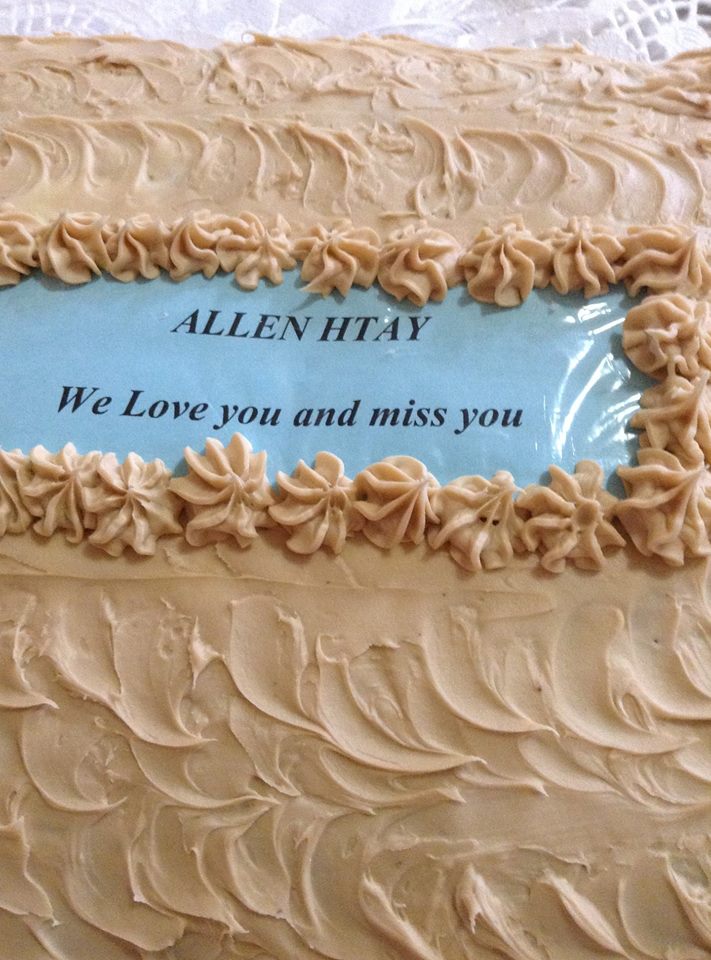
Saya Allen Htay (C58)
Leader of the San Francisco Bay Area Alumni Group
Co-founded “RIT Alumni International” which hosted SPZP-2000 and served as President.
His article “Brother, can you spare US $500?” is a classic.
Daw Mu Mu Khin hosted a lunch in memory of Saya on December 31, 2017.
In memory of Saya Allen, Daw Mu Mu Kin donated Saya’s books to the YTU library. Also sponsored scholarships for eligible YTU students.
Golden Sponsors
U Thaung Sein (Steeve, EC70)
U Benny Tan (M70)
U Khin Maung Oo (Ivan Lee, M69)
U Tin Myint (David Ko, M67)
U Maung Maung Than (M79)
The five Golden sponsors and other donors made sure U Nyo Win’s Act (requiring the organizers to chip in if SPZP-2000 will not have the minimum number of attendees) will not be needed.
2019
Completed two decades as Chief Editor of RIT Alumni International Newsletter
Compiled posts for the Golden Jubilee of 69ers Attended both events on December 14, 2019
2020 – 2024
Writing and revising posts in hlamin.com
Request help to transform into digital and/or printed books for posterity
* Received a set from U Maung Maung Gyi (saya of my father). The wooden pieces had lead inside.
* Standard set with Plastic pieces
* Portable Chess set from my brother U Sein Htoon upon his return from 1960 ARAE Regatta in Colombo
* Virtual sets in Computer Programs
Chess Enthusiasts
* Saya Dawson (Burma Chess Champion) taught Mathematics at SPHS before opening his Private Tuition School. He taught Chess to his students and aspiring players. He is an organizer of Chess tournaments (e.g at YMCA).
His daughter Mary was among the top female players.
* Several doctors : Dr. Tin U (Children’s hospital), Dr. Tin U (TB hospital), Dr. Aung Nyein (Radiologist), Dr. Lyn Aung Thet (Joint 1st in Burma in 1964) …
* RIT Chess Club was founded by U Aung Than (EE69er), U Maung Maung (M72), U Thet Lwin (EE72) and several more alumni with some Soviet Lecturers.
U Tin Swan was Burma Chess Champion. U Maung Maung (Sin Gyi, Table Tennis Champion, C67) was also an excellent Chess player.
Computer Chess
* Professor Don Michie (Machine Intelligence pioneer) and David Levy (Programmer & Chess Master) had a friendly bet (of a year’s wages of David) if a computer program can beat David within 10 years. David won.
* Monty Newborn was an organizer of Computer Chess tournaments. Notable Champions include Belle (by Ken Thompson, co-inventor of Unix) and Deep Thought (by five Ph.D students from Carnegie Mellon University (CMU)).
* IBM hired three members of Deep Thought team and several Computer Experts to develop Deep Blue to challenge Gary Kasparov (World Chess Champion). Deep Blue was unsuccessful in the first attempt, but beat Gary Kasparov in the second attempt. IBM retired Deep Blue.
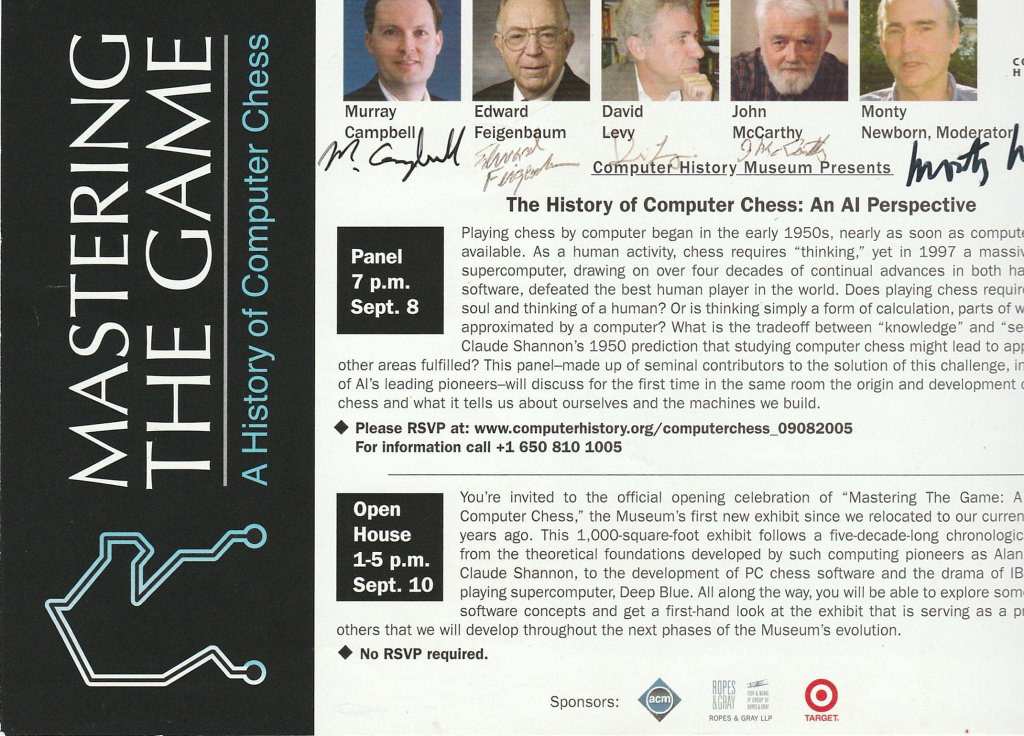
* Computer History Museum (CHM) at Shoreline, Mountain View, California had an exhibition on the History of Computer Chess.
CHM had a panel. I had autographs of the Panelists & Moderator.
Professor John McCarthy (LISP inventor, Time Sharing System)
Professor Edward Feigenbaum (Computer Expert Systems)
Murray Campbell (Member of CMU Deep Thought & IBM Deep Blue Teams)
David Levy (Programmer & Chess Master whose wager with Professor Don Michie led to the rise of Computer Chess)
Monty Newborn (Organizer of Computer Chess Tournaments)
There is a NFLC (National Foreign Language Center) at the University of Maryland (College Park), USA.
It used to provide free (or limited) access to Federal employees and eligible educators to study languages (e.g. French, Chinese, Arabic).
For a number of years, it chose from among the languages used by minorities to add introductory level courses to its library.
Burmese
One year NFLC chose to develop Listening and Reading Comprehension listening for basic Burmese. NFLC sent request to Burmese associations to help with the project.
Hla Min
I was accepted as the Language Advisor for the Burmese project.
The listening comprehension consisted of broadcasts (e.g. “Win Pe Lwai Eik”).
The reading comprehension consisted of short articles (e.g. Amyotha Pyinnya Wun U Po Kyar).
Specific fonts and browsers were needed to read the script for the Listening and Reading Comprehension.
An English translation was provided. My task was to ensure the quality (e.g. correctness of the translation).
Exercises were provided
Access
As a contributor to the project, I had access to LangNet
NLC no longer offers free access. Individuals and groups can subscribe to NFLC’s courses for nominal fees.
Fascinating, full of wonder and memories, heart rendering, sublime Bagan finally, rightfully inscribed as World Heritage Site O … ancient Temple City where I left my heart
Every time one looks yonder touched by the whirling, swirling, vibrant Ayeyarwaddy (Lord of the rivers) Misty, dreamy panoramic view O … my dear Ayeyarwaddy
Finest culture Treasure of sculpture Architecture galore Countless shrines and pagodas of Pagan Will last for eternity as World Heritage Site to be revered, cherished and appreciated O … glorious Bagan
တကၠသိုလ္ မိုး၀ါ ၇-၇-၂၀၁၉ နံနက္ ၁၁:၃၀
Tekkatho Moe War (Saya U Moe Aung) July 7, 2019 11: 30 AM