The Burmese Calendar is a luni-solar-socio-religious calendar.
The Burmese New Year falls on or around April 16. The three (or sometimes four) days preceding the New Year is celebrated as Thingyan (similar to Songkran festival in Thailand).
It is a lunar calendar with 12 lunar months in most years. An intercalary month called “Second Waso” is added every three years. There are 12 religious and/or social festivals (one for each Burmese month).
Most religious festivals are celebrated on the Full Moon Day.
The following is a brief description of the 12 Burmese months and the associated festivals.
1. Month of Tagu
Name of the auspicious event: Ushering in the Burmese New Year by the Buddhists
Associated festival: A Ta Thingyan Water Festival (generally held from April 13 – 15 or 16)
Details for the celebration: (a) Invite guests for special treat. (b) Take eight precepts and practice Sila (morality). (c) Listen attentively to the “38 Blessings” by the sangha. (d) Chant Paritta (protective verses) and Pathana (“relations”) (e) Pay homage to the elderly people as if they were one’s own parents (f) All the above are performed (by the Burmese Buddhist) to accumulate kusala (wholesome deeds) (g) Most younger people usher in the Burmese New Year by throwing water (h) Thingyan festival is the most prominent among the 12 (monthly) festivals.
Objectives: To cleanse akusala (unwholesome deeds) from the past year (a) symbolically by throwing water (b) practically by performing meritorious deeds such as dana (charity), sila (mrality), and bhavana (meditation)
2. Full Moon Day of Kason
Name of the auspicious event: Buddha’s Day. It is the most prominent day for the (Theravada) Buddhists celebrating four milestones (a) the proclamation that the Bodhisatta Sumeda would become Buddha in four incalculables and 100,000 worlds (b) birth of the Boddhisatta Sidartha (c) enlightenment of Gautama Buddha (d) Mahaparinibbna (final passing away of Buddha)
Associated festival: Kason Nyaung Ye Thun Pwe (pouring water on the Bodhi tree)
Details for the celebration: (a) Invite guests for special treat. (b) Invite sangha and offer requisites (c) Take (five or eight) precepts and practice Sila (morality) (d) Listen to the dhamma talks (e) Practice metta (loving kindness meditation) (f) Share merits (g) Pour water on the Bodhi tree
Objectives: (a) To acknowledge the practice of parami (perfection) for four incalculables in order to become a Buddha (b) To realize that Buddha’s teachings are for our own good (c) To make a determination that we should practice Buddha’s teachings to the fullest extent
3. Full Moon Day of Nayone
Name of the auspicious event: Mahasamaya (“Great Occasion”) A Kha Daw Nay (a) Commemorating truce between Kapilavutta and Koliya countries (b) Assembly of devas, brahmas, galons, nagas, and sanghas expressing their metta (unbounded love) (c) Ordination of 500 princes from the Sakya clan (d) In sum, distinguished and outstanding day of love and peace
Associated festival: Recitation of Mahasamaya Sutta
Details for the celebration: (a) Invite guests for special treat. (b) Invite sangha and offer requisites (c) Take (five or eight) precepts and practice Sila (morality) (d) Listen to the dhamma talks (e) Recite Mahasamaya Sutta (f) Practice metta (loving kindness meditation) (g) Share merits
Objectives: (a) To advocate love and peace among nations with diverse cultures and beliefs (b) To practice metta (unbounded love) not only for humans but for all beings
4. Month of Waso
Name of the auspicious event: (a) Offering of Waso robes (b) Recitation of Dhammacakkapavutna Sutta (“Turning the Wheel of Dhamma”)
Associated festival: There is no specific date for the offering of Waso robes to the sangha. Full Moon Day of Waso is a prominent day for (Theravada) Buddhists celebrating three milestones (a) the day when Boddhisatta was conceived in the womb of Queen Mahamaya (b) the day when Prince Sidharta renounced his worldly pleasures (c) the day when the First Sermon Dhammacakkapavutna Sutta was delivered to his five disciples
Details for the celebration: (a) Invite guests for special treat. (b) Invite sangha and offer requisites (c) Take (five or eight) precepts and practice Sila (morality) (d) Listen to the dhamma talks about Magga (Noble Eight-fold Path) (e) Collectively recite Dhammacakkapavutna Sutta (f) Practice metta (loving kindness meditation) (g) Share merits
Objectives: (a) To avoid the two extremes of sensual pleasure and self-mortification (b) To practice the Noble Eight-fold Path
5. Full Moon Day of Wa Khaung
Name of the auspicious event: Metta (“Unbounded Love”) A Kha Daw Nay 500 monks who were practicing meditation in the forest were intimidated by nats (guardian spirits) and returned to Buddha’s monastery. Buddha preached them Metta Sutta and exhorted them to practice loving kindness meditation to the nats before meditating. The monks returned to the forest and practiced per Buddha’s exhortation. The nats no longer obstructed the practice of the monks, thereby allowing them to progress and get enlightened. Thus, Metta A Kha Daw Nay came into being.
Associated festival: Recitation of Metta Sutta & Sar Ye Tan Mei (deciding the donation to a monk based on a “raffle” [letter written on a stick, in ancient times]
Details for the celebration: (a) Invite guests for special treat. (b) Invite sangha and offer requisites (c) Take (five or eight) precepts and practice Sila (morality) (d) Collectively recite Metta Sutta (e) Offer requisites to the monks based on the Sar Ye Tan Mei “raffle” (f) Dhamma talk on metta and the virtues of practicing metta (g) Share merits
Objectives: To practice metta (unbounded love), karuna (compassion), mudita (altruistic joy), & uppekha (equinamity)
6. Full Moon Day of Tawthalin
Name of the auspicious event: Garudhamma (“Five precepts”) A Kha Daw Nay A brief history is as follows. Bodhisatta was (once) born in Kuru Taing (province), where the king and his people practiced Garudhamma. They refrain from (a) killing (b) stealing (c) sexual misconduct (d) lying (e) taking intoxicants. So, the weather was fine and wealth was amassed. Kawlinga Taing (province) suffered from (a) war (b) famine (c) disease. Many perished. The king and people of Kawlinga Taing decided to emulate the king and people of Kuru Taing. Soon, the weather became fine and wealth was amassed. The three sufferings disappeared. The Full Moon Day of Tawthalin, which is part of the rainy season, was named Garudhamma (“Five precepts”) A Kha Daw Nay.
Associated festival: Competition for reciting poems about the merits of taking five precepts.
Details for the celebration: Host competitions for reciting poems about the merits of taking five precepts.
Objectives: (a) To make people aware of the merits of taking five precepts (b) To have a peaceful community (c) To promote world peace
7. Full Moon Day of Thadinkyut
Phaungdaw-u Festival
Name of the auspicious event: Abhidhamma (“Ultimate Reality”) A Kha Daw Nay & Mahapavayana Nay Buddha taught Abhidhamma to the devas in Savateinsa (during the Buddhist Lent) and returned to earth on the Full Moon Day of Thadinkyut
Associated festival (1): Festival of Light
Details for the celebration: (a) Light candles (b) Light incandescent bulbs Objectives: Emulate the scene where the devas and the people paid homage with candles and lights to the Buddha upon his return from Savateinsa
Associated festival (2): Pavayana Pwe
Details for the celebration: (a) Monks assemble in a sima hall (b) Each monk invites other monks to give advice. He says, “If you have seen me commit a misdeed, you may reprimand me. If you hear that I have committed a misdeed, you may reprimand me. If you doubt me, you may reprimand me. I will try not to commit that misdeed in the future.” (c) Lay people might also invite their fellow people to give advice.
Objectives: (a) To practice Nivata Mangala — blessing where one displays humility (b) For monks to practice Sovacasatta Mangala — blessing where one takes constructive critism (c) For lay people to become good & wise people
8. Full Moon Day of Tazaungdaing
Name of the auspicious event: Samyannaphala (“Virtues of monkhood”) A Kha Daw Nay Buddha gave the sermon to King Ajjasathat on the Full Moon Day of Tazaungdaing
Associated festival: Tazaungdaing Festival
Details for the celebration: (a) Light candles (b) Take (eight) precepts and practice Sila (morality) (c) Dhamma talks based on Samyannaphala Sutta (d) Practice metta (loving kindness meditation) (e) Share merits
Objectives: (a) Make people aware of the virtues of monkhood and the qualities of sangha (b) If one has conducted misdeeds like King Ajjasathat, one should acknowledge the fact, but be determined to be good by doing meritorious deeds.
9. Full Moon Day of Nadaw
Name of the auspicious event: Dhamma Sarsodaw Myar Nay In Burmese History, Full Moon Day of Nadaw honors the literary giants (writers, poets). In modern days, the Department of Religious Affairs designated the day to honor writers for the dissemination of dhamma
Associated festival: Sar Pyan Pwe (Oral and written examination for the monks)
Details for the celebration: (a) Hold religious examinations (b) Written examination about Tipitaka (“Three Baskets”) : Vinaya (Monastic rules of conduct), Sutta (Discourses), Abhidhamma (Ultimate Reality) (c) Oral examination about Tipitaka (d) Lay people may visit libraries and borrow religious books (e) Lay people may hold discussions about dhamma
Objectives: (a) Preservation and propagation of Tipitaka (b) Encourage youths to be highly literate and have good moral character
10. Month of Pyatho
Name of the auspicious event: Shin Ta Htaung (1000 ascetics) A Kha Daw Nay During Buddha’s time, 1000 ascetics in Uruvela forest led by the Kassappa brothers renounced their wrong beliefs and become arahants.
Associated festival: Ordination of monks and novices
Details for the celebration: (a) Hold ceremonies for higher ordination of monks (b) Allow youths to become novices
Objectives: (a) To reinforce the importance of practicing morality (b) To familiarize people with religious ceremonies & the performing of meritorious deeds
11. Full Moon Day of Tabodwe
Name of the auspicious event: Ovada Patimauk (Buddha’s exhortation to avoid akusala, to perform kusala, and to purify one’s mind) A Kha Daw Nay
The Full Moon Day of Tabodwe is significant for several reasons. (a) Venerable Sariputta became an arahant (b) Both Venerable Sariputta and Venerable Mogallana were proclaimed by Buddha as the Best in their specialties (c) Without any explicit notice, Ehi Bhikkhu Calabinna Patisambidapatta arahants (elite monks who do not need explicit ordination, who possess six divine powers, and who easily became enlightened) convened for the Ovada Patimauk ceremony.
Associated festival: Ovadaha Partimauk & Htamane Pwe (Sticky rice) festival
Details for the celebration: (a) Collectively prepare Htamane (b) Offer htamane to monks and devotees (c) Listen to dhamma talks
Objectives: (a) Emphasize the strength of unity (b) Perform meritorious deeds collectively (c) Understand Buddha’s exhortation to avoid akusala, to perform kusala, and to purify one’s mind & practice accordingly
12. Full Moon Day of Tabaung
Name of the auspicious event: Myat Buddha Pyi Daw Win A Kha Daw Nay At the request of his father’s emissary Kaludayi, Buddha accompanied by 20000 arahants returned to Kapilavutta from Rajagaha. The return trip commenced on the 1st waning day of Tabaung in year 103 of Mahatheikarit (calendar used in Buddha’s time)
Associated festival: Buddha Pujaniya Tabaung Festival (paying homage to Buddha)
Details for the celebration: (a) Invite as many sangha as possible (b) Offer requisites to the sangha
Objectives: To remember the Triple Gems: Buddha , Dhamma, and Sangha
Winner Inn is run by Saya U Ba Than’s family : son Ye Than, daughter-in-law Win Mar Oo, grandson Aung Myo Myint and granddaughter Ei Khine.
U Ba Than
Before the family moved to a new residential home (a little bit further down Than Lwin Road), Saya would entertain his relatives (visiting from abroad), former colleagues and students at Winner Inn.
Gatherings
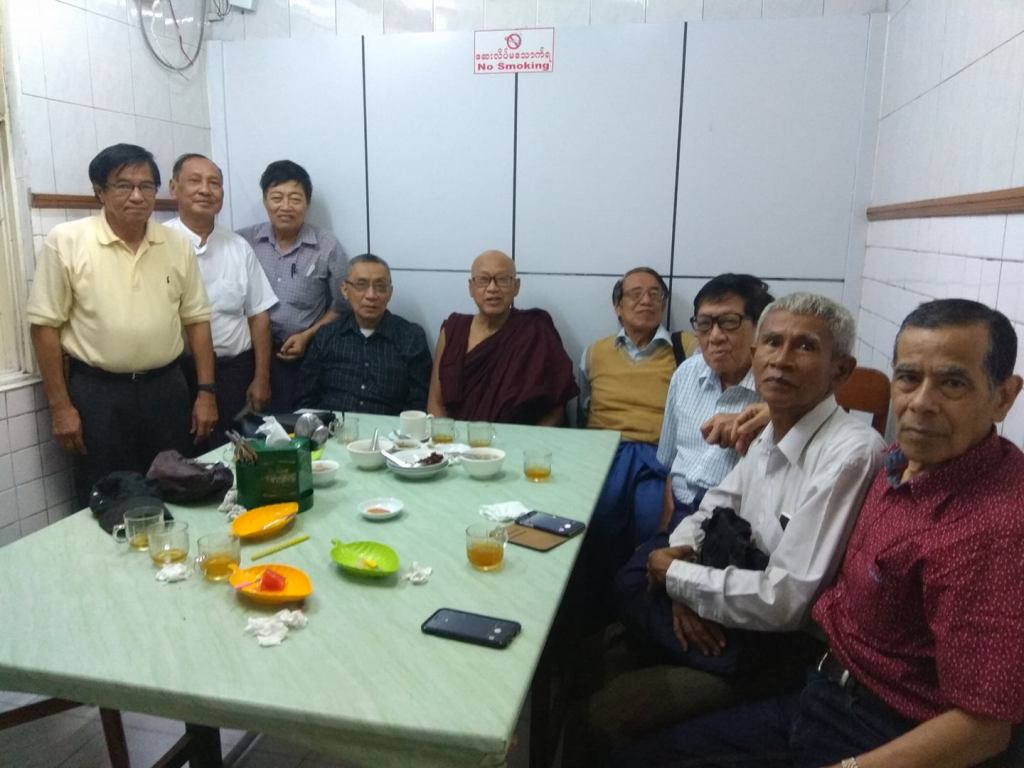
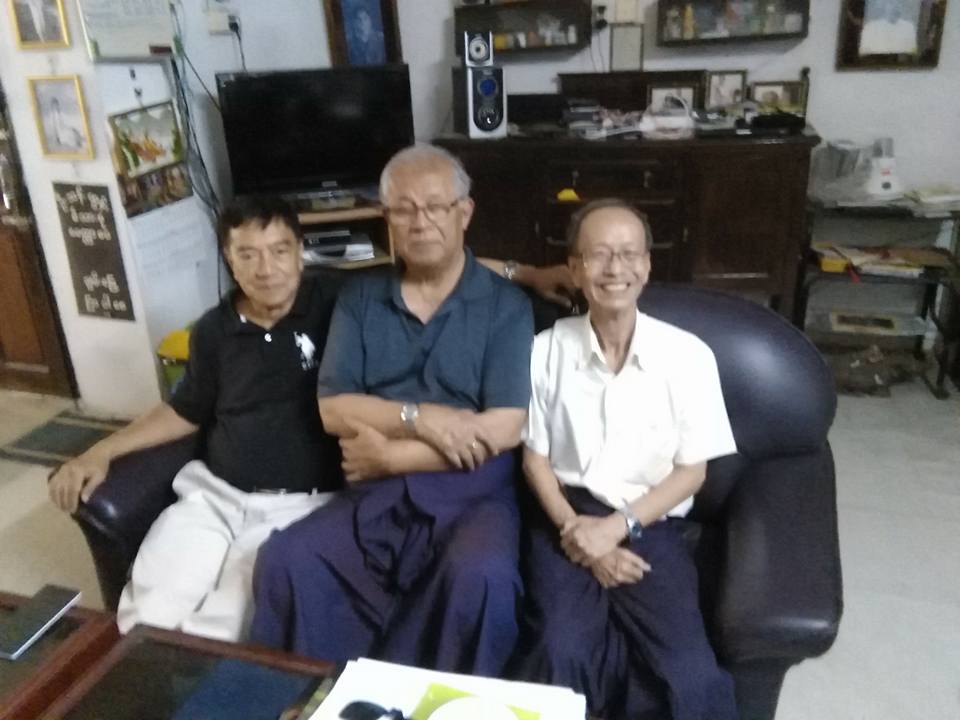
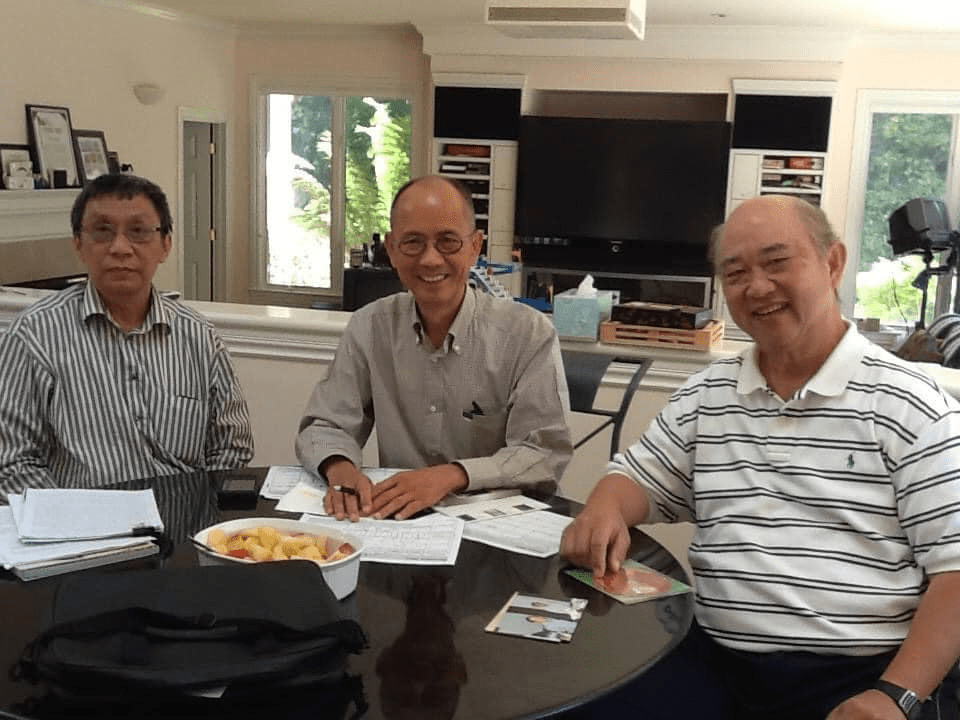
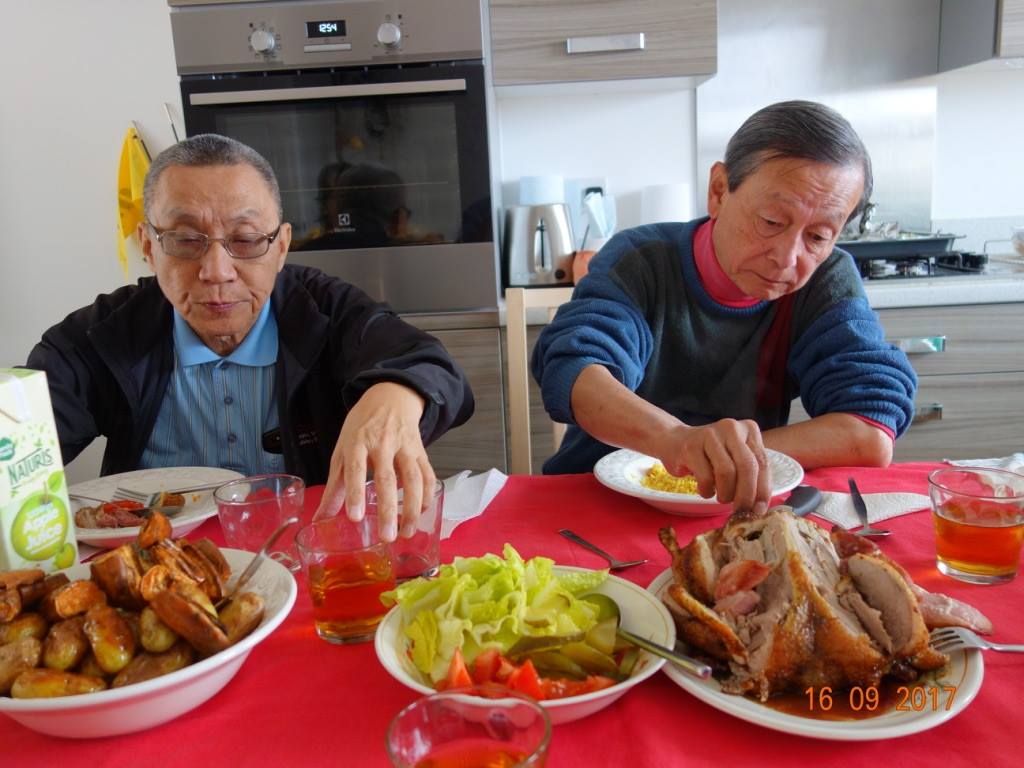
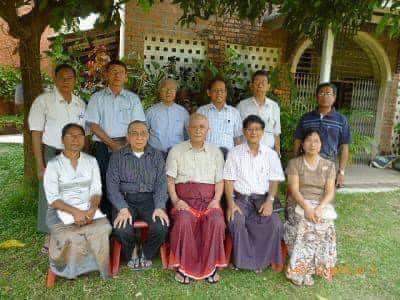
An informal gathering took place at Winner Inn in January 2017. Attendees include Dr. Khin Tun (Peter, GBNF) & Daw Win Mar, U Hla Win, U Aung Moung (GBNF), my spouse and me
U Aung Moung came to see Saya U Ba Than and Daw Win Mar. It’s a small world. Win Mar’s older brother was a childhood friend of U Aung Moung.
Sadly, U Aung Moung passed away in 2018. He was active in HMEE, SDYF and several social and religious organizations. Several monks arranged their own transportation to attend U Aung Moung’s last journey at Yay Way.
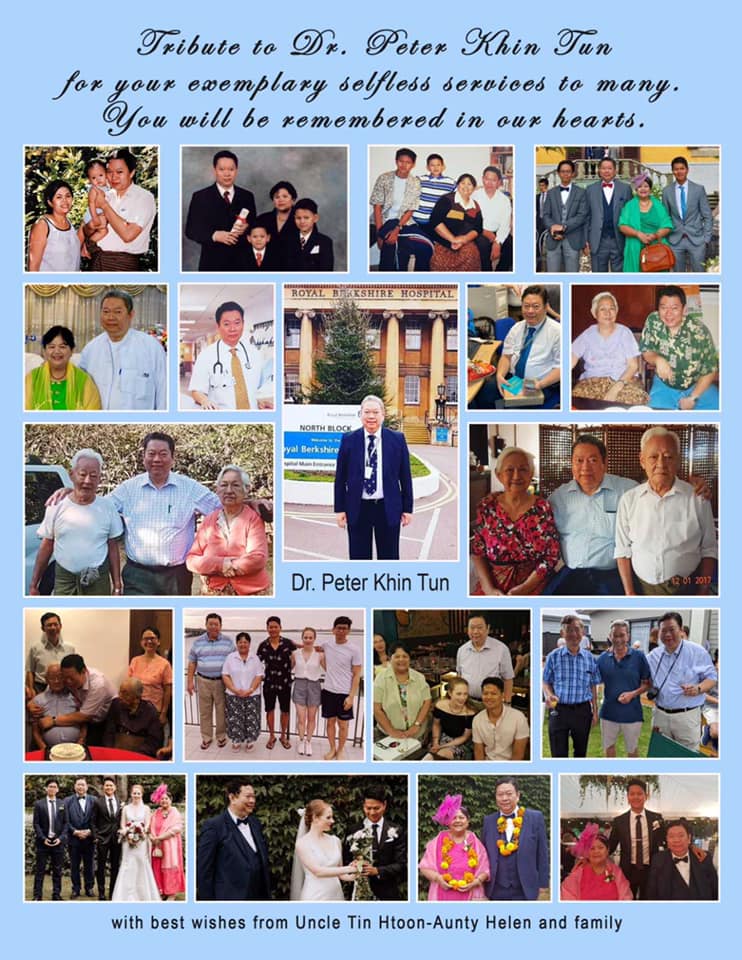
Dr. Peter Khin Tun (GBNF)
Peter would usually come back to Yangon before January 12 to celebrate his mother Dr. Kyi Kyi Nyunt’s birthday. His father U Tin U is the elder brother of Saya U Ba Than.
Peter would host some celebrations (e.g. engagement party of his elder son Min Ko) at Winner Inn.
Sad to report that Peter was an early victim of Covid and lax UK Hospital policies about PPE. He passed away on April 13, 2020 (which was Easter Monday & start of Thingyan). The sad news is covered in BBC and some UK newspapers.
His spouse Win Mar recovered after two weeks of treatment at the hospital.
On a bright note, Peter was given awards posthumously and the UK hospital systems adopted better procedures.
Wanted her daughters — Hazel, Olive & May — to have experience like her at the Inya Hall.
Hazel & May spent a year at Inya Hall as room mates. Olive had to stay at the Hall for medical students.
Fund raiser
Danced three roles in the fund raiser for the Tekkatho Dhammayone. Her cousin Saya U Lu Pe Win (Pali and Kyauksar Scholar) directed the play. The rehearsal was assisted by U Nyi Pu (First male actor in a Burmese movie).
Play
Was honored at the Thet Kyee Pu Zaw Pwe (Paying homage to the elders) held at the Tekkatho Dhammayone.
Her account was published in the Golden Jubilee Sar Saung of Inya Hall.
A1 Film
Myanmar Ah Swe Film evolved into A1 Film.
A1 U Tin Nwe & his family are known as Producers, Directors & Actors.
U Nyi Pu founded Maha Weikzardo Film.
U Tin Pe (Maung Maung Soe) founded Maung Maung Soe Film.
A1 U Tin Maung acted alongside May Shin and other lead female actors before becoming a Director/Actor.
Daw Khin Myint’s son U Tin Yu & son-in-law U Mya Maung are Director & Producer.
Feedback
Thit Yine (alumnus of Yegyaw Methodist) wrote : Dr. Hla Shwe (Boon Chiong) stood First in the Matriculation examination of 1953 from Yegyaw Methodist, and that his class mate Ohn Khin stood Second. Yegyaw Methodist was well known before the Nationalization of schools.
Thit Yine and Ko Ko shared the names of sayas (e.g. U Aung Myint, U Khin Zaw, U Ko Lay) who taught in the late 50s and early 60s.
Po Shwe Kyu wrote : Credit to Saya Hla Min as being the most prolific writer in this group, and his archives and chronicles will be of greatest help to coming generations. Drs. Hla Shwe & Tin Maung returned to Burma around 1962-63. I don’t know Dr Hla Shwe but Dr. Tin Maung also resided at the Chummery during my short stay there. Chummery is a “Saya Lu Pyo Saung”.
Myo Thaik wrote : Sayama Daw Khin Aye passed away last year. His cousin uncle Dr. Myint Thein won a Gold Medal for scoring highest marks in Chemistry in the I.Sc. examination, and later became the first Myanmar to received Ph.D in Nuclear Chemistry in the USA. He is currently staying with his son in Texas. He also wrote about “A Che A Nay Kaung” and “Ma Khan Chin Seik” that led him and his uncle cousin Dr. Win Naing to pursue their dreams to have doctorates.
Myo Thaik wrote : Dr. Hla Shwe is Emeritus Professor, East Stroudsburg University, Pennsylvannia, and then moved to California.
First in Burma
I knew that several SPHS students stood First in Burma in the Matric exam. They include
U Ba Khin (Vipassana teacher, first native Auditor General)
George Chapman (SPHS51)
Dr. Nyunt Tin (SPHS52)
Koon Yin Chu (Phillip, SPHS54)
Dr. Soe Win (SPHS58)
Dr. Frankie Ohn (SPHS59
Dr. Khin Maung U (SPHS63)
Bernard Khaw (SPHS65)
I was aware that students from other schools also scored Top in the some years.
St. Peter’s High School, Mandalay
Methodist English High School (MEHS)
St. John’s Convent
Yegyaw Mthodist
Sacred Heart
Thanks to those who provided additional info and/or corrections
GBNF & Tone Kyaw
I have to be very careful in specifying persons as GBNF (Gone But Not Forgotten).
There are at least three Tone Kyaw (person believed to have died) including me.
When my name sake CO U Hla Min (Chief Operator at UCC, who appeared healthier than me) passed away in his mid-30s, two Training Departments (from Co-op and Trade) inquired UCC where they could send a “Lwan Thu Pann Kway” (wreath) for me. My former class mate Moe Hein (Ajala with an extremely loud voice) was surprised when he saw me at the Kyandaw Cemetery. He said, “I have taken a day off to come here. I wondered why your brother did not tell that you had passed away.” I became a Tone Kyaw.
U Han Sein (C69, Ah Pho Gyi) was sentenced to 20 years for his alleged involvement in 8-8-88. His classmates, who were organizing the 30th Reunion of Graduation, inadvertently listed him as GBNF. He became a Tone Kyaw. He was released after 16 years (with the Amnesty Proclamation), but sadly, his family had been broken. He recently celebrated his 10 years of regained freedom.
When Dr. Tin Hlaing (Marine Technology) passed away in Singapore, some RIT inadvertently sent condolences to Saya Dr. Tin Hlaing (M63), who became a Tone Kyaw.
Mya Kyun Nyo Nyo Kun Yeik Kho
The song was first recorded as a “Dat Pya” at Myanmar Ah Than (Burma Broadcasting Service). It was first sung by U Mya Thein and group. U Thet Lwin received 100 Kyats for his composition, and he treated his fellow Ah Nu Pyinnya Shins.
In a TV interview, Saya played the song.
The song has been sung in many events including the SPZPs (Saya Pu Zaw Pwe) of RIT Alumni.
The Singapore “Pon Chan Chan Group” led by Don Min U Yu Swan recorded the song.
The song was also sung at the Ceremony on December 1, 2019 to kick off the RU Centennial.
The various versions can be listened from the Facebook Posts and You Tube.
Land marks
Thit Pope Pinn is recognized by the Yangon Heritage Society.
The tree was there even before the founding of the University of Rangoon, and it survived Cyclone Nargis.
A few readers expressed displeasure to see the wired fences and the inexplicable disappearance of landmarks.
The Convocation Hall is another land mark.
Eons ago, the Prime Minister of the Union of Burma served as Chancellor of the University of Rangoon, and also delivered “Commencement Speech” at the graduation.
I posted the program of the 1958 Convocation which listed about 30 prize winners (Gold Medals, Silver Medals and Books).
U Soe Paing, my mentor at RIT and UCC, received two Gold medals (after paying 150 Kyats for each Gold Medal, because the original endowments no longer covered the “rising cost” of Gold for the Medals). He had the highest score for I.Sc. (A) and (B) combined. He had the joint highest Maths score for I.Sc. exams — with two other students.
In 1962, Dr. Myint Tun (Henry Cho Tun) won the Gold Medal for the highest score for I.Sc.(A) and (B) combined. U Myat Thwin (ChE66) beat him by one point for the highest score in Mathematics for I.Sc.(A) and (B) combined.
Autograph
Ma Chit Swe (Hazel Kyaw Zaw’s mother) was a Junior I.A. (Intermediate of Arts) student in 1936. Hazel has posted her mother’s autograph.
Daw Hla Myint, a close friend of Hazel’s mom, wrote a lovely poem. Many were unaware of her talent. She had to leave the University before graduation to get married to U Tu Maung. Saya U Tu Myint (Winston Tu Maung) was our saya at RIT and later taught at Singapore Polytechnic until retirement. Dr. Hla Maung (Ronald Tu Maung, MEHS65) moved to the UK. Her siblings include Dr. Pe Nyun (Pediatric Surgeon, who led the operation of conjoined twins Ma Nan Soe and Ma Nan San), Dr. Pe Thein (Professor and Retired Minister), Daw Ivy San Pe and Daw Flora San Pe.
P Peter (NHS Hero) paid a high price for misguided policies and guidelines E Envisioned retirement to spend quality time with his extended family T Talented Doctor, Gourmet Chef, Sketch and Oil Painter — to name a few E Educated and/or entertained aspiring medical specialists far and near R Real irreparable loss to patients, friends, family and community
P Pote Pote Kyee (see “Cho Cho Hlaing”) E Enthusiastic learner and practitioner (see “Aung Jee”) T Took care of parents of relatives, patients and friends (see “Min Ko”) E Ever smiling and helpful (see “Ye Myint”) R Rural doctor with a huge heart (see “Vicky Bowman)
85th Birthday of Ma Cherry (Peter’s mom)Zoom gathering for offering Dana in memory of Peter
Sad Loss that might have been prevented
Dr. Khin Tun (Peter) served as Associate Graduate Dean at Oxford University from 2012 – 2016. He worked at Royal Berkshire Hospital in Reading for 20+ years.
Sadly, he passed away on April 13, 2020 due to COVID-19 infection. He was the first doctor from RBH Trust to pass away in the line of duty. Due to misguided Policies and Guidelines, Peter lost his life at the tender age of 62. Thanks in part to interviews by Minko and Ye Myint, RBH Trust initiated an inquiry into the loss of Peter.
Peter was looking forward to retiring in a couple of years and spend quality time with his extended family.
His paternal grand mother lived up to 94.
His father celebrated his 90th birthday in 2019. He used to sit in the garden every evening talking with someone and taking his daily dose of medicine. After learning about Peter’s untimely demise, he was devastated for three days. He no longer had the desire to sit in the garden. He lamented that he had no one to talk to. Ye Myint told his father that he will call from UK daily.
His mother passed away a few months short of her 89th birthday. She and Peter are both January born. Peter would fly back to Yangon almost every year (for the past decade) in time for his mother’s birthday. They would perform dana together mostly at Chan Myei Yeiktha.
Three uncles and two aunts are in their 80s.
Relatives and friends mourn the loss of Peter and miss his compassion, help and smiles.
Hope
We cannot get Peter back, but we hope other medical staff in the front line fighting the invisible enemy would not have to suffer the same fate as Peter.
He hosted two gatherings for Saya Dr. Aung Gyi and Daw Emma. Saya attended SPZP-2012 & SPZP-2016 in Yangon.
The first was in 2013 (a few days after SPZP-2012).
The second was in 2016.
Jan 2013
He hosted a Birthday Gathering for Daw Emma Gyi.
Daw Emma Gyi’s birthday in Jan 2013
Dec 2016
In 2016, Ko Wai Lwin hosted a dinner for the Sayagyi Dr. Aung Gyi and several other sayas at Ko Nyan Tun U’s residence.
Ko Nyan Tun U, Ko Khin Maung Kyaw, Ko Ye Chit Pe, Ko Ohn Khine and Ko Tun Aung are retired. Ko Kyaw Lwin and Ko Win Myint were in charge of the Ministry of Construction.
Ko Win Myint (later Bogyoke) was a 10th standard Luyechun at the Inlay Khaung Daing Camp in 1965. Ko Win Myint said that Ko Sein Shwe (M67, 4th year Luyechun from RIT, group leader and musician) inspired him to join RIT. Ko Win Myint has published some books.
Ma Pwint Than, spouse of Ko Htun Aung (“Aung Daung”), was also a 10th standard Luyechun. Later, at SPZP-2016, I met Ko Htun Aung, his close friend Ko Hmaing (author, GBNF) and Ma Pwint Than at the gallery of the famous Bagyee Saya Ko Myo Myint.
BAPS is based in the San Francisco Bay Area. It was founded as a merger of BEA (comprising of senior engineers) and BASTS (comprising of young engineers, scientists and technologists).
Saya U Htin Paw (EE58, GBNF), Saya U San Tun (M59) and Saya Dr. K C Chiu (ChE63) served as President of Bay Area Burmese Engineers Association (BEA).
Burmese American Science and Technology Society (BASTS) was founded by young engineers and scientists (mostly graduates from USA). Some are children of RIT alumni. They include
Daniel Maung/Mao — son of Saya Mao Toon Siong (M62)
Eugene and Jonathan Shu — sons of U Aung Khin (James Shu, M70, GBNF)
With the approval of Sayagyi U Aung Khin, BEA and BASTS merged to become Burmese American Professionals Society (BAPS).
BAPS
I am a Life Member of BAPS.
I served as Contributing Editor for BAPS Newsletter.
BAPS Presidents
Saya U Nyo Win (M65)
Benny Tan (M70)
Maurice Chee (M75)
Edison Paw
Roger Sha
Daniel Mao
Edison, Roger and Daniel are founding members of BASTS.
BAPS Newsletter
Chief Editor : Henry Lim
Editors : U Thein Aung, Jane Wang
Contributing Editors : Linda Khaw, U Hla Min, Edison Paw, Mike Yin
Table of Contents (Sample)
Article on Dr. Htay Lwin Nyo
I wrote an article for Dr. Htay Lwin Nyo (EP74, ex-UCC).
I had the honor to start the incinerator, and later to throw the ashes in the Santa Cruz waters.
The End of a Sad Saga
The weather was exceptionally beautiful this morning — not only in the Silicon Valley where we live and work, but also over the hills along Highway 17, and even in the coastal area around Santa Cruz. There were no fogs, mists, or clouds.
I am not an early bird, but I woke up really early this morning to prepare for Dr. Htay Lwin Nyo’s final journey — the scattering of his ashes from a 35 foot trawler motor yacht, DESTINY.
On Saturday, 10th June, 2000, Dr. Khin Nyo Thet and Dr. Lyn Swe Aye had retrieved the cremated remains of HLN from Oak Hill Funeral Home (OHFH). OHFH had packed and sealed HLN’s ashes in a sturdy, shining metal box (in compliance with postal regulations). With the approval of HLN’s family members in Yangon, Myanmar, we decided to give HLN a sea burial.
RIT Alumni International had earlier sent an advance check of $75 to Captain Pete Petersen, skipper of DESTINY. In his brochure, Captain Petersen clearly stated that “inclement weather will result in a rescheduling”. We do not want high winds to prolong the sad saga. The unusually fine weather, according to Dr. Lyn Swe Aye, must be Htay Lwin Nyo’s kusala (kutho or meritorious deeds) and the well wishing of numerous friends and colleagues. We all agree.
Dr. Khin Nyo Thet had asked me to be at her house not later than 7:30 a.m. She was surprised but delighted when I showed up barely a few minutes after 7 AM. “It’s better to be early than late”, she said and gave me a cup of coffee and some biscuits [that looked and tasted like those way back in Burma]. Dr. Lyn Swe Aye had come back from his early biking round.
There was virtually no traffic on the way to Santa Cruz Yacht Harbor. To cut the story short, DESTINY took off at 5 mph. There were no swells. More than a mile into the ocean waters, the Captain set the gears to neutral. Dr. Khin Nyo Thet scattered Htay Lwin Nyo’s ashes into the ocean waters. There were tears in her eyes. There was also relief knowing that she had done her best to give the last rites to Htay Lwin Nyo. We shared our merits once more to Htay Lwin Nyo.
The round trip took about 50 minutes or so. It was the finale of a sad saga.
Thanks to all those who endured with us. May Htay Lwin Nyo rest in peace.
Honoring U Nyo Win, Ko Benny and Ko Henry
On November 9, 2000, there was a special dinner at Ming’s seafood restaurant in Sunset, San Francisco to honor Saya U Nyo Win (M65), out-going president of BAPS and to welcome Ko Benny Tan (M70), the in-coming president. There were 30+ attendees. Saya U Nyo Win was presented a plaque in recognition of his leadership and services to BAPS.
A plaque was also awarded to Henry Lim (RIT Alumni) for his services as Editor of the BAPS newsletter. It grew from a 4 pager to a 20 pager.
BEA to BAPS
The first ever RIT Grand Reunion and SPZP did not happen out of the blue. One of the first seeds was sown with the founding of Burmese Engineers Association (BEA). The presidents Saya U Htin Paw (EE58), Saya U San Tun (M59) and Saya U KC Chiu (ChE63) — with the able support of Daw Khin Hta Yee (Lily Win, T72) — organized mini-reunions and reunions in the Bay Area. At the welcome party for Saya U Aung Khin, the idea of merging BEA with a younger association BASTS to become BAPS (Burmese American Professional Society) was proposed and overwhelmingly approved.
BAPS Picnic to RIT Alumni International
At one of the BAPS picnics, several EC members — Saya Allen Htay, Saya U Nyo Win, Saya KC Chiu, Saya U Maung Maung, Ko Benny Tan, Ko Maurice Chee, — held an impromptu meeting with me and asked how they could support Ko Khin Maung Zaw (KMZ) and me regarding the ex-rit web site in general and other activities [such as Grand Reunion] in general.
Later, at Ko Benny’s house, the Bay Area Alumni Group was formed. The rest is history.
U Nyo Win
According to the bye-laws of BAPS, a President can serve for at most two terms. Saya U Nyo Win served two terms. Saya also chaired the meetings by the Organizing Committee of the RIT Reunion and SPZP. His colorful meeting minutes are enjoyable to read.
He is an outstanding writer and an excellent speech giver. Saya wears two hats: BAPS for the Bay Area activities and RIT Alumni International for activities related to his alma mater world-wide. Our kudos to you, Saya.
After Dinner
We went to Ko Aye Tun (Anthony Ng, M76)’s house, which is within walking distance from the restaurant. A preview of the raw / semi-edited copy of the video taken at the RIT Reunion dinner and SPZP took place. The 2+ hour footage caught several viewers by surprise. The “Waing gyi putt putt du way way” dance — started by Diana (Myint Myint Sein, M70) and Richard Chao (Htin Aung, M70) — was joined by Saya U Khin Aung Kyi, Saya U Min Wun, and several alums.
It was close to two o’clock in the morning when I got back home.
Henry Lim (Aung Myint)
Attended Rangoon Institute of Technology, but left for USA before graduation.
Writer and Publisher
Served as Chief Editor of the BAPS Newsletter.
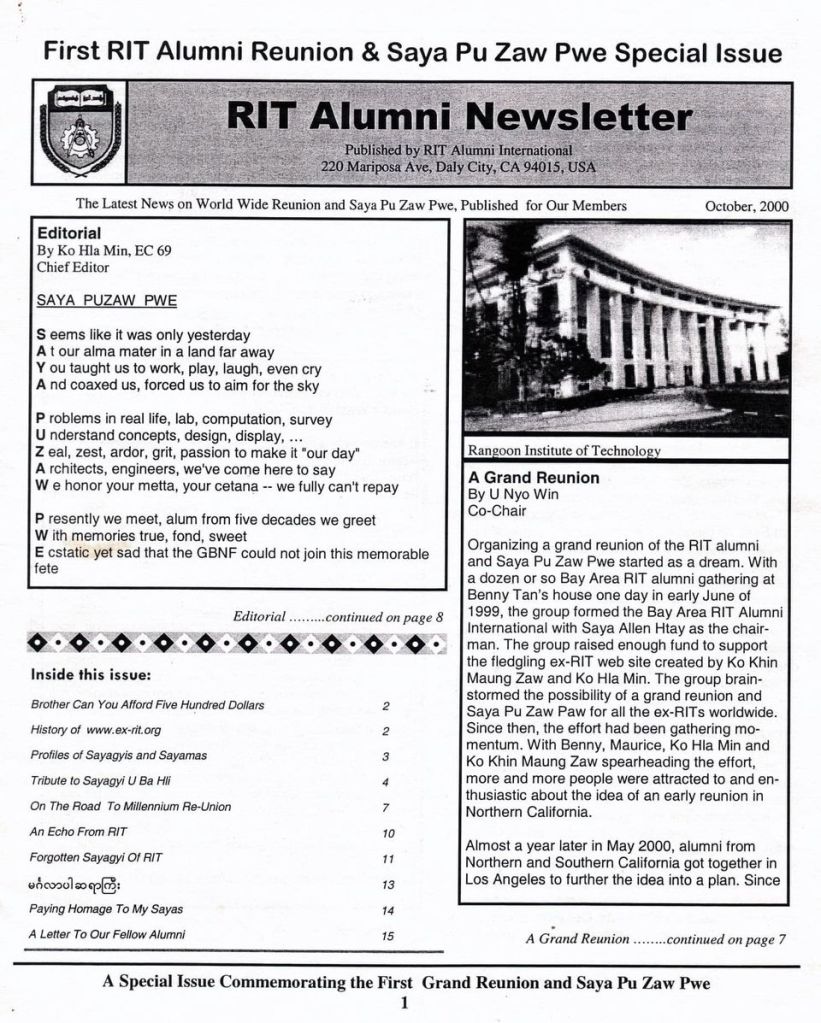
Associate Editor of the commemorative issue of the “RIT Alumni International Newsletter” for SPZP-2000.
Published “Shwe (Golden) Padauk” Magazine in the San Francisco Bay Area. It was a bi-lingual (Burmese and English) magazine.
For a short while, he published “Du Yin Thee (Durian)” Magazine in the San Francisco Bay Area. It was a ti-lingual (Burmese, English and Chinese) a magazine.
Had a medical problem that needed a kidney transplant. Doctors advised him to slow down and take care of his health.
Stopped the publications.
Fast forward. Had a successful transplant, and is now happily retired.