Category: Burma

  • Currency

    • The Union Bank of Burma issued Burmese Currency notes backed by Gold Reserves.
    • The bills were signed by authorities (e.g. Sithu U Kaung, U San Lin).
    • One US dollar traded at 5 – 6 kyats, and one Sterling pound around 12 – 13 kyats.
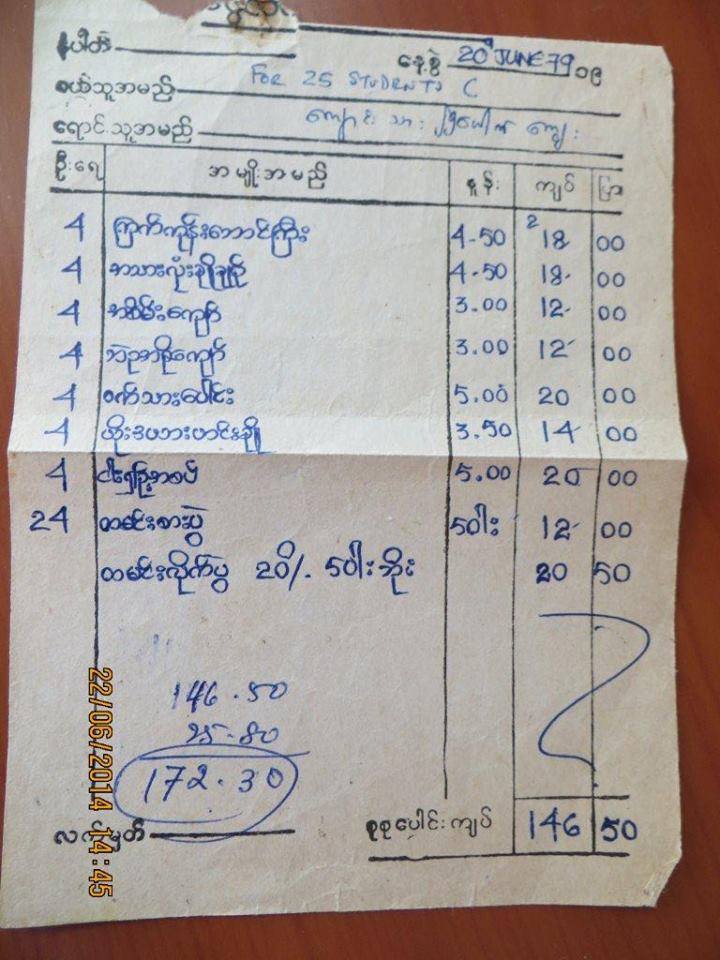
    Old Receipt

    Old Receipt from 1979

    • The Old Receipt (for 146 Kyats and 50 Pyas) is a testament of the purchasing power in the 70s.
    • It was for a farewell dinner for Saya U Myo Win (M/Ag65) by 25 members of the RIT Automobile Club.

    Decline in the value of the Kyat

    Three rounds of Demonetization, mismanagement, … saw a huge decline in the value of the Kyat.

    Snap shots of the exchange rate :

    • 1 Kyat = 4 (or more) Bahts (Early days)
    • 1 Kyat = 1 Baht (Baht Taik Kyat Taik Khit)
    • 4 (or more Kyats) = 1 Baht
    • Four decades ago, a Palmist friend told me that I would own 10 Lakhs.
      The top prize for the “Aung Bar Lay” Lottery was 1 Lakh.
      A professor’s monthly salary was K1300.
      A lecturer earned 800 – 1200 kyats.
    • A few years back, my friend had to pay 10 Lakhs for a visit to a hospital in Yangon.
    • Another friend had to pay 800+ Lakhs to a hospital in Singapore. Luckily, he had inherited a fortune from his parents.
  • Early Scholars to the UK

    Dr. Hla Myint

    • Studied for a Doctorate in Economics in the UK
    • Became Professor and Head of Economics Department
    • Retired as Rector of the University of Rangoon.
    • Continued as Researcher, Scholar and Administrator in UK.
    • There is an Economic Theory with Saya’s name.

    Dr. Tha Hla

    • Studied for a Doctorate in Geology in the UK
    • Became Professor and Head of Geology Department
    • Retired as Rector of the University of Rangoon.
    • Served as UN Advisor in several countries and settled in Thailand.
    • There are several anecdotes about Saya.
    • When an AFPFL minister protested the States Scholarship for his mentee Dr. Nyi Nyi, Saya did not back out.
      He pushed the nomination through during a period when the minister was away.
    • Saya is highly regarded for “Lead by Example
      Saya calmly requested and convinced the students and crowd (following the agitator Ajala) to disperse
    • Director Thar Du was unhappy when Saya (as Member of the Movie Censor Board) recommended some parts of the movie to be revised.
      Thar Du was surprised and delighted when Saya voted the same movie for an Academy Award.
      Saya explained that the two roles required different consideration.
    • During his stay in Thailand (while waiting for a US visa), U Tin Maung Nyunt was recommended by Dr. Tha Hla to be a proof reader for the Nation newspaper.
    • He hosted people with different beliefs and helped them if needed.
      Saya offered guests (including U Tin Maung Nyunt) his collection of Whiskey and drinks, but added, “Do not spoil Whiskey by adding water or soda. You can drink “Ah Yet”, but never let Ah Yet” drink you.”

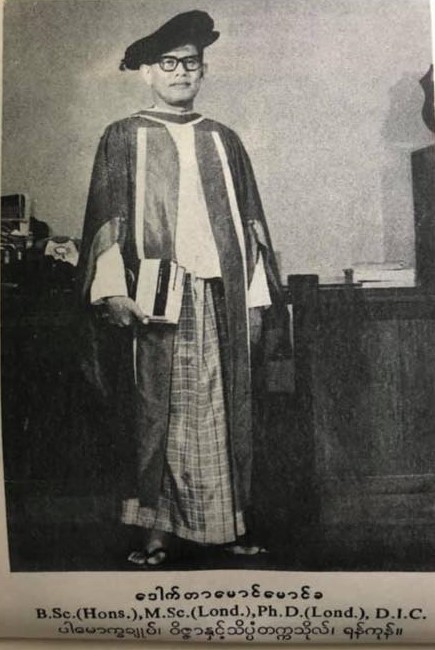
    Dr. Maung Maung Kha

    • Several posts cover Saya Kha.
    • Studied for a Doctorate in Metereological Physics in the UK
    • Became Professor and Head of Physics Department
    • Served as Rector of the University of Rangoon, RASU and University Distance Learning
    • Shwe Ku May Hnin remembered Saya Kha’s smile when a student (from the Social and Reading Club) asked him, “Saya, will you continue the tradition of Di Tha Par Mauk Kha Saya giving away his beautiful daughters to brilliant students?”.
    • A member of the RU Centennial group remembered Saya Kha’s smile and forgiveness when he was inadvertently hit by a student (who had to take classes at Workers’ College and come to the Main Campus for practical sessions).
      The young sayas U Thein Aung (Micky) and U Thein Htut scolded the offender and his companions for not knowing Sayagyi.
    • Per Dr. Alvin Oak Soe Kha, his father is the Rector with the longest tenure and is known for his kindness and compassion.
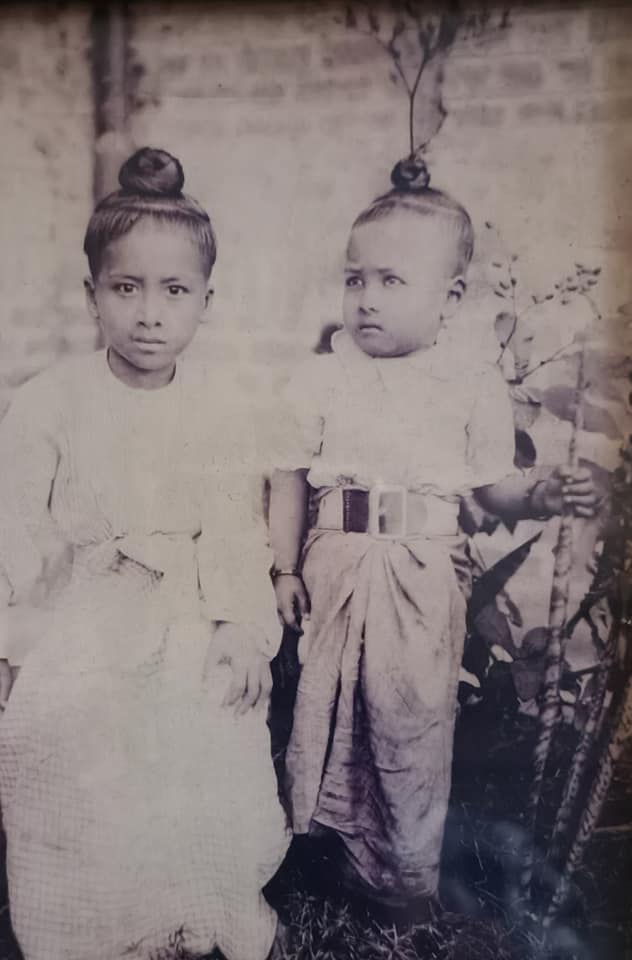
  • Dr. Ohn Pe and U Khin Maung Gyi

    • The photo was taken around 1913 or 1914.
    • Dr. U Ohn Pe (the elder brother) studied Medicine in India.Medical College was not opened yet in Myanmar in those days.
      Retired as Director of Malaria, Ministry of Health. Awarded “Wunna Kyaw Htin”
    • U Khin Maung Gyi (the younger brother) was 3 or 4 years old. He received BA in 1930. He became BCS (Sr. Branch) in 1950.
      He received BL in 1953.

      He had three daughters. The youngest is Daw Mae Khin Nyunt (Rosie Gyi, ChE71). She posted additional photos in the RU Centennial Facebook pages.
  • Burmese

    The Burmese Alphabet has 33 Eik Khaya (letter or character).

    There are several groups (Wagga) of five letters.
    The first group (known as “Ka” wag [or wagga]) consists of က Ka / Ka gyi, Kha / Kha Gway, Ga / Ga Nge, Ga / Ga Gyi and Nga.
    Linguists and phonologists have explained how and why they are grouped.

    The 3rd and 4th members of a group have the same sound.

    There are some basic rules for “Pa Sint ပတ်ဆင့် where one letter is placed on top of the other).
    A rule says “Eik Khaya Tu, Wag Tu Sint”. It means the two letters forming a “Pa Sint” must be the same (အက္ခရာတူ) or from the same group (ဝဂ်တူ). So, it is a “No No” to have a က Ka on top of Sa.
    Another rule says, “Even for letters within a group, the ordering must be preserved”. So, က Ka can be put on top of Kha, but not the other way. Also,Ga Nge can be put on top of Ga Gyi, but not the other way.

    A language has two forms : Oral form (e.g. Myanmar Saga) and Written form (e.g. Myanmar Sar).

    is used as a ဗျည်း Byee (Consonant) and sometimes as a သရ Thara (Vowel).

    A Burmese word can be formed with a Byee and one or more Thara.

    When the Burmese Keyboard was implemented for a typewriter (e.g. Olympia), the keys are labeled Red (keys that prevent the shifting of the carriage to type Thara) and Black (keys that signal the completion of the word and allows the carriage to advance).

    The early Burmese word processing systems use (a) transliteration (e.g. on Mac) (b) Thara before Byee (as in the typewriter) (c) Byee followed by Thara (which requires processing to delimit the words and to have a canonical ordering for representation).

    The rush to implement Burmese type faces and type fonts without consensus led to the incompatibility issues in the current computer systems, smart phones and devices.

  • U Pe Maung Tin

    Sayagyi U Pe Maung Tin was Professor of Pali and Burmese. He proposed to have Burmese as a separate department. His students include

    • ICS U Sein Tin (Theikpan Maung Wa)
    • U Thein Han (Zawgyi)
    • U Wun (Minthuwun) 

    Myanmar Sar Mi Thar Su had unveiled Sayagyi’s bust in the RU Main Campus.

    He also served Principal of Rangoon College.

    Two Sermons

    U Tha Win requested Sayagyi to translate into English the two sermons that Buddha gave to his five disciples at the Deer Sanctuary.

    • Dhammacakkapavattna Sutta is the first sermon delivered to the five disciples.
    • Anatta Lekhanna Sutta is the follow up sermon given to the five disciples.

    Note : Hemanwunta Sutta given to a celestial is considered as Buddha’s second sermon.

    Saya U Aung Zaw (UCC) sent me an early version of the book. It has three columns :

    • Pali
    • Burmese
    • English (translated by Sayagyi).

    Dr. Kyaw Tint (Science Scholar for Physicshas an old worn-out copy of the book. He had typed a few verses and posted on his time line. Hope some reader has a good copy that is easy to scan.

  • Examination Systems

    Intermediate College

    • During a period, students at the University of Rangoon [and Mandalay] attended Intermediate (A) classes for a year, but they did not have to take the examination.
    • They then attended Intermediate (B) classes for a year. They then take the examination for both courses.

    Compart System

    • There used to be two examinations for a class.
      The students have two chances to pass.
    • The first examination was usually held in March.
      Those who pass all subjects are eligible to apply for stipends and grants.
    • Those who pass at least three subjects have to take the remaining subjects in the second examination, which was usually held in June.

    Saya U Ba Toke

    • Saya was born in December, 1920.
    • He attended Mandalay University.
    • He joined the Students’ Strike Camp, and missed the first examination held in March.
    • The strike ended, and Saya took all the subjects in the second examination and passed.
    • He wanted to attend the Faculty of Engineering in Rangoon, but he needed a stipend. He could not get the stipend because he did not take the first examination.
    • Saya’s teachers persuaded him to take Mathematics Honors in Mandalay.

    Dr. Tint Lwin

    • He took the Pure Science option for I.Sc.
    • He attended engineering classes for a while, but he changed his mind to study Medicine.
    • He took the classes needed to study medicine (e.g. Biology) and the supplementary exams.
    • Finally, he was admitted to the MBBS classes.
    • During his university days, he was a University Goalkeeper. He played with Collegian Nay Win, Tun Kyi and Kenneth Shein.
    • After retirement, he moved to the USA.
  • Education Systems

    • A US professor was startled when a Burmese student proudly claimed that he had all-round Ds (for distinctions) back in Burma. In USA schools, “D” means grade 1 (lowest), and “A” means grade 4 (highest).
    • In the initial stages of the new education system, a student must have at least 75% attendance; otherwise one cannot take the examinations.
    • Getting a grade 1 in any subject means failing the whole examination.
    • To pass the examination, each paper must have at least a grade 2, and the average grade must be at least 2.5.
    • Some professors are not keen on making too many moderation.
      Some students got penalized for “not taking minor subjects seriously”.
    • In ’64, there were three intakes.
    • About 500 students were admitted to the first ever 1st B.E. Also, their admission was based not on total marks, but on the controversial ILA (Intelligence Level Aggregate), using the “distribution curve” for each subject.
    • About 320 students were admitted to the first ever 2nd B.E.
    • About 200 students were admitted to the first ever 3rd. B.E.
      Saya U Myo Myint Sein (A) would say that Saya Sai Yee Laik (A 68) stood “first and last in his class”.
    • In the “newer” education system, a student needs 5 years to get a B.E.
      One gets an AGTI after the first two years, and a B.Tech after another two years.
    • The terms “old” and “new” are relative.
    • We took the last ever 7th std Government exam in 1960.
    • The “new” system had 8th std Government exam.
    • We took the first ever High School Final /HSF only (9th std Government exam) in March ’62 with the security forces patrolling the city.
      The exam results were annulled, and we were asked to take another exam a few months later.
    • In the “old” system, the students take the HSF & Matriculation combined exam.
    • We took the first ever Matriculation only (10th std Government exam) in May ’63.
    • Consequently, those who were one year senior to us in High School graduated two (or even 2.5) years ahead of us.
    • In an “old, old” system [following second world war], anyone who is confident can [take “jump promotions’ and] take the HSF & Matriculation exam.
    • When Rangoon University reopened in 1946, three siblings Dr. Pe Nyun, Dr. Pe Thein and their sister — joined entered the University together.
    • The “old” Rangoon University allowed “compartmental” system.
      One needs to re-sit only the subjects that one failed (in the first exam – usually in March) in the “supplementary” exam – usually in June.
      Note however that those who apply for scholarships/stipends must pass all subjects in the first exam.
    • Sayagyi U Ba Toke did not take the first exam because he was in a college strike camp.
      He was the sole student to take and pass all subjects in the supplementary exam, but without access to scholarship/stipend and with persuasion from the Mathematics teachers, he struck off the choice of becoming an engineer.
      For details, read the book by Saya Dr. Khin Maung Swe (“Maung Thinchar”, GBNF).
  • Chinlon

    RIT won the Inter-Institute Chinlon Championship in the 60s.

    • U Tin Shein (M69)
    • Dr. Htin Aung (C69)
    • U Soe Tint (64 Intake)
    • U Myint Than (M71)
    • Uzin Chan Min (B.Com)
  • 1960 B.O.C College of Engineering Students

    သံလျင် မှာ Training ဆင်းခဲ့

    • 1962 နဲ့ 1963 မှာ B.Sc. (Engg) ဘွဲ့ ရ ကြ
    • Credit ပုံပေးပို့သူ — ဦးမြင့်သိန်းလွင် (M62)

    General အထွေထွေ

    • ဥပစာသိပ္ပံ နှစ်နှစ် အောင်ပြီး မှ
      အင်ဂျင်နီယာသင်တန်း လေးနှစ် တက်ရ။

    Classes သင်တန်းများ

    • I.Sc(A)
    • I..Sc(B)
    • 1st year Engg
    • 2nd year Engg,
    • 3rd year Engg
    • Final year Engg
  • Sama Duwa Sin Wa Naung

    Sama Duwa


    1962


    President Elect


    တော်လှန်ရေးကောင်စီ ကောင်းမှုကြောင့် သမတ မဖြစ် Did not become President due to the Coup d’etat


    Presidents of the Union of Burma သမတ များ

    စဝ်ရွှေသိုက် San Shwe Thaik

    ဒေါက်တာဘဦး Dr. Ba U

    မန်းဝင်းမောင် Mahn Win Maung