by Hla Min
Updated : May 2026
From U Tin Aung Lwin
- Collection of articles
- သင်္ချာပညာပေး
- Thanks. The postage is much more than the sales price of the book.

by Hla Min
Updated : May 2026

by Hla Min
Updated : May 2026


by Hla Min
Updated : May 2026

Three rounds of Demonetization, mismanagement, … saw a huge decline in the value of the Kyat.
Snap shots of the exchange rate :

by Hla Min
Updated : May 2026

by Hla Min
Updated : May 2026


by Hla Min
Updated : May 2026

ပြဇာတ် — ဦးနု
by Hla Min
Updated : May 2026

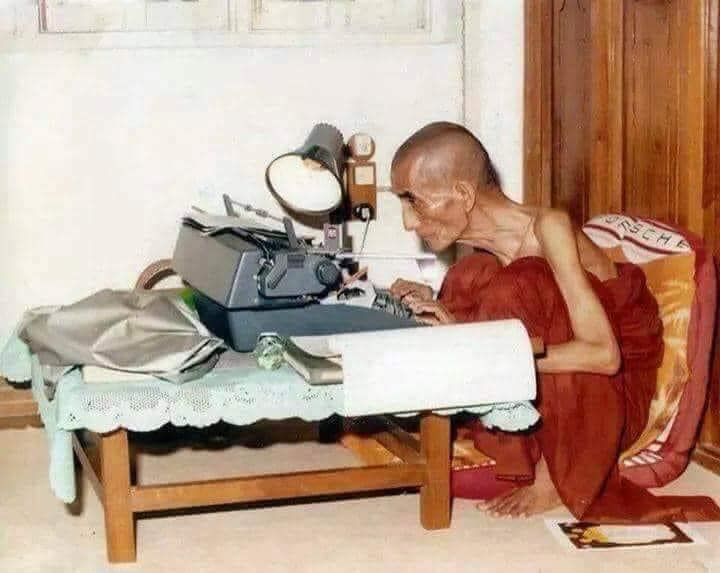
Olympia was commissioned to produce typewriters for Burmese. It was not trivial to type Burmese and Pali characters. The red keys were used to type vowels; the carriage did not go forward. The black keys were used to type consonants. Back-spacing for half a step was necessary on the Standard Edition to type characters such as “tha gyee”. Manual dexterity was needed to type some “pa sint” characters. The Office edition had extra keys (e.g. tha gyee, common pa sint).
Before the wide spread use of copiers (initiated by Xerox), special care is needed to print multiple copies. We miss the days when we had type perfectly or reasonably well on typewriters using messy carbons. Also, planning to cyclostyle double-sided printing (odd numbered pages first, then repeat with even-numbered pages).
IBM produced Selectric typewriters. “Golf” ball-like character sets had to be installed/replaced.
Wang computers provided word processors for various languages. Ko Htay Aung (Victor, EC80) worked at Wang for a while on the Burmese language project.
The evolution has seen
Chinese characters are used by Chinese, Japanese, Korean. To input them to a computer, various techniques were used. They include (1) large tablets containing the most common characters (2) three corner method (based on the horizontal, vertical and diagonal strokes in the character (3) Romaji (mostly used by Japanese (4) human user to select if there are ambiguities (e.g. in the three corner method).
Burma Research Society (BRS) used transliteration for its journals. For example, “k-o-l” combination represents “ko”. The scheme was used inputting Burmese on Macintosh.
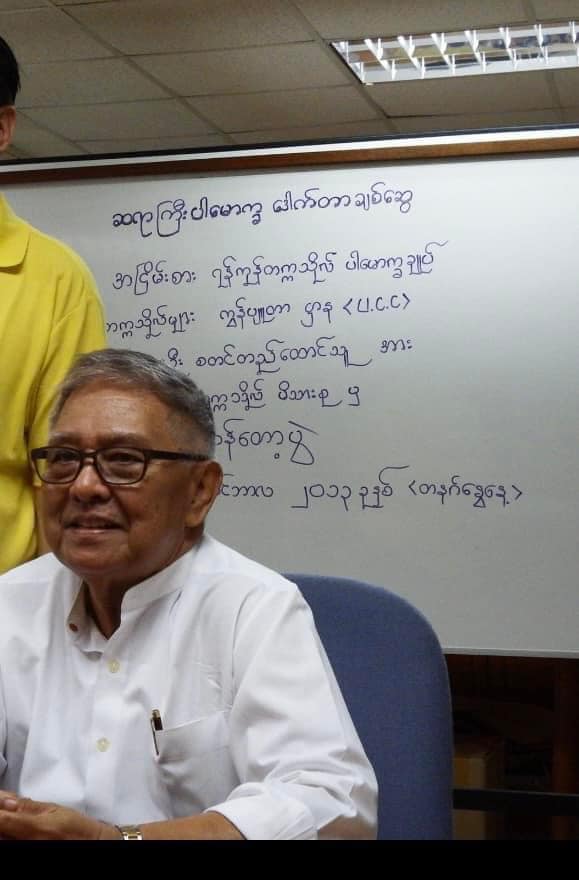
Universities’ Computer Center (UCC) had projects to do Burmese word processing. Saya U Myo Min supervised a project for Ma San Yu Hlaing for “collation” (needed for sorting). Saya U Tun Aung Gyaw and his team (Ko Htay Aung, Ko Soe Myint, …) worked on Cromenco System Three for printing and processing. U Soe Win and team worked on Calcomp graph plotter.
Myanmar Sar Ah Phwe မြန်မာစာအဖွဲ့ Burmese Language Commission) bowed to higher authorities to revise the spelling at least two times.
Fines were imposed on authors and publishers spelling the established way. (e.g. “Ta” တ) instead of the preferred way (e.g. “Tit” တစ်) despite the scholars pointing out the old inscriptions at “Bo ta htaung ဗိုလ်တထောင်” not “Bo tit htaung” pagoda.
CTK (Children’s Treasury of Knowledge) project was delayed to correct the spellings.
It was not easy to write in those days without facing censorship. It was taboo to quote “Dhammata ဓမ္မတာ” poem (by Ananda Thuriya). It was a crime to mention the “setting sun နေ ဝင်”.
by Hla Min
Updated : May 2026


by Hla Min
Updated : May 2026


Friday (18 September) will be the 66th anniversary of the assassination of U Tin Tut, ICS. He was mortally wounded when a bomb exploded in his car on Sparks Street (now Bo Aung Kyaw Street). He died shortly after in Rangoon General Hospital. The mystery of who killed U Tin Tut has never been solved. His death changed the course of Burmese history.
U Tin Tut was educated at Dulwich and Queen’s College, Cambridge. He was a top scholar and athlete (captaining his college rugby team) and the first Burmese admitted into the elite Indian Civil Service. After World War Two, he was the only Burmese fluent in both financial and constitutional affairs and widely seen as the most brilliant Burmese of his generation.
He was in many ways U Aung San’s principal deputy and a key figure at both the January 1947 London negotiations and at Panglong. He was seriously injured on 19 July 1947 when U Aung San and the others were killed.
He was Burma’s first foreign minister but resigned during the increasingly chaotic and violent days of mid-1948 to become the Inspector General (i.e. commander) of the new Union Auxiliary Force, meant to counter the communists and other ‘Leftists’.
He was a nationalist but not a socialist, and wanted to maintain good relations with the West. The more radical factions in Burmese politics and in the Burma Army saw him as a threat.
by Hla Min
Updated : Apr 2026