Category: Burma

  • Pioneers

    Sayagyis

    • U Pe Maung Tin
      First native Principal of Rangoon College
    • Dr. Htin Aung
      First native Rector of University of Rangoon
    • U Ba Hli
      First native Dean of Engineering, University of Rangoon
    • Dr. Mya Tu
      Founder/Director of Burma Medical Research Institute
    • Dr. Chit Swe
      Founder/Director of UCC

    Early Burmese Scholars in the UK

    • Dr. Hla Myint
      Economics
    • Dr. Tha Hla
      Geology
    • Dr. Maung Maung Kha
      Meteorological Physics

    Recipients of the Twinning Program

    • Dr. Aung Gyi
      BS, MS from MIT
    • U Min Wun
      BS from MIT, MS from Cornell
    • U Maung Maung Than
      BS from Clemson, MS from Lowell
    • U Khin Aung Kyi
      BS, MS from MIT
    • U Aung Khin
      BS, MS from Lehigh
    • U Sein Hlaing
      MS from MIT
    • U Tin Swe
      MS from Michigan
    • U Sein Win
      BS, MS from Michigan

    Founders of Khit San Sar Pay

    • Theikpan Maung Wa
      ICS U Sein Tin
    • Zawgyi
      U Thein Han
    • Minthuwun
      U Wun

    There were the early students at the then newly established “Burmese Department” at the University of Rangoon (per request of Sayagyi U Pe Maung Tin, Pali and Burmese Scholar).

    Founders of UCC

    • Dr. Chit Swe
      Founder Director
    • U Soe Paing
    • U Myo Min
    • U Ko Ko Lay

    Sayadaws

    Early Burmese Sayadaws in the UK

    • U Thithila
    • Dr. Rewata Dhamma

    Early Burmese Sayadaws in the USA

    • U Silanandabhivamsa
      Dhammananda Vihara, Northern California
    • Penang Sayadaw
      Southern California
    • U Kelasa
      East Coast

    Early Non-Burmese Sayadaws in Burma

    • U Lokanatha
      Former Chemist in the USA
      Italian Buddhist Monk
    • Ashin Ananda
      Formerly Reverend F. Lustig
      Buddhist Archbishop of Latvia
  • Cost of Living

    In our days at RIT and some time after graduation

    School fees

    • 15 kyats per month
    • Paid 30 kyats every two months

    Collegiate Scholarship and Stipend

    • 75 kyats per month
    • Net 60 kyats after paying the school fees

    Remuneration

    • Poem 15 kyats
    • Article 15 kyats
    • Translation of short story (a) 50 kyats to the translator (b) 50 kyats to the author
    • Artist 50 kyats for doing the background

    Bus fare

    • 10 to 15 pyas (for short and medium distances)
    • 30 pyas (whole route)

    Mohinga

    • 15 pyas (without ah kyaw)
    • 25 pyas (with ah kyaw)

    Bananas

    • 15 pyas for one banana
    • 25 pyas for two bananas

    Meal

    • 50 pyas for a plate of rice
    • K 1.50 – 2 kyats (with Hin)
  • Typing, Transliteration, Word Processing and Publication

    Typing

    Typewriters

    • Remington typewriters were used for typing English text.
    • Olympia was commissioned to produce typewriters for Burmese.
    • Versions : Office, Standard and Portable
    • Red keys were used to type vowels; the carriage did not go forward.
    • Black keys were used to type consonants.
    • Back-spacing for half a step was necessary on the Standard version to type “tha gyee”.
    • Manual dexterity was needed to type “pa sint” characters.
    • The Office edition had extra keys.
    • IBM produced Selectric typewriters.
    • Golf ball-like character sets had to be installed/replaced.

    Challenges

    • In the early days we had to type perfectly or reasonably well on typewriters using messy carbons.
    • For mass copies, we had to plan to cyclostyle double-sided printing
      (odd numbered pages first, then repeat with even-numbered pages).

    Transliteration

    • Burma Research Society (BRS) used transliteration for its publications.
      For example, “k-o-l” combination represents “ko”.
    • The scheme was used for typing Burmese words on Macintosh.

    Word Processing

    Word Processor

    • Wang Computers provided word processors for various languages.
      Ko Htay Aung (Victor, EC80) worked at Wang for a while on the “Burmese” language project.
    • Chinese characters were input on the early systems using
      (1) Large tablets
      (2) Three corner method
      (3) Romaji

    UCC Projects

    • UCC had Burmese word processing projects.
    • Saya U Myo Min supervised a project for Ma San Yu Hlaing for collation / sorting.
    • Saya U Tun Aung Gyaw and his team (Ko Htay Aung, Ko Soe Myint, …) worked on Cromenco System Three for printing and processing.
    • U Soe Win and team worked on Calcomp graph plotter.

    Evolution

    • The evolution has seen various type face/font families, keyboard layouts, Unicode support, …
    • The transition from old fonts (e.g. Zawgyi) to Unicode-compliant fonts is not smooth.

    Publication

    Spelling Issues

    • Burmese Language Commission bowed to higher authorities to revise the spelling at least two times.
    • Fines were imposed on authors and publishers spelling the established way. (e.g. “ta”) instead of the preferred way (e.g. “tit”) despite the scholars pointing out the old inscriptions at “Bo ta htaung” (not “Bo tit htaung”) pagoda.
    • Children’s Treasury of Knowledge (CTK) project was delayed — after the initial type setting — to correct the spellings.

    Censorship

    • It was not easy to write in those days without facing censorship.
    • It was taboo to quote “Dhammata” poem (by Ananda Thuriya).
    • It was a crime to write about the “setting sun”.
  • U Ba Khin

    Background

    • In pre-war days, U Ba Khin attended SPHS and stood First in Burma.
    • After Independence, he became the first native Auditor General.
    • He also managed three other Directorates.

    Vipassana

    • Dhamma descendant of the Ledi Sayadaw and Saya Thet
    • Mentor of Saya S. N. Goenka.

    Books

    • Received two books about Sayagyi U Ba Khin.
    • One has Sayagyi’s photo on the cover.
    • The other is a Dhamma Dana reprint.
    • Saya U Ko Lay (Zeyar Maung, former Vice-Chancellor of Mandalay University) compiled and translated Sayagyi’s dhamma talks.
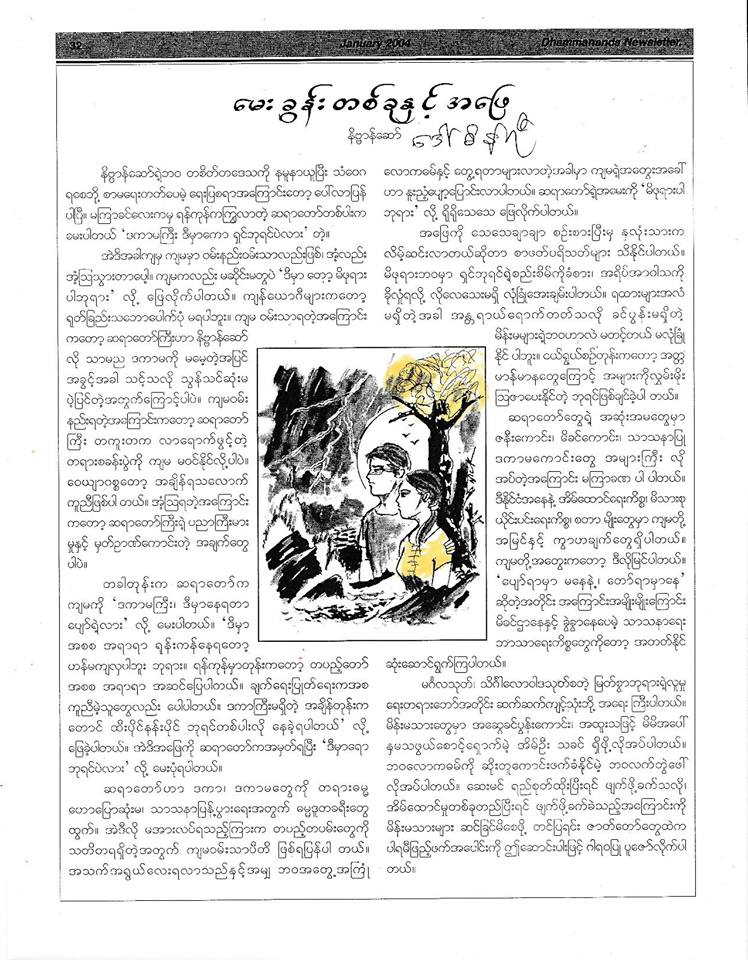
  • Neikban Zaw (3)

    • The article “A Question and Answer” was published in the Dhammananda Newsletter many years ago.
    • “Neik Ban Zaw” is the pen name of my beloved spouse.
    Article by Neik Ban Zaw

  • Typing, Spelling and Word processing

    Burmese Typewriter

    Olympia was commissioned to produce typewriters for Burmese.
    Red keys were used to type vowels; the carriage did not go forward. Black keys were used to type consonants.
    Back-spacing for half a step was necessary on the portable version to type tha gyee. Manual dexterity was needed to type some pa sint characters.
    The office version edition had extra keys (e.g. tha gyee).

    Character Sets

    The early computers mostly used ASCII and EBCDIC.
    It took some time to support other character sets.
    The evolution has seen various type face/font families, keyboard layouts, Unicode support, …

    IBM produced Selectric typewriters.
    Golf ball-like character sets had to be installed/replaced.

    Wang Computers provided word processors for various languages.
    Ko Htay Aung worked at Wang for a while on the “Burmese” language project.

    Chinese characters were input using (1) large tablets (2) three corner method (3) Romaji

    Techniques

    Burma Research Society (BRS) used transliteration for its publications. For example, “k-o-l” combination represents “ko”. The scheme was used on Macintosh.

    Universities’ Computer Center (UCC) had projects to do Burmese word processing. Saya U Myo Min supervised a project for Ma San Yu Hlaing for “collation” (needed for sorting). Saya U Tun Aung Gyaw and his team (Ko Htay Aung, Ko Soe Myint, …) worked on Cromenco System Three for printing and processing. U Soe Win and team worked on Calcomp graph plotters.

    We miss the days when we had type perfectly or reasonably well on typewriters using messy carbons.
    Also, planning to cyclostyle double-sided printing (odd numbered pages first, then repeat with even-numbered pages).

    Spelling

    Burmese Language Commission bowed to higher authorities to revise the spelling at least two times.
    Fines were imposed on authors and publishers spelling the established way. (e.g. “ta“) instead of the preferred way (e.g. “tit”) despite the scholars pointing out the old inscriptions at “bo ta htaung” (not “bo tit htaung”) pagoda.
    CTK (Children’s Treasury of Knowledge) project was “delayed” to “correct” the spellings.

    Censorship

    It was not easy to write in those days without facing censorship.
    It was taboo to quote “Dhammata” poem (by Ananda Thuriya).
    It was a crime to mention the “setting sun.

  • Adeikhtan

    Adeikhtan is rendered as Determination. It is a commitment to do something as planned. One needs resolve.

    New Year Resolution is a form of Adeikhtan, but many do not seriously follow it.

    A time-bounded Adeikhtan is easier to fulfill. At some meditation retreats, one pledges to practice mindfulness for the period (e.g. one hour).

    According to the Buddhist Chronicles, the Bodhisatta (Buddha to be) made an Adeikhtan to meditate under the Bodhi Tree until he became Enlightened.

    Examples of Determination

    • Try a new task every day for a specified period
    • Learn a new language every year
    • [Hard] master four languages in a year by living and studying with native speakers
    • Visit a number of places (e.g. countries) within a specified period
  • Bedin / Burmese Astrology

    ဗေဒင်

    Some claim that Bedin is a pseudo-science.

    My father’s experience

    My father sent his assistant to Dat Pone Zon Aung Min Gaung ဓာတ်ပေါင်းစုံအောင်မင်းခေါင် Pagoda to see a Bedin Saya (who was visiting the Pagoda).
    The assistant showed the Bedin Saya a zartar ဇာတာ (Natal horoscope) of my father.
    The Bedin Saya said, “The spouse of the Zartar’s owner is pregnant. She will give birth to a boy on a specified day of week. The boy will be known for his Pyin Nar Ye.” The assistant was surprised. He did not know that my mother was pregnant at that time.
    Was it an educated guess? Or a random prediction?

    Probability and Statistics give

    • a low probability in guessing if someone is pregnant (without a medical test)
    • a 50 – 50 chance on guessing the gender correctly
    • one in seven chance on guessing the Day of Week correctly
    • a low probability in guessing one’s strength and occupation correctly.

    Despite the long odds, the prediction was correct on all counts.

  • 1968 Electrical Engineering

    1968 လျှပ်စစ်အင်ဂျင်နီယာ ကျောင်းသား များ

    ** EP : Electrical Power စွမ်းအား

    ** EC : Electrical Communication ဆက်သွယ်ရေး

    ** xxx : အမည်သိရင် ဖြည့်​ပေးပါ

    ရှေ့တန်း Front Row

    * ကိုအောင်ပန်: (EC)၊ ကိုစိုးမြင့်လွင် (EP, ကွယ်)၊ ဆရာဦးစိန်ဝင်း (ကွယ်)၊ မမြမြသန်း (ကွယ်)၊ ဆရာDr. စန်းတင့် (ကွယ်)၊ ကိုအောင်ခင် (EP)၊ xxx

    အလယ်တန်း Middle Row

    * ကိုမြင့်ဝင်း (EC, ကွယ်)၊ xxx၊ ကိုသန်းထွန်း (EP)၊ ကိုစောဝင်း (EP, ကွယ်)၊ ကိုတင်ထွန်း (EP)၊ Surinder Singh (EP), Bishnu Shahi (EP)၊ ကို​မောင်ထွန်း (EP)

    နောက်တန်း Back Row

    * xxx၊ ကိုခင်မောင်လတ် (EP)၊ ကိုစန်းမြင့် (EC)၊ ကိုမျို:မြင့် (EC)၊ ကိုအုန်းမြင့် (EP)၊ ကိုနေအောင် (EP)၊ ကိုကျော်စိုး (EC, ကွယ်)

    Absentee

    * ကိုမင်းမောင် (EP)၊ ကိုမြတ်မောင် (EP)၊ ကိုထွန်းအောင် (EC, ကွယ်)