For protection against and getting free from sickness and disease
Reference the three occasions when Venerable Mogallana, Venerable Kassapa, and Lord Buddha felt sick but were cured after listening to and contemplating on the “Seven factors of Enlightenment”
This is one of the Suttas that is not only for chanting but also for practice
Bojjhanga Suttas (in Pali Prose) in the Scriptures
One of the four Bhamaso Taya or Bhama Vihara (along with Karuna, Mudita, and Uppekha)
Practiced as a form of meditation
U Silananda‘s book on Protective Verses has a section on how to practice Loving Kindness Meditation.
Tipitaka Mingun Sayadawgyi recited the Two Methods of sending Metta. As mentioned in Metta Sutta Alternative: 528 “Metta” (13 x 4 x 12) They can be found on YouTube and CDs.
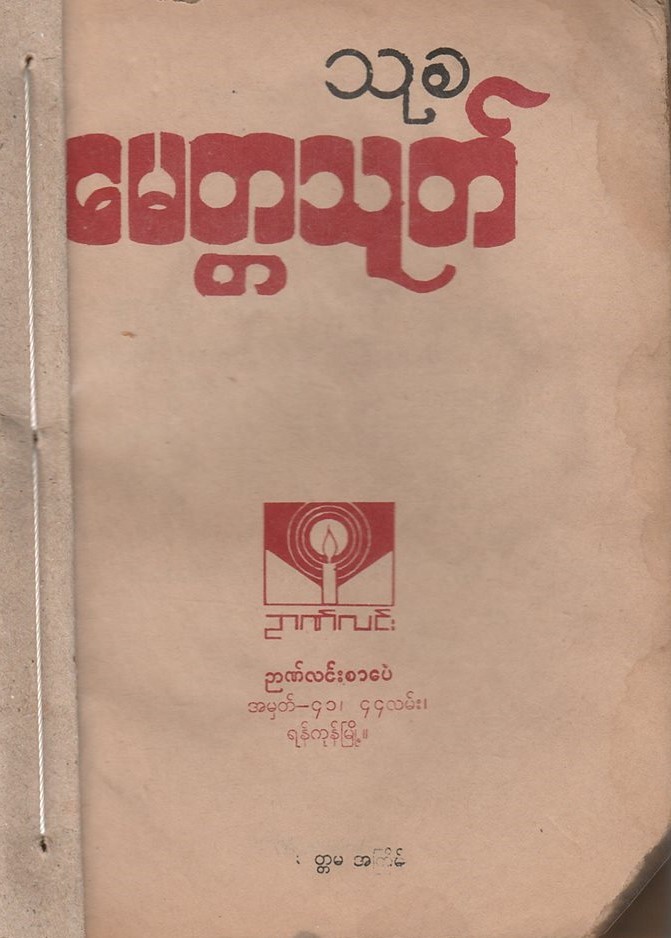
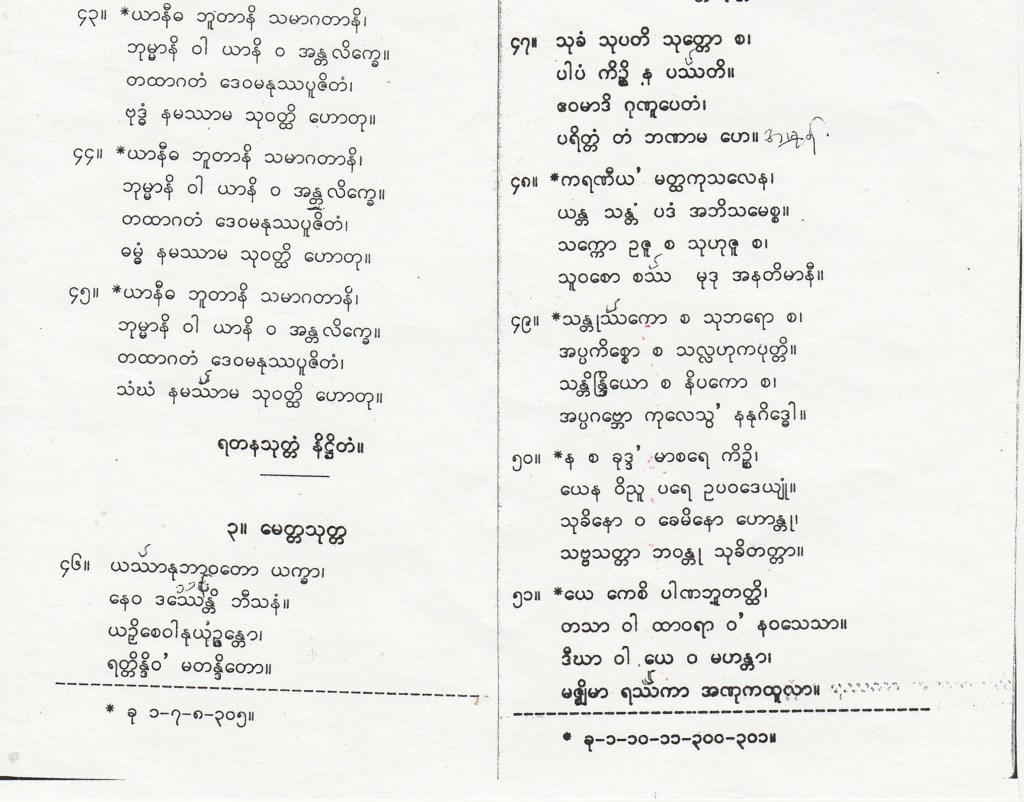
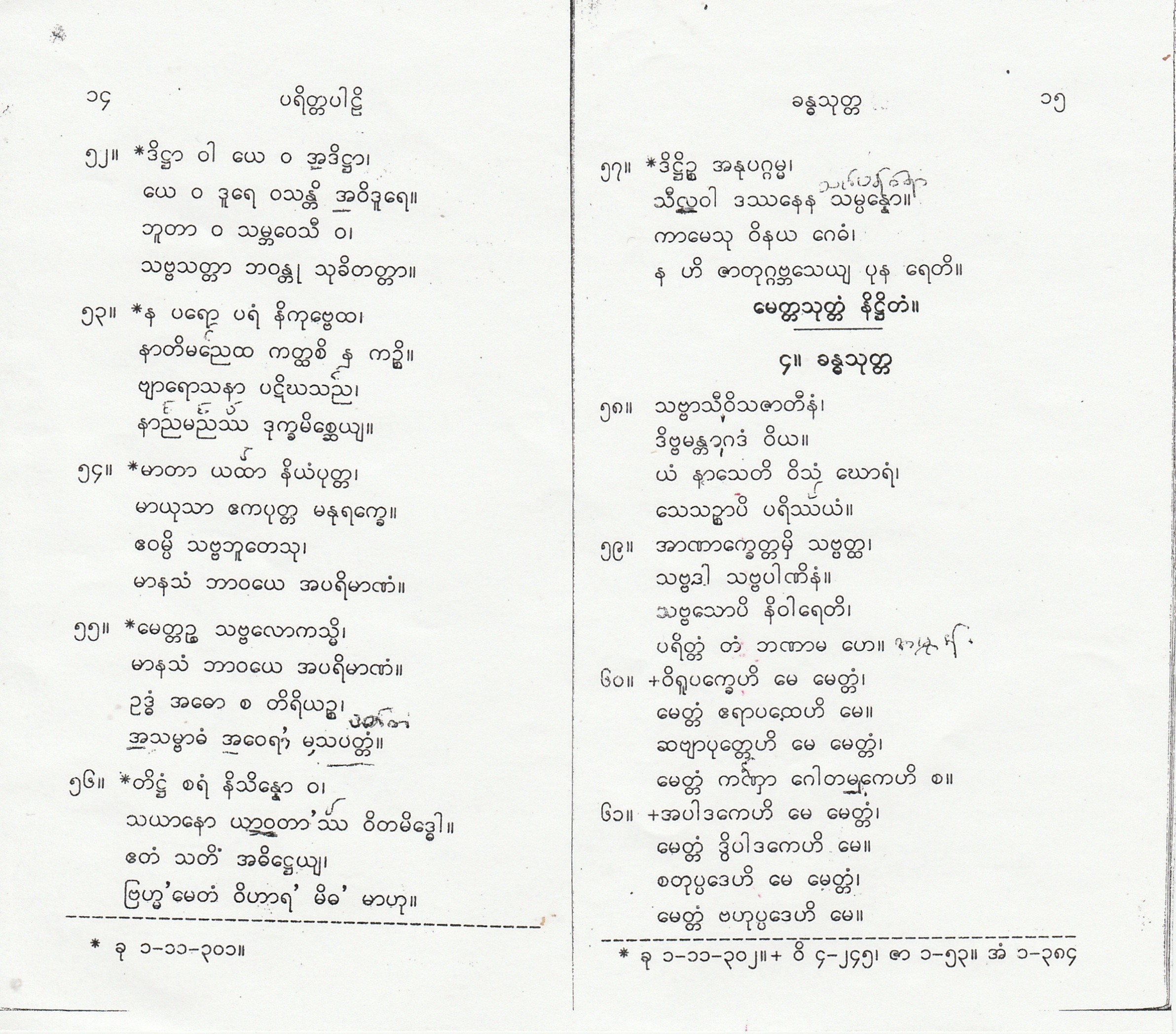
“Metta Sutta” is one of the eleven Suttas in “Paritta Pali” (Protective Verses). Also known as Karaniya Metta Sutta Chanted at most Buddhist ceremonies.
Myitta is covered along with Thitsar (Truth) in Dr. Min Tin Mon‘s book “Myitta and Thitsar“
U Thu Kha wrote a book on Metta Sutta.
U Jotalankara‘s book explains the 528 Metta.
A Physics teacher said, “Myitta So Dar Ah Hlyar Ah Nan Ma Shee Bay Mei Ah Thwar Ah Pyan Shee Bar Thay Dae.”
Metta is also used as a name or part of a name.
Metta is a Myanmar comedian.
Mettananda Vihara is a monastery in Northern California. Moved from Central Avenue, Fremont to Castro Valley.
Metta Vihari is an association that performs Chanting, and also offers food dana at selected gatherings.
Practicing Metta
By Way of LOCATION:
May I be well, happy and peaceful.
May all beings in this house be well, happy and peaceful.
May all beings in this area be well, happy and peaceful.
May all beings in this city be well, happy and peaceful.
May all beings in this country be well, happy and peaceful.
May all beings in this world be well, happy and peaceful.
May all beings in this universe be well, happy and peaceful.
May all beings be well, happy and peaceful.
By Way of PERSONS:
May I be well, happy and peaceful.
May my teachers be well, happy and peaceful.
May my parents be well, happy and peaceful.
May my relatives be well, happy and peaceful.
May my friends be well, happy and peaceful.
May the indifferent persons be well, happy and peaceful.
May the unfriendly persons be well, happy and peaceful.
May all meditators be well, happy and peaceful.
May all beings be well, happy and peaceful.
Metta Sutta
Third sutta in “Paritta Pali”
also referred to as Karaniya Metta Sutta
Desirable qualities of a Practitioner
Loving Kindness Meditation
Formal Translation from Pali into Burmese/Myanmar and English
Informal Books by Saya U Thu Kha and Saya Dr. Mehm Tin Mon
Chanting
Two ways (as per Mingun Tipitaka Sayadawgyi)
Referred in Metta Sutta
528 “Metta” (13 x 4 x 12)
Karuna
Pali term
Rendered as Compassion
One of the four Bhamaso Taya
Buddha is called “The Compassionate One”
Mahayana Buddhists emphasize the importance of Compassion
Sayadaw U Sobhana (GBNF) had four Indonesian siblings as his students. Named one of them Karuna. She was present at Sayadaw’s Last Journey.
U Moe Myint (M76) and several alumni are members of the “Karuna Ah Thinn” in Singapore. One activitiy is to help the needy for the Last Journey of their loved one.
We saw an outpouring of Karuna in the relief efforts for Disaster Recovery (e.g. Cyclone Nargis)
Practicing Karuna
May suffering ones be suffering-free
And the fear-struck fearless be
May the grieving shed all grief
And all beings find relief
Mudita
Pali term.
Rendered as Altruistic Joy or Sympathetic Joy
One of the four Bhamaso Taya
One should feel joyful when one hears good news about others.
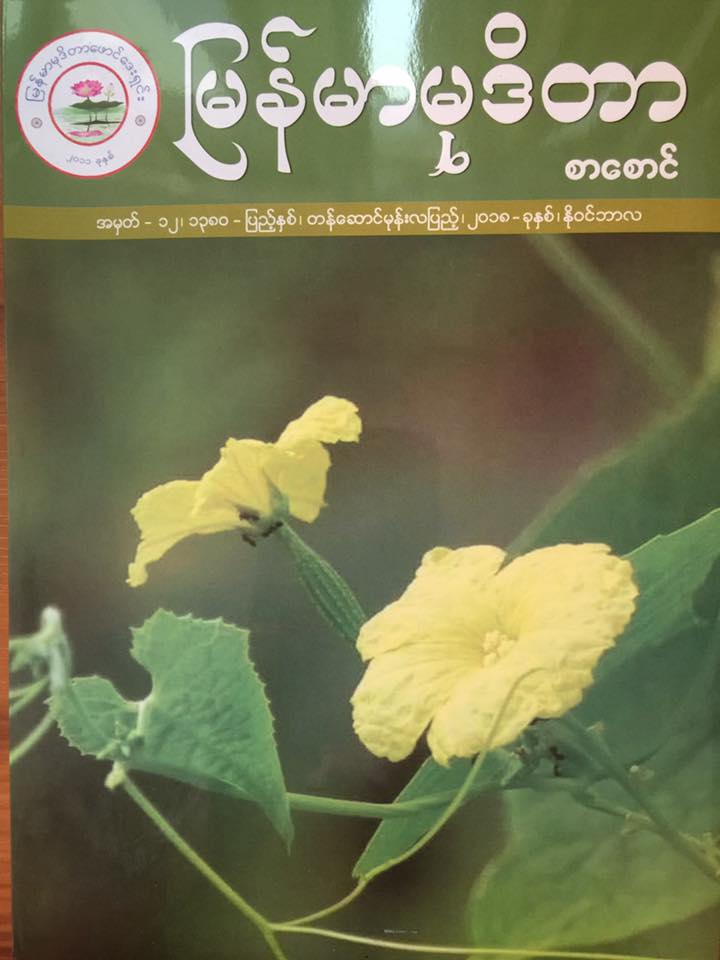
Myanmar Mudita Sar Saung
Saya U Nyunt Htay (Met73) is Chief Editor
Contributor : Tekkatho Moe War (U Moe Aung)
Upekkha
Pali term
Rendered as Neutral [Feeling]
Also translated as Equanimity
One of the four Bhamaso Taya
In a loose usage in Burmese, “Upekkha Shu” means “ignore”. It is not representative of the importance of Upekkha, which provides a balance of life and avoids the two extremes stated in the Dhammacakka Sutta
It is non-trivial to sense Upekkha while practicing Vipassana (Insight) Meditation.
Feelings may be be categorized as
Pleasant Feeling
Unpleasant Feeling
Non-Pleasant and Non-Unpleasant Feeling
Upekkha is synonymous with “Non-Pleasant and Non-Unpleasant Feeling”.
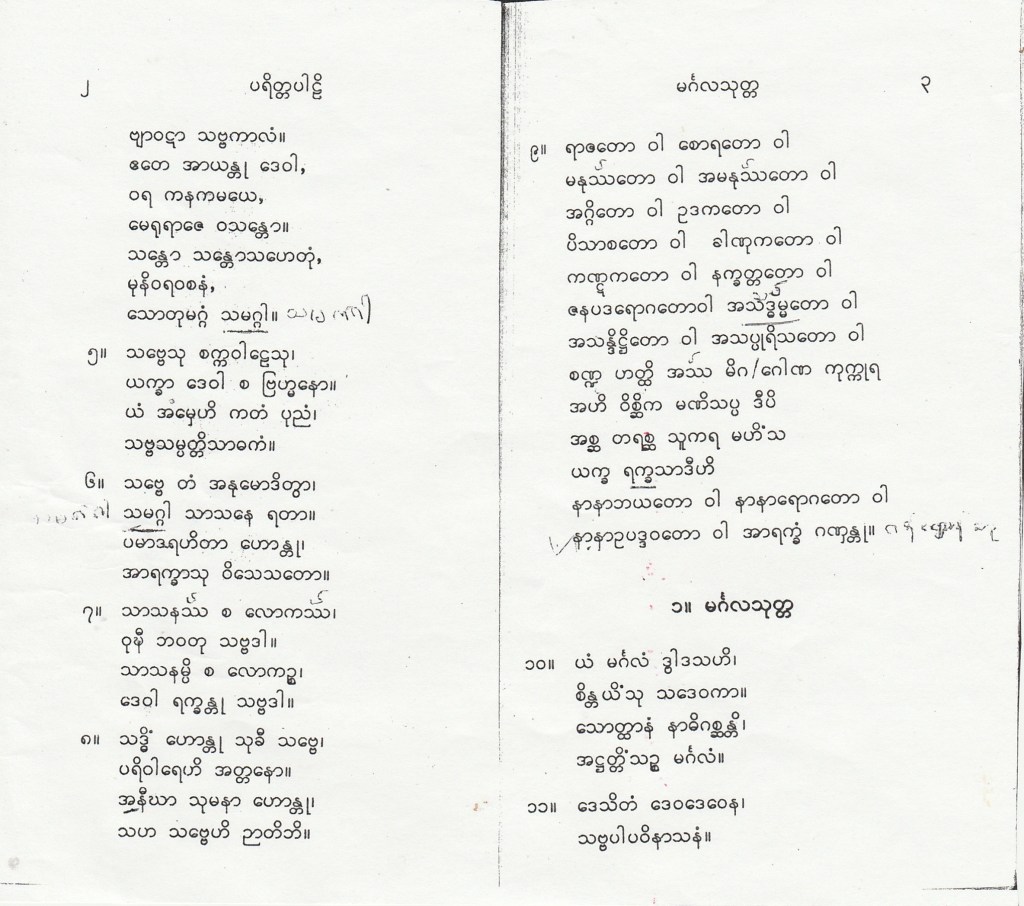
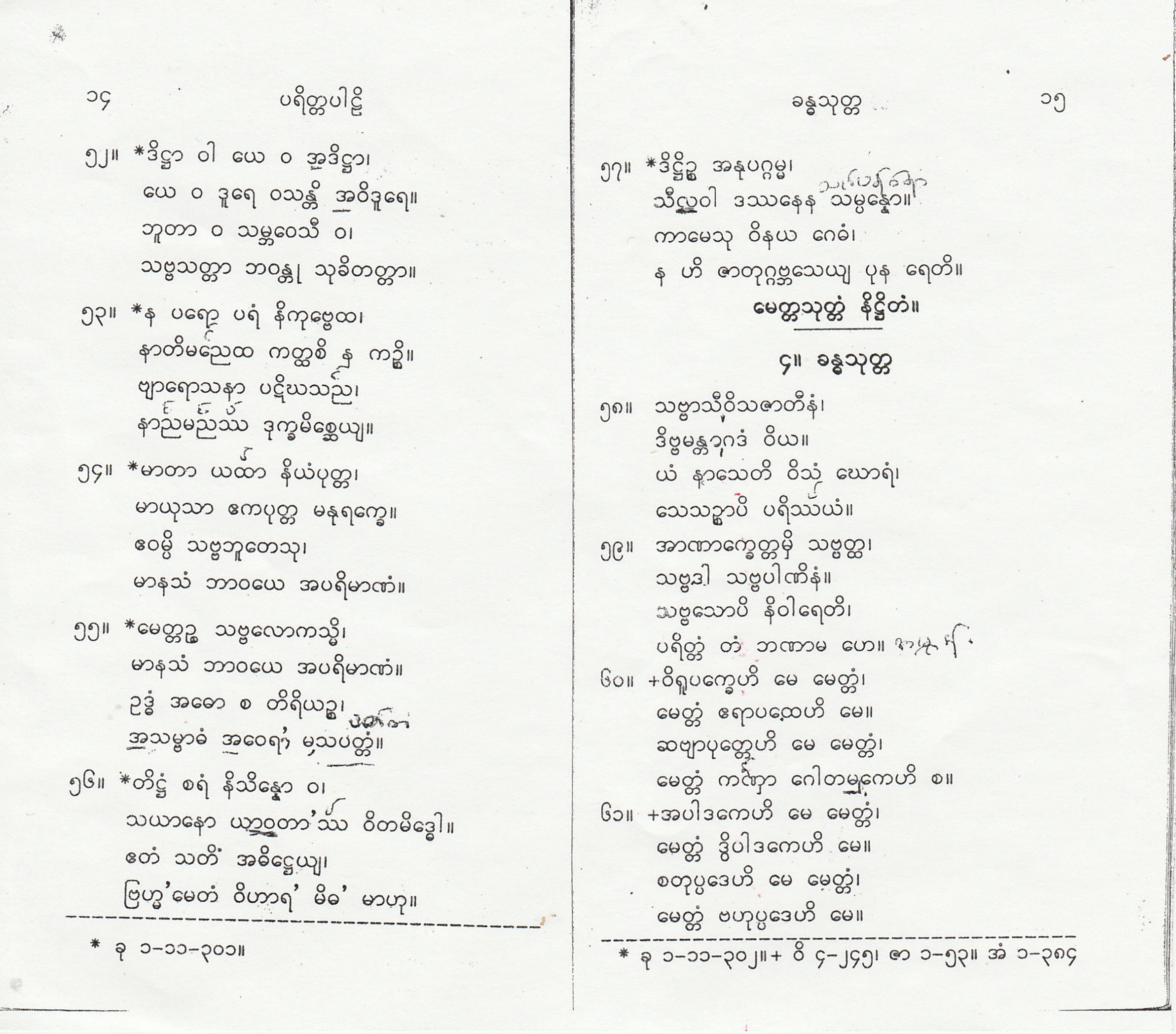
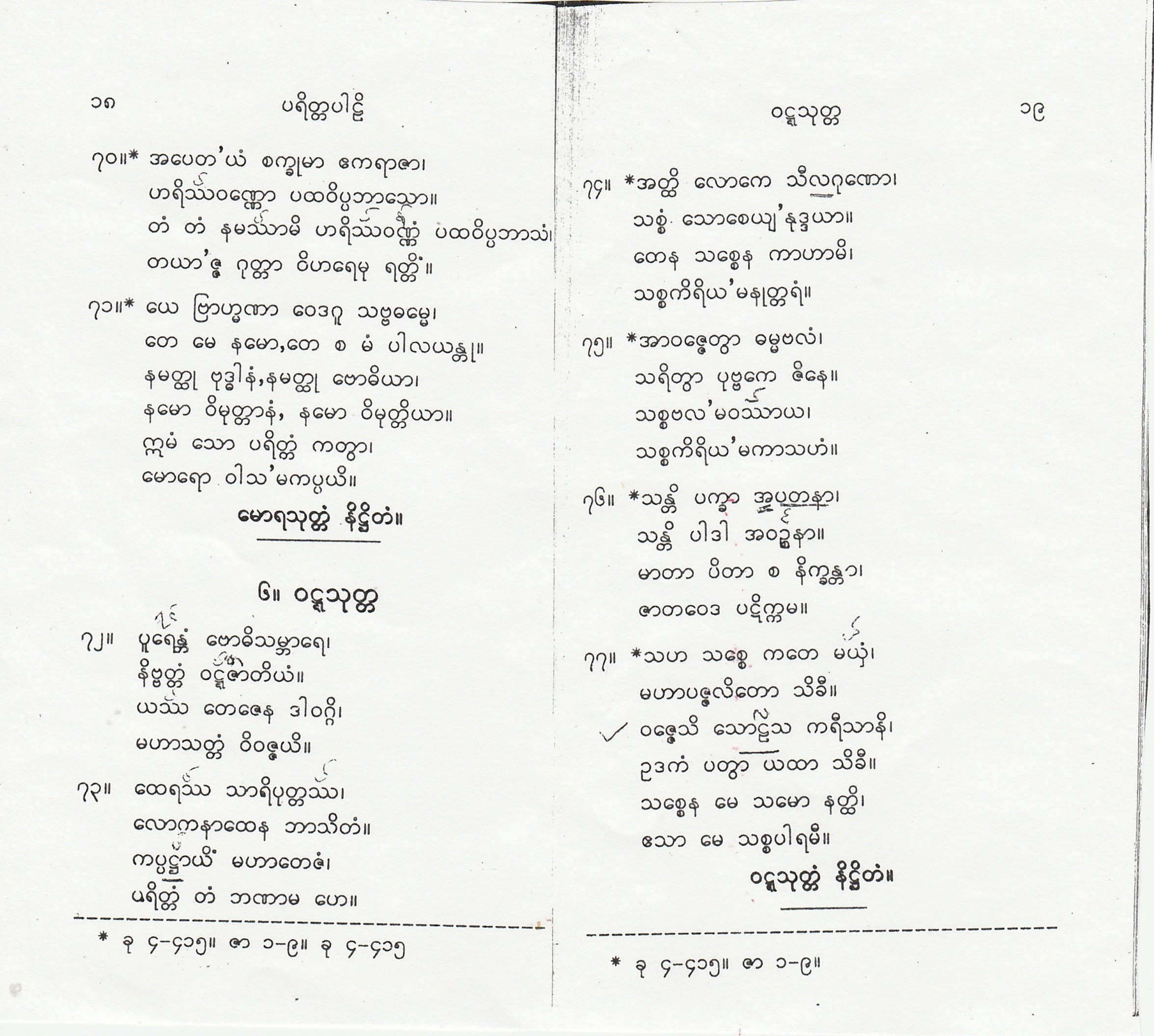
Paritta is usually rendered as “Protective Verse”.
Early Texts
Hanthawaddy and Thudhammawaddy published early Paritta texts edited by Pali experts (e.g. Saya Phyay, U Pan Maung).
Versions
The Ministry of Religious Affairs published the standard version of 11 Pairtta Suttas, and the comprehensive version of 30+ Suttas (including the 11 Paritta Suttas).
The Suttas were approved/re-affirmed at the Sixth Buddhist Council.
Pali and Translation
Paritta texts with Pali and English translation were compiled and /or edited by Sayadaw U Silananda and Sao Htun Hmat Win.
Paritta texts with Pali and Burmese/Myanmar translation were compiled/edited by Sayadaw U Ayethaka, Dhammacariya U Soe Win, and Dhammacariya U Kyaw Lin.
Comprehensive Treatment
Comprehensive treatment of Paritta had been done by Thabyekan Sayadaw, and Sayadaw U Jotilankara.
Mon Version
Used to own a copy of a Pariita (Burmese and Mon version) given by the Dat Paung Zone Aung Min Gaung Sayadaw U Thilawunta.
Based on the Mon manuscripts. One difference is in the “last” Sutta. The Mon version has two major sections: one for chanting in the morning and one for chanting in the evening/night.
Schedule for Recitation
Customary for the Burmese Buddhist monks to recite all the 11 Suttas daily.
A recommendation for the lay people is to break up the 11 Suttas into seven groups, and chant a group per day.
The 11 Suttas will then be covered every week.
Audio
The Paritta verses by the various Sayadaws Mingun Tipitaka Sayadaw, Taung Tan Thatanapyu Sayadaw, U Silananda, Kyar Ni Kan Sayadaw, Aung San Tat Oo Sayadaw, Las Vegas Sayadaw U Zeya) are available as CDs.
Some (if not all) can be found at dhamma web sites such as dhammadownload.com and nibanna.com.
YouTube has a collection of Paritta recited by Myanmar, Sri Lankan, and Thai monks.
Forms of Pali
Pali is rendered in Romanized form (for international use) and in native versions (Myanmar, Sinhali, Thai, …).
Example: Lay people and most monks in Myanmar will say “Git sar mi”. Lay people and most (if not all) monks from Sri Lanka and Thai will say “gacchami”.
Mangala is usually rendered as Auspices or Blessings. Myanmar call it Mingalar
Mangala Sutta describes 38 Blessings, which are related to both Loki (mundane) and Lokotra (supramundane). First of the 11 Suttas covered in Paritta Pali / Protective Verses.
For lay persons
U Thu Kha wrote a book discussing the Mangala Sutta (using lay people’s terms).
At PPBRS, we had to study “Mingalar Kabyar” (poem) by Saya Dagon U Tun Myint. Received a Thermos flask for successfully reciting the Kabyar.
Cartoon U Pe Thein illustrated the 38 Blessings.
Highest Blessing
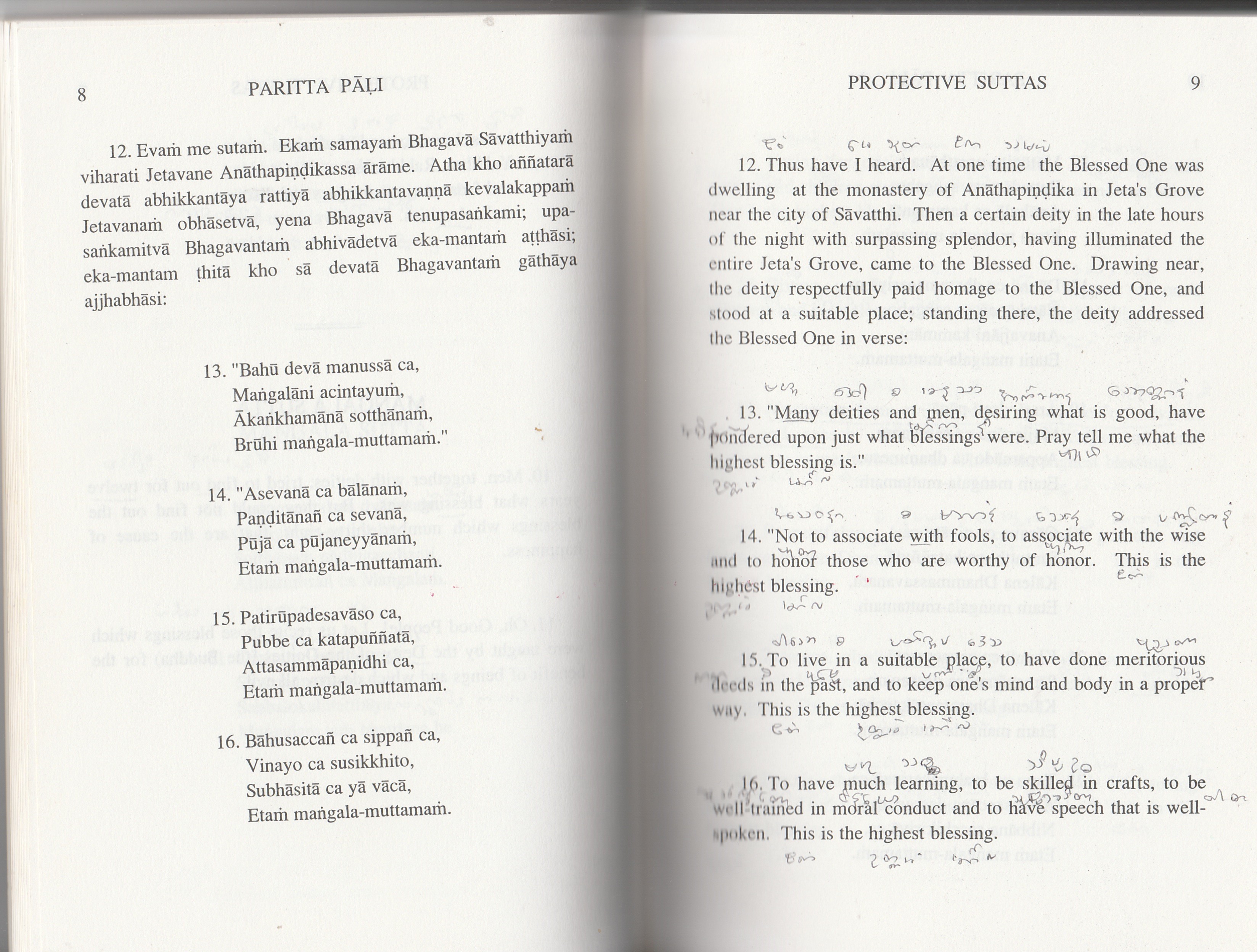
From Paritta Pali and Protective Suttas by Sayadaw U Silananda
Not to associate with fools, to associate with the wise and to honor those who are worth of honor.
To live in a suitable place, to have done meritorious deeds in the past, and to keep one’s mind and body in a proper way.
To have much learning, to be skilled in crafts, to be well-trained in moral conduct and to have speech that is well-spoken.
Caring for one’s mother and father, supporting one’s spouse and children and having work that causes no confusion.
Giving, practice of what is good, support of one’s relatives and blameless actions.
Abstention from evil in mind, abstention from evil in body and speech, abstention from intoxicants and non-negligence in meritorious acts.
Respectfulness, humbleness, contentment, gratitude and listening to the Dhamma on suitable occasions.
Practice that consumes evil states, a noble life, seeing the Noble Truths and realization of Nibbana.
The mind of a person (an Arahant) who is confronted with worldly conditions does not flutter, is sorrowless, stainless and secure.
Having fulfilled such things as these, beings are invincible everywhere and happiness everywhere.
Sayadaw’s name is Silananda. He became Silanandabhivamsa when he passed the Abhivamsa (tough monastic examination in Mandalay to be completed before the age of 26). I will use both names where appropriate.
Trail blazer
In April of 1979, Mahasi Sayadawgi made a Dhamma Duta mission to the US. At the request of the devotees, Sayadawgyi agreed to leave behind Sayadaw U Silanandabhivamsa and Sayadaw U Kelasa as “trail blazers” for the promulgation, preservation, and the promotion of Sasana.
There were no Burmese Buddhist monasteries and/or temples, but the Sayadaws were determined to sacrifice their blissful lives back in their homeland to do whatever they can to
help with the Buddhist rites and rituals
teach theory and practice of Dhamma
encourage core supporters to found “Theravada Buddhist Society of America” [by the middle of 1979]
solicit donations (often going “door-to-door”) from families who want pass on the legacy to their family members
encourage young adults and children to Dhamma Courses and take “Aye-Thet Scholarship Examination”
hold short term and [some] long term meditation retreats (in Zen temple, and churches)
strive to have “Dhammananda Vihara”.
Supporters
The journey was not smooth as indicated by some entries in his “journal”, but well-wishers (including the Khoo family, Dr. Tin Wa and friends, Dr. Maung Maung Chwan and friends, Dr. Julie Han and Executive Committee members who did the fund-raising, Dr. Rina Sircar who offered Sayadaw to be a Lecturer at her University, the Sri Lankan monks who “sponsored” Sayadaw) all shared Sayadaw’s resolve to spread Dhamma in the San Francisco Bay Area and beyond.
Details can be found in the Commemorative Book for Sayadaw U Silanandabhivamsa (1927 – 2005) and the companion DVD set for “Sayadaw’s Final Journey“.
I was fortunate to be asked to be the Master of Ceremony for the Service, which was attended by Sitagu Sayadadaw, Sayadaw Dr. Nandamalabhivamsa and many monks from US, UK, and Burma. I was blessed to be a member and editor for the “Commemorative Book” project.
Wise and humble
Sayadaw U Silanandabhivamsa served as the Chief Compiler of the “Pali-Mynamar Dictionary” as part of the Sixth Buddhist Council.
He is an expert in Pali, Sanskrit family of languages, and English.
He is highly regarded by non-Burmese devotees (including Vietnamese and American) not only for his wisdom but also for his “humble” actions (void of “boasting”).
Teachings and Legacy
Sayadaw’s teachings (“Basic Course in Buddhism for children”, “Abhidhamma courses in Burmese and English”, “Dhammapada”, “Patissasamupada”, “Four Foundations of Mindfulness”, ….) are available as Dhamma Dana.
Tathagata Meditation Center (TMC) depicts Sayadaw’s dhamma duta mission in US and Mexico by photos of the wall of the dining hall, and by publishing Sayadaw’s works.
Many audio tapes were transcribed by Sarah E. Marks, U Osadha, … and edited/polished as books.
I edited a book of Sayadaw’s short talks at the meditation retreat. The tapes were transcribed by U Osadha.
Sayadaw’s Thai devotee published “Paritta Pali: Protective Verses” in Pali and English with an accompanying audio CD.
Ko Jeffey Wong (Fremont) put Sayadaw’s Abhidhamma courses (covering 50+ audio tapes) into COBY MP-3 player and distributed them at Abhidhamma courses offered in the San Francisco Bay Area.
Sadhu, sadhu, sadhu.
Sayadaw’s Works
Rector, IMBTU
Chief Resident Monk of Dhammananda Vihara, Half Moon Bay, California, USA
Ovadacariya Sayadaw of various monasteries in Myanmar, US and Mexico
Chief Editor of the Tipitaka Pali-Myanmar Dictionary
Meditation teacher
Author of several texts in Pali, Myanmar and English. Some are presented in this post.
Details can be found in the Commemorative Book for Sayadaw U Silanandabhivamsa (1927 – 2005) and the companion DVD set for “Sayadaw’s Final Journey”.
I was honored to be the Master of Ceremony for the Service, which was attended by Sittagu Sayadadaw and many monks from US, UK, and Burma.
I was blessed to be a member and editor for the “Commemorative Book” project.
Remembrance
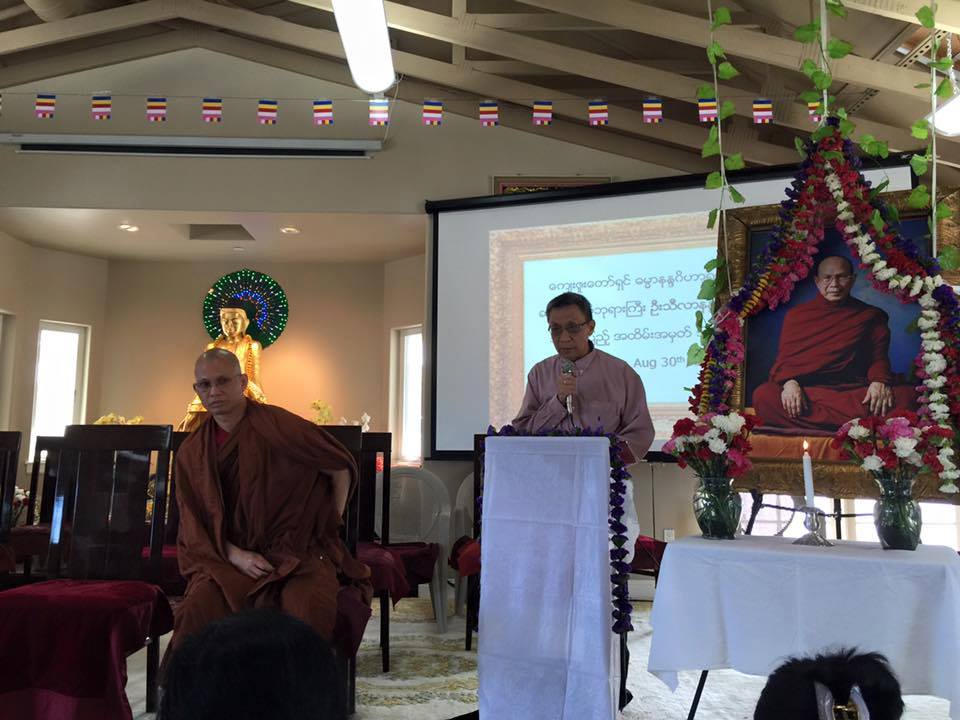
On the morning of December 15, 2013 at Dhammananda Vihara, Half Moon Bay, the resident Sayadaws and devotees conducted the 86th Birthday for Sayadaw U Silanandbhivamsa and offered soon dana in the “U Silanandabhivamsa Memorial Dhamma Hall.”
Fundamentals of Buddhism (Course)
Sayadaw U Silananda taught “Fundamentals of Buddhism” course. The course was made available in MP3/CD (which was distributed at the ceremony for the opening of “U Silananda Hall” at Dhammananda Vihara, Half Moon Bay.
The Four Foundations Of Mindfulness
Author : Venerable U Silananda
Editor : Ruth-Inge Heinze, Ph.D.
Wisdom Publications
First Printing : 2002
Foreword by Larry Rosenberg, Cambridge Insight Meditation Center
PART I : COMMENTARY
Introduction
1. Contemplation of the Body in the Body
2. Contemplation of Feelings
3. Contemplation of Consciousness
4. Contemplation of the Dhammas
5. Assurance of Attainment
PART II : THE GREAT DISCOURSE ON THE FOUNDATIONS OF MINDFULNESS
PART III : MEDITATION INSTRUCTIONS
Notes
Glossary
Select Bibliography
Index
Dependent Origination
Subtitle: Paticca-samuppada
The Wheel of life
Author: Sayadaw U Silananda
Editor: U Hla Myint
Publisher : Tathagata Meditation Center
Contents
Publisher’s notes
Venerable U Silananda’s biography
Dependent origination
Introduction
First link : Avjja-pacaya sankhara
Second link : sabkahara-paccaya vinnanam
Third link : Vinnana-paccaya nama-rupam
Fourth link : Nama-rupa-paccaya salayatanam
Fifth link : Salayatanam-paccaya phassa
Sixth link : Phassa-paccaya vedana
Seventh link : Vedana-paccaya tanha
Eight link : Tanha-paccaya upadana
Ninth link : Upadana-paccaya bhavo
Tenth link : Bhava-paccaya jati
Eleventh link : Jati-paccaya jara-marana
Conclusion
The Fundamentals Of Buddhism
Teacher : Sayadaw U Silanandabhivamsa (1927 – 2005)
Transcribed and edited by Sarah E. Marks, Dhammachakka Meditation Center
First edition : 2008
Fourteen chapters
1. Introduction : The Fundamentals of Buddhism
2. Life of the Buddha
3. Four Noble Truths
4. Kamma
5. Dependent Origination
6. Conditional Relations
7. The Outstanding Characteristics of Buddhism
8. Beings on the Spiritual Path
9. The Spiritual Path
10. Samatha Meditation : The Spiritual Path (Part II)
11. Vipassana Meditation : The Spiritual Path (Part III)
12. Enlightenment : The Goal of Spiritual Path
13. Divisions of the Buddha’s Teachings and Buddhist Councils
14. The Doctrine of Anatta
Eulogy
1. Sayadaw’s student for more than 25 years, USA
2. Luyen Pham, Tathagata Meditation Center, San Jose, USA
The Essence in The Buddha’s Words
Dhamma Dana Book from TRIPLE GEM PUBLICATION
Lectures by Sayadaw U Silananda
Based on the Book: “The Word of The Buddha” Compiled, Translated and Commented by Nyantiloka Mahathera
Transcribed by Sarah E. Marks
Edited by Harry Than Htut
42 Chapters
The Four Noble Truth (1) The Noble Truth of Suffering (2) The Noble Truth of the Origin of Suffering (3) The Noble Truth of the Extinction of Suffering (4) The Path of the Extinction of Suffering
The Noble Eightfold Path (1) Right Understanding (2) Right Thought (3) Right Speech (4) Right Action (5) Right Livelihood (6) Right Effort (7) Right Mindfulness (8) Right Concentration
Fundamentals of Vipassana Meditation
Primary Author : Mahasi Sayadaw
Translator : Maung Tha Noe
Editor: Sayadaw U Silananda
Original Publisher : Dhammachakka Meditation Center, 1991
Republished with other sources : Tathagata Mediatation Center
Other sources included the book
“Instructions to Meditation Practice” by Mahasi Sayadaw
“Benefits of Walking Meditation” by Sayadaw U Silananda
“Guidance for Yogis at Interview” by Sayadaw U Pandita
“An Interview with Mahasi Sayadaw” by Thamanaykyaw, translated by U Hla Myint
Protective Verses (Paritta Pali)
A Thai devotee requested Sayadaw to record Paritta Pali (Protective Verses) in Pali and English.
She sponsored the book (with Pali and English on opposing pages) as a birthday present for Sayadaw.
Abhidhamma
Tathagata Meditation Center (TMC)
Sayadaw U Silanandabhivamsa gave a talk “The ten meanings of Tatagatha” at the Tathagata Meditation Center at 1215, Lucretia Street, San Jose.
In the dining hall, there is an album about Sayadaw U Silanandabhivamsa’s early years in the US (e.g. meditation retreat at a church, dhamma classes at a Zen Buddhism Temple). There are two cabinets of books: one for dhamma dana distribution, and another for sale.
Highest blessing
Excerpts from
Paritta Pali (A Collection of Eleven Protective Suttas)
and
Protective Suttas (An English Translation with an Introduction)
by Sayadaw U Silananda
Not to associate with fools, to associate with the wise and to honor those who are worth of honor.
To live in a suitable place, to have done meritorious deeds in the past, and to keep one’s mind and body in a proper way.
To have much learning, to be skilled in crafts, to be well-trained in moral conduct and to ahve speech that is well-spoken.
Caring for one’s mother and father, supporting one’s spouse and children and having work that causes no confusion.
Giving, practice of what is good, support of one’s relatives and blameless actions.
Abstention from evil in mind, abstention from evil in body and speech, abstention from intoxicants and non-negligence in meritorious acts.
Respectfulness, humbleness, contentment, gratitude and listening to the Dhamma on suitable occasions.
Practice that consumes evil states, a noble life, seeing the Noble Truths and realization of Nibbana.
The mind of a person (an Arahant) who is confronted with worldly conditions does not flutter, is sorrowless, stainless and secure.
Having fulfilled such things as these, beings are invincible everywhere and happiness everywhere. This is the highest blessing for them.
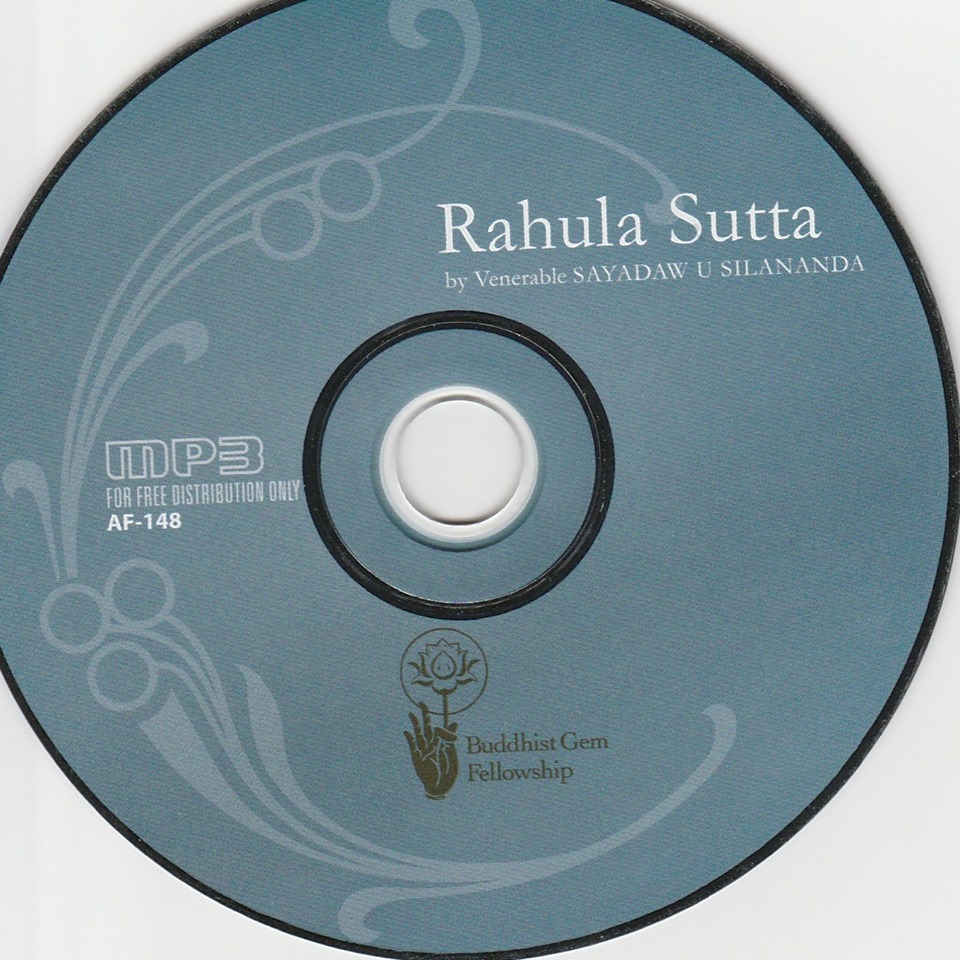
Rahula Sutta
The MP3 “Rahula Sutta by Venerable Sayadaw U Silananda” is offered for free distribution only by “Buddhist Gem Fellowship”.
Teachings and Legacy
Dhamma Dana of Sayadaw’s teachings
Basic Course in Buddhism for children
Abhidhamma courses in Burmese and English
Dhammapada
Patissasamupada
Four Foundations of Mindfulness
Rahula Sutta
…
are available as Dhamma Dana.
Tathagata Meditation Center (TMC)
TMC depicts Sayadaw’s dhamma duta mission in US and Mexico by photos of the wall of the dining hall, and by publishing Sayadaw’s works.
Audio Tapes
Many audio tapes were transcribed by Sarah E. Marks and U Osadha. They were and edited and published as books.
Sayadaw’s Thai devotee published “Paritta Pali: Protective Verses” in Pali and English with an accompanying audio CD.
Ko Jeffey [Wong, Fremont] put Sayadaw’s Abhidhamma courses (covering 50+ audio tapes) into COBY MP-3 player and distributed them at Abhidhamma courses offered in the San Francisco Bay Area.
Remembrance
On the morning of December 15, 2013 at Dhammananda Vihara, Half Moon Bay, the resident Sayadaws and devotees conducted the 86th Birthday for Sayadaw U Silanandbhivamsa and offered soon dana in the “U Silanandabhivamsa Memorial Dhamma Hall.”
Tipitaka comprises of Vinaya / Monastic rules of conduct Sutta / Discourses Abhidhamma / Ultimate reality
Buddhist Councils
According to the Theravada tradition, there are six Buddhist Councils.
The First, Second and Third Councils were held in India.
The Fourth Council (which recorded the teachings on palm leaves) was held in Ceylon.
The Fifth Council was held in Mandalay, Burma. U Khanti inscribed the Tipitaka on marble slabs. It was featured as the World’s Largest Book in Ripley’s “Believe it or not”.
The Sixth Council was held in Rangoon, Burma. Tipitaka was reconfirmed and published as printed texts. Selected Pali texts were also translated into Burmese.
First Buddhist Council
Source : U Silananda
Date : 3 months and 5 days (Sasana Era)
Place : Rajagaha (India)
King : Ajasattha
Leader : Mahakassapa Thera
Number of Monks : 500
Duration : 7 months
Accomplishment : Collected, examined, classified, and recorded orally the Buddha’s Teachings











 HlaMin