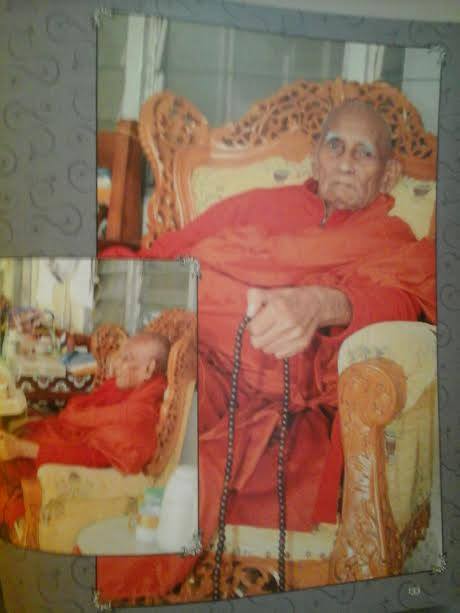
Known fondly as “Mon Sayadaw”, DPZ Sayadaw U Thilawunta built pagodas in Burma/Myanmar, USA, Canada, New Zealand, South Africa and several other countries.
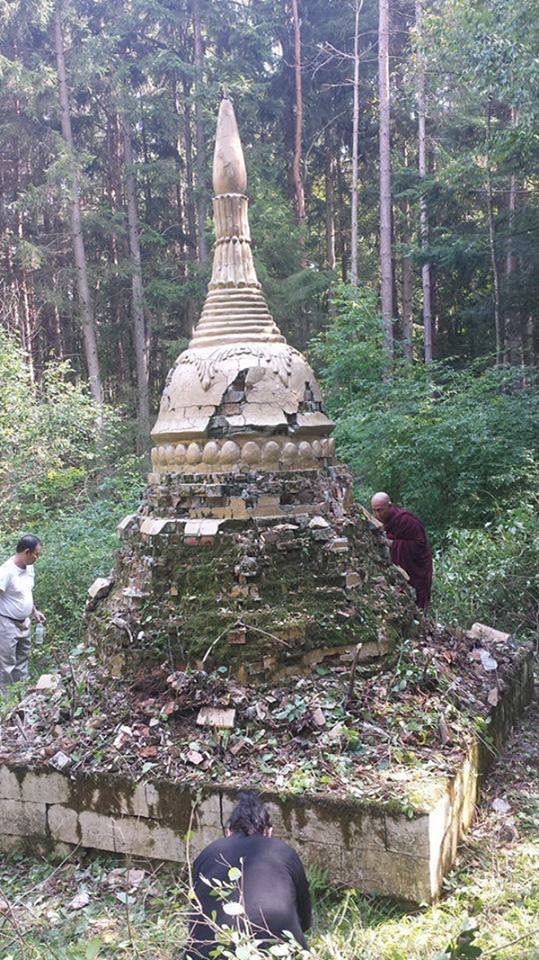
Sayadaw visited the United Nations and U Thant. He build the first Burmese pagoda in the Allegheny mountains near New York.
He served as the Chief Abbot of the Dat Paung Zon Aung Min Gaung monastery on Windermere Road, Rangoon, Burma from 1949.
At the invitation of U Thant, Sayadaw traveled to the US (via the ocean liner – predating the days of air travel) and build a pagoda on the Allegheny Mountains.
In 1958, Leslie Dawson, Canadian of Irish and Scottish descent, asked Mon Sayadaw to be his mentor. Dawson traveled to Bodh Gaya, India to rejoin the Sayadaw and received ordination as a samanera (novice monk). He continued on to Burma where he was ordained as Anandabodhi bhikkhu at the Shwedagon temple, Rangoon (21 Dec 1958). Ananda Bodhi had followers in Canada and New Zealand, most of whom have visited Sayaadaw and the Dat Paung Zon pagoda. Two of them also ordained as Buddhist monks with Mon Sayadaw as preceptor.
Ananda Bodhi became a Tibetan Master with the name Namgyal Rinpoche in 1971, but continued to preach dhamma from Theravada, …
Mon Sayadaw built pagodas in the several countries including US, Canada, New Zealand, and South Africa.
Details of Sayadaw’s dhamma duta missions can be found in the official biography (in Burmese and English) and the web pages of his disciples.
Mingun Sayadaw U Vicittasarabhivamsa (GBNF) was listed in the “Guinness Book of World Records” for his phenomenal memory.
When Burma hosted the Sixth Buddhist Council at Kaba Aye Pagoda in 1954 – 56 to commemorate the 2500th year of the “Sasana Calendar”, Sayadaw acted as the “Reciter” of the Tipitaka (Triple Basket : Vinaya, Sutta, and Abhidhamma) and the “selected” Commentaries. According to the Kaba Aye Edition, the Tipitaka covers 8000+ pages.
To prepare for the Buddhist Council, Sir U Thwin requested Mingun Sayadaw to take the Tipitaka examination.
Sayadaw passed the Oral and Written tests for the Three Baskets with Distinction.
Oral tests will fail a candidate if he needs five (or six) prompts. Sayadaw did not need a single prompt. The Written tests cover in-depth topics. During the recitation, Sayadaw amazed the examiners by pointing out the variations of the text and highlighted the preferred version.
He was the first Sayadaw to be conferred “Bearer of the Tipitaka & Treasurer of the Dhamma”.
Sayadaw received requisites. He distributed them to the monks (mostly in the town where he received them).
To help ease the monks trying to pass one or more Baskets in the later Tipitaka examinations, Sayadaw set up a monastery in Mingun and accepted monks who had finished their Dhammacariya.
Types of Memory
We have a short term memory and a long term memory.
When people age, most retain their long term memory, but they often experience decline of their short term memory.
My young cousin approached us and then uttered, “I forgot what I was about to say”.
My high school classmate would abruptly stop in the middle of our walk and pondered, “Did I lock the door?”
U Tun Aung’s uncle (GBNF) could recall his primary classmates but could not recognize his beloved grand kid.
There are books and courses about memory.
According to some authors, we could use “chunking”, “association”, “reinforced (non-blind) repetition”, … to move important and worthwhile items in the short term memory into long term memory.
Memory is not static. It is “elastic”. There is restructuring (reorganizing, indexing, …) every time we use it.
There are techniques (“mnemonics”, “visualization”, …) to “train” and “improve” our memory.
Thanks to the sayas and colleagues who complimented for having a good memory.
I was a mini-dictionary, a micro-encyclopedia, and a reliable proof-reader & spelling checker.
May be it was partly because I was born before the pervasive use of Internet and on-line tools, and there was not too much diversion.
There are a few who want to down play the importance of memory.
The first pagoda in the US was built on the Allegheny Mountains in New York by Dat Paung Zon Sayadaw U Thilawunta (also known fondly as “Mon Sayadaw”) in the 50’s.
TKAM
Following the Dhamma Duta Mission by Taung Pu Lu Sayadaw in the late 70’s, two pagodas were built at TKAM (Taung Pu Lu Kaba Aye Monastery) in Boulder Creek, Northern California. Pa yan sayas from Burma/Myanmar were brought in for the project.
Subsequent Pagodas
Pagodas were also built in
Sae Taw Win II Dhamma Center, Sebastapol, Northern California
Azusa Monastery in Los Angeles, Southern California
New Jersey
Sitagu Monastery in (a) Texas (b) Florida (c) Minneapolis
Chaitya Monastery in Nevada, Las Vegas
Note :
Due to restrictions such as zoning laws, scenic routes, and historical buildings, it is not easy to build pagodas in the US.
Mahā Calendar Year 67 (623 BC) – Full Moon Day of Waso (Thursday): Conception took place.
Mahā Calendar Year 68 (624 BC) – Full Moon Day of Kason (Vesākhā) (Friday): Born in Lumbini Park (now known as Padaria in modern Nepal. Name as Buddha: Gotama Name as Prince: Prince Siddattha Mother: Mahā Māyā Devi Father: King Suddhodana Mahārājā City: Kāpilavatthu (now in India) Royal Bride: Princess Yasodharā Devi Son: Prince Rāhula
Mahā Calendar Year 97 (595 BC) – Full Moon Day of Waso (Monday): Renounced worldly life, became an ascetic to seek enlightenment.
Mahā Calendar Year 103 (589 BC – Full Moon Day of Kason (Vesākhā) (Wednesday): Attained enlightenment, became a Buddha. (Time: At dawn on the first Waxing Day of Kason (Vesākhā))
Mahā Calendar Year 104 (589 BC) – Full Moon Day of Waso (Saturday): Expounded Dhammacakkapavatthana Sutta
Mahā Calendar Year 148 (544 BC) – Full Moon Day of Kason (Tuesday): In the Sāla Grove in the City of Kusināra in Māllas (modern Kasia in the eastern part of Nepal), Buddha passed into Nibbānna.)
Mahā Calendar Year 148 (544 BC) – 12th Waxing Day of Kason (Vesākhā) (Sunday): The Buddha’s remains burned on their own in cremation.
Notes
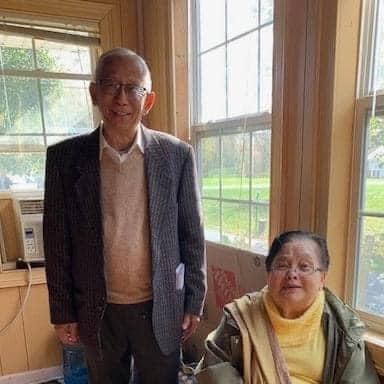
Dr. Khin Maung U (SPHS63) stood First in Burma in the Matriculation.
He is a Multiple Luyechun (Outstanding Student) at IM (1).
He did Teaching & Research in Burma and USA.
He translated a part of Dr. Nandamalabhivansa’s course on Abhidhamma.
He and his spouse Dr. Nyunt Nyunt Wai are Gawpaka at a monastery in Maryland, USA.
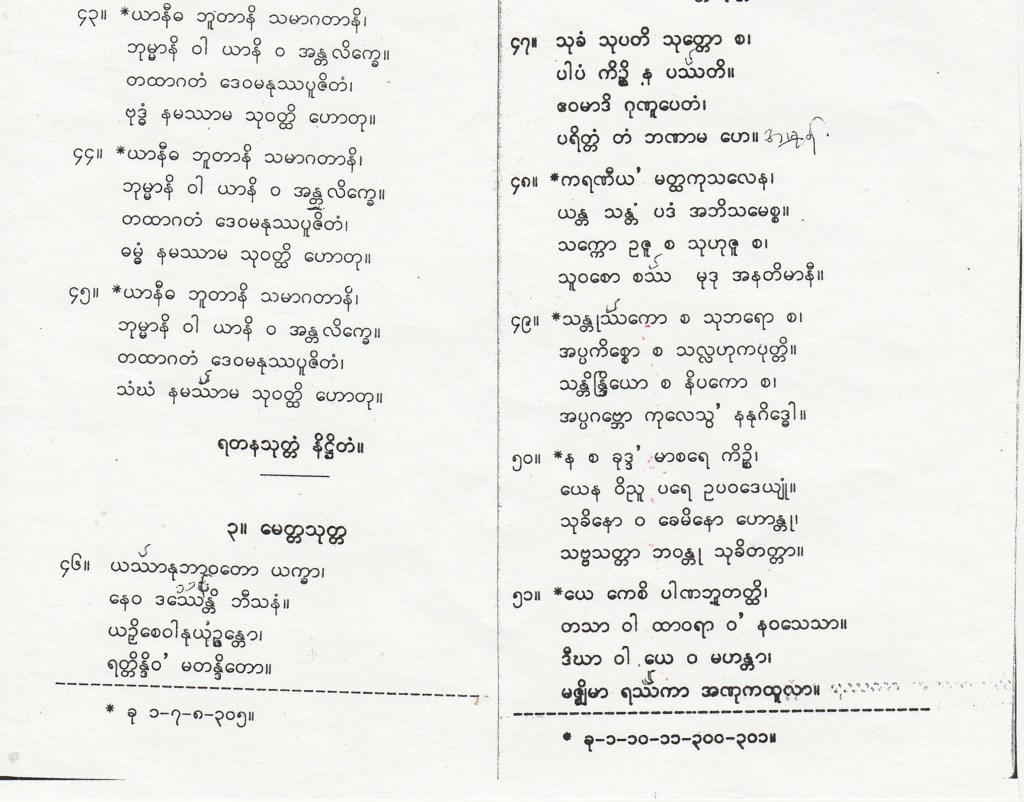
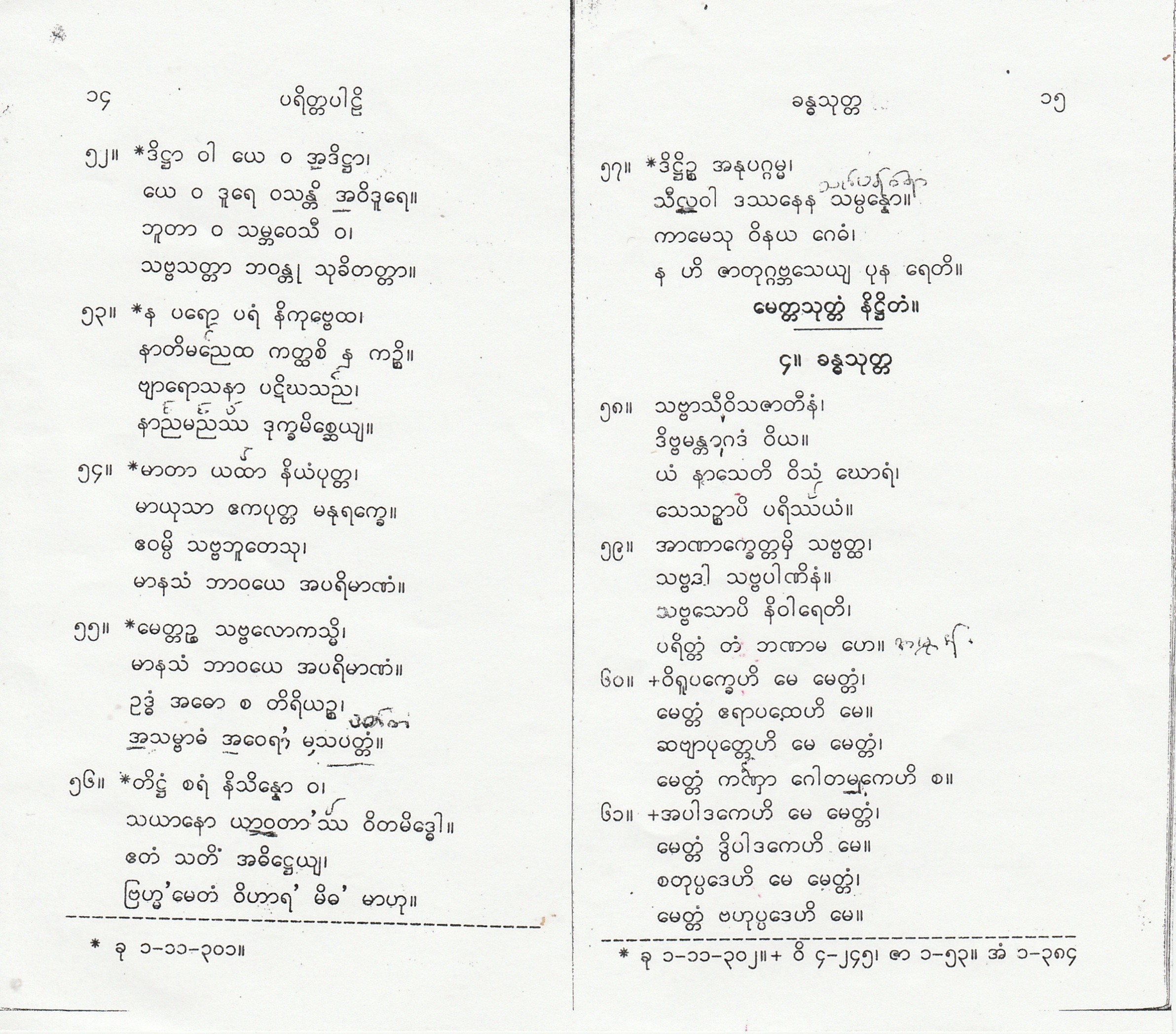
METTA SUTTA => Third sutta in “Paritta Pail” also referred to as KARANIYA METTA SUTTA Desirable qualities of a “practitioner” Loving kindness “meditation”