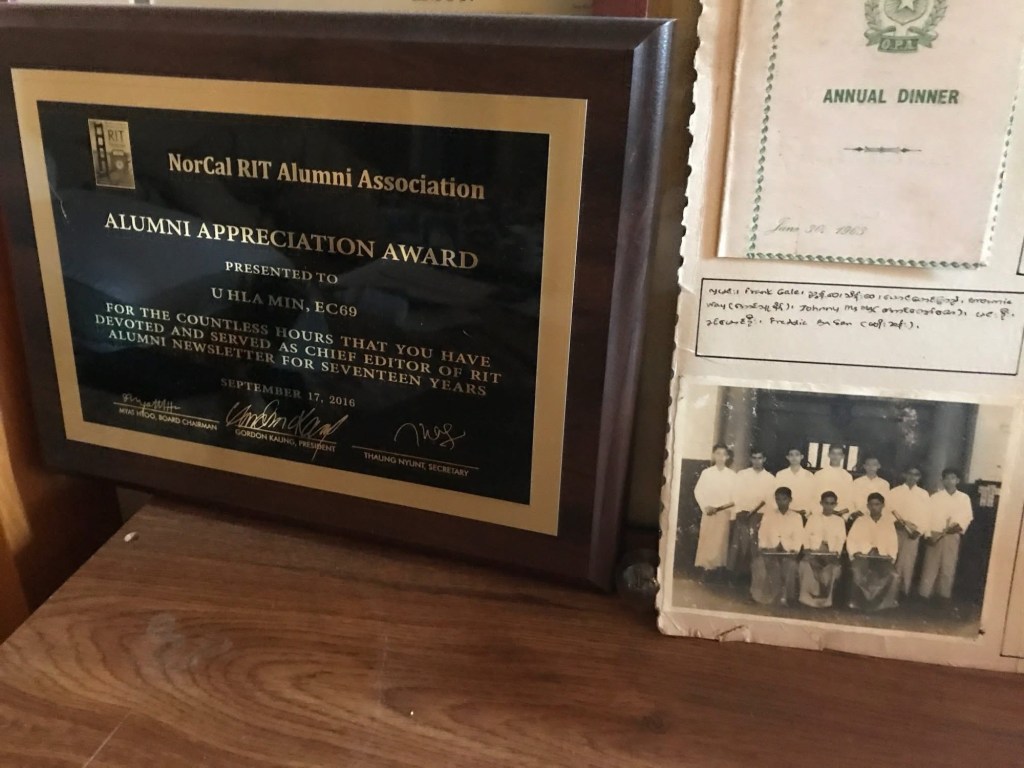
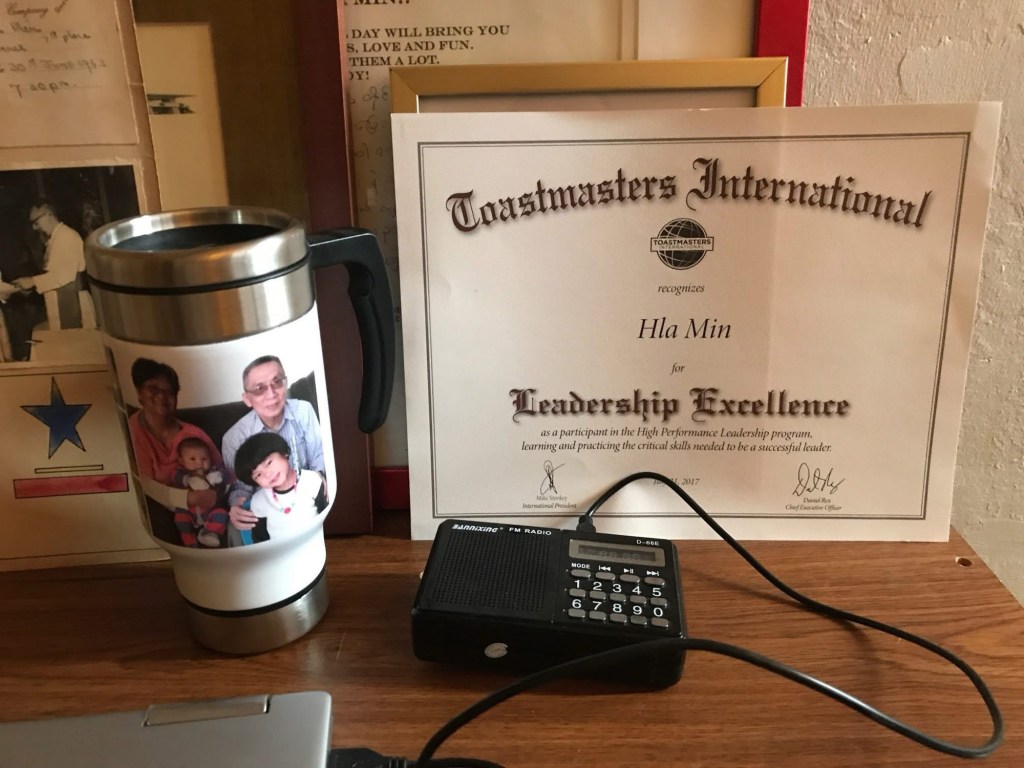
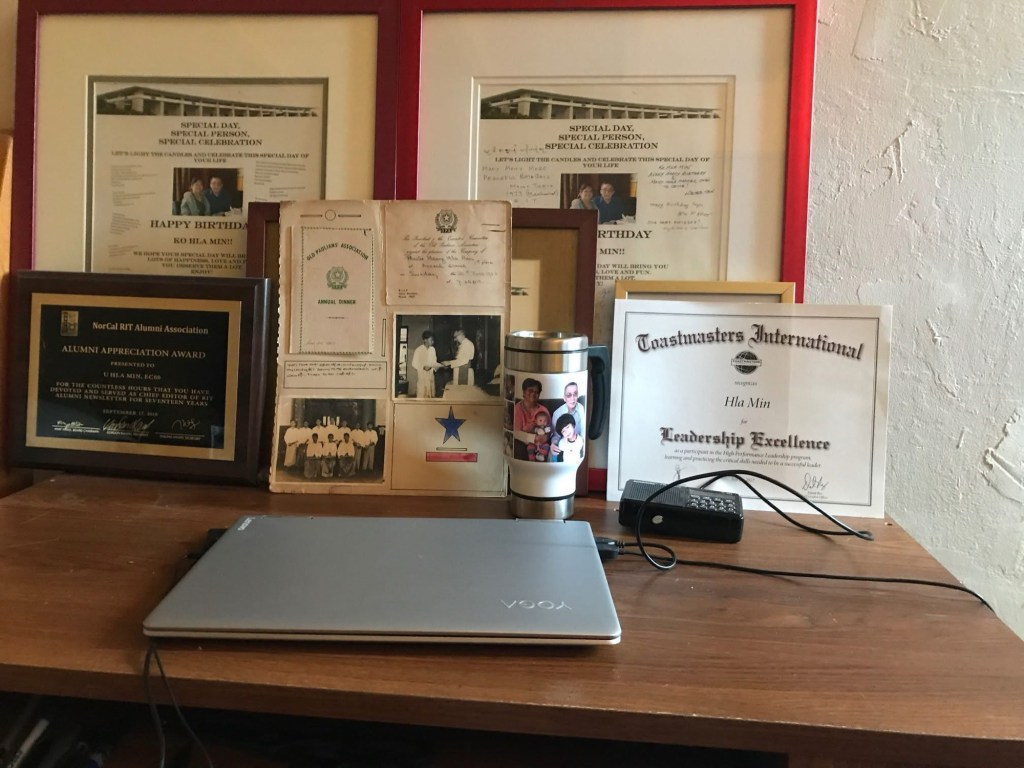
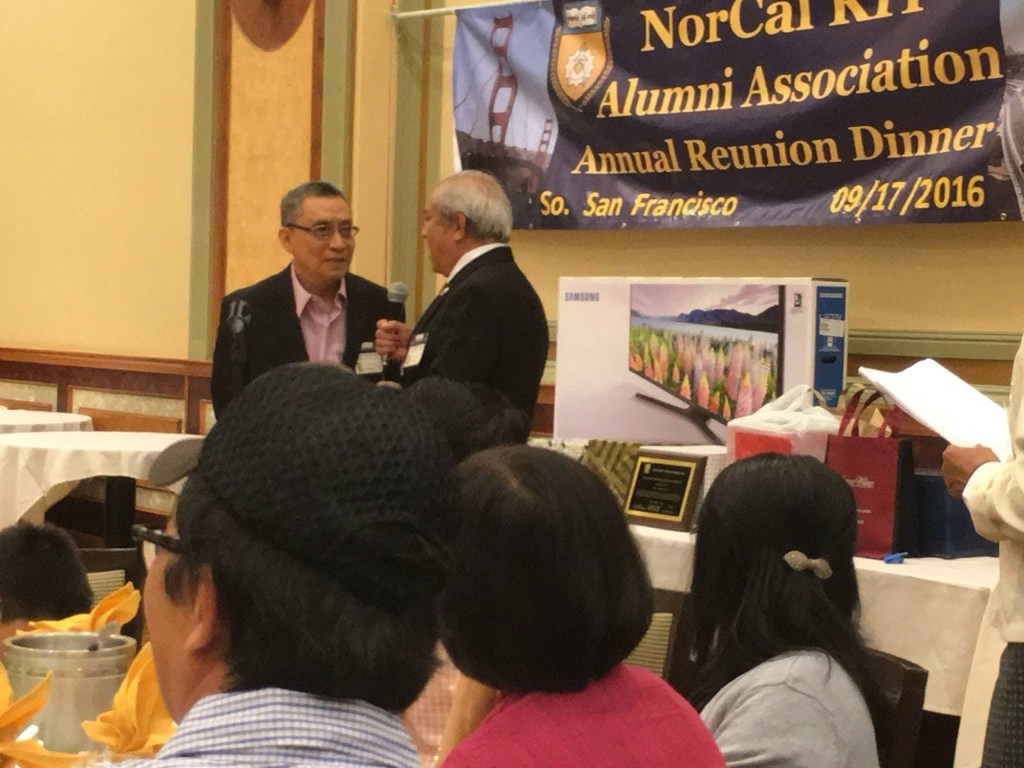
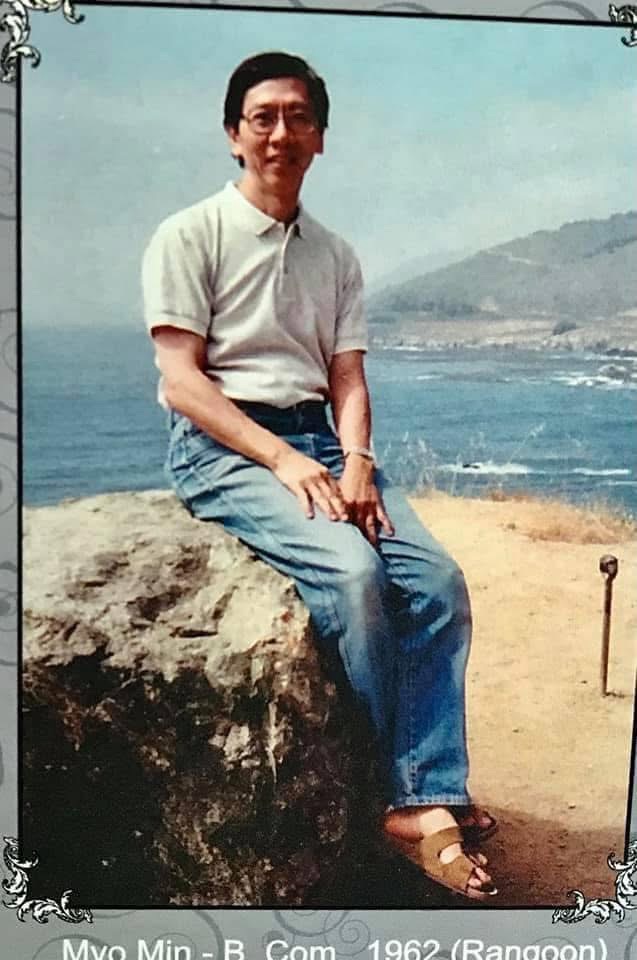
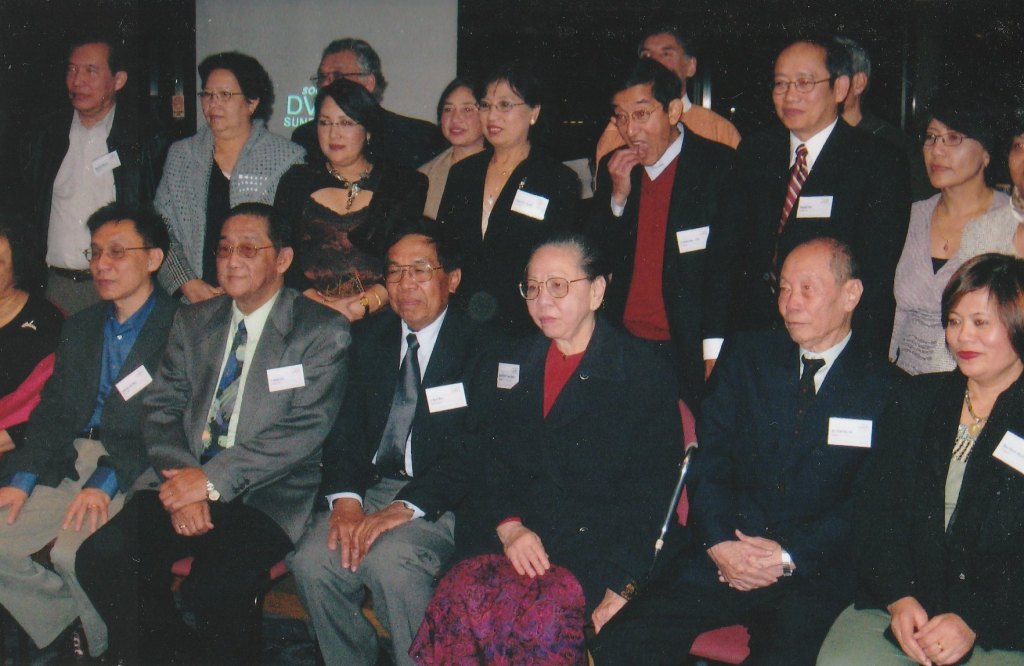
Rowed for the Institute of Economics. His crew members include U Htin Kyaw (Peter) and U Soe Thinn.
Attended the computer classes at UCC in Rangoon.
Became a monk at Dhammananda Vihara (Half Moon Bay) after his retirement.
U Tha Aung (M79) and Daw Kinsa Maw-Naing (ChE79)
Hosted mini reunions in Canada
Volunteer as SPZP2016 representatives.
Sayamagyi Daw Tinsa Maw-Naing was my English teacher in I Sc(A).
Dear Ko Hla Min,
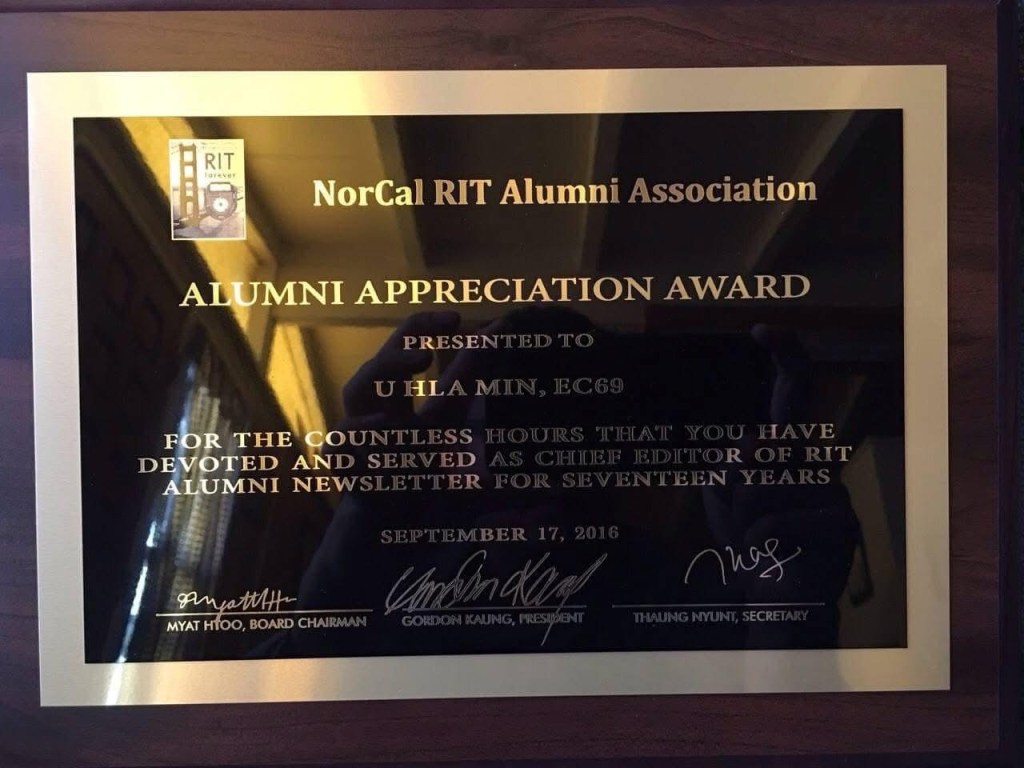
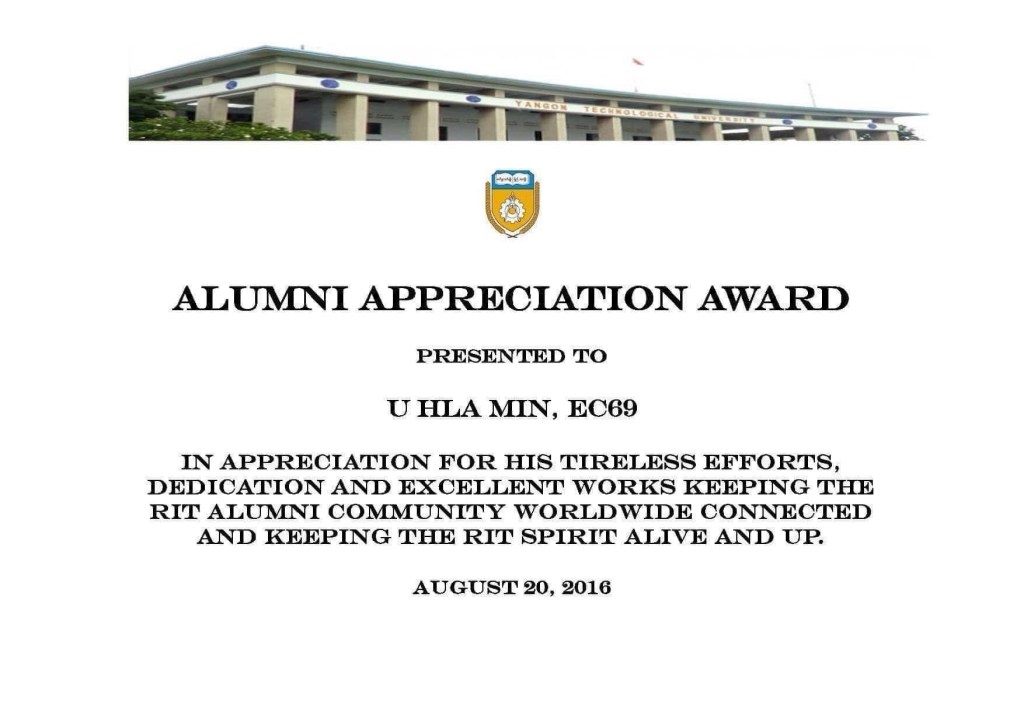
Happy Birthday and to say thank you for all your efforts in keeping RIT alumni connected globally. Even though we don’t have much to say, we always follow your updates.
May you have a happy healthy long life and lots of ku-tho.
with metta from Tha Aung & Kinsa
Saya U Htun Aung Kyaw (ChE67, SPHS61)
Happy Birthday Ko Hla Min and cutie pie! I appreciate all you hard work and dedication to RIT Alumni newsletter. Sorry I cannot attend the event.
Thanks for your appreciation
Dear Sayas and Colleagues,
It is truly amazing to be appreciated by sayas and alumni. he following are some examples.
Sayagyi Dr. Aung Gyi and Daw Emma called from Canada to wish my Cutie Pie and me. They also sponsored “Tohu Thoke” for the attendees. Sayagyi sent Ko Maurice his congratulatory message for me to be read at the soon kyway gathering. See the following section for details.
Saya U Tin Htut flew in from Southern California.
Ko San Lin (M87, “Maung Lu Pay”) took “time off” from work to attend the soon kyway.
Ko Kyaw Myint (M83) delegated his “Flower shop” to his assistant to attend the soon kyway.
Ko Myint Soe (M79), who recently had knee surgery, requested Ko Aung Myint Oo (EC84) to give him and his spouse a ride to the soon kyway.
Due to tight multiple schedules, Angelina and Ko Benny Tan (M70) came in separate cars so that Ko Benny can have more time with his sayas and colleagues
Saya U Tin Maung Nyunt (M60) will celebrate his 80th birthday in December, 2016. Saya only drive local short distance, so he asked Ko Thein Naing (Patrick) to give him a ride.
Daw Mu Mu Kin, spouse of Saya Allen Htay, had tears in her eyes. She said that Saya would wish to be at the RIT mini-gatherings. She gave me silk neck ties that were bought (but never worn) by Saya Allen. She shares the birthday on August 18 with my grand daughter.
Ko Maurice ordered a cake to celebrate August Born including Daw Mu Mu Kin and Ko Myint Swe (EP74).
Ko Maurice hand crafted a custom “birthday greetings” card with extracts from the birthday greetings from the RIT updates. The messages from Saya Dr. San Hla Aung, Ko Tha Aung, Ma Kinsa Maw-Naing came in too late to be incorporated into the gigantic card.
Ko Maurice spent countless days organizing the event. Following the tradition of his late father Uncle U Wah Kyu, Ko Maurice also prepared custom birayani (dan bauk).
Ko Charlie Tseng (EC70) and Ma Diana Tseng (ChE71) ordered two large birthday cakes for me.
The full list of food donors and sponsors are maintained by Ko Maurice.
Ko Johnson Lim (cousin of Ko Robert San Lin) needs a human walking “cane” (his beloved spouse). They are regular food donors at most events.
Daw Kyu Kyu Lin (T75) rarely attends gatherings. She made an exception this time. She brought “Kyee Oh See Kyet”. She also gave a ride to two Textile grads: Ko Than Htay (T75) and Ma Bibsu (T76).
Saya Daw Khin Khin Chit Maung also rarely attends gatherings. She made an exception this time. She and Saya U Myo Min fetched Saya U Tin Htut (Daw KKCM’s elder brother) at the air port and also brought him to the Half Moon Bay monastery.
Ko Gordon Kaung (M83) and Ma Lillian Kaung (EC83) drove 2+ hours from Napa. They also brought a bottle of iNapa Premium wine and also some desserts.
Saya U Myat Htoo (C68) spent a decade or so as President of TBSA (Theravada Buddhist Society of America) at half Moon Bay monastery. It was a sort of “welcome back” for Saya and Ma Ku (Daw Hnin Maung Maung).
Saya U Maung Maung (George, ChE66) is a Past President of Northern California RIT Alumni Association and a founding member of RIT Alumni International. He and Daw Eng Eng (sister of Saya U Myat Thwin, ChE66) brought samoosa.
There were a few young and not so young alumni at the event. They include Ko Soe Thu (C98) and Ma Thandar.
Saya U Nyo Win (M65) and spouse were caught in the traffic.
Saya U Thein Aung (Met72) and Sandra (M76) brought their daughter.
Dr. Myint Thein (M73) talked about his “Htaik Htar” Daw Nyo Nyo Win (T73) and provide examples of “Applied English” (e.g. “air cut” for stroke).
Matriculates had to study two years of Intermediate Classes.
Those aspiring to become Engineers had to pass the I.Sc. (Intermediate of Science) classes with 50+ marks in Maths, Physics and Chemistry. They then study four years at the Engineering College for their B.Sc. (Engg) degree.
RU
Rangoon University was opened on 1st December 1920 with Rangoon College and Judson College as constitutent colleges. There were only three Faculties: Arts, Science and Law.
First Strike
The First RU Students’ Strike started on 5th December 1920 to protest the deficiencies of the 1920 RU Act. It led to the opening of National Schools and National College. It also forced amendments to the RU Act (notably in 1923).
Engineering Classes
In 1924, the inaugural engineering classes were opened.
Details can be found in the HMEE (History of Myanmar Engineering Education) book published in 2012. Saya U Aung Hla Tun (GBNF, National Literary Award winner, former Chief Editor of RIT Annual Magazine) served as Leader and Principal Auhor of the book. U Ohn Khine (M70) and I compiled the CD Supplement for the HMEE book.
Engineering students have to attend
I.Sc.(A)
I.Sc.(B)
1st Year of Engineering
2nd Year of Engineering
3rd Year of Engineering
4th & Final Year of Engineering
Engineering Departments
Architecture
Chemical
Civil
Electrical
Mechanical
Metallurgy
Mining
Textile.
Civil was the earliest Discipline. Mechanical and Electrical Disciplines were offered next. In the mid and late 1950s, five more Disciplines were added.
New Education System
In November 1964, RU was reorganized. Several Faculties became autonomous Institutes.
RIT
The Faculty of Engineering (known also as the Burma Institute of Technology) became Rangoon Institute of Technolgy with U Yone Moe (former Dean of BIT) as Rector and U Soe Thein (former Ta-Ka-Tha Leader) as Registrar.
Three Batches
In November 1964, three batches of students were admitted to RIT.
ILA (Intelligence Level Agregate) was used to admit 400+ Matriculates to the 1st BE. ILA was controversial.
300+ students who had passed the I.Sc.(A) examination were admitted to the 2nd BE.
About 200 students who had passed the I.Sc.(B) examination were admitted to the 3rd BE.
Classes
In the New Education System, the Classes are called
1st BE
2nd BE
3rd BE
4th BE
5th BE
6th & Final BE. BE stands for Bachelor of Engineering.
For Architects, the Classes are called BArch (Bachelor of Architecture).
RIT69ers
Guinea Pigs
The Group is jokingly eferred to the Guinea Pigs of the Education Systems.
Most took the Last ever 7th Standard Government exam in March 1960.
They took the First ever 9th Standard (HSF/ High School Final Only) exam in March 1962. Those from Rangoon had to take the exam with Security Forces patroling the streets after the Coup d’etat on March 2nd by the Revolutionary Council. They had to retake the HSF exam in August 1962 because the Higher Authorities said that there were question leakage.
They took the 10th Standard (Matriculation Only) exam in May 1963.
In sum, they had to take three or four Government exams before being admitted to the University. In contrast, my older brother had to take only two exams : 7th Std. exam in March 1955, and the HSF & Matriculation exam in March 1957.
They took the Last ever I.Sc.(A) exam at various schools, since most classes at Rangoon University, Mandalay University and Intermediate Colleges were suspended (for an unspecified period).
Some classmates (e.g. Maung Maung Kyi (GBNF, SPHS63, 11th in Matric) applied Scholarship to study abroad, since he was the eldest in the family and did not want to burden his parents.
After a long wait, some of my Leik Khone classmates (e.g. Aung Min (M69)) were admitted to 2nd BE in November 1964. There were 300 + students. The admission was based on the I.Sc.(A) exam marks. A few decided to study BArch.
For the 2nd BE, the students had to study English, Maths, Physics, Chemistry, Mechanical Drawing, Surveying, Materials and Processes, Sociology & Workshop.
Starting with the 3rd BE, the students had to choose their Discipline. Civil and Mechanical were the top choices with 100+ students. Electrical had 70+ students. Chemical and Textile had 15+ students. Mining, Metallurgy and Architecture had 10 (or so) students.
For 5th BE, EE students had to chose the Option: EP (Electrical Power) and EC (Electrical Communications)
Most 69ers graduated in 1969 after passing 6th BE. Some took sabbatical, and graduated a year or two later.
The 69ers worked mainly in the Government departments and Industry. Some worked for private companies and family business. A few moved abroad.
Some 69ers (e.g. Dave Saluja and Win Maung) left before graduation.
Membership
The members include (a) those who entered 2nd BE in 1964 (b) those who graduated in 1969 (c) those who studied a year or more with the above
The Group is also known as 69ers, the RIT Class of 69 and the Class of RIT 69++ .
Gatherings
The first formal Reunion of the Group occurred in 1999. It also was instrumental for the development of the RIT Alumni Newsletter, the inaugural ex-rit website, and the First RIT Grand Reunion and Saya Pu Zaw Pwe (SPZP-2000).
30th Anniversaryin 1999
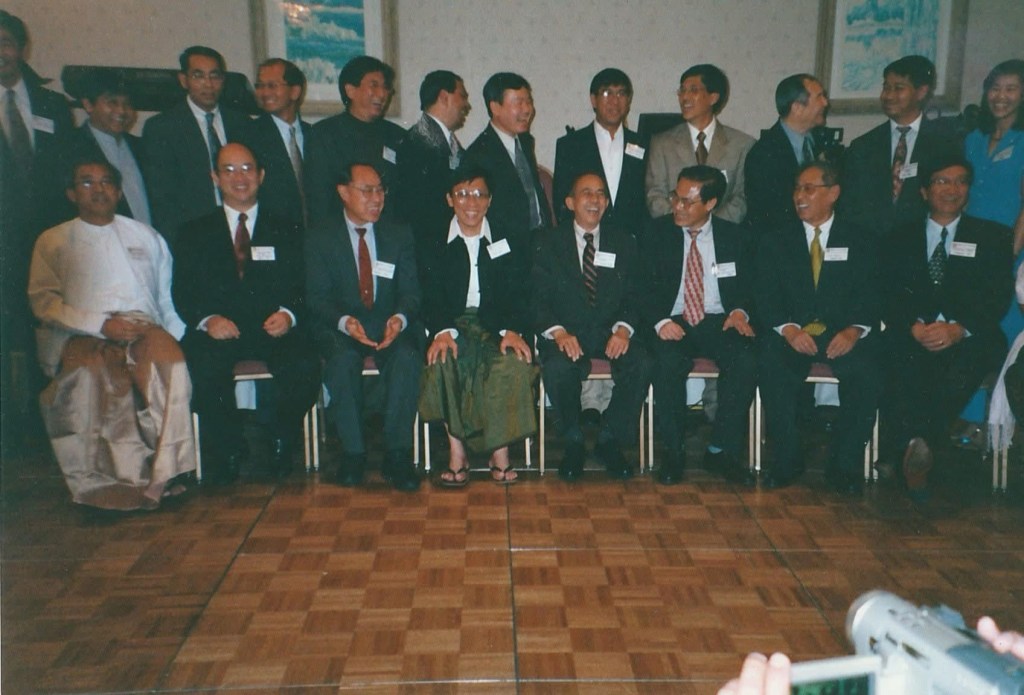
In 1999, Ko Tint Lwin (Daniel), Ko Sein Myint, Ko Sein Win (“Nar Yee”), and several 69ers organized the reunion for the “30th Anniversary of Graduation” and also a mini-SPZP. Ko Tint Lwin e-mailed me a report. Ma Saw Yu Tint (Alice) e-mailed me photos.
Saya U Soe Paing e-mailed me about several mini-gatherings in Yangon (e.g. with Sayagyi Dr. Aung Gyi).
Ko Tint Lwin (M69) wrote :
Thank you very much for your write-up about our 1999 “30th Anniversary of Graduation”. Actually. it all started in 1996 when I visited Burma and had dinner with a few of my close friends, including, Ko Shwe, Ko Win Mg, Ko Ye Pinn, Gabar Ko Myint Thein, etc. During dinner somebody mentioned that in 3 years time it would be 30 years since we graduated. Out of the blues I suggested to have a reunion in 1999. Everybody laughed as it was so far away. When I came back to Singapore and told Ko Sein Myint and Dickie they also laughed and told me that I must be crazy to think about so far away. However, time flies and in either late 1998 or early 1999 at Ko Win Htein’s funeral wake, some of our friends remembered the reunion proposal. They quickly formed a committee and organised the very first reunion at ‘Sait Taing Kya Restaurant. After the event I wrote you a report, Alice sent you a few photos and the rest is history.
40th Anniversaryin 2009
The Class of 69 organized the “40th Anniversary of the Graduation” in 2009.
Golden Jubilee of Admissionin 2014
The “Golden Jubilee of the admission to 2nd BE” was celebrated in 2014, because the 69ers were concerned with the declining health of members and that some may not be able to make it to the True Golden Jubilee of graduation in 2019.
Golden Jubilee of Graduation in 2019
The Class of 69 celebrated the true Golden Jubilee (50th Anniversary of Graduation) in December 2019.
Acariya Pu Zwe Pwe was held at the Assembly Hall on Gyogone Campus.
The Reunion Dinner and Entertainment was held at the former Office Compound of Ko Aung Min.
Ma Tin Tin (Anne, EC69) had a “Home Coming” after her graduation.
Many were unaware that the gathering would be a final one for some (especaially those who would succumb to Covid).
My Contributions
RIT Alumni Newsletter
I started “RIT Alumni (Abroad) Newsletter” to share RIT-related news (such as the mini-gatherings) and solicited contact information (in the form a spread sheet) from interested sayas and alumni.
“RIT” stands not only for Rangoon Institute of Technology, but all the engineering schools that precede or succeed it. RIT is a place holder for the RU Faculty of Engineering, Burma Institute of Technology, Yangon Institute of Technology, Yangon Technological University and various Technological Universities in Myanmar.
The name was changed to “RIT Alumni International Newsletter” to include alumni in Burma and the rest of the world.
A commemorative issue was published for SPZP-2000.
RIT Web Site
Ko Khin Maung Zaw (KMZ, EC76) designed and implemented the first RIT web site.
I served as Content Provider and Editor of the web site. I composed the “SAYA PU ZAW PWE” poem. I posted 64 “Countdown to the Reunion” and 36 “Post Reunion”.
Ko Ivan Lee (Khin Maung Oo, M69), Ko Aung Myint (M69, Singapore) and the San Francisco Bay Area Group led by Saya Allen Htay (C58, GBNF) provided some financial help to operate the web site.
“RIT Alumni International” hosted the First RIT Grand Reunion and Saya Pu Zaw Pwe (SPZP-2000) in October 2000.
SPZP
The term “Saya Pu Zaw Pwe” was chosen over “Saya Ga Daw Pwe” (which has religious connotation) so that alumni professing various faiths can pay respect to their former sayas / mentors.
There has been seven world wide SPZPs: SPZP-2000 in USA, SPZP-2002, SPZP-2007 and SPZP-2010 in Singapore, SPZP-2004, SPZP-2012 and SPZP-2016 in Yangon.
Due to COVID-19 pandemic, SPZP-2020 was cancelled.
I have been an Organizer and/or Facilitator for the SPZPs.
My “SAYA PU ZAW PWE” poem was published in the Commemorative Newsletter for SPZP-2000.
Saya U Moe Aung reprinted the poem as the Back Cover of Commemorative Swel Daw Yeik Sar Saung for SPZP-2002.
My poem “SWE DAW YEIK” was published in the Commemorative Swel Daw Yeik Sar Saung for SPZP-2007.
My article “A Sad and Short Clip : EE Sayas” was published in the Commemorative Swel Daw Yeik Sar Saung for SPZP-2010.
Zau Lai (EP69) wrote :
Thank you, Ko Hla Min, for your writings. If it’s not for you there will be no records and history of RIT. I am reading interestingly all your writings all the time. When we all are gone your writing will live on.
Aung Min (M69) wrote :
So thanks for your recordings. Appreciations.
Food For Thought
Aging, Health and GBNF
At one moment, the Class of 69 had a median age of 69, and the list of GBNF has 69 members.
That symmetry no longer holds. The Class of 69 has a median age of 79, and the list of GBNF has 128!(or so) members. Over 40% have passed away.
In the latter half of 2021, twenty 69ers passed away. 18 were victims of Covid.
Declining Health
The attendees at the mini-gatherings have decreased. Some could not drive, and had to ask their family members to take them to the gatherings. Some had major or minor operations, and need time to recover fully. Some had medical problems for some time (e.g. a year or two).
Retirement
Most are retired or semi-retired. A few did not retire or did not have the chance to retire.
Ko Tin Maung Lay (M69) worked in Europe and Middle East. So he came back to California only on home leave.
His spouse wanted him to retire.
He agreed but his boss requested him to perform a meticulous “hand-over” before retiring.
He had daily work outs and supposedly had no known major health problems.
He passed away in Dubai on a Friday (holiday in the country). His company and colleagues tried extra hard to make sure that his body could be flown back to Southern California, USA.
69er HCF (Health Care Fund)
U Aung Min (M69, Chair), U Shwe (EP69, Secretary) and team are the core volunteers for the 69er HCF. The team sends out monthly, quarterly and annual reports (including Donations, Income, Expenditure, GBNF)
Ivan Lee (U Khin Maung Oo, M69), Daw Myint Myint (C69) and U Sein Myint (K K Wong, EP69) are some of the major donors to HCF.
Most 69ers donate at the 69er Gatherings (e.g. Monthly Breakfast Gathering at Taw Win Hnin Si / Royal Rose Restaurant).
Ko Ivan Lee (M69) wrote :
Dear Classmates,
Recently rather than optimistic good news, we heard spreading pessimistic health concern news mostly. It clearly indicates that we are aging higher and health is going down lower and lower. I can imagine 5 years from now how many will be terribly survived. I am kind of depressed that sooner or later we will be meeting THERE. At this moment all I can express is to wish our classmates who are in sickness to recover ASAP.
Ivan Lee (M69)
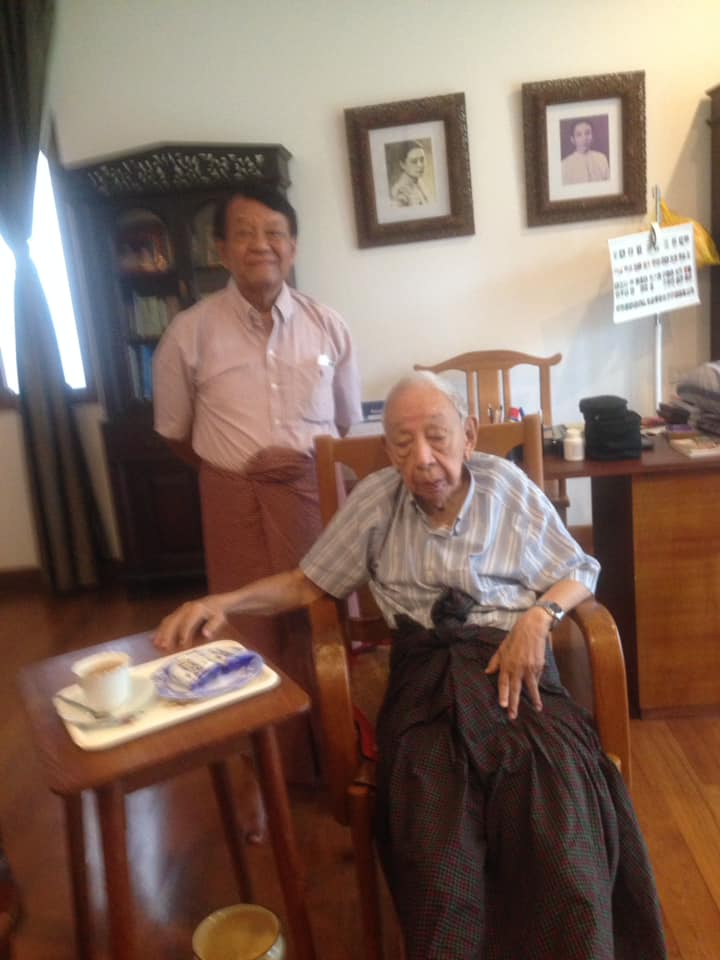
Paying Homage to Saya U Ba Than (GBNF)
Saya U Ba Than and U Aung Min
U Tin Maung Soe (Tommy, EP69, GBNF)
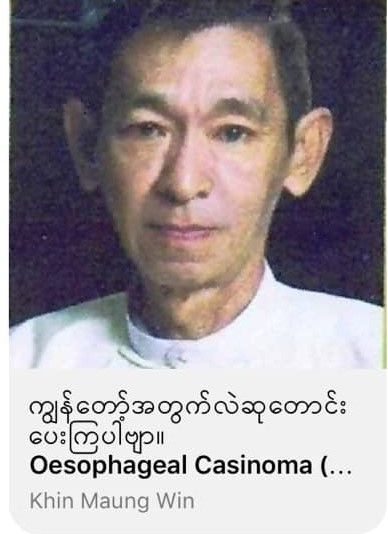
Khin Maung Win (EP69, GBNF)
Known fondly as “Sargalay” and “Nutty”
Usually finished Mechanical drawings in about an hour and still get Grade 5.
Later changed his name to “Lada” and “Galon”
Training partner for Sai Kham Pan (EP69, Burma Selected in Badminton)
Badminton selection at the Township level
U Khin Maung Win (RIP)
A69
Aung Khin After working in Botswana, he and Tin Tin Hla (A70) moved to Seattle, Washington, USA to be near their daughters and grand children. He attended the Golden Jubilee on December 14, 2019 in Yangon
Kyaw Kyaw He belonged to an elite group who married before graduation.
Myo Tun (Bobby) Won essay contests as Errol Than Tun. After retirement from PWD, he became Ashin Pannagavesaka. He is an editor of Pa Auk Sayadaw’s books and a dhamma librarian at the Mawlamyine Pa Auk Taw Ya. He went on dhamma dhuta missions (e.g. to Vietnam).
Tobias K. Ku, Saw (Tobi, GBNF) He attends 69er monthly breakfast gatherings. Passed away in 2021.
Thet Htun He moved to Taiwan.
Thwin Thwin Aye Hmi, Daw (Olive) Used to play chinlon with her classmates. Spouse : U Han Zaw. Met both last at the lunch gathering at Crystal Jade in 2012 (preceding SPZP-2012).
Tin Maung Hla (GBNF) Had some medical problems (which hopefully had gone away).
ChE69
Aung Min Oo
Aung San
Aye Aye Kyu, Daw
Ceril Shair (USA) ?
Khan Za Lan
Khin Maung Win
Kyaw Minn (Ei Kun, Singapore)
Kyaw Min (Albert)
Moe Hein (Ajala, Swimming and Water Polo)
Myat Tun
Myint Ko
Myint Myint Aye, Daw
Myo Khin, Dr. (Japan)
Mehm Myo Min
Soe Win
Swe Swe Oo, Daw
Taing Oke, Dr. (Japan)
Yi Yi Khaing, Daw (Vilma, Singapore)
C69
Aung Chaw (Victor, Ashin Okkantha)
Aung Kyaw Nyein (USA)
Aung Myint
Aung Than
Aung Win
Ba Than Chit (Saw Myint Naing)
Han Sein (“Tone Kyaw”, Swimming and Water Polo, GBNF)
Hla Myint
Hla Myint Thein (Patrick Aye)
Htay Aung (Canada)
Htay Myint
Htin Aung, Dr. (Chinlone)
Khin Aung (Taiwan)
Khin Maung
Khin Maung Aye
Khin Maung Myint (Mandalay)
Khin Maung Tint
Khin Maung Win, Dr. (Donald Ba Pe)
Kyaw Min Thein (Kenneth)
Kyaw Naing (Kyaw Thwin)
Kyaw Thein
Kyaw Tint
Li Li Wai, Daw
Maung Kyaw
Myint Aung
Myo Khin, Dr. (Japan)
Myo Nyunt
Myo Win
Myo Chit
Myint Myint, Daw
Nyi Hla Nge
Ngwe Tun (Tun Tun)
Phone Kyaw (Mandalay)
Phor Daw Khan
Sam Nithang (Samuel, USA)
Saw Lwin
San Linn
Saw Yan Naing (GBNF)
Sein Tun
Soe Myint
Soe Tint
Than Htwe
Than Oo
Thaung Htay
Thaung Htwe, Daw
EE l69
Abdul Rauf (GBNF)
Aung Gyi Shwe (Track and Field, Soccer, GBNF)
Aung Kyaw Pe (Singapore, Myanmar)
Aung Than
Aung Thu Yein (GBNF)
Aye Thein (Volleyball)
Ba Oak
Bishnu Shahi (Badminton, Nepal, GBNF)
Chit Tin (GBNF)
Dave Singh Saluja (Thailand)
Hla Min (Rowing, USA)
Hla Paik
Hla Tun
Khin Maung Hassan (Saudi Arabia. USA)
Khin Maung Bo (Alan Saw Maung, GBNF)
Khin Maung Soe
Khin Maung Tint
Khin Maung Nyo (GBNF)
Khin Maung Win Sargalay, GBNF)
Khin Maung Win (Roland)
Krishnan Lal (Australia)
Kyaw Sein (Ashley Woo, Kyaukme)
Kyaw Sein (Singapore)
Kyaw Soe (GBNF)
Kyaw Win
Kyaw Zin (visiting Australia)
Kyi Shwin
Kyi Win (Kyaw Gyi)
Kyin Hwet
Maung Toung (Tom, USA)
Maung Kaung
Maung Ko
Maung Maung (Volleyball, EE69er HCF)
Maung Shwe (69er HCF, EE69er HCF)
Mehm Paw Oo (GBNF)
Mehm Aung Tin
Min Aung (Hla Thaung)
Min Lwin
Min Thaw (Gilbert, GBNF)
Myat Soe Lwin (Sai Hwet)
Myint Maung (Bu, Volleyball)
Myo Aung (GBNF)
Myo Hein (GBNF)
Oo Kyaw Hla (Canada, GBNF)
Sai Aik Yee (GBNF)
Sai Kham Pan
Sai Kyaw Aye
Saw Aung
Saw Edison
Saw Lwoi Lwin Thaw (?)
Sein Myint (K K Wong)
Soe Myint
Soe Myint Thein (GBNF)
Soe Thein (Peter)
Tan Chaung Yin (USA)
Thar Kyaw
Than Hla (Cyril)
Than Htay
Than Lwin (Henry)
Than Myint
Thein Swe (GBNF)
Thein Tun (Michael)
Thet Lwin
Tin Maung Soe (Tommy, GBNF)
Tin Oo
Tin Shwe
Tin Tin, Daw (Anne, USA)
Tun Aung Gyaw, Dr. (USA)
Victor Lwin
Win Boh (Robert, Australia)
Win Maung (Lake)
Ye Win, Mehm
Yi Tun
Zau Lai, Duwa
M69
Aye Lwin (GBNF) Secretary of RIT Mechanical Engineering Association Editor of RIT Annual Magazine Attended RIT Alumni Gathering in Los Angeles in 2015
Aung Myint Joined Faculty after graduation Taught at Singapore Poly Lives in New Zealand and Singapore Hobbies : Painting, Motivational Messages
Mehm Aye Chan (Ohn Maung) Joined Faculty after graduation Worked at sea before founding his own company
Htay Aung Outstanding swimmer. Won 100m, 200m, 400m, 800m, 1500m and Cross-lake. Burma selected in water polo for 1969 SEAP Games Spouse : Than Than (Burma Champion sprinter)
Khin Maung Aye Joined Defense Industries Pen name : Maung Hmut
Khin Maung Tin Joined Faculty after graduation Taught at RIT and Marine Engineering Institute
Khin Maung Oo (Ivan Lee) Post graduate studies in USA Professional Engineer for New York and New Jersey Golden Sponsor of SPZP-2000 Major donor to 69er Health Care Fun Host for RIT-UCC Gathering in New Jersey for more than a decade
Tint Lwin (Daniel) Grad studies in Canada Retired Associate Professor from NTU Guitarist / Vocalist
Aung Naing (Bahadhur, GBNF)
Chit Pe (GBNF)
Chit Po Po (GBNF)
Dicky (Win Naing, GBNF)
Khin Maung Gyi (GBNF)
Kyaw Nyunt (GBNF)
Myint Sein (Badminton, HCF, GBNF)
Myint Thein (David)
Myint Thein (Kabar, GBNF)
Ngwe Soe (Walter)
Sein Win (GBNF)
Soe Win (GBNF)
Than Myaing
Than Win
Tin Aung (GBNF)
Tin Aung Win (Oscar)
Tin Htut (Seafarer)
Tin Htut (Harry)
Tin Maung Aye (Accordion)
Tin Myint (John Lee, GBNF)
Yin Kyu (GBNF)
Met69
Myint Kyi
Maung Tun (GBNF)
Ohn Kyaw
Sai Aung Win (Mandalay)
Sai Kyaw Myint
Tin Aung
Min69
Aung Win
Chit Htun (GBNF)
Khin Kyaw Nyein (GBNF)
Kyaw Tint (GBNF)
Khin Maung Gyi
Mya Win
Tin Maung (oldest)
Tin Win (Hosted the lunch gathering at Crystal Jade in 2012)
Win Thein Zaw (Wai Lu)
Pet69
Aung Myint (Kyant Ba Hone, GBNF)
Kyaw Din
Kyaw Than (Magwe)
Kyaw Myint
Myint Maung
Myint Swe
Paw Mya
T69
Aung Thein (USA)
Aye Aye Kyi, Daw
Cho Cho, Daw
Hla Shwe (GBNF)
Hla Thaung
Hla Tun (Japangyi, GBNF)
Jimmy Kyin (GBNF)
Kyaw Min (Mandalay)
Kyi San (Win Maung, Mandalay)
Lyo Kyin Sein, Daw (Mabel Lee, USA)
Lin Lin Aung, Daw (Singapore)
Myo Myint Thein
Nan Su Su, Daw (GBNF)
Naw Mu Mu Aye, Daw
Nyunt Nyunt Wai, Daw (Millie Hoe, Germany)
San Kyi, Daw (USA?)
San San Myint, Daw (Helen Wu, USA)
Saw Yu Tint, Daw (Alice)
Sein Sein Maw
Than Win
Thet Myint
Tin Tun Aung
Tint Swe (Zeegone)
Recollections of a 69er
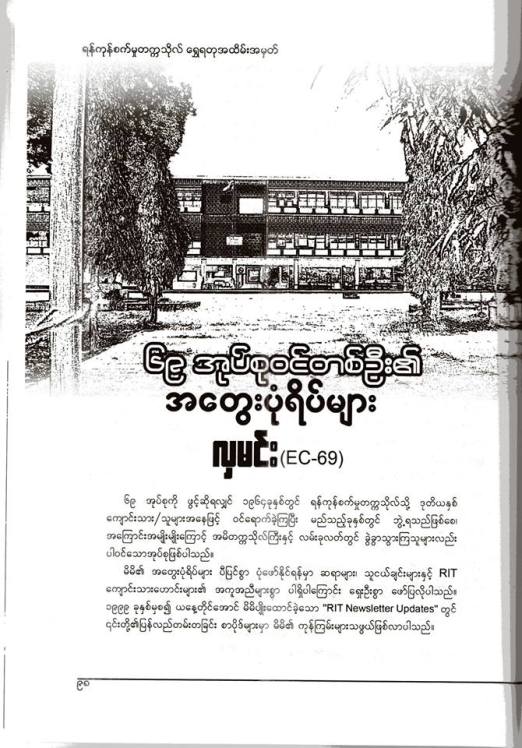
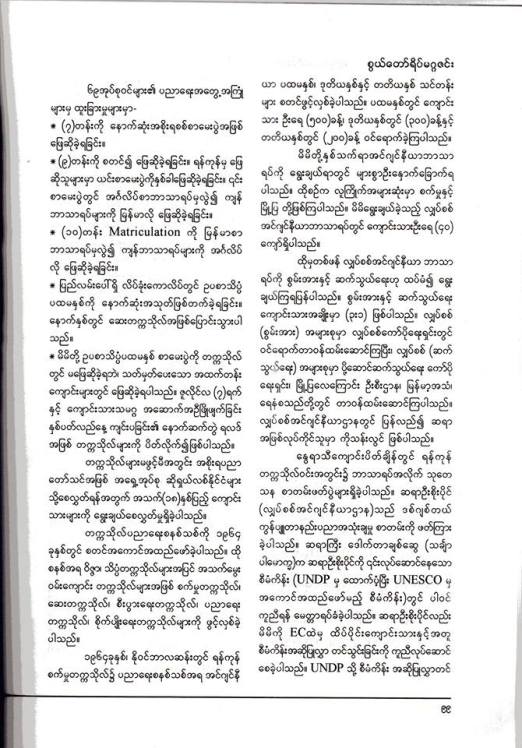
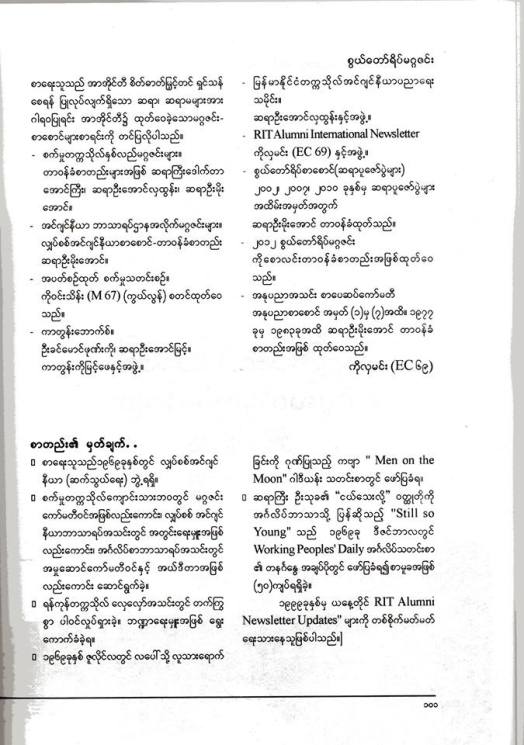
I wrote an article for the Commemorative Issue of Swel Daw Yeik Magazine in 2014 for RIT Shwe YaDu (Golden Jubilee of the then New Education System).
Saya U Moe Aung (Tekkatho Moe War) served as the Chief Editor.
Article 1Article 2Article 3
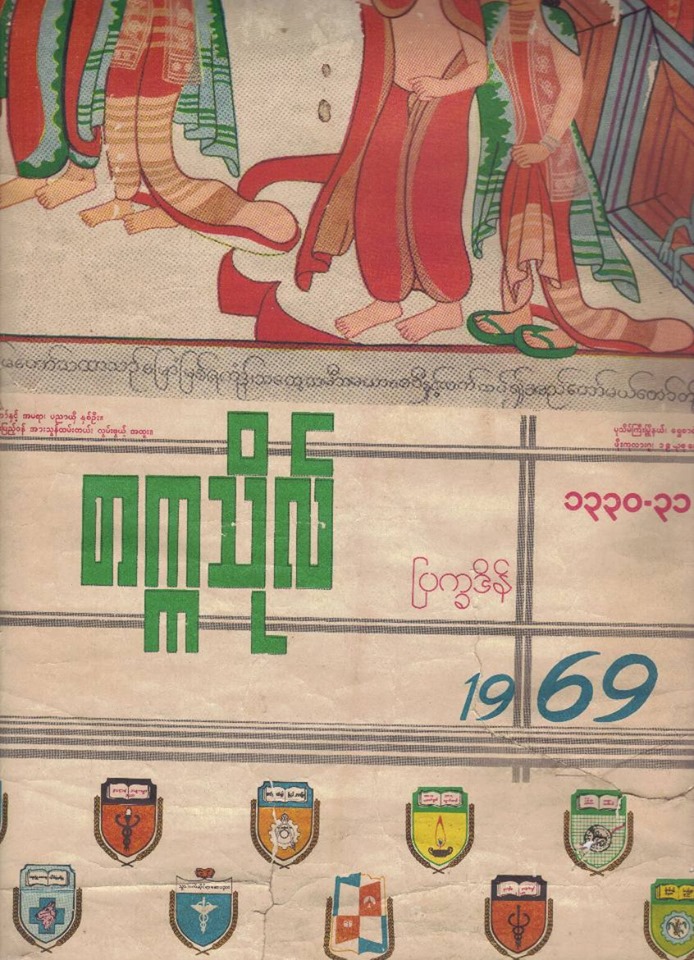
1969 Calendar
Published for the Universities and Institutes
1969 Calendar
Some Memories
Alice visiting the San Francisco Bay Area
Alice visited her son and family in the San Francisco Bay Area
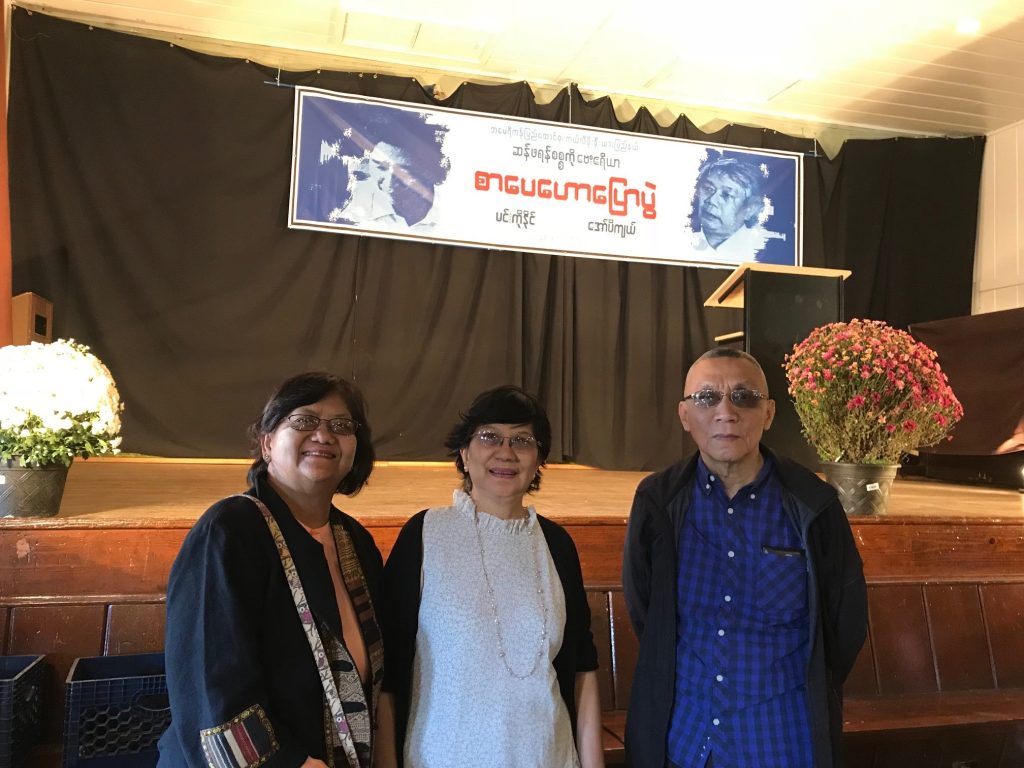
She took time off to attend the Literary Talks by Min Ko Naing and Aw Pe Kye
With Alice
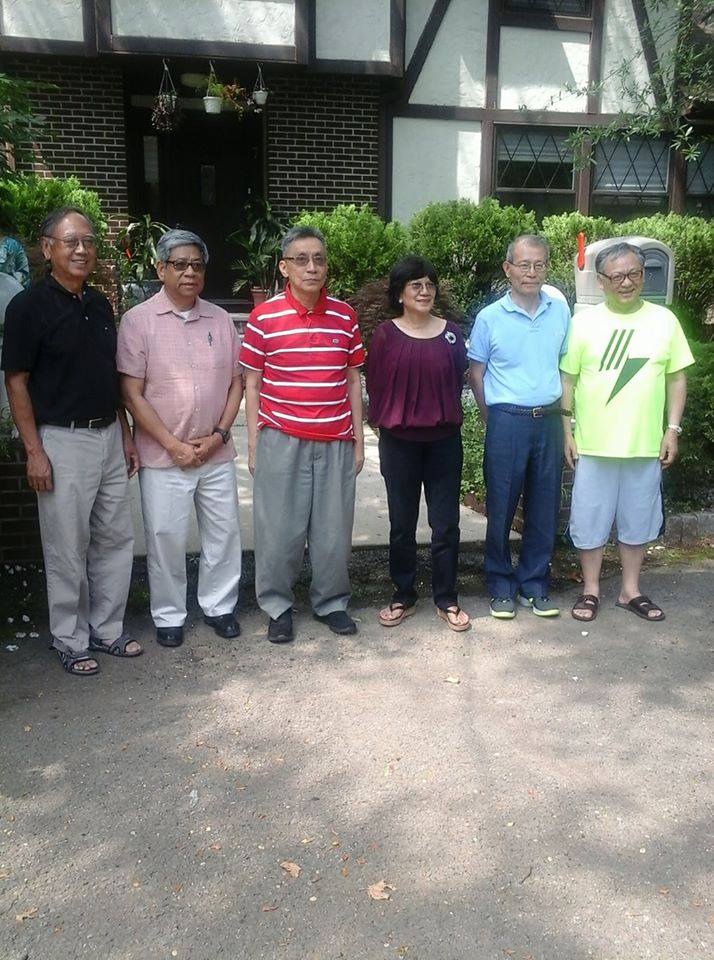
69ers at a gathering hosted by Ivan Lee (New Jersey)
Ivan has hosted annual gatherings at his house for RIT and UCC Alumni.
The timing is chosen to conincide with the visits of Sayagyi Dr. Aung Gyi and Saya U Soe Paing to the area.
Fred (Pennsylvannia), TAG (Massachussetts), HM (California), Alice (Myanmar), Tom (Connecticut) and Ivan (New Jersey) had a mini-gathering.
Ivan is co-founder and Patron of MASTAA (based in New York). MASTAA has broadcast interviews with Sayagyi Dr. Aung Gyi, Saya U Soe Paing and Saya Dr. San Hla Aung. MASTSAA members and friends donated for COVID-19 relief (prevention and treatment) in USA and Myanmar.
Ivan is a major donor to the 69er HCF (Health Care Fund) along with Daw Myint Myint and U Sein Myint.
In New Jersey
Monthly Breakfast Gathering at Taw Win Hnin Si
Before the pandemic, 69ers had monthly breakfast gathering at Taw Win Hnin Si (Royal Rose Restaurant).
At Taw Win Hnin SiMyo Nyunt, Ngwe Soe (Walter), Tin Aung Win (Oscar), Uzin Myo Tun (Bobby), Mehm Aye Chan (Ohn Maung), Soe Thein (Peter), Albert Kyaw Min
Annual Dinner at M3
For several years, the Annual Dinner and Entertainment was held at M3.
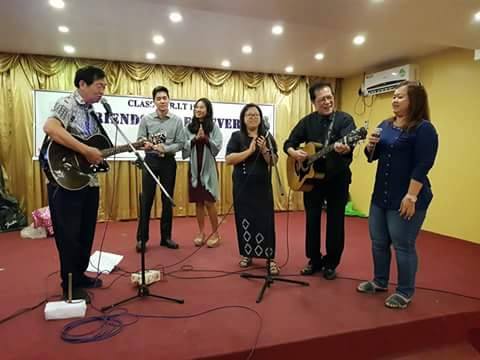
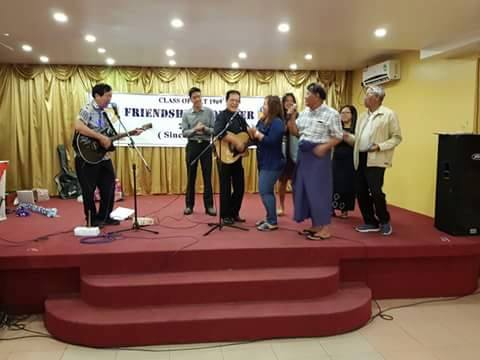
Albert and Danny are two regular performers (guitar and vocal).
Best Friends Forever 1Best Friends Forever 2
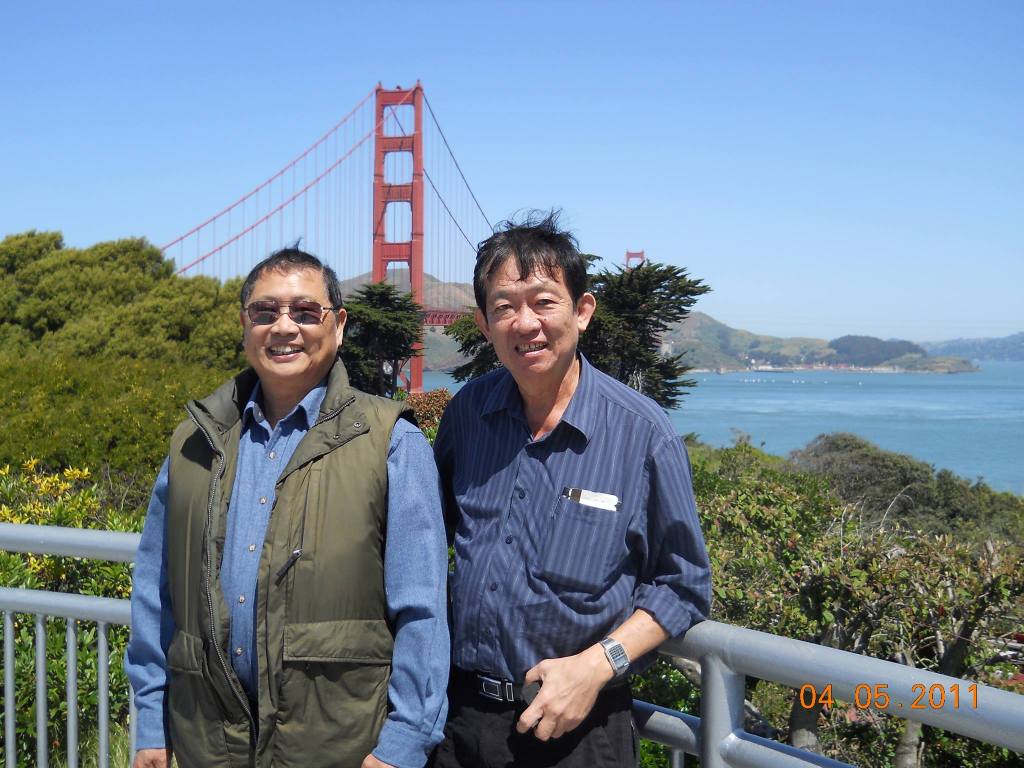
Danny’s visit to San Francisco
Ko Tin Myint (John Lee) showed Danny around the SF Bay Area.
Saya Allen Htay and Daw Mu Mu Kin hosted a dinner for Danny at a restaurant in Castro.
Ko Tin Myint (John Lee) and Ko Tint Lwin (Daniel)
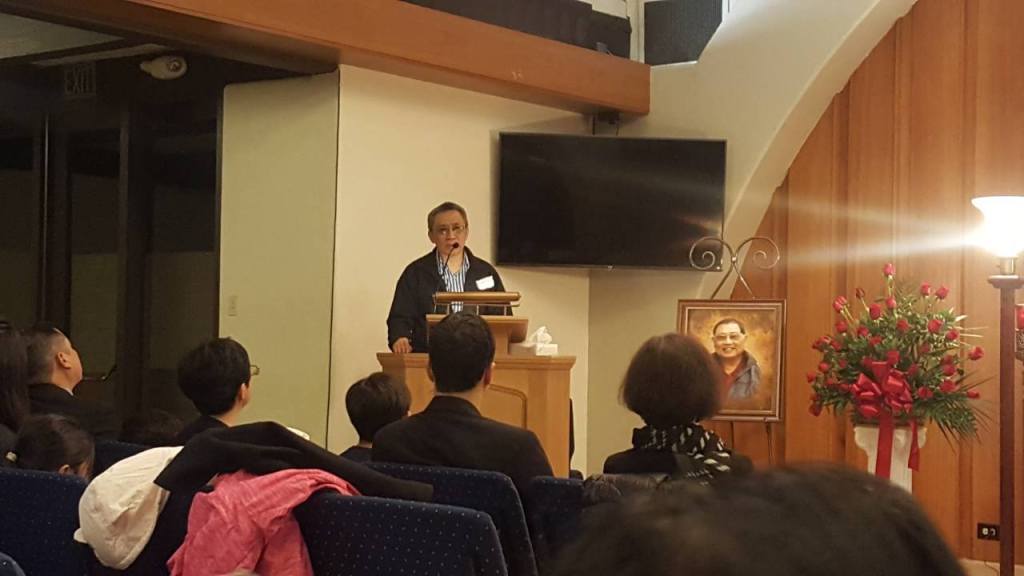
Speaking at John Lee’s Memorial Service
Ko Tin Myint (John Lee) passed away.
His daughter (a medical doctor) requested me to share my memories.
Ko Tin Myint’s Service
Maung Maung Kaung (Yi Pinn) in Dawei
Yi Pinn is busy with his projects in Dawei.
Some time back, his spouse passed away in Yangon. He rushed to Yangon, but had to self-Q. He could not be present at his spouse’s last journey.
He later succumbed to Covid.
Yi Pinn
Donation by Daw Myint Myint
Daw Myint Myint is a major donor to the 69er HCF.
She also hosted or sponsored lunch and dinner gatherings. e.g. Welcome Daw Nyunt Nyunt Wai (Millie) at Westin Park Hotel
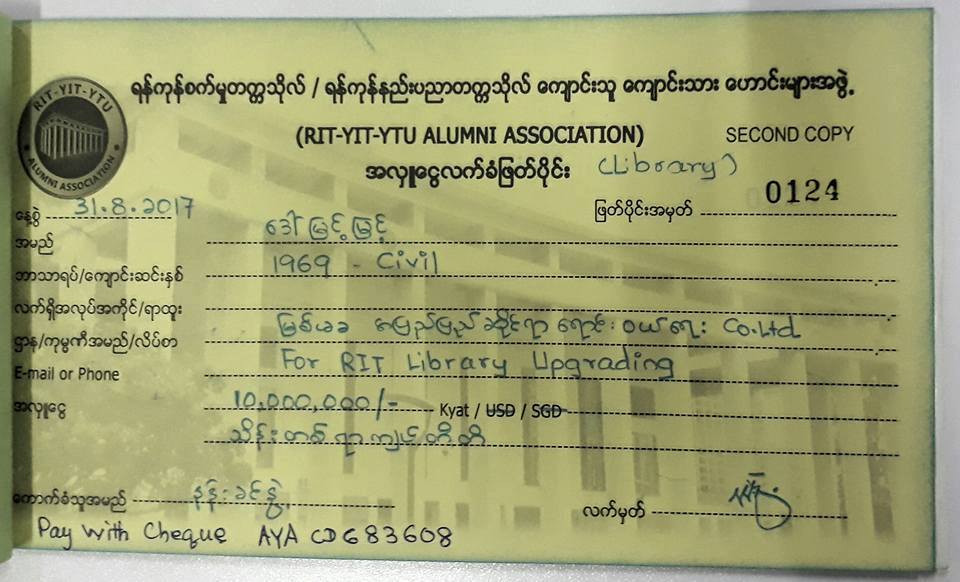
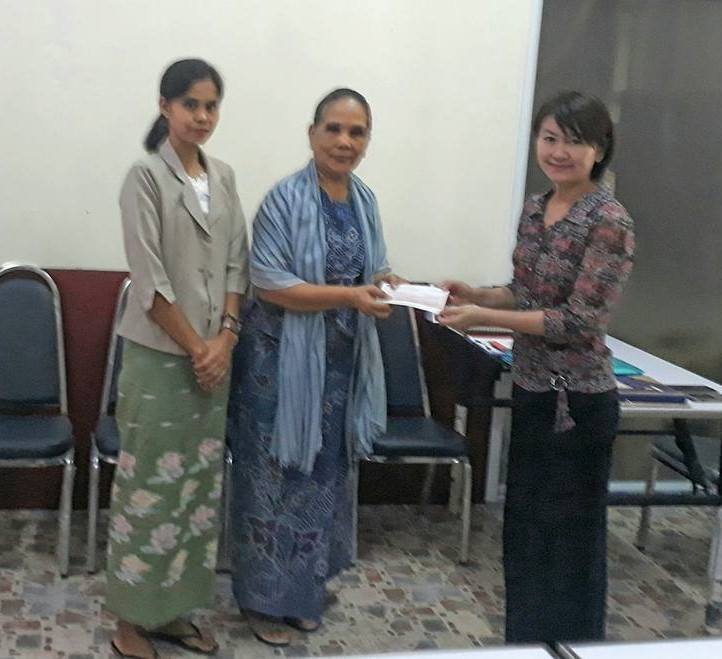
She donated twice for YTU Library Modernization Project. e.g. K100 Lakhs once
Daw Myint Myint’s donation receiptDaw Myint Myint and Nan Khin Nwe
Children : Tin Oo, Glory, Aung Khin (GBNF), Thein Wai
Col. Min Sein (GBNF)
Dean, Medical College
Spouse : Dr. Daw Yin May (GBNF)
Children : Dr. Thein Htut (RUBC Gold), Tin Tin Aye
U Maung Gale (GBNF)
Dean of the Rangoon Medical College from 1959 – 1962
He translated Grey’s Anatomy to Burmese and he handed over the manuscripts to Dr Norma Saw.
U Khin Maung Win (GBNF)
Pathologist
DG ME
Head of Medical Board to examine the people chosen for States Scholar.
Dr. Mya Tu (GBNF)
Dr. Mya Tu
Founder-Director of Burma Medical Research Institute (BMRI) which later became DMR.
Compiled the Magnum Opus (“Who’s who in Medicine in Burma?”) with his spouse Khin Thet Hta.
Passed away in Australia
Dr. Tin U (GBNF)
He initiated the study of Pediatrics in Burma as a separate discipline.
Medical Superintendent of Rangoon Children’s Hospital.
Dr. P. R. Mohan (GBNF)
Dr. Mohan
He served in the Burma Army Medical Corps from 1939 – 1945 as a medical officer in Burma theater, and discharged as a Major at the completion of World War II.
He passed away in USA in 2005. He was 88 yrs old.
Dr. Mohan & Dr. Daw Hnin Yi
Dr. Mohan and Dr. Daw Hnin Yi (Rosie) are remembered by several former students and colleagues.
Dr. Pe Nyun (GBNF)
Pe Nyun & Pe Thein at 1948 Independence Day Regatta
Past Captain and Gold, RUBC
Pediatric Surgeon
Led team to operate conjoined twins (Ma Nan Soe & Ma Nan San)
Passed away in Canada
Dr. Pe Thein (GBNF)
RUBC Gold
Professor
Retired Minister of Health and Education
Dr. Htut Saing (Harry Saing, GBNF)
Dr. Harry Saing
Second Lead to operate conjoined twins (Ma Nan Soe and Ma Nan San)
All-round athlete : Burma Selected in Cricket, Hockey & Rowing
Past Captain & Gold, RUBC
1958 ARAE Champion for Coxless Pairs
1960 ARAE Champion for Coxed Fours
Worked at RCH and Hong Kong
Passed away in Hong Kong
Siblings : Sheila, Victor, Shirley
Dr. Daw Khin Than Nu (GBNF)
Pioneer of Neonatal Care in Burma/Myanmar
She regularly attended the IM(1) Saya Pu Zaw Pwes.
She left to visit her son Ko Win Htut in the USA. When she passed away, Ko Win Htut gave a soon kwyay in her memory at Mettananda Vihara.
Dr. Thein Toe (GBNF)
Headed Nutrition Research at BMRI / DMR
Spouse : Khin Thitsar
Passed away in UK
Dr. Thein Toe and Dr. Htut Saing (Harry)
Dr. Kyaw Win (GBNF)
Army Doctor / Bogyoke
Ambassador to UK and US
Spouse : Kyi Kyi Chit Maung (GBNF)
Sons : Htut Kyaw Win (GBNF), Aung Kyaw Win
Dr. TheinHtut
RUBC Gold
Moved to Australia
Spouse : Wendy Sein
Dr. Nyunt Win (Eddie Tha Win, GBNF)
Neurologist
Moved to Australia
Spouse : Marie Yu Khin (GBNF)
Dr. Daw Kyin Yee (GBNF)
Worked in Myanmar before following her spouse Saya U Kyaw Myint (M/Auto64) to Beijing where he was working for UN.
Relocated to USA and volunteered for meditation retreats.
Dr. Aung Khin Sint (GBNF)
Medical doctor with a passion for “Public Health”
Won the National Literary Award for his book on the “Awareness and Prevention of Diseases“
Deputy Director with the Ministry of Health
Led protests in the 8-8-88 movement
Vilified for his criticism of the “unconstitutional” proposals and for running as an MP for the NLD in the 1990 elections
Dr. Khin Maung Gyi (Kevin, SPHS59)
The Gardener
(A tribute to all teachers)
Let me introduce to our teacher Who is also a guardian and preacher Guiding and nurturing from a youthful age To raise us up with a healthy image.
As soon as the morning bell tolls He started his routine – heart and soul Never does he skips a single day Sickness and malady are kept at bay.
He may be tired, his voice may whimper His zest and zeal, nothing gets dimmer Never to be seen in fits or rage Happy and contented on not so high a wage.
His loving kindness is like a mountain Goodwill from him flows like a fountain He looks after us as one of his own His empathy towards us is very well known.
Hearing the success of his ‘daughters and sons’ He beams as though ‘a war was won’ He is now overjoyed and highly thrilled His life seems to be thus fulfilled.
Dr. Thane Oke Kyaw Myint (SPHS60)
TOKM 1TOKM 2
He was the top Paulian in his class, and stood Sixth in the Matriculation exam.
He founded the group “Alumni of the Institute of Medicine in Myanmar (Overseas)” and wrote about his mentors (Aba U Hla Myint, Dr. Tin U) and other trail blazers.
His former students published a book for his 70th birthday.
Dr. Min Lwin (SPHS60)
Orthopedic Surgeon
Dr. Than Toe (SPHS60, GBNF)
Rehabilitation
Dr. Kyaw Win (SPHS61)
Also known as Robin Ban
Stood 2nd in Burma
Moved to Australia
Dr. Khin Maung U (SPHS63)
SPHS
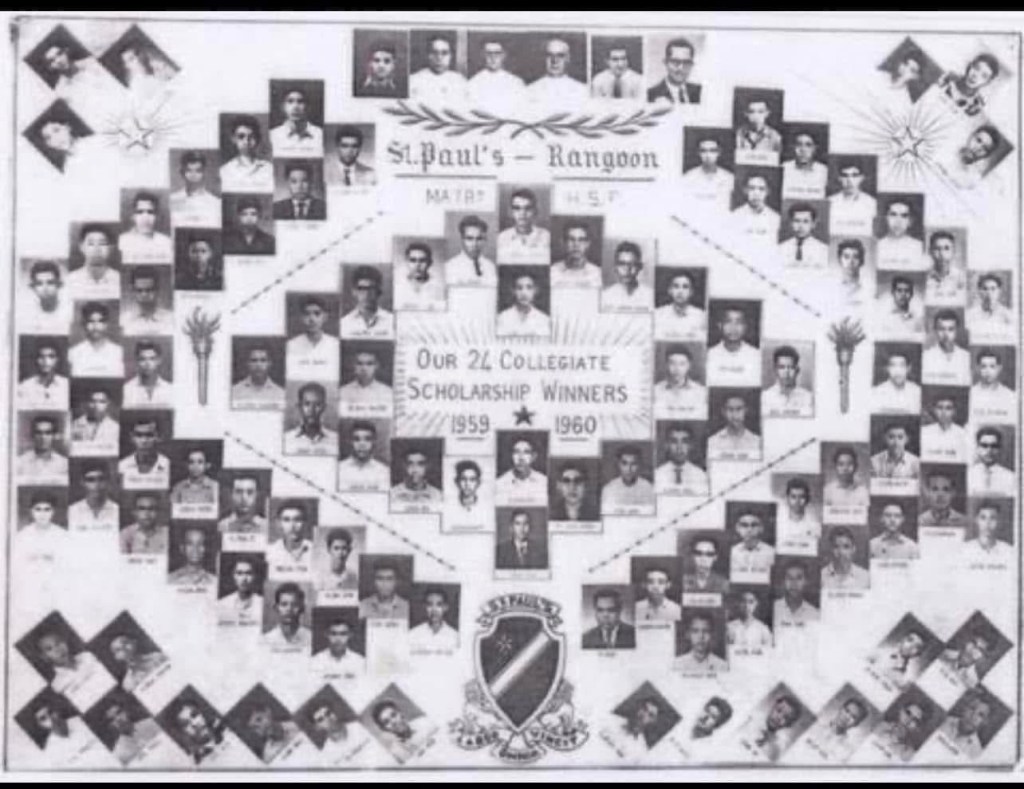
Stood 1st in Burma. First student to have almost perfect score in Mathematics, Chemistry and Physics with 299 marks out of the possible 300. Grapevine says that Chief Examiner of Physics reluctantly took back a mark.
Retired from FDA
Sharing KMU Medical Reports
Scholarship Winners
Dr. Myo San (Freddie, SPHS63, GBNF)
Stood Third in Burma
Took early retirement as Surgeon
Dr. Nyunt Wai (Victor, SPHS63)
Stood Fourth in Burma
Retired as Professor of Physiology
Taught at IM and Malaysia
Hobbies : Painting, Writing, “Sagar Pari Ye”
Dr. Thein Wai (SPHS63)
Stood Fifth in Burma
Moved to USA after graduation
Dr. Aung Kyaw Zaw (Johnny Mg Mg, SPHS63)
Stood Ninth in Burma
Army Doctor / Cardiologist
Dr. Khin Maung Zaw (Frank Gale, SPHS63)
Stood Seventeenth in Burma
Retired Medical Doctor / Examiner / Registrar (in UK)
Dr. Aung Win Chiong (SPHS64)
He had the second highest “raw” score behind Dr. Cherry Hlaing and Dr. Lyn Aung Thet. He had a perfect ILA score and was admitted to IM(2) as Roll Number One.
He is now retired. His spouse Dr. Winnie Tan is co-founder of USA Con-Bro Association.
Dr. Min Lwin (Maurice, SPHS64)
Admitted as Roll Number Two to IM(2)
Surgeon (with Practice in UK and Myanmar)
Dr. Yi Thway (Edwin, SPHS65, GBNF)
Fifth highest marks
He was admitted as Roll Number (1) to IM(1).
Passed away in UK
Dr. Paing Soe (Freddie, SPHS65)
He had the same marks as Dr. Yi Thway.
He was admitted as Roll Number (2) to IM(1).
Medical Research
Thanks to TOKM (Dr. Thane Oke Kyaw Myint) and VNW (Dr. Victor Nyunt Wai) for their input and feedback.
Dr. Mya Tu (GBNF)
He founded Burma Medical Research Institute (BMRI). BMRI later became Directorate of Medical Research (DMR). DMR had branches in Upper and Lower Burma.
He served as Director General.
He was a physiologist.
He and his spouse compiled a directory of medical professionals in Burma.
He passed away at the age of 91 in Australia.
Dr. Thein Htut and Dr. Thane Oke Kyaw Myint gave eulogies at Saya’s service.
Dr. Aung Than Ba Tu
He is fondly known as ATBT.
He succeeded Dr. Mya Tu.
He requested UCC to give lectures on computing at BMRI. I was a Guest Lecturer.
In his 90s, he is still active, giving talks and participating in the editorial team of a certain journal.
Dr. Khin Maung Tin (GBNF)
He was MS of the Rangoon University Sanatorium.
He succeeded Dr. ATBT.
He specialized in liver diseases
He passed away the earliest (heard it was a heart attack)
survived by Dr Daw Htay Kyi, a TB specialist.
Dr. May May Yi (GBNF)
I met Sayama at the Inlay Luyechun camp in the summer of 1965.
She is a physiologist.
She was Professor of Physiology at the Institute of Medicine.
She became DG at BMRI.
Dr. Than Shwe
He is a microbiologist.
After retirement, he moved to USA.
He stays active by guiding high school students for their SAT tests.
Dr. Paing Soe
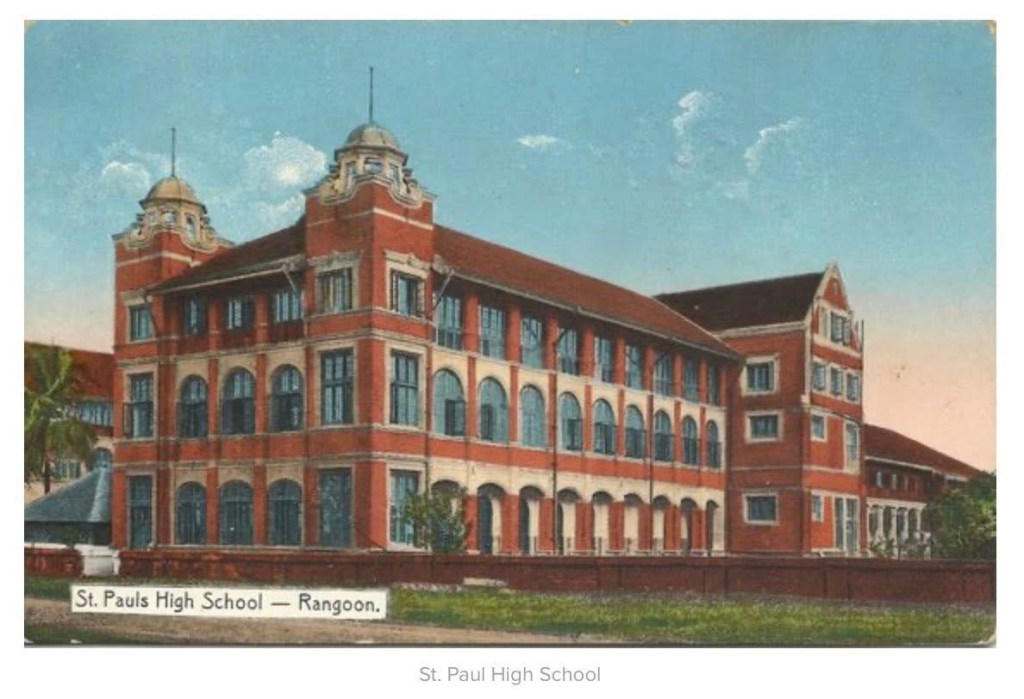
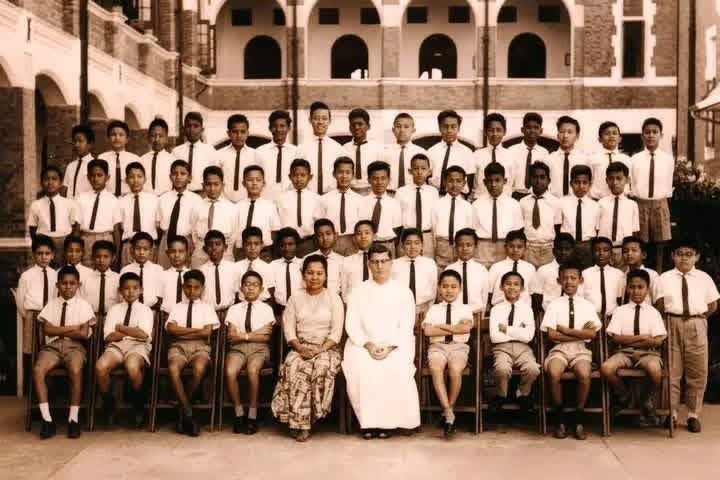
He matriculated from St. Paul’s High School in 1965.
He was selected Luyechun.
He was DG of DMR.
He retired as Deputy Minister of Health.
Researchers
Dr. Thein Toe (UK, GBNF)
Dr. Cho Nwe Oo
Dr. Khin Kyi Nyunt (GBNF)
Dr. Khin Maung U (FDA, USA)
Dr. Kyaw Min (Retired as Acting DG)
Group photo : Young researchers (BMRI- DMR)
Medical Researchers
L to R: U Aung Myint, Dr Htay Htay, Saya (Prof Mya Tu), Dr Myo Thein, U Ba Aye (statistician), Dr Pe Thaung Myint (sports medicine), Dr Htin Kyaw (physiologist).
I am trying to emulate their philanthropy by sharing my knowledge & expertise.
Sharing Knowledge & Expertise
Jack of All Trades; Master of Some
Proponent of Youth Leadership
Sharing Knowledge & Expertise gained as
Software Engineer / Craftsman
Consultant
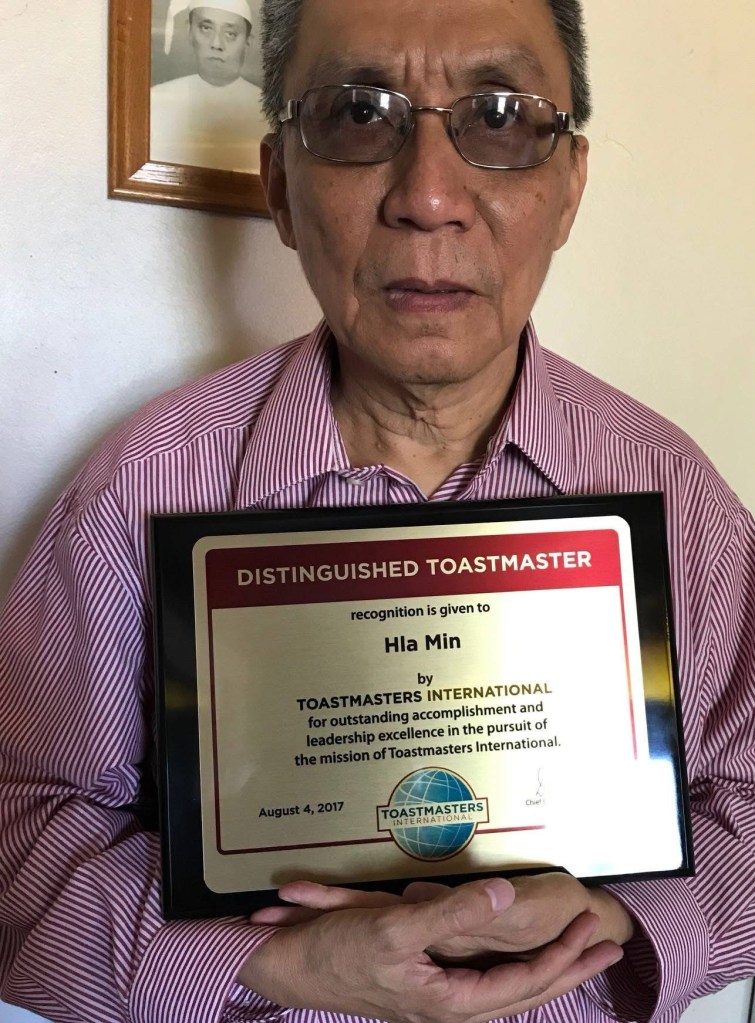
Distinguished Toastmaster
Author & Blogger
Translator & Interpreter
Editor of newsletters & books
Folklorist & Historian
Recording history of our beloved land
Love history
HMEE TeamHMEE Book
Was Member of “History of Myanmar Engineering Education Project”. U Ohn Khine (M70) & I compiled CD supplement for HMEE book.
Was Docent at the “Computer History Museum” in Mountain View, California, USA.
CHM
Published 2500+ posts
Broadcast 220 Short Talks from August 2020 to February 2021. Can be viewed using @hmin3664 on YouTube
YouTube Channel for my videos
Hope that my posts &videos will be helpful to scholars and historians in Myanmar and beyond.
Wrote articles, reviews, poems & translations for
National Foreign Language Center at University of Maryland, College Park : Burmese Language Lessons (Listening and Reading)
Encyclopedia of Asian American Folklore and Folklife ABC-CIO Press : Can access my articles from Google Books.
Encyclopedia
MoeMaKa : Online Publication
RIT Alumni Newsletter : from April 1999 – present
RIT Alumni Newsletter for SPZP-2000
Swel Daw Yeik Sar Saung : Poems for SPZP-2002 & 2007; Article in SPZP-2010
SDY Sar Saung for SPZP-2002
Swel Daw Yeik Magazine : Article for Shwe Yadu 2014
SDY Magazine for Shwe YaDu 2014
History of Myanmar Engineering Education : U Ohn Khine (M70) & I compiled CD Supplement for HMEE Book
CD for HMEE Book
BAPS Newsletter : Contributing Editor
BAPS Newsletter
Dhammananda Newsletter : Contributing Editor for Dhammananda Vihara, Half Moon Bay, California & Theravada Buddhist Society of America (TBSA)
Dhammananda Newsletter
Paying Homage to Sayadaw U Silanandabhimvama : Contributing Editor & Member of Publications Committee
Homage to U Silananda
Rangoon University Boat Club : Contributing Editor for 90th Anniversary Issue
RUBC Magazine
Guardian Newspaper : Poems (e.g. Men on the Moon); Articles (e.g. Computers and Applications) in English
Men on the Moon
Working People’s Daily (WPD) : Poems (e.g. Phaung daw-u Festival); Translation (e.g. Still So Young) in English
Phaungdaw-u Festval
Forward Magazine : Poems (e.g. To the Fallen Warrior) in English
To the Fallen Warrior
Veda Magazine (ဝေဒ) : Articles for Burma Astro Research Bureau
Pan Magazine (ပန်) : Articles in Burmese
High School Mathematics Project : Member of Editorial Team
Team of System Specialists : Computer Education & Application
Set Hmu Thadin Zin (စက်မှုသတင်းစဉ်) : Short notes
Hlyat Sit Sar Saung (လျှပ်စစ်စာစောင်) : Article for RIT EE
I have volunteered for
Computer History Museum
History of Myanmar Engineering Education Project
Toastmasters International
SF Bay Area ACM Chapter
2010 Census Count Committee
RIT Alumni International
NorCal RIT Alumni Association
Tathagata Meditation Center
Theravada Buddhist Society of America
Souvenirs
Dream Big or Small
“If one person can dream, others will fulfill”
The saying is attributed to Jules Verne who dreamed & wrote about space ships, submarines, and travel around the globe.
My Earlier Dream
SPZP-2000
Was to connect or re-connect Sayas, Colleagues & Friends physically and electronically.
We successfully organized the First RIT Alumni Reunion and Saya Pu Zaw Pwe in San Francisco, California in October 2000.
Six more World-wide Reunion and SPZP took place. Singapore in 2002, 2007 & 2010. Yangon in 2004, 2012 & 2016. Due to pandemic, SPZP-2020 was canceled.
Started RIT Alumni International Newsletter in April 1999.
Served as Content Provider & Editor for ex-RIT websites : first one by KMZ (UKhin Maung Zaw, now retired from Microsoft) and second one by Wunna Ko Ko (then at SAS).
Both ex-RIT websites are now inactive.
My Later Dream
Was to record Oral & Written History of our Alma Mater and our Beloved Land.
Set up hlamin.com (to archive old posts, add new posts and revise selected posts).
Requested SPZP-2000 Organizers, interested sayas & alumni to record gatherings.
Requested Subject Matter Experts & interested readers to review and enhance selected posts.
The 1969 RIT Graduates Reunion was held in Rangoon/Yangon, Burma/Myanmar on Saturday, 20 February 1999 at Sait-Teng-Kya Restaurant near Kandawgyi lake.
Idea
The idea was mooted three years ago when a few of us were having dinner together and thought of having a gathering in 1999. After that most of us have forgotten about the idea until around the end of November 1998 when a group of our friends led by Ko Yee Pinn (Tavoy), Ko Myint Maung (aka “Bu”, RIT Volleyball selected), Ko Shwe, Ko Win Lwin, etc. decided to have a grand re-union in February 1999. They also decided that to be more meaningful we should invite our Sayas to pay them respect as well and, hence, it became the reunion cum Saya-ga-daw-pwe.
Attendees
On that very day the guest trickled in starting from about 4.00 p.m at the restaurant. The guests were required to fill in their names and contact numbers. The organizers promised to compile the name list and send to everybody who attended. By 6.00 p.m. about 30 Sayas and about 120 of our graduates were in the restaurant. The master-of-ceremony, Ko Win Lwin, announced the start of the ceremony.
Speeches
The programme started off with a few speeches, led by Nyi Hla Nge, representing the graduates in Rangoon, followed by Danny, representing the graduates overseas, Sai Aung Win, representing graduates outside Rangoon and last but not the least, by Saya U Kyin Soe, representing all the Sayas.
Paying respect
After that we gave respect to the Sayas. All the Sayas were seated on the stage and all of us sat on the floor. Some gifts were distributed to the Sayas followed by photo taking session and then the sumptuous dinner began.
Dinner & Entertainment
About 9 to 10 dishes were served but, most of us were too excited to notice what we were eating. Halfway through the dinner some of us went up the stage and sang some songs for entertainment. Even all the ladies, led by Alice and Naw Mu Mu Aye were on the stage as well. The crowd went wild.
Vow
The party ended at about 9.30 p.m. with some of the graduates not so sober. It was indeed a memorable gathering and we all vowed to meet again in December 2000 at place and date to be announced early next year. Three cheers to the organizers and those who have one way or the other help in making this event a great success.
1969
Updates
How time flies.
The Class of 69 celebrated the 30th anniversary reunion in 1999. The correspondence (Ko Daniel Tint Lwin, Ma Alice Saw Yu Tint, …) was partly responsible for the establishment of the “RIT Alumni International Newsletter” and the first ex-RIT web site.
40th Anniversary Reunion in 2009
2009
Golden Jubilee of Admission in 2014
2014
Golden Jubilee of Graduation in 2019
2019
U Aung Min (M69) is Chair of 69er Health Care Fund. He and his team maintain the GBNF list.
GBNF
Several Octogenarians — U Tin Maung, Harry Tin Htut, Uzin Bobby, Uzin Aung Chaw, U Ngwe Tun, U Win Thein Zaw, U Ngwe Soe, Albert Kyaw Min, Mehm Aye Chan, U Kyaw Zin, Robert Win Boh, U Tin Aung Win …
This is a belated report of my wife Gandasari’s (“Riri”) and my visits with Brother Charles Everard in Liss (Hampshire, England) and Brother Felix (Albert Gissler) in Illertissen (Germany). Technical and other problems got in the way, delaying this report.
Saturday, 7 July 2007
After attending Dora Than E’s funeral in Oxford, followed by a reception at St. Hugh’s College (Aung San Suu Kyi’s alma mater), our friends Ken & Marion Freeman of Pershore, drove us through the English countryside to Liss, Hampshire. It was a pleasant 2.5-hour drive on uncrowded roadways. (Some of you may recall Aunty Dora as the recording artiste of yesteryear whose professional name was Beelat-pyan Than.She later worked for the United Nations, beginning at its founding in 1948 at Lake Success, New York. Had she survived her final fall, she would have turned 100 on 16 February 2008.)
Clayton Court, the De La Salle Brothers retirement community at Liss, is a beautiful 22-acre estate with gently manicured lawns, gardens, and gorgeous views of the rolling hills. There are three large structures on the gated property. It is a place with spirit, where one’s soul is rejuvenated. The Fratres Scholarum Christianarum, (Christian Brothers), acquired this estate, once owned by a wealthy gentry, in 1974. The other FSC retirement home in England is located in Manchester.
We arrived at Clayton Court about 5:45 P.M. The place was abuzz with staff, volunteers, and neighbors who were preparing for a party for one of the brothers’ 70th birthday. The brothers were in the chapel doing devotions. Becky, a staffer, who was my contact, was most gracious. There was another staffer whose forearms were heavily tattooed. “Were you in the royal navy?” I asked. “Yes,” he said with a glint in his eyes. “I was a cook on the aircraft carrier Ark Royal,” he answered with pride. The two were most welcoming and amiable. From them, I took comfort that the brothers were living and eating well.
When prayers were over, Brother Director Joseph Hendron wheeled Brother Charles out of the chapel. I recognized the former right away even though I had not seen him since 1979 when my De La Salle, and later St. Paul’s classmate, Brother Patrick Minus, and I visited him at the Brothers’ Mother House in Rome. I do not know whether Brother Charles recognized me, but he broke out in a big smile when I greeted him in Burmese. At 89, dementia has diminished much of his memory and affected his speech. I helped him eat some of the goodies that were generously spread out on the table. He uttered a few words in Burmese: “taw bee, …yay ne ne thauk chin de,” (တော်ပြီ။ ရေနည်း နည်း သောက်ချင်တယ် enough.., want to drink a little water), etc. I spent the rest of the afternoon with Brother Charles and the other party goers until the celebrants faded away.
Brother Director Joseph is truly a personification of tremendous love and patience. He was most gracious. He made us feel very welcome. We were accommodated in comfortable guest rooms which commanded beautiful views of the estate.
Sunday, 8 July 2007
Riri and I took a leisurely stroll on the estate as the sun shone over the countryside. At breakfast, I sat on Brother Charles’ left while Brother Joseph occupied the end seat on the right. Both Brother Joseph and I helped Brother Charles with his breakfast. His appetite was good.
Breakfast over, I wheeled Brother Charles back to his room. The room was nicely decorated with Burmese and other memorabilia. There was a large framed photograph of a much younger Brother Charles of his Burma days. (I recall seeing him in 1959 at the Kalaw Railway Station as he hopped on to the steam locomotive. “I always ride in the gaung dwe (locomotive),” he harked, as the train pulled away towards Thazi. He was happy as a lark. (Riri and I were teachers at Kalaw’s Kingswood School that year).
Bidding Brother Charles adieu was difficult. I had known him when we were both young long years ago at a place so far away.
We took leave of Brother Joseph and the other Brothers later that morning. Ken and Marion drove us to Liphook from where we boarded the National Express coach for London’s Victoria Station. (Marion and I began our friendship as pen pals when we were both 16. I was then at Woodstock School in the Himalayan town Mussoorie, India, in 1950).
Brother Charles with U Kyaw WinClayton Court, Liss, Hampshire, England
Monday, 9 July 2007
After spending the night in London, we flew to Frankfurt, arriving there in the evening. We bedded down at Hotel Manhattan, conveniently located across the street from the Frankfurt bahnhoff (railway station).
Tuesday, 10 July 2007
The train from Frankfurt took us to Ulm where we changed for Illertissen. It was raining when we got there in the afternoon. We started to walk towards Kolleg der Schulburder. A kind gentleman picked us up along the way and drove us to the Kolleg, sparing us from getting wetter. (He did not speak English. We did not speak German. But the language of the heart transcends all tongues). Brother Felix, who is known as Brother Albert at the retirement home, was brought out to a waiting room. He walked with the help of a stick, and a walker, alternately. He was as happy to see us as we were to see him. (I had last seen him, and Brother Peter, over thirty years ago, in Germany). His first words were: “You look like your father.” What a compliment!
Once he got warmed up after muttering a few words in German, the talk gushed out. He talked and talked, recalling his days in Burma; as a prisoner in Dehru Dun (India) and Insein Jail; De La Salle, St. Paul’s.Dinner that evening was at a restaurant. When Brother Felix noticed a paunchy man sitting at the next table, he remarked: “Baik pu gyi,” (ဗိုက်ပူကြီး paunchy fellow), a mischievous glint in his eyes.
Because guest accommodations at the Kolleg der Schulbruder were occupied by a visitor from Rome, we lodged at Hotel Vogt for the next two nights.
This was also Riri’s birthday. I snuck out of the hotel quietly and walked the streets of tiny Illertissen in search of a bakery. But it had shut down for the night. I was fortunate to get a cake from a restaurant just as it was closing. With the help of the hotel’s staff, I was able to surprise her.
Wednesday, 11 July 2007
In the morning, we were fetched and taken to Kolleg der Schulbruder where Brother Felix was waiting for us at the breakfast table. But we had just eaten at the hotel. So we nibbled a bit while he ate. After breakfast, he showed us the chapel, grounds, gymnasium, and gardens at the school. There are only lay teachers at the school. The numbers of those entering the FSC are getting thinner and thinner. A section of the campus is partitioned off as a retirement home for the brothers.
A sumptuous lunch prepared by the kitchen staff was served. When he saw the generous fare spread over the table, Brother Felix remarked, “Do they think we are starving?” That was typical of him, wit fully intact.
At 93, Brother Felix is the most senior retiree at the home. He has a comfortable room with an attached bath. “When I die, everything I own can be cleared out of this room in ten minutes,” he said.
After a brief rest, another non-English speaking brother drove us around that charming Bavarian town. Sightseeing ended after visiting the graves of Brothers Fulbert and Peter in the well maintained cemetery. A section of the cemetery is reserved for brothers and priests. The graves were well tended, a profusion of flowers growing on them.
Afterwards, we were driven back to the hotel where a teary Brother Felix hugged and kissed us before he was driven back to the retirement home. “Pray for me,” he asked. “I pray for all the people of Burma,” were his parting words.
Bidding Brother Charles and Brother Felix at their respective retirement homes was very difficult. Brother Felix was only 18 when he left his family and country to go to Burma as a missionary with the (French) Christian Brothers Order of the Roman Catholic Church to serve a lifetime as a teacher. But it gave me joy that I could honor these two teachers in the sunset of their days. “Parting is such sweet sorrow…”
If there is one word that comes to mind which describes these two brothers retirement communities, it is COMPASSION, of which there was an abundance.
Brother Felix at Kolleg der Schulbruder_1, Illertissen, Germany, July 2007Brother Felix at Kolleg der Schulbruder_3, Illertissen, Germany, July 2007Brother Felix with U Kyaw Win_1, Illertissen, GermanyBrother Felix with U Kyaw Win_2, Illertissen, GermanyBrother Felix at Kolleg der Schulbruder_2, Illertissen, Germany, July 2007Brother Felix with Gandasari and U Kyaw Win, Illertissen, Germany, July 2007U Kyaw Win at Bro. Fulbert’s grave, Illertissen, Germany, July 2007U Kyaw Win at Bro. Peter’s grave, Illertissen, Germany, July 2007
I thank Margaretha Sudarsih (“Menuk”) for blogging this report for me.
The holy season of Christmas is upon us. May peace, joy, and good health of both body and mind be yours. UPDATE: Brother Charles passed away on 28 December 2007. May “flights of angels sing thee to thy rest.”
I am yours sincerely, a grateful product of the Christian Brothers schools,
U Kyaw Win 8566 Flagstaff Road Boulder, CO 80302-9531, USA
I am indebted to Thin Saya သင်ဆရာ, Myin Saya မြင်ဆရာ and Kyar Saya ကြားဆရာ
They taught me all I knew.
I would like to thank my mentors who directly or indirectly taught me Communication (Oral and Written) and Languages (English, Burmese, …)
Last but not the least, a zillion thanks to my “Let Oo Sayas” (လက်ဦးဆရာ my beloved parents).
My Parents
Studying Languages
StudyingEnglish
I had to read / study
Tom Thumb’s Essays
A Student’s Companion
Oxford English Dictionary (OED — various sizes and editions)
Chamber’s Dictionary (used in Scrabble tournaments)
Rhyming Dictionary
Word Power / Vocabulary in [six weeks, 21 days, …]
Idioms (book present from my cousin uncle U “Eric” Than Lwin)
They helped me improve my writing and communication skills.
Thanks to all the authors, who are my implicit teachers.
Still learning (especially during the “Shelter at Home” due to the COVID-19 Pandemic)
Listen to the daily offering by Blinkist.com
Listen and/or read Merriam Webster’s wotd (word of the day) pod cast
Miscellaneous
See posts on “Myanmar Sar“
See posts on “Pali“
See posts on “Languages“
Studying Computers
Dr. Chit Swe (GBNF)
Dr. Chit Swe
Sayagyi was my mentor at UCC.
He invited over renowned computer scientists [led by Professor Harry D. Huskey, Pioneer in Computer Hardware, Software and Teaching] and mathematicians [e.g. Professor Frank Harary, Expert in Graph Theory] to Rangoon to hold seminars and to design courses in computer science and applications. Michael Stonebraker (then at UC Berkeley) gave a short course on Ingres (an early Relational Data Base Management System) at UCC. A few years back, he won the prestigious “ACM Turing Award” (which is considered as the equivalent of Nobel Prize in Computing).
He taught us to use CPM/PERT (Critical Path Method/Programme Evaluation and Review Technique) for the various projects.
Saya asked me to assist in several of his projects. To name a few, I was a translator/ reviewer for CTK (Children’s Treasury of Knowledge) I served as an editor for “High School Mathematics” I was a member of TOSS (Team Of System Specialists)
Saya passed away in November 2019, but his Legacy as Pioneer for Computer Systems, Application and Education in Burma will last forever.
Sydney 2006
U Soe Paing(EE, UCC)
U Soe Paing
Saya was my mentor at RIT and UCC.
Together with Saya U Myo Min and Saya U Ko Ko Lay (GBNF), they taught degree and diploma courses in computer science, and also conducted courses in computer programming, computer orientation, to name a few.
The sayas asked me to be their assistant.
Saya U Soe Paing also allowed Saya U Aung Zaw and me to co-author texts, guides and manuals used at UCC.
Publications
Guardian Thanks to U Soe Myint (Chief Editor)
Working People’s Daily (WPD) Thanks to U Ko Lay (Chief Editor) and Daw Khin Swe Hla (Editor)
Forward magazine Thanks to Bohmu Ba Thaw (Maung Thaw Ka, Chief Editor) and U Sein Hla (Editor)
Pan magazine Burmese publication
Veda magazine Published by BARB
Swel Daw Yeik Sar Saung Commemorative Issues for SPZP-2002, SPZP-2007 and SPZP-2010 in Singapore Thanks to Saya U Moe Aung (Tekkatho Moe War)
Swel Daw Yeik Magazine Commemorative Issues for SPZP-2012 and Shwe YaDu (2014) Thanks to Saya U Moe Aung (Tekkatho Moe War)
RUBC magazine Commemorate issue for 90th Anniversary of the founding of RUBC
BAPS Newsletter Contributing Editor
Dhammananda Newsletter Contributing Editor
Paying Homage to Sayadaw U Silananda Contributing Editor
Encyclopedia of Asian American Folklore and Folklife Contributor to the Burmese American section
National Foreign Languages Center Language Expert for the Burmese Language Project (Reading and Listening Comprehension)
RIT Alumni International Newsletter Contributing Editor for 21 years
hlamin.com 3000+ articles
Facebook Owner, Admin or Moderator of selected Facebook Groups
VideoBroadcasts Archived in Facebook and my You Tube Channel
Volunteering
I gained experience by volunteering as
Several organizations in Myanmar and USA
EC, Joint Secretary and Secretary of RIT EE Association
Contributing Editor of RIT English Newsletter
Treasurer and Vice Captain of RUBC
Translator / Interpreter at Meditation Retreats
Organizer, SPZP-2000
Coordinator, World wide SPZPs in Singapore and Myanmar
Docent at the Computer History Museum (at Mountain View, California
Contributing Editor of the materials taught at the Summer Dhamma Camp at Dhammananda Vihara (at Half Moon Bay
Area Governor, Club Coach, Contest Chair, Test Speaker, Club Ambassador at Toastmasters International
Editor of several publications by Sayadaws (e.g. U Jotalankara) and friends (e.g. U Aung Zaw)
Language expert at National Language Center
Administrator and/or Moderator of selected Facebook Pages
Owner and content creator of selected web sites (e.g. hlamin.com)
Parents and Ancestors
Last but not the least, my heartfelt thanks to my beloved parents and their philanthropic forebears for instilling me the passion to help humanity in general and to my alma mater. They believed that “Any thing that’s worth doing is worth doing well.”
Pay Back
My beloved spouse told me that I should pay back to my alma mater, mentors and my beloved land.
She reminded me that I should take care of my health to enjoy quality time with our Life Savers : Chit Sa Noe ချစ်စနိုး and Po Lone ဖိုးလုံး
I had paid back to my alma mater RIT where I studied from 1964 – 1969 by volunteering as Messenger and Organizer for 21 years. e.g. For SPZP-2000, I wrote 64 “Countdown to the Reunion” and 36 “Post_Reunion”.
In 2018, I wrote “Memories of UCC” . I wrote a Summary for the magazine to commemorate the 30th anniversary of ICST.
To commemorate the 19th anniversary (in April 2018) for “RIT Alumni International Newsletter” and the 45th wedding anniversary (in June 2018), I wrote several hundred posts covering a variety of topics.
Since then, I have completed 3000+ posts. I have revised most of them with the feedback provided by my readers (including Dr. Khin Maung U, Dr. Nyunt Wai (Victor), Dr. Thane Oke Kyaw Myint, U Khin Maung Zaw).
In April/May 2019, I celebrated 20th Anniversary as Founder-Editor of RIT Alumni International Newsletter
In November 2019, I was invited as a Panelist to the 5th ILF (Irrawaddy Literary Festival) held in Mandalay.
In December 2019, I attended the SPZP and Reunion Dinner of RIT 69er’s Golden Jubilee of graduation.
I was invited to attend the 6th Acariya Pu Zaw Pwe of ICST / UCSY and the Annual mini-gathering of UCC Alumni.
In January 2020, I was invited as a Special Guest for the 2020 PSA (Public Speakers’ Association) Tour to six cities in Upper Myanmar.
I am adding / revising posts for hlamin.com and share some of them via Facebook pages (e.g. Life Long Learning, RIT Updates, RU Centennial) and my You Tube Channel.
I am a Dreamer. I believe, “If one can dream, others will fulfill.”
I matriculated in 1949 and entered the University of Rangoon and stayed in Ava Hall and took the Intermediate of Science (ISc) courses. The courses were: English, Burmese, Physics, Chemistry, and Mathematics (Pure and Applied Maths). We needed to take these courses for two years in order to go to the engineering studies. I remember having a great time in the first year as we did not have to take the examination at the end of the first year for some unknown reason. But we had to take the examination at the end of the second year for all the subject matters that were taught to us for the whole two years. It was a tough examination at the end of the second year as we had to study a lot. We had physics and chemistry examination papers, two mathematics papers, English and Burmese papers, physics lab practical exam and chemistry lab practical exam within a period of 15 to 20 days in the hot month of March. Only about 60% of the students passed through the first time. The passing grade for each subject was 40%. Fortunately the University authorities in those days were understanding and kind enough to give the failed students what they called compartmental examination again in May/June for the failed subjects. Given a second chance like that, a lot of students passed the examination this time around. The Faculty of Engineering admitted the students, including the students who passed the ISc exam. under the compartmental system, with a passing grade of at least 40% for each of ISc subjects and the average passing grade for all the subjects combined of 50%.
I was quite fortunate to have good teachers in my ISc days. I remember that Saya U Than Tin gave good lectures in physics. Saya U Thein Nyunt was good as well in teaching us chemistry. Needless to say the experiments that I had to do in physics and chemistry labs were interesting as they were all new to me.The maths teachers I remember were Professor U Aung Hla, Sayagyi U Kar, Sayagyi U Ba Toke, two Indian lecturers with the same last name Chowdhury. I forgot their first names. One Chowdhury was bald headed and the other had a lot of hair.They were teaching, I think, under contract with the Rangoon University. These very good teachers, I had to say, gave me a good foundation in mathematics. The English teachers were very good too. They were Saya U Kan Gyi and Sayama E. Kan Gyi. The only Burmese teacher I remember was Saya U Hla Maung who could make a boring topic into an interesting lecture. I owe a lot of gratitude to these wonderful teachers.
I joined the first year engineering class in 1951-1952 academic year, having satisfied the entrance requirements of the Faculty of Engineering mentioned above. The academic year , I think was from June to February with about one month break in October. So far as I know there was a “new course engineering” at the Faculty of engineering right after the World War ll. I do not know what the entrance requirement for this new course was.
I stayed in Prome Hall like most of the other engineering students in those days, as it was situated close to the B.O.C. College of Engineering building where we had classrooms, laboratories, and workshop for our engineering courses. A few engineering students however stayed in Tagaung Hall which was in the same Prome road campus of the Rangoon University as Prome Hall. Both of these hostels were timber buildings and they could easily get burnt down; but I was happy to see that they are still standing there when I visited Yangon in 2010. These two Halls gave accommodations to all engineering students, even to some students from Rangoon at that time, as there were vacancies and as the total engineering student population was not that big. If my guess is correct, I think there were about 350 to 400 students for 4 years of all engineering disciplines, out of which there were about 75 1st year engineering students. The system in place at that time was in such a way that the students had to take common courses in the first 2 years and branched out into different disciplines of choice, starting from 3rd year.
I remember that as first year engineering students, we still had to take mathematics classes from 7:00 am to 9:00 am at the main campus where we had taken the Intermediate of Science courses. I remember getting up early in the morning in Prome Hall ,and taking a walk along the road, what we called as “Padaukpin lane” or “Thaton lane”, and through Thaton Hall and Ava Hall , for the mathematics classes at the main campus. All of us then rushed back to B.O.C. College of Engineering from the main campus after 9:00 am to take theengineering classes, which included lectures, practical laboratory work, workshop practice, and drawing classes, starting from 10:00 am. We normally finished our classes around 4:00 pm. The total contact hours of learning for engineering students were about 30 hours per week. If my memory is correct, it was difficult to get an engineering degree in 6 years after matriculation. Somewhere along the way some of us failed for one reason or the other, and had to repeat a class.The passing grade for each subject, which included workshop training at the Engineering Faculty was 40% and the average passing grade for all the subjects combined was 50%. When I passed my 1st year engineering in April/May 1952 I noticed that about 15% of my classmates were left behind to repeat the 1st year engineering.
I do not remember all of my teachers at that time. I can only recall that Saya Num Kock was in charge of 1st year engineering drawing, Saya Jaidka taught us ” building materials and construction”, Saya Ketrepal gave lectures and practical laboratory training in “heat engines”, Sayagyi U Kyaw Tun / Saya C. Ping Lee taught us “electrotechnology” in the classroom and in the laboratory. In addition to the lectures, laboratory work and drawing, all of us had to take workshop training in carpentry, blacksmith, welding, and in machine shop. The medium of teaching was English. We were also encouraged to take some practical training with some engineering organization during the summer vacation. I am not quite sure , but I think Ko Chit was an assistant at the blacksmith shop, and U Ba Sein was an assistant in the electrical lab. I think Mr P. Davis was the workshop superintendent. The classrooms , laboratory facilities, the workshop facilities that I had attended were good and adequate. The library I visited some time was full of good engineering books, magazines and journals. I could imagine that with its qualified teaching staff and good teaching facilities, the Faculty of Engineering was producing the qualified engineers needed by the country at that time.
I do not know what was the total number of teachers we had at the Faculty of Engineering at that time. I could guess that the student/teaching staff ratio was about 20:1 from the number of teachers and from the number of students I had seen. I noticed that there were few Burmese nationals teaching staff at the Faculty, and most of the teachers were from India and UK. It seems that, right after the World War II, there was shortage of qualified teaching staff from Burma at higher education/University level as a whole. Sayagyi Professor U Ba Hli was Dean of the Faculty of Engineering, and I believe he received his post graduate degree from a British University. He was quite far-sighted and tried to broaden and improve the engineering education by having some kind of twinning arrangements with not only a British University but also with Massachusetts Institute of Technology, USA (M.I.T). I remember as a student that there was a visiting Professor called Professor Horwood from M.I.T at the Faculty; and I think he gave us lectures on sanitary engineering. Sayagyi U Ba Hli must have planned to increase the number of engineering disciplines that were given at the Faculty from civil, mechanical and electrical engineering to other disciplines as well, such as Mining, Chemical, Metallurgy, Textile engineering and Architecture. I understood this plan came into fruition in 1954/1955. He must have also planned to send the Burmese nationals to UK, USA and as qualified teaching staff at the Faculty at a later date. I therefore take this opportunity to put on record that a big credit is due to the late Sayagyi U Ba Hli for his contribution to the improvement of engineering education in Myanmar.