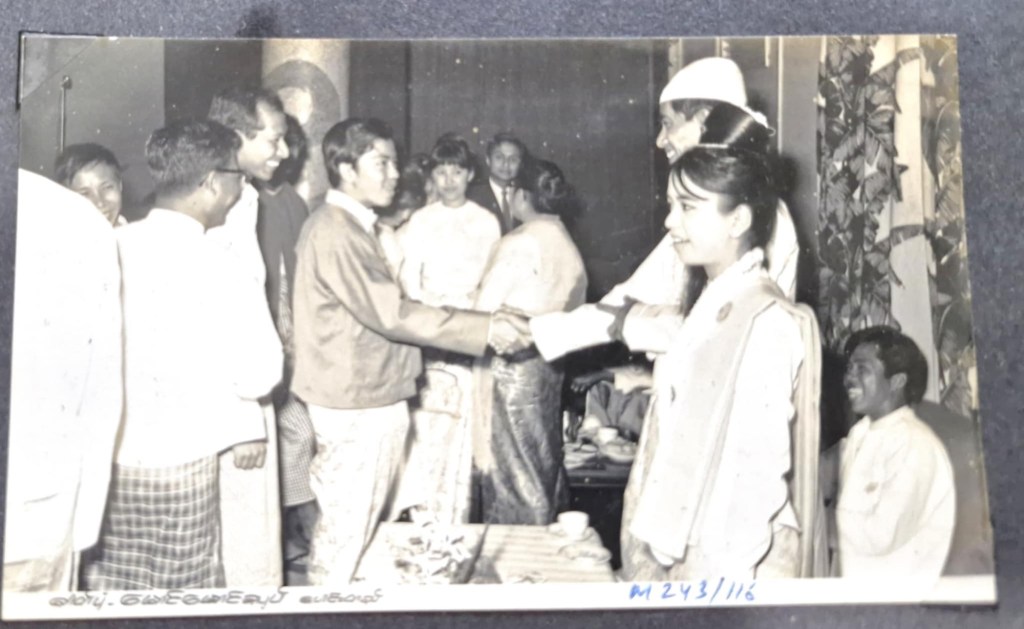
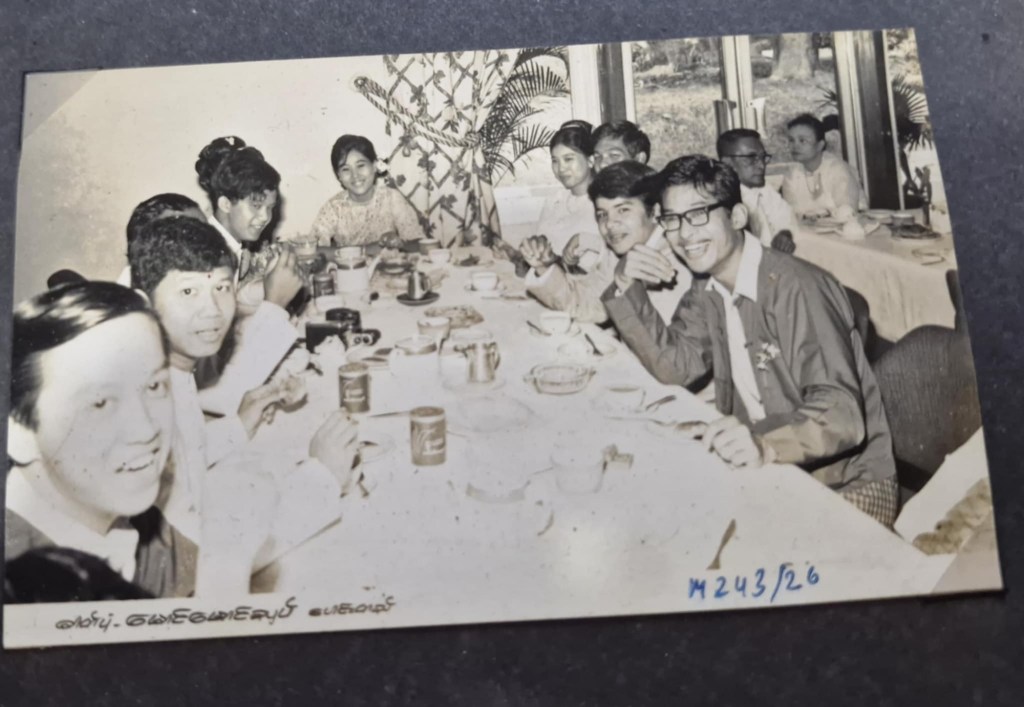
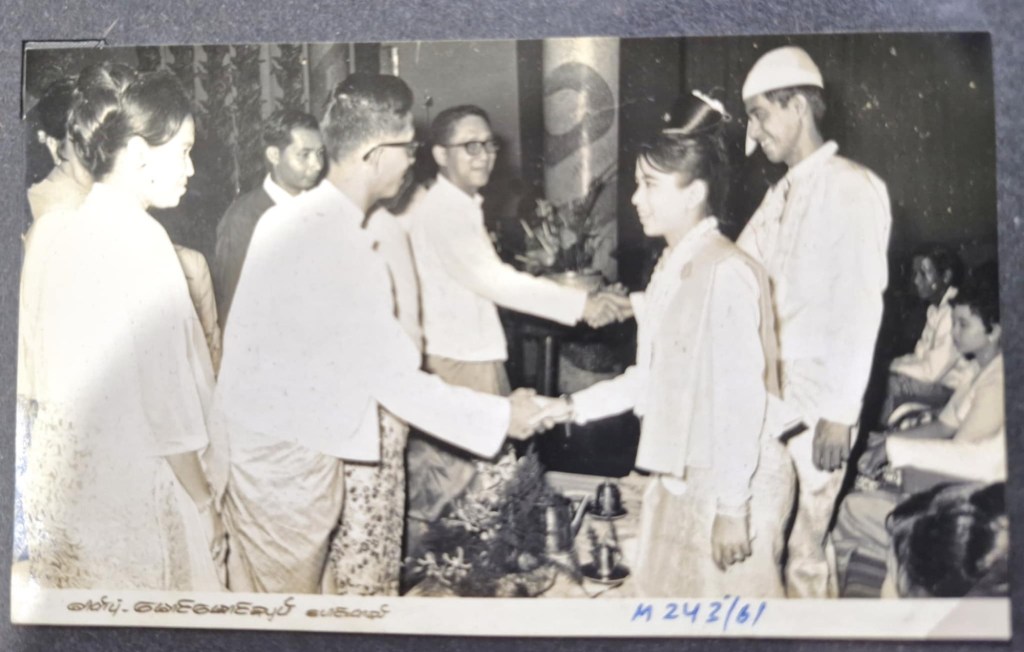
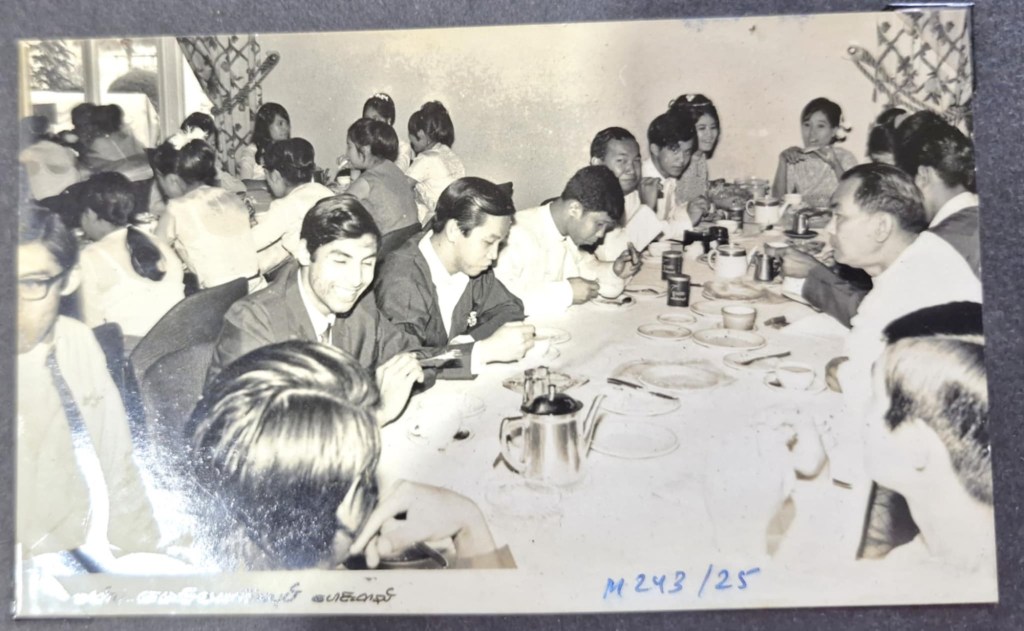
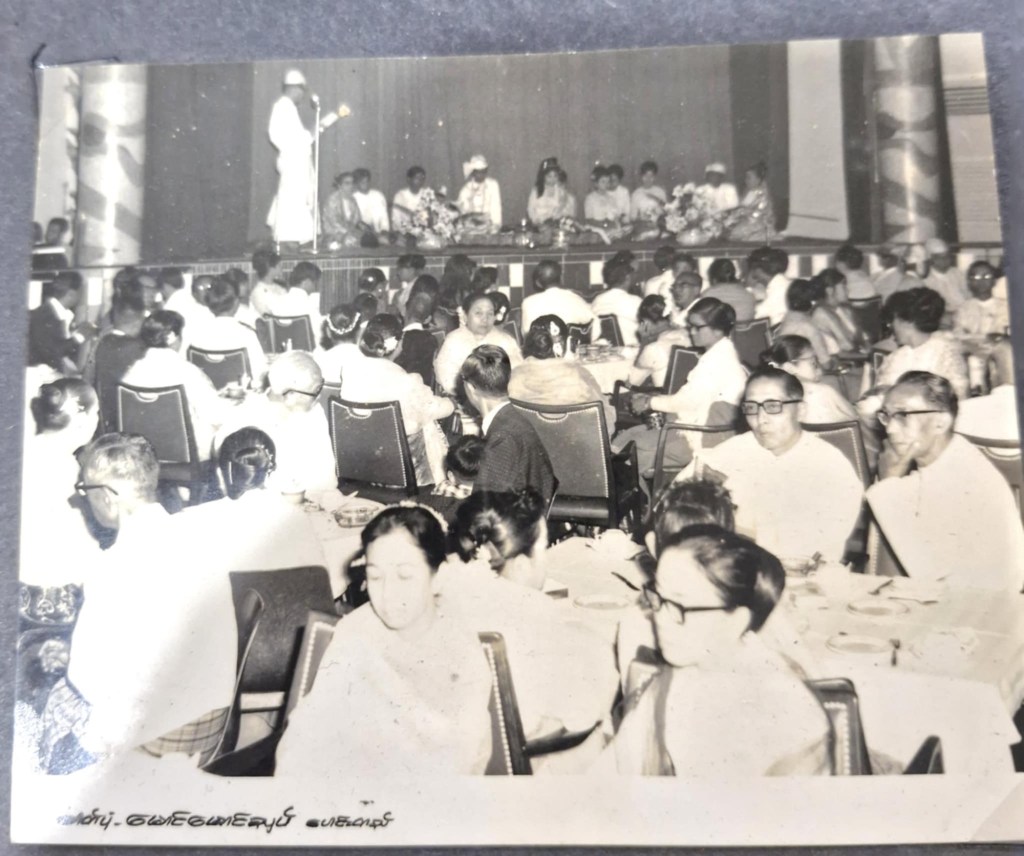
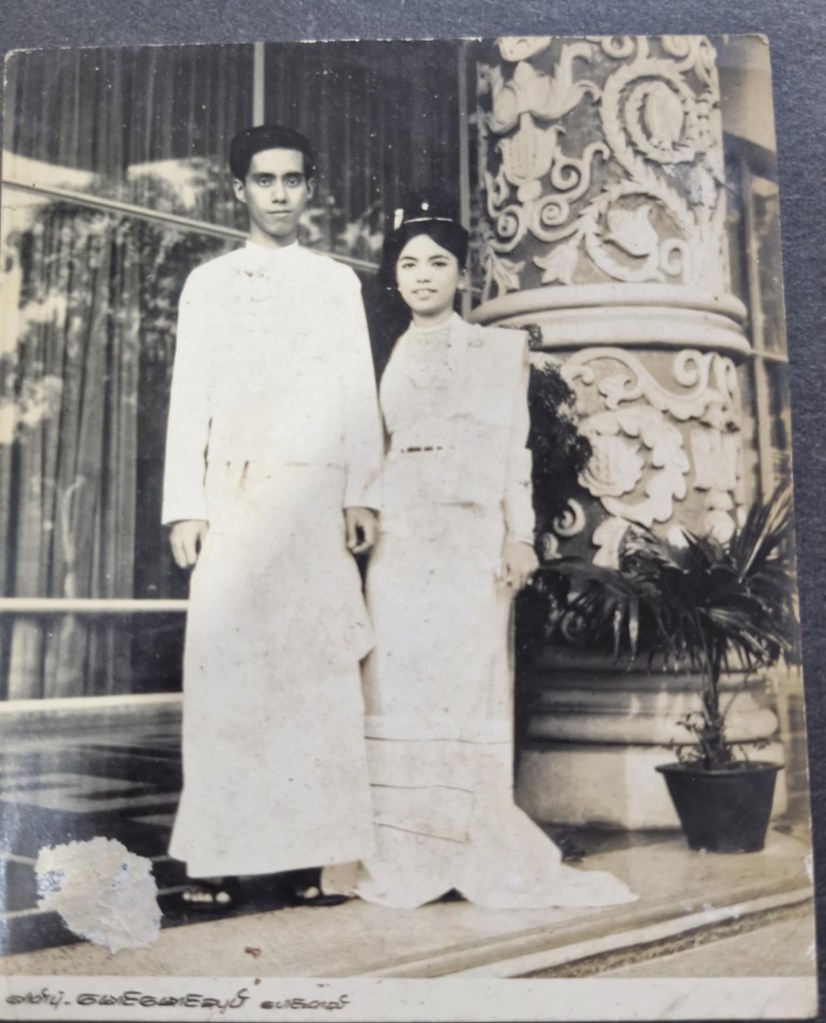
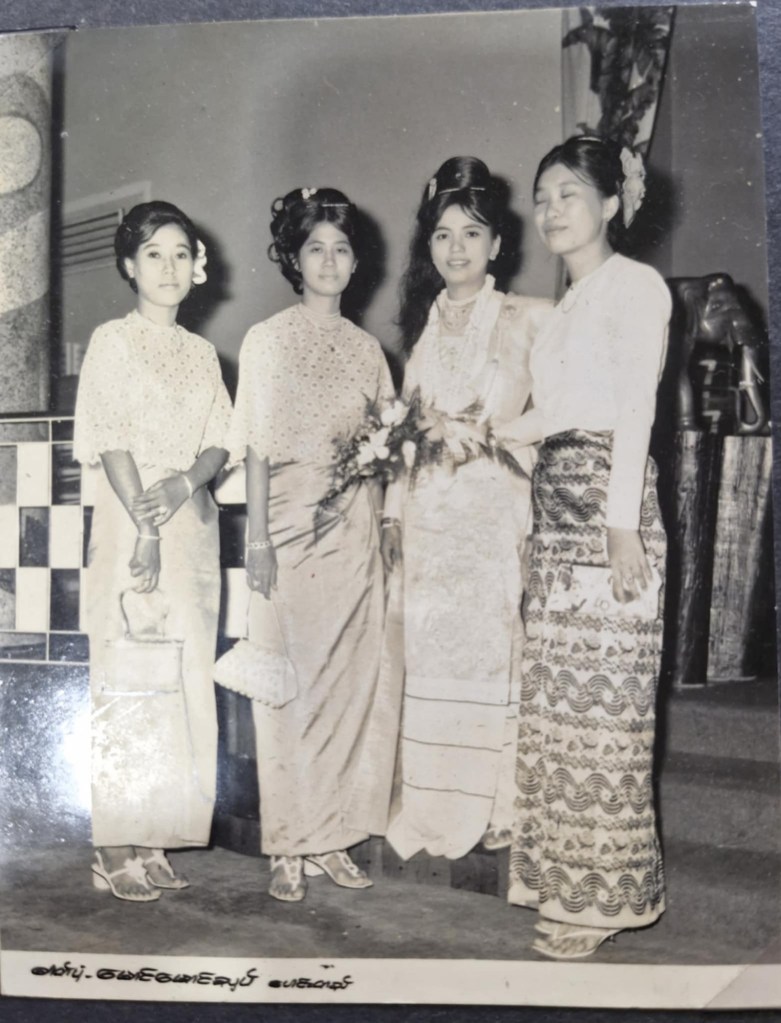
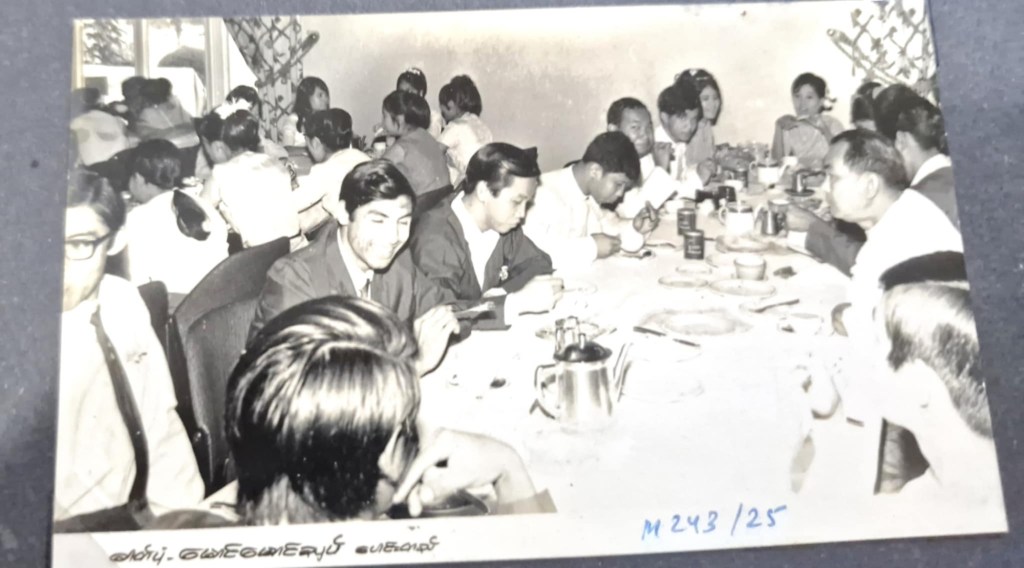
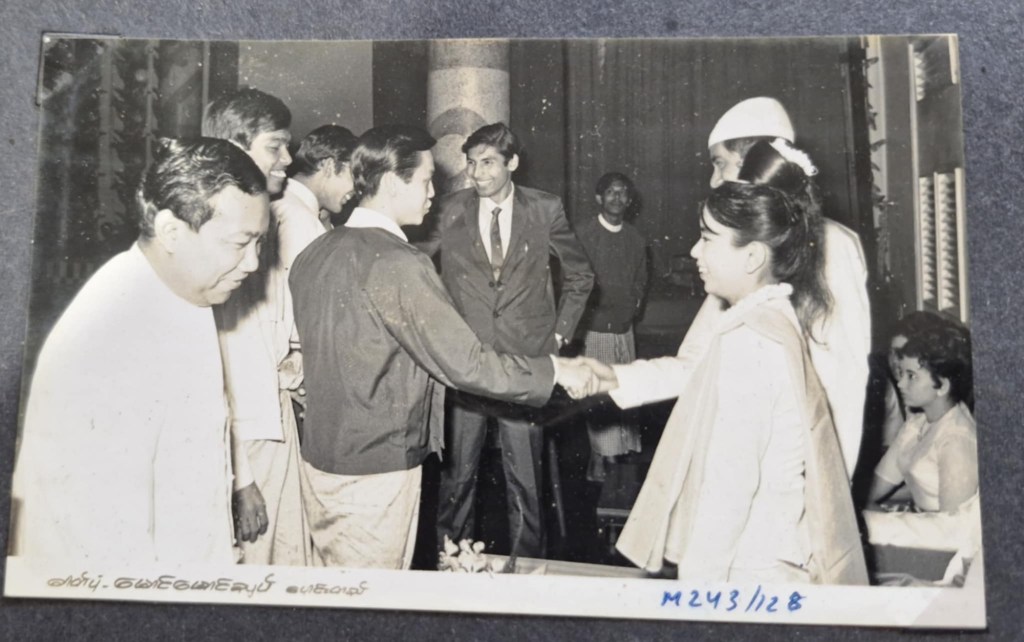
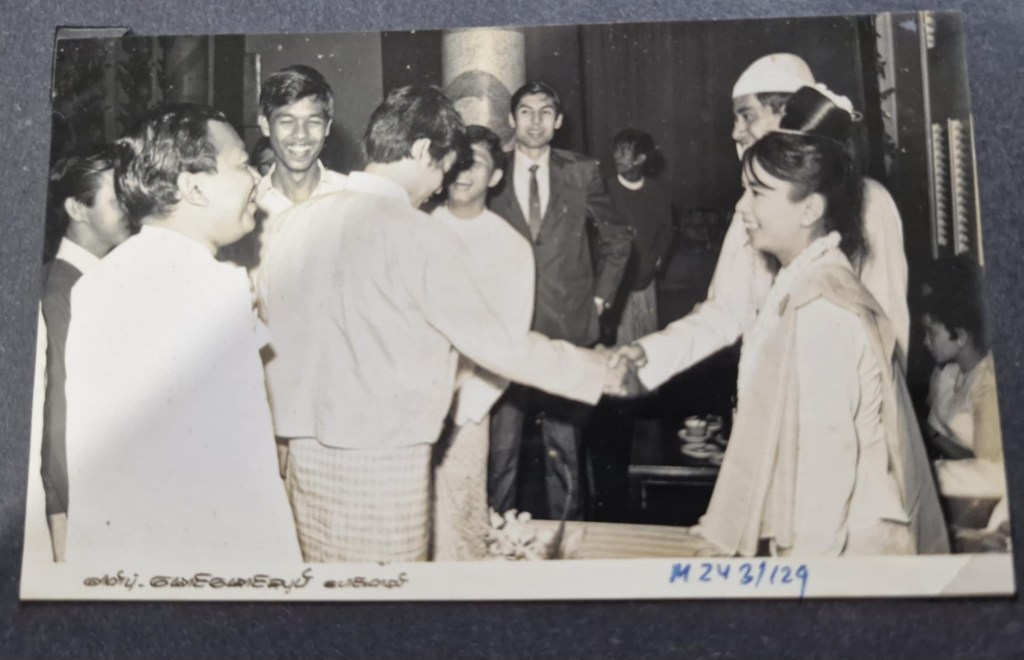
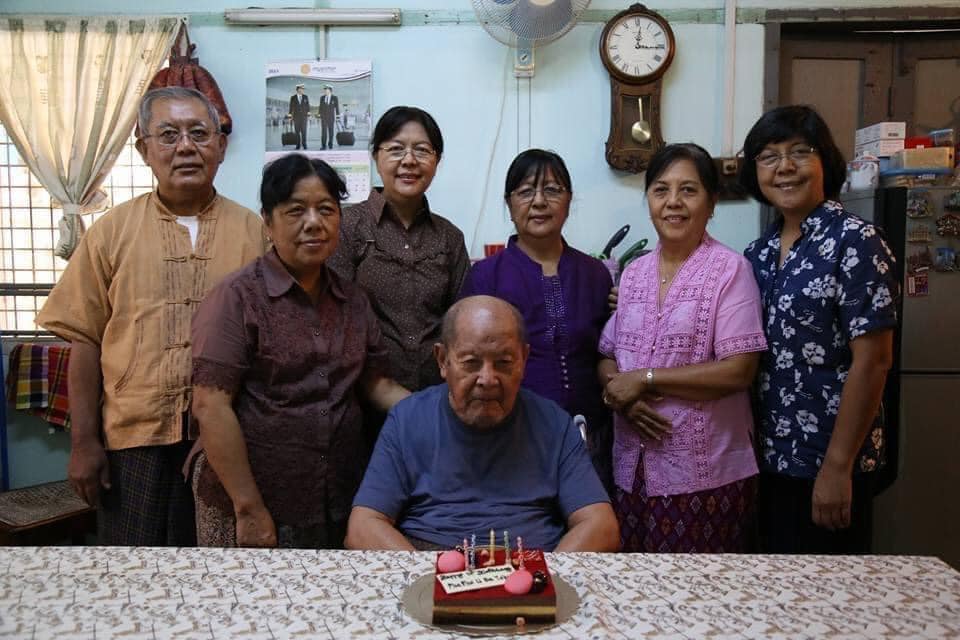
At my wedding, Mama Si Si Chit Maung did the flower arrangements on the stage. In those days there were no florists yet. And all the white Lillie’s were from Daw Khin Kyi’s garden, 54 University Ave. Aunty Marie Hla Taw booked for my wedding (4 months ahead) after my engagement was done in September 1971. Can’t get those flowers in the market in those days too.
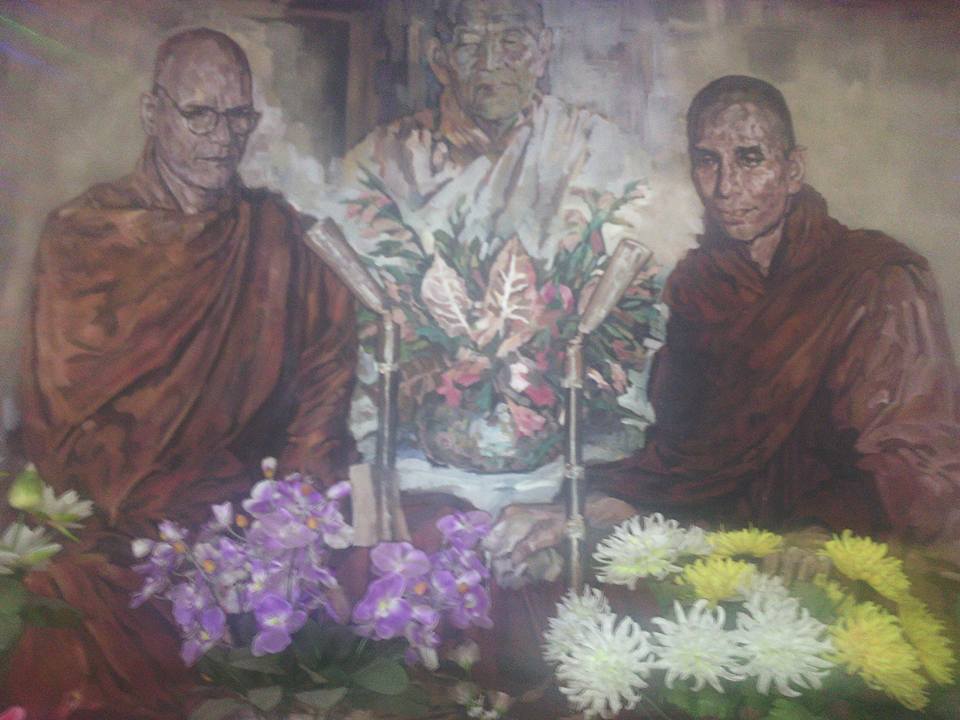
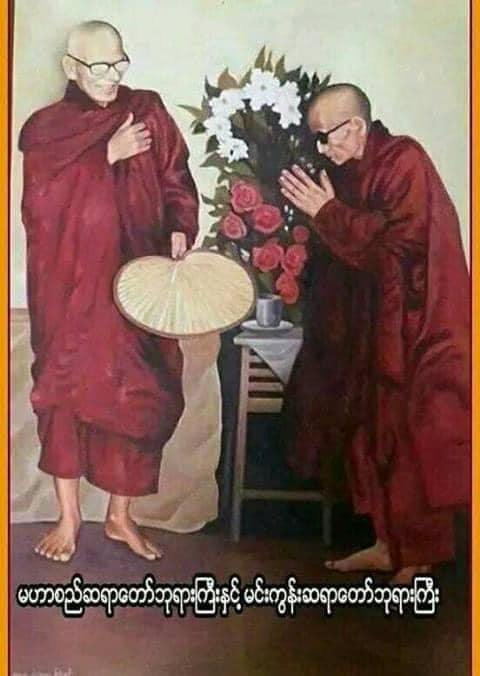
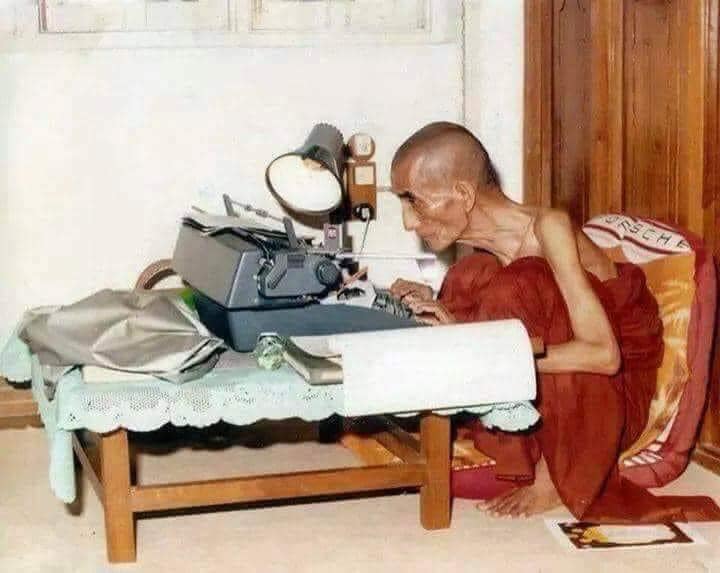
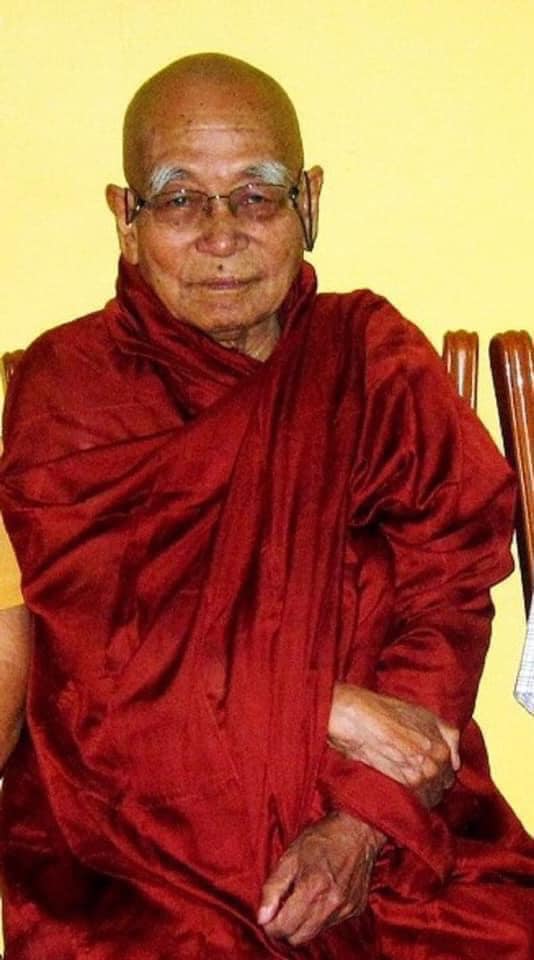
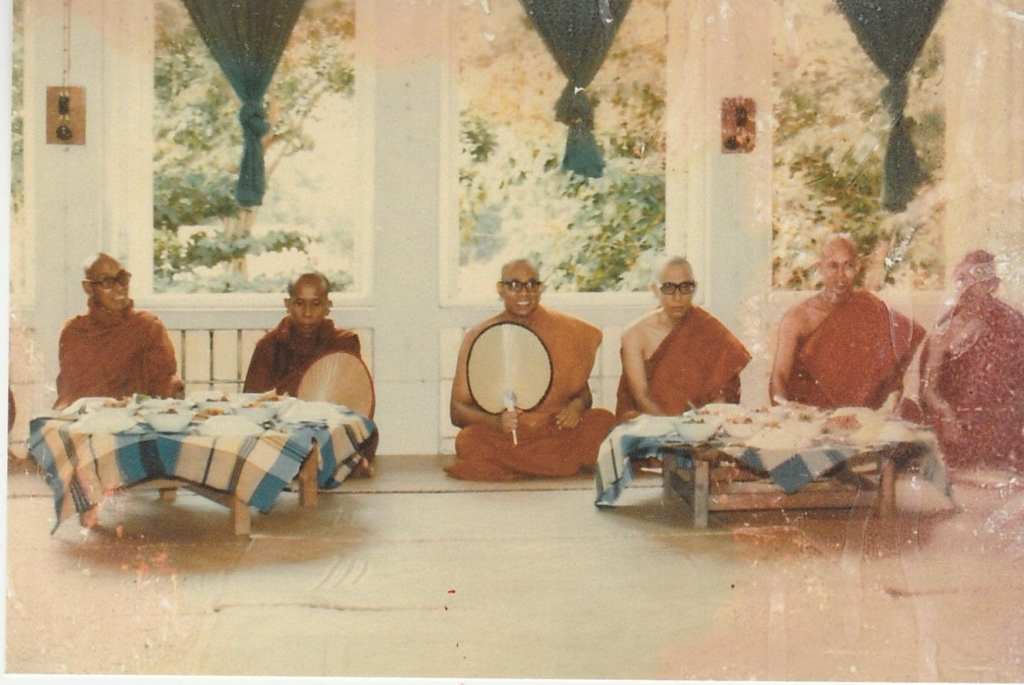
U Vicittasarabhivamsa (GBNF) ဦးဝိစိတ္တသာရာဘိဝံသ was listed in the “Guinness Book of World Records” for his phenomenal memory.
When Burma hosted the Sixth Buddhist Council ဆဌသံဂါယနာ at Kaba Aye Pagoda in 1954 – 56 to commemorate the 2500th year of the “Sasana Calendar“, Sayadaw acted as the “Reciter” of the Tipitaka (Triple Basket : Vinaya, Sutta, and Abhidhamma) and the selected Commentaries.
According to the Kaba Aye Edition, the Tipitaka covers 8000+ pages. Vinaya : ဝိနည်းMonastic rules of conduct Sutta : သုတ္တန် Discourses Abhidhamma : အဘိဓမ္မာUltimate Reality
Sayadaw could recall all and provide exposition.
To prepare for the Buddhist Council, Sir U Thwin ဦးသွင်requested Mingun Sayadaw to take the Tipitaka examination.
Sayadaw passed the Oral and Written tests for the Three Baskets with Distinction.
Oral tests will fail a candidate if he needs five (or six) prompts. Sayadaw did not need a single prompt.
Written tests cover in-depth topics.
During the recitation, Sayadaw amazed the examiners by pointing out the variations of the text and highlighted the preferred version.
First Sayadaw to be conferred “Guardian / Bearer of the Tipitaka & Treasurer of the Dhamma“.
When Sayadaw received requisites, he gave them to the monks (in the town where he received them).
To support the monks studying for the later Tipitaka examinations, Sayadaw set up a monastery in Mingun and accepted monks who had finished Dhammacariya.
Became monk after retirement and spent several vassa.
Dr. Lwin Aung (Center)
U Bo Gyi (A59, GBNF)
Assisted Saya Mr. O Nagler for the design of the RU Recreation Center.
Pianist
Modeling expert
Co-founder of Architects Incorporated.
After Nationalization, moved to PWD.
Architect of Daw Khin Kyi Mausoleum.
Became monk after retirement from PWD.
U Bo Gyi
Civil
U Kyaw Sein (Bran Dev, C59)
EE Irrigation (Sedawgyi project).
RU team forward. From Mandalay. Prome hall.
U Htay Aung(C59)
Prome hall soccer forward. He was transferred from Tagaung hall.
U Hla Baw(C59)
Prome hall S& R President
Mechanical
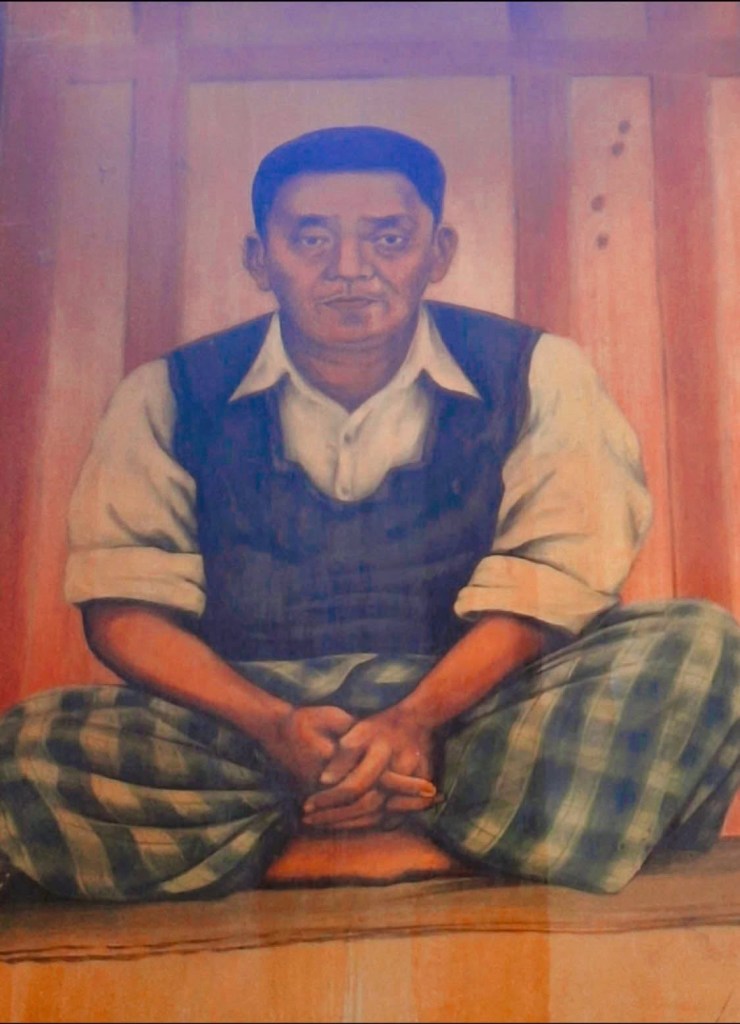
Saya U San Tun (M59, GBNF)
Mechanical Engineering 1959 U San Tun 1U San Tun 2 U San Tun 3 U San Tun 4
Saya U San Tun (Sain Fone Wong) graduated with B.Sc. in Mechanical Engineering from the University of Rangoon in 1959. He passed with distinctions and won a Gold Medalist. At the convocation, he met Dorothy Tham (a female Gold Medalist from a different faculty). They became friends and later tied the knot.
He joined the Mechanical Engineering Department as an Assistant Lecturer.
He was awarded a States Scholarship to pursue graduate studies at MIT, USA. He received Masters from MIT, USA in 1962.
Upon his return, he taught at BIT and also served as a Hall Tutor.
He was promoted to Lecturer in 1964. He headed the Automobile Engineering (Sub-department of the Mechanical Engineering)
He relocated to California, USA in 1968.
From 1968 – 1974 he worked as a Contract Engineer, Cone Company, Burlingame, California
1974 – 1999 Bechtel Corporation, San Francisco, California (Retired in August 1999 after 25 years service).
Saya served as President of BEA. He succeeded Saya U Htin Paw (EE58, GBNF)
Saya passed away in California on December 12, 2025 at 10:30 am
U Tin Hlaing(M59, GBNF)
U Tin Hlaing
Joined the Faculty as Assistant Lecturer
MS from Purdue University.
Promoted to Lecturer.
Head of Agricultural Engineering (Sub-department of Mechanical Engineering)
Manager of All Universities and Institutes Hockey Team.
Played Tennis and Soccer
Passed away untimely since he could not get access to the Dialysis Machines at BMH and also could not get Passport and Visa in time to have medical treatment abroad.
U Tin Htway (M59)
Co-founder of BASES
U Tin Win (M59, Bei, Bago)
Assistant Lecturer
Left to run family business
M. Krishna(M59)
Assistant Lecturer
Moved to India and later to USA.
Attended SPZP-2000.
U Ohn Khin(M59, GBNF)
Lt Col. DI (Retired)
MD TC1
Tagaung hall.
U Win Tin(M59, GBNF)
BG DI (Retired)
Minister for Finance and Revenue
Minister for Post and Telecoms
Ramanya hall.
U Hla Aye(M59, GBNF)
EE Irrigation
Later FAO/UN Project Engineer in Laos.
RU football team Captain.
Prome hall and Moulmein district volleyball team Captain
Hla Myint Thein (Maurice Chee, M75) — Worked in Singapore and USA; Founding member of RIT Alumni International and served as Treasurer; Core Organizer of SPZP-2000 and served as co-Chair of the Working Committee, Financial Controller, Logistics Guru and Publisher of the commemorative issue of “RIT Alumni International Newsletter”; Past President of BAPS; Donated books to YTU Library and also coordinated the book donations by others (Daw Mu Mu Kin, Victor Wong) Founding member of NorCal RITAA and served as Vice President.
Ba Htoo — Started the Resistance ahead of March 27 in 1945
Ba Htoo Myo — Named after Ba Htoo; Had training centers for the army
Hla Htoo, Col., FRCR, senior radiologist Burma Army Medical Corp (BAMC), one of the first radiologists to pass the Fellowship of the Royal College of Radiology exam.
Khin Khin Htoo — Author
Khin Maung Htoo — Vocalist
U Myat Htoo (C68) — RIT Saya; Founding member of RIT Alumni International, and NorCal RITAA; Past President of TBSA and BADA.
Myat Htoo Razak, Dr. — RUBC Gold; Father: U Tin Myint
Myint Htoo — Justice
Yahandar Hnit Pokko Htoo Myar — Book by Dhammacariya U Htay Hlaing.
Ba Min — Saya; UC Berkeley alumnus; Mathematics; Astronomy
Ba Myaing — Saya; SPHS
Ba Myint — Pro-Rector, YTU
Ba Myint — Pyinnya Mingyi
Ba Nyein — Advisor, BSPP Government
Ba Nyein, Kyar — Boxing; Checkers
Ba Nyunt — Saya; History Professor
Ba Nyunt (EE58) — Saya; RIT; MOGE
Ba Oo — Sons : Eddie (Tin Aung Moe), Reggie (Tekkatho Aye Maung)
Ba Oo — “Tiger” Scrabble
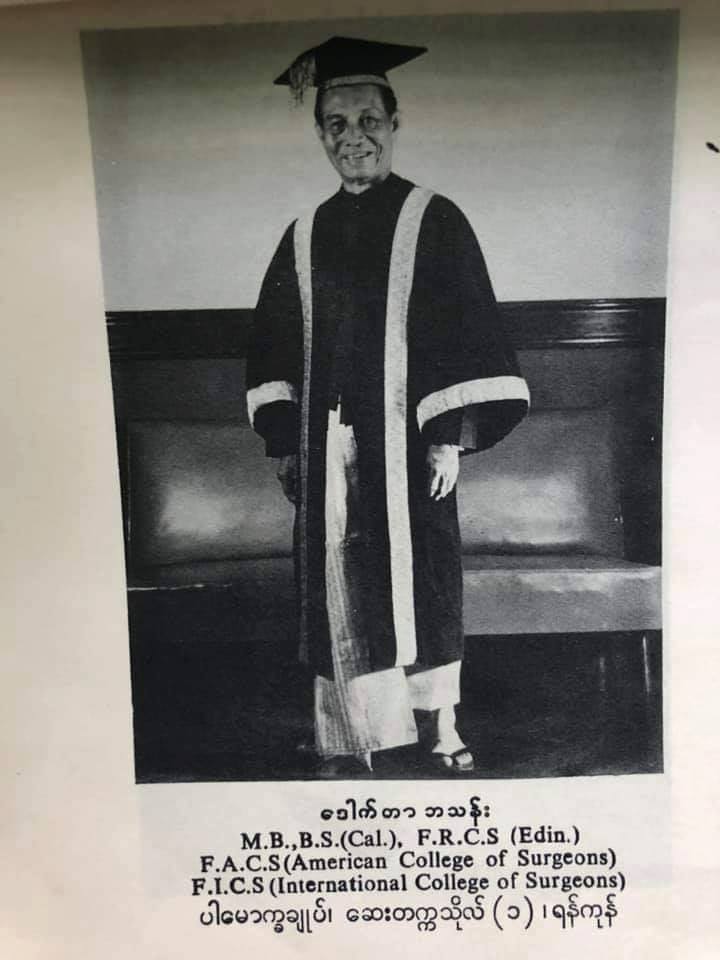
Ba Pe, Dr. — Medical Doctor
Ba Pu, Dr. — Medical Doctor; Son : Peter
Ba Sein, Thakin — AFPFL
Ba Shin — Bohmugyi; Burma History Commission
Ba Shwe — Colonel
Ba Soe — Gyobinkauk; Brother : Hla Soe
Ba Swe, Kyargyi (Dawei Ba Swe) — Served as Interim Prime Minister when U Nu took sabbatical; Led the Stable AFPFL faction
Ba Swe, Yangon — Writer,;Sharpshooter; Credited as o shooter of Galon U Saw
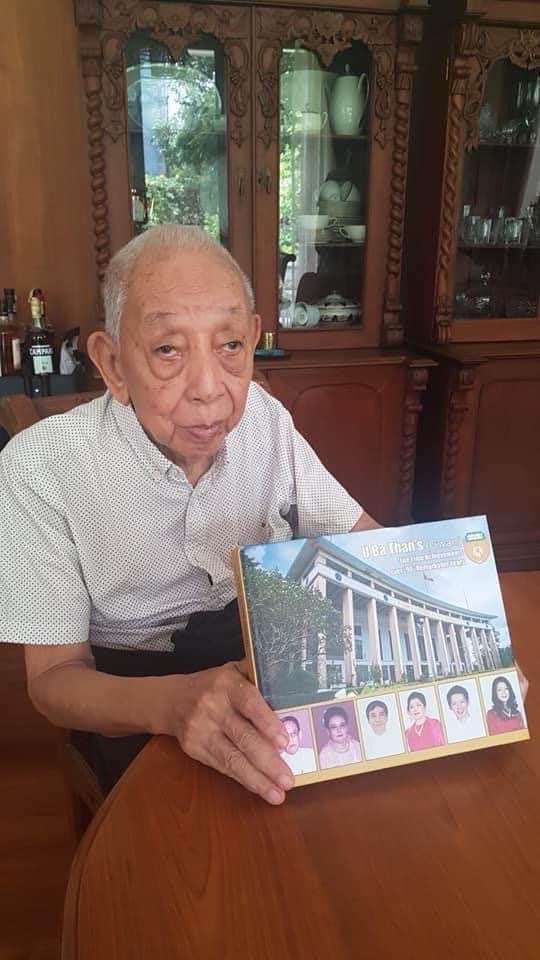
U Ba Than
Ba Than — Saya; Alumnus of Imperial College, University of London; Retired as Professor and Head of Mechanical Engineering; Proud supporter of HMEE project; Donated rare photos to HMEE project and MES; Donated back all the Garawa money that he received from the SPZPs and mini-PZPs; Offers soon kway on or around his birthday (October 2nd) and invites his former colleagues and students; Per request from his grandson, he wrote his Memoirs; U Tin Htoon (younger brother) compiled a Photo Album / Book for his 90th birthday in October 2020
Dr, Ba Than
Ba Than, Dr. — Police Surgeon; Rector of Institute of Medicine; Excellent soccer player and Harpist; Founder of “Zwe Ah Nyeint”; Stayed behind when the British evacuated Burma; Ran a hospital during the Japanese occupation with assistants including Dr. Maung Maung (father of U Maung Maung Kyi (SPHS63)) and Dr. Myint Swe; Children : Georgie, Kitty, Amy
Ba Than, Saung — Icon in Burmese music.; eight obituaries (one by each spouse).
Ba Than, Dhammika — Retired army officer and author
Ba Than — Founding member of the Kone The Gyi Myar Ah Thin (aka Burmese Chamber of Commerce); Son : U Chit Po Po (M69)
Ba Than — Son : Cyril (Than Hla)
Ba Than — Son : Kyaw Zwa Than (Jaws)
Ba Than — Physical Education, Palmistry
Ba Than Aye (Myo Myint Lay, GBNF) — UCC, Army
Ba Than Chain — UCC
Ba Than Haq — Saya; Pro-Rector, RASU
Ba Thaung — Burma Trade; Son : U Thaung Win
Ba Thaung — Son : George (Maung Maung Win)
Ba Thaung, Thakin — Author, Co-founder of Dobama Asi Ah Yone
Ba Thaw — Writer, Pa Lait Ah Yay Shi Ta Oo
Ba Thaw, Bohmu — Maung Thaw Ka, Chief Editor, Forward Magazine
Ba Thein — Children: Peter, Than Than Nwe
Ba Thein — Son: Glen / Dr. Zaw Mon
Ba Thein (Atlanta) — Pen name of Dr. Myint Thein (M73)
Ba Toke — Saya; Mathematics Professor; Rector of MASU; Burma Olympics Team Leader
Ba Tu — Daughter : Pearl (Pale)
Ba U, Dr.– President of the Union of Burma; Wrote “My Burma”
Ba Wai — Table Tennis
Ba Win — Arzani; Brothers: Aung Than, Bogyoke Aung San; Son: Dr. Sein Win
Names with Ba in middle and end
Aung Ba
Kyaw Ba
Shwe Ba
Ben
Benedict — Brother; SPHS
Benjamin Kyle — Myint Soe
Benny Tan (M70) — Tan Yu Beng; Golden Sponsor
Benny Tan
Bo
Bo Aung Kyaw
Bo Aye
Bo Zaw Win
Bo Bo (C69, GBNF) — Saw Yan Naing
Bo Bo — Father : Hla Maung
Bo Bo Han (Tony Hundley) — Vocalist; Siblings : Mary, John
Bo Bo Kyaw Nyein — Father: Kyaw Nyein
Bo Dwe — Father: Hla Maung
Uzin Bo Gyi (A59)
Bo Gyi (A59, Uzin) — Co-founded Architects Incorporated with Tin Htoon (A60) and Aung Kyee Myint (A60); Their office became a gathering place for artists such as Paw Oo Thet, Director Win Pe, U Khin Maung Yin (A60); The three amigos later joined PWD; Designed the Mausoleum for Bogyoke Kadaw Daw Khin Kyi, and the higher authorities neglected him after that; Gave up playing the piano, modeling buildings, and drinking to become a permanent monk.
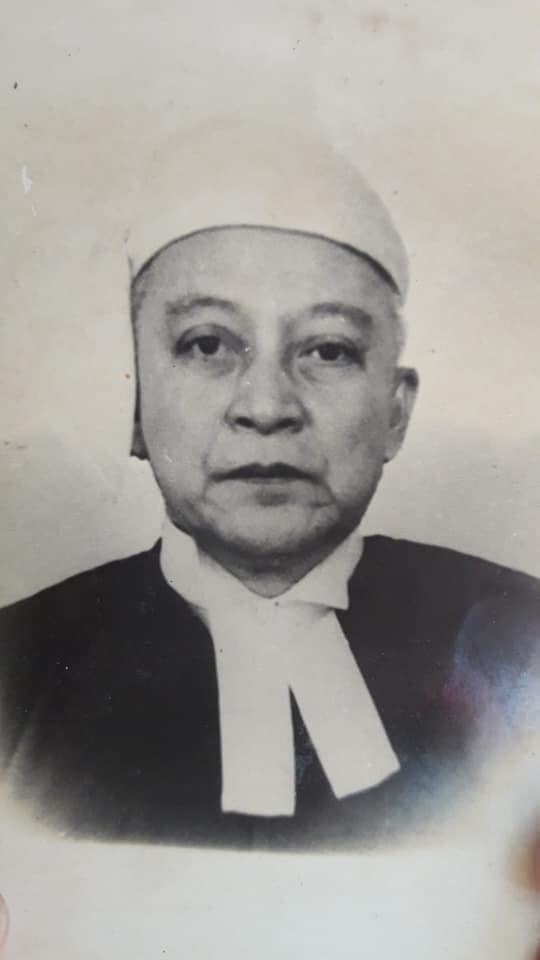
Bo Gyi (Chief Justice)
Bo Gyi — Justice, Vice-Chancellor of RU; Children : Sein Hla, Dr. Daw Khin Kyi, Tint Swe
Bo Gyi, Sandaya— Pianist; composer
Bo Gyi — Brothers: Robert Guy, Bo Lay
Bo Gyi — Father: Hla Maung
Bo Kyi (SPHS) — Drummer; Brother : Bo Ni
Bo Lay, Dr. — Deputy Minister; Translated several Veda texts into Burmese
My beloved parents. For us, every day is “Father’s Day” and “Mother’s Day“.
Raised seven children & several grand children.
Passed away in their 80s.
For a long time, I was among the lucky ones to have both parents. Now, I am among the unlucky ones to have lost both parents.
Took care of my two sons when they were young
Sad to say, they did not live long enough to see my grand children.
Let Oo Saya
During my school days, my parents gave me 25 pyas as pocket money. They wanted to make sure that I study hard.
In Standard VI(D) and Standard VII(D), Ms. Amelia Kyi (“Miss Hong Kong“, mother of U Win Kyi (RUBC Gold)) taught us English. We had to take weekly tests. She would fine 25 pyas to those who fail in a test. She would give 50 pyas to those who do well in a test.
My parents would give bonus prizes only when I did well in the final examinations.
They would buy us typewriters : Remington for English and Olympia for Burmese.
They also gave me a Raleigh bicycle, a Yashika Mat camera, and Cashprizes (100 Kyats for passing a Government exam and 100 Kyats for each Distinction).
They would also provide us books : several types of dictionaries, Myanmar Swel Sone Kyan စွယ်စုံကျမ်း၊ Reader’s Digest, Student’s Companion, A book for Idioms, Grammar (e.g. Wren and Martin), the King’s English (by Fowler and Fowler), “How and Why”, Fun with Mathematics, Classics Illustrated, …, Saya Mauk ဆရာမောက် (Bedin ဗေဒင်), Cheiro (Palmistry), …, Second World War.
Uncles and Aunts
My uncles & aunts were like my adopted Parents.
They had private libraries. There was a set of Encyclopedia Britannica, books by Dale Carnegie (“How to win friends and influence people”, “Five minute biographies”) and more.
They allowed me to play their piano and games (Badminton, Table Tennis, Carrom, Bridge).
Uncle U Thet Toe would take us to Inya Lake for swimming followed by a feast of Buthee Gyaw ဘူးသီးကြော်
Uncle U Than Lwin would take me to the Recreation Center in the Main Campus (e.g. to meet Saya Dr. Than Tun) and to the Faculty of Social Science & Library (e.g. to meet Saya U Khin Maung Kyawe (Jimmy) and Sayama Daw Myint Myint Khin (Hazel)).
A Zillion Thanks
Dear beloved parents, uncles, aunts and teachers, “I’m sure you will be in the good abodes. I want to thank you for your unbounded love and for your exhortation that “Every thing that’s worth doing is worth doing well” “.
Second Generation
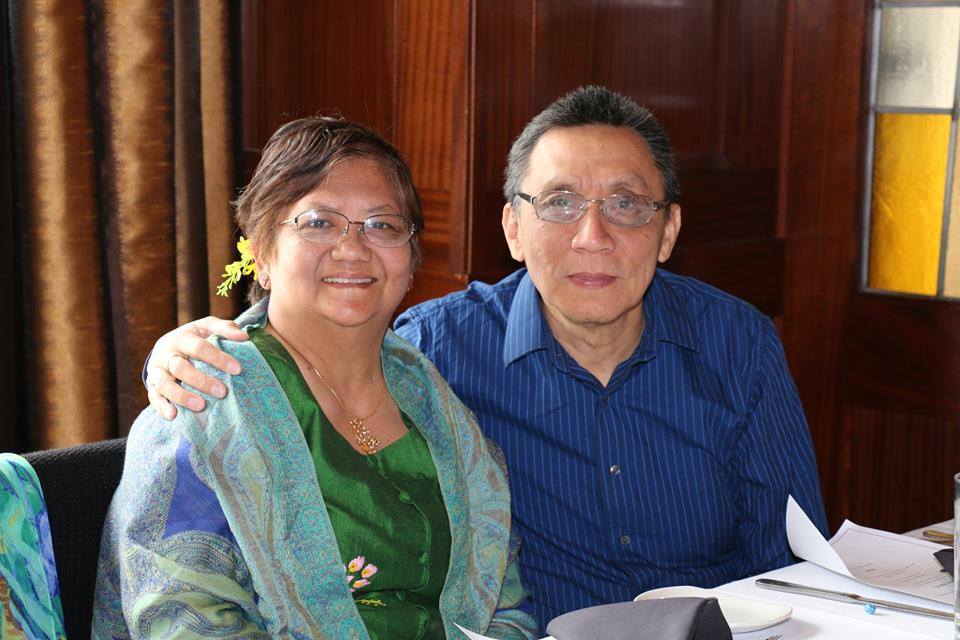
My beloved spouse and I tied the knot in June 1973 in front of our parents (my father, my mother and her mother) and elders including Sayagyi Dr. Chit Swe (Founder and Director of Universities’ Computer Center).
All my siblings are alive and well.
My spouse had lost five family members.
Her father passed away in his mid 50s.
Her mother passed away in her late 80s.
Her elder brother passed away in his early 50s.
Her younger brother passed away in his early 60s.
Her nephew passed away in his late 30s.
She volunteered for social and religious events. She wrote several articles for Dhammananda Newsletter with the pen name “Neik Ban Zaw“.
She encouraged me to pay back to our parents, mentors, alma mater, society and our beloved land.
Ah Phwa and Hmyee Ma
With her support, I served for 27!years as Chief Editor of “RIT Alumni International Newsletter” and as an organizer of activities (including RIT Grand Reunion and Saya Pu Zaw Pwe).
I have written 2500+ posts in my Facebook pages and hlamin.com
Third Generation
I have two loving sons.
The elder is a Senior Industrial Engineer.
The younger is a Senior Software Engineer.
Fourth Generation
I have two kind, loving and intelligent grandchildren. They excel in Academic, Sports & Social Relations.
Son-in-law of Dr. Freddie Ba Hli (GBNF, Former Advisor of National Planning) & Daw Myint Thwe (GBNF)
Spouse : Tin Tin Hlaing (UCC)
Son & Daughter
He volunteered as an interpreter for the meditation courses conducted in Sydney Australia & Sasana Yeik Thar in Yangon.
Memories of Ko Htay Aung
Introduction
I was born without knowing that I would have to live my early life next to the big BIT facade and that I would also become an engineer.
I had played inside, outside, and on top of the BIT roof, but I was unaware of what the engineering students were learning inside.
Then, one day, I made a long hard decision to become an engineer instead of a medical doctor, because I like the noise, the smell, and the science of the machinery better than having to face the sobs, the sighs and the anguish of the sick and dying people at the hospital. (Over the years I’ve learnt that sickness, aging and death are part and parcel of life; so I don’t have much objection now.)
Besides, I had met too many engineers and had seen so many role models as I grew up in the BIT/RIT compound in Gyogon.
My late father is the elder brother of late Prof. U Sein Hlaing (Elec). My family moved to Gyogon and lived together with him in BIT compound when BIT was opened in 1961. My first neighbour in BIT was late Saya U Kyaw Tun and family.
When my family moved in to live in BIT compound, I was studying KG at St. Paul’s High School opposite the Secretariat Building. (SPHS later become No. 6 Botataung State High School). I survived the traveling between Gyogon and Botataung for the next decade to come until I finished the 10th standard. Catching the No.8 Hino bus to go to high school in the city became a daily routine.
Gyogon
Gyogon is about 9 miles (14.4 km) away from the Rangoon city center. It is rather very close to Insein town. BIT compound is surrounded by some living quarters and the Veterinary Institute in North, a huge suburb from Kyike-Kala (Aung-Theikdi) to Thamaing College (where other engineering student hostels were established from the 1969 SEAP Games Village) with the Shwedagon pagoda above the skyline in South, a vast open bush land with “9th mile” Chinese cemetery towards the Prome Road in the East, and the Insein Road, a small Agricultural Research Institute, the BPI factory, the Gyogon train station on the West.
The Rangoon Airport is not too far away in the North East corner so the entire air space above the compound is also occupied 24 hours a day. I got so much used to the roar of the turbo jet engines that they didn’t wake me up in the middle of the night. Fortunately, the planes never hit the huge BIT facade or the tall concrete water tank tower. The big sharp “thunder-bypass” discharge spikes on the roof top might have scared them away.
BIT to RIT
I remembered one day that a few people were working on the BIT facade. Then I realized they were removing the “Burma” stone scriptures from the facade and replacing with “Rangoon” so it became RIT from then on.
Tennis
During the summer holidays and any other holidays (if not raining), I used to play tennis in the RIT compound. There are several tennis courts (one provided for staff) in the compound. At night time, the Sayas tennis court would light up to play a few matches among Sayas and family members. Some Sayas who I remembered playing there regularly were Dr. Aung Gyi (Civil), U Aung Khin (Mech), U Myo Myint Sein (Arch), U Kyin Soe (Mech), U Tin Hlaing (Mech), Dr. Tin Hlaing (Mech), U Aung Than (Mining), U San Hla Aung (Civil), Dr. Aung Soe (Civil), Dr. Khin Maung Win (Petroleum), Dr. Saw Pyu (Metallurgy), U Win Kyine (Petroleum), Dr. Thaung Lay (Metallurgy), U Thein Lwin (Elec), U Tin Htut (Mech), Dr. Tin Win (Mech), U Tu Myint (Mech), etc. The tennis court was next to Saya Dr. Aung Gyi’s family house so we got all necessary supplies with their compliments. A Russian Saya who played there sometimes would also bring a nice Russian tea for every player to enjoy.
I also enjoyed riding bicycle inside the RIT compound as there were long and hard concrete roads connecting the staff residences and the main class room buildings. Some open big water drains (Myaung) ran along those roads too so it wasn’t very nice to fell into the drain and dragged the bicycle along the drain.
There were other sporting venues provided in the compound for all students and staff and family to play, including a weight-lifting room (next to the student dinning hall), a huge indoor badminton room with 2 courts, fields for basketball, volleyball, football, hockey, and also a 400 meter track and field ground. We would also use the hill top unoccupied Rector’s (green) residence as a Kids’ Karate Club. The main assembly hall in front of the RIT facade would be used to conduct indoor boxing, judo, karate, weight lifting competitions too. Sometimes, Burmese and English movies would be showed regularly in the hall too so the whole neighborhood could come along to watch the movies. I also enjoyed watching other arts events (A-Nyeint & Lu-Pyet shows) conducted by elder engineering students.
I had learned to swim at the very early age not because the RIT swimming pool was there (well almost) but because our family friend took us to the Inya lake for swimming lessons. Later on, I continued to swim at the Universities’ Swimming Pool at Thaton Road near University Ave. I still remembered one university student (might be from RIT) who brought along a “live” frog and put it in the swimming pool water just to learn “How to swim a frog swim (breaststroke)” from the real master! (The pool supervisor had to pour more chlorine immediately into the filter just to make sure no disease would spread from the frog.)
When it rains, it pours in Rangoon. So the lower land in the RIT compound would sometimes become a flooded paddy field. It was a blessing in disguise for Agricultural Engineering students; they have a chance to drive a tractor and cultivate the land. The land was so wild that I would easily find lots of leeches (or vice versa). Frogs and snails came out of nowhere. The bush would also grow very tall if not cleared up quickly. Of course, the snakes were there too all the year round. Snakes would find quiet dark places around (and even inside) the houses to shed their skin every year. Some people who lived around the RIT compound loved to eat them too.
Food
There were some food shops available in the compound. One can enjoy Burmese, Chinese, and Indian food. For students, the shops were there to spend their time sitting and chatting around the tea pot. For staff and families, they were very handy while living remotely inside the compound away from the usual amenities.
Landmark
Another interesting landmark in the RIT compound was the septic tank system where almost every medical student in Rangoon had to come to look at the system as part of their public health study. They were also told about the air pollution over the RIT compound, especially in the evenings, when the gas from the fermented-rice was released into the air from the BPI factory in order to produce methylated spirit (that’s what we were told anyway).
First twist of fate
It was in 1974 when I had to make that big and painful decision to become an engineer while many of my high school class mates went on to study medicine.
The first day of the first year at RIT was quite exciting for me although there’s nothing new for me to see the surrounding. I was very anxious to find out what it would take me to become an engineer in the next 6 years to come.
Second twist of fate
Since there were about 500 fresher students who came to RIT from all over the country, the students were grouped into 4 sections according to their alphabetically sorted names.
That was the second twist of fate for me as it determined who I would meet and make new friends in the section with similar sounding names, e.g. lining up with 3 other Htay Aung’s but luckily we didn’t look the same!
These 4 sections were maintained during the 1st and 2nd years while we learned basic engineering and related disciplines. The class rooms in which we took lectures were either inside the main building or in the extended bamboo-palm sheds on the West or in smaller buildings along the Eastern side of the main building.
My friends would sometimes pick me up at home before the class began to save me from walking to the class room. I was ridiculed sometimes that I couldn’t even take a bus or hire a taxi from my home to go to the class. During the lunch hours or longer breaks during the day or in the exam seasons, friends would follow me home to have a rest or finish assignments or go through together the “last minute what ever it means” memory juggling before the many exams.
Third twist of fate
The third twist of fate happened in the 3rd year when I needed to decide what kind of engineer I’d really like to become. I had decided to take the electrical engineering major (with obvious influence) and learned more specific disciplines for the next two years.
Fourth twist of fate
Another twist of fate was waiting for me in the 5th year to choose whether to specialize in Electronic or Electrical Power engineering fields. I had chosen the Electronic Engineering and finished the study by 1980.
Subjects
The subjects taught in RIT to make someone with a high school science background to become an Electronic Engineer in the 1970s were listed below. Not that I remembered all of it but for the sake of recollection. There was one industrial training session during the summer in the 5th year and a 6 months thesis work in the final year.
The subjects include English, Burmese, Mathematics, Physics, Chemistry, Political Science, Workshop Practice, Engineering Drawing, Engineering Mechanics, Electrical Circuits, Strength of Materials, Fields & Materials, Electrical Measurements, Engineering Thermodynamics, Electronics, Electromechanics, Computer Programming, Electrical Machines, Industrial Electronics, Networks, Lines & Antennas, Linear Systems, Control Systems, Microwave Techniques, Electrical Communications Systems, … and Thesis.
Graduation
Those who made it through these 6 long years or more were eventually commemorated in person or remotely (A-Way-Yauk) in the 16th RIT Convocation held on the Saturday, the 16th of January, 1982, in the Rangoon Arts & Science University (RASU) Convocation Hall. We missed a chance to proudly walk down the infamous “graduation” center lane right behind the RIT facade to be cheered. (Usually, at any other time, you’d be jeered if you braved to walk down that graduation lane!)
According to the 16th RIT Convocation Program, the number of graduates were:
1 M.E. (Civil, Water Resources & Development Engg)
Looking back now over these years at RIT, after twisting my fate at least four times, I always wondered whether I’d really changed my fate or it’s just my fate that had guided me to make sure that I’d be an engineer. I didn’t get much chance to apply most of the engineering knowledge except the Computer Programming and the industrial training at the Universities Computer Centre (UCC) from my 5th year study.
It spun me off to learn more Computer Science subjects at UCC in Hlaing Campus during the mid 1980s.
I’ve re-wired myself as a Master of Software Engineering engineer at the University of Technology, Sydney (UTS).
Do I need to re-wire or un-wire once more when I finally get retired? May be back in RIT? Only time will tell.
With this, I pay my respect and tribute to all Sayas and friends as well as neighbors from BIT/RIT, near and far, living or gone.
Supervised students in Burma, Thailand and Australia
Alumnus of Mandalay University, Imperial College (London University), Glasgow University, Liverpool University
Dr. Chit Swe 1Dr. Chit Swe 2Dr. Chit Swe 3
ဦးစိုးပိုင် — U Soe Paing
Co-founder, UCC
Retired as UN Expert
Alumnus of Stanford University, Southampton University
Hosted UCC-RIT gatherings
U Soe Paing 1U Soe Paing 2U Soe Paing 3
ဦးမျိးမင်း — U Myo Min
Co-founder, UCC
Worked for IBM (UK), Nangyang Institute (Singapore), Seagate, Connors
Gold medalist, I. Com
Gold medalist, B.Com (Accounting)
Chartered Accountant (UK)
Alumnus of Rangoon University, Lancaster University
U Myo Min 1U Myo Min 2
ဦးကိုကိုလေး (ကွယ်လွန်) — U Ko Ko Lay (GBNF)
Co-founder, UCC
Professor, Department of Computer Science
Professor of Information Technology, ICST (Institute of Computer Science and Technology)
Alumnus of Stanford University, Lancaster University
U Ko Ko Lay
အထွေထွေ General
Dr. တင်မောင် (ကွယ်လွန်) — Dr. Tin Maung (GBNF)
Succeeded Dr. Chit Swe as Director of UCC
Retired as Rector of ICST
Alumnus of Rangoon University, Queen Mary College
Dr. Tin Maung
Dr. ထွန်းအောင်ကျော် — Dr. Tun Aung Gyaw
Member of Generation Zero, UCC
Former Associate Professor of Hardware Technology, ICST
Alumnus of RIT, RU and UIUC
Give seminars and tutorials on Artificial Intelligence and Natural Language Processing
Dr. Tun Aung Gyaw
ဦးလှမင်း — U Hla Min
Member of Generation Zero, UCC
Former Associate Professor of Software Technology, ICST
Alumnus of RIT, RU and Rice University
Lifelong Learner
U Hla Min 2U Hla Min 2U Hla Min 3U Hla Min 4U Hla Min 5U Hla Min 6
Dr. ကျော်သိန်း (ကွယ်လွန်) — Dr. Kyaw Thein (GBNF)
Succeeded Dr. Tin Maung as Rector of ICST
Alumnus of Rangoon University, Southampton University
Dr. Kyaw Thein (Rightmost), Dr. Pyke Tin (2nd from Kept)
Dr. ပိုက်တင် — Dr. Pyke Tin
Succeeded Dr. Kyaw Thein as Rector of ICST
Alumnus of Rangoon University, Monash University
UCC Activities
UCC 1UCC 2
UCC မိသားစု — UCC Reunions
Gatherings hosted by U Soe Paing and alumni in Burma, Singapore, Australia and USA
40th Anniversary of UCC
30th Anniversary of ICST
UCC သကြင်္န — UCC Thingyan
UCC Dana for Thingyan
Dobat
UCC Donlaba
UCC သင်တန်း — UCC Courses
Degree and Diploma courses
Certification
Training
Gathering in Sydney Sayas Dr. F Ba Hli, Dr. Chit Swe, U Myo Min, U Aung Zaw, Dr. Kyaw Thein — Four are GBNFMICT ParkUCC 3UCC 4UCC 5UCC 6UCC 7UCC 8UCC 9UCC 10UCC 11UCC 12