In April 1999, I started sharing news of selected Alumni and Gatherings via e-mail.
It was called RIT Alumni (Abroad) Newsletter.
Several readers suggested a more inclusive name : RIT Alumni International Newsletter.
Special Issue for
SPZP-2000
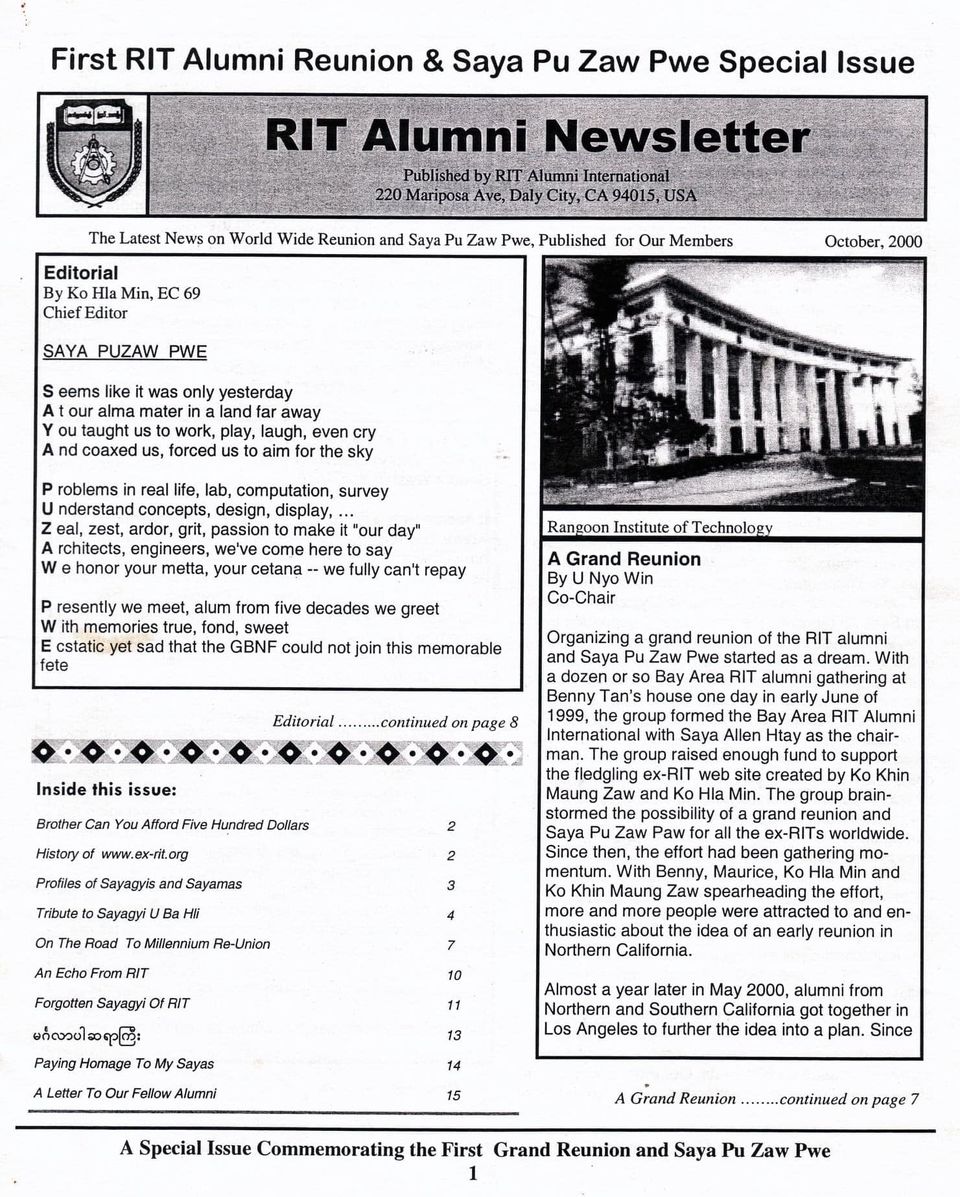
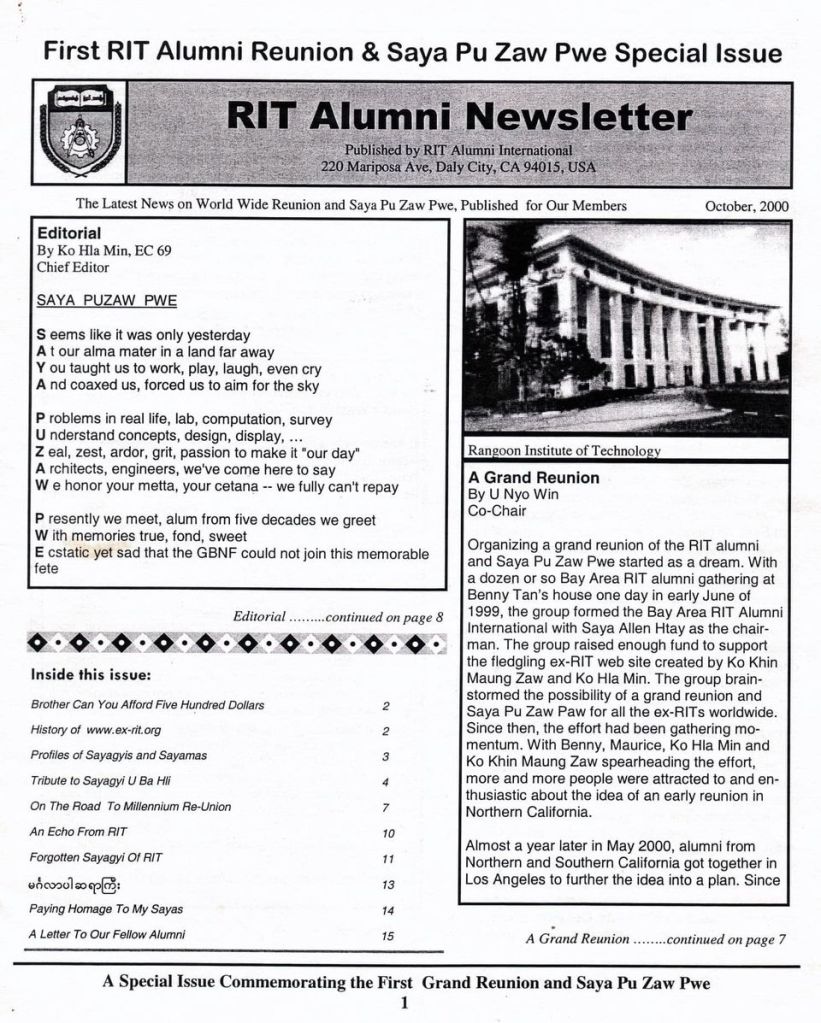
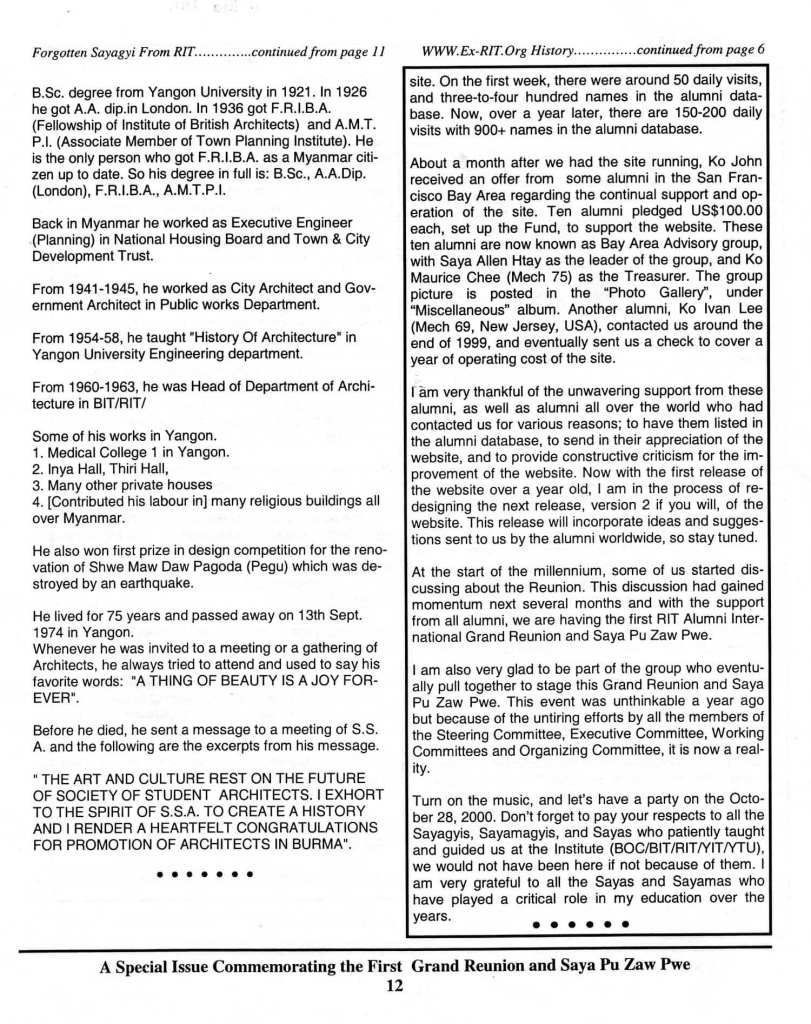
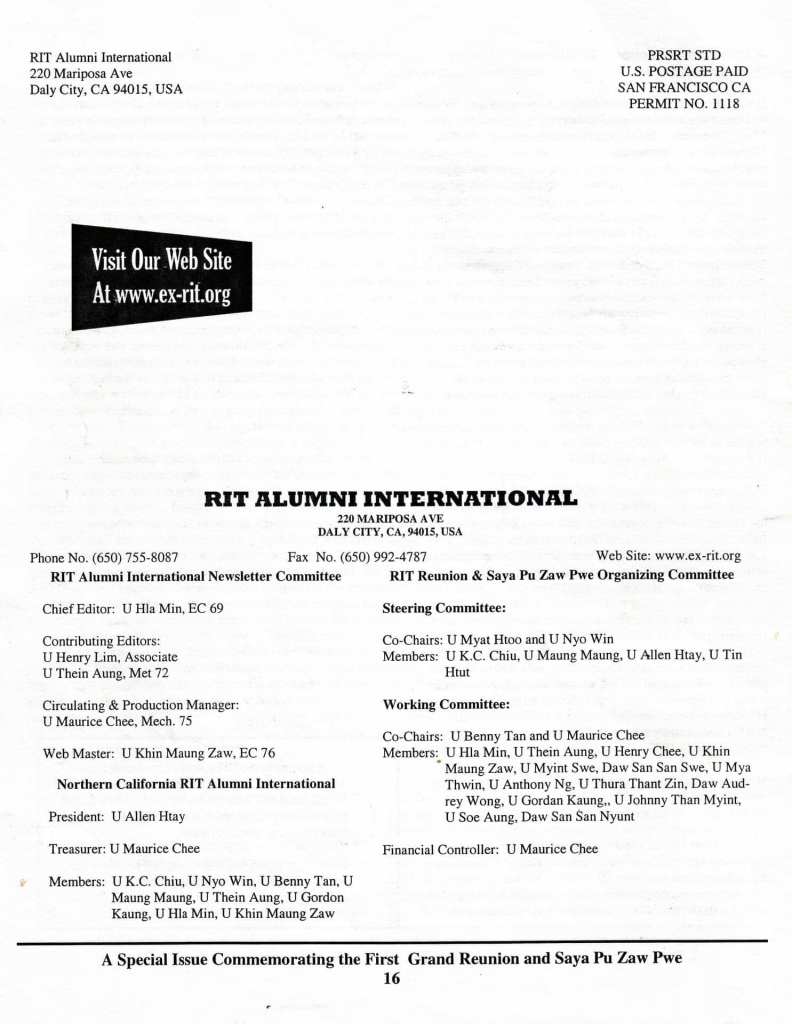
Page 1 of Special Issue
In October 2000, the First RIT Alumni Reunion & Saya Pu Zaw Pwe (SPZP-2000) was held in the San Francisco Bay Area.
We published a Special Issue of RIT Alumni Newsletter for SPZP-2000.
Editors
I was the Chief Editor. Saya U Thein Aung (Met72) and Henry Lim (U Aung Myint) were Editors.
I wrote “SAYA PU ZAW PWE” poem and the Editorial.
Authors authors
Saya Dr. Freddie Ba Hli (GBNF)
Saya U Aung Khin
Saya Allen Htay (C58, GBNF)
Saya Dr. Nyo Win (M65)
Saya U Myo Win (M/Ag65, GBNF)
Saya Dr. Koung Nyunt (A67, GBNF)
U Hla Min (EC69)
Benny Tan (M70)
Saya U Thein Aung (Met72)
Dr. Myint Thein (M73)
Maurice Chee (M75)
U Khin Maung Zaw (EC76)
Contents
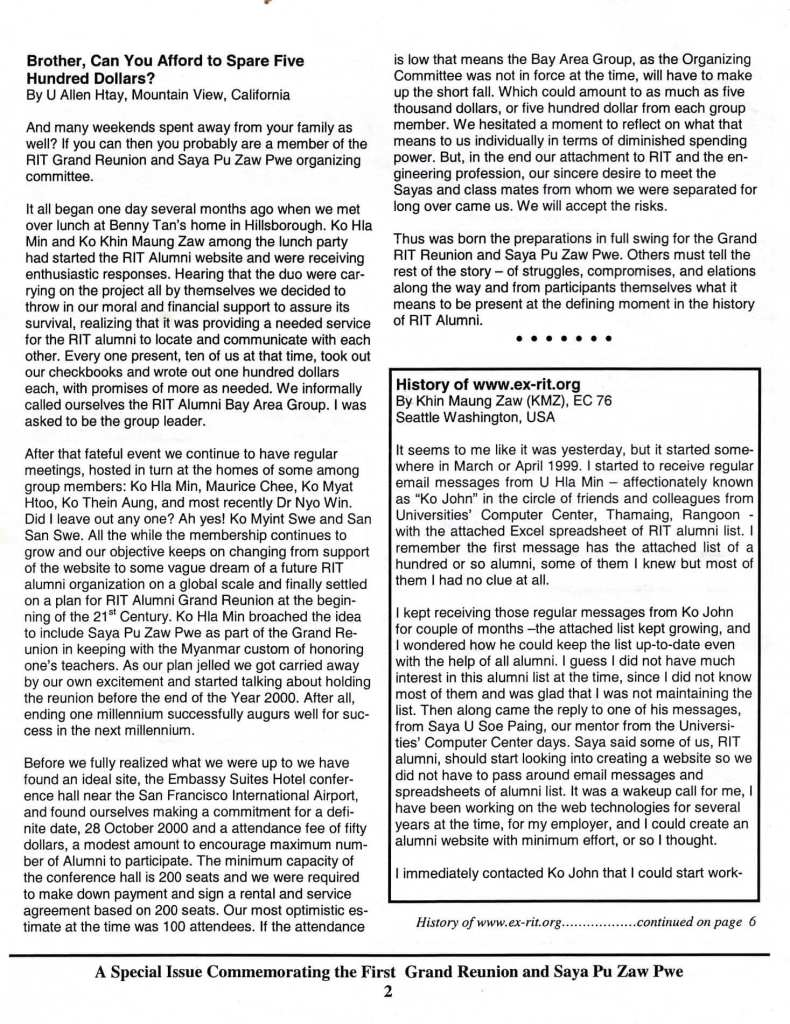
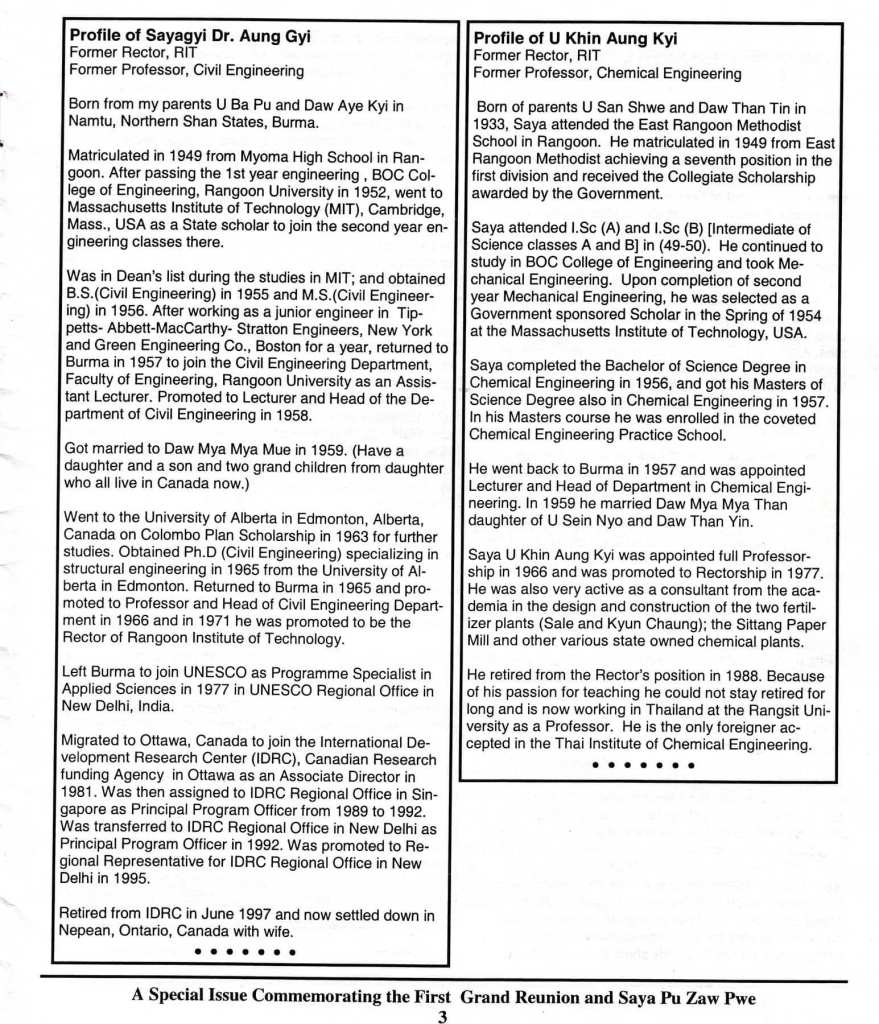
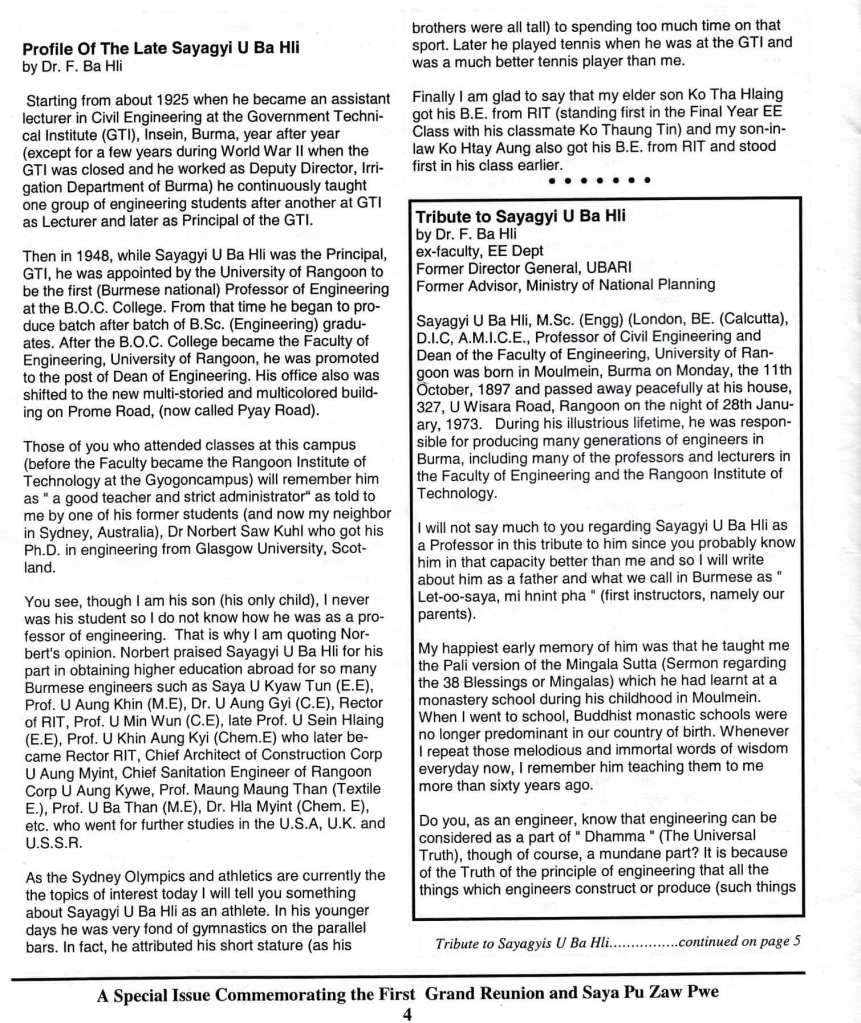
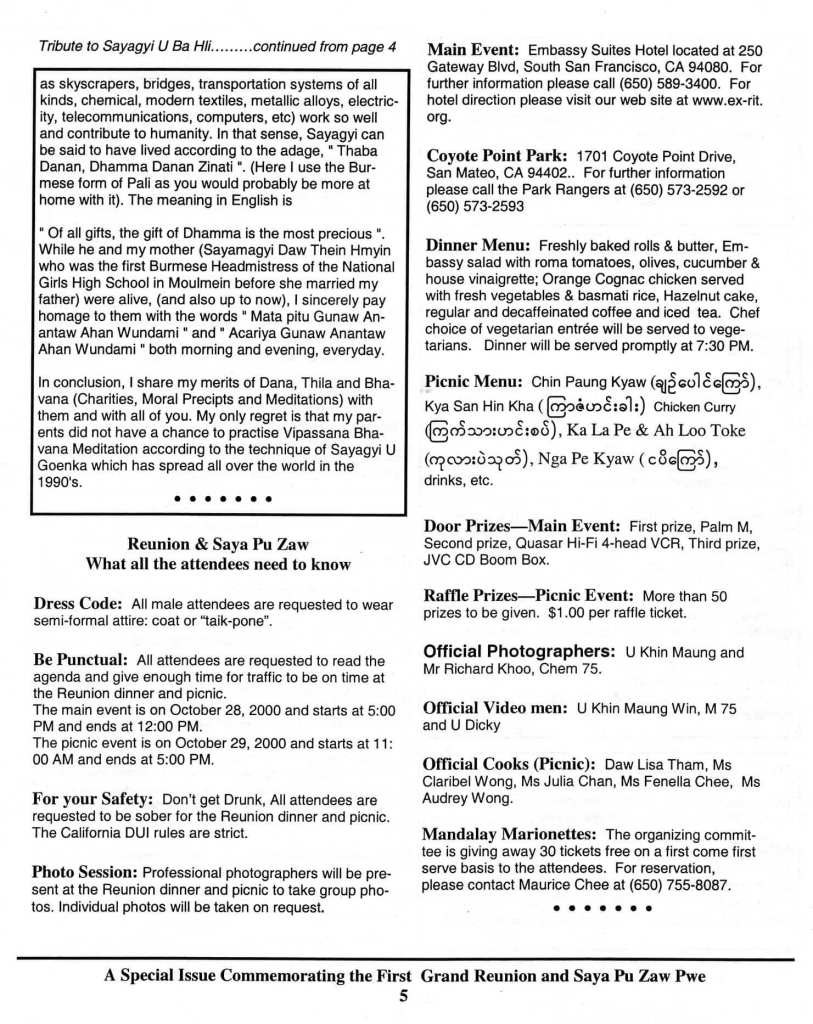
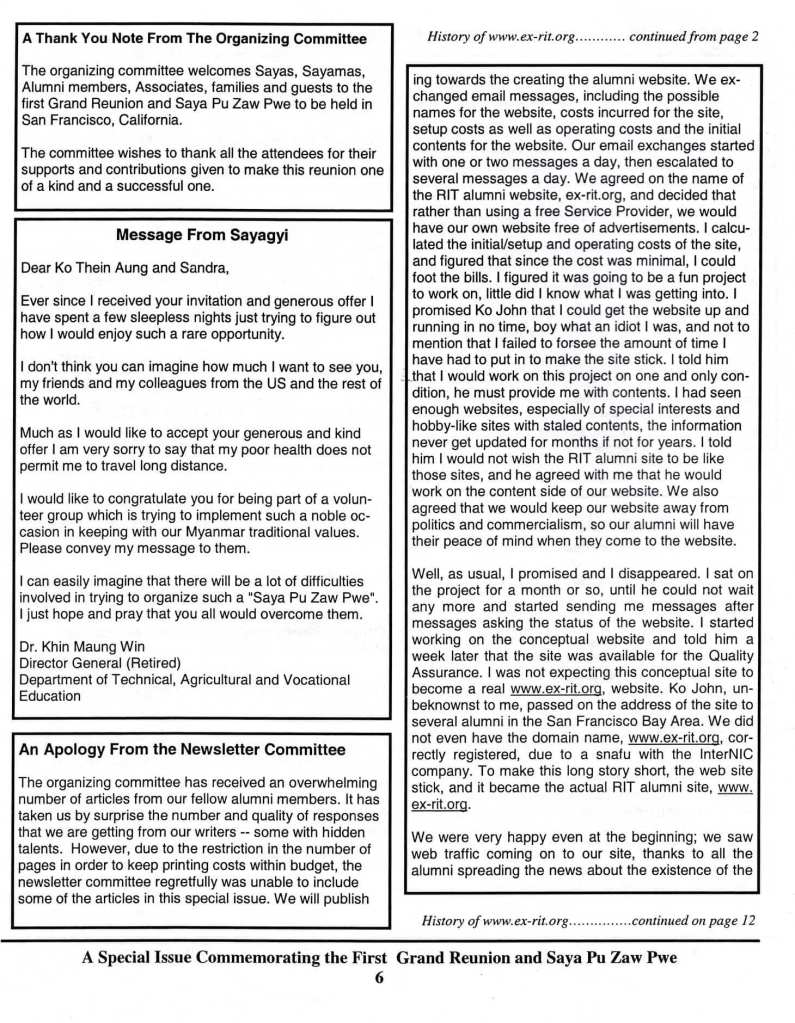
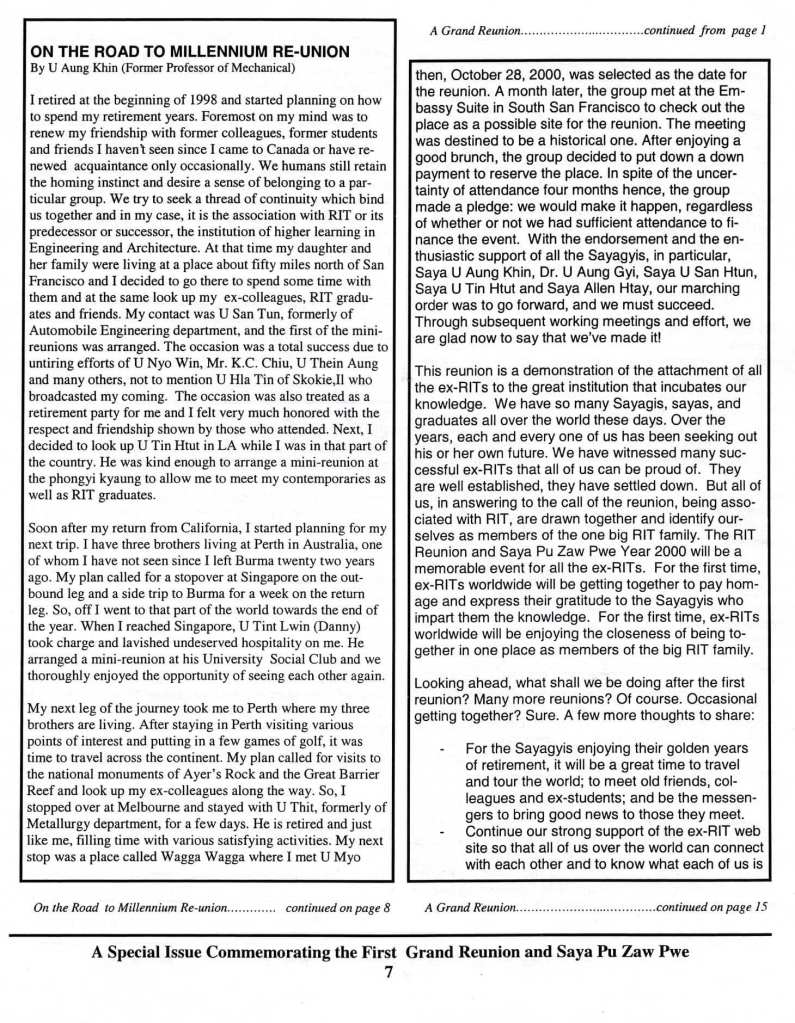
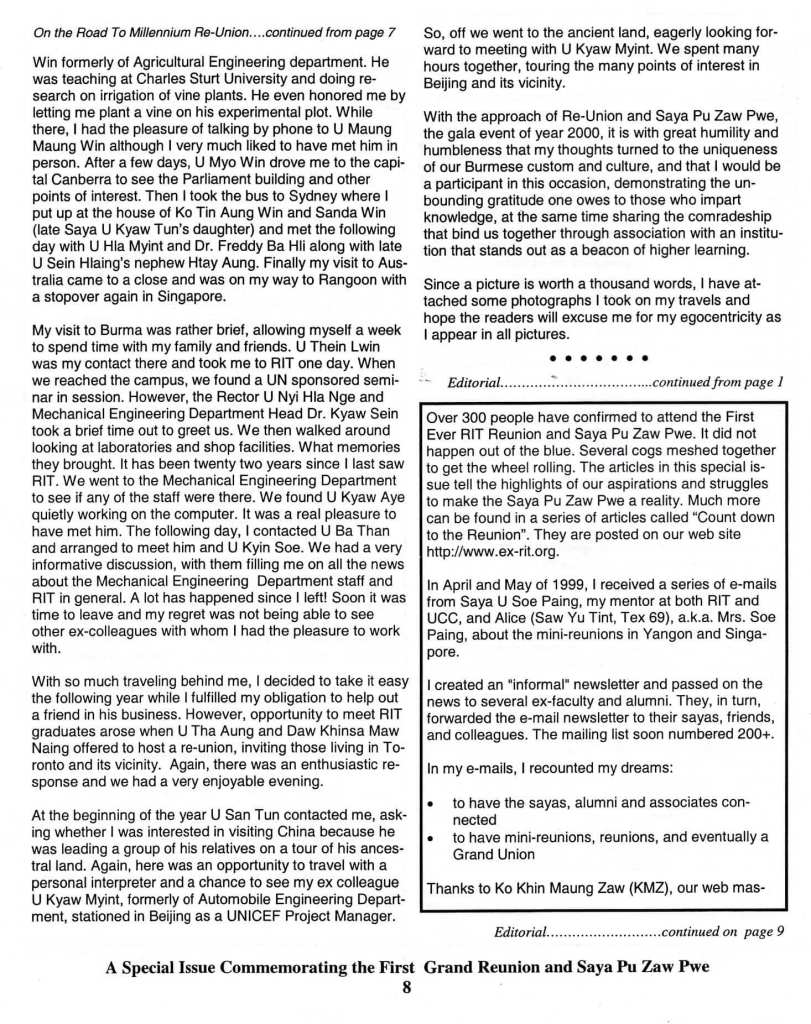
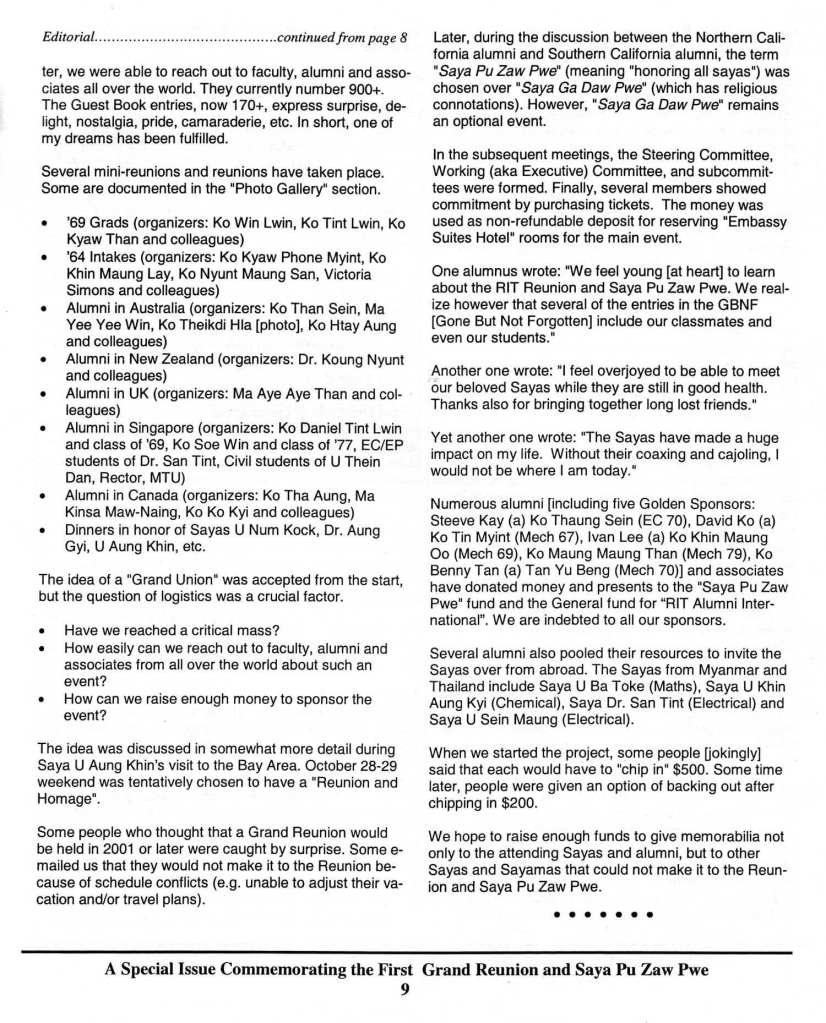
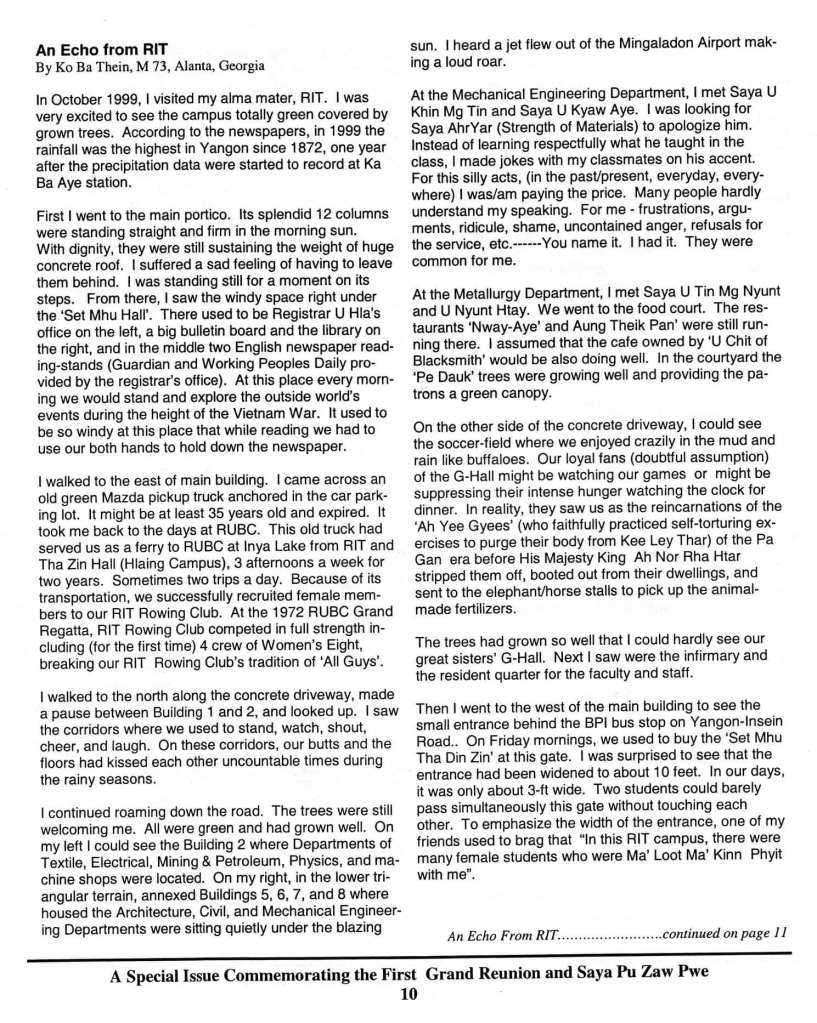
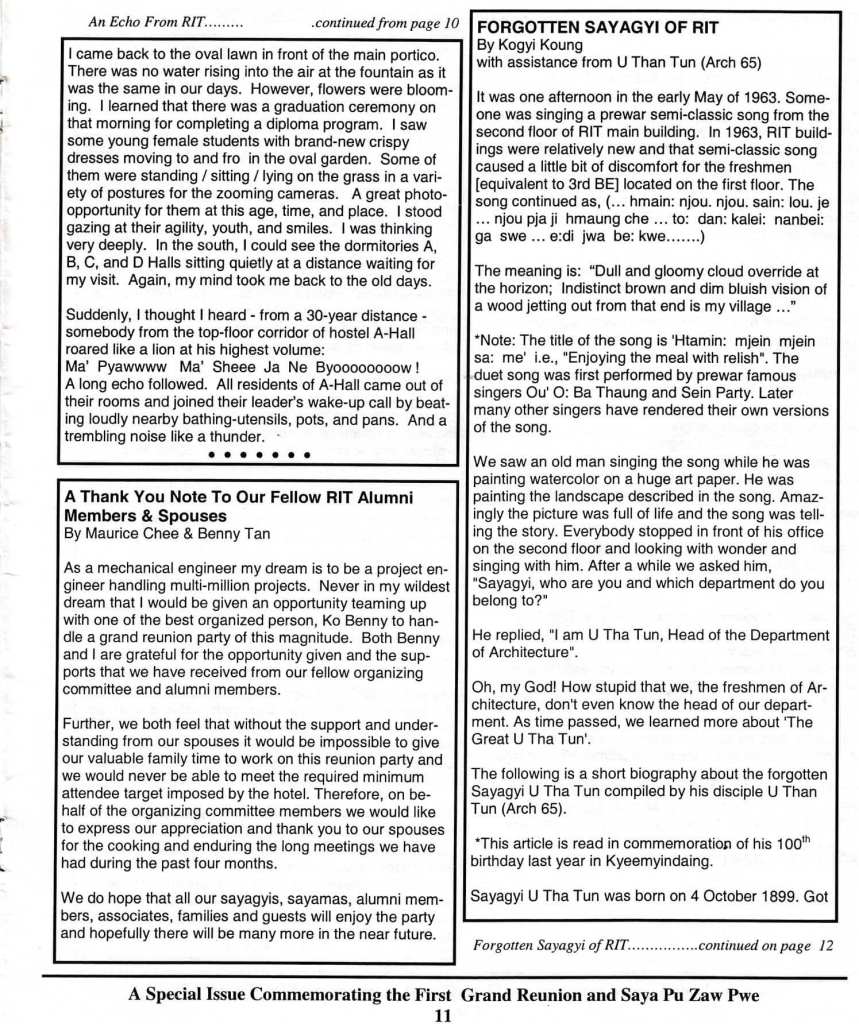
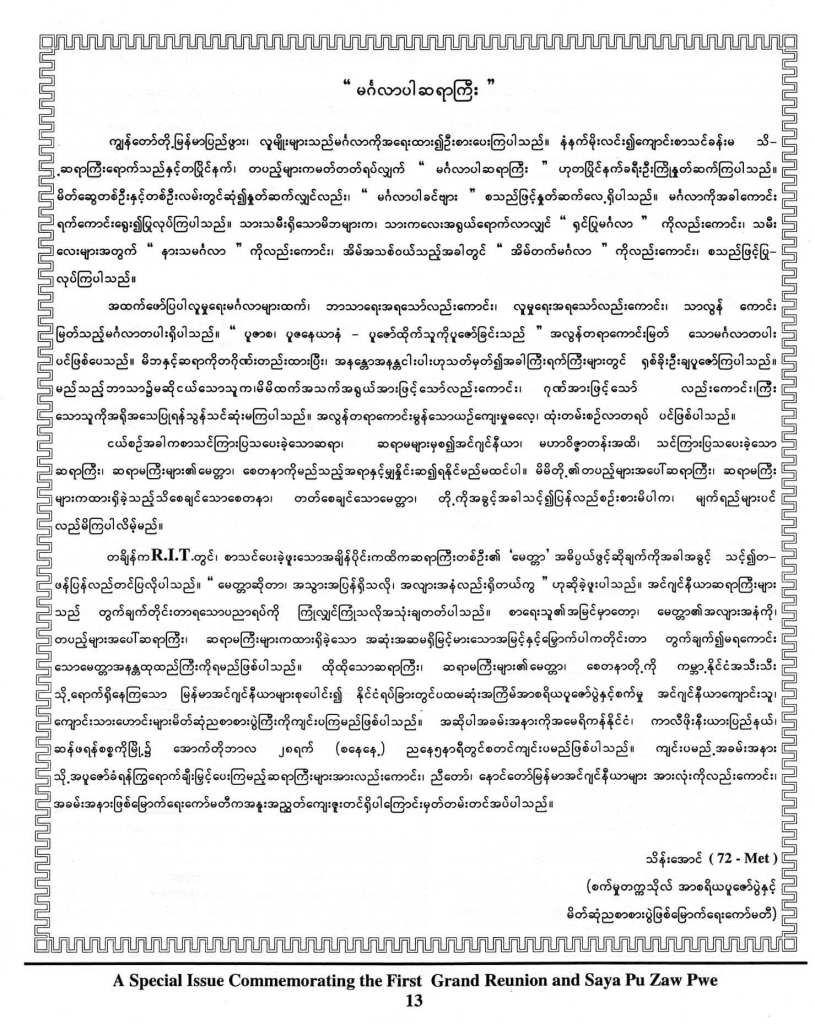
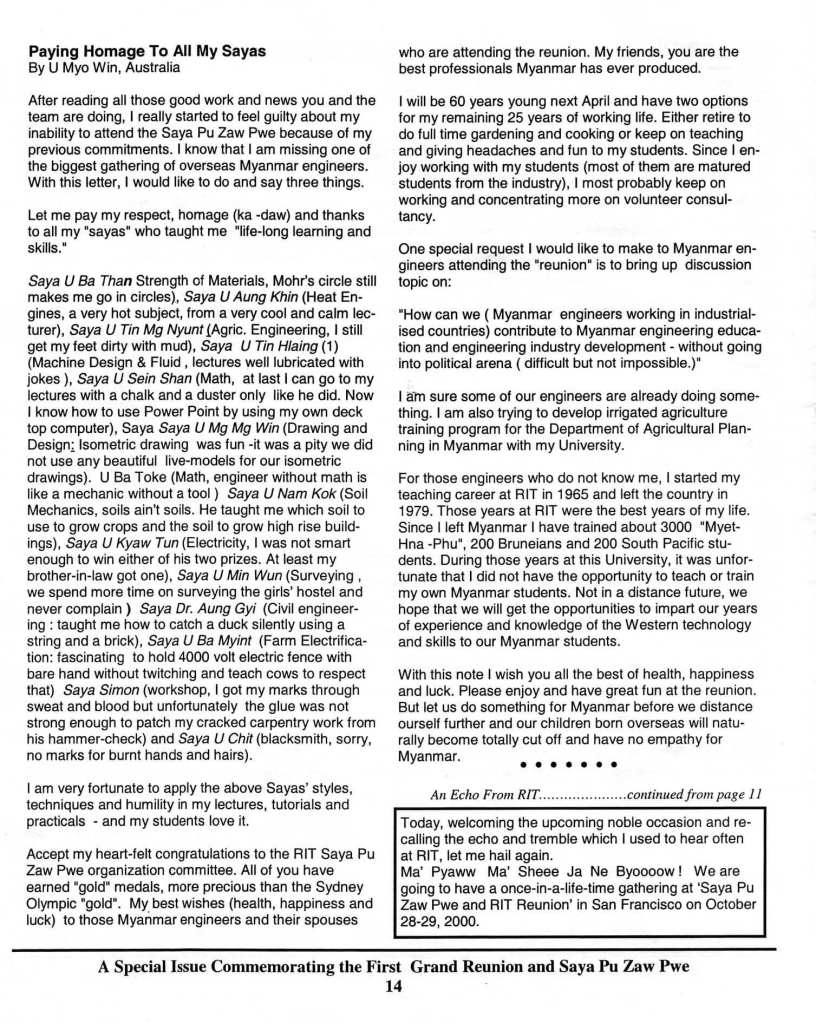
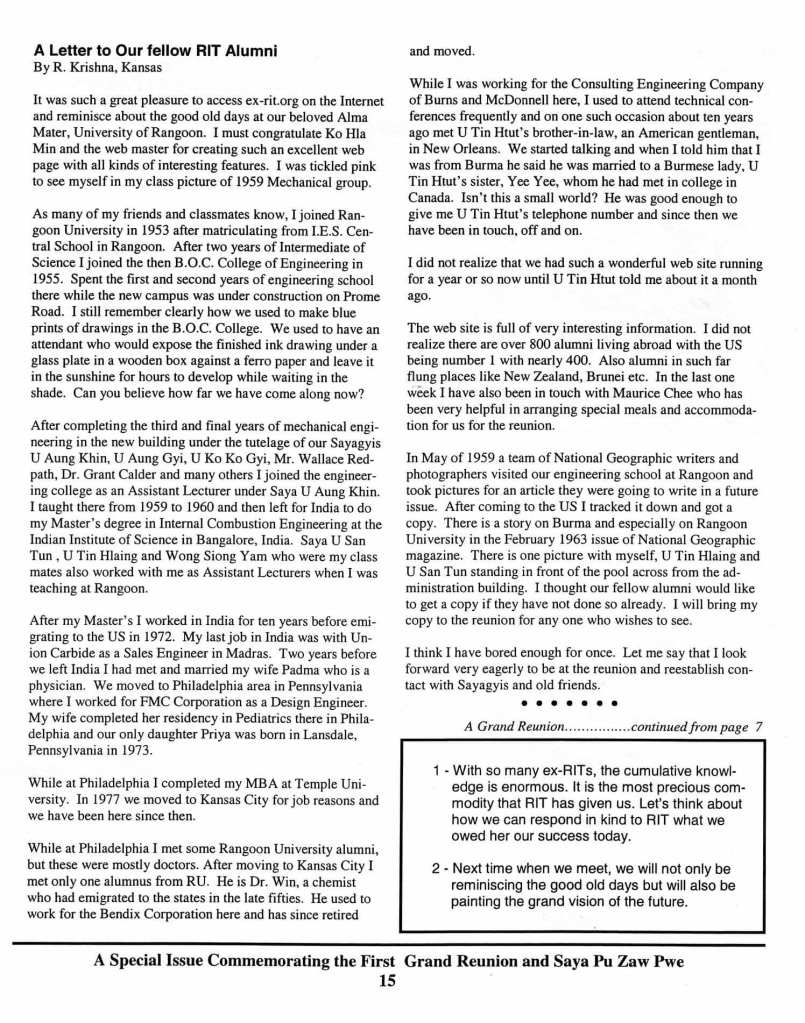
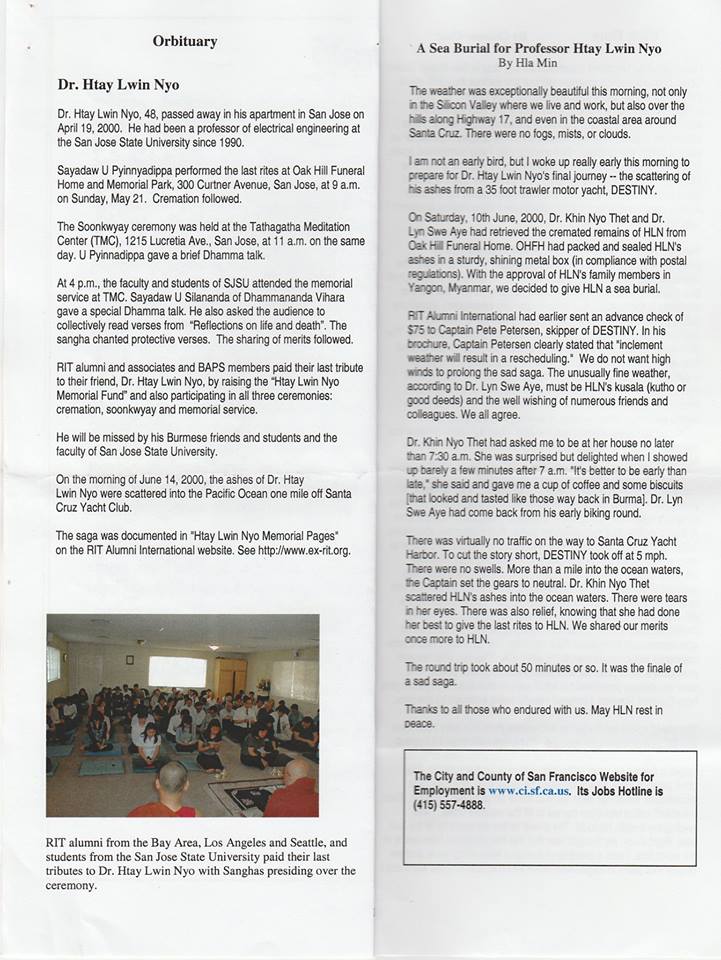
Page 2 of Special IssuePage 3 of Special IssuePage 4 of Special IssuePage 5 of Special IssuePage 6 of Special IssuePage 7 of Special IssuePage 8 of Special IssuePage 9 of Special IssuePage 10 of Special IssuePage 11 of Special IssuePage 12 of Special IssuePage 13 of Special IssuePage 14 of Special IssuePage 15 of Special IssuePage 16 of Special Issue
Archives
U Khin Maung Zaw archived the early newsletters in ex-rit org website.
U Wunna Ko Ko archived the later newsletters in RitAlumniInfo website.
Both websites are no longer active.
Contributing Editor
I volunteered as a Contributing Editor for the following newsletters
RIT English Association Newsletter
BAPS (Burmese American Professional Society) Newsletter
Dhammananda Newsletter published by TBSA (Theravada Buddhist Society of America)
Irrespective of years gone by, my beloved mother and benefactor still remains in my heart. I wrote the poem for Thway Thauk Magazine in May 1964 in memory of my mom who passed away on March 10, 1964.
The course in Burmese is available in CD and MP3 tapes.
The course is English is available as a 3-volume book.
Abhidhamma Course (in Burmese)
Abhidhamma (Burmese)
Sayadaw U Silananda gave a course at Dhammananda Vihara (then in Daly City) over several weekends.
Saya U Tin Maung Nyunt (M60) completed the course.
Some devotees converted the 26 tapes into MP3 format.
Ko Jeffrey (from Fremont) loaded them onto an MP3 player, and offered them as dhamma dana to students taking Abhidhamma courses.
Handbook of Abhidhamma Studies
Three Volumes by Venerable Sayadaw U Silananda
Transcription by Sarah E Marks
Abhidhamma (English)Back cover
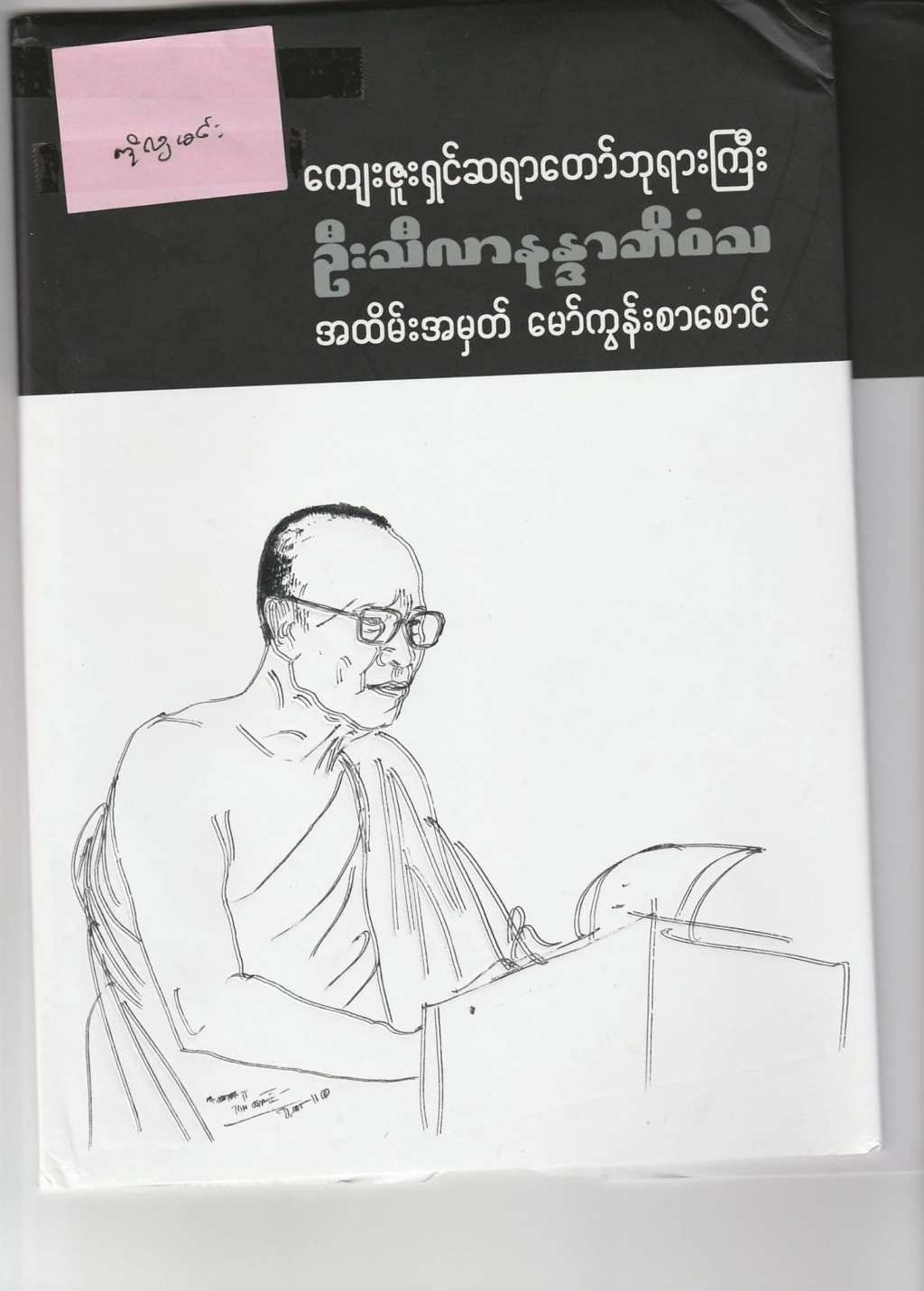
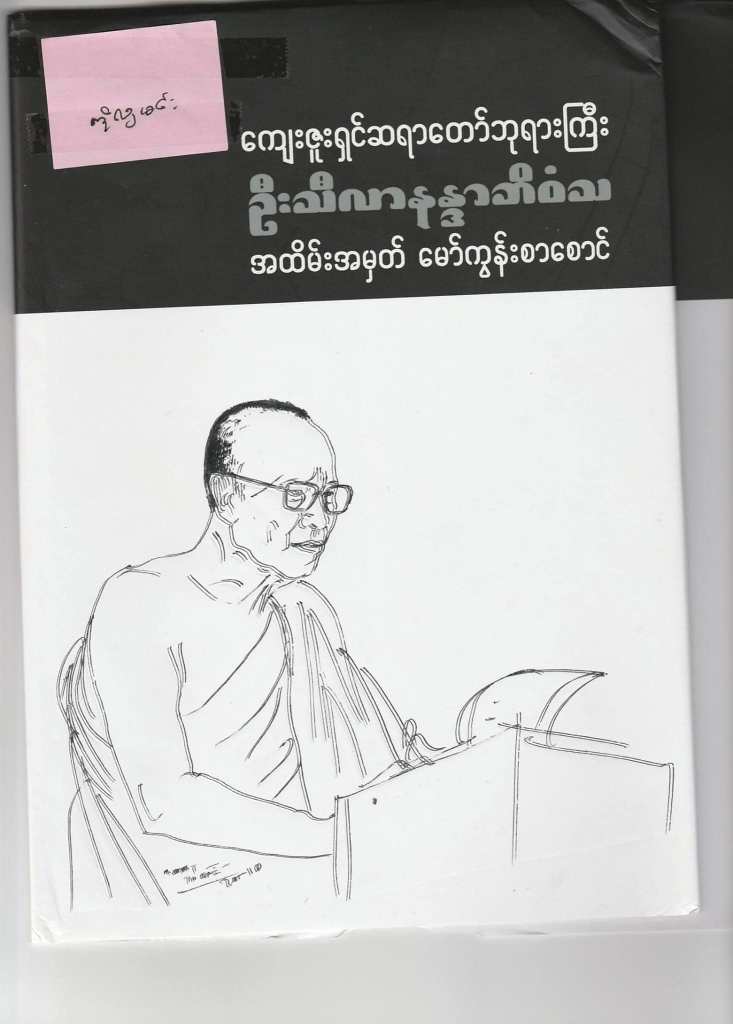
Dr. Nandamalabhivamsa
Dr. Nandamalabhivamsa
He succeeded U Silanandabhivamsa as Rector of IMBTU
He taught Abhidhamma in Myanmar and beyond.
Fundamental Abhidhamma Part I was first taught in 1997 at Maryland, USA. The book was edited by Dr. Khin Maung U (First in Burma in the Matric exam of 1963). The second edition was published by the Center of Buddhist Studies (CBS), Sagaing Hills in 2005.
Fundamental Abhidhamma Part II was published by the Center of Buddhist Studies (CBS), Sagaing Hills in 2007.
Fundamental
Fundamental Abhidhamma
Part I
By Dr. Nandamalabhivamsa
First edition : June 1997
Editor : Dr. Khin Maung U
Myanmar-Buddhist Meditation Society, Baltimore, Maryland, USA
Second, extended edition : January 2005
revised : November 2005
Center for Buddhist Studies (CBS), Sagaing Hills, Sagaing, Myanmar
Contents
The History of Abhidhamma
(1) Why is it called Abhidhamma? (2) Who is the author? … (8) The role of Abhidhammattha sangaha (9) The role of Vibhavani (10) Ledi Sayadaw (11) Paramatthadipani, the critic of Vibhavani
Ashin Garudhamma teaches two courses at the monastery in Spady, Fremont.
One is Pali.
The other is Abdhidhamma.
Gary dhamma
Abhidamma Newsletter (1999)
Sayadaw U Silanandabhivamsa was Patron of Dhammachakka Meditation Center, Berkeley, C.A.
Abdhidhamma Newsletter was published by the Abhidhamma Study Group of DMC.
Abhidhamma Newsletter
Abhidhamma Newsletter Volume 1 Number 3 (April 1999) Adviser: Venerable U Silananda Editor: Maung Tin-Wa (Ph.D.) Editorial Board: James Cameron, U Aye Cho, Aung Khin (M.D.). Marc F. Lierberman (M.D.), Yan Naing Lwin (Ph.D.), Sarah E, Marks, Tin Than Myint (M.D.), Bach Dong Nhut, U Han Nyo, Phil Rohrer, Larry Rosenberg, Anna Spievogel (M.D., Ph.D.), Tin Myo Than (M.D.), Hla N. Tin (Ph.D.), Rita Adelman Graphic Designer: Scott Jordan Transcribing and Word Processing: Pat McMahon Published by the Abhidhamma Study Group of Dhammachakka Meditation Center, Berkeley, C.A.
Many monasteries have libraries with texts in Pali, Burmese/Myanmar & English. Some have indexed the library collection.
It is difficult if not impossible to read all the books in a library.
Libraries in Monasteries (Northern California)
Dhammananda Vihara Half Moon Bay
Kuthalakari, Fremont
Mettananda Vihara, Oakland (formerly at Fremont & Castro Valley)
Mudita Shwe Kyaung, Hayward
Tathagata Meditation Center, San Jose
Training and Teaching Centers
Mingalar Byu Har (မင်္ဂလာဗျူဟာ), Dhamma Byu Har (ဓမ္မဗျူဟာ), Dhammacakka Society (ဓမ္မစကြာအသင်းအဖွဲ့ ), Pathan Sar Thin Taik (ပဌာန်းစာသင်တိုက်) and the various training and teaching centers have helped sustain, promote, and propagate Sasana.
Theravada Canon
Theravada means “Way of the Elders”.
At the First Buddhist Council and at the subsequent Councils, the sacred texts are reaffirmed. The Teachings are not added, deleted, or modified.
Burma hosted the Fifth & Sixth Buddhist Councils.
Sayadaw U Silanandabhivamsa initiated two projects: one to digitize the marble slabs inscribed during the Fifth Buddhist Council in Mandalay, and the other to compile a CD of the Tipitaka texts that were re-affirmed at the Sixth Buddhist Council in Rangoon/Yangon.
The Pali-Myanmar Tipitaka Dictionary was compiled under the guidance of the Sayadawgyis (e.g. Mahasi Sayadaw) and the [then young] Sayadaws (e.g. U Silananda). Myanmar translations of the Tipitaka texts were published by the Department of Religious Affairs.
Mahagandaryone Sayadaw U Janakabivamsa
He wrote texts for both the sanghas and the lay people. They include
Ba Tha Thway ဘာသာသွေး
Yadana Gone Yi ရတနာ့ဂုဏ်ရည်
A Na Gut Thar Tha Yay အနာဂတ်သာသနာရေး (Future of the Dispensation)
Ko Kyint Abhidhamma ကိုယ်ကျင့်အဘိဓမ္မာ (Abhidhamma in Daily Life)
Shin pone shin kyint wut ရှင်ပုံ ရှင်ကျင့်ဝတ် (rules for the samanera/novices)
The Illustrated History of Buddhism (with drawings by Sayagyi U Ba Kyi)
Dhamma Recording
Tape Recorders
In the 50’s and 60’s, the Burma Broadcasting Service (BBS) used mostly Ampex tape recorders for high fidelity.
The general public used less expensive brands such as Akai, Grudig and Sony for recording.
Sixth Buddhist Council
During the Sixth Buddhist Council (1954 – 1956), BBS broadcast the sessions where Mahasi Sayadaw served as the Questioner and Mingun Tipitaka Sayadaw served as the Reciter/Expositor.
The archives are being offered as dhamma dana in Audio CD and MP3 formats.
Kudos to those who are trying to preserve, practice, and propagate the Sasana (Teachings of the Buddha).
Teachings of Sayadaws
Individuals and organizations have provided access to their dhamma archives.
Sun Lun Sayadaw
Recordings (dhamma talks, kammavaca, …) of Myingyan Sun Lun Gu Kyaung Sayadaw U Kavi were made by his disciples. They can be downloaded from the Sun Lun web site.
Mogok Sayadaw
U Sway Tin and his team recorded 500+ talks of the Mogok Sayadaw U Vimala. They also transcribed the tapes for distribution as books. The advances in technology make possible the redistribution of the archives as Audio CDs, MP3s, and e-Books.
Dhammananda Sayadaw
Recordings of Sayadaw U Silananda (Abdhidhamma, “Words of the Buddha”, …, dhamma talks given at the meditation retreats) were made by his disciples at Dhammacakka Center, Theravada Buddhist Society of America (TBSA), Tathagatha Meditation Center (TMC), and Zen Buddhist Temple. Some works are available as Audio CDs, MP3s and books. I was honored to edit the dhamma talks (transcribed by Sayadaw U Osadha) before presenting them to SayadawU S ilananda for final review and editing. The book was published in 2003 by the Malaysian yogis organized by Pauline Chiong.
Taya Oo
TMC Publications
Tathagata Meditation Center
TMC was founded by the Vietnamese disciples of Sayadaw U Silananda.
TMC is located at 1215 Lucretia Avenue, San Jose, CA 95122
Conducts about six long-term meditation retreats per year.
Offers two week-end retreats for months when there are no long-term retreats.
Holds summer classes : one for children and the other for young adults.
Published several books for Dhamma Dana distribution. They include teachings by Mahasi Sayadaw, U Pandita, U Silananda, and books to study Pali.
Pali
For the past few years, U Dhammika-bhivamsa (Tharmanay Kyaw) taught Pali courses using selected Suttas to interested yogis to have an appreciation of Buddha’s teachings without delving into the details of Pali grammar.
The course materials were prepared by Som Tu (Director of TMC, Retired executive in Technology) under the guidance of Thamanay Kyaw Sayadaw.
Reference Books
I used to volunteer as Translator/Interpreter for Meditation Retreats at Tathagata Meditation Center (TMC).
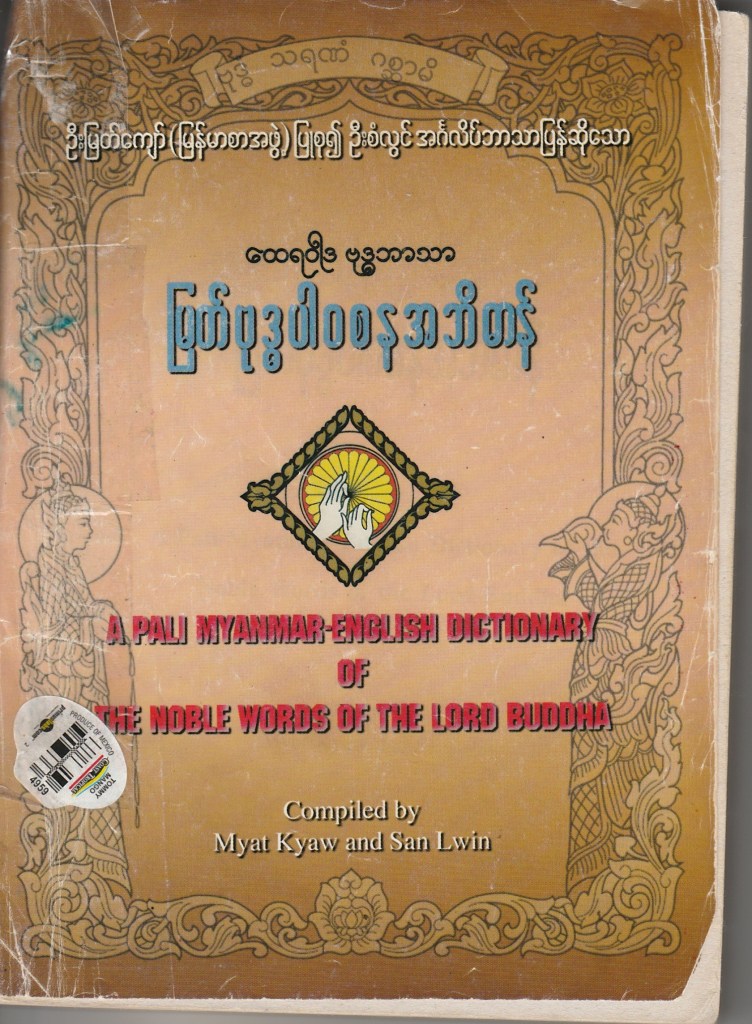
Beelin Sayadaw U Pannadipa (then Resident Sayadaw at TMC, currently Padana Nayaka Sayadaw at Panditarama Shwe Taung Gone in Yangon) gave me the book “A Pali Myanmar-English Dictionary of the Noble Words of the Lord Buddha”.
The book was compiled by U Myat Kyaw (Myanmar Sar Ah Phwe) and translated into English by U San Lwin.
TMC gave me the book “Buddhist Dictionary” by Ven. Nyantiloka.
It is subtitled “Manual of Buddhist Terms and Doctrines”.
The first edition was published in 1946.
The third revised & enlarged edition was edited by Ven. Nyanaponika in 1970.
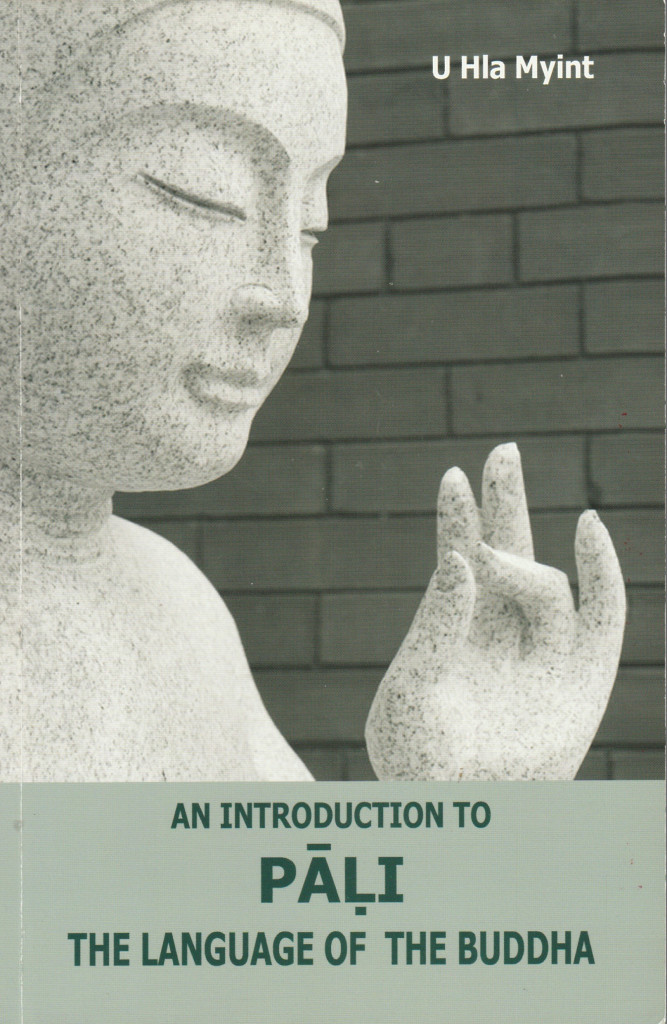
U Hla Myint, who had passed Dhammacariya & several monastic exams as a monk, gave me a PDF version of his manuscript “An Introduction to Pali” for study and review.
The book is available as Dhamma Dana distribution from TMC.
He studied Pali under the guidance of Mahagandayone Sayadaw U Jananabhivamsa (one of the greatest Pali scholars in the 20th century) and with the outstanding teachers U Vijaya-lankara and U Dhamika-bhivamsa (with pen name “Thamanay Kyaw”).
He studied English under the guidance of Sayadaw U Pandita-bhivamsa and with the eminent teachers such as U Aung Myat Thut, U Aye Maung and U Hla Maung.
He has written, translated and edited several books for TMC.
U Hla Myint
Triple Gem Publications
Founder Members
Harry Than Htut (Canada)
U Htay Aung (Victor, Australia)
Dr. Maung Maung Lwin (UK)
U Tin Htoon (USA)
Daw Tin Tin Myint (Emma, Singapore)
Sample Publications
Emptying the Rose-Apple Seat A day-to-day guide to Buddhist meditation methods as taught by a renowned meditation master by Aggamahapandita Bhaddhanta Dr. Rewata Dhamma Foreword by Joseph Goldstein
The Buddha’s Prescription A selection of talks and essays by Dr. Rewata Dhamma
Inward Path Publisher
Background
IPP is in Penang, Malaysia.
Aims at disseminating the noble teachings of Wisdom and Compassion of the Buddha to a wide segment of readers through the printing of Dhamma books and booklets.
Dhamma Dana
Inward Journey Books (free Dhamma books) include the following :
One Truth Only A Compilation of Passages from Mahasi Sayadaw’s discourses
The Way to the Happiness of Peace Understanding the Basics of Insight Meditation By Sayadaw U Pandita
Paritta Pali and Protective Verses A Collection of Eleven Protective Verses & An English Translation By Sayadaw U Silananda
Volition An Introduction to the Law of Kamma By Sayadaw U Silananda
No Inner Core An Introduction to the Doctrine of Anatta By Sayadaw U Silananda
Idriya The Nine Causes which Sharpen the Controlling Faculty of a Vipassana Meditating Yogi By Sayadaw U Kundala
Vipassana Bhavana Basic Principles of Mindfulness Meditation By Sayadaw U Kundala
Time and Priceless Treasures of Thabyekan Sayadaw Compiled by Tharmanay Kyaw
Triple Gems Publications, in collaboration with Suki Hoti Publications, have made available dhamma dana books. See the relevant postings.
Theravada Web Sites
Thanks to the websites (such as those listed below), the Teachings of the Buddha and His disciples can easily be studied, practiced, and propagated.
Visiting Professor, Osaka University, Japan Collaborated with Professor Harada (Chit Mann Nwe)
Daw Khin Saw Mu
Khit San Kabyar
Statuette in “Bagyi Aung Nyar De” (short story)
Siblings : ICS U Tin Tut, U Kyaw Myint, U Myint Thein, Dr. Htin Aung, Daw Khin Mya Mu, Daw Tin Saw Mu
Spouse : ICS U Ba Tint
Children : Daw Khin Saw Tint, U Nay Oke Tint
TEDxTalk
Two Poets and their Legacy on Kabyar
Main Characters from “Bagyi Aung Nyar De” : ICS U Tin Tut (Bagyi Aung), Minthuwun (Maung Chit), Daw Khin Saw Mu (Statuette), ICS U Ba Tint (Merchant / Buyer of Statuette)
All four have passed away
It’s time to debunk the myth about “Bagyi Aung”. Many thought that he was Dr. Htin Aung.
Rhyme (or Kar Yan ကာရန်) is an essential element of Poetry.
Outer Rhyme
In most English poems, the end of specific lines rhyme. Some Burmese will call them “Ah Pyin Kar Yan အပြင်ကာရန်”(Outer Rhyme).
Rhyming Patterns
A B A B (where the first and third lines rhyme & the second and fourth lines rhyme).
A B B A (where the first and fourth lines rhyme & the second and third lines rhyme).
Rhyming Dictionary
I received “The Rhyming Dictionary” for taking part in the Debate held by RIT English Association.
Sayas Des Rodgers, Sao Kan Gyi (GBNF) and U Khin were the judges.
I gave the book to my mentor Ashin Ananda (Laureate Poet).
Inner Rhyme
Most Burmese poems use the “Ah Twin Kar Yan အတွင်းကာရန်” (Inner Rhyme).
For example,
o o o x o o x o o x o o x o o y o o y o
…
The first rhyme (x) starts with the 4th position in the first line. It moves to the 3rd position in the second line, then to the 2nd position in the third line, and finally hits the 1st position in the fourth line.
A second rhyme (y) can be started in the line where the first rhyme ended.
Differences in Style
Mya Zin
Some poets have their opinions & preferences. They may not strictly follow the rhyming rules. A few tend to use rhymes sparsely or not at all claiming that rhythm and ideas are sufficient ingredients of a Kabyar (poem).
Dr. Nyunt Wai (Victor, SPHS63) wrote that moderate use of Kar Yan ကာရန် is acceptable, but excessive use of Kar Yan can transform a verse or poem into Ah Kar Ah Yan အကာ အရံ (secondary).














 HlaMin