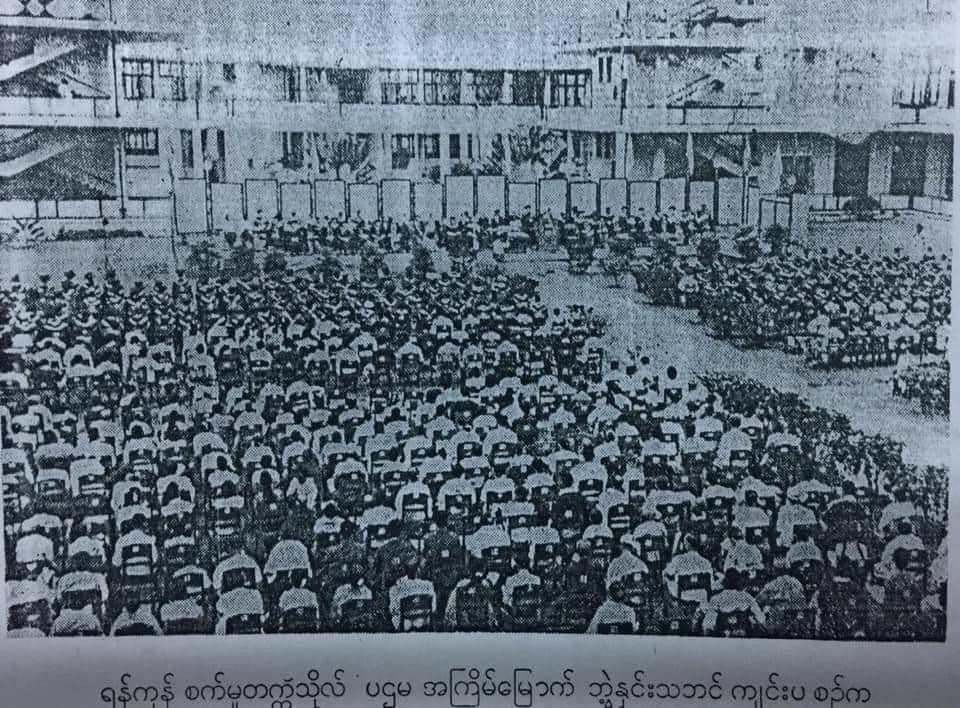
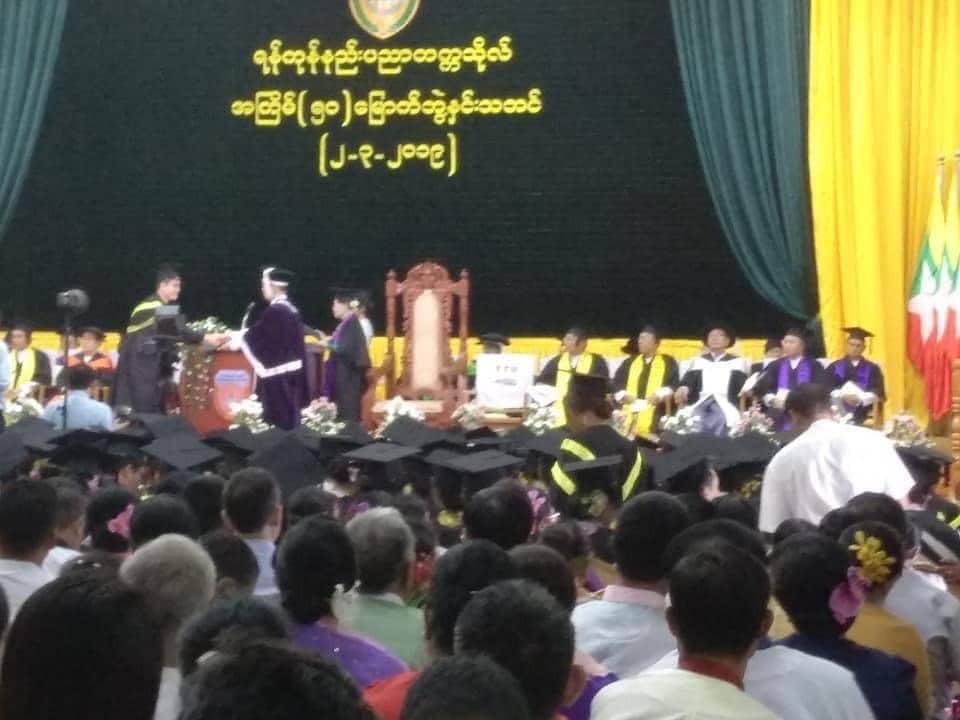
Before the advent of DVDs and Video Streaming, one has to rely on the Silver Screen.
Cinemas in Rangoon
In our younger days, the cinemas in Rangoon include :
Bayint Naung
Carlton / Yuzana
Excelsior / Waziya
Globe / Gon
Kar Htay
Light house / Nay Pyi Daw
Ma Yo San
Myoma
President / Thamada
Palladium / Pa Pa Win
Ritz
Regent
Royal / Taw Win
Shwe Gon
Shwe Mann
Sun Thiri
Tabin Shwe Htee
Wizaya
Cost of cinema tickets
President had Loge seats for five kyats
Most cinemas have Dress Circle seats for K3.50.
Back row seats cost K2.50.
Middle row seats cost K1.50. UTC members get a discount rate of 90 pyas.
Front row sets sell for 75 pyas.
Schedule
Screening times were 12:30 PM, 3:30 PM, 6:30 PM and 9:30 PM.
When a movie was offered in multiple cinemas, the starting times of the main feature were staggered (to allow the physical sharing of the movie reels across adjacent or close cinemas).
New shows usually started on Fridays at 12:30 PM.
Attendees for the “First Day First Show” usually indicated the popularity of a new movie.
The movie “Hna ma let shawt nay le dawt” was one exception. Some believe U Khin Maung Yin (A60, Modern Artist) was ahead of the time.
Before the main feature, there were news (e.g. by Rank Organization), cartoons and trailers (of forthcoming movies).
Popular movies
Action e.g. The Longest Day, The Guns of Navarone
Comedy e.g. Jerry Lewis, Norman Wisdom
Drama e.g. Imitation of Life, Madam X
Historical e.g. Ten Commandments, Ben Hur
Musical e.g. South Pacific, Sound of Music
Science Fiction e.g. Time Machine
Suspense e.g. Dracula, Psycho
Travelog e.g. Around the world in eighty days
Observations
Cinema-scope, Todd AO productions were some of the then novel features.
Most movie lengths were between 8000 to 12000 feet. Longer films required the change of viewing times (e.g. less shows per day).
Movies needed approval from the Censor Board.
Academy awards were given to eligible Burmese/Myanmar movies, directors, actors, …
Cinemas were nationalized were nationalized a few years after the Coup d’etat.
With the advent of TV, DVDs and the Internet, the former cinema goers around the world changed their viewing habits.
A few years back, only a limited number of movies were produced in Myanmar.
Some Myanmar movie stars and enthusiasts are building cinemas (some of them mega-cinemas) to revive the memories of the Silver Screen (and its improvements).
There were Three Presidents in the Union of Burma.
Sao Shwe Thaik served as the first President of the Union of Burma. Burma gained Independence on January 4, 1948. He was succeeded by Dr. Ba U and Mahn Win Maung.
Coup d’etat took place on March 2, 1962 before Sama Duwa Sinwa Naung could take office.
Sao Shwe Thaik’s son (Mie Mie Thaik) passed away during the Coup.
Prime Minister of the Union of Burma
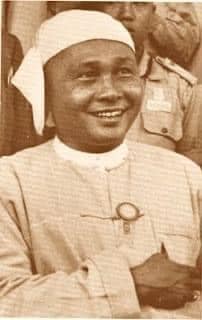
U Nu
There were five Prime Ministers in the Union of Burma. U Nu (formerly known as Thakin Nu) was Prime Minister three times.
U Nu served as the first Prime Minister of the Union of Burma.
He was also the Third Prime Minister (after a Sabbatical in which Dawei U Ba Swe served as Second Prime Minister)
Bo Ne Win became the Fourth Prime Minister after the Soft Coup in 1958.
U Nu became the Fifth and Last Prime Minister before the fateful Coup d’etat on March 2, 1962.
Medical doctor to study medicine in the West
Dr. Shaw Loo was the first doctor to study medicine in the USA.
Compilers of the English-Burmese Dictionary
Mekkhaya Mintha (Prince) & Mr. Lane translated Dr. Samuel Johnson’s Dictionary into Burmese.
Judson
Subsequent Lexicographers include Dr. Judson, U Tun Nyein, Dr. Ba Han and U Ohn Pe (Tet Toe).
Science and Technology Author
Yaw Mingyi U Pho Hlaing was the first Burmese author to write about Science and Technology.
Ahmyotha Kaw Leik (National College) Graduate
U Razak was the first to graduate from Ah Myo ThaKaw Leik.
Served as Principal of the Ah Myo Tha Kyaung (National School) in Mandalay.
Minister of Education in Bogyoke Aung San’s Cabinet.
Assassinated on July 19, 1947.
Engineer
Phan Chet Wun U Shwe Oh was the first Burmese engineer.
Political prisoner
Sayadaw U Ottama was the first Political Prisoner (Prisoner of Conscience) in Burma. “U Ottama Pan Chan” is a park named in his honor.
Sayadaw U Wisara was another famous Political Prisoner. “U Wisara Kyauk Taing” was erected in his honor.
Social Service Performer
Phwa Oo Zun (Mandalay native) was the first Burmese female to perform Social Service for the public.
Established the Home for the Aged.
Details can be found in Ludu Daw Ah Mar’s book “Mandalay Thar & Mandalay Thu”.
Actor
U Nyi Pu was the First leading male actor in a Burmese movie.
Siblings : Daw Khin Myint, A1 U Tin Nwe, U Maung Maung Soe (U Tin Pe) and A1 U Tin Maung
The siblings and their extended families founded several film companies.
U Nyi Pu founded Maha Weikzahto Film. The “Thamankyaw” movie was shot and produced at U Nyi Pu’s studio. A1 Than Htut and A1 Thein Htut directed the movie based on the script by Than Win (T70). Actors : Toe Nyunt, Ko Myint (Aung Myint, Min71) and Sai Wunna.
Producer and director
London Art U Ohn Maung founded a company to produce Burmese films
Served as Director.
Best Male Actor
Kyaw Soe won the inaugural award for Best Male Actor.
The awards were known as “Shwe Sin Yoke Su”.
The winners prefix their names with “Academy”.
Best Female Actor
Kyi Kyi Htay won the inaugural award for the Best Female Actor.
Won the award several more times.
Best Child Actor
Aung Tun Lay won the inaugural award for the Best Child Actor.
Best Male Supporting Actor
U Kyauk Lone (U Aung Gyi) won the inaugural award for the Best Male Supporting Actor.
Son : Sway Tin (Kyauk Pyar)
Best Female Supporting Actor
Daw May Nwe won the inaugural award for the Best Female Supporting Actor.
Best Director
U Thu Kha won the inaugural award for the Best Director.
Also wrote, acted and sang.
My translation “Still So Young” of U Thu Kha’s short story was published in the Sunday Supplement of Working People’s Daily. I received K50 for the translation. U Thu Kha received an honorarium of K50 for his short story.
Overseas Tour by Saing Saya
Sein Beda was the first Saing Saya to perform overseas.
Novelist
James Hla Kyaw wrote the first Burmese novel “Maung Yin Maung Ma Mae Ma”.
Female journalist
Independent Daw San was the first Burmese female Journalist.
Lecturer at RU English Department
Dr. Ba Maw was the first Burmese lecturer at the Department of English at the University of Rangoon.
Later became Adhipati during the Japanese Occupation.
Principal
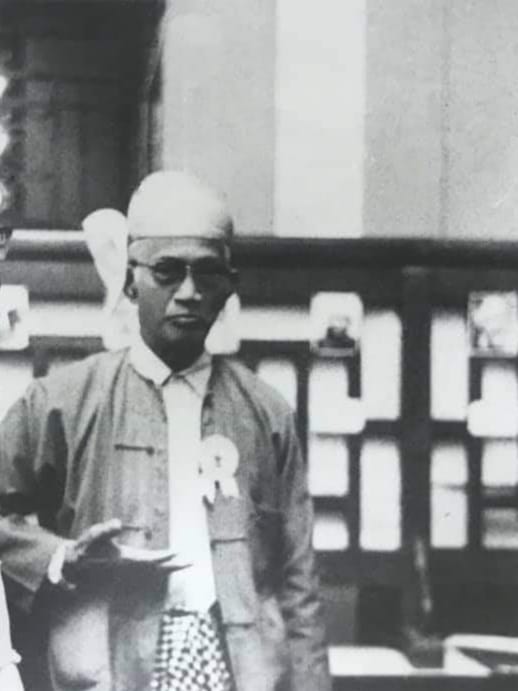
U Pe Maung Tin
U Pe Maung Tin was the first Principal of the University of Rangoon.
Professor of Oriental Studies (including Pali).
Proposed to have a separate Department for Burmese.
Three outstanding students — ICS U Sein Tin (Theikpan Maung Wa), U Thein Han (Zawgyi) and U Wun (Minthuwun) — founded the “Khit San Sar Pay” movement.
Rector
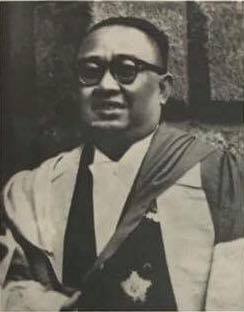
Dr. Htin Aung
Dr. Htin Aung was the First native Rector of the University of Rangoon
Vice-Chancellor, RU
Ambassador to Ceylon
Author, Historian, Folklorist
Stereo Khit (Era)
Tekkatho Tun Naung (BDS, Luyechun) was the first vocalist of the Stereo Khit (Era).
Others include Accordion Ohn Kyaw and Min Min Latt.
Former performers of BBS Local Talent and Variety Show also became professionals.
Aerial acrobat
Mee Bone Byan U Kyaw Yin was the first aerial acrobat to perform stunts from a Hot Air Balloon.
He was featured in a text book that we studied in Middle School.
Son : Cartoonist U Kyaw San [Ka Sa]
Robotics
U Kyi constructed the first robot.
Roving Troupe
Great Po Sein founded the first Nei Hlei Zat Tha Bin (roving troupe for performing plays).
Sons : Kenneth Sein and Thet Thet Sein also performed
Chief Justice of High Court
Dr. Mya Sir Bu studied in France and Germany
Served as the first Burmese Chief Justice of High Court.
Atomic Energy Commission
Dr. Tin Hlaing founded the Department of Atomic Energy
Served as the first Director General.
Cartoonist
U Ba Galay (U Shwe Ta Lay) was the first Burmese Cartoonist.
History Commission
Sithu U Kaung served as the first President of Burmese History Commission.
Children : U Thaw Kaung, Dr. Yee May Kaung and Daw Kyi May Kaung.
The History Commission was later merged with the Burmese Language Commission.
Computer Systems and Applications
Dr Chit Swe is the Computer Pioneer in Burma.
Saya founded the Universities’ Computer Center (UCC) with the help of Saya U Soe Paing, Saya U Myo Min and Saya U Ko Ko Lay (GBNF) and served as the Founding Director
Saya established the academic and training courses at UCC with the help of Professor Dr. Harry D. Huskey (Past ACM President) and visiting professors from US, UK and Europe.
Enabled the academic courses at UCC to have degrees conferred by the Department of Mathematics at Rector of Rangoon Arts and Science University.
Became Rector of RASU. He never lost his passion about UCC and the dissemination of Computer Science and Applications.
Dr. Chit Swe was succeeded as Director of UCC by Dr. Tin Maung (Mathematics Lecturer at RASU).
During Dr. Tin Maung’s tenure, the Department of Computer Science (DCS) and the Institute of Computer Science and Technology (ICST) were established.
U Tun Aung Gyaw (EC69) and I were members of “Generation Zero” at UCC. We taught at UCC, DCS and ICST.
President of Burma Students’ Union (Ba Ka Tha)
U Raschid (also known as M. A. Raschid) served as the first President of Ba Ka Tha (All Burma Students’ Union). He was also President of Ta Ka Tha (Rangoon University Students’ Union)
Served as a Minister in the AFPFL Government.
Son : Saya Bilal Raschid (Architecture)
Checkers
Chit Oo Nyo, a prolific writer, wrote the first book on how to play “Kyar” (Checkers).
Distinguished Social Service
Hajeema Pyinmana Daw Pu was the first female to win Lu Hmu Htoo Chun Su Pathama Sint (First Class for Distinguished Social Service).
Donated for the founding of some hospitals.
Son-in-law : Saya U Ba Than Haq (Retired Professor of Geology and Pro-Rector of RASU)
Florence Nightingale Award
Major Daw Khin Ohn Mya was the first recipient of the Florence Nightingale Award [for outstanding Nursing].
Pen name : Mya Marlar
Body Donor
U Win Myint (Mandalay) was the first Burmese to donate his body.
United Nations Secretary General
U Thant succeeded Daj Hammerjold as UNSG (United Nations Secretary General).
He was the Third UNSG and the First Asian UNSG
Served two terms
Passed away in 1974
“U Thant Ah Yay Ah Khin” (In December 1974) is a sad event in the history of Burma.
Nobel Laureate
Daw Aung San Suu Kyi was the first Burmese to receive the prestigious Nobel Peace Prize.
Most Entries in Myanmar were compiled by Minthuwun (U Wun)
Retired Professor of Burmese at Rangoon University
Head of the RU Translation Department
Compiler of the Myanmar Abhidan (Burmese Dictionary)
Co-compiler of the Japanese-Burmese Dictionary
Visiting Professor of Burmese at Osaka University at the invitation of Professor Harada (“Chit Mann Nwe”)
Co-founder of “Khit San Sar Pay” with U Thein Han (Zawgyi) and ICS U Sein Tin (Theikpan Maung Wa)
Laureate Poet
Children : Edgar Wun (U Nyan Soe), Peter Wun (U Htin Kyaw, former President of Myanmar) and Rosalind Wun (Daw Htar Cho)
The initial Luyechun program ran from 1964 to 1988.
The Luyechun program was revived a few years back.
1964
Luyechun (Outstanding Student) Program was established in 1964. Eligible students from 7th Standard to 10th Standard were chosen to attend the Ngapali Luyechun Camp.
1964 Luyechuns include Ko Win Aung, Ko Oke Soe Kha (son of Saya Dr. Maung Maung Kha) from Rangoon, Ma Pwint Than (Loikaw), Ko Aung Myint (Mandalay), and Ma Mie Mie Khine (Akyab).
1965
Luyechun Program was extended in 1965 for eligible students from Universities and Institutes. There were three Camps
Inlay Camp for high school and university students
Ngapali Camp for middle school students
Combined Camp in Rangoon
I was selected as RIT Luyechun for the Inlay Camp along with Ko Sein Shwe, Ko Zaw Min [Nawaday] and Ma Khin Than Myint Tin (Margaret).
Ko Kyaw Sein Koe (Victor Koe, GBNF), Ma Anita Aye Pe, Ko Khin Maung U and Ma Than Than Tin (Cherry Hlaing) were selected for IM(1).
Ko Tun Naung (GBNF, BDS, Stereo Khit Pioneer), Ko Soe Aung (IM2, elder brother of Ko Soe Myint [GBNF, UCC]), Ko Min Oo (Mathematics), Ko Ye Myint & Ma Khin Aye Than (Chemistry), Ko Myint Thein & Ko Soe Lwin (Physics), and Ko Tin Hlaing (Lay Dwin Thar Saw Chit, Burmese) were some who were selected for their disciplines.
Those from Matriculation include Ko Win Myint (later Bogyoke), Ko Aung Win (later RIT Saya), Uttam Singh (later NASA) and Ma Pwint Than (later EPC). They joined RIT.
Others include : Ko Aung Shwe (brother of Tekkatho Phone Naing), Ko Than Sit (GBNF, Liver Foundation), Ko Aung Kyaw Nyunt (GBNF), Ko Aung Myint, Ko Thein Lwin, Nelson Kaw and Ko Kyaw Myint.
Multiple Luyechun
Several students (e.g. Dr. Khin Maung U, Dr. Thynn Thynn Lynn, Daw Mie Mie Khine) were selected Luyechun multiple times.
Staff Sayas
Some sayas from Universities and High Schools were chosen to manage the Luyechuns. e.g. U Aung Gyi (MASU), Daw Po (RASU), Dr. May May Yi (GBNF, IM2)
Dr. Min Oo (SPHS63, Mathematics) was selected Luyechun in 1965 and later as a Staff Saya.
Guest Speaker
Saya U Thein Han (Zawgyi), Saya Dr. Nyi Nyi and U Thu Ta (Meteorology) were Guest Speakers at the Inlay Luyechun Camp.
Saya U Kyaw Myint (DHE) and I were Guest Speakers at the Nagapali Lu Ye Chun Camp in 1988.
Status
Luyehun project ended in 1988.
A few years back, an Association was formed for Lu Ye Chuns from 1964 to 1988.
The 7th Annual General Meeting was held online in January 2021.
Laughter is the best medicine Feature in Reader’s Digest
It takes less effort and nerves to smile than to frown.
A Cartoon (or Comics) a day keeps the blues away.
Cartoons (and Comics) have no age boundaries.
EarlyCartoonists
Aung Shein
Ba Gyan
Ba Htwe
Heng Soon
Kyaw San (“Ka Sa”)
Pe Thein
Shwe Ta Lay
Than Kywe
…
They published Cartoons in Burmese and English newspapers, magazines, books, …
The “Cartoon Festival” was held in U Ba Gyan Street (around Tazaung Daing).
In the mid 1950s, there was a rift between the two factions of AFPFL. Some cartoonists took sides and a “price war” started. The cartoons, which sold for 60 pyas were then given away at bargain prices (any where between 10 and 50 pyas).
There were two Gates during our RIT days. The RIT Main Gate was named “U Lu Paw” Gate (at the suggestion of Ko Win Thein (M67). The Side Gate used by those that came be Bus and Rail was known as “Sin Ye Thar” Gate.
Maung Kabar
Ko Myint Soe (C68, GBNF) and Ko Myint Thein (M69, GBNF) are fondly called Maung Kabar or Kabar.
About a decade ago, my spouse paid K10,000 for xeroxed copy of “old” cartoons published in the Rangoon Times. Some are political satire.
Engineer Cartoonists
There may have been engineer/cartoonists before Saya U Khin Maung Phone Ko (C64), Saya U Aung Myint (Pet69, GBNF), and U Myint Pe (M72).
U Khin Maung Phone Ko
U Khin MaungPhone Ko
Saya U Moe Aung (EE 63) mentioned that Saya U Khin Maung Phone Ko made his name in the media (e.g. Kye Mon Daily) with his “Vietnam” cartoons.
Signature “Phone Ko” emphasized the “Na Gyee” (Big Na).
Patron of the RIT Cartoon Box.
Moved to Singapore.
U Aung Myint
U Aung Myint(GBNF)
Saya U Aung Myint (Pet69) is known for “Kyant Ba Hone“. The character looks superficially like Nick Kelly, but the contents are different.
Served as President of the RIT Cartoonists Association.
Patron of the RIT Cartoon Box.
Called “Delta Tun Shein” for his likeness to Saya U Tun Shein (Mathematics).
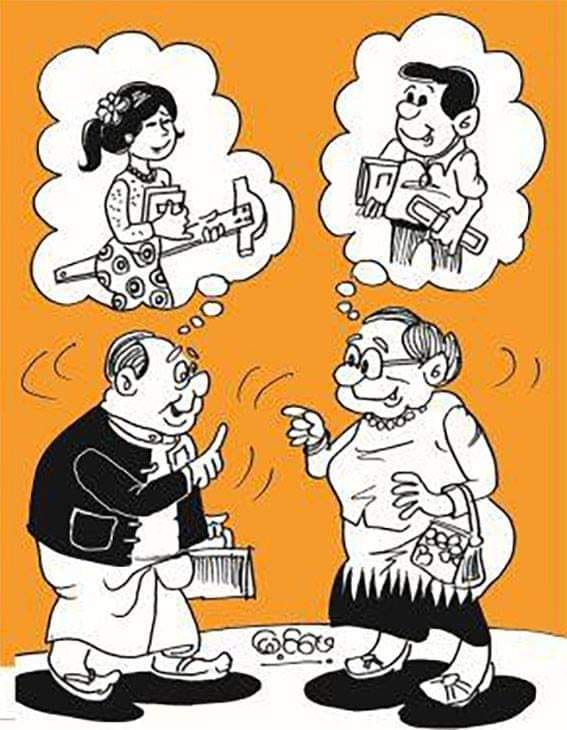
Two of his early cartoons were about “Kar Ku La Thin Char” (Calculus) and the now obsolete “Slide Rule“.
“Ah Ba, Kar Ku La Thin Char is fascinating. If you differentiate a Lada, you get a Sargalay. If you integrate a Sargalay, you get a Lada.”
“Ah Ba, Slide Rule is fascinating.” “Lu Galay, Show me how to add 2 and 3 with your slide rule. “Ah Ba, I cannot do it.” “Then, show me how to subtract 2 from 3 with your slide rule.” “Ah Ba, I cannot do it.” “Lu Galay, Throw away your useless slide rule.”
U Myint Pe
U Myint Pe
U Myint Pe (M72) has several hobbies.
One of the “Mike Khe” and “Pho So Chin”. Admin of U70 musical group.
Performed as Lu Shwin Daw Seik Kyee of the Swel Daw Yeik Ah Nyeint at the Rangoon University Golden Jubilee Celebrations in 1970.
Under the patronage of Saya U Khin Maung Phone Ko and Saya U Aung Myint, U Myint Pe implemented the RIT Cartoon Box using an old telephone kiosk for posting RIT-related cartoons (weekly).
U Myint Pe’s sample cartoon
RIT Cartoon Box
The tradition was maintained by three (or more) generations of Cartoon Boxers.
After 1988, the authorities ordered to close the Cartoon Box.
The organizers of “Cartoon Box” spanning several years finally had a Grand Union prior to SPZP-2012. Most met face to face for the first time. They compiled selected cartoons from the RIT publications (Set Hmu Thadin Zin, Annual Magazines, Sar Saungs) for a book to commemorate SPZP-2012 and to re-display the Cartoon Box. Many (manned the booth at SPZP-2012 and autographed the cartoon books.
The History of the Cartoon Box was published in the Swel Daw Yeik Magazine for SPZP-2012. U Myint Pe was a Contributing Editor.
Collection of RIT Cartoons was published in time for SPZP-2012. During my visit to Yangon in March 2012, U Saw Lin (C73, GBNF) gave me a xeroxed copy of “Selected RIT Cartoons”.
Pamphlet of RIT Cartoons distributed at Shwe YaDu in 2014 and SPZP-2016
Aw Pi Kye
Aw Pi Kyeh (Mann Bei) served as Secretary of the RIT Cartoonists Association. He later headed the Myanmar Cartoonists Association. I met him twice during his visit to US : first at the San Francisco Bay Area Literary Talks in Fremont, Northern California and later in Los Angeles, Southern California.
Aw Pi Kye’s Sample Cartoon
Miscellaneous
Joker was a contributor.
Joker’s Sample CartoonU Thiha Latt
Saya U Thiha Latt was one of the last “Cartoon Box” organizers. He also helped with the design/type setting of “History of University Engineering Education in Burma/Myanmar”, “Swel Daw Yeik Magazine”, and “RIT Cartoon Collection”.
U Myo Myint
U Myo Myint (Myat Myo Myint) is known for his Cover Designs, Pon Tus and Paintings. He also drew some cartoons for the RIT Magazine. One of them reminded me of three female friends who were known as “Half Size”, “Full Size” and “Double Size”. Sadly two : Sayama Daw Mya Mya Than (EP68) and Daw Nyunt Nyunt Zaw (T68) are GBNF. Another reminded of the several “Pho So Chin” and “Mike Khe” in the USA, Australia, Singapore and Myanmar. Yet another reminded me of some classmates who excel in extra curricular activities so much that they bade farewell to RIT before graduation.
There were dozens of RIT/YIT/YTU cartoonists. U Myint Pe published a partial list.
Maung Yit (Maung Maung Win, Moe Ma Ka) is one of the junior members of RIT Cartoon Box Contributors.
Laughter is the best medicine (Feature in Reader’s Digest)
It takes less nerves to smile than to frown.
A Cartoon a day keeps the blues away.
Cartoons have no age boundaries.
EarlyCartoonists
Shwe Ta Lay
U Ba Gyan
U Heng Soon
U Aung Shein
U Pe Thein
U Than Kywe
U Ba Htwe
U Kyaw San (“Ka Sa”)
…
They published Cartoons in Burmese and English newspapers, magazines, books, …
The “Cartoon Festival” was held in U Ba Gyan Street (around Tazaung Daing).
In the mid 1950s, there was a rift between the two factions of AFPFL. Some cartoonists took sides and a “price war” started. The cartoons, which sold for 60 pyas were then given away at bargain prices (any where between 10 and 50 pyas).
There were two Gates during our RIT days. The RIT Main Gate was named “U Lu Paw” Gate (at the suggestion of Ko Win Thein (M67, GBNF). The Side Gate used by those that came be Bus and Rail was known as “Sin Ye Thar” Gate.
Ko Myint Soe (C68, GBNF) and Ko Myint Thein (M69, GBNF) are fondly called Maung Kabar or Kabar.
About a decade ago, my spouse paid K10,000 for xeroxed copy of old cartoons published in the Rangoon Times. Some are political satire.
Engineer Cartoonists
There may have been engineer/cartoonists before Saya U Khin Maung Phone Ko (C 64), Saya U Aung Myint (Pet 69, GBNF) and U Myint Pe (M 72).
U Khin MaungPhone Ko
Saya U Moe Aung (EE 63) mentioned that Saya U Khin Maung Phone Ko made his name in the media (e.g. Kye Mon Daily) with his “Vietnam” cartoons.
His signature “Phone Ko” emphasized the “Na Gyee” (Big Na).
He was a Patron of the RIT Cartoon Box.
He moved to Singapore.
Ko Kyant / Aung Myint
U Aung Myint
Saya U Aung Myint (Pet69) is known for “Kyant Ba Hone“. The character looks superficially like Nick Kelly, but the contents are different.
He served as President of the RIT Cartoonists Association.
He was a Patron of the RIT Cartoon Box.
He was called “Delta Tun Shein” for his likeness to Saya U Tun Shein (Mathematics).
Two of his early cartoons were about “Kar Ku La Thin Char” (Calculus) and the now obsolete “Slide Rule“.
“Ah Ba, Kar Ku La Thin Char is fascinating. If you differentiate a Lada, you get a Sargalay. If you integrate a Sargalay, you get a Lada.”
“Ah Ba, Slide Rule is fascinating.” “Lu Galay, Show me how to add 2 and 3 with your slide rule. “Ah Ba, I cannot do it.” “Then, show me how to subtract 2 from 3 with your slide rule.” “Ah Ba, I cannot do it.” “Lu Galay, Throw away your useless slide rule.”
U Myint Pe
U Myint Pe (M72) has several hobbies.
He is one of the “Mike Khe” and “Pho So Chin”. He is admin of U70 musical group.
He performed as Lu Shwin Daw Seik Kyee of the Swel Daw Yeik Ah Nyeint at the Rangoon University Golden Jubilee Celebrations in 1970.
Under the patronage of Saya U Khin Maung Phone Ko and Saya U Aung Myint, U Myint Pe implemented the RIT Cartoon Box using an old telephone kiosk for posting RIT-related cartoons (weekly).
U Myint Pe’s sample cartoon
RIT Cartoon Box
The tradition was maintained by three (or more) generations of Cartoon Boxers.
Cartoon Box was “ordered close” by authorities after 1988.
The organizers of “Cartoon Box” spanning several years finally had a Grand Union prior to SPZP-2012. Most met face to face for the first time. They compiled selected cartoons from the RIT publications (Set Hmu Thadin Zin, Annual Magazines, Sar Saungs) for a book to commemorate SPZP-2012 and to re-display the Cartoon Box. Many manned the booth at SPZP-2012 and autographed the cartoon books.
The history of Cartoon Box is published in the Commemorative Issue of Swel Daw Yeik Magazine for SPZP-2012. U Myint Pe was a Contributing Editor.
Collection of RIT Cartoons was published in time for SPZP-2012. During my visit to Yangon in March 2012, U Saw Lin (C73, GBNF) gave me a xeroxed copy of “Selected RIT Cartoons”.
Pamphlet of RIT Cartoons distributed at Shwe YaDu in 2014 and SPZP-2016.
Aw Pi Kye
Aw Pi Kyeh (Mann Bei) served as Secretary of the RIT Cartoonists Association. He later headed the Myanmar Cartoonists Association.
I met him twice during his visit to US : first at the San Francisco Bay Area Literary Talks in Fremont, Northern California and later in Los Angeles, Southern California.
Aw Pi Kye’s Sample Cartoon
Miscellaneous
Joker was also a contributor.
Joker’s Sample CartoonRIT Cartoonists
Saya U Thiha Latt was one of the last “Cartoon Box” organizers. He also helped with the design/type setting of “History of University Engineering Education in Burma/Myanmar”, “Swel Daw Yeik Magazine”, and “RIT Cartoon Collection”.
Bagyee Myat Myo Myint
U Myo Myint (Bagyee Myat Myo Myint) is known for his Cover Designs, Pon Tus and Paintings. He also drew some cartoons for the RIT Magazine. One of them reminded me of three female friends who were known as “Half Size”, “Full Size” and “Double Size”. Sadly two : Sayama Daw Mya Mya Than (EP68) and Daw Nyunt Nyunt Zaw (T68) are GBNF. Another reminded of the several “Pho So Chin” and “Mike Khe” in the USA, Australia, Singapore and Myanmar. Yet another reminded me of some classmates who excel in extra curricular activities so much that they bade farewell to RIT before graduation.
There were dozens of RIT/YIT/YTU cartoonists. U Myint Pe published a partial list.
Maung Yit (Maung Maung Win, MoeMaKa) is one of the junior members of RIT Cartoon Box Contributors.
During our school days we had to learn World History (Feudal system, Renaissance) and Burmese History (called “Yazawin”and renamed as “Thamaing”).
Later, after hearing from the Thin sayas, Myin sayas, and Kyar sayas, I became interested in some aspects of history : History of computers and computing, History of Myanmar Engineering Education, “Truth or fiction?” about historical events, …
Burmese History
After the first Anglo-Burmese war (in 1824), the British annexed Rakkhine (Arakan) and Tennasserim (Taninthayee).
After the second war (in 1852), the British annexed Lower Burma.
After the third war (in 1885), the British annexed Upper Burma. Burma became a British Colony.
For some time, the British Governors would base their office in India and rule both India and Burma.
ICS (Indian Civil Service) examinations were held in India and UK. It was succeeded by BCS (Burma Civil Service).
Formal history of Burma has been written by British scholars (Harvey, Luce, …) and later by native scholars (Dr. Kyaw Thet, Dr. Than Tun, Bohmu Ba Shin …).
Informal accounts of Burma can be found in the works by Indians (Tagore, …), British (Maurice Collis, George Orwell, …) and Burmese (Dr. Htin Aung, U Po Kyar, …).
The conventional wisdom is that our neighbors entered the country in three phases.
Burmese archeologists and geologists found “ancient sites and quite old fossils and bones” to indicate that there were early inhabitants, but they could not completely counter the “migration theory” proposed by the British historians.
Pyu is an ancient civilization, and some Pyu sites are “preserved” as UNESCO Cultural Heritage Sites.
Dr. Than Tun
Some sayings
History repeats itself.
We should learn history so that we may not be stupid or dumb.
There is usually no single correct history. Often there are parallel, competing histories.
“Pazat Yazawin” and “theories” should be evaluated with the help of kyauk sar (stone inscriptions).
Even in the peer-to-peer refereed papers, there are discrepancies and [unintentional] errors.
National Archive, Burmese History Commission, and Burma Research Society used to hold artifacts about Burmese History.