6th month of the old Roman calendar had 30 days. It was renamed August in honor of Emperor Augustus Caesar and was given an extra day.
August is the 8th month of the Gregorian Calendar. It has 31 days.
Special Days
August 8
8-8-88 Start of a long struggle to restore Democracy in Myanmar
8-8-08 Beijing Olympics
August 13
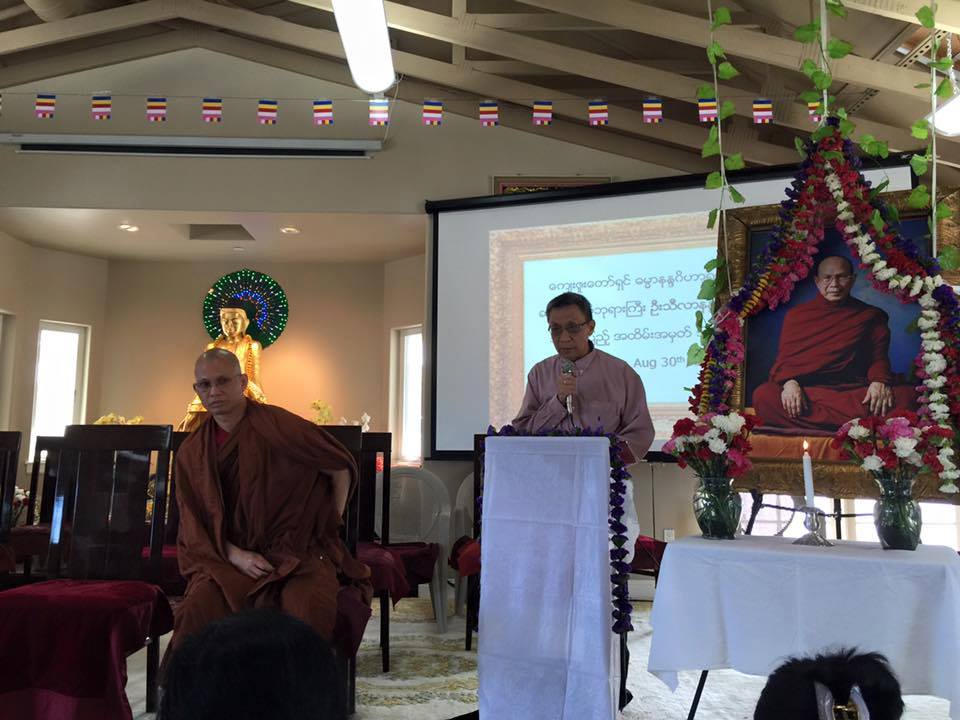
Sayadaw U Silananda (Rector, IMBTU) passed away on August 13, 2005
My father-in-law passed away five decades ago.
GBNF in August
My spouse lost four of her family members in August.
Her father passed away in his mid-50s.
Her mother passed away in her late-80s.
Her elder brother passed away in his early 50s.
Her nephew passed away in his mid-30s.
Sayadaw U Silananda
Rector, IMBTU Chief Resident Sayadaw of Dhammananda Vihara, Half Moon Bay, California
Sayadaw passed away in his late-70s on August 13, 2005
I was Master of Ceremonies at Sayadaw’s Memorial Service.
I was Committee Member and Contributing Editor for “Paying Homage to Sayadaw U Silananda” Book.
Accompanied Saya U Myat Htoo (C68, President, TBSA) carrying the box of Sayadaw’s ashes to be scattered from a yacht into the waters near Golden Gate Bridge in San Francisco.
TBSA
Birthdays in August
Several birthdays in my extended family.
Eldest sister
Younger sister
Grand daughter
Me
Several cousins
Birthday Soon Kwyay in 2016
In August 2016, U Maurice Chee (M75) organized a birthday soon kwyay for me at the Dhammananda Vihara in Half Moon Bay, California.
The sayas and alumni presented me an Appreciation award.
Friends
Daw Mu Mu Khin (spouse of Saya Allen Htay)
U Myint Swe (EP74, NorCal RITAA)
U Thein Naing (Patrick, La Phet Yay Waing member)
They are August-born and also hosted Birthday Parties.
Lunch Gathering in 2018
In August 2018, U Patrick (Thein Naing) and Daw Mie Mie hosted a lunch gathering for the August born at Moss Beach Distillery.
They gave me a best-seller book “The Greater Journey (Americans in Paris)” as birthday present.
Daw Mie Mie translated several short stories of Ah Myothar Pyinnya Wun U Po Kyar. She plans to publish them as a book.
Is 8 lucky or unlucky?
8-8-88 (August 8, 1988) and the following days mark the hope and then despair of the people longing for the end of the Adhamma Era.
Grapevine says that the event was inspired in part by numerologists who remembered the historic event (about Mingyi Yan Naung) in 888 Burmese Era. They extrapolated the magic of No. 8 from three 8’s to four 8’s.
Most Chinese think that the number 8 is lucky.
For example, Beijing Olympics was opened on 8-8-08 (August 8, 2008).
Mahayana Buddhists emphasize the importance of Compassion
Sayadaw U Sobhana (GBNF) had four Indonesian siblings as his students. Named one of them Karuna. She was present at Sayadaw’s Last Journey.
U Moe Myint (M76) and several alumni are members of the “Karuna Ah Thinn” in Singapore. One activitiy is to help the needy for the Last Journey of their loved one.
We saw an outpouring of Karuna in the relief efforts for Disaster Recovery (e.g. Cyclone Nargis)
Practicing Karuna
May suffering ones be suffering-free
And the fear-struck fearless be
May the grieving shed all grief
And all beings find relief
Mudita
Pali term.
Rendered as Altruistic Joy or Sympathetic Joy
One of the four Bhamaso Taya
One should feel joyful when one hears good news about others.
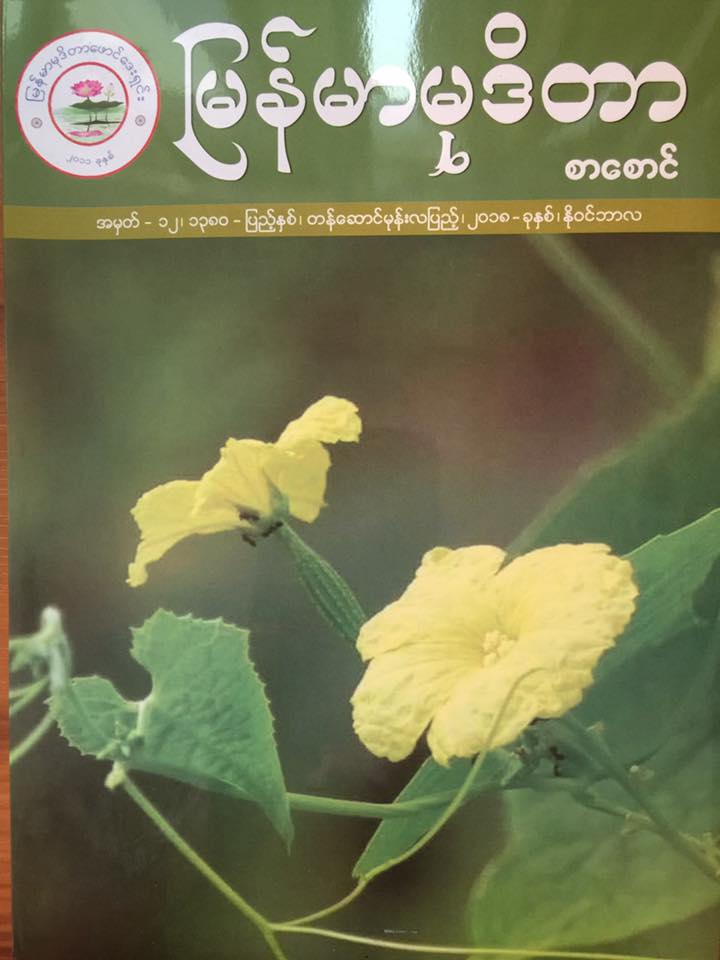
Myanmar Mudita Sar Saung
Saya U Nyunt Htay (Met73) is Chief Editor
Contributor : Tekkatho Moe War (U Moe Aung)
Mudita Sar Saung
Upekkha
Pali term
Rendered as Neutral [Feeling]
Also translated as Equanimity
One of the four Bhamaso Taya
In a loose usage in Burmese, “Upekkha Shu” means “ignore”. It is not representative of the importance of Upekkha, which provides a balance of life and avoids the two extremes stated in the Dhammacakka Sutta
It is non-trivial to sense Upekkha while practicing Vipassana (Insight) Meditation.
Feelings may be be categorized as
Pleasant Feeling
Unpleasant Feeling
Non-Pleasant and Non-Unpleasant Feeling
Upekkha is synonymous with “Non-Pleasant and Non-Unpleasant Feeling”.
Luyechun is an award presented by the Ministry of Education to selected “outstanding students“.
The initial program ran from 1964 to 1988.
A new program was established a few years back.
I was selected as RIT Luyechun in the summer of 1965.
I was invited as a Guest Speaker to the Ngapali Luyechun Camp in the summer of 1988.
Summer of 1964
The first Luyechun camp was opened at Ngapali in the summer of 1964.
It was for Luyechuns for 7th, 8th, 9th and 10th standards.
Some Luyechuns
Ko Win Myint (Mergui, UCC)
Ko Win Aung (TTC, Mech 70, RIT Swimming and Water Polo)
Ko Kyaw Zaw (TTC, EC72, GBNF)
Ma Pwint Than (Loikaw, EP71)
Ko Oak Soe Kha (IM1, Swimming and Water Polo)
Ko Aung Myint (Mdy)
Ko Tin Soe (Ygn, DSA, Attaché)
Summer of 1965
The second Luyechun camp was opened at Inlay in the summer of 1965.
For the first time, Luyechuns were selected for the Universities and Institutes.
Staff at Inlay Camp
U Aung Gyi (Maths, MASU)
Dr. Daw May May Yi (IM2)
Daw Po (Burmese)
Dr. Naing Tint San (Med Officer)
U Khin Aung
U Khin Maung Htwe
U Than Tun Aung Hlaing
Lu Nge Yay Yar / Youth Affairs
Some Luyechuns
Ma Than Than Tin (Cherry Hlaing, First in Burma in 1964, IM1)
Ko Khin Maung U (First in Burma in 1963, IM1)
Ma Anita Aye Pe (IM1)
Ko Kyaw Sein Koe (IM1, GBNF)
Ko Thein Win (IM2)
Ko Soe Aung / Soe Min Thein (IM2)
Ko Tun Naung (BDS, Stereo)
Ko Tin Hlaing (MASU, Le Dwin Tha Saw Chit, Literary Awards)
Ma Khin Aye Myint (RASU)
Ma Mu Mu Win (RASU)
Ko Min Oo (Second in Burma in 1963, RASU, Mathematics Professor in Germany and Canada)
Ko Ye Myint (RASU)
Ma Khin Aye Than (RASU, GBNF)
Ko / Maung Aye (RASU, Diplomat)
Ko Mya Than (RASU)
Ko Zaw Min (RIT)
Ko Hla Min (RIT)
Ma Khin Than Myint Tin (RIT)
Ko Sein Shwe (RIT)
…
They attended the Inlay camp together with the 10th standard Luyechuns. Ko Than Sit (Sagaing, Liver Foundation, GBNF) Ko Uttam Singh (Myitkyina, RIT, NASA) Ko Win Myint (Letpadan, RIT, Bogyoke / Dy Minister) Ko Aung Myint (Mandalay) Ko Aung Kyaw Nyunt (Myingyan) Ko Kyaw Myint (Yamethin) Ko Kyaw Myint (Delta) Ko Nelson Kaw (Taunggyi) Ko Thein Lwin Ko Hla Kyaing (Yangon) …
There were two other camps : Rangoon Combined Camp and Ngapali Camp (for the lower classes).
The staff members from Lu Nge Yay Yar (Youth Affairs) were responsible for the logistics.
Selected sayas and sayamas took charge of the Luyechuns. They include Dr. May May Yi (then at IM(2), later DG of BMRI), Daw Po (later Professor of Burmese), and U Aung Gyi (MASU Maths).
There was a mishap when one student got injured during a “mandatory” exercise program.
For this and other reasons, the later Camp Commandants were chosen from Sayagyis (e.g. U Ba Toke).
Front : Than Sitt, Sein Shwe, Min Oo, Nelson Kaw, Kyaw Myint Back : Soe Aung, Aung Kyaw Nyunt, Aung Shwe, Hla Min, U Khin Aung
Front : Than Sitt, Aung Kyaw Nyunt, Min Oo Back : Soe Aung, Kyaw Myint, Sein Shwe, Ye Myint, Hla MinFront : Hla Min Back : Aung Myint, Aung Kyaw Nyunt, Tin Maung Htwe, Ye Myint, Sein Shwe
Tekkatho Tun Naung (1st year BDS, madolin) and Ko Sein Shwe (4th BE Mech, dobat, harmonica, flute) were some of the entertainers for the Luyechun concert. U Aung Gyi (Maths, MASU) wrote the “Than Gyurt”.
Ko Tin Hlaing (Le Dwin Thar Saw Chit, 1st year Burmese, MASU) was a notable contributor to the daily pamphlets.
Some high school Luyechun students later joined RIT. They include Ko Win Myint (later Bogyoke), Ko Aung Win (later Saya), Uttam Singh (later Ph.D working at NASA), Ma Pwint Than (later EPC), …
The guest lecturers include Saya U Thein Han (Zawgyi), Saya Dr. Nyi Nyi, and U Thu Ta (Met and Hydro DG).
Trips include Lawpita Dam and selected factories and departments.
Miscellaneous
Htut Kwan
7-time winner
6-time winner
…
2-time winner
Association
Gatherings
FB Group
Support new generation of LYC
Donation for prevention / treatment of COVID
Database of LYC
Active members
GBNF (Gone But Not Forgotten)
Guest Lecturers in 1965
Dr. Nyi Nyi (Secretary / Dy Minister)
U Thu Ta (DG, Met and Hydro)
U Thein Han (Zawgyi)
…
Guest Lecturers in 1987/88
U Kyaw Myint (DHE)
U Hla Min (UCC/DCS/ICST)
…
Luyechun Association
A few years back, Luyechun (1964-1988) Association was formed. The association meets one or more times a year.
There have been Annual Dinner Gatherings.
It has a Facebook group.
There are “Then and Now” photos of some Luyechuns.
Some are “Hturt Kwan” (Multiple) Luyechuns. Some were selected Luyechun for a consecutive number of years. A few won the award six or seven times.
Some Luyechuns have passed away.
Dr. Kyaw Sein Koe (IM 1) passed away early.
H.E. U Myint Thaung and U Myint Thin (M71, RIT) are some Luyechuns who passed away recently.
Another Trip to Inlay in October 1965
As part of the award, one received a 50% travel discount.
During the October holidays in 1965, I took on the offer from Ko Aung Kyaw (Peter Pe, SPHS, star in one movie) to join him and Ko Maung Maung Aye (IM(1), GBNF) to visit his cousin doctor in Inn Paw Khone (Inlay village).
I visited Phaung Daw-U again with a difference (as expressed in my poem).
PHAUNG DAW-U FESTIVAL
Phaung Daw-U, oh Burma’s grandeur Can truly make our hearts sublime Its mystic charm and rhymeless splendor Have firmly stood the test of time
It lies deep in the heart of people It gives them courage and inspiration No wonder this festival has no equal It promises joy and veneration
On board the Karaweik so scintillating Stood the four images of Lord Buddha For the Noble Truth are we vindicating? What lies deep under the completed tour?
But one statue was left behind Because in writings we do find That should it ever leave the shrine There will be thunder and storm Thus a happy reunion on the morn of the full moon of Thadinkyut
From floating islands the leg rowers came To take part in the race With their muscular frame, with might and main Their oars flashing at a rapid pace
Festivities last all night long Dances to the company of ozi and gong Oh, prayers that fill the cool evening air May loving kindness prevail everywhere
Last Trip to Inlay in January 2020
I was invited to join the 2020 Professional Speakers Association (PSA) Tour to selected cities in Upper Myanmar.
Several hotels sponsored part of the tour and/or provided discount rates to the Tour group.
At the end of the tour, we visited Inlay. Two PSA sayas provided a short training course for the employees of the hotel.
MBBS (Rangoon) offered by the Faculty of Medicine, Rangoon University
“Fast track” MBBS for LMP
Medical Branch (of RU) in Mandalay
MBBS (Mandalay)
New Education System Institute of Medicine (1) Institute of Medicine (2) Mandalay Institute of Medicine
MD
Ph.D
Membership MRCP, MRCOG …
Fellowship FRCP, FRCS …
Physicians / Medicine Col Min Sein (Dean) Major Shwe Zan Dr. Maung Gale (Dean) Dr. Maung Maung Gyi (Rector) Dr. U E (Rector) Dr. Hla Myint (Aba) …
Surgeons Dr. Ba Than (Police Surgeon, MS of war-time RGH, Rector) Dr. Pe Nyun (Ped) Dr. Htut Saing (Ped) Dr. Maung Maung Taik(Forensic) Dr. Min Lwin (Ortho) …
One of the four Bhamaso Taya or Bhama Vihara (along with Karuna, Mudita, and Uppekha)
Practiced as a form of meditation
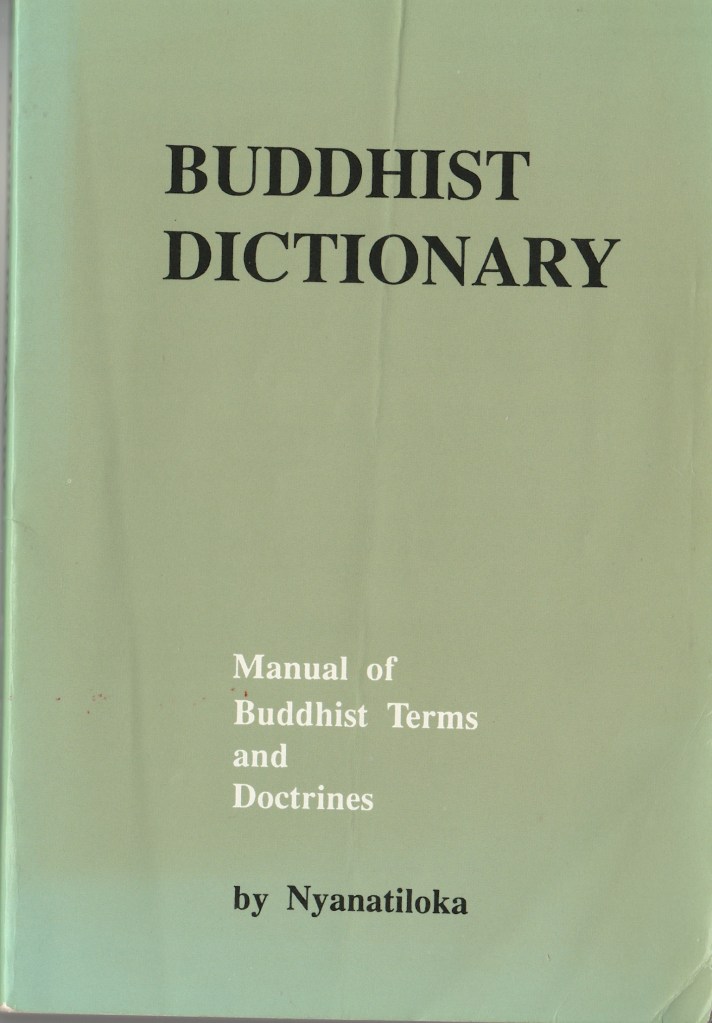
U Silananda‘s book on Protective Verses has a section on how to practice Loving Kindness Meditation.
Tipitaka Mingun Sayadawgyi recited the Two Methods of sending Metta. As mentioned in Metta Sutta Alternative: 528 “Metta” (13 x 4 x 12) They can be found on YouTube and CDs.
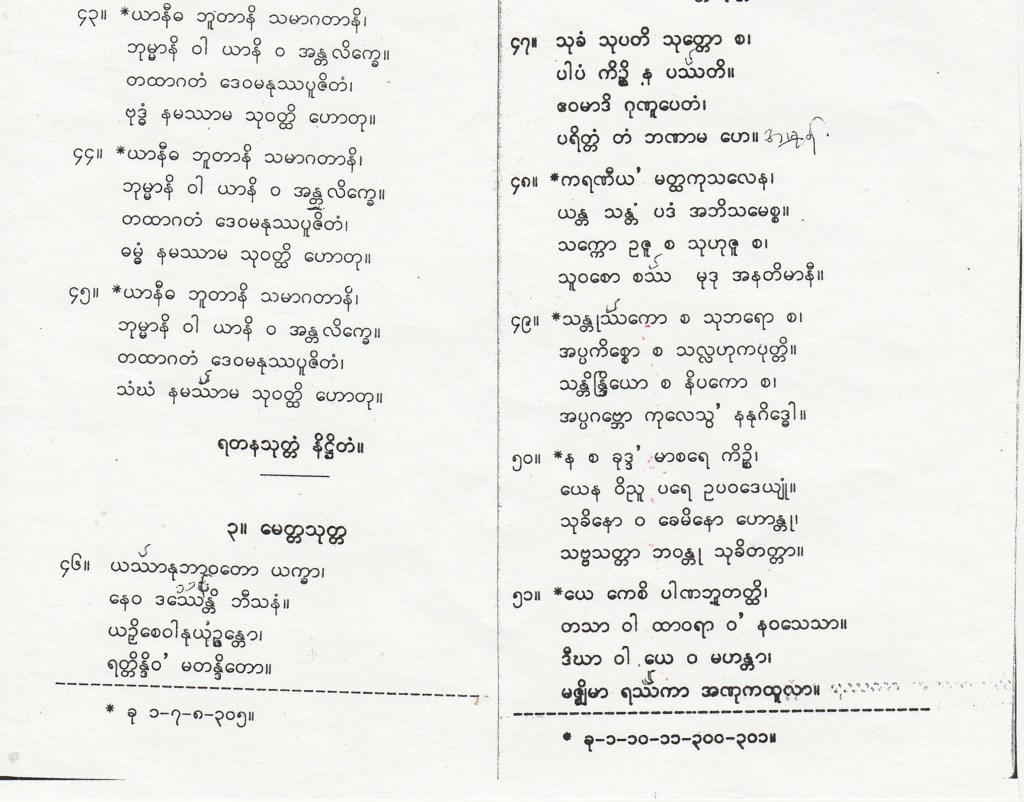
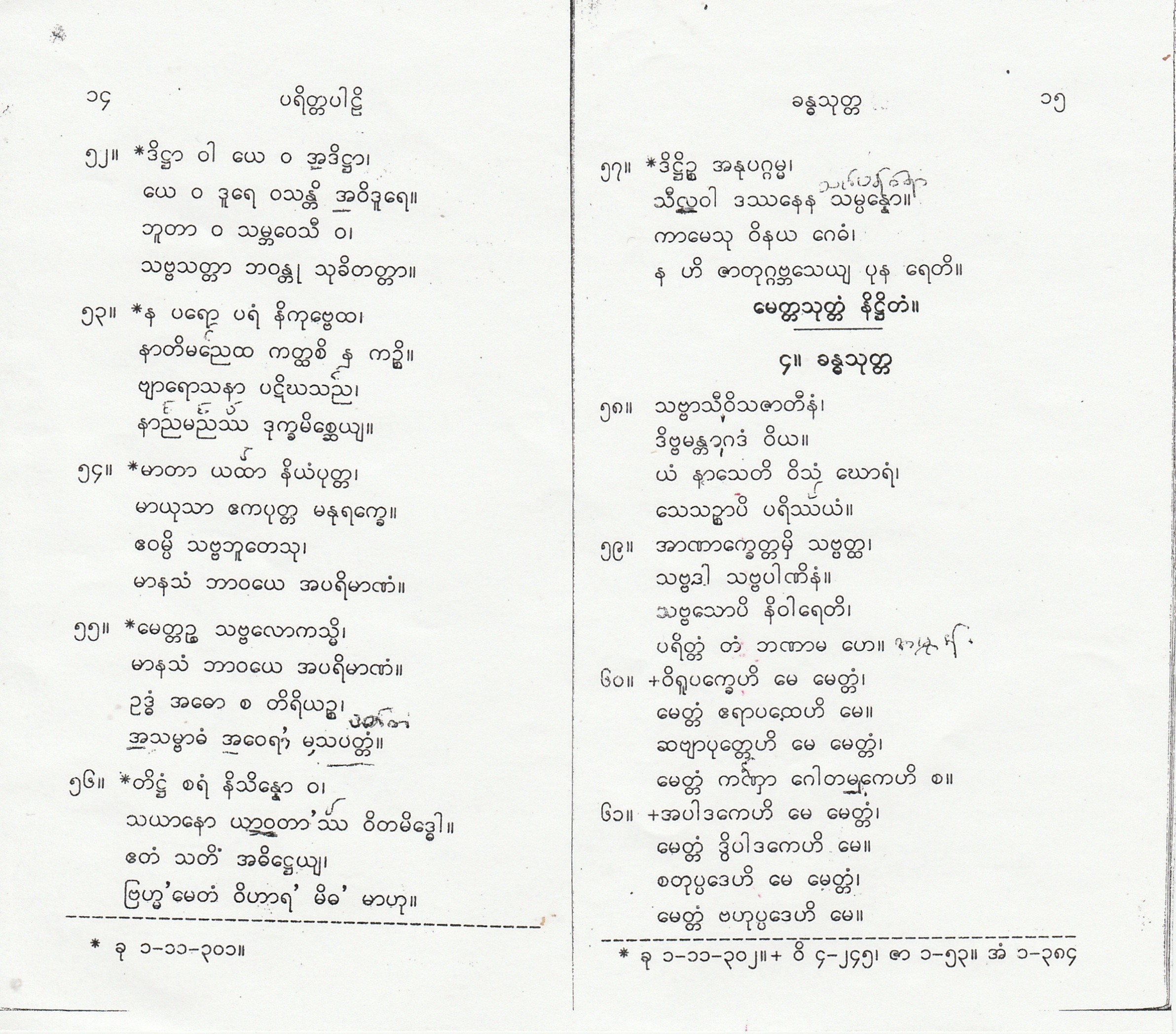
“Metta Sutta” is one of the eleven Suttas in “Paritta Pali” (Protective Verses). Also known as Karaniya Metta Sutta Chanted at most Buddhist ceremonies.
Myitta is covered along with Thitsar (Truth) in Dr. Min Tin Mon‘s book “Myitta and Thitsar“
U Thu Kha wrote a book on Metta Sutta.
U Jotalankara‘s book explains the 528 Metta.
A Physics teacher said, “Myitta So Dar Ah Hlyar Ah Nan Ma Shee Bay Mei Ah Thwar Ah Pyan Shee Bar Thay Dae.”
Metta is also used as a name or part of a name.
Metta is a Myanmar comedian.
Mettananda Vihara is a monastery in Northern California. Moved from Central Avenue, Fremont to Castro Valley.
Metta Vihari is an association that performs Chanting, and also offers food dana at selected gatherings.
Practicing Metta
By Way of LOCATION:
May I be well, happy and peaceful.
May all beings in this house be well, happy and peaceful.
May all beings in this area be well, happy and peaceful.
May all beings in this city be well, happy and peaceful.
May all beings in this country be well, happy and peaceful.
May all beings in this world be well, happy and peaceful.
May all beings in this universe be well, happy and peaceful.
May all beings be well, happy and peaceful.
By Way of PERSONS:
May I be well, happy and peaceful.
May my teachers be well, happy and peaceful.
May my parents be well, happy and peaceful.
May my relatives be well, happy and peaceful.
May my friends be well, happy and peaceful.
May the indifferent persons be well, happy and peaceful.
May the unfriendly persons be well, happy and peaceful.
May all meditators be well, happy and peaceful.
May all beings be well, happy and peaceful.
Metta Sutta
Third sutta in “Paritta Pali”
also referred to as Karaniya Metta Sutta
Desirable qualities of a Practitioner
Loving Kindness Meditation
Formal Translation from Pali into Burmese/Myanmar and English
Informal Books by Saya U Thu Kha and Saya Dr. Mehm Tin Mon
One who has studied at SPHS (St. Paul’s High School).
In the early days, the school was called St. Paul’s English High School to emphasize the language of instruction.
Since SPHS is a De La Salle School, Old Paulians are also known as BOB (Brothers’ Old Boys).
Some may join OPA (Old Paulians’ Association).
Old Paulians’ Association
OPA invited the Top Matriculates in 1963 to attend the Annual Dinner.
Invitation
After nationalization, OPA premises were frequented by non-Paulians, who wanted to play billiards and/or enjoy drinks. In the mid-50s, OPA was reorganized with true Paulians. The activities include Araciya Pu Zaw Pwe at the school, Reunion gatherings and dana at the Shwe Dagon by the OPA Buddhist Association
Notable Old Paulians
ICS U Tin Tut : First ICS by invitation
U Tin Tut
Saya U Ba Khin (Vipassana Teacher) : First in Matriculation in the whole of Burma
U Ba Khin
Dr. Ba Than : Rector, Institute of Medicine
Dr. Ba Than
Dr. Ba Han : Law Professor; Lexicographer
Dr. Ba Han
Dr. Ba Maw : Adipati
U Chan Htoon : Justice
U Than Aung : Education Minister
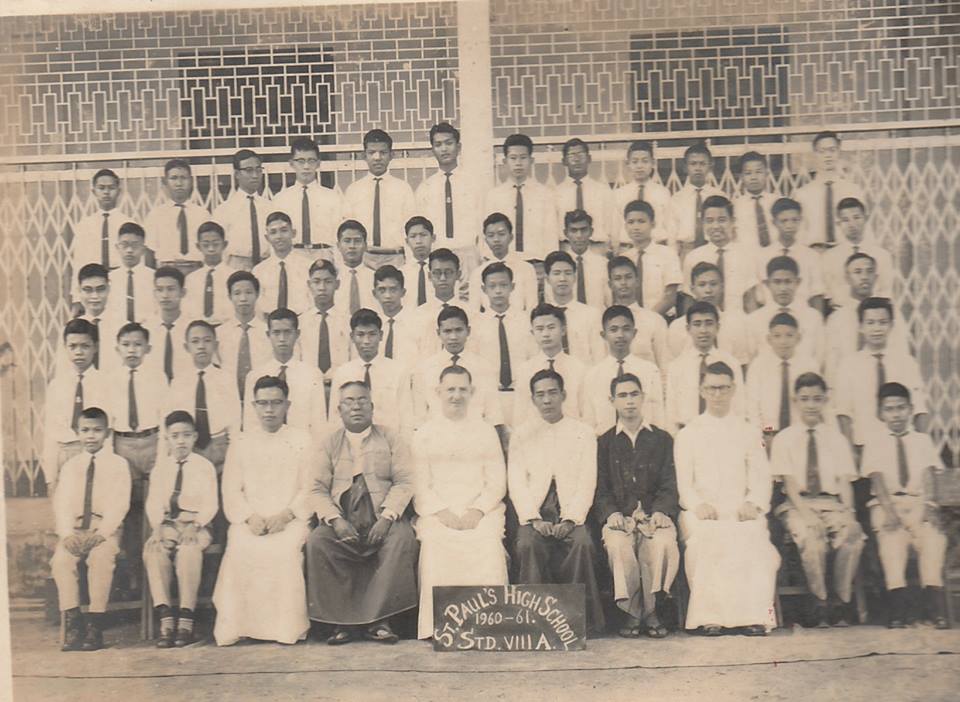
Std VIII (A) in 1960 – 61
1st Row: William Win Kywe, Khin Maung Bo (Allan Saw Maung), Brother Anthony, Saya U Sein, Brother Fexlix, Saya U Nyunt Maung, Saya U Beatson, Brother Xavier, Thein Wai, Min Oo (Kenneth Khine)
2nd Row : Thein Lwin (Stanley Shwe Gyi), Hla Min, Han Tun, Naing Win (Tommy Chit Maung), Tun Tun Aung (Tommy Aung), Herbert Khai Chin Liang, xxx, Aung Thu Yein (Brownie Way, GBNF), Tommy Aung, Bernard Taylor, Han Thein (Gallant Leong)
3rd Row : Richard Lim, Sean Young, Edward Chow, Khin Maung Htay, Myo San (Freddie Ba San, GBNF), Aung Chaw (Victor Chaw), Maung Maung Kyi, Than Win (Henry Wong), Nay Lin, Eddie Nyunt, San Maung (Robert Kyi), Than Win
4th Row : Aung Kyi (Arthur Kyi), Khin Maung U (George Khin Maung), Nyunt Wai (Victor Nyunt), Sebastian Law Kee, Win Maung, Than Htay, Edwin David (GBNF), Orlando Thein, Htin Paw (Jerry Hin Hwa), Aye Ngwe (Edwin Ngwe), Aung Kyaw (Peter Pe)
5th Row : Bo Ni, Kyaw Wynn, Robert Myint Win, Yin Sein (Caesar Yang), Aung Khin (GBNF), Aung Kyee Myint, Chu Pu Thein, Anthony Lourdes, Myint Soe (Willie Soe Maung, GBNF), Tin Tun, Richard Pe, xxx
Sayas
Brother Felix (Brother Director)
Brother Anthony (Class Teacher)
Brother Xavier
Saya U Sein
Saya U Nyunt Maung
Saya U Beatson
Some chose to become Engineers
Aung Chaw / Victor (Sayadaw Ukkamsa after retirement, GBNF)
Aung Thu Yein / Brownie Way (GBNF)
Hla Min (EC, CS)
Khin Maung Bo / Alan Saw Maung (GBNF)
Kyaw Wynn
Maung Maung Kyi (GBNF)
Than Htay
Than Win
Tin Tun (GBNF)
Yin Sein (Caesar Yang)
…
Some chose to become Medical doctors
Khin Maung U (George Khin Maung)
Myo San (Freddie Ba San, GBNF)
Nyunt Wai (Victor Nyunt)
Orlando Thein
Thein Wai
William Win Kywe
…
Some chose other Careers
Aung Khin (DSA, GBNF)
Bernard Taylor (Priest)
Edwin David (Priest, GBNF)
Han Tun (DSA)
Min Oo (Doctorate in Mathematics fro Germany, Professor in Germany and Canada
In the Matriculation examination in 1963, the students from St. Paul’s High School had
five in the Top Five
seven in the Top Ten
ten in the Top Twenty
Collegiate Scholarship Winners
The standings were
Khin Maung U / George Khin Maung : First in the whole of Burma
Min Oo / Kenneth Khine : Second
Myo San / Freddie Ba San (GBNF) : Third
Nyunt Wai / Victor Nyunt : Fourth
Thein Wai : Fifth
Hla Min : Seventh
Aung Kyaw Zaw / Johnny Maung Maung : Ninth
Maung Maung Kyi (GBNF) : Eleventh
Aung Thu Yein / Brownie Way (GBNF) : Thirteenth
Khin Maung Zaw / Frank Gale : Seventeenth
Of the ten,
Six chose to study Medicine
Three choose to study Engineering & Computer Science
One chose to study Mathematics
The scholarship holders were
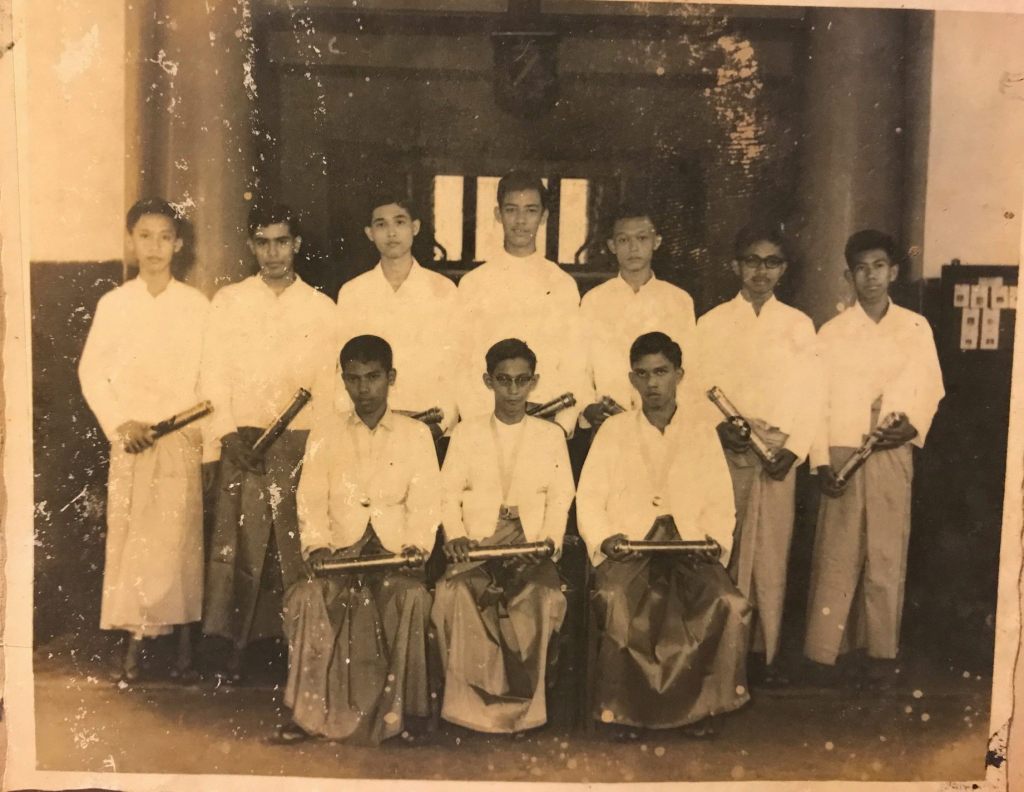
presented with certificates and awards at the Assembly Hall of SPHS
invited by the Old Paulians’ Association to attend the Annual Dinner
Hla Min (SPHS63)OPA 1OPA 2
Doctorates
Min Oo — Mathematics; Professor Emeritus, McMasters University, Canada
Nyunt Wai — Physiology; Retired Professor at IM(1), IM(2) and Malaysia
Htin Aung — Civil Engineering; Retired Professor, RIT
Nyan Taw — Marine Biology; Retired from UN / FAO
Myo Khin — Civil Engineering; Retired Professor, Japan
Birthday Soon Gathering hosted by Kyaw Wynn
Kyaw Wynn is a cousin of Saya U Tin Htut (M60) and Sayama Daw Kin Kin Chit Maung (RIT English).
He offered birthday soon kyway to Uzin Okkantha (Victor, Aung Chaw) and treated his former classmates (some of whom have not seen each other for a long time) at Aung Thu Kha (aka “Shwe Ba Htamin Saing”).
Attendees at Kyaw Wynn’s Gathering
Aye Ngwe / Edwin Ngwe (GBNF)
Kyaw Win (“Birthday Boy”)
Khin Maung Bo / Alan Saw Maung (GBNF, EP69)
Hla Min (EC69)
Uzin Okkantha / Aung Chaw, Victor (GBNF, C69)
Than Win (M69)
Aung Kyi / Arthur Kyi (GBNF)
Tin Tun (GBNF, M69)
Khin Maung Zaw / Frank Gale (IM1 70, UK)
RUBC Novice Crew in 1963
Maung Maung Kyi (B, Dip Ing in ChE, Wales, UK, GBNF): Bow
Universities’ Computer Center (UCC) Project — proposed in the mid-1960s; took a long time to get approval and funding
Funding Agency — UNDP
Executing Agency — UNESCO
Founders — Dr. Chit Swe (GBNF), U Soe Paing, U Myo Min, U Ko Ko Lay (GBNF)
University
Concept
College
Faculty
Vipassana
Meditation Centers
Teachers
Instruction
Volunteer
Volunteer for five decades
Win
Zero Sum Games
Win – Win
Four Wins
Y
YMCA
Years
1946
Matriculates
U Tin U, Dr. Pe Nyun, Dr. Pe Thein, U Sein Hlaing
1947
Matriculates
U Ba Than, Dr. Myint Soe, U Tin Swe
1948
Matriculates
U Aung Khin, U Aw Taik Moh
1949
Matriculates
Dr. Aung Gyi, U Min Wun, U Maung Maung Than, U Khin Aung Kyi
1950
Matriculates
Bilal Raschid
1951
Top Matriculates
George Chapman
1952
Top Matriculates
Dr. Nyunt Tin, Dr. Myo Tint
1953
Top Matriculates
Dr. Hla Shwe (Boon Chiong), U Ohn Khin
1954
Top Matriculates
Koon Yin Chu (Phillip), Dr. Tin Myo Than
1955
Top Matriculates
Lily Hwang
1956
Top Matriculates
U Ye Myint, U Thaung Tin, U Khin Maung Than, Dr. Than Myint (Harry)
1957
Top Matriculates
Dr. Htin Kyaw, Nellie Liu
1958
Top Matriculates
Dr. Soe Win, U Robert Sein, Daw Myint Myint Tin (Pearl)
1959
Top Matriculates
Dr. Frankie Ohn , Dr. Shewan Lee, Dr. Than Nwe Aung, U Oo Tha
1960
Top Matriculates
Dr. Austin Kyan, Dr. Nyan Win, Arthur Hla Maung, Marie Nyunt, Dr. Thane Oke Kyaw Myint
1961
Top Matriculates
Lina Ong, Dr. Robin Ban (Kyaw Win)
1962
First HSF Only Examination
Coup d’etat
Two State Funerals
1963
Top Matriculates
Dr. Khin Maung U, Dr. Min Oo, Dr. Myo San (Freddie), Dr. Nyunt Wai (Victor), Dr. Thein Wai, Kenny Wong, U Hla Min, Winnie Aung, Dr. Aung Kyaw Zaw (Johnny), Dr. Maung Maung Kyi, Dr. Khin Tun, U Aung Thu Yein (Brownie), Dr. Khin Maung Zaw (Frank)
1964
Top Matriculates
Dr. Cherry Hlaing (Than Than Tin), Dr. Lyn Aung Thet, Dr. Aung Win Chiong, Dr. Min Lwin (Maurice)
1965
Top Matriculates
Bernard Khaw, Maung Aye, Winston Sein Maung, Cherry Than Tin, Dr. Yi Thway, Dr. Paing Soe
1966
RIT Graduates
U Thaung Lwin, U Soe Lwin
1967
RIT Graduates
Dr. Chan Nyein, U Win Thein, U Myo Myint,
U Than Htut
1968
RIT Graduates
U Myat Htoo, U Aung Khin, U Tun Aung
1969
RIT Graduates
U Aung Min, Dr. Taing Oke, Daw Myint Myint, Daw Mu Mu Aye
1970
RIT Graduates
U Thaung Sein (Steeve), Tan Yu Beng (Benny), U Ohn Khine
1971
RIT Graduates
U Tin Win, U Myint Thin (GBNF), U Myint Toe
1972
RIT Graduates
U Aung Myaing, U Wynn Htain Oo, U Myint Pe
1973
RIT Graduates
U Hla Win, U Khin Maung Cho, Dr. Myint Thein, Dr. L Sein Myint
1974
RIT Graduates
Dr. Htay Lwin Nyo (GBNF), U Myint Swe, Daw Khin Swe Oo
1975
RIT Graduates
U Hla Myint Thein (Maurice), Daw Mar Mar Yee, U Win Khaing
1976
RIT Graduates
U Khin Maung Zaw (KMZ), U Moe Myint, U Thura Thant Zin
The first year students were divided into four sections : A, B, C and D. Most students of Sections A & B had passed Matriculation with Pure Science. Most from Sections C & D had passed with either Science & Arts Combination or Pure Arts. There were some late joiners to RIT.
Male students from districts and states were boarded in hostels, in the ground floor rooms of B, D and E Blocks and “Inlay Hall” in Thamaing.
A building named “G Hall” was assigned to board female students from districts and states. Local female students who applied were also allowed to board in G Hall.
Engineering was not considered appropriate livelihood for women. Hence, there were only a few female students studying Engineering before our intake. With the new system, there was an influx of girls. It was quite a pleasant feast to the seniors who were not used to seeing those many female students. So when our ‘64 intake started attending classes, it was a thrill for the senior students to watch a great number of female students strolling in the corridors, coming in and out of class rooms,in canteen, in the food shops, in the library and everywhere on the campus grounds. We were also thrilled to get in company with a lot of female classmates. (It was exciting for me to have female classmates as I [Ohn Khine] was sent to all boys school, St. Peter’s High School in Mandalay since Kindergarten till I matriculated in 1964.) It is fair to note that the girls were somewhat intimidated and somewhat amused by the loud remarks of a few rowdy students or even feeling stared at while having to move from one classroom to another. Girls spent time during breaks in an area of a corridor surrounded by shaded blinds which was known as LCR (Ladies’ Common Room) where the day students usually ate home-brought snacks and rest. Ladies residing at G Hall would have lunch at the canteen and were able to rest in their rooms. The first LCR was a little room on the third floor before a section of the corridor on the third floor was made as the LCR before the start of our 2nd year at RIT. When the bell rang for the next class, it was customary to peek through the blinds to check whether the boys had gone inside the theatre for the timid girls to come out of the LCR.
Outstanding athletes from our class
The list was compiled by Ko Ohn Khine. Comments were provided by Ko Zaw Min Nawaday. Organization / presentation (with corrections) was done by Ko Hla Min
Badminton
Tommy Shwe (GBNF)
Kyi Kyi Sein
Basketball
Tin Aung (E)
Tin Aye (M)
Kevin Law
Soe Aung (Auto)
Body Building / Weightlifting
Than Htike (M)
Boxing
Maung Maung Thaw (E)
Chinlon
Soe Tint (C)
Mya Daung (M, GBNF)
Football / Soccer
Sai Thein Maung (C)
Khin Maung Lay (Mutu, M)
Win Zaw (A)
Myint Sein (Ja Pu Sein, GBNF)
Kenneth (Khin Maung Shwe, GBNF)
Htun Myint (M)
Hla Kyi
Sai Aung San (Met)
Judo / Aikido
Sein Myo (C)
Kyaw Soe Win
Soe Aung (Auto)
Thaung Lwin (M)
Soe Myint (Agri)
Sai Loke Khan (Mn)
Rowing
Htein Win (M)
Aung Lwin (Jaspar Wu) (C)
Swimming / Water Polo
Peter Pe (GNBF)
Htein Win (M)
Win Aung (M)
Mg Mg Swe (M) (5)
Ma Tin Tin Myint (Ch)
Tennis
Aung Kyaw Soe (James Than) (Ep)
Khin Mg Shwe (Ep)
Wai Lwin (Agri)
Rosie Tin Maung (Ch)
Track and Field
Sai Thein Maung (C)
Shein Kee Gae (GBNF)
Saw Mg Mg Htwe
Oo Myint (Mn)
Win Naing
Lei Lei Chit (Ch)
Nan Kham Ing (A)
Maung Maung Thaw (E)
UTC Marksman
Tan Yu Beng (Benny) (M) Let Pyaunk Tat Thar, twice, both UTC 1st & 2nd yr.
Volleyball
Kyaw Sein (M)
Salai Myo Myint (C)
Additional Information by Ko Zaw Min Nawaday
Sai Thein Maung (C), was a great RIT goalkeeper for 6 years. He also won gold medals in 100 meters and Hop Step and Jump in the Inter Institute track and field competition almost every year.
Tin Tin Myint (Emma) (Ch) bravely competed in the inter-institute swimming meet. I believe she also practiced throwing the Javelin and played volleyball.
Khin Mg Shwe (Ep) won the “Novice” tennis competition at RIT. He represented RIT in the 2nd year and we cheered him as he played a nationally known played from RASU (at the courts across from the Universities football field) during our 2nd yr at RIT.
My good friend Tan Yu Beng (Benny, M) took the best marksman trophy at both 1st and 2nd yr UTC camps. He competed against not only RIT but UTC students from RASU, Institute of Medicine, and Institute of Economics.
Hla Kyi (nickname Sut Kaw) played center right back for RIT selected football team. Most RIT students that watched the game between RIT and Loke Thar during our first year will remember the flying kick he took at the head of the left winger of Loke Thar when Myint Sein (M) GBNF and that left winger got into a fracas. The Universities team coach Saya Nyein, who was the referee for this game, promptly told Hla Kyi to leave the field.
There were also unsung heroes (e.g. The RIT B football team). I did not know about them until the third year, when Sai Aung San, my room mate for that year, told me about it. He was the goalkeeper, Yan Shin played in the back line and Kyaw Min Aung was the reserve goalkeeper.
Ah Nu Pyinnya Shins from our class
Ko Myint Swe Win (M): Mandolin virtuoso, vocalist. Participated in every concert and pwe
Ma Mo Mo Yi (E) : Announcer
Ma Tin Tin Myint (Emma Myint) (Ch) : Myanmar Dance
Ma Tin Myint Oo (Rosie Tin Maung) (Ch) acted as “Tha Gyar Min သိကြားမင်း in the musical performance of the song “Sanda Kein Na Yi”. Vocalist and instrument (Don Minn) by Ko Yu Swan (M 68).
George Ko Ko Gyi (Ch) played the part of Ten Headed Ogre (Dat Tha Gi Ri) in the short opera of Chasing the Deer (Rammayana play)
Ko Than Myint (M) : Vocalist & All-round instrument player
Ko Soe Aung (Auto) : Clarinet
Ko Tin Win (Texile) : Burmese Harp (Don Minn)
Ko Aung Myint (a) “Thaman Kyar Ko Myint” (Mn) starred in the “Thaman Kyar သမန်းကျား” movie
Ko Than Win (Tex), spouse of Ko Myint’s cousin, wrote the story of “Thaman Kyar”.
UTC (Universities’ Training Corps)
Some of us entered the UTC.
We had two camps the first year we were at RIT : Summer camp at KyeDaw, Toungoo; October camp at Meikthila.
First UTC Camp
At the Toungoo camp, our platoon was the only RIT platoon stationed with RASU students. So we were 30 or so RIT students among 500 plus RASU students at the 10th Buregt. The main body of RIT students were at a little school. They were the lucky ones. They had the instructors from UTC in charge while we at the 10th Buregt. were assigned a grouchy sadistic corporal from the regular infantry to drive us. He has a mustache so we nicknamed him “Nga Khu”. Ko Win Htut (C), Ko Khin Mg Lay (M), Ahmed Soorma (Ch), Ko Kyaw Min Aung, John Krasu, Ko Htwe Myint (C), Ko Htain Win (M, Chauk Pe) were among those in this platoon.
It was here that Ko Htwe Myint got his nickname “Bo Hmu” because of the military bags he had on him.
We slept on a long bamboo platform, next to each other. We had to stand guard duty at night, one hour each and sign off on the duty sheet. If our duty hour fell on 8pm-9pm, it was great. If it were from 1pm to 2pm, it was the graveyard hour. One time, my duty was from 1pm to 2pm, Ko Khin Mg Lay (M), who slept next to me was from 12-1pm. He tried to wake me up to give the duty sheet but I refused to get up since I was so sleepy. He finally said “Min Tar Wun You Mea So Yin Ngar Ate Pi”. I finally got up and took over the duty sheet. Standing guard duty during graveyard hours had its benefits. I saw the Big Dipper, Khun Na Sin Kyea, turn and point its tail upwards. (Khun Na Sin Kyea Pyong ah mee thoung, than goun chain tho youk.)
We had to get up at 5pm and run PT, guzzle a cup of tea and swallow down bein moun at 6.30am. At 7am, we were on the parade ground doing marching drills. One time, our sadistic corporal made us run for 45 minutes with our rifles in our hands because he was unhappy with our performance. That event also brought out the best in the RASU students. When the whistle blew for a 10 minute break, in a rare display of camaraderie, some RASU students came over with water for us to drink.
Lunch was a little meat dish and great Pe Hin.
In the afternoons, we had to go to a Phone Gyi Kyaung about half a mile away so that we can sit in the shade while we were taught small arms. We were not allowed to use the water in the well at the Kyaung, so four persons from each platoon had to take 2 Ye Oes full of water. Although it meant carrying the heavy Ye Oe, in addition to my rifle, I always volunteered for that duty since we got to leave about 20 minutes earlier for the Phone Gyi Kyaung. That way, we got to rest and enjoy the tranquility of the Kyaung Win before the rest of the students arrived and the lessons started. I remember laying under the trees while waiting for the rest to come over, looking at the Toddy (Htan) trees and wondering if King Tabinshwethi had one time spent his days near this place drinking Htan Ye .
I remember the incident about Ko Win Htut being punished harshly one time. I don’t remember exactly what it was about. We all know that Ko Win Htut liked to have fun and his happy go lucky come attitude got him into trouble with our party pooper instructor Nga Khu. He was ordered to jump from a squatting position while having his rifle held above his head until he fell exhausted. After 3 weeks, training was ending and we decided to give the Corporal a longyi as present and all of us Ka Daw to him. For the first time, tears rolled down this tough Corporal’s cheeks.
The next day was the graduation parade. It was a proud moment for all RIT students when Tan Yu Beng (Benny) (M), stepped up to receive the award for Let Pyaunt Tat Thar, standing first in marksmanship among 800 UTC students from all Institutes and RASU.
Second UTC Camp
To attend the second UTC camp, we left for Meikthila on the 3rd week of September. The train travel ed at night, but we had trouble sleeping on the train. We were sent to the 3rd BATD. Beautiful barracks with wood flooring. But horror of horrors. Hundreds of bed bugs came out from between the wooden planks. That night, there was no way I could sleep with the bugs biting me. so, even though there was a slight drizzle of rain falling, I decided to sleep on the ground outside. Since I did not get any sleep the night before, I slept through the morning PT before waking up. Ko Khin Mg Lay told me that the instructor came to kick me while I was sleeping in the morning, but I just kept on sleeping. The instructor was overheard saying something like “Mway Pauk Tay Mae” before walking away. My official place in the barracks was next to Ko Sein Win (EC). Ko Sein Win was very neat and had the best prepped bed for daily inspection. Next to him, mine looked like crap. Points were given daily for how good you had prepared your bed. Ko Sein Win always got the best comments and mine was in the pits. Actually I did not sleep a single night in my bed place. I used my blanket as a cot by tying it to two posts out in the veranda and slept there.
Life at Meikthila camp was more pleasant than Toungoo camp. For one thing, all of us RIT 1st year students were in one company. We had our share of funny incidents. One day, the RSM of UTC chided all of us for soiling the side of the toilet holes in the outhouses. His words were, “Nya Kya Ah Pauk Te Te Ko Min Doe Win Aung Htet Naing Dae. De Louk Ah Pauk Gyi Kya Win Aung Ma Par Naing Bu.”
As it happened, that evening, the RSM was kicking the ball to the goal and it went wide. Bohmu Htwe Myint shouted “De Louk Gyi Dae Ah Pouk Win Aung Ma Kan Naing Bu Lar?” The RSM walked away with his head bowed.
Sometimes, we drove the instructors hopping mad. One time the instructor told us “Ngar So Dar Lite So”. In one voice, we all shouted “Ngar So Dar Lite So”.
After two weeks, we were told to give our kit bags to be taken by truck to Taung Pulu, while we would have to march 18 miles to that place the next day. Without a kit bag, no blanket to make my cot, I spent the night just walking around in the veranda since it was raining outside and there was no way I could sleep inside with the bed bugs. The next day we marched to Taung Pulu, carrying our rifles. It was tough for me since I did not sleep a wink the night before. The sun was beating down on us the whole day. Where was the rain when we needed it? Worse was the rocky road made of Gawoon rocks. It made the nails in my boots hurt my feet. I must have pulled out over half a dozen nails from each boot.
We finally made it to Taung Pulu in the evening. We were given rice to cook for ourselves and were assigned 4 persons to a tent. That night, there was a tremendous storm. Water gushed into the tents. The next day, someone told me that everyone was sitting in their tents except me. He said I was asleep with my head in the mud. I did remember waking up during the storm, looking up at my tent mates who were sitting, and going back to sleep.The next day, we were told to move into a Zayat on a hill. It was so crowded in the Zayat, I refused to sleep there. Instead, I went up the Phaya Yin Pyin and slept alone on the brickwork with a blanket tucked around my body to prevent the winds from blowing it away.
Time came for graduation and our Tan Yu Beng (Benny, M) again got the Let Pyaunk Tat Tar award.
Ko Win Htut, I and others that I don’t remember, took a bus to Mandalay from Meikthila. We arrived in Mandalay, near 33rd and Zeygyo (84th) around 6 pm. Ko Win Htut was home since his house was around the corner. For myself and a couple of others, we just kept on walking towards the direction of the clock tower, hoping we would run into something. It was seeming more and more likely we might have to sleep on someone else’S doorstep.
Then, we saw a jeep come down 84th street and stop. It was a MMTA taxi with Saw Mg Mg Htwe sitting in the front seat! (MMTA stood for Maymyo-Mandalay Taxi Association).
He told us that he figured there might still be some UTC students that wanted to go to Maymyo coming this way and had asked the taxi driver to drive along 84th street before turning towards “A” road to take the car out of Mandalay to the Maymyo road.