Requirements for accreditation of YTU (Yangon Technological University) include an excellent library.
Donations poured in from alumni all over the world for the YTU Library Modernization Project.
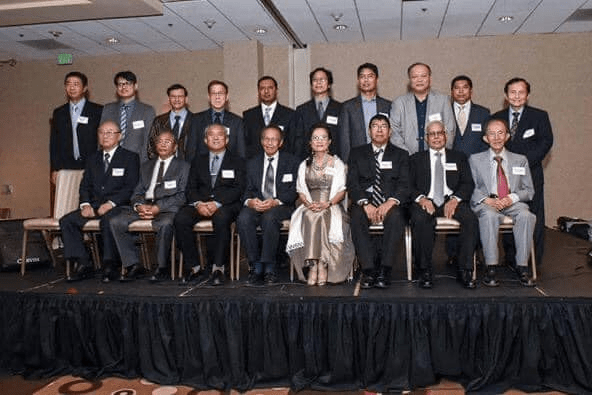
The following lists some Donations from USA.
BASES & Friends
BASES was founded by Saya U Tin Htut (M60), U Tin Htway (M59), U Tun Tin / David and supporters
Several RIT Sayas and Alumni served as President and EC of BASES.
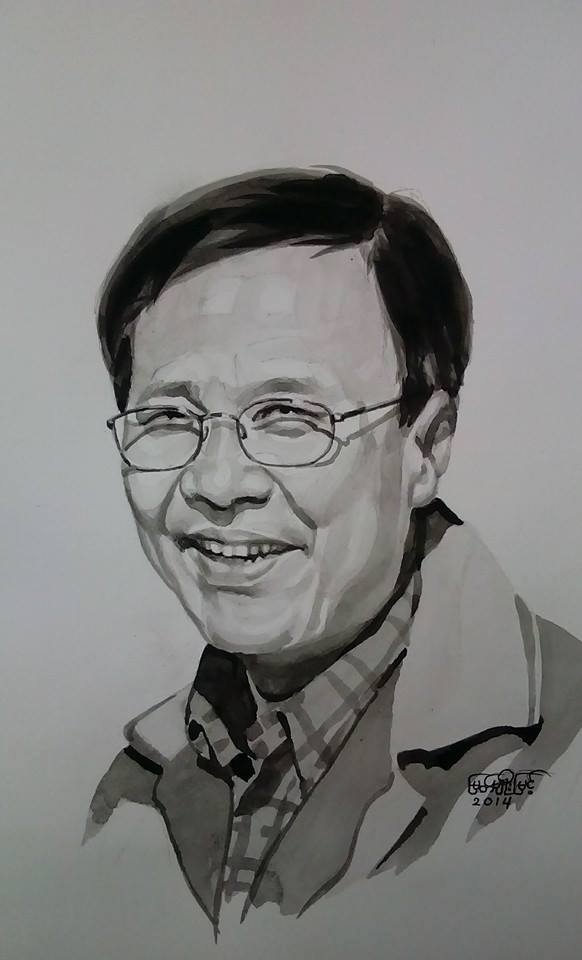
Saya Dr. Tin Win (M62) & Daw Khin Htar Yee (Lily, T72)
Dr. Tin WinKhin Hta Yee (Lily)
Dr. Tin Win was youngest & among the Brightest of his Class
In 1958, won Gold Medal for Joint Highest Maths Marks in combined I.Sc
After graduation, worked briefly in industry before joining Mech Engg Dept.
Taught us “Strength of Materials” (sequel to Sayagyi U Ba Than’s course)
Received Doctorate from Melbourne University
Moved to USA.
Worked for several companies (including Brown & Root in Texas)
Past President & Advisor of BASES
Interviewed by Myanmar Gazette (Southern California)
Ran LA Marathon to raise fund for SPZP-2007
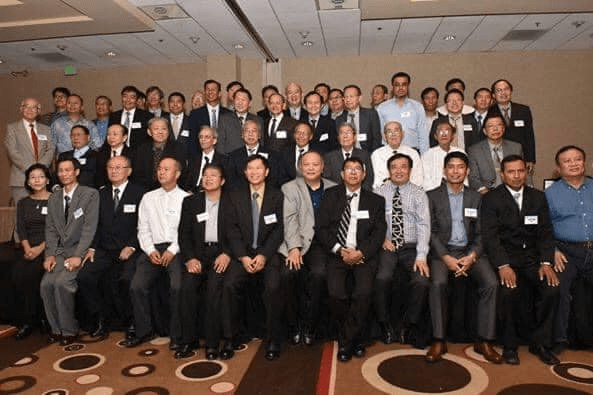
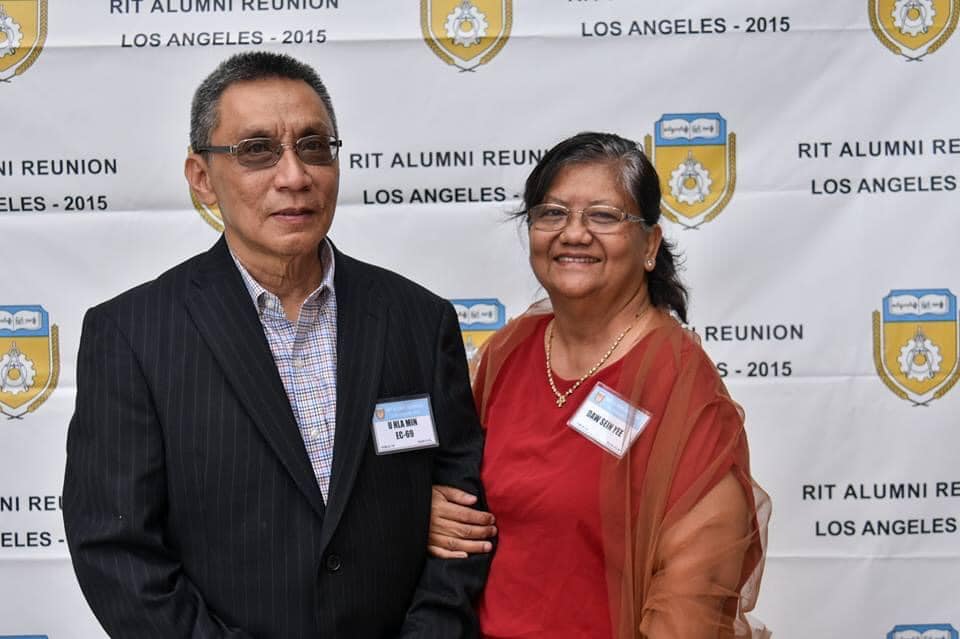
Organized the 2015 RIT Alumni Reunion in Los Angeles
Lily was Founding Member & Secretary of BEA (Burmese/Bay-Area Engineering Association)
Saya & Lily were core organizers of 2015 RIT Alumni Reunion in Los Angeles (along with Saya U Tin Htut, U Thura Thant Zin and U Khin Maung Lay)
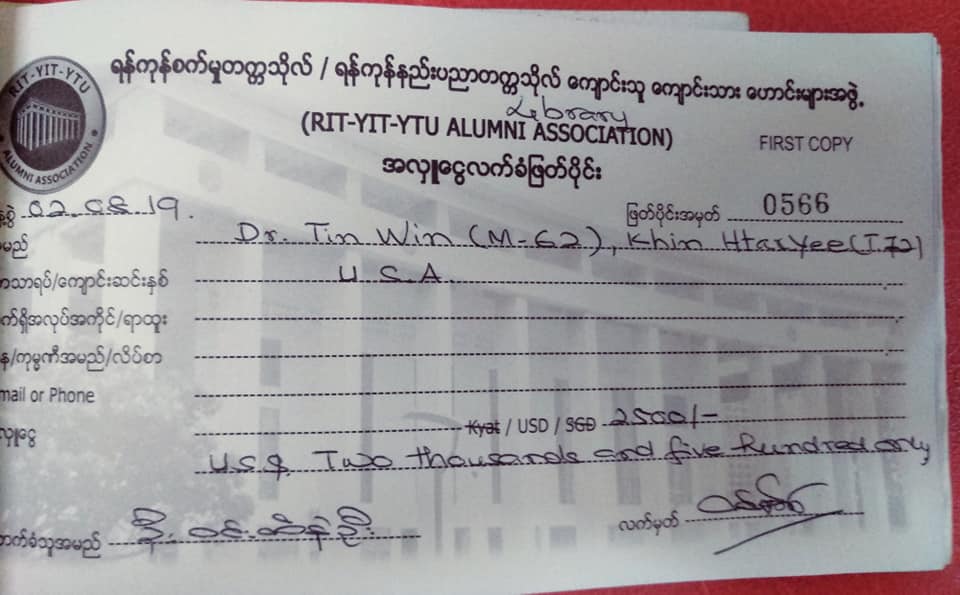
They donated $2500 for the YTU Library Modernization Project
Saya U Tin Htut (M60)
U Tin Htut
Visiting lecturers from the Faculty of Social Science (later Institute of Economics) taught “Industrial Management”.
First Engineering Saya to teach “Industrial Management”
Past Captain & Gold of RUBC
Founded BASES with U Tin Htway (M59) and David Tun Tin (GBNF)
Donated twice — K100 Lakhs first & again K1000 — for YTU Library
Donation
David Tun Tin (GBNF)
Was States Scholar in the USA
Went back to Burma & worked for some time before migrating to the USA
Founded BASES with Saya U Tin Htut and U Tin Htway
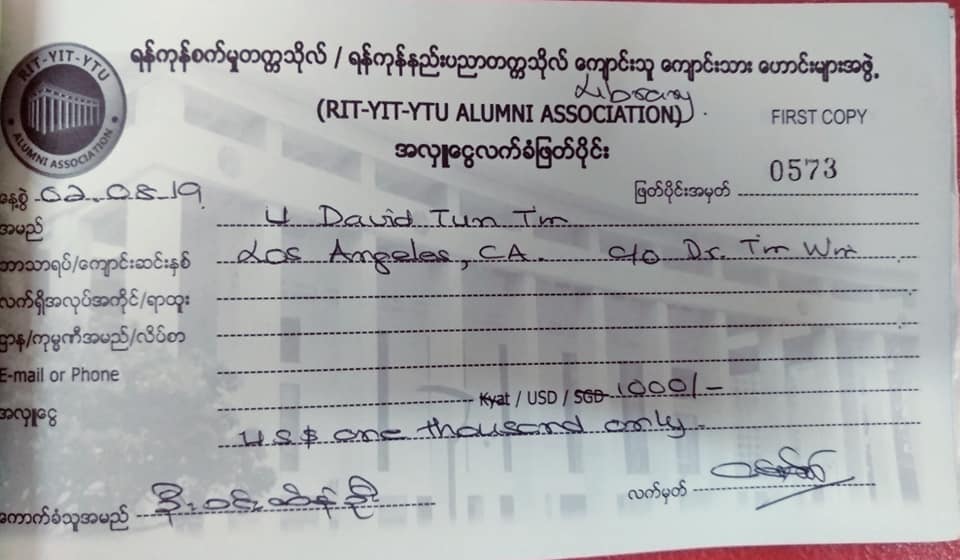
Donated $1000 to YTU Library
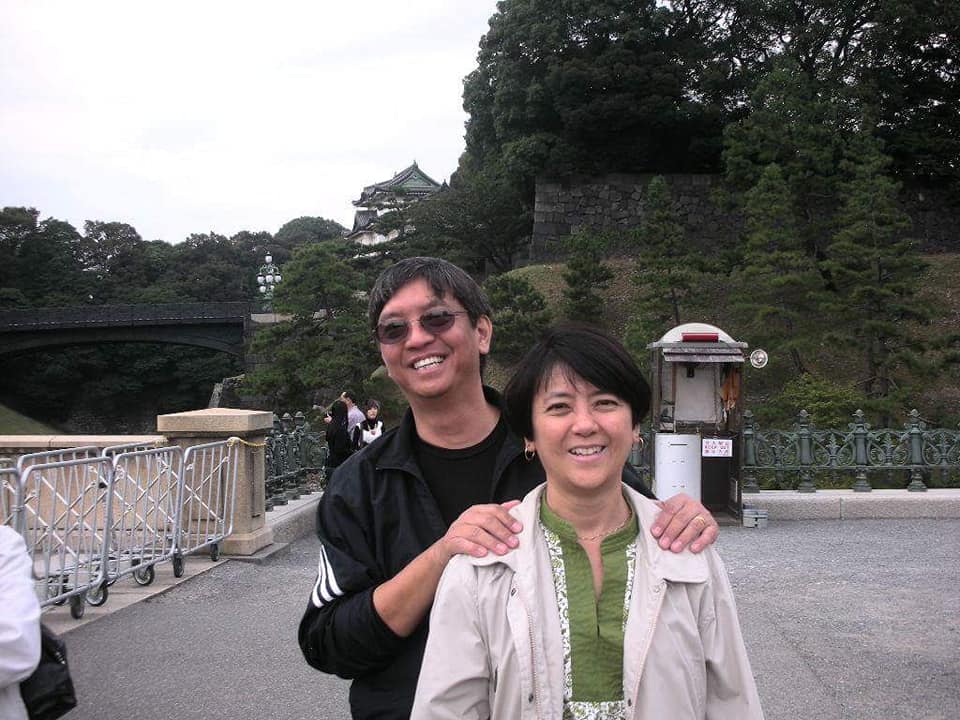
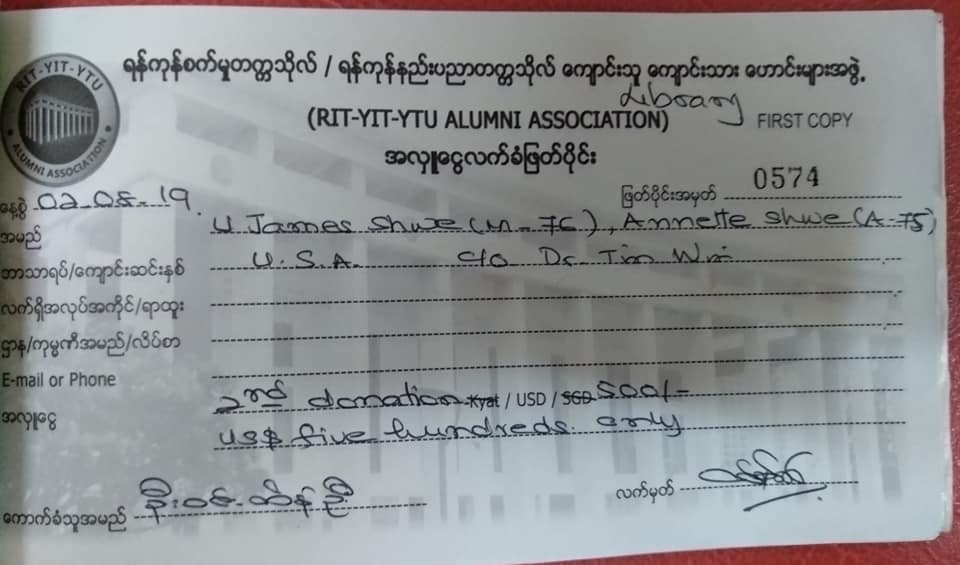
James Shwe (M76) & Annette Shwe (A75)
James & Annette
Earlier donated towards the expenses of HVAC Design and Implementation.
Donated again $500 for YTU Library.
Helped several alumni by offering internship/job at their company.
Provided scholarship for eligible university students in Myanmar.
Donation
U Khin Maung Lay (Henry, T68)
Secretary of RIT Track & Field
Represented RIT in Track & Field, Soccer and Rowing.
Past President & Advisor, BASES
Master of Ceremonies for BASES & 2015 LA Reunion
Enjoys singing in Burmese, English & Chinese
Helped several alumni by offering internship/job at his company
Donated $1000 to YTU Library
Donation
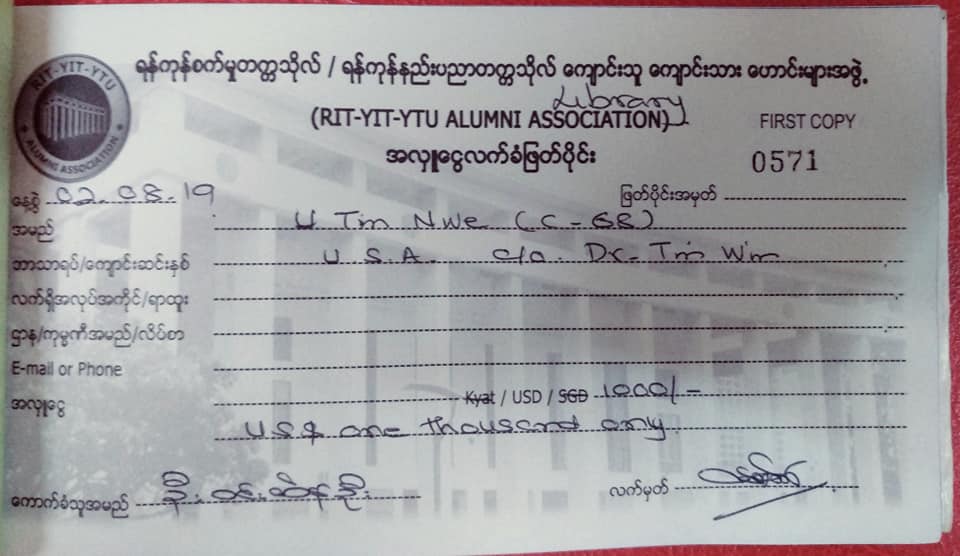
U Tin Nwe (C68)
Past President of BASES
Donated $1000 to YTU Library
Donation
Daw Htay Htay Than (EC93) & U Saw Win Aung (C87)
Sarina forwarded my e-mail about SPZP-2000 to Steeve Kay, (EC70, her family friend). Steeve contacted his friend Benny Tan (M70) & offered to be the first Golden Sponsor of SPZP-2000.
Sarina and U Saw Win Aung donated $300 to YTU Library.
U Min Lwin (M62)
Classmate of Saya Dr. Tin Win
Donated $1000 to YTU Library
Donation
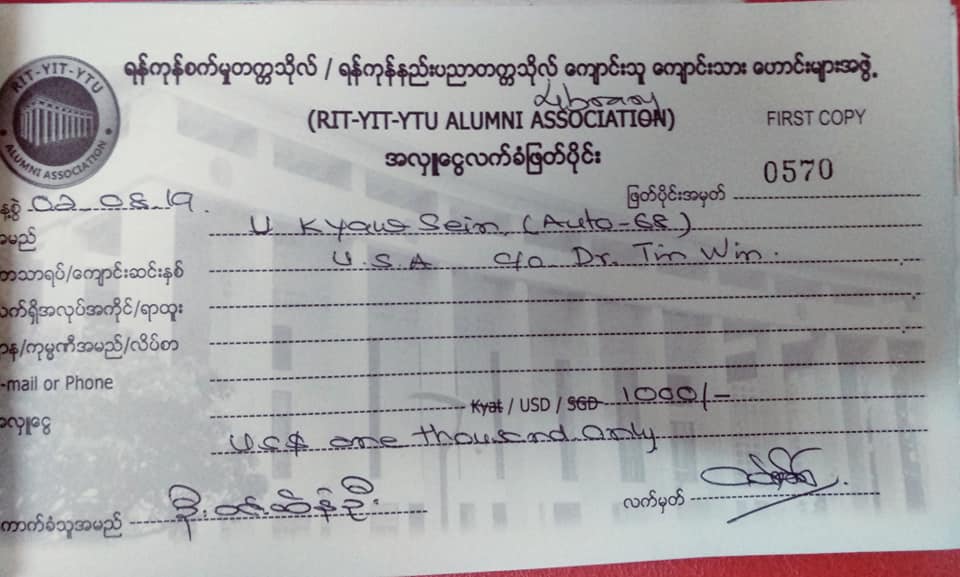
U Kyaw Sein (Auto68)
Mechanical Engineering Department had two sub-departments: Automobile Engineering & Agricultural Engineering.
U Kyaw Sein donated $1000 to YTU Library.
Donation
Daw May Nwe Yee (Rosie)
Younger sister of Saya Dr. Tin Win (M62)
Faculty member of RIT Chemistry Department
Donated $100 to YTU Library
Donation
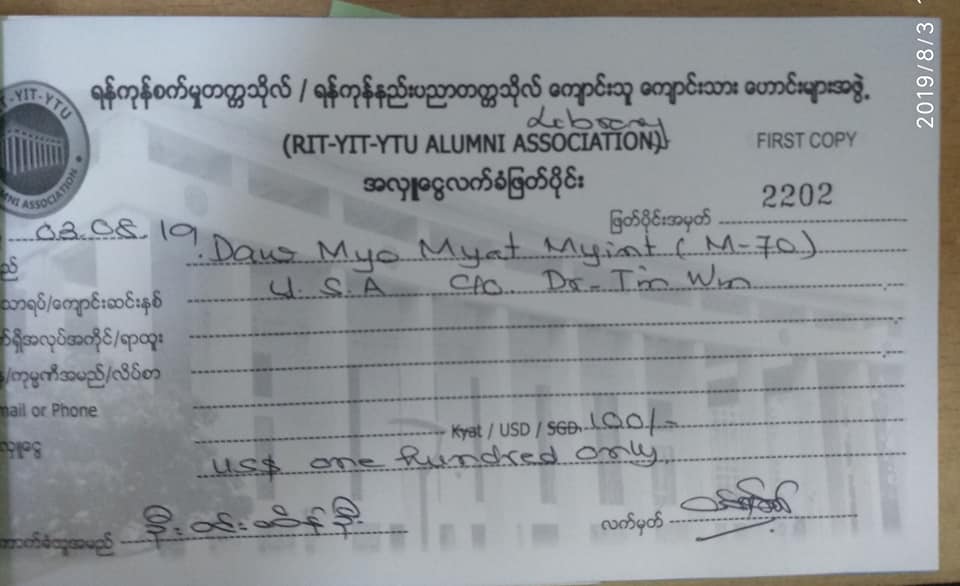
Daw Myo Myat Myint (Penny, M70)
Younger sister of Saya Dr. Tin Win and Sayama Rosie
Donated $100 to YTU Library
Donation
U Sonny Kyi (79 Intake)
LA Gathering in 2015
EC member of BASES
Volunteer for 2015 RIT Alumni Reunion in Los Angeles
Donation
U Myint Aung
Responded to Saya Dr. Tin Win’s request for helping YTU
Donated $150 to YTU Library
Donation
Other Donations
Via NorCal RITAA
U Thein Tun Aung (Dennis, EP76)
Donated $500 to YTU Library (via U Wynn Htain Oo).
Donated $500 to NorCal RITAA for the YTU Library Modernization Project.
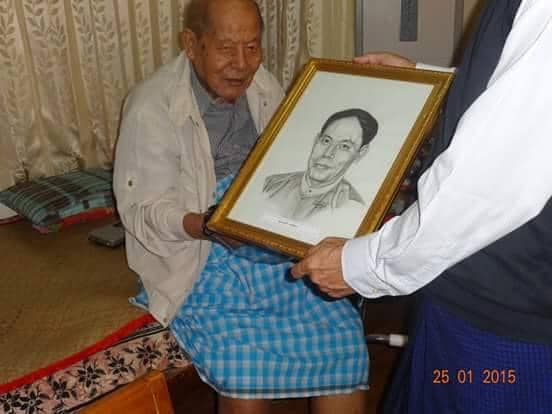
Saya usually celebrates his birthday performing meritorious deeds.
Before his current medical condition, he observed Eight Precepts.
Practices Vipassana Meditation
He is a day older than Saya Allen Htay.
My Beloved Spouse
My spouse (in her younger days)
Supported my volunteer activities for nearly five decades.
I completed 26 years as Founder & Editor of “RIT Alumni Newsletter Updates”.
2015 in Los Angeles
We attended several RIT gatherings : SPZP-2000, SPZP-2012, SPZP-2016 & 69er Golden Jubilee in Yangon; RIT & UCC Gatherings in Australia & Singapore; and many gatherings in the USA.
SPZP-2016
Attended 2015 RIT Alumni Reunion in Los Angeles held at the Knott Berry Farms, and a special gathering at iNapa Winery.
iNapa Winery
She is a Caring Spouse, a Dutiful Mother & a Loving Grandmother. She asked me to take care of my health and minimize use of phone & computer.
Myee
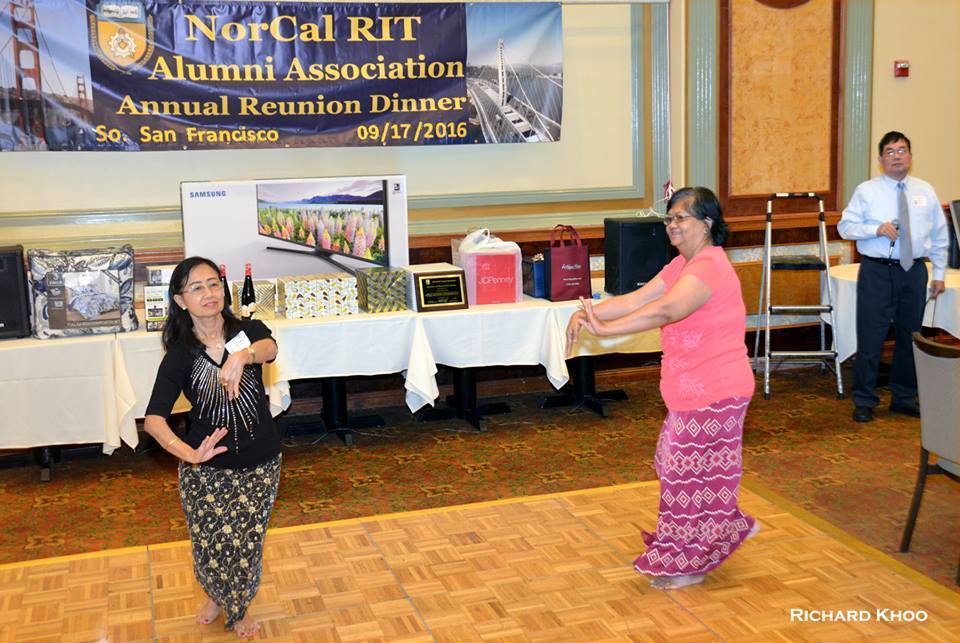
She loves to sing and dance at the gatherings. I am an amateur musician who plays instruments (piano, key board, guitar, harmonica) by ear.
NorCal RITAA
Here’s my birthday wish:
May you be blessed with Good Health, Abundant Wealth, Unbounded Love, Peace, Calm, Tranquility … for many more years to come.
June 1973
Events in December
Saya U Ba Toke
December 1, 1920 : Under the RU Act of 1920, Rangoon University was established with Rangoon College & Judson College as constituent colleges.
RU Golden Jubilee in 1970 : I was member of the “Zay Nay Yar Cha Htar Yay” committee
RU Diamond Jubilee in 1995 : BARB produced documentary for “Rangoon University Sports”
RU Centennial in 2020 : I was Moderator of the RU Centennial Facebook group
December 26, 1920 : Saya U Ba Toke’s birthday. His life story is published in the book by Tekkatho Maung Thin Char (Dr. Khin Maung Swe, GBNF). Saya passed away on December 2, 2020 a few days before his Centennial Birthday
December 5, 1920 : First RU Students’ Strike — Caused amendments to the RU Act. Led to the establishment of Amyothar Kyaung (National School) & Amyothat Kawleik (College). Amyothar Aung Bwe Nay (National Day) is celebrated using the Burmese date
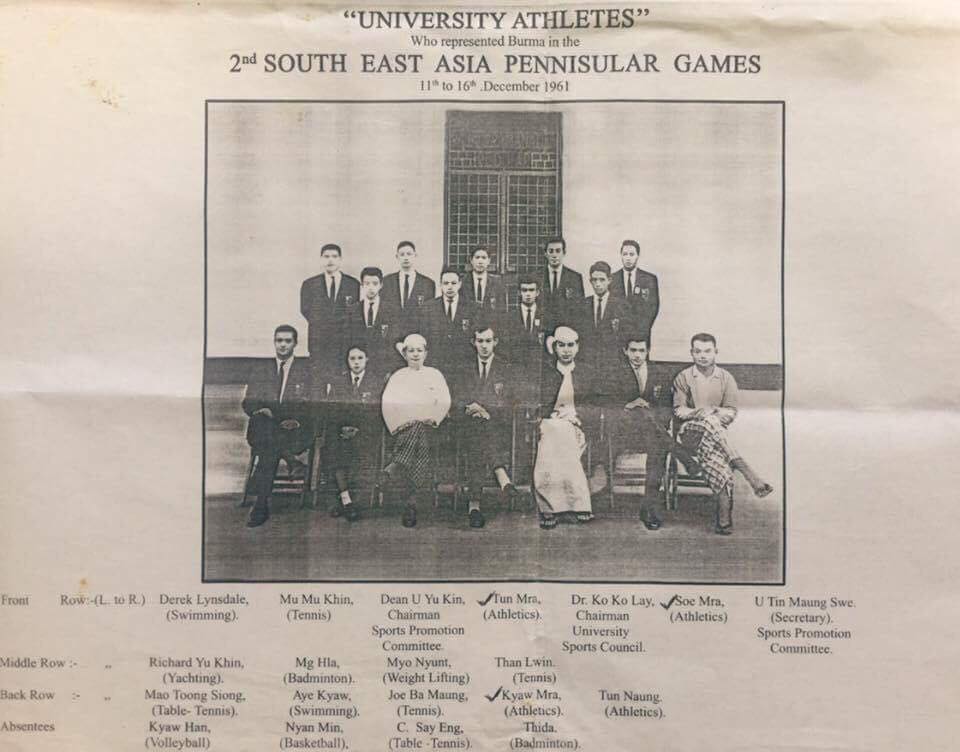
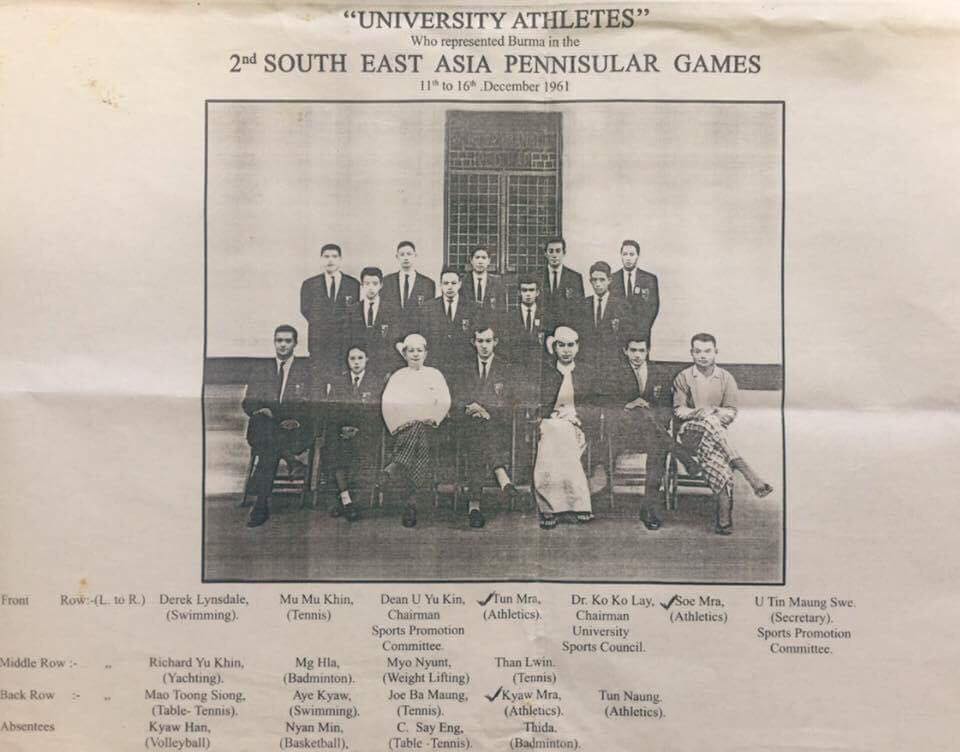
December 1961 : Second SEAP Games — Hosted in Rangoon; Burma dominated in Track & Field, Swimming & Volleyball. About 20 athletes from RU represented Burma in the Games (See photo by Dr. Richard Yu Khin)
RU students who represented Burma in the 2nd SEAP Games in 1961
January 1 is usually accepted as “New Year’s Day”.
Some countries celebrate it as a holiday.
December 31 is “New Year’s Eve”.
Some sing “Auld Lang Syne” to usher in the New Year.
Old Calendars
The old Roman Calendar has only 10 months starting with March So, March signified the New Year
Some civilizations celebrate Vernal equinox or First Day of Spring e.g. Persian New Year So, the New Year will fall around 20th – 22nd March
Lunar New Year
Falls around end of January or beginning of February
Celebrated by Chinese and Vietnamese
Luni-solar New Year
Falls in mid-April
Celebrated by Burmese / Myanmar, Thai, Cambodia, Laos
Burmese New Year followsThingyan (which means change) Maha Thingyan means Great Change (from one year to the next). Cula Thingyan means Small Change (from one month/yathi to another month/yathi)
3 or 4 days of Thingyan (also known as Water Throwing Festival)
Miscellaneous
New Year of the indigenous people e.g. Karen New Year
Saya U Soe Paing co-founded UCC. He hosted Lunch and Dinner gatherings at his house.
There have been UCC gatherings at MICT Park, Singapore, Australia and UCC.
Saya U Soe Paing’s house
Saya U Soe Paing’s house
Saya U Soe Paing hosted gatherings (usually dinner meeting) at his house. Sayagadaw Daw Saw Yu Tint (T69) was my class mate. She also attended CPC course.
U Thein Oo, Daw Tin May Lwin and several others help organize the gatherings.
U Thein Oo, U Htin Kyaw, Aung Aung and several others provided transportation to or from Saya’s house.
40th Anniversary
There was fun and laughter at UCC’s 40th Anniversary Gathering.
Saya Dr. Tin Maung was represented by his spouse (now GBNF) and daughter.
Several UCC alumni are now GBNF. Recent GBNF include Ko Soe Myint Gyi, U Maung Maung Lay, Ko Maung Maung Gyi and Ko Aung Myint
ICST SPZP
In January 14, 2018, I attended the 5th UCSY Acariya Pu Zaw Pwe as “Generation Zero” representative and the “Most Senior” (not by age). Several attendees started their studies and/or careers at UCC.
Saw Yan Naing, son of Dr. Saw Naing (Wesley, SPHS59), gave me a ride to the Pu Zaw Pwe. He is a nephew of Dr Myo Khin (C) and a cousin of Soe Lin Maung (UCC).
Gatherings in USA
Dr. Rafiul Ahad, Ko Khin Zaw,, Ko Aung Myint Oo & Ma Thida Khin, Ko Sein Myint & Sao Mon Sint (Cindy) hosted UCC gatherings (especially to welcome and alumni visiting US).
Ivan Lee (M69) hosts an annual joint gathering for UCC and RIT sayas and alumni at his home in New Jersey. He later co-founded MASTAA and served as its inaugural CEO.
Gatherings in Singapore
My early hosts include Ko Win Latt and Ko Ngwe Soe.
Ko Tin Aung Win, Ko Zaw Tun and Pale Shein organized buffet gatherings.
Ko Aung Aung & Ma Kyin Mya are regulars at the gatherings and at the Soon Kyway at Singapore Chan Myei Yeik Tha.
Some UCC have moved to Thailand and Myanmar.
Gatherings in Australia
Sydney
Saya U Aung Zaw (GBNF), Ko Sein Myint Maung & Khin Aye Mu, Ko Htay Aung & Tin Tin Hlaing organized the gatherings. I met Thandar Htwe and Khin May Thet.
Ko Sein Tin created a short music video during my visit to Oz in 2006.
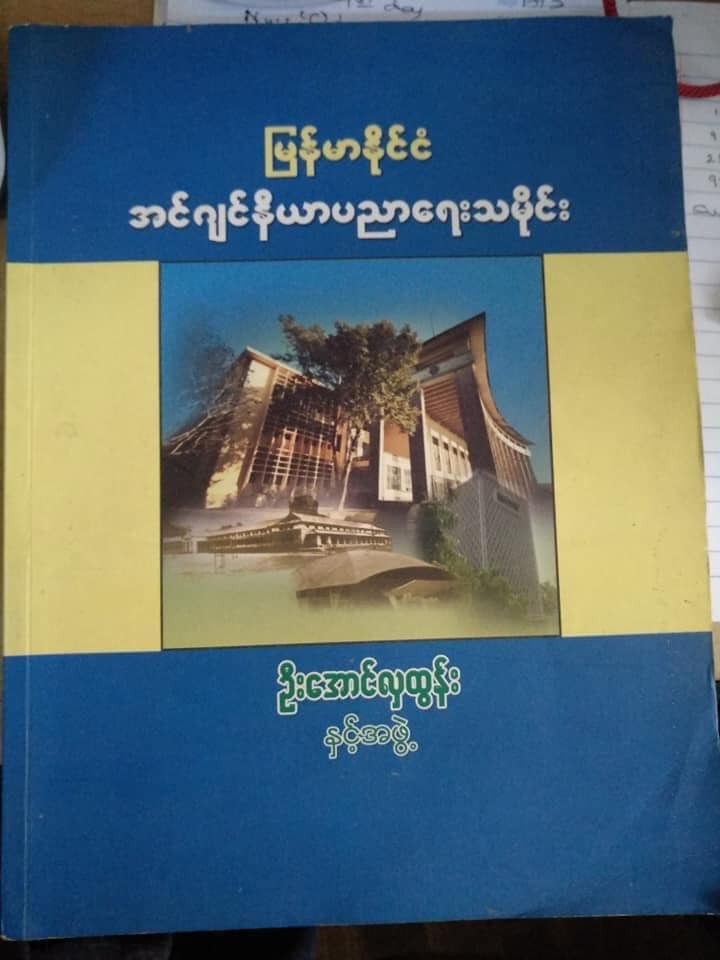
HMEE (History of Myanmar Engineering Education) Book was published in December 2012.
Due to resource constraints, the Book was published in Burmese.
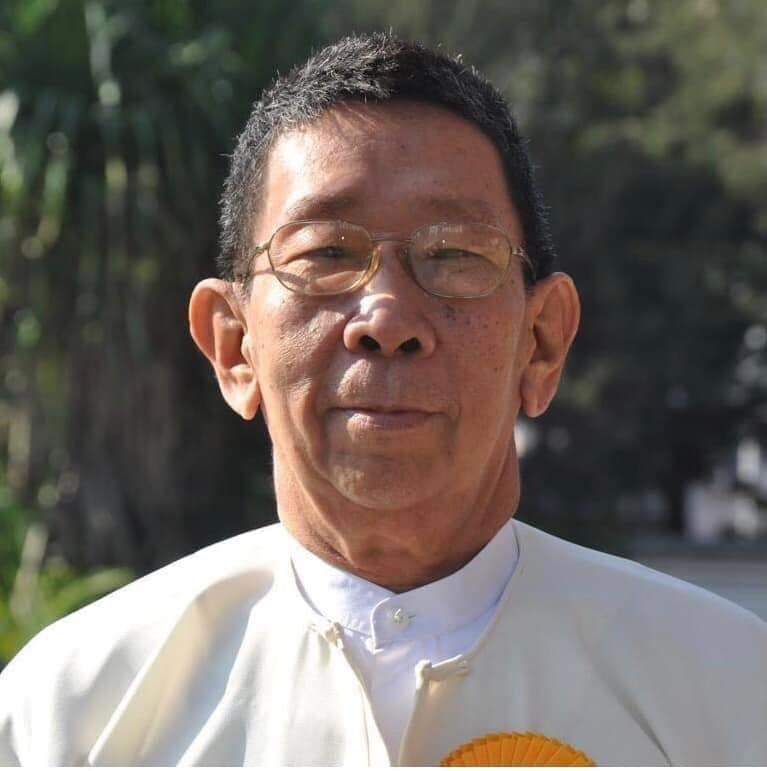
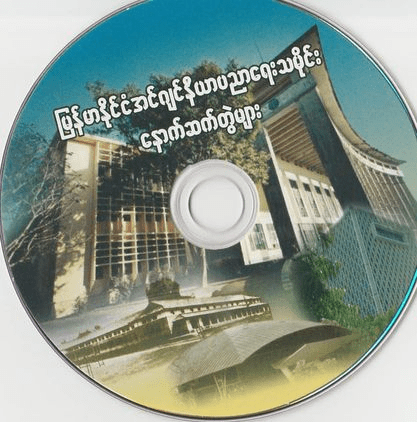
Ko Ohn Khine (M70) and Hla Min compiled the CD supplement for the HMEE Book.
Ko Ohn Khine translated Section 1 and summarized Section 2. They were revised by Saya U Soe Paing (EE, UCC).
Ohn KhineHMEE BookCD SupplementHMEE-2012 Group
Magazines and Periodicals published by the Faculty of Engineering (1946 to 1964)
Engineering students as well as teaching staff expressed their knowledge on Science and technical subjects and also their philosophies and narrative skills by writing technical articles, poems and short stories in the periodicals and magazines published by the faculty.
By going through these articles, one could clearly see the reflection of the activities of the students and staff of our Faculty of Engineering (later Institute of Technology). It was also one of the main source of information for this brief history of engineering education.
There were not many publications during the 1940 to 1964 period. Only five issues could be found. “Engineering Student Journal” was the first to be published in 1940-41 academic year. A proper magazine came out in 1951-52 academic year named “Rangoon University Engineering Students’ Union Annual Magazine”.
RUESU formed a magazine committee at the students’ annual mass meeting to be able to publish an annual magazine. Chief editor was Ko Maung Maung Aye (2nd year), secretary was Ko Ohn Ghine (2nd year). Teaching staffs were named as consultants. Mr. Cutter Pearl acted as consultant editor. See Appendix B for the list of magazine committee members.
RUESU took care of everything from financial matters up to the printing of the magazine. Motto of the magazine was “to shape knowledge with our hands”, and the main objective of publishing the magazine was to be able for the students to achieve the talent of expressing the significant features of the subject(s) that they regarded as interesting.
The magazine was bi-lingual (Burmese and English) and had 168 pages. It was printed at “Aung Meit Set” printing house.
The annual magazine came out in 1952-53 academic year also. Chief Editor was Ko Maung Maung Lay (3rd year), secretary was Ko Kyaw Win (2nd year), and consultant editor was Mr. C. Ping Lee [father of Dr. Win Aung (M 62)]. A contest for short story, poem and article was included in this magazine. It was bi-lingual and had 138 pages. It was printed at “Setkyarwalar (Universe)” printing house on Inya Road. See Appendix B for a list of committee members and winners of the contest.
In the foreword of the 1956-57 annual magazine, it was stated thus: “It was a sad thing that the annual magazine could not be published for three years after 1952-53 academic year. We had tried our utmost to overcome whatever difficulties we faced and finally we could hand the magazine to you”. To overcome the shortage of capital, advertisements had to be included in the magazine.
Ko Myo Aung was chairman of the magazine committee and Ko Kyaw Hoe was chief editor and publisher. The consultant editors were U Maung Maung Gyi (later professor of Burmese department) and U Ngwe Thein (later lecturer of Engineering Geology of Mining department) for Burmese and English sections respectively. The magazine was bi-lingual and had 108 pages. Photos of the newly opened Engineering College on Prome Road were included in the magazine.
There were no annual magazines after 1956-57 academic year. Only in 1960-61 academic year, the magazine could be published again. Publisher was Ko Ne Tun and editor in chief was Tetkatho Moe War (U Moe Aung, Electrical Engineering department). U Kyaw Tun (Lecturer, Electrical department), and U Aung Khin (Lecturer, Mechanical department) were consultant editors. See appendix B for a list of members.
The magazine was printed at Myo Nyunt Press House. It was a bi-lingual with 160 pages. It was the last magazine published with the name of “Rangoon University Engineering Students’ Union Annual Magazine”. After the publishing of 1960-61 annual magazine, there were no magazines up till 1965.
Engineering Education around the 1950 period
To get a clear picture of the engineering education at the faculty of engineering, Rangoon University, excerpts from an article written by Dr. Aung Gyi is included. Dr. Aung Gyi was an Inter Science and Engineering student from 1948 to 1952. He served as Rector of Rangoon Institute of Technology from 1971 to 1978. The following are excerpts from his article.
“I was an engineering student and then became one of the teaching staff at a later date. I matriculated in 1949 and entered the University of Rangoon and stayed in Ava Hall and took what we called in those days the Intermediate of Sciences (I. Sc.) courses. The courses were: English, Burmese, Physics, Chemistry and Maths (pure and applied maths). We needed to take these courses for two years in order to go to the engineering studies. I remember having a great time in the first year as we did not have to take the exam at the end of the first year for some unknown reason. But we had to take the exam at the end of the second year for all the subject matters that were taught to us for the whole two years. It was a tough examination at the end of the second year as we had to study a lot. We had physics and chemistry exam papers, two maths papers, English and Burmese papers, physics lab practical exam and chemistry lab practical exam within a period of 15 to 20 days in the hot month of March. Only about 60% of the students passed through the first time. The passing grade for each subject was 40%. Fortunately the University authorities in those days were understanding and kind enough to give the failed students what they called compartmental examination again in May/June for the failed subjects. Given a second chance like that, a lot of students passed the exam this time around. The Faculty of Engineering admitted the students, including the students who passed the ISc exam under the compartmental system, with a passing grade of at least 40% for each of I. Sc. subjects and the average grade for all the subjects combined of 50%.
I was quite fortunate to have good teachers in my I. Sc. days. I remember that Saya U Than Tin gave good lectures in physics. Saya U Thein Nyunt was good as well in teaching us chemistry. Needless to say the experiments that I had to do in physics and chemistry labs were interesting as they were all new to me. The maths teachers I remember were Professor U Aung Hla, Sayagyi U Kar, Sayagyi U Ba Toke, two Indian lecturers with the same last name Chowdhury, I forgot their first names. One Chowdhury was bald headed and the other had a lot of hair. They were teaching, I think, under contract with the Rangoon University. These very good teachers, I had to say, gave me a good foundation in maths. The English teachers were very good too. They were Saya U Kan Gyi and Sayama E. Kan Gyi. The only Burmese teacher I remember was Saya U Hla Maung who could make a boring topic into an interesting lecture. I owe a lot of gratitude to these wonderful teachers.
I joined the first year engineering class in 1951-52 academic year, having satisfied the entrance requirements of the Faculty of Engineering mentioned above. The academic year, I think, was from June to February with about one month break in October. So far as I know there was a “new course engineering” at the Faculty of Engineering right after the World War II. I do not know what the entrance requirement for this new course was.
I stayed in Prome Hall like most of the other engineering students in those days, as it was situated close to the B.O.C. College of Engineering building where we had classrooms, laboratories and workshop for our engineering courses. A few engineering students however stayed in Tagaung Hall which was in the same Prome road campus of the Rangoon University as Prome Hall. Both of these hostels were timber buildings and they could easily get burnt down, but I was happy to see that they are still standing there when I last visited Yangon in 2010. These two Halls gave accommodations to all engineering students, even to some students from Rangoon at that time, as there were vacancies and as the total engineering student population was not that big. If my guess is correct, I think there were about 350 to 400 students for 4 years of all engineering disciplines, out of which there were about 75 first year engineering students. The system in place at that time was in such a way that the students had to take common courses in the first two years and branched out into different disciplines of choice, starting from 3rd year.
I remember that as first year engineering students, we still had to take maths classes from 7:00 am to 9:00 am at the main campus where we had taken the I. Sc. courses. I remember getting up early in the morning in Prome Hall, and taking a walk along the road what we called as “Padaukpin Lane” or “Thaton Lane”, and through Thaton Hall and Ava Hall, for the mathematics classes at the main campus. All of us then rushed back to B.O.C. College of Engineering from the main campus after 9:00 am to take the engineering classes, which included lectures, practical laboratory work, workshop practice, and drawing classes, starting from 10:00 am. We normally finished our classes around 4:00 pm. The total contact hours of learning for engineering students were about 30 hours per week. If my memory is correct, it was difficult to get an engineering degree in 6 years after matriculation. Somewhere along the way some of us failed for one reason or the other, and had to repeat a class. The passing grade for each subject, which included workshop training at the engineering faculty was 40% and the average passing grade for all the subjects combined was 50%. When I passed my 1st year engineering in April/May 1952, I noticed that about 15% of my classmates were left behind to repeat the 1st year engineering.
I do not remember all of my teachers at that time. I can only recall that Saya U Num Kok was in charge of 1st year engineering drawing, Saya Jaidka taught us “building materials and construction”. Saya Ketrapal gave lectures and practical laboratory training in “ heat engines”. Sayagyi U Kyaw Tun and/or Saya C. Ping Lee taught us “electrotechnology” in the classroom and in the laboratory. In addition to the lectures, laboratory work and drawing, all of us had to take workshop trainings in carpentry, blacksmith, welding and in machine shop. The medium of teaching was English. We were also encouraged to take some practical training with some engineering organization during the summer vacation. I am not quite sure, but I think Ko Chit was an assistant at the blacksmith shop, and U Ba Sein was an assistant in the electrical lab. I think Mr. P Davies was the workshop superintendent. The classrooms, laboratory facilities, the workshop facilities that I attended were good and adequate. The library I visited some time was full of engineering books, magazines and journals. I could imagine that with its qualified teaching staff and good teaching facilities, the Faculty of Engineering was producing the qualified engineers needed by the country at that time.
I do not know what the total number of teachers we had at the Faculty of Engineering at that time. I could guess that the student/teacher ratio was about 20:1 from the number teachers and from the number of students I had seen. I noticed that there were few Burmese nationals teaching staff at the Faculty, and most of the teachers were from India and UK. It seems that right after the World War II, there was shortage of qualified teaching staff from Burma at higher education/University level as a whole. Sayagyi Professor U Ba Hli was Dean of the Faculty of Engineering, and I believe he received his post graduate degree from a British University. He was quite far-sighted and tried to broaden and improve the engineering education by having some kind of twinning arrangements with not only a British University but also with Massachusetts Institute of Technology USA (M.I.T.). I remember as a student hat there was a visiting Professor called Professor Horwood from M.I.T. at the Faculty, and I think he gave us lectures on sanitary engineering. Sayagyi U Ba Hli must have planned to increase the number of engineering disciplines that were given at the Faculty from civil, mechanical and electrical engineering to other disciplines as well, such as Mining, Chemical, Metallurgy, Textile engineering and Architecture. I understood that this plan came into fruition in 1954/55. He must have also planned to send the Burmese nationals to UK, USA, and other countries for further training so that they could be appointed as qualified teaching staff at the Faculty at a later date. I therefore take this opportunity to put on record that a big credit is due to the late Sayagyi U Ba Hli for his contribution to the improvement of engineering education in Myanmar.
After attending the 2nd year engineering class from June 1952 to September 1952, I went straight to MIT on a state scholarship to continue my studies. Saya U Min Wun and I went together to MIT and joined the academic session, starting from September 1952. We met Dr. Freddie Ba Hli at MIT, who was already studying for his Ph.D in electronics or electrical engineering. He was one of the nicest and helpful persons that I have ever met in my life. He gave us briefings and guidance so that we were able to assimilate into the American education system and American way of life without any difficulty. He also helped with our home works when we had some difficulties in the beginning. I am forever grateful to him for his kind help. I am sure U Min Wun feels the same. Saya U Khin Aung Kyi, Saya U Sein Hlaing, U Percy Lao, U Win Htein, U Kyaw Min, Robin Aw, U Kyaw Thein, U Aung Kywe, U Aung Myint and U Sein Hla came to MIT for further studies at a later date. U Percy Lao later became Rangoon City Engineer (water and sanitation). U Win Htein who is an architect became a Rangoon City Building Engineer. The late U Kyaw Min became a free lance architect (and also taught part-time at the architecture department for some time). All these three professionals taught some time at RIT. I do not know what happened to Robin Aw. The late U Kyaw Thein was an engineer at the Construction Corporation and later became a lecturer at the Civil Engineering department at RIT. U Aung Kywe was a Director (water and sanitation) at the Construction Corporation. U Aung Myint became the Chief Architect at the Construction Corporation. U Sein Hla was an engineer at the Construction Corporation and later became the Registrar at RIT under Rector U Yone Moe. Later more batches of Burmese students came to MIT when I was no longer there. I am describing all these things to point out the fact that the standard of engineering education in Burma at that time was quite good. None of us had to go through the entrance exam to get into MIT. They trusted our grades and our education standard. Maybe the visiting Professor Horwood from MIT was quite impressed with the Faculty of Engineering and put a good word for us to the MIT admission authorities.
Now I would like to touch upon the extra-curricular activities of the students from 1949 to 1952 when I was one of the University students in Rangoon. As mentioned in the beginning, all the extra-curricular activities were in sports; in artistic and literary related activities; in activities of various students’ associations, societies and clubs according to their respective aims. Good and adequate facilities were available for these activities at the Rangoon University campus, except for swimming. But Inya Lake was available for the students for swimming and rowing. There were competitions in sports such as soccer, tennis, table tennis, badminton, basket ball, volley ball, track and field, swimming, rowing, boxing, weight-lifting, and body building (Mr. University). There was University soccer team which was quite good and competing nationally at Aung San stadium. There were annual dinners of various hostels with anyeints and concerts participated by outside professional artists. There were separate annual concerts, stage shows and anyeints by the talented students also. There were students’ magazines published every year with articles and poems by the students.
I will not go into details of all the various students’ associations, societies and clubs, as there were so many of them. But I would like to mention briefly about the hostel life, that I had experienced at that time. Every hostel had what we called social and reading club. There was an adequate room reserved for this club at the ground floor of the hostel. In general, newspapers, popular magazines, a chess board, a carom board and a table tennis were provided so that the hostel students could read, play chess, play carom board, and play table tennis and socialize to get to know each other well. Even without the social and reading club, all the hostel students ended up knowing each other well sooner or later, as they met each other almost everyday at the hostel and at the dining hall. The hostel students were in general well behaved. I hardly saw the Warden or Hall Tutors at Ava Hall and Prome Hall, as there were very few student problems which needed attention of the Warden or Hall Tutors.
Based upon my experience, I feel that these extra-curricular activities and hostel life gave the opportunities to the students to broaden the knowledge of the different parts of Myanmar; and they also created a better understanding of the different culture, food, habit, dresses, dialects etc. of the country. Most of the students developed life-long friendships through these activities which contributed to well-beings of these students throughout their lives. Sports activities also taught the students about hard work, cooperation, team work, competition, winning and losing. The extra activities also triggered, developed, and enhanced the hidden talents of some of the students. These activities therefore formed part of the University education of the students, in addition to the education that they received from the classrooms. Another benefit of these activities was the bonding and a better understanding, which developed between the students and the teachers who were involved in these activities”.
Editor’s notes
With the support of Sayagyi U Ba Than & Saya U Thaw Kaung, Chief Librarian of the RU Central Library, Saya U Soe Paing compiled materials. Most articles and correspondences from the early periods were in English. Based on Saya U Soe Paing’s work, the editorial team headed by Saya U Aung Hla Tun, former Editor-in-chief of RIT Annual Magazines and also a National Literary Award winner, wrote the book in Myanmar/Burmese.
U Ohn Khine and I prepared the CD Supplement for the book. It included photos (too many to be incorporated into the book), bio of Sayas and sayamas, articles for the SPZPs, and excerpts from my Updates.
Pyidaungsu Party (formerly known as Clean AFPFL) won. U Nu became Prime Minister of the Union of Burma for the Third and Last time.
Several military officers (who used power to support the Losing Party) were purged.
The 17 man Revolutionary Council staged a Coup d’etat on March 2, 1962. According to Kyemon U Thaung, six of them did not have access to high level information / decision.
Burma lost its hard fought Independence.
Sham Elections
During the BSPP era, there were Sham Elections. Mostly single candidate nominated by BSPP. Voters had to choose White (Yes) or Black (No).
During one BSPP Convention, the then Number One did not get the Top Vote. A purge followed. Those suspected of “Election Fraud” were criminalized with ludicrous charges. The MI Chief and his followers became extremely powerful. Eventually they were detained or dismissed.
Jump Promotions and Purges led to many Toadies. e.g a Commander who baby sit the grand kids of his Boss.
Past Elections
In September 1988 General Saw Maung took over. He promised to hold free and fair elections and that the soldiers will return to the Barracks. Citing medical reasons, he was forced out & replaced by a Ruthless Dictator.
The National League for Democracy won the 1990 Elections. The results were nullified. The majority of elected representatives were detained.
The military rule — accompanied by Nepotism, Cronyism & Terrorism — established a hand crafted Constitution in 2008 to ensure impunity for their Crimes and an unfair advantage to the past, present & future Thugs.
2010 Election was virtually uncontested. Some Toadies helped the military by posing as Opposition.
2015 and 2020 Elections were won convincingly by NLD (National League for Democracy).
The Coup d’etat ended Parliamentary Democracy in the Union of Burma.
President Mahn Win Maung, Prime Minister U Nu & cabinet ministers, and Shan Sawbwas were detained.
U Nu
7th July 1962
It saw indiscriminate shooting at the student protesters.
The official death tally was 17.
Ko Aung Khin was hit by a stray bullet as he was returning from RUBC to his home in Windermere Road.
8th July 1962
It saw the revered RU Student Union Building demolished.
The then No. (1) and No. (2) said that they did not give orders for the two sad events.
Some people reported hearing strange sounds and seeing strange images in or near the residence halls (e.g. Mandalay Hall). Some believe that there might be ghosts.
1963
There were pamphlets and Sar Saungs commemorating the anniversary of 7th July.
The higher authorities gave ultimatum to the hostel students to leave.
All classes except those from the Faculty of Medicine and the Faculty of Engineering were closed.
Final exams were held locally (e.g. at State High Schools).
The schools were reopened in November 1964 under a new Education System.
1964
The use of Intelligence Level Aggregate (ILA) system and the 3 NRC rule created a Tier System among the Once Equal Disciplines.
A sayagyi told his students, “If all of you go to medical and engineering, there will not be talent left to cover other important fields.”
There were some exceptions. Dr. Min Oo (in 1963) and Dr. Zaw Win (a few years later) stood Second in the whole of Burma in Matric. They chose to study Maths and received their Doctorates from Germany. Dr. Min Oo retired from McMasters University in Canada. He earlier taught in Germany and in the US as a visiting professor. Dr. Zaw Win is GBNF.
Mid-1960s
Nationalization of Schools took place on April 1, 1965.
“Burmese Way to Socialism (Despotism, Nepotism)” created 2nd and 3rd Class Citizens.
Shortage of rice (unheard of in the “Rice Bowl of Asia”) caused unease. The problem was redirected to create a riot known as “Tayoke Bama Ah Yay Ah Khinn” တရုပ်ဗမာ အရေးအခင်း
1974
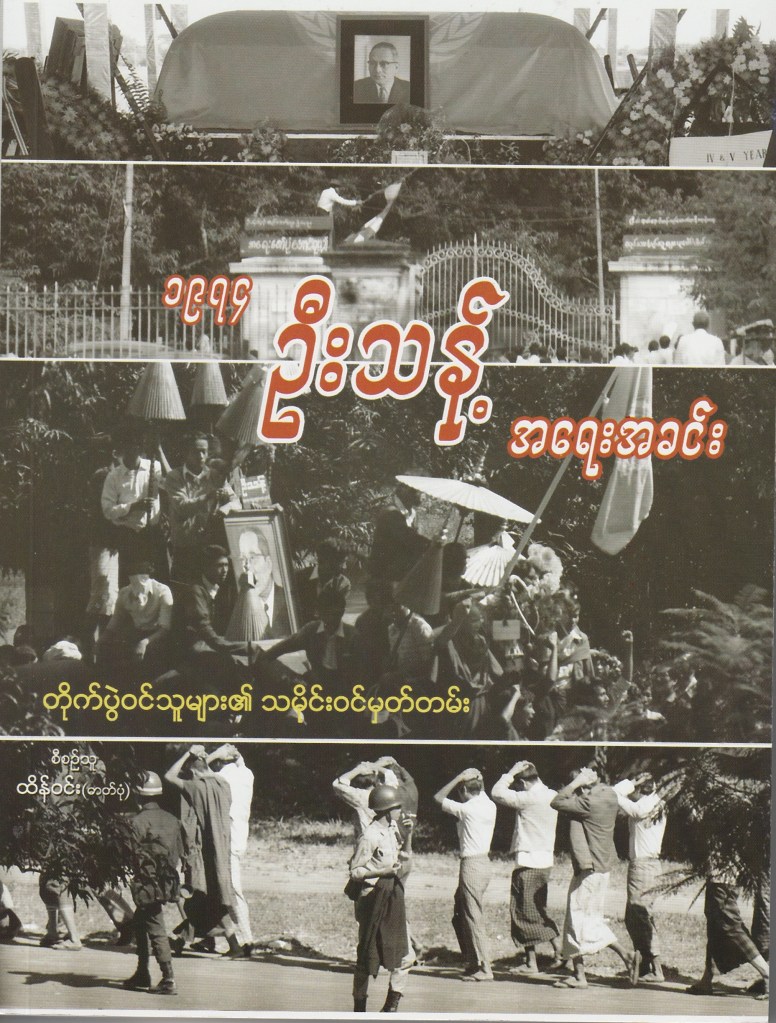
U Thant Ah Yay Ah Khin
“U Thant Ah Yay Ah Khin” ဦးသန့်အရေးအခင်း can be read in a book with rare photos. Htein Win Sar Pay ထိန်ဝင်းစာပေ has published books about the two Ah Yay Ah Khinn in 1974 and 1988. Ko Khin Maung Zaw mailed me a copy of “U Thant Ah Yay Ah Khinn”. At the 5th ILF (Irrawaddy Literary Festival), Ko Htein Win gave me a copy of the 8-8-88 Ah Yay Ah Khinn.
Late 1980s
1988
There were several more closure of the schools.
Many students lost three precious years of their lives (1988, 1989 and 1990). There were no classes, exams and Convocation for the three years. The 1st BE Intake of 1983 graduated in 1992. Those who failed the 6th BE in 1987 had to repeat again in 1991.
Some, who witnessed the events in March and August of 1988, had a long wait before they could freely express their experiences.
In August 1988, Dr. Tin Aung (Physics) and U Tun Aung Chain (History) were in the US as members of the Burmese Education Delegation. Dr. Tin Aung was elected in abstentia as a Patron / Nayaka နာယက of the “Sayas and Sayamas from All Universities and Institutes” Ah Phwe အဖွဲ့ supporting the 8-8-88 movement. Upon his return to Burma, Dr. Tin Aung was forced to resign. When Dr. Tin Aung’s pacemaker needed replacement, his former students from Myanmar and Overseas donated for his health expenses.
In the beginning, there was no RIT and of course no BEs. There was only the BOC College [of Engineering], Rangoon University. Saya Ba Hli was the Dean of Engineering. The degree conferred was B.Sc. (Engg).
Saya Allen Htay remembers that the Dean wanted every engineering student to attend at least one common course with his/her senior batch. Thus, by the time one graduates, everyone will be familiar with three batches: one’s own, one senior, and one junior.
Then, for a brief period, there was BIT (B for Burma). In anticipation for the opening of more engineering institutes the name was changed to RIT (R for Rangoon).
Feedback (by Saya Dr. Aung Soe): In the summer of 1961 BIT/RIT was born. It was also the time that I started my teaching career.
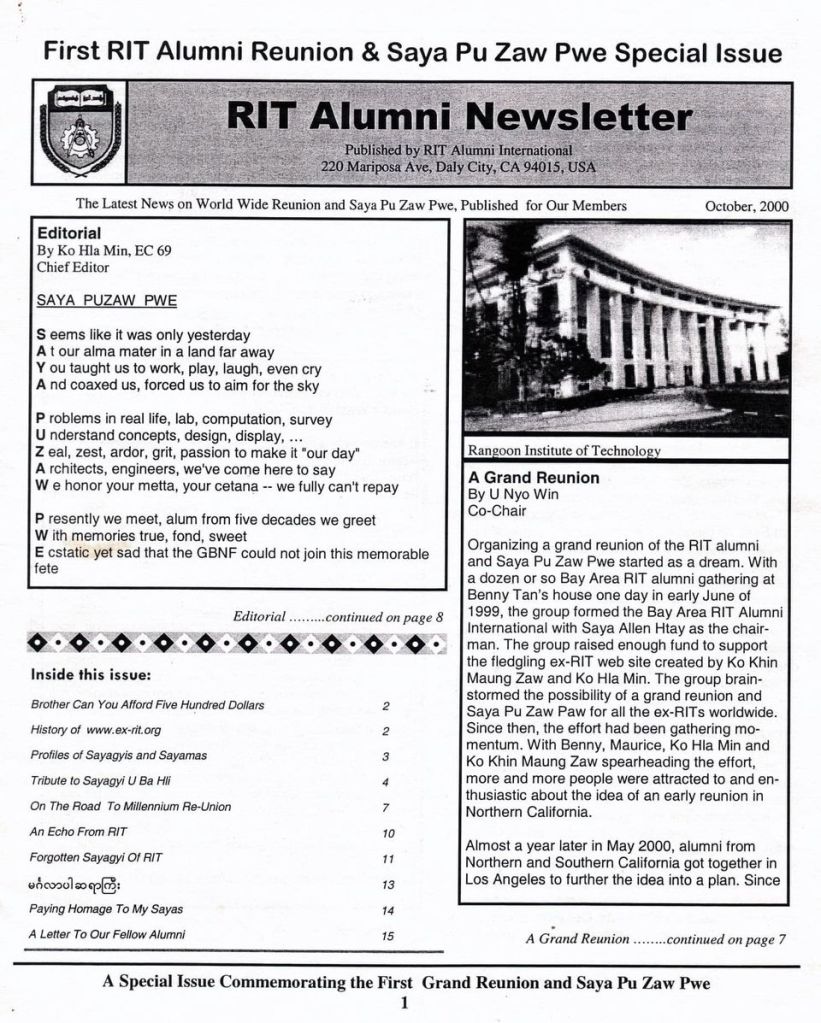
Several years back, RIT became YIT (Y for Yangon). Now, there’s an MIT (M for Mandalay) and an engineering branch of DSA. The latest name for RIT is YTU (Yangon Technological University).
It’s been a looong time since I had to sit at the last row [according to the seating plan — you cannot take the exams unless you have 75% attendance] of the “Surveying” course taught by Saya U Min Wun; the field work was supervised by Saya U Aung Soe. I noticed that I could no longer read the blackboard and became “four eyes”.
I started compiling a list of RIT alumni and ex-faculty after I received emails from Saya U Soe Paing (from UK, after his four month visit to Burma). See “Saya’s corner”.
I received encouraging words. Better still, a lot of people including Saya K C Chiu (ChE63), Saya U Myat Htoo (C68), Ko Aung Khin (EP68), Ko Tint Lwin (Danny, M69), Saw Yu Tint (Alice, T69), Lei Lei Myaing (Amy, T70), Than Than Yi (T71). Saya Ko Thein Aung (James, Met72), Ko San Lin (Robert, EC73), Ko Maurice Chee (M75), Ko Khin Maung Zaw (EC76), Ko Hla Kyi (EC77), Ko San Myint Thane (Sammy, EC79), Ko Aung Win Myint (Kevin, EC80), Ko Aung Myint Oo (EC84), Ko Yu Ket (Edward, EC85), Ko Nyunt Than (M86) contributed to the list. They have also become the de facto class reps.
On most Internet newsgroups, there are 20 – 100 readers for every writer. In our case, we have more contributors and active readers who provide useful feedback. The list has grown to 250+, and still growing.
I gained (or re-gained) contact with my Sayas (including Sayagyi U Min Wun and Saya Dr. Aung Soe), classmates, and schoolmates. Also, I learned that there have been semi-reunions and reunions in California, Singapore, Sydney, and Yangon.
I hope this newsletter will serve as a starting point for a “Virtual (world-wide) reunion” and also bring back fond memories. Saya U Soe Paing, Saya U Myat Htoo and Ko Tint Lwin (Danny) have promised to write in the forthcoming newsletters.
Feedback: The list has grown, within a day, to 280+.
SAYA’S CORNER
From UK, Saya U Soe Paing (EC) writes: During our recent visit to Burma, I saw Ko Tin Htut in Rangoon. He told us that Dr Aung Gyi would be visiting Burma. We managed to contact Dr Aung Gyi and we had a small get together at our house. The following came. Dr Aung Gyi and Ma Emma, Dr Khin Maung Win (Metallurgy) and Margaret, Ko Kyin Soe & Chit Chit, Ko Sein Win (Electrical Power), Soe Min (my classmate and ex Instructor in RIT) and Dr. Than Htaike (Chemical Engineering). Han Tin (Rector of the Institute of Education) was also there.
Played golf with Ko Maung Maung Than. He is now the advisor at the DSA Engineering college in Maymyo. They have appointed retired RIT sayas. S. Arya is one of them and I met him in town. Also saw Ko Thein Lwin in Rangoon and Ko Tu Myint & Myitzu in Singapore.
From Singapore, Saya U Tu Myint (Mech) writes: Thanks for the info. Nice to talk about the good old days. I think it’s a good idea to keep Old RIT Colleagues informed, especially when we are getting old. Awaiting for more news. Perhaps scan in some photos.
From Los Angeles (California), Sayagyi U Min Wun (Civil) writes: Ko Hla Min, what a surprise to get in touch with you again after such a long time. Sorry for this late response. My pc was disconnected from the Network after Y2K Remediation. Anyhow, my name has already been included in the Ex-RIT listing. Thanks for the long list. Please keep in touch.
From Chicago (Illinois), Saya Dr. Aung Soe (Civil) writes: Ko Hla Min: Thanks for the list. U Chin Way from LA passed away a few years ago. Aung Myint Thwin, one of my students, is in Singapore. I was told Aye Win Kyaw, ex civil staff, is also in Singapore. … Thanks for the photo [of the RIT Sayas; photo credit: Saw Yu Tint (Alice)]. With certainty I can name the followings: U Ba Than, U Sein Win, U San Tint, U Tin Maung
Saya U Soe Paing (EC) adds: Here are the names of the RIT Sayas in the picture:
Front row L to R: Ko Kyaw Thein(C) {picture not really clear}, Ko Shwe Yi (Tex), Ko Myo Kyi (E), Ko Sann Tint (E), Ko Sein Win (E), U Ba Than (M), U Sein Shan (Math), Ko Khin Maung (M), Ko Kyin Soe (Auto/Mech), Ko Ba Myint (E).
Back row L to R: Christopher Maung (C), S. Arya (M), U Kyaw (A), Ko Phone Myint (Workshop), Ko Soe Minn (E), Ko Tin Maung (C), Ko S. Kyaw Aye (M), Ko Han Tun (M), Ko Kyaw Sein I (M), Ko Kyi (M), Ko Soe Lwin (M), Ko Tin Win(C), Ko Kyaw Win (Mining or Petroleum).
ALUMNI NOTES
From Danville (California), Saya U Myat Htoo (C68) writes: I would like to make a proposition that I hope you will agree. Why don’t we organize an “Old RIT Colleagues/Graduates” get-together sometime in this Summer? Saya Allen Htay and myself were talking about it a couple of weeks ago. Actually, we have done a similar gathering of Civil Engineers in San Francisco about twelve years ago while Dr. Aung Gyi and Mama Emma were visiting us. I think it’s about time to have a gathering for RIT graduates of all principles. My suggestion is to do it in San Francisco since I think it has a biggest concentration of RIT graduates. We could ask U Nyo Win and Maurice Chee for their help. This is just my thought.
From Japan, Saya Dr. Myo Khin (Ci70) writes: You have done a great job for the RIT old boys and teachers. I’ve been in Japan for ten years already and doing the same job as teaching at the University. This coming October 1999, I will be attending the ACI fall convention in Baltimore, Maryland. Please say hello to all our friends and Sayas in the states.
From Singapore, Ko Tint Lwin (Danny) (M69) writes: We had a great 30th re-union of our 1969 RIT Graduates in Rangoon, Burma on Feb. 20, 1999. About 120 of the graduates and about 30 lecturers attended. We really had a great time. The organizers told us that starting from year 2000, our 1969 graduates would have a re-union dinner every last Saturday in December every year. That’s a good idea and we can pass the word around and we could try to plan our holidays accordingly.
From UK, Saw Yu Tint (Alice, T69) adds: There was a saya ga daw pwe (paying respects to the teachers) by the 1969 RIT graduates. We have pictures of the sayas and of course the RIT graduates.
From Benicia (California), Saya Ko Thein Aung (Met72) writes: I am so glad to read the message about our old teachers get together party in Burma. KC Chiu (ex-faculty, Chem), brother of Dr Aung Soe (C), had actively organized Dr Aung Gyi’s welcome party back in 1986 in Bay area and Saya U Aung Khin party last year. He is a founding member of BEA (Burmese Engineers Association) and also a Past President. He is preparing a list to send it to you.
From Vallejo (California), Saya Dr. KC Chiu (ChE63) writes: Ko Hla Min: I am impressed by the list you have assembled. I would like to suggest the followings: – delete the name of the deceased alumni – delete the Type column and use an * to identify ex-faculty – list the official name and put the name used in RIT as alias – except for some sayas, confirm the year of graduation from RIT (include BOC college, BIT, etc.) Attached is a list of RIT alumni in the US that come to my mind. Naturally, it will have some repeat in your list. We used to have an old list of RIT alumni in the bay area, I will try to find it. Thanks.
From UK, Ko Nyunt Aung (C73) writes: Dear U Hla Min, Thank you for sending me the list. It will be more helpful if you can provide us with more detail (i.e. full address, telephone nos & email address) so we can contact to those we knew. I do not know about the rest, but I am willing to include my details.
From Daly City (California), Gordon Kaung (M83) writes: I heard that you are compiling the e-mail info. of former RIT colleagues. It is very good idea and a clever way to keep in-touch one another. We can also discuss via e-mail to do good for our former school RIT including donating technical books and so on.
From Potomac (Maryland), Lei Lei Myaing (T70) writes: Special thanks to Ko Johnny for the compiling all information. I had the opportunity to take Sayas U Khin Maung Win and U Maung Maung Than sightseeing in Washington, D.C. when they visited the U.S. a few years ago. I also met Saya U Min Wun at a friend’s place in Virginia. Saya looked the same as before! I enjoyed seeing the former RIT list growing and getting to see the Sayas’ picture that Alice and Saya U Soe Paing sent. I am fortunate to see my former Textile and Chemical engineer friends whenever I visit Rangoon; the last gathering was at the Bon-Kyaung restaurant in Kokine. I also happened to bump into Alice at the Mingaladon airport!
Gone but not forgotten (GBNF)
Faculty U Sein Hlaing (Professor, Electrical) U Chin Way (Electrical) Alumni Ko Kyaw Oo (Mech 67) Duga Raj (Civil 68)
With metta, Hla Min
Editor’s Note:
I have completed 27 years as a volunteer editor of “RIT Alumni International Newsletter & Updates”.
While I still have a reasonably good memory and good health, I am sharing my experience, knowledge and memories (especially of the Good Old Days).
My postings can be found in
Selected e-mails
hlamin.com (web site)
RIT-update@Googlegroups
FB groups : I was Contributor and/or Moderator for (i) RIT Updates (ii) Memories (iii) RU Centennial (iv) Old Burma Group (v) Old Paulian (vi) Swel Daw Yeik Foundation (vii) NorCal RITAA (viii) RIT69ers (ix) Team Old School IT (x) PBRS Group (xi) RUBC (xii) Dhamma Q & A
Special thanks to my family members who wholehearted support “Paying Back to my Alma Mater”.