Matriculated from St. Albert’s High School, Maymyo in 1964.
Had a high ILA (Intelligence Level Aggregate) and was admitted to the first ever 1st BE as Roll Number One.
Selected RIT Luyechun for the 1965 Summer Camp at Inlay. His outspoken remarks about the Camp drew the ire of higher authorities.
Graduated with Electrical Power (EP) in 1970.
After working in the industry, he moved to the USA.
Studied Electronics in the USA
Added “Nawaday” to his name.
Several years ago, he shared his memories of RIT to the Google group of “the Combined Intake of 1st BE for 1964 and 1965”.
Ohn Khine (M70)
Ohn Khine
He matriculated from St. Peter’s High School, Mandalay in 1964.
Took a combination of Science and Arts subjects and had good ILA score to be admitted to RIT.
Graduated with Mechanical Engineering in 1970
Worked for Heavy Industries Corporation (HIC),
Created and maintained the the Google group of “the Combined Intake of 1st BE for 1964 and 1965”.
Volunteered for SPZP-2012 and SPZP-2016, HMEE-2012 and HMEE-2018, Swel Daw Yeik Foundation and several RIT-related activities.
Gave me rides during my visits to Yangon.
Filled the missing pieces in Ko Zaw Min’s accounts.
Hla Min (EC69)
Hla Min (DTM)Hla Min (Pon Tu)
He matriculated from St. Paul’s High School in 1963. Stood 7th in Burma and received Collegiate Scholarship.
Finished Top in the Science Option of I.Sc.(A) examination
Admitted to the first ever 2nd BE in November 1964 as Roll Number One.
Selected Luyechun for the Inlay Khaung Daing Camp in the Summer of 1965
Graduated with Electrical Communications in 1969.
Started the “RIT Alumni International Newsletter” in 1989 and have maintained it for 26 years.
Administrator or Moderator of selected Facebook pages.
Maintain web sites : hlamin.com & myanmar2021.wordpress.com
Had the honor to edit the draft versions “Memories by Ko Zaw Min Nawaday (EP70) and Ko Ohn Khine (M70)”, which was first posted as Google Docs for the Combined 1st BE Intake of 64 and 65.
Published the edited document as a series of articles in “RIT Alumni Newsletter and Updates”.
Three Intakes in 1964
The new education system started in 1964. Eligible students were admitted to the 1st BE, 2nd BE and 3rd BE classes. They are also known as
Class of ’70 (1st BE Intake in 1964) : Matriculates were admitted using the ILA
Class of ’69 (2nd BE Intake in 1964) : Those who had passed I.Sc.(A) with Science Option were admitted in order of merit
Class of ’68 (3rd BE Intake in 1964) : Those who had passed I.Sc.(B) with Science Option were admitted in order of merit
The RIT Rector was U Yone Mo and the Registrar was U Soe Thein.
U Yone Mo
Class of ’70
It comprised of the first year intake students in 1964. There were 494 registered students, of which 67 were female. Most graduated in 1970. Some took sabbatical and graduated later. A few left RIT before graduation. The GBNF (Gone But Not Forgotten) list is maintained by Ko Ohn Khine & team.
The matriculates entered the first ever 1st BE classes. The ILA (Intelligence Level Aggregate) was used for the vetting of applicants. In the system, a score of 1 to 20 was assigned to map the marks for each subject. The ILA score (rather than the raw marks) was used to determine the eligibility of the students admitted to an institute.
Under the old education system, the matriculates had to attend I.Sc. (A) classes. There were restrictions on the subjects taken at Inter classes to be eligible for Faculty of Engineering, Faculty of Medicine, etc. For example, one must pass the I.Sc. with at least 50 marks in Mathematics, Physics and Chemistry to attend the 1st Year Engineering Classes (3rd BE in the new system).
Under the new education system, there were no restrictions on the subjects taken in Matriculation exam. As such, many students who passed Matriculation with combined Science and Arts subjects and even those with pure Arts subjects were able to attend RIT. For example, Ko Ohn Khine passed the Matriculation exam with the combination of Maths, Chemistry and Geography.
Class of ‘69
Most members matriculated in 1963. They attended I.Sc(A) with the Science Option : Maths, Physics and Chemistry.
Eligible students were admitted to 2nd BE in November 1964.
Most graduated in 1969. Some took Sabbatical and graduated later. A few left RIT before graduation. The GBNF list is maintained by Ko Aung Min (M69) & team.
Class of ‘68
Most matriculated in 1962. They attended I.Sc(A) and I.Sc(B) with the Science Option : Maths, Physics and Chemistry.
Eligible students were admitted to 3rd BE in November 1964.
Most graduated in 1968. Some took Sabbatical and graduated later. A few left RIT before graduation. There is no official maintainer for the GBNF (Gone But Not Forgotten) list.
During our first and second years, we were wild eyed students, partially overwhelmed by the imposing buildings and the college level classes.
Our outlook changed when we started our third year. We felt we were experienced students who knew their way around. During the first month of the school year, we would sometimes cut classes to go to RASU. Ko Win Htut (C), Ko Kyaw Phone Myint (M), Ko Nyunt Mg San (C), Ko Myo Khin (C, one year senior), Ko Tin Aye (M) were in that group. In addition, our 64 intake group of Ko Kyaw Phone Myint (M), Ko Nyunt Mg San (C), Ko Phone Thwin (Mn), Ko Win Htut (C), teamed up with Ko Myo Khin (C), Ko Tin Nwe (C, GBNF), Ko Min Thaw (E, GBNF), Ko Win Htein (A, GBNF), Ko Chit Po Po (M, GBNF), Ko Htin Aung (C), from the one year senior group and we could be seen sitting in the pathway leading to U Tin Maung’s shop, talking and laughing loudly.
In addition, with my room mate that year in C block, Sai Aung San (Met), I even traveled to MC2 a couple of times during school hours. I gave that up since the distance to travel was very long and was not worth it to satisfy a fleeting interest. I also remember going to Prome hall with Sai Aung San to eat the Sa Dhu Dee Thar given there for Tazaungdaing. That was the only night male students could get inside the Hostel compound after 6pm. The compound held three women’s hostels, Tagaung, Prome and another hostel that I have forgotten the name of. Needless to say, we avoided the Tagaung Hall, where our sisters were staying.
Sai Aung San and I were both goalkeepers. He was RIT B selected during out first year. We took turns in minding goal in Inter Block games. By a strange coincidence, his sister and mine were room mates at Tagaung Hall that year.
One thing different about playing football in our third year was that I no longer trained hard to better myself. I was content to use my angle cutting skills to keep the score down. In one Inter Block game, I was tending goal for C Block. A player from the opposing team, a final year student, ran up to me after I had caught the ball and threw himself to the ground. I thought it was strange he would do that. After the game, Ko Naing Win (M, GBNF), who was watching the game, remarked to me that I had “hacked” the other man down viciously. Since he was watching from a distance, he had no way of knowing what really happened. I told Ko Naing Win I did not even touch the other guy and that he threw himself down. Only much later did I learn that the person who threw himself to the ground did it to show someone who was watching from G Hall what a bad person I was, hitting him viciously. I was quite dismayed some people would go to such lengths to discredit me.
In addition to the Inter Block competition, Inter Department competition was held. I tended goal for the Electrical Dept.. We played against Civil Dept. in the finals and lost 0-1. I still remember the goal I let in (my fault again). Ko Kyaw Htin (C67, Burma Youth and Universities selected), kicked in a free kick from about 18 yards. I didn’t even need to jump to get the ball. As I was catching the ball, Ko Myo Nyunt (C69, RIT selected), rushing in, yelled out to frighten me. Distracted for a split second, I dropped the ball and he tapped it into the net. After that debacle, I knew I did not possess the mental toughness, confidence and concentration needed to be a good goalkeeper. A couple of years later, when the Universities team was visiting Maymyo, Ko Soe Myint Lwin (EP 68) told me he will ask the Universities coach, Saya U Nyein, to let me be the goalkeeper for the game against the Maymyo Selected if I wanted to play. I told him I did not want to play. He asked me if I was afraid, and I remember telling him that I was. I just did not trust myself to play flawlessly after the game against the Civil Dept.
Track and Field
The only other RIT sponsored activity I took part in our third year was to participate as an EC on the Track & Field Association. Saya Mr Num Kok (C) was the president and Ko Henry Khin Mg Lay (T68, nickname “Kywe Gyi”) was the secretary. The good thing about being in that T&F association was that Ko Henry liked to have meetings, which were held at Mr Num Kok’s residence and Mrs Num Kok would serve great cookies, which we greatly enjoyed eating. Being an EC member, I got to sit in the RIT tent at the annual Inter Institute Track & Field meet.
Sai Thein Maung (C) got golds in 100 meters and Hop Step and Jump. Helen Pershad (Ch 72, younger sister of Ma Tin Tin Nwe (Ch)), got the first ever women’s gold medal for RIT in the ladies high jump competition. Watching the women’s high jump, we could not help noticing a beautiful student from the Institute of Education among the participants. She was Marjorie Duncan, later to become Mrs U Win Mra. Ko Oo Myint (Mn) and Ko Aung Gyi Shwe (Ep, one year senior), got silver medals in Javelin and 200m respectively.
Time outside RIT
Third year also meant spending more time outside RIT. I remember going to Hnin Si Gone Bo Bwar Yeiktha နှင်းဆီကုန်းဘိုးဘွားရိပ်သာ fun fair with Ko Myo Khin (C, senior to us in 1964), and Ko Nyunt Mg San (C), stopping by at the stall ran by Ma Than Than Yi (T71). I believe Ma Than Than Yi’s parents (“Han Tha Aye ဟံသာအေး Nylon”) were the principal sponsors of that event.
Sometimes, I would go to Ko Nyunt Mg San’s house in Inya Myaing on weekends and his mother would prepare lunch for us. Ko Nyunt Mg San’s mother, Daw Daw Nyunt, was a classmate of my mother at the Mandalay ABM school back in their high school days (late 1920s). Knowing I loved Hta Ma Nae, Ko Nyunt Mg San would bring it to RIT for me to eat whenever Hta Ma Nae ထမနှဲ was made in his home. Ko Nyunt Mg San accompanied me to Maymyo on one of the holiday school closures but I do not remember which year that happened.
Summer Training
We all started summer training after the half yearly exams in March. It was decision time for me. Since summer training was a requirement for graduating from RIT, I had to submit my resignation from UTC. It was the first of many decisions I had to make regarding what I would have loved to do, and what I really had to do for practical reasons.
I believe Ko Han Tha Myint was with us when we opted to go to the Post and Telecom for our training. We were first sent to the P & T storage facility at Botahtaung, next to the main exchange at Pansodan and then to the long distance interface exchange in Maung Taw Lay Lan. Lastly, we had to go to the wireless relay station in Toe Gyaun Gale. The bad thing about going there was once we got there, the train back to the central Yangon station did not come until about 3.30pm
Kauk Yoe Mee
I also had another of my Kauk Yoe Mee ကောက်ရိုးမိုး projects in our third year. I took lessons in playing the Myanmar Guitar. I was so impressed by the way Ko “Guitar” Than Myint (M) played the Myanmar Guitar that I signed up for lessons taught by Guitar Ko Mya Gyi in Myenigone. After 5 months, Ko Mya Gyi’s assessment of me was “rough player”. I had tried to do something I did not have the aptitude for. I didn’t even know how to distinguish a note so that I did not know whether my guitar needed tuning or not.
Football Competition at Aung San Stadium
All of us had something to cheer for when we went to Aung San Stadium in May 1967 for the finals of the Opening Cup competition. The finalists were Universities and P&T. Universities team won 1-0, the winning goal being scored by John Tint (M72, Universities and Burma Youth Selected). John Tint entered RIT as a Mechanical engineering student in October 1966.
After the Final Exams
After the final exams, I took a trip to Rakkhine with Ko Sein Win (EC) and Ko Han Thar Myint (EC).
After coming back from the Rakkhine trip, Ko Kyaw Phone Myint (M), Ko Nyunt Mg San (C) and Ko Han Kyu Pe (A, GBNF), came with me to visit Maymyo. Arriving in Mandalay, I found that my father’s Say Gan ဆေးခန်း was locked, and we decided to go and spend the night at Ko Ye Myint’s (EP, 65 intake) home at the Mandalay University compound. Ko Ye Myint (EP) is Sayagyi U Ba Toke’s son. His mother, Sayagadaw Aunty Khin, was very kind and welcomed us warmly. The next day, we picked up my brother’s car (which was stored at my father’s place), and with Ko Win Htut (C) we went to the Sagaing hills.
A funny incident happened while we were exploring Oo Min Chauk Sae in the Sagaing hills. Ko Win Htut yelled out in fright while we were going into the pitch dark man made caves, thinking he met a “Tha Ye သရဲ”. Turned out to be Ko Kyaw Phone Myint who had entered from another entrance. Ko Win Htut treated us to lunch at his parent’s house, which was just around the corner from my father’s Say Gan. Ko Win Htut drove us to Maymyo in my brother’s car since I did not have a driver’s license at that time. Ko Win Htut stayed at his parent’s Maymyo house, which was about 10 minutes walk from my house. The rest of my friends stayed with me at my house. I had been taught how to drive by our driver in my high school days, using the army jeep while my father wasn’t looking. Apart from that, I had no experience in driving. Ko Kyaw Phone Myint showed me some fine points about driving during his stay in Maymyo.
We spent time going around Maymyo. I remember going to Anisakan အနီးစခန်း Falls, about 7 miles outside the city limits, where you had to go down a gorge for about 800 feet to reach the mid section of the waterfalls. Anisakan was not just one waterfall. It was a series of waterfalls, some low, some high. By going down 800 feet, following a mountain footpath, we had arrived at the middle of the series of waterfalls. We tried to follow the waterfalls upwards by wading through the rushing waters and climbing up the falls against the current. We gave no thought to the fact that had we lost our footing, we could be swept down the waterfalls. Luckily, we reached a fall that was too steep to climb and we had to turn back. The things we did in those days, I would not do now even if I get the chance to do again.
Fourth BE (1967 – 68)
We felt we were veteran students when we entered the fourth year classes. After all, if we had been at RASU, that would have been the final year.
We had Sayagyi U Ba Than for “Strength of Materials”. Back in our third year, we had all been “stressed” and “strained” by this subject. After listening to Sayagyi U Ba Than’s first lecture, we knew we had nothing to be afraid of. Sayagyi U Ba Than had a unique way of teaching. He would go through the text book, word by word, and explained everything slowly and calmly in very clear terms. If I have to vote for the best lecturer at RIT during our days, Sayagyi U Ba Than has my vote. I have no doubt all the Sayas and Sayamas taught with Cetana in their hearts. Perhaps it was due to our inattentiveness or lack of some fundamental understanding that prevented us from fully understanding what was being taught. With Sayagyi U Ba Than, for some reason, everything he taught registered in our minds.
Saya U Maung Maungg Win (M) and Saya U Soe Paing (E) were two other Sayas that were also excellent teachers (in my opinion). Of course there may have been other Sayas in other disciplines that were excellent teachers but I have no way of knowing.
Years later, after I got married, I was told about the kind “Uncle Gwan” that lived next door to my wife’s house in Windermere. My wife told me her parents bought that house from “Uncle Gwan”. Imagine my surprise when I found out that “Uncle Gwan” was Sayagyi U Ba Than. Many years later, in the USA, I met and became very good friends with Sayagyi U Ba Than’s younger brothers, U Tin Htoon (A60) and U Myo Min (B.Com, Chartered Accountant, former Manager at UCC). U Myo Min is married to Sayama Daw Khin Khin Chit Mg (English), who turned out to be my wife’s classmate since Kindergarten at St John’s Convent. U Tin Htoon (A60) mentioned to me he had designed the house that my In-Laws bought from Sayagyi U Ba Than.
Tazaungdaing
I was the Ah Saung Athwin Ye Hmu အဆောင်အတွင်းရေးမှူး for C and D blocks for that year. A decision was made to have a “Sa Dhu Dee Tha စတုဒီသာ” for Tazaungdaing. We wanted to have it done near the RASU campus in Kamayut (in order to attract students from other Institutes), but the final decision came down with the Shwe Dagon Phaya Yin Pyin Daw as the venue. Ko Tha Htay (M), Ko Aung Min (Ch) and I took care of asking for donations from the hostel students.
Ko Kyaw Win Maung (Ch) worked hard to ensure things get done in the Paun Mont Ohn Noe San ပေါင်မုန့်အုန်ူနို့စမ်း preparation. I don’t know the details so I hope Ko Kyaw Win Maung (Ch) will write about them. Ma Tin Tin Hla (A) took charge of buying the coconuts, with Ko Mg Mg Swe (M) showing the way (using the RIT truck) to the market that sells coconuts wholesale. After the Sa Dhu Dee Tha, we spent the night on the Phaya Yin Pyin and waited for the Ma Tho Thin Gan မသိုးသင်္ဃန်း to be presented to the Sangha သံဃာ
Need Anger Management?
The next day, I did something that I regret doing to this day. I got physical with a student from the 2nd yr class. He was putting up a cartoon critical about the behavior of some student volunteers that worked at the previous night’s event. I did something I should never have done, hitting that student with my fists. I was totally wrong to do this sort of thing. If I have the chance to redo things in my life again, this is one thing I would have liked to correct. But, unfortunately, what’s done is done and the past can never be undone. The Registrar, Saya U Hla, was very understanding, and called a meeting of both parties in his meeting room. Our 64 intake students sat down with the 66 intake students, with Saya U Hla and Sayagyi Dr Aung Gyi (C) mediating and resolving the issue. Sayagyi Dr Aung Gyi told me to count to 100 the next time I got angry so that my anger would die down. Unfortunately, that would not have worked with me. I had waited over 2 hours to get my hands on the person responsible for the cartoons. My problem being that once I set my mind to do something, I would do it regardless of the consequences, and even if I had to wait a long time to do so.
This incident came back to haunt me 3 years later when I was about to get married. My wife’s father, a retired Dy. I. G. of Police, asked for a police report on me from his former colleagues in the police force. This incident was mentioned in that report. My wife’s mother, after reading the police report, asked her daughter to call off the wedding. Fortunately (or unfortunately), my wife had the habit of doing the exact opposite of what her mother wished, and went through with her wedding plans.
MAKE RIT BEAUTIFUL
I had another of my Kauk Yoe Mee projects that year. Using my position as Ah Saung Ahtwin Ye Hmu for C and D blocks, I initiated a “make RIT beautiful” drive. With Ko Phone Thwin (Mn), Ko Aung Min (Ch) and others, we started by cleaning up the grass near the pedestrian entrance to RIT from the BPI bus stop. Saya U Myo Win (Agri) came with his tractor and cut down the heavy foliage all the way to the sheds, L1 to L4. Sayagyi U Yone Moe came out to talk to us and mentioned he did not like the way the cactuses that were already growing in the big lawn in front of the Hostels had been planted, since they were not planted uniformly.
Here, I made a mistake. Ko Aung Min (Ch) advised that we should think about planting more cactuses rather than remove the ones that seemed to be planted oddly out of place. I did not take his good advice and tried to remove a cactus tree. I found out the hard way why these plants grow even in desert conditions. It was next to impossible to remove them. So, instead of making RIT beautiful, I created an eye sore by mutilating one of the cactuses.
Pardon My Memory
I do not remember whether the following took place during our fourth year or fifth year. The Inter Institute football tournament was held to include Institutes, Universities and Colleges from the whole country. RIT faced RASU in the semi finals. This competition was held during the summer recess so that not many students were aware of the games.The semi final game was held in Aung San stadium. RIT was the better team, with Ko Khin Mg Shwe on the front left wing, Ko Win Zaw (A), right blender, Sai Thein Maung (C) the goalkeeper and Ko Myint Sein (M), outer right back. Ko Win Zaw thrilled the crowd with his runs down the center of the field. He looked exciting as he ran with the ball, dribbling past opposing players. At times, it seemed no one could stop him. I have no doubt Ko Win Zaw would have been a great Universities selected player had he gone and practiced at the Universities football field under the Universities coach Saya U Nyein. I believe Ko Win Zaw only wanted to play for RIT and did not go. The score was tied 2-2 at full time and the outcome was decided by tossing the coin. Unfortunately, RIT lost the toss and RASU advanced to the finals. In addition, Ko Khin Mg Shwe got a broken rib when a RASU player jumped up and “Knee-ed” him during the match. Going back to RIT, Sayagyi U Maung Maung Than kindly allowed us to ride with the football team on the Hino bus (Sin Phyu Daw Hmee, Kyan Sote).
Electrical Association
Ko La Min (EP) was the secretary of the Electrical association that year. I was an EC member. One day, Ko La Min told me he had been asked by Saya U Moe Aung to publish the Electrical magazine. He asked me to speak out against doing the publication. At the meeting, I argued against publishing the magazine. Saya U Sein Win and Saya U Moe Aung spoke for publishing the magazine. A vote was called for. Only I and Ko Ye Myint (EP, 65 intake) were against it. We lost the vote.
A couple of months later, I asked Ko La Min when the magazine will come out. He said “Never” and told me what he did. He insisted on having his room number as the place where articles can be submitted on the announcement, in addition to Saya U Moe Aung’s room. He put away all, but two of the articles, under his bed. When Saya U Moe Aung asked him for the submitted articles, he showed Saya U Moe Aung only the two he did not throw away under his bed. You cannot publish a magazine with two articles only so that was the end of the Electrical magazine.
Summer Training
For summer training in our fourth year at RIT, I went to the small appliance manufacture and repair departments of the small scale industries. Ko La Min (EP) was with me. At the assembly plant of “Sein” radio in Pazundaung, we were asked to solder the circuit boards for the radios.
For the second part of the training program, we were assigned to the small appliance repair shop located on either Merchant St or Anawratha St, near 38th street. Here, we were shown how to test the electric irons that were sent there for repairs. After a week, the supervisor there told us that although he appreciated our work, he wished we would never get posted to his department after we graduate, since we “worked too hard”.
Research Congress
Summer time also meant attending the “Research Congress” held in the RASU campus. Not that we were interested in any engineering research. Our main interest were the papers presented by well known writers of that era, like Thetkatho Phone Naing.
Don’t even think for a minute that we had any literary interests. Our attention was on the large number of the fairer sex that were listening at those meetings.
Sayas’ Football Team
We also had a football match between the Ah Zaung Thar Yar Ye Athin and the Saya’s team. I did not tend the goal for this match and played in midfield instead. I did something I was not proud of in this game. Sayagyi Dr Aung Gyi and I were running for the ball. Sayagyi was surprisingly swift and beat me to the ball. My animal instincts took over and I pushed Sayagyi to the ground and took the ball away. Sorry, Sayagyi. I know I shouldn’t have done that. I acted really bad that time.
The winning goal was scored by Ko Aung Min (Ch) from a ball I pushed forward. To the onlooker from a distance, it might seem that I passed forward for Ko Aung Min to score. In actual fact, I was taking a shot at goal, the ball fell short and got stuck in the mud. Ko Aung Min was nearby to take advantage of the situation and kicked in the winning goal.
Mathematics Association
Another activity I was involved was as secretary of the Maths Association. The only thing we did was to have a Hoa Pyor Pwe. I don’t remember who the guest speaker was. The only thing I remember is that I had to go and get the Zee Pyaw Ye concentrate and ice for the attendees.
Russian Language Class
During summer training, either in our fourth year or fifth year, Ko Myo Khin (C, one year senior in 64), and I took lessons in Russian language at the Leik Khone in the evenings. Mrs Marinsky was the instructor. Except for a few words of Russian, I don’t remember much except for the song “Sol Nich Nay Druk”.
After the Finals
After the final exams in our 4th year, I took the “Ah Myan” train back to Mandalay. The train started out from Yangon Central Station at 6am and arrived in Mandalay at 6pm. It was like traveling in an RIT train, since a lot of our fellow RIT students were on it. I had the habit of never letting my parents know when I was coming back. I was prepared to find my way around when I got to Mandalay. Since I did not tell my father I was coming, when I went to his Say Gan on 84th St (Zeygyo) near 32nd St, I found the door locked from the outside. It was about 6.30pm and starting to get dark so I decided to go and spent the night at Ko Ye Myint’s (EP, 65 intake) parents’ house in the Mandalay University compound. I jumped into a “Side Car” for the ride to the Mandalay University compound that cost me 3 Kyats. Ko Ye Myint was not at home when I got to his house, but Sayagadaw Aunty Khin warmly welcomed me and made me feel at home. The next day, I took my brother’s car that was in my father’s Say Gan garage and drove to Maymyo.
Fifth BE (1968 – 69)
After the fourth year, it was decision time for us again. We could either take Electrical Communications (EC) or Electrical Power (EP).
My heart said Communications but my brain decided for Power. Employment opportunities for communications graduates were limited so I decided to do what should be done, rather than what I wanted to do. I had to wait another 12 years before I could do what I wanted to do, take Electronics when I continued my studies in the USA.
I was surprised to learn that someone else did the opposite. I met Ko Henry Khoo (EC 67) while attending the mini reunion hosted by Ko Thaung Sein (Steeve Kay, EC70), in December 2011. He had taken the opposite path. He took Electrical Communications at RIT and changed to Electrical Power when he came to USA.
Activities
When the fifth year started, I decided not to get too involved in activities at RIT. Still, I remained as the Secretary of Maths Association at the request of Saya U Sein Shan (GBNF).
One day, Ko Win Zaw (A) reminded me to attend the meeting for the formation of the RIT football association for that year. At the meeting, both Ko Win Zaw (A) and Sai Thein Maung (C) urged me the to be the secretary. The only thing I remember doing as secretary of the RIT football association for our 5th year at RIT was to go around the hostels, asking for donations. RIT had opted to participate in the Insein Township football competition and money was needed to provided transportation for the students to Ywama Stadium from RIT Hostels. Since there was an important game, we had to solicit donations from the students and rented 6 Dodge Jeeps from the Insein-Danyingone Bus Line. After the game, we found that there were only 4 Dodge Jeeps waiting at Ywama Stadium to take us back to RIT. I don’t remember what team RIT played against. I can only recall that RIT lost.
I started two other activities that took me outside RIT. One was to go to the University swimming pool in Kamayut a couple of times a week, with Ko Win Thein (EP) GBNF, Ko Tin Win (EP) and Ko Than Lwin (EP).
Water Polo Match
We also watched RIT play against the Inst. of Medicine 1 in the Water Polo competition. We were loud and boisterous as usual, filling the air with derogatory comments about the Inst. of Medicine. Ko Htein Win (M, nickname Chauk Pe), tended goal for RIT at the shallow end. Ko Win Aung (M) played in the forward position. After RIT scored the first goal, Ko Myo Khin (C, one year senior in 64), jumped into the swimming pool fully clothed. (He was told to get out of the water immediately). But our joy was short lived. At the change of ends after 15 minutes of play, Aung Tun Oo (a) George Htoon Pay (M, 65 intake), took over as deep end goalkeeper for RIT. Inst. of Medicine scored 7 goals against RIT in a space of 15 minutes, Since RIT was losing badly, we stopped yelling bad things about the Inst. of Medicine, but we did not totally shut up. Ko Myo Khin (C) noticed the Saya U Hlaing, the sports- in – charge from the Inst. of Education, was sitting improperly across that pool and his private part was showing. Ko Myo Khin (C) told us to yell “Ha Bac Ko Aing Luu, Ah Htaw Ma Tine, Gor Pwae”. U Hlaing got the message after we had shouted out twice.
Rowing
Another activity that I undertook was to go to the University Boat club. The RIT Rowing Association had Saya U Thein Dan (C) as President and Ko Aung Lwin (Jasper Wu, C), as the Secretary. Saya U Thein Aung (Mickey Tan, Physics, RASU), took care of most things at the Boat club. We formed a novice crew. Ko La Min (EP) was our cox. I was in the Stroke position, Ko Zaw Win (Ch) was No 2, Ko Yit Moe (C, 65 intake), was No 3 and Ko Than Htun Aung (Ch) was in the Bow position. Ko Aung Lwin guided all of us through the steps at the Boat club. As novices, we were only allowed to row wooden tubs. The only race we won was by default when the other crew did not have enough men to compete in the heats for the annual Regatta. We lost the semi-final race against a team from RASU and did not get the chance to participate on Regatta day.
On Regatta day, George Htoon Pay (M, 65 intake), won the single sculls competition. Ko Aung Lwin (C) and another person won the coxless pairs competition. There was also a female novice crew from RIT. Ma Myint Myint Sein’s (M) younger sister, Aye Aye Than (nickname Pauk Pauk) headed that crew of 66 intake students. We used to travel together from RIT to the Boat Club and back.
Ma Pauk Pauk and her daughter stayed overnight at our house in New York (around 1998) when they came for a visit from England (where they were living). Actually, they visited Washington DC first, and Ma Lei Lei Myaing (T, my wife’s classmate from St John’s convent), brought them to our house when they visited New York city.
Cross Lake Swimming
Going to the RUBC almost daily meant I was around when the 2000 meter cross lake swimming eet was held. About 30 to 40 swimmers from RIT took part. Saya U Hla Myint (Charlie, M65) as President of the RIT Swimming Association, was the organizer and supervisor of the event. Non-participants like us, took to the water in flat bottom paddle boats and rowed on the sides of the swimmers, ready to give aid if needed. I was with Ko Win Thein (EP, GBNF) and another person for the event held in our 5th year. We followed the swimmers to Dubern beach and paddled back.
Cross Lake in Final Year
For the event held in our Final year at RIT, which was won by Ko Wunna Sithu (EC71), I was in the paddle boat with Ko Ye Myint (EP) and Ko Mg Latt (M) both 65 intakes. None of us knew how to steer a paddle boat, but we blushed it off as no big deal. We would somehow make it across the water to Dubern beach. Easier said than done. We found ourselves going around in circles in the middle of Inya lake, listening to the laughter and jeers of the people looking at us from the Boat club. Finally, I asked the other two not to paddle and slowly paddled and guided the boat to Dubern beach. We arrived at Dubern beach after the last swimmer had gone ashore. Luck was with us as there was a person who was taking care of getting the boats back to the other side of the lake and we gladly let him take it.
I remember meeting Daw Tin May, wife of the late Sayagyi U Ba Kyi, nationally well known artist and Saya, as we walked up Dubern beach. She was there since her house was being built there at that time. After Ko Ye Myint introduced me to her, I remember her comment “Thi Par Dae, Ah Chaw Myo Tway Bae”.
RIT Magazine
A committee was formed at RIT for the publishing of the RIT Magazine. I was in the sub committee led by Saya U Win Kyaing. Our sub committee was assigned to take care of advertisements. Saya U Win Kyaing decided we should ask for advertisements from foreign embassies. I remember going in Saya U Win Kyaing’s car into the North Korean consulate compound and being ushered out quickly.The only embassy interested in putting an advertisement was the West German embassy. We talked to their cultural secretary and he cut out a cheque for 100 Kyats as payment for the advertisement. Saya U Win Kyaing later told us that he had been instructed not to take advertisements from foreign embassies and we had to send the cheque back.
Saya U Tein Kyi asked us to come to his house (on Attia Road) on weekends so that he may give us submitted articles for us to edit. One article I edited was “Sabe Hna Pwint Hta Yan Kar”, which I found to be very well written with a great story line. That article won the best fiction article award.
When the printing started, I had to go to Pazaundaung in the evenings to check on the progress and edit sample runs of the RIT Magazine for errors. We took turns going there, and as far as I can remember, there were always two of us paired to work together. I might have been paired with Ko Kyaw Win Maung (Ch) but I am not certain.
Ko Cho Aye
At the end of our 4th year at RIT, Ko Cho Aye (M, GBNF) and I agreed to submit as room mates for the 5th year. When the 5th year started, we were on the 3rd floor of D block, facing C Block. Even though we were in different disciplines, Electrical for me and Mechanical for Ko Cho Aye, we still had classes in common. Advance Calculus, Industrial Management and Fluid Mechanics were common to both of us. Saya U Tin Htut taught Industrial Management and I still remember the “Critical Path Method” he taught.
Summer Training
For summer training in our 5th year, we went to ESB. Ko Khin Mg Shwe (EP) and Ko Pyi Soe (EP) were with me. We had to accompany the crews that were sent out on calls at first. Later, we were sent to the Ywama Power Station. At the Ywama Power Station, they had a program ready for us, detailing what we should be taught on each day.
Maymyo
After the summer training was over, I went back to Maymyo. Ko Phone Thwin (Mn), showed up in Maymyo as guest of Ko Win Htut (C). Since Ko Win Htut’s parents’ Maymyo house was quite near to mine, I remember spending time in the evenings, sitting on a little bridge over a stream near Ko Win Htut’s house. with Ko Phone Thwin (Mn) and Ko Win Htut (C) .
One evening, while we were sitting there, a man passed by on a bicycle and called out Ko Phone Thwin’s name. I asked Ko Phone Thwin who he was and was told that this person had been with our 64 batch at RIT and left to attend DSA after the first half of the year. Ko Phone Thwin probably remembers who that person was.
Final Exams and After the Finals
The final exams for the 5th year were held earlier than usual, in August. The reason being that efforts were been made to move the start of the school year to June from November.
After the finals, I went back home. Ko Aye Win Hlaing (EP, 65 intake), came to stay with me for a little while. Ko Ye Myint (EP, 65 intake), who was always with me during holidays, could not come anymore since his father, Sayagyi U Ba Toke, had transferred to RIT on his own volition from his previous position as Rector of Mandalay University.
This newsletter will be brief, since I will simply refer to the “Count
down to the Reunion” series that appear in the special “Reunion Pages”
on this web site. Thanks to the Sayas, colleagues, and friends who
directly or indirectly contributed to the 64 articles in that series.
The following is the first article in the new series “Post Reunion”. Feel free to contribute to this series as well.
Post Reunion (1) “Successful Reunion” and “Homage to my father” October 29, 2000
Dear Sayas and Colleagues,
At this time of writing, several alumni [including KMZ, our web master] and ex-faculty are on their way back to their homes after spending two (or three) wonderful days of their lives at the once-in-a-lifetime Reunion and Saya Pu Zaw Pwe.
After receiving the Distinguished
Member Award, KMZ promised — in public — his grand plans: a preview of
Version 2 of the RIT Alumni International web site, a special CD-ROM
that will try to cover as comprehensively the Reunion and Saya Pu Zaw
Pwe with the contributions by most if not all of the photographers
(Richard Khoo [ChE75], U Khin Maung, … ), and video men (Dicky Choo,
Ko Khin Maung Win [M75], ….).
Unlike the closing ceremonies of
the Olympics, there was no singing and dancing to the tune of “Auld
Lang Syne” and “Aloha Oe”, but there was a striking resemblance when the
“Reunion and SPZP” banner was lowered and then handed over to Ko Daniel
Tint Lwin (M69), an Associate Professor at NTU in Singapore, who
pledged to try his best to hold the next Reunion and SPZP in Singapore
two years from now. According to Danny, there are 1000+ (mostly young)
alums working and/or studying in Singapore. They had asked Danny to take
videos for the 2-day official (3-day unofficial) event. They cannot
wait a few weeks for the official video to be distributed by Ko Maurice
Chee.
The following are random jottings about a dream come true.
Never before have I witnessed a gathering that surpassed all expectations. Despite the meticulous planning by the Organizing Committee, the Emcees (Master of ceremonies) — Ko Myat Htoo (C68) and Ko Thein Aung (Met72) — found it very hard to follow the schedule.
There was a spontaneous Saya Ga Daw Pwe where many old alums — some in
their 60’s — took part. There was a “follow-the-leader” dance to
complement and compliment the singing talents of Ko Daniel Tint Lwin
(M69), Ma Myint Myint Sein (M70) and Ko Tan Yu Sein [guest and brother
of Ko Benny Tan (a) Tan Yu Beng]. Saya Kris Krishna showed his hidden
talent — playing “Peaceful Myanmar” (Aye Chan Thar De Myanmar Pye) on
his harmonica.
Ko Benny brought the crowd down relating his
futile attempts to get his grades readjusted by Saya Allen Htay, Saya U
Aung Khin, Saya U Min Wun and Saya U Tin Htut. Saya Allen said that “Had
I given you a 5 [equivalent to “A” in the US], you would likely be a
Saya to this day. If I gave you a 4, you would probably be a government
employee. But, my intuition told me that you would be a very successful
enterpreneur, so I gave you a 3.” Saya U Aung Khin — being a taciturn
— replied diplomatically that the “statuette of limitations had run
out”. Saya U Min Wun gave Benny a lengthy lecture (a la “Surveying”
class he taught three decades ago). Saya U Tin Htut would not entertain
any discussion that does not involve stocks.
Although Asians are
known for showing up late for weddings and ceremonies, throngs of alums
showed up early at the Embassy Suites Hotel in Southern San Francisco,
California. I was called in to verify attendees who told the reception
desk volunteers that they had [genuinely] forgotten to bring their
tickets. I saved the day for Ko Anthony Kyam (a) Ko Kyaw Win (a) Ko Joe
Kyin and several other alums and sayas.
Every attendee got at
least a commemorate mug, but a lot of smiles and memories. Several said
that they would not mind even if dinner was not served. Saya U Myo Myint
Sein’s friend — a world renowned architect — told Saya that he would
trade all his gold medals and prizes to be honored in a SPZP tradition.
Saya U Aung Khin gave a synopsis of his post-retirement sojourn round
the world. [For details, see the “RIT Alumni International Newsletter
Special Issue.”] Saya U Min Wun — the last but not the least (and an
eloquent) invited speaker — reminded that without true “cetana”, even
Internet and the modern technologies are not sufficient to hold the
Grand Reunion and SPZP. Saya U Khin Aung Kyi clasped his hands and
verbally (and physically) paid respect to his two Sayas — Sayagyi U Ba
Toke (Maths) and Sayagyi U Num Kok (Civil). Sayagyi U Ba Toke, on behalf
of all the Sayas, prayed that we should all be “wealthy” spiritually
and be “healthy” physically — the two mottos/guidelines he had
treasured all his life. Saya U Aung Gyi’s key note speech touched
lessons of the past, the importance of the present, and well-laid plans
for the future.
On Friday, 27th October, there was an informal
get-together at an all you can eat Japanese, Korean and Chinese buffet
in San Bruno, California. 40+ attendees including two of our Golden
Sponsors: Steeve Kay (a) Ko Thaung Sein (EC 70) and Ko Benny Tan (Mech
70) were present. Both are successful enterpreneurs and CEOs, but they
took their precious time off to support RIT Alumni International and its
activities.
Usually Steeve does not surf the web. When Sarina
Tan (EC 93), who helps Steeve part-time while pursuing her postgrad
degree, informed him about the RIT Reunion and SPZP in general and my
“Count down to the Reunion” articles in particular, Steeve sent in a
check of $1000 for the Saya Pu Zaw Pwe Fund. He later sent in another
check of $2000 to cover the costs of printing RIT Reunion and Saya Pu
Zaw Pwe T-shirts that were designed by Ko Benny. At the Reunion and SPZP
dinner [on Saturday, 28th October 2000], all Sayas and Sayamas — young
and old — were given the memorabilia T-shirts and the wall clocks
(designed and donated by Ko Benny). At the get-together picnic [on
Sunday, 29th October, 2000], the remaining T-shirts were put on sale.
They were sold out in no time. The Sayas and alums proudly sported the
T-shirts.
Steeve told me that he liked the explicit as well as
the sublimal messages — “If one person can dream, others can make the
dream come true”, “Face adversity”, “Be kind to your parents and sayas”,
— that were present in my e-mail articles/updates. He said that at
the end of three days, he is reliving sweet memories of his days at RIT.
Ko Tun Aung (a) Jeffrey (EC 68) brought unannounced
commemorative pens. Now a Director of Engineering in Los Angeles — and
probably one of the highest ranking government employee in Southern
California and may be elsewhere in the US — Ko Tun Aung showed his
appreciation of RIT Alumni International in general and Reunion and SPZP
in particular but his deeds and not words. Ko Tun Aung is a past
President of BASES, the BAPS counterpart in Southern California. The
Reunion and SPZP owe in part to the existence and activities of BAPS and
BASES (which was co-founded by Saya U Tin Htut, U Tin Htway, and U Tun
Tin (David)).
Ko Maurice Chee (M75), co-chair of the Working Committee along with Ko Benny, thanked the spouses and family members. Without their support, who in the world would bet that a world-wide event can be planned and executed within four months. Thanks to our better halves who tolerated long meetings [which often had schedule conflicts with other social events such as offerings at monasteries], and a quick “I love you, honey, but I need to read the latest update about the Reunion and SPZP”.
Sayagadaw Pam Lee (spouse of Saya Chris Lee) — gave me several home grown fruits and an impromptu Gardening 101. “You need TLC [Tender Loving Care} to the trees and plants. You might have to use 50 lb fertilizers two or three times a year.” They also plan to host a future BASES dinner which can be attended by the Northern alums as well.
Nearly all of the alums and some of their spouses said that we had done a great job. Some said that they feel 30 years younger. They requested me to relax for a while, but to keep on writing. Which is why I’m starting a new series “Post Reunion”.
Relieved and overjoyed after being part of a team that gave 200%, I would second what Saya U Myo Myint Sein’s colleague said. From my KG days, I had won numerous prizes and awards, but the recognition from my Sayas, my fellow alums, their spouses and their families is far more precious that all those.
My only regret concerns my multi-talented father, an alum of “Lan-na-bay Tekkatho လမ်းနဘေး တက္ကသိုလ် — the University of Life ဘဝ တက္ကသိုလ်)”.
My Beloved Parents
According to the leading medical doctors of his day, he was given three months to live — at the tender age of 14 or 15 — but a Burmese say-sa-yar gave him a new life and even imparted his knowledge. Though he defied death for nearly seven more decades, he did not live long enough to see his son strive over one and half years not for a degree exam, not for monetary awards, but solely to show that he can follow the footsteps of his father.
Without formal training in Civil Engineering and
Architecture, he built pagodas [including the “Dat Poung Zone Aung Min
Gaung” pagoda], renovated old pagodas and designed and built houses for
himself and his brothers. He was known for his culinary skills and for
organizing “Sa-tu-di-tha” [often at Tabaung festivals of the Great
Shwedagon pagoda]. Like Ko Benny and Ko Maurice, he had a passion for
tools. He told me bed time stories. He taught me astrology, numerology,
…, but most of all he loved and honored all his sayas — thin saya,
myin saya, kyar saya. His sayas loved him and his children. One of his
sayas gave me a special chessboard (and leaded wooden chess pieces) that
he had kept as a treasure for years.
Dear father, where ever
you are [although I believe that you would be in one of the good abodes
in samsara], I’m thankful for for being my first saya. You brought
smiles to countless people. Thanks for passing on that gift to me.
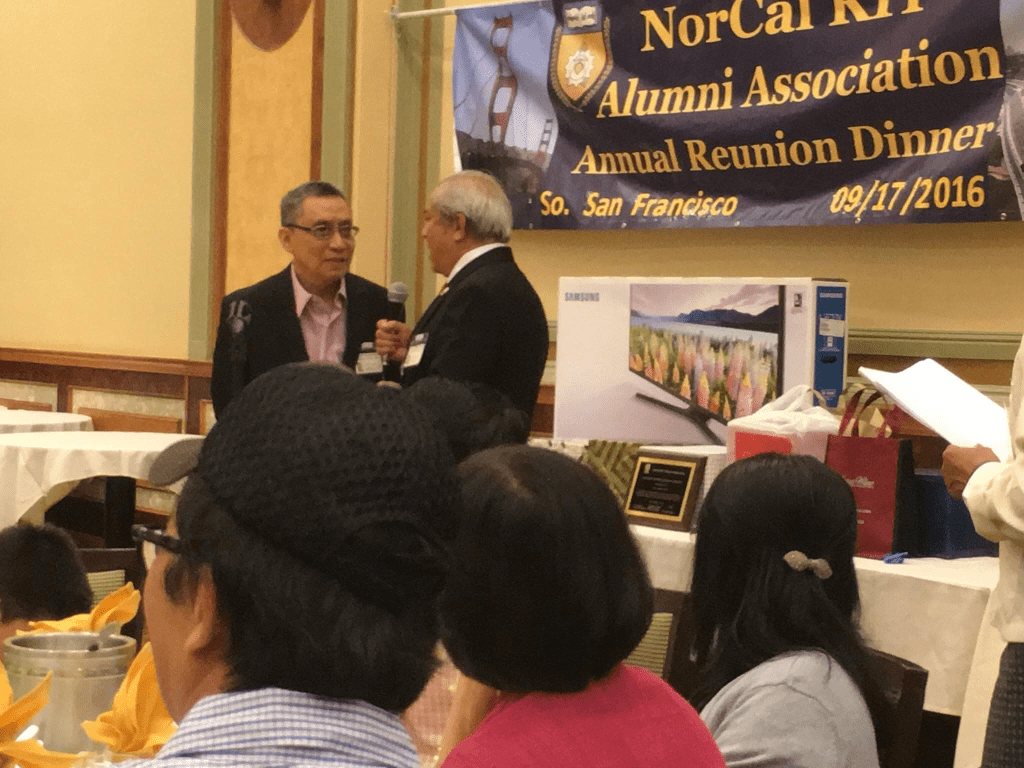
Saya U Myat Htoo (Chair, BOD, Norcal RITAA) presented the award to U Hla Min (EC69) at the Annual Dinner
Alumni Appreciation AwardAward presented by U Myat Htoo
U Han Sein / A Pho Gyi (GBNF)
Represented RIT in Swimming, Water Polo, Diving and Basketball
Became a Tone Kyaw when he was inadvertently listed as GBNF in the 69er Contact List (in 1999).
He was sentenced to 20 years by a kangaroo court (along with Dr. Aung Khin Sint and Ma Thidar – Sanchaung). He was released after 17 years.
He was a Thet Kyee of Latha Township.
He took photos at the 69er gatherings and distributed them to selected attendees.
He succumbed to Covid
U Han Sein (GBNF), U Ngwe Tun, Roland (U Khin Maung Win), U Sein Myint (K K Wong), Cyril (U Than Hla), Oscar (U Tin Aung Win) at 69er Breakfast Gathering
U Ngwe Tun / Tun Tun
Every month, he offers Garawa money to Ashin Ukkamsa (Victor Aung Chaw) and Ashin Pannagavesaka (Bobby Myo Tun) in memory of his beloved spouse.
He offered to host the 69er breakfast gathering for Sept 2022, but the gathering did not take place. Apology was offered by U Aung Min and team.
U Khin Maung Win / Roland Thein
He was known for his debating skills.
He also competed in Scrabble tournaments.
U Sein Myint / K K Wong
He represented RIT in Swimming, Water Polo and Rowing.
He is a major Donor for 69er HCF and EE69er HCF.
He spends time in Singapore, California and Myanmar.
U Than Hla / Cyril Ba Than
Son of U Ba Than
Also known as Cyril or Cyril Than Hla
He took Training / Studies abroad.
U Tin Aung Win / Oscar Than Nyunt
He is a Moderator of RIT Updates FB group.
He uses Zoom to keep in touch with selected 69ers and HIC Colleagues.
He gave me rides to attend 69er gatherings.
U Tin Htut / Harry / Mon Yu
Hobbies (old and new)
Writing (Hmu Tin encouraged him)
Music
Tai Chi
Very Senior 69er
Harry Tin Htut
Albert Kyaw Min
Founder & President, Myanmar Pulp & Paper
Current President (AFPPI) Meeting (of 8 countries) in Thailand
Guitarist & Vocalist along with Daniel Tint Lwin (Singapore) & Robert Win Boh (Australia)
Seated : Nay Win (GBNF), Win Boh (Robert), Yi Yi Khaing (Vilma), Minn Aung (Hla Thaung) Standing: Win Naing (Dicky), Tint Lwin (Daniel), Aung Myint, Kyaw Min (Ei Kun)
Notes
U Chit Po Po’s father is U Ba Than (co-founder of Burma Chamber of Commerce). U Chit Po Po (GBNF) represented RIT in Rowing. He is an expert Harpist.
Many 69ers have less or no time for their hobbies. e.g U Tin Maung Aye (Accordion)
119 members (about a third of the Class) are GBNF. 20+ passed away (within the past two years; mostly due to Covid)
Architecture was introduced for the very first time in 1954 at BOC, University of Rangoon. U Myo Myint Sein belongs to this first batch. One of his classmates, Ko Myint Thein retired as Chief Architect of Public Works Department in Yangon. We were the “third batch” and were fortunate to study at the brand new “Faculty of Engineering” campus, commonly known as “Leik-khone” at Pyay [Prome] Road. There were nine of us in the first year, (1956). One of them was Shajahan, an Indian lady who became the first female to join the male dominated Engineering campus. However, she was unfortunate to be the victim of the “2F” system of our days. She left for India and later graduated as an Architect from there.
In our second year, three guys from the second batch joined us. One from the first batch joined us in the final year. Two of the old-timers became the victims of the “2F” system.
One very unique and interesting aspect of being an architecture student is doing design work. We were trained to solve design problems within a stipulated time and because of that we use to spend most of our time in our studio class. Eventually, the studio became our second home. We practically eat and sleep there and we spent our break times in the studio as well.
Only when attending related Engineering subjects, we join together with other Engineering students. Otherwise, we normally confined ourselves within the Department of Architecture block and among our own group. Thus, the reason that most of the Engineering students came to know us because we were like “caged animals” in the zoo; being watched by people from outside and in our case by our friends as they walked along the corridors. Although the majority of us were day students, we were better off than those staying in the hostels as we didn’t have to pay extra to live in the studios. It was fun spending our time in the studios and as we were able to come up with fantastic ideas and designs and draw them as and whenever desired and complete the project within the stipulated time. For us, we didn’t had “days” and “nights”. The nights were more peaceful and productive for us. Only the studios in the architecture block were lit up at night. Sometimes, we even walk over to Hledan, Kamayut to have our break and supper.
When architecture was introduced at BOC in 1954, there were one British and two Indian architects as full time staff assisted by their Myanmar counterparts. They were still teaching us during our first year. Roger Johnson, also a British architect became head of Department when we got to the second year. He was assisted by Nagler, an American architect and Saya U Kyaw Min (GBNF) and Saya U Win Htain in the later years. Sayagyi U Tha Tun (GBNF), Saya U Maung Maung, Saya U Aung Myint, Saya U Khin Mg Thint and Saya U San Tun Aung were part time staff. All the architectural subjects and the studio design work were taught by them except the freehand drawing class which was taught by an artist. We were fortunate that there were no changes in the staff and they all taught us till we graduated in 1960.
Apart from the architectural staff, our years at the University will not be complete without mentioning some of our Engineering Faculty staff who taught us some of the related Engineering subjects.
The first person I wish to mention is Sayagyi Num Kock. He taught us structure and we sometimes didn’t attend his class due to our studio design assignments. Since the class was meant only for architectural students, and since he knew where to find us, he used to come straight to our studio and requested us to come and attend his class. He was very good natured, humble, and led a simple life carrying a shan bag instead of a leather brief case. We always saw him with a smiling face and was very soft spoken.
Another Saya I remembered well was Saya U Kyit In (later known as U Min Wun). He taught us survey and he was just back from the United States at that time. Whenever I had problem with the survey readings, he came over and nudged me out and checked the readings himself. He used to wear khaki long pants with a single buckle at the rear, which was the fashion of those days.
Then I remember my Strength of Materials saya, Saya U Ba Than, who happens to be my brother. He was very strict and didn’t give any special favors even to his own brother. He was famous in setting questions for the exam as he never repeated the same ones that were given and worked out in the class.
The list won’t be complete without mentioning Saya U Kyaw Tun(GBNF) who taught us Electro Technology. Since his classes were immediately after the lunch break, we had a hard time to overcome sleepiness and be attentive to his lectures.
Last, but not least, I wish to mention about Saya Solomon and Saya Wein Choung. Their metal and wood work classes were always enjoyable and plenty of fun. We were in a totally different environment, not like those of lecture theaters or studio rooms. It was in these classes that we learnt the practical aspect of transforming design drawings into finished products.
My wonderful six years at the Rangoon University will not be complete without mentioning about my rowing activities. Since I came from a rowing family starting from my uncle Chan Cheng Hock who was Captain (1940-41) and the present oldest surviving Captain, I also became Captain (1959-60) after my two brothers U Tin U (ex-faculty member of BOC) and Dr. Myo Tint. I earned my “Gold” in 1956 by competing in the Inter-varsity regatta at Calcutta. I had the opportunity to represent RUBC seven times in regattas abroad and several times in Yangon.
Although we started with nine students in the first year in 1956, ten of us graduated in 1960 due to the circumstances explained earlier. Philip Koon Ying Chu, who is now retired after being a very successful restaurant businessman in the Bay area, stood first. It was not the first time for him to have this academic achievement as he got first in the matriculation (in the whole of Burma) and was able to maintain the same position for the Intermediate of Science as well. Out of these ten graduates, six are now residing in the States. Among these six, Tan Teong Kiat (aka) Wai Lwin is the most successful professionally. He is doing consultancy work specializing in conceptual design. S. Hsiang Wu, Victor Pe Win and Jack Min continue to practice architecture in the private sector. Aung Kyee Myint became the Chief Architect of Public Works Department in Yangon and is now serving as an Advisor after his retirement. Khin Maung Yin excels in design and eventually became a well known artist in Myanmar. Later, he spent most of his time giving tuition to children. H. Hla Myint was unfortunate not to live long and passed away a few years ago.
As for me, I had to be contented with being a Managing Partner of Architects Incorporated after graduating and running my own business. It was challenging, exciting and rewarding compared to being in the Government service. However, in 1962, we had to close down our business. I joined the Industrial Development Corporation (IDC) to open a new architectural division with my two partners Aung Kyee Myint and Bo Gyi in 1964. IDC, together with Housing Board and other Civil Engineering organizations were amalgamated to form Public Works Corporation. While working with Public Works, I had the opportunity to design Thiripyitsayar Hotel in Pagan (Bagan). Now, it is the only hotel complex left within the archaeological zone of Pagan and I am proud to be associated with it. I left Myanmar in 1980 and worked as Sr. Architect with one of the well known architectural firms in Singapore. I had a wonderful and memorable time for over ten years designing multi-story hotels, aerospace exhibition pavilions, commercial complexes, restoration projects and luxurious bungalows. In the beginning I had to work very hard to get acquainted with building codes, bye-laws and local regulations as we never had such standards and regulations to abide by at home. It was wonderful to discharge the duties of an architect properly as “Prime Consultant”. It was like a “Commander-in-Chief”, coordinating with other Engineering disciplines and the related fields like interior decorators and landscape architects, chairing site meetings etc.
Now that I have settled down in Los Angeles and working for Design Division of L.A. County Dept. of Public works, I am devoting most of my time more in assisting those who are deeply involved in the propagation and perpetuation of Buddha Sasana.
In conclusion, I wish to pay my tribute to all my Sayas and wish to thank them for educating and equipping us with proper tools in order to be able to face any type of situation in this world. And to my classmates, I salute all of you for your lifetime achievements and hope that this article will throw some light about our wonderful days at “Leik-khone”.
Benny Tan (Yu Beng, M70) is a founding member of RIT Alumni International, which hosted the First RIT Grand Reunion and Saya Pu Zaw Pwe (SPZP-2000) in October 2000.
He hosted meetings of the San Francisco Bay Area Alumni including the one that led to the formation of RIT Alumni International.
He wore multiple hats for SPZP-2000
Golden Sponsor
Co-chair of the Working Committee
Designer of SPZP Banner, commemorative Mug, Calculator / Clock, and T-shirt
Along with Steeve Kay (Thaung Sein, EC70), he is a Multiple Golden Sponsor for SPZPs and for his class gatherings.
He wrote “Traveling through the Time Machine” for RIT Alumni Newsletter
Also a major donor for the “YTU Modernization Project”. Donated K150 Lakhs.
Sponsored several tables for the 69er gatherings e.g. welcoming Daw Nyunt Nyunt Wai (Millie, T69, Germany) at Western Park Royal, and the Annual Dinner at M3.
Ivan
Ivan Lee (Khin Maung Oo, M69)
Major donor of the 69er HCF (Health Care Fund)
Golden Sponsor of SPZP-2000 and SPZP-2007
Hosted RIT-UCC Gatherings (with Saya Dr. Aung Gyi and Saya U Soe Paing as Honored Guests) in his New Jersey home.
Co-founded MASTAA. Served as CEO
Organized two Trips to visit Canada and pay respect to Saya U Aung Khin in Windsor and Saya Dr. Aung Gyi in Napean.
Sein Myint (K K Wong, EP69)
Sein Myint (Leftmost)
Major donor of the 69er HCF (Health Care Fund)
Also Major Donor of EE69er HCF (Health Care Fund)
Represented RIT in Rowing, Swimming and Water Polo
U Tin Win (Min69)
Donated for a couple of 69er Gatherings
e.g. at Lunch Gathering at Crystal Jade (around a SPZP)
Miscellaneous
There are many donors — large and small.
Some donate at the 69er Gatherings e.g. Monthly Breakfast Gathering at Taw Win Hnin Si
Mandalay Gazette was founded by U Maung Maung Kyi who had three careers as a Swimmer, a Medical Doctor in Burma and a Journalist & Organizer in Southern California.
It featured Interviews with selected Burman (Myanmar).
InterviewInterview 1 of 6Interview 2 of 6Interview 3 of 6Interview 4 of 6Interview 5 of 6Interview 6 of 6
For SPZP-2016, free breakfast, lunch and dinner were provided to registered attendees.
It was partly due to the cetana of the food donors.
Buffet Ticket
Stage and Equipment
There were two stages nicknamed as
Lugyi Sin (for formal performances)
Khalay Sin (for informal performances).
They were made possible by the sponsors and donors.
Heroes for SPZP-2016
Event Committee
Entertainment Committee
Food Committee
Providers for Transportation
Providers of the Sound Systems
Providers of the Lightning System
Special thanks
Thanks go to Saya Dr. Aye Myint (former Rector of YTU) and Saya Dr. Myint Thein (current Rector of YTU) for the activities held at our beloved alma mater.
Several sayas wondered what happened to the Swel Daw Bins, which provided Swel Daw Yeik to the engineering students. How did they perish?
Saya U Moe Aung (Tekkatho Moe War) was sad to see the demise of Swel Daw Bins, but he is convinced that virtual Swel Daw Yeik lie deep in the heart of the engineering sayas and students and will live on forever.
Ko Saw Linn (C71, GBNF) had a kidney transplant, and had been to ICU at least thrice.
Saya U Moe Aung & U Saw Lin
Ko Wynn Htain Oo (M72) has a hip replacement surgery several years ago.
WHO 1WHO 2
Ko Myint Pe (M72) had a Stage-3 cancer.
Myint Pe 1
I met them on RIT Alumni Facebook Pages before I met them face to face at the SPZP-2012 Main Organizing Committee meetings.
Their health problems did not prevent them from working feverishly to repay their metta and cetana to their mentors, and to ensure that their former classmates and school mates will have wonderful reunions and flash backs to the good old days.
Cartoonists & Supporter
The three alumni are living proof that Swel Daw Yeik (RIT) Spirit is alive and well.












 HlaMin