Category: Anniversaries

  • RIT Days (Intro)

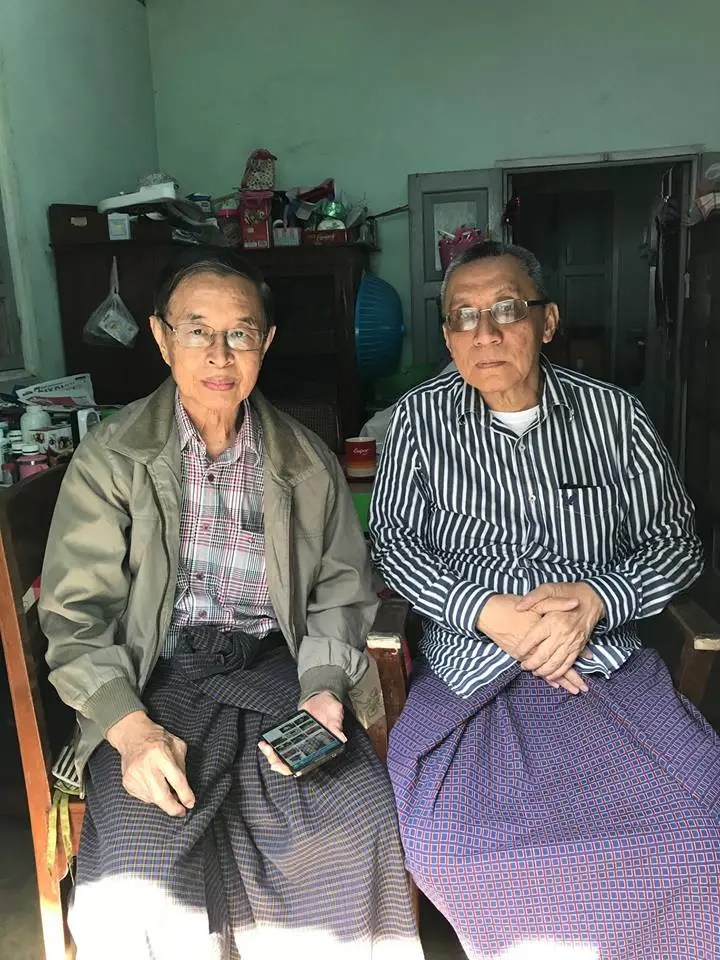
    by U Zaw Min (EP70) and U Ohn Khine (M70)
    Edited by U Hla Min
    (EC69)

    Note : Ko and U, Ma and Daw are used in the articles. The prefixes may sometimes be omitted.

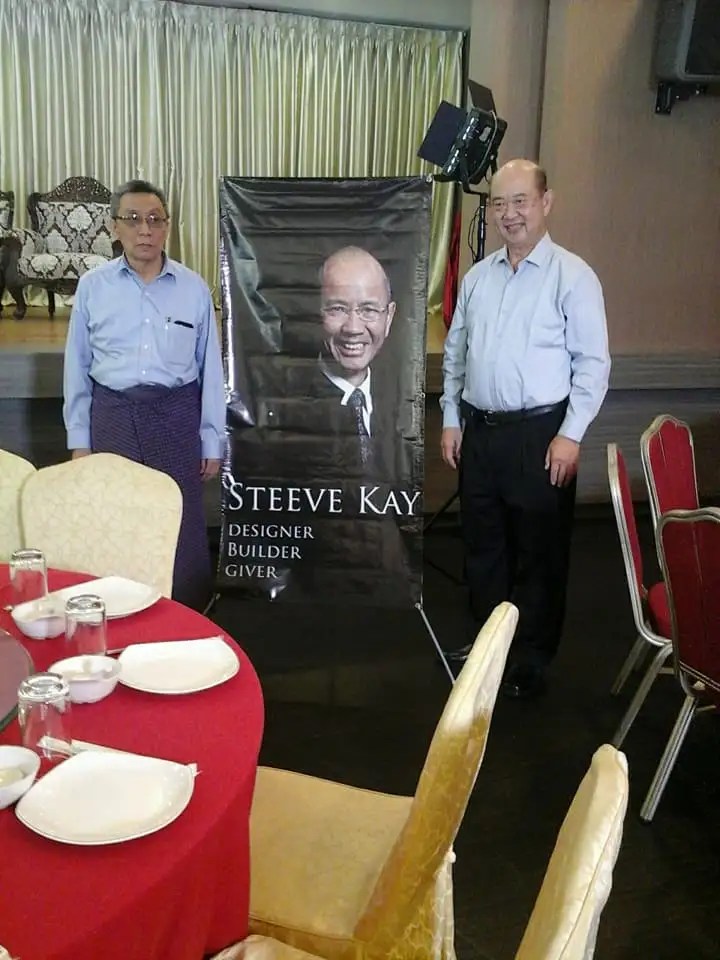
    Hla Min (EC69) and Benny (M70) beside picture of Steeve (EC70)

    Introduction

    Authors

    • U Zaw Min (EP70) matriculated from St, Albert’s High School, Maymyo in 1964.
    • Had a very high ILA (Intelligence Level Aggregate) and was admitted to the first ever 1st BE as Roll Number One.
    • Selected RIT Luyechun for the 1965 Summer Camp at Inlay.
      His outspoken remarks about the Camp drew the ire of higher authorities.
    • Graduated with EP (Electrical Power) in 1970.
    • After working in the industry, he moved to the USA.
    • Studied Electronics in the USA
    • Added “Nawaday” to his name.
    • Several years ago, he shared his memories of RIT to the Google group of “the Combined Intake of 1st BE for 1964 and 1965”.
    • U Ohn Khine (M70) matriculated from St. Peter’s High School, Mandalay in 1964.
    • Took a combination of Science and Arts subjects and had good ILA score to be admitted to RIT.
    • Graduated with Mechanical Engineering in 1970
    • Worked for HI (Heavy Industries).
    • Created and maintained the the Google group of “the Combined Intake of 1st BE for 1964 and 1965”.
    • Volunteered for SPZP-2012 and SPZP-2016, HMEE-2012 and HMEE-2018, Swel Daw Yeik Foundation and several RIT-related activities.
    • Gave me rides during my visits to Yangon.
    • Filled the “missing pieces” in U Zaw Min’s accounts.

    Editor

    • U Hla Min matriculated from St. Paul’s High School.
      Received Collegiate Scholarship for standing 7th in the whole of Burma.
    • Finished top in the Science Option of I.Sc.(A) examination
    • Admitted to the first ever 2nd BE in November 1964 as Roll Number One.
    • Selected Luyechun for the Inlay Khaung Daing Camp.
    • Graduated with Electrical Communications in 1969.
    • Started the “RIT Alumni International Newsletter” in 1989 and have maintained it for 22 years.
    • Administrator or Moderator of selected Facebook pages.
    • Personal website : hlamin.com
    • Edited the draft versions “Memories by Ko Zaw Min Nawaday (EP70) and Ko Ohn Khine (M70)”, which was first posted as Google Docs for the Combined 1st BE Intake of 64 and 65.
    • Published the edited document as a series of articles in “RIT Alumni International Newsletter and Updates”.

    Three Intakes in 1964

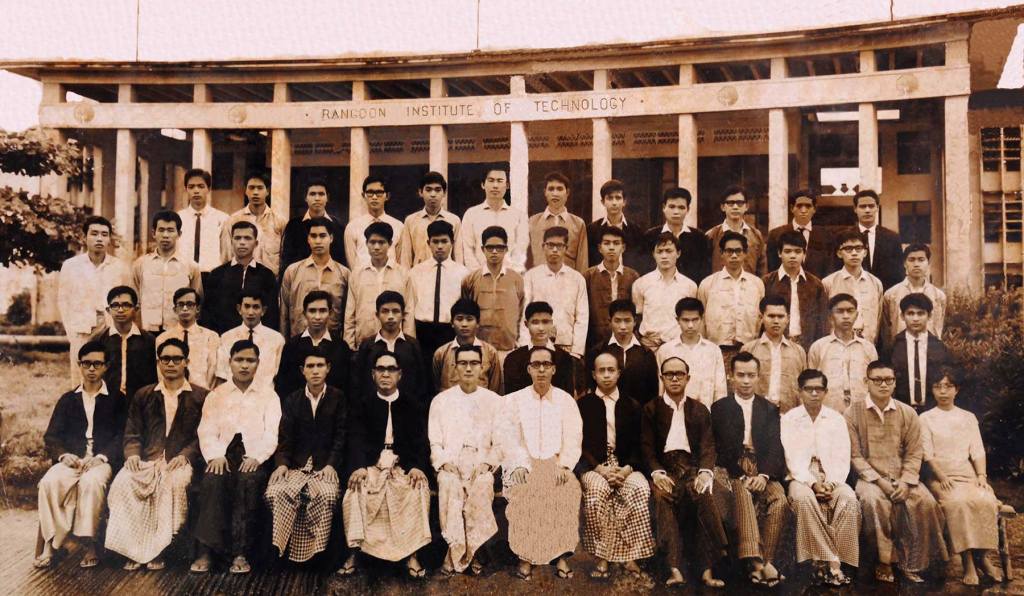
    There were three intakes at the Rangoon Institute of Technology (RIT) when the new education system started in 1964. Eligible students were admitted to the first ever 1st BE, 2nd BE and 3rd BE classes. They are also known as

    • Class of 70 (1st BE Intake in 1964)
      Matriculates were admitted using the ILA
    • Class of 69 (2nd BE Intake in 1964)
      Those who had passed I.Sc.(A) with Science Option were admitted in order of merit
    • Class of 68 (3rd BE Intake in 1964)
      Those who had passed I.Sc.(B) with Science Option were admitted in order of merit

    The RIT Rector was U Yone Mo and the Registrar was U Soe Thein.

    Class of 70

    The Class of ‘70 comprised of the first year intake students in 1964. There were 494 registered students, of which 67 were female. Most graduated in 1970. Some took sabbatical for a year or two. A few left RIT before graduation.

    The GBNF (Gone But Not Forgotten) reached 111 in September 2021.

    The matriculates entered the first ever 1st BE classes. The controversial ILA (Intelligence Level Aggregate) was used for the vetting of applicants. In the system, a score of 1 to 10 was assigned to “map” the marks for each subject. The ILA score (rather than the”raw” marks) was used to determine the eligibility of the students admitted to an institute.

    Under the old education system, the matriculates had to attend I.Sc. (A) classes. There were restrictions on the subjects taken at Inter classes to be eligible for Faculty of Engineering, Faculty of Medicine, etc. For example, one must pass the I.Sc. with at least 50 marks in Mathematics, Physics and Chemistry to attend the 1st Year Engineering Classes (3rd BE in the new system).

    Under the new education system, there were no restrictions on the subjects taken in Matriculation exam. As such, many students who passed Matriculation with combined Science and Arts subjects and even those with pure Arts subjects were able to attend RIT. For example, Ko Ohn Khine passed the Matriculation examination with an odd combination of Mathematics, Chemistry and Geography.

    First BE (1964 – 65)

    The first year students were divided into four sections : A, B, C and D. The majority of students of Sections A and B had passed matriculation with pure science subjects. Most of the students of Sections C & D had passed with either Science and Arts Combination or pure Arts. There were some late joiners to RIT.

    Male students from districts and states were boarded in hostels, in the ground floor rooms of B, D and E Blocks and “Inlay Hall” in Thamaing.

    A building named “G Hall” was assigned to board female students from districts and states. Local female students who applied were also allowed to board in G Hall.

    Engineering was not considered appropriate livelihood for women hence there were only a few female students studying Engineering before our 1964 intakes. With the new system, there was an influx of girls. It was quite a pleasant feast to the seniors who were not used to seeing those many female students. So when our ‘64 intake started attending classes, it was a thrill for the senior students to watch a great number of female students strolling in the corridors, coming in and out of class rooms,in canteen, in the food shops, in the library and everywhere on the campus grounds. We were also thrilled to get in company with a lot of female classmates. (It was exciting for me to have female classmates as I [Ohn Khine] was sent to all boys school, St. Peter’s High School in Mandalay since Kindergarten till I matriculated in 1964.) It is fair to note that the girls were somewhat intimidated and somewhat amused by the loud remarks of a few rowdy students or even feeling stared at while having to move from one classroom to another. Girls spent time during breaks in an area of a corridor surrounded by shaded blinds which was known as LCR (Ladies’ Common Room) where the day students usually ate home-brought snacks and rest. Ladies residing at G Hall would have lunch at the canteen and were able to rest in their rooms. The first LCR was a little room on the third floor before a section of the corridor on the third floor was made as the LCR before the start of our 2nd year at RIT. When the bell rang for the next class, it was customary to peek through the blinds to check whether the boys had gone inside the theatre for the timid girls to come out of the LCR.

    Outstanding athletes from our class

    The list was compiled by Ko Ohn Khine.
    Comments were provided by Ko Zaw Min Nawaday.
    Organization / presentation (with corrections) was done by Ko Hla Min

    Badminton

    • Tommy Shwe
    • Kyi Kyi Sein

    Basketball

    • Tin Aung (E)
    • Tin Aye (M)
    • Kevin Law
    • Soe Aung (Auto)

    Body Building / Weightlifting

    • Than Htike (M)

    Boxing

    • Maung Maung Thaw (E)

    Chinlon

    • Soe Tint (C)
    • Mya Daung (M) GBNF

    Football / Soccer

    • Sai Thein Maung (C)
    • Khin Maung Lay (Mutu, M)
    • Win Zaw (A)
    • Myint Sein (Ja Pu Sein, GBNF)
    • Kenneth (Khin Maung Shwe, GBNF)
    • Htun Myint (M)
    • Hla Kyi
    • Sai Aung San (Met)

    Judo / Aikido

    • Sein Myo (C)
    • Kyaw Soe Win
    • Soe Aung (Auto)
    • Thaung Lwin (M)
    • Soe Myint (Agri)
    • Sai Loke Khan (Mn)

    Rowing

    • Htein Win (M)
    • Aung Lwin (Jasper Wu) (C)

    Swimming / Water Polo

    • Peter Pe GNBF
    • Htein Win (M)
    • Win Aung (M)
    • Mg Mg Swe (M)
    • Tin Tin Myint (Ch)

    Tennis

    • Aung Kyaw Soe (James Than) (Ep)
    • Khin Mg Shwe (Ep)
    • Wai Lwin (Agri)
    • Rosie Tin Maung (Ch)

    Track and Field

    • Sai Thein Maung (C)
    • Shein Kee Gae (GBNF)
    • Saw Mg Mg Htwe
    • Oo Myint (Mn)
    • Win Naing
    • Lei Lei Chit (Ch)
    • Nan Kham Ing (A)
    • Maung Maung Thaw (E)

    UTC Marksman

    • Tan Yu Beng (Benny) (M) Let Pyaunk Tat Thar, twice, both UTC 1st & 2nd yr.

    Volleyball

    • Kyaw Sein (M)
    • Salai Myo Myint (C)

    Additional Information by Ko Zaw Min Nawaday

    Sai Thein Maung (C), was a great RIT goalkeeper for 6 years. He also won gold medals in 100 meters and Hop Step and Jump in the Inter Institute track and field competition almost every year.

    Tin Tin Myint (Emma) (Ch) bravely competed in the inter-institute swimming meet. I believe she also practiced throwing the Javelin and played volleyball.

    Khin Mg Shwe (Ep), won the”Novice” tennis competition at RIT. He represented RIT in the 2nd year and we cheered him as he played a nationally known played from RASU (at the courts across from the Universities football field) during our 2nd yr at RIT.

    My good friend Tan Yu Beng (Benny, M) took the best marksman trophy at both 1st and 2nd yr UTC camps. He competed against not only RIT but UTC students from RASU, Institute of Medicine, and Institute of Economics.

    Hla Kyi (nickname Sut Kaw) played center right back for RIT selected football team. Most RIT students that watched the game between RIT and Loke Thar during our first year will remember the flying kick he took at the head of the left winger of Loke Thar when Ko Myint Sein (M) GBNF and that left winger got into a fracas. The Universities team coach Saya Nyein, who was the referee for this game, promptly told Ko Hla Kyi to leave the field.

    There were also unsung heroes (e.g. The RIT B football team). I did not know about them until the third year, when Sai Aung San, my room mate for that year, told me about it. He was the goalkeeper, Yan Shin played in the back line and Kyaw Min Aung was the reserve goalkeeper.

    Ah Nu Pyinnya Shins from our class

    • Myint Swe Win (M) Mandolin virtuoso, vocalist. Participated in every concert.and pwe
    • Mo Mo Yi (E) Announcer
    • Tin Tin Myint (Emma Myint) (Ch) Myanmar Dance
    • Tin Myint Oo (Rosie Tin Maung) (Ch) acted as “Tha Gyar Min” in the musical performance of the song “Sanda Kein Da Yi”. Vocalist and instrument (Don Minn) by Ko Yu Swan (M 68).
    • George Ko Ko Gyi (Ch) played the part of Ten Headed Ogre (Dat Tha Gi Ri) in the short opera of Chasing the Deer (Rammayana play)
    • Ko Win (Milton Win Pe) (M) Myanmar Drum (Chauk Lone Putt)
    • Than Myint (M) Vocalist & All-round instrument player
    • Soe Aung (Auto) Clarinet
    • Tin Win (Tex) Burmese Harp (Don Minn)
    • Aung Myint (a) “Thaman Kyar” Ko Myint (Mn) co-starred in the movie “Thaman Kyar”
    • Than Win (Tex) wrote the script of “Thaman Kyar”.

    Universities’ Training Corps (UTC)

    • Some of us entered the UTC.
    • We had two camps the first year we were at RIT :
    • Summer camp at KyeDaw, Toungoo
    • October camp at Meikthila.

    First UTC Camp

    At the Toungoo camp, our platoon was the only RIT platoon stationed with RASU students. So we were 30 or so RIT students among 500 plus RASU students at the 10th Buregt. The main body of RIT students were at a little school. They were the lucky ones. They had the instructors from UTC in charge while we at the 10th Buregt. were assigned a grouchy sadistic corporal from the regular infantry to drive us. He has a mustache so we nicknamed him “Nga Khu”. Ko Win Htut (C), Ko Khin Mg Lay (M), Ahmed Soorma (Ch), Ko Kyaw Min Aung, John Krasu, Ko Htwe Myint (C), Ko Htain Win (M, Chauk Pe) were among those in this platoon.

    It was here that Ko Htwe Myint got his nickname “Bo Hmu” because of the military bags he had on him.

    We slept on a long bamboo platform, next to each other. We had to stand guard duty at night, one hour each and sign off on the duty sheet. If our duty hour fell on 8pm-9pm, it was great. If it were from 1pm to 2pm, it was the graveyard hour. One time, my duty was from 1pm to 2pm, Ko Khin Mg Lay (M), who slept next to me was from 12-1pm. He tried to wake me up to give the duty sheet but I refused to get up since I was so sleepy. He finally said “Min Tar Wun You Mea So Yin Ngar Ate Pi”. I finally got up and took over the duty sheet. Standing guard duty during graveyard hours had its benefits. I saw the Big Dipper, Khun Na Sin Kyea, turn and point its tail upwards. (Khun Na Sin Kyea Pyong ah mee thoung, than goun chain tho youk.)

    We had to get up at 5pm and run PT, guzzle a cup of tea and swallow down bein moun at 6.30am. At 7am, we were on the parade ground doing marching drills. One time, our sadistic corporal made us run for 45 minutes with our rifles in our hands because he was unhappy with our performance. That event also brought out the best in the RASU students. When the whistle blew for a 10 minute break, in a rare display of camaraderie, some RASU students came over with water for us to drink.

    Lunch was a little meat dish and great Pe Hin.

    In the afternoons, we had to go to a Phone Gyi Kyaung about half a mile away so that we can sit in the shade while we were taught small arms. We were not allowed to use the water in the well at the Kyaung, so four persons from each platoon had to take 2 Ye Oes full of water. Although it meant carrying the heavy Ye Oe, in addition to my rifle, I always volunteered for that duty since we got to leave about 20 minutes earlier for the Phone Gyi Kyaung. That way, we got to rest and enjoy the tranquility of the Kyaung Win before the rest of the students arrived and the lessons started. I remember laying under the trees while waiting for the rest to come over, looking at the Toddy (Htan) trees and wondering if King Tabinshwethi had one time spent his days near this place drinking Htan Ye .

    I remember the incident about Ko Win Htut being punished harshly one time. I don’t remember exactly what it was about. We all know that Ko Win Htut liked to have fun and his happy go lucky come attitude got him into trouble with our party pooper instructor Nga Khu. He was ordered to jump from a squatting position while having his rifle held above his head until he fell exhausted. After 3 weeks, training was ending and we decided to give the Corporal a longyi as present and all of us Ka Daw to him. For the first time, tears rolled down this tough Corporal’s cheeks.

    The next day was the graduation parade. It was a proud moment for all RIT students when Tan Yu Beng (Benny) (M), stepped up to receive the award for Let Pyaunt Tat Thar, standing first in marksmanship among 800 UTC students from all Institutes and RASU.

    Second UTC Camp

    To attend the second UTC camp, we left for Meikthila on the 3rd week of September. The train travel ed at night, but we had trouble sleeping on the train. We were sent to the 3rd BATD. Beautiful barracks with wood flooring. But horror of horrors. Hundreds of bed bugs came out from between the wooden planks. That night, there was no way I could sleep with the bugs biting me. so, even though there was a slight drizzle of rain falling, I decided to sleep on the ground outside. Since I did not get any sleep the night before, I slept through the morning PT before waking up. Ko Khin Mg Lay told me that the instructor came to kick me while I was sleeping in the morning, but I just kept on sleeping. The instructor was overheard saying something like “Mway Pauk Tay Mae” before walking away. My official place in the barracks was next to Ko Sein Win (EC). Ko Sein Win was very neat and had the best prepped bed for daily inspection. Next to him, mine looked like crap. Points were given daily for how good you had prepared your bed. Ko Sein Win always got the best comments and mine was in the pits. Actually I did not sleep a single night in my bed place. I used my blanket as a cot by tying it to two posts out in the veranda and slept there.

    Life at Meikthila camp was more pleasant than Toungoo camp. For one thing, all of us RIT 1st year students were in one company. We had our share of funny incidents. One day, the RSM of UTC chided all of us for soiling the side of the toilet holes in the outhouses. His words were, “Nya Kya Ah Pauk Te Te Ko Min Doe Win Aung Htet Naing Dae. De Louk Ah Pauk Gyi Kya Win Aung Ma Par Naing Bu.”

    As it happened, that evening, the RSM was kicking the ball to the goal and it went wide. Bohmu Htwe Myint shouted “De Louk Gyi Dae Ah Pouk Win Aung Ma Kan Naing Bu Lar?” The RSM walked away with his head bowed.

    Sometimes, we drove the instructors hopping mad. One time the instructor told us “Ngar So Dar Lite So”. In one voice, we all shouted “Ngar So Dar Lite So”.

    After two weeks, we were told to give our kit bags to be taken by truck to Taung Pulu, while we would have to march 18 miles to that place the next day. Without a kit bag, no blanket to make my cot, I spent the night just walking around in the veranda since it was raining outside and there was no way I could sleep inside with the bed bugs. The next day we marched to Taung Pulu, carrying our rifles. It was tough for me since I did not sleep a wink the night before. The sun was beating down on us the whole day. Where was the rain when we needed it? Worse was the rocky road made of Gawoon rocks. It made the nails in my boots hurt my feet. I must have pulled out over half a dozen nails from each boot.

    We finally made it to Taung Pulu in the evening. We were given rice to cook for ourselves and were assigned 4 persons to a tent. That night, there was a tremendous storm. Water gushed into the tents. The next day, someone told me that everyone was sitting in their tents except me. He said I was asleep with my head in the mud. I did remember waking up during the storm, looking up at my tent mates who were sitting, and going back to sleep.The next day, we were told to move into a Zayat on a hill. It was so crowded in the Zayat, I refused to sleep there. Instead, I went up the Phaya Yin Pyin and slept alone on the brickwork with a blanket tucked around my body to prevent the winds from blowing it away.

    Time came for graduation and our Tan Yu Beng (Benny, M) again got the Let Pyaunk Tat Tar award.

    Ko Win Htut, I and others that I don’t remember, took a bus to Mandalay from Meikthila. We arrived in Mandalay, near 33rd and Zeygyo (84th) around 6 pm. Ko Win Htut was home since his house was around the corner. For myself and a couple of others, we just kept on walking towards the direction of the clock tower, hoping we would run into something. It was seeming more and more likely we might have to sleep on someone else’S doorstep.

    Then, we saw a jeep come down 84th street and stop. It was a MMTA taxi with Saw Mg Mg Htwe sitting in the front seat! (MMTA stood for Maymyo-Mandalay Taxi Association).

    He told us that he figured there might still be some UTC students that wanted to go to Maymyo coming this way and had asked the taxi driver to drive along 84th street before turning towards “A” road to take the car out of Mandalay to the Maymyo road.

  • HMEE-2012 Section 2 (4)

    History of Myanmar Engineering Education
    by U Ohn Khine (M 70)

    Implementation to improve Engineering Education

    To improve the university education as a whole, including engineering, the government laid down plans for the enhancement of engineering education. The Burmese government approached Technical Co-operation Administration (TCA) of the United States of America (USA) in the 50’s to get aid for the development of engineering education.

    At the same time, efforts were made to offer more engineering disciplines at the faculty, to have more local qualified teachers, to have more buildings to accommodate the increasing number of students, and to get up to date and complete machinery and equipment for the test laboratories. Most of the teaching staff at that time were British and contract lecturers from India.

    After Burma gained independence, Professor Davies who was Dean and other foreign teaching staffs left the Faculty in 1950. U Ba Hli, Principal of Insein Government Technical Institute (GTI), was appointed as the first local Dean of the Faculty. U Ba Hli, a far-sighted educator, did a lot to develop the engineering education during his tenure as Dean from 1950 to 1958.

    The program to increase the teaching staff at the Faculty of Engineering started in 1952. Under the twinning program with TCA, two visiting professors from Massachusetts Institute of Technology (MIT) arrived in 1952. They were later followed by others. At the same time, to have more qualified local teaching staff, outstanding students from the 2nd year engineering class were selected and sent to MIT, Lehigh University, etc., for further studies to attain Masters degrees. Those selected were to be appointed as assistant lecturers when they came back.

    Furthermore those who graduated from the Faculty with flying colors were also appointed as teachers. There were instances of appointing some locals who had graduated from foreign universities.

    Requirement of teaching staff at the Faculty during 1952 to 1959 was fulfilled by the visiting professors and lecturers from UK and USA under TCA program and by hiring Indian nationals from India on contract basis as teaching staff.

    Nurturing of Local Teaching Staff with Post-graduate Degrees

    When the Rangoon University Engineering Department opened, there were very few teaching staff and the department had to be run with British and Indian teachers. This situation continued up till the Second World War, when the department had to close down.

    When the department reopened after the war in 1947, the situation at first was the same as in pre-war era. After the Independence, teaching staff from UK and India, including Dean Prof. D. Pindri Davies went back in 1950.

    U Ba Hli, Principal of Insein GTI, became Dean of the Faculty of Engineering in 1950. As he was a far–sighted person, he laid down plans to improve the quality of engineering education. One of the plans was a twinning program under TCA to get more teaching staff. He contacted UK universities and MIT to get help for the recruitment of qualified teaching staff. At the same time, some outstanding students were sent abroad for further studies with the aim of appointing them as teaching staff upon their return. Dean U Ba Hli jointly acted as Professor of Civil Engineering and taught Sanitary Engineering.

    Sayagyi U Ba Hli played a major part in the offering of more engineering disciplines besides the existing civil, electrical and mechanical engineering. From the 1953-54 academic year, Mining, Chemical, Metallurgy and Textile engineering courses could be offered. Architecture was offered later. Sending student scholars to UK and USA was also a part of U Ba Hli’s plans to recruit qualified teaching staff. We had to acknowledge and record these efforts of our Sayagyi to develop and improve the engineering education system in Burma.

    According to the photo in the 1951-52 academic year RUESU Annual Magazine, there were about 200 students from 1st to 4th year. There were 63, 55, 44 and 34 students in the 1st, 2nd, 3rd and 4th year respectively. Number of teaching staff including Dean was 11. (Appendix 2 F), with 5 Indian and 6 (including Workshop Superintendent) local staff members. The ratio of student to staff was 18:1 at that time. In 1952-53 academic year, the number of students was 163 and teaching staff was 12. Among the teaching staff, five were local staff. There was a workshop superintendent, four Indian lecturers, and two visiting professors from MIT. The student teacher ratio was 13.6 :1. It can be seen that there were not enough teachers. The ratio of local to foreign teachers was nearly one.

    Ko Aung Gyi, a second year student was awarded a scholarship in June 1953, and went to MIT in September 1953 to get graduate as well as post graduate studies in Civil Engineering. Ko Kyit In (later named U Min Wun) was also sent to MIT with Ko Aung Gyi to study Civil Engineering. Ko Maung Maung Than was sent to Lowell University to study Textile Engineering. They were allowed to work one year after graduation so as to have exposure and experience, before coming back and joining the Faculty as Assistant Lecturers. U Freddie Ba Hli, son of Dean U Ba Hli was in MIT for his doctorate in Electrical Engineering when Ko Aung Gyi and other scholars arrived there. Because of his generous help, the newcomers could study at MIT without any inconveniences. Ko Khin Aung Kyi (Chemical), Ko Sein Hlaing (Electrical) were sent to MIT also. The other scholars who studied later at MIT were Ko Percy Lau, Ko Win Htein, Ko Kyaw Min, Ko Kyaw Thein, Ko Aung Kywe and Ko Sein Hla.

    U Win Htein, U Kyaw Min both architects were part-time lecturers at Architecture department of RIT. U Kyaw Thein worked as an engineer at Construction Corporation after obtaining the masters degree and later transferred to Civil Engineering department at RIT as a lecturer. U Sein Hla joined CC and later became Registrar of RIT during the time when U Yone Moe was Rector.

    Two visiting professors from MIT, Mr. Daniel D.Streeter Jr., S.B., S.M., (MIT) for Mechanical Engineering department and Dr. Murray P. Horwood, Director, MIT Education Project, Professor of Sanitary Engineering, arrived in 1952-53 to help solve the shortage of teachers at the Faculty. Dean U Ba Hli put his utmost efforts to achieve Education Project aids and resulted in the arrival of two visiting professors. More visiting professors and lecturers came in the following years.

    At the same time graduates from the Faculty were also recruited as teaching staff. U Sein Hlaing was the first to be appointed. As there were plans to offer more engineering disciplines in the near future, some outstanding students sent to MIT and Lehigh University for further studies. The aim was to appoint these scholars as teaching staff at the Faculty when they come back, thus fulfilling the requirement of local teaching staffs.

    Ko Aung Khin a mechanical engineering student was sent to Lehigh in 1951. Ko Aung Gyi and Ko Kyit In both civil engineering students were sent to MIT and Ko Maung Maung Than was sent to Lowell University in 1952.

    The standard of engineering education at that time was quite high and was recognized by MIT.

    Following is an excerpt from Dr. Aung Gyi’s article

    I am describing all these things to point out the fact that the standard of engineering education in Burma at that time was quite good. None of us had to go through the entrance examination to get into MIT. They trusted our grades and our education standard. Maybe the visiting Professor Horwood from MIT was quite impressed with the Faculty of Engineering and put a good word for us to the MIT admission authorities.

    Ko Thit, a second year student was also sent to Lehigh University in US to study Metallurgy Engineering. U Tin Swe, assistant lecturer at the Faculty was sent to Michigan University for a masters degree in electrical engineering.

    Mining, Chemical, Metallurgy, Textile Engineering and Architecture departments were opened at the Faculty in 1953, 1954 and 1955. The number of engineering students increased substantially during these years. There were more than 400 first year engineering students in 1955-56 academic year. Due to these increase in students, it was inevitable to have more teaching staffs. To solve this, teaching staff from India were hired on contract basis. Visiting professors and lecturers from US and UK were called in to help solve this shortage. Even those who obtained degrees from abroad on their own were also appointed.

    According to the photos of the 1956-57 annual magazine, there were 29 teaching staff at the Faculty. Among them 14 were Indian nationals, and 6 locals who obtained their degrees from abroad. They were U Ba Than (Mechanical), U Kyaw Tun (Electrical), U Soon Sein (Mining), U Percy Lau (Civil), and U Ngwe Thein (Geology). U Than Tin (Metallurgy) and U Win Kyaing (Mining) were appointed after 1958.

    Visiting lecturers from UK and US at that time were Mr. R.D.Neale (B.E., M.I.e.E. (Men), A.I.E.E., M.N.Z.I.E., Senior lecturer Electrical ), Mr. Redpath ( B.Sc. (Engg) (London). A.M.I.Mech.E. Senior lecturer in Mechanical), Mr. G.H. Calder (B.S. M.B.A. Harvard, D.C.S., D.B.A. India) Visiting professor in Business administration. Mr. Skelton (Mech) and Mr. Johnson (Architect) also joined as visiting lecturers later.

    U Aung Khin, U Sein Hlaing and U Tin Swe came back in 1956 and were appointed as assistant lecturers. U Aung Gyi, U Min Wun (U Kyit In), U Khin Aung Kyi, U Maung Maung Than and U Thit came back in 1957 and joined the Faculty as assistant lecturers. All of them except U Thit were promoted to lecturers in 1958.

    A considerable number of B.Sc.(Engg.) graduates were appointed as assistant lecturers starting from the end of 1959.. State scholars under Colombo Plan were also sent abroad for further studies up till 1964. U Ba Than (Mech) to UK, U Thit (Met) to Australia, U San Hla Aung (Civil) to MIT, U Tin Hlaing (Mech) to US, U Mung Maung Win (Chem) to US, U Allen Htay (Civil) to US, U Soe Paing (Elec) to US and Daw Julie Han (Tex) to US. U Aung Gyi went to Alberta University, Canada, for his doctorate in Civil Engineering.

    When the new Burma Institute of Technology was opened at Gyogone campus in 1961, visiting professors and lecturers from USSR came and helped the teaching at most of the departments lasting about two to three years.

    There were a total of 55 teaching staff at the Faculty according to the list published by the Education department in September 1964. (Appendix 2-G)

    Editor’s notes:

    With the support of Sayagyi U Ba Than and Saya U Thaw Kaung, Chief Librarian of the Rangoon University Central Library, Saya U Soe Paing compiled materials. Most articles and correspondences from the early periods were in English. Based on Saya U Soe Paing’s work, the editorial team headed by Saya U Aung Hla Tun, former Editor-in-chief of RIT Annual Magazines and also a National Literary Award winner, wrote the book in Myanmar/Burmese.
    U Ohn Khine and I prepared the companion CD for the book. It included photos (too many to be incorporated into the book), bio of Sayas and sayamas, articles for the SPZPs, and excerpts from my Updates.
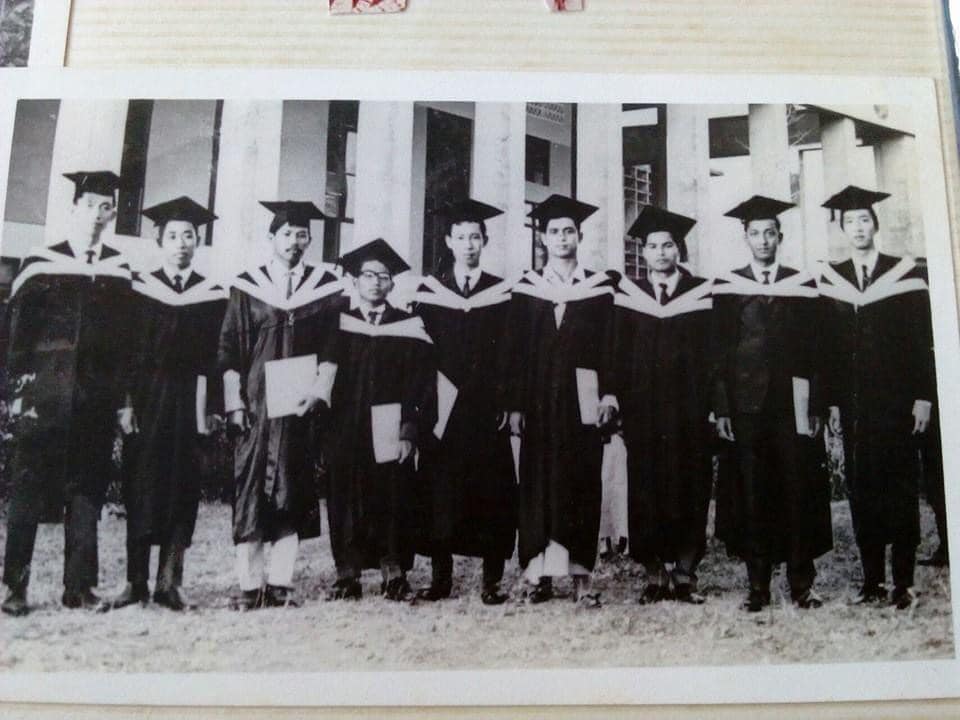
  • 1963 – 69

    by Hla Min

    • There are 3000+ articles in my web site hlamin.com
    • It is difficult if not impossible to revise all the articles.
    • Note that the events described here mostly cover my personal journey as a University Student.
    • Other events (e.g. from 1946 to 1970s) are covered in other Posts.
    • I have honored Outstanding Matriculates (e.g. from 1951 to 1965) in other Posts.

    1963

    Guinea Pigs

    We took the first ever Matriculation Only examination in 1963.

    Paulians took 5 places among the Top Five, 7 places among the Top Ten, and 10 places among the Top Twenty.

    • Khin Maung U (1st)
    • Min Oo (2nd)
    • Myo San (3rd, GBNF)
    • Nyunt Wai (4th)
    • Thein Wai (5th)
    • Hla Min (7th)
    • Johnny Maung Maung (Aung Kyaw Zaw, 9th)
    • Maung Maung Kyi (11th)
    • Aung Thu Yein (13th, GBNF)
    • Frank Gale (Khin Maung Zaw, 17th)

    We attended the last ever I.Sc.(A) class at Leik Khone.

    Following the “Anniversary of 7th July, 1962” events, the major parts of the Universities (in Rangoon, Mandalay, …) were closed “for an unspecified period”.

    Engineering and Medical Classes were spared at that time.

    Subsequently, those who were only one year senior to us in High School graduated 2.5 years ahead of us (the Guinea Pigs of the Education Systems).

    RUBC

    We joined Rangoon University Boat Club (RUBC).

    We — the Paulians Crew — were Runners-up for Senior Novices.
    Maung Maung Kyi (Bow)
    Hla Min (2)
    Kyaw Wynn (3)
    Willie Soe Maung (Myint Soe, Stroke, GBNF)
    Myint Thein (Cox)

    We were awarded Full Green.

    40th Anniversary Gathering

    • Sithu U Tin, U Po Zon and U Tin Htoon (A60) compiled the Souvenir Magazine for the 40th Anniversary of the Founding of RUBC.
    • Due to Security Concerns, the 40th Anniversary Annual Regatta was cancelled.
    • President Sithu U Tin and the Patrons decided to hold the “40th Anniversary of the founding of RUBC” at a hotel in Kandawgyi.

    Burma Institute of Technology

    • My elder brother and several of my sayas graduated from the Burma Institute of Technology (BIT) in 1963.
    • They were from the second batch of BIT.
    • The degree conferred was B.Sc. (Engg).

    1964

    Education System

    • The New Education System was implemented in November, 1964.
    • Most Faculties of the University of Rangoon became autonomous Institutes with their own Rectors.
    • The Youth Affairs Department implemented Luyechun (Outstanding Students) Program in the Summer of 1964.
    • Eligible students from 7th, 8th, 9th and 10th Standards were chosen to attend the Ngapali Shwe Wah Gyaing Camp in the Summer of 1964.

    Rangoon Institute of Technology

    In November 1964, three batches of students entered RIT (Rangoon Institute of Technology).

    • 400+ were admitted to the first ever 1st BE using the controversial ILA (Intelligence Level Aggregate)
      Ko Zaw Min was admitted as Roll Number One.
    • 300+ who had passed the last ever I.Sc.(A) examination were chosen by merit to attend the first ever 2nd BE.
      Ko Hla Min was admitted as Roll Number One.
    • About 200 students who had passed the last ever I.Sc.(B) examination were admitted to the 3rd BE (formerly 1st year Engineering).

    RUBC

    • Elected as Honorary Treasurer of RUBC (Rangoon University Boat Club).
      I had to report to Professor William Paw (President of RUBC).
    • Last Executive Committee member to be elected at the Annual General Meeting.
    • Served as Vice Captain the following year.
    • However, the higher authorities prevented me from becoming RUBC Captain by throwing away the Bye Laws and implementing their ad-hoc rules (e.g. selecting instead of electing Captain)

    Matriculation

    • Cherry Hlaing (Than Than Tin, St. John’s Convent) stood First in Burma.
      She would be admitted as Roll Number One to IM(1).
      She would be selected Luyechun for the Inlay Camp in the summer of 1965.
    • Her grand father U Hoke Sein and her father U Saw Hlaing were also First in Burma.
    • Her two children would also be First in Family.
    • The record of five family members (spanning four generations) standing First in Burma is an enviable record that will not be broken.
    • Lyn Aung Thet (MEHS64) had four distinctions and the same “raw” score, but his performance in Burmese caused him a lower ILA than Cherry.
    • Aung Win Chiong (SPHS64) has the next best “raw” score.
      He had a perfect ILA score of 50, and was admitted to IM(2) as Roll Number One.
    • Maurice Hla Kyi (Min Lwin, SPHS64) was admitted to IM(2) as Roll Number Two.

    1965 – 1969

    Matriculation in 1965

    • Bernard Khaw (SPHS65) had four distinctions (with 80+ marks in English) and stood First in Burma.
      Due to the revised policy (e.g. 3 NRC requirement), he could not apply for professional courses.
      He moved to USA and/or Canada.
    • Aung Myint (SPHS65) had the second best “raw” marks.
      He and his twin brother Maung Aye moved to USA.
    • Winston Sein Maung (SPHS65, GBNF) had the third best “raw” marks.
    • Cherry Than Tin had the fourth best “raw” marks.
      She was admitted as Roll No (1) to MC (2).
    • Yi Thwe (SPHS65) was admitted as Roll No (1) to MC (1).
    • Paing Soe (Freddie, SPHS65) had same marks as Yi Thwe.
      He was admitted as Roll No (2) to MC (1).
    • Forty four Paulians were admitted to MC in 1965.
      They are from the Last Batch of True Paulians.
    • After Nationalization, St. Paul’s High School was renamed as No. (6) Botathaung State High School.

    Nationalization

    The consequences of the Coup d’etat include

    • Disappearance of Democracy
    • Nationalization of industry and schools
    • Indiscriminate demonetization
    • Increased censorship
    • With every turmoil (effecting “National Security”), the universities, institutes and schools were suspended.

    After the schools were nationalized, St. Paul’s High School became No. (6) Botathaung State High School. Some Brothers left Burma. A few indigenous Brothers remained in Ady Road. Brother Joseph was ordained as Father Joseph.

    Luyechun

    • The Luyechun Program was extended to include Universitites and Institutes in the Summer of 1965.
    • I attended the Inlay Khaung Daing Lu Ye Camp in the summer of 1965 along with U Sein Shwe, Daw Khin Than Myint Tin and U Zaw Min Nawaday.
    • MC(1) sent Cherry Hlaing, Khin Maung U, Anita Aye Pe and Kyaw Sein Koe (Victor, GBNF).

    RIT

    There were eight engineering departments

    • Architecture
    • Chemical
    • Civil
    • Electrical
    • Mechanical
    • Metallurgy
    • Mining
    • Textile

    Most departments have associations. The RIT Mechanical Engineering Association was active. U Win Thein (M67, GBNF) was a Prime Mover. He co-founded Set Hmu Thadinzin and Mechanical Magazine. He co-organized activities.

    The RIT Sports Council was headed by Saya U Maung Maung Than. U Maung Maung (Burma Selected in soccer) was Sports Officer. The associations for the various sports was headed by a saya.

    Several RIT students were Burma Selected. They include Sai Kham Pan (Badminton) and Htay Aung (Swimming and Water Polo).

    Saya Mao Toon Siong (former Burma Champion) was National Coach for Table Tennis. He also coached the RIT team which won the Inter-Institute Championship.

    Electrical Sayas

    • In those days, the Electrical Engineering was headed by Saya U Sein Hlaing (Professor and Head).
    • The senior sayas included U Kyaw Tun (saya of our sayas), U Tin Swe and U Sein Win.
    • There were about 20 sayas. Five (or so) were on deputation for further studies abroad.
    • For details, see “A Sad and Short Clip : EE Sayas

    EC and EP

    There were two options : EC (Electrical Communications) and EP (Electrical Power). Per advice in the industry, only a quarter of the students were accepted for EC.

    • There were 80+ EE students in the beginning.
      Tin Tin (Anne) was the lone female EE student.
    • At the end, there were 40+ EE students left.
    • The EP students outnumbered the EC students 3 by 1.
    • Several bright students played safe by choosing EP (which provided a job guarantee).
    • We studied EC (Electrical Communications).
    • Eleven of us graduated in 1969.
    • Three (Kyaw Soe, Aung Thu Yein, Chit Tin) are now GBNF (Gone But Not Forgotten) at this time.
    • A few years later, EC became Electronics Engineering.
    • A few decades later, Electronics Engineering and Electrical Power became full-fledged departments.

    Khin Maung Zaw (KMZ, EC76) wrote :

    AFAIK, EC was the hardest and strictest discipline at the RIT in those days as we’ve been told. Some even asked us why we had to go there. Of course, I am not going to mention the easiest discipline there, but we joked like, “they had 109 students and 110 passed the exam”. I do not mean any disrespect to Sayas and friends from other majors!! At times, it made us wonder why were we there for god’s sake. CRAZY TIMES!!! Indeed.

    Volunteer

    I served as

    • Treasurer & Vice Captain of RUBC (Rangoon University Boat Club)
    • Class Representative, Joint Secretary & Secretary of RITEE (Rangoon Institute of Technology Electrical Engineering Association)
    • Member of Committee for “Hlyat Sit Sar Saung”
    • Editor of the Bulletin published by RIT English Association
    • Member of UTC, Rowing, Scrabble, and Chess Assocations /Clubs
    • Free lance writer (articles, poems, translations)
      My poem “Men on the Moon” was sent to NASA by USIS, and it was published in the Guardian newspaper in July 1969

  • M69ers

    Several M69ers passed away (mostly due to medical conditions).

    The parents of U Win Htein (M69) ran a Lorry / Transportation business.

    He contracted Malaria.

    He was treated with Quinine and/or Blood Transfusion.

    Sadly, he passed away.

    U Nay Win (M69, Singapore) taught Maritime subjects at a Polytechnic in Singapore. He was in and out of a hospital for three or four years before he passed away.

    U Khin Maung Gyi (M69) recently succumbed to Covid.

    ** Notes

    * Need photos (e.g Win Htein)

    * U Aung Min (M69) and team maintain the GBNF List for 69ers

    There are 120 members.

    * U Win Htein’s older brother is U / Maung Win (M6x)

    * U Nay Win attended PPBRS and MEHS.

    His spouse is the daughter of Daw Htoo.

    * The other U Khin Maung Gyi is Min69.

    He had dark hair.

  • EE69ers (GBNF)

    EE69ers

    Several EE69ers passed away (mostly due to medical conditions and/or Covid).

    • U Khin Maung Nyo was an early GBNF. He passed away while swimming in the Irrawaddy
    • U Soe Win was Captain of RIT Basketball Team.
    • Tommy played Basketball for RIT.
    • U Khin Win represented RIT in Weightlifting.
    • U Aung Gyi Shwe (Secretary of RIT Track and Field Association)
    • U Tin Aye (A Rauf)
    • U Thein Swe (Luyechun for 3rd BE)
    • U Khin Maung Win (Sargalay)
    • U Khin Maung Bo (Allan)
    • Bishnu Shahi
    • U Min Thaw (Gilbert)
    • U Myo Aung
    • U Ye Naing
    • U Kyaw Soe
    • U Aung Thu Yein (Brownie)
    • U Chit Tin
    • U Oo Kyaw Hla
  • Intake of 1st BE in 1964

    400+ students were admitted.

    Some did not report for the classes.

    Some left RIT before graduation.

    120+ are GBNF

    The post is based on the Spreadsheet compiled by U Ohn Khine (M70).

    Ohn Khine

    Feel free to provide corrections and additional information.

    Students

    1. Zaw Min (Nawaday, EP70, MS, USA)

    RIT Luyechun

    Participated in English Debate

    Wrote “RIT Days 1964 – 1970”

    Worked in Electronics Industry

    Retired in Las Vegas, Nevada

    2. Tommy Shwe (GBNF)

    Played Badminton for RIT

    Left before graduation to Taiwan

    Passed away in California, USA

    3. Cho Aye (M70, GBNF, 2018)

    Represented RIT Hiking & Mountaineering in the All Universities & Institutes Expedition to Mount Victoria

    Organizer, Combined 1st BE Intake for 1964 and 1965

    4. Peter Pe (GBNF, 1969, accident)

    Represented RIT in Swimming and Water Polo

    Fell from a horse

    Brother of Saya Nita Pe

    5. Salai Myo Myint (C70)

    —-

    6. Aung Myint (C70, USA)

    7. Myint Myint Sein (Diana, M70, Canada)

    Performed dance at SPZP-2000

    8. Kyaw Win Maung (ChE70)

    RIT Luyechun

    9. Thaung Sein (Steeve Kay, EC70, USA, GBNF)

    Steeve Kay

    Entrepreneur and Philanthropist

    CEO, Kay Family Foundation

    Donated $200000+ to RIT-related activities

    Passed away in California, USA

    10. Win Maung (M70)

    —-

    11. S Joseph Aung (M70)

    12. Myo Myint (M70)

    13. Maung Maung (M70)

    14. ???

    15. Tin Maung Win (M70, Singapore)

    —-

    16. Win Tint (Patrick Hla Pe, EP70)

    17. Nay Aung (M70)

    18. Thaung Htike (EC70)

    19. Ma Kyin Myint (E 70)

    20. Maung Aung (C70, USA)

    Maung Aung (2nd from Left)

    —-

    21. Johnnie Bott

    22. Htun Kyaw (EC70)

    23. Zaw Win (C70, Australia)

    24. Sai Aung Min (M70)

    25. Than Lwin (EP70)

    —-

    26. Lin Zaw Min (Walter Tan, M70, USA)

    Past BOD, Norcal Ritaa

    Participated in English Debate

    27. Aung Nyein

    28. Kyaw Soe Oo

    29. Aung Htoo

    30. Tin Aye (M70)

    —-

    31. Win Aung (M70)

    32. Kyaw Win

    33. Tin Win

    34. Kyaw Tin

    35. Albert Trutwein

    —-

    36. Kyaw Nyunt

    37. Sonny Yeo (M70)

    38. Ma Hnin Yee (C70)

    39. Khin Maung Lay (Mutu, M71)

    40. Ma Khin Hme (Margaret, M70)

    —-

    41. Maung Maung Gyi (Victor Jones, C70)

    42. Ma Cho Cho Saw (ChE70)

    43. Myo Win Thein (Patrick Fong, C70)

    44. Maung Kaung (M71)

    45. Nay Win (T70)

    —-

    46. Kyaw Phone Myint (Victor Kyaw Phyo, M71, GBNF)

    47. Myo Nyunt

    48. Tin Ohn (M70)

    49. Nyunt Shwe

    50. Myo Myint

    —-

    51. Stanley Lim

    52. Naw Hta Khaw (EP70)

    53. Aung Khin (Lee Wee Kee, C7?)

    54. Naing Win (M70, GBNF)

    55. Sai Aung Hla (M70)

    —-

    56. Yee Yee Myint (C70)

    57. Thein Win (M/Ag70)

    58. Mya Daung (M/Ag71)

    59. Win Htut (C70)

    60. Lay Myint (C7?)

    —-

    61. Ma Win Yee (?7?)

    62. Than Htwe (Mn70)

    63. Ye Chit Pe (M70)

    64. ???

    65. Khin Maung Kyaw (M/Auto70)

    —-

    66. Khin Maung Pun (Pet70)

    67. Hla Htun (M/Ag70)

    68. Myo Thaw (Freddie Thaw)

    69. Tin Aung (EP70)

    70. Than Htun (M70)

    —-

    71. Aung Kyan (M/Auto70)

    72. Ma Khin Phyu Win (C?)

    73. Sai Maung Lin (M/Ag70)

    74. Aung Htun (M7?)

    75. Thet Win (M70, USA)

    —-

    76. Ma Thit Thit Aye (EP7?)

    77. Maung Maung Lwin (C71)

    78. Htun Swe (Terrence Lee, Pet7?)

    79. Win Htay (Walter Cheng Lyan, M70, USA)

    80. Kyaw Min Aung

    —-

    81. Myint Aung (M70)

    82. Hla Min (Pauk Si, E 70, GBNF)

    83. Htay Naing (?)

    84. Ye Myint (ChE70)

    85. Ba Kyaw (C70)

    —-

    86. Aung Lwin (M70)

    87. Han Tha Myint (EC70)

    88. Soe Win (EC70)

    89. Madan Chand (C70, USA)

    90. Ohn Thaung (C70)

    —-

    91. Thaung Htun (Robin Chu, M7?)

    92. Hla Myint (Met7?)

    93. Maung Maung Myint (M7?)

    94. Soe Tint (Nevil Kyi Maung, C7?)

    95. Maung Maung Thaw (EP70)

    —-

    96. Aung Thein (M70)

    97. Maung Maung Than (M/Ag70)

    98. Soe Win (M71)

    99. Nyunt Tin (M70)

    100. Le Le Win (Lillian, M71)

    —-

    101. Win Thein (?)

    102. Nan Lwin (EP70)

    103. Ma Myo Myat Myint (M70)

    104. Myat Khine (M7?)

    105. Thaung Han (?)

    —-

  • A Zillion Thanks

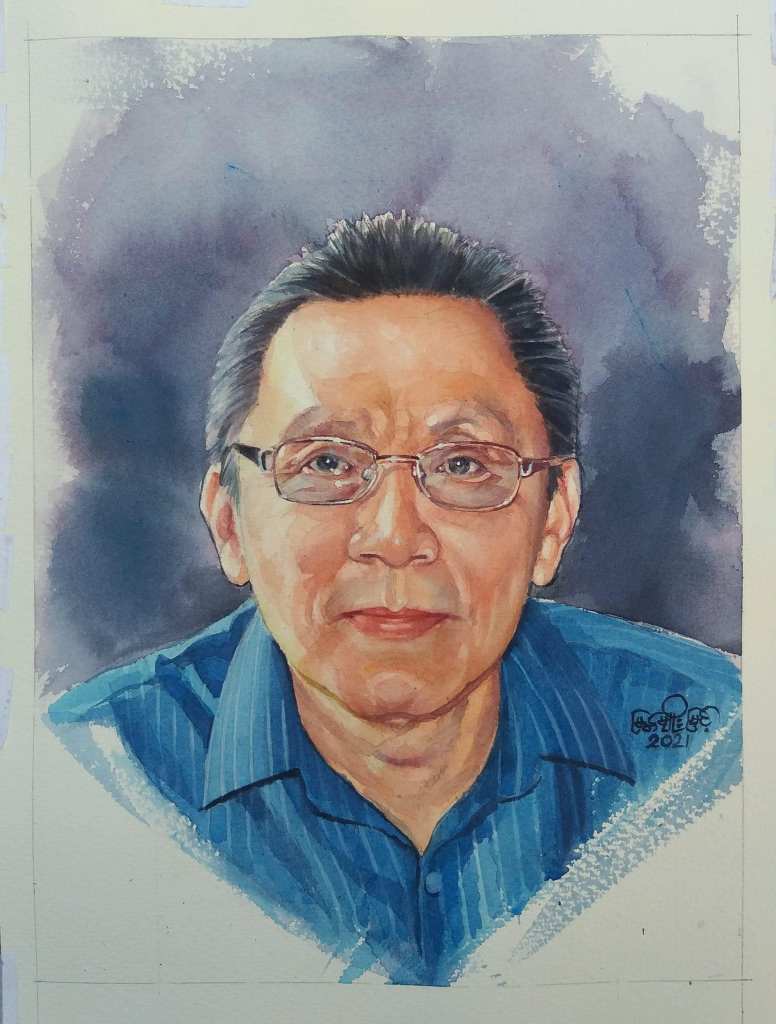
    Pon Tu of Hla Min
    • Received an awesome gift from Bagyee Myat Myo Myint, (Distinguished Artist and Pon Tu Specialist).
    • He was gracious to spare my Grey Hair and Wrinkles and make me look young and vibrant.
    • He put his heart into every painting — both inanimate and animate objects — and produce priceless Collectibles.

    Comments

    • U Moe Aung
      Exquisitely marvelous.
    • U Zaw Winn
      Awesome
    • U Aung Myaing
      Both lips and eyes are wearing gracious smile.
      Wonderful !
      My respect to both of you, Ko Hla Min and Ko U Myo Myint.
    • U Tin Aung Win
      Very impressive!
    • U Aung Min
      One of the best Pon Tu
    • U “Daniel” Tint Lwin
      Great portrait of a great man.
      Good
    • U Ngwe Tun (Tun Tun)
      You’re amazing.
      Don’t forget it
    • Ashin Siri
      Beautiful Art ပါ ဒကာကြီး
    • Than Win
      အမှတ်တရ save ထားလိုက်မယ်သူငယ်ချင်းရေ
    • Rita Chan
      What a great picture တော်တော်တူတယ်နော်
    • Aye Khin
      Great picture
    • U Hla Myint RIT
      V. V. Nice
      Be mindful
    • Tin May Lwin
      Very nice!!!
    • U Maung Maung Thant
      Looks really good
    • Sann Ni
      Very nice Arts, especially the talking eyes
    • Rosie Mai Khin Nyunt
      Very very nice painting.
    • Mu Mumyint
      Looks really good sayar.
      Be healthy.
    • Khin Maw
      Awesome
    • Tin Aung Win
      Very nice “Pon Tu”.
      Thanks,Bagyee Myat Myo Myint.
    • San Tint Tint Zaw
      Love it
    • Kyaw Thura
      ေလးစားလ်က္ပါ ဆရာႀကီး
    • Hla Lay
      That’s Great
    • Maung Htay
      Good looking Saya.
    • Thane Oke Kyaw Myint
      Very good portrait
    • Thet Hta Su
      Looks great
    • Myint Myint Than
      Nice shot
    • Khin Sabai
      Looking good
    • Nwe Ni Tun
      တူတယ် ဆရာ
    • Thein Han
      Excellent painting.
    • Sein Yie
      The best!!!
  • Swel Daw Yeik Sar Saung

    U Moe Aung & U Hla Min

    Saya U Moe Aung (Tekkatho Moe War) and team published commemorate issues of “Swel Daw Yeik Sar Saung” for

    • SPZP-2002
    • SPZP-2007
    • SPZP-2010

    †Swel Daw Yeik Sar Saung for SPZP-2002

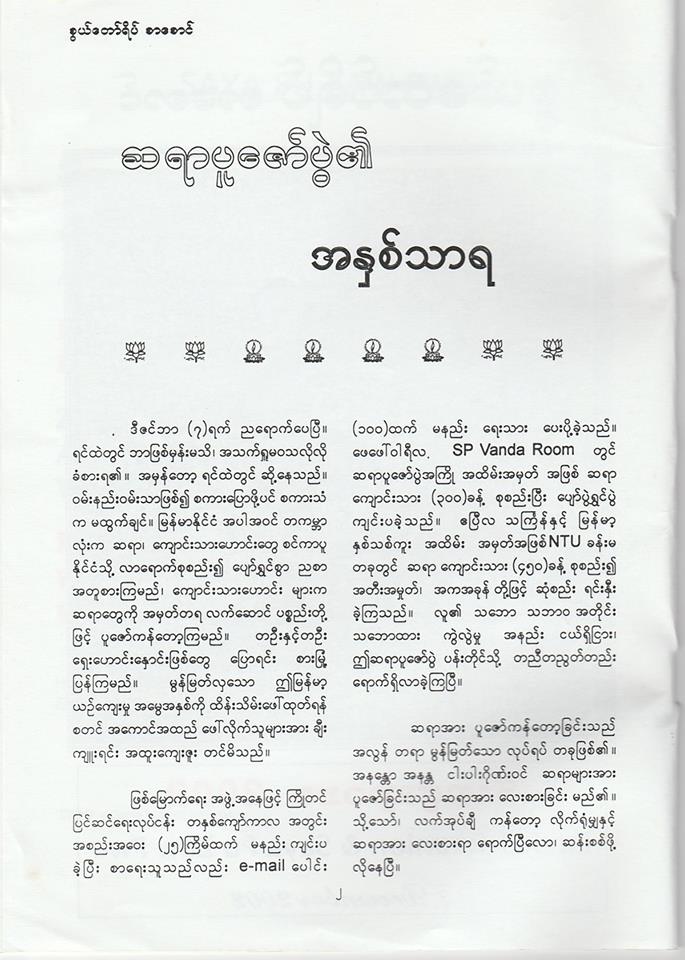
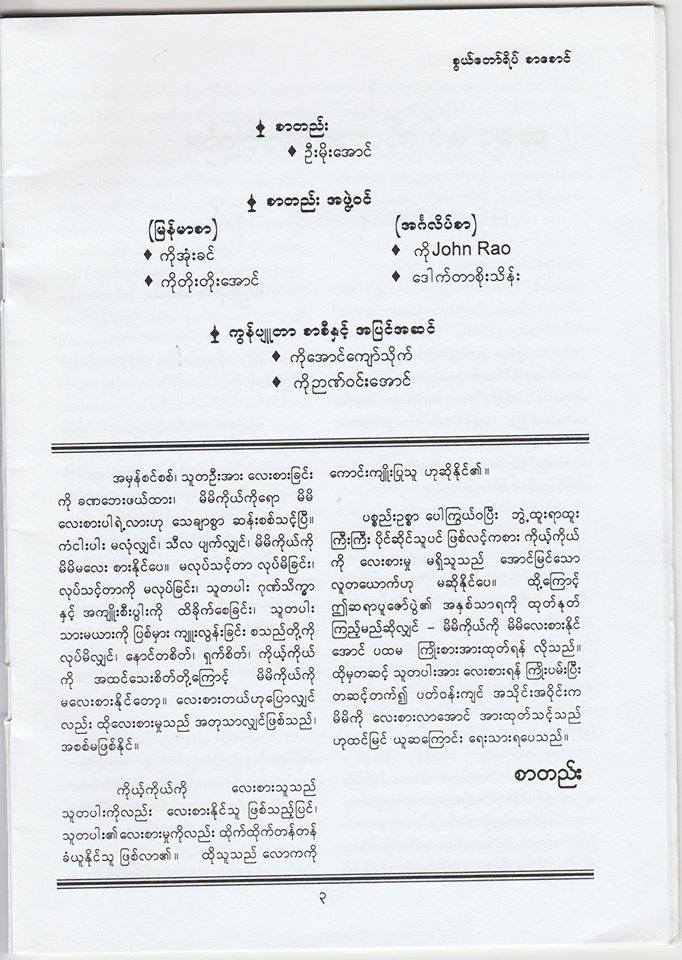
    Sample pages from SPZP-2002 edition are shown.

    Editorial

    Saya wrote the editorial “Essence of SPZP”.

    Publication Team

    • Saya U Moe Aung served as the Chief Editor of the Sar Saung.
    • U Ohn Khin and U Toe Toe Aung served as Editors for the Burmese section.
    • U John Rao and Dr. Soe Thein served as Editors for the English section.
    • U Aung Kyaw Thaik and U Nyan Win Aung helped with the Layout and Typesetting.

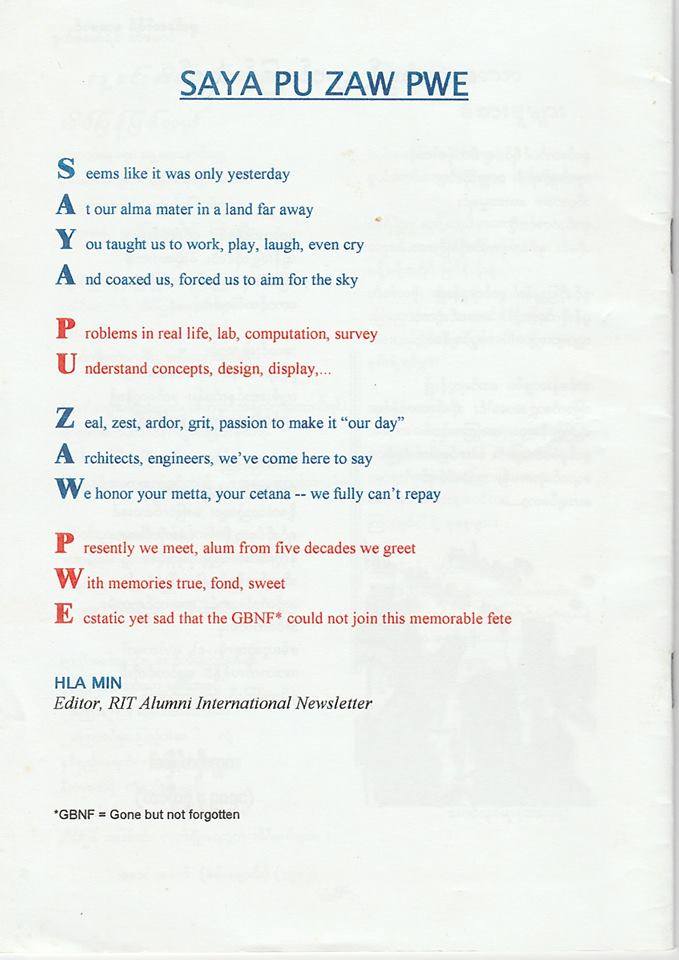
    My Poem

    My poem “SAYA PUZAW PWE” (written for SPZP-2000) was reprinted on the back cover of the Sar Saung for SPZP-2002.

  • Publications

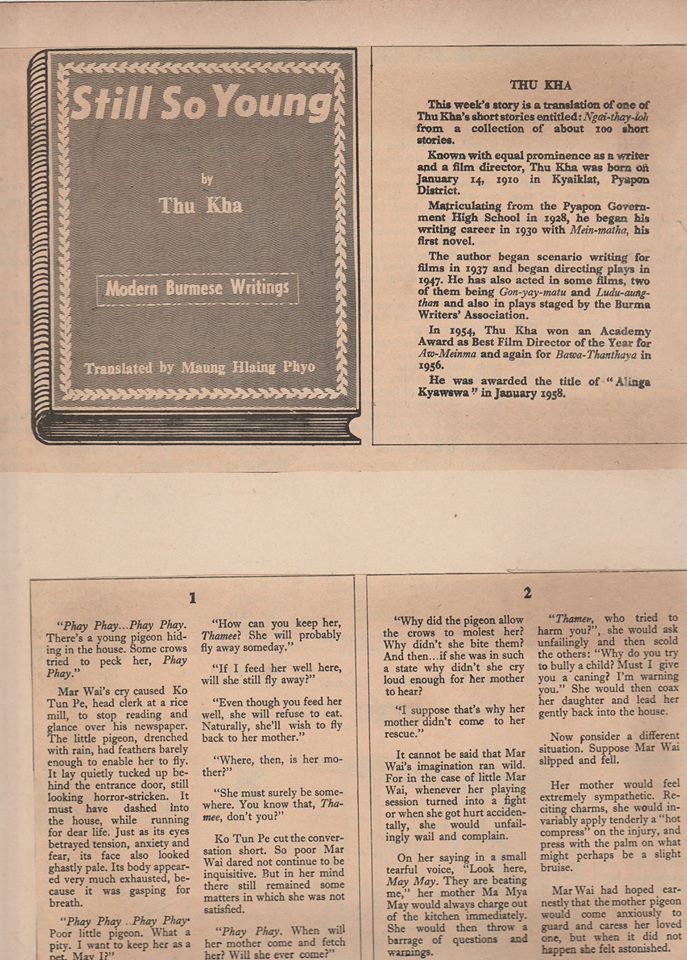
    • Still So Young (Working People’s Daily)
      Translation of a short story by U Thu Kha
    • Men on the Moon (Guardian)
      Poem honoring the Apollo 11 Mission to the Moon in July 1969
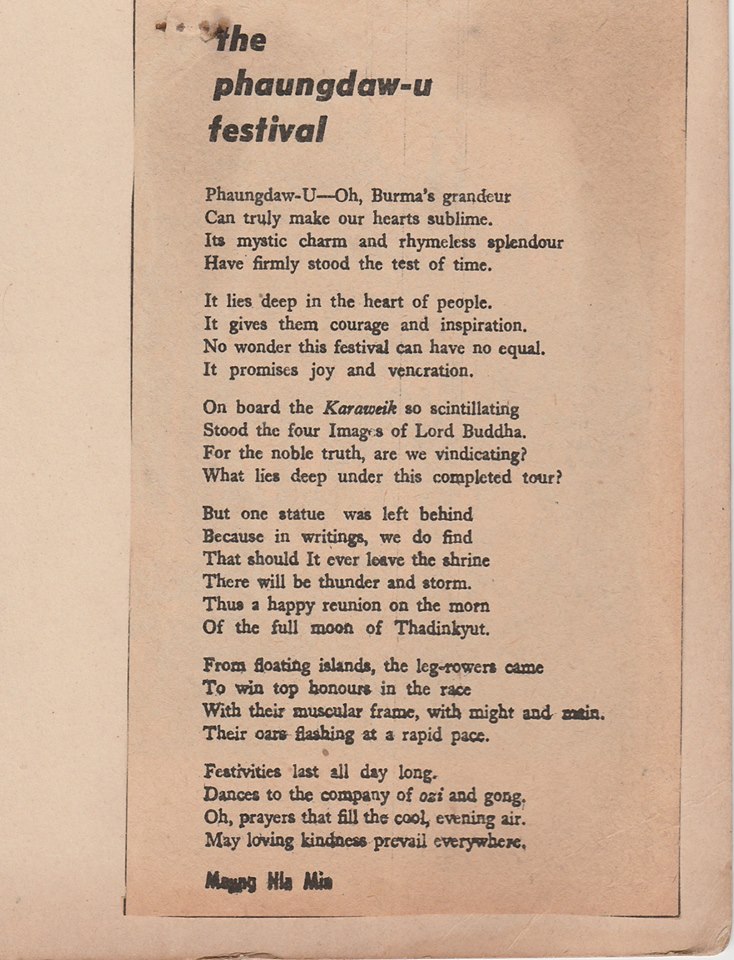
    • Phaungdaw-u Festival (Working People’s Daily)
      Thadinkyut celebrations at Inlay Lake in Shan State
    • The Great Gandhiji (Working People’s Daily)
      Poem honoring the Centennial of the Apostle of Non-violence
    • To The Fallen Warrior (Forward Magazine)
      Poem honoring the writers and poets who fought for Independence
    • Calendars (BAPS Newsletter)
      Overview of Burmese Calendar and other Calendars
    • A Sea Burial for Dr. Htay Lwin Nyo (BAPS Newsletter)
      Last Journey for the alumnus of RIT and UCC

    Still So Young (Working People’s Daily)

    • Short Story by U Thu Kha
    • Translated by Maung Hlaing Phyo (Hla Min)
    • Daw Khin Swe Hla (Editor) wanted a “young” translator (for a change)
    • Received fifty kyats for the translation
    • Saya U Thu Kha was given “Garawa” money of fifty kyats
    This image has an empty alt attribute; its file name is still-so-young.jpg
    Translation

    Men On The Moon (Guardian)

    • Poem honoring the Apollo 11 Mission in July 1969
    • Historic Landing in Tranquility Bay (Far side of the Moon)
    • Mission Commander : Neil Armstrong
    • Lunar Module Pilot : Edwin “Buzz” Aldrin
    • Command Module Pilot : Michael Collins
    • Published in the Guardian Daily newspaper
    • Copy sent by Mr. Hall (USIS) to NASA
    Writing 107
    Poem

    Phaungdaw-u Festival (Working People’s Daily)

    • Annual celebrations at Phaungdaw-u Pagoda in Inle / Inlay (Southern Shan States)
    • Published in the Thadinkyut Supplement (WPD)
    This image has an empty alt attribute; its file name is writing-105.jpg
    This image has an empty alt attribute; its file name is writing-104.jpg
    Poem

    The Great Gandhiji (Working People’s Daily)

    • Commemorate the Centenary of the birth of “The Apostle of Non-violence”
    • Mohandas K. Gandhi / Mahatma Gandhi
    This image has an empty alt attribute; its file name is writing-101.jpg
    Poem

    To The Fallen Warrior (Forward Magazine)

    • Honoring the Sarsodaws / Writers who struggled for Burma’s Independence
    • Bohmu Ba Thaw (Maung Thaw Kha) was the Chief Editor
    • U Sein Hla was the Editor
    • Received fifteen kyats for the poem
    • Illustrator received fifty kyats
    This image has an empty alt attribute; its file name is writing-106.jpg
    Poem

    Calendars (BAPS Newsletter)

    • Types of Calendars
    • Burmese / Myanmar Calendar
    • Henry Lim was the Chief Editor
    • I was a Contributing Editor
    This image has an empty alt attribute; its file name is writing-102.jpg
    Article

    A Sea Burial for Dr. Htay Lwin Nyo (BAPS Newsletter)

    • Last journey of Dr. Htay Lwin Nyo (EP74, UCC)
    • I had the honor to press the incinerator at the Crematorium
    • We accompanied Dr. Swe Aye and Dr. Khin Nyo Thet for scattering the ashes into the waters in Santa Cruz Bay, California
    • Published in BAPS Newsletter and RIT Alumni International Newsletter
    This image has an empty alt attribute; its file name is writing-103.jpg
    Article
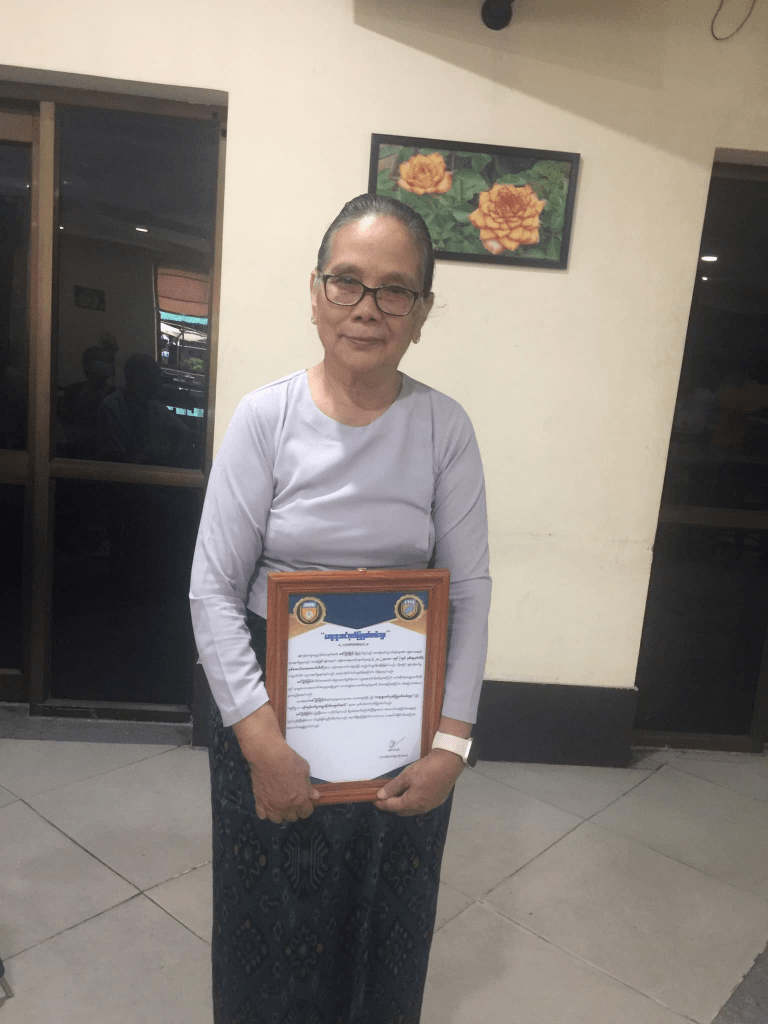
  • Daw Myint Myint (C69)

    • She is an entrepreneur and philanthropist.
      She owns “Myit Makha International Trading Co.”
    • She donated more than K200 Lakhs to the 69er HCF (Health Care Fund).
    • She sponsored many activities:
      69er monthly Breakfast gathering,
      Lunch gathering (e.g to welcome Nyunt Nyunt Wai (Germany)),
      Several tables at 69er Annual Dinner and Entertainment
    • She donated K150 Lakhs for YTU Library Modernization project.

    Feedback

    U Ngwe Tun (C69) wrote :

    Sadhu Sadhu Sadhu. Thank so much Daw Myint Myint. You are the great donor of69ers and also taking pride of you on behalf of69 civil students. May God Bless you always.

    Uzin Bobby Myo Tun (A69) wrote :

    Daw Myint Myint … your generosity and metta is greatly appreciated by all your fellow RIT69ERs

    Dr. Soe Thein (C75) wrote :

    Congratulations
    For her dedication to the community

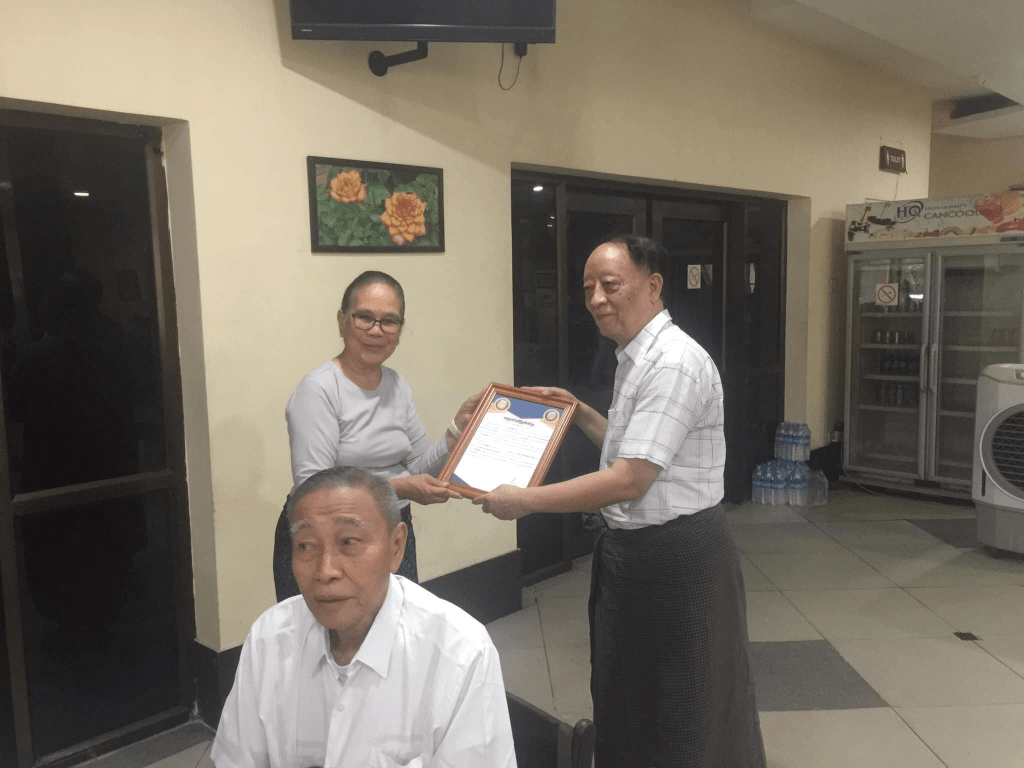
    Certificate of Appreciation
    Daw Myint Myint
    Daw Myint Myint accepting the Certificate