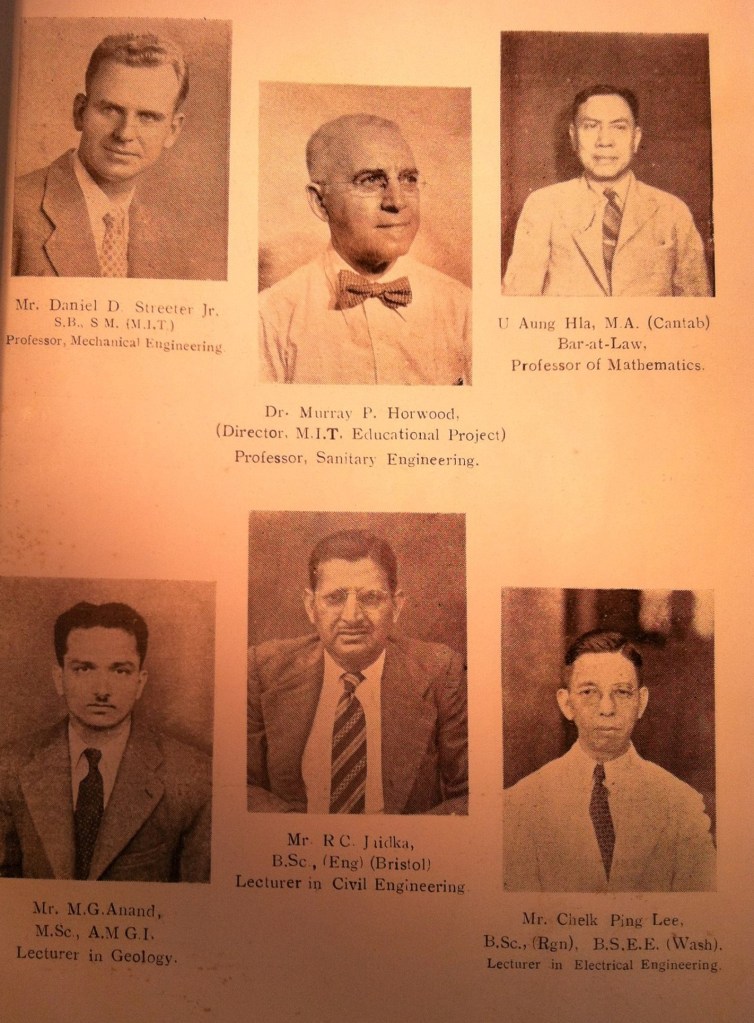
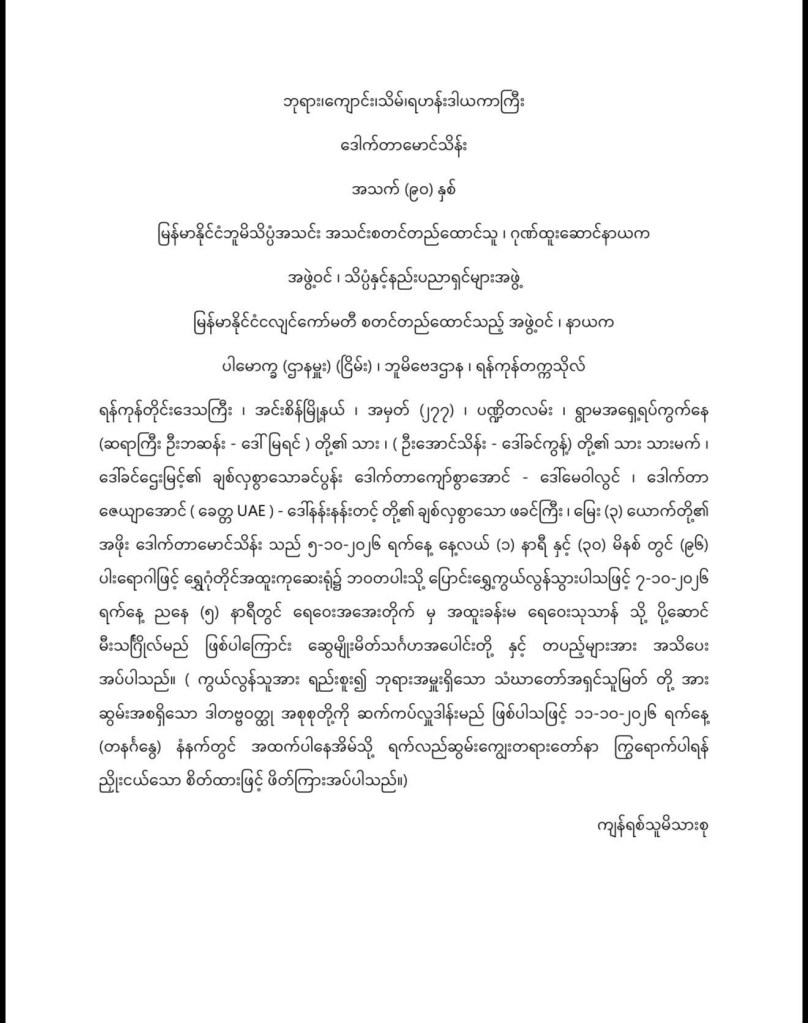
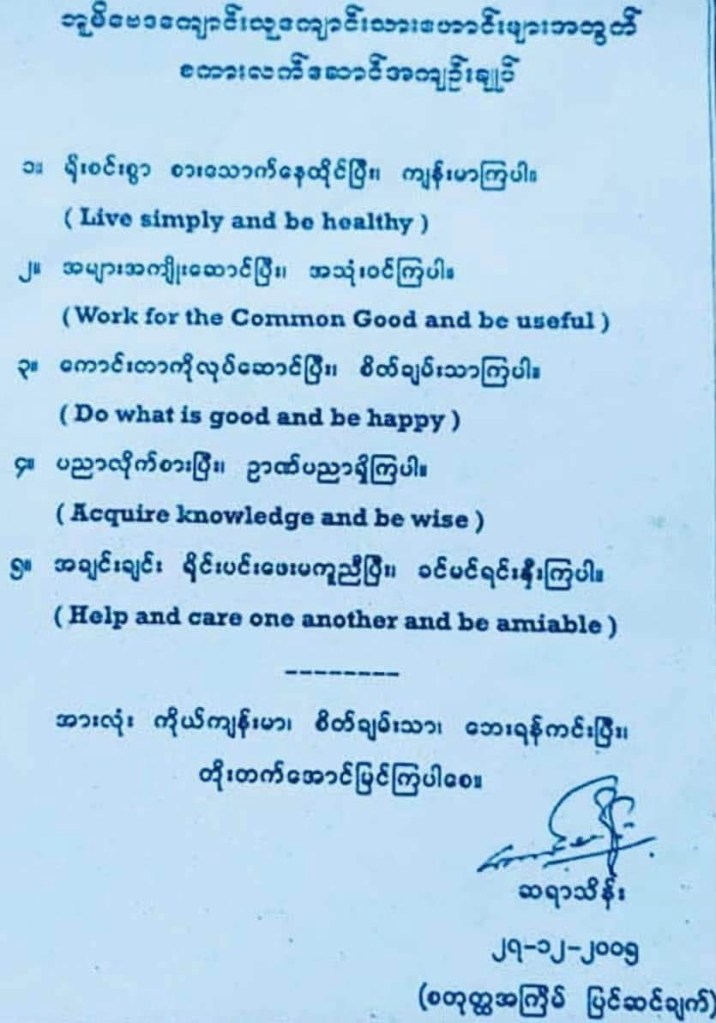
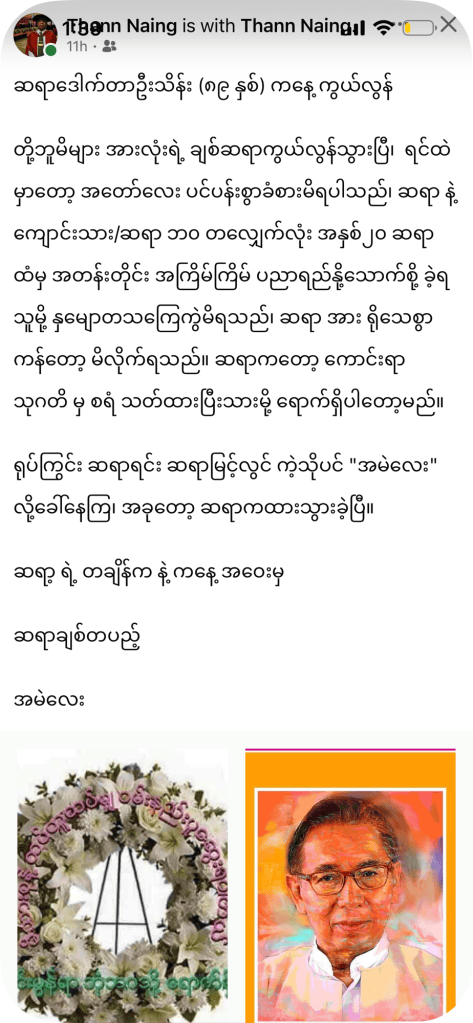
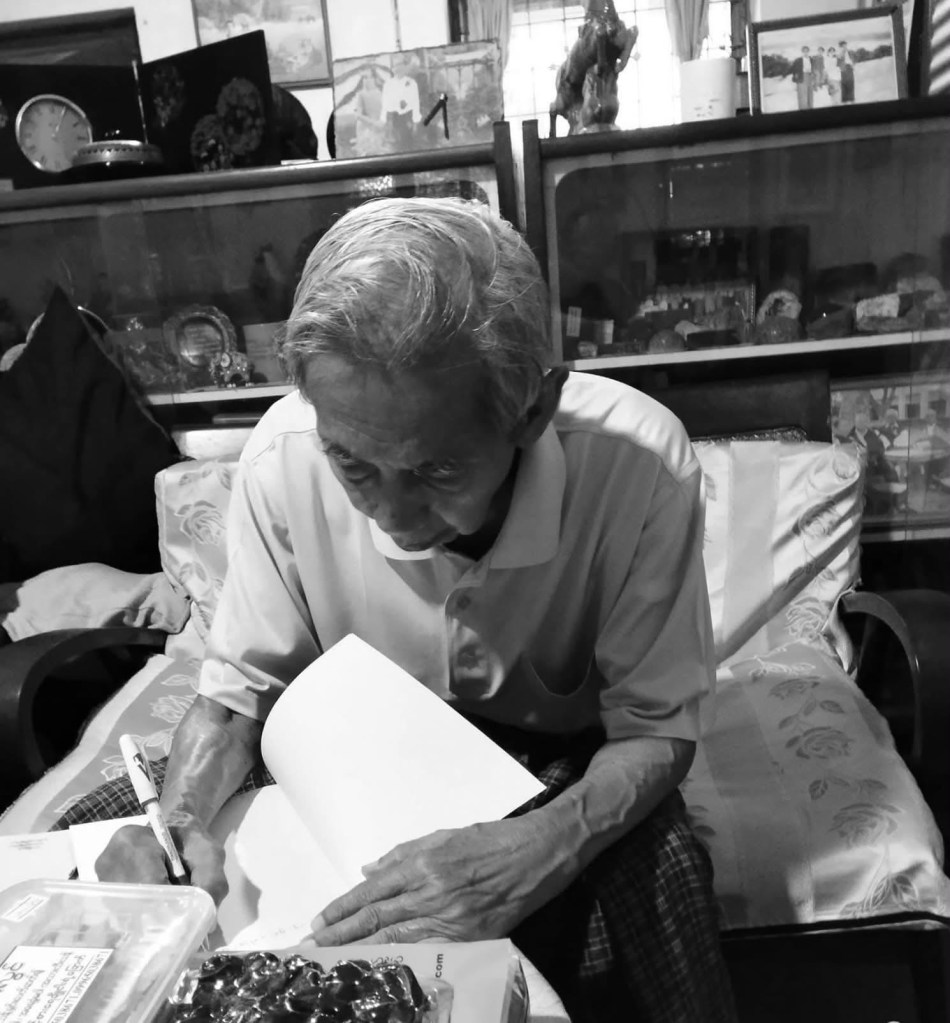
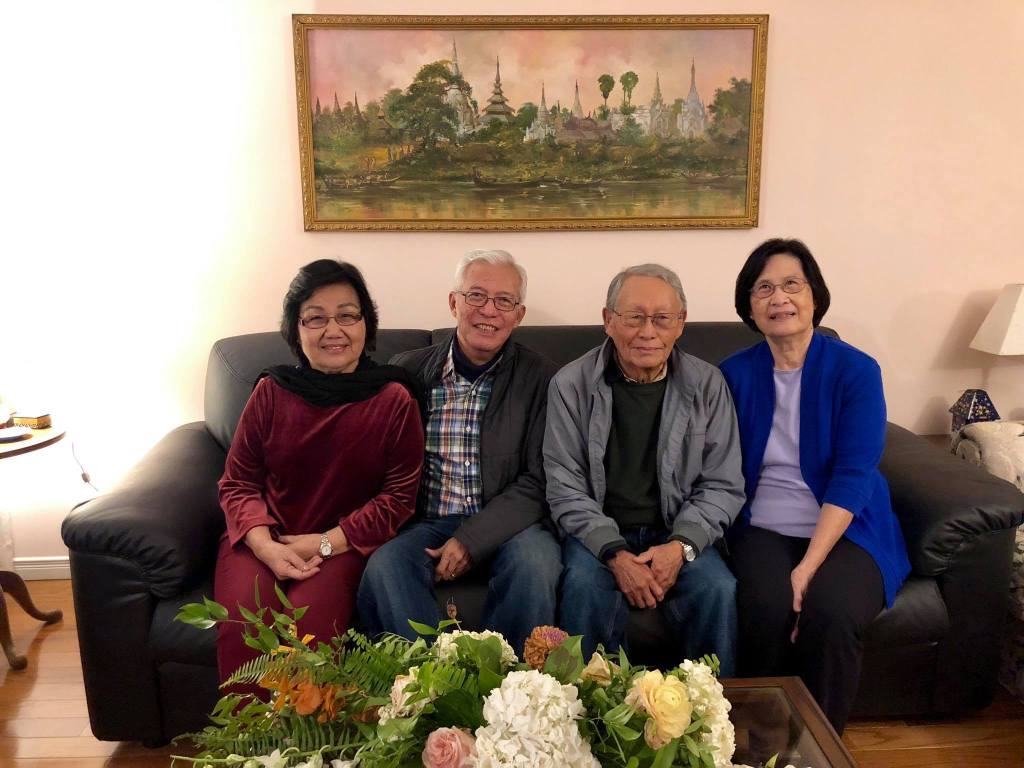
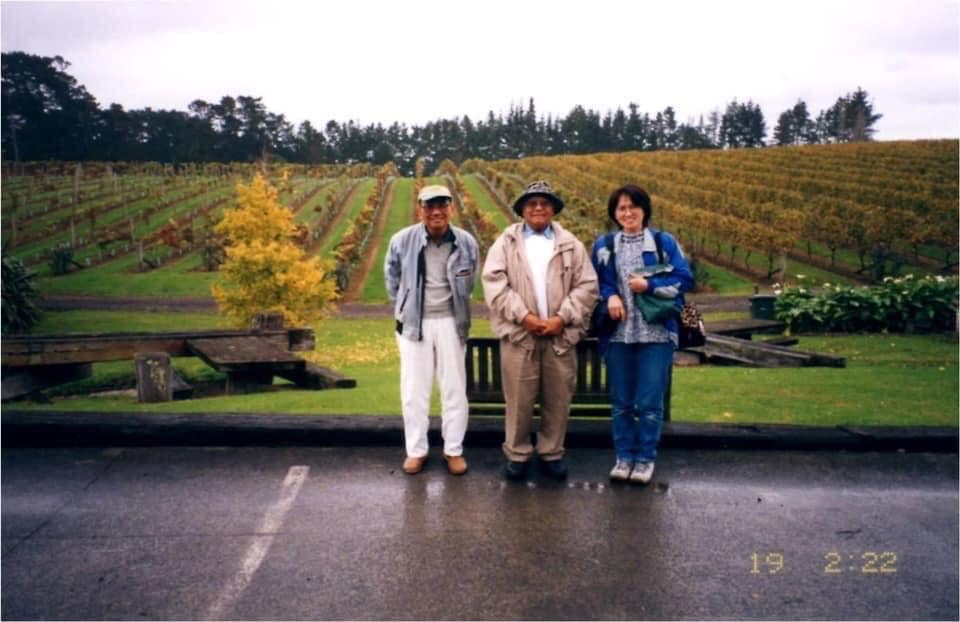
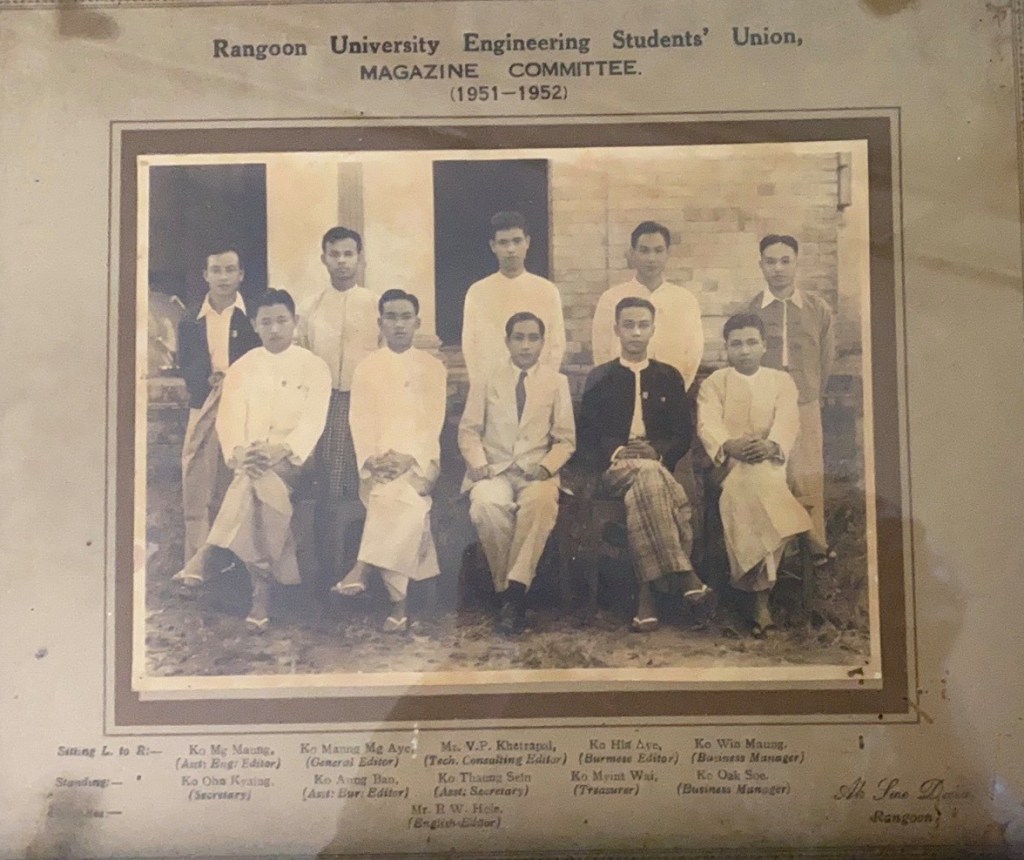
I was very sad to read the news of Saya C. Ping Lee in Ex-RIT web site. Ko Win Aung (M62, NSF) wrote: “Please add the name of my late father, Saya C. Ping Lee, Lecturer in Electrical Engineering, BOC College. He passed away in Berkeley, CA in 1987. He was a contemporary of the late Dean U Ba Hli and late Saya U Kyaw Tun. His former students included the late Saya U Sein Hlaing”.
At our first Burmese Engineers Association in the Bay Area, he was named the first honorary member of the association.
When I was a first year student at BOC College, I heard he had left the BOC College of engineering for the position of the Director of Technical Education at Insein Technical Institute (GTI). Though he left the BOC College, people at the Engineering Lab mentioned so much of their fond memory of him. The words then was that he left BOC College to take up a position as an educator in the engineering arena, GTI. He was one of the most outstanding scholars in electrical engineering in Burma of his time. He was a good teacher and a compassionate one. Most of his pupils could attest to that.
He had groomed many outstanding pupils like, U Mya Than (EE 53) a contemporary of Prof. U Sein Hlaing, and U Jimmy Sein, to head several of the branch facilities in Insein and Mandalay. Although he has departed, he left behind his legacies for all his pupils to cherish and treasure. Mr. U Taik Moh (C54), one of his top name pupils, said many good things of Saya C. Ping Lee. I am sure his contributions to Technical Education in Burma will remain in the forefront for years to come.
I would like to encourage his former pupils like Mr. Aw Taik Moh to write their thoughts and their fond memory of Saya C. Ping Lee for the posterity. If anyone who should meet U Mya Than B.Sc.Engg. (EE 53), M.S.E (Mich) (Ex-Principal, GTI, Insein), in the New York area, please let him know about this short note.
Ko Win Aung, please accept my sympathy and I would to put this on record in the ex-rit web site for all as my tribute to your Dad, Saya C. Ping Lee.
Sabbe purentu samma sankappa Mettacittena
(Maung H[tin] Paw – E58)
Update
by Hla Min
Saya U Htin Paw is Past President of BEA and TBSA. He attended SPZP-2000. He is now GBNF. His only son Dr. Barry Paw passed away mid-air on a flight from Sydney to USA.
U Htin Paw
U Than Aung (Minister of Education) recruited Saya C. Ping Lee (his student at SPHS) to be Director of Technical & Vocational Education. U Than Aung is the father of Ko Nge / Alphonso and Ko Cho / Charlie.
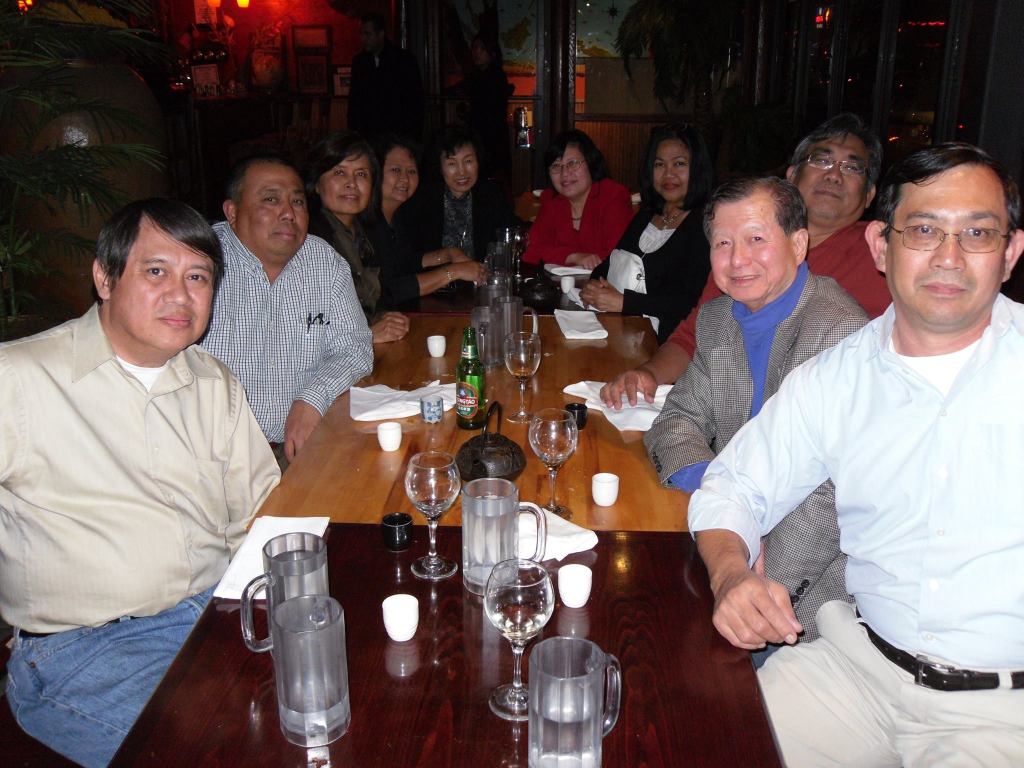
Dr. Win Aung (M62) worked for NSF and as Secretary General of iNeer. He hosted a Dinner Gathering following the RIT Alumni Reunion in East Coast in 2009.
I read through your updates shown in hlamin.com and my suggestions are given below.
I feel that your book should reflect the love of RIT students for their alma mater, the respect and gratitude shown by RIT students towards their respective teachers, the attachment, bond and friendship among RIT students; and the love for their motherland by RIT students. In short, it should reflect what we call “RIT spirit”. You can base the preparation of the book, beginning from the establishment of Faculty of Engineering, Rangoon University, on your updates and other relevant sources. The word RIT includes all different names of Engineering Institutions in Myanmar, past and present.
Having said all of the above, the following headings come to my mind for your proposed book:
SPZPs/Reunions involving all disciplines which had taken place in Myanmar and abroad.
Establishment of alumni associations abroad and in Myanmar to help RIT and motherland.
Establishment of Swe Daw Yeik Foundation.
Establishment of healthcare fund for RIT teachers in Myanmar.
Fund drive and contributions to upgrade the RIT/YTU library.
Various activities/ mini-reunions / get-togethers among groups of RIT students/teachers which reflect the life and also bond among RIT students/teachers, established in the past ,during RIT days.
Other interesting episodes related to RIT.
The above gives you a few thoughts I have for your book. I would like to recommend that you also get suggestions from others for your book.
Good luck and best wishes. Aung Gyi
(2) Keynote from SPZP-2000
Mr. Chairman, my Sayas, my former colleagues, friends, RIT graduates, Ladies and Gentlemen,
Before I begin to say anything, I would like to request you to take the word “RIT” as to stand not only for Rangoon Institute of Technology but also BOC College of Engineering and Faculty of Engineering, Rangoon University. I am using RIT only, just for convenience sake.
Having said that, it is with a chestful of emotions that I am standing before you, trying to say a few words appropriate and befitting to this important and joyful occasion. My overwhelming emotion is, needless to say, happiness – happiness which results from seeing my Sayas, my friends, my former colleagues, and RIT graduates alive and well, after so many years. My happiness is also mingled with a certain amount of pride: pride arising from the knowledge that we have fond memories and a sense of belonging and attachment to the good old institution as well as to one another.
We are fortunate that we could all gather here to exchange our life experiences, both good and bad, and to reminisce about our past when we were at RIT. While we are doing that, we all must have noticed that all of us have changed quite a bit since we last saw one another, at least physically, some more so than other. We all now have a few gray and also less hair, we have a few wrinkles on our face; maybe we also lost a few teeth and cannot see or hear as well as we did before. Some of us also lost the memory a bit and become forgetful about lots of things such as forgetting names for example. This, as we all know, is life and nature of things. Everything changes and nothing is permanent. Bur fortunately we still have our values. Our values such as respect and gratitude for the elders and teachers, caring of our respective children and family members, helping our friends, and attachment, and gratitude to the institution which nurtured us to meet the challenges of life, are still with us. They have not changed. This Saya Pu Zaw Pwe and reunion is a testimony to those values.
I must now pause and thank and congratulate the Organizing Committee for their untiring and selfless efforts to make this event possible and successful. This Saya Pu Zaw Pwe and RIT Alumni reunion is, as far as I know, once-in-a-life-time event. As far as I am concerned it is already a resounding success with the cooperation and great enthusiasm that I have seen. I hope this will be the beginning and not the last of our get-togethers. When my wife and I paid visits to Myanmar in 1996, 1997 and 1999 we had mini get-togethers with RIT Alumni. When I was here a few years ago we also got together with a few RIT Alumni. I understood that Saya U Aung Khin also had one mini get-together here some years ago. But these get-togethers were not on a grand scale as the one that we are having here now. However the spirit of camaraderie and friendliness among RIT Alumni mini get-togethers, was the same as the one that we find here now. If you look around you, you will find that all of us came here from different parts of the world, indicating the great attachment and respect that we all have for our old institution and also for one another.
While I was preparing for this speech, fond memories of the years that I spent as a student, as a teacher and later as Rector at RIT came flashing through my mind. Without going into details, I remember that all my teachers, including Saya Num Kock and Saya U Ba Toke who are here with us, were good inspiring teachers with kind hearts. When I became a teacher and later the Rector at RIT, I noticed that my colleagues were good and dedicated people who tried their best to teach what they had learnt from good Universities and Institutions abroad.
They made conscious efforts to raise the level of education at RIT so much that the students were fully occupied with classes, studies, projects, and homework. I have to mention here that my Sayas and my former colleagues were, and still are honest, compassionate, gentle and kind people. Within this context I would now like to take this opportunity to offer my humble apologies to my Sayas and colleagues for the wrong things that I may have done or said which might have hurt them in any way in the past.
As for the students, I remember that they were good, intelligent, and energetic students in general. Since I was also involved in extracurricular activities of the students, I had more interaction and gained more understanding of their needs and feelings. Like most of the other teachers I tried my best to be helpful to them not only in their studies but also in any other problems that they needed my help. Because of the compassion that I had shown for them they became more communicative, and listened to what I had to say most of the time. Like a breath of fresh air, the first batch of female engineering students were among us, I believe in 1958. So far as I remember they did as well as or some even better than the male students in their studies. I remember that as a teacher I felt very good and satisfied whenever some students did well in their studies or did well in their careers after they left school. These are fond memories that I still have with me about the students at RIT.
As you probably know, I left RIT and Myanmar in 1977 to join UNESCO. I then migrated to Canada to join International Development Research Centre (IRDC) in 1981. For your information, IRDC is a Canadian Agency which funds research projects for development in the developing countries. I retired from IRDC in 1997. Looking back to the past, I must say that I spent the best years of my life at RIT, challenging and troubling at times, but on the whole happy and satisfied with the job that I was doing.
Now please let me take a few minutes of your time to share with you my thoughts, which I believe are some important elements of life. You might not agree with me to what I am going to say. At least, in that case, you might take them as food for your thoughts. If I sound like lecturing to you now, you must remember that the habit of a former teacher dies hard. When I was young and immature. I had great admiration for people with high I.Q. (Intelligence Quotient). I also tended to think in those days that I was quite intelligent. After going through life experiences with ups and downs I became to realize that high Emotional Quotient (E.Q.) or emotional mastery is more important in life than high I.Q., to cope with adversities, disappointments, failures and sometimes even tragedies. No one that I know of, escapes the negative impacts of life in one form or another. If you have emotional mastery you can deal with and overcome these negative impacts and still get ahead in life and be relatively happy. One thing that can help us is to have optimism, hope and courage in life and to minimize the negative thoughts and creeping pessimism. It will be wrong to classify anything in life in opposites either in black or white. One can neither be fully optimistic nor fully pessimistic all the time. There is a gray area which is neither black nor white, and so long as the dominant part of this gray area is optimism, things will turn alright in the end. I read in one of the books long time ago that the Chinese word for “crisis” denotes both risk and chance (opportunity). A pessimistic person would tend to look at the crisis as the big risk and will despair and do nothing, whereas an optimistic person will look at it as a challenge and opportunity and will do something with courage and determination and overcome the crisis. He or she might fail in doing something. But without failures one will not know success. In short, although we will not be able to master the circumstances, and situations in life, we sure can try to master our thoughts and emotions to meet the challenges of life. Here are the spiritual sides of us or our respective religions might be helpful.
Now that I am getting old and getting inflicted with aches and pains here and there, especially when I get up in the morning, I begin to realize that the important part of my life is to keep myself in good health. There are lots of books and doctors telling us how to keep ourselves in good health. The simple gist of the whole message is to have some form of physical exercise or activity to keep our weights down; and to eat nutritious food and avoid or cut down fatty, sweet, salty and high cholesterol food which are harmful to our health. As you know, it is easier said than done. What I know is we do need to make conscious efforts to keep ourselves in good health by taking physical exercises and by eating nutritious and non-fattening food. One thing is for sure, if we are not in food health we will not be able to enjoy our success or good things in life, and we will be, relatively speaking, unhappy.
When I was young, my grandmother used to tell me to get ahead in life I would need luck, brain, and industriousness. She was right of course. But one important element in life that she missed telling me was to develop and have good social relationships will all the people that I would come across in life, including family members. No one can live and get ahead in life alone. Each one of us at some stages of our respective lives needed and got help from someone to move on with our lives. From my personal experience, I noted that one must be non-egoistic, not too aggressive, be polite, be helpful, and tries to understand and respect other person’s points of view, needs and feeling, to develop good social relationships. Here I would like to add that each of us can judge who is good, who is bad, who is untrustworthy, etc. and avoid bad people and associate with good people to the extent that each of us can.
Each one of us had twenty four hours a day and the one who can budget and manage his/her time day by day, week by week, month by month, year by year according to his priorities and short term and long term goals will get ahead in life better. One should use the time and even manipulate it and not waste it to achieve one’s short term and long term goals. One must also be patient if the short term and long term goals are not achieved in budgeted time. So long as the time is used and not wasted, one will reach his/her goads in due course.
I hope everyone present here will agree with me the importance of financial management at the personal or family level as well as at the business level. At the business level there are of course financial plans and budgets for the present as well as for the future. One should likewise have financial plans and budgets at personal/family level for the present and future, to spend, save and invest within one’s available means. As you know money is neutral. If you are wise, money will treat you well; and if you are foolish it will not stay with you for long. Like time, one’s hard-earned money should be used and not wasted.
The last thing that I would like to point out to you is the danger of complacency. If you own a business and if you are complacent after a certain level of success, your business will suffer, simply because you fail to keep up with the changes in the market conditions and because of the intense competition one faces nowadays. Likewise at the personal level we should be wary of complacency. We should try not to be complacent by improving ourselves and keeping ourselves busy mentally and physically. Life thrives on activity and activity is the proof of our existence. No one is perfect and there is always something that each of us can improve upon. If we do that, at least we will not be bored, and may achieve some fulfillment in life.
With these remarks I now conclude my speech. May you all be successful and happy in life. May you have a pleasant stay in SF.
(3) Memories
After attending the 2nd year engineering class from June 1952 to September 1952, I went straight to MIT on a state scholarship to continue my studies. Saya U Min Wun and I went together to MIT and joined the academic session, starting from September 1952. We met Dr Freddie Ba Hli at MIT, who was already studying for his Ph.D in electronics or electrical engineering. He was one of the nicest and helpful persons that I have ever met in my life. He gave us briefings and guidance so that we were able to assimilate into the American education system and American way of life without any difficulty He also helped us with our home works when we had some difficulties in the beginning. I am forever grateful to him for his kind help. I am sure U Min Wun feels the same. Saya U Khin Aung Kyi, Saya U Sein Hlaing, U Percy Lao, U Win Htein, U Kyaw Min, Robin Aw, U Kyaw Thein, U Aung Kywe, U Aung Myint and U Sein Hla came to MIT for further studies at a later date. U Percy Lao later became Rangoon City Engineer (water and sanitation), U Win Htein who is an architect became a Rangoon City Building Engineer, and the late U Kyaw Min became a free lance architect [and also taught part-time at the Architecture department for some time]. All these three professionals taught some time at RIT. I do not know what happened to Robin Aw. The late U Kyaw Thein was an engineer at the Construction Corporation and later became a lecturer at the Civil Engineering Department at RIT. U Aung Kywe was a Director (water and sanitation) at the Construction Corporation. U Aung Myint became the Chief Architect at the Construction Corporation. U Sein Hla was an engineer at the Construction Corporation and later became the Registrar at RIT under Rector U Yone Moe. Later more batches of Burmese students came to MIT when I was no longer there. I am describing all these things to point out the fact that the standard of engineering education in Burma at that time was quite good. None of us had to go through the entrance examination to get into MIT. They trusted our grades and our education standard. Maybe the visiting Professor Horwood from MIT was quite impressed with the Faculty of Engineering and put a good word for us to the MIT admission authorities.
I will not go into details of the activities of all the various students’ associations, societies and clubs, as there were so many of them. But I would like to mention briefly about the hostel life, that I had experienced at that time. Every hostel had what we called a social and reading club . There was an adequate room reserved for this club at the ground floor of the hostel. In general, newspapers, popular magazines, a chess board, a carom board and a table tennis were provided so that the hostel students could read, play chess, play carom board, and play table tennis and socialize to get to know each other well. Even without the social and reading club, all the hostel students ended up knowing each other well sooner or later, as they met each other almost everyday at the hostel and at the dining hall. The hostel students were in general well behaved. I hardly saw the Warden or Hall Tutors at Ava Hall and Prome Hall, as there were very few student problems which needed attention of the Warden or Hall Tutors.
Based upon my experience, I feel that these extra-curricular activities and hostel life gave the opportunities to the students to broaden the knowledge of the different parts of Myanmar; and they also created a better understanding of the different culture, food, habit, dresses, dialects etc of the country. Most of the students developed life-long friendships through these activities which contributed to well-beings of these students throughout their lives. Sport activities also taught the students about hard work, cooperation, team work, competition, winning and losing. The extra-curricular activities also triggered, developed and enhanced the hidden talents of some of the students. These activities therefore formed part of the University education of the students, in addition to the education that they received from the classrooms. Another benefit of these activities was the bonding and a better understanding, which developed between the students and the teachers who were involved in these activities.
After getting my Bachelor degree in Cvil Engineering in 1955 and my Master degree in Civil Engineering in 1956 from MIT, I worked for Engineering Companies for a year, which involved both design and fieldwork in engineering construction projects. I then came back to Rangoon in 1957 to join the Civil Engineering Department as an Assistant Lecturer. I was promoted to become a Lecturer in 1958 and became also more or less Head of the Civil Engineering Department. The policy in place at the University of Rangoon under the Ministry of Education at that time stated that a teacher/ any person could become a lecturer / professor only if he/ she had a post graduate degree. Sayagyi U Ba Hli was the Professor of Civil Engineering and Dean of the Faculty at the same time. U Aung Khin was Head of the Mechanical Engineering Department, U Sein Hlaing was Head of the Electrical Engineering Department, U Khin Aung Kyi was Head of the Chemical Engineering Department, U Soon Sein was Head of the Mining Engineering Department, U Thit was Head of the Metallurgy Department, and U Maung Maung Than was Head of the Textile Engineering Department. I think Mr Johnson was Head of the Architecture Department. I do not remember who was the Workshop Superintendent at that time. We were quite happy as we had new facilities near the Prome road in addition to the B.O.C College of Engineering building. These new facilities comprised of a tall administrative building (with offices, conference/meeting rooms, library), classrooms, lecture theaters, laboratories , offices for the teaching staff and a small assembly place under the copper dome roof in the corner of the campus. The dome roof looked like a turtle back, and pretty soon this new campus became known as “turtle dome /leik khone” campus. After our arrival from USA, UK etc, the foreign teachers under contract were let go, as we gradually replaced them, except for a few teachers from UK or USA. I could recall Prof. Neale? in Electrical Engineering Department, Mr Redpath and Mr Skelton in Mechanical Engineering Department and Mr Johnson and Mr Nagler in Architecture Department.
As a young teacher I was surprised and pleased to see a few pioneering female engineering students (not more than ten) at the Leik Khone campus. They and their parents overcame the social uneasiness and they decided to study engineering/architecture to become lady engineers /architects. I do not know exactly when they first joined the 1st year engineering class; but It was one of the important turning points in the history of engineering education.
As young teachers, most of us were struggling to learn how to teach effectively at the beginning. I noticed that we were teaching about 15 to 20 hours per week which included lectures, laboratory and drawing classes. The contact hours of learning for the students remained the same as the time when I was an engineering student i.e. about 30 hours per week. The passing grade for the students also remained the same. i.e. 40% for each subject and 50% average for all the subjects combined. The medium of teaching was still in English. The laboratory and workshop facilities were quite good and adequate for the student population that we had. But the library looked quite small when I compared it with the library that they had in MIT, although it had a few good engineering books and journals. I felt that it needed a lot of investment to become a top notch engineering library.
It was with enthusiasm and hope that most of us were busy trying to build up our respective departments and trying to improve the engineering education in general. While we were busy, Professor and Dean U Ba Hli retired some time around 1961, and in place of U Ba Hli we had a succession of temporary Deans, Professor of Chemistry U Po Tha, Professor of Geology Dr Tha Hla, and Professor of Physics Dr Maung Maung Kha for about 6 months. The Faculty of Engineering also had to move to a new campus in Gyogone in 1961. Before our relocation to Gyogone, the Faculty of Engineering was one of the Faculties of the University of Rangoon. The academic and administrative related policy decisions were made by the Senate and Administrative Council of the University of Rangoon respectively so as to maintain and improve the standard of education of all its Faculties, including the Faculty of Engineering.
As you all know, Gyogone campus was built with the aid of Russia; and I understood that the Government of Burma paid back the cost in rice. I do not know whether it was true or not. In any case it was and still is an impressive looking campus. The buildings accommodated classrooms, laboratories and workshop, big assembly hall with a movie projector, library, offices for the administrative and teaching staff,and student hostels. There were also houses for all the staff, dining and kitchen facilities, small medical clinic, and open space for sport activities. All the buildings, houses etc occupied and still occupy a large area in a compound.
My introduction to teaching at RIT began as a team member of the English Department. Besides Daw Yin Yin Mya (Head of the English and known to us as Terry), and Daw Sheila Saing (Asst. Head), there were 10 tutors including myself.
Nicknames
In his own inimitable and affectionate way, Saya U Khin, also one of the new tutors, decided to spice up our group by giving us nicknames. I’m sure my former colleagues will forgive me for revealing these juicy tidbits as this generous gesture of U Khin’s served to bind and give our departmental community a semblance of togetherness.
Daw Yin Yin Mya was complimented with the name Shwe Man Mé (in honor of her previous beauty pageant title). I wouldn’t want to reveal Daw Sheila Saing’s nickname. Despite its not being slanderous or derogatory, it was a typical humorous expression of what we Burmese immediately notice about anyone’s appearance. U Win Mra was known as Rakhine gyi, Saya Tony (Sao Kan Gyi) as Shan gyi (sadly gone, but he must be smiling down on us from his abode of eternal rest), Sayama Toni as Byaing ma gyi, Sayama Muriel – a name I don’t recall, but which I think reflected her sweet innocence and being the object of Saya U Khin’s “secret” admiration, Sayama Khin Saw Tint, ungallantly nicknamed Ahnaik té gyi, and Sayama Charity who was inexplicably called Shwe nga.
For some strange reason, U Khin spared me, perhaps out of intimidation or deference for my scrabble prowess, as he often challenged but rarely ever beat me in games involving money bets.
Both Saya Joe Ba Maung, and Saya Kyaw Lwin Hla, easy targets, were also excepted by U Khin, perhaps to portray a side of his that reminded him of having some good social graces. These intimate nicknames, characteristic of us Burmese helped with the bonding process more closely, and nobody took offense at their liberal use. It certainly seemed that despite our different ethnic backgrounds, we enjoyed a far greater measure of coexistence, cooperation, and friendship in our department than the Burmese government of the day did, in their efforts to co-opt and mold the various ethnic groups of the country into a unified whole.
Classes and Examinations
Those were halcyon days for us at RIT, teaching classes of 20 to 25 respectful and committed students, who basically went along with what we decided was appropriate to teach, and in the manner we decided was best for them to learn. Saya U Khin and I usually had Sayama Terry’s ear, so to speak, and we got to make considerable input into the curriculum and test instruments. At exam time, I was given the duty of conducting the Listening tests over a loudspeaker system across a few wooden framed classrooms (not unlike large zayats), likely due to my previous stint as a radio entertainer with the BBS.
Students
I got to love my work and I became very attached to the students. In particular, I remember one student. In my classes, he was almost habitually slouched over his desk in the last row of the class, seemingly half asleep on one bent elbow with glasses barely supported on his nose, and seldom looking up or towards the front of the classroom. His seeming indifference belied a very active, bright, and absorbing mind, one which on facing a problem or engaging in conversation requiring close concentration manifested its ability to ably comprehend sophisticated concepts or language use. Usually indulging in his pastime of doodling, I’m sure he was immersed in daydreams of one day becoming an editor of a successful newspaper or a widely popular and eagerly-read newsletter.
When I wasn’t teaching, I was either playing scrabble with Saya U Khin, Roland Thein, Sayama Anne, or Bobby Myo Tun, now respectfully addressed as Bhikku Pannagavesaka, who undoubtedly must now be spending some time apart from his meditation in his monastery in Mawlamyine to reminisce on some of the earthly pleasures RIT once had to offer.
Our teaching staff was a friendly bunch. We had a regular stream of students, and some members of other departments visiting with us either to exchange pleasantries or to “check out the scenery” from our vantage point on the 3rd floor. Regulars such as Roland Thein and the Rev. Bobby Myo Tun (no disrespect intended), were often joined by Johnny Hla Min, Kenny Wong, Robert Win Boh, La La, George Tun Pe, D.S. Saluja, Toby Kittim Ku, Zaw Min Nawaday, Walter Tan, Gregory Win Htut, Reggie Kyaw Nyunt, etc., and their delightful female counterparts viz., Christine Phyu Phyu Latt, Emma Myint (later an RIT sayama), and Pamela Myo Min (now Head of Architecture) etc.,. Others, one year junior were Merrylin Smith (now Mrs. Zaw Mon with a very successful career in the US government’s EPA), Than Than Yi (at whose house I played tennis a few doors from Daw Aung San Su Kyi’s residence on University Avenue), Amy Lei Lei Myaing (Tex), Rosie Gyi, Annie (?), and Merlin Vaz, etc., Many of these students not only strolled into our “English Corner”, but unstintingly gave of their time to help me set up the RIT scrabble group, which later even involved the participation of Sayagyis Dr. Aung Gyi, U Min Wun, and perhaps Saya Bilal Raschid in competition games in the institute. The students’ help also extended to organizing the department’s debates and carol singing at Christmas time – an interesting seasonal Christian celebratory event, where racism and religious discrimination played no part in the thinking of our community. We were just happy to be one, and to do things and enjoy each other’s company in whatever manner we could, all in true Burmese fashion.
Sayas from other departments
On other fronts, I thoroughly enjoyed socializing and cultivating friendships with faculty members from other departments. Saya U Sein Shan (Math) was a consistently friendly and jovial presence, as were Saya U Maung Maung Win (Mech) with his flashing smile worthy of any CNN news anchor, Saya Maurice Kyaw Zaw, and Saya U Soe Paing, whom I called “the involver and the motivator”. I had frequent stimulating conversations with Sayas Christopher, U Thein Dan, and U Allen Htay of the Civil department. And of course, I was not only very friendly with Saya Bilal Rachid of the Architecture Dept., but was, and will always continue to be deeply grateful to him for helping me get my Canadian visa. He did much to introduce me to the international diplomatic circuit where the foreign ambassadors often engaged in discussing topical issues, a pastime close to my heart. We now keep in close contact by email, and I plan to visit him and others in the Washington [D.C.] area in the near future.
In the same way that I had learned to smoke from some RIT seniors in 1959, I also learned to drink from socializing and playing tennis with the Russian Architectural and Mining lecturers. Interestingly, Viktor, the head of the Russian group took me aside when I went on my rounds to wish my various colleagues “Good-bye”, and asked if I would mind keeping in touch with him as he wanted to immigrate to Canada. When asked, “Why Canada?” his answer was a simple, “They have excellent fishing there!”
Rector and Registrar
Despite my very cordial relations with Sayagyi U Yone Moe through my occasional visits to his office, there was one person in the administration who seemed to consider me anathema to the institution, with no apparent justifiable reason. Whenever I happened to see U Soe Thein the Registrar, which was practically everyday, he would always stare or glare at me with thinly disguised feelings of dislike.
Anecdote
I know I’m fast forwarding a bit here, but I’d like to narrate an interesting and illuminating anecdote that happened towards the end of my teaching career at RIT.
One day, a brilliant student of mine – who shall remain anonymous, returned from the government’s annual Lu Ye Chun summer camp for outstanding achievers. At the usual meeting of students, faculty and administration in the RIT Assembly Hall, instead of going along meekly with the official policy line of praising the program to the skies, and using the occasion to encourage other students to strive for higher ideals within the government’s philosophical purview, he delivered a critical unflattering message labeling the program as nothing less than an attempt to indoctrinate the students with questionable socialist ideals!
We sat in stunned silence, not for one moment expecting such a tirade. I never quite got around to asking him what chastisement was meted out to him, but within an hour of his outburst, I was “requested” to see U Soe Thein in his office. There, I was pointedly accused of imbuing this student of mine with harmful western liberal thinking that was detrimental to the Burmese Way to Socialism. Despite my protests to the contrary, I was roundly castigated on the grounds that I was a natural suspect due to my westernized manner of dressing, my behavior, and outlook. Well, so much for U Soe Thein – himself a suspected front man for the party, and his heavy-handed attitude.
There was no love lost between us, but I very sadly had to conclude that after this, my first experience of discrimination in my life, and a few other misgivings about the systemic failure I was witnessing, including the plight of the working class people at large, I would sooner or later have to leave the land of my birth, as it was becoming extremely constricting and taxing for me to exist in such a stifling political system. I have since moved on, preferring to relegate the “U Soe Thein fiasco” to a footnote in my teaching career at RIT.
And as for my student? I was left with an absolute sense of admiration for this young, conscientious, and courageous person who had had enough gumption to speak truth to power!
Editor’s notes
Sayama Terry moved to Australia.
Daw Yin Yin Mya
Sayama Sheila moved to Thailand. Her spouse Dr. Zin Aung taught at Assumption University (formerly ABAC).
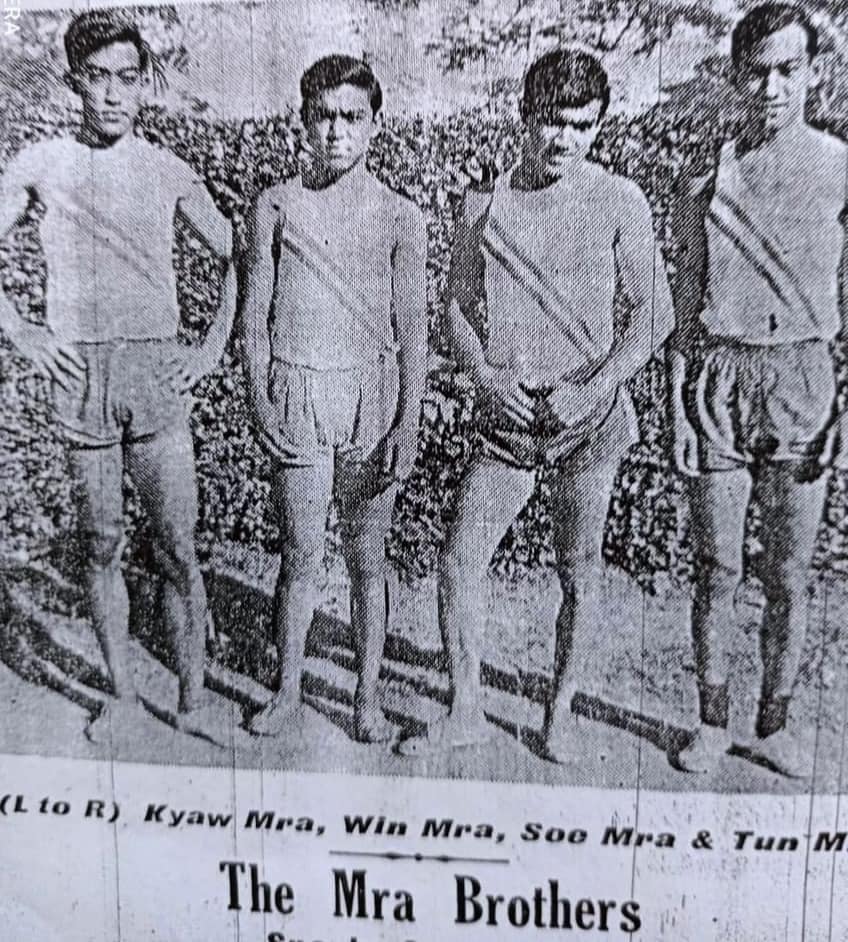
U Win Mra retired from Pole Vault Competition and became Burma’s Elvis Presley. He joined the Foreign Office. He served as Ambassador to the UN. Upon his return, he chaired the Burma Human Rights Commission. He is a Khamee Khamet of Sayama Toni .
Win Mra
Sao Kan Gyi (GBNF) wrote with the pen name “Khemerat”. His sister Biddy (spouse of Mawn Pong Sawbwa Lay) published a book in Australia.
Daw Khin Saw Tint is a bilingual author and a happy great grand mother. Her younger brother U Nay Oke Tint (St. Paul’s) gave a TEDx talk about their mother Daw Khin Saw Mu and her role in the Khit San Sar Pay.
Sayama Muriel (spouse of Saya U Aung @ Alphonso Rivers @ Ko Nge) moved to Thailand. I met them at Saya U Tin Maung Nyunt’s house in Milpitas. They were visiting their daughter in Southern California and made a short trip to Northern California.
Sayama Charity retired as Professor. I met her at SPZP-2012.
Saya Des sent me his book. He had back pain, which limited his traveling. For some time, he taught English on-line to students far and wide.
Joe Ba Maung (GBNF) was Burma’s Tennis Champion in both Singles and Doubles. He joined Burma Railways and also managed the Sports Program. He lost his job after 8-8-88.
U Kyaw Lwin Hla joined UNDP and had a long UN career.
U Khin also won some Scrabble tournaments, but the awards are less that those of Saya Des. He moved to Taiwan. He sent me a long e-mail in 2016 when Ko Maurice Chee (M75) organized a Birthday & Appreciation Soon Kway at Dhammananda Vihara, Half Moon Bay, California.
Class of M75 — Donated to Class Fund and Mechanical Fund
Worked in Singapore and USA
Past President, BAPS
Founding Member and Treasurer, RIT Alumni International
Wore Multiple Hats for SPZP-2000 — Co-Chair, Working Committee (SPZP-2000); Financial Controller; Publisher of the Commemorative Issue of “RIT Alumni International Newsletter” for SPZP-2000
Founding Member and Past Vice President, NorCal RITAA
Organizer, SF Bay Area Retiree Luncheon
Donor and Coordinator, Donation of books to YTU Library
Seminar, YTU Mechanical Engineering Department
Wrote “Planning for an engineering career in the US”
Planning for an engineering career in the US
The contents may not be up to date, since this is a re-post of an old article. However, the principles should apply.
Step One
For RIT graduates to become registered professional engineers, they need to take the Engineering-in Training which is an eight-hour exam given by the Department of Consumer Affairs, State of California. The exam is given twice a year. The following is a list of information and guidelines on E-I-T that I have extracted from the web site, http://www.dca.ca.gov.
General
Certification as an Engineer-in-Training (EIT) is the first step required under California law towards becoming licensed as a professional engineer.
Certification as a Land Surveyor-in-Training (LSIT) is the first step required under California law towards becoming licensed as a professional land surveyor.
Each applicant must file the application, pay the stated filing fee, and sit for the assigned 8-hour written examination. Persons who pass the written examination will be issued a certificate as either an Engineer-in-Training or a Land Surveyor-in-Training, whichever is appropriate.
Neither U.S. Citizenship nor California residency is required. However, you must provide your social security number or individual taxpayer identification number, or your application will NOT be processed. Disclosure of your social security number is mandatory. U.S. Citizens, if you do not have a social security number you may contact your local United States Social Security Office at 1-800-722-1213 or http://www.ssa.gov/online/forms.html. Non-U.S. citizens without a social security number may request an individual taxpayer identification number from The Department of Treasury (Internal Revenue Service) at (215) 516-4846 or http://www.irs.gov/ind_info/itin.html.
Examination Requirements
EIT applicants must have either completed 3 years of course work in a board-approved engineering curriculum OR have 3 years of engineering-related work experience, and never have been convicted of a crime related to the practice of engineering.
Examination Scope
The EIT examination covers fundamental engineering subjects including mathematics and the basic sciences. The exam has a four-hour morning and four-hour afternoon session. In the morning, all examinees answer the same 120 questions, each worth one point, covering the breadth of knowledge in engineering. In the afternoon session, examinees choose one of the six following subject areas: General, Chemical, Civil, Electrical, Mechanical, or Industrial Engineering. Candidates identify the chosen subject area at the examination.
Each has 60 two-point questions, written to test the depth of knowledge in the selected subject area. The total number of possible points for the morning and afternoon session is 240.
The LSIT examination covers material related to the fundamentals of land surveying. The exam has a four-hour morning and a four-hour afternoon session. In each session all examinees answer 85 questions and all are required.
The total number of possible points for the morning and afternoon sessions is 170.
Both the EIT and LSIT examinations are closed-book examinations. NO REFERENCE MATERIALS OF ANY KIND ARE ALLOWED. Calculators are acceptable, however, any calculating device having a QWERTY keypad arrangement similar to a typewriter or a keyboard will not be allowed for the exam.
How to apply
Submit a completed and signed application form to the Board office in Sacramento, together with a check or money order in the amount of $60 made payable to the “Department of Consumer Affairs”. Self-address and stamp a 4 x 5″ postcard for notification that your application has been received by the Board.
You may provide your own postcard. The card will notify you of the progress/status of your application. It will be mailed to you approximately two weeks after the receipt of your application.
The Board recycles reference manuals from the previous exam. EIT applicants (except renewal applicants) will receive a recycled manual from the Board. Applicants may purchase a new copy of the handbook for $9.95 from the National Council of Examiners for Engineering and Surveying (NCEES), 1820 Seneca Creek Road, Clemson, South Carolina 29633-1686, (800) 250-3196. It is possible to place an order on the publications page of the NCEES website.
LSIT applicants can purchase, for $9.95, a reference handbook on the Fundamentals of Land Surveying to help them prepare for the examination from the National Council of Examiners for Engineering and Surveying (NCEES), 1820 Seneca Creek Road, Clemson, SC 29633-1686, (800) 250-3196, or you may order it directly from the publications page on the NCEES website. Your application must be postmarked by the final filing date noted in the exam schedule to be accepted for the next examination. Applications received requiring postage due will not be accepted by our office. Final filing dates will not be extended for those who have their applications returned for insufficient postage.
Your admission notice will be sent approximately 10 days before the exam to the address indicated on your application. Use the Board’s address change affidavit to notify the Board if your address changes after you apply.
Step Two
After passing the E-I-T exam, one needs to obtain four years of experience under the direct supervision of a registered professional engineer (California License). You will need to get four references as part of your application. The registration fee is $175.00 and DCA administers the exam twice a year.
Please contact DCA to obtain the following information:
General References
Professional Engineers Act: Business and Professions Code sections 6700-6799
Professional Land Surveyors Act: Business and Professions Code sections 8700-8805
Rules of the Board for Professional Engineers and Land Surveyors:
California Code of Regulations sections 400 – 474.5
(For print copy of all three above, send $5.00 check, payable to DCA, to:
Attention: Cashier, P O Box 349002, Sacramento, CA 95834-9002. If you are licensed by this Board, you may receive a free copy. Just include your license number with your request)
Professional Engineer Plain Language Pamphlet (.htm)
Professional Land Surveyor Plain Language Pamphlet (.htm)
Professional Land Surveyor Plain Language Pamphlet (.pdf)
EIT/LSIT Examinee Instructions
Professional Engineer and Professional Land Surveyor Examinee Instructions
Special Civil Examination (Seismic & Survey): Reference List
Special Civil Examination (Seismic & Survey): Information for Examinees
Booklet
Traffic Engineer Examination Reference List
Geotechnical Engineer Examination Reference List
Structural Engineer: Special Format Information and Examination Instructions
Structural Engineer: Information for Examinees e_ge00refs.htm
The Eight-Hour Mechanical Engineering Exam format is now all multiple choice.
For information, follow this link to Principles and Practice of Engineering Examinations on the NCEES website.
The Eight-Hour Civil Engineering Exam format is now all multiple choice. The NCEES “Transportation Design Standards” has changed. For information, follow this link to Principles and Practice of Engineering Examinations on the NCEES website.
For information regarding use of codes or standards for any other examination offered by this Board, contact the National Council of Examiners for Engineering and Land Surveying (NCEES). The NCEES toll-free telephone number is: 1-800-250-3196.
Test Plans for California Specific Exams
Geotechnical Engineering Test Plan
Land Surveyor Examination Test Plan
Special Civil Engineering Survey Test Plan
Special Civil Seismic Principles Test Plan
Structural Engineering Test Plan
Traffic Engineering Test Plan
Step Three
Job Opportunity
RIT graduates with E-I-T certification and with no local experience can apply for entry level position as junior engineer with City and County of San Francisco and Bay Area Counties. There are several engineers including myself working for City and County of San Francisco and many hold higher engineering positions. Hin Lok Kung, a 1967 RIT graduate is the manager of the electrical section. Cal-Tran also accepts RIT graduates. U Myat Htoo is a Senior Transportation Engineer with Cal-Tran. Further, job advancement in civil service jobs requires registration as professional engineer. Most RIT graduates start their career with Consulting Engineers as design engineer or designer and many of them obtained their registration through the steps that I have described above. There are several consulting firms with RIT graduates as principal or partner.
Other Options
For those who are single, young, ambitious, academically good and financially sound, we would recommend to follow the footsteps of Mr. Benny Tan (M70) and Dr. Kim Chen aka U Nyo Win (M65) and go for post grad studies. To do so you may need to take the GRE and with good score you may be able to get admission to local universities.
Conclusion
The suggestion mentioned above is based on choosing an engineering career in the A&E industry. As always, career success depends on other factors such as possessing good communication, analytical, and problem solving skills, and a blend of theory and practice in the chosen engineering field.
RIT Alumni International
Founding Member and Treasurer, RIT Alumni InternationalWore Multiple Hats for SPZP-2000
Co-Chair, Working Committee (SPZP-2000)
Financial Controller
Publisher of the Commemorative Issue of “RIT Alumni International Newsletter” for SPZP-2000
Hello
The following is [a dramatization of] an event that happened last night (October 20, 2000).
“Hello, is this RIT Alumni International?”
“If you are Burmese, you can speak in Burmese.”
“We’ve landed at SFO. Someone was supposed to pick up at the airport and take him to his house. He’s not here.”
“I’ll come and pick you up at the airport. I’ll ask Ko Hla Min to contact your friend.”
Maurice Chee (M75), co-chair, Organization got the “wake up” call. He rushed to pick up Ko Ye Myint (the caller), his spouse and his father our beloved Sayagyi U Ba Toke.
I tried to reach Ko Zaw Min Nawaday (EP70) several times via his cellular phone and voice mail.
“URGENT. Sayagyi will be at Maurice’s house. Please contact Maurice immediately at xxxx”.
A few moments later, Ko Zaw Min called back.
“Ko Ye sent me an e-mail saying that they’ll arrive on 21st [Saturday]. Anyway, give me the phone numbers of Maurice.”
Minutes later, Ko Ye called from Maurice’s house. He was surprised that it was 20th [Friday] albeit late at night. Though he had made international travels, he failed to remember this time that you gain/lose a day by crossing the International Date Line.
Sayagyi spoke to me saying that he’s looking forward to the Reunion. He asked if Dolly Lim (Dr. Thynn Thynn Lynn) was the one who wanted to see him at the Reunion. Sayagyi remembered “Baw Lone” (Kyu Kyu Lin) and her siblings well.
If time permits, Sayagyi may visit Southern California and neighboring states.
Thanks to the various alumni — Saya Allen Htay, Saya U Tin Htut, Ko Zaw Min Nawaday, Ko Philip Mya Thwin — and last but not the least our golden sponsor Ko Maung Maung Than] for inviting Sayagyi over to the US.
Thanks to Ko Ba Thein (Atlanta, Georgia) for his article, “An Apology …”
Thanks to Ko Zaw Min and Chicky for hosting Sayagyi at their new house.
Thanks to Ko Maurice who “saved the day” for Sayagyi.
SF Bay Area Retirees’ Luncheon
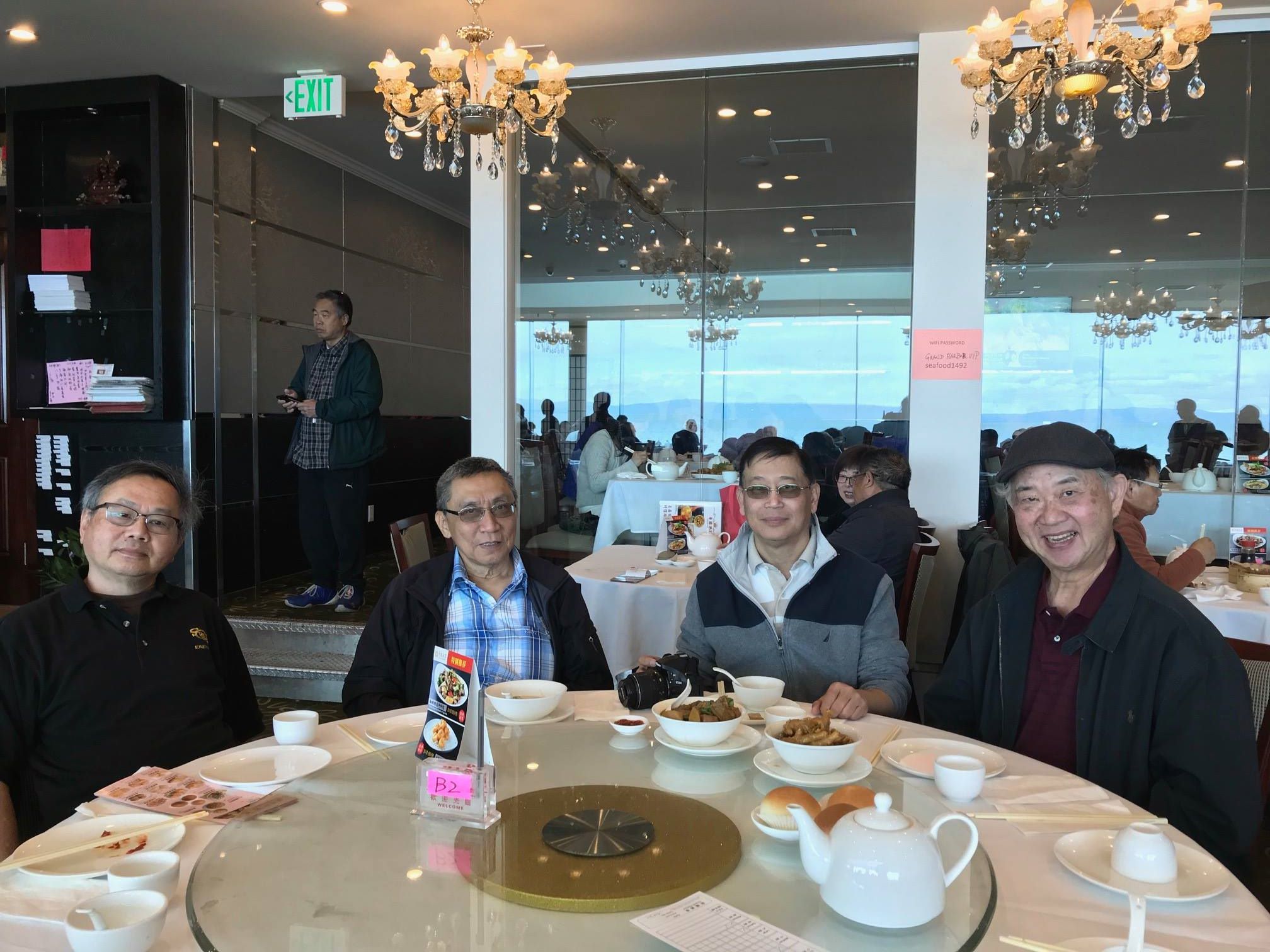
Ko Maurice Chee (M75) not only manages the monthly lunch gathering for retirees (sayas and alumni), but also brings prepared food. He cooked Chicken Danbauk.
To some gatherings, he brought Laphet Thoke.
Attendees include :
Saya U San Tun (Sain Fone Wong, M59) & spouse
Saya Dr. Nyo Win (M65)
Saya U Maung Maung (George, ChE66) & spouse
U King Wong (Victor, C66)
U Tin Myint (David, M67) & spouse
U Hla Min (EC69) & spouse
Walter Tan (M70) & spouse
Charlie Tseng (EC70) & Diana Tseng (ChE71)
U Aung Thein (John, M71) & spouse
Maurice Chee (M75)
U Aye Tun (Anthony, M76)
By default, the group meets on the 2nd Wednesday of the month at a specified restaurant or mall.
Maurice Chee (M75) is the organizer of the San Francisco Bay Area Retirees’ Lunch Gathering.
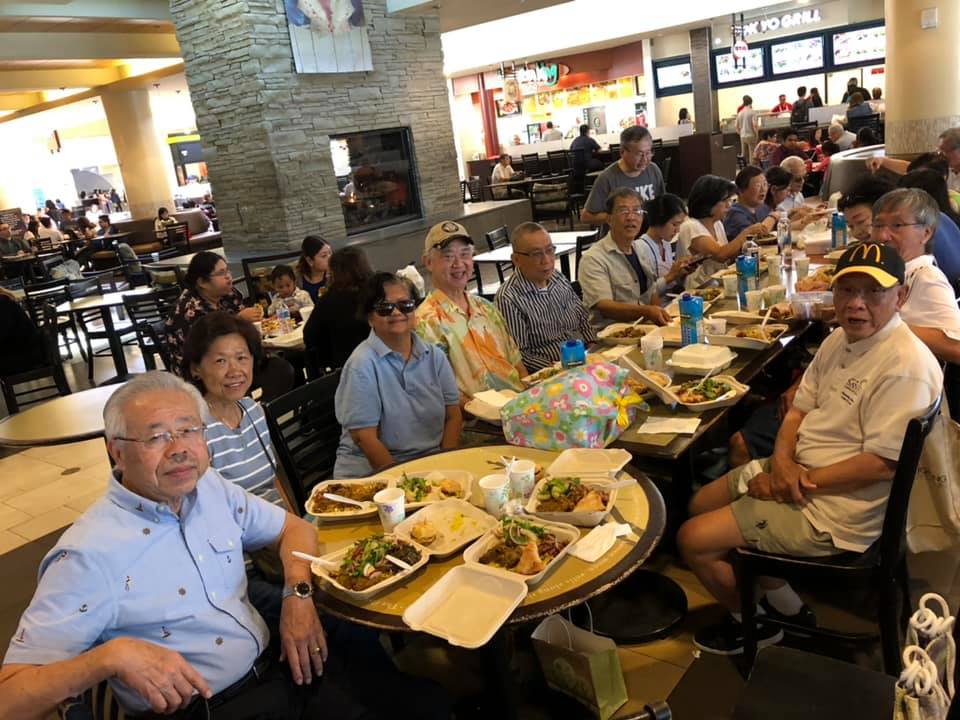
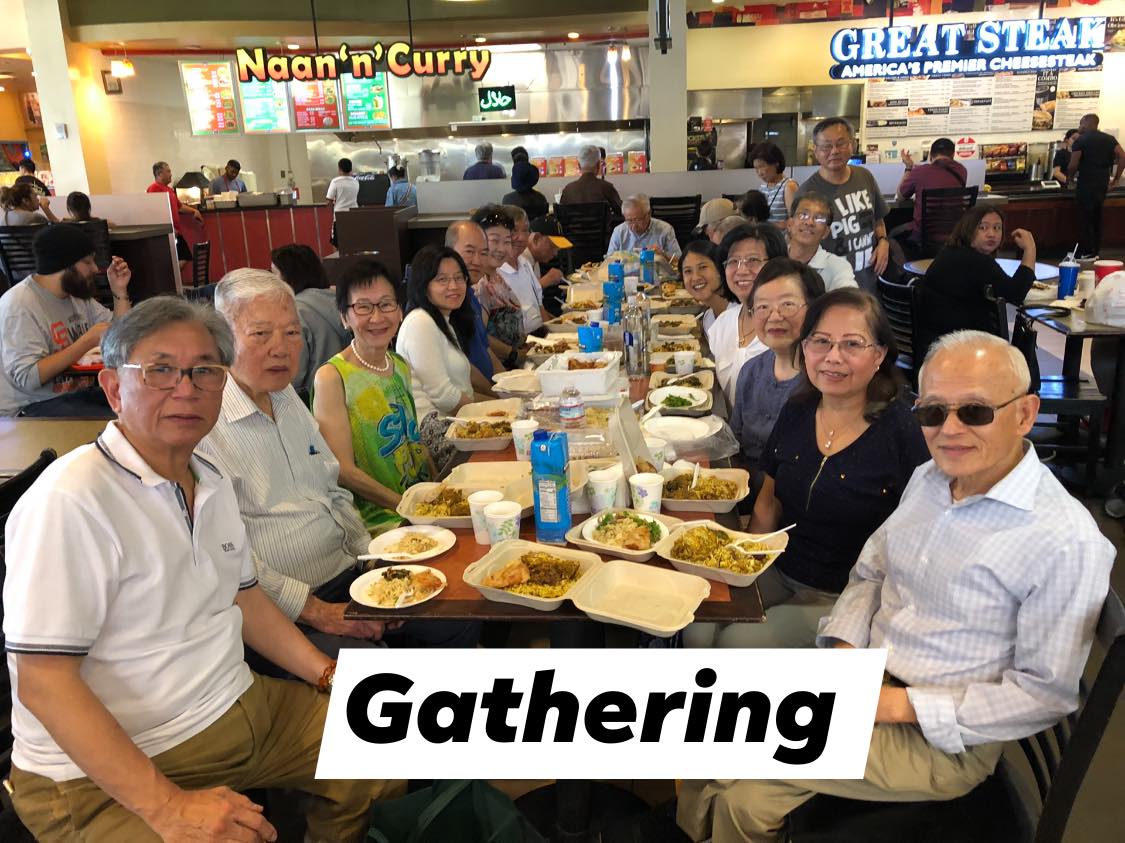
For August 2019, he chose the Food Court in Serramonte Mall, Daly City.
The attendees include :
Saya U San Tun (Sain Fone Wong, M59) and spouse
Saya U Maung Maung (George Chan, ChE66) and spouse
King Wong (Victor Wong, C66)
Stan Liou (M67) and spouse
U Tin Myint (David Ko, M67) and spouse
U Hla Min (EC69) and spouse
Benny Tan (M70)
Walter Tan (M70) and spouse
Charlie Tseng (EC70) and spouse Diana Tseng (ChE71)
Saya U Thein Aung (James K Wu, Met72), spouse Daw San San Nyunt (Sandra, M77) and daughter
Maurice Chee (M75)
U Aye Tun (Anthony Ng, M76)
Guest : Dr. Daisy Saw (Co-founder of ConBro, spouse of Derrick Wu (A62, GBNF)
Aug 2019Aug
Ko Maurice cooked his specialty Dan Bauk (Birayani) : one set with Lamb and another set with Chicken.
Others brought Fried rice, salad, drinks (Coconut milk, Water), fruits and ”Ah Cho Pwe” desserts.
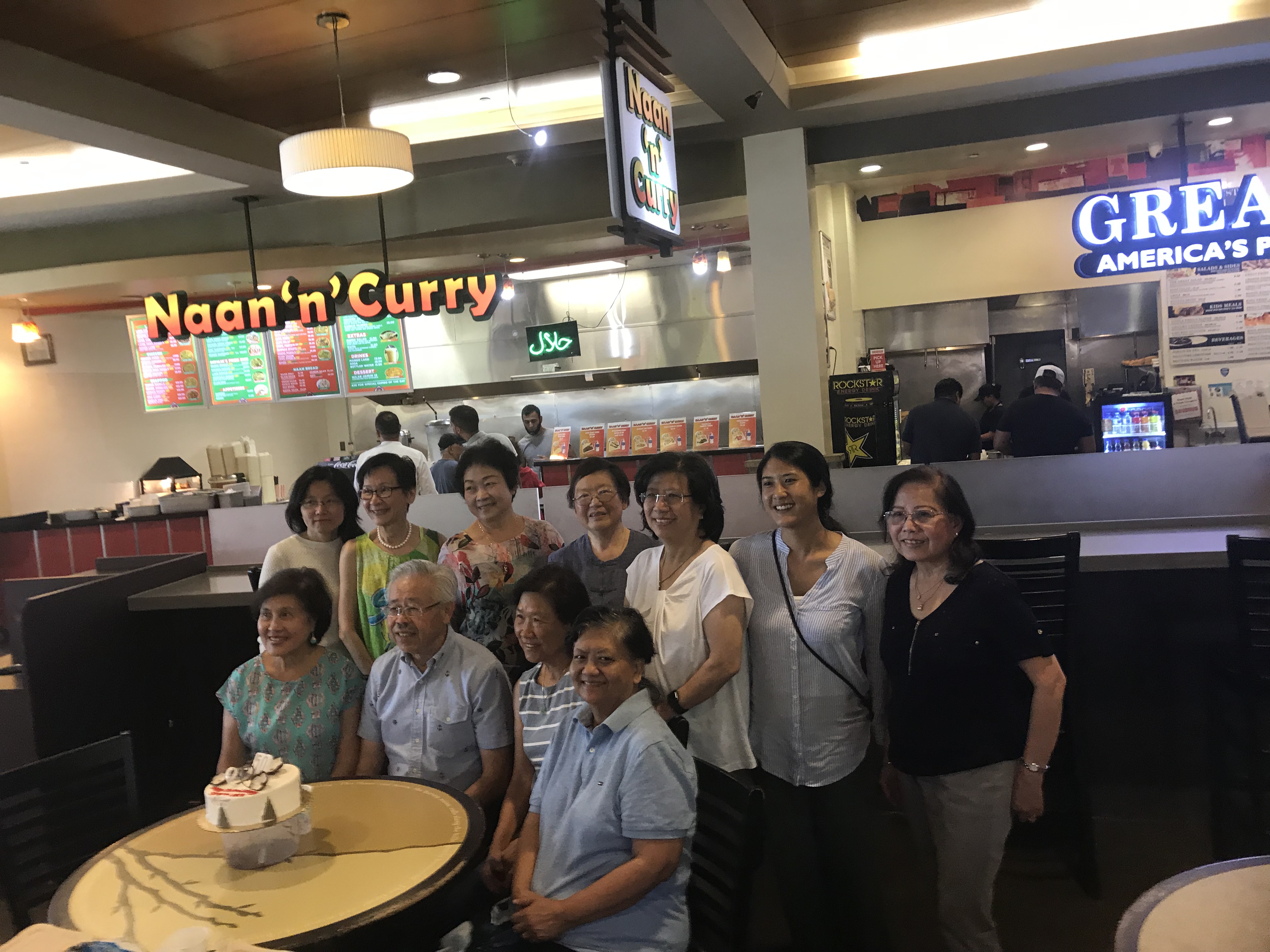
Tea was free to the clients of “Naan ‘n’ Curry” shop.
There was a Cake to celebrate the 50th Wedding Anniversary of Stan and Lu Lu.
It is a myth that brain cells die as you get older.
You can get smarter up to Age 100 by reading, doing puzzles, engaging in exercise like Tai Chi, playing instruments or learning dances.
Synapses are like wires that connect brain cells and they grow by above mentioned activities. They don’t die.
Acetyl choline is important for the cognition and drugs that we are using like donepezil (Aricept) prevent breakdown of Acetyl choline and they don’t work very well.
I will mention the diet, minerals and vitamins, and herbs that will reduce the risk of dementia and Alzheimer’s diseases.
Phosphatidylserine. 300 mg. a day to preserve serotonin and dopamine.
Bacopa. 300 mg. a day.
Ginkgo biloba. 120 mg. twice a day. Avoid if you are taking Coumadin.
Vitamin B 12. 800 mcg. a day.
Huperzine A (Chinese Club Moss) 0.2 mg. a day.
Essential fatty acids. flaxseed oil, fish oil.
Acetyl L carnitine. 500 mg. 3 times a day.
Phosphatidylcholine in fish, egg yolk, legumes, nuts and vegetables.
Turmeric (Curcumin). Cook your curry or go to Indian restaurant.
Zinc.
Vitamin B 6, B12, Folate and Vitamin D.
Jelly fish (Apoaequorin). Prevagen is the trade name for this. 10 to 20 mg. a day.
Citicoline is for ATP production and protects against free radicals . 500 to 1000mg. a day.
Dental care like flossing, brushing and rinsing to kill P. gingivalis which causes heart attacks, stroke and dementia by way of chronic inflammation.
PPIs like omeprazole lowers zinc level and increase risk of dementia.
Inorganic copper from copper pipes in drinking water is detrimental. Measure copper level and use reverse osmosis filter to lower it.
In the early 70s, New Zealand had an intensive technical training program with the Burmese government, namely the NZ Polytechnic sector and our GTI. One direct, international flight to Myitkyina with staff, teaching equipment and machinery was even made accessible to the NZ government. There is no such program that we know of at University level. However, there have been several at professional level with visits by Myanmar engineers and geologists in the Energy (Oil and Gas, Electricity) sector.
Graduate engineers from Myanmar also arrived in New Zealand in the early-to-mid 1970s. Almost all have settled in the North Island, particularly in Auckland, the City of Sails, which is also known as the gateway to NZ, where it is easier to secure jobs and the weather is relatively warmer. Currently, there are 27 alumni; 4 are architects and the rest, engineers. The most senior member graduated in 1967 and the youngest in 2003. Six are female and notably, two of them (both single) who used to live in Auckland are now working in Australia; one is in Perth, Western Australia working in the mining sector. Just as we are particularly proud of these two remarkably enterprising female alumni, we also take pride in our younger members who are pursuing post-graduate studies in their related fields in NZ.
In terms of Myanmar community functions, we are abreast with our counterparts in Australia, North America (USA) and SE Asia (Singapore). It is our engineering alumni who have, for the past 20 years, spearheaded the annual Thingyan celebrations in Auckland, and more recently, championed other socio-cultural events at our Buddhist monasteries. Although we do not have a formal engineering association per se, we have organized and enjoyed several summer get-together picnics in Auckland. On more than one occasion, our members have attended Myanmar Engineers’ gatherings in Sydney, Australia. In February this year, we successfully organized and celebrated our first “Get Together Auckland 2012” for Myanmar Engineers and Professionals. Of the 44 who attended, 4 were from Australia and 2 from Singapore. We envisage and sincerely hope that more RIT alumni will be able to join us in our future get-together.
Dennis (2nd from Left)
Editor’s Notes
Dr. Koung Nyunt (A67, GBNF) and Ko Myo Lwin / Stanley Saw (M71) were active RIT Alumni in New Zealand. They also attended SPZP-2000 in California and later SPZPs in Singapore and Yangon
Mr. Chairman, my Sayas, my former colleagues, friends, RIT graduates, Ladies and Gentlemen,
Before I begin to say anything, I would like to request you to take the word “RIT” as to stand not only for Rangoon Institute of Technology but also BOC College of Engineering and Faculty of Engineering, Rangoon University. I am using RIT only, just for convenience sake.
Having said that, it is with a chestful of emotions that I am standing before you, trying to say a few words appropriate and befitting to this important and joyful occasion. My overwhelming emotion is, needless to say, happiness – happiness which results from seeing my Sayas, my friends, my former colleagues, and RIT graduates alive and well, after so many years. My happiness is also mingled with a certain amount of pride: pride arising from the knowledge that we have fond memories and a sense of belonging and attachment to the good old institution as well as to one another.
We are fortunate that we could all gather here to exchange our life experiences, both good and bad, and to reminisce about our past when we were at RIT. While we are doing that, we all must have noticed that all of us have changed quite a bit since we last saw one another, at least physically, some more so than other. We all now have a few gray and also less hair, we have a few wrinkles on our face; maybe we also lost a few teeth and cannot see or hear as well as we did before. Some of us also lost the memory a bit and become forgetful about lots of things such as forgetting names for example. This, as we all know, is life and nature of things. Everything changes and nothing is permanent. Bur fortunately we still have our values. Our values such as respect and gratitude for the elders and teachers, caring of our respective children and family members, helping our friends, and attachment, and gratitude to the institution which nurtured us to meet the challenges of life, are still with us. They have not changed. This Saya Pu Zaw Pwe and reunion is a testimony to those values.
I must now pause and thank and congratulate the Organizing Committee for their untiring and selfless efforts to make this event possible and successful. This Saya Pu Zaw Pwe and RIT Alumni reunion is, as far as I know, once-in-a-life-time event. As far as I am concerned it is already a resounding success with the cooperation and great enthusiasm that I have seen. I hope this will be the beginning and not the last of our get-togethers. When my wife and I paid visits to Myanmar in 1996, 1997 and 1999 we had mini get-togethers with RIT Alumni. When I was here a few years ago we also got together with a few RIT Alumni. I understood that Saya U Aung Khin also had one mini get-together here some years ago. But these get-togethers were not on a grand scale as the one that we are having here now. However the spirit of camaraderie and friendliness among RIT Alumni mini get-togethers, was the same as the one that we find here now. If you look around you, you will find that all of us came here from different parts of the world, indicating the great attachment and respect that we all have for our old institution and also for one another.
While I was preparing for this speech, fond memories of the years that I spent as a student, as a teacher and later as Rector at RIT came flashing through my mind. Without going into details, I remember that all my teachers, including Saya Num Kock and Saya U Ba Toke who are here with us, were good inspiring teachers with kind hearts. When I became a teacher and later the Rector at RIT, I noticed that my colleagues were good and dedicated people who tried their best to teach what they had learnt from good Universities and Institutions abroad.
They made conscious efforts to raise the level of education at RIT so much that the students were fully occupied with classes, studies, projects, and homework. I have to mention here that my Sayas and my former colleagues were, and still are honest, compassionate, gentle and kind people. Within this context I would now like to take this opportunity to offer my humble apologies to my Sayas and colleagues for the wrong things that I may have done or said which might have hurt them in any way in the past.
As for the students, I remember that they were good, intelligent, and energetic students in general. Since I was also involved in extracurricular activities of the students, I had more interaction and gained more understanding of their needs and feelings. Like most of the other teachers I tried my best to be helpful to them not only in their studies but also in any other problems that they needed my help. Because of the compassion that I had shown for them they became more communicative, and listened to what I had to say most of the time. Like a breath of fresh air, the first batch of female engineering students were among us, I believe in 1958. So far as I remember they did as well as or some even better than the male students in their studies. I remember that as a teacher I felt very good and satisfied whenever some students did well in their studies or did well in their careers after they left school. These are fond memories that I still have with me about the students at RIT.
As you probably know, I left RIT and Myanmar in 1977 to join UNESCO. I then migrated to Canada to join International Development Research Centre (IRDC) in 1981. For your information, IRDC is a Canadian Agency which funds research projects for development in the developing countries. I retired from IRDC in 1997. Looking back to the past, I must say that I spent the best years of my life at RIT, challenging and troubling at times, but on the whole happy and satisfied with the job that I was doing.
Now please let me take a few minutes of your time to share with you my thoughts, which I believe are some important elements of life. You might not agree with me to what I am going to say. At least, in that case, you might take them as food for your thoughts. If I sound like lecturing to you now, you must remember that the habit of a former teacher dies hard. When I was young and immature. I had great admiration for people with high I.Q. (Intelligence Quotient). I also tended to think in those days that I was quite intelligent. After going through life experiences with ups and downs I became to realize that high Emotional Quotient (E.Q.) or emotional mastery is more important in life than high I.Q., to cope with adversities, disappointments, failures and sometimes even tragedies. No one that I know of, escapes the negative impacts of life in one form or another. If you have emotional mastery you can deal with and overcome these negative impacts and still get ahead in life and be relatively happy. One thing that can help us is to have optimism, hope and courage in life and to minimize the negative thoughts and creeping pessimism. It will be wrong to classify anything in life in opposites either in black or white. One can neither be fully optimistic nor fully pessimistic all the time. There is a gray area which is neither black nor white, and so long as the dominant part of this gray area is optimism, things will turn alright in the end. I read in one of the books long time ago that the Chinese word for “crisis” denotes both risk and chance (opportunity). A pessimistic person would tend to look at the crisis as the big risk and will despair and do nothing, whereas an optimistic person will look at it as a challenge and opportunity and will do something with courage and determination and overcome the crisis. He or she might fail in doing something. But without failures one will not know success. In short, although we will not be able to master the circumstances, and situations in life, we sure can try to master our thoughts and emotions to meet the challenges of life. Here are the spiritual sides of us or our respective religions might be helpful.
Now that I am getting old and getting inflicted with aches and pains here and there, especially when I get up in the morning, I begin to realize that the important part of my life is to keep myself in good health. There are lots of books and doctors telling us how to keep ourselves in good health. The simple gist of the whole message is to have some form of physical exercise or activity to keep our weights down; and to eat nutritious food and avoid or cut down fatty, sweet, salty and high cholesterol food which are harmful to our health. As you know, it is easier said than done. What I know is we do need to make conscious efforts to keep ourselves in good health by taking physical exercises and by eating nutritious and non-fattening food. One thing is for sure, if we are not in food health we will not be able to enjoy our success or good things in life, and we will be, relatively speaking, unhappy.
When I was young, my grandmother used to tell me to get ahead in life I would need luck, brain, and industriousness. She was right of course. But one important element in life that she missed telling me was to develop and have good social relationships will all the people that I would come across in life, including family members. No one can live and get ahead in life alone. Each one of us at some stages of our respective lives needed and got help from someone to move on with our lives. From my personal experience, I noted that one must be non-egoistic, not too aggressive, be polite, be helpful, and tries to understand and respect other person’s points of view, needs and feeling, to develop good social relationships. Here I would like to add that each of us can judge who is good, who is bad, who is untrustworthy, etc. and avoid bad people and associate with good people to the extent that each of us can.
Each one of us had twenty four hours a day and the one who can budget and manage his/her time day by day, week by week, month by month, year by year according to his priorities and short term and long term goals will get ahead in life better. One should use the time and even manipulate it and not waste it to achieve one’s short term and long term goals. One must also be patient if the short term and long term goals are not achieved in budgeted time. So long as the time is used and not wasted, one will reach his/her goads in due course.
I hope everyone present here will agree with me the importance of financial management at the personal or family level as well as at the business level. At the business level there are of course financial plans and budgets for the present as well as for the future. One should likewise have financial plans and budgets at personal/family level for the present and future, to spend, save and invest within one’s available means. As you know money is neutral. If you are wise, money will treat you well; and if you are foolish it will not stay with you for long. Like time, one’s hard-earned money should be used and not wasted.
The last thing that I would like to point out to you is the danger of complacency. If you own a business and if you are complacent after a certain level of success, your business will suffer, simply because you fail to keep up with the changes in the market conditions and because of the intense competition one faces nowadays. Likewise at the personal level we should be wary of complacency. We should try not to be complacent by improving ourselves and keeping ourselves busy mentally and physically. Life thrives on activity and activity is the proof of our existence. No one is perfect and there is always something that each of us can improve upon. If we do that, at least we will not be bored, and may achieve some fulfillment in life.
With these remarks I now conclude my speech. May you all be successful and happy in life. May you have a pleasant stay in SF.
After attending the 2nd year engineering class from June 1952 to September 1952, I went straight to MIT on a state scholarship to continue my studies . Saya U Min Wun and I went together to MIT and joined the academic session, starting from September 1952. We met Dr Freddie Ba Hli at MIT, who was already studying for his Ph.D in electronics or electrical engineering. He was one of the nicest and helpful persons that I have ever met in my life. He gave us briefings and guidance so that we were able to assimilate into the American education system and American way of life without any difficulty He also helped us with our home works when we had some difficulties in the beginning. I am forever grateful to him for his kind help. I am sure U Min Wun feels the same. Saya U Khin Aung Kyi, Saya U Sein Hlaing, U Percy Lao, U Win Htein, U Kyaw Min, Robin Aw, U Kyaw Thein, U Aung Kywe, U Aung Myint and U Sein Hla came to MIT for further studies at a later date. U Percy Lao later became Rangoon City Engineer (water and sanitation), U Win Htein who is an architect became a Rangoon City Building Engineer, and the late U Kyaw Min became a free lance architect [and also taught part-time at the Architecture department for some time]. All these three professionals taught some time at RIT. I do not know what happened to Robin Aw. The late U Kyaw Thein was an engineer at the Construction Corporation and later became a lecturer at the Civil Engineering Department at RIT. U Aung Kywe was a Director (water and sanitation) at the Construction Corporation. U Aung Myint became the Chief Architect at the Construction Corporation. U Sein Hla was an engineer at the Construction Corporation and later became the Registrar at RIT under Rector U Yone Moe. Later more batches of Burmese students came to MIT when I was no longer there. I am describing all these things to point out the fact that the standard of engineering education in Burma at that time was quite good. None of us had to go through the entrance examination to get into MIT. They trusted our grades and our education standard. Maybe the visiting Professor Horwood from MIT was quite impressed with the Faculty of Engineering and put a good word for us to the MIT admission authorities.
I will not go into details of the activities of all the various students’ associations, societies and clubs, as there were so many of them. But I would like to mention briefly about the hostel life, that I had experienced at that time. Every hostel had what we called a social and reading club . There was an adequate room reserved for this club at the ground floor of the hostel. In general, newspapers, popular magazines, a chess board, a carom board and a table tennis were provided so that the hostel students could read, play chess, play carom board, and play table tennis and socialize to get to know each other well. Even without the social and reading club, all the hostel students ended up knowing each other well sooner or later, as they met each other almost everyday at the hostel and at the dining hall. The hostel students were in general well behaved. I hardly saw the Warden or Hall Tutors at Ava Hall and Prome Hall, as there were very few student problems which needed attention of the Warden or Hall Tutors.
Based upon my experience, I feel that these extra-curricular activities and hostel life gave the opportunities to the students to broaden the knowledge of the different parts of Myanmar; and they also created a better understanding of the different culture, food, habit, dresses, dialects etc of the country. Most of the students developed life-long friendships through these activities which contributed to well-beings of these students throughout their lives. Sport activities also taught the students about hard work, cooperation, team work, competition, winning and losing. The extra-curricular activities also triggered, developed and enhanced the hidden talents of some of the students. These activities therefore formed part of the University education of the students, in addition to the education that they received from the classrooms. Another benefit of these activities was the bonding and a better understanding, which developed between the students and the teachers who were involved in these activities.
After getting my Bachelor degree in Cvil Engineering in 1955 and my Master degree in Civil Engineering in 1956 from MIT, I worked for Engineering Companies for a year, which involved both design and fieldwork in engineering construction projects. I then came back to Rangoon in 1957 to join the Civil Engineering Department as an Assistant Lecturer. I was promoted to become a Lecturer in 1958 and became also more or less Head of the Civil Engineering Department. The policy in place at the University of Rangoon under the Ministry of Education at that time stated that a teacher/ any person could become a lecturer / professor only if he/ she had a post graduate degree. Sayagyi U Ba Hli was the Professor of Civil Engineering and Dean of the Faculty at the same time. U Aung Khin was Head of the Mechanical Engineering Department, U Sein Hlaing was Head of the Electrical Engineering Department, U Khin Aung Kyi was Head of the Chemical Engineering Department, U Soon Sein was Head of the Mining Engineering Department, U Thit was Head of the Metallurgy Department, and U Maung Maung Than was Head of the Textile Engineering Department. I think Mr Johnson was Head of the Architecture Department. I do not remember who was the Workshop Superintendent at that time. We were quite happy as we had new facilities near the Prome road in addition to the B.O.C College of Engineering building. These new facilities comprised of a tall administrative building (with offices, conference/meeting rooms, library), classrooms, lecture theaters, laboratories , offices for the teaching staff and a small assembly place under the copper dome roof in the corner of the campus. The dome roof looked like a turtle back, and pretty soon this new campus became known as “turtle dome /leik khone” campus. After our arrival from USA, UK etc, the foreign teachers under contract were let go, as we gradually replaced them, except for a few teachers from UK or USA. I could recall Prof. Neale? in Electrical Engineering Department, Mr Redpath and Mr Skelton in Mechanical Engineering Department and Mr Johnson and Mr Nagler in Architecture Department.
As a young teacher I was surprised and pleased to see a few pioneering female engineering students (not more than ten) at the Leik Khone campus. They and their parents overcame the social uneasiness and they decided to study engineering/architecture to become lady engineers /architects. I do not know exactly when they first joined the 1st year engineering class; but It was one of the important turning points in the history of engineering education.
As young teachers, most of us were struggling to learn how to teach effectively at the beginning. I noticed that we were teaching about 15 to 20 hours per week which included lectures, laboratory and drawing classes. The contact hours of learning for the students remained the same as the time when I was an engineering student i.e. about 30 hours per week. The passing grade for the students also remained the same. i.e. 40% for each subject and 50% average for all the subjects combined. The medium of teaching was still in English. The laboratory and workshop facilities were quite good and adequate for the student population that we had. But the library looked quite small when I compared it with the library that they had in MIT, although it had a few good engineering books and journals. I felt that it needed a lot of investment to become a top notch engineering library.
It was with enthusiasm and hope that most of us were busy trying to build up our respective departments and trying to improve the engineering education in general. While we were busy, Professor and Dean U Ba Hli retired some time around 1961, and in place of U Ba Hli we had a succession of temporary Deans, Professor of Chemistry U Po Tha, Professor of Geology Dr Tha Hla, and Professor of Physics Dr Maung Maung Kha for about 6 months. The Faculty of Engineering also had to move to a new campus in Gyogone in 1961. Before our relocation to Gyogone, the Faculty of Engineering was one of the Faculties of the University of Rangoon. The academic and administrative related policy decisions were made by the Senate and Administrative Council of the University of Rangoon respectively so as to maintain and improve the standard of education of all its Faculties, including the Faculty of Engineering.
As you all know, Gyogone campus was built with the aid of Russia; and I understood that the Government of Burma paid back the cost in rice. I do not know whether it was true or not. In any case it was and still is an impressive looking campus. The buildings accommodated classrooms, laboratories and workshop, big assembly hall with a movie projector, library, offices for the administrative and teaching staff,and student hostels. There were also houses for all the staff, dining and kitchen facilities, small medical clinic, and open space for sport activities. All the buildings, houses etc occupied and still occupy a large area in a compound.
I have chosen 1950 as the start of my recollections regarding the state of higher learning in the field of engineering because I was admitted to the Faculty of Engineering, Rangoon University, in June of that year. Also, Sayagyi U Ba Hli started his first year as Dean of Faculty of Engineering, having transferred from Government Technical Institute at Insein. The requirement for admission was 50% aggregate in Intermediate of Science Examination and there was no limit to the number admitted. There were about 75 students in my First Year, which included fresh admissions, repeat students and a few New Course transfers. I should explain that New Course transfers were those who signed up for the 5-year condensed degree course after matriculation offered in the previous years and which was scrapped in the year of my admission. When I started on my engineering course, it was of four years’ duration, at the end of which the degree of Bachelor of Science (Engineering) was awarded.Since I was a student as well a teacher of engineering, I will attempt to present my perspective of Mechanical engineering education from both sides.
In the first and second years of study, the students had to take courses basic to Civil, Electrical and Mechanical Engineering, namely, Geometric, Machine and Building Drawing, Building Construction, Electrotechnology, Heat Engines, Surveying and Workshop. In addition, The Mathematics Department of Rangoon University was responsible for teaching Statics and Dynamics. Only in the third year were the students get to choose their line of engineering, civil,electrical or mechanical. So began my first year classes at the BOC College building. Actually, the first classes started every morning at 7am at the Mathematics Department where we were taught Statics and Dynamics by Dr. Sarkar till 9am. He was an extraordinary teacher and remembers every student by his roll number. Then we began the long trek to BOC College for rest of the classes of the day. Usually, lecture classes preceded before we spend the afternoon in the drawing room, laboratories, survey field or workshop.
The full-time staff of the faculty consisted of Dean and Professor of Civil Engineering Sayagyi U Ba Hli, Lecturer in Civil Engineering Sayagyi Mr. Jaidka, Lecturer in Electrical Engineering Sayagyi U Kyaw Tun, Assistant Lecturer in Civil Engineering Sayagyi Mr. H. Numkok and Superintendent of Workshop Mr. J. P. Law. Part-time lecturers were recruited to meet the goal of satisfying the requirements of the syllabus in each of the three disciplines. First and second year students were taught Building materials and construction by Sayagyi Mr. Jaidka, Electrotechnology by Sayagyi U Kyaw Tun ably assisted by Laboratory technician U Ba Sein in the laboratory, Heat Engines by part-time lecturer U Aung Than, Chief boiler inspector and Drawing by part-time lecturer and later on by Sayagyi Mr. Numkok when it came to Building drawing. Workshop program involved spending one term in each of the four shops, namely, machine, fitting, carpentry and blacksmith. Mr. J. P. Law made sure that students get hands-on experience in the use of tools. He stayed on for one year and was succeeded by U Aung Gyaw. Sayagyi U Ba Hli considered that technically challenged environment required students to be practical and workshop experience as well as summer practical training was essential. First year examination was a relatively easy hurdle for most students whereas the Second year examination was a lot harder and a career make or break event. I managed to get past the hurdle and found myself in the Third year to pursue my choice of Mechanical engineering in June of 1952. There were about twelve of us, all hoping to be an Assistant Engineer holding a civilian job, or a Leutenent in B.E.M.E. who were on army stipend, upon graduation. Third year courses included Heat engines, Theory of machines, Machine design, Electrotechnology, Strength of materials, Hydraulics, Metrology and Industrial management. We finally had a full-time staff in mechanical engineering. He was Mr. Khetrapal who came over from B.O.C. as an Assistant lecturer and he took care of all mechanical engineering subjects. In addition, Sayagyi Mr. Chelk Ping Lee came over from Directorate of Technical education to join the Electrical engineering staff and taught us Electrotechnology. Industrial Management was taught by a contract lecturer from India. We also had a U.S.Visiting professor and he taught us Strength of materials and for the first time we were introduced to the American quiz system of teaching.
About that time, the University focused its attention to modernizing and increasing the number of disciplines in the Faculty of Engineering by upgrading the staff as well as sending state scholars to the U.S. for future staffing. Sayagyi U Kyaw Tun was sent on deputation for post-graduate studies, followed by selection of several state scholars from among the engineering students. The first two were Sayagyi Dr. Aung Gyi and Sayagyi U Min Wun, earmarked for Civil engineering, followed by Sayagyi U Pu and me for Mechanical engineering, Sayagyi U Khin Aung Kyi for Chemical Engineering, Sayagyi U Maung Maung Than for Textile engineering, Sayagyi U Sein Hlaing and Sayagyi U Tin Swe for Electrical Engineering, Sayagyi U Kyaw Min for Architecture and Sayagyi U Thit for Metallurgy. We formed the initial group and other sayas were sent abroad for further studies in succeeding years as opportunity arose. I was instructed to leave for the U.S. in late December of 1952 to be in time for the start of the spring semester. So ended my exciting years at the Faculty of engineering and my classmates gave me and Sayagyi U Pu a farewell tea at the Sun Cafe to send us on our way.
I returned in early part of 1956, having obtained the Bachelor’s and Master’s degrees in Mechanical engineering, the latter being an essential qualification for promotion to lecturership. Sayagyi U Ba Than had returned earlier from England and Sayagyi U Ba Hli got him working during summer holidays on various tasks such as supervising installation of new laboratory equipment, in preparation for the opening of the new school year. I was appointed as an Assistant lecturer in June. In the three years I was away, rapid and vast changes had taken place. Academically, engineering disciplines increased from three to seven, additions being Chemical engineering,Textile engineering, Mining engineering and Metallurgical engineering. Architecture department was also added to the Faculty. Staffing of the expanded fields of engineering as well as existing ones involved hiring contract teachers from India.Furthermore, additional staffing was provided by Columbo Plan donor countries in the form of visiting lecturers. On the physical side, a brand new complex was built fronting Prome Road by Taylor Woodrow Construction Company, consisting of an assembly hall, known as “Leik Khone”, administrative building and teaching blocks housing drawing rooms, lecturer theatres, classrooms and laboratories. Civil, Electrical and Mechanical engineering departments and Architecture department were located in the new complex. More importantly, Mechanical engineering department benefitted when Colombo Plan aid was channeled to provide laboratory equipment to various departments. A new Applied Mechanics laboratory located in the Mechanical wing was acquired. More modern equipment was added to the Strength of materials laboratory located in the new laboratory block. Heat engines laboratory recieved an educational Gas turbine unit along with other engines hooked up for testing.
I started my teaching career, for which I was earmarked when I was sent abroad for advanced studies, at a time of transition. The Mechanical engineering department had a staff of contract teachers from India and visiting lecturer Mr. W. Redpath from United Kingdom. Workshop Superintendent was Mr. V. Simon. Sayagyi U Ba Hli assigned me to teach First Year Drawing and First Year Heat Engines. Also, I was to assist Mr. Redpath in conducting the Heat Engines laboratories for the Third and Fourth Year students. The number of students admitted to the Faculty had been growing over the years and the size of the First Year Heat Engines class was about 150. Drawing classes were split into sections and limited to about 40 students each. The following year Sayagyi U Pu returned and later on Sayagyi U Ko Ko Gyi joined the staff. However, the contract teachers were leaving and the slack was taken up by the collective effort on the part of all of us. At the same time, attention was directed at modifying the syllabi of various departments to correspond with specialization in the practical field. Decision was made to introduce courses pertinent to a particular field of specialization at earlier stages, split some courses into component specialties or replace with more appropriate course. Subject of Mechanisms was introduced in the Second year. Heat Engines for First and Second years was renamed Thermodynamics to cover fundamental concepts and for senior years was split into Internal Combustion Engines and Refrigeration and Air Conditioning. Fluid Mechanics replaced Hydraulics. Corresponding expansion of staff was taking place with Sayagyis U San Tun, U Tin Hlaing, U Tun Shwe joining the staff. All of them, along with Sayagyi U Ba Than, were sent abroad later for advanced studies.
In the late 1950’s, we learned that Soviet Union would make a gift of a complete and fully equipped Institute of Technology to be built at Gyogon with skilled and semi-skilled Burmese workers of Public Works Brigade together with Soviet Specialists. The Soviet Union would also provide lecturers in special fields as needed. It was decided that the Faculty of Engineering would be moved to the new location and reconstituted as a separate educational facility at the same time preserving the existing engineering education format and of six years duration with high school matriculates entering the First Year. It was realized that more drawing and laboratory space was required to accommodate the large classes entering the system. So three more buildings were added to the original design and where Mechanical Engineering and Architecture Departments were located. Thus Rangoon Institute of Technology was created as a pre-eminent place of higher learning in the country. Sayagyi U Yone Mo was the first Rector of the Institute. This is where I will end my recounting of events past, sometimes vague, with the dawn of a new decade and hope that it might help those wanting to know the humble beginnings of mechanical engineering education in a place called Myanmar. All of us who taught at, studied or graduated from or otherwise associated with the Institute remember it as a special place and fondly refer to it as R.I.T.
I graduated from the University of Rangoon with a Bachelor’s degree in Civil Engineering in March 1954. The few years I spent at the University of Rangoon, particularly at Engineering, were one of the happiest and most rewarding times of my life.
The BOC College of Engineering was actually the School of Engineering in the late 1940’s and early 1950’s. It was funded by BOC (British Oil Company). It was then understandably heavily mechanically and electrically oriented. In my first two years, about half of the faculty members were Britons and the Dean of the Engineering Faculty was Professor Davies. We had very excellent lecturers who were of diverse ethnic background – Indians, Chinese and Burmese – but they and us the students were all Burmese citizens. I spent four years at Civil Engineering (CE). We the civil engineering students were required to take some basic mechanical and electrical courses and workshops also, while the mechanical and electrical students were not required to take any civil engineering courses. Since these courses were mandated or compulsory for civil engineering students, I could not avoid them. I did pass those subjects but not very proud of it because they were not my major interests.
Professor Davies and all the Britons left Rangoon around 1950. U Ba Hli took over the engineering faculty as Dean. To his credit, U Ba Hli ran the school very professionally. He recommended and managed to get many of his students and graduates to go abroad for graduate studies. These student-graduates of his came back to Myanmar with master’s degrees and doctorates from England and USA to teach under his deanship. U Ba Hli also initiated an education exchange program with the Massachusetts Institute of Technology (MIT, located in Cambridge, Massachusetts, USA) during the period beginning, I think, in 1951 and ending in 1954. The program brought 3 to 4 civil, mechanical and electrical professors from MIT to Rangoon University. The R.U. Engineering Faculty made a very impressive and quick progress in its worldwide reputation and was duly recognized and accredited internationally. I am proud to say that we Burmese students, including myself, did exceedingly well at the foreign universities in England and the U.S. This shows that, given the opportunity and the tools, we the Burmese students were as good, if not better than, as any other in the world. I went to MIT for graduate studies, came back to Myanmar with a Master’s degree in 1957 and served the Myanmar government in the National Housing and Town and Country Development Board for a number of years. Many of my fellow students from R.U. Engineering went to and graduated from MIT, Harvard, Cornell, Michigan, UCLA, Columbia and other big-name American universities.
In my first year at RU Engineering I stayed at Prome Hall for a semester. The Prome Hall Football (soccer) Team was the best, the champion team of all the university teams all the time, winning the university championship trophy for years in a row. You know, we the engineering students were very close; we were like a family. We never thought of ourselves as Burmese, Indians or Chinese. We loved each other, helped each other, and took care of each other like brothers (there were no female students in engineering during my time). In fact, all engineering students were very united as one family. Our classes at that time had only 12 to 14 students each. Even the professors treated us like they were our older brothers, but of course we addressed them as Sayas with deep respect. As far as I can recall, no one from my class or any other class failed in any subjects or to graduate from RU. I learned a lot from RU Engineering and enjoyed every courses, including the Surveying Class in a summer. I must confess that although we appreciated the Geology course at the Geology Department, which was located like miles away from the Engineering school, this was the least liked by my entire class of students and we all scored a “C” or “C-” at best. The geology professor didn’t like us either because we were usually late arriving for his class lectures. But we couldn’t help being late, considering the distance we had to walk or bike from Engineering to the Geology Department. I hope for the present engineering students, some arrangement could be made for a geology professor to walk or bike from his department to Engineering, instead of having so many students getting late to his class. Although I wouldn’t consider myself as a top-notch or extremely bright student, somehow even with a “C” for geology, to my and my fellow students’ great astonishment I was placed second in my final year exams.
I fondly remember the little Indian restaurant by Prome Hall where I and my many friends used to have lunch, paratas and keema paratas. I also enjoyed boating at the Inya Lake when we occasionally skipped classes.
Update
He attended SPZP-2000. He requested to be seated with the Sayagyis (his contemporaries at RU)
He was active with RUESU.
He served as Business Manager for an Annual Magazine of RUESU.