First school established by the De La Salle Brothers in Burma.
Built in Moulmein (1860)
Photos taken during my visit to the school (2016)
Clock Tower, boarding house upstairs, exam hall below
Photos taken during my visit
St. Pat 1St. Pat 2St. Pat 3Entrance
Memories
Our class photoV B
Our class photoVII Std
Class teacher Bro. Sebastian. I met Bro Sebastain during our first year at Leikkone in 1958-59 while he was attending BAed.
Ko Ko Lay (UCC) first row, sitting second from left. U Aye (M62), second row, sitting second from right. B. Singh (RU goalkeeper) third row, first from right, Myo Lwin (M63), third row third from right.
Absentees : Kyaw Win (M62), Peter Gale.
Bro Canice was Bro Director, House Master Mr. E. Swarris, House Capt. Dr. Aung Myin (Eye, passed away in UK around 2018), U Win Naing (MS pulp and paper)(CRO) third row, fourth from right, U Aye, third row, third from right.
Our matriculation class 1955-56
Bro Austin, Bro Director, Bro Wilfrid, Class teacher, U Tun Shwe, Myanmar Sar, Mr. DeMonte, Moral and Manners.
Peter Gale, Dr. Thet Lwin (Statistics), B. Singh (RU goalkeeper), medical doctors Dr JK Sinha (UK), Dr Rafi, Dr Rajani Vora, India, Capt. Aung Myint, Capt Ya Kyaw, Myo Lwin (M63), Kyaw Win (M62), John Ba Maung, Russian Lecturer (IFL)
Prof. Khin Zaw (Chemistry), Saw Alfred Keh (Preacher after graduation, son of pre-WW2, RU footballer Washington Keh), U Kyi Win (BPI), U Aye among others.
St Patrick’s HS football team of late 40s and early 50s
During 1948-49, St Pat’s team beat all other Schools’ Combined team. Some of the team members were-
Bernard Henry – Goalkeeper,
R. S. Pathy, Tin Aye — Fullbacks,
Pway Ain (Htay Aung), Jimmy Innes, Tin Ngwe (Mid-field),
Rama (Rightwinger), Khine Thein,SV Lingham, Jimmy Sein (Tint Swe), B. Boudville (Left winger).
Later Pway Ain (Htay Aung) played for RU, Jimmy Sein (Tint Swe) played for Prome Hall and RU. Jimmy Innes played for Customs FC in Rangoon first div.
Many played in Friends Union FC in Moulmein first div.
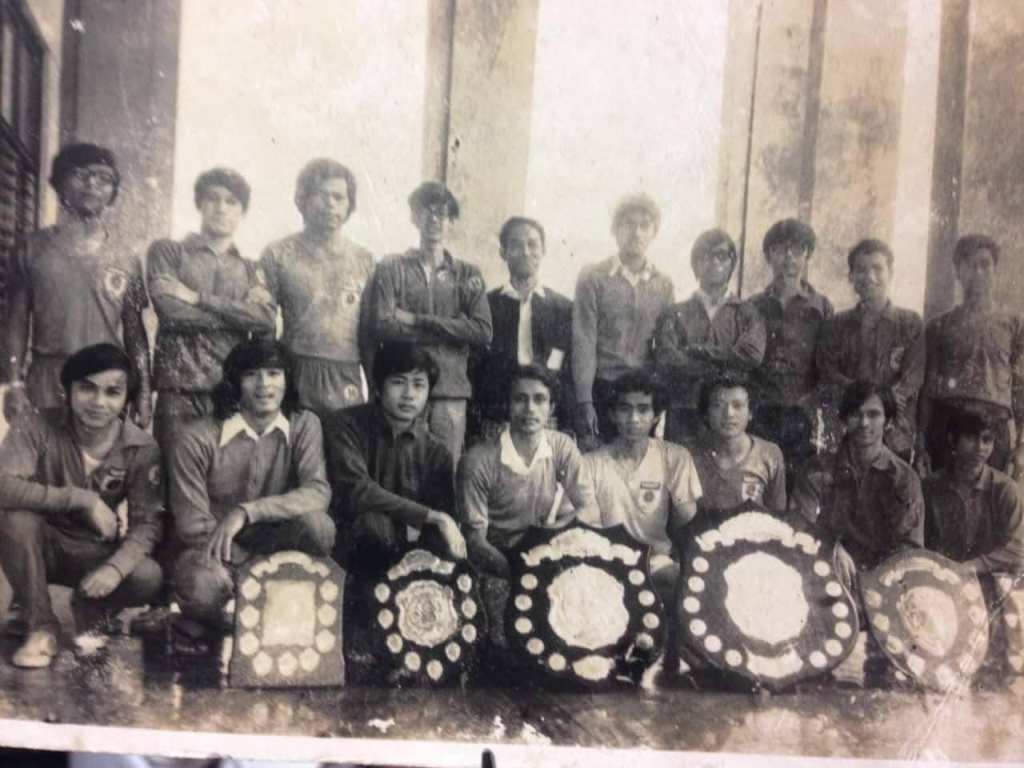
St Patrick’s Alumini, Ko Ko Gyi, Tenasserim division and Burma selected footballer.Standing second from L Pway Ain(Hyay Aung)) and Jimmy Sein(Tint Swe) seated second from L, were from St Patrick’s HS football teamB.Singh back row, fifth from L in black goalkeeper jersey, the tall guy was from St Patrick’s HS, he was also a Tenasserim Division player. He was my classmate in St Pat.
Dennis Mackey (C73) wrote
Thanks for this piece as part of your “Work in Progress”.
Below are photos and notes that I posted on my FB page and on St. Patrick’s HS, Moulmein FB public group page.
De La Salle Schools — St. Pat (Moulmein), St. Paul’s (Rangoon), St. Peter’s (Mandalay), St. Albert’s (Maymyo), St. Columban’s (Bhamo), St. Joseph’s (Loikaw), DLS (Twante)
Private schools were nationalized on April 1, 1965
U Aye represented RU & BIT in Volleyball. He graduated with Mechanical Engineering in 1962. He worked for HIC and FAO.
I read through your updates shown in hlamin.com and my suggestions are given below.
I feel that your book should reflect the love of RIT students for their alma mater, the respect and gratitude shown by RIT students towards their respective teachers, the attachment, bond and friendship among RIT students; and the love for their motherland by RIT students. In short, it should reflect what we call “RIT spirit”. You can base the preparation of the book, beginning from the establishment of Faculty of Engineering, Rangoon University, on your updates and other relevant sources. The word RIT includes all different names of Engineering Institutions in Myanmar, past and present.
Having said all of the above, the following headings come to my mind for your proposed book:
SPZPs/Reunions involving all disciplines which had taken place in Myanmar and abroad.
Establishment of alumni associations abroad and in Myanmar to help RIT and motherland.
Establishment of Swe Daw Yeik Foundation.
Establishment of healthcare fund for RIT teachers in Myanmar.
Fund drive and contributions to upgrade the RIT/YTU library.
Various activities/ mini-reunions / get-togethers among groups of RIT students/teachers which reflect the life and also bond among RIT students/teachers, established in the past ,during RIT days.
Other interesting episodes related to RIT.
The above gives you a few thoughts I have for your book. I would like to recommend that you also get suggestions from others for your book.
Good luck and best wishes. Aung Gyi
(2) Keynote from SPZP-2000
Mr. Chairman, my Sayas, my former colleagues, friends, RIT graduates, Ladies and Gentlemen,
Before I begin to say anything, I would like to request you to take the word “RIT” as to stand not only for Rangoon Institute of Technology but also BOC College of Engineering and Faculty of Engineering, Rangoon University. I am using RIT only, just for convenience sake.
Having said that, it is with a chestful of emotions that I am standing before you, trying to say a few words appropriate and befitting to this important and joyful occasion. My overwhelming emotion is, needless to say, happiness – happiness which results from seeing my Sayas, my friends, my former colleagues, and RIT graduates alive and well, after so many years. My happiness is also mingled with a certain amount of pride: pride arising from the knowledge that we have fond memories and a sense of belonging and attachment to the good old institution as well as to one another.
We are fortunate that we could all gather here to exchange our life experiences, both good and bad, and to reminisce about our past when we were at RIT. While we are doing that, we all must have noticed that all of us have changed quite a bit since we last saw one another, at least physically, some more so than other. We all now have a few gray and also less hair, we have a few wrinkles on our face; maybe we also lost a few teeth and cannot see or hear as well as we did before. Some of us also lost the memory a bit and become forgetful about lots of things such as forgetting names for example. This, as we all know, is life and nature of things. Everything changes and nothing is permanent. Bur fortunately we still have our values. Our values such as respect and gratitude for the elders and teachers, caring of our respective children and family members, helping our friends, and attachment, and gratitude to the institution which nurtured us to meet the challenges of life, are still with us. They have not changed. This Saya Pu Zaw Pwe and reunion is a testimony to those values.
I must now pause and thank and congratulate the Organizing Committee for their untiring and selfless efforts to make this event possible and successful. This Saya Pu Zaw Pwe and RIT Alumni reunion is, as far as I know, once-in-a-life-time event. As far as I am concerned it is already a resounding success with the cooperation and great enthusiasm that I have seen. I hope this will be the beginning and not the last of our get-togethers. When my wife and I paid visits to Myanmar in 1996, 1997 and 1999 we had mini get-togethers with RIT Alumni. When I was here a few years ago we also got together with a few RIT Alumni. I understood that Saya U Aung Khin also had one mini get-together here some years ago. But these get-togethers were not on a grand scale as the one that we are having here now. However the spirit of camaraderie and friendliness among RIT Alumni mini get-togethers, was the same as the one that we find here now. If you look around you, you will find that all of us came here from different parts of the world, indicating the great attachment and respect that we all have for our old institution and also for one another.
While I was preparing for this speech, fond memories of the years that I spent as a student, as a teacher and later as Rector at RIT came flashing through my mind. Without going into details, I remember that all my teachers, including Saya Num Kock and Saya U Ba Toke who are here with us, were good inspiring teachers with kind hearts. When I became a teacher and later the Rector at RIT, I noticed that my colleagues were good and dedicated people who tried their best to teach what they had learnt from good Universities and Institutions abroad.
They made conscious efforts to raise the level of education at RIT so much that the students were fully occupied with classes, studies, projects, and homework. I have to mention here that my Sayas and my former colleagues were, and still are honest, compassionate, gentle and kind people. Within this context I would now like to take this opportunity to offer my humble apologies to my Sayas and colleagues for the wrong things that I may have done or said which might have hurt them in any way in the past.
As for the students, I remember that they were good, intelligent, and energetic students in general. Since I was also involved in extracurricular activities of the students, I had more interaction and gained more understanding of their needs and feelings. Like most of the other teachers I tried my best to be helpful to them not only in their studies but also in any other problems that they needed my help. Because of the compassion that I had shown for them they became more communicative, and listened to what I had to say most of the time. Like a breath of fresh air, the first batch of female engineering students were among us, I believe in 1958. So far as I remember they did as well as or some even better than the male students in their studies. I remember that as a teacher I felt very good and satisfied whenever some students did well in their studies or did well in their careers after they left school. These are fond memories that I still have with me about the students at RIT.
As you probably know, I left RIT and Myanmar in 1977 to join UNESCO. I then migrated to Canada to join International Development Research Centre (IRDC) in 1981. For your information, IRDC is a Canadian Agency which funds research projects for development in the developing countries. I retired from IRDC in 1997. Looking back to the past, I must say that I spent the best years of my life at RIT, challenging and troubling at times, but on the whole happy and satisfied with the job that I was doing.
Now please let me take a few minutes of your time to share with you my thoughts, which I believe are some important elements of life. You might not agree with me to what I am going to say. At least, in that case, you might take them as food for your thoughts. If I sound like lecturing to you now, you must remember that the habit of a former teacher dies hard. When I was young and immature. I had great admiration for people with high I.Q. (Intelligence Quotient). I also tended to think in those days that I was quite intelligent. After going through life experiences with ups and downs I became to realize that high Emotional Quotient (E.Q.) or emotional mastery is more important in life than high I.Q., to cope with adversities, disappointments, failures and sometimes even tragedies. No one that I know of, escapes the negative impacts of life in one form or another. If you have emotional mastery you can deal with and overcome these negative impacts and still get ahead in life and be relatively happy. One thing that can help us is to have optimism, hope and courage in life and to minimize the negative thoughts and creeping pessimism. It will be wrong to classify anything in life in opposites either in black or white. One can neither be fully optimistic nor fully pessimistic all the time. There is a gray area which is neither black nor white, and so long as the dominant part of this gray area is optimism, things will turn alright in the end. I read in one of the books long time ago that the Chinese word for “crisis” denotes both risk and chance (opportunity). A pessimistic person would tend to look at the crisis as the big risk and will despair and do nothing, whereas an optimistic person will look at it as a challenge and opportunity and will do something with courage and determination and overcome the crisis. He or she might fail in doing something. But without failures one will not know success. In short, although we will not be able to master the circumstances, and situations in life, we sure can try to master our thoughts and emotions to meet the challenges of life. Here are the spiritual sides of us or our respective religions might be helpful.
Now that I am getting old and getting inflicted with aches and pains here and there, especially when I get up in the morning, I begin to realize that the important part of my life is to keep myself in good health. There are lots of books and doctors telling us how to keep ourselves in good health. The simple gist of the whole message is to have some form of physical exercise or activity to keep our weights down; and to eat nutritious food and avoid or cut down fatty, sweet, salty and high cholesterol food which are harmful to our health. As you know, it is easier said than done. What I know is we do need to make conscious efforts to keep ourselves in good health by taking physical exercises and by eating nutritious and non-fattening food. One thing is for sure, if we are not in food health we will not be able to enjoy our success or good things in life, and we will be, relatively speaking, unhappy.
When I was young, my grandmother used to tell me to get ahead in life I would need luck, brain, and industriousness. She was right of course. But one important element in life that she missed telling me was to develop and have good social relationships will all the people that I would come across in life, including family members. No one can live and get ahead in life alone. Each one of us at some stages of our respective lives needed and got help from someone to move on with our lives. From my personal experience, I noted that one must be non-egoistic, not too aggressive, be polite, be helpful, and tries to understand and respect other person’s points of view, needs and feeling, to develop good social relationships. Here I would like to add that each of us can judge who is good, who is bad, who is untrustworthy, etc. and avoid bad people and associate with good people to the extent that each of us can.
Each one of us had twenty four hours a day and the one who can budget and manage his/her time day by day, week by week, month by month, year by year according to his priorities and short term and long term goals will get ahead in life better. One should use the time and even manipulate it and not waste it to achieve one’s short term and long term goals. One must also be patient if the short term and long term goals are not achieved in budgeted time. So long as the time is used and not wasted, one will reach his/her goads in due course.
I hope everyone present here will agree with me the importance of financial management at the personal or family level as well as at the business level. At the business level there are of course financial plans and budgets for the present as well as for the future. One should likewise have financial plans and budgets at personal/family level for the present and future, to spend, save and invest within one’s available means. As you know money is neutral. If you are wise, money will treat you well; and if you are foolish it will not stay with you for long. Like time, one’s hard-earned money should be used and not wasted.
The last thing that I would like to point out to you is the danger of complacency. If you own a business and if you are complacent after a certain level of success, your business will suffer, simply because you fail to keep up with the changes in the market conditions and because of the intense competition one faces nowadays. Likewise at the personal level we should be wary of complacency. We should try not to be complacent by improving ourselves and keeping ourselves busy mentally and physically. Life thrives on activity and activity is the proof of our existence. No one is perfect and there is always something that each of us can improve upon. If we do that, at least we will not be bored, and may achieve some fulfillment in life.
With these remarks I now conclude my speech. May you all be successful and happy in life. May you have a pleasant stay in SF.
(3) Memories
After attending the 2nd year engineering class from June 1952 to September 1952, I went straight to MIT on a state scholarship to continue my studies. Saya U Min Wun and I went together to MIT and joined the academic session, starting from September 1952. We met Dr Freddie Ba Hli at MIT, who was already studying for his Ph.D in electronics or electrical engineering. He was one of the nicest and helpful persons that I have ever met in my life. He gave us briefings and guidance so that we were able to assimilate into the American education system and American way of life without any difficulty He also helped us with our home works when we had some difficulties in the beginning. I am forever grateful to him for his kind help. I am sure U Min Wun feels the same. Saya U Khin Aung Kyi, Saya U Sein Hlaing, U Percy Lao, U Win Htein, U Kyaw Min, Robin Aw, U Kyaw Thein, U Aung Kywe, U Aung Myint and U Sein Hla came to MIT for further studies at a later date. U Percy Lao later became Rangoon City Engineer (water and sanitation), U Win Htein who is an architect became a Rangoon City Building Engineer, and the late U Kyaw Min became a free lance architect [and also taught part-time at the Architecture department for some time]. All these three professionals taught some time at RIT. I do not know what happened to Robin Aw. The late U Kyaw Thein was an engineer at the Construction Corporation and later became a lecturer at the Civil Engineering Department at RIT. U Aung Kywe was a Director (water and sanitation) at the Construction Corporation. U Aung Myint became the Chief Architect at the Construction Corporation. U Sein Hla was an engineer at the Construction Corporation and later became the Registrar at RIT under Rector U Yone Moe. Later more batches of Burmese students came to MIT when I was no longer there. I am describing all these things to point out the fact that the standard of engineering education in Burma at that time was quite good. None of us had to go through the entrance examination to get into MIT. They trusted our grades and our education standard. Maybe the visiting Professor Horwood from MIT was quite impressed with the Faculty of Engineering and put a good word for us to the MIT admission authorities.
I will not go into details of the activities of all the various students’ associations, societies and clubs, as there were so many of them. But I would like to mention briefly about the hostel life, that I had experienced at that time. Every hostel had what we called a social and reading club . There was an adequate room reserved for this club at the ground floor of the hostel. In general, newspapers, popular magazines, a chess board, a carom board and a table tennis were provided so that the hostel students could read, play chess, play carom board, and play table tennis and socialize to get to know each other well. Even without the social and reading club, all the hostel students ended up knowing each other well sooner or later, as they met each other almost everyday at the hostel and at the dining hall. The hostel students were in general well behaved. I hardly saw the Warden or Hall Tutors at Ava Hall and Prome Hall, as there were very few student problems which needed attention of the Warden or Hall Tutors.
Based upon my experience, I feel that these extra-curricular activities and hostel life gave the opportunities to the students to broaden the knowledge of the different parts of Myanmar; and they also created a better understanding of the different culture, food, habit, dresses, dialects etc of the country. Most of the students developed life-long friendships through these activities which contributed to well-beings of these students throughout their lives. Sport activities also taught the students about hard work, cooperation, team work, competition, winning and losing. The extra-curricular activities also triggered, developed and enhanced the hidden talents of some of the students. These activities therefore formed part of the University education of the students, in addition to the education that they received from the classrooms. Another benefit of these activities was the bonding and a better understanding, which developed between the students and the teachers who were involved in these activities.
After getting my Bachelor degree in Cvil Engineering in 1955 and my Master degree in Civil Engineering in 1956 from MIT, I worked for Engineering Companies for a year, which involved both design and fieldwork in engineering construction projects. I then came back to Rangoon in 1957 to join the Civil Engineering Department as an Assistant Lecturer. I was promoted to become a Lecturer in 1958 and became also more or less Head of the Civil Engineering Department. The policy in place at the University of Rangoon under the Ministry of Education at that time stated that a teacher/ any person could become a lecturer / professor only if he/ she had a post graduate degree. Sayagyi U Ba Hli was the Professor of Civil Engineering and Dean of the Faculty at the same time. U Aung Khin was Head of the Mechanical Engineering Department, U Sein Hlaing was Head of the Electrical Engineering Department, U Khin Aung Kyi was Head of the Chemical Engineering Department, U Soon Sein was Head of the Mining Engineering Department, U Thit was Head of the Metallurgy Department, and U Maung Maung Than was Head of the Textile Engineering Department. I think Mr Johnson was Head of the Architecture Department. I do not remember who was the Workshop Superintendent at that time. We were quite happy as we had new facilities near the Prome road in addition to the B.O.C College of Engineering building. These new facilities comprised of a tall administrative building (with offices, conference/meeting rooms, library), classrooms, lecture theaters, laboratories , offices for the teaching staff and a small assembly place under the copper dome roof in the corner of the campus. The dome roof looked like a turtle back, and pretty soon this new campus became known as “turtle dome /leik khone” campus. After our arrival from USA, UK etc, the foreign teachers under contract were let go, as we gradually replaced them, except for a few teachers from UK or USA. I could recall Prof. Neale? in Electrical Engineering Department, Mr Redpath and Mr Skelton in Mechanical Engineering Department and Mr Johnson and Mr Nagler in Architecture Department.
As a young teacher I was surprised and pleased to see a few pioneering female engineering students (not more than ten) at the Leik Khone campus. They and their parents overcame the social uneasiness and they decided to study engineering/architecture to become lady engineers /architects. I do not know exactly when they first joined the 1st year engineering class; but It was one of the important turning points in the history of engineering education.
As young teachers, most of us were struggling to learn how to teach effectively at the beginning. I noticed that we were teaching about 15 to 20 hours per week which included lectures, laboratory and drawing classes. The contact hours of learning for the students remained the same as the time when I was an engineering student i.e. about 30 hours per week. The passing grade for the students also remained the same. i.e. 40% for each subject and 50% average for all the subjects combined. The medium of teaching was still in English. The laboratory and workshop facilities were quite good and adequate for the student population that we had. But the library looked quite small when I compared it with the library that they had in MIT, although it had a few good engineering books and journals. I felt that it needed a lot of investment to become a top notch engineering library.
It was with enthusiasm and hope that most of us were busy trying to build up our respective departments and trying to improve the engineering education in general. While we were busy, Professor and Dean U Ba Hli retired some time around 1961, and in place of U Ba Hli we had a succession of temporary Deans, Professor of Chemistry U Po Tha, Professor of Geology Dr Tha Hla, and Professor of Physics Dr Maung Maung Kha for about 6 months. The Faculty of Engineering also had to move to a new campus in Gyogone in 1961. Before our relocation to Gyogone, the Faculty of Engineering was one of the Faculties of the University of Rangoon. The academic and administrative related policy decisions were made by the Senate and Administrative Council of the University of Rangoon respectively so as to maintain and improve the standard of education of all its Faculties, including the Faculty of Engineering.
As you all know, Gyogone campus was built with the aid of Russia; and I understood that the Government of Burma paid back the cost in rice. I do not know whether it was true or not. In any case it was and still is an impressive looking campus. The buildings accommodated classrooms, laboratories and workshop, big assembly hall with a movie projector, library, offices for the administrative and teaching staff,and student hostels. There were also houses for all the staff, dining and kitchen facilities, small medical clinic, and open space for sport activities. All the buildings, houses etc occupied and still occupy a large area in a compound.
I was very sad to read the news of Saya C. Ping Lee in Ex-RIT web site. Ko Win Aung (M62, NSF) wrote: “Please add the name of my late father, Saya C. Ping Lee, Lecturer in Electrical Engineering, BOC College. He passed away in Berkeley, CA in 1987. He was a contemporary of the late Dean U Ba Hli and late Saya U Kyaw Tun. His former students included the late Saya U Sein Hlaing”.
At our first Burmese Engineers Association in the Bay Area, he was named the first honorary member of the association.
When I was a first year student at BOC College, I heard he had left the BOC College of engineering for the position of the Director of Technical Education at Insein Technical Institute (GTI). Though he left the BOC College, people at the Engineering Lab mentioned so much of their fond memory of him. The words then was that he left BOC College to take up a position as an educator in the engineering arena, GTI. He was one of the most outstanding scholars in electrical engineering in Burma of his time. He was a good teacher and a compassionate one. Most of his pupils could attest to that.
He had groomed many outstanding pupils like, U Mya Than (EE 53) a contemporary of Prof. U Sein Hlaing, and U Jimmy Sein, to head several of the branch facilities in Insein and Mandalay. Although he has departed, he left behind his legacies for all his pupils to cherish and treasure. Mr. U Taik Moh (C54), one of his top name pupils, said many good things of Saya C. Ping Lee. I am sure his contributions to Technical Education in Burma will remain in the forefront for years to come.
I would like to encourage his former pupils like Mr. Aw Taik Moh to write their thoughts and their fond memory of Saya C. Ping Lee for the posterity. If anyone who should meet U Mya Than B.Sc.Engg. (EE 53), M.S.E (Mich) (Ex-Principal, GTI, Insein), in the New York area, please let him know about this short note.
Ko Win Aung, please accept my sympathy and I would to put this on record in the ex-rit web site for all as my tribute to your Dad, Saya C. Ping Lee.
Sabbe purentu samma sankappa Mettacittena
(Maung H[tin] Paw – E58)
Updates (by Hla Min)
Saya U Htin Paw is Past President of BEA and TBSA. He attended SPZP-2000. He is now GBNF. His only son Dr. Barry Paw passed away mid-air on a flight from Sydney to USA.
U Than Aung (Minister of Education) recruited Saya C. Ping Lee (his student at SPHS) to be Director of Technical & Vocational Education.
Dr. Win Aung (M62) worked for NSF and as Secretary General of iNeer. He hosted a Dinner Gathering following the RIT Alumni Reunion in East Coast in 2009.
In the early 70s, New Zealand had an intensive technical training program with the Burmese government, namely the NZ Polytechnic sector and our GTI. One direct, international flight to Myitkyina with staff, teaching equipment and machinery was even made accessible to the NZ government. There is no such program that we know of at University level. However, there have been several at professional level with visits by Myanmar engineers and geologists in the Energy (Oil and Gas, Electricity) sector.
Graduate engineers from Myanmar also arrived in New Zealand in the early-to-mid 1970s. Almost all have settled in the North Island, particularly in Auckland, the City of Sails, which is also known as the gateway to NZ, where it is easier to secure jobs and the weather is relatively warmer. Currently, there are 27 alumni; 4 are architects and the rest, engineers. The most senior member graduated in 1967 and the youngest in 2003. Six are female and notably, two of them (both single) who used to live in Auckland are now working in Australia; one is in Perth, Western Australia working in the mining sector. Just as we are particularly proud of these two remarkably enterprising female alumni, we also take pride in our younger members who are pursuing post-graduate studies in their related fields in NZ.
In terms of Myanmar community functions, we are abreast with our counterparts in Australia, North America (USA) and SE Asia (Singapore). It is our engineering alumni who have, for the past 20 years, spearheaded the annual Thingyan celebrations in Auckland, and more recently, championed other socio-cultural events at our Buddhist monasteries. Although we do not have a formal engineering association per se, we have organized and enjoyed several summer get-together picnics in Auckland. On more than one occasion, our members have attended Myanmar Engineers’ gatherings in Sydney, Australia. In February this year, we successfully organized and celebrated our first “Get Together Auckland 2012” for Myanmar Engineers and Professionals. Of the 44 who attended, 4 were from Australia and 2 from Singapore. We envisage and sincerely hope that more RIT alumni will be able to join us in our future get-together.
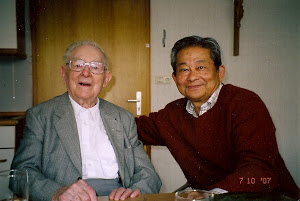
This is a belated report of my wife Gandasari’s (“Riri”) and my visits with Brother Charles Everard in Liss (Hampshire, England) and Brother Felix (Albert Gissler) in Illertissen (Germany). Technical and other problems got in the way, delaying this report.
Saturday, 7 July 2007
After attending Dora Than E’s funeral in Oxford, followed by a reception at St. Hugh’s College (Aung San Suu Kyi’s alma mater), our friends Ken & Marion Freeman of Pershore, drove us through the English countryside to Liss, Hampshire. It was a pleasant 2.5-hour drive on uncrowded roadways. (Some of you may recall Aunty Dora as the recording artiste of yesteryear whose professional name was Beelat-pyan Than.She later worked for the United Nations, beginning at its founding in 1948 at Lake Success, New York. Had she survived her final fall, she would have turned 100 on 16 February 2008.)
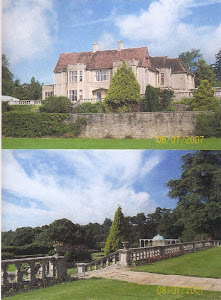
Clayton Court, the De La Salle Brothers retirement community at Liss, is a beautiful 22-acre estate with gently manicured lawns, gardens, and gorgeous views of the rolling hills. There are three large structures on the gated property. It is a place with spirit, where one’s soul is rejuvenated. The Fratres Scholarum Christianarum, (Christian Brothers), acquired this estate, once owned by a wealthy gentry, in 1974. The other FSC retirement home in England is located in Manchester.
We arrived at Clayton Court about 5:45 P.M. The place was abuzz with staff, volunteers, and neighbors who were preparing for a party for one of the brothers’ 70th birthday. The brothers were in the chapel doing devotions. Becky, a staffer, who was my contact, was most gracious. There was another staffer whose forearms were heavily tattooed. “Were you in the royal navy?” I asked. “Yes,” he said with a glint in his eyes. “I was a cook on the aircraft carrier Ark Royal,” he answered with pride. The two were most welcoming and amiable. From them, I took comfort that the brothers were living and eating well.
When prayers were over, Brother Director Joseph Hendron wheeled Brother Charles out of the chapel. I recognized the former right away even though I had not seen him since 1979 when my De La Salle, and later St. Paul’s classmate, Brother Patrick Minus, and I visited him at the Brothers’ Mother House in Rome. I do not know whether Brother Charles recognized me, but he broke out in a big smile when I greeted him in Burmese. At 89, dementia has diminished much of his memory and affected his speech. I helped him eat some of the goodies that were generously spread out on the table. He uttered a few words in Burmese: “taw bee, …yay ne ne thauk chin de,” (တော်ပြီ။ ရေနည်း နည်း သောက်ချင်တယ် enough.., want to drink a little water), etc. I spent the rest of the afternoon with Brother Charles and the other party goers until the celebrants faded away.
Brother Director Joseph is truly a personification of tremendous love and patience. He was most gracious. He made us feel very welcome. We were accommodated in comfortable guest rooms which commanded beautiful views of the estate.
Sunday, 8 July 2007
Riri and I took a leisurely stroll on the estate as the sun shone over the countryside. At breakfast, I sat on Brother Charles’ left while Brother Joseph occupied the end seat on the right. Both Brother Joseph and I helped Brother Charles with his breakfast. His appetite was good.
Breakfast over, I wheeled Brother Charles back to his room. The room was nicely decorated with Burmese and other memorabilia. There was a large framed photograph of a much younger Brother Charles of his Burma days. (I recall seeing him in 1959 at the Kalaw Railway Station as he hopped on to the steam locomotive. “I always ride in the gaung dwe (locomotive),” he harked, as the train pulled away towards Thazi. He was happy as a lark. (Riri and I were teachers at Kalaw’s Kingswood School that year).
Bidding Brother Charles adieu was difficult. I had known him when we were both young long years ago at a place so far away.
We took leave of Brother Joseph and the other Brothers later that morning. Ken and Marion drove us to Liphook from where we boarded the National Express coach for London’s Victoria Station. (Marion and I began our friendship as pen pals when we were both 16. I was then at Woodstock School in the Himalayan town Mussoorie, India, in 1950).
Brother Charles with U Kyaw WinClayton Court, Liss, Hampshire, England
Monday, 9 July 2007
After spending the night in London, we flew to Frankfurt, arriving there in the evening. We bedded down at Hotel Manhattan, conveniently located across the street from the Frankfurt bahnhoff (railway station).
Tuesday, 10 July 2007
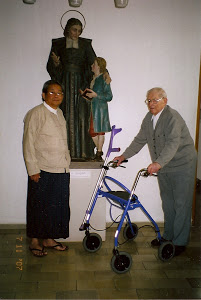
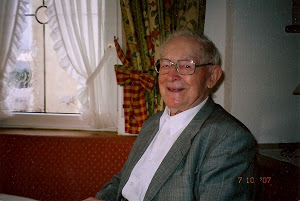
The train from Frankfurt took us to Ulm where we changed for Illertissen. It was raining when we got there in the afternoon. We started to walk towards Kolleg der Schulburder. A kind gentleman picked us up along the way and drove us to the Kolleg, sparing us from getting wetter. (He did not speak English. We did not speak German. But the language of the heart transcends all tongues). Brother Felix, who is known as Brother Albert at the retirement home, was brought out to a waiting room. He walked with the help of a stick, and a walker, alternately. He was as happy to see us as we were to see him. (I had last seen him, and Brother Peter, over thirty years ago, in Germany). His first words were: “You look like your father.” What a compliment!
Once he got warmed up after muttering a few words in German, the talk gushed out. He talked and talked, recalling his days in Burma; as a prisoner in Dehru Dun (India) and Insein Jail; De La Salle, St. Paul’s.Dinner that evening was at a restaurant. When Brother Felix noticed a paunchy man sitting at the next table, he remarked: “Baik pu gyi,” (ဗိုက်ပူကြီး paunchy fellow), a mischievous glint in his eyes.
Because guest accommodations at the Kolleg der Schulbruder were occupied by a visitor from Rome, we lodged at Hotel Vogt for the next two nights.
This was also Riri’s birthday. I snuck out of the hotel quietly and walked the streets of tiny Illertissen in search of a bakery. But it had shut down for the night. I was fortunate to get a cake from a restaurant just as it was closing. With the help of the hotel’s staff, I was able to surprise her.
Wednesday, 11 July 2007
In the morning, we were fetched and taken to Kolleg der Schulbruder where Brother Felix was waiting for us at the breakfast table. But we had just eaten at the hotel. So we nibbled a bit while he ate. After breakfast, he showed us the chapel, grounds, gymnasium, and gardens at the school. There are only lay teachers at the school. The numbers of those entering the FSC are getting thinner and thinner. A section of the campus is partitioned off as a retirement home for the brothers.
A sumptuous lunch prepared by the kitchen staff was served. When he saw the generous fare spread over the table, Brother Felix remarked, “Do they think we are starving?” That was typical of him, wit fully intact.
At 93, Brother Felix is the most senior retiree at the home. He has a comfortable room with an attached bath. “When I die, everything I own can be cleared out of this room in ten minutes,” he said.
After a brief rest, another non-English speaking brother drove us around that charming Bavarian town. Sightseeing ended after visiting the graves of Brothers Fulbert and Peter in the well maintained cemetery. A section of the cemetery is reserved for brothers and priests. The graves were well tended, a profusion of flowers growing on them.
Afterwards, we were driven back to the hotel where a teary Brother Felix hugged and kissed us before he was driven back to the retirement home. “Pray for me,” he asked. “I pray for all the people of Burma,” were his parting words.
Bidding Brother Charles and Brother Felix at their respective retirement homes was very difficult. Brother Felix was only 18 when he left his family and country to go to Burma as a missionary with the (French) Christian Brothers Order of the Roman Catholic Church to serve a lifetime as a teacher. But it gave me joy that I could honor these two teachers in the sunset of their days. “Parting is such sweet sorrow…”
If there is one word that comes to mind which describes these two brothers retirement communities, it is COMPASSION, of which there was an abundance.
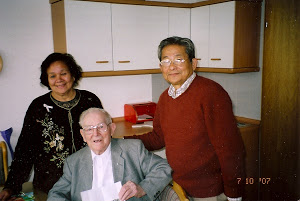
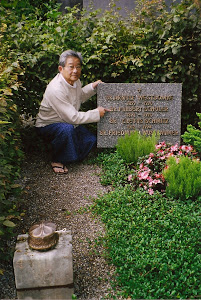
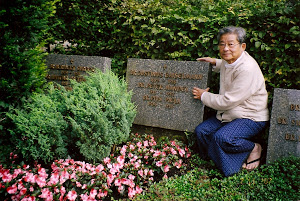
Brother Felix at Kolleg der Schulbruder_1, Illertissen, Germany, July 2007Brother Felix at Kolleg der Schulbruder_3, Illertissen, Germany, July 2007Brother Felix with U Kyaw Win_1, Illertissen, GermanyBrother Felix with U Kyaw Win_2, Illertissen, GermanyBrother Felix at Kolleg der Schulbruder_2, Illertissen, Germany, July 2007Brother Felix with Gandasari and U Kyaw Win, Illertissen, Germany, July 2007U Kyaw Win at Bro. Fulbert’s grave, Illertissen, Germany, July 2007U Kyaw Win at Bro. Peter’s grave, Illertissen, Germany, July 2007
I thank Margaretha Sudarsih (“Menuk”) for blogging this report for me.
The holy season of Christmas is upon us. May peace, joy, and good health of both body and mind be yours. UPDATE: Brother Charles passed away on 28 December 2007. May “flights of angels sing thee to thy rest.”
I am yours sincerely, a grateful product of the Christian Brothers schools,
U Kyaw Win 8566 Flagstaff Road Boulder, CO 80302-9531, USA
It was the academic year 1958-59 and I was teaching the final year mechanical engineering students at the dome buildings. Having returned from the United States two years prior, I was still a novice at the trade. I had to put in many hours of lesson preparation because the class was filled with a number of bright students eager to learn and ready to throw questions at me from every possible angle. Among them was late Saya U Tin Hlaing (M59).
Saya
Upon graduation, he was appointed an Assistant Lecturer in Mechanical Engineering Department. A must for junior staff member was to take charge of First Year Drawing classes and U Tin Hlaing gave his hundred percent and more. It was a time when contract staff were gradually phased out, being replaced by returning State’s Scholars and at the same time the buildings at Gyogon were readied to accommodate the Faculty of Engineering, which later changed to BIT/RIT. Plans were also afoot to upgrade the staff by sending members abroad for further studies and U Tin Hlaing along with Saya U San Tun were selected from the Mechanical Engineering Department. U Tin Hlaing obtained admission to Purdue University and U San Tun to MIT.
Head of Agri
Upon successful completion of his studies, U Tin Hlaing returned to RIT to assume more responsible teaching duties and his specialization was in Theory of Machines. He was also involved in other activities besides teaching and his gentle nature coupled with respect for fellow workers endeared him to all who knew him. His depth of knowledge and guidance was very much appreciated by the students. When RIT underwent further expansion, U Tin Hlaing was made Head of Agricultural Engineering department, in which capacity he managed to coordinate the classroom activities with field applications. He was also actively involved in academic pursuits and authored a number of books besides contributing towards Burmese technical vocabulary.
Sports
He was a member of the staff tennis club and his participation in the club activities contributed to evenings of joy and laughter at the court.
He also played on the RIT Sayas Soccer Team.
U Tin Hlaing
He managed the “All Universities & Institutes” Hockey Team.
Sad Loss
He was a devoted husband and father, being a family-first man. Unfortunately, his health began to fail at an early age and passed away in 1978. His demise was sorely missed by his colleagues and all those who came into contact with him, however remote. I, for one, felt a great personal loss and having had a loyal colleague and friend like him will forever be embedded in my memory.
Saya U Myo Win (GBNF)
Also known as Melvin Ba Tin.
Joined the Faculty after graduation.
Rowed for RIT.
Managed the RIT Automobile Club. The Club members gave him a farewell dinner.
RIT Automobile Club
Moved overseas.
Taught for many years at Waga Waga University in Australia.
He and Saya U Hla Myint (M65) were the two senior sayas at the RIT Alumni Dinner in Sydney, Australia in 2006.
I last met him at SPZP-2016 in Yangon.
According to Ma Noreen, Saya did not want to broadcast his health condition. So, we were surprised when Saya passed away.
There were several messages of condolence.
Saya U Ba Than wrote :
Please help me pass on my condolences to Myo Win’s wife.
I am very sorry to hear that your husband has passed away.
May he rest in peace.
Saya U Soe Paing and Daw Saw Yu Tint wrote :
See the photo of Ko Myo Win & wife with us and Ko Kyaw Sein at the 2016 SYPZP.
Our condolences to his family.
SP & SYT
Saya Dr. San Hla Aung wrote :
I am so saddened by the unexpected news of Saya Melvin U Myo Win’s passing away. I met and talked with him briefly during the 2016 SPZP in Yangon and he was looking just fine then. I have known Melvin’s family for a long time and am now joining them in their sorrow.
Kindly convey my heartfelt condolences to Melvin’s wife Noreen, sister Pearl, and their families on the recent loss of a beloved husband, brother, and head of the family.
My prayers also for Melvin to reach a higher abode in his next existence.
Saya Dr. Nyo Win wrote :
I’m saddened to learn about Melvin’s passing away. Melvin and I were from the class of 65 ME. We both joined the faculty after graduation. He taught in the Agri Dept and I in the ME. I remembered well his smile and friendly chats wherever we got together. I want to extend my deepest sympathy and condolences to Melvin’s family. May you Rest In Peace.
Saya Dr. Tin Win wrote :
I am very sad to learn that U Myo Win had left us. I was away visiting my eldest sister who is in Hospital in Houston, TX, and was very much surprised to see the sad news when I got home last night.
I spent over a year sharing an apartment with Ko Myo Win, Ko Aung Soe (Math), and Dr. Ko Lay (Mandalay MC) in 1968-9 while he studied for M.Sc. at Melbourne University, Australia. We also worked together in the ME Department at RIT until 1976. He then pursued a successful academic career in Australia. He put in a lot of effort to help bring / apply Australian Technology to Agricultural practices in Myanmar while he was working, and after retiring.
He was always optimistic, had a very good nature, and was liked by everyone. He was a good husband and father, and a very proud grandfather. He was also very friendly and always ready to help anyone. I remember him always enjoying tinkering with his cars as well as those of his friends.
He will be missed by all who had the good fortune to know him.
My deepest condolences to Noreen and family.
U Thein Tun Aung (GBNF)
Thein Tun Aung
Hevpassed away in November 2010.
His daughter Kay Thi donated K1 Lakh for the second time in Saya’s memory.
May Saya rest in peace.
Dr. Chan Nyein (GBNF)
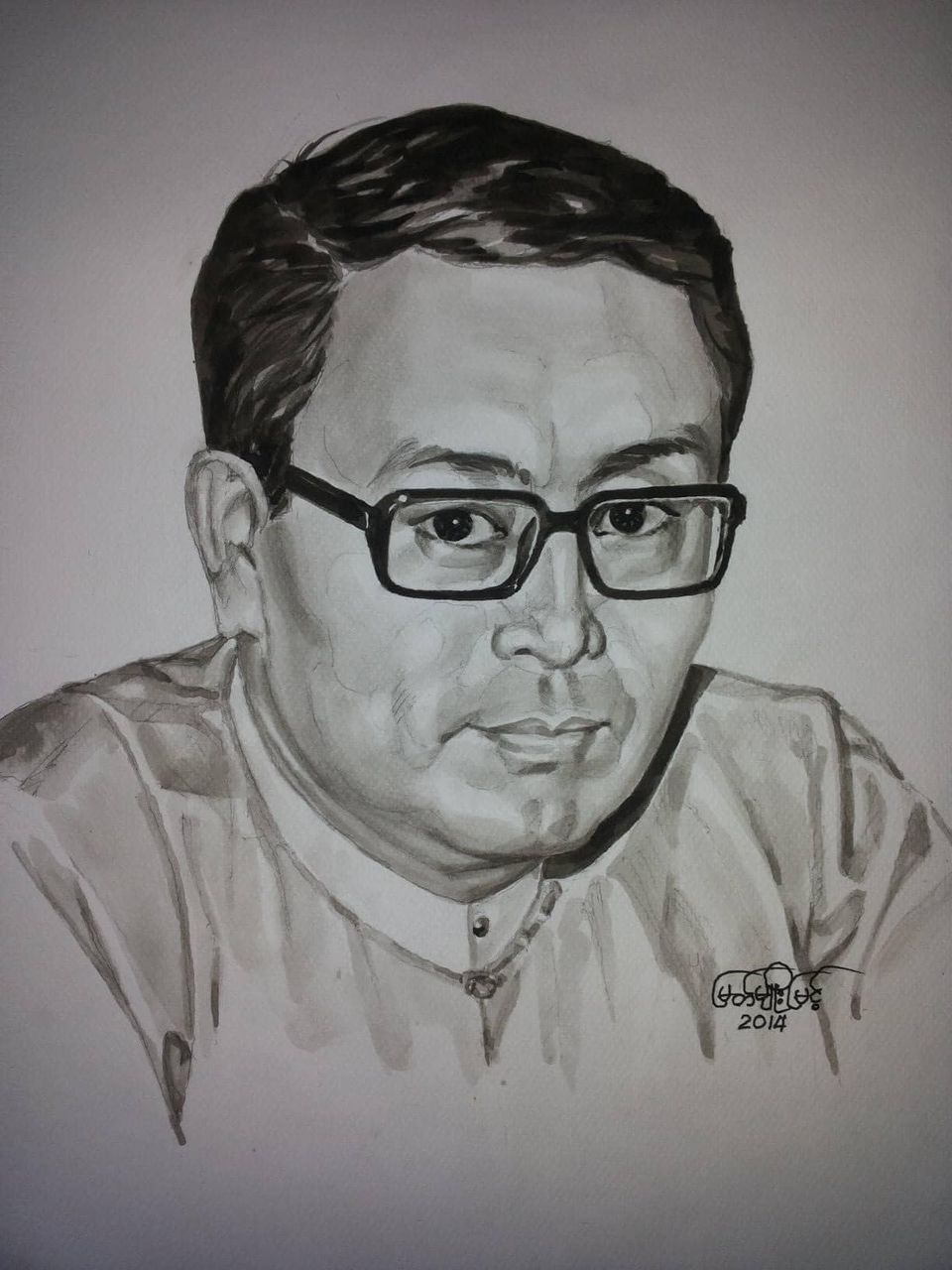
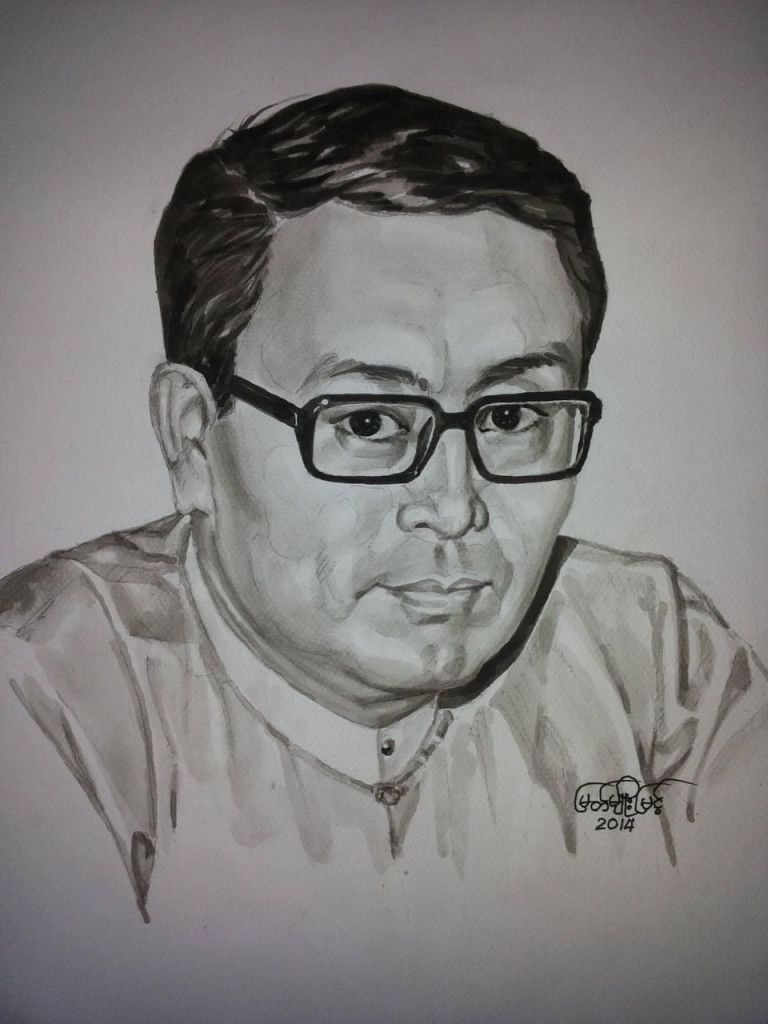
Dr. Chan Nyein
Studied at Imperial College, University of London. DIC stands for “Diploma of Imperial College”.
Was Professor and Head of Mechanical Engineering Department.
Was Deputy Minister of Science and Technology.
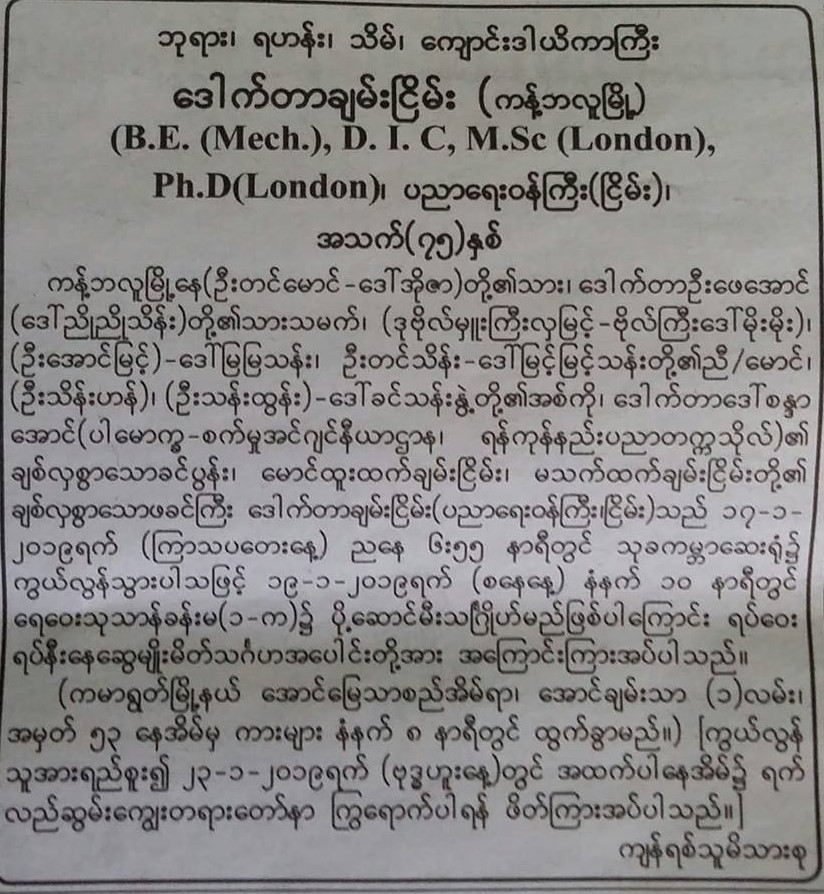
Was Minister of Education.
Passed away on January 17, 2019 (Thursday).
Last journey took place at Ye Wai Cemetery on January 19, 2019 (Saturday).
Yet Lei Soon Kway was held on January 23, 2019 (Wednesday).
It was the first school established by the De La Salle Brothers in Burma.
St. Pat 1
St.Patrick’s HS, Moulmein. Clock Tower and boarding house upstairs, examination hall below.
Photos taken in 2016, when I visited Moulmein
St. Pat 2St. Pat 3St. Pat 4Entrance
Our class photoV B
Our class photoVII Std
Class teacher Bro. Sebastian. I met him during our first year at Leikkone in 1958-59 while he was attending BAed.
Ko Ko Lay (UCC) first row, sitting second from left. U Aye (M62), second row, sitting second from right. B. Singh (RU goalkeeper) third row, first from right. Myo Lwin (M63), third row third from right.
Absentees : Kyaw Win (M62), Peter Gale.
Bro Canice was Bro Director, House Master Mr. E. Swarris, House Capt. Dr. Aung Myin (Eye, passed away in UK around 2018), U Win Naing (MS pulp and paper)(CRO) third row, fourth from right, U Aye, third row, third from right.
Our matriculation class 1955-56
Bro Austin, Bro Director, Bro Wilfrid, Class teacher, U Tun Shwe ,Myanmar Sar, Mr. DeMonte, Moral and Manners.
Peter Gale, Dr. Thet Lwin (Statistics), B. Singh (RU goalkeeper), medical doctors Dr JK Sinha (UK), Dr Rafi, Dr Rajani Vora, India, Capt. Aung Myint, Capt Ya Kyaw, Myo Lwin (M63), Kyaw Win (M62), John Ba Maung, Russian Lecturer (IFL)
Prof. Khin Zaw (Chemistry), Saw Alfred Keh (Preacher after graduation, son of pre-WW2, RU footballer Washington Keh), U Kyi Win (BPI), U Aye among others.
St Patrick’s HS football team of late 40s and early 50s
During 1948-49, St Pat’s team beat all other Schools’ Combined team. Some of the team members were-
Bernard Henry – Goalkeeper,
R. S. Pathy, Tin Aye — Fullbacks,
Pway Ain (Htay Aung), Jimmy Innes, Tin Ngwe (Mid-field),
Rama (Rightwinger), Khine Thein,SV Lingham, Jimmy Sein (Tint Swe), B. Boudville (Left winger).
Later Pway Ain (Htay Aung) played for RU, Jimmy Sein (Tint Swe) played for Prome Hall and RU. Jimmy Innes played for Customs FC in Rangoon first div.
Many played in Friends Union FC in Moulmein first div.
St Patrick’s Alumini, Ko Ko Gyi, Tenasserim division and Burma selected footballer.
Dennis Mackey (C73) wrote
Thanks for this piece as part of your “Work in Progress”.
Below are photos and notes that I posted on my FB page and on St. Patrick’s HS, Moulmein FB public group page.
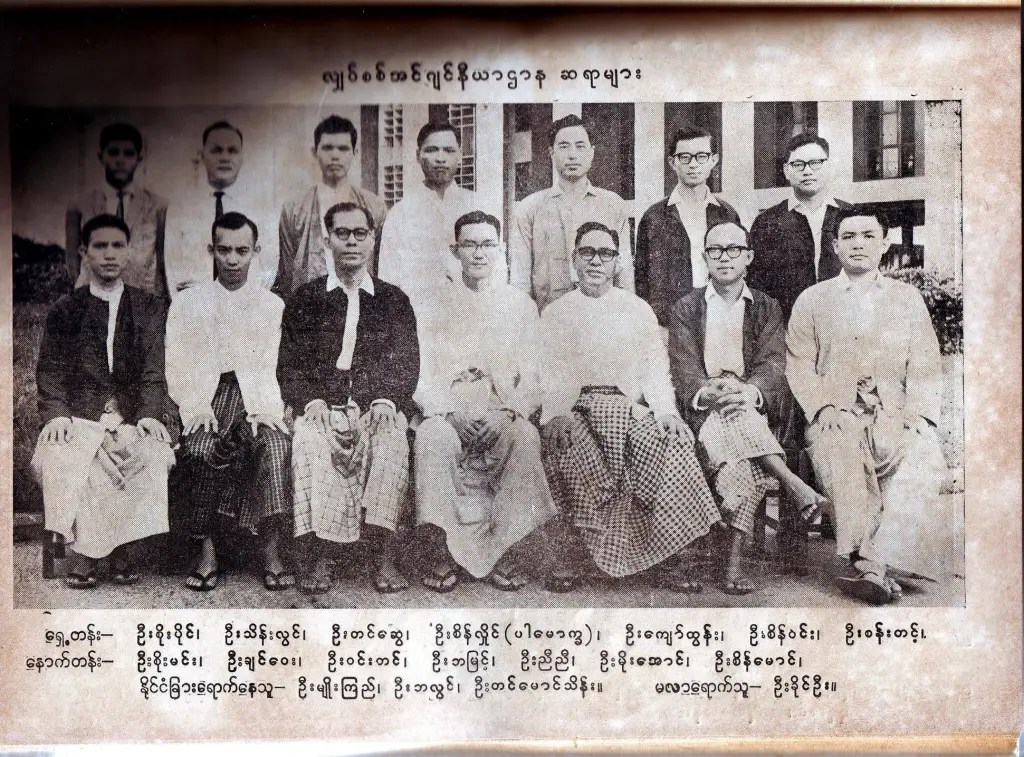
I have chosen 1950 as the start of my recollections regarding the state of higher learning in the field of engineering because I was admitted to the Faculty of Engineering, Rangoon University, in June of that year. Also, Sayagyi U Ba Hli started his first year as Dean of Faculty of Engineering, having transferred from Government Technical Institute at Insein. The requirement for admission was 50% aggregate in Intermediate of Science Examination and there was no limit to the number admitted. There were about 75 students in my First Year, which included fresh admissions, repeat students and a few New Course transfers. I should explain that New Course transfers were those who signed up for the 5-year condensed degree course after matriculation offered in the previous years and which was scrapped in the year of my admission. When I started on my engineering course, it was of four years’ duration, at the end of which the degree of Bachelor of Science (Engineering) was awarded.Since I was a student as well a teacher of engineering, I will attempt to present my perspective of Mechanical engineering education from both sides.
In the first and second years of study, the students had to take courses basic to Civil, Electrical and Mechanical Engineering, namely, Geometric, Machine and Building Drawing, Building Construction, Electrotechnology, Heat Engines, Surveying and Workshop. In addition, The Mathematics Department of Rangoon University was responsible for teaching Statics and Dynamics. Only in the third year were the students get to choose their line of engineering, civil,electrical or mechanical. So began my first year classes at the BOC College building. Actually, the first classes started every morning at 7am at the Mathematics Department where we were taught Statics and Dynamics by Dr. Sarkar till 9am. He was an extraordinary teacher and remembers every student by his roll number. Then we began the long trek to BOC College for rest of the classes of the day. Usually, lecture classes preceded before we spend the afternoon in the drawing room, laboratories, survey field or workshop.
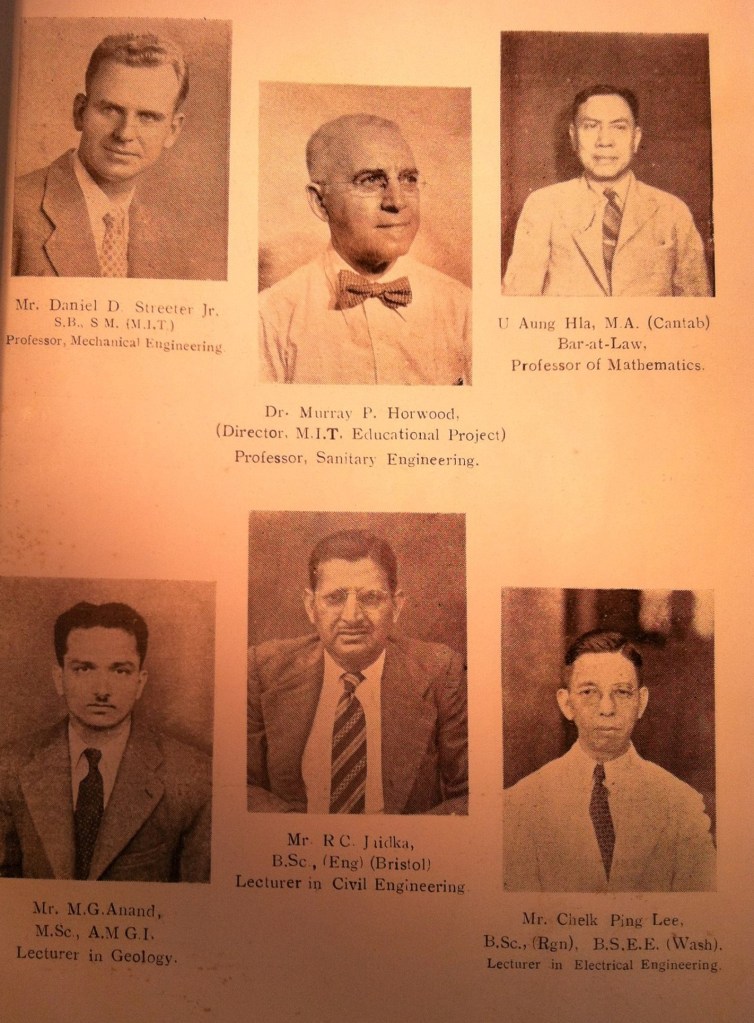
The full-time staff of the faculty consisted of Dean and Professor of Civil Engineering Sayagyi U Ba Hli, Lecturer in Civil Engineering Sayagyi Mr. Jaidka, Lecturer in Electrical Engineering Sayagyi U Kyaw Tun, Assistant Lecturer in Civil Engineering Sayagyi Mr. H. Numkok and Superintendent of Workshop Mr. J. P. Law. Part-time lecturers were recruited to meet the goal of satisfying the requirements of the syllabus in each of the three disciplines. First and second year students were taught Building materials and construction by Sayagyi Mr. Jaidka, Electrotechnology by Sayagyi U Kyaw Tun ably assisted by Laboratory technician U Ba Sein in the laboratory, Heat Engines by part-time lecturer U Aung Than, Chief boiler inspector and Drawing by part-time lecturer and later on by Sayagyi Mr. Numkok when it came to Building drawing. Workshop program involved spending one term in each of the four shops, namely, machine, fitting, carpentry and blacksmith. Mr. J. P. Law made sure that students get hands-on experience in the use of tools. He stayed on for one year and was succeeded by U Aung Gyaw. Sayagyi U Ba Hli considered that technically challenged environment required students to be practical and workshop experience as well as summer practical training was essential. First year examination was a relatively easy hurdle for most students whereas the Second year examination was a lot harder and a career make or break event. I managed to get past the hurdle and found myself in the Third year to pursue my choice of Mechanical engineering in June of 1952. There were about twelve of us, all hoping to be an Assistant Engineer holding a civilian job, or a Leutenent in B.E.M.E. who were on army stipend, upon graduation. Third year courses included Heat engines, Theory of machines, Machine design, Electrotechnology, Strength of materials, Hydraulics, Metrology and Industrial management. We finally had a full-time staff in mechanical engineering. He was Mr. Khetrapal who came over from B.O.C. as an Assistant lecturer and he took care of all mechanical engineering subjects. In addition, Sayagyi Mr. Chelk Ping Lee came over from Directorate of Technical education to join the Electrical engineering staff and taught us Electrotechnology. Industrial Management was taught by a contract lecturer from India. We also had a U.S.Visiting professor and he taught us Strength of materials and for the first time we were introduced to the American quiz system of teaching.
About that time, the University focused its attention to modernizing and increasing the number of disciplines in the Faculty of Engineering by upgrading the staff as well as sending state scholars to the U.S. for future staffing. Sayagyi U Kyaw Tun was sent on deputation for post-graduate studies, followed by selection of several state scholars from among the engineering students. The first two were Sayagyi Dr. Aung Gyi and Sayagyi U Min Wun, earmarked for Civil engineering, followed by Sayagyi U Pu and me for Mechanical engineering, Sayagyi U Khin Aung Kyi for Chemical Engineering, Sayagyi U Maung Maung Than for Textile engineering, Sayagyi U Sein Hlaing and Sayagyi U Tin Swe for Electrical Engineering, Sayagyi U Kyaw Min for Architecture and Sayagyi U Thit for Metallurgy. We formed the initial group and other sayas were sent abroad for further studies in succeeding years as opportunity arose. I was instructed to leave for the U.S. in late December of 1952 to be in time for the start of the spring semester. So ended my exciting years at the Faculty of engineering and my classmates gave me and Sayagyi U Pu a farewell tea at the Sun Cafe to send us on our way.
I returned in early part of 1956, having obtained the Bachelor’s and Master’s degrees in Mechanical engineering, the latter being an essential qualification for promotion to lecturership. Sayagyi U Ba Than had returned earlier from England and Sayagyi U Ba Hli got him working during summer holidays on various tasks such as supervising installation of new laboratory equipment, in preparation for the opening of the new school year. I was appointed as an Assistant lecturer in June. In the three years I was away, rapid and vast changes had taken place. Academically, engineering disciplines increased from three to seven, additions being Chemical engineering,Textile engineering, Mining engineering and Metallurgical engineering. Architecture department was also added to the Faculty. Staffing of the expanded fields of engineering as well as existing ones involved hiring contract teachers from India.Furthermore, additional staffing was provided by Columbo Plan donor countries in the form of visiting lecturers. On the physical side, a brand new complex was built fronting Prome Road by Taylor Woodrow Construction Company, consisting of an assembly hall, known as “Leik Khone”, administrative building and teaching blocks housing drawing rooms, lecturer theatres, classrooms and laboratories. Civil, Electrical and Mechanical engineering departments and Architecture department were located in the new complex. More importantly, Mechanical engineering department benefitted when Colombo Plan aid was channeled to provide laboratory equipment to various departments. A new Applied Mechanics laboratory located in the Mechanical wing was acquired. More modern equipment was added to the Strength of materials laboratory located in the new laboratory block. Heat engines laboratory recieved an educational Gas turbine unit along with other engines hooked up for testing.
I started my teaching career, for which I was earmarked when I was sent abroad for advanced studies, at a time of transition. The Mechanical engineering department had a staff of contract teachers from India and visiting lecturer Mr. W. Redpath from United Kingdom. Workshop Superintendent was Mr. V. Simon. Sayagyi U Ba Hli assigned me to teach First Year Drawing and First Year Heat Engines. Also, I was to assist Mr. Redpath in conducting the Heat Engines laboratories for the Third and Fourth Year students. The number of students admitted to the Faculty had been growing over the years and the size of the First Year Heat Engines class was about 150. Drawing classes were split into sections and limited to about 40 students each. The following year Sayagyi U Pu returned and later on Sayagyi U Ko Ko Gyi joined the staff. However, the contract teachers were leaving and the slack was taken up by the collective effort on the part of all of us. At the same time, attention was directed at modifying the syllabi of various departments to correspond with specialization in the practical field. Decision was made to introduce courses pertinent to a particular field of specialization at earlier stages, split some courses into component specialties or replace with more appropriate course. Subject of Mechanisms was introduced in the Second year. Heat Engines for First and Second years was renamed Thermodynamics to cover fundamental concepts and for senior years was split into Internal Combustion Engines and Refrigeration and Air Conditioning. Fluid Mechanics replaced Hydraulics. Corresponding expansion of staff was taking place with Sayagyis U San Tun, U Tin Hlaing, U Tun Shwe joining the staff. All of them, along with Sayagyi U Ba Than, were sent abroad later for advanced studies.
In the late 1950’s, we learned that Soviet Union would make a gift of a complete and fully equipped Institute of Technology to be built at Gyogon with skilled and semi-skilled Burmese workers of Public Works Brigade together with Soviet Specialists. The Soviet Union would also provide lecturers in special fields as needed. It was decided that the Faculty of Engineering would be moved to the new location and reconstituted as a separate educational facility at the same time preserving the existing engineering education format and of six years duration with high school matriculates entering the First Year. It was realized that more drawing and laboratory space was required to accommodate the large classes entering the system. So three more buildings were added to the original design and where Mechanical Engineering and Architecture Departments were located. Thus Rangoon Institute of Technology was created as a pre-eminent place of higher learning in the country. Sayagyi U Yone Mo was the first Rector of the Institute. This is where I will end my recounting of events past, sometimes vague, with the dawn of a new decade and hope that it might help those wanting to know the humble beginnings of mechanical engineering education in a place called Myanmar. All of us who taught at, studied or graduated from or otherwise associated with the Institute remember it as a special place and fondly refer to it as R.I.T.






















 HlaMin