Category: HMEE

  • Civil Engineering Education

    By Saya U Min Wun: March 12, 2012

    Dr. Aung Gyi’s article about the history of Engineering Education reminds me of my 31 years of tenure as a teacher at RIT. I’ll try to describe some achievements in rendering Civil Engineering education, as far as my memory would carry me through by recollecting events of the past 55 years. I’ll try to supplement some of my recollections to his excellent account of engineering education in Myanmar.

    Abroad for further studies

    Dr. Aung Gyi and I had similar academic journey at the University of Rangoon, starting from admission to Intermediate of Science class to the day when we left Myanmar to pursue further studies abroad, until we graduated from MIT earning B.S. in Civil Engineering.

    On September 19, 1952 three 2nd Year students [namely, Aung Gyi, Maung Maung Than, and Kyit In (aka) Min Wun] of BOC College were sent off at the Mingaladon Airport by a large group of classmates. It was such a wonderful event and surprisingly good news that three of us, the engineering students from B.O.C. College, were to be sent abroad to study engineering on State Scholarship.

    U Maung Maung Than went to Falls River to study Textile Engineering. Dr. Aung Gyi and I flew to Boston to study at M.I.T. which is situated in Cambridge on the opposite bank of Charles River from Boston. When we arrived at the Logan Airport in Boston, Freddie Ba Hli, who was a post graduate student at M.I.T. , came to welcome us and helped us to get accommodated in the dormitory. He also took us to buy slide rule and advised us to learn how to use it before the classes.

    As soon as the 1st assignment was given I really came to appreciate Freddie’s advice. Slide rule was an essential tool for calculation at that time. As we were admitted to the 2nd Year [sophomore] class we found Physics a bit tough for us. Freddie willingly came to our help again.

    Before I was sent abroad to study engineering I was informed that I’ll be assigned to come back home to teach. I, therefore, paid special attention to the engineering education curriculum and collected all my class notes and assignments. Between school years I went to get practical training in structural engineering, both in design and construction, by working with the same company for three summers. In my final year I have to compile a Thesis, doing a Bascule Bridge Design, as part of the requirement.

    After graduation from MIT in June 1955 Dr. Aung Gyi continued graduate studies in Transportation Engineering at M.I.T. However, I transferred to Cornell University to study Geodesy and Photogrammetry, as directed by Ministry of Education, because MIT did not offer this course at that time. I chose Structural Engineering as Minor option. I got M.S. degree in June 1956.

    A Burmese State Scholar’s monthly allowance for boarding was $140. As I needed extra pocket money I worked for Professor Dr. Belcher doing aerial interpretation of terrain geology for real estate development. Dr. Belcher later came to Myanmar to train surveyors in the Department of Survey, under the Ministry of Forest and Agriculture.

    I also worked part time for Professor Dr. Winter, doing bamboo-reinforced concrete design and testing. Dr. Winter sponsored me to continue with post graduate study in structural engineering. However, I was not granted extension of stay. The directive from Ministry of Education was to extend my stay for one more year to work and gain practical experience in Geodesy and Photogrammetry. I got a job with Hycon Aerial Surveys Company in Pasadena, California, where I gained practical experience in Aerial Mapping and Terrain Interpretation to select corridors for highways, power transmission lines, and oil pipe lines.

    Beginning of teaching career

    In June 1957 I flew back to Yangon and reported for duty at the Faculty of Engineering. I was appointed as Assistant Lecturer in the Department of Civil Engineering, Faculty of Engineering of the University of Rangoon. This is the beginning of my teaching career as a young engineer freshly out of college with only a limited practical experience.

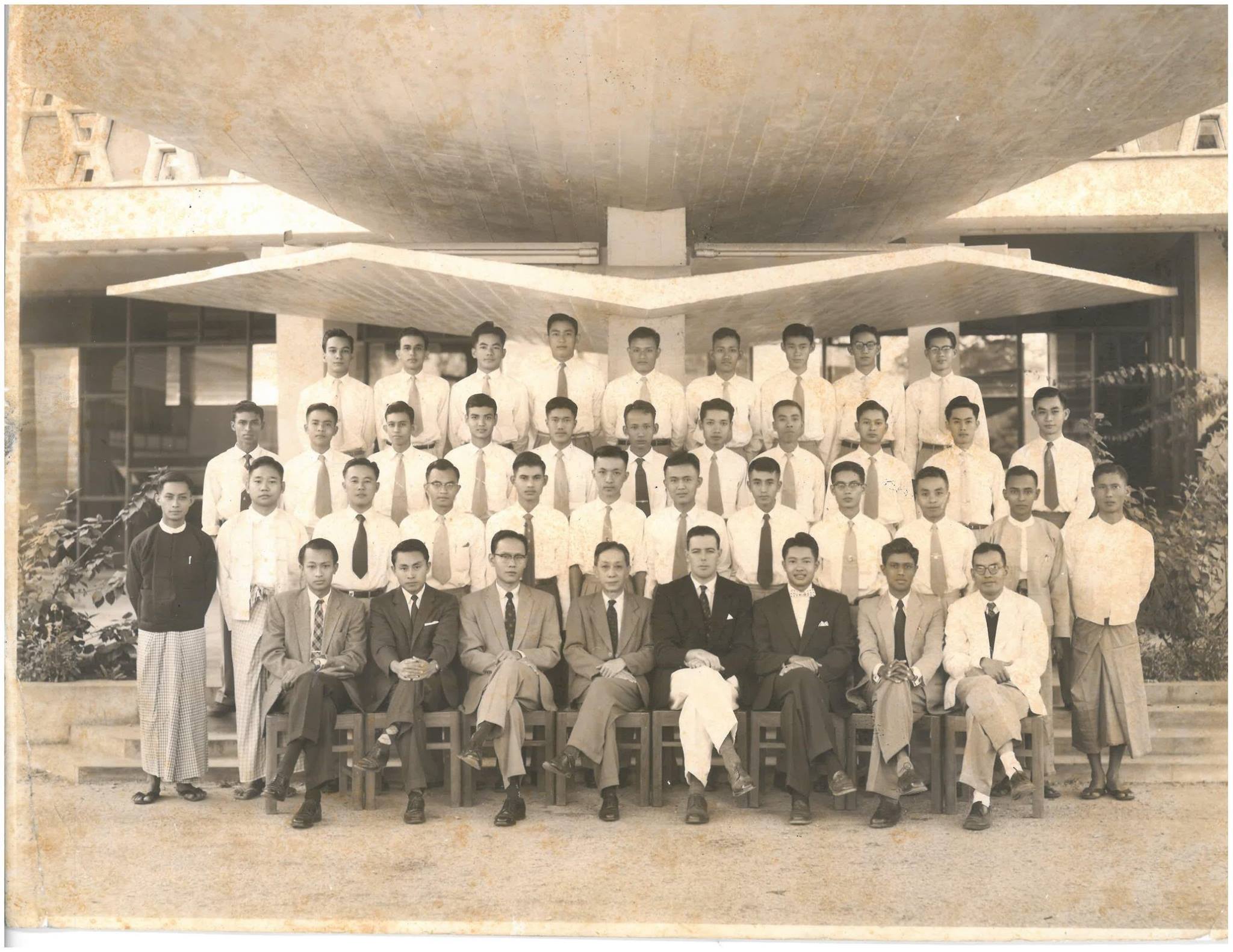
    Three major Departments of Engineering [namely, Civil, Mechanical, and Electrical] of B.O.C. College were relocated in the new buildings along Prome Road. The turtle-shaped dome [Leik Khone] was a beautiful wooden folded plate structure and it served as an assembly hall. Dr. Aung Gyi and I were later promoted as Lecturers in 1958, and in 1960 the late U Mya Han was appointed as Professor and Head in our Department. But he did not stay long enough and I did not have a chance to get acquainted with him. He later worked for Louis Berger Construction Company to design Rangoon Mandalay Highway and as Dr. San Lin has recounted, U Mya Han employed some Civil Engineering graduates with higher pay to work for him.

    In 1958 I was appointed as warden for the new Pagan Hall for engineering students. Pagan Hall was a new building situated in the same compound as Prome Hall and Tagaung Hall. At that time all the hostels were managed by a warden and an assistant warden. Instead of assistant warden, I requested U Yu Khin, registrar of the University of Rangoon, to allow me to appoint three tutors to help manage hostel matters, especially to help students in their studies. Three tutors were U Tun Shwe and U Ko Ko Gyi [Johnny King] of Mechanical Engineering Department, and U Ko Ko Lay of Chemical Engineering Department. I managed the hostel together with the three tutors, and EC members of the Students’ Welfare Committee. Procurement matters were jointly handled by us in consultation with U Aung Sein, the chief cook. We purchased rice, cooking oil, salts, etc at whole-sale prices and thus could save for messing. Packing materials were carefully salvaged and later sold back to the vendors and the proceeds were distributed to the hostel staff as annual bonus. The quality of meals became greatly improved so that the students could enjoy plentiful and better meals.

    When we moved to Gyogone Campus in 1961 Saya U Kyaw Tun of Electrical Engineering was appointed as warden of three hostels [Block A, B, and C] and I continued as warden for three hostels [Block D, E, and F]. Our quality of meals was so well known that U Yu Khin interviewed me as to how we could provide batter and plentiful meals. I could still remember the first grand dinner held on the lawn in front of the hostel buildings. When new rules of a two-year term limit for a warden were set I resigned from the warden post.

    Curriculum Development

    When B.I.T. [later renamed as R.I.T.] became a separate institute the first thing I noticed was that the curriculum for the first two years were developed with emphasis toward technology. The curricula for Civil Engineering were also revised based upon our academic and practical training abroad.

    One requirement for undergraduate study was to prepare a Thesis in the Final Year. All the staff was assigned as supervisors, thus creating an opportunity for the staff to work more closely with the students.

    Graduate courses leading to Master Degree were also offered in [a] Structural Engineering, [b] Water Resources Engineering, and [c] Surveying and Photogrammetry. A Diploma Course was also offered in Water Supply and Sanitation Engineering.

    Upgrading Laboratory Facilities

    In an effort to upgrade laboratory facilities we have achieved to set up several up-to-date laboratories through foreign aids. Some equipment were also acquired through government funding.

    1. Structural Testing Laboratory was established with the aid from German Government and Dr. Roberts of Tulane University came to teach Structural Engineering for one year.

    2. Hydraulics Laboratory was aided by the British Colombo Plan.

    3. A Photogrammetry Laboratory was also acquired through the British Colombo Plan Aid. Mr. Heathcoat from Great Britain came to teach Photogrammetry for one year. A Russian Professor came to the Department to teach Photogrammetry also. He delivered lecture through an interpreter. Through UNESCO aid the Department of Archeology, under the Ministry of Cultures, a Terrestrial Photogrammetric Plotter was acquired and it was set up in the Photogrammetry Laboratory. This plotter was later used to map ancient monuments of Pagan.

    4. Materials Testing Laboratory was also expanded with equipment for testing soils as well as bitumen.

    5. For Survey Laboratory modern Theodolites, such as Wild T-1, T-2, and T-3 and Zeiss Automatic Levels, and Invar Tapes for precise distance measurement were acquired.
    Saya U Min Wun and C58

    Staff Development

    To fulfill staff requirement for the graduate courses Civil Engineering staffs were encouraged to attend graduate courses for Master Degree. Many were also sent abroad for further studies. The following list indicates that almost all the staff were trained abroad or locally to pursue graduate studies.

    1. Structural Engineering staff

    Dr. Aung Gyi was sent to Canada to pursue post graduate studies in Structural Engineering.

    The late Saya U Kyaw Thein transferred to R.I.T. from Construction Corporation.

    Dr. San Hla Aung was sent to M.I.T. to study Structural Engineering. He was also sent to Germany for training in Structural Laboratory Techniques.

    U Tin Maung, U Nyi Hla Nge, U Khin Maung Tint, U Aung, and U Aung Kyaw Myat attended M.S. Course in Structural Engineering at R.I.T.

    Dr. Myo Khin was sent to Japan to study Building Construction Technology, one of the Engineering electives for Regional Colleges.

    2. Soil Mechanics and Geotechnical Engineering

    Saya H. Num Kock was sent to England for to study Soil Mechanics Laboratory Techniques.

    U Allen Htay was sent to the United States of America, and Dr. Aung Shein was sent to England to study Soil Mechanics and Geotechnical Engineering.

    3. Water Resources Engineering

    Dr. Win Thein was sent to Russia, U Thein Tan was sent to England, Dr. Daw Khin Ni Ni Thein, and Dr. Daw Nilar Win were sent to Netherlands, and Dr. Htin Aung and Dr Khin Maung Win were sent to the United States of America to pursue post graduate studies in Water Resources Engineering.

    4. Surveying and Photogrammetry

    I was sent to England to do research in Photogrammetry at University College, London. I collaborated with a post graduate student to do research on measurement of deflection patterns of a typical Railway Bridge by Terrestrial Photogrammetric method.

    Dr. Aung Soe was sent to East Germany to study modern Surveying Techniques.

    U Khin Maung Phone Ko was sent to the University College, London to specialize in Photogrammetry. He pursued graduate studies at the University of Glasgow.

    U Aye Win Kyaw was sent to Paris to train in Terrestrial Photogrammetry.

    U Ye Myint and U Khin Maung Maung were sent to the Netherlands to study Photogrammetry and Aerial Photo Interpretation.

    5. Sanitary Engineering

    Saw Christopher Maung, U Kyaw Win, U Khin Aung Han, the late Daw Yin Yin Myaing were sent to Netherlands.

    6. Others

    Saya U Myat Htoo , U Thein Kyaw, U Tauk Lin, U Samual Nay Than, U Kaung, and Tan Kyi Kong were some staffs who left the Department to go abroad. Daw Kyi Ngwe, Daw Yin Tint, and Daw Cho Cho pursued graduate studies at R.I.T.

    Practical Training

    Summer training program was coordinated with various Government Departments, such as Construction Corporation, Department of Irrigation, Department of Water Ways, etc and in some departments students were also paid.

    Summer Surveying Training was part of the requirement for 4th Year Civil Engineering students. The first survey practical training was held during the summer of 1961 in Maymyo [PyinOo Lwin]. The Department of Survey, under the Ministry of Forest and Agriculture allowed us to establish the Survey Camp in one of their Office Buildings, where there were big office rooms for evening classes and for students to do survey data compilation, checking and calculations, and also to draw a topographic map. The training lasted four weeks and it was a good opportunity for the staff to get more acquainted with the students, thus creating a lasting and intimate relationship between the staff and the students.

    On-the-job Training with CECC

    In September 1976 Civil Engineering Construction Cooperative [CECC] was organized to create job opportunity for Civil Engineering graduates. I was assigned to lead as chairman with Sayas U Tin Maung and U Thein Tan as vice-chairmen, and student members were U Toe Maung as secretary with U Tin Ohn and U Myo Thant as executive members. Retired Charter Account U Ba Win was employed to supervise budgeting and accounts branch. U Mya Than, a retired Superintending Engineer of Construction Corporation, was also employed to supervise design branch. With the permission of Department of Higher Education laboratory technicians were also employed part-time to use the laboratory facilities to help CECC.

    All the members were assigned to rotate on-the-job training through design branch, construction branch, procurement branch, etc. The purpose of the rotation program was to train all the members to be ready to assume any assignments and to be able to take charge of a project independently. CECC is still a strong and active construction cooperative. Many ex-CECC members are working abroad, especially in Singapore, as construction engineers.

    In the beginning we started to work for free until we were awarded contracts to earn profits. With the support of the Ministry of Cooperatives CECC was awarded contracts to do the following:

    1. Site development project for 100-ton rice mills.

    2. Kyaik Hti Yo development project. My article “Kyaik Hti Yo Development Project 1979” was published at the www.ex-rit.org

    3. Micro hydro power project for Tachilaik Township.

    4. Township market building project.

    5. Aerial Mapping project for Bassein-Monywa highway.

    6. Terrestrial Photogrammetric mapping of ancient monument [stupas, pagodas, etc] in Pagan

    7. Exhibition Stalls construction project for 12 Divisions and 12 States during Union Day Celebration event, etc.

    Special Assignments

    I came back from London on July 4th 1975. Pagan earthquake of July 8th 1975 destroyed the once awe-inspiring panorama of Pagan. Almost all the monuments were affected to a greater or lesser extent. The beautiful silhouettes of giant monuments, Thatbyinnyu, Ananda, Gawdawpalin, etc changed within a split second into ugly heaps of debris.

    On July 9th 1975 a National Commission for Restoration of Pagan Monuments was duly formed, headed by the Deputy Minister of the Ministry of Construction. The Commission comprised of expertise from the Department of Archaeology, Universities and Institutes under the Department of Higher Education, and the Construction Corporation. Dr. Aung Gyi, U Myo Myint Sein, and I were also members of the Commission. I was with the Commission until I retired in December 1988.

    From 1981 to 1988 I was assigned to become a member of the National Calendar Committee [Naing Gan Daw Pyeikkadaindaw Set Ah Phew]. Sayadaw U Thilasara of Patheingyi Kyaung of Mandalay was the chairman. Well known astrologers from Upper Myanmar and Lower Myanmar were appointed as members. Annual Myanmar Lunar Calendar was compiled and I also participated in computing planetary positions to determine Thinn Gyan duration and to fix the Myanmar New Year Day. It involved many hours of hand calculations based upon Surya-Siddhanta, Myanmar version of the archeo-astronomy. A Fortran Program was introduced to help the hand calculations and save time. Comparative studies on (a) Myanmar Almanac and Nautical Almanac, (b) Myanmar traditional methods of calculations for Solar eclipse and Lunar eclipse, (c) Identification of 27 Asterisms (Nakshatra) on a Star Chart based upon visual observation as shown by Sayadaw U Thilasara, etc were also presented to the NCC.

    When Regional Colleges were established I was assigned in 1981 to work as National Counterpart with UNESCO expert, Mr. Harris. We were involved to help establish institution buildings for 20 Regional Colleges, curriculum development and reviews, staff development, etc.

    In May 1981 a group of staff from Universities and Institutes under the Department of Higher Education took part in the inspection tour of the Industries on the West bank of Irrawaddy River. The tour began from Yangon to Bassein to inspect the Glass Manufacturing Factory. The entourage of motor vehicles continued with the inspection of the Bassein-Monywa road, Heavy Industries in Sin Te, and inspection of the Ngawin Dam.

    The group presented reports at the end of the tour. My presentations were (1) How to prevent bullock cart tracks on the slopes of the earth embankments of Basssein-Monywa road, and (2) Justifications not to cover up the upstream embankment of Ngawin Earth Dam with concrete blanket to prevent seepage. I was glad that my presentations were accepted and the proposal for the concrete blanket was reversed.

    Conclusion

    The above recount of the History of Civil Engineering during my tenure at R.I.T. is compiled as far as I could recall. I’m sure there are some omissions, errors, or mistakes. Please help to correct them to be incorporated in the final edition.

    I would like to say in conclusion that my 31 years of teaching career was not only a rewarding experience but also an opportunity to contribute toward upgrading the standard of Civil Engineering education in my motherland. I’m proud to say that R.I.T. graduate engineers are well qualified to assume responsibilities at home and abroad.

  • Memories of Dr. Aung Gyi (2)

    By Dr. Aung Gyi

    After attending the 2nd year engineering class from June 1952 to September 1952, I went straight to MIT on a state scholarship to continue my studies. Saya U Min Wun and I went together to MIT and joined the academic session, starting from September 1952. We met Dr Freddie Ba Hli at MIT, who was already studying for his Ph.D in electronics or electrical engineering. He was one of the nicest and helpful persons that I have ever met in my life. He gave us briefings and guidance so that we were able to assimilate into the American education system and American way of life without any difficulty He also helped us with our home works when we had some difficulties in the beginning. I am forever grateful to him for his kind help. I am sure U Min Wun feels the same. Saya U Khin Aung Kyi, Saya U Sein Hlaing, U Percy Lao, U Win Htein, U Kyaw Min, Robin Aw, U Kyaw Thein, U Aung Kywe, U Aung Myint and U Sein Hla came to MIT for further studies at a later date. U Percy Lao later became Rangoon City Engineer (water and sanitation), U Win Htein who is an architect became a Rangoon City Building Engineer, and the late U Kyaw Min became a free lance architect [and also taught part-time at the Architecture department for some time]. All these three professionals taught some time at RIT. I do not know what happened to Robin Aw. The late U Kyaw Thein was an engineer at the Construction Corporation and later became a lecturer at the Civil Engineering Department at RIT. U Aung Kywe was a Director (water and sanitation) at the Construction Corporation. U Aung Myint became the Chief Architect at the Construction Corporation. U Sein Hla was an engineer at the Construction Corporation and later became the Registrar at RIT under Rector U Yone Moe. Later more batches of Burmese students came to MIT when I was no longer there. I am describing all these things to point out the fact that the standard of engineering education in Burma at that time was quite good. None of us had to go through the entrance examination to get into MIT. They trusted our grades and our education standard. Maybe the visiting Professor Horwood from MIT was quite impressed with the Faculty of Engineering and put a good word for us to the MIT admission authorities.

    I will not go into details of the activities of all the various students’ associations, societies and clubs, as there were so many of them. But I would like to mention briefly about the hostel life, that I had experienced at that time. Every hostel had what we called a social and reading club . There was an adequate room reserved for this club at the ground floor of the hostel. In general, newspapers, popular magazines, a chess board, a carom board and a table tennis were provided so that the hostel students could read, play chess, play carom board, and play table tennis and socialize to get to know each other well. Even without the social and reading club, all the hostel students ended up knowing each other well sooner or later, as they met each other almost everyday at the hostel and at the dining hall. The hostel students were in general well behaved. I hardly saw the Warden or Hall Tutors at Ava Hall and Prome Hall, as there were very few student problems which needed attention of the Warden or Hall Tutors.

    Based upon my experience, I feel that these extra-curricular activities and hostel life gave the opportunities to the students to broaden the knowledge of the different parts of Myanmar; and they also created a better understanding of the different culture, food, habit, dresses, dialects etc of the country. Most of the students developed life-long friendships through these activities which contributed to well-beings of these students throughout their lives. Sport activities also taught the students about hard work, cooperation, team work, competition, winning and losing. The extra-curricular activities also triggered, developed and enhanced the hidden talents of some of the students. These activities therefore formed part of the University education of the students, in addition to the education that they received from the classrooms. Another benefit of these activities was the bonding and a better understanding, which developed between the students and the teachers who were involved in these activities.After getting my Bachelor degree in Civil Engineering in 1955 and my Master degree in Civil Engineering in 1956 from MIT, I worked for Engineering Companies for a year, which involved both design and fieldwork in engineering construction projects. I then came back to Rangoon in 1957 to join the Civil Engineering Department as an Assistant Lecturer. I was promoted to become a Lecturer in 1958 and became also more or less Head of the Civil Engineering Department. The policy in place at the University of Rangoon under the Ministry of Education at that time stated that a teacher/ any person could become a lecturer / professor only if he/ she had a post graduate degree. Sayagyi U Ba Hli was the Professor of Civil Engineering and Dean of the Faculty at the same time. U Aung Khin was Head of the Mechanical Engineering Department, U Sein Hlaing was Head of the Electrical Engineering Department, U Khin Aung Kyi was Head of the Chemical Engineering Department, U Soon Sein was Head of the Mining Engineering Department, U Thit was Head of the Metallurgy Department, and U Maung Maung Than was Head of the Textile Engineering Department. I think Mr Johnson was Head of the Architecture Department. I do not remember who was the Workshop Superintendent at that time. We were quite happy as we had new facilities near the Prome road in addition to the B.O.C College of Engineering building. These new facilities comprised of a tall administrative building (with offices, conference/meeting rooms, library), classrooms, lecture theaters, laboratories , offices for the teaching staff and a small assembly place under the copper dome roof in the corner of the campus. The dome roof looked like a turtle back, and pretty soon this new campus became known as “turtle dome /leik khone” campus. After our arrival from USA, UK etc, the foreign teachers under contract were let go, as we gradually replaced them, except for a few teachers from UK or USA. I could recall Prof. Neale? in Electrical Engineering Department, Mr Redpath and Mr Skelton in Mechanical Engineering Department and Mr Johnson and Mr Nagler in Architecture Department.

    As a young teacher I was surprised and pleased to see a few pioneering female engineering students (not more than ten) at the Leik Khone campus. They and their parents overcame the social uneasiness and they decided to study engineering/architecture to become lady engineers /architects. I do not know exactly when they first joined the 1st year engineering class; but It was one of the important turning points in the history of engineering education.As young teachers, most of us were struggling to learn how to teach effectively at the beginning. I noticed that we were teaching about 15 to 20 hours per week which included lectures, laboratory and drawing classes. The contact hours of learning for the students remained the same as the time when I was an engineering student i.e. about 30 hours per week. The passing grade for the students also remained the same. i.e. 40% for each subject and 50% average for all the subjects combined. The medium of teaching was still in English. The laboratory and workshop facilities were quite good and adequate for the student population that we had. But the library looked quite small when I compared it with the library that they had in MIT, although it had a few good engineering books and journals. I felt that it needed a lot of investment to become a top notch engineering library.It was with enthusiasm and hope that most of us were busy trying to build up our respective departments and trying to improve the engineering education in general. While we were busy, Professor and Dean U Ba Hli retired some time around 1961, and in place of U Ba Hli we had a succession of temporary Deans, Professor of Chemistry U Po Tha, Professor of Geology Dr Tha Hla, and Professor of Physics Dr Maung Maung Kha for about 6 months. The Faculty of Engineering also had to move to a new campus in Gyogone in 1961. Before our relocation to Gyogone, the Faculty of Engineering was one of the Faculties of the University of Rangoon. The academic and administrative related policy decisions were made by the Senate and Administrative Council of the University of Rangoon respectively so as to maintain and improve the standard of education of all its Faculties, including the Faculty of Engineering.

    As you all know, Gyogone campus was built with the aid of Russia; and I understood that the Government of Burma paid back the cost in rice. I do not know whether it was true or not. In any case it was and still is an impressive looking campus. The buildings accommodated classrooms, laboratories and workshop, big assembly hall with a movie projector, library, offices for the administrative and teaching staff,and student hostels. There were also houses for all the staff, dining and kitchen facilities, small medical clinic, and open space for sport activities. All the buildings, houses etc occupied and still occupy a large area in a compound.

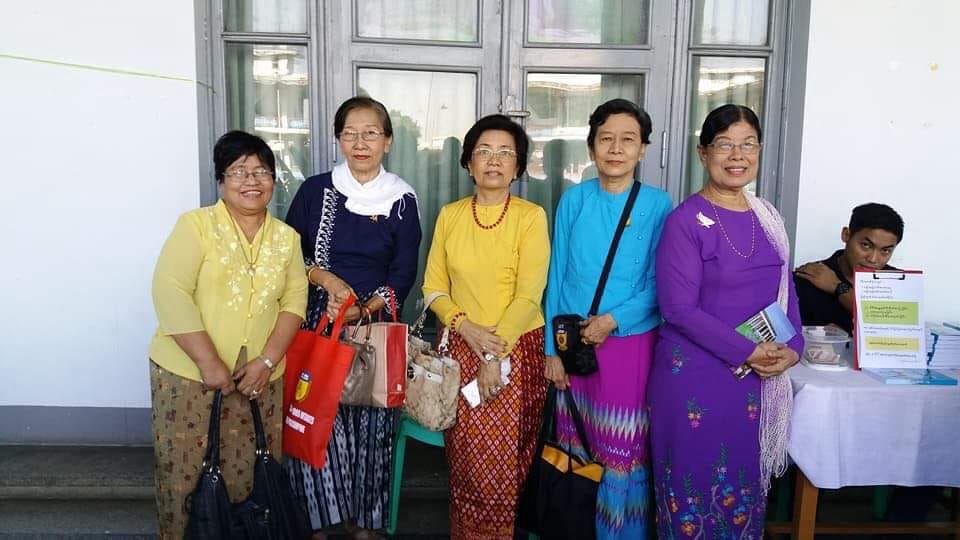
  • RIT Belles

    By Mai Khin Nyunt (Rosie, ChE71) and Ma Tin Aye (C73)

    Dear Ko Hla Min,

    May I present the names of TWO photos of RIT ladies.

    First photo :

    Right – Ma Sandi Hlaing — Ch 66 intake
    2nd from Right Mai Khin Nyunt (Rosie Gyi) — Ch 65 intake
    3rd. — Ma Nila Mya Aung — M 64 intake
    4th Ma Jessie Htwe — M 66 intake
    5th Ma Annie Ba Htaw — Tex65 intake
    6th Ma Aye Aye Than (Pauk Pauk, Emma’s cousin) Ch 66 intake (UK)
    7th Ma Tin Tin Myint (Emma Myint) — Ch 64 intake (Singapore)
    8th Ma Than Than Yi (GBNF) Tex 65 intake (my best friend who passed away
    in Sept 2013, USA)
    9th Ma Phyu Phyu Latt (Christine Latt) — Ar – 64 intake (Australia)
    10th Ma Min Thet Mon (Pamela Myo Min) — Ar -64 intake

    We all served as ushers at the Graduation Dinner in late 1966. Graduation took place at RIT as well as the Dinner, at “Aw Bar Lann” area.

    Second photo by Ma Tin Aye (C73 Volleyball) :

    As far as I remember, those were:

    Right …. Ma Aye Aye Than (Pauk Pauk, Emma’s cousin) — (Ch 66-72, UK)

    2nd from Right Ma Tin Tin Myint (Emma Myint) — Ch 64-70, Singapore)

    3rd Ma Hla Hla Aye (She was a cover girl of the “Shay Tho Sar Saung”. Inside the Sar Saung had an article about RIT activities with photos. I kept that Sar Saung, but unfortunately (after so many years) now I only have a page left with a photo taken at the Chemistry lab, which included Ma Khin Myat Swe (spouse of Saya U Moe Aung), Henry Koe, my spouse Ko Khin Mg Myint and myself).

    4th Ma Tin Aye (C )

    5th Ma Nelly Khin Myo Win (GBNF) (Ch 65-71, Mandalay)

    6th I guess it could be Ma Margaret Yi (Ch 65).

    All are from G -Hall at one of the Tha Din Gyut or Da Saung Taing Pwe at Shwe Dagon Pagoda, organized by G -Hall.

    Regards,
    Rosie (Ch 65-71)

    Editor’s Notes:

    • There were 45 (or so) female students in the first 1st BE intake in 1964.
    • There may be a little bit more in the 1st BE intake in 1965.
  • RU (10) years after its inauguration

    Translated by Saya U Soe Paing

    U Soe Paing

    Buildings for Student use built during the first decade of Rangoon University

    To place all the colleges under Rangoon University in one area the Burmese government allocated eight lakh kyats for purchasing land for a University Estate. With these funds more than 400 acres of land now known as University Estate was bought. At that time the land known as “Na Nat Taw” was a thick forest. The estate was surrounded by Inya Road on the East and North side, Prome Road on the West side, and Windermere Road on the South. In 1927, Rangoon University leased from the Government under a 90-year grant, Scout Island in Inya Lake where the Rangoon University Boat Club (RUBC) was located. The area of the University estate expanded up to Inya Lake in the North.

    To construct buildings in the estate a University Building subcommittee was formed and the committee chose Mr. T. O. Foster as the Architect. Mr. Foster went to England and brought back with him the required staff and started drawing plans and designs of the buildings in the estate. The bushes and trees on the estate were cleared with the help with of Forest Officer Mr. A Roger and the building constructed.

    The British Government support funds for the building of the Rangoon University was only about one lakh kyats annually. There was also no endowment/main funds for the construction. To get funds for the construction and for the expenses of the University, the Governor, Sir Harcourt Butler allowed gambling officially known as “Our Day” in the whole country. From the funds raised the buildings were slowly constructed.

    Two years after Rangoon University was opened, the University Chancellor, Sir Reginald Craddock laid the foundation of the Convocation Hall on 2nd December 1922 but was completed only in 1931.

    The number of students had grown and in December 1923 two double storey wooden buildings that can accommodate 224 students were built on Prome Road and completed in June 1924. One was named Tagaung Hall and the other Prome Hall and opened for occupancy. In 1925 Engineering students started staying at Tagaung Hall and in 1927 some Engineering students stayed at Prome Hall.

    In 1927 Mr. Rao Bahadur S Ramanatha Reddiar donated 200,000 Kyats for building of the University Library. University Chancellor Sir Harcourt Butler laid the foundation for the library on 8th December 1927. Architect Foster designed and built the library, and finished it in 1931.

    The BOC College building funded by the BOC Company was completed in 1927, and was inaugurated by the Governor Sir Harcourt Butler on 30th November 1927.

    The University Avenue was built in 1928, and the University Hospital building on University Avenue was finished in June 1928. There was one Resident doctor and one assistant doctor at that time.

    The foundation of the Rangoon University Arts Hall was laid by the University Chancellor Sir Charles Innes on 3rd November 1928, and completed in 1931. The Rangoon University Science Hall was also completed in the same year.

    Merchant U Chan Chor Khine (son of Chan Mah Phee) donated Kyats 100,000 for the construction of the Rangoon University Gymnasium. Construction started in 1929, and was completed and opened in 1930.

    Besides the above mentioned buildings, Medical College, Education College, Hostels for students, Houses for Professors, Staff quarters, University Post Office, University Bookshop, telephone exchange, the football and athletics fields, tennis courts, and the boat club were built mainly on the University estate. Apart from the two wooden buildings, the remaining buildings were built by the University Building Construction Committee. The committee formed in 1931 was disbanded in August 1932 when all the buildings were completed.

    Rangoon University Students’ Union and Union Building

    The most memorable development concerning all the college students occurred in 1930 when the Students’ Union building was finished and the Rangoon University Students’ Union was formed. Some of the engineering students became members.

    Old documents and reports showed that when Rangoon University was first established, the University authorities believed that there should be a Students Union building. However in 1926-27 only when Dr. U Nyo (K.S.M. LL.D) generously donated 170,000 Kyats to build the Students Union building that construction started.

    The Students Union building was constructed in 1929 in a plot at the corner of Chancellor Road and University Avenue and completed in the middle of 1930.

    The senior students held meetings hall-wise and according to the decisions reached at the meetings Ko Kyaw Khin, Ko Tint Swe and Ko Ba Gyan representing the students met with University Vice-Chancellor U Ba on 12/9/1930 and discussed forming of a committee to set up rules and regulations for the Students’ Union. As agreed at the meeting Ko Kyaw Khin chaired a students mass meeting at the University Gymnasium where there was unanimous agreement to form a students’ union. A committee to draft the rules and regulations of the union was formed with the following students: Ko Kyaw Khin (Chairman), Ko Ba Gyan (Secretary), Ko Kyaw Thein, Ko Tint Swe, Ko Htun Tin, Ko Ba Thein, Mr. M. A. Raschid, Ko Ohn, Mr. Paratasan, Ko San Phaw Aung, Ko Ba Pe and Ko Nyunt.

    The committee submitted the report on 23/11/1930. The suggestions made by the University authorities and students were considered and some incorporated into the amended report which was accepted and approved by the student mass meeting on 9/1/1931. An executive committee was formed at the meeting with Chairman Ko Kyaw Khin (who later became Barrister-at-Law), and Secretary Mr. M. A. Raschid (who later became Minister of Mines, Industry, Labor).

    However the meeting did not like some of the paragraphs regarding handing over of the union building in the agreement between the University authorities and the student union and authorized the executive committee to continue discussions. Eventually an agreement was reached and on 27/2/1931 the working meeting accepted it. The executive committee of the Rangoon University Students’ Union signed accepting the agreement at 11AM on 28/2/31.

    When writing the rules and regulations to establish the Rangoon University Students Union, Students Unions at Oxford and Cambridge universities in England were taken as standard examples. However those students unions are primarily associations that emphasize debating. Under Chapter (1), Section (3) of the University Rules and Regulations, it was stipulated that, for the objectives of the Rangoon University Students Union to be met, debates, talks, discussions, fun fairs should be organized and provided for the benefit of the students.

    But it was inevitable that the colonized countries’ attempt to gain independence and educated youths would come together sooner or later.

    Situation after the first ten years

    When Rangoon University was first established in 1920 there were 839 students and 6 Professors and. In 1930 there were 1550 students and 21 Professors. Out of the 21 Professors, one was the Professor of Engineering. Professor Elgood had retired at that time and Prof. C. H. E. Cherry was the acting Professor.

    Two remarkable developments in 1930 were the opening of the Teachers’ Training College and Medical College under Rangoon University as constituent colleges. The Honors courses for the Arts and Sciences were changed from a 2-year course to a 3-year course. The more important modifications in academic policy during the year were the lengthening of Honors courses leading to the B.A. and B.Sc. degrees from two to three years duration; amendments of the Matriculation Regulations to take effect from June 1934 requiring all candidates for admission to the University to have passed in Burmese in the High School Final Examination.

    Recognition of BSc (Engineering) degree by the Institute of Engineers (India)

    In the 1930-31 academic year, a special committee formed by the Boards of Study wrote the new regulation regarding the curriculum. The new regulation was approved by the Boards of Study and used starting from the 1931-32 academic year.

    At the time the new regulations were used, the Engineering College made approaches for the Institute of Engineers (India) to recognize the B.Sc. Engineering degree awarded by Rangoon University starting in the 1930-31 academic year.

    There were only 4 teaching staff at the Engineering College up to 1930. See Appendix (1D). In the academic year there were no plans to appoint more staff or to get external lecturers, and the number of teaching staff was still below the minimum advised by the Sandes Committee report. Hence the Institute of Engineers (India) did not recognize the B.Sc.Engineering degree from Rangoon University. This demand for increased staff came at an awkward time. The Rangoon University Engineering graduates were ruled ineligible for any of the Government of India competitive exams for professional appointments in the Railway and Telegraph departments.

    Financial stringency and the need for rigid economy loomed large in University administration throughout the 1931-32 academic year. Faced with the possibility of a radical reduction of income the Univer­sity examined ways to reduce the expenses and to use the existing resources effectively.

    Among the proposals for a very substantial reduction of the cost to Government of Engineering Education by adjustments of courses between the Insein Technical Institute and the B.O.C. College. This involved the opening of Diploma Courses in the B.O.C. College with but small addition to the staff of the College and the closing down of the advanced courses in Mechanical and Electrical Engineering in the Insein Technical Institute involving considerable reduction of staff in that institution.

    The recognition of the B.Sc. Degree in Engineering of the University by the Institution of Engineers (India) was again addressed. The Institution appointed Mr. C. Innes, Deputy Chief Engineer, P. W. D., to report on the standards of the Courses and Examinations in Engineering. The Inspection was carried out during the University Examinations of March 1931 and a report submitted.

    In 1931-32, the teaching staff increased to 5 and the Institute of Engineers (India) eventually recognized the B.Sc.(Engg) degree starting at the time of the degree examinations in March 1932.

    The high standard of the B.Sc.(Engg) degree conferred by Rangoon University was maintained for the March examinations in 1934. In the opinion of the External Examiner the standard was up to that of a British University. Nevertheless in spite of the high aggregate of marks required two students secured a distinction without any serious overwork.

    Teaching staff

    When the Rangoon University engineering department opened in 1924, there were only 2 teaching staff. It increased to 4 in 1928. One workshop superintendent was appointed in 1931. In the 1930-31 academic year due to financial difficulties in the University administration the minimum required number of teaching staff cannot be reached. In 1932 with an addition of one teaching staff, the number was 5 teaching staff and a workshop superintendent making it a total of 6. The situation remained the same till 1939. Only in the 1940-41 academic year the number of students increased substantially and the number of courses were increased that the number of teaching staff became 7 with a workshop superintendent making it a total of 8.

    During 1934 to 1939 the Engineering department added diploma courses in Mechanical and Electrical Engineering, degree courses in Mechanical and Electrical Engineering, Honours courses in Civil Engineering. However during the period no additional staff was appointed and the existing staff had to bear more teaching loads than they could.

    All this time the teaching staff appointed up to 1940 were only English and Indians. Only in the 1940-41 academic year, a Rangoon University Engineering graduate and Burmese national, U San Shin was the first to be appointed. It was evident that during that time there were no plans to develop nationals as teaching staff for the long term.

    The list of all the teaching staff of the Engineering department from 1924 to 1941 giving names, position and period of service are shown in Appendix (1D).

    Although there were not enough teaching staff in the engineering department, the staff from other departments of the Rangoon University had helped in teaching related engineering subjects all this time. Especially the Mathematics department took responsibility for teaching mathematics. Geology and Chemistry departments also helped.

    A Library was opened in BOC College and a Librarian, one upper division clerk and one lower division clerk were appointed for the library.

    Prof. W. N. Elgood was the first Head and Professor of the Engineering Department. He retired in the 1930-31 academic year and Prof. H. .C. E. Cherry took over his duties temporarily. In 1932-33, Prof. F. Webster took over from Professor Webster and served as Head and Professor) until 1940. In 1940-41 Professor Webster took leave for war duties, and Prof. D. P. Davies took over his duties.

    Job opportunities for the graduates

    Since the time the Rangoon University Engineering Department started producing engineers, graduate engineers had difficulties finding employment and even some were jobless. Besides in 1922-23 academic year the government had financial difficulties and stop the government departments from recruiting graduates. It however had the effect of directing the attention of such graduates to the necessity of securing adequate practical experience and also to the greater possibility of employment with private industry. Thus practical industrial training was emphasized more in the engineering instruction.

    That year Head of Engineering Department Prof. Webster went to various private industries and factories and spent a great deal of time discussing about employment for the engineering graduates. The private engineering industry organization in their search and recruitment of new engineers for their industries, helped in making the Engineering College a regular source to supply qualified graduate engineers.

    That’s why in the 1934-35 academic year, the prospects of employment graduates increased and became better. In the first examination of the Publice Service Commission for the Superior Engineering Services in which graduates of this College were allowed to appear, one of them Mr. Sen Gupta, secured one of the two vacancies in open competition with the rest of India.

    At that time, there was good rapport with BOC and arrangements were made for the students to undergo training in the fields of BOC, and fresh graduates to serve a short term apprenticeship with the ultimate prospect of joining the technical services of the company. For this purpose, Prof. Webster was invited to the oil fields and to consult with Mr. Bowlby, the Field Manager. This also permitted him to make a tour of the fields to satisfy himself that students would be capable of providing the required services. As a result, arrangements were made to get at least 15 students send to Yenangyaung and Chauk oil fields for the summer training.

    All engineering graduates in the 1938-39 academic year got employment in industry and the job opportunity for engineering graduates was very good.

    BOC played a major role in employing most of the graduates in 1940-41. All 4 engineering graduates got jobs, and out of the 11 combined Mech/Elec diploma holders, 10 were employed. It could be clearly seen that employment prospects and opportunities had become better.

    This year for the first time for several years inquiries have been made for the services of engineering graduates for the public sector.

  • HMEE (4th Installment)

    Saya U Soe Paing (EE)

    U Soe Paing

    Rangoon University (10) years after its inauguration

    Buildings for Student use built during the first decade of RU

    To place all the colleges under Rangoon University in one area the Burmese government allocated eight lakh kyats for purchasing land for a University Estate. With these funds more than 400 acres of land now known as University Estate was bought. At that time the land known as “Na Nat Taw” was a thick forest. The estate was surrounded by Inya Road on the East and North side, Prome Road on the West side, and Windermere Road on the South. In 1927, Rangoon University leased from the Government under a 90-year grant, Scout Island in Inya Lake where the Rangoon University Boat Club (RUBC) was located. The area of the University estate expanded up to Inya Lake in the North.

    To construct buildings in the estate a University Building subcommittee was formed and the committee chose Mr. T. O. Foster as the Architect. Mr. Foster went to England and brought back with him the required staff and started drawing plans and designs of the buildings in the estate. The bushes and trees on the estate were cleared with the help with of Forest Officer Mr. A Roger and the building constructed.

    The British Government support funds for the building of the Rangoon University was only about one lakh kyats annually. There was also no endowment/main funds for the construction. To get funds for the construction and for the expenses of the University, the Governor, Sir Harcourt Butler allowed gambling officially known as “Our Day” in the whole country. From the funds raised the buildings were slowly constructed.

    Two years after Rangoon University was opened, the University Chancellor, Sir Reginald Craddock laid the foundation of the Convocation Hall on 2nd December 1922 but was completed only in 1931.

    The number of students had grown and in December 1923 two double storey wooden buildings that can accommodate 224 students were built on Prome Road and completed in June 1924. One was named Tagaung Hall and the other Prome Hall and opened for occupancy. In 1925 Engineering students started staying at Tagaung Hall and in 1927 some Engineering students stayed at Prome Hall.

    In 1927 Mr. Rao Bahadur S Ramanatha Reddiar donated 200,000 Kyats for building of the University Library. University Chancellor Sir Harcourt Butler laid the foundation for the library on 8th December 1927. Architect Foster designed and built the library, and finished it in 1931.

    The BOC College building funded by the BOC Company was completed in 1927, and was inaugurated by the Governor Sir Harcourt Butler on 30th November 1927.

    The University Avenue was built in 1928, and the University Hospital building on University Avenue was finished in June 1928. There was one Resident doctor and one assistant doctor at that time.

    The foundation of the Rangoon University Arts Hall was laid by the University Chancellor Sir Charles Innes on 3rd November 1928, and completed in 1931. The Rangoon University Science Hall was also completed in the same year.

    Merchant U Chan Chor Khine (son of Chan Mah Phee) donated Kyats 100,000 for the construction of the Rangoon University Gymnasium. Construction started in 1929, and was completed and opened in 1930.

    Besides the above mentioned buildings, Medical College, Education College, Hostels for students, Houses for Professors, Staff quarters, University Post Office, University Bookshop, telephone exchange, the football and athletics fields, tennis courts, and the boat club were built mainly on the University estate. Apart from the two wooden buildings, the remaining buildings were built by the University Building Construction Committee. The committee formed in 1931 was disbanded in August 1932 when all the buidings were completed.

    Rangoon University Students’ Union and Union Building

    The most memorable development concerning all the college students occurred in 1930 when the Students’ Union building was finished and the Rangoon University Students’ Union was formed. Some of the engineering students became members.

    Old documents and reports showed that when Rangoon University was first established, the University authorities believed that there should be a Students Union building. However in 1926-27 only when Dr. U Nyo (K.S.M. LL.D) generously donated 170,000 Kyats to build the Students Union building that construction started.

    The Students Union building was constructed in 1929 in a plot at the corner of Chancellor Road and University Avenue and completed in the middle of 1930.

    The senior students held meetings hall-wise and according to the decisions reached at the meetings Ko Kyaw Khin, Ko Tint Swe and Ko Ba Gyan representing the students met with University Vice-Chancellor U Ba on 12/9/1930 and discussed forming of a committee to set up rules and regulations for the Students’ Union. As agreed at the meeting Ko Kyaw Khin chaired a students mass meeting at the University Gymnasium where there was unanimous agreement to form a students’ union. A committee to draft the rules and regulations of the union was formed with the following students: Ko Kyaw Khin (Chairman), Ko Ba Gyan (Secretary), Ko Kyaw Thein, Ko Tint Swe, Ko Htun Tin, Ko Ba Thein, Mr. M. A. Raschid, Ko Ohn, Mr. Paratasan, Ko San Phaw Aung, Ko Ba Pe and Ko Nyunt.

    The committee submitted the report on 23/11/1930. The suggestions made by the University authorities and students were considered and some incorporated into the amended report which was accepted and approved by the student mass meeting on 9/1/1931. An executive committee was formed at the meeting with Chairman Ko Kyaw Khin (who later became Barrister-at-Law), and Secretary Mr. M. A. Raschid (who later became Minister of Mines, Industry, Labor).

    However the meeting did not like some of the paragraphs regarding handing over of the union building in the agreement between the University authorities and the student union and authorized the executive committee to continue discussions. Eventually an agreement was reached and on 27/2/1931 the working meeting accepted it. The executive committee of the Rangoon University Students’ Union signed accepting the agreement at 11AM on 28/2/31.

    When writing the rules and regulations to establish the Rangoon University Students Union, Students Unions at Oxford and Cambridge universities in England were taken as standard examples. However those students unions are primarily associations that emphasize debating. Under Chapter (1), Section (3) of the University Rules and Regulations, it was stipulated that, for the objectives of the Rangoon University Students Union to be met, debates, talks, discussions, fun fairs should be organized and provided for the benefit of the students.

    But it was inevitable that the colonized countries’ attempt to gain independence and educated youths would come together sooner or later.

    Situation after the first ten years

    When Rangoon University was first established in 1920 there were 839 students and 6 Professors and. In 1930 there were 1550 students and 21 Professors. Out of the 21 Professors, one was the Professor of Engineering. Professor Elgood had retired at that time and Prof. C. H. E. Cherry was the acting Professor.

    Two remarkable developments in 1930 were the opening of the Teachers’ Training College and Medical College under Rangoon University as constituent colleges. The Honors courses for the Arts and Sciences were changed from a 2-year course to a 3-year course. The more important modifications in academic policy during the year were the lengthening of Honors courses leading to the B.A. and B.Sc. degrees from two to three years duration; amendments of the Matriculation Regulations to take effect from June 1934 requiring all candidates for admission to the University to have passed in Burmese in the High School Final Examination.

    Recognition of BSc (Engineering) degree by the Institute of Engineers (India)

    In the 1930-31 academic year, a special committee formed by the Boards of Study wrote the new regulation regarding the curriculum. The new regulation was approved by the Boards of Study and used starting from the 1931-32 academic year.

    At the time the new regulations were used, the Engineering College made approaches for the Institute of Engineers (India) to recognize the B.Sc. Engineering degree awarded by Rangoon University starting in the 1930-31 academic year.

    There were only 4 teaching staff at the Engineering College up to 1930. See Appendix (1D). In the academic year there were no plans to appoint more staff or to get external lecturers, and the number of teaching staff was still below the minimum advised by the Sandes Committee report. Hence the Institute of Engineers (India) did not recognize the B.Sc.Engineering degree from Rangoon University. This demand for increased staff came at an awkward time. The Rangoon University Engineering graduates were ruled ineligible for any of the Government of India competitive exams for professional appointments in the Railway and Telegraph departments.

    Financial stringency and the need for rigid economy loomed large in University administration throughout the 1931-32 academic year. Faced with the possibility of a radical reduction of income the Univer­sity examined ways to reduce the expenses and to use the existing resources effectively.

    Among the proposals for a very substantial reduction of the cost to Government of Engineering Education by adjustments of courses between the Insein Technical Institute and the B.O.C. College. This involved the opening of Diploma Courses in the B.O.C. College with but small addition to the staff of the College and the closing down of the advanced courses in Mechanical and Electrical Engineering in the Insein Technical Institute involving considerable reduction of staff in that institution.

    The recognition of the B.Sc. Degree in Engineering of the University by the Institution of Engineers (India) was again addressed. The Institution appointed Mr. C. Innes, Deputy Chief Engineer, P. W. D., to report on the standards of the Courses and Examinations in Engineering. The Inspection was carried out during the University Examinations of March 1931 and a report submitted.

    In 1931-32, the teaching staff increased to 5 and the Institute of Engineers (India) eventually recognized the B.Sc.(Engg) degree starting at the time of the degree examinations in March 1932.

    The high standard of the B.Sc.(Engg) degree conferred by Rangoon University was maintained for the March examinations in 1934. In the opinion of the External Examiner the standard was up to that of a British University. Nevertheless in spite of the high aggregate of marks required two students secured a distinction without any serious overwork.

    Teaching staff

    When the Rangoon University engineering department opened in 1924, there were only 2 teaching staff. It increased to 4 in 1928. One workshop superintendent was appointed in 1931. In the 1930-31 academic year due to financial difficulties in the University administration the minimum required number of teaching staff cannot be reached. In 1932 with an addition of one teaching staff, the number was 5 teaching staff and a workshop superintendent making it a total of 6. The situation remained the same till 1939. Only in the 1940-41 academic year the number of students increased substantially and the number of courses were increased that the number of teaching staff became 7 with a workshop superintendent making it a total of 8.

    During 1934 to 1939 the Engineering department added diploma courses in Mechanical and Electrical Engineering, degree courses in Mechanical and Electrical Engineering, Honours courses in Civil Engineering. However during the period no additional staff was appointed and the existing staff had to bear more teaching loads than they could.

    All this time the teaching staff appointed up to 1940 were only English and Indians. Only in the 1940-41 academic year, a Rangoon University Engineering graduate and Burmese national, U San Shin was the first to be appointed. It was evident that during that time there were no plans to develop nationals as teaching staff for the long term.

    The list of all the teaching staff of the Engineering department from 1924 to 1941 giving names, position and period of service are shown in Appendix (1D).

    Although there were not enough teaching staff in the engineering department, the staff from other departments of the Rangoon University had helped in teaching related engineering subjects all this time. Especially the Mathematics department took responsibility for teaching mathematics. Geology and Chemistry departments also helped.

    A Library was opened in BOC College and a Librarian, one upper division clerk and one lower division clerk were appointed for the library.

    Prof. W. N. Elgood was the first Head and Professor of the Engineering Department. He retired in the 1930-31 academic year and Prof. H. .C. E. Cherry took over his duties temporarily. In 1932-33, Prof. F. Webster took over from Professor Webster and served as Head and Professor) until 1940. In 1940-41 Professor Webster took leave for war duties, and Prof. D. P. Davies took over his duties.

    Job opportunities for the graduates.

    Since the time the Rangoon University Engineering Department started producing engineers, graduate engineers had difficulties finding employment and even some were jobless. Besides in 1922-23 academic year the government had financial difficulties and stop the government departments from recruiting graduates. It however had the effect of directing the attention of such graduates to the necessity of securing adequate practical experience and also to the greater possibility of employment with private industry. Thus practical industrial training was emphasized more in the engineering instruction.

    That year Head of Engineering Department Prof. Webster went to various private industries and factories and spent a great deal of time discussing about employment for the engineering graduates. The private engineering industry organization in their search and recruitment of new engineers for their industries, helped in making the Engineering College a regular source to supply qualified graduate engineers.

    That’s why in the 1934-35 academic year, the prospects of employment graduates increased and became better. In the first examination of the Publice Service Commission for the Superior Engineering Services in which graduates of this College were allowed to appear, one of them Mr. Sen Gupta, secured one of the two vacancies in open competition with the rest of India.

    At that time, there was good rapport with BOC and arrangements were made for the students to undergo training in the fields of BOC, and fresh graduates to serve a short term apprenticeship with the ultimate prospect of joining the technical services of the company. For this purpose, Prof. Webster was invited to the oil fields and to consult with Mr. Bowlby, the Field Manager. This also permitted him to make a tour of the fields to satisfy himself that students would be capable of providing the required services. As a result, arrangements were made to get at least 15 students send to Yenangyaung and Chauk oil fields for the summer training.

    All engineering graduates in the 1938-39 academic year got employment in industry and the job opportunity for engineering graduates was very good.

    BOC played a major role in employing most of the graduates in 1940-41. All 4 engineering graduates got jobs, and out of the 11 combined Mech/Elec diploma holders, 10 were employed. It could be clearly seen that employment prospects and opportunities had become better.

    This year for the first time for several years inquiries have been made for the services of engineering graduates for the public sector.

  • Mandalay University

    Mandalay

    • Mandalay College was affiliated with Rangoon University
    • Mandalay College later became Mandalay University
    • U Ko Lay (Zeyar Maung) served as Vice Chancellor of Mandalay University
    • U Hla Shwe served as Rector of Mandalay Arts and Science University (MASU)
    • Medical classes were offered by the Faculty of Medicine, Rangoon University
    • Some (e.g. Dr. Maung Maung Nyo) attended the BMF (Branch Medical Facility) at Mandalay
      The students were registered at Rangoon University
    • Mandalay later has its own Medical College
    • Dr. Maung Maung Gyi served as Rector of Mandalay Institute of Medicine
    Dr. Maung Maung Gyi

    Some Medical Graduates Trained at BMF Mandalay

    By Dr. Maung Maung Nyo

    1. Dr Myint Lwin MRCP, Director-General of Medical Research (Retired)
    2. Dr Nyunt Lwin (Leonard Muhammad) MD. (USA) (Florida)
    3. Dr Aung Khin Sint M.Sc.(Community Medicine) NLD (Deceased)
    4. Dr Lay Maung M.Sc.(Public Health)
    5. Dr Prakash Singh Talwar MD.(USA) (Chicago)
    6. Dr Krisna Brajwaja MD (USA) (Pennsylvania)
    7. Dr S. Kumar MRCP (India)
    8. Dr Aung Than M.Med.Sc. (Orthopedics)
    9. Dr Yash Pal M.Med. Sc (Anaes.)
    10. Dr B.S. Ko Lay Ph.D. (Anatomy) (Melbourne)
    11. Dr Tan Myint Maung M.Med.Sc.( Medicine) (Rangoon)
    12. Dr S. Hla Mong FRCS (Edin) (Deceased)
    13. Dr Than Aung FRCS (Edin)
    14. Dr Sheila San San Myint (FFARCS, England)
    15. Dr Muriel Yi Yi Myint MD (Psychiatrist) (USA) (Florida)
    16. Dr Than Yin DPM (Psychiatrist) (Rangoon)
    17. Dr San Yi Ph.D. (Dublin) (Professor, Retired, Mandalay)
    18. Dr Maung Maung Nyo Ph.D. (London), M.A.(Michigan State), FOMERAD
  • Belles

    At Shwe Dagon

    Daw Tin Aye (C73) posted a picture taken at the Tazungdaing Lightning Festival at Shwe Dagon Pagoda on November 26, 1966.

    L to R :

    • Ma Moe Moe Yi (Margaret)
    • Khin Myo Win (Nellie, GBNF)
    • Ma Tin Aye
    • Ma Hla Hla Aye
    • Ma Tin Tin Myint (Emma)
    • Ma Aye Aye Than (Pauk Pauk)

    At Reunion and PZPs

    Belles 2
    Maubin Ma Shwe Than, Khin Mya Swe, Rosie Gyi, Rosie Tin Maung, Ma Sandar
  • SDYF Goals

    U Moe Aung
    • Thanks to Saya U Moe Aung (Patron) — for championing SDYF and also for disseminating the SDYF news — and to everyone who helped transform the SDYF vision into reality in a remarkably short time.
    • As Saya U Moe Aung often mentioned, there are short term and long term goals of SDYF.
    • Kudos to the countless volunteers organizers and supporters (including family members and friends).
    • Sadhu, sadhu, sadhu for the donors / donations
      single and repeated, large and small, in cash and kind.
    • Special mention to the Executive Committee members for not adding a single kyat as overhead for SDYF-related activities.
      Their dedication and desire to repay the metta and cetana of their mentors is transcendental.
    • Some sayas need physical, financial, and spiritual assistance.
    • Some sayas often give back the Garawa money and Financial Aid for Health Care
      to SDYF or donate to other (equally) worthy causes.
      They express their joy mingling with their former colleagues and mentees.
    • Saya Ge Ha” is an excellent step forward to cater to the social needs of our aging and needy sayas.
    • SDYF Bulletin” will reiterate and clarify the objectives, to record the SDYF activities, to solicit ideas for improving ways and means to help past, present, and future engineers.
  • Architecture

    By U Tin Htoon (A60)

    Congratulations to the members of the Organizing Committee of the “First RIT Grand Reunion and SPZP” for systematically and expeditiously planning, arranging and executing the forthcoming grand reunion of the millennium in San Francisco. It is a very good idea to build up the momentum while awaiting for October 28, 2000 by having write ups about the faculty members and the alumni as well as the up-dates for this occasion. If not for the dedication and concerted efforts of the Editor Hla Min and the webmaster Khin Maung Zaw (KMZ), we will not have the opportunity to read them even though people may be willing to contribute articles. The articles and up-dates inspired me and thus my decision to contribute about our class of 1960.

    Architecture was introduced for the very first time in 1954 at BOC, University of Rangoon. U Myo Myint Sein belongs to this first batch. One of his classmates, Ko Myint Thein retired as Chief Architect of Public Works Department in Yangon. We were the “third batch” and were fortunate to study at the brand new “Faculty of Engineering” campus, commonly known as “Leik-khone” at Pyay [Prome] Road.

    There were nine of us in the first year, (1956). One of them was Shajahan, an Indian lady who became the first female to join the male dominated Engineering campus. However, she was unfortunate to be the victim of the “2F” system of our days. She left for India and later graduated as an Architect from there.

    In our second year, three guys from the second batch joined us. One from the first batch joined us in the final year. Two of the old-timers became the victims of the “2F” system.

    One very unique and interesting aspect of being an architecture student is doing design work. We were trained to solve design problems within a stipulated time and because of that we use to spend most of our time in our studio class.
    Eventually, the studio became our second home. We practically eat and sleep there and we spent our break times in the studio as well.

    Only when attending related Engineering subjects, we join together with other Engineering students. Otherwise, we normally confined ourselves within the Department of Architecture block and among our own group. Thus, the reason that most of the Engineering students came to know us because we were like “caged animals” in the zoo; being watched by people from outside and in our case by our friends as they walked along the corridors.

    Although the majority of us were day students, we were better off than those staying in the hostels as we didn’t have to pay extra to live in the studios. It was fun spending our time in the studios and as we were able to come up with fantastic ideas and designs and draw them as and whenever desired and complete the project within the stipulated time. For us, we didn’t had “days” and “nights”. The nights were more peaceful and productive for us. Only the studios in the architecture block were lit up at night. Sometimes, we even walk over to Hledan, Kamayut to have our break and supper.


    When architecture was introduced at BOC in 1954, there were one British and two Indian architects as full time staff assisted by their Myanmar counterparts. They were still teaching us during our first year. Roger Johnson, also a British architect became head of Department when we got to the second year. He was assisted by Nagler, an American architect and Saya U Kyaw Min (GBNF) and Saya U Win Htain in the later years. Sayagyi U Tha Tun (GBNF), Saya U Maung Maung, Saya U Aung Myint, Saya U Khin Mg Thint and Saya U San Tun Aung were part time staff. All the architectural subjects and the studio design work were taught by them except the freehand drawing class which was taught by an artist. We were fortunate that there were no changes in the staff and they all taught us till we graduated in 1960.

    Apart from the architectural staff, our years at the University will not be complete without mentioning some of our Engineering Faculty staff who taught us some of the related Engineering subjects.

    The first person I wish to mention is Sayagyi Num Kok. He taught us structure and we sometimes didn’t attend his class due to our studio design assignments. Since the class was meant only for architectural students, and since he knew where to find us, he used to come straight to our studio and requested us to come and attend his class. He was very good natured, humble, and led a simple life carrying a shan bag instead of a leather brief case. We always saw him with a smiling face and was very soft spoken.

    Another Saya I remembered well was Saya U Kyit In (later known as U Min Wun). He taught us survey and he was just back from the United States at that time. Whenever I had problem with the survey readings, he came over and nudged me out and checked the readings himself. He used to wear khaki long pants with a single buckle at the rear, which was the fashion of those days.

    Then I remember my Strength of Materials saya, Saya U Ba Than, who happens to be my brother. He was very strict and didn’t give any special favors even to his own brother. He was famous in setting questions for the exam as he never repeated the same ones that were given and worked out in the class.

    The list won’t be complete without mentioning Saya U Kyaw Tun (GBNF) who taught us Electro Technology. Since his classes were immediately after the lunch break, we had a hard time to overcome sleepiness and be attentive to his lectures.

    Last, but not least, I wish to mention about Saya Solomon and Saya Wein Choung. Their metal and wood work classes were always enjoyable and plenty of fun. We were in a totally different environment, not like those of lecture theaters or studio rooms. It was in these classes that we learnt the practical aspect of transforming design drawings into finished products.

    My wonderful six years at the Rangoon University will not be complete without mentioning about my rowing activities. Since I came from a rowing family starting from my uncle Chan Cheng Hock who was Captain (1940-41) and the present oldest surviving Captain, I also became Captain (1959-60) after my two brothers U Tin U (ex-faculty member of BOC) and Dr. Myo Tint. I earned my “Gold” in 1956 by competing in the Inter-varsity regatta at Calcutta. I had the opportunity to represent RUBC seven times in regattas abroad and several times in Yangon.

    Although we started with nine students in the first year in 1956, ten of us graduated in 1960 due to the circumstances explained earlier. Philip Koon Ying Chu, who is now retired after being a very successful restaurant businessman in the Bay area, stood first. It was not the first time for him to have this academic achievement as he got first in the matriculation (in the whole of Burma) and was able to maintain the same position for the Intermediate of Science as well. Out of these ten graduates, six are now residing in the States. Among these six, Tan Teong Kiat (aka) Wai Lwin is the most successful professionally. He is doing consultancy work specializing in conceptual design. S. Hsiang Wu, Victor Pe Win and Jack Min continue to practice architecture in the private sector. Aung Kyee Myint became the Chief Architect of Public Works Department in Yangon and is now serving as an Advisor after his retirement. Kin Maung Yin excels in design and eventually became a well known artist in Myanmar. Later, he spent most of his time giving tuition to children. H. Hla Myint was unfortunate not to live long and passed away a few years ago.

    As for me, I had to be contented with being a Managing Partner of Architects Incorporated after graduating and running my own business. It was challenging, exciting and rewarding compared to being in the Government service. However, in 1962, we had to close down our business. I joined the Industrial Development Corporation (IDC) to open a new architectural division with my two partners Aung Kyee Myint and Bo Gyi in 1964. IDC, together with Housing Board and other Civil Engineering organizations were amalgamated to form Public Works Corporation. While working with Public Works, I had the opportunity to design Thiripyitsayar Hotel in Pagan (Bagan). Now, it is the only hotel complex left within the archaeological zone of Pagan and I am proud to be associated with it. I left Myanmar in 1980 and worked as Sr. Architect with one of the well known architectural firms in Singapore. I had a wonderful and memorable time for over ten years designing multi-story hotels, aerospace exhibition pavilions, commercial complexes, restoration projects and luxurious bungalows. In the beginning I had to work very hard to get acquainted with building codes, bye-laws and local regulations as we never had such standards and regulations to abide by at home. It was wonderful to discharge the duties of an architect properly as “Prime Consultant”. It was like a “Commander-in-Chief”, coordinating with other Engineering disciplines and the related fields like interior decorators and landscape architects, chairing site meetings etc.

    Now that I have settled down in Los Angeles and working for Design Division of L.A. County Dept. of Public works, I am devoting most of my time more in assisting those who are deeply involved in the propagation and perpetuation of Buddha Sasana.

    In conclusion, I wish to pay my tribute to all my Sayas and wish to thank them for educating and equipping us with proper tools in order to be able to face any type of situation in this world. And to my classmates, I salute all of you for your lifetime achievements and hope that this article will throw some light about our wonderful days at “Leik-khone”.

    Editor’s Note :

    • U Kin Maung Yin passed away.
    • U Tin Htoon and U Aung Kyee Myint are retired.
    • U Bo Gyi is a Sayadaw.
  • RUESU Magazine 1951 – 52

    Feedback from U Aye (M62) : Class of some members

    Sitting L-R :
    Ko Maung Maung (M54), Ko Maung Maung Aye (C52), Mr. V. P. Khetrapal, Ko Hla Aye (ES52), Ko Win Maung (EE52)

    Standing L-R :
    Ko Ohn Kyaing, Ko Aung Ban, Ko Thaung Sein (M55), Ko Myint Wai, Ko Oak Soe

    U Aye (M62) wrote :

    Sitting, second from left- Ko Mg Maung Aye (C52)
    Sitting second from right, Ko Hla Aye (ES 52).