He served as the Executive Committee member of the RIT Electrical Engineering Association.
He graduated from RIT in 1968 with B.E (EP). He joined EPC (Electric Power Corporation) and retired as DyCE (Deputy Chief Engineer).
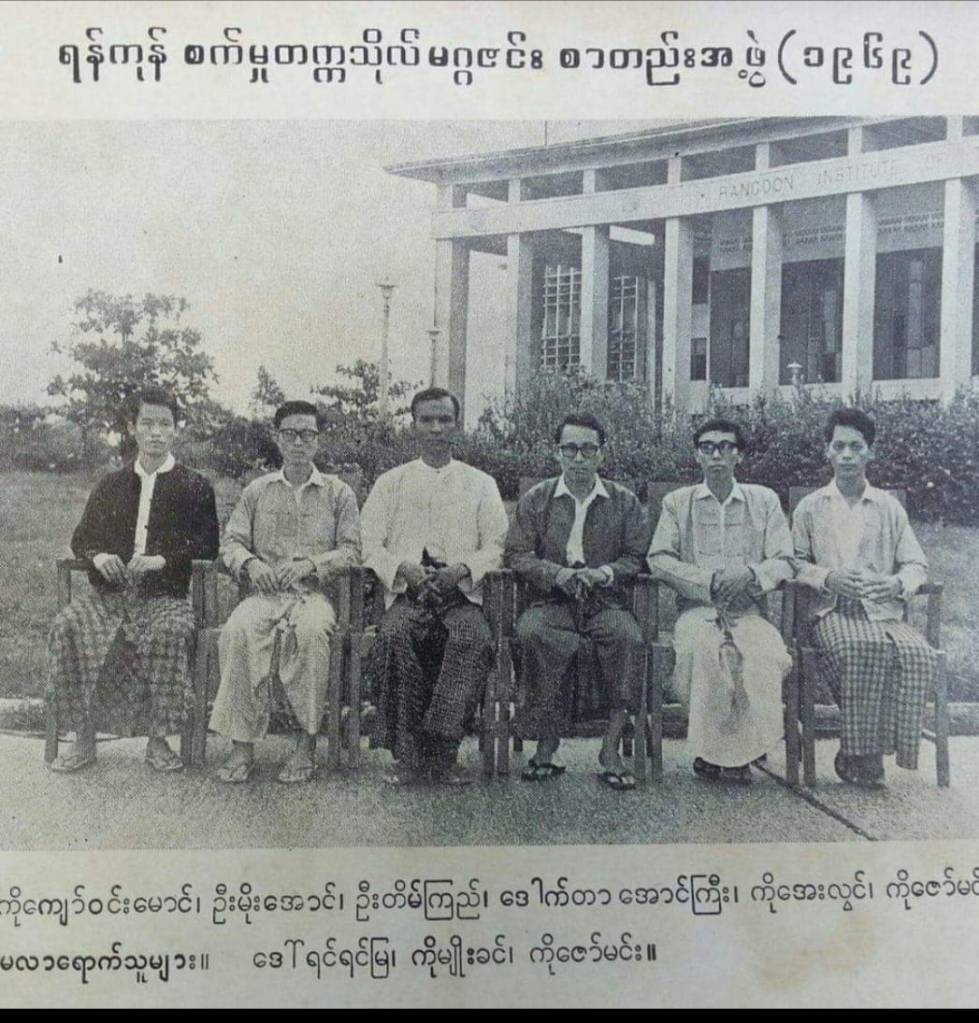
He played soccer for RIT, All Universities & Institutes, Electric Power Corporation (EPC) and Burma.
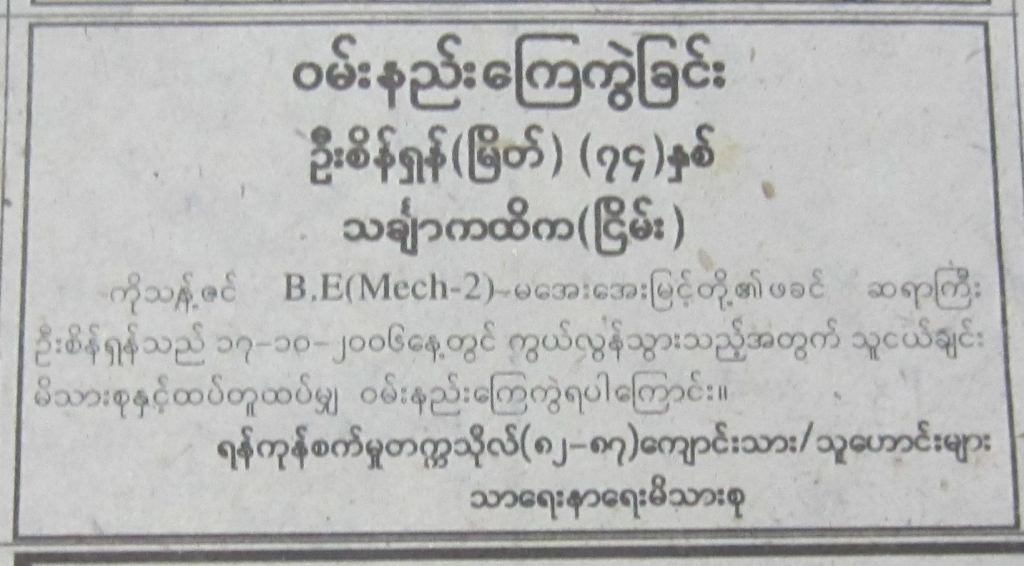
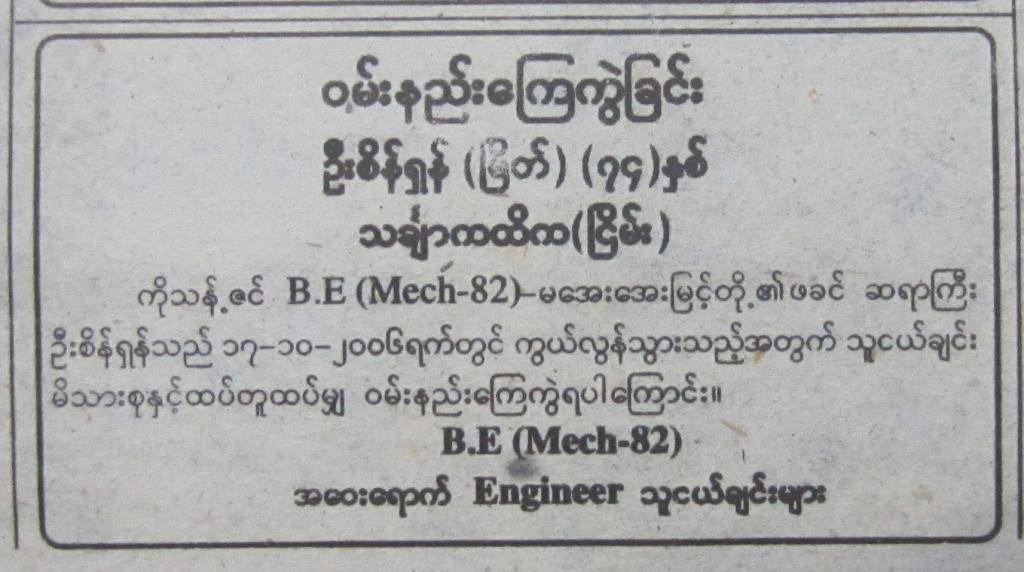
He passed away at the age of 72.
He is a cousin of Daw Thuzar (actress & spouse of Jeffery Tun Aung).
U Khin Maung Zaw (KMZ, EP76) wrote :
I believe he left EPC as DyCE. Upon retirement he was active in football [soccer], became Technical Director/Team Leader with the Football federation. For all his efforts, he was awarded “Excellent Performance in Social Field (Third Class)” in January 2008.
Received his doctorate from Japan. Also found his love life “Moe Moe”.
Due to the immigration laws in Myanmar and Japan, the family finally decided to move to Auckland, New Zealand.
Organizer for RIT events in New Zealand.
Wrote articles for RIT Alumni International Newsletter
One article is about two Forgotten Songs from RIT. One song is a favorite of Saya U Tha Tun (Head of Department). Another song is about a Belle Ma Ma Q & her fans (sayas and alumni).
Wrote a photo essay on Kyaik Hti Yo Development. Saya U Min Wun wrote a supplement article for the Project.
Wrote a letter to the Thagyar Min to second his favorable opinion on Naw Louisa Benson (Miss Burma & movie actress).
Wrote about some paintings.
Quoted Reverend F Lutvig (Ashin Ananda, Laureate Poet) in his articles.
He passed away, but “Moe Moe” kept contact with Daw Phyu Phyu Latt (Christine, A70) and other alumni in Australia.
Forgotten Songs of RIT
by Kogyi Koung
First Song
It was one afternoon in the early May of 1963. Someone was singing a prewar semi-classic song from the second floor of RIT main building. In 1963, RIT buildings were relatively new and that semi-classic song caused a little bit of discomfort for the freshmen [equivalent to 3rd BE] located on the first floor. The song continued as, (. hmain: njou. njou. sain: lou. je . njou pja ji hmaung che . to: dan: kalei: nanbei: ga swe . e:di jwa be: kwe…)
The meaning is: Dull and gloomy cloud override at the horizon; Indistinct brown and dim bluish vision of a wood jetting out from that end is my village … *Note: The title of the song is ‘Htamin: mjein mjein sa: me’ i.e., “Enjoying the meal with relish” . The duet song was first performed by prewar famous singers Ou’ O: Ba Thaung and Sein Party. Later many other singers have rendered their own versions of the song.
We saw an old man singing the song while he was painting watercolor on a huge art paper. He was painting the landscape described in the song. Amazingly the picture was full of life and the song was telling the story. Everybody stopped in front of his office on the second floor and looking with wonder and singing with him.
After a while we asked him, “Sayagyi, who are you and which department do you belong to?” He replied, “I am U Tha Tun, Head of the Department of Architecture”. Oh, my God! How stupid that we, the freshmen of Architecture, don’t even know the head of our department. As time passed, we learned more about ‘The Great U Tha Tun’.
When we became senior students, U Tha Tun’s health deteriorated so much that Saya U Myo Myint Sein (Raymond, A58) stepped up as a ‘Kagemusha’ [Japanese for “shadow-warrior”]. UMMS, as acting head, took care of everything about the department. Young and energetic Saya UMMS found that it was not easy to steer the department as Captain of Architecture’s Flag Ship. There were lots of problems for a relatively young department in RIT.
One such problem occurred during our final year. Two of the most experienced Sayas of architecture left the department and went abroad [for enhancing their careers]. They were (a) Saya U Sein Maung (with elegant moustache) has long experience in Rangoon City Development Corporation. He taught each and every detail of the development of Rangoon. (b) Saya M.B. Raschid (son of U Raschid, minister of many affairs under Prime Minister U Nu). He taught with all his professional experience and perfect pronunciation of King’s Burmese with ‘zagaboun’ proverbs. Sometimes he corrected our broken Burmese.
Saya UMMS, Head of the department, not only had lost his right and left hand men, but also there was a danger that the notorious Koung Nyunt and Kyaw Thein (both A67) might not finish their Architecture degrees.
After a long struggle, Saya UMMS stabilized the flagship of Architecture and its direction. A pioneer of the Architecture of RIT, Professor U Myo Myint Sein handed over the headship to Dr. Maung Kyaw in early 80’s. In the late 80’s Dr. Lwin Aung (A59) took over.
Second Song
For creative and original works, Architects cannot design during the office hours. It is also true [to a lesser degree] for the students of architecture. During the lectures and tutorial hours we [as students] have to follow what they have taught. After school hours [mostly after 4 or 5 pm], we start to create and test our design ideas. Note that for other students and staff of RIT, such periods are the pleasure and relaxation time.
There were only a few girls in Architecture, but the one in our studio is especially alluring beauty and glamorous face. She was so popular that she became known as the queen of the student-architects. We called her Ma Ma Q.
Most of the evenings many senior students and young eligible bachelors and/or sayas visit our studio. Some stay late into the evenings. At that time we sang a song named ‘Saga: ta’ kathou’ i.e., Language University, by Khin Yu May.
Because in the song, one part said ‘dage lar te. Ko Ko. kwe ja hmar ba lou lou’ i.e., really coming Ko Ko, out of sight he is sth in the air.
Ma Ma Q didn’t know the meaning, but the visiting Ko Kos were annoyed by our song. They politely requested us to stop singing. At that time the notorious KN and KT asked ‘hse’ kjei:’ i.e., extortion money about 2-3 kyats from the Ko Kos and went to U Chit tea shop. This continued for days and weeks.
When the Ko Kos are not visiting our studio, we sang the following song, instead of Ma Ma Q. i.e., Third Song. (Note. Extract from Shwe Kyi: nyo song by Daw Ngwe Myaing) ‘Diga nei. nya hpjin. lar ma te. so: joun ya hmar lar: akou Kja.ma ne. ne: te. Shwe kyi: nyo Shwe kyi: nyo Shwe kyi: nyo’ “To-night coming you said so, may I believe Ako.. Near the blessed golden crow, golden crow, golden crow…”
Article (Sept/Nov 2000)
With all of those excellent works and flying colours for Saya Pu Zaw Pwe, your organizing committee is a living history of RIT. Our Sayas, Sayamas and Saya-Gyis have contributed their unlimited knowledge to affect and benefit our lives. Many of our Sayas and colleagues have sent their thanksgiving letters to your web site.
I feel guilty in staying quietly at a corner of the Southern Hemisphere. Actually I am busy, because of my article ‘Wanna Migrate to New Zealand, 3/15/00’ that you published on the ex-rit web site. After that article, I got many inquires/contacts by e-mail and direct phone calls, especially from SE Asia. In July there are 133 migrants and in September 28 migrants are now in Auckland, and expecting another over 50 in November 2000. All speak the common language “Burmese” with their own native accents. Now I know our Sayas and colleagues speak “King’s Burmese” in RIT.
I would like to honor my Sayas with a poem from our forefathers-cum-engineers how they had built a city.
Title: ‘SHWE PYI GYI’ (Golden Capital City)
Sweet sound of drums and silver bells Coming from the Palace Can be heard reverberating in the air And I can see the palace roofs, The graduated turrets and buildings Encompassed by haze. And, my dear girl, I can still faintly see The silhouettes of a high pagoda Reaching nearly to the clouds And of super-imposed roofs (i.e., pyathat) Oh my dear, don’t you hear A melodious sound of small bells Coming from the golden monastery? Our golden capital city must be near. (By U Ku: 1827-1895 Translated by Rev. Friedrich V. Lustig)
Dear Sayas and colleagues,
We see not only the Panoramic Photo of golden capital city of our ancient time, but can hear the sound-scape with audio-visual scene. Silhouettes effect of high pagoda in the haze has shown the air perspective of city skyline. We try to sketch the imaginary scene of ancient city in the architectural studios of RIT in the middle of 60’s. The discussion topic of ‘Ancient City Skyline’ is not only interested by the architectural students, but also from various students of other departments from RIT.
This is the starting point to form the ‘RIT Photographic Club’. According to my diary, first general meeting was chaired by Saya U Myo Myint Sein on Saturday, 1 May 1965 at the Department of Architecture. The general meeting selected Professor U Myo Myint Sein as President of RIT Photographic Club and the author as the secretary.
After forming the executive committee, the club took part in various activities and many outstanding photographers from the club took major prizes from Burma Photographic Society and Myawadi Magazine. e.g., Ko San Aung, M74 is the owner of the famous ‘Photo Lab USA’, (i.e., initials for U San Aung) in Yangon is originally from this club. Kjei: zu: tin: bar-de, many thanks for my Sayas and colleagues
Koung Nyunt (Auckland, New Zealand).
Letter to Tha-gyar-min
by Kogyi Koung
Date: Thursday, 14 April 2011 (3:40pm. Thin-gyan Akya-ne.) P.O. Box; Top of the never used RIT water tower Ashe. Jo. Koun (East Gyogone): RIT Compound, Insein, Rangoon, Burma
Dear Your Majesty the Sovereign of Tawadein dha တာဝတိံသာ
As from the beginning of 1960’s our RIT is like the last paradise on earth, with all enjoyments, teachings, preaching, learning, playing sports and friendship never sails away. Kogyi Koung recollects the stories at the time of 60’s RIT and retold the fairy-tales to our Bushido-Burmans at gatherings in Auckland, NZ. However, the young generations of Maha Bandoola do not believe the stories, and they whispered by themselves that Kogyi Koung is now ‘Yin yin galay Yuu-nay-pyi-de’ ယဉ်ယဉ်ကလေး ရူးနေ ပြီတဲ့
Your Majesty the Tha-gyar-min-gyi please take this message to Tawadein dha and explain to my late Sayas and colleagues there, that my stories are not fabricated.
I have the evidences. For example, I have sent a message to RIT alumni update (February 6, 2010) as follows,
Dear U Hla Min,
It is sad news for our elder brothers at RIT, especially those who reside at E and F block during the beginning of 60’s.
A term called “Ma-pyo: mashi.ja ne he.” မပြောမရှိကြနဲ့ဟေ့ was coined at that time. When I visited my elder brother [U Than Soe, M63] at E block (when I was at Leik-khone I.Sc). I heard somebody shout “Ma-pyo: mashi.ja ne he.” Then I looked outside. Everybody lined up at corridor and they were looking at a far side on top of the entrance hall that is attached to a two story house.
I could not believe my eyes. She was a beauty queen, who had Miss Burma two times excising physical training on the porch. I noted down in my diary and the rallying cry “Ma-pyo: mashi.ja ne he.” She is Naw Louisa Benson Craig. Now she has left our brothers’ heart at age 69.
Yours etc. (“Ma-pyo: mashi.ja ne he.”)
When I retold that story here at Auckland, everybody laughed like ‘Wa:lone kwe:aung ye kya de”. I said it is not a joke. I have evidence.
Also, Kogyi Koung explained about the following, written by Maung Maung Hla, a Karen pastor in Rangoon who was close to Naw Louisa during her youth, remembered her aloud : “She had a little mole on her cheek and she had a kind heart. She was also a very good singer.”
This statement has no evidence.
However, Tha-gyar-min-gyi if you find Naw Louisa at Tawadein dha, please ask if what I wrote is true?
Architecture Students and Staff
I have an old group photo taken about the end of 1963, and all the known information are printed. Inside the brackets are where about of the person [at the time of the post].
Top of the photo:
Department of Architecture Rangoon Institute of Technology 1963 ~ 64
Bottom of the photo:
Front row, L to R
Jim Lim (3rd. Year) [?]
Ma Khin Khin Kyu (Ann, 1st.Year) [San Francisco, California, US]
U Myo Myint Sein B.Arch (Rgn) M. Arch (Mch) [Los Angeles, California, US]
U Tha Tun B.Sc, F.R.I.B.A. (Fellowship of Royal Institute of British Architects), A.A. Dip (Lond.), A.M.T.P.I.(Associate Member of Town Planning Institute), F.I.B.A., Head of Department [Deceased on 13 September 1974]
U Yone Mo B.Sc (Hon) Rgn, B.Sc (Engg)Lond, A.C.G.I, A.M.I. Mech.E, A.M.I.Loco.E, Principal [Deceased]
Mr. S. Ozhegov, Cand. Of Arch, Master of Fine Arts, UZBEK, U.S.S.R [Moscow]
Miss Rosalind Maung (Ma Pyi Aye, 2nd Year) [Rangoon]
Htin Myaing (Ben, 2nd Year) [New York, US]
2nd. Row, L to R
Tun Thein (1st Year) [Los Angeles, California, US]
Tin Aung (2nd Year) [Melbourne, Australia]
Yaco B.E. Mayet (3rd Year) [?]
Than Tun (3rd Year) [Rangoon]
Sonny Chin (2nd Year) [?]
Hla Thein (1st Year) [New York, US]
E. I. Jeewa (3rd Year) [?]
Aung Pa Win (1st Year) [Chicago, Illinois, US]
Back Row, L to R
Aung Kyaw Min (3rd Year) [Rangoon]
M. (Ku?) hlgh (2nd Year) [?]
Than Htike (3rd Year) [Warsaw, Poland]
William Chen (2nd Year) [?]
C. E. Munnee (1st Year) [?]
Koung Nyunt (1st Year) [Auckland, New Zealand, GBNF]
Kyaw Thein (1st Year) [Deceased 22 April 2001]
Absentees:
Win Myint (1st Year) [Rangoon]
Win Naing (1st Year) [?]
Note:
1st Year B. Arch, 10 students (8 passed and 2 failed) 2nd Year B. Arch, 5 students (3 passed and 2 failed) 3rd Year B. Arch, 6 students (3 passed and 3 failed) Several Architecture students failed in of a subject from other departments. There was no moderation. If one gets 49% or less of the grade, the student has to repeat all subjects next year.No block selected.
Editor’s Note :
I cannot find the photo mentioned by Kogyi Koung.
The early sayas and sayamas of the Architecture Department include :
U Thar Tun (GBNF)
Pi-thu-kar Kyaw Min (GBNF)
U Myo Myint Sein (USA)
U Bilal Raschid (USA)
Dr. Maung Kyaw (GBNF)
Dr. Lwin Aung (Retired as Pro-Rector)
Artist/Bagyee Aung Soe
U Maung Maung
U Sein Maung (Stanley Ba Pe)
U Maung Maung Phone Myint
Dr. Koung Nyunt (GBNF)
U Hla Than (Retired as Rector)
Daw Min Thet Mon (Pamela Myo Min, Retired Professor)
Graduated with Electrical Engineering in 1958. Received two Gold Medals.
Joined the faculty as Assistant Lecturer in 1958.
Received MSEE from the University of Michigan.
Upon his return to Burma, he joined UBARI which had provided him the States Scholarship.
Transferred to the Electrical Inspectorate.
Taught part-time at EE Department.
Migrated to the USA.
Co-founder and President, BEA
President of TBSA (Theravada Buddhist Society of America). When Sayama Dr. Julie Han (Past VP & fund raiser of TBSA) passed away, Saya donated $2000 to TBSA in her memory.
Attended the First RIT Grand Reunion and SPZP. He have to leave early because his spouse was not feeling well. She passed away after several years of ill health.
Wrote articles for RIT Alumni International Newsletter
He passed away a few years back.
Memorial Service
His only son, Dr. Barry Paw (MD, PhD, outstanding researcher), passed away at the tender age of 55. He suffered a heart attack on the flight back from Australia to the US.
Brother : U Tun Thein (A67)
Nephew : U Hla Thein (Robert, M72)
Article in RIT Alumni International Newsletter
Intermediate of Science
The year was 1952, the year you started your first year intermediate (pre-engineering) at Rangoon University. On hindsight I could probably say, those were the young and restless years. Those early years, there was some student political uprising at Rangoon University. I was gassed while staying at the dormitory at Pinya Hall. A week later it was calm and peaceful. Nevertheless, years went by very peacefully. To the upstart, like me, all we knew was to get good grade and some day become a scientist like Albert Einstein. The interest in science was so great that I set my goal to be a great physicist. So with my mind set to become a scientist, I tried very hard to get good grade. Subject in science were all taught by science Lecturers from India. These were the days when Burmese Lecturer in Science was a rare commodity. The only Burmese teaching Mathematics was Saya U Ba Toke. His Upper Burman ascent was so pronounced and unique it was and is giving a ringing sound to my ears even to this days. Well, my assumption was if I get a couple of distinctions in science subjects, I could probably register for an Honor class in Physics and then proceed on to get a PhD degree at some foreign University. So two years past by very easily by keeping my interest in Science. My dream was all shattered when I register to start my honor class in Physics, I was the only one registered for the class. Loneliness overwhelmed me then, and I went on to join my friends for the first year engineering at BOC College. They say BOC college was a desolate place to be for young man.
My First Year Class (1954) (BOC)
It was like hell to start the first year engineering. The day started with the first year black smith course. Lifting a ten-pound hammer was some effort, needless to say pounding the ten-pound hammer at the heated iron rod. The same day, I thought I have made the biggest mistake in my life starting on engineering course. In the back of my mind, I thought of changing back to Physics Honor Course. My physique was not much of a type to do any blue collar work like black smith. However, my family encouraged me to be an engineer, like some our family friends, like U Kyaw Myint who eventually became a railway commissioner. Again, with some kind and friendly persuasions from friends I stick on with the Engineering School. Some Burmese Saya’s that came to my mind were Saya’s U Num Kok, U Eng Hock (Cl. 1955) and U Kyaw Tun. Well, I passed my first year very smoothly with distinction on all subjects. Courses for all first year students were common to all disciplines. U Kyaw Tun was teaching Electro technology and the rest of the courses were by Sayas from East and West Bengal, India. These were the years when picking up Bengali accent English was considered perfect King’s English. The differential calculus was taught by Dr. Sircar and the projectile solution took several pages; and the advanced algebra was taught by Saya U Ba Toke and Saya U Ko Ko Lay.
My Second Year Class (1954) (BOC)
My second year course was a little heavier and all my concentration was in my study hoping that some day I could pickup a scholarship to study in foreign University. Those days, to study in foreign University was just an impossible dream to my country folks, so I was prevented from applying for a state scholarship. There were a few Colombo-Plan lecturers from New Zealand and England teaching engineering courses, so I elected to major in Electrical Engineering. Textbooks from McMillan and Longman publishers were easy to obtain, then. A little while later, I witnessed the first wave of Burmese Scholar came back (U Sein Hlaing , U Tin Swe and U Ba Than) to replace some Bengali’s Saya’s. There after, another wave of scholars arrived to take up their respective staff positions (U Aung Gyi, U Min Wun, U Khin Aung Kyi). The inspiration to study abroad was so great then, that it pushed me to concentrate on my study with high hope that I may be fortunate to be on the staff of Dean U Ba Hli. So I passed my second year very smoothly with distinction on all subjects.
My Third Year Class (1956) (Leik Khone)
So I passed halfway mark and started my third year course. We started at the new facility Leik Khone constructed under Colombo plan. The lecturers Mr. Neale, MIEE and U Kyaw Tun, AMIEE , Mr Redpath, AMIMech.E and U Ba Than teaching styles were very much oriented to British style. I did admired their logical teaching method; unlike U Sein Hlaing who taught us Communication theory, Dr. Freddy Ba Hli who taught us Vacuum tube circuit theory and U Tin Swe who taught us the Symmetrical Component theory for solving three-phase circuit theory. The third year passed by with mostly academically courses oriented for graduate school, with the exception of electro technology taught by Mr. Neale. Well, I passed my third year with distinction on all subjects. These were the years when we still use the K&E slide rules to solve problems in class and in examinations. Still, if I were to design a small building wiring, then, I could have selected a wire size very much non-code wire sides.
My Fourth Year Class (1957) (Leik Khone)
To me even in my final year, my goal was to proceed on for further study in foreign University. Even though we were in the final year, we never knew that there existed a Burmese National Electrical Code of Practice, equivalent to National Electric Code (NEC in USA). With majority of my class mate concentrating on getting a position in one of the many government departments, my concentration of the academic study become much easier and so I passed my final year with distinction on all subjects. Well, I do not want to be a Wun Dauk Min, anyway. Well, I picked up two gold medals on completion of my final year. Todarmal Talwal Gold Medal and J.A Hills Gold Medal. Well, these medals were all subsidized by my family. The Registrar U Yu Khin sent me a notice that if I should elect to receive a real gold medal, I should submit Kyats 150 for each of these medals, since the price of gold had risen higher than when the cash endowments were made. So my family pitched in Kyats 300 for me to receive the two Gold Medals from Chancellor Bogyoke Ne Win. This achievement honor bought me an invitation from the President Bogyoke Ne Win to attend the presidential dinner party at President Palace. Very soon after, I joined the staff of Dean U Ba Hli. The years of young and restless thus ended.
My First Year as Teaching Staff (1958-1959)
Among the graduating classmates Ko Ba Nyunt (Burmah Oil Company) and myself joined the staff of Dean U Ba Hli. Soon there after there were some political wind blowing in the horizon from the staff. The uprising started among the staff was on the subject of setting the criteria for promotion to the lecturer ship at the college of engineering. As an upstart staff member I was also involved in the meeting at Shwedagon Pagoda to scheme up an engineering staff strike. The personal matter was the subject of contention, then. Some how it was resolved peacefully thus avoiding a strike. I was much happier when I picked up a scholarship for further study in USA. It might just be due to Dean U Ba Hli’s letter of recommendation or my academic achievement in obtaining two gold medals and a straight A grade average that bought me a scholarship to do my further study in USA. So I left Rangoon in 1959 for USA to study at University of Michigan.
Years as an Engineer
The year was 1958, I was a young Assistant Lecturer at the Engineering Faculty. Electro-technology Laboratory course was assigned to my colleague U Ba Nyunt and myself. Well, those days, student don’t think much of newly minted young graduate: there were some instances where some students even wrote nasty comments when their Laboratory Reports were not graded at the level they expected. Well, they say, maturity takes years to culture, but in my mind I thought I was not good enough to be their instructor, so these happened. Like a young maturing child, I will take up the issues with Saya Gyi U Ba Hli, who will reprimand the subject students. A few months into the faculty we are to find ourselves to apply for foreign scholarship. To my disappointment there were no scholarships allotted for the engineering college. I went to see Saya Gyi and presented my deep interest to continue serving in the Department. That year, there was no budget provision to staff up the college. As fate would have it, I took the scholarship allotted for UBARI.
Preparation for Foreign Study in 1958
My student year life at BOC College was more of a bookworm. Yes, I did achieved what I aimed for, but I was behind in my social aspect. So my Mum said, now that you have graduated and is leaving for foreign land, I need to fix you up for good to ensure that you would be back at home after your study in USA. Here in Rangoon, I soon found myself betrothed to my present wife. Yes, where is my dream to reach out for the top notch Ph.D degree, I asked myself ? With this marriage knot tied to me, my mind was to get my first graduate Engineering degree and return home. Since I was not to continue with the academic career at the University, my graduate degree would not buy me a good position at the Government Departments. So this was my fate and there was my disappointment in life.
Years at Graduate School in University of Michigan
My Mum had good intention in starting up my matrimonial career; but did hamper all my drive to go further to completing a Ph.D degree. Although, I could achieve the highest honor in my bachelor years, I found myself not so brilliant in doing my graduate study. Nevertheless, I managed to complete my Master Degree in June of 1960 and returned home to work at UBARI.
Years at UBARI
In 1960, I started work at UBARI. I was not doing much engineering, then. So I thought I could do some real engineering work. After three years at UBARI, I moved to work for the Department of Electrical Inspectorate in Secretariat, Rangoon.
Years at Electrical Inspectorate
This department governed the “The Electrical Rules and Regulation“ of Burma. I found Testing and inspecting electrical construction projects to be very challenging. I traveled far into remote areas across entire Burma. I was privileged to be assigned to give a taste of Electricity Rules and Regulations of Burma to the senior year electrical class at RIT. Bringing the graduating year class to get a taste of “National Electric Code“ was a great honor even as a part-time staff faculty member. In 1967, my outlook in life started to change so dramatically.
In some way, the work is a challenge. You do a lot of testing and calibration of protective relays and commissioning of small and large power station. You also do a lot of facility industrial facility commissioning. In addition, you are also chasing electrocution incidents all over Burma.
Article in RIT Alumni International Newsletter
My Fond Memory of the Reunion Dinner and SPZP
The Reunion of ex-RIT graduates and Associates on October 28, 2000 is in everyone eye’s a success at the premier level. It would have been a mission impossible for me to organize a reunion meeting like this in the early eighties. The success of RIT Alumni International was due mainly to engineers who contributed their hard work in the most unselfish way: nobody in the organizing committee cared about who gets the credit for the event’s success. To put the entire success in the right perspective, I can attribute the success to the three pillars on which it stands on: 1. The prosperity achieved by Burmese engineers in the early ninety eighties and nineties 2. The unselfish diligent and hard work from the volunteers and the members of the organizing committee 3. The ease and convenience of communication in the new millennium
In the late ninety sixties when I first landed in this new world, we have very few RIT Alumni who have left their homeland to make their right livelihood (samma-ajiva) in the new world. Most emigrants from Burma left with their Certificate of Identity. Very few numbers hold the Burmese Passport. We have no relatives here to guide us nor do we have the opportunity to tailor and write our resume for employment. Even though some have had US education, lack of work experience in the US was a factor in getting compatible engineering positions. The second drawback we faced was we left Burma flying the Pan Am plane with fare paid for on credit basis. Some friends had to advance the plane fare to enable us to leave Mingaladon Airport. Most Burmese families had to start with a couple of thousand dollars credit hung on their neck to begin their livelihood here. A lot of us tend to look for job opportunities in the civil service arena for stability and security. Most of us started at entry level at around $750 per month for graduate engineer in civil service. It was no rare occurrence to witness some of us having to change to a second career as a restaurant owner from a successful Architectural career in Rangoon. Living under this environment, with not much money to throw around for extra curriculum activities, to organize the kind of Reunion event then was unimaginable.
Things changed gradually after a few years, with hard work and the diligent endowed in each and every one of the first wave of immigrants things have changed. There were new opportunities in the engineering employment to build power plants, industrial and refinery plants that required a large number of engineering job opportunities. From the early eighties people brought in relatives, the second wave of immigrants from Burma. We built up strength from unity and the community spirit grew. The economic growth brought forth the abundance to do charities in the Burmese communities all across the United States. From one single Taungpulu monastery in Boulder Creek we saw almost two to three monasteries in one city to serve the Burmese communities. The baby boomers who came in as babies in the early seventies have grown up to serve the communities as professionals: engineers, doctors, lawyers and some entrepreneurs. In the group of engineers at the reunion we can find a good number of millionaires working to become multi-millionaires. Some us even owned their own companies employing twenty or thirty ex-RIT engineers. Time has changed from Rag to Riches. We can now afford to enjoy life from our hard earned investment. We no longer have to calculate in the back of mind the currency exchange rate on whatever we touch to buy for our daily staples. It reminded me of an instance when we took a new comer to a Bush-Garden on one weekend. The entrance fees was three dollars per person and when we continued on to another Universal Studio, he said that he would rather sit at the entrance and wait for us than spend another $3.00 on entrance fee. That was then, and this is now: US $50.00 per head to a reunion party would be an insurmountable hurdle for a new comer. Still we saw a few new comers at the event, because their resident relatives were rich enough to give them tickets [as gifts] to attend the event.
We even have ex-RIT graduates who were benevolent enough to sponsor a few of their Sayas from outside the US to attend the event. The enabling factor here is the economic wealth of our fellow graduates. So the Rags were then and the Wealth is now: things have changed.
Most of us have inherited our Buddhist heritage: take for instance Mr. Maurice Chee’s e-mail address: alluding his belief on the “Triple-Gems” the Buddhist three jewels: Buddha, Dhamma and Samgha. Believing in Metta (loving kindness), Karuna (compassion), Mudita (sympathetic joy), Upekkha (balanced mind). These are the kind of people who run the Reunion operation: no one seeks fame and fortune and let alone grabbing credit for the success. In my several dealings with them, like Maurice, Ko Hla Min and K.M. Zaw are all alike: they would always end their e-mail with “With Metta”. The word Metta after all is not a small unit of measurement its true meaning can only be described in combination of two words in English – “Loving Kindness” — and is a very Pure thought. With such people running the show success is boundless. The web page: < http://www.ex-rit.org/rit.asp > is indeed the guiding beacon of Success for the Reunion. K.M.Zaw and Ko Hla Min should each be proud of this success.
One deterrent or restraint in organizing people from far places is communication. In the early seventies and early eighties, you give up before you start to write because the process of communication takes so much hassle: you write, you print, you paste the stamp, you mail the envelope and wait for confirmation after a week. That was then. In the current setting, you e-mail the letter and if willing, you get the answer in an instant. Some of us are more or less holding the mouse five to six hours a day and the e-mail call out “You’ve got mail”. This is now. The ease of communication is indeed a great help, thanks for the help that brought the great success to our reunion. I would like to thank Saya U Aung Khin who gave the go-ahead signal of convening a reunion in the Bay Area and also brought in all the big celebrities like Sayagyi U Ba Toke, Sayagyi U Aung Gyi, and Sayagyi U Khin Aung Kyi. Their support and their attendance had made a big difference and greater success. Last but not the least, the credit goes to the organizing committee members for their inexhaustible hard work and Metta to their Sayas and their fellow graduates. I wish each and every one of our Sayas named in here “Saya Pu Zaw Pwe” should contribute an article to express their appreciation. My good wishes also goes to the Organizing Leadership of the coming event in 2002 in Singapore. Regards and Metta, Sabbe Satta Bhavantu Sukhitatha ! ! !
Together with her cousins (Eddie, Stanley, …) she co-founded TBSA to support Dhammananda Vihara for the propagation of Sasana in the San Francisco Bay Area.
She volunteered for many years.
She passed away on April 27, 2020.
Another Clan
C C Khoo
Lawyer & Business man
Named older children using Vowels : A E I O U
Alan (Than Win)
Eddie (Kyin Win)
Iris (Nyo Nyo Win)
Owen (Aung Win)
Unice (Myint Myint)
Named the youngest child using the first Consonant (B) : Beep Po
Matriculated from St. John’s Diocesan Boys’ School.
Joined the RIT Mechanical Engineering Department in 1965.
U Kyaw Sein 2
He was called U Kyaw Sein (1). Dr. Kyaw Sein was then known as U Kyaw Sein (2).
Taught Engineering Drawing
Expert in AutoCAD
Hobby : Tinkering with gadgets
Singapore
He managed a Facebook group for Engineers.
He archived the Pon Tu’s painted by Bagyee Myat Myo Myint. Saya U Tin Lin (ChE72) annotated the Pon Tu’s. Saya U Aung Myaing (ChE72) & team created a musical video using the Pon Tu’s and additional photos.
Alumnus of PPBRS (Private Primary Boundary Road School), PHS (St. Paul’s High School) and IE (Institute of Economics);
Principal of BARB (Burma Astro Research Bureau). He requested me to write programs for use in Veda. I supervised U Win Latt and U Zaw Tun to develop Veda programs.
Taught Medical Astrology at the School of Indigenous Medicine (Taing Yin Saya Pyinnya) in Mandalay.
He later founded “Idea Astrology”.
He is now GBNF.
Myint Sein (M69)
Badminton 1Badminton 2
He represented RIT in Badminton.
He is an organizer of 69er Health Care Fund.
He is now GBNF.
Myint Sein (M69) — RIT Badminton; 69er Health Care Fund
He matriculated from St. Paul’s High School in 1968
He was admitted to 1st BE as Roll Number 1.
He was selected as RIT Luyechun.
Graduated among the top of the EP74 class.
Studied M.Sc. (Computer Science) at UCC (Universities’ Computer Center)
Received Ph.D. in EE from Syracuse University, New York, USA.
Last Job: Part-time Professor at SJSU (San Jose State University), California, USA.
Last Journey
I was honored to push the incinerator, and later to scatter the ashes in the ocean near Santa Cruz
I wrote about his Sea Burial for Burmese American Professional Society (BAPS) Newsletter.
NewsletterBAPS Newsletter
U Khin Maung Zaw (KMZ, EC76) set up special web page for HLN. My poem HTAY LWIN NYO was also posted there.
There was no next-of-kin of HLN in the USA. KMZ remembered that Kyaw Zwa Than (Jaws, UCC) was HLN’s cousin. The missing link was supplied by some alumni (including Ko Ko Kyi).
Ko Ko Kyi (EC72) wrote :
Ko Hla Min, sad to read about Htay Lwin Nyo’s sea burial. I played a small part in notifying his first cousin Myo San Than in Toronto, when my brother called me from Birmingham, UK and informed me about HLN’s demise. Apparently, someone from California had contacted a friend of my brother’s and asked him to inform me, as he knew that HLN had a cousin living in Toronto. I informed HLN’s cousin Myo San Than, who called his elder brother living in Winnipeg, Canada. Subsequently, this cousin went to the US for HLN’s funeral. HLN was a good friend of mine, although he was two years my junior at RIT.
It is a Pali word meaning “Sense of urgency”. We’ve heard it many times especially when we attended the last journey of our loved ones.
We feel the pain even when the dearly departed are in their 80s. The pain grows when we learn that someone young (not so old) had passed away.
We feel shocked and upset when we hear about the untimely demise. My cousin nephew Dr. Peter Tun warned about lack of PPE, but he succumbed to Covid.
Gone But Not Forgotten (GBNF)
The list of GBNF for RIT 69ers is now 128. About 40% of our classmates are no longer with us. Covid claimed about 20.
U Sein Win (Win Kyaw, C69) was an expert in Palmistry. His spouse is a professional Palmist. Not sure whether he knew his life span, but he is GBNF.
U Myint Sein was a former classmate at PPBRS. He was Principal of BARB. He later founded Idea Astrology. Not sure whether he informed his spouse and son about his life span or his sudden demise, but he is also GBNF.
My uncle was sent as a state scholar to Japan during the Second World War. He was in Hiroshima & Nagasaki before both cities were ravaged by the Atomic Bombs. He was lucky. His luck ran out when he was sentenced to seven years by a kangaroo court during the Adhamma Era. The UN Human Rights Rapporteur pleaded with the government to release him. Sadly, he passed away early (because of the harsh environment & treatment). His siblings all lived to be 80+ years. The eldest sister lived to be 94.
Dr. Khin Tun (Peter)
Dr. Peter Tun
He is the elder son of my cousin U Tin U. He became one of the early doctors in UK to fall victim to COVID-19. He is an MRCP and a former Associate Dean of Oxford University. He at the Royal Berkshire Hospital. His ward needed PPE, but he was told that they would be supplied when there is a case. He replied, “It would be too late”. Sad to say, he passed away on April 12, 2020. Could his life been saved?
The news shocked not just his immediately family, but many around the world. BBC and the newspapers in UK have reported several heroes who died in the battle fighting COVID-19.
PPBRS (Private Primary Boundary Road School) was opened at 109 Boundary Road by Daw Tin Tin Aye. She was succeeded by her younger sister Daw Khin Khin Aye (Teacher Ah Mar) as Principal. Daw Yi Yi (second sister) taught Infant (A) / Higher KG. They are all GBNF.
The school was renamed PBRS (Private Boundary Road School) after it opened classes for Middle School and High School.
Daw Khin Khin Aye
U Kyaw Zaw & Daw Khin Khin AyeObituary
Siblings : Daw Tin Tin Aye (Founder of PPBRS), Daw Yi Yi, U Thin Tu
Spouse : U Kyaw Zaw Studied Motion Pictures Industry as a States Scholar in the US
Children : Thane Myint, Kyaw Thein, Mo Mo
Taught at PPBRS. Became Principal
Extended the school to teach Middle School and High School. School was renamed PBRS.
After nationalization, she worked as Township Education Officer for Bahan.
Students
Most students were from nearby places : Windermere, Inya, Golden Valley / Lowis, Myenigone, San Chaung
Among the alumni are
Tin Maung Thant (son of UNSG U Thant)
Francis Ohn Maung (son of Arzani U Ohn Maung)
Dr. Flora Aye & Shirley Aye
Bonzo, Bonnie, Ruby & Pearl Kun alone
Elizabeth Kyaw Tun (Ph.D. in English, daughter of Saya U Kyaw Tun)
Kenneth San & Margaret San (moved from Taung Gyi)
Ma Pyone Khin (daughter of U Ba Yoke)
My siblings and cousins
A1 Family Members
A1 Family Members
The movie pioneers in Burma include four brothers : A1 U Tin Nwe, U Nyi Pu, U Maung Maung Soe, and A1 U Tin Maung.
A1 was earlier known as “Myanmar Ah Swe“.
U Tin Nwe
U Hla Bu (son-in-law) Children : Margie (Ma Aung Si), Stanley (A1 Than Htut), Freddie (A1 Thein Htut, Sat Su), Bobby (Aung Myint, Thamankyar Ko Myint), Sai Wunna (GBNF)
U Thein Zaw (actor)
U Hla Myo (directed several movies with Nyunt Win)
U Nyi Pu
Founded Ma Weik Za Do Films (produced “Thamankyar”)
Daughter attended PPBRS.
Sayamagyi Daw Khin Khin Aye (Teacher Ah Mar) supported her former students to direct and produce “Thamankyar“. Twin brothers Than Htut and Thein Htut were Director and Cinematigrapher. Toe Nyunt, Aung Myint and Wunna were Actors. Than Win was the author.
U Maung Maung Soe
Real name : U Tin Pe
Actor, Director and Producer
Son-in-law : U Maung Maung has his own Studio.
Children : Rosalind (Ma Pyi Aye), Richard, Glory (Khin Than Nu)
U Tin Maung
Was Actor before he turned Director and Producer.
Children : Phylis, Eileen
Daw Khin Myint
Sister of U Tin Nwe, U Nyi Pu, U Maung Maung Soe and U Tin Maung
Spouse : J Maung Sein
Son : U Tin Yu (Director); Grand Children : Zelma Yu, Zaw Min Yu, Zin Thi Yu
Daughter : Daw Marlar (spouse of U Mya Maung); Grand Children : Peggy, Winnie (Win Mar), Ted (Toe Nyunt). Rosebelle (Sandar, Sar Oo), Mya Zaw (Fuji)
Some members
Since A1 extended family is huge, I do not know all members.
Ma Pyi Aye graduated in 1966 with Architecture.
Aung Myint (Thamankyar Ko Myint) graduated in 1970 with Mining Engineering.
Thamankyar Movie Poster Thamankyar Ko Myint 1Thamankyar Ko Myint 2
Than Win graduated in 1970 with Textile Engineering. He married Zelma Yu.
Win Mar won the Academy Award for her role in “Pho Pyone Cho”. She became a doctor, and did not pursue a career in movies.
Sar Oo won the Academy Award for her role in “Hne Hmar Ah The”.
Toe Nyunt became known as “Shwe Gaung Byaung”.
Thein Htut became known as “Sat Su”.
Aung Chein, nephew of U Hla Bu, was selected Luyechun. He graduated in 1972 with Mechanical Engineering.
Other PPBRS Alumni
Patail Clan
Arif Clan
Myat Hla Sein (GBNF) & Chit Mya Sein (children of U Chin Sein)
Myo Set (GBNF, son of Thar Gaung Gyi)
Han Tun (SPHS63, DSA), Nyunt Shwe, Hlaing Mi Mi, Sein Hlaing (GBNF), Myo Hlaing & Htoo Hlaing