Category: Doctor

  • TOKM — Posts

    TOKM — Posts

    by Dr. Thane Oke Kyaw Myint

    Updated : June 2025

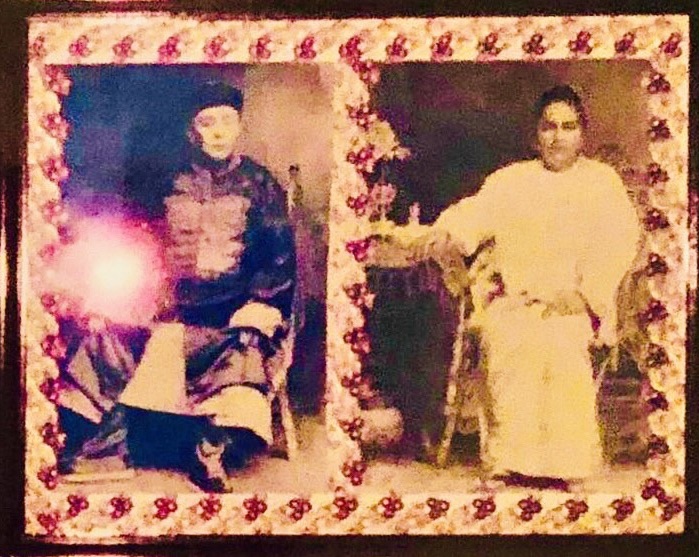
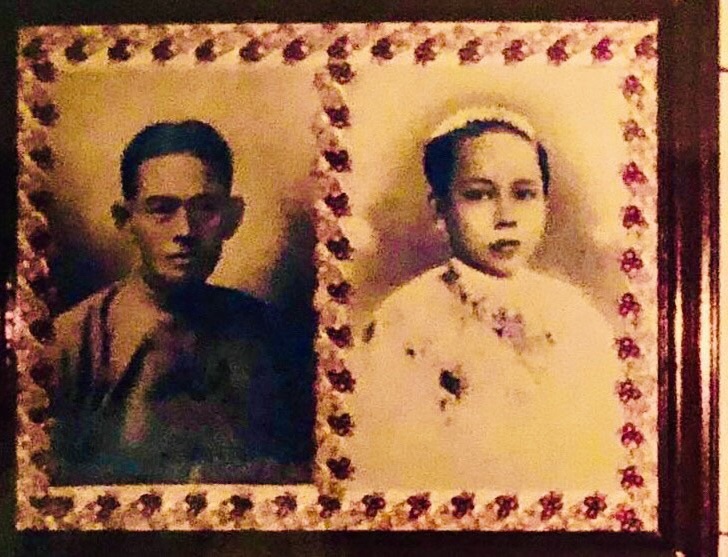
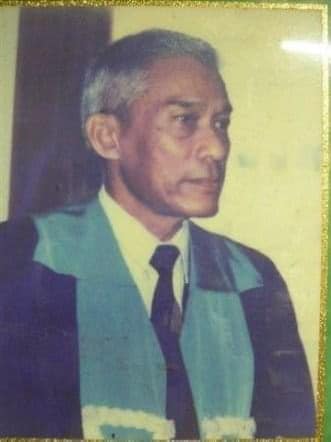
    My Father (U Kyaw Myint)

    This image has an empty alt attribute; its file name is u-kyaw-myint-1-3.jpg
    U Kyaw Myint’s Brief Biography
    U Kyaw Myint
    This image has an empty alt attribute; its file name is u-kyaw-myint-3-1.jpg
    Mesopotamia (Action during WWI)

    My father had a very chequered life.

    Short stay at Rangoon College

    He stood first in the Matriculation examination at the age of sixteen. He had distinction in all subjects including shorthand and typing. He got scholarship when he entered Rangoon College in June 1914 but was expelled from the College in July 1914.

    There was going to be a scholarship exam to enter Calcutta University. The Principal of Rangoon College, Mr. Mathew Hunter had chosen two bright young men to take the exams to enter medical college in Calcutta. The two students for this exam were my father and Sayagyi U Ba Than. They were very close friends.

    Just before the exams, my grandmother passed away in upper Burma where my grandfather was working. Father went to the Principal to give him leave to attend his mother’s funeral. But the dates would clash with the exams and Mr Hunter refused his permission. Father was told that if he went without the Principal’s agreement, he would be expelled on return.

    My father went in time for the funeral but on return, as told to him earlier he was expelled from the College.

    Self Support

    My grandfather was very angry with my father being expelled. Father was told not to come back to the family.

    Father supported himself by doing a unique job. He traveled from Pegu passing through small towns and villages. At that time, there were many Burmese women who had children by Englishmen, and were common law wives. The Englishmen had left Burma, but they did not money regularly.

    On behalf of the women, father wrote letters in English to the men in England. He was offered food, small amounts of money, and a place to stay.

    He continued doing this, going up the country till he reached Myitkyina some months later.

    Bombay Burma Company

    Due to father’s expertise in short hand and typing, a young English man from Bombay Burma Company gave father a job as a clerk and secretary. Father told me about the kindness of the English couple who let him stay with them.

    Apart from Secretary work, he had to go with workers to the teak trees that had been cut down and later sent them down the Irrawaddy to Rangoon. Father had to supervise that the Bombay Burma Company seal was hammered deep at the end of the logs. The logs were floated down the Irrawaddy river. Logs with the seal were collected and exported to England.

    Illness

    A year later father had cerebral malaria and it was the young couple who looked after him during the illness.

    Enlistment and Assignments

    Father stayed on with the English couple till the end of 1916. By that time the war that was said to last only one year had to gone into its third year with no resolution. There were many casualties and new fronts for the conflict. The English government intensified their recruiting efforts.

    The young Englishman and his wife returned to England. The husband joined the army.

    Father did not want to continue working in Myitkyina. He also thought of enlisting for the war.

    He first went to Pegu to reconcile with his father. Grand father was doing a job what would be equivalent to a District Commissioner (DC) but being Burmese was given the post as Extra Assistant Commissioner (EAC) but doing the same job.

    Burmese doctors were appointed as Sub Assistant Surgeon (SAS). They had to work like surgeons and civil surgeons.

    NB: the status of Burmese doctors before Independence can be read in the books by Dr. U Myint Swe.

    In spite of my grandfather telling him not to enlist, father went ahead for enlistment.

    The place for enlistment was the at the Cantonment (which Burmanized as “Kan Daw Min” Park). It is the place with a small lake near the Shwe Dagon Pagoda.

    At that time, no Burmese would be accepted. One must either be an Anglo-Burman or and Anglo-Indian.

    When asked, father gave his name as “John Henry Wilson”. He could be taken for an Anglo because he was very fair with sharp facial features.

    Next he was asked to go against the wall to measure his height. Father was only five foot two inches. When the sergeant cane to measure him, he stood up on his toes so that it would be five foot four (the required height for a soldier.

    The sergeant asked him whether he really wanted to serve, and getting an affirmative, the sergeant write down on his enlistment as “John Henry Wilson, Anglo-Burman, five foot six”. Father became a soldier.

    NOTE:

    Since, the English keeps excellent records, there must be enlistment records for the regiment that above item written down above, would still be there in their archives.

    I visited the Middle Temple Inn in London, from where my father was called to the Bar. I wanted know about my father, the Librarian asked me for date of being called, went in, back in about 15 mins and gave me a copy of information of my father as recorded in their archives.: Will write more about this in a later post “My father: the Barrister”

    I tried to remember but still could not get the place in India where he was sent. I only remembered that it was in a cantonment not far from Dehli.

    Father was sent to where the Gloucester Regiment, the 12th Battalion was billeted. He got his training, stayed there for some time rising to the rank of corporal.

    Mesopotamia Campaign and “the war to end all wars”

    At the start of the war, the British army and its allies thought that it would be a short war lasting for a year or so. But it didn’t as the allies were fighting on different fronts. When the Turkish Ottoman army joined the war, that opened a new front of the war: the “Mesopotamia Front / Campaign”. Father’s regiment was sent to that front.

    Germany had sent a fleet of submarines to attack British ships carrying either troops or cargo.

    Although not entirely, the British army and navy were depending on oil from Burma Oil Company in Yenangyaung. But when their ships sailing from Burma were being sunk, they looked for an alternative.

    Apart from Burma, the oil fields from Mesopotamia were near to England and likely to have less loss during transport.

    Just like Burma Oil Company (BOC), there was another company that could offer the required crude oil. Like BOC, the Anglo-Persian Oil Company (AOC) was owned by an Englishman. Both BOC and AOC were taken over by the British government for the war efforts.

    The Mesopotamia Campaign happened mainly to save and have access to AOC refineries.

    For some years now, whenever I heard about Iraq, Iran, Syria, two words often appeared: Basra and Mosul.

    Mesopotamia was the area between the Tigris and the Euphrates rivers. It covered what would later become most of Iraq, parts of Northern Arabia, Eastern part of Syria and South East Turkey.

    The oil rigs were in Basra and Mosul within Mesopotamia.

    And that was where my father’s regiment was sent: to guard the oil fields from the Germans.

    As the German army was engaged in other fronts, it was the Turkish (Ottaman) soldiers and Nomadic Arabs attacking these two areas.

    It was mainly skirmishes and attacks mainly by the nomadic Arabs who were given arms by the Germans. The disciplined regiment could repel the poorly planned attacks and thus England still had access to the oil.

    Armistice: 11-11-11 11AM

    Father and did comrades stayed on in that area till Armistice, the end of the war at: “the 11th hour, of the 11th day of the 11th. month of the year”.

    President Woodrow Wilson in his speech said, “the war to end all wars” had ended, using H.G . Wells’ words from the book “The War of the Worlds”. How ironic it was as only three decades later the Second World War happened.

    Return Home

    Not too long after that soldiers including my father were demobilized and could return to their home countries.

    Father returned home to be with his family.

    Study at Cambridge University

    Since he was expelled from the College, he had never given up his hope to gain a good education. The demob and savings from his salary and other benefits on leaving the army, he now had enough money to go to England to get what he had wanted to do since 1914.

    He applied to be admitted to Queens’ College Cambridge, where his elder brother had attended gaining MA, LLB.

    Father landed on the shores of England in the spring of 1919. He was twenty one years old.

    After spending time in London for a week or so he got to Cambridge to seek admission. Father told me that it was a vibrant time to be as there were so many young men like him, veterans of the war, some who had left their studies and had left to fight the war as well as those like him who had come to be admitted for the first time. He wanted to study at Cambridge as this was where his elder brother studied for his BA (later MA) and LLB.

    Both Oxford and Cambridge gave dispensation for veterans, so that they did not have to undergo a strict entrance exam but only had to take what was known as “the little go”.

    Father went to the College with all that he had was his matriculation certificate from Burma. He had to go through an interview first to see whether he should be admitted. Father impressed the examiners that he was admitted without the need to take entrance exams.

    Finally he thought he was going to get the education he had missed before. He had enough money to sustain him for the four years at the university.

    During the two years he was in Cambridge, he actively participated in debates conducted by the Cambridge Union, where he sharpened not only his oratory but also would help him at the courts when he became a practising barrister in Burma. It also helped when he became a well known politician in Burma.

    Two things happened that would affect his ambition to be a college graduate.

    First when he was in the second year, U Tin Tut arrived. He was sent to Oxford to do his training for the Indian Civil Service (ICS). He was to be the very first Burmese to be admitted to the Service. And unlike the others who later joined, he was the only Burmese to be admitted by nomination and not by selection examinations.

    In December 29th 1920, there was a nation wide students strike against the British government. Schools and the Rangoon University was closed down.

    U Myint Thein was then studying in the junior BA class at the University. Not knowing when the university would be reopened, even without telling my father he traveled by ship to England. This he did without any funds for tuition fees. He arrived and requested my father to pay for his tuition and upkeep in Cambridge.

    U Tin Tut gambled a lot on the races and he also was asking father to help pay some of his gambling debts.

    Father decided to leave Cambridge so that he could support his younger brother. He searched for a job to sustain the three of them.

    For the second time in his life, his education had to be postponed.

    At that time, there was Burma Club. Many years later — at the time when Saya U Maung Nyo was studying in London — there would be the Britain Burma Club. And Prof. Woodruff, who was a visiting professor of tropical medicine in Rangoon, was a Patron.

    The Burma Club was for the people who have served in Burma both before and during the war. Father got a job as the secretary of the Club. It enabled him to sustain the needs of his two brothers and allowed him to prepare for the barrister examinations.

    I have titled this part of my post as “Cambridge — here I come”, but for father in 1920 was “Cambridge — here I leave”.

    Yet again he was thwarted from gaining a university degree.

    P.S. In spite of all the obstacles, in 1948, on gaining independence, my father, the college dropout, was appointed as one of the first three Supreme Court Justices of our country. And also later became the very first Dean of the Faculty of Law at the Rangoon University.

    Four brothers and Inns of Court

    This image has an empty alt attribute; its file name is inns-2-1.jpg
    This image has an empty alt attribute; its file name is inns-of-the-court-1.jpg

    The complete series of articles have been posted in Facebook and archived in hlamin.com

    Magnum Opus

    • Dr. Thane Oke Kyaw Myint e-mailed me a soft copy of “Who’s Who in Heath and Medicine (in Burma/Myanmar)” (Second edition).
    • It is the Magnum Opus of Professor Mya Tu and his wife Daw Khin Thet Hta.
    • There was an attempt to update it, but did not happen.

    Dr. Tin U

    Saya U Tin U was the pioneer of child health and paediatrics in Burma. He was the first Burmese doctor to pass the MRCP (Paediatrics), the first professor of Child Health, the first medical superintendent of the Rangoon Children’s Hospital, the first Principal of the postgraduate school of child health. He was the only Burmese Paediatrician to serve as WHO Professor of Paediatrics in India (Calicut) and Bangladesh (Dhaka).

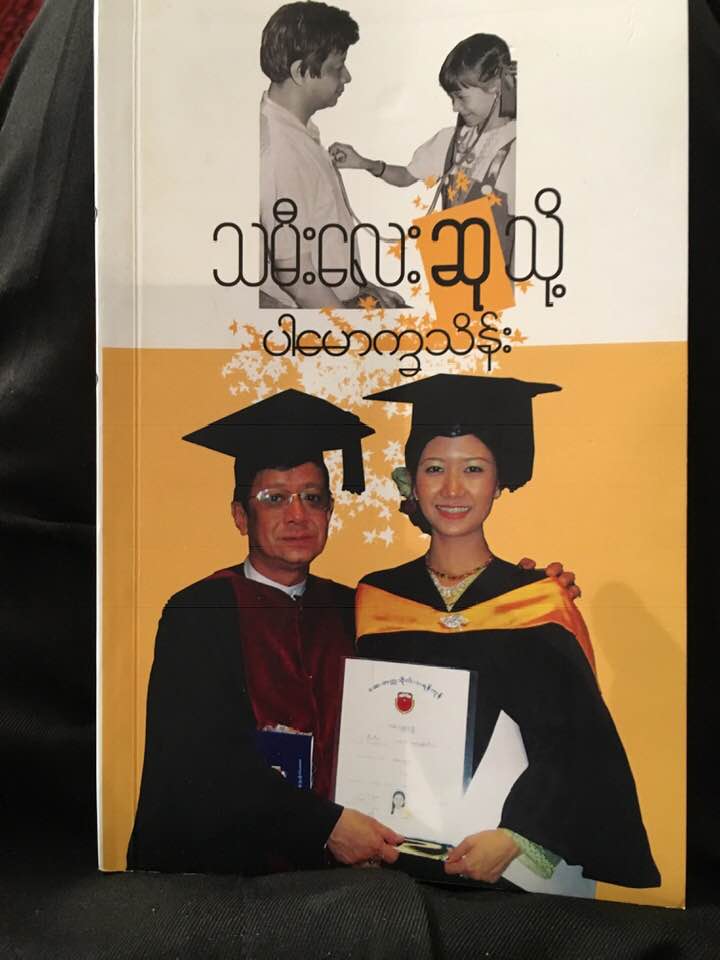
    Saya called our medical disciple as “child health” rather than Paediatrics as he would like to focus on keeping children healthy rather than looking after them when their are unwell. Saya pioneered the use of Oral Rehydration Solution for diarrhoea in children, setting up center for childhood malnutrition; standardization of treatment of Dengue Haemorhagic Fever. He authored seven books on child health, all of which went into multiple reprints and Saya was awarded the National Literary Prize (Ahmyo Thar Sapay Su). Saya also served as the Member of the parliament for Dagon Township for one term. Saya was the elder brother of Saya U Sein Win (RIT EE).

    Before You Judge People (2015)
    Dr. Su Mon, daughter of Dr. Thane Oke Kyaw Myint, used her strong mental prowess to overcome adversity.

    She posted on Facebook in 2015:

    Dear world, I just want you to know that I am more than the sum of my diseases and limitations, I am more than my usually failing body, I am more than my brains and IQ, I am more than just a person with disability. I am more than my limp and my strange gait (yes it would be good if you stop staring at me when you see me) and I am more than my many scars. And I am definitely stronger (mentally) than you can possibly imagine. Please don’t think my life is easy, that I was born with a silver spoon in my mouth, that all that I have achieved so far came to me easily. I worked damn hard for every little thing, every step forward is hard fought with all that I have in me. I may not meet your definition of success or beauty, or intelligence but I am ok with that. I love who I am, many flaws and all. All I ask before you judge me or dismiss me is that you spend an hour in my shoes. I will do the same for you.
    Dr. Myo Khin (C70) wrote :

    Heartfelt appreciations to your strong spirit and will, all the best. May lord Buddha bless and keep you. Your god uncle, MK.

    Cecilia James wrote :

    A fighter against all adversaries and a risk-taker is to be admired. The world makes way for a person who knows where she / he is going. May God bless you and may you be successful in all your endeavors !

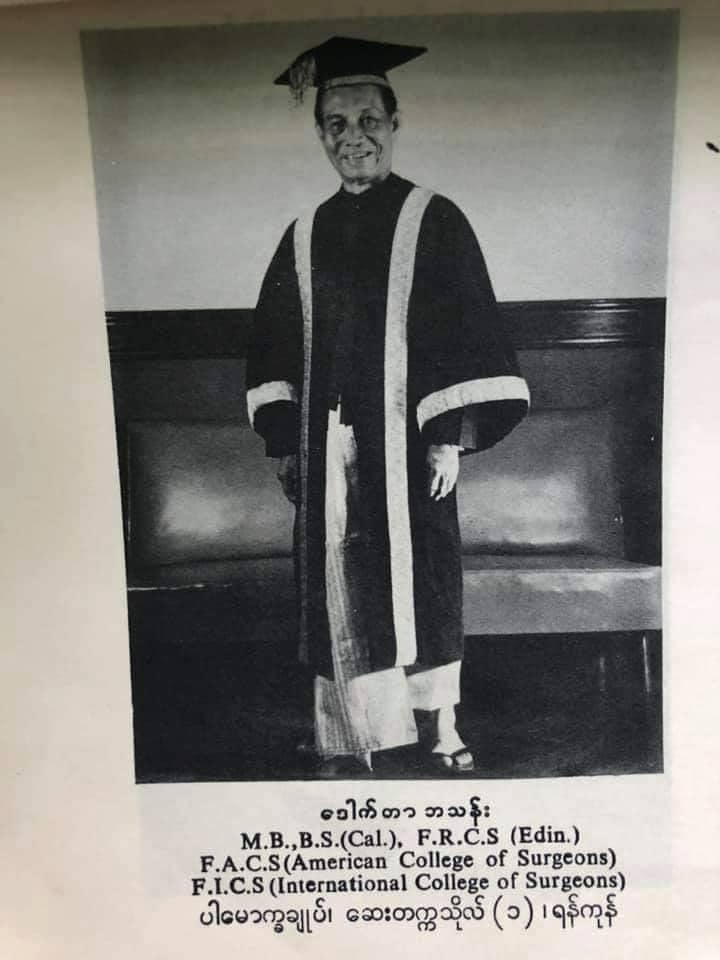
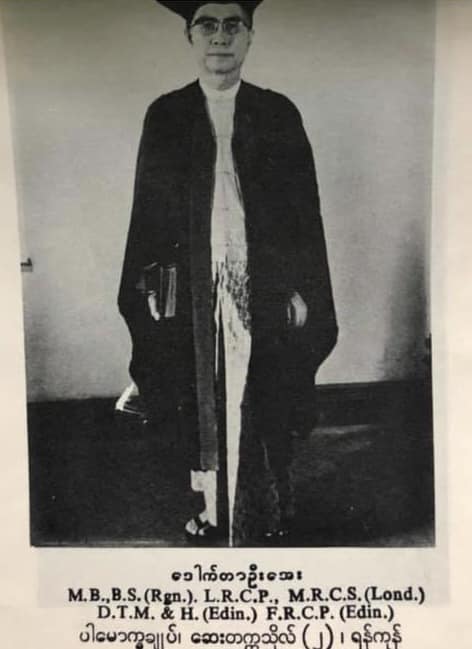
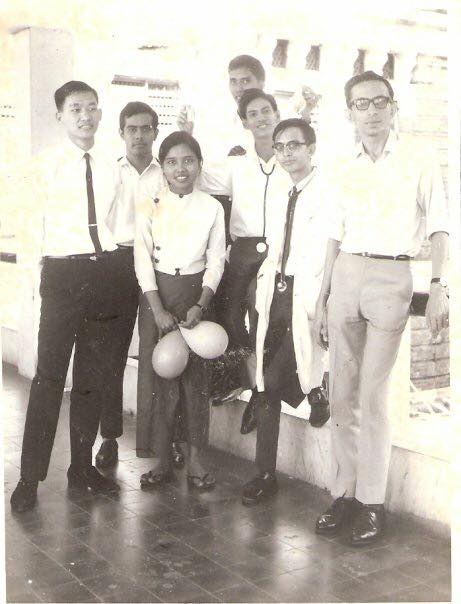
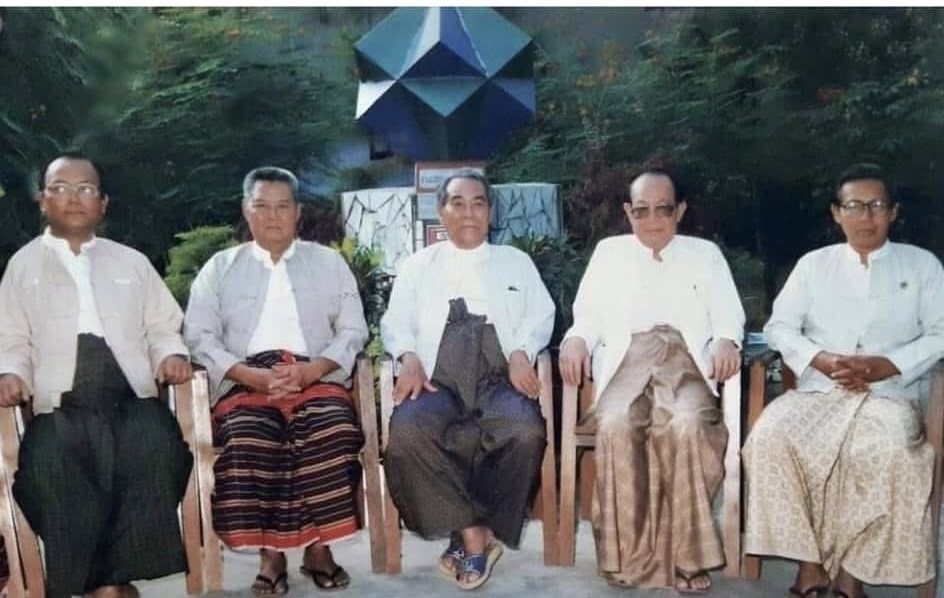
    Historic photo of Burmese Doctors

    Saya Ko Gyi, Ophthalmologist and Medical Superintendent of EENT Hospital, is the father of Dr. Thein Wai (SPHS63, Fifth in Burma) and U Aung Khin (SPHS63, DSA, GBNF).

    Sayagyi Col. Min Sein is the father of Dr. Thein Htut (RUBC Gold).

    Sayagyi U Maung Gale was Dean of the Rangoon Medical College from1959 to 1962. Per Saya Dr. Maung Nyo, “He was our dean, very quiet and peaceful. He translated Grey’s Anatomy to Burmese and he handed over the manuscripts to Dr Norma Saw.”

    Prof. U Khin Maung Win was Pathologist and DG ME. At one time, he headed the Medical Board to examine the people chosen for States Scholar.

    Garawa

    This image has an empty alt attribute; its file name is 1166.jpg

    Garawa means paying respect (especially to elders and mentors).

    U Myint Thein (“MMT”, former Chief Justice of the Union of Burma, former Ambassador to China, and author) paid respect to his elder brother U Kyaw Myint (Barrister, Head of the Tribunal which tried Galon U Saw, and former Dean of the Faculty of Law).

    Dr. Thane Oke Kyaw Myint wrote :

    It was on the occasion of the 80th birthday celebration of [my Ba Dwe] U Myint Thein at the residence of the British Ambassador Mr. Charles Booth.

    Father [U Kyaw Myint] was the Dean of the Faculty of Law, University of Rangoon. He took classes in constitutional law as he explained why it was important to have a comprehensive constitutional law. He also lectured on criminal law.

    One anecdote about father: I was very curious when father marked the answer books of BL students. I once saw father giving pass to a student who answered only one question. Father showed me the book which the single answer almost fill. Father told me that although it was only one answer, he wrote as though it was a real lawyer’s brief while others “regurgitate” what they had learned from lectures and books. Father followed the career of his student. As father predicted he became one of the best lawyers in Burma (sorry, have forgotten the name)

    The Prime Minister was the Chancellor of the Rangoon University. U Nu followed by U Ba Swe were Chancellors. [Ba Dwe] Dr. Htin Aung was Vice Chancellor. It was during U Ba Swe’s time that father was conferred LLD (in honoris causa), together with Emperor Haile Salasi of Ethiopia.

    Among his students was Guardian U Sein Win and Sao Hso Holm.

    Father defended U Sein Win when he was arrested and charged for writing articles about the then government. The trial went on till the last day of summation by both sides. Uncle Sein Win told me about what father did. In that day, father stood up and announced that U Sein Win himself would present the summation. U Sein Win was aghast as he had not been told if this. He turned to my father who said “You can do it. If not you are not my student of law”. U Sein Win gave a very impressive summation of the case which was reported full in both national and international papers. And he was acquitted.

    “Sawbwalay” Sao Hso Holm (Son of Arzanee Sao San Htun) together with [my Ba Dwe] U Myint Thein, was the first to be arrested and last to be released from custody. [He was the Legal Advisor to the Sawbwas.] He visited my father in his office. Father told his former student that he could join their chambers if he was looking for a job. But he was offered a job by UN ending his career as Assistant Resident Representative in Fiji covering the Pacific islands. I recently bought “Burma, My Mother” by Saw Kaemawadde (Ma Ma Biddy, Sawbwalay’s spouse) her autobiography. Very touching narration of her life. You can get a soft copy from Amazon.

    At present is U Mya Thein, senior adviser on the constitution to the present government. He is the son of a brilliant lawyer U Kyin Htone, and also my father’s student. [He is a younger brother of advocate U Tun Tin.]

    Dr. Hla Yee Yee wrote :

    “ Uncle Monty” to everybody

    Dr. Myat Soe wrote :

    I know well about your uncle U Myint Thein Saya [TOKM].

    He was former Myanmar Ambassador to China, and he was a good friend of (Late) Chinese P.M Mr. Chou-Eng-Lai.

    The Student who taught me

    This image has an empty alt attribute; its file name is tokm-1-1.jpg

    In the book of tribute to me, that Prof. Aye Maung Han, Prof. Nyunt Thein, Prof. Ye Myint Kyaw published for my seventieth birthday, many of my former students wrote about what they learned from me when I was teaching and working with them over two decades as a teacher in our medical college.

    I would like to share with whoever gets to read this, learning is not one way but two ways: while the students are learning from the teacher, the teacher himself learn from his students Some of the lessons that I learn from them are work related but many more lessons are about being a good person, being dutiful, respect for people, compassion, humbleness, gratitude, integrity and religiosity. For a significant number of them, being either a medical student, a house surgeon and later as a qualified doctor or specialist, life was never a bed of roses.They juggled to fulfill their professional role as well as the role as the bread earner for either their young families or in support of elderly parents.

    The student who taught me has written and published significant number of books ranging from fiction (based on his life experiences) to belle letters and articles mainly of which are not only sharing knowledge but also inspirational.

    The last time I went back home, he kindly gave me a book of his.

    I have read his book more than once. I go back to each chapter of his book repeatedly , especially when I come across an incident or experience, which relates very much to a relevant chapter of his book.

    And through this book, my student teaches me.

    I had a strong affinity with my colleagues and students and previously when my memory was better than now, I could remember most of whom I taught by their names and the year they graduated. The author, although I knew him well, was not close to me as student, intern and in service,as unfortunately he was either in units other than where I was in or he did postgraduate studies only I had left the country.

    Some years back, at the request of Prof. U Aye Maung Han, I gave a talk about my experiences of working in UNICEF, which were so different from my life as a paediatrician. I had titled the talk as “Shades of Mediocrity” as I felt that what I would talk about might seem both to the audience as well as to myself as my having gone through a state of mediocrity, as someone who moved from being a clinician to being an UNICEF staff responsible for public health, nutrition, water and sanitation, emergencies and the broader aspects of interventions to ensure that the the rights of children would be fulfilled. I did genuinely wonderd many times, whether I had contributed significantly beyond mediocrity, to areas of work which I had never worked in.

    I had used the title from Simon and Garfunkel’s Homeward Bound lyrics:

    “All my words came back to me
    In shades of mediocrity”.

    And I also quoted the vow in Burmese that appears on the front page of every book written by the well known author Tetkatho Phone Naing. The following is my own translation, more correctly my “transliteration” as I will never be able to give a precise translation of of Saya Phone Naing’s poem:

    THE VOW

    If you should not gain, by reading what I have written,|
    You cannot lose, if it helps to overcome ennui
    If at least a word or a para will make you thoughtful
    If you should find such in my writings, I the slave of writing
    Will feel that my duty is done.

    I will never claim that my writings are to be cherished by the reader,
    Nor through my writing I will claim as being more learned than the readerI will not go over your head, nor claim to enlighten you

    I make this my vow.

    Tetkatho Phone Naing

    (The original “vow” by the author, I have added as a photo as I do not know how to write in Burmese on Facebook)

    After I had just recited the first few lines, someone from the audience stood up and finished the poem for me, the whole passages and vow that had been made by the author..

    On top of that he said the “mediocrity or mediocre” need not be seen as permanent nor to be disparaged, as he himself was once a mediocre student during his college life.

    The person who said that he was “mediocre” was far from being mediocre, he was already a writer of renown and at the time my talk, he had not only acquired more accolades both as doctor and a writer than most of us but also held a senior teaching position at the medical college.

    I must come back to the book he gave me. I want to tell how my ” mediocre” student, whom I know that is never so, with his writings taught me to be a better person.

    The book is “Mingalar shi thaw aung myin gyin” or “Auspicious acts conducive to success”

    I have looked at how the word “mingalar” could has been translated. In the version of Paritta Protective Verses in Pali, Burmese and English, Sayadaw Silannadabhivamsa translated “mingalar” as “highest blessing”. But, I would like to use “auspicious acts” because according to the Oxford English Dictionary, auspicious means “conducive to success” , and thirty eight auspicious acts in the Mingalar Sutta lead towards the highest blessings. Maybe those who are more conversant with Pali may question my translation. But it would be appropriate for the book, to be translated as “auspicious acts that lead to success”

    The author himself has translated “mingalar” as “rules for good and auspicious conduct”

    The writer has written a chapter for each of the Mingalar (act or conduct) with erudite explanation on each of the mingalar, quoting each in Pali and Burmese. He has based these not only by rote or learning but from lessons given by eminent sayadaws of Burma. References are made to books on dhamma and sermons by Ledi Sayadaw, Dr. Pyinneikthara, Sayadaw Seikienda, Shwe Oo Min Sayadaw and many more. He shows not just learning and knowing but how much he has internalized and practiced each of the auspicious act, by referring to his life lessons.

    The fourteenth stanza of the Mingala sutta describes the first three auspicious acts:

    “Asevana ca balanam,
    Panditanan ca sevana,
    Puja ca pujaneyanam”

    “Not to associate with fools,
    to associate with the wise
    And to honor those who are worthy of honor.”

    From: translation by Ashin Silanandabhivamsa

    As I read, I learn and am so impressed not just by the narratives of his life experiences but also by seeing the depth of understanding of Mingalar Sutta. While starting life as a simple young student, he gets to where he is now by following the various tenets of Buddhism. I use the word “erudite” for him as again Oxford English Dictionary gives the meaning of “erudite” as “having or showing great knowledge or learning” as those who have read the book would agree with me that he has not only understands and learns but also practices what he has learned.

    His third chapter is on the third auspicious conduct “pujaca pujaneyyanam” : he wrote about me, as one of the persons whom he considered as his “guru”‘ among those he honors as being worthy of honor. I was very touched on reading this chapter as well as it makes me feel humble to be among those he honored the most as I may not deserve such honor, as I did not have as much contact with him during both his student years nor later as a paediatrician.

    Each chapter of this book carries with it the precise meaning of each mingalar and how he has conducted himself according to his deep understanding of each.

    After the third reading of the book, I feel as though he are saying the words to me and guiding me towards not only just understanding but also ensure that my conduct are within the tenets of each of the mingalar.

    Ko Ye Myint Kyaw, with your book, you have taught me and I would like to thank you for this.

    I have only one wish to ask of you: the wish is to ask you to write a similar book on “Metta Sutta” my favorite sutta in the paritta, as I know the extent of metta (compassion) that you have for the patients, their families and your students.

    May all the highest blessings be upon you.

    With metta,
    Thane Oke Kyaw-Myint
    20 June 2015.

    Sad Loss of Manuscripts

    Daw Khin Mya Mu’s work

    Before U E Maung died, he asked me to bring out exercise books with writings by [my aunt] Daw Khin Mya Mu.

    In the books were transcript of many “Kyauk sar” and translation into Burmese of hundreds of stone scriptures from all over Burma.

    When I asked him why they were not published, he told me that no printing press [in those days] have fonts for the ancient writings.

    [Thus] they were all unpublished.

    U E Maung donated his house and belongings to Tipitaka Sayadaw. When he passed away Dr Tha Hla was given the task of selling the property and have as cash donation for Sayadaw. We were not informed but later on when I asked, I was told that except for some books, the handwritten documents were not saved anywhere. Felt very sad about losing the handwritten books.

    Only some books were chosen to be donated to the Burmese Department of Rangoon University.

    Dr. Htin Aung’s works

    The sad thing was when [my Ba Dwe] Dr. Htin Aung left Burma, he had also left not only his books but drafts of books he wanted to finish and publish, mainly in history.

    Two Fallen Comrades

    Dr. Thane Oke Kyaw Myint shared his memories about two fallen comrades. The first one was about Dr. Myo Myint. The second one was about Dr. Mya Thein (nicknamed “Win Oo” for his mustache and for appearing beside Win Oo in singing “Mee Pone Pwe”).

    Dr. Mya Thein was barely fourteen when he passed the Matriculation examination in 1957. His parents pleaded with Saya Dr. Htin Aung (Rector, Ba Dwe of Dr. Thane Oke Kyaw Myint). Sayagyi had returned the favor he received from the Principal of Rangoon College to let him (then underage) attend college.

    Plan A failed when Dr. Mya Thein missed the cut to study Medicine by a couple of marks. Plan B succeeded when he passed the Bachelors examination with high marks overall (and especially 60+ marks in Biology) to be attend 2nd MBBS.

    For details, read Dr. TOKM’s blog.

    Books

    Dr. Thane Oke Kyaw Myint wrote :

    I am so fortunate that books written by my former students are either given to me by the authors or bought for me by my niece Hnin Wit Yee or Min Thet Aung.

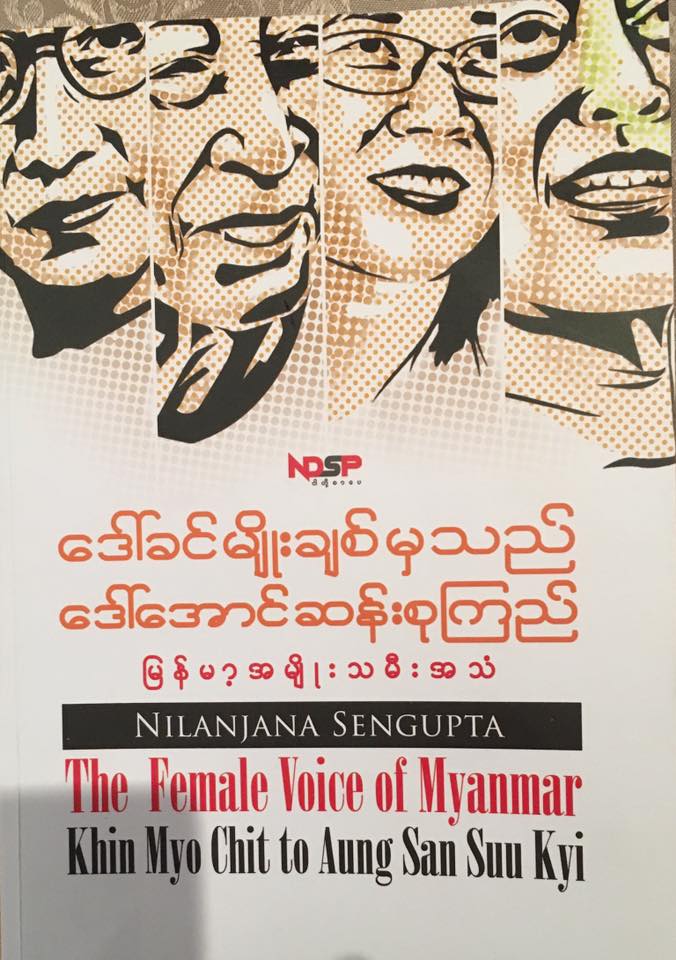
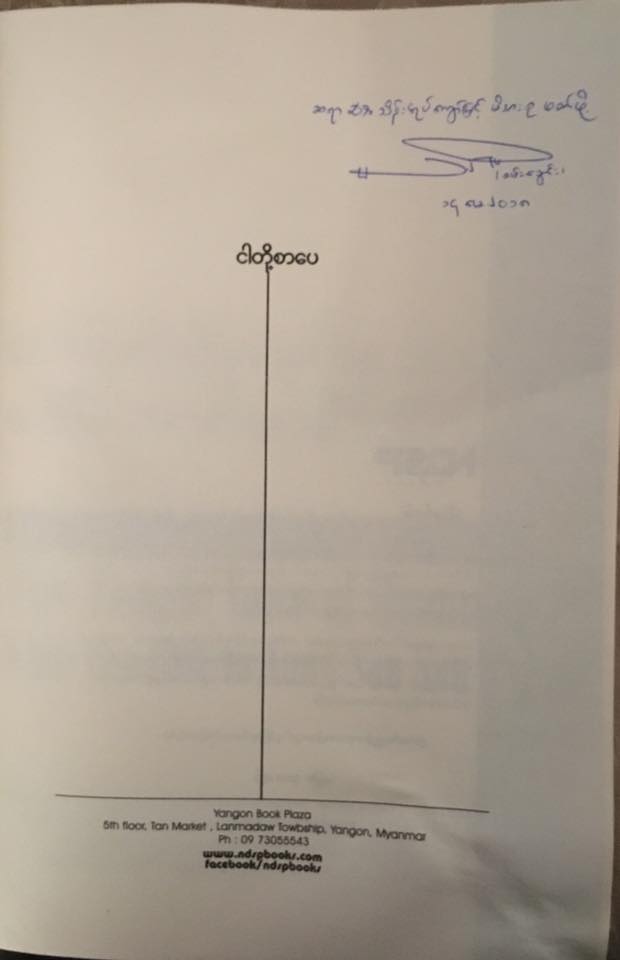
    I got a signed copy of “The Female Voice of Myanmar” by Nilanjana Sengupta, translated into Burmese, by Myae Hmone Lwin. It was given to me by Ma Thida.

    The book consist of articles about and by four eminent lady Burmese writers and activists: Ludu Daw Ah Mar, Daw Khin Myo Chit, Daw Aung San Su Kyi and my “daughter writer” Ma Thida (San Gyaung).

    Please do not say that I am biased towards my daughter but I read the articles on Daw Ah Mar, Daw Khin Myo Chit and Daw Sung Dan Su Kyi once only but read and reread the articles by and on Ma Thida about three times or more.

    Coming from a family whose members were at different times and at different lengths of incarceration by the military government, each article about Ma Thida in prison brought back sad memories of my own family. I had to pause even in the middle of each article as such memories flooded my mind.

    From a very young age Ma Thida stand out among her contemporaries . A multifaceted person with deep attitudes and understanding of right and wrong, justice and injustice, tears welled up in my eyes reading what she went through in prison, and had to stop reading after going through some incidents described by her in the book.

    I am happy and very proud that she can be what she is now, an activist, feminist, author and running PEN Myanmar and many more.

    This book must be read in Burmese as in any other language, much would be lost in translation.

    P.S. Although she left the book for me in May, due to circumstances, I happily received the book only last month.

    Posts

    • Alumni from Myanmar Institutes of Medicine
    • Early Doctors
    • Medical Research
    • SPHS60
    • The Empty Tomb
  • Ah Ba U Hla Myint

    Ah Ba U Hla Myint

    by Dr. Thane Oke Kyaw Myint

    Updated : June 2025

    “Have you ever really had a teacher? One who saw you as a raw but precious thing, a jewel that, with wisdom, could be polished to a proud shine? If you are lucky enough to find your way to such teachers, you will always find your way back. Sometimes it is only in your head. Sometimes it is right alongside their beds.”

    At the end of his book “Tuesdays with Morrie”, Mitch Albom wrote the above about his teacher, Morrie Schwatz, his professor of sociology in Brandeis. I am sure that Ko Nyunt Thein who asks me to write about Ah Ba will agree that the words can be said of Ah Ba U Hla Myint who passed away yesterday. Like Prof. Schwartz, Ah Ba had or must have seen each and every student that he had taught as “precious things” that he could polish to a “proud shine”.

    Ko Nyunt Thein and I are among thousands of doctors who were fortunate to be polished by Ah Ba in many ways. While Ko Nyunt Thein was able to be “alongside” Ah Ba’s bed till the last day of Ah Ba’s life, I can close my eyes, and in my head and in my memories of saya, I know I would never be lost because of what Saya taught me and made me to be who I am .

    …………………………………………………

    May I tell the readers a few anecdotes that would make them understand the various aspects of saya:

    “Put their names on HPD list”

    “Sister Florence, make sure their names are on the high protein diet list every day. And tell U Gyi Hla, to make sure that they eat”. Sister Florence was his ward sister for many years, U Gyi Hla was responsible for getting the prescribed diets from the hospital kitchen and give it out to each patient . And “their names” meant the names of Ko Myo Myint and myself.

    I might have mentioned to some that the two of us literally lived in Ah Ba’s wards from April 1964 onwards, and for myself, from then till November 1970 when I moved to Children’s hospital for my paediatrics training. Saya Bobby, with Ah Ba’s agreement, had given us this little room which used to be the “ECG room” to live in, while we were learning from both of them. Ah Ba asked me one day, coming into the room where I was studying and said,” I should have asked you before. What are you doing for your meals?” I replied, “If we have time, we go to Latha Lan or 19th. Street for food (this was the cheap affordable roadside food eaten by med students and interns)”. “This wouldn’t do!” saya said and turned away calling for Sister. That was how we remained on Wards 5 & 6 High Protein Diet for about three years.

    This was in the really good days when there was no “ko htu ko hta ကိုယ်ထူကိုယ်ထ” i.e self help or “sa zeit hmya pay စရိတ်မျှပေး” cost sharing as it was now. All the patients’ needs, from linen, mosquito nets, food, medicines were all provided free of charge by the hospital.

    And being on HPD, we got a jug of milk, two toasts, two boiled eggs for breakfast, and a meat of our choice together with veggies on the side, either a fruit or a portion of a custard pie as dessert! Talk about eating in style.

    The only complaints came from the interns, our seniors: they had to write up the diet sheet every night making sure that the right diet be asked for each patient, by name and bed number. And some literally got “pissed off” (pardon my French!) to have to add our names to the list every night!

    Was Saya wrong in doing this? No, saya was just caring for us and making sure that we ate and ate well!!!

    “Shit Gyi Kho Par Yae, Ta gar pwint pae bar”

    (For goodness sake, please open the door)

    This was the time when junior doctors could not afford to own cars. At that time, there were about a dozen doctors senior to me who had already passed the selection examinations and were being trained in RGH. Only Ma Ma Thelma who could drive herself and Ah Ko Thein Han who had a driver, could be in time every day. The other three, Ko Harry, Ko Sein Oo and Ko Ko Hla, posted to our wards came by bus, buses that they had to take after a long walk from where they lived to the bus station on the nearest main roads. And with the erratic bus schedules and crowded buses, they were often just a few minutes late. But, by Ah Ba’s rules, every entrance must be closed and locked by 8.00am. and nobody could enter the ward when Ah Ba did his rounds.

    The “shit gyi kho pa yae.. ..” was a common refrain that we could hear from my three elder brothers, making a plea with the ward boy to let them in. And of course, the ward boy would never dare to go against saya’s orders.

    Many ploys were tried: going up one story up to the surgical wards and coming down by the stairs pretending to be busy at the other end or returning from a surgical referral; coming up to the way that dead bodies were carried down to the mortuary through the basement; going around towards Lanmadaw, climbed to the X-ray department, got an old X-ray to pretend that you were fetching an urgent X-ray – with Ah Ba, none would work. You got caught by Ah Ba and Ah Ba kept on closing every entrance!

    Ko Tin Maung Htun who lived in the AS quarters across the street and for me living in the ward, we escaped the scolding and enjoyed the discomfort of our seniors!

    “No, saya, it wasn’t me, it was Shwe Shwe”

    One essential duty before Ah Ba saw patients was what we called “the cheroot rounds”. We had many cases of Cor Pulmonale (COPD) cases all the time in the wards. Many were heavy smokers of cheroots. We had to do one round to check their bedside lockers that the cheroots were either not there or at least well hidden.

    If by chance, Ah Ba opened the locker and found cheroots, I got a scolding. But I was lucky when Shwe Shwe got posted to us. I only had to say, “I didn’t check saya, it was Shwe Shwe”, Ah Ba would just frowned at us but no scolding! With Ah Ba, Shwe Shwe could get away with anything short of murder!

    The same would be for diabetics and their “locker rounds” – nothing of high sugar or carbohydrate content must be found or woes betide the house surgeons to whom the bed had been assigned.

    “Saya, it is time for me to change my glasses”

    Ah Ba got very upset if we missed physical signs. If he had time, he would thoroughly examine each patient on his rounds and expected all of us to have detected relevant physical signs present. His “favorite thing” was to detect “pericardial rub” which we tended to miss. It happened once to me. I thought I had done well with that patient but when Ah Ba turned to me, handed the earpieces for me to listen, while holding the chest piece where he heard the rub, I knew I was in trouble.

    Frowning, he said, “I did not expect that you would miss this, Johnny”.

    I was so frightened of being scolded, blurted out, “Saya, it is time for me to change my glasses, at such times, my hearing gets less acute.” Only later I realized that I had given him a ridiculous excuse. He did not say anything. Just said, “When I go back for lunch, come with me.”

    I thought I would be in for a “one to one” “monhinga kywae” – we called being scolded as being given mohinga. Instead, on arriving at his house, he pulled open a drawer and gave me a new Littman, so that I could hear well!!!

    “Silence ! Johnny is sleeping”

    It was just one of those bad days: That admission day, we had so many patients, many coming in very ill. All beds were full and we had to put up what we called “centre beds” i.e. setting up beds between the two lines of regular beds as well as “stretcher cases”, those whom we could not give beds had to be kept on the stretchers on which they were brought in. On top of that I got called away twice to Dufferin to see and bring back two cases of septic abortion with acute renal failure.

    By 7.00, having requested Emergency to kindly stop sending patients to us but to wait and send them to the next admitting wards, I laid down for a short nap. But, I must have fallen asleep, because it was past 10.00 when I woke up. Strangely, the wards were very quiet and I could not imagine why. I washed my face, changed clothes and got out. Then I saw the reason why.

    Ah Ba had told Sister to close off the passage way, between his office and my little room with trolleys at each end. I was so embarrassed that Saya had also put up two signs on cardboards on the trolleys that said “Silence, Johnny is sleeping” in Burmese!!! Talk about being so priviledged to be treated like his very own little son!

    “Rosalind, Johnny is here”

    Every Thadingyut, I would go to Ah Ba’s house to pay homage to Ah Ba and Ma Ma. The moment he saw me coming in he would shout, “Rosalind, Johnny is here.” He would not accept anything from me, either expensive or inexpensive, as homage. If I did, he would give it back to me. He preferred that I came empty handed so that Ma Ma could give me a plastic bag containing either white shirts and black material for trousers or later white collarless shirt, a yaw longyi (my favorite) and a length of cloth to make a Burmese jacket.

    Only once he accepted: I was leaving Burma and had asked Ko Sein Aung, an artist whose children I looked after, for a painting to give as a farewell present to Ah Ba, especially as I did not know when I might be able to come back to Burma.

    I got off the car, carrying this painting wrapped in brown paper. The first thing he said was, “How many times did I tell you not to bring anything for me.” I said, “Saya, I am leaving Burma and do not know when I can come back again. I asked a friend to paint what I would like to say to you for everything that you have done for me.”

    I kowtowed and paid homage and handed the wrapped painting to Ah Ba.

    He opened it, looked at it and said, “Why this painting?” I replied, “Saya, I were Rahula, you would be Buddha to me”. It was a copy of one of U Ba Kyi’s paintings of Rahula asking for his inheritance from Buddha.

    The painting will still be in Saya’s prayer room till now. And like Rahula, I did inherit from my father Ah Ba who as a Buddhist, I revered as being equal to the Enlightened one, inherited not material riches but lessons for life that made me a good person and a good doctor.

    …………………………………………………

    No, Ah Ba did not die yesterday: he lived on in each of us who were his students, now scattered all over the world.

    Thane Oke Kyaw-Myint

    14 September 2012

    Memories

    Ah ba and me
    Ah Ba, with Marie, Ko Nyunt Thein and me, Jan 2011
    This is the mural of Buddha and Rahula in my old office in Children’s Hospital. The painting given to Ah Ba is a smaller version of my mural

    Posts

    • Dr. Mohan
    • Dr. Thane Oke Kyaw Myint
    • Early Doctors
    • Medical Research
  • Dr. Pe Nyun

    Dr. Pe Nyun

    by Hla Min

    Updated : June 2025

    Highlights

    • Joined Rangoon University in 1946. RU was close for 3 years during the Japanese Occupation
    RUBC
    • Secretary & later Captain of RUBC.
    • Represented RUBC at the 1948 Independence Day Regatta
    • MBBS
    • FRCS
    • Chief Pediatric Surgeon at Rangoon Children’s Hospital
    • Leader of team that operated on the Conjoined Twins : Ma Nan Soe & Ma Nan San
    • Moved to Canada
    • Saya is now GBNF

    Professor Pe Nyun Award

    Source : U Pe Tun and U Pe Thin (sons of Dr. Pe Nyun) and Daw Phyu Phyu Kyaw (their friend)

    • Award given to Young Pediatric Surgeon
    • Award established in 2019
    • The award for 2021 was presented via Zoom Meeting

    First Operation on Conjoined Twins in Burma

    Rangoon Children’s Hospital
    • Dr. Pe Nyun, Dr. Htut Saing & team operated on Ma Nan Soe and Ma Nan San
    • Dr. Pe Nyun & Dr. Htut Saing are Past Captains of Rangoon University Boat Club
    • Dr. Pe Nyun passed away in Canada
    • Dr. Htut Saing passed away in Hong Kong

    Independence Day Regatta at Kandawgyi in 1948

    RUBC crew
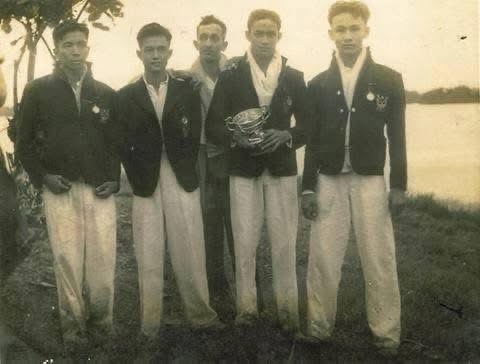
    • Pe Nyun, Pe Thein, Khin Maung Wint, Tin U and Cox represented Rangoon University Boat Club at the Independence Day Regatta held at Kandawgyi in 1948.
  • Kamma

    Kamma

    by Khin Maung U

    Updated : June 2025

    Dr. Khin Maung U

    First published in Ashin Kelatha Journal in 1999.

    by Dr. Khin Maung U

    Kamma is a Pali word meaning action or doing. In its general sense kamma means all good and bad intentional actions whether mental, verbal or physical (thoughts, words and deeds). In the Buddhist teachings, all physical (kãrya kamma), verbal (vacî kamma) and mental (mano kamma) actions are known as the three kammas. All beings perform these three kammas at all waking hours. All their work, great or small, is performed by means of these three kammas. These three kammas become inert when a person is asleep. In the case of a dead person, the three kammas cease to function as far as that body is concerned.

    In its ultimate sense, kamma means all moral and immoral volition. The Buddha says:
    “O Bhikkhus, I declare that volition (cetanã) is kamma. Having volition, one acts by body, speech and thought” (Aînguttara Nikãya).

    When any action of thought, word or body takes place, volition determines or causes its concomitants to perform their respective functions simultaneously. For this reason, volition is predominant in all actions. Involuntary, unintentional or unconscious actions, though technically deeds, do not constitute kamma, because volition, the most important factor in determining kamma, is absent. Thus, the real nature of action (kamma) of man is mental.

    According to Abhidhammã, 29 types of consciousness (Citta) consisting of (i) 12 types of immoral consciousness (akusala citta) and (ii) 8 types of moral consciousness (kusala citta) from among the 54 types of mundane consciousness (kãmãvacara citta) pertaining to the sentient realm, (iii) 5 types of moral consciousness (kusala citta) pertaining to the realms of form (rüpãvacara citta or jhãnas), and (iv) 4 types of moral consciousness (kusala citta) pertaining to the formless realms (arüpãvacara citta or jhãnas), are called kamma because they have the power to produce their due effects quite automatically, independent of any external agency.

    The eight types of supramundane consciousness (lokuttarã citta) are not regarded as kamma because they tend to eradicate the roots of kamma; in them, the predominant factor is wisdom (paññã) while in the mundane, it is volition (cetanã).

    Inherent in kamma is the potential of producing its due effect.

    Every volitional action is inevitably accompanied by its due effect just as every object is accompanied by its shadow. Kamma is action and vipãka, fruit or result, is its effect. If kamma is likened to a seed, then the fruit, arising from the tree, is vipãka, effect or result. As kamma may be good or bad, so may vipãka be good or bad. As kamma is mental, so vipãka, too, is mental; it is experienced as happiness or misery, according to the nature of the kamma seed. The concomitant material conditions may be advantageous (ãnisamsa) such as prosperity, health and longevity, or disadvantageous (ãdinava) such as poverty, ugliness, disease, short life-span, etc.

    As surely as water seeks its own level, so does kamma, given opportunity, produce its inevitable result not as reward or punishment, but as an innate sequence. From a Buddhist standpoint, happiness and misery are not rewards and punishments assigned by a supernatural, omniscient power to one that has done good or evil. The sequence of action and effect is a natural law of kamma.

    There are inequalities and many different destinies of human beings in the world. For example, one perishes in infancy and another lives to the age of eighty or more, one is sick and infirm and another healthy and strong, one is a millionaire and another a pauper, one is handsome and another ugly, one is brought up in luxury and another in misery, one is a genius and another a half-wit.

    What is the cause of these inequalities? The Buddha’s reply is:
    “All living beings have actions (kamma) as their own, their inheritance, their congenital cause, their kinsman, their refuge. It is kamma that differentiates beings into low and high states” (Majjhima Nikãya).

    According to Buddhism, the disparities that exist in the world are not due to blind chance. They are due, to some extent, to heredity and environment, and, to a greater extent, to kamma which includes not only the present kamma, but also the proximate or remote past kamma. While Buddhism teaches that kamma is the chief cause of inequalities in the world, it does not teach fatalism or the doctrine of pre-destination.

    In the Aînguttara Nikãya, the Buddha states: “If anyone says that one must reap according to his deeds, in that case there is no religious life nor is an opportunity afforded for the entire extinction of sorrow. But if anyone says that which one reaps accords with one’s deeds, in that case there is a religious life and an opportunity afforded for the entire extinction of sorrow.”

    Thus, Buddhism does not hold the view that everything is due to past kamma. Kamma is not fate. Kamma is not irrevocable destiny imposed upon us by some unknown power to which we must helplessly submit ourselves. The past influences the present but does not entirely control it, for kamma of the past as well as the present are in effect in the present. The past and present influence the future. One’s action (kamma) of a later day may modify the effects of one’s action (kamma) of a former day.

    One may at any moment change for the better or for the worse. In Buddhism, therefore, man has a certain amount of free will, and there is almost every possibility to mould one’s kamma. If this were not so, what possibility would there ever be of a man’s getting free from all kamma forever. It would be perpetually self-continuing energy that could never come to an end.

    What is the cause of kamma? Ignorance (avijjã), not knowing things as they truly are, is the chief cause of kamma. Dependent on ignorance arise kammic activities. Associated with ignorance is its ally, craving (tanhã), the other root cause of kamma. Evil actions are conditioned by these two causes. All good deeds of a worldling, though associated with the three wholesome roots of generosity (alobha), goodwill (adosa) and knowledge (amoha), are nevertheless regarded as kamma because the two roots of ignorance (avijjã) and craving (tanhã) are dormant in him.

    Who is the doer of kamma? Who experiences the effects? Volition (cetanã) is itself the doer. Feeling (vedanã) is itself the reaper of the fruits of action. Apart from these pure mental states there is none to sow and none to reap.

    Venerable Buddhaghosa writes in Visuddhimagga:
    “No doer is there who does the deed,
    Nor is there one who feels the fruit,
    Constituent parts alone roll on,
    This indeed is right discernment.”

    Where is kamma? Kamma is not stored anywhere within or without the body. It is not stored somewhere in this fleeting consciousness or in any other part of the mind or the body. But dependent on mind and matter kamma rests, manifesting itself at the opportune moment. Thus, kamma is an individual force, and is transmitted from one existence to another.

    Buddhism teaches that there is no permanent soul, no eternal, immortal soul that directs one’s action. So, if there is no soul, what is it that is reborn? The answer is kammic energy: the actions we have done. These actions do not disappear unless or until they have produced their effects. So each being has body and mind as a result of actions they did in the past or in the present, and thus this kammic action goes on and on.

    Kamma may be classified in many ways.
    Kamma is classified into four kinds according to the time at which results are produced:
    1. kamma that produces results in the same life-time (Ditthadhammavedaniya kamma);
    2. kamma that produces results in the next life (Upapajjavedaniya kamma);
    3. kamma that produces results in any one (or more) of successive births and is indefintely effective (Aparãpariyavedaniya kamma);
    (These first three types require auxiliary causes such as circumstances, surroundings, etc., to produce an effect.)
    4. and, kamma that does not produce any result (Ahosi kamma).

    The timing of the results of kamma depends upon which thought-moment is associated with the thought-processes (cittavîthi) of volition (cetanã). According to Abhidhammã one thought-process is completed at the expiration of seventeen thought-moments, consisting of seven initial thought-moments followed by seven javana states (at which point an action is judged whether it be moral or immoral, and kamma is performed) and subsequently by votthapana (determining consciousness) and two Tadãlambana (registering consciousness).

    Of the seven javana thought-moments, the effect of the first javana thought-moment is the weakest in potentiality, and is manifested in this life (Ditthadhammavedaniya kamma). If it does not operate in this life, it becomes ineffective (Ahosi kamma).

    The next weakest is the seventh javana thought-moment; its effect is reaped in the subsequent birth (Upapajjavedaniya kamma). This, too, becomes ineffective (Ahosi kamma) if it does not operate in the next rebirth.

    The effect of the five intermediate javana thought-moments (Aparãpariyavedaniya kamma) may take place at any time in the course of one’s wanderings in life continua (Samsãrã) until the final emancipation. No person – not even the Buddha and Arahants – is exempt from this kamma.

    Kamma is also classified into four kinds according to its particular function (kicca):
    1. Janaka (Reproductive) kamma which conditions the next rebirth;
    2. Upatthambhaka (Supportive) kamma which assists or maintains the results of already-existing kamma;
    3. Upapilaka (Counteractive) kamma which suppresses or modifies the result of the reproductive kamma; and
    4. Upaghãtaka (Destructive) kamma which destroys the force of existing kamma and substitutes its own resultants.

    Again, it is the last (seventh) javana thought-process – Janaka (Reproductive) kamma – that determines the state of a person in his/her subsequent birth. As a rule, the last javana thought-process depends on the general conduct of a person. In exceptional cases, perhaps due to favorable or unfavorable circumstances, at the moment of death a good person may experience a bad last javana thought and a bad person a good one. The subsequent birth will be determined by this last javana thought-process, irrespective of the general conduct. This does not mean that the effects of the past actions are obliterated. They will, in turn, produce their inevitable results at the appropriate moment.

    o assist and maintain or to weaken and obstruct the fruition of this reproductive (Janaka) kamma, another past kamma may intervene, being supportive (Upatthambhaka kamma) or counteractive (Upapilaka kamma), respectively.

    The reproductive (Janaka) kamma can be totally annulled by Upaghãtaka (Destructive) kamma which is a more powerful opposing past kamma, that, seeking an opportunity, may quite unexpectedly operate; it is more powerful than the above two in that it not only obstructs but also destroys the whole force of existing kamma.

    There is another classification of kamma according to the priority of effect:
    1. Garuka (Weighty or serious) kamma which produces its effects for certain in the present life or in the next (On the moral side, these weighty actions are the jhanas, while on the immoral side, they are heinous crimes (ãnantariya kamma) namely, matricide, parricide, the murder of an Arahant, the wounding of the Buddha, and the creation of a schism in the Sangha);
    2. Ãsanna (death proximate) kamma which is the action that one does or recollects – mentally or physically – immediately before the moment of death and it determines the conditions of the next birth;
    3. Ãcinna (habitual) kamma which is action that one performs and recollects constantly, and in the absence of death-proximate kamma, produces and determines the next birth; and
    4. Katattã kamma which is the last in priority of results and is the unexpended kamma of a particular being that has followed him/her through the continua of kappas (Samsãrã), and it conditions the next birth if there is none of the above kammas to operate.

    Kamma is further classified according to the place in which the results are produced:
    (1) Immoral (akusala) kamma that produces its effects in the plane of misery: Immoral (akusala) kamma is rooted in greed (Lobha), anger (Dosa) and delusion (Moha). There are ten immoral (akusala) actions (kamma):
    • killing (pãnãtipãtã),
    • stealing (adinnãdãnã),
    • sexual misconduct (kãmesu micchãcãrã)
    {these three are committed by deed},
    • lying (musãvãdã),
    • slandering (pisunãvãcã),
    • harsh language (pharusãvãcã),
    • frivolous talk (samphappalãpa) {these four are committed by word},
    • covetousness (abhijjhã),
    • ill will (vyãpãda), and
    • false view (micchãditthi)
    {these three are committed by mind}.
    (2) Moral (kusala) kamma which produces its effects in the plane of the world of desires: There are ten moral (kusala) actions (kamma):
    • alms-giving (dãna),
    • observance of five or eight precepts (sîla),
    • practicing meditation (bhãvanã),
    • reverence (apacãyana),
    • service (veyyãvacca),
    • sharing of merit (pattidãna),
    • rejoicing in others’ good actions (pattãnumodanã),
    • hearing the doctrine (dhammasavana),
    • expounding the doctrine (dhammadesanã),
    • and, forming correct views (ditthijukamma).
    (3) Moral (kusala) kamma that produces its effects in the realms of form (Rupa): It is of five types, which are purely mental actions (meditation) leading to the five states of rüpa jhãna.
    (4) Moral (kusala) kamma which produces its effect in the formless realms: These are four types of purely mental actions (meditation) leading to four types of moral consciousness (arüpa jhãna).

    Kammasakatã Sammã-ditthi: Right understanding of the truth about the fact that in the case of beings only the two things – namely, good and bad actions done by them – are their own possessions that always accompany them throughout their life continua, wherever they may wander in Samsãrã.

    1. Sabbe sattã kammasakã: Only the volitional good or bad actions done by all sentient beings are their own possessions that always accompany them wherever they may wander in Samsãrã.

    2. Sabbe sattã Kamma dãyãdã: All beings are the heirs of their own kamma (good or bad actions).
    The kamma performed by beings are always theirs in their future existences. Only Kamma is inherited by beings. The effects of one’s kamma always accompany one in many existences yielding good or bad results at the opportune moments. One can never get rid of that kamma, but one has to enjoy or suffer its results under appropriate circumstances.

    3. Sabbe sattã Kamma yoni: All beings are the descendants of their own kamma.
    With regard to the present good and evil results, one’s own kamma performed in the present existence with wisdom and knowledge or otherwise as well as one’s own wholesome kamma such as alms-giving, morality, etc., and unwholesome kamma such as killing beings, etc., performed in past existences are the primary causes (parents) of good and evil results.

    4. Sabbe sattã Kamma bandhü: Kamma alone is the real relative that all beings can rely on through their life continua in Samsãrã.
    Parents, brothers, relatives, etc, whom we love and rely upon, can be loved and relied upon for only a short period, i.e., before our death. One’s own physical, verbal and mental kamma are one’s constant companions who accompany one in future existences, wholesome kamma giving happiness and prosperity. Thus, one’s wholesome kamma alone is one’s real relative who should be esteemed and relied upon.

    5. Sabbe sattã Kamma patisaranã: Kamma alone is the real refuge of all beings.
    Here, refuge means reliance upon or taking shelter for protection against troubles and dangers. Unwholesome kamma will lead one to be reborn to the lower world where one has to suffer grievously. Performing wholesome kamma will lead one to be reborn as a man or deva, and save him from the lower worlds in the future existences.

    In Buddhism, there are four kinds of taking refuge for the future:
    (i) taking refuge in the Buddha,
    (ii) taking refuge in the Dhamma,
    (iii) taking refuge in the Sangha, and
    (iv) taking refuge in one’s own wholesome kamma.

    This is explained by the following example. All worldlings who indulge in sensual pleasures resemble sick persons who, to be cured, would take refuge in the chief physician (the Buddha), in good medicines (the Dhamma), in the assistant physicians (the Sangha) and in following the physician’s directions (physical, verbal and mental wholesome kamma).

    The three refuges, Buddha, Dhamma and Sangha, exist only during the Buddhasãsana. They do not exist outside the Buddhasãsana.

    The refuge of wholesome kamma exists both within and outside the Buddhasãsana. We can never be free from kamma that is operating all the time in this universe as well as in other innumerable universes. For this reason, kamma is our refuge throughout our life-continua in Samsãrã.

    6. Yam kammam karissanti kilayãnam vã pãpakam vã tassa kammassa dãyãdã bhavissanti: Whatever good or bad actions are done by beings bodily, verbally or mentally, they become the heirs of their kamma.

  • Nyunt Wai (Victor)

    Nyunt Wai (Victor)

    by Hla Min

    Updated : June 2025

    • Classmates in Standards VIII A, IX A and X A at St. Paul’s HS.
    VIII A
    • Stood 4th in Burma in Matric of 1963 and won Collegiate Scholarship.
    SPHS63
    • Graduated from Institute of Medicine (2). Wrote articles and drew paintings & cartoons for IM(2) magazine.
    • Doctorate from UK
    • Taught Physiology at IM(1), IM(2) and a Malaysian University.
    • Has compiled a list of Professors of Physiology.
    • Attended the Soon Kyway for Sayadaw Beatson (Physics teacher & Scout Master at SPHS).
    V Nyunt Wai 1
    • Artist and painter. He illustrated a book by Ashin Ananda (Reverend F Lustig, Laureate Poet).
    • Writes blogs, poems (including Kauk Kyaung Kabyar ကောက်ကြောင်းကဗျာ and Sagar Pariyae စကားပရိယာယ်).
    V Nyunt Wai 3
    • Dr. Nyunt Wai wrote :
      I’m no painter or a poet. Just occasional excursions to these fields. And I’m not a visiting Professor. Had to apply for this job in Malaysia just like any other expatriate from India or Bangladesh. So I’m no 3 “P”s. This reminds me of “No 3 P policy” of the now extinct Yahoo group Alumni-Myanmar-medical-institutes founded by Saya Johnny Thane Oke Kyaw-Myint, which served well as a lively forum for us until the advent of Facebook.

      Dr. Thane Oke Kyaw Myint wrote :
      Yes AMIM was a tight small group of us. Those who became friends then remain now as close friends. On FB, there is short attention as well as being bombarded by posts that we have no interest in.
    V Nyunt Wai 1

    Posts

    • Matriculates
    • Sagar Pariyae
    • St. Paul’s High School
  • Myo San

    by Hla Min

    Updated : June 2025

    • Aka as Freddie Ba San
    • Classmates in Standards VIII A, IX A and X A at St. Paul’s HS
    This image has an empty alt attribute; its file name is viiia.jpg
    Myo San (3rd row, 5th from left)
    • Stood third in Burma in the Matric of 1963 and won Collegiate Scholarship.
    This image has an empty alt attribute; its file name is sphs-63-c.jpg
    Myo San (Seated right)
    • Mastered phonetics and read lots of English books.
    • One would not be surprised that he scored distinctions in English, Maths, Physics and Chemistry.
    • A little bit older than me and that might have given him an advantage.
    • Gave me a quiz. “How do you pronounce GHOTI?” I gave an answer which he corrected as “FISH”. He had read George Bernard Shaw, who posed the quiz as a lesson on the eccentricity of English.

    GH is phonetically equivalent to F as in ROUGH.
    O is phonetically equivalent to I as in WOMAN.
    TI is phonetically equivalent to SH as in ATTENTION.
    Thus, GHOTI is phonetically equivalent to FISH.

    • Became a surgeon
    • Stress caused him to take early retirement.
    • He had mini-reunion with SPHS63 classmates. In the photo, the three (seated) — Freddie, Alan and Tin Tun — are now GBNF.
    Myo San (Seated Left)
    • He has two younger sisters : Elsie and Ivy.
    Siblings

    Posts

    • GBNF
    • Old Paulians
    • Scholarship
    • St. Paul’s High School
  • Prominent Doctors

    Prominent Doctors

    by Hla Min

    Updated : June 2025

    ဆရာဝန် / ဆရာ (တချို့)

    Dr. Thane Oke Kyaw Myint co-founded “Alumni of Myanmar Institutes of Medicine” and wrote about selected sayas, colleagues and junior doctors.

    ဦးမောင်မောင်စိန် U Maung Maung Sein

    • Surgeon
    • Rector
    Mg Mg Sein

    ဦးထွဋ်ဆိုင် / Harry Saing

    • Pediatric Surgeon : Second Lead for the operation of Ma Nan Soe & Ma Nan San
    • Professor at Hong Kong University
    • Scholar athlete — Rowing, Hockey, Cricket, Soccer, Track & Field
    • Past Captain, Gold & Coach of RUBC
    • ARAE Champion in 1958 (for Coxless Pairs) and 1960 (for Coxed Fours)

    ** ဦးမြဦး U Mya Oo

    ** ဦးခင်မောင်စိန် U Khin Maung Sein

    ** ဦးထွန်းသင် U Tun Thin

    ** ဦးဖေဝင်း U Pe Win

    ** ဦးဘချွန်း U Ba Choon

    ** Credit

    • Alumni of Myanmar Institutes of Medicine
    • Dr. သိန်းအုပ်ကျော်မြင့် Thane Oke Kyaw Myint
  • Peter Tun

    Peter Tun

    by Hla Min

    Updated : June 2025

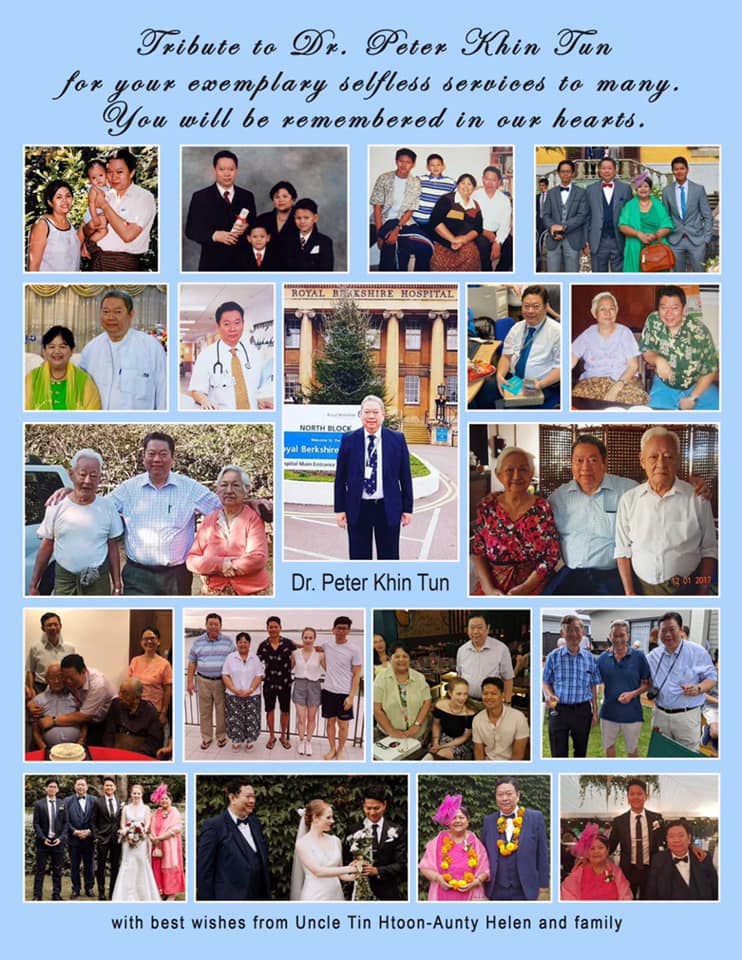
    This image has an empty alt attribute; its file name is pkt8-1.jpg
    Ah Hlu

    The following post contains excerpts from my long article (posted on April 15, 2020 and updated daily through April 30, 2020). It also contains some additional material.

    U Tin U & Family
    Peter, Win Mar & Min Ko
    Peter & Ye Myint
    Peter & Win Mar
    U Tin U, Dr. Daw Khin Kyi Nyunt & relatives
    Royal Berkshire Hospital
    Min Ko’s wedding
    Peter, Win Mar & Min Ko
    Young Peter
    Peter, Aye Aye, Ye Myint
    U Tin U & family

    The Beginning

    January 1958

    Peter (Dr. Khin Tun) became the first born child of U Tin U and Dr. Khin Kyi Nyunt (Cherry Tin Gyi).

    Like his grandfather and father, Peter became the Eldest Son in his family.

    Like his grand parents who won Prizes for the Horticulture Show, Peter would also enjoy gardening.

    Peter would later have a younger sister Aye Aye Khin and a younger brother Dr. Ye Myint.

    Snapshot of Peter’s Life

    1973

    • After finishing 10th standard examination, Peter entered a meditation retreat at Chan Myei monastery.
    • Matriculated from St. Augustine’s High School with four distinctions.
      Stood 23rd in the whole of Burma.
      Received Collegiate Scholarship.
    • Admitted to the Institute of Medicine (1).

    1980s

    • Received MBBS in 1981.
    • Worked for Rangoon Children Hospital and Dr. Thane Oke Kyaw Myint (Pediatrician).
    • Collected and analyzed data for UNICEF projects including Perinatal Survey with his colleagues (e.g. Dr. Pe Thet Khin)
    • Found Win Mar, a beautiful school teacher, as his love life.
    • Moved to Mezaligone and did private practice (often receiving little or no money from cash-strapped patients).

    1990s

    • Some friends suggested Peter to study for MRCP in the UK.
    • Peter hosted nine friends for group study at his parent’s house.
    • With Ye Myint’s sponsorship, Peter moved to UK in 1994.
      (See Ye Myint’s speech for details).

    2000s

    • Worked for Royal Berkeley Hospital
    • Promoted to Associate Specialist for Neuro and Rehabilitation
    • Served as Associate Dean of Oxford University

    September 2017

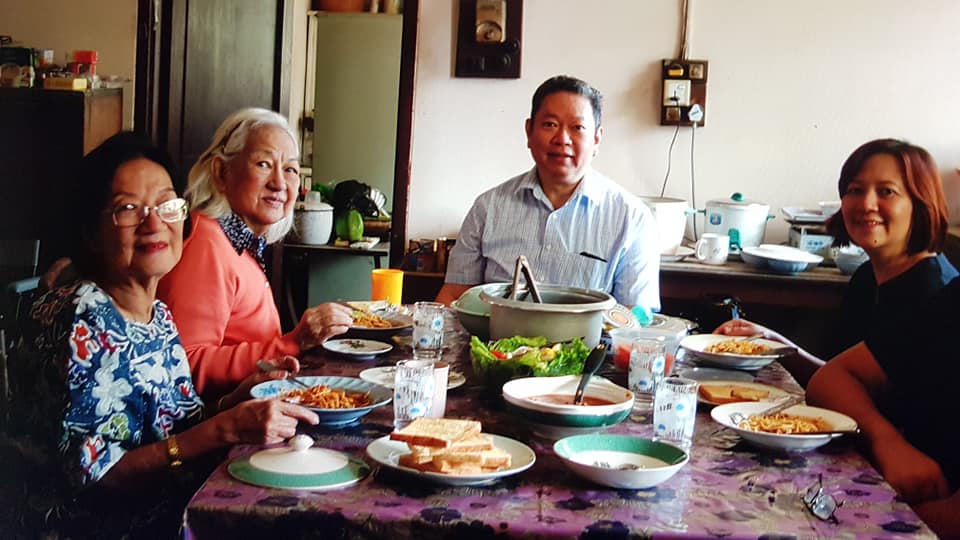
    In September 2017, he and Win Mar hosted us. Both cooked delicious meals every day. They showed us around. They drove us to Wales to see my high school friend Maung Maung Kyi.

    2019

    U Tin U (Peter’s father) celebrated his 90th Birthday.

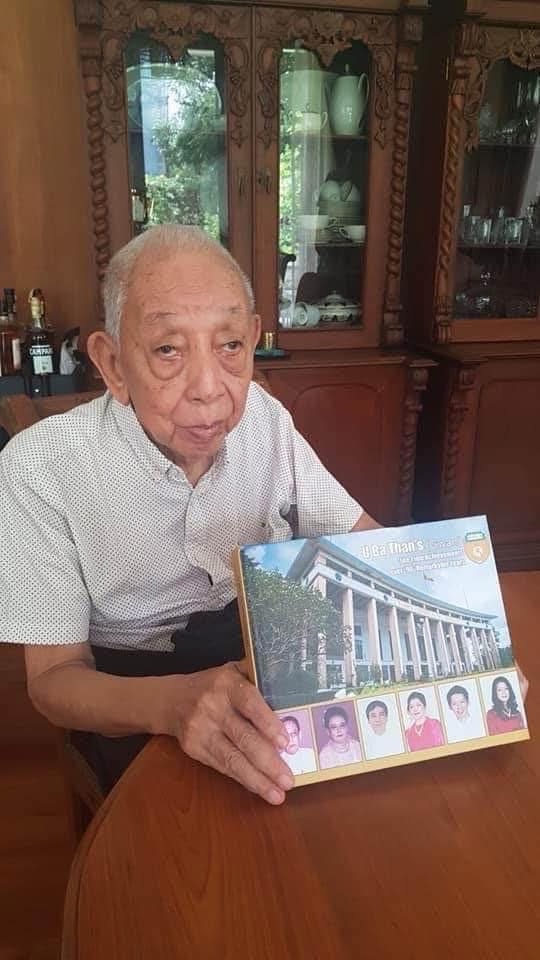
    Details of Peter’s life is recorded in the Photo Album for his father’s 90th Birthday Celebrations. The URL is provided by his uncle U Tin Htoon

    https://www.blurb.com/books/9536015-u-tin-u-s-life-time-achievements-over-90-remarkabl

    Dr. Daw Khin Nyunt (Peter’s mother) passed away a few months before her 89th Birthday.

    February 2020

    Peter and family went to New Zealand to celebrate Min Ko’s birthday and wedding.

    Ye Myint and family stopped over in Sydney, Australia to have gatherings with the relatives.

    Peter skipped the visit to Australia, because he wanted to be back at the hospital and enable his junior staff members to take leave.

    March 2020

    On March 25, 2020, he said there were COVID-19 cases in London and Birmingham but not much in Reading. He showered twice daily as a precaution.

    He said he was elated with his trip to NZ in February 2020. He enjoyed entertaining his aunt (Dr. Ruby) and his uncle (U Tin Htoon). He mentioned that his father (U Tin U) might finally have a Great Grandchild.

    April 2020

    Peter got infected with COVID-19 from one of his patients.

    Five of his patients tested positive.

    He was hospitalized.

    His health deteriorated.

    He passed away on April 13, 2020 (Easter Monday).

    His Last Journey took place on April 30, 2020.

    Peter’s Parents

    U Tin U and Siblings

    • U Tin U
    • U Ba Than
    • Dr. Daw Win Hlaing (Ruby)
    • Daw Myint Thwe (Betty)
    • Dr. Myo Tint
    • U Tin Htoon
    • U Myo Min
    • U Thaung Lwin
    • Daw Cho Cho Hlaing

    U Tin U

    U Tin U is the eldest of nine siblings. He matriculated from St. John’s Diocesan in 1946 and attended Rangoon University. He joined Rangoon University Boat Club (RUBC) and became Captain and Gold in 1948.

    He studied BSCE at Oregon State University and MSCE at Yale University. Upon his return he worked for Clark and Grieg (eventually becoming a Director) and also taught part-time at the Civil Engineering Department, Faculty of Engineering, Rangoon University. He later worked as Consultant for InterKiln and “Bogyi Kyu Kyaw’s Group of Architects and Engineers.” He served as Secretary of Burma Civil Engineers Society, and as Captain of Rangoon Golf Club (RGc). He stayed active by playing golf, doing gardening and have a daily dose of whiskey as medicine.

    He celebrated his 90th birthday in August 2019. U Tin Htoon compiled U Tin U’s accomplishments and photos into a book as a birthday present. The book also contains photos and information about U Tin U’s children.

    U Tin U also gave interviews

    • about his days as Captain of the Rangoon Golf Club
    • to Saya U Soe Paing for the HMEE (History of Myanmar Engineering Education) project
    • to Min Ko (Peter’s elder son) about his early days in Burma and in the US.

    Dr. Daw Khin Kyi Nyunt (Cherry Tin Gyi) and Siblings

    • U Sway Tin
    • Laura
    • Sarah
    • Lynn
    • Icy
    • Margaret
    • U Myo Kyaw
    • Olga
    • Cherry

    Min Ko also interviewed his grandmother, who recounted her early school days in India and the sad loss of her father U Tin Gyi. After the war, she returned to Burma and continued schooling until she graduated from the Medical School.

    She worked as Demonstrator at the School, and later joined the Nutrition Research Division of BMRI. She did her postgraduate Diploma in the UK.

    Peter inherited the joy of cooking and entertaining relatives and friends with gourmet food. Peter compiled the recipes of my father and several aunts.

    She and Peter had birthdays in January. They would jointly offer dana / requisites usually at Chan Myei Monastery (where Peter learned meditation after he finished his 10th standard examination).

    She passed away late last year (2019) a few months before she turned 89.

    Peter would join her a few months later at the tender age of 62.

    Peter and Siblings

    • Peter
      Spouse : Win Mar
      Sons : Min Ko (Michael Tun) and Ye Lay (Will Tun)
    • Aye Aye Khin
      Spouse : Tin Tun
      Daughters : Thin Thiri Tun (Honey) and Khin Sandy Tun
    • Ye Myint
      Spouse : San San Aye
      Daughter : Aye Sanda (Jess Myint)

    Win Mar

    Our host

    During our visit to UK, Win Mar recounted the story of how she and Peter met, their life in Mezaligone, the brief period when Peter moved to study in the UK, and the days when the family reunited in UK.

    Mezaligone

    Win Mar hails from Mezaligone. She knows Htein Linn (Artist, Prisoner of Conscience) and family. She hosted Htein Linn’s sister Hla Hla Htay at her house in Reading.

    Post by Vicky Bowman, former UK Ambassador to Myanmar

    Another foreign born NHS worker died of CoViD yesterday, in Royal Berkshire Hospital in Reading, where he worked as a rehab specialist, adding to the toll.

    But more importantly, Dr Peter Khin Tun was once the much loved doctor of the cooperative medical clinic in Mezaligon, Htein Lin’s village. He was particularly known for deworming any patient who crossed the threshold of the clinic for whatever reason.

    Worms in Myanmar are ‘than’, သန်. Peter became known locally in Mezaligon as the than-amat သန်အမတ် (amat means high official, and than-amat is an Ambassador).

    He married local school teacher-cum-nurse Ma Win Mar. We feel so sad for her and their two sons.

    In the post I have shared you can see him and Win Mar showing my sister in law Hla Hla Htay, around Windsor. She was doubtless de-wormed at some point by him, before she followed in Win Mar’s footsteps and became a teacher in the village.

    Win Mar got infected by COVID-19. She was hospitalized. She recovered and was discharged on April 29, 2020. She attended Peter’s Last Journey on April 30, 2020.

    We managed to phone Win Mar before she was hospitalized. She and Peter hosted us during our visit to the UK a few years back. They cooked sumptuous meals daily. Peter drove us to Ogmore-by-the-sea in Wales to see my high school friend Maung Maung Kyi (who also was a Best Man at my wedding).

    Min Ko (Michael Tun)

    Contributions by Min Ko

    • Interview of U Tin U
    • Interview of Dr. Khin Kyi Nyunt
    • Phone conversation with Peter (about the days at Mezaligone)
    • Several posts about Peter
    • Providing Peter’s emails to the Media
    • Interviews with BBC and Newspapers
    • Caused Royal Berkshire Hospital to launch a formal inquiry about Peter’s demise
    • Handled legal and financial matters related to Peter
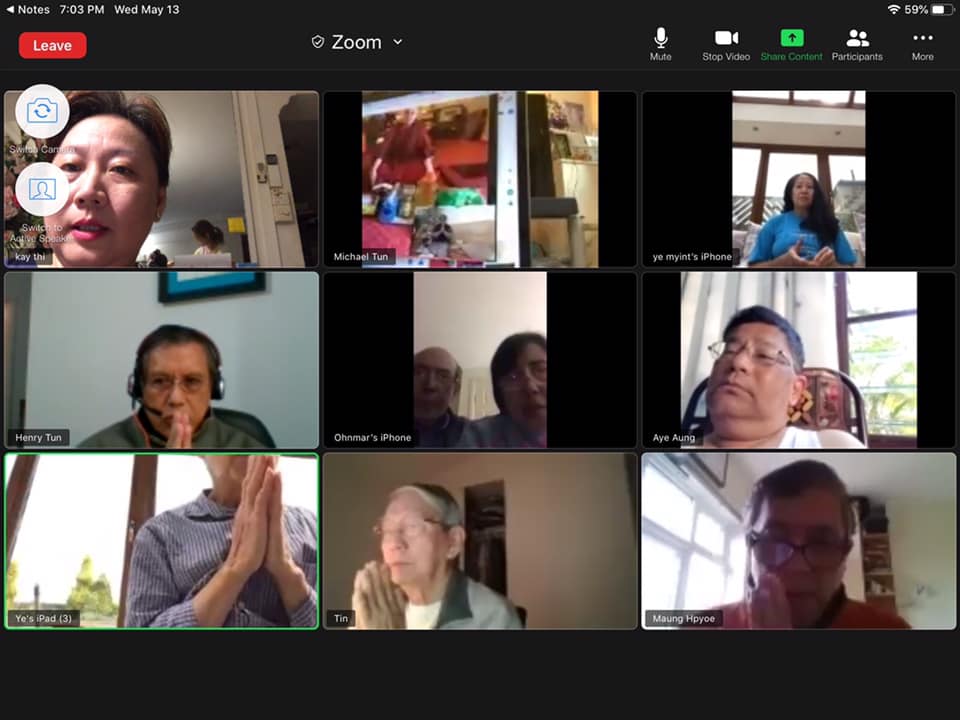
    • Video conferences for Peter’s final day and the Last Journey
    • Emotional farewell to Peter
    • Pru posted a message for Peter

    Memories of Min Ko

    Min Ko shared Dr. Peter’s wonderful, precious life in Meizaligone, a village in Henzada District, Irrawaddy Division.

    Since the clinic was at the house, the family members were woken up early by villagers lining up to get water from the tube well.

    Peter’s clinic opened from 6AM to late at night seven days a week.

    Peter treated sick villagers with CETANA, some free of charge, and some were given cash assistance to go to Hospital in Big Towns.

    Once a month Peter invited neighbors to have meals in the house.

    Peter had an old car and learned how to do repairs.

    Min Ko then read a letter written to his father and had to pause occasionally to wipe the tears. He promised to take care of the family.

    Michael Tun’s sad thoughts (following Peter’s demise)

    My dad Dr Peter Tun died from COVID19 because of the lack of PPE.

    My hope in writing this is that it will save more doctors and nurses lives and avoid pain for their families. My dad would have wanted to speak up if he thought it would save lives.

    I spoke to my dad the day that he found out there was someone who was positive for COVID19 in his ward. My dad told me that he had earlier complained to a manager because they took PPE away from his ward to take somewhere else. He was told that if there was a case, they would bring it back. He had replied that it would be TOO LATE. The last he told me, there were 4 more positive patients with no symptoms. 2 weeks later, my dad passed away and I couldn’t do anything.

    Please do everything to protect the doctors and nurses. They go in scared for themselves and their families. They did not get into the profession to die a hero in battle. This is why he was a superhero to us. He was scared and still went in to help strangers completely knowing the risk. The pain for the families is unbearable. He was afraid that he would give this to my mum and now she is in hospital also waiting for her test results. The thought that if only he had had a proper protective mask, he might still have been able to enjoy his hard earned retirement after a lifetime of service just kills me.

    I hope this won’t cause distress or take attention away from the need to help people but we need to also protect the people trying to protect us. We couldn’t protect my dad so I want to help protect everyone else who is in the same position that he was. Thank you for everything to all the heroes. ‬

    Memories by Prudence (Min Ko’s spouse)

    Goodbye Dr Peter Tun

    It was an honour to know you.

    There will never be the right words but thank you for your kindness, good humour and your selfless acts of service. I will remember your great story telling, you telling me the recipes of your favourite dishes, planting flowers in your garden together In Reading and how beloved and respected you were by so many different people. Your spirit is already in both of your sons and it will continue to live on through them.

    Here we are 8.5 weeks ago in NZ during our Buddhist wedding ceremony where you stood by our side and celebrated with us and now we will celebrate you and will ensure that your legacy lives on.

    Note :

    Min Ko and Prudence held their engagement party at Winner Inn in Yangon. Peter invited us to the party.

    Their wedding was held in New Zealand.

    Memories by Ye Lay (Will Tun)

    “Pe Pe Ko Chit Tae“. [ I love you, Dad]

    Ye Lay thanked his father Peter for the wonderful things that he had learned. In particular, the chanting “I take refuge in the Triple Gems”. He recited to Peter at the hospital.

    He sang an old Scottish ballad “Loch Lomond“. He remembered Peter taking Chan Myei Sayadaw to Loch Lomond.

    By yon bonnie banks and by yon bonnie braes
    Where the sun shines bright on Loch Lomond
    Where we two have passed so many blithesome days
    On the bonnie, bonnie banks of Loch Lomond

    [Refrain]
    O ye’ll take the high road and I’ll take the low road
    And I’ll be in Scotland afore ye
    But me and my true love will never meet again
    On the bonnie, bonnie banks of Loch Lomond

    I mind where we parted on yon shady glen
    On the steep, steep side o’ Ben Lomond
    Where in purple hue, the Heiland hills we view
    And the moon shinin’ out from the gloamin’

    Ye Lay studied at St Andrew’s in Scotland for his second Masters. His parents attended his graduation.

    He ended by reciting

    “Buddham saranam gaccha mi. [I take refuge in the Buddha].
    Dhammam saranan gaccha mi. [I take refuge in the Dhamma].
    Sangham saranam gaccha mi. [I take refuge in the Sangha].

    Contributions by Ye Lay

    • Posts and Farewell speech
    • Sang songs / ballads to Dr. Khin Kyi Nyunt
    • Sang “Loch Lomond” at Peter’s Last Journey
    • Was my guide to Oxford University

    Dana by Aye Aye Khin (sister) and Dr. Ye Myint (brother)

    On behalf of Peter’s family, Aye Aye Khin (sister) offered requisites to Sayadaw U Thawbita (Chan Myei) in Yangon.

    Offerings were also made by U Ba Than (uncle) and Daw Mya Mya (GBNF), Ye Than (cousin) and family, U Myo Myint and Daw Tin Tin Win, Dr. Khin Win Myint, Aung Thu and Khin Myat Naing, Myo Tin and Dr. Khine Zin Oo.

    Aye Aye Khin (Peter’s sister) wrote :

    Listen to sayardaw u thaw bi ta’s Tayar.
    You can hear $ donation of
    Tina / Dr. Win Marla (Aunty Olga’s daughter);
    Kyi Kyi Han (Aunty Icy’s daughter)
    & Maung Maung Tin (Aunty Olga’s son).

    and also Thingan and Nawkama
    by Cho Cho Hlaing (aunt)
    Aye Aye Khin (sister), Ko Tin Tun and daughters

    5 Thingun donate from (Ko Tin Tun’s cousin) Susi Sein; Ohnmar Sein & Sayarlay Nwe Ni Sein

    Contributions by Aye Aye Khin and family

    • Took care of U Tin U and Dr. Daw Khin Kyi Nyunt
    • Organized dana for Peter
      Donations by relatives
    • Thin Thiri posted a video of Peter’s Last Journey

    Memories by Dr. Ye Myint (Recording played at Peter’s Last Journey)

    Firstly I would like to thank you all for being here.

    Thanks to all those who shared their good memories of my beloved brother. The family appreciates your kind thoughts and prayers.

    It is a great honour to be able to share my memories, and talk about my big brother Peter, who will forever remain in our hearts.

    My kindhearted brother spent his life caring not only for patients, but relatives, friends and acquaintances. He gave up his life in the line of duty. He will be missed by all.

    Peter, my sister and I were very privileged to grow up together in one large family estate. We were very close sharing the same room and being together daily.

    He set a high bar for us intellectually and socially. Due to his high intellect, he got double promotion twice and skipped 2 years.

    He matriculated with four distinctions. He stood 23rd in the whole of Burma and was awarded a University Scholarship. He was admitted to the Rangoon University of Medicine, which I also attended. He supported me to become a good compassionate doctor like himself.

    He stayed fit by taking part in many sports : football, badminton, cycling and rowing. He was the university selected athlete for Shot put and Discus throwing.

    He started cooking as a teenager and learnt many recipes from our mother and continued this lifelong hobby. He was a very good artist and created large paintings as well as water coloured Christmas cards. He was also a very keen gardener and read various books. He had great general knowledge and many called him a walking encyclopaedia.

    After he qualified as a doctor, he worked as a UNICEF research officer for mother and child health in Hlegu where he met his future wife Ma Win Mar. After they fell in love he decided to move to Mezligone. I accompanied him on this trip there and helped to set up a new medical clinic. He worked there daily for 11 years where he was relied upon by his patients even out of hours.

    I sponsored him to move to UK in 1994 to help progress his medical career. He lived with us until he got his first job in Burton-on-Trent. He got his second job in Pontefract and arranged for his family to relocate to the UK to join him. We were lucky to live only 20 minutes drive away so had nice weekly reunions which made our families even closer.

    He then moved to London for rehabilitation medicine training after he passed his MRCP examinations and then moved to Reading 21 years ago working as an associate specialist. Peter has helped many Doctors coming to the UK for further studies where he gave valuable advice and treated them to his home cooking. He always enjoyed entertaining and cooking for family and friends.

    We had regular family reunions and memorable family holidays together in Devon, Italy, Burma and most recently in New Zealand. We will cherish these lovely memories together. He had such a great sense of humour and always made those around him happy with his personality and big smiles. He was remarkable in many different ways. He lived an enjoyable successful life and treated all family members, relatives and friends with loving kindness. He touched so many people as evident by the countless tributes, messages, cards and donations.

    I am sure you are in a much better place, Ko Ko, after doing so many good deeds throughout your life. We will miss you greatly and always remember you with love. Thank you so much for being a loving big brother, a great Uncle to Aye Sanda, a best friend, mentor and teacher.

    Donations for Peter

    We donated £100 to SHEFFIELD Monastery and £50 to Manchester Monastery (fund will be sent to Myanmar to fight against COVID).

    Contributions by Ye Myint and family

    • Liaison with ICU Doctors (during Peter’s hospitalization)
    • Liasion with Medical Staff (during Win Mar’s hospitalization)
    • Interview with BBC (Burmese Program)
    • Interview with BBC (English Program)
    • Message for Peter’s Funeral
    • Per suggestion from San San Aye, appealed to relatives to help alleviate the financial burden of Peter’s family members
    • Jess wrote two posts : one during Peter’s hospitalization and another after Peter’s demise
      The FB page also has reference to “Remembering Peter Tun” by the Royal Berkshire Hospital (which had 80+ entries)

    From Oxford Sayadaw U Dhammasami

    Dakagyi Dr Peter Khin Tun,

    From now on, it will not be my priority to remember that you lived 62 years, but rather how many thousands of life you have touched and nurtured. People are remembered for what they did for others, not how long they live. Ultimately, it is your exemplary selfless service to the many that will be inscribed in many hearts. Since we came to know each other in London in 1996, you have watched proudly your two boys grow up and achieve some standing of their own. As you always wished, I will take care of them spiritually so they can serve many souls as you have. Have a good rebirth.

    With metta,

    Oxford Sayadaw


    Jess Myint’s post after Peter’s health deteriorated

    My Uncle Peter has been on a ventilator for four days after testing positive for COVID-19 2 weeks ago. He seemed to be coping well in the first week and he kept sending me pictures as reassurance. But things rapidly progressed and he was unreachable not replying back or answering calls which was very unlike him for 2 days. He was admitted to ICU and was initially stable on the ventilator but his condition has unfortunately deteriorated last night. There are many pleas but it is scary what this virus has done to people and families worldwide so please everyone take things seriously and do whatever you can to help minimize the spread of this virus any further.

    Think of the doctors, nurses and NHS workers, like my Uncle that have put their lives at risk to help others and do their duty of care, even when they have not had the appropriate PPE.

    Healthcare workers and anyone showing any symptoms, even mild symptoms, please isolate and do not put others at risk as they may not recover from this.

    Feel so sorry and helpless for my Uncle, Aunty and cousins, who are constantly in our thoughts. I’m hoping with everyone’s prayers, Uncle’s kindness, good deeds, and Uncle’s fighting spirit he will pull through.
    Please come back to us Uncle Peter.

  • Early Doctors

    by Hla Min

    Updated : May 2025

    Dr. Ko Gyi

    • Ophthalmologist and Medical Superintendent of EENT Hospital
    • Sons : U Tin Oo, Dr. Thein Wai (SPHS1963) and U Aung Khin (SPHS63, DSA, GBNF).

    Colonel Min Sein

    • Senior doctor in the British Administration
    • Spouse : Dr. Daw Yin May
    • Son : Dr. Thein Htut (RUBC Gold)
    • Daughter : Daw Tin Tin Aye

    Dr. Maung Gale

    • Dean of the Rangoon Medical College from1959 to 1962.
    • Per Saya Dr. Maung Nyo, “He was our dean, very quiet and peaceful. He translated Grey’s Anatomy to Burmese and he handed over the manuscripts to Dr Norma Saw.”

    Dr. Khin Maung Win

    • Pathologist
    • Director General of Medical Education
    • Headed the Medical Board to examine the people chosen for States Scholar.

    Dr. Mohan and Dr. Daw Hnin Yee

    Dr. Mohan

    Dr. Khin Than Nu

    Daw Khin Than Nu
    • According to Dr. Thein Nyunt, Sayama regularly attended the IM(1) Saya Pu Zaw Pwes as the oldest sayama.
    • She left to visit her son Ko Win Htut in the USA.
    • She passed away about three years ago. Ko Win Htut (who is an RIT alumni) gave a soon kwyay in her memory at Mettananda Vihara.
  • Khin Maung U, Dr.

    by Hla Min

    Updated : May 2025


    Work experience (in reverse chronological order) :

    • Clinical Reviewer and Senior Medical Officer at U.S. Food and Drug Administration
    • Assistant Professor and Physician at Johns Hopkins University
    • Associate Professor, Physician at Hahnemann University Hospital
    • Head, Clinical Research Division at Department of Medical Research, Ministry of Health
    • Clinical demonstrator at Institute of Medicine 1, Yangon (Rangoon), Myanmar (Burma)
    • Demonstrator, Dept. of Pharmacology at Institute of Medicine 1, Yangon (Rangoon), Myanmar (Burma)
    • He stood first in 1963 with 100 marks in Maths & Chemistry and 99 points (after a point deduction in review) in Physics. He had Distinction in English in HSF, Matric and I.Sc.(A).
    • Due to policy changes for sending State Scholars, he had to do M.Sc. (Med Sc). Later, he completed Fellowships and MD from UNSW.
    • He still writes KMU Medical Research Reports.
    • Earlier, he wrote and translated articles on Dhamma and acted as an interpreter at the Dhamma Talks and Meditation Retreat.
    • His spouse Dr. Nyunt Nyunt Wai (Amy) did DCH.
    • They have a son and two daughters. Nilar (eldest) is a medical doctor in the USA.

    Feedback

    Dr. Nyan Taw wrote :
    Our batch Khin Maung U (SPHS 63) to be proud of !

    Eddie Shein wrote :
    Proud of you, Dr. Khin Maung U. I always remember your very good signs of ambitions and success lines on your palms.

    Wai Aung wrote :
    I am proud of you Ko Khin Maung U. You are a genius. Glad you made it to the top.

    Ye Htut wrote :
    Sayar U is my teacher- mentor who was just like a swan who laid a golden egg daily for me when I worked under him at RGH and DMR in 1970s. I never had a day that I did not learn a new lesson or knowledge from him when we were together.

    Dr. Khin Maung U wrote :
    Thank you Johnny (U Hla Min) for your kind portrayal, and to all who commented with support and friendship. I am so fortunate to have good friends throughout St. Paul’s HS and Medical School and also during post-graduate clinical work, and to have good students during my teaching years in IM (1), all of whom helped and supported me in many ways. With some time available in my retirement, I came upon an idea. As a service to medical education in Myanmar, I would post recently published medical articles (not readily available in Myanmar) that friends and colleagues in the medical profession may find useful or applicable to medical care or public health of people in Myanmar. In all these medical posts, I preceded with a simplified summary of the medical journal article so that non-medical persons who read these posts can also understand and be able to apply for their own health care. I hope this activity will provide useful medical or educational information to all who read my medical posts.

    Mayrose Wong wrote :
    Wonderful and Genius Doctor, truly and caring classmate, doing meritorious deeds for Dhamma and Sanghas. He is Awesome.

    Eiei Tan wrote :
    Could not agree more, my dear friend May Rose. We are all extremely proud to be his classmates. He certainly is awesome & ingenious !!!

    Kyaw Myint Malia wrote :
    You make all of us Burmese proud. I was fortunate to meet you again while you were preparing for your MD at the University of NSW where I was an Anatomy tutor. You are my kalyana-mitra truly. Regards to Amy.

    Tin Tin Hla wrote :
    Proud of you and your family.

    Kyi Maung wrote:
    How genius you are ko kmu. I’m always proud of u. I used to tell others that I’m from ko Khin Maung U ‘s batch.

    Tin Myint wrote :
    Proud of you Ko U. You stood Whole of Burma 1st in Matriculation from St Pauls High School.

    Ngwe Tun wrote :
    On behalf of old Paulians, l am proud of you Ko Khin Maung U.