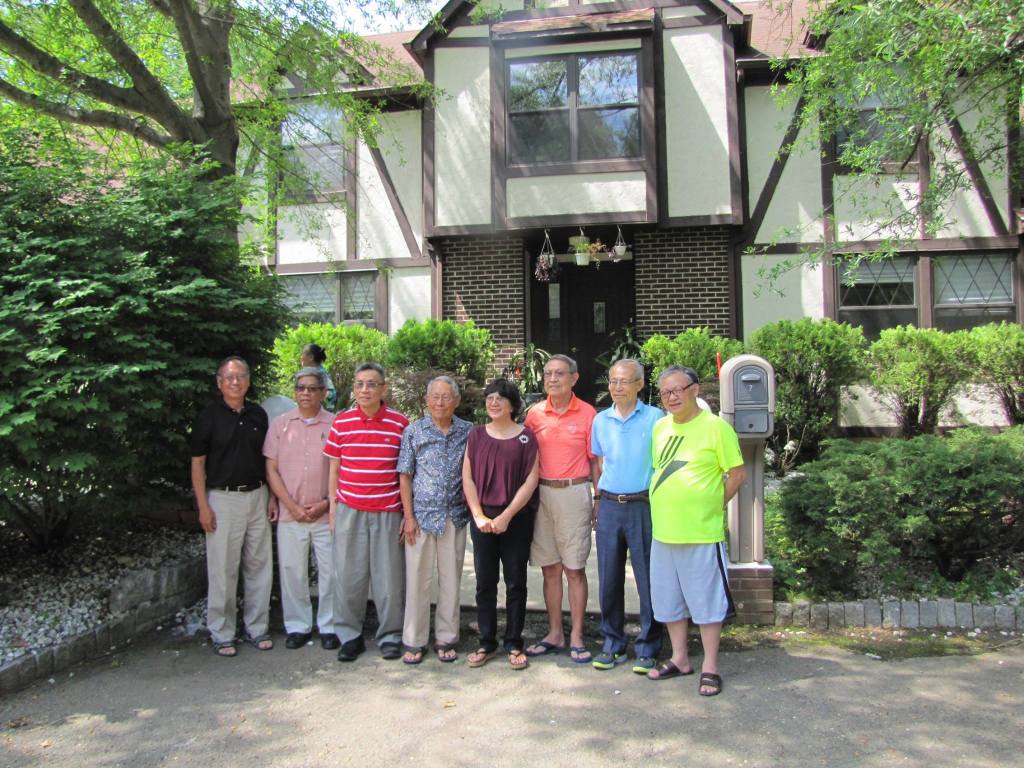
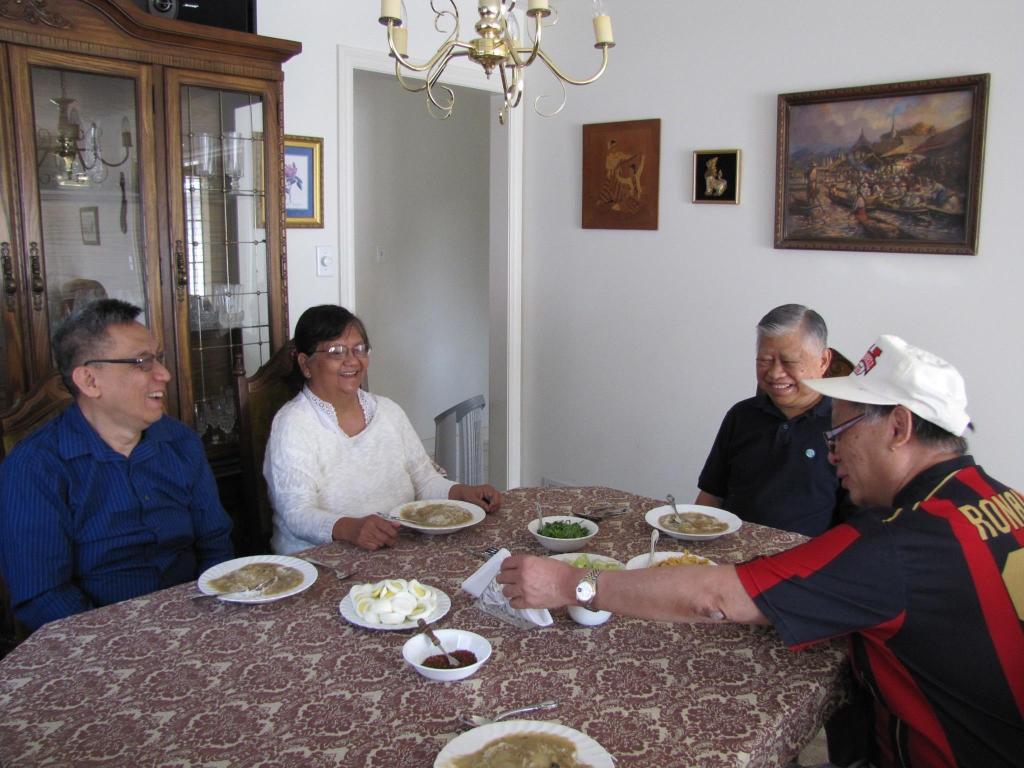
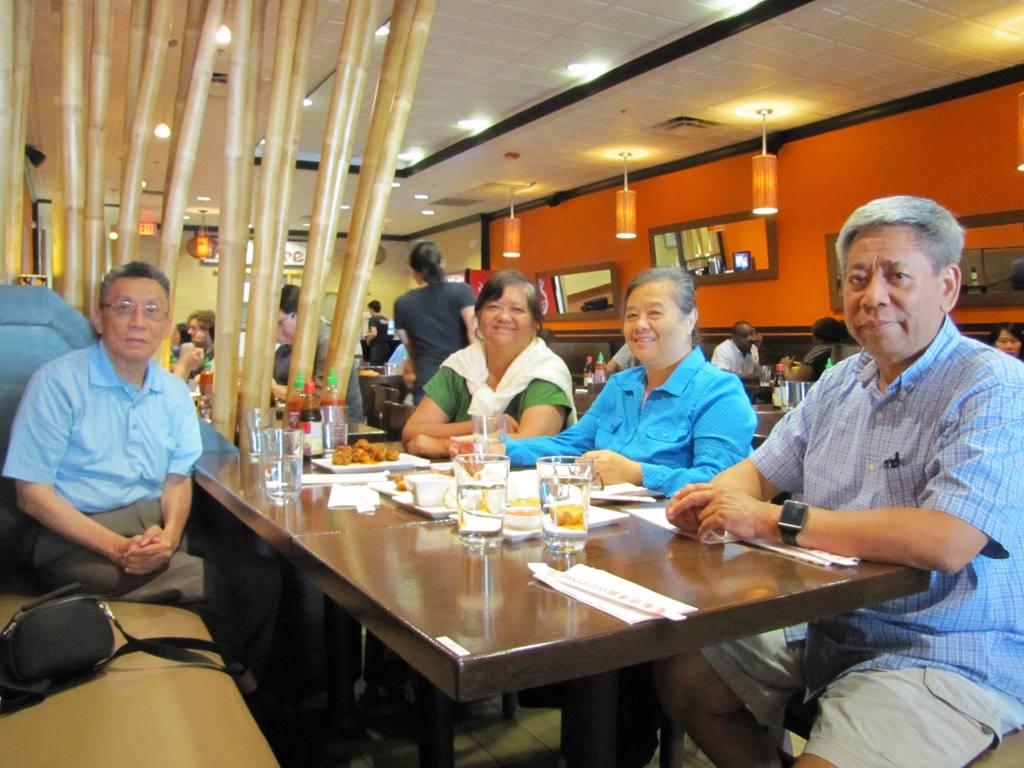
Albert Kyaw Min wrote : The Oldies of RIT 64′ (Second BE) intake, 69’++ Luncheon Gathering at Feel Restaurant sponsored by Danny who arrived yesterday (November 28, 2015) from Singapore. Over 50 classmates gathered .
Emma (Tin Tin Myint) wrote : Good Friends, Good Food, Good Times
Albert, Danny & Robert are the Guitarists. Have not heard from Robert.
U Win Kyi (GBNF)
U Aung Min wrote : Funeral service of Ko Win Kyi (GBNF 87) from The Mirror 30/11/18
U Kyaw Oo wrote : U Win Kyi was my roommate in Delft, the Netherlands.
Took United Airlines from San Francisco International airport
Flight was delayed for more than two hours because the computer system was down
Our plane was diverted to Syracuse airport in New York to refuel and to wait there until Newark (New Jersey) airport — which had experienced traffic congestion — could handle the incoming flights
Ivan Lee (M69) was aware of the flight delay. He picked us up at the airport.
He would be our host & trip coordinator.
Selected events from the trip are described below.
July 10, 2015
On the road to NYC
Ivan took us — Sayagyi Dr. Aung Gyi, Daw Emma, my spouse & me— on a New York tour.
We felt like “honored guests” because New York City was lined up with fans — young and old — of the US women’s soccer team which won the World Championship for the third time.
July 11, 2015
NJ GatheringSix 69ers & Two Sayas
Ivan hosted a gathering in honor of Sayagyi Dr. Aung Gyi and Saya U Soe Paing (EE, UCC).
Ivan had hosted the RIT-UCC gathering for several years.
Attendees include Richard Than Se (ChE62, classmate of U Soe Paing), Fred Thegyi (M69), U Tun Aung Gyaw (EC69), Daw Saw Yu Tint (Alice, T69), U Toung (Tom, EC69), U Sein Myint (EC76, UCC), Daw Sao Mon Sint (Cindy, UCC), U Mya Aung (UCC), U Soe Myint (UCC) and Ivan’s relatives (who displayed their culinary skills).
There were six 69ers at the gathering.
July 13, 2015 (Windsor, Canada)
Windsor Breakfast
Sayagyi U Aung Khin was delighted to see his former students — Ivan Lee & Fred Thetgyi — drive a long way to pay respect to him.
Ivan provided his Mercedes & gas for the trip.
Fred drove most of the way to let Ivan have a light load. Fred also took photos of the trip.
Sayagyi allowed my spouse & I to spend the night at his guest room.
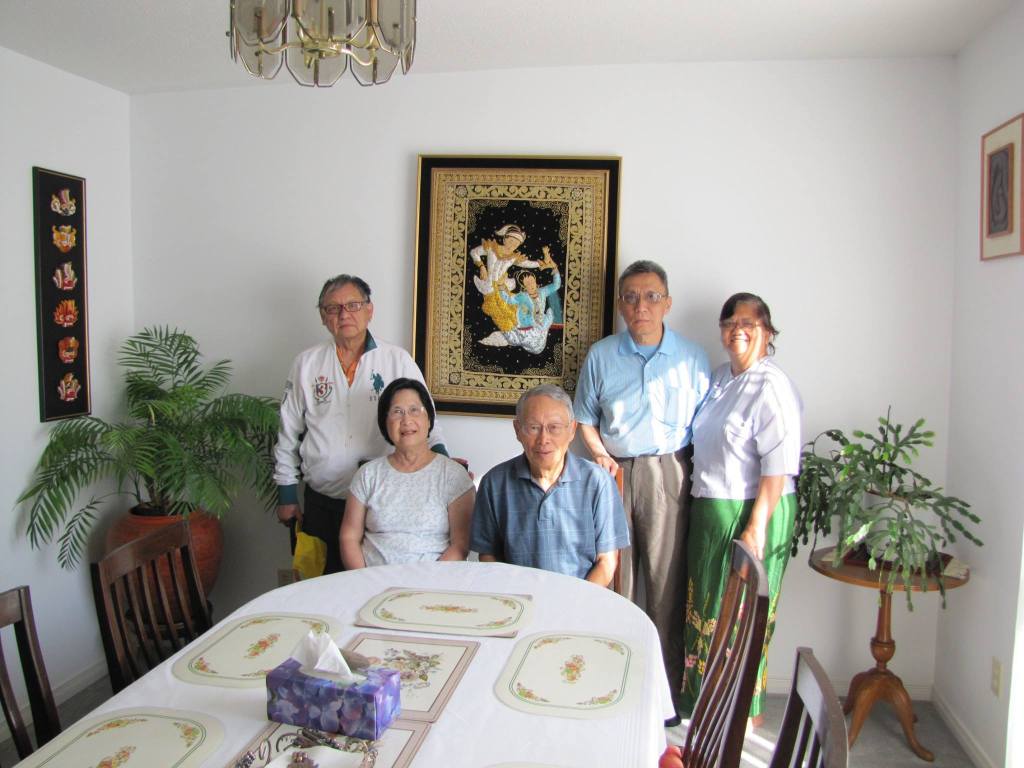
Sayagyi prepared “pe kyaw” and “mohinga” for breakfast the next morning for the four of us. He also gave mementos.
July 14 – 15, 2015 (Napean, Canada)
NapeanThousand Islsnds
Sayagyi Dr. Aung Gyi hosted his former students for two days.
Showed us around Toronto
Took us to the Thousand Islands
July 16 -17, 2015 (Massachusetts)
MITU TAG & Daw KMM
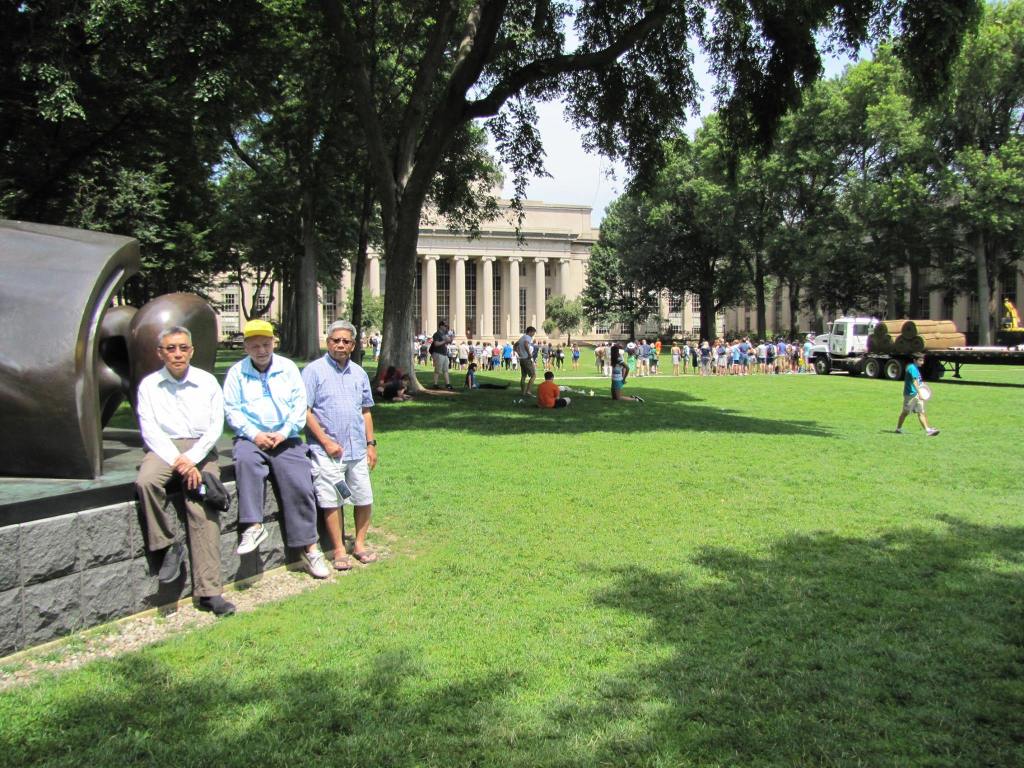
Despite being busy working on two projects, U Tun Aung Gyaw took two days off to host his former classmates.
He took us to MIT & Harvard.
It has become a tradition to touch the “shining” shoe of Harvard’s statue (and make a wish). Fred touched with one hand and made a wish on behalf of his grand kid. Ivan touched with both hands (saying he need to make a wish on behalf of his six grand children).
July 18 – 19, 2015 (Connecticut)
Library
U Toung (Tom) & Daw Khin Myint (Kim) were our hosts for the Connecticut leg of our trip.
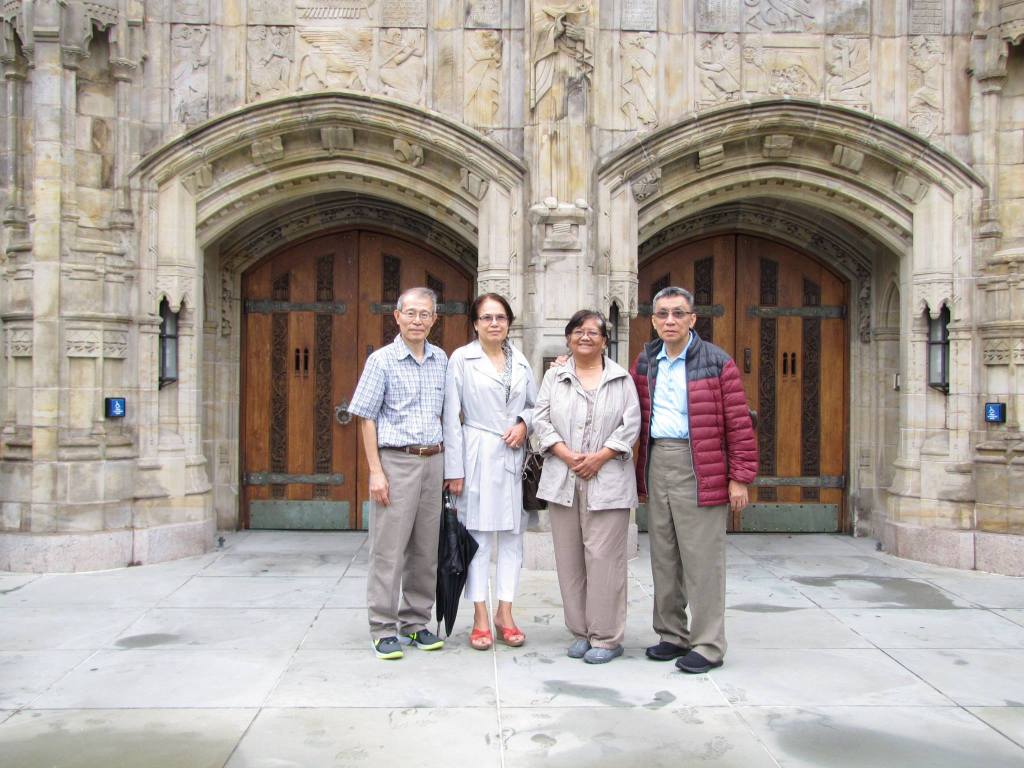
A photo was taken by Fred in front of one of the 30+ libraries at Yale University.
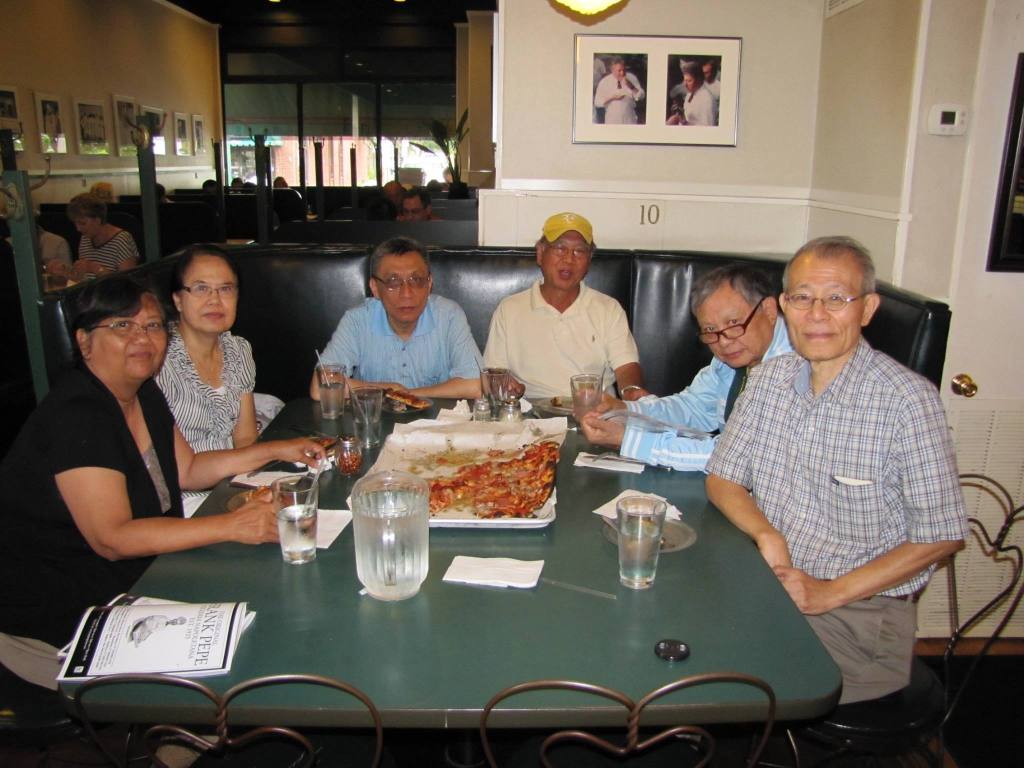
Another photo was taken by a waitress (who has a “FRED” tattoo on her arm in honor of her dad) at Table (10) of Frank Pepe’s pizza. Photos of the then young Bill Clinton, who frequented the pizza place, can be seen on the wall. She then checked Fred’s ID and agreed to have a picture together.
Pizza
Miscellaneous
On the way to Windsor, Canada we stopped to see Niagara Falls from the Canadian side. On a previous trip, I had seen Niagara Falls from the US side. Many say that the view from the Canadian side is better.
The speed limit in Canada was lower than that of US. The GPS had some hiccup inside Canada. We ended up late arriving at Sayagyi U Aung Khin’s house.
We just drove around Toronto on our way to Sayagyi Dr. Aung Gyi’s house. We prefer to be early than late.
U Tun Aung Gyaw lives in Shrewbury (about 50 miles from Boston). He was working on multiple projects.
Tom lives in Trumbull, Connecticut. He is retired. He often flew to Hong Kong to see his son & grandchild.
As a side trip, Fred took us to Pennsylvania (where he lives) & Maryland. We visited Liberty Bell & selected places. U Thein Han is my sole remaining uncle. He lives in Maryland.
Ivan had two PEs (from New Jersey and New York). He owns some real estate. He loves to cook. He plays accordion and harmonica. He is a Life time Platinum member of US Bridge Association. He is a Golden Sponsor of SPZP-2000 and SPZP-2007. He is a major donor to the 69er Health Care Fund.
Took United Airlines from San Francisco International airport
Flight was delayed for more than two hours because the computer system was down
Our plane was diverted to Syracuse airport in New York to refuel and to wait there until Newark (New Jersey) airport — which had experienced traffic congestion — could handle the incoming flights
Ivan Lee (M69) was aware of the flight delay. He picked us up at the airport.
He would be our host & trip coordinator.
Selected events from the trip are described below.
July 10
On the road to NYC
Ivan took us — Sayagyi Dr. Aung Gyi, Daw Emma, my spouse & me— on a New York tour.
We felt like “honored guests” because New York City was lined up with fans — young and old — of the US women’s soccer team which won the World Championship for the third time.
July 11
NJ GatheringSix 69ers & Two Sayas
Ivan hosted a gathering in honor of Sayagyi Dr. Aung Gyi and Saya U Soe Paing (EE, UCC).
Ivan had hosted the RIT-UCC gathering for several years.
Attendees include Richard Than Se (ChE62, classmate of U Soe Paing), Fred Thegyi (M69), U Tun Aung Gyaw (EC69), Daw Saw Yu Tint (Alice, T69), U Toung (Tom, EC69), U Sein Myint (EC76, UCC), Daw Sao Mon Sint (Cindy, UCC), U Mya Aung (UCC), U Soe Myint (UCC) and Ivan’s relatives (who displayed their culinary skills).
There were six 69ers at the gathering.
July 13 (Windsor)
Windsor Breakfast
Sayagyi U Aung Khin was delighted to see his former students — Ivan Lee & Fred Thetgyi — drive a long way to pay respect to him.
Ivan provided his Mercedes & gas for the trip.
Fred drove most of the way to let Ivan have a light load. Fred also took photos of the trip.
Sayagyi allowed my spouse & I to spend the night at his guest room.
Sayagyi prepared “pe kyaw ပဲကြော်” and “mohinga မုန့်ဟင်းခါး” for breakfast the next morning for the four of us. He also gave mementos.
July 14 & 15 (Napean)
NapeanThousand Islsnds
Sayagyi Dr. Aung Gyi hosted his former students for two days.
Showed us around Toronto
Took us to the Thousand Islands
July 16 & 17 (Massachusetts)
Despite being busy working on two projects, U Tun Aung Gyaw took two days off to host his former classmates.
Took us to MIT and Harvard.
It has become a tradition to touch the “shining” shoe of Harvard’s statue (and make a wish).
Fred touched with one hand and made a wish on behalf of his grand kid.
MIT
Ivan touched with both hands saying he needed to make a wish on behalf of his six grand children.
Dinner
July 18 & 19 (Connecticut)
U Toung (Tom) and Daw Khin Myint (Kim) were our hosts for the Connecticut leg of our trip.
A photo was taken by Fred in front of one of the 30+ libraries at Yale University.
Another photo was taken by a waitress (who has a “FRED” tattoo on her arm in honor of her father) at Table (10) of Frank Pepe’s pizza. Photos of the then young Bill Clinton, who frequented the pizza place, can be seen on the wall. She checked Fred’s ID & agreed to have a picture together.
YalePizza
Miscellaneous
On the way to Windsor, we stopped to see Niagara Falls from the Canadian side. On a previous trip, I had seen Niagara Falls from the US side. Many say that the view from the Canadian side is better.
Niagara
The speed limit in Canada was lower than that of US. Ivan’s GPS had some hiccup inside Canada. We ended up late arriving at Sayagyi’s U Aung Khin house.
We just drove around Toronto on our way to Sayagyi Dr. Aung Gyi’s house. We prefer to be early than late.
U TAG lives in Shrewbury about 50 miles from Boston. He was working on multiple projects.
Tom lives in Trumbull, Connecticut. He is retired. He spends time in Hong Kong with his son & grandchild.
As a side trip, Fred took us to Pennsylvania & Maryland. He lives in Philadelphia. We visited Liberty Bell & selected places. U Thein Han is my sole remaining uncle. He lives in Maryland.
Ivan had two PEs (from New Jersey and New York). He owns some real estate. He loves to cook. He plays accordion and harmonica. He is a Life time Gold member of US Bridge Association. He is a Golden Sponsor of SPZP-2000 and SPZP-2007. He is a major donor to the 69er Health Care Fund.
Please allow me to use your forum to express my great sorrow on learning of Saya U Myo Win’s demise.
We certainly lost a valuable person while engaged in his professional life. His exuberance and optimism knew no bounds. I had the privilege of enjoying U & Mrs Myo Win’s hospitality at Wagga Wagga on my tour of Australia.
My deepest condolences to Noreen and family.
[Sayagyi U] Aung Khin
Canada
From the Teoh family
On behalf of the Teoh family, and the rest of MEHS schoolmates, we offer our sincere condolences to Melvin’s family.
Melvin and Pearl Ba Tin are fellow graduates of the original Methodist English High School (MEHS) of Rangoon.
In 1972, when I was leaving for the U.S., my mother-in-law recommended/sponsored me to be a monk at Mahasi Sayadaw’s Sasana Yeiktha, Rangoon for 10 days.
Started meditating there, I was surprised to meet Melvin who was also in monkhood. The two of us, the evil two, caused much consternation with some senior monks, because we presented them with provocative and/or audacious (Western style) questions.
We were summoned to the presence of the Mahasi Sayadawgyi himself. We explained that as young engineers, we were naturally precocious (and suspicious) of any assumptions and beliefs unless backed up by solid proof research data. We could not design machinery, without knowing the qualities and of steel, etc.
The Sayadawgyi advised us to attain wisdom and the truth of Nirvana for ourselves thru further meditation. He gave us the example of a tortoise trying to explain to the rest of the fishes, the phenomena of a desert dry land. Seek further and ye shall find.
I really remember and thankful for that my life changing 10 day retreat and Melvin was part of that.
Melvin, my friend, I miss you. May you attain Nirvana soon.
Edward Teoh (M 64) & Khin Thein Yi (Chem 65), Houston, Texas
From Saya Dr. San Hla Aung
Dear U Hla Min,
I am so saddened by the unexpected news of Saya Melvin U Myo Win’s passing away. I met and talked with him briefly during the 2016 SPZP in Yangon and he was looking just fine then. I have known Melvin’s family for a long time and am now joining them in their sorrow.
Kindly convey my heartfelt condolences to Melvin’s wife Noreen, sister Pearl, and their families on the recent loss of a beloved husband, brother, and head of the family.
My prayers also for Melvin to reach a higher abode in his next existence.
Thanking you,
[Saya Dr.] San Hla Aung [C58]
From Saya Dr. Nyo Win
I’m saddened to learn about Melvin’s passing away. Melvin and I were from the class of 65 ME. We both joined the faculty after graduation. He taught in the Agri Dept and I in the ME. I remembered well his smile and friendly chats wherever we got together. I want to extend my deepest sympathy and condolences to Melvin’s family. May you Rest In Peace.
[Saya Dr.] Nyo Win [M65]
From Saya Dr. Tin Win
Dear Ko Hla Min,
I am very sad to learn that U Myo Win had left us. I was away visiting my eldest sister who is in Hospital in Houston, TX, and was very much surprised to see the sad news when I got home last night.
I spent over a year sharing an apartment with Ko Myo Win, Ko Aung Soe (Math), and Dr. Ko Lay (Mandalay MC) in 1968-9 while he studied for M.Sc. at Melbourne University, Australia. We also worked together in the ME Department at RIT until 1976. He then pursued a successful academic career in Australia. He put in a lot of effort to help bring/apply Australian Technology to Agricultural practices in Myanmar while he was working, and after retiring.
He was always optimistic, had a very good nature, and was liked by everyone. He was a good husband and father, and a very proud grandfather. He was also very friendly and always ready to help anyone. I remember him always enjoying tinkering with his cars as well as those of his friends.
He will be missed by all who had the good fortune to know him.
My deepest condolences to Noreen and family.
[Saya Dr.] Tin Win [M62]
From Maurice Chee
We are saddened to learn the passing away of saya U Myo Win.
He was our saya for the fluid mechanics lab.
Please convey my deepest condolences and sympathy to sayakadaw and family.
May saya rest in peace.
Maurice Chee, M75
From Saya Charlie Hla Myint
Ko Tin Aung Win,
Can you please pass our heartfelt condolences to Saya U Myo Win’s family?
The sad news came in yesterday from an early morning call from Ko Henry Thet Tun.
It came in as a shock because I never heard of U Myo Win’s condition prior.
Melvin, Dr Kyaw Sein, U Kyaw Sein et al are class mates of mine & we graduated in 1965 and our group joined Mechanical Engineering Dept same day.
Our prayers for a transition to a higher plane of existence to U Myo Win’s soul.
Saya (Charlie) Hla Myint (M65)
Sydney
From Stanley Saw
I am deeply saddened to learn of Saya U Myo Win passing away.
We remember the several RIT functions in Sydney where we discussed interesting developmental projects.
Our heartfelt condolences to Ma Ma Nu and family, Ko Tin Aung Win and Dorothy.
Stanley [Saw, M71] and Sandra
(Auckland. New Zealand)
From Saya Dr. Kyaw Sein
I am very much surprised and shocked to learn that my best friend Melvin Ba Tin had passed away so suddenly. When I last met him at SPZP 2016 he seemed to be in very good health alert and energetic.
We were together and very intimate since the time we started studying at Yankin College. He is two months younger than me.
I just called Noreen Aung Kyaw (Nu Nu Yee) and felt so sorry with an aching heart.
I wish to extend my heartfelt sympathy and most deepest condolences to Noreen and family.
May his soul rest in peace.
From U Hla Oo
Saya U Myo Win taught us a couple of subjects in our third and fourth year mechanical classes. He was the patron of our Automobile Club at RIT Mechanical Engineering Dept and he left RIT for FIJI in 1978. The attached was the group photo taken at his farewell party given by our Automobile Club.
I still remember when we asked him if he would be coming back to RIT and Burma he showed us the visible star sign on the success line on his left palm and said he was going to achieve better future overseas. We were all surprised that we did not know he knew Palmistry well too. Later I found out he became a lecturer or a professor at Charles Sturt University in Waga Waga of Australia.
I ended up in Australia in late 1980s but I never had a chance to meet him again as he was in Waga Waga at 700 km away from Sydney where I used to live. When I had to visit Charles Sturt in late 2000s I didn’t meet him there as he was already retired and living in Canberra by then.
Rest in Peace Saya,
Hla Oo (Mech 1980)
Updates (by Hla Min)
Saya U Kyaw Sein is now GBNF.
The receipt from Saya U Myo Win’s farewell has been shared by readers of various FB groups.