Author: Hla Min (Lifelong Learner)

  • GBNF — Intake of 1964

    by Hla Min

    Updated : July 2025

    1st BE Intake in 1964

    Most members graduated in 1970. Some left RIT before graduation. A few took Sabbatical & graduated later.

    U Ohn Khine (M70) reports the Gone But Not Forgotten (GBNF) list periodically.

    An entry contains

    • Name (Alias or nickname)
    • Roll Number in 1st BE
    • Major/Discipline
    • Date of demise (if known)

    Status

    As of June 20, 2025, there were 143 entries in the GBNF list.

    • Tommy Shwe 2 : RIT Selection for Badminton; Moved to Taiwan & USA; Kidnapped & murdered by his Handyman
    Tommy Shwe
    • Cho Aye 3 Mech 7/8/18 : RIT Hiking & Mountaineering; Organizer for the Group
    Cho Aye (Standing rightmost)
    • Peter Pe 4 Mech : RIT Swimming & Water Polo; Fell off from a horse
    • Thaung Sein (Steeve Kay) 8 Elec : Entrepreneur; Multiple Golden Sponsor for SPZP; Philanthropist; Steeve & Helen Kay Health Care Fund for RIT Sayas; CABA; Kay Family Foundation
    Thaung Sein (Steeve Kay) at 2015 RIT Alumni Reunion in Los Angeles
    • Victor Jones 41 Civil
    • Ne Win 45 Tex
    • Tin Ohn 49 Mech
    • Naing Win 54 Mech : Spouse Polly Ba San was Burma Selected in Swimming
    • Mya Daung 58 Mech/Agri
    • Lay Myint 60 Civil
    • Khin Maung Pun 66 Petro ?/10/16 : Named after his birthplace Papun
    • Myo Thaw 68 5/15
    • Aung Kyan 71 Mech/Auto
    • Thet Win 75 Mech
    • Hla Min (Pauk Si) 82 Elec : Chief Operator at UCC; Passed away in his 30s
    • Mg Mg Myint (Japu Sein) 93 Mech : RIT Selection for Soccer
    • Soe Tint (Nevil Kyi Mg) 94 Civil
    • Mg Mg Than 97 Mech 8/7/18
    • Le Le Win (Lilian Tha Mya) 100 Mech
    • Nan Lwin 102 Elec
    • Myat Khine (Tha Aye) 104 Mech
    • Han Kyu Pe 110 Arch : Paulian
    • Than Tun (Ivan Win) 114 Mech/Agri
    • Aung Win 120 Chem
    • Aye Thin 122 Chem
    • Chit Khin 124 Arch 23/6/15
    • Than Sein 130 Mech
    • Aung Kyi 135 Mech
    • Khin Mg Saan 139 Civil
    • Ko Ko Tin (Winston Hla Mg) 141 Mech
    • Saw Pae Pae 143 Met
    • Win Maw (George Hock) 146
    • Ma Yin Shwe Tun 150 Tex
    • Myat Myat Moe 154 Arch
    • Ma Htay Htay Win (Marlene Mg Mg) 158 Chem
    • Than Myint 168 23/1/13
    • Myint Thein 172 Mech
    • Phone Thwin 177 Min
    • Than Nyunt Win 181 Civil
    • Khin Mg Kyu 183 Mech
    • Win Thein 185 Elec
    • Ma Khin Mya Oo 188 Met
    • Kyaw Naing (Sin Gwan) 191 Elec : RIT EE Saya
    • Mg Mg Yu 194 Mech/Agri
    • Tin Aye 195 Mech/Agri
    • Htike Nyan 198 Elec 26/10/15
    • Aung Khin 203 Mech
    • Kyi May Nwae 206 Met
    • Tin Win 209 Chem
    • Myat Swe (Myint Swe) 215 Elec 22/3/15
    • Kyaw Win Mhan 234 Arch
    • Ma Yaw Ze 243 Chem
    • Hla Shwe 247 Mech Lar Gyi
    • Min Thant (Maurice Bo Ni) 254 Elec
    • Tin Win (Arthur) 256 Mech
    • Aung Htay 277 Civil
    • Michael Shein Myint 280 Chem
    • Mar Mar 292 Civil
    • Thein Htun 304 Mech 29/8/18
    • Mg Mg Oo 312 PP
    • Myo Tint (Stanley Hla) 313 PP
    • Mg Mg Swe 314 Mech ?/1/18
    • Min Swe 318 Mech
    • Ye Myint Aung 323 Mech
    • Toe Nyunt 326 Elec
    • Tin Ko 330 Met
    • Aung Law Ha 342 Mn 30/1/16
    • Ma Tin Tin 348 Mech/Agri
    • Kyaw Swe Thet 354 Mech 2017
    • Kan Myint 371 Mech
    • Aye Than 385 Elec 25/4/16
    • Khin Soe 388
    • Khin Than Win 389 Tex 3/9/18 : Silver Pearl Diary co-owner
    • Maung Maung 398 Tex 31/8/14
    • John Krasu 402 Mar 2016
    • Shein Kee Gae 407 Elec
    • Ohn Kywe 408 Elec
    • Kan Win 409 Mech
    • Win Aung 413
    • Onward Taw 419
    • Sein Sein 418 Tex 19/2/15
    • Tin Oo 428 Arch
    • Nay Daung 435 Civil
    • Oo Myint 445 Min
    • Khin Mg Shwe (Kenneth) 446
    • Thein Han 463 Elec 18/5/12
    • Hla Kyaing 467 Min
    • Tin Win 475
    • Zaw Nyein 482 Tex 10/2/14
    • Myo Nyunt Saw 485 Elec
    • Mya Thaung 487 Mining Ye Baw Pae Hlaw
    • Sai Maung Lin 73 Mech
    • Maung Myint 332 Tex
    • Htay Lwin 367
    • Stanley Lim 51
    • Aye Win Kyaw 169 Civil : RIT Civil Saya
    • Zin Maung Oo 328 Civil
    • Khin Nyo 352
  • Data Security

    Data Security

    by Hla Min

    Updated : July 2025

    Background

    In this part of the world, three companies collect and monitor data to determine if a person is credit worthy. They provide a FICO score that is used by companies and institutions to determine the risk level of a person applying for a loan (e.g to buy a house).

    Sad to say, one company was presumably STINGY or not technologically savvy to provide multiple line of defense against intruders. Even after two of its subsidiaries were hacked, the company did NOT report the intrusion to its customers and the general public, most of whom now have to figure what lies ahead with their precious private data (such as social security number, credit cards …) stolen.

    Could this incident have been prevented?

    Personal Experience

    Many years ago, I had to use a Smart Card to enter the office building and to access computers. We were told NOT to use SSN and sensitive information in e-mails. We had to refrain from printing documents heedlessly, and to shred them (or put in special bins for shredding later).

    We had to take courses about
    (a) handling different types of data — private, sensitive, classified …
    (b) secure communication channels and/or secure data
    (c) integrity

    One company developed software to encrypt or replace sensitive data from e-mails, files, database. The test environment has to ensure that no sensitive data is leaked. A subtle assumption is that insiders may explicitly or implicitly be partners in crime.

    Some Incidents

    • the backup tape for personnel data went missing; The affected personnel had great pains to correct their profile
    • lap tops containing sensitive information were stolen; The information are not encrypted, or encryption with weak keys
    • a professor posted SSNs along with the grades; A few students started identity theft
    • without a unique national ID, many companies and institutions use SSN for storing/access records;
    • Phishing attacks or malicious companies set up with the intention of getting credit reports from unwary job seekers
    • a credit card was used in rapid succession at a different state or outside the country; Some credit card companies are good in sending alerts about fraudulent uses.
    • A bug fix made by a professor was NOT properly reviewed and validated

    Rationale

    I have touched only the surface of the security problem.

    Professor Dr. Than Tun was asked “Why should we learn History?”
    He replied, “To ensure that one is not stupid or dumb”.

    To paraphrase, “Why should we learn about Computer & Data Security?”
    “To save countless people from having sleepless nights. Losing one’s identity, assets … is intolerable”.

    U Khin Maung Zaw (KMZ, EC76) wrote :

    One of the first work items on the Data Security is the classification of the data, it depends on what kind (or items) of data is collected/stored in a given application, At some point, it is termed ‘Data Asset’ and have several categories as below.


    HBI – High Business Impact
    MBI – Medium Business Impact
    LBI – Low Business Impact
    PII – Personally Identifiable Information
    HSPII – Highly Sensitive PII

    Of course, the above is not the exhaustive list, and is UN, HIPAA – Health Insurance Portability and Accountability Act, has one of the strictest regulatory requirements.

    Posts

    • Data Processing
    • Data Types
    • Fraud
    • Malware
    • Regulation
    • Security
  • Burmese Music

    by Khin Zaw

    Updated : July 2025

    U Khin Zaw (“K”), Director, Burma Broadcasting Service

    U Khin Zaw

    Article written in 1958

    What is Burmese music like? To ears accustomed only to Western music, ours may at first be a little disconcerting. It may seem more like a medley of spontaneous, unrelated sounds than a careful composition. And its rhythmic patterns may be hard to follow at first hearing. But I think that if you will listen to some of it a few times—and the Burmese Folk and Traditional Music record in the Ethnic Folkways Library offers a good sampling—you will discover that ours is actually a fully developed musical art. Historically, the traditions of Burmese music go back at least fifteen hundred years. For we know from a fascinating description in a Chinese chronicle of the year 802 A.D. that our musical instruments, and compositions for them, were already highly perfected at that time.

    To begin with the fundamentals, let us first analyze our Burmese scale. It sounds as though it might have quarter tones and microtones, but actually it does not. It is the same as your European diatonic scale, but with this difference, that the fourth and seventh notes are both “neutral,” so that the succession of notes is different. The makers of our early instruments did not provide for the accidentals in an octave. Yet our music does modulate from the tonic to the dominant—say, from C major to G major—and frequently from the tonic to the subdominant — C major to F major, and back again. But we have no F sharp, or B flat. What we do is to put our F halfway between F natural and F sharp, and our B halfway between B flat and B natural.

    Since we do not have the chromatic scale, our music may sound a bit flat to Westerners. Another basic point of difference is its essentially two-dimensional nature. The development of harmony has given Western music enormous depth. Because our instruments were not suitable for harmony, our music has instead developed a complexity of pure melodic patterns. You derive your musical satisfaction from marching in depth with chords. We have to get ours by going in the single file of notes, twisting and turning in graceful patterns. Even our drums play tunes. Thus our putt waing, a circle of tuned drums, is not merely for percussion, but plays a melody itself.

    The rhythmic systems of Burmese music may have been determined by the nature of our language, which is not accentual but tonal. Rhythm in English depends largely on differences of emphasis on the syllables in the words and the words in the sentence. Burmese verse depends rather on the schematic arrangement of words with certain sounds recurring at fixed points. This means that timing and caesuras have great importance. In fact, in our singing the caesuras are even more important than the syllables or words in each measure. Often the singer keeps time with a pair of tiny bells and a small clapper in his hand.

    The most usual time in our music is a simple duple or a simple quadruple beat. In the duple, the bells and the clapper go alternately. In the quadruple there is a rest on one or the other of the middle beats. No great importance is attached to the variation. In one and the same piece the quadruple may sometimes change into the duple, or become faster or slower. But never must a musician get out of rhythmic time. So far as I am aware, compound time has never been used in our music.

    Turning to the instruments which are now most in use, we must give pride of place to the graceful, boat-shaped harp, the thirteen-stringed saung kauk (see Plate 23 in art section). The Burmese orchestra is called a saing. Its ensemble includes the picturesque putt waing, with the player seated in his circle of drums, a circle of gongs (the kyee waing), the big putt ma drum, cymbals, clappers, and wind instruments such as the hnè (like an oboe) and the palwé (a bamboo pipe). The saing accompanies our stage performances (zat pwès), our ritual dances (nat pwès), and others of the many festal occasions that enliven Burmese life.

    Even though Buddhist doctrine has sometimes frowned on music as appealing to the senses, we Burmese must be one of the most music-loving peoples in the world. Folk music is very much alive in our villages, where several interesting kinds of drums are especially popular.

    The bucolic dohpat (which can be heard on Side II, Band 4 of the Folkways record) presides over village roisterings and goes along with itinerant singers. The pot-shaped ozi, boon companion of the bamboo flute, may be trusted to go off on such a spree of tune and rapid rhythm as to make one’s limbs twitch to dance. The big bongyi (Side II, Band 3) is lord of the paddy fields, where its thundering rhythm eases the toil of those who are transplanting the rice. The byaw drum (Side I, Band 2) has its day in such home ceremonies as our almsgivings and shinpyu head-shavings.

    Our classical music is far more elaborate than the instinctive rural drumming and singing, and scholars usually divide it into six main categories, most of which are represented on the Folkways record. But I must not risk tiring you with too many strange names and will say only that these classical compositions are usually songs, ranging in theme and tone from simple lyrics to courtly measures eulogizing the king or the royal city and solemn chants composed in adoration of Lord Buddha.

    One of the most important events in the history of Burmese music—and all Burmese culture for that matter— was the second conquest of Siam by King Hsinbyushin in 1767. It is pleasant to think that although our wars with Siam were generally motivated by the Siamese king’s white elephants, we brought back something which was by no means a white elephant to us! Craftsmen, entertainers, musicians, dancers numbering many hundreds were imported from Siam to Burma, and they brought about a vast augmentation of our culture. New life and new forms were infused into our theater, our classical dance style is far closer to that of Siam than, say, to that of India, and a principal type of our classical song, the yodaya (Side I, Band 3 and Side II, Band 8), takes its name from Ayuthia, the old capital of Thailand.

    In the years following this Thai “invasion,” there lived a remarkable man named U Sa, a veritable Leonardo da Vinci, who was poet, musician, playwright, soldier, diplomat, and statesman all combined. In a long lifetime, he was constantly creating and adapting new literary, dramatic, and musical forms, and over two hundred of our finest songs are attributed to him. Another important school of classical music comes down to us from the Mons; their beautiful songs were long ago enshrined in a collection called the Mahagita.

    Finally, some of the purest and oldest forms of our traditional music are preserved in the propitiatory rituals of rural Nat worship. As Dr. Htin Aung explains in his essay, these spirits from the old animist cults have been welcomed into Buddhism, and the country folk still honor them with wayside shrines, or by hanging a coconut turbaned with a piece of red and white cloth from the king post of the house, to which offerings of fruit or cooked rice are made with music and dancing.

    Now what has been happening to Burmese music since the radio and the cinema have vastly magnified the influence of Western music upon us? For my purist taste, far too much! But, to speak for the other side — and I fear they are numerous — let me bring in the views of my much admired and musically learned friend Ko Thant of Mandalay.

    Ko Thant is scornful of our Burmese instruments because they lack the precision of the Western ones. But does he stop to consider that, in a sense, their very precision has made a slave of the instrumentalist? Our Burmese players attain extraordinary virtuosity with their crude instruments — making them the slaves — and achieve the most subtle shadings in moving from one note to the next. And because they do not read from a written score, but play entirely from memory, our musicians create the music anew at each playing, with full scope for the expression of personal art.

    Ko Thant likes the strict discipline of the Western orchestra and condemns the free-for-all of the Burmese saing. He rails at Sein Beda for tuning a recalcitrant drum in the middle of a concert. Ile does not realize that this really does not matter, that Western music is a compound, whose object is harmonious coalescence, whereas ours is a mixture, the pleasure lying in the artful mixing of sounds. A European listens for the total effect of all, a Burmese for the individual effect of each voice in the orchestra.

    In our music, accompaniment to singing does not mean a harmonic background to vocal melody, but a partnership in patterns. In and out of the framework of musical time and melodic direction provided by the instruments, the vocal part weaves another, related pattern and direction. So long as they keep to the framework, both singer and player may embellish and improvise. It is skill in weaving sounds, rather than voice production, which determines the quality of the singer.

    Ko Thant maintains that music is an “international language” and that we should allow Western instruments and melodies to overwhelm us so that our musicians may speak the same musical tongue as the rest of the world. But does not this idea stem from a basic misconception of the nature of art? Is not the individual voice the really important thing? And will not the community of world culture be far richer and more stimulating if each regional culture seeks to develop its own traditions?

    And since we already have improvisation in our music do we really need Western jazz and popular songs? But perhaps that question has already been answered: we have them. As long ago as 1940, Daw Than E wrote this little sketch on that subject:

    An old-fashioned Burmese gentleman was visited by a radio salesman. He settled down expectantly as the set was hooked up; perhaps he would hear the soothing strains of a song from the Mahagita. But what came out shocked him; he looked puzzled. “That’s Johnny, the Burmese yodeller,” explained the salesman, “the public adores Johnny; the new trend in Burmese music, you know. Oh, you’ll hear wonderful things with this set. To give you an idea, there’s Good Morning Tin Tin singing Thama-wa-yama to the tune of John Brown’s Body and Eingyipa to a rumba called Mañana mañana. They have Bei mir bist du schoen and Isle of Capri with Burmese words and even the old favorites like Good King Wenceslas —-that’s a duck of a tune —and Come to the Savior, make no delay . . .” At this point the old Burmese gentleman became unconscious.

    Yes, we have been flooded with Hawaiian guitars, hillbilly banjos, and Harlem saxophones. Where will it end? As director of broadcasting in Burma I am trying to fight the menace. There are good modern pieces in the Burmese vein still being produced, and a number of popular songs based on our own folk tunes have become hits. And to preserve our old music—since little of it has been written down—we have been making tapes of the best classical pieces and folk songs.

    For certainly our Burmese music is worth preserving, just as Gujarat painting, Khmer architecture, Chinese porcelain, and Mayan sculpture are worth preserving. The tragedy in those cases is that the art of the craftsmen has been lost. We cannot let that happen. We must not hope vainly for the evolution of a style that will be neither Burmese nor Western. Rather, we must go back to the purest traditions of our own music—relearn them, safeguard them, and present them to the world in a way the world can understand. For there is a strange beauty in the remote flowering of Burmese music

    Updates

    K & family members
  • Notes 2

    Notes 2

    by Hla Min

    Updated : July 2025

    Academic Year

    • An academic year usually spans two years.
      e.g. 1968 – 1969 academic year
    • To save space and time, I use the end year instead of the start year and end year
      e.g. Class of 1969 (or simply Class of 69)

    Early Days at Rangoon University

    • The Faculty of Engineering accepted students who had completed I.Sc. (two years of Intermediate of Science) with the “Pure Science” option with reasonable marks.
    • The engineering classes are named 1st year of Engineering to Final (4th year of Engineering).
    • There were no “Instructors” .
      There were Assistant Lecturers, Lecturers and Professors.
      They are “Gazetted Officers”.
    • Saya U Ba Hli, first native Dean of Engineering, proposed the Twinning Program between the Faculty of Engineering and prestigious universities in the USA.
    U Ba Hli (Right)
    • Some engineering students (e.g. Dr. Aung Gyi, U Min Wun, U Maung Maung Than, U Khin Aung Kyi, U Soe Paing) applied for “States Scholar” before graduation. They joined the Faculty upon their return to Burma.
    • Some engineering students (e.g. U Sein Hlaing, U Tin Swe, U Allen Htay, Dr. San Hla Aung, U San Tun) joined the faculty upon graduation. They were selected to do post-graduate studies in the USA.
    • Saya Dr. Yan Naing Lwin (Professor Emeritus, WIU) e-mailed me a copy of the “Burmese state scholars in the USA ’54”. There were about 400 state scholars including Saya U Sein Hlaing and Saya U Tin Swe.

    Sports

    • The Halls (e.g. Prome) would aggressively seek outstanding athletes (footballers, tennis players, rowers, …).
    • U Chan Tha is Past Captain and Gold of RUBC Gold.
      He was Captain of the Prome Hall Soccer Team which won the Inter-Hall Trophy for two consecutive years.
      Saya U Tin Swe was a member of that victorious team.

    New Education System in 1964

    • The Rangoon University was reorganized into RASU (Rangoon Arts and Science University) and several Institutes (Economics, Education, Engineering, Medicine …).
    • Burma Institute of Technology (BIT) was renamed as Rangoon Institute of Technology (RIT).
      U Yone Mo, Dean of BIT, became the Rector of RIT.
    • Matriculates were admitted to the 1st BE class using the controversial ILA (Intelligence Level Aggregate).
    • Those who had passed I.Sc.(A) examination were admitted to the 2nd BE class based on the total marks.
    • Those who had passed I.Sc.(B) examination were admitted to the 3rd BE class (equivalent to the Old 1st Year Engineering class).
    • The positions for “Instructors” were created. It meant, most sayas have to wait to become Assistant Lecturers.

    Memories

    • Ko Benny Tan (M 70) lent me a copy of the “RIT Handbook” for 1966 – 67. I published the list of permanent and part-time sayas and sayamas in one of “RIT Alumni International Newsletter” updates.
    • Saya U Moe Aung (EE) has old copies of “Hlyat Sit Sar Saung” and RIT Annual magazines.
      He served as Chief Editor for both publications.
    • Saya Charlie Kaw (Tex, GBNF) brought to USA projects of his final year students.

    GBNF for UCC sayas and alumni

    • Dr. Chit Swe (Founder / Director)
    • Dr. Tin Maung (Director)
    • U Ko Ko Lay (Co-founder)
    • U Hla Min (EP70, Chief Operator)
    • U Soe Myint (M72, Operations)
    • U Maung Maung Gyi (Operations)
    • U Maung Maung Lay (Operations)
    • U Aung Myint (Systems)
    • U Mya Thein (Business Applications)
    • U Soe Thein (Business Applications)
    • U Kyaw Nyein (Scientific Applications)
    • U Win Naing (Scientific Applications)
    • U Khin Maung Aye (M73)
    • U Shein Soe Myint (EC83)
    • U Aung Aung Thein (EE 8x)
    • U Thein Tan
    • U Hla Aye (Bhaimyar)
    • U Myint Aung (Admin)
    • Daw Win May Thaung
    • Daw Kyu Kyu Lwin
    • Daw Hla Hla Win
    • Daw Khin Lay Myint (Admin)
    • Daw Khin Mya Swe
    • Daw Khin Toe Nyein
    • Daw Thida Aung
  • Kyaw Nyunt (M69)

    Kyaw Nyunt (M69)

    by Hla Min

    Updated : July 2025

    He represented RIT in Tennis.

    Tennis

    He is Patron of a Retirees Association.

    After retirement, he often visited his son in East Coast and had micro-reunion with Ivan Lee and Fred Thetgyi.

    He had some medical problems (diabetes, skin irritation) and had weekly visits to a hospital for treatment.

    He passed away unexpectedly.

    He was a regular attendee at 69er breakfast gatherings.

    * David Myint Thein wrote :

    Gone But Not Forgotten, dear Kyaw Nyunt. May your soul rest in peace.

    Kyaw Nyunt 2
  • Win Naing (M69)

    Win Naing (M69)

    by Hla Min

    Updated : July 2025

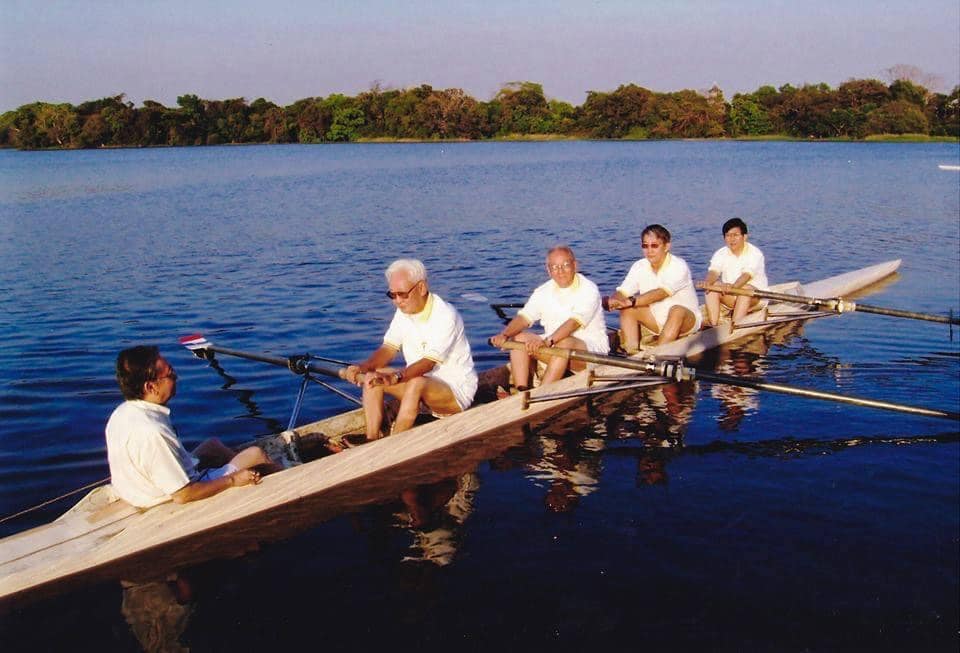
    U Win Naing (Dicky, M69, Singapore) represented RIT in Rowing. He also recruited his classmates (David, Fred, Sein Tun …) and served as their cox.

    He also played Badminton.

    He had problems with bowel movement. He relied on laxatives and medications.

    A 69er suggested him to see another doctor for second opinion.

    He was surprised to find out that he had a late stage pancreatic cancer.

    He canceled his trip to Yangon to attend a 69er Reunion.

    He spent his final months calmly at his home.

    He passed away around the Chinese / Lunar New Year.

    Due to superstition, only his family members and a few friends were present at his last journey.

    * David Myint Thein wrote :

    Gone But Not Forgotten, our dear friend as well as our Cox. May your soul rest in peace.

    * Daniel Tint Lwin wrote :

    May you rest in peace Dickie. We miss you dearly.

    Dicky
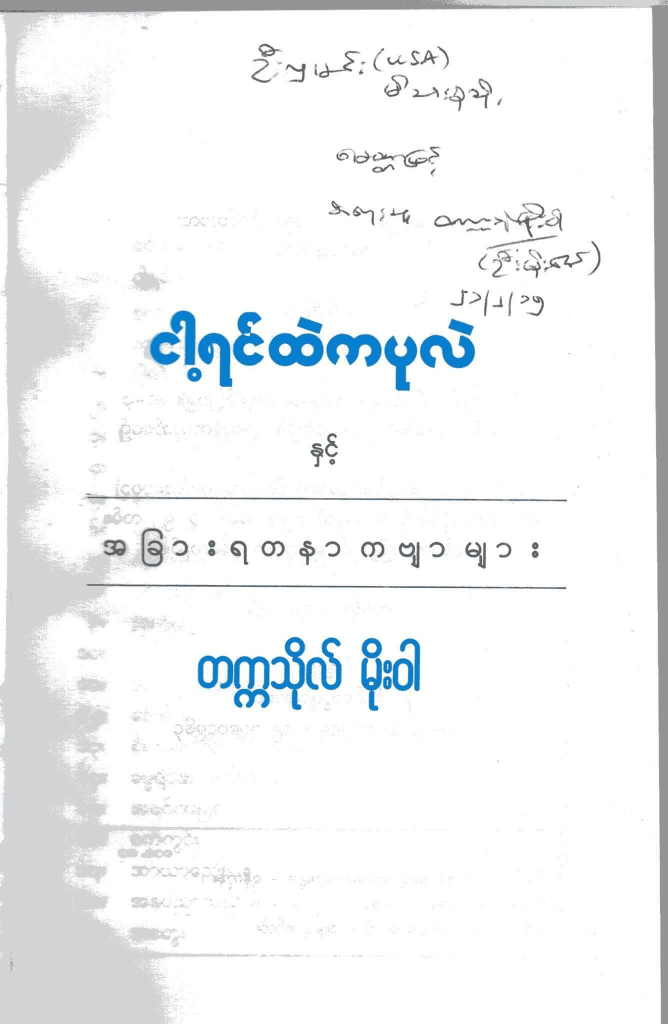
  • ဖြတ်၍မရသော သံယောဇဥ်

    ဖြတ်၍မရသော သံယောဇဥ်

    by Tekkatho Moe War

    Updated : July 2025

    Kabyar

    Irrespective of years gone by, my beloved mother and benefactor still remains in my heart.
    I wrote the poem for Thway Thauk Magazine in May 1964 in memory of my mom who passed away on March 10, 1964.

    နှစ်ကာလ ဘယ်လောက်ပဲ ကုန်လွန်ကုန်လွန်ကျွန်ုပ်နှလုံးသားထဲမှာလည်း ကျေးဇူးရှင် မေမေရှိနေသေးသည်ပဲ။၁၉၆၄ ခုနှစ် မေလထုတ် သွေးသောက်မဂ္ဂဇင်းတွင် ကျွန်ုပ်ရေးခဲ့တဲ့ ကဗျာတစ်ပုဒ်…။

    Poem

    ” ဖြတ်၍မရသော သံယောဇဥ် “
    (၁၀- ၃ -၁၉၆၄ နေ့တွင်ကွယ်လွန်ခဲ့သောချစ်မေမေ…..သို့)

    ချစ်တဲ့မေမေ…
    မြေထိ မတတ်၊ ဦးခေါင်းညွှတ်၍
    စိုစွတ် မျက်ရည်၊ ပေါက်ပေါက်မြည်အောင်
    ဖြေဆည်မရ၊ ကြင်လွန်းစွလည်း
    ဘဝ လမ်းခွဲခဲ့ရပြီ။

    ချစ်တဲ့မေမေ…
    သည်မြေကမ္ဘာ၊ သည်လူ့ရွာသို့
    သင်သာ ကျွန့်အား
    တံခါးပေါက်ဖွင့်၊ ပို့ပေးလင့်သော
    သွေးနှင့် တစ်ကြိမ်၊ သင့် သားအိမ်မှ
    စိုးရိမ် မွေးထုတ်၊ နာမ် ရုပ် တို့ပင်
    သင့်ဝိညာဥ်မှ၊ ကြင်နာတစ်ဖန်
    ဖြည့်ဆည်းပြန်မို့
    ပွင့်အန် သစ္စာ၊ သင်နှင့်သာလျှင်
    မခွာ ဝိညာဥ်၊ အသက်ရှင်၍
    သေလျှင်တူဘိ၊ ယုံကြည်မိလည်း
    မငြိတော့ပါ၊ သည်လူ့ရွာကို
    ဘာကြောင့် သံယောဇဥ်ဖြတ်သနည်း။

    ကျွန်တို့လမ်းသည်၊ မတူပြီကော…
    ညလည် တစ်ကွေ့၊ ပန်းမျိုးစေ့သို့
    ချမ်းမြေ့ သင့်မှာ၊ ရှိနေပါလည်း
    ထွန်ကာ နေဆဲ၊ မြေစိုင်ခဲ မှ
    တွဲရရွဲလှ၊ သီးမြမြနှင့်
    ဘဝဘယ်ချိန်ရောက်မည်နည်း။

    ချစ်တဲ့ မေမေ….
    မျက်ရည်ကျလျက်၊ နမ်းနှုတ်ဆက်၍
    လေးနက် ဝင်းထိန်၊ တည်ငြိမ်ကြည်လင်
    သင့်ဝိညာဥ်မှအားအင် ပြည့်ဝ၊ စဥ် မ, စ,ပါ
    ရွရွ ခွာမြန်း၊ ခြေကိုလှမ်းမည်
    မောပန်း လှစ်ဟ၊ ဆုံးဖြတ်ရစဥ်
    ကျွန့် ဝိညာဥ်ကား၊ လွင့်ပါး မစောင်း
    သင့်အလောင်းနား၊ ခုတင်နားတွင်
    လုံးလျား ငြိတွယ်နေပါပြီ။ ။

    တက္ကသိုလ် မိုးဝါ

    ၂၂. -၃ -၁၉၆၄
    (သွေးသောက်မဂ္ဂဇင်း- ၁၉၆၄မေလ)

  • Heartfelt Night

    Heartfelt Night

    by Nyunt Htay & Hla Min

    Updated : July 2025

    Nyunt Htay 1
    Nyunt Htay 2

    ရင်ထဲကည

    ဝါလကင်းလွတ်
    သီတင်းကျွတ်တည့်
    လပြည့်သည်ည
    တင့်ရွှန်းပမြိုင်
    နိုင်ငံအဝှမ်း
    မြေမဟီနန်းမှာ
    ကပ်ရောဂါဒဏ်
    စစ်ဘေးရန်နှင့်
    အန္တရာယ်ခပ်သိမ်း
    ကင်းလွတ်ငြိမ်း၍
    အောင်ကိန်းကိုပိုင်
    အောင်လံခိုင်မြဲ
    အောင်နိုင်ပွဲတွေ
    ရနိုင်စေ ။ ။

    မောင်ညွန့်ဌေး (အထက်မင်းလှ)
    ၃၁.၁၀.၂၀၂၀
    (ကိုနေမျိုးဇော် လက်ရာ ပန်းချီ ကိုကြည့်ပြီးရေးပါသည်။)

    Heart Felt Night


    End of Vassa , Rainy Season Retreat

    Thadinkyut , Lightening Festival

    The night of the Full Moon

    In glorious splendor

    Throughout the nation

    This Royal Land

    Calamities — pandemic

    battles and war

    countless dangers

    May they fade and disappear

    View Victory signs

    Hoist Victory banner

    May series of Victories be achieved .

    Translated by
    Hla Min ( EC 69)

  • Retire / Re-tire

    Retire / Re-tire

    by Hla Min

    Updated : July 2025

    Steeve’s Advice

    Steeve
    • U Thaung Sein (Steeve Kay, EC70, GBNF) is a Multiple Golden Sponsor of SPZPs.
    • He said, “You should not retire.
      You may re-tire (as in re-threading a tire). We will try to support you and your projects.

    Retired

    I am retired from working to make ends meet.

    Re-tiring

    • I am re-tiring as long as my physical and mental health permit.
    • Took a few on-line courses (for credit)
      Too taxing and slow
      Opted to audit 100+ courses (covering many subjects)
    • Listen to one or more Blinkist every day
    • Listen to selected Podcasts every day.
    • Ride stationary bike for 30+ minutes every day.
    • Write or revise 10+ posts every day.
  • Learning

    Learning

    by Hla Min

    Updated : July 2025

    There are several ways to classify learning.

    Four Pillars of Learning

    • Learning to know — both formal (via schooling) and informal (via senses)
    • Learning to do — both formal (via a mentor or supervisor) and informal
    • Learning to be — e.g. a professional (doctor, engineer, scientist, public speaker)
    • Learning to live — e.g. a happy and fruitful life (with peace and tranquility)

    Types

    There is meta-learning and efficient learning (e.g. Learning how to learn).

    For AI (artificial intelligence), there is Machine Learning (which may be supervised or unsupervised) and Deep Learning (from large sets of data).

    Rote learning is not very effective. An effective technique is to perform repetitions (or revisions) at specified intervals.

    Lifelong Learner