Original Publisher : Dhammachakka Meditation Center, 1991
Republished with other articles : Tathagata Meditation Center
Other articles included the book
(1) “Instructions to Meditation Practice” by Mahasi Sayadaw (2) “Benefits of Walking Meditation” by Sayadaw U Silananda (3) “Guidance for Yogis at Interview” by Sayadaw U Pandita (4) “An Interview with Mahasi Sayadaw” by Thamanaykyaw, translated by U Hla Myint
Anagram Making new words and phrases from the given word e.g. North, South, East and West can be transformed into Thorn, Shout, Seat and Stew
Jumbled Words Feature of a newspaper column
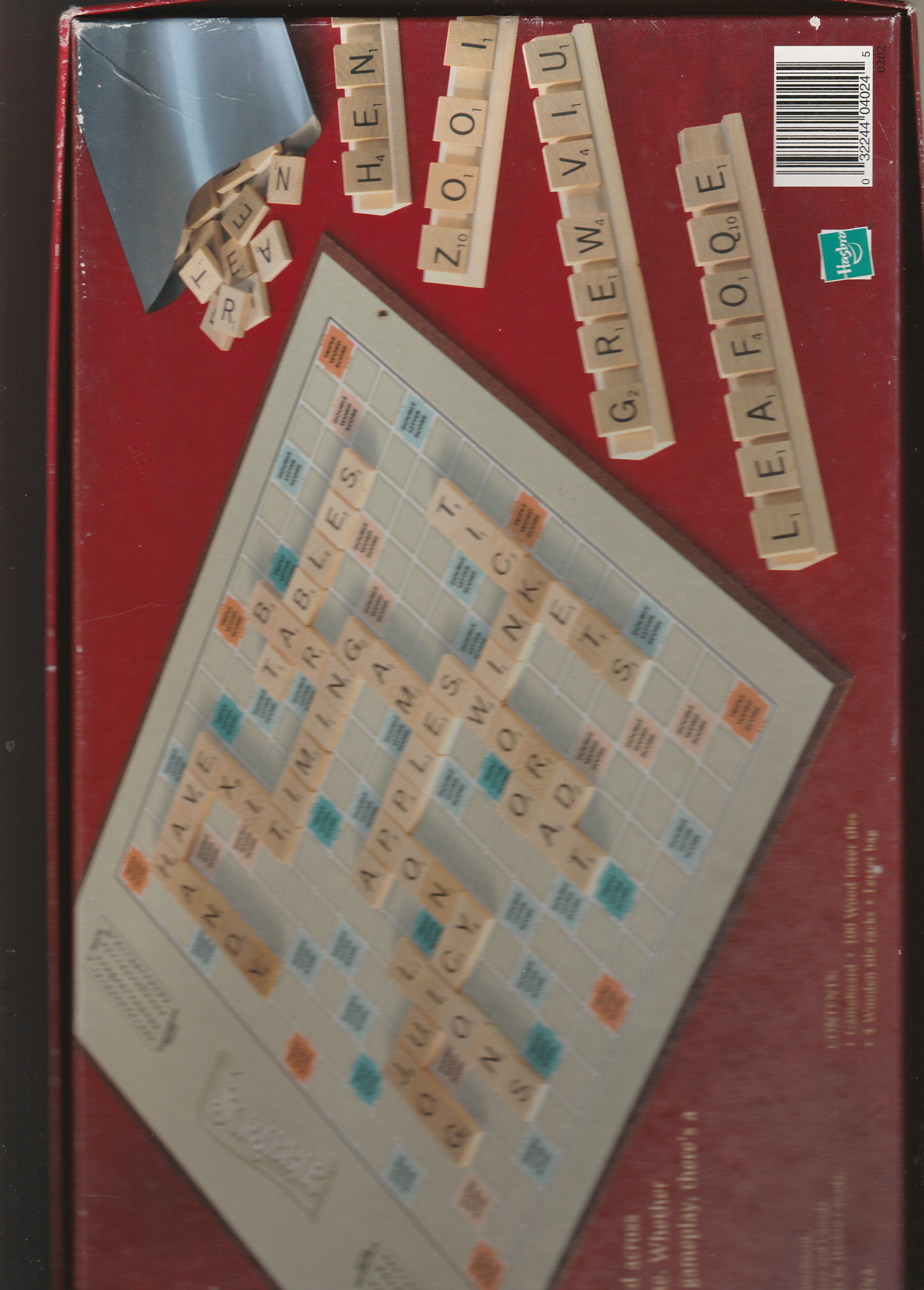
Scrabble
Scrabble
Scrabble is a board game.
A game can be played by two to four players.
There are a specified number of tiles.
Each tile holds a letter worth one to ten points, or a “blank” (similar to a “joker” or a “wild card” in card games).
Rules
The word must appear in the official set of dictionaries (e.g. Chamber’s Dictionary, Jone’s Pronouncing Dictionary).
A player can challenge the validity of a word. He or she will forfeit a turn if the challenge is unsuccessful.
A bonus of 50 points is given for a word formed with all seven tiles. e.g. MAJESTY
In some contests, adding “s” to a singular to make it plural is disallowed.
Scrabble Tournaments
In our younger days, Scrabble tournaments were held by
Guardian Newspaper P. (Paul) Aung Khin (Editor, “Dawlay’s Circle”) was a host. There was a “Tiger” Scrabble team with U Tin Shwe, U Ba U and their friend. One of the Tigers joined Saya Des Rodgers to play Doubles.
RIT Scrabble Club Saya Des and Saya U Khin were hosts.
YMCA Known for the Chess Champions (e.g. Saya Dawson). Hosted Scrabble tournaments.
Saya Des Rodgers won several trophies. Most of the English sayas (e.g. U Khin) and sayamas (e.g. Daw Toni) played Scrabble along with the students such as Ko Myo Tun (Bobby) and Ko Khin Maung Win (Roland). Civil Engineering sayas (e.g. U Tin Win) also frequent the English Department for Scrabble sessions and tournaments.
Saya U Khin has Chamber’s Dictionary and Jone’s Pronouncing Dictionary on his desk for use in the challenges.
Update of RIT Scrabble Players
Saya Des moved to UK and then Canada.
Saya U Khin moved to Taiwan.
Sayama Toni joined her husband U Nyi Than (who retired as Ambassador). After his demise, Sayama moved back to Yangon. She attends and/or host gatherings (sumptuous food and Scrabble) in Yangon.
Bobby is now Ashin Pannagavesaka (Former Dhamma Librarian, Pa Auk Tawya monastery in Mawlamyine). Bobby mentioned that Paul requested him to be a judge at the Guardian Scrabble tournaments, so he could not participate.
Roland retired after working for an Embassy in Yangon.
HMEE-2012 Lead Author : Saya U Aung Hla Tun (National Literary Award Winner) U Ohn Khine (M70) and I compiled the CD Supplement
Beginning of Engineering Courses at Rangoon University
BOC College of Engineering and Mining
Faculty of Engineering
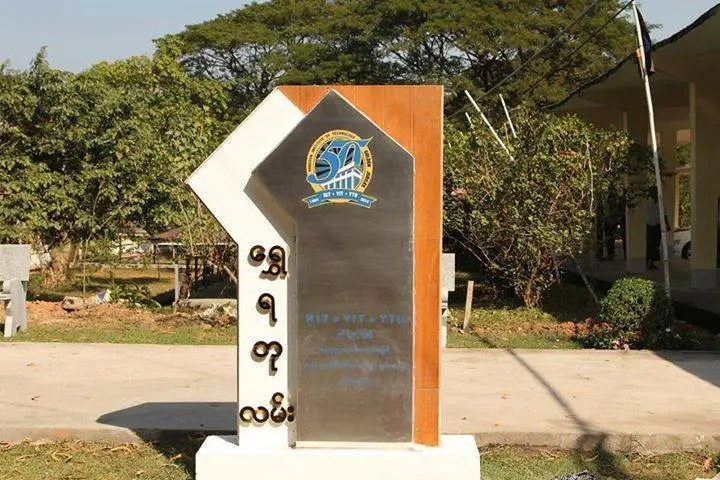
Leik Khone
Burma Institute of Technology (BIT)
Rangoon Institute of Technology (RIT)
Yangon Institute of Technology (YIT)
Yangon Technological University (YTU)
Changes in Education Systems and Names
Early supporters of the Project
Sayagyi U Ba Than
Saya U Thaw Kaung
Saya U Soe Paing (my mentor at RIT and UCC).
Saya U Soe Paing’s post on March 5, 2011
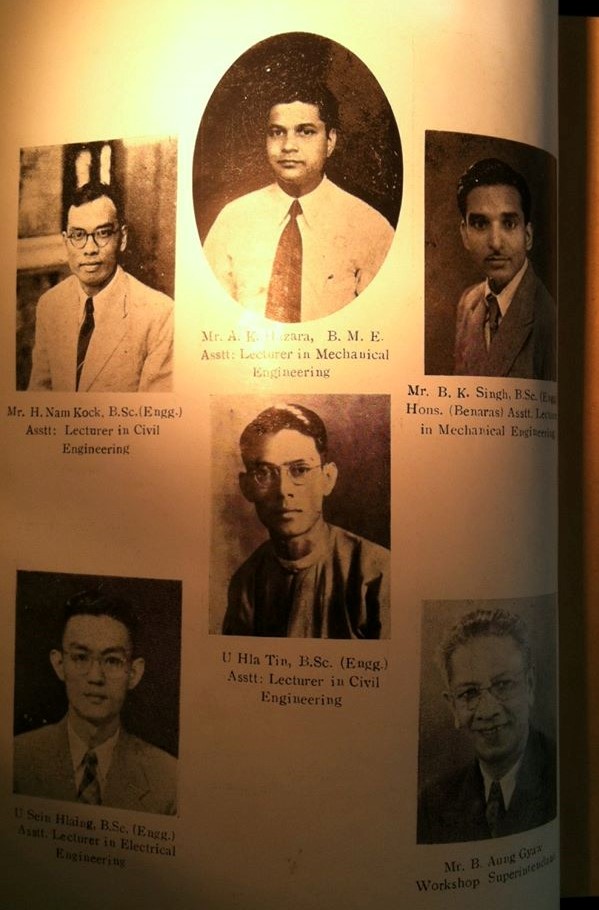
I went to the University Central Library (UCL) on Tuesday and managed to get scanned photos from the Eng Student Annual Magazines for the academic years 51-52, 52-53, 56-57 and 60-61. Photos include photos of Sayas and students of that year. From these when can know about the Sayas at that year. We can also identify the students at that year.
Saya U Sein Hlaing (Professor of Electrical Engineering) was a final year student in 1951-52 and became an A/L (Assistant Lecturer) starting 1952-53.
Saya U Tin Swe (Lecturer, EE Department) was a student in 1951-52 and 52-53. He was a member of the Eng Student Union and the victorious Prome Hall football team.
Ex-Burma Selected Footballer U Chan Tha (Chief Engineer, Roads, Rangoon Municipal) was the Captain of the football team.
U Khin Si, husband of RIT Finance Officer Daw Yin Yin Htway and part time lecturer Textile, and his brother U Tin Si were also members of that victorious team. The brothers were also outstanding tennis players and excelled at the Doubles event. Their partnership won RU as well as national championships.
The 1956-57 magazine contains photos when the new Leik Khone Engineering Buildings were inaugurated in 1956 Nov by HE U Ba Swe, Prime Minister at that time.
In the 1952-53 magazine I found out that Mr. Robert Hole (ex-EE, Highways, PWD,PWC,CC; uncle of Percy Maung Maung and uncle Bobby to me) was the English editor. I called Uncle Bobby and requested him to write something about his engineering student days, his teachers and fellow students. He agreed and asked for about three weeks time.
I need to go back and to the UCL to get more info from the RIT handbook 1966-67 and photos from the Hlyat Sit Sar Saung.
Saya U Ba Than (Professor of Mechanical Engineering) has donated some of his Engineering College photos to the MES library and I need to go there to check up on the photos.
Best wishes SP (Saya U Soe Paing)
Editor’s notes
An academic usually spans two years. To save space and time, I had loosely used the end year instead of the start year and end year. Using that notation, Saya U Sein Hlaing is from the Class of 52; Saya U Tin Swe and U Chan Tha are from the Class of 53; U Aw Taik Maw is from the Class of 54.
In the early days, there were no Instructors (but only Assistant Lecturers) for the Faculty of Engineering. They are Gazetted officers.
Some of our sayas (Saya Dr. Aung Gyi, Saya U Min Wun, Saya U Maung Maung Than, Saya U Khin Aung Kyi, Saya U Aung Khin, Saya U Thit, Saya U Thein Lwin, Saya U Soe Paing) applied for “States Scholar” before graduation.
Some (Saya Allen Htay, Saya Dr San Hla Aung, Saya U Htin Paw, Saya Dr. Ba Lwin, Saya U San Tun, Saya U Tin Hlaing) joined the faculty and were selected to do post-graduate studies.
Grapevine says that the Halls would aggressively seek outstanding athletes (footballers,…)
U Chan Tha is also Past Captain and Gold of RUBC Gold. He attended RUBC Regattas (including the 90th Anniversary of the Founding of RUBC). I was a contributing editor for the commemorative issue.
Ko Percy Maung Maung and his younger brother Ko Hugh Maung Maung are old crocs. Ko Percy is a class mate of Saya U Soe Paing at SPHS (St. Paul’s High School) and Stanford University.
Ma Gilmore Hole, daughter of Mr. Robert Hole, was a sayama at UCC, DCS and ICST. Due to declining health (and some loss of memory), Mr. Robert Hole could not fulfill his promise to write about RUESU and the olden days.
Saya Dr. Yan Naing Lwin (Emeritus Professor of Physics at Western Illinois University) e-mailed me a copy of the “Burmese state scholars in ’54”. The list was published in one of my early updates. The list includes Saya U Sein Hlaing, Saya U Tin Swe, …
Ko Benny Tan (M 70) used to have two copies of the “RIT Handbook”. One was loaned indefinitely by an alumni. I published the list of permanent and part-time sayas and sayamas from that handbook in one of early “RIT Alumni International Newsletter” updates.
Saya U Moe Aung (Tekkatho Moe War, EE) may have old copies of “Hlyat Sit Sar Saung”, RIT Annual Magazines, commemorative Swel Daw Yeik Sar Saungs for SPZP-2002, SPZP-2007 and SPZP-2010, commemorative Swel Daw Yeik Magazines for Shwe YaDu and SPZP-2016. Saya served as Chief Editor and/or Publisher for the above mentioned publications.
Saya Charlie Kaw (Tex, GBNF) is believed to have brought along with him the projects of his final year students when he migrated to the USA.
“History of University Engineering Education in Burma/Myanmar” was published in time for SPZP-2012. Due to resource constraints, there were inadvertent errors and missing names/captions for the photos. Ko Ohn Khine (M70) translated Section 1 and summarized Section 2 in English. The translations were provided in the companion CD compiled by Ko Ohn Khine and yours truly.
Saya U Aung Hla Tun (Met, National Literary Award winner) headed the team (see attached photo). Saya feels that the younger generation could/should “correct” the book and enhance it.
Some Early Authors and Poets Minby Sayadaw U Awbatha Kyee The Lay Htutt Sayadaw Ananda Thuriya Shin Maha Rathta Thara Shin Maha Thilawuntha Pho Thudaw U Min and Lu U Min U Kyin Oo U Pone Nya …
Burmese Language Commission Bogyi (later Bohmu Ba Thaung) Thesis on Early Sarsodaws Retired Colonel U San Lwin Compiler, Lexicographer
Khit San Khit San Sar Pay co-founders : students of U Pe Maung Tin ICS U Sein Tin (Theikpan Maung Wa) U Thein Han (Zawgyi) U Wun (Minthuwun) Khit San Kabyar Published by Saya U Pe Maung Tin and students
Sagar Sagar Lein Mar Aung Myint Yar (Speaking) Sar Pay Beik Man Sagar Pone (Proverbs) Early : Series by High School Sayamagyi Burmese Proverbs (by Saya Dr. Hla Phay, Professor, SOAS) Later : Book (by Myanmar Sar Ah Phwe) Sagar Pariye Collection by Dr. Nyunt Wai (SPHS63)
Jataka Tales Tay Za Thu Nay Ma Bu San Nar Wi Way (Zat Tasw Gyi) Some are available as Audio Books from https; //www.facebook.com/listenersheaven (Ko Myint Htwe and Team)
Media Radio Programs (Plays …) Newspapers (Columnists …) Magazines (Poems, Short stories, Novels …) Later : TV Broadcasts, Internet
Infant (C), (B) and (A) in PPBRS Known as LKG, MKG and HKG in other schools Basics of Myanmar Language (Reading, Writing, Recitation)
Primary School Daung Phutt Sar (Peacock Reader)
Middle School Myanmar Thadda (Grammar by Saya U Pe Maung Tin) Selected Prose Selected Kabyar
High School Prescribed Texts (Prose, Kabyar, Pya Zat, Spelling …) Essays
Formal and Informal Learning Prize : Translation of Aesop’s Fables (by Min Yu Way and Ngwe Tar Yi) Texts and References of older brother and sisters (Zi Nat Hta Pa Ka Tha Ni, Lu Du Aung Than, Pyidaung Su Pan Daing, Pyi Daw Tha Kha Yee, Kabyar Pan Kone …) Fiction and Non-fiction Magazines Cartoons, Comics Protective Verses Myanmar Swel Sone Kyan
Matriculated from St. John’s Diocesan Boys High School.
Attended Rangoon University.
EC member of the Rangoon University Writers Club in 1959 – 60.
Editor of the RUESU (Rangoon University Engineering Students Union) Annual Magazine.
Graduated with Electrical Engineering in 1963
Joined the Faculty at RIT (Rangoon Institute of Technology).
Chief Editor of RIT Annual Magazine
Chief Editor of the Hlyat Sit Sar Saung published by the RIT Electrical Engineering Association
Wrote poems and articles for various magazines & journals
Authored or co-authored five books
Worked in Singapore and chaired two Saya Pu Zaw Pwes — SPZP-2002 and SPZP-2010 — in Singapore.
He and his team published Commemorative Issues of Swel Daw Yeik Sar Saung for three Saya Pu Zaw Pwes — SPZP-2002, SPZP-2007 and SPZP-2010 — in Singapore.
After retirement, moved back to Yangon.
Helped published Commemorative Issues of Swel Daw Yeik Magazine for SPZP-2012, Shwe YaDu (in 2014) and SPZP-2016
Founding member and Patron of SDYF (Swel Daw Yeik Foundation).
Still writes poems and articles.
U Moe Aung
Literary Work
Pen name : Tekkatho Moe War
Mentor : Daung Nwe Swe
Composed hundreds of Kabyars (poems). Some (e.g. Shwe YaDu Lann) took four days of contemplation. Composed some Kabyars “Let Tann” (extemporaneously)
Published several books. Some are compilation of articles and poems.
Editor for RUESU Magazine
Chief Editor of the RIT Annual Magazines, Swel Daw Yeik Sar Saung, Swel Daw Yeik Magazine, Hlyat Sit Sar Saung
Columnist for Weekly Eleven Journal
I translated some of saya’s poems and articles:
Search for beauty posted in “Poetic Art Series”
Bagan Heritage in honor of recognition by UNESCO
Shwe YaDu Lann for the RIT Golden Jubilee
To the Shwe Duo in memory of Saya U Tin Shwe (EP66) and Saya U Hla Shwe (T69)
Kabyar Let Saung A precious gift
Computer in my heart
…
Sea of Men
Kabyar Let Saung
by Saya U Moe Aung (Tekkatho Moe War) Translated by Hla Min
String of attachment — then in its infancy grew beyond proportion — on her birthday to express my deepest feelings — while courting her I gave “Sho Whet The Pho” (Mystery/Thriller) Magazine as a birthday gift to my beloved.
We shared our metta with true devotion
I presented a golden ring to my yee-sar as a birthday gift.
Hand in hand we entered the “married” land on her birthday past the Honeymoon I presented Goya fragrance as a birthday gift
Traveling together Often facing dark nights Yonder looked thick and rough
Goal seemed distant [and not straight] [Tired and] weary [Often] look but could not see
Struggle just to keep alive Despite the challenges I feel I owe my beloved a nice birthday gift
But … Precious jewels are out of reach I can only offer a gift from my heart
Kabyar inexpensive — not meaning to underrate her love
Will she accept as a priceless treasure?
___________________________________
RUESU
Dear Ko Hla Min,
Thanks to Saya U Soe Paing for his great endeavour in visiting the UCL (Universities’ Central Library) numerous times [in January 2012] to gather and record invaluable information relating to RIT (and BOC college of Engineering as well). And thanks to you for archiving all through your emails and keeping all RITians gelled together.
Only when did Saya U Soe Paing mention Engineering Students’ Magazines, that I happen to recall one Engineering Students’ Magazine in which I was part of it. That was in Academic Year 1960-1961. I was still an Electrical Engineering Student at that time (2nd year, or, by the present calling, 4th year). At Rangoon University (Main University) they had a University Students’ Union (in Burmese, Thud Meg-ga is translated as Union), and we had correspondingly an Engineering Students’ Union as well at our Faculty of Engineering at Leik-Khone (Dome), Prome Road.
At that time I met one Ko Hla Tin (Civil) who was my senior and several years older than me, staying at Prome Hall which was adjacent to Leik Khone, only separated by a fence. He was an avid poet (pen name Kay-tu Win Tint, from Taunggoo) and I used to visit his room at Prome Hall to talk about poems and literature during lunch or break times. I also met one senior (can’t recall his name, I think Ko Sein Hlaing) who was the Secretary of the Students’ Union. After some lively discussions, we decided to issue an Engineering Students’ Union Annual Magazine and they made me the Chief Editor. The Magazine consisted of two sections, Burmese and English, of which Saya U Aung Khin (Mech) was the English Editor.
I still have the 1960-61 issue neatly tucked in a cupboard in Yangon.
Now I remember that Ko Sein Hlaing (EE?) is still in Yangon, helping to look after his grand children, but not in good health. Ko Sein Hlaing’s daughter was my daughter’s very close friend since their childhood days. We met once in Singapore about 12 years back.
Dear Ko Hla Min, this is the time to reminisce and be happy about the good old days and try to fly back with whatever time machine we could get hold of. Time really flies and we should realize that our days are numbered.
SHWE duo Blossom in unison Disappear together Free from complaint Even with thin breath Showed mark [of courage and wisdom] Never wavered … Pressed by burden At the awaited turn [of journey’s end] Body — inheritance [from previous lives] Succumbs [to failing health] Yet, “Wei-nyin” is fresh, alive and hovering.
Translated by Hla Min
___________________________________
Shwe YaDu Lann
Shwe YaDu Lann
Shwe YaDu Lann
Poem by Tekkatho Moe War Translation by Hla Min
Shwe YaDu Lann Let it be rough [but it’s tough]. Flowers are blossoming again. Fear not the summer Care not the rain [drops] or the thick fogs & darkness or if winter’s not true to its form
Shwe YaDu Lann Let it be rough. No gentle stream flowing Fear not high winds Care not dense clouds Topsy turvy [come what may] Can paddle upstream With strong mind & conviction Place where heroes [Thu Ye Kaungs] are produced.
Swel Daw Myaing Dann Shwe YaDu Lann is a start [of a journey] To raise the Banner loftily to the skies, to the Zenith displaying our thitsar (vow of truth and integrity)
HLA MIN (Editor, Newsletter Updates, USA)
___________________________________
The (Hidden) Power of Kabyar
Kabyar is animate But [it’s life is] not just a [fleeting] morn
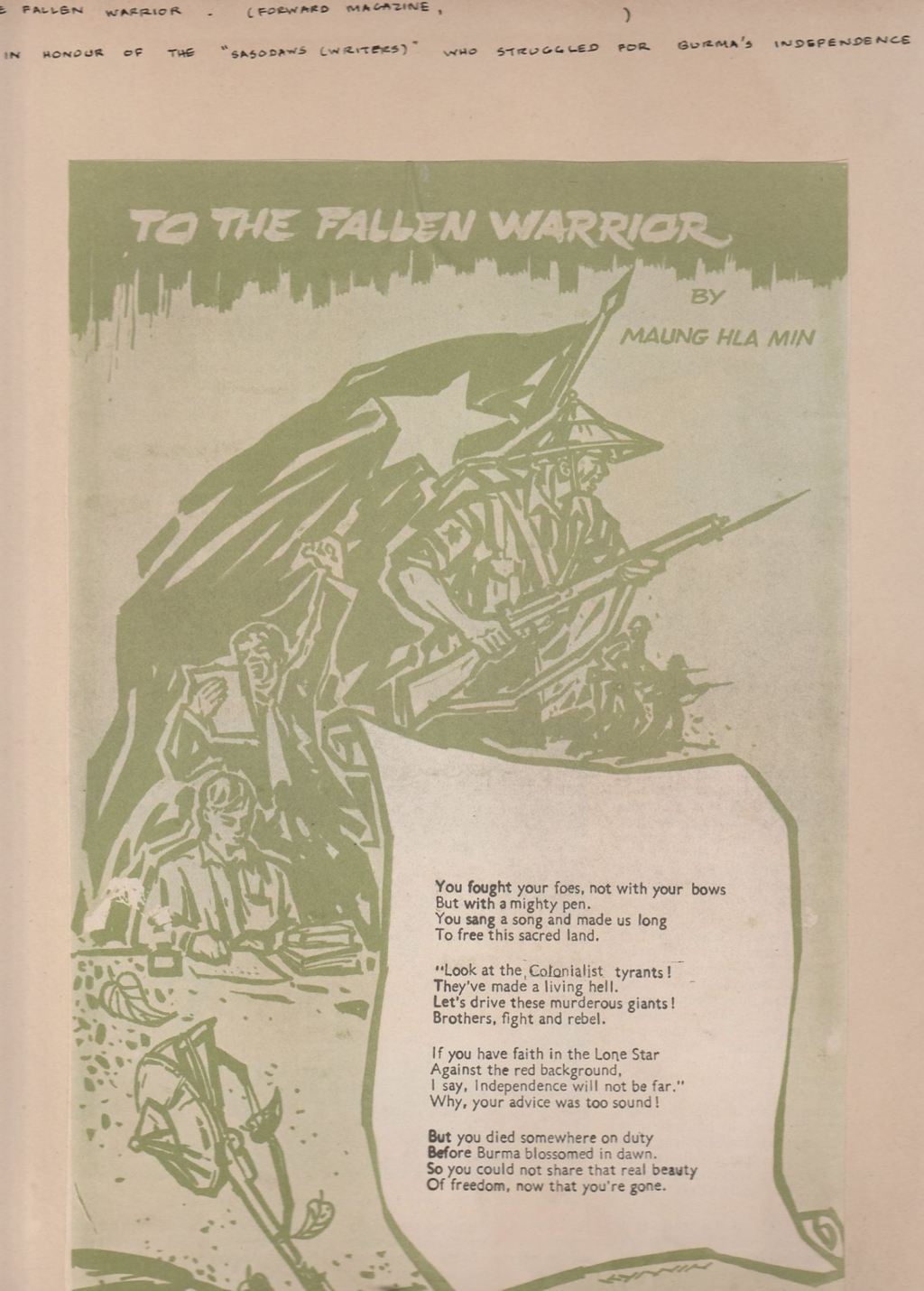
Kabyar is a weapon But not for destroying the world
Kabyar is key For liberation and independence But not devoid of principles [and morals]
Kabyar has power Hidden but efficient & effective Like sharp-pointed spear-head Can thrust into [the heart of] a power-maniac Cause trembling, shivering, throbbing & anguished pain
Poem in Burmese by Tekkatho Moe War (Saya U Moe Aung) Translated by Hla Min
It is named after Janus, two-faced God to symbolizetwo tasks : bid farewell to the old year and usher in the new year
It has 31 days.
Events
January 1
New Year’s Day (Start of the New Year). For most people, it is a holiday. In most parts of the world, New Year’s Eve is celebrated on 31st December.
Annual Soon Kyway at Panditarama (Shwe Taung Gone) by Ye Than (Winner Inn)
Birthday Soon Kyway by Ye Than
Peasant’s Day in the Union of Burma. It was a holiday. It was moved to 2nd March by the Revolutionary Council.
Sometimes : Lunar (Chinese) New Year
Sometimes : Sar So Daw Nay
January 4
Burma gained Independence on January 4, 1948 at 4:20AM
Grapevine : Burma was given a choice: “January 4th or January 6th”
In Lighter Vein : A British Official said, “We would have to get up early once on January 4, 1948. The Burmese will have to get up early January 4th of the following years.”
Unsolved Mystery : Who chose 4:20AM? Why?
Third Monday in USA
Martin Luther King’s Day
Birthdays
Saya U Than Lwin (Eric Lwin, my cousin uncle, GBNF) celebrated his birthday on January 1st.
Dr. Khin Kyi Nyunt (Cherry Tin Gyi, GBNF) and her elder Dr. Khin Tun (Peter Tin U, GBNF) celebrated their birthdays together on or around January 12. They offer requisites to the monks at Chan Myei Yeik Tha.
Ma Cherry’s 87th Birthday with family and friends (Jan 12, 2018)
Independence Day Regatta at Kandawgyi in 1948
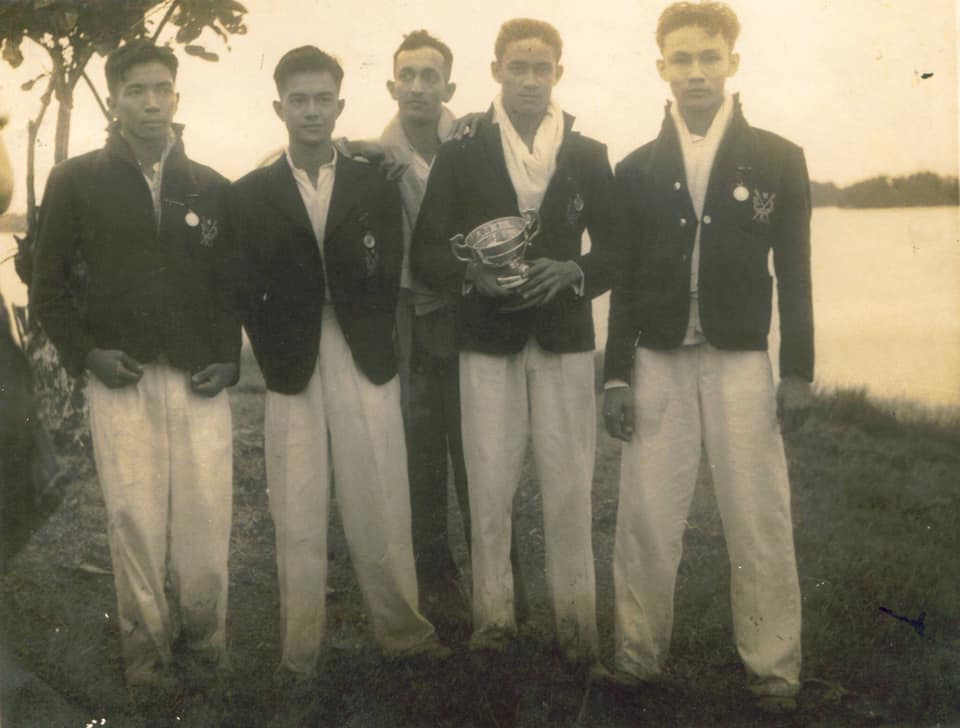
U Tin U, Dr. Pe Nyun (Dick San Pe), Dr. Pe Thein (Tom San Pe) and Bobby Tin rowed for RUBC against the Burmese Laung at the Independence Day Regatta.
He had a checkered life with a a series of setbacks and victories. His life is brilliantly recounted by his son Dr. Thane Oke Kyaw Myint (Pediatrician).
Several readers have compared the accounts as befitting a romantic novel or historical episodes.
Connections
I first knew him as a dhamma friend of my parents. The two families helped build the Dat Poung Zon Aung Min Gaung Pagoda and supported Mon Sayadaw U Thilawuntha.
Two paternal uncles (who are Barristers) worked at his Law firm.
His son Dr. TOKM was my senior at SPHS. He became a saya of my beloved spouse at IM(1). He took care of my two young sons. When I published “Trivia” posts, he provided comments and details to several posts.
I learned more about his father, uncles and aunts first via his commentaries and now via his articles (e.g. the value of emotional intelligence and brotherhood, the indomitable spirit). He also covered notable events and people.
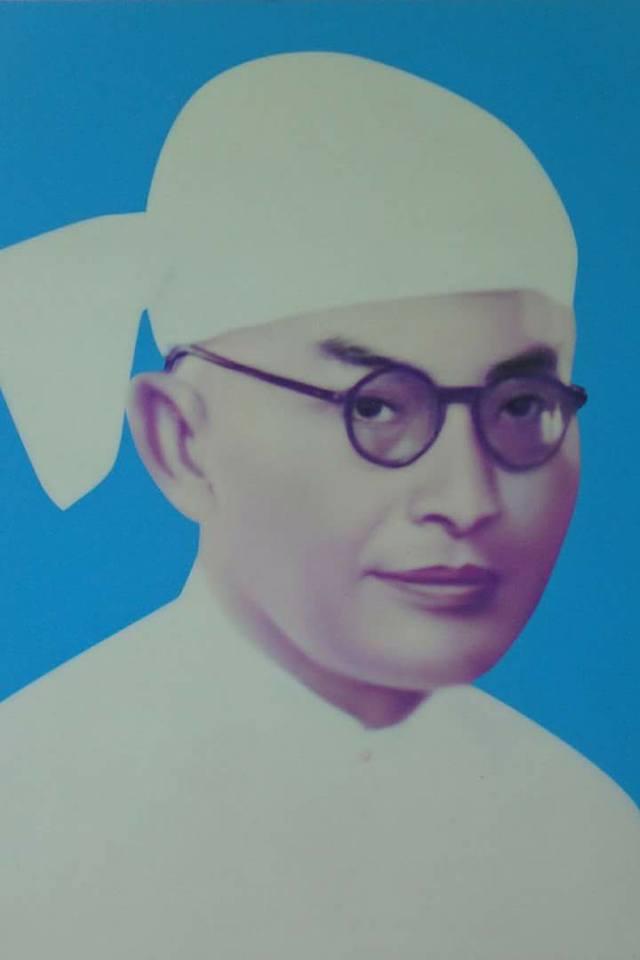
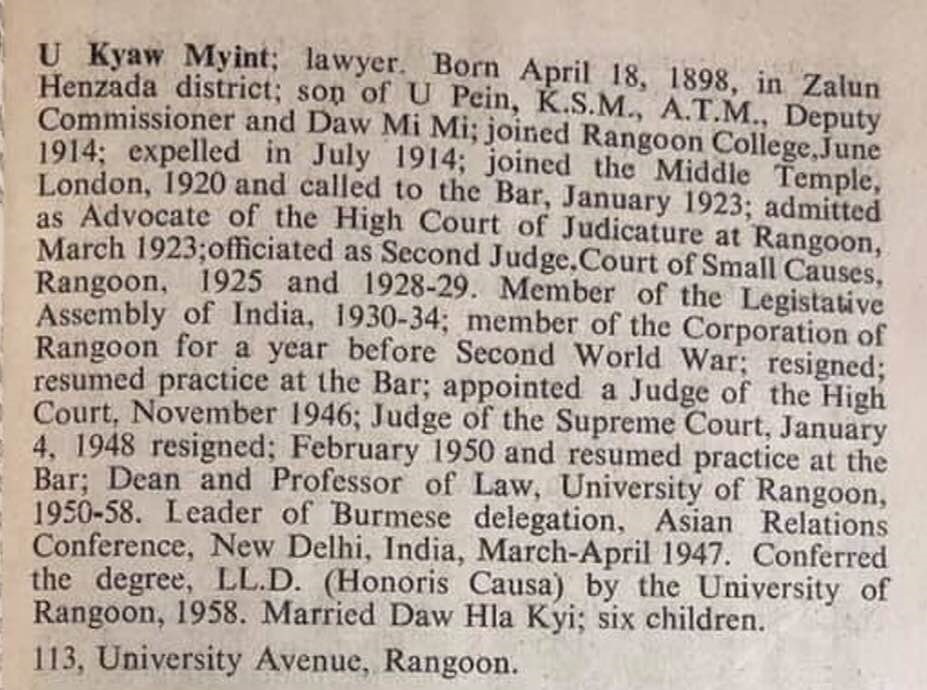
The Brief Biography of U Kyaw Myint appeared in “Who’s Who in Burma”.
U Kyaw Myint’s Brief Biography
He was born in April 18, 1898 in Zalun Henzada district. He is the second son of U Pein, K.S.M, A.T.M, Deputy Commissioner and Daw Mi Mi.
Seven Siblings / Outstanding Burmans
ICS U Tin Tut is known as a diplomat, journalist and for being a victim of the the political assassination. Details can be found in the post “The Empty Tomb” and related articles on the unsolved mysteries of Burma. He is the first Burmese ICS by invitation.
U Kyaw Myint His life is covered in this post. It was first published as a series of articles in Facebook.
U Myint Thein was Chief Justice of the Union of Burma. He was detained in the Coup d’etat on March 2, 1962. He was Ambassador to China. Pen name : MMT Spouse : Daw Phwa Mi (first Burmese Female Barrister)
Dr. Htin Aung Principal, Rangoon College First native Rector, Rangoon University Vice Chancellor, Rangoon University Diplomat, Ceylon Scholar : Oxford & Cambridge Author, Historian & Folklorist
Daw Khin Mya Mu Kyauk Sar Specialist Thamadi Myo Wun Spouse : Professor U E Maung
Daw Khin Saw Mu Early graduate of Burmese Department, RU Khit San Poet Spouse : ICS U Ba Tint Children : Daw Khin Saw Tint & Nay Oke Daw Khin Saw Tint wrote an article about her mom and aunts
Daw Tin Saw Mu Lecturer, English Department, RU
Mesopotamia (Action during WWI)
My Father
U Kyaw Myint
By Dr. Thane Oke Kyaw Myint (SPHS60)
My father had a very chequered life.
Early Life
Short stay at Rangoon College
He stood first in the Matriculation examination at the age of sixteen. He had distinction in all subjects including shorthand and typing. He got scholarship when he entered Rangoon College in June 1914 but was expelled from the College in July 1914.
There was going to be a scholarship exam to enter Calcutta University. The Principal of Rangoon College, Mr. Mathew Hunter had chosen two bright young men to take the exams to enter medical college in Calcutta. The two students for this exam were my father and Sayagyi U Ba Than. They were very close friends.
Just before the exams, my grandmother passed away in upper Burma where my grandfather was working. Father went to the Principal to give him leave to attend his mother’s funeral. But the dates would clash with the exams and Mr Hunter refused his permission. Father was told that if he went without the Principal’s agreement, he would be expelled on return.
My father went in time for the funeral but on return, as told to him earlier he was expelled from the College.
Self Support
My grandfather was very angry with my father being expelled. Father was told not to come back to the family.
Father supported himself by doing a unique job. He traveled from Pegu passing through small towns and villages. At that time, there were many Burmese women who had children by Englishmen, and were common law wives. The Englishmen had left Burma, but they did not money regularly.
On behalf of the women, father wrote letters in English to the men in England. He was offered food, small amounts of money, and a place to stay.
He continued doing this, going up the country till he reached Myitkyina some months later.
Bombay Burma Company
Due to father’s expertise in short hand and typing, a young English man from Bombay Burma Company gave father a job as a clerk and secretary. Father told me about the kindness of the English couple who let him stay with them.
Apart from Secretary work, he had to go with workers to the teak trees that had been cut down and later sent them down the Irrawaddy to Rangoon. Father had to supervise that the Bombay Burma Company seal was hammered deep at the end of the logs. The logs were floated down the Irrawaddy river. Logs with the seal were collected and exported to England.
Illness
A year later father had cerebral malaria and it was the young couple who looked after him during the illness.
Enlistment and Assignments
Father stayed on with the English couple till the end of 1916. By that time the war that was said to last only one year had to gone into its third year with no resolution. There were many casualties and new fronts for the conflict. The English government intensified their recruiting efforts.
The young Englishman and his wife returned to England. The husband joined the army.
Father did not want to continue working in Myitkyina. He also thought of enlisting for the war.
He first went to Pegu to reconcile with his father. Grand father was doing a job what would be equivalent to a District Commissioner (DC) but being Burmese was given the post as Extra Assistant Commissioner (EAC) but doing the same job.
Burmese doctors were appointed as Sub Assistant Surgeon (SAS). They had to work like surgeons and civil surgeons.
NB: the status of Burmese doctors before Independence can be read in the books by Dr. U Myint Swe.
In spite of my grandfather telling him not to enlist, father went ahead for enlistment.
The place for enlistment was the at the Cantonment (which was Burmanized as “Kan Daw Min” Park). It is the place with a small lake near the Shwe Dagon Pagoda.
At that time, no Burmese would be accepted. One must either be an Anglo-Burman or and Anglo-Indian.
When asked, father gave his name as “John Henry Wilson”. He could be taken for an Anglo because he was very fair with sharp facial features.
Next he was asked to go against the wall to measure his height. Father was only five foot two inches. When the sergeant cane to measure him, he stood up on his toes so that it would be five foot four (the required height for a soldier).
The sergeant asked him whether he really wanted to serve, and getting an affirmative, the sergeant write down on his enlistment as “John Henry Wilson, Anglo-Burman, five foot six”. Father became a soldier.
Note:
Since, the English keeps excellent records, there must be enlistment records for the regiment that above item written down above, would still be there in their archives.
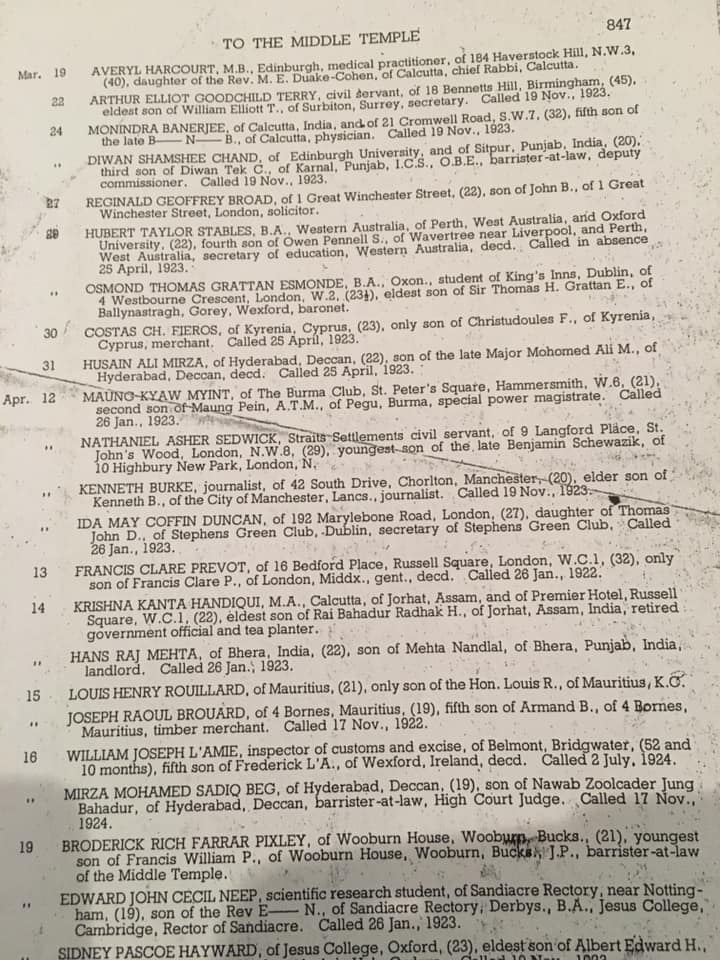
I visited the Middle Temple Inn in London, from where my father was called to the Bar. I wanted know about my father, the Librarian asked me for date of being called, went in, back in about 15 mins and gave me a copy of information of my father as recorded in their archives.Will write more about this in a later post “My father: the Barrister”
I tried to remember but still could not get the place in India where he was sent. I only remembered that it was in a cantonment not far from Dehli.
Father was sent to where the Gloucester Regiment, the 12th Battalion was billeted. He got his training, stayed there for some time rising to the rank of corporal.
Mesopotamia Campaign and “the war to end all wars”
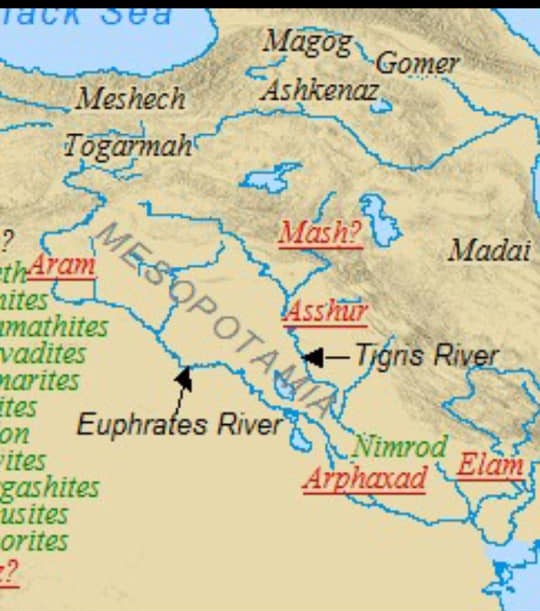
At the start of the war, the British army and its allies thought that it would be a short war lasting for a year or so. But it didn’t as the allies were fighting on different fronts. When the Turkish Ottoman army joined the war, that opened a new front of the war: the “Mesopotamia Front / Campaign”. Father’s regiment was sent to that front.
Germany had sent a fleet of submarines to attack British ships carrying either troops or cargo.
Although not entirely, the British army and navy were depending on oil from Burma Oil Company in Yenangyaung. But when their ships sailing from Burma were being sunk, they looked for an alternative.
Apart from Burma, the oil fields from Mesopotamia were near to England and likely to have less loss during transport.
Just like Burma Oil Company (BOC), there was another company that could offer the required crude oil. Like BOC, the Anglo-Persian Oil Company (AOC) was owned by an Englishman. Both BOC and AOC were taken over by the British government for the war efforts.
The Mesopotamia Campaign happened mainly to save and have access to AOC refineries.
For some years now, whenever I heard about Iraq, Iran, Syria, two words often appeared: Basra and Mosul.
Mesopotamia was the area between the Tigris and the Euphrates rivers. It covered what would later become most of Iraq, parts of Northern Arabia, Eastern part of Syria and South East Turkey.
The oil rigs were in Basra and Mosul within Mesopotamia.
And that was where my father’s regiment was sent: to guard the oil fields from the Germans.
As the German army was engaged in other fronts, it was the Turkish (Ottaman) soldiers and Nomadic Arabs attacking these two areas.
It was mainly skirmishes and attacks mainly by the nomadic Arabs who were given arms by the Germans. The disciplined regiment could repel the poorly planned attacks and thus England still had access to the oil.
Armistice: 11-11-11 11AM
Father and did comrades stayed on in that area till Armistice, the end of the war at: “the 11th hour, of the 11th day of the 11th. month of the year”.
President Woodrow Wilson in his speech said, “the war to end all wars” had ended, using H.G. Wells’ words from the book “The War of the Worlds”. How ironic it was as only three decades later the Second World War happened.
Return Home
Not too long after that soldiers including my father were demobilized and could return to their home countries.
Father returned home to be with his family.
Study at Cambridge University
Since he was expelled from the College, he had never given up his hope to gain a good education. The demob and savings from his salary and other benefits on leaving the army, he now had enough money to go to England to get what he had wanted to do since 1914.
He applied to be admitted to Queens’ College Cambridge, where his elder brother [U Tin Tut] had attended gaining MA, LLB.
Father landed on the shores of England in the spring of 1919. He was twenty one years old.
After spending time in London for a week or so he got to Cambridge to seek admission. Father told me that it was a vibrant time to be as there were so many young men like him, veterans of the war, some who had left their studies and had left to fight the war as well as those like him who had come to be admitted for the first time. He wanted to study at Cambridge as this was where his elder brother studied for his BA (later MA) and LLB.
Both Oxford and Cambridge gave dispensation for veterans, so that they did not have to undergo a strict entrance exam but only had to take what was known as “the little go”.
Father went to the College with all that he had was his matriculation certificate from Burma. He had to go through an interview first to see whether he should be admitted. Father impressed the examiners that he was admitted without the need to take entrance exams.
Finally he thought he was going to get the education he had missed before. He had enough money to sustain him for the four years at the university.
During the two years he was in Cambridge, he actively participated in debates conducted by the Cambridge Union, where he sharpened not only his oratory but also would help him at the courts when he became a practising barrister in Burma. It also helped when he became a well known politician in Burma.
Two things happened that would affect his ambition to be a college graduate.
First when he was in the second year, U Tin Tut arrived. He was sent to Oxford to do his training for the Indian Civil Service (ICS). He was to be the very first Burmese to be admitted to the Service. And unlike the others who later joined, he was the only Burmese to be admitted by nomination and not by selection examinations.
On 29th December 1920, there was a nation wide students strike against the British government. Schools and the Rangoon University was closed down.
U Myint Thein was then studying in the junior BA class at the University. Not knowing when the university would be reopened, even without telling my father he traveled by ship to England. This he did without any funds for tuition fees. He arrived and requested my father to pay for his tuition and upkeep in Cambridge.
U Tin Tut gambled a lot on the races and he also was asking father to help pay some of his gambling debts.
Father decided to leave Cambridge so that he could support his younger brother. He searched for a job to sustain the three of them.
For the second time in his life, his education had to be postponed.
At that time, there was Burma Club. Many years later — at the time when Saya U Maung Nyo was studying in London — there would be the Britain Burma Club. And Prof. Woodruff, who was a visiting professor of tropical medicine in Rangoon, was a Patron.
The Burma Club was for the people who have served in Burma both before and during the war. Father got a job as the secretary of the Club. It enabled him to sustain the needs of his two brothers and allowed him to prepare for the barrister examinations.
I have titled this part of my post as “Cambridge — here I come”, but for father in 1920 was “Cambridge — here I leave”.
Yet again he was thwarted from gaining a university degree.
P.S. In spite of all the obstacles, in 1948, on gaining independence, my father, the college dropout, was appointed as one of the first three Supreme Court Justices of our country. And also later became the very first Dean of the Faculty of Law at the Rangoon University.
The Four Brothers and Inns of Court
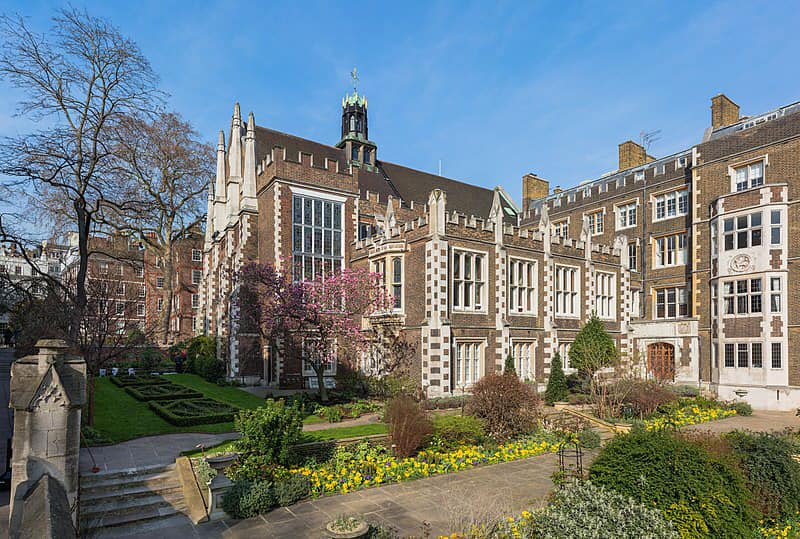
May I give some information about the Honorable Societies of Barristers: the four Inns of the Court of England and Wales. namely The Inner Temple, The Middle Temple, Grey’s Inn and Lincoln’s Inn.
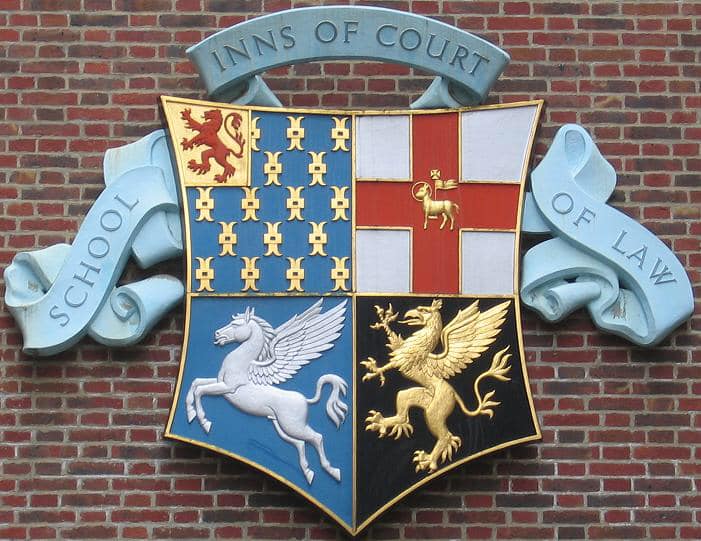
The first photo is the Temple and second is the current School of Law, under University of London, showing the shields of the four Inns: On top Lincoln’s Inn and Middle Temple. below Grey’s and Inner Temple.
The full name of the Temple was Solomon’s Temple.
Originally the temple was for a Catholic Military Order (Fellow Soldiers of Christ) and the members of the Order were known as Knight Templars. This order was to protect pilgrims going to the the holy land as well as to fight with Muslim armies trying to expand their territories.
This change must be made as seen in the photo as the four Honorable Societies do not give degrees, no scrolls, no diploma nor parchment. There was only entries of a person being called to the bar in the records of the four inns.
According to my uncles (U Myint Thein and Dr Htin Aung) the exams were tougher in the Inner and Middle Temple compared to Grey’s and Lincoln’s. They therefore chose to go to Lincoln’s Inn.
There were no formal lectures nor teaching. Candidates had to attend and listen to trials going on and listen to some tutorials given at the Temple by senior barristers. And mainly one studied on his own.
The way assessments were made was for each subject, written papers had to be submitted followed by “dinings”.
When a candidate felt that he was ready to be assessed, he would invite three senior barristers to actually dine with him in the dining hall. Over dinner, questions were asked and discussions were made. The candidate was told whether he had satisfied the senior barristers and could now go to the next subject i.e. next dining.
If unsuccessful, the candidate had to undergo another dining for that subject.
Father succeeded in at the first attempt of all subjects except on Roman Civil Law which was examined in Latin. Father could answer only one question as he had to learn Latin only on arriving in England. Father had been preparing himself for the bar exams while he was in Cambridge.
At his last dining, the senior most barrister said, “young man you had answered only one out of the four questions in Roman Civil Law. But you had written it like a brief by an experienced barrister. If need be, we hope that you will study more. We are satisfied with you and you need not come back for a second dining”.
Father, the College drop out, the ex- soldier, had finally been called to the Bar on 26 January 1923 at the age of 25 years.
He would then go on to be a Judge of Court of Small Causes at the age of 25 (after only ten months as a practicing barrister), a High Court Judge in 1946 and one of the first three Supreme Court Judges at independence in 1948. He resigned in 1950 in protest against the Prime Minister’s interference with the judiciary. (This will have to be told later).
He became the Professor and Dean of Law, Rangoon University and was conferred with a honorary doctorate (LL D in honoris causa) on his retirement.
…………………..
In 1972, when I was living and studying in London, I became a friend with South African (of Dutch descent) who was taken his bar exams at Middle Temple Inn. He had stayed on to do an academic degree in law.
Candidates were allowed to bring friends to dinner even when they were not being examined.
Each table was for four. My friend and I were joined by two senior barristers. It was such a pleasant evening.
There were two entrances to the dinning hall. Barrister had to go in one, where they were given barrister gowns to wear. Visitors in formal wear had to enter from another entrance. He took me through the visitors entrance, moved to the other entrance, donned the robe and came back to me to go to the dining tables.
There were tables on a stage. My friend told me that the tables were for for judges called the Benchers.
My friend told the senior barristers about my father. They wanted to know whether father was still practising. I told them about my father being a Supreme Court Judge but had retired and had resumed his legal practice.
On another day, my friend took me to the Temple Library where records of people who been called to the Bar from Middle Temple.
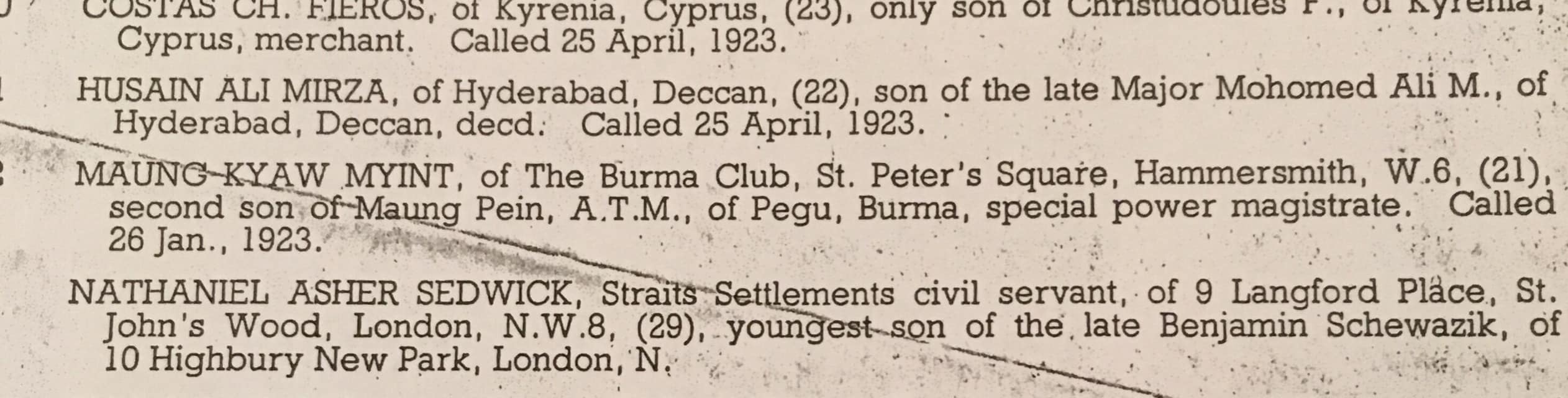
When I told the librarian that I only knew about my father being called in 1923, she went to look at the records for that year, found my father’s name and brought out the to me to show me the entry for my father.
It was a very brief entry:
“Maung Kyaw Myint, of the Burma Club, St. Peter’s Square, Hammersmith W.6. (21) second son of Maung Pein, A.T.M of Pegu, Burma, special power magistrate. Called 26 January 1923”.
Then she said, “would you like to have a copy of the entry? I said yes. I was given a xerox copy of that page.
P.S: U Tin Tut and U Kyaw Myint were called to the Bar from Middle Temple. U Myint Thein and Dr. Htin Aung from Lincoln’s Inn.
Daw Phwa Hmi, who would become the wife of U Myint Thein, was the first Burmese woman to be called to the bar from Inner Temple. There was a story behind this about U Myint Thein and Daw Phwa Hmi.
P. S. in case I might forget to write about my uncles, I want to add two amusing anecdotes of them.
Anecdote #1: U Myint Thein
When U Myint Thein was studying in school at Pegu, he and his friends had a fight with another group of young men. U Myint Thein hit a man from the other side with an iron rod and broke his head.
Both groups were arrested for fighting and disturbance of peace by the police and brought before the magistrate. It was my grandfather as the EAC had magisterial function. The young men had to appear before him. All meekly accepted the fines to be given but not for Maung Myint Thein.
When each of them were asked why and the fight started, and what should be their sentence. All accepted to pay the fine for bring public nuisance.
Except my uncle, who was being given a sentence more than others because of the assault with an iron rod. He was made to pay a fine and seven days custody at the police station.
He would not keep his mouth shut that it was not fair as what he said that what he did was according to the Buddhist literature.
His father asked him to explain why. He quoted a stanza of the Mingala Sutta:
He said that in the 20 stanza of the sutta, “Garavo ca Novato ca Suntutthi ca katannuta”
The Burmese pronounced the Pali words differently: the word “suntutthica” was pronounced as “than dote thi sa” and therefore he said he should not be given a punishment more than the others as he was doing what was mentioned in the scripture.
Grandfather was very angry with his insolence and sacrilege in using a Pali word to be equal to an iron rod, he had not only to pay to stay in custody for fourteen days for not only assault but also sacrilege.
And that was the my uncle Myint Thein the jailbird who would many years later became the Chief Justice of the Union.
Anecdote 2: Dr Htin Aung
Badwe was studying in Trinity College Dublin for his doctorate which he finished in nine months. To celebrate, he and some friends went on the town. Although he did not drink himself, he plied his college friends with as much alcoholic drinks that they could drink.
After some time, the group became very rowdy and disturbing to other people. They became such a nuisance that the bar tender called the police and all were arrested by the police.
The next morning they were brought in front of the magistrate accused of disturbance of peace in the community. The magistrate asked whether they were all inebriated at the time of arrest. The arresting policemen said yes except for one person who happened to be my uncle.
The magistrate gave a sentence of a fine of one pound for all his friends “disorderly while being drunk”.
My uncle was fined five pounds. The magistrate said while he did not partake in the drinking but was equally rowdy and disturbing people he was fined more because of “disorderly without being drunk”. Said he should have known better than other not to disturb people.
The Age of Barristocracy
Father came back to Burma in 1923 and started practicing as a barrister in Rangoon.
Ten months later he was appointed as a judge of the Court of Small Causes, similar to a magisterial Court. He was the youngest lawyer to be made a judge, not just in Burma but in India also.
How it came about was that the sitting English judge had to return to England. The Court clerk asked the then Chief Justice as to who should be appointed in that position.
The Chief Justice said “the very bright young barrister who had appeared in court. He knows the laws and is very impressive”. The court clerk explained that father had only been working as a barrister for only ten months. The Chief Justice nevertheless decided to give the post to my father.
Father was the youngest ever — at the age of twenty three — to be become a judge in colonial India and Burma.
Nationalism
But at that time, the political climate has begun to change. Nationalism had emerged in both India and Burma.
After two years as a judge, father at twenty five years of age resigned to return to practice as well as to enter the political arena.
He stood for and won the elections of the Members of the Legislative Assembly (MLA), which was equivalent for the lower house in Parliament. The Imperial Council was similar to the upper house but their members were appointed by the Governor General and was by nomination rather then by election.
Seeing the work of many well known barristers in Indian made father stand for election and winning the position from the Kyimindaing (Kemmendine) constituency in Rangoon where he served for two terms.
It was the senior barristers of India and Burma whom he wanted to emulate. While serving as a member of the Legislative Assembly, he got to know and learn from these barristers.
As most of the MLA were barristers and he got to know them well. It seemed as though one would have to be a barrister to become a politician that was why the term “barristocracy” came into being.
Eminent barristers and political leaders
The following eminent barristers in India and Burma were the political leaders at that time.
Mahatma Gandhi : Inner Temple
Pandit Nehru : Inner Temple
Mohamed Jinnah : Lincoln’s Inn, the youngest to be called to the bar at the age of nineteen
Solomon Bandaranaike : Inner Temple
Another activist barrister was Dr. Ambedkar, a dalit, from the scheduled caste, who entered the legislative assembly to fight for the Dalits and formed the “scheduled cast federation”. He was a highly educated and committed lawyer and activist.
Dr. Ambedkar studied at Columbia University and London School of Economics and he was called to the bar at Grey’s Inn. He attained following degrees: BA, MA, PhD, MSc, DSc, LL D, D Litt, Barrister at Law (Grey’s Inn).
He founded the Scheduled Caste Alliance. One tactic he used was to have the untouchable to change their religion from Hinduism where they were at the bottom of the ladder, to Buddhism which had no hierarchy.
Father was to become close to Nehru from India and Mr. Bandaranaike, who not only knew fellow barristers but also MLAs.
He visited Calcutta to meet with Dr. Ambedkar and also with Nataji (Subaru Chandra Bose).
Father also visited Mahatma Gandhi in his ashram, every time when he was in India when he and his disciples were doing “satyagraha” the nonviolence movement.
Nehru and Indira
Nehru was arrested and put in prison. On being released, he and the young Indira came to visit Burma and stayed with my father for three weeks. Nehru gave copies of his books “Letters to a daughter” and “Glimpses of India”. The first book was signed by both the father and the daughter.
When U Myint Thein was arrested by Ne Win, the MI (Military Intelligence) people came, ransacked and took away many of my father’s books. We did not know why the Nehru books, books by Jung and Freud, a complete collection of Gandhi’ speeches, law books and even some books of fairy tales were taken.
Father was told that the books would be returned after some time but they never came back. May be most of them were illiterate and could not read them.
Father knew Nataji very well. Apart from members of the Indian community, my father visited him often in the Mandalay jail where he was imprisoned from 1924 to 1925. Later U Myint Thein also did the same.
In Burma not just the barrister but also eminent lawyers entered politics:
Dr. Ba Maw, MA Calcutta, LL D Bordeaux
U Pu, Barrister at Law
Dr Ba U, MA, LL D (Cambridge).
Non-separation versus Separation
During the separation movement, Dr. Ba Maw, Rambyae U Maung Maung and my father U Kyaw Myint founded a political party. They were for non-separation.
U Ba Pe (a journalist), Barrister U Pu and U Shein were for separation from India. U Ba Pe was the founder of the Burmese Newspaper: Thuriya (the Sun). Their stand was for separation from India.
During the campaigning, U Ba Pe called his faction as “Pe Pu Shein” the initials of the three leaders of their party. But he addressed my father’s party as “Maw Myint Byae” – the “byae” was a derogatory word meaning “disorderly”.
Due to standing for non-separation, father did not win in the next legislative assembly and returned to his practice as a barrister.
Deciding late for standing in the election, the Kemmendine constituency went to another candidate. Father was given the Kungyangone constituency where he lost mainly because of his non-partition stance.
The positive side of standing for election in Kungyangone was that he met my mother. And married her.
The Eligible Bachelor and a Man About Town
Father returned to his practice as a barrister and became very busy. As Burma had been annexed to India, the Burmese Courts were under the judicial system of India.
There were many Indians businessman in Burma who had kept some of their enterprises in India. Father was traveling from Burma to appear before the courts in India. For some cases, Burma not having a Supreme Court at that time, he had to travel to New Dehli from time to time.
Being an eligible bachelor had “dalliances” with young ladies but never serious except for a couple of them: Daw Yin May and Daw Khin Khin Gyi. As both my father as well as the two ladies had passed away, I think I could write a few sentences about my father’s love life!
One of the main reasons he stayed a bachelor was because of his three younger sisters, Daw Khin Mya Mu, Daw Khin Saw Mu and Daw Tin Saw Mu. Grandfather had remarried and the step mother was very unkind to father’s sisters. In spite of grandfather objections, father took them under his wings and they lived together in Lewis Street Rangoon.
Father and Daw Yin May did have a serious relationship. I was told by one of father’s previous staff that, father would as much as possible visit Daw Yin May in the evenings whenever she was less busy. She was then living in the house in the Dufferin Hospital compound.
Father had left his job as a judge to enter politics. According to my father, she asked father what would happen then. It was about the time when Nehru was in jail. He said there could a chance of being imprisoned.
Due to this uncertainty, Daw Yin broke her relationship with my father and eventually married Col. Min Sein.
When they were still favouring each other, father sent a bouquet of flower to Daw Yin May every day.
According to Prof. Daw Hla Kyi, Daw Yin May told her about receiving daily bouquets from father. She said that she also received flowers every day from the gardener of the hospital!
Prof. Daw Hla Kyi was from Pegu and her father worked under my grandfather in Pegu. She had many stories of my father and his three brothers.
Father also had a relationship with Daw Khin Khin Gyi but again he was looking after his sisters on top of being involved in politics.
Father told me that Daw Khin Khin Gyi asked him to give a pair of velvet slippers from Mandalay adorned with semiprecious stones. This he did get a pair (setting semiprecious stones into the slippers was not easy and they were more expensive).
She married lCS U Shwe Baw. Father told me that he was very happy that both of them got married to very good men.
Dr. Daw Yin Yin Nwe asked me when did my father got to become a life long friend the princes of Shan State.
And below is the answer.
At the time, Shan States were different in governance to the mainland Burma. The British allowed the Sawbwas to retain their status and administer and govern as before. But the British foresaw that it would be to the advantage of the Shans to be part of Burma even though the Shan rulers were more closer and related to the kings of Thailand.
Father was appointed as the legal (constitutional) adviser to the Shan rulers. He had to travel to the Shan States and explain why a constitution would be drafted even before getting independence. That a consultation and an agreement would be made (which would be the Pinlon conference).
Father was helping the Shan royalties to understand definitely how things would be or should not be when the time came.
It was a lengthy process as father was going to each of the Sawbwas and later as a group.
The Mongrai family was related to the Thai royalty and efforts were made so that they would stay in the Union of Burma, with state governance for the Shans.
During his visits he stayed with Nyaung Shwe Sawbwa and came very close to Sao Shwe Thaike. Similarly he became very close with the Sawbwas of Kengtung and Sipaw.
I would like to mention two ladies who had made their marks in not just in the history of the Shan States and the Sawbwas, bit also internationally.
They were:
Daw Mi Mi Khaing : educationalist/author
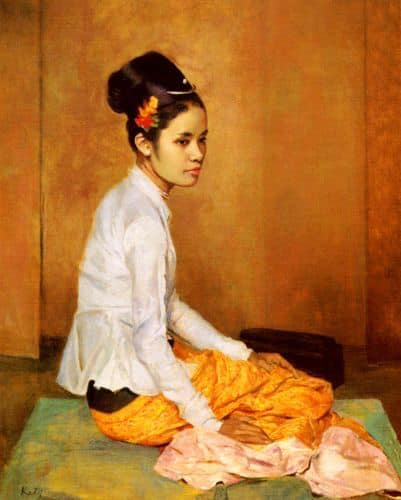
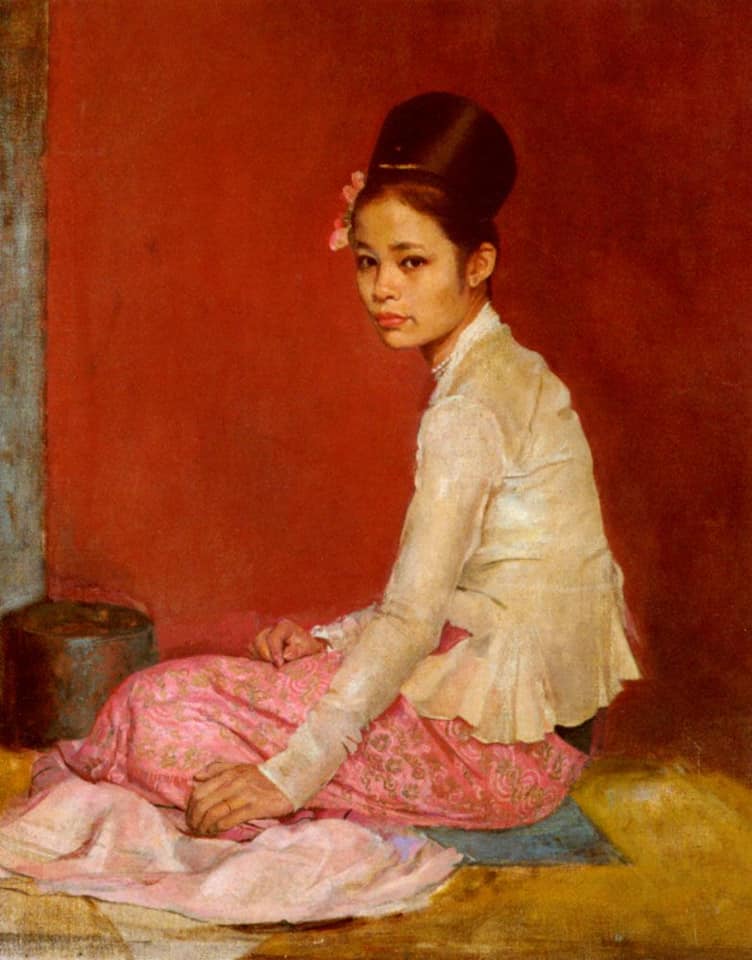
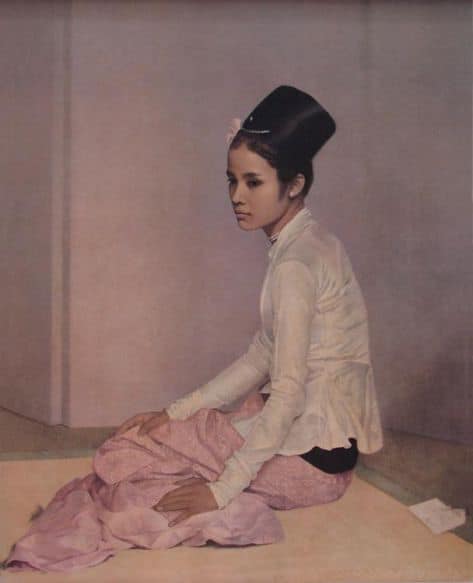
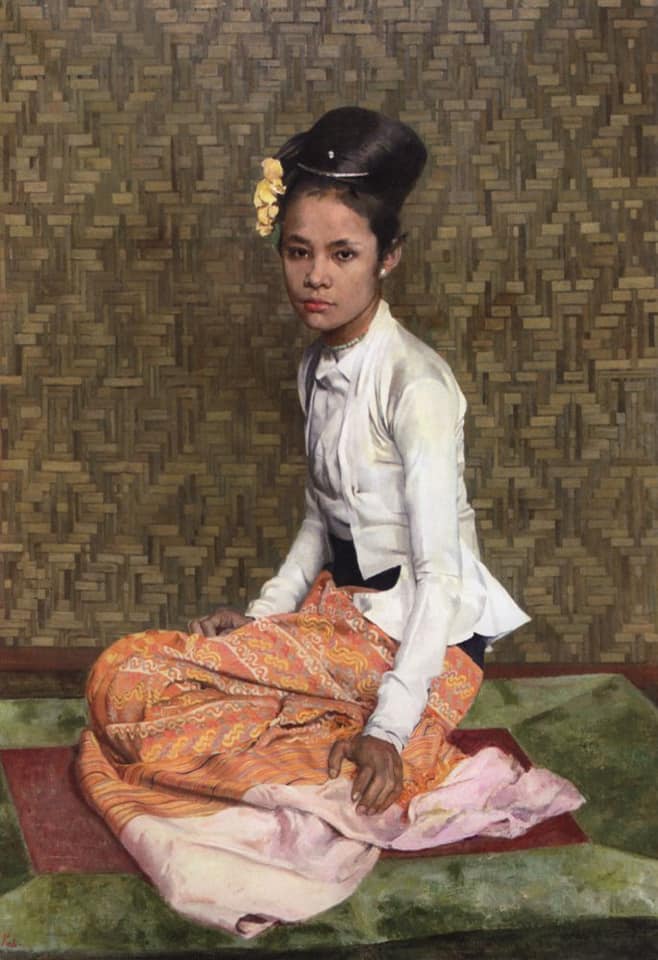
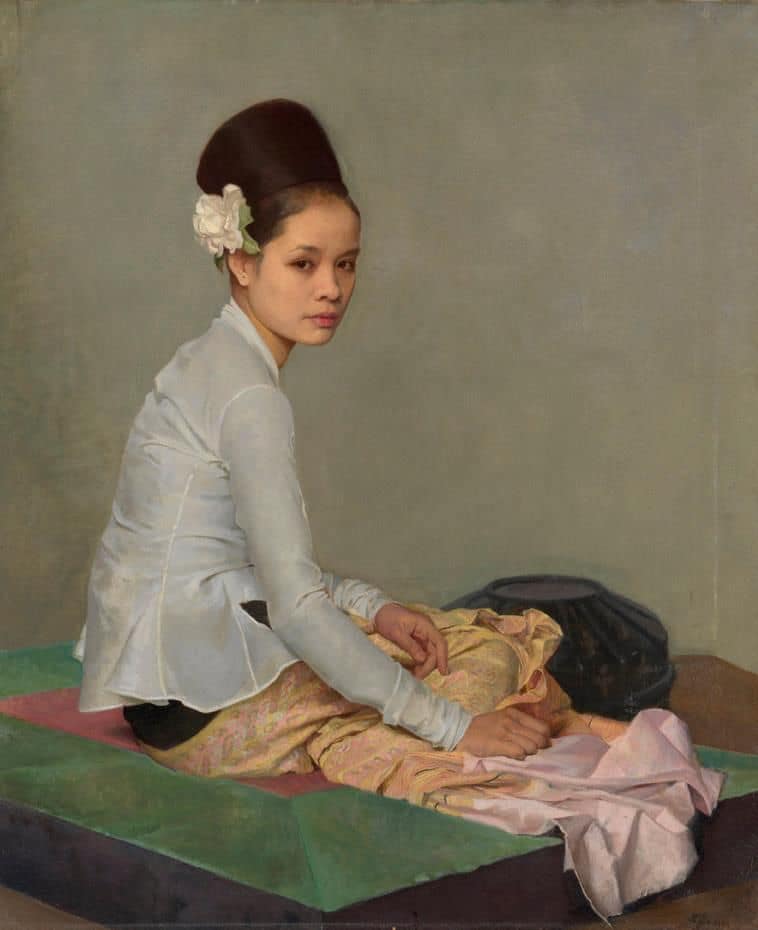
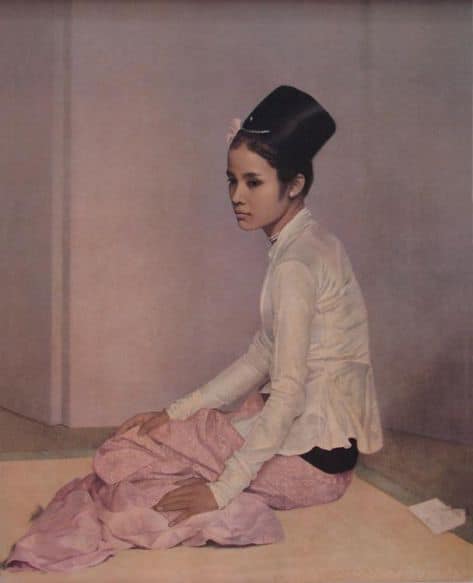
Sao Ohn Nyunt: paintings of her by Sir Gerald Kelly became international renowned, for her beauty and demeanor: I have put up only right of the paintings by Kelly.
The two photos in black and white are photos of Daw Mi Mi Khaing, again good friends with father.
Interludes
Interlude (1) : Daw Phwa Hmi
She was Burma’s first barrister at Law from Inner Temper Inn. She became my aunt when she married U Myint Thein. My uncle was an eligible young man, Cambridge graduate and barrister at Law (Lincoln’s Inn). They would be the first Burmese couple to be barristers. How did they meet?
While working at the Burma Club and studying to be called to the Bar, father had taken down very complete notes on various laws and on trials that he observed in courts. Father unlike me had a very fine and readable writing. Younger Burmese preparing for the Bar exams used his notes even when he went home.
One evening, U Myint Thein was at the Club to borrow the notebooks. He found that it was already taken by a lady. He got to know her by him telling her that he was the brother of the person who wrote the Notes. And gentlemanly let the books be taken by the lady. He also offered to come to wherever she was residing to collect the books and return them to the Club.
The “young lady” was no other than Daw Phwa Hmi. Letting her have the notes first, offering to collect them from her residence just my uncle’s ploy to get to know about this young lady!
In the pretext of studying together, he became very friendly with her. Both were called to the Bar about the same time. Ba Dwe wooed her and was accepted so that they were to get married on return.
Father was told about his engagement and was asked to prepare for the wedding. But on his way back by ship, father had just reached Aden he received an urgent telegram from his younger brother:
“HAVE MET EVA. STOP. MARRYING HER SOON. STOP. CAN YOU MARRY MA PHWA HMI IN MY PLACE. ENDS
Father was very upset and sent back the following telegram:
YR TELEGRAM RECEIVED. STOP. AM SUEING YOU FOR BREACH OF PROMISE. STOP. ON BEHALF OF MA PHWA HMI. ENDS.
At that time, if a gentleman after betrothal, would not marry the lady, he could be sued and would be usually ordered by the court to give substantive amount of cash to the lady. And gentlemen’s clubs could “black ball” him and would lose memberships of the clubs.
U Myint Thein knew that his elder brother would and could do as per the telegram. He came back and married Daw Phwa Hmi. Father was upset because his brother would not keep his promise to not only a fellow barrister but the country’s first woman barrister.
Sadly, they had not any children. My aunt got pregnant, difficult labour during which she had what must had been amniotic embolism that caused a stroke and she was left with paralysis on one side of her body. The baby did not survive.
P.S. Eva, the English lady whom my uncle would like to marry, kept in touchwith him. She died two years later of cancer. My aunt magnanimously allowed my uncle to put a framed photo of Eva on the mantelpiece in their dining room.
Interlude (2) : Daw Mi Mi Khaing
She was a prominent educator and writer.
During the British times, the Sawbwas were initially living on levies from their subjects and the income for mining of silver.
Their eyes were opened by seeing bright young men like U Kyaw Myint as well as how these Western educated young men were holding important jobs,, They wanted their sons to have similar education. As mining was important, few of the Shan princes were sent to University of Colorado to get degrees in Geology.
Saopha Kuang Kiao Intakeng, father of Sao Sai Mong Mangrai, decided to send his son Sao Sai Mong Mangrai for studies in the West. He studied at the University of London, Cornell University, University of Michigan. Cambridge. He became famous as historian, scholar, linguist, lexicographer of the Shan script and language. His most well known publication was “Shan States and British Annexation” published by Cornell.
Sai Saing Mong met and married Daw Mi Mi Khaing, the first Burmese lady to write about Burmese Culture and traditions in English.
Well known publications of Daw Mi Mi Khaing were:
Burmese Family: University of Indiana 1962
Cook and Entertain the Burmese way 1973, Karoma Publishers.
The World of Burmese Women 1984
People of the Golden Land
Burmese Characters and Customs 1958
Burmese Names and a guide 1955
And many more: the most well known of her books was “Burmese Family”.
And many more articles in various English magazines and periodicals.
Daw Mi Mi Khaing was also very well known for the Kanbawza College.
There was earlier a College in Taunggyi only for the son’s of the sawbwas.
Daw Mi Mi Khaing opened the first private college in Burma, in the Shan States, a school very much like the well known colleges of England. (My elder brother attended this college after he studied at the St. Joseph College in Darjeeling India).
I did not meet either of them but learn about both from my father telling me about the two famous intellectuals.
I only had the good fortune to meet and know of their brilliant daughter Dr. Yin Yin Nwe PhD (Cantab) doctorate in geology. Due to the connections between the Shan Lords and my father, I got to know members of the Mangrai family, and Yin became a “sister” to me.
The daughter took after both parents, worked for many years in UNICEF and currently a well sought adviser on development in many countries.
Most of what I knew was from my father and from my uncle U Myint Thein, who succeeded my father as the legal adviser to the Shan princes. When my father got appointed as a High Court Judge, his younger brother to take over his responsibilities in the Shan State.
POST SCRIPT:
1. My father became close friends with the families of the Sawbwas , Mahadevis, other consorts. And he was showered with gifts, mainly products of the Shan States. This included many silk cloths and other woven clothes for his “Gaung Paung” headdresses, shirts, jackets and long gyi.
All of these became very handy during the Japanese Occupation: mother told me that dress materials were very scant during this period. Most of the clothes that my mother, my sisters and other members of the family were by using these gifts given to father.
Other source was material from parachutes.
2. There was one episode told me without mentioning names. One of the wives of a Prince eloped with a member of the household staff. The Prince was so upset. My father was there at that time. He asked my father to get back his wife (also a close friend of father). Father said he gave his car, a driver and a bodyguard who was armed. He asked my father to persuade her to come back. Failing this the bodyguard was to shoot both of them.
Father caught up with them before they have reached May Myo. The lady told father about why she had left. Father stopped the body guard from harming them and the two left. He went back and told the prince that they must have left early and could not catch them in time.
I was very intrigued with what father told me.
Request for corrections
I have been jotting down what I remember about my father. He had led a very full life.
If there are mistakes in my writings please let me know and correct me. I will change or delete the affected parts as needed.
I do not want to hurt people’s feelings. My memory is not as good as before. I forget some names and events from the past.
Writing about my father and the family is in some way catharsis for me. It is also very poignant because memories about what happened on 2nd March 1962. The dark day in Burma left psychological scars on the family.
It was also sad to experience 8-8-88 and the aftermath. I had to resign from my job in 1990 and eventually leave our country.
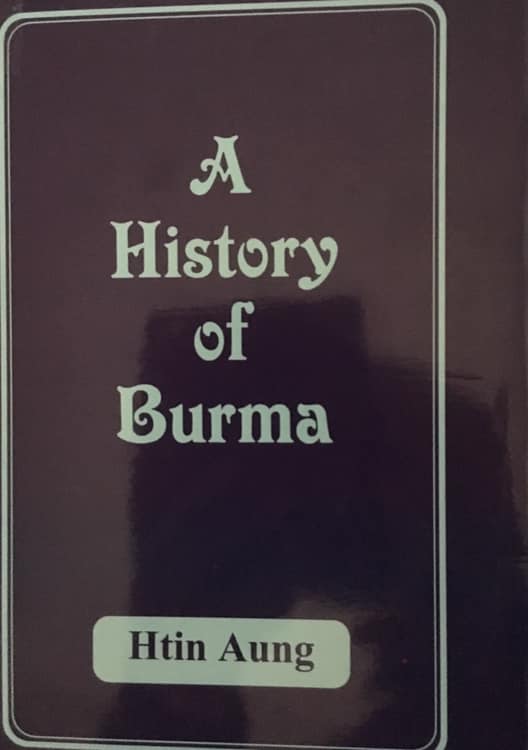
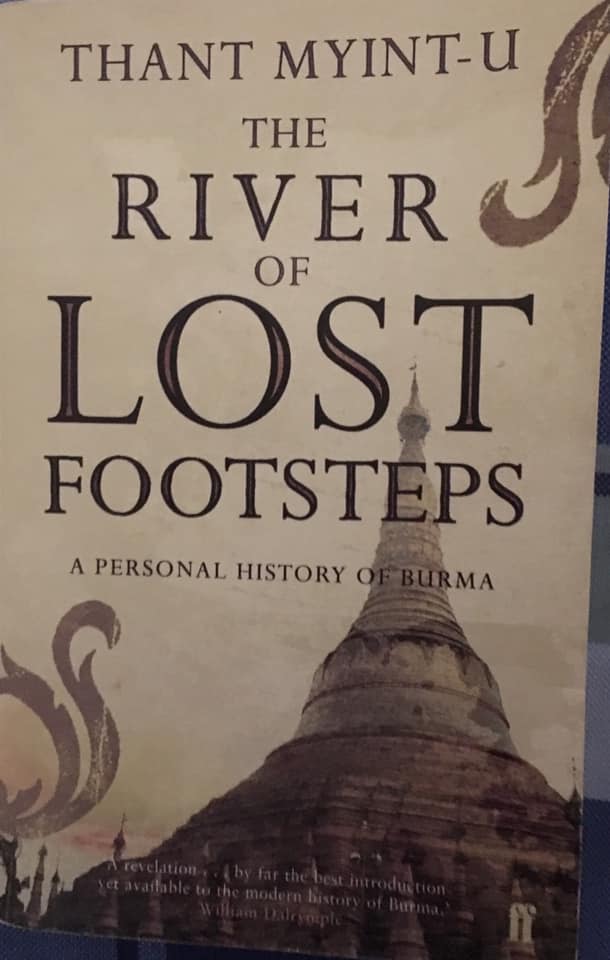
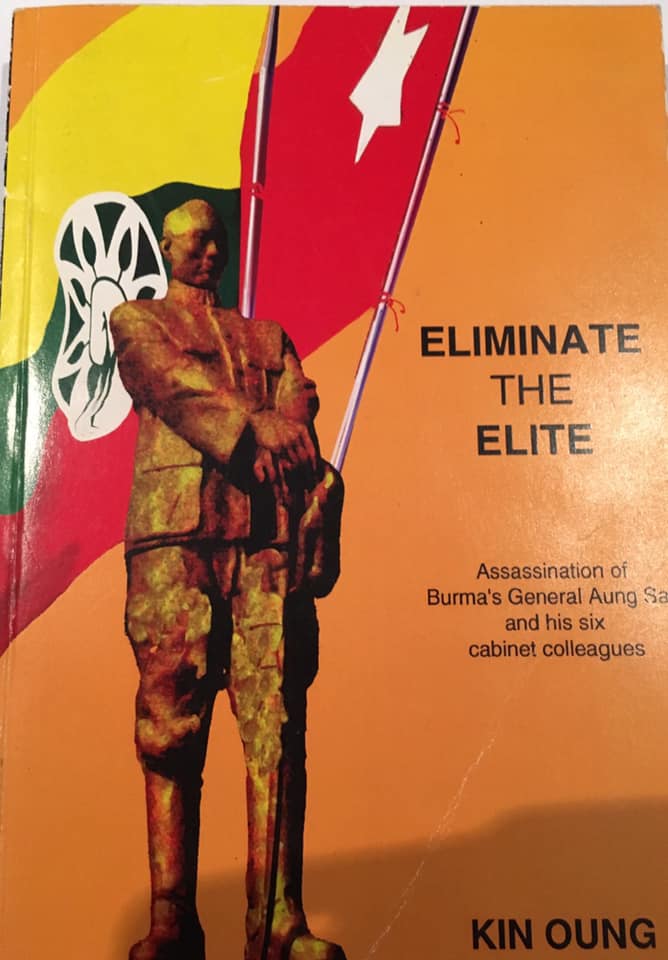
Before I write further, I reread the following books, as I would like write about
1. assassination of Aung San and associates, as my father was the Chairman of the Special Tribunal 2. assassination of U Tin Tut, my father’s elder brother 3. Why my father resigned from the Supreme court, in protest
The books are:
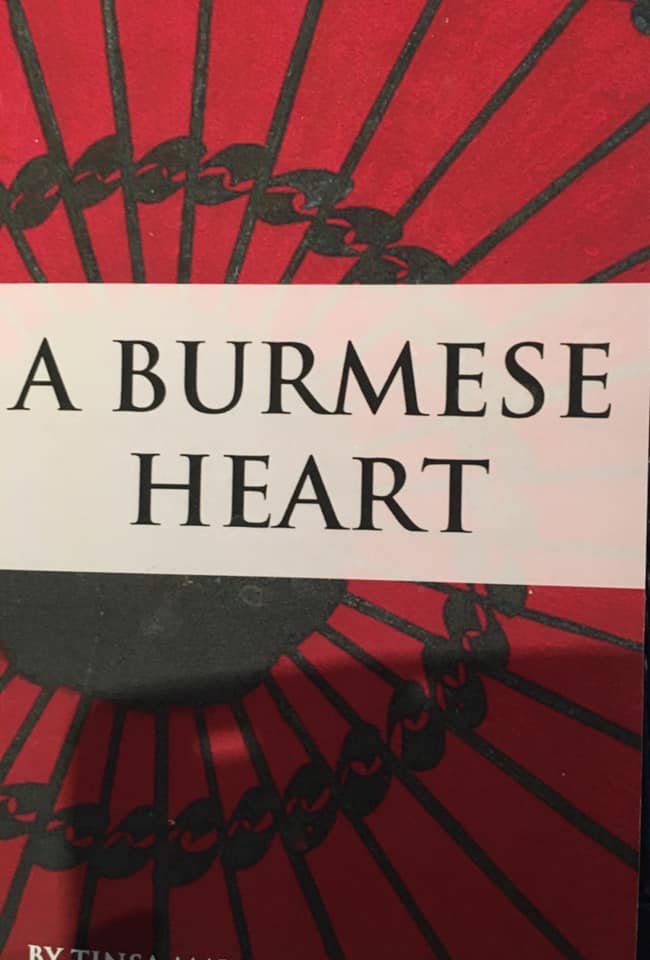
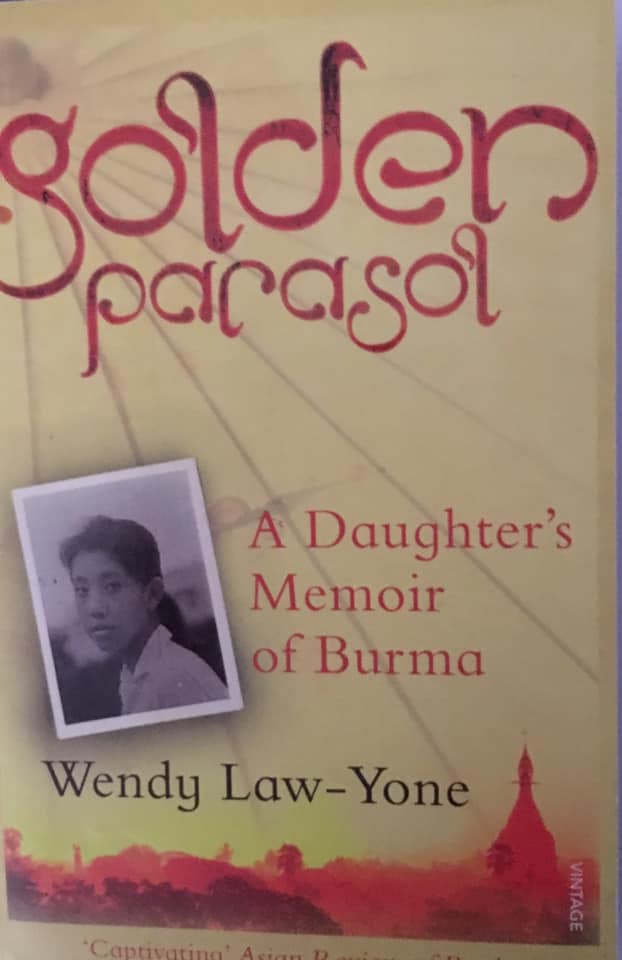
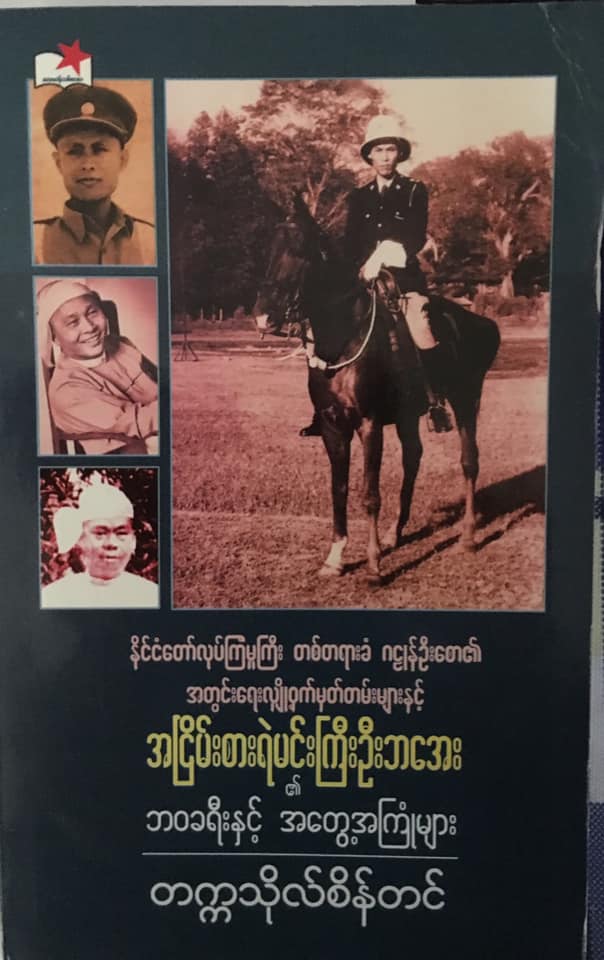
1. A History of Burma by Dr Htin Aung (my father’s younger brother) 2. The River of Lost Footsteps by Thant Myint U 3. Eliminate the Elite by U Kin Oung 4. A Burmese Heart by Daw Tinsar Maw Naing 5. Golden Parasol by Wendy Law-Yone 6. Biography of Commissioner of Police (Rest.) U Ba Aye. (In Burmese)









 HlaMin