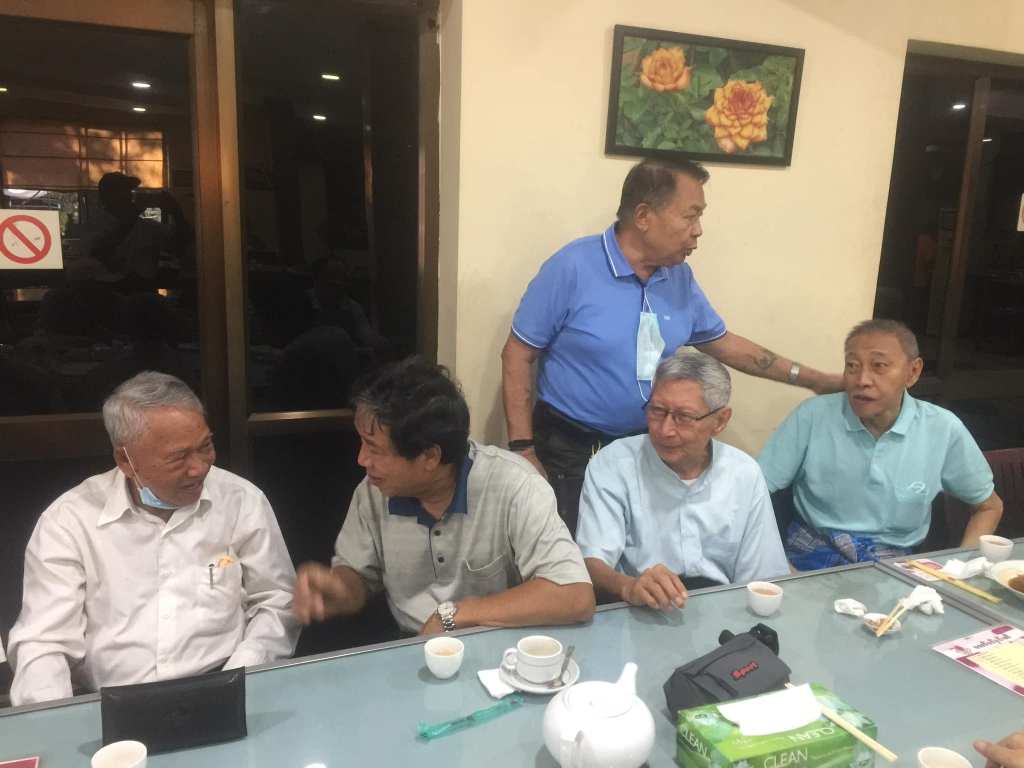
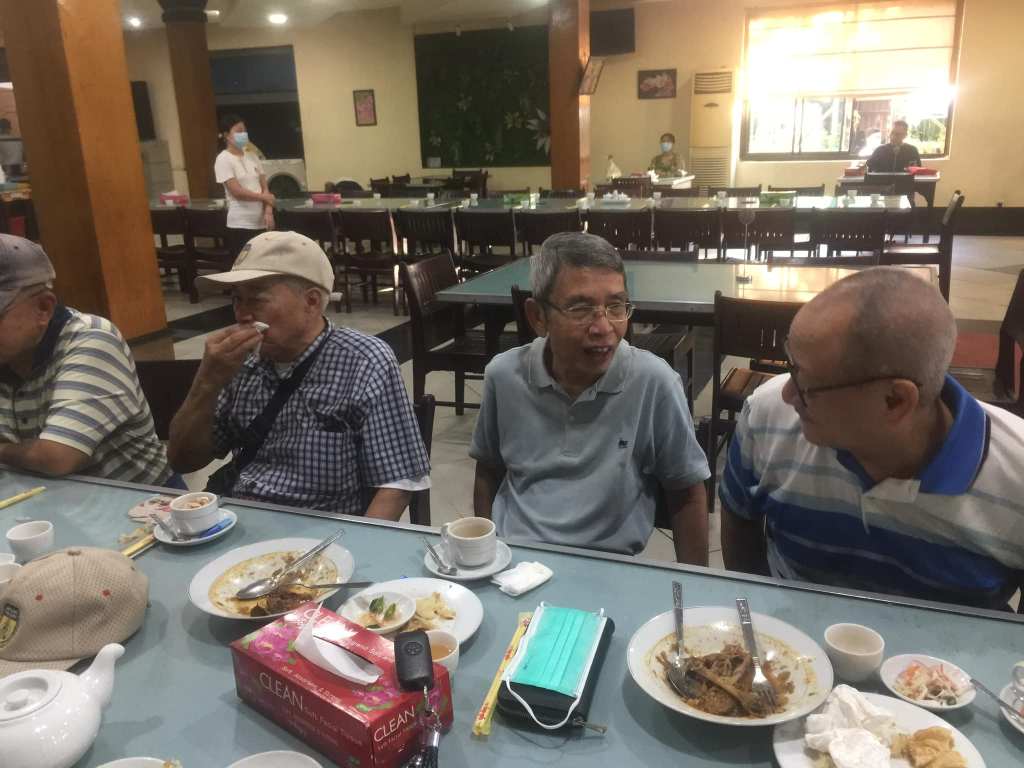
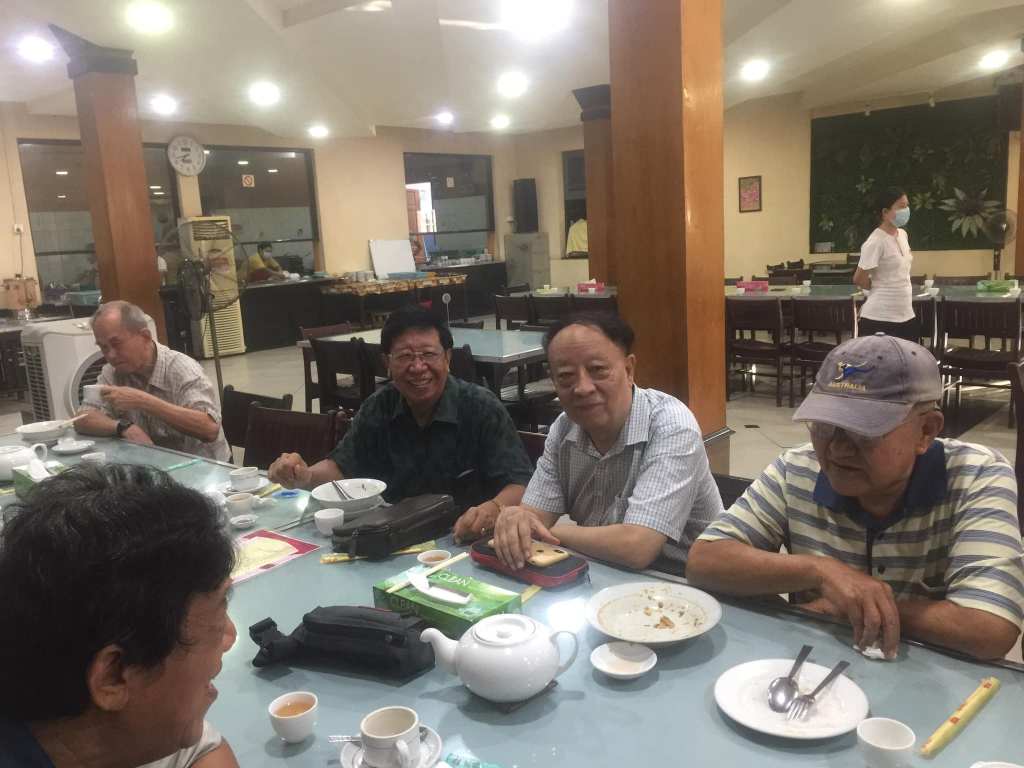
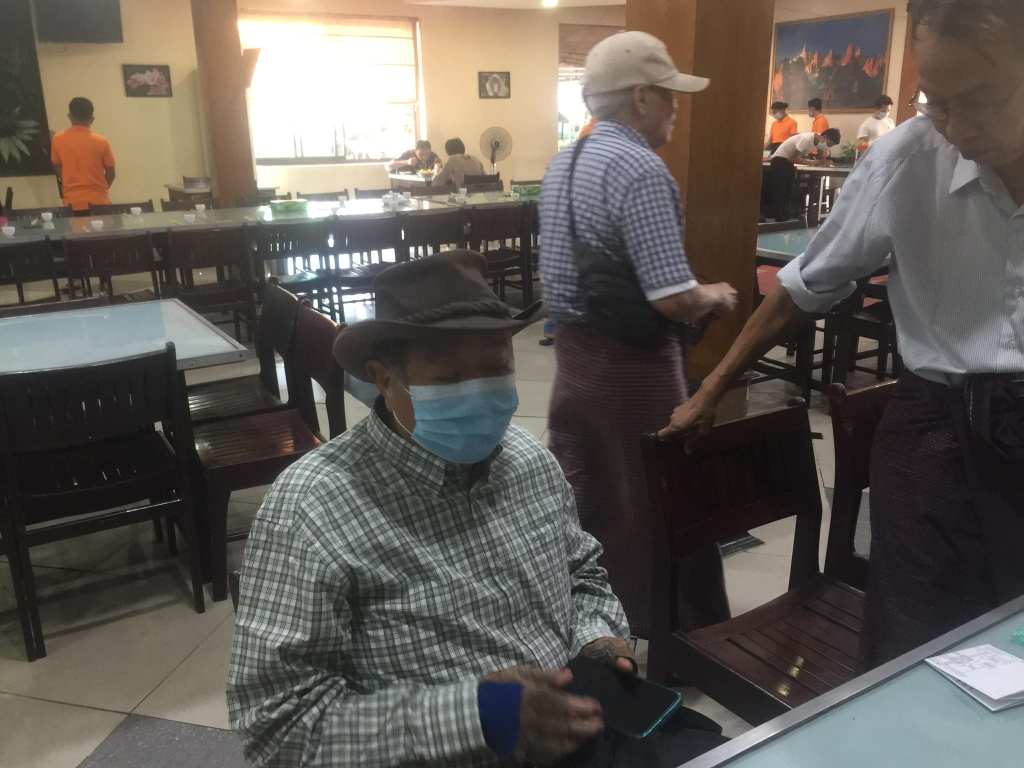
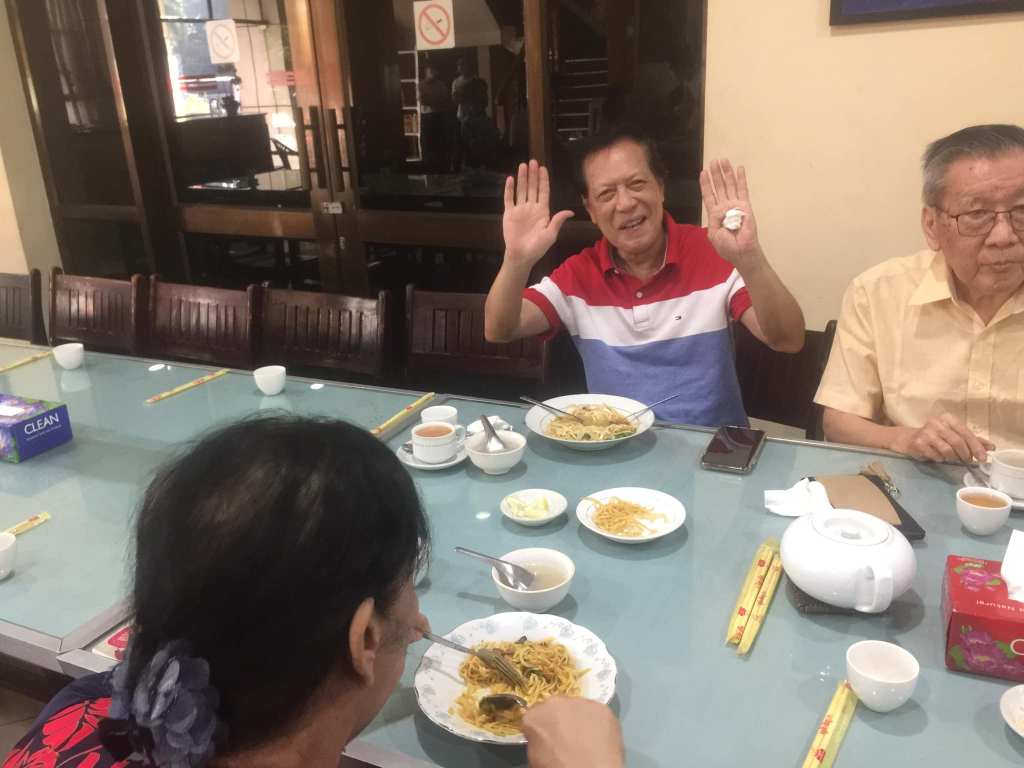
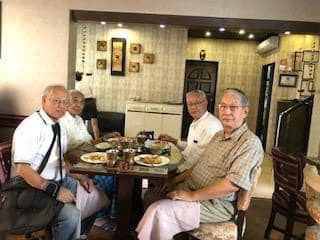
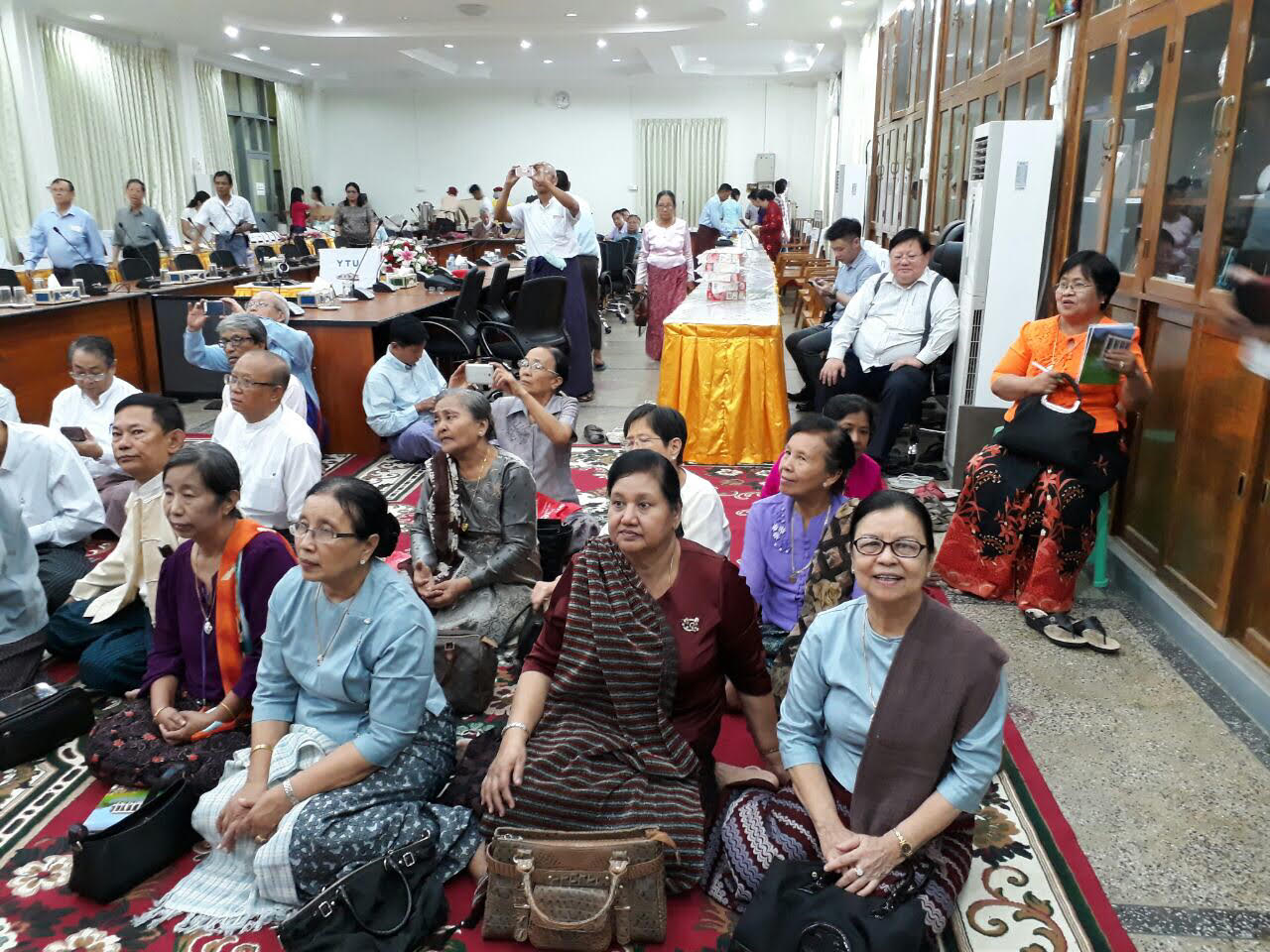
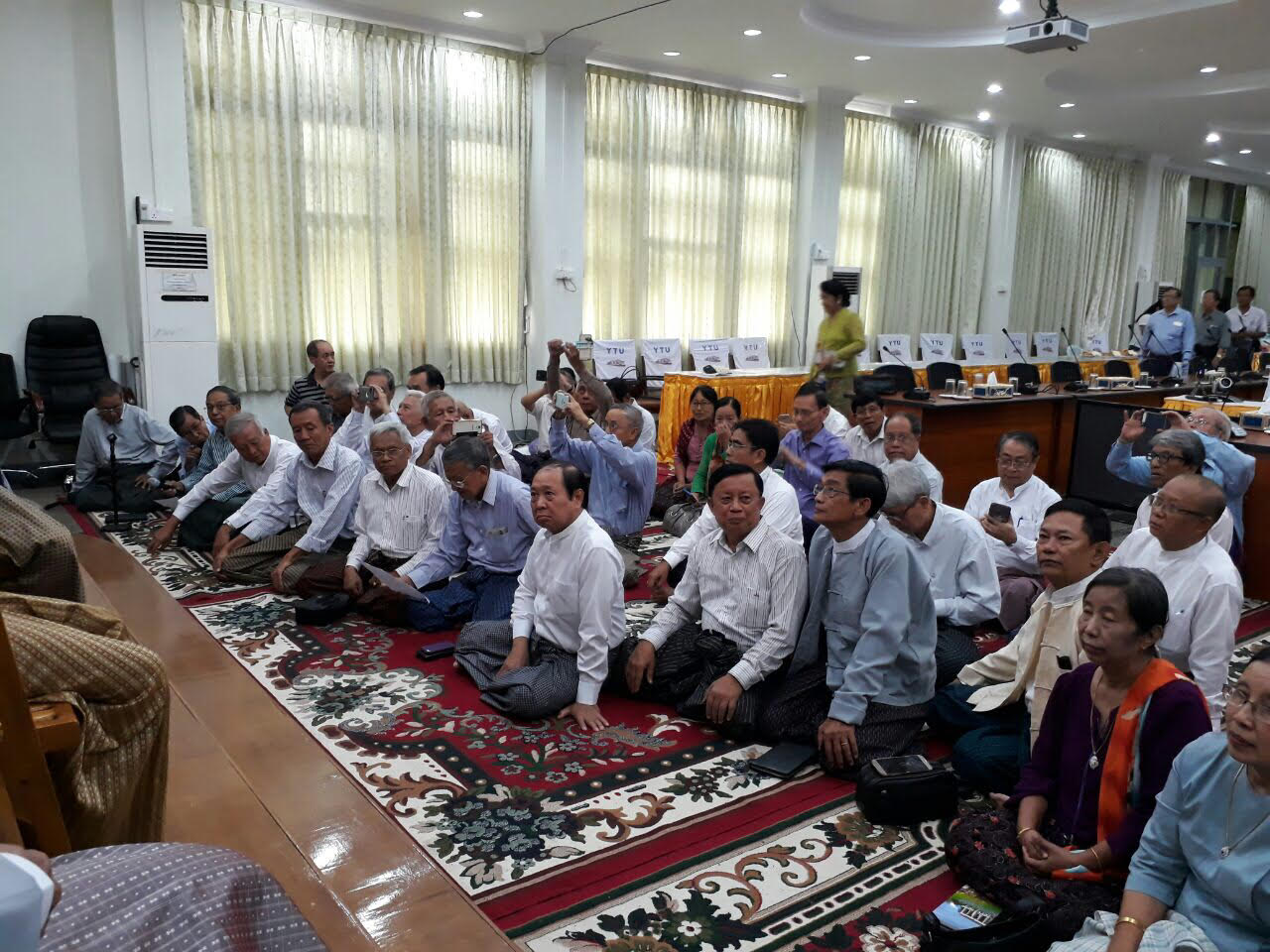
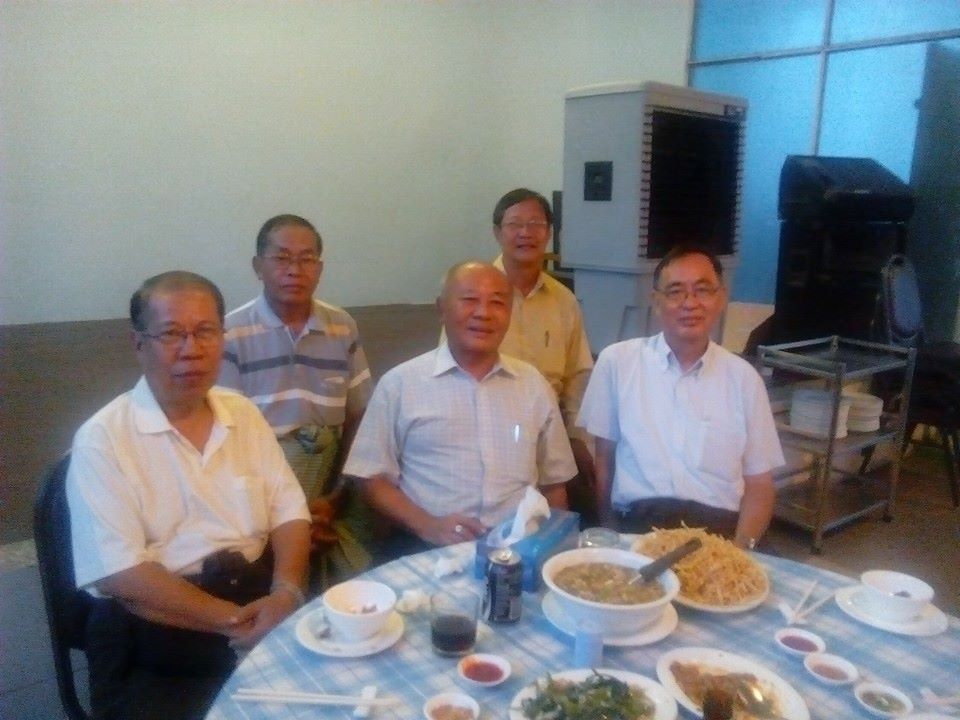
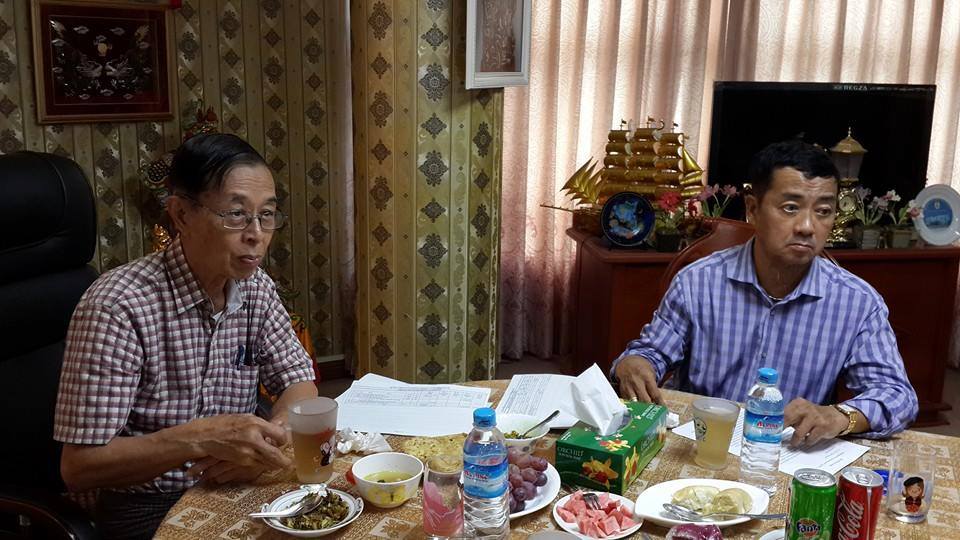
U Tin Shwe (EE) hosted the Dec 2022 Gathering at Royal Rose Restaurant.
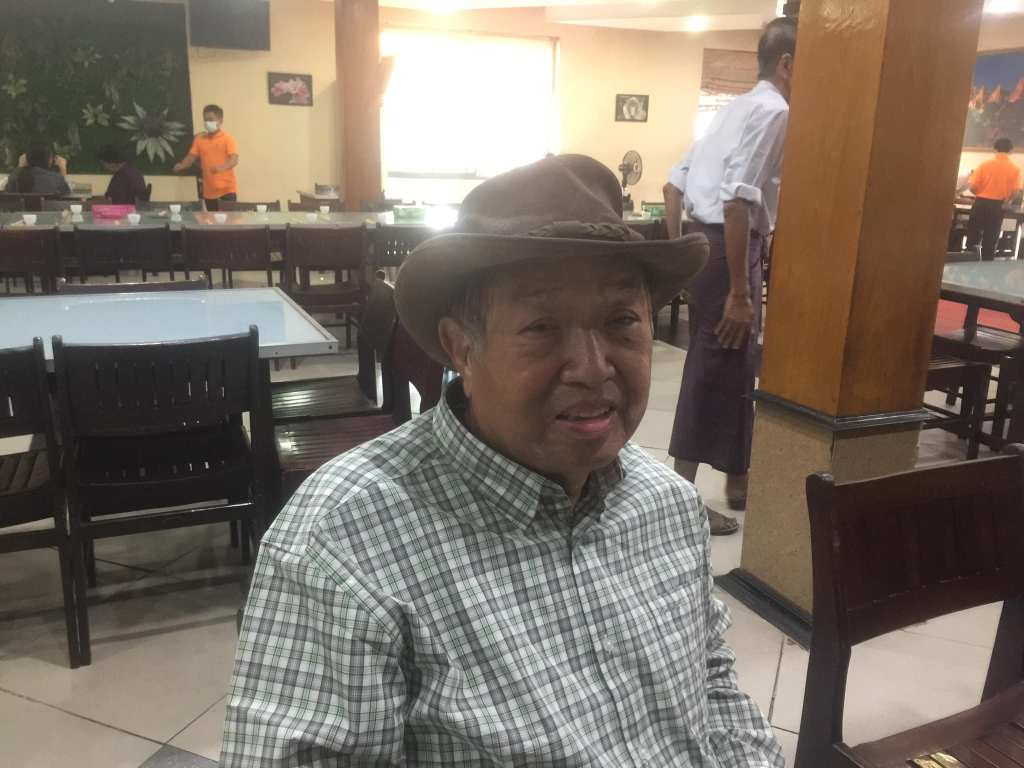
U Tin Shwe
Attendees
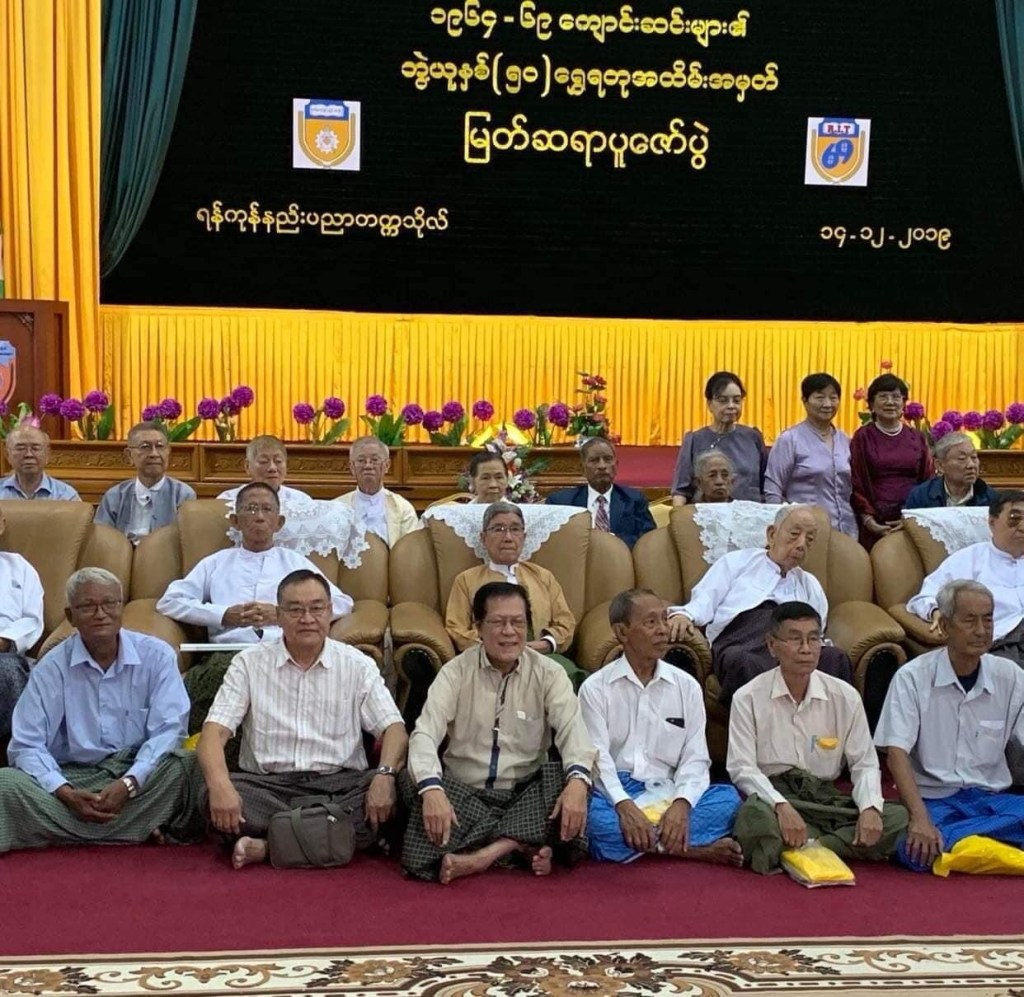
Zau Lai (Myitkyina) attended the gathering along with 27 members.
About 30 – 40 members regularly attended the Gatherings before the pandemic, and much more were present at 30th, 40th and 50th (Golden Jubilee) Anniversaries.
Some pledged to attend the 60th Anniversary and beyond.
Status
120 members are GBNF.
Oldest : U Tin Maung (87 years)
Young Ones : 75+ years
Several have Medical problems with varying degrees.
Ashin Pannagavesaka is an Itinerant Bikkhu and an avid photographer.
A few (e.g TAG, Albert) are still working happily.
TAG recently sang ဘဝသံသရာ in the MASTAA zoom meeting.
Have spent 26 years (from 1999) paying back to my alma mater & my mentors
Thanks to my family members for their support.
1963
SPHS63
Received award given by SPHS for passing Matriculation (7th in Burma) Won Collegiate Scholarship
7th in Matriculation examination of 1963
Attended the last ever I.Sc.(A) at Leik Khone
Senior Novices Runner-up at RUBC Monsoon Regatta with Willie Soe Maung (Stroke, GBNF), Kyaw Wynn (3), Maung Maung Kyi (Bow, GBNF) & Myint Thein (Cox, GBNF)
Attended RUBC 40th Anniversary Dinner hosted by Sithu U Tin (President, GBNF) at Kandawgyi
Received Full Green
1964 – 1969
Admitted to the first ever 2nd BE in November 1964 as the Top Student
2nd BE
Selected RIT Luyechun in the Summer of 1965 and attended the LYC Camp at Inlay Khaung Daing.
Luyechun
Joint Secretary, Secretary & Magazine Committee, RIT EE Association
RIT EE
Treasurer and Vice Captain, RUBC
Editor, Newsletter published by RIT English Association
Started free lance writing (article, poem, translation …)
My poem “Men on the Moon” was published in the Guardian in July 1969
Poem
1970 – 1998
Generation Zero member of UCC (Universities’ Comouter Center) Hardware & Software Engineer Senior Systems Programmer Manager, Business Applications
UCC
Senior Lecturer, Computer Science, DCS (Department of Computer Science)
Associate Professor, Software Technology, ICST (Institute of Computer Science and Technology)
Worked for several high tech companies in Silicon Valley
1999
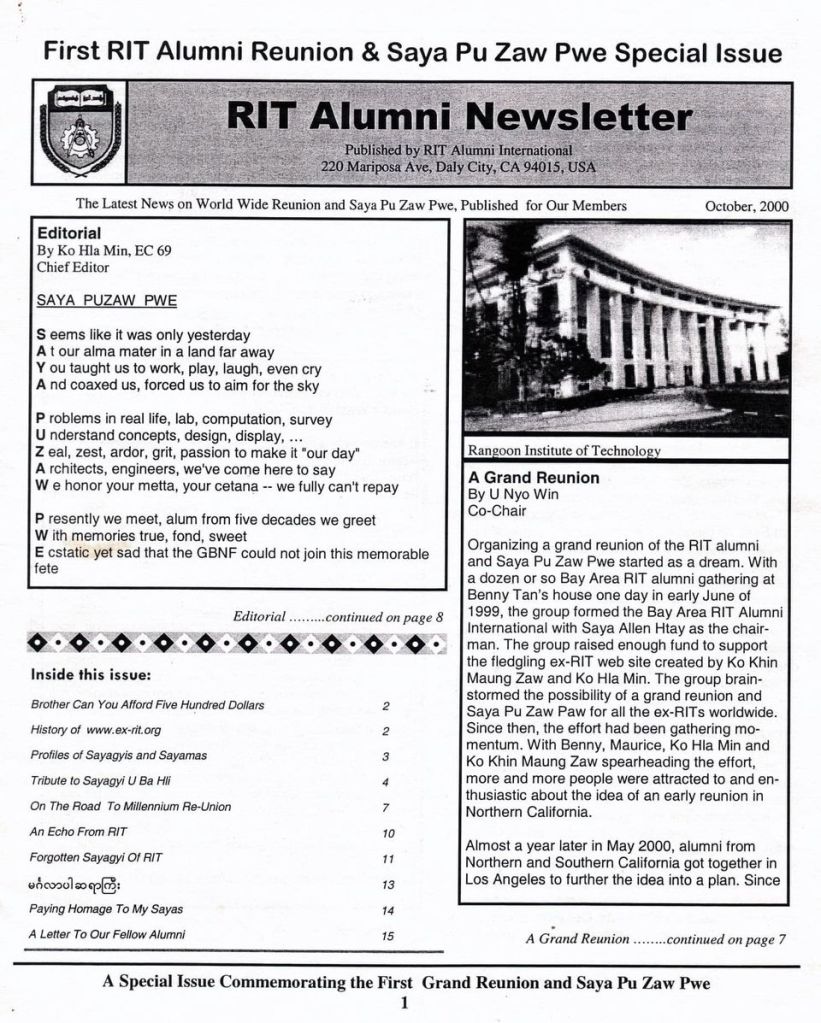
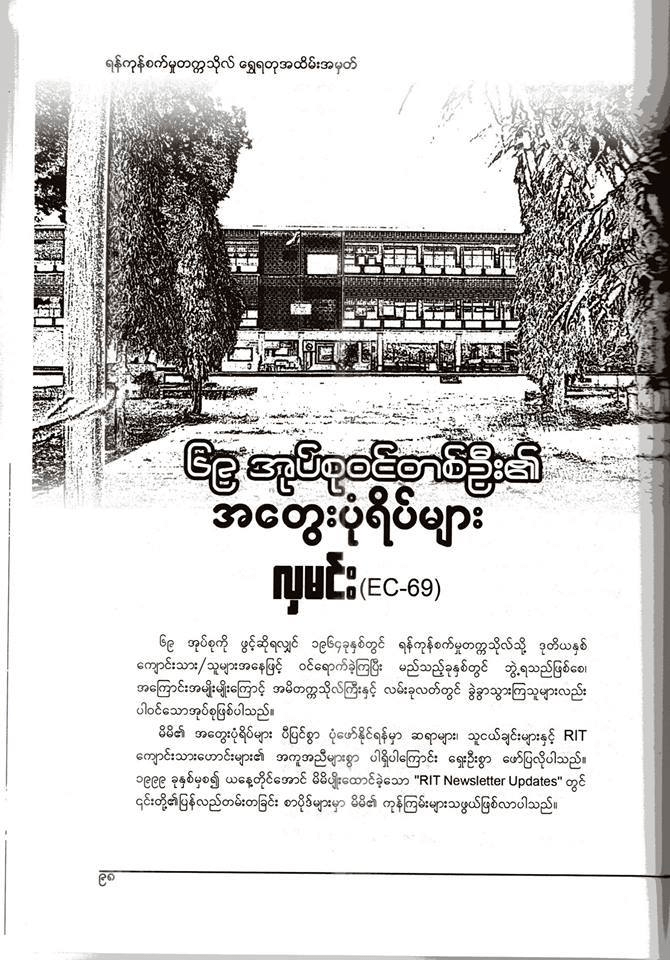
NewsletterChief Editor, RIT Alumni Newsletter
Started “RIT Alumni International Newsletter”
It started with the news and photos of some gatherings back in Burma. (a) 30th Anniversary of the Graduation of the Class of 69 [reported by Ko Daniel Tint Lwin and Ma Saw Yu Tint (Alice). (b) Mini-gathering with Sayagyi Dr. Aung Gyi and other sayas and senior alumni (reported by Saya U Soe Paing)
2000
SPZP-2000
SPZP-2000 First RIT Grand Reunion and SPZP in San Francisco, USA Core Organizer
Content Provider & Editor for the First RIT Web Site designed and implemented y KMZ / Khin Maung Zaw (EC76)
Special Web Pages for SPZP-2000
Commemorative Issue of the Newsletter for SPZP-2000 Chief Editor) Composed “SAYA PUZAW PWE” poem
64 Countdown to the Reunion posts
36 Post-Reunion posts
2002
SPZP-2002 Second RIT Grand Reunion and SPZP in Singapore
Commemorative Issue of “Swel Daw Yeik Sar Saung” by Saya U Moe Aung and team Reprinted my “SAYA PUZAW PWE” poem as Back Cover
2004
SPZP-2004 Third RIT Grand Reunion and SPZP in Yangon
Mild earthquake did not rattle the attendees
2007
SPZP-2007 Fourth RIT Grand Reunion and SPZP in Singapore
Commemorative Issue of “Swel Daw Yeik Sar Saung” by Saya U Moe Aung and team Contributed a poem “SWE DAW YEIK”
2010
SPZP-2010 Fifth RIT Grand Reunion and SPZP in Singapore
Commemorative Issue of “Swel Daw Yeik Sar Saung” by Saya U Moe Aung and team Contributed an article “Sad and short clip — EE sayas”
2012
SPZP-2012 Sixth RIT Grand Reunion and SPZP in Yangon Traveled twice (in March and December) to help with the SPZP
True “Home Coming” in the Gyogone Campus
With Steeve Kay (Multiple Golden Sponsor of SPZPs)
Special publication : History of University Engineering Education in Burma/Myanmar by Saya U Aung Hla Tun and team. Ko Ohn Khine (M70) and I prepared the supplemental CD for the book.
Special publication: Selected RIT Cartoons
Commemorative Issue of “Swel Daw Yeik Magazine” by U Saw Lin and team
Commemorative Issue of “Swel Daw Yeik Magazine” by Saya U Moe Aung and team; I wrote an article “Recollections of a 69er”
Memories of a 69er (published in Swel Daw Yeik Magazine in 2014)
Paved Shwe YaDu lane and set up Swel Daw Yeik benches
Translated Saya U Moe Aung’s Shwe YaDu poem
2016
RIT/YIT/YTU Alumni Association Life Member
SPZP-2016 Seventh RIT Grand Reunion and SPZP in Yangon
10000+ attendees
Free food and fun (all day and all night long)
Platinum Jubilee for the Class of 69 Hosted by some 69ers for their friends (in their sunset)
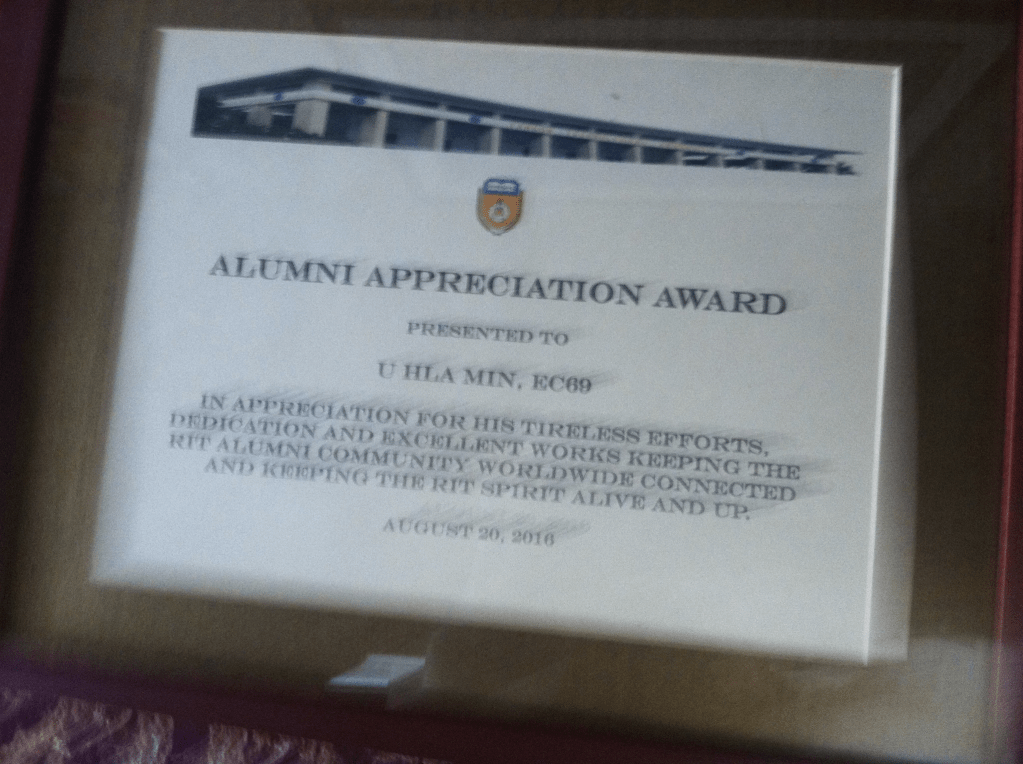
Alumni Appreciation Award (received for the second time)
Soonkway at Half Moon Bay Monastery (organized by U Maurice Chee) Received Alumni Appreciation Award from alumni worldwide
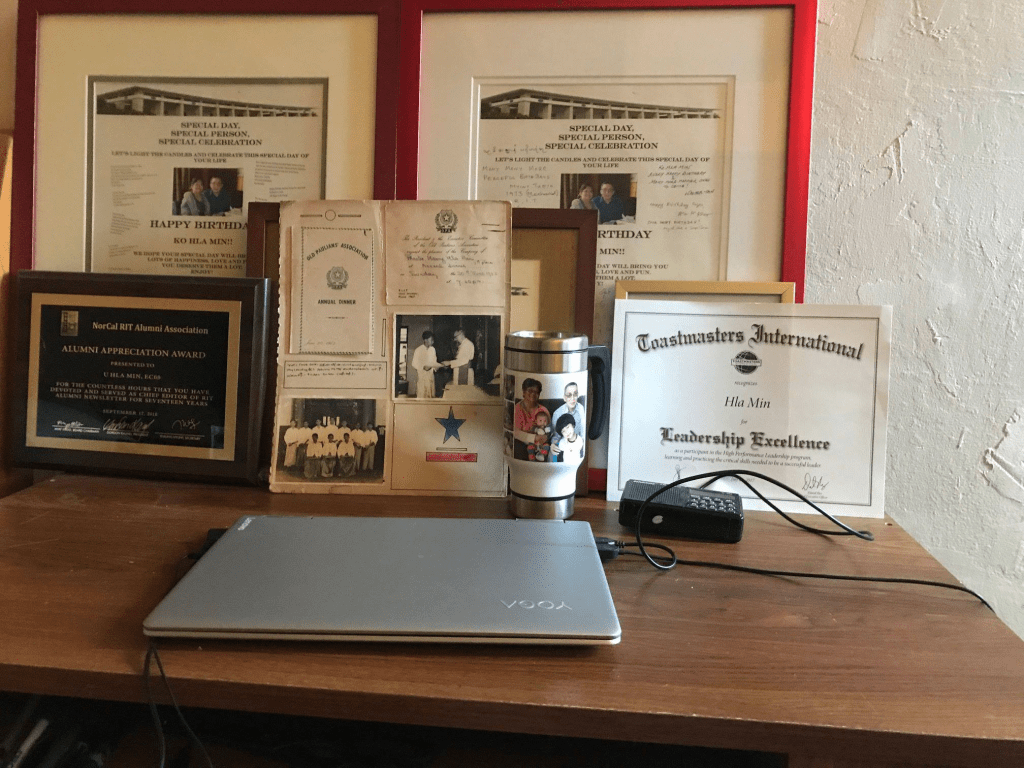
Annual Dinner by Northern California RIT Alumni Association Received plaque signed by Saya U Myat Htoo (Chair, BOD), U Kaung Kaung Oo (Gordon, President), and U Thaung Nyunt (Secretary)
Alumni Appreciation Award(received for the third time)
Attended SPZP-2016 and Platinum Jubilee of the Class of 69
SPZP-2016
2017
Attended Post-SPZP2016 Gatherings
Award Distinguished Toastmaster
DTM
2018
Memories of UCC 40+ posts
Trivia : 1000+ posts (on going) Several readers said that the posts are more than Trivia
Archived newsletters and posts in my website hlamin.com
2019
Panelist, 5th Irrawaddy Literary Festival
ILF
Golden Jubilee, RIT 69ers
GJ
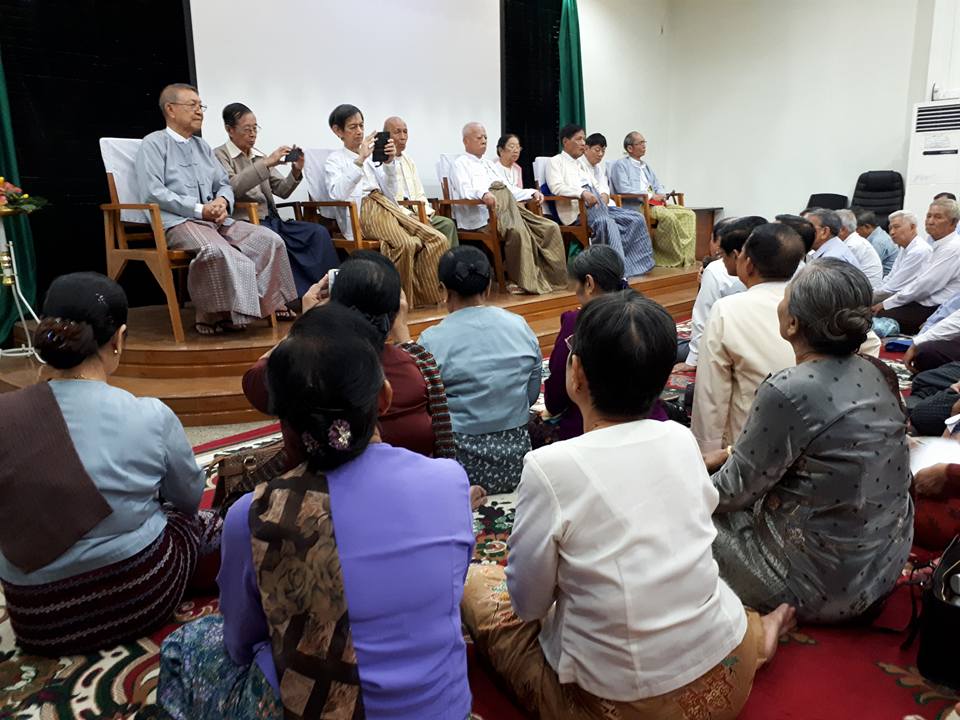
Attended several gatherings and Acariya Pu Zaw Pwes
2020
Invited to join the PSA 2020 Tour to Upper Burma
Broadcast Short talks (Videos) Archived in Facebook and Youtube
Moderator & Contributor RU Centennial Facebook Group
2021 – 2023
Due to pandemic, outdoor activities were put on hold
Overseas travel required certificate of Covid vaccine
Revise articles
Write new articles
Short Trips to Singapore, Thailand & Laos
2024 – present
In 2024, we celebrated (a) Centennial of Engineering Education in Burma / Myanmar (b) 60th Anniversary of RIT (c) Silver Jubilee of RIT Alumni Newsletter
In 2025, updating posts.
My educational videos can be accessed from YouTube. Search for @hmin3664
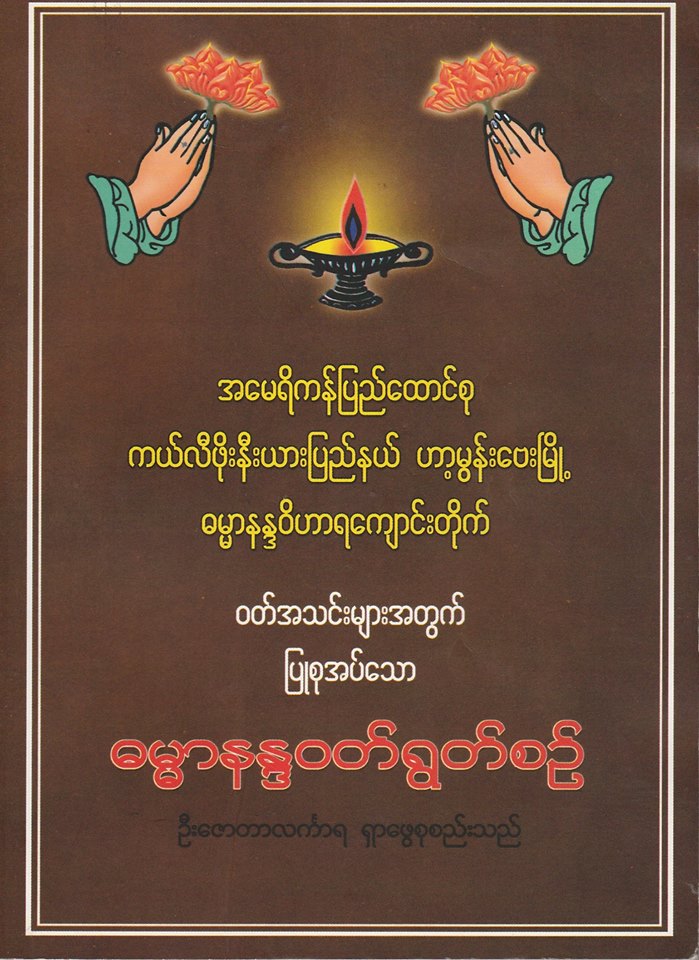
Subtitle : The Philosophical Psychology of Buddhism
By Sayadaw Rewata Dhamma
Completed : 2004
Last book by Sayadaw
Publisher: Triple Gems Publication
The book is intended for all serious students of the Abhidhamma.
It serves as supplement to Bhikkhu Bodhi’s book “A Comprehensive Manual of Abhidhamma”, and treats various important aspect in more detail – in articular the process of consciousness and matter.
Preface by Sayadaw U Silanandabhivama, Rector of the International Theravada Buddhist Missionary University, Yangon
Acknowledgement by Sayadaw Dr. Ottaranyana, Birmingham Buddhist Vihara, UK
Introduction
Chapter I : CONSCIOUSNESS AND ITS FACTORS
CHAPTER II : PROCESS CONSIOUSNESS (CITTA VITHI)
CHAPTER III : MIND-DOOR COGNITIVE PROCESS (MANODVARA VITHI)
CHAPTER IV : ABSORPTION JAVANA IN THE MIND-DOOR PROCESS (APPANA JAVANAVARA MANODVARA VITHI)
Received higher ordination as a monk at the Neikbeinda Monastery in Pyay / Prome.
Completed one part of the Tipitaka Examination.
Dhamma Duta missions in Japan, US, Jamaica, Canada, Taiwan …
Joined U Silananda at the Dhammanada Vihara (then in Daly City, California).
In 2007, he succeeded U Silananda as Chief Resident Monk of Dhammananda Vihara, Half Moon Bay, California.
Publications
He has published books in
Myanmar e.g. Book for Chanting/Recitation
English e.g. The Basic Teachings of Theravada of Buddhism (edited by Hla Min and Don Johnson)
Japanese e.g. Translation of selected works of U Silananda
Book for Dhamma Chanting
Chanting
The Basic Teachings Of Theravada Buddhism
Author: U Jotalankara (Dhammananda Vihara, Half Moon Bay, California, USA)
Editors: Hla Min and Don Johnson
First edition : June 2004
Foreword by Ven. Sayadaw U Silanandabhivamsa
Fifteen chapters
1. Program of worshiping
2. Explanation of words
3. Benefits and stories of taking refuges and precepts, and offering food, flowers, etc.
4. The discipline or duties of laypersons (Gihi-vinaya)
5. What is the teaching of the Buddhas?
6. Cultivating Good
7. Purifying One’s Mind
8. The For Divine Abodes (Brahama-viharas)
9. Vipassa-bhavana, Insight or Mindfulness Meditation
10. The Four Noble Truths & Four Noble Persons
11. The Teaching to the Kalamas
12. The Pali Alphabet in Roman Characters
13. Program of Chanting (Paritta — Eleven Protective Suttas — and other Suttas)
14. First two sermons of the Buddha & the Program of Chanting to Consecrate a Buddha Image & Ovada-patimokha
15. Program of Novice Ordination
This book has been used in the Summer Dhamma Camps at Dhammananda Vihara
He has written Dhamma books in Myanmar, English, and Japanese. Some books were compiled from his articles in the Dhammananda Newsletter published by the Theravada Buddhist Society of America (TBSA).
Book 2
Theravada Buddhist Novice Ordination and Monk Ordination
Author : U Jotalankara
Editor : James Rives, Ph.D.
First Edition : August, 2008
Two kinds of ordination
Pabbajja : to become a novice (samanera)
Upasambada : to become a monk (bhikkhu)
Novice Ordination
Three steps of novice ordination
shaving off the hair of the head
putting on robes
giving the Three Refuges
The procedures for the second and third steps of novice ordination
Paying homage to the Three Gems
Handing robes to the teacher
Asking for the robes from the teacher and putting them on
Requesting a novice ordination
Requesting the Ten Novice-precepts with the Three Refuges
Paying homage to the Buddha
Taking the Three Refuges
Taking the Ten Precepts of a Novice
Choosing a teacher to be the candidate’s preceptor
Reply of the preceptor
Reflecting on the use of the Four Requisites
Reflecting on the repulsiveness of the body
Ten conditions for expulsion from Novice-hood
Ten punishments
Monk Ordination
Five fulfilling conditions for becoming a monk
Perfections of a person Eleven categories of disqualified persons
Perfection of an assembly
Perfection of the Sima (“Thane”) Two kinds of Sima
Perfection of the Motion
Perfection of the Kammavaca
The procedure of monk ordination
1. Choosing the candidate’s preceptor
2. Stating the ownership of alms-bowl and robes
3. Giving temporary names
4. Ordering the candidate to go and stand outsie the Sangha
…
10. Reciting the Natti and Kammacvaca
…
15. The new monk’s special request
The procedure of monk ordination for two candidates
In the early 70s, New Zealand had an intensive technical training program with the Burmese government, namely the NZ Polytechnic sector and our GTI. One direct, international flight to Myitkyina with staff, teaching equipment and machinery was even made accessible to the NZ government. There is no such program that we know of at University level. However, there have been several at professional level with visits by Myanmar engineers and geologists in the Energy (Oil and Gas, Electricity) sector.
Graduate engineers from Myanmar also arrived in New Zealand in the early-to-mid 1970s. Almost all have settled in the North Island, particularly in Auckland, the City of Sails, which is also known as the gateway to NZ, where it is easier to secure jobs and the weather is relatively warmer. Currently, there are 27 alumni; 4 are architects and the rest, engineers. The most senior member graduated in 1967 and the youngest in 2003. Six are female and notably, two of them (both single) who used to live in Auckland are now working in Australia; one is in Perth, Western Australia working in the mining sector. Just as we are particularly proud of these two remarkably enterprising female alumni, we also take pride in our younger members who are pursuing post-graduate studies in their related fields in NZ.
In terms of Myanmar community functions, we are abreast with our counterparts in Australia, North America (USA) and SE Asia (Singapore). It is our engineering alumni who have, for the past 20 years, spearheaded the annual Thingyan celebrations in Auckland, and more recently, championed other socio-cultural events at our Buddhist monasteries. Although we do not have a formal engineering association per se, we have organized and enjoyed several summer get-together picnics in Auckland. On more than one occasion, our members have attended Myanmar Engineers’ gatherings in Sydney, Australia. In February this year, we successfully organized and celebrated our first “Get Together Auckland 2012” for Myanmar Engineers and Professionals. Of the 44 who attended, 4 were from Australia and 2 from Singapore. We envisage and sincerely hope that more RIT alumni will be able to join us in our future get-together.
Received his doctorate from Japan. Also found his love life “Moe Moe”.
Due to the immigration laws in Myanmar and Japan, the family finally decided to move to Auckland, New Zealand.
Organizer for RIT events in New Zealand.
Wrote articles for RIT Alumni International Newsletter
One article is about two Forgotten Songs from RIT. One song is a favorite of Saya U Tha Tun (Head of Department). Another song is about a Belle Ma Ma Q & her fans (sayas and alumni).
Wrote a photo essay on Kyaik Hti Yo Development. Saya U Min Wun wrote a supplement article for the Project.
Wrote a letter to the Thagyar Min to second his favorable opinion on Naw Louisa Benson (Miss Burma & movie actress).
Wrote about some paintings.
Quoted Reverend F Lutvig (Ashin Ananda, Laureate Poet) in his articles.
He passed away, but “Moe Moe” kept contact with Daw Phyu Phyu Latt (Christine, A70) and other alumni in Australia.
Forgotten Songs of RIT
by Kogyi Koung
First Song
It was one afternoon in the early May of 1963. Someone was singing a prewar semi-classic song from the second floor of RIT main building. In 1963, RIT buildings were relatively new and that semi-classic song caused a little bit of discomfort for the freshmen [equivalent to 3rd BE] located on the first floor. The song continued as, (. hmain: njou. njou. sain: lou. je . njou pja ji hmaung che . to: dan: kalei: nanbei: ga swe . e:di jwa be: kwe…)
The meaning is: Dull and gloomy cloud override at the horizon; Indistinct brown and dim bluish vision of a wood jetting out from that end is my village … *Note: The title of the song is ‘Htamin: mjein mjein sa: me’ i.e., “Enjoying the meal with relish” . The duet song was first performed by prewar famous singers Ou’ O: Ba Thaung and Sein Party. Later many other singers have rendered their own versions of the song.
We saw an old man singing the song while he was painting watercolor on a huge art paper. He was painting the landscape described in the song. Amazingly the picture was full of life and the song was telling the story. Everybody stopped in front of his office on the second floor and looking with wonder and singing with him.
After a while we asked him, “Sayagyi, who are you and which department do you belong to?” He replied, “I am U Tha Tun, Head of the Department of Architecture”. Oh, my God! How stupid that we, the freshmen of Architecture, don’t even know the head of our department. As time passed, we learned more about ‘The Great U Tha Tun’.
When we became senior students, U Tha Tun’s health deteriorated so much that Saya U Myo Myint Sein (Raymond, A58) stepped up as a ‘Kagemusha’ [Japanese for “shadow-warrior”]. UMMS, as acting head, took care of everything about the department. Young and energetic Saya UMMS found that it was not easy to steer the department as Captain of Architecture’s Flag Ship. There were lots of problems for a relatively young department in RIT.
One such problem occurred during our final year. Two of the most experienced Sayas of architecture left the department and went abroad [for enhancing their careers]. They were (a) Saya U Sein Maung (with elegant moustache) has long experience in Rangoon City Development Corporation. He taught each and every detail of the development of Rangoon. (b) Saya M.B. Raschid (son of U Raschid, minister of many affairs under Prime Minister U Nu). He taught with all his professional experience and perfect pronunciation of King’s Burmese with ‘zagaboun’ proverbs. Sometimes he corrected our broken Burmese.
Saya UMMS, Head of the department, not only had lost his right and left hand men, but also there was a danger that the notorious Koung Nyunt and Kyaw Thein (both A67) might not finish their Architecture degrees.
After a long struggle, Saya UMMS stabilized the flagship of Architecture and its direction. A pioneer of the Architecture of RIT, Professor U Myo Myint Sein handed over the headship to Dr. Maung Kyaw in early 80’s. In the late 80’s Dr. Lwin Aung (A59) took over.
Second Song
For creative and original works, Architects cannot design during the office hours. It is also true [to a lesser degree] for the students of architecture. During the lectures and tutorial hours we [as students] have to follow what they have taught. After school hours [mostly after 4 or 5 pm], we start to create and test our design ideas. Note that for other students and staff of RIT, such periods are the pleasure and relaxation time.
There were only a few girls in Architecture, but the one in our studio is especially alluring beauty and glamorous face. She was so popular that she became known as the queen of the student-architects. We called her Ma Ma Q.
Most of the evenings many senior students and young eligible bachelors and/or sayas visit our studio. Some stay late into the evenings. At that time we sang a song named ‘Saga: ta’ kathou’ i.e., Language University, by Khin Yu May.
Because in the song, one part said ‘dage lar te. Ko Ko. kwe ja hmar ba lou lou’ i.e., really coming Ko Ko, out of sight he is sth in the air.
Ma Ma Q didn’t know the meaning, but the visiting Ko Kos were annoyed by our song. They politely requested us to stop singing. At that time the notorious KN and KT asked ‘hse’ kjei:’ i.e., extortion money about 2-3 kyats from the Ko Kos and went to U Chit tea shop. This continued for days and weeks.
When the Ko Kos are not visiting our studio, we sang the following song, instead of Ma Ma Q. i.e., Third Song. (Note. Extract from Shwe Kyi: nyo song by Daw Ngwe Myaing) ‘Diga nei. nya hpjin. lar ma te. so: joun ya hmar lar: akou Kja.ma ne. ne: te. Shwe kyi: nyo Shwe kyi: nyo Shwe kyi: nyo’ “To-night coming you said so, may I believe Ako.. Near the blessed golden crow, golden crow, golden crow…”
Article (Sept/Nov 2000)
With all of those excellent works and flying colours for Saya Pu Zaw Pwe, your organizing committee is a living history of RIT. Our Sayas, Sayamas and Saya-Gyis have contributed their unlimited knowledge to affect and benefit our lives. Many of our Sayas and colleagues have sent their thanksgiving letters to your web site.
I feel guilty in staying quietly at a corner of the Southern Hemisphere. Actually I am busy, because of my article ‘Wanna Migrate to New Zealand, 3/15/00’ that you published on the ex-rit web site. After that article, I got many inquires/contacts by e-mail and direct phone calls, especially from SE Asia. In July there are 133 migrants and in September 28 migrants are now in Auckland, and expecting another over 50 in November 2000. All speak the common language “Burmese” with their own native accents. Now I know our Sayas and colleagues speak “King’s Burmese” in RIT.
I would like to honor my Sayas with a poem from our forefathers-cum-engineers how they had built a city.
Title: ‘SHWE PYI GYI’ (Golden Capital City)
Sweet sound of drums and silver bells Coming from the Palace Can be heard reverberating in the air And I can see the palace roofs, The graduated turrets and buildings Encompassed by haze. And, my dear girl, I can still faintly see The silhouettes of a high pagoda Reaching nearly to the clouds And of super-imposed roofs (i.e., pyathat) Oh my dear, don’t you hear A melodious sound of small bells Coming from the golden monastery? Our golden capital city must be near. (By U Ku: 1827-1895 Translated by Rev. Friedrich V. Lustig)
Dear Sayas and colleagues,
We see not only the Panoramic Photo of golden capital city of our ancient time, but can hear the sound-scape with audio-visual scene. Silhouettes effect of high pagoda in the haze has shown the air perspective of city skyline. We try to sketch the imaginary scene of ancient city in the architectural studios of RIT in the middle of 60’s. The discussion topic of ‘Ancient City Skyline’ is not only interested by the architectural students, but also from various students of other departments from RIT.
This is the starting point to form the ‘RIT Photographic Club’. According to my diary, first general meeting was chaired by Saya U Myo Myint Sein on Saturday, 1 May 1965 at the Department of Architecture. The general meeting selected Professor U Myo Myint Sein as President of RIT Photographic Club and the author as the secretary.
After forming the executive committee, the club took part in various activities and many outstanding photographers from the club took major prizes from Burma Photographic Society and Myawadi Magazine. e.g., Ko San Aung, M74 is the owner of the famous ‘Photo Lab USA’, (i.e., initials for U San Aung) in Yangon is originally from this club. Kjei: zu: tin: bar-de, many thanks for my Sayas and colleagues
Koung Nyunt (Auckland, New Zealand).
Letter to Tha-gyar-min
by Kogyi Koung
Date: Thursday, 14 April 2011 (3:40pm. Thin-gyan Akya-ne.) P.O. Box; Top of the never used RIT water tower Ashe. Jo. Koun (East Gyogone): RIT Compound, Insein, Rangoon, Burma
Dear Your Majesty the Sovereign of Tawadein dha တာဝတိံသာ
As from the beginning of 1960’s our RIT is like the last paradise on earth, with all enjoyments, teachings, preaching, learning, playing sports and friendship never sails away. Kogyi Koung recollects the stories at the time of 60’s RIT and retold the fairy-tales to our Bushido-Burmans at gatherings in Auckland, NZ. However, the young generations of Maha Bandoola do not believe the stories, and they whispered by themselves that Kogyi Koung is now ‘Yin yin galay Yuu-nay-pyi-de’ ယဉ်ယဉ်ကလေး ရူးနေ ပြီတဲ့
Your Majesty the Tha-gyar-min-gyi please take this message to Tawadein dha and explain to my late Sayas and colleagues there, that my stories are not fabricated.
I have the evidences. For example, I have sent a message to RIT alumni update (February 6, 2010) as follows,
Dear U Hla Min,
It is sad news for our elder brothers at RIT, especially those who reside at E and F block during the beginning of 60’s.
A term called “Ma-pyo: mashi.ja ne he.” မပြောမရှိကြနဲ့ဟေ့ was coined at that time. When I visited my elder brother [U Than Soe, M63] at E block (when I was at Leik-khone I.Sc). I heard somebody shout “Ma-pyo: mashi.ja ne he.” Then I looked outside. Everybody lined up at corridor and they were looking at a far side on top of the entrance hall that is attached to a two story house.
I could not believe my eyes. She was a beauty queen, who had Miss Burma two times excising physical training on the porch. I noted down in my diary and the rallying cry “Ma-pyo: mashi.ja ne he.” She is Naw Louisa Benson Craig. Now she has left our brothers’ heart at age 69.
Yours etc. (“Ma-pyo: mashi.ja ne he.”)
When I retold that story here at Auckland, everybody laughed like ‘Wa:lone kwe:aung ye kya de”. I said it is not a joke. I have evidence.
Also, Kogyi Koung explained about the following, written by Maung Maung Hla, a Karen pastor in Rangoon who was close to Naw Louisa during her youth, remembered her aloud : “She had a little mole on her cheek and she had a kind heart. She was also a very good singer.”
This statement has no evidence.
However, Tha-gyar-min-gyi if you find Naw Louisa at Tawadein dha, please ask if what I wrote is true?
Architecture Students and Staff
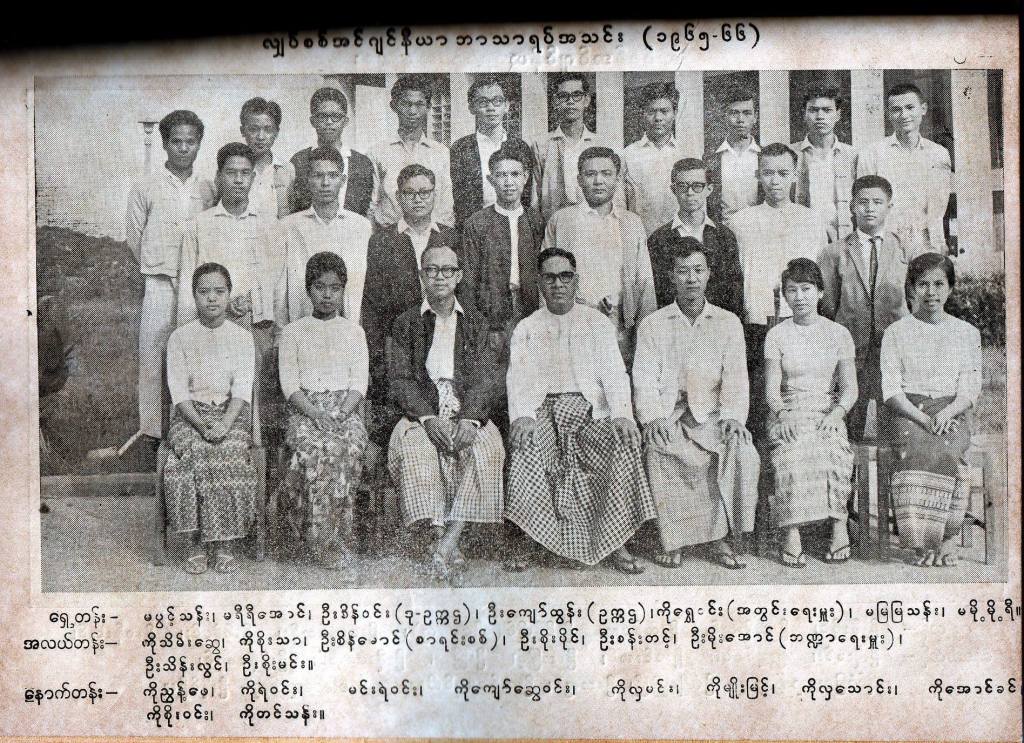
I have an old group photo taken about the end of 1963, and all the known information are printed. Inside the brackets are where about of the person [at the time of the post].
Top of the photo:
Department of Architecture Rangoon Institute of Technology 1963 ~ 64
Bottom of the photo:
Front row, L to R
Jim Lim (3rd. Year) [?]
Ma Khin Khin Kyu (Ann, 1st.Year) [San Francisco, California, US]
U Myo Myint Sein B.Arch (Rgn) M. Arch (Mch) [Los Angeles, California, US]
U Tha Tun B.Sc, F.R.I.B.A. (Fellowship of Royal Institute of British Architects), A.A. Dip (Lond.), A.M.T.P.I.(Associate Member of Town Planning Institute), F.I.B.A., Head of Department [Deceased on 13 September 1974]
U Yone Mo B.Sc (Hon) Rgn, B.Sc (Engg)Lond, A.C.G.I, A.M.I. Mech.E, A.M.I.Loco.E, Principal [Deceased]
Mr. S. Ozhegov, Cand. Of Arch, Master of Fine Arts, UZBEK, U.S.S.R [Moscow]
Miss Rosalind Maung (Ma Pyi Aye, 2nd Year) [Rangoon]
Htin Myaing (Ben, 2nd Year) [New York, US]
2nd. Row, L to R
Tun Thein (1st Year) [Los Angeles, California, US]
Tin Aung (2nd Year) [Melbourne, Australia]
Yaco B.E. Mayet (3rd Year) [?]
Than Tun (3rd Year) [Rangoon]
Sonny Chin (2nd Year) [?]
Hla Thein (1st Year) [New York, US]
E. I. Jeewa (3rd Year) [?]
Aung Pa Win (1st Year) [Chicago, Illinois, US]
Back Row, L to R
Aung Kyaw Min (3rd Year) [Rangoon]
M. (Ku?) hlgh (2nd Year) [?]
Than Htike (3rd Year) [Warsaw, Poland]
William Chen (2nd Year) [?]
C. E. Munnee (1st Year) [?]
Koung Nyunt (1st Year) [Auckland, New Zealand, GBNF]
Kyaw Thein (1st Year) [Deceased 22 April 2001]
Absentees:
Win Myint (1st Year) [Rangoon]
Win Naing (1st Year) [?]
Note:
1st Year B. Arch, 10 students (8 passed and 2 failed) 2nd Year B. Arch, 5 students (3 passed and 2 failed) 3rd Year B. Arch, 6 students (3 passed and 3 failed) Several Architecture students failed in of a subject from other departments. There was no moderation. If one gets 49% or less of the grade, the student has to repeat all subjects next year.No block selected.
Editor’s Note :
I cannot find the photo mentioned by Kogyi Koung.
The early sayas and sayamas of the Architecture Department include :
U Thar Tun (GBNF)
Pi-thu-kar Kyaw Min (GBNF)
U Myo Myint Sein (USA)
U Bilal Raschid (USA)
Dr. Maung Kyaw (GBNF)
Dr. Lwin Aung (Retired as Pro-Rector)
Artist/Bagyee Aung Soe
U Maung Maung
U Sein Maung (Stanley Ba Pe)
U Maung Maung Phone Myint
Dr. Koung Nyunt (GBNF)
U Hla Than (Retired as Rector)
Daw Min Thet Mon (Pamela Myo Min, Retired Professor)
When Rangoon University reopened in 1946, three siblings — Dr. Pe Nyun (Dick), Dr. Pe Thein (Tom) and their elder sister — attended RU along with U Tin U.
RUBC Fours
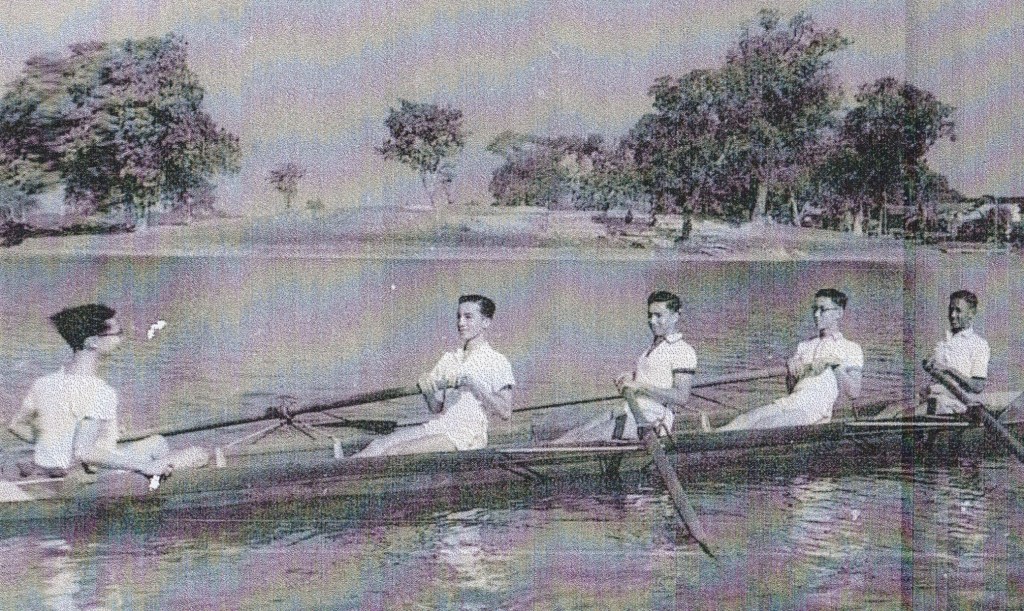
Pe Nyun, Pe Thein, Khin Maung Wint / Bobby Tin (son of Architect U Tin) and Tin U represented Rangoon University Boat Club at the 1948 Independence Day Regatta at Kandawgyi and became RUBC Gold.
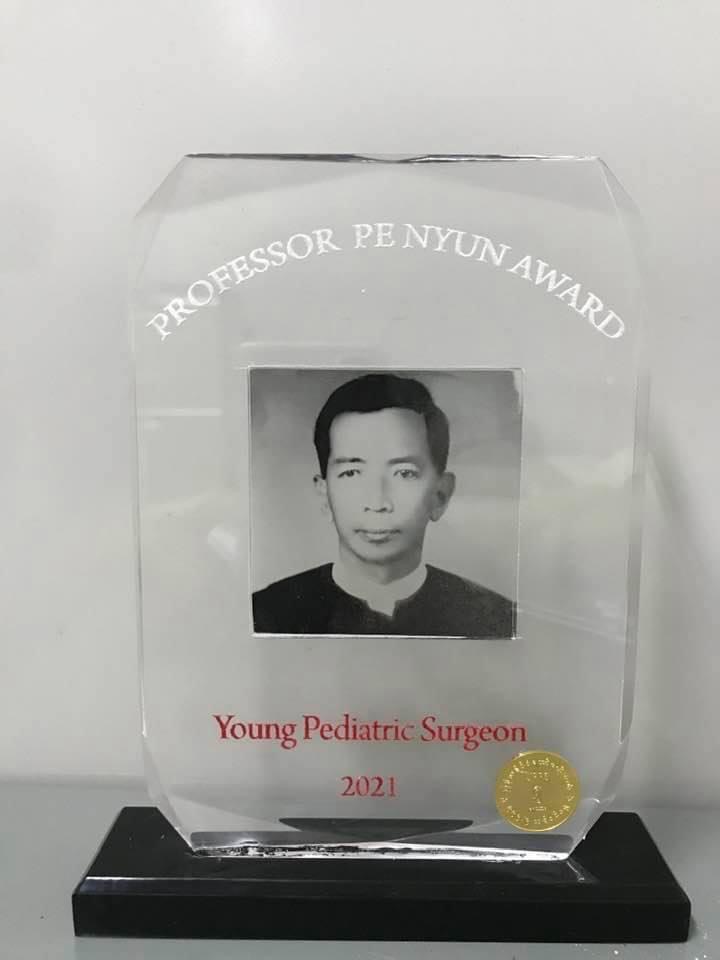
Dr. Pe Nyun
Award for Young Pediatric Surgeon
Secretary and later Captain of RUBC.
Chief Pediatric Surgeon at Rangoon Children Hospital.
Leader of the team that operated on conjoined twins (Ma Nan Soe & Ma Nan San).
Moved to Canada.
He is now GBNF.
His family established an award in his memory.
Dr. Pe Thein
Professor
(Later) Minister of Health & Education.
He is now GBNF.
Spouse : Professor Dr. Kyu Kyu Swe.
U Tin U
Oldest & Most Senior Past Captain of RUBC
Past Captain of Rangoon Golf Club.
Received BSCE from University of Oregon and MSCE from Yale University.
Taught part-time at Civil Engineering
Worked for private companies
Advisor at PWD.
Spouse : Dr. Khin Kyi Nyunt is a Nutritionist researcher. She passed away in November 2019.
(2) U Maung Maung Than Tun
U Maung Maung Than Tun
He was the oldest Past Captain alive.
He is now GBNF.
He and his younger son Aung Khine form the First Father & Son at RUBC to be Captain & Gold.
His older son Hla Maw Tun is Past Secretary & Gold. He is VP of OMA.
(3) Father & Son
U Sein Htoon and U Zeyar Linn
U Sein Htoon
Graduated with B.Sc.(Engg) in 1963.
Past Captain & Gold of RUBC.
Cox of the RUBC team that won the Willingdon Trophy for Coxed Fours at the ARAE (Amateur Rowing Association of the East) Regatta in Colombo, Ceylon in 1960.
Past President of the Burma Rowing Federation.
Boat Club
U Zeyar Linn
Graduated with B.E (Mech) in 2001.
RUBC Captain/Gold (1996)
Record
U Sein Htoon & U Zeyar Linn have the honor to be the Second Father-Son pair of RUBC Captain and Gold.
(4) RUBC Captains
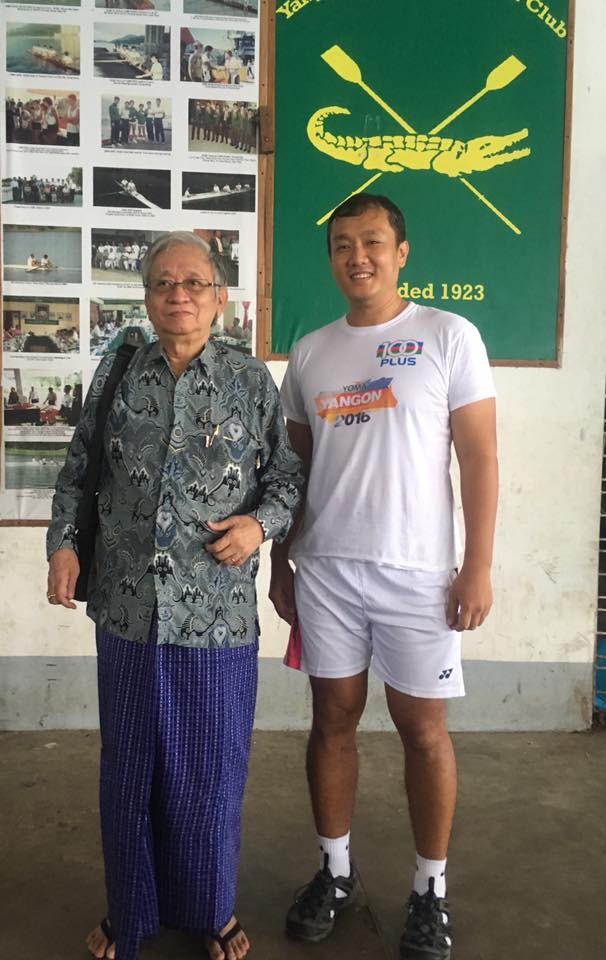
RUBC was founded in 1923. U Ba Tun served as the first Captain.
RUBC Captains
A group photo of the RUBC Captains were taken in 1963-64.
Tha Htin (1931-32)
Tun Thoung (1932-33)
Aye Maung (1935-36)
Khin Maung Bo (1939-40)
C. H. Chan (1940-41)
Kyaw Thein (1947-48)
Tin U (1948-49)
W. Ohn Pe ( 1950-51)
Chan Tha (1952-53)
Mg Mg Than Tun (1953-54)
Myo Tint (1955-56)
Tin Htut (1956-57)
Harry Saing (1957-58) — absentee
Than Nyun (1958-59)
Tin Htoon (1959-60)
Han Tin (1960-61)
Tin Wa (1961-62) — absentee
Sein Htoon (1962-63)
Thaung Lwin (1963-64)
(5) RUBC Magazine Committee
40th Anniversary
Sithu U Tin (President)
U Po Zon (Vice President)
U Tin Htoon (Past Captain; ARAE Champion in 1958 & 1960)
90th Anniversary
U Tin Htoon (Chair)
U Myo Myint (Vice Chair)
U Htaik San (Secretary)
U Hla Min (Contributing Editor) : wrote Prelude to each section; contributed three articles
90th Anniversary
(6) RUBC Crew in 1954
Crew 1
(7) Coxed Eights
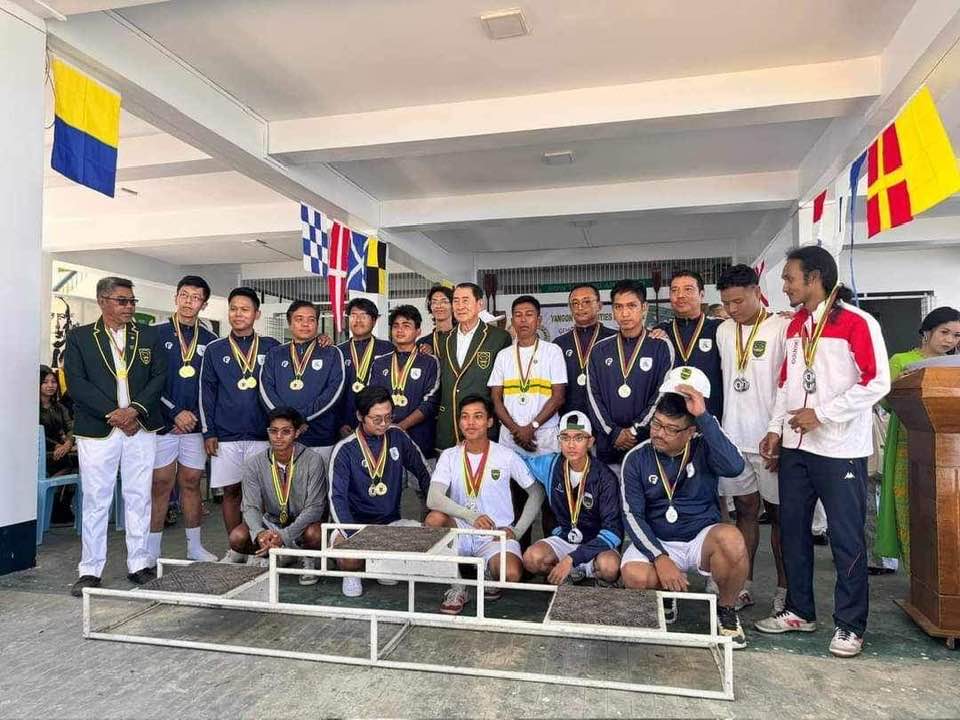
In 1956, Sir Arthur Eggar (Life President) attended the Annual Regatta. He posed with the RUBC crew that won the President’s Challenge Cup for Inter-Club Coxed Eights
President’s Cup Winners
Lazarus (Soviet Lecturer) was Timing Stroke of the Engineering crew that won the Inter-Faculty Coxed Eights trophy. Ohn Hlaing (Elmo), Kyaw Lwin (George) and Tin Aung (Victor) are now GBNF.
RIT Eights
(8) RUBC Regatta
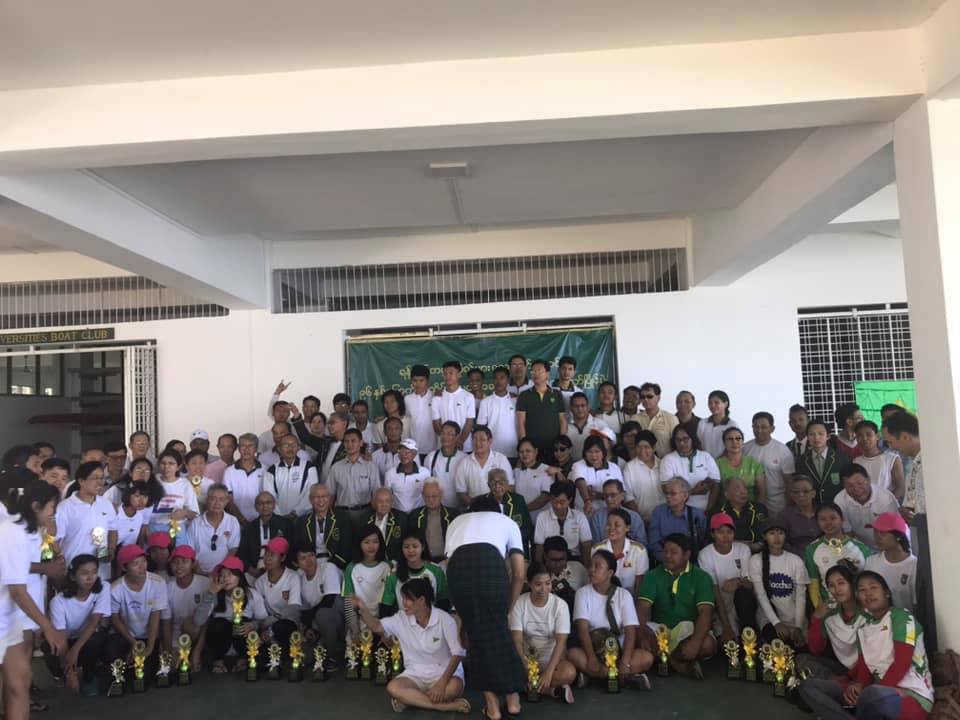
Attended the Regatta for 95th Anniversary in 2018
95th Anniversary
U Tin Htoon and U Tun Aung (George) represented the Old Members from overseas at the RUBC Centennial Celebrations in 2023.
Regatta
(9) Boat Club in late 1960s
RIT 69ers visited Inya Lake and RUBC
Chit Po Po, Win Naing (Dicky) and Sein Tun are RUBC members.
Win Naing (Dicky), Yi Pinn (Maung Maung Kaung), Nay Win, Chit Po Po & Khin Maung Gyi are now GBNF.
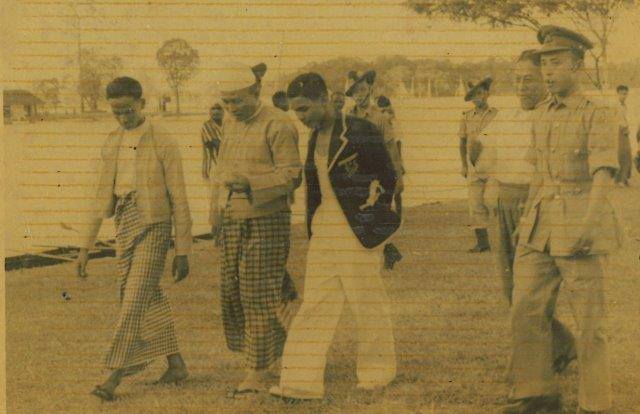
(10) RASU Rowing in 1967
Saya Micky (U Thein Aung, RUBC Gold) managed the RASU Rowing teams.
Nyan Taw (Dicky, RUBC Gold) & crew mates are seen with the trophies
(11) Reunions
Wedding
Date : December 12, 2017.
Host : U Maung Maung Than Tun and family
Event: Wedding of U MMTT’s grand daughter (daughter of U Hla Maw Tun, Past Secretary)
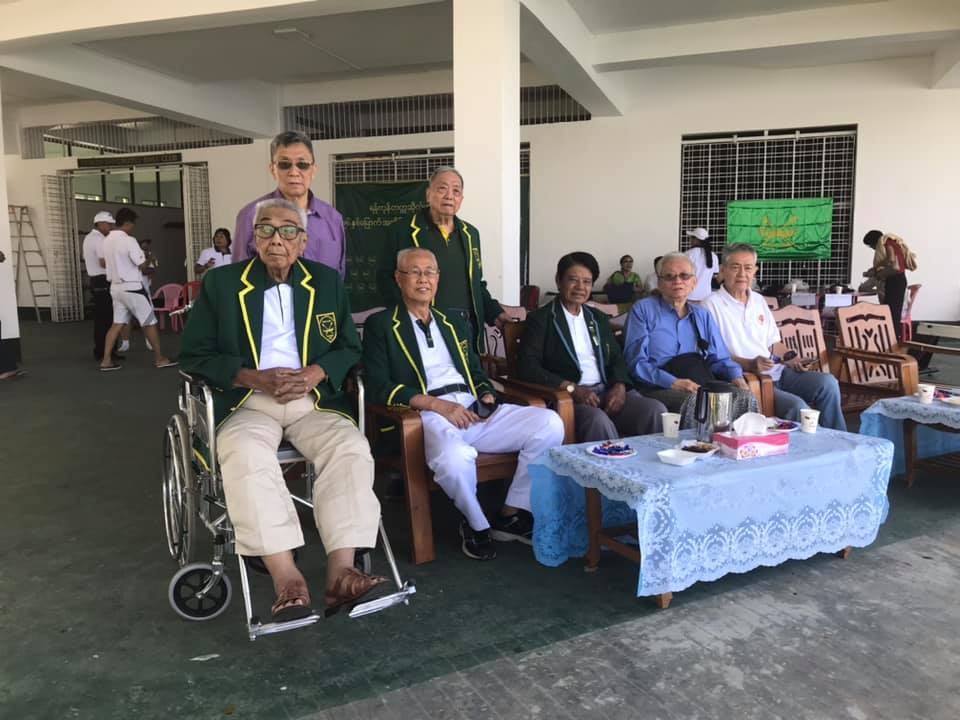
Attendees include U Tun Shein (Willy, RUBC Gold), Dr. Than Nyunt (George, Past Captain & Gold), U Tin Htoon (A60, Past Captain & Gold).
Lunch Gathering
U Tun Shein (Willie, RUBC Gold) hosted a lunch gathering for Saya U Tin Htut (M60, RUBC Captain & Gold, US), U Tin Htoon (A60, RUBC Captain & Gold, US) and U Maung Maung Than Tun (Retired Ambassador, RUBC Captain & Gold).
U Tin Htut coxed the Old Paulians crew, which won the Senior Novices event in 1954. The crew comprised of Tun Shein (Stroke), M. Hla Min (SPHS Saya), Than Nyun (George, retired minister), and Sao Hso Holm (Bow, son of Arzanee Sawbwa).
Four of the five crew members became RUBC Gold. Two became RUBC Captains.
(12) U Chan Tha
U Chan Tha
Multi-sports athlete
Past Captain & Gold of RUBC
Captain of the Prome Hall Soccer team, which won Inter-Hall Trophy for successive years
Represented RU and SAMB in soccer
(13) Old Crocs from our days
Aye Ko
Aye Lwin (GBNF)
Aung Lwin (Jasper, C70)
Bonnie Kun Lone (GBNF)
Chan Min (George) — Uzin
Chit Po Po (M69, GBNF)
David (Cycling)
Dicky Tan (Win Naing, M69, GBNF)
Dicky Taw (Dr. Nyan Taw, SPHS63)
Dennis Tun Thoung (Dr. Mehm Tin Thaung)
Edward Tai (Kyaw Sint, T70, GBNF)
Frankie Ohn (Dr. Hla Ngwe Tin, SPHS59)
Frederick Thetgyi (M69)
Freddie Tun Thoung (Dr. Mehm Thein Thaung)
George Ba Thaung (Maung Maung Win, GBNF)
George Htoon Pay (Aung Tun Oo, George D Smithers, M71)
Before, during and after SPZP-2012, Saya U Moe Aung floated the idea of Swel Daw Yeik Foundation to help alumni (past, present and future) and to take care of the health of eligible sayas and sayamas.
U Khin Maung Tun (T78) not only seconded the idea but showed his commitment by donating and or pledging Kyat 1500+ Lakhs for SDYF.
President of SDYF
Major donor not only for SDYF, but for the Alumni Association
Donated for SPZP-2012, Shwe YaDu and SPZP-2016
Sponsored Entertainment Program for SPZPs & SDYF events
Provided Eye Care for eligible RIT sayas and sayama
Attended 2015 RIT Alumni Reunion in Los Angeles
Attended Alumni Gathering in San Francisco Bay Area.
Sang a song with Saya U Moe Aung (Patron of SDYF) at SPZP-2016
Also sang the SDYF theme song with the SDYF members
The SDYF theme song is not a transformation of one of Saya’s poems. It was the outcome of a completely new composition. Ko Than Po (M75, Zat Sayagyi) helped with the music injection.
As SDYF President, he hosted meetings with lunch & entertainment
Expressed his desire to retire after a couple of terms, but the EC members politely declined.
USA Trip
U Khin Maung Tun and his spouse attended the 2015 Alumni Reunion in Los Angeles, and the Dinner gathering in San Francisco to welcome Sayagyi Dr. Aung Gyi & visitors from Yangon.
Gathering at sea food restaurant to welcome Sayagyi Dr. Aung Gyi
Gave me a “Htet Linn” bag with indigenous medicine and an MP3 player loaded with dhamma talks.
He and his family provided “Eye Care” for eligible sayas and sayamas. They balance of the Eye Care Fund has been transferred to Swel Daw Yeik Foundation.
Health Care & Financial Aid
The eligibility rules may change depending on the availability of funds, and the number of eligible sayas and sayamas.
SDYF provides medical checkup, but currently it can offer a limited amount (e.g. 4 – 5 Lakhs) of medical expenses per saya per annum.
When a Saya or Sayama passes away, SDYF offers 2 Lakh Kyats to the bereaved family.
SDYF offers 4 Lakh Kyats to eligible sayas and sayamas
for Hospitalization
for frequent medical check ups
for severe loss of mobility
SDYF also considers case-by-case for sayas and sayamas needing financial assistance for health care.
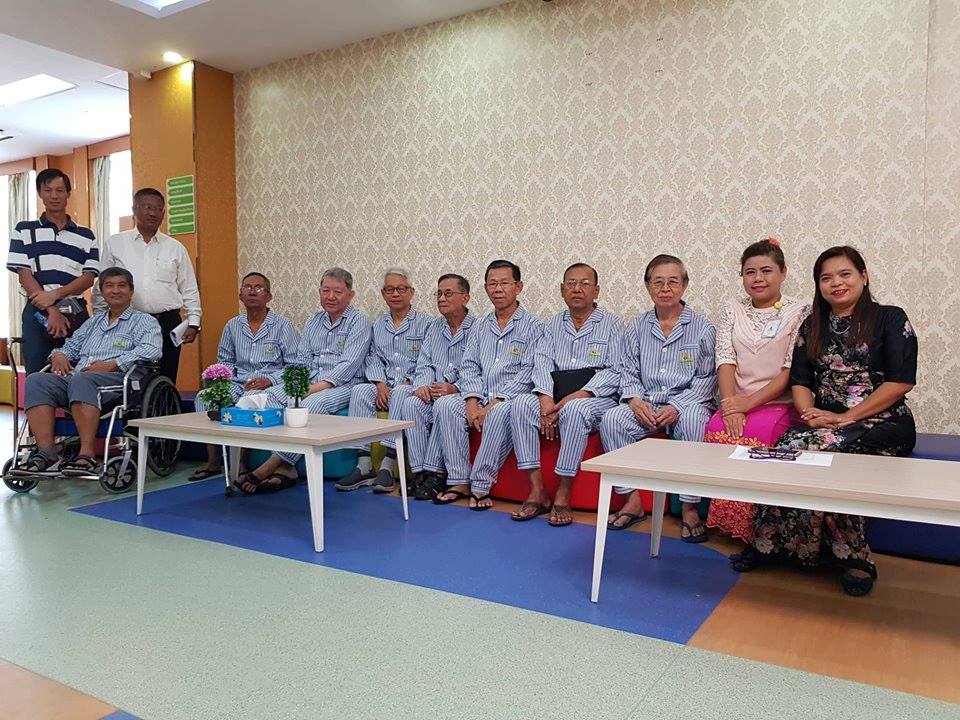
Medical Check up in 2018
SDYF provided medical check up for sayas aged 60 and above.
May Nge and Sayas
The program started on Nov 6, 2018 at Grand Hantha Hospital.
Kudos to May Nge and group for their volunteer services.
Sadhu, Sadhu, Sadhu to the young donors.
Khin Htay Lin and May Nge
Khin Htay Lin and May Nge
Khin Htay Lin (EC93)
She is a Director of Grand Hantha Hospital. She donated (or offered a discount) 25% of the expenses for the medical checkup of eligible RIT sayas and sayamas.
May Nge (May Thet Hlaing)
She is the lead volunteer for the noble task
U Kyaw Sein (M65)
SDYF will provide Saya U Kyaw Sein (M65, Singapore) K4 Lakhs annually to take care of his health.
For 2018, Ko Kyaw Moe (M 2001) donated to bring up the total to S$400.
U Ohn Maung (ChE68)
SDYF will provide Saya U Ohn Maung (ChE68, Singapore) K4 Lakhs annually to take care of his health.
Pre-AGM Meeting in 2018
In 2018 (before the AGM meeting) SDYF Meeting was hosted by U Khin Maung Tun (President) with a sumptuous meal.
U Tin Latt’s food donation became “take out” by the attendees.
Discussed preparations for the AGM of SDYF
Passed resolution to spend K50 lakhs for the medical check up of eligible sayas and sayas
Discussed the provisional financial support for use in presenting research papers overseas.
Discussed the “Total Care” program for eligible sayas and sayamas
U Maung Maung Than (M81) donated K5 lakhs to SDYF.
U Wynn Htain Oo (M72) received a present (special drinks) from the President.
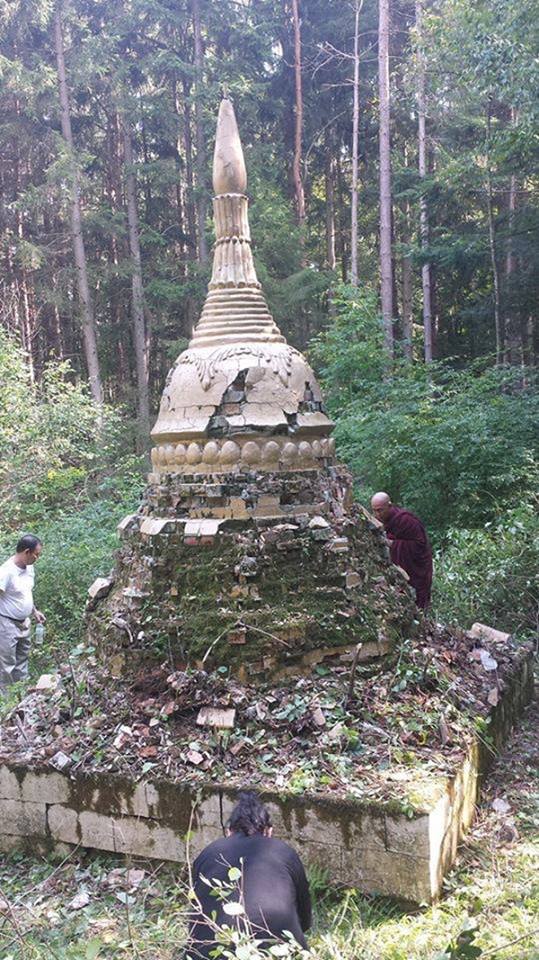
First Pagoda in the USA Sayadaw U Thilawuntha (Dat Paung Zon Aung Min Gaung, Mon Sayadaw) built the first pagoda in the Allegheny Mountain in the USA. Sayadaw built pagodas in several countries (e.g. Canada, New Zealand)
Food for thought Discussions include effective listening and evaluation, netiquette
First RIT Alumni Web Site Ko Maurice Chee’s post for the donors of the now defunct web site
Robert Floyd Professor without a graduate degree but with tons of talent
Silicon Valley An overview of the birth of Silicon Valley
First Pagoda in the USA
Dat Paung Zon Aung Min Gaung Saya U Thilawunta (also fondly known as “Mon Sayadaw”) built the first pagoda in the USA on the Alleghany Mountains.
The American devotee, who permitted the pagoda to be constructed on his land, passed away.
Grapevine says that there were plans to contact the current owners to ask permission to renovate the pagoda or to relocate the pagoda.
Later pagodas include the ones at Kaba Aye Taung Pulu monastery in Boulder Creek, California.
Pagoda in USA
Food For Thought
Listening, evaluation and feedback are important for effective communication.
The salutations are context and culture dependent.
A visiting Professor from Germany wanted to be addressed as “Professor Doctor”.
Saya Allen Htay told us that he could not use “Mr” during his stay in Netherlands. He was asked to use “Ingr” (based on his profession).
Grapevine says that the early surgeons in the UK were not necessarily doctors, and so they did not force people to address them as Dr.
Some overuse the “Like” button in Facebook. It is puzzling to see many Likes in an Obituary posting.
One should be aware of “opt-in” versus “opt-out” options.
Malicious software industry is responsible for losses (in down time, data corruption, identity theft, …) in the billions. The penalty of offenders is “peanuts” compared to drug dealers in most countries.
“To err is human. To forgive divine.” I like another version. “To err is human. To really goof, use a computer.”
I have made intentional and unintentional errors. Thanks to my colleagues, friends and readers for catching and correcting them.
Word processors also introduce some errors by correcting legal Burmese words and names. e.g. “Nwe” becomes “New” when auto-corrected. A work around is to add such words to a private dictionary for use by the word processor.
Without analysis of context, a program cannot decide whether you meant “goal” (objective) or “gaol” (alternative spelling for jail).
Inconsistencies are not easy to detect. For example, if I write about Saya U Shwe Hlaing for two posts : “Names — Shwe” and “Names — Hlaing”, the contents may not be exactly the same. I use FB for convenience (e.g. getting rapid feedback), but it is not designed for cross-referencing posts.
When I am not sure about an alumnus’s year of graduation or discipline, I use X for “unknown or unsure”. Most of the time, I get corrected by the readers.
There is no “hard and fast” rule for including or excluding names in my posts. The coverage may not be uniform for the names mentioned. My posts are not complete for “Who’s who in Burma and Myanmar?”
I am not consistent in tagging friends in my posts.
U Khin Maung Zaw (EC76) wrote :
One of the issues with Burmese names, is that there are more than one way to spell it in English, like Tun vs Htun. We used to have two ထွန်းအောင်ကျော် (I left U/Ko on purpose of clarity not for the lack of respect). One spells his name as Tun Aung Gyaw; the other as Htun Aung Kyaw. Hence they are been distinguished as TAG and HAK.
I used to have a god-grandmother here in US in the early days – she passed some years back, may her soul RIP. We, myself and U Min Maung (EP68), jokingly told her to make sure she spelled our name MAUNG in her will. Khin Mg Zaw may not be the same as Khin Maung Zaw in legalese.
First RIT Alumni Website
Posted in 1999 by Maurice Chee (Hla Myint Thein, M75)
As the Treasurer of the Bay Area RIT Alumni Group, I am pleased to announce the names of financial supporters whose donations have been helpful in taking care of the RIT Alumni web site maintenance.
Saya U Nyo Win (a) Kim Chen (M65) US$ 120
Saya Allen Htay (C58) US$ 120
Saya U Myat Htoo (C68) US$ 120
Saya U Thein Aung (a) James Wu (Met72) US$ 120
U Benny Tan (M70) US$ 120
U Maurice Chee (M75) US$ 120
U Gordon Kaung (M83) US$120
Saya K. C. Chiu (a) Dr. Tin Aung (ChE63) US$ 120
Saya George Chan (a) U Maung Maung (ChE66) US$ 120
U Hla Min (EC69) US$ 120
U Daniel Tint Lwin (M69, Singapore) US$ 100
U Ivan Lee (a) U Khin Maung Oo (M69, New Jersey) US$ 360
Saya U Soe Paing (EE,), Daw Saw Yu Tint (T69) US$ 120
Note: –
Saya U K. C. Chiu’s donation included U Htin Paw (EE58), Mr. Patrick Chin (M70), and U Kyi Kong Tham (C63)
U Hla Min’s donation included S$50 donated by Saya U Aung Myint (M69, Singapore Polytechnic)
Webmaster’s Note :
The hard cost of hosting the RIT Alumni website with a hosting company is US24.95 per month. This costs does not include time and efforts put in by various people. The initial set up and programming effort took about five to six weekends, remember we do have day jobs. It takes an average of three to ten hours a week for routine content maintenance and program enhancements.
Editor’s Note:
U Khin Maung Zaw designed and maintained the web site. He was then working four 10-hour days and spent nights and weekends to get the sayas and alumni connected virtually and later physically at SPZP-2000. He was one of the eligible bachelors. He was then employed by Microsoft. He also found his true love and set up a loving family. It was a loss for RIT Alumni International.
He is now retired and is providing feedback on my posts.
Professor Robert W (Bob) Floyd (June 8, 1936 – September 25, 2001)
He received his BA at the age of 17, and another BS in 1958 (working and studying part time) from the University of Chicago.
He taught and researched at two prestigious universities : Carnegie Mellon University (CMU) and Stanford University.
He was recommended to by Professor Donald Ervin Knuth (winner of Grace Murray Hopper Award, and ACM Turing Award) to become the Chairman, Department of Computer Science, Stanford University.
Knuth said, “any of the papers he had written could be taken as a doctoral dissertation “. Floyd’s pioneering papers included graph algorithms, compiling techniques, tree data structures, and proof of program correctness.
He supervised several doctoral students.
He was also awarded the prestigious ACM Turing Award, which is considered the Nobel Prize in Computing.
His biography, citation for the ACM Turing Award and the Award Lecture can be read from the ACM web site.
Silicon Valley
In the early days of computing, manufacturers of magnetic devices (core memory, tapes, disks and drums) than silicon [dioxide based] devices. Some said that “Magnetic Valley” might be a more appropriated name than “Silicon Valley”.
Several factors are attributed to the birth and the culture of Silicon Valley.
Professor [later Dean] Frederick Terman joined Stanford University instead of the more established ones in the East because of his health. He is known for (a) encouraging his students such as Hewlett, Packard and the Varian brothers to become entrepreneurs (b) leasing land owned by the University to the fledgling companies (c) making agreements with the companies to hire his students and/or send employees to attend courses at the University.
The oft-told story is about William Shockley (Nobel Prize winner for co-inventing the transistor) and his decision to set up “Shockley Labs”. He was brilliant but not so good at nurturing his employees. This led the “Traitorous Eight (including Robert Noyce and Gordon Moore)” to join Fairchild semiconductors. Noyce and Moore later co-founded Intel (Integrated Electronics) with Andy Grove. The ability to move around companies is a good aspect of the Silicon Valley culture.
The entrepreneurship (initiated by Professor Terman) lives on. Yahoo, Google and several other companies were founded by Stanford alumni.
Some pointed out Harvard, MIT, and Cornell produced early computers (e.g. Mark I) and disciplines (e.g. Time sharing system, AI Lab, Computer Graphics, Machine Vision). Their alumni also founded computer companies (e.g. DEC).

































 HlaMin