by Hla Min
Updated : June 2025
Highlights

- Received higher ordination as a monk at the Neikbeinda Monastery in Pyay / Prome.
- Completed one part of the Tipitaka Examination.
- Dhamma Duta missions in Japan, US, Jamaica, Canada, Taiwan …
- Joined U Silananda at the Dhammanada Vihara (then in Daly City, California).
- In 2007, he succeeded U Silananda as Chief Resident Monk of Dhammananda Vihara, Half Moon Bay, California.
Publications
He has published books in
- Myanmar
e.g. Book for Chanting/Recitation - English
e.g. The Basic Teachings of Theravada of Buddhism (edited by Hla Min and Don Johnson) - Japanese
e.g. Translation of selected works of U Silananda
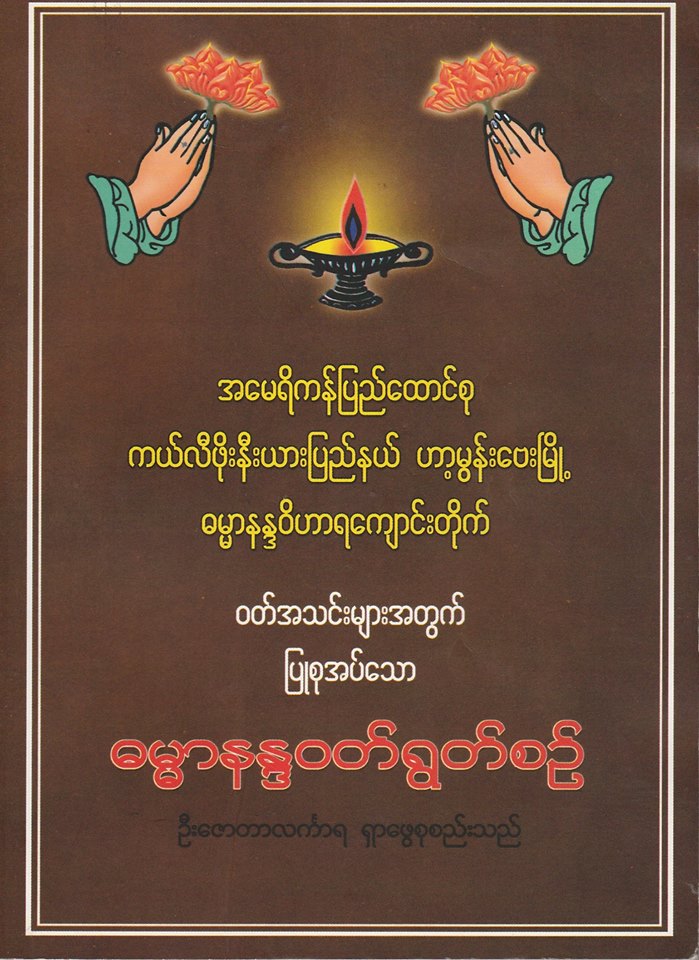
Book for Dhamma Chanting
The Basic Teachings Of Theravada Buddhism
- Author: U Jotalankara (Dhammananda Vihara, Half Moon Bay, California, USA)
- Editors: Hla Min and Don Johnson
- First edition : June 2004
- Foreword by Ven. Sayadaw U Silanandabhivamsa
- Fifteen chapters
- 1. Program of worshiping
- 2. Explanation of words
- 3. Benefits and stories of taking refuges and precepts, and offering food, flowers, etc.
- 4. The discipline or duties of laypersons (Gihi-vinaya)
- 5. What is the teaching of the Buddhas?
- 6. Cultivating Good
- 7. Purifying One’s Mind
- 8. The For Divine Abodes (Brahama-viharas)
- 9. Vipassa-bhavana, Insight or Mindfulness Meditation
- 10. The Four Noble Truths & Four Noble Persons
- 11. The Teaching to the Kalamas
- 12. The Pali Alphabet in Roman Characters
- 13. Program of Chanting (Paritta — Eleven Protective Suttas — and other Suttas)
- 14. First two sermons of the Buddha & the Program of Chanting to Consecrate a Buddha Image & Ovada-patimokha
- 15. Program of Novice Ordination
- This book has been used in the Summer Dhamma Camps at Dhammananda Vihara
- He has written Dhamma books in Myanmar, English, and Japanese. Some books were compiled from his articles in the Dhammananda Newsletter published by the Theravada Buddhist Society of America (TBSA).

Theravada Buddhist Novice Ordination and Monk Ordination
- Author : U Jotalankara
- Editor : James Rives, Ph.D.
- First Edition : August, 2008
Two kinds of ordination
- Pabbajja : to become a novice (samanera)
- Upasambada : to become a monk (bhikkhu)
Novice Ordination
Three steps of novice ordination
- shaving off the hair of the head
- putting on robes
- giving the Three Refuges
The procedures for the second and third steps of novice ordination
- Paying homage to the Three Gems
- Handing robes to the teacher
- Asking for the robes from the teacher and putting them on
- Requesting a novice ordination
- Requesting the Ten Novice-precepts with the Three Refuges
- Paying homage to the Buddha
- Taking the Three Refuges
- Taking the Ten Precepts of a Novice
- Choosing a teacher to be the candidate’s preceptor
- Reply of the preceptor
- Reflecting on the use of the Four Requisites
- Reflecting on the repulsiveness of the body
Ten conditions for expulsion from Novice-hood
Ten punishments
Monk Ordination
Five fulfilling conditions for becoming a monk
- Perfections of a person
Eleven categories of disqualified persons - Perfection of an assembly
- Perfection of the Sima (“Thane”)
Two kinds of Sima - Perfection of the Motion
- Perfection of the Kammavaca
The procedure of monk ordination
- 1. Choosing the candidate’s preceptor
- 2. Stating the ownership of alms-bowl and robes
- 3. Giving temporary names
- 4. Ordering the candidate to go and stand outsie the Sangha
- …
- 10. Reciting the Natti and Kammacvaca
- …
- 15. The new monk’s special request
The procedure of monk ordination for two candidates
…
The 227 Training Rules
…


Leave a comment