Blog

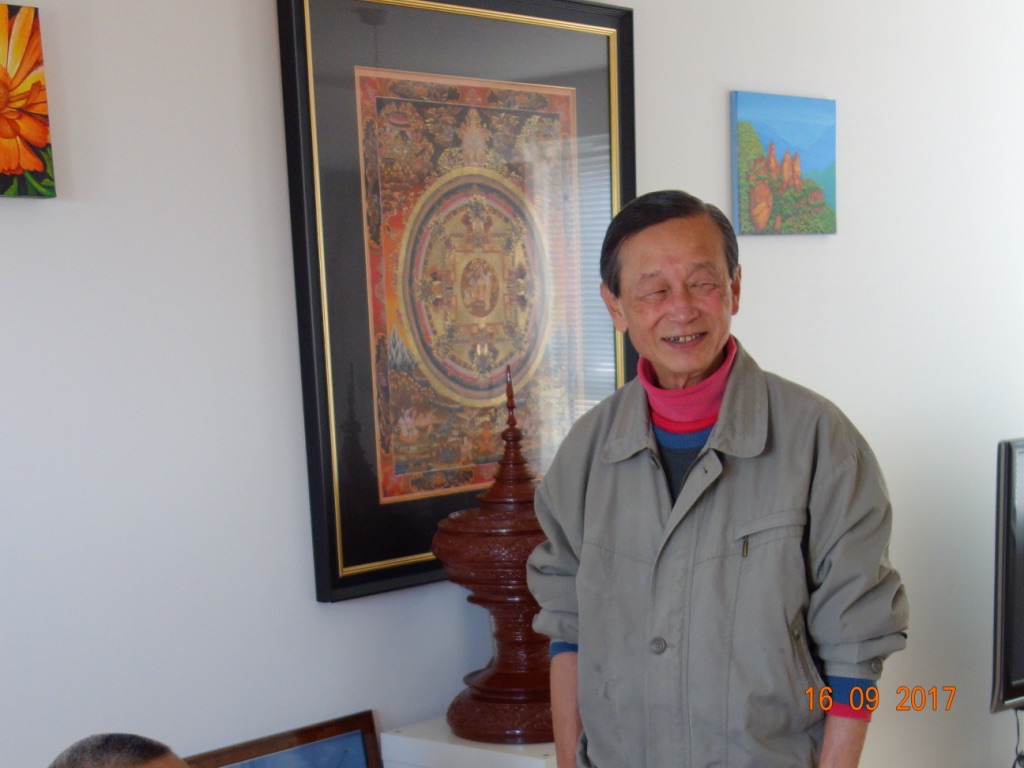
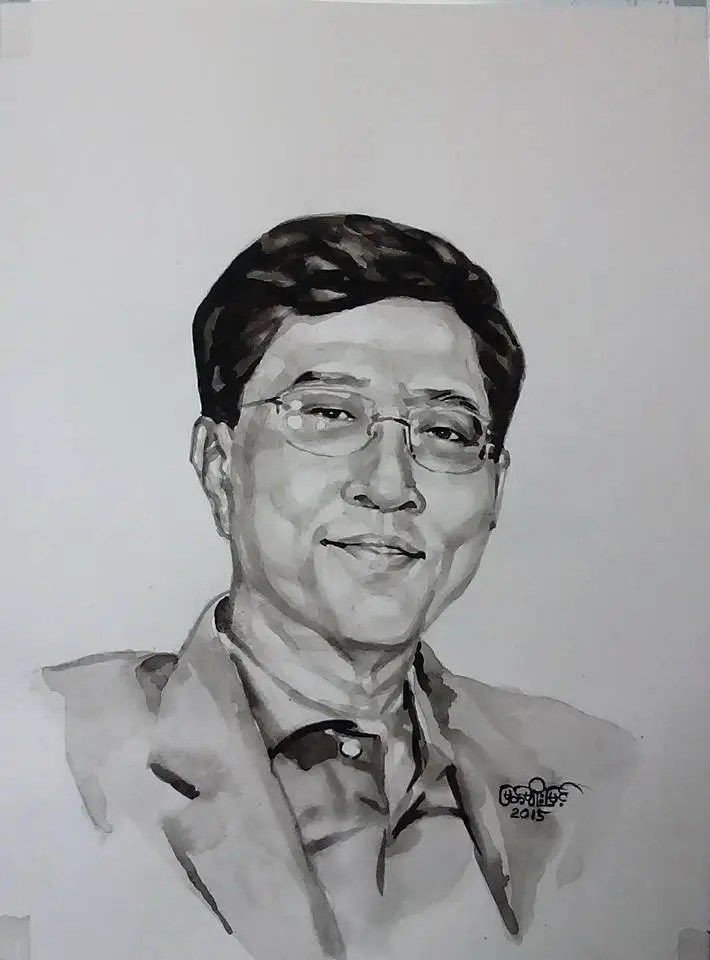
  • Htin Paw (EE58)

    by Hla Min

    Updated : June 2025

    Highlights
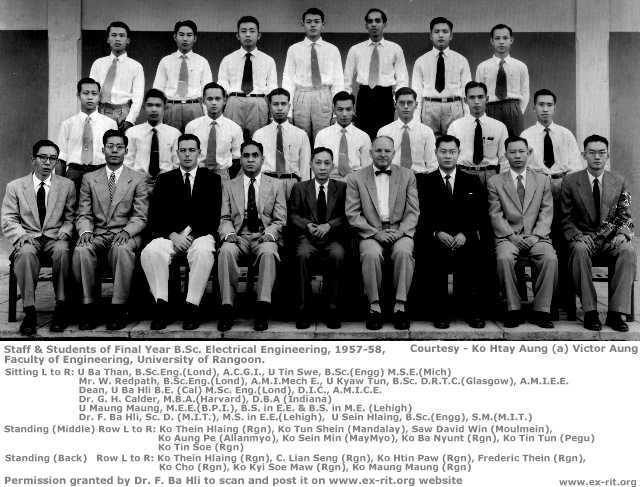
    This image has an empty alt attribute; its file name is ee58.jpg
    EE58
    • Graduated with Electrical Engineering in 1958. Received two Gold Medals.
    • Joined the faculty as Assistant Lecturer in 1958.
    • Received MSEE from the University of Michigan.
    • Upon his return to Burma, he joined UBARI which had provided him the States Scholarship.
    • Transferred to the Electrical Inspectorate.
    • Taught part-time at EE Department.
    • Migrated to the USA.
    • Co-founder and President, BEA
    • President of TBSA (Theravada Buddhist Society of America).
      When Sayama Dr. Julie Han (Past VP & fund raiser of TBSA) passed away, Saya donated $2000 to TBSA in her memory.
    • Attended the First RIT Grand Reunion and SPZP. He have to leave early because his spouse was not feeling well. She passed away after several years of ill health.
    • Wrote articles for RIT Alumni International Newsletter
    • He passed away a few years back.
    Memorial Service
    • His only son, Dr. Barry Paw (MD, PhD, outstanding researcher), passed away at the tender age of 55. He suffered a heart attack on the flight back from Australia to the US.
    • Brother : U Tun Thein (A67)
    • Nephew : U Hla Thein (Robert, M72)

    Article in RIT Alumni International Newsletter

    Intermediate of Science

    The year was 1952, the year you started your first year intermediate (pre-engineering) at Rangoon University. On hindsight I could probably say, those were the young and restless years. Those early years, there was some student political uprising at Rangoon University. I was gassed while staying at the dormitory at Pinya Hall. A week later it was calm and peaceful. Nevertheless, years went by very peacefully. To the upstart, like me, all we knew was to get good grade and some day become a scientist like Albert Einstein. The interest in science was so great that I set my goal to be a great physicist. So with my mind set to become a scientist, I tried very hard to get good grade. Subject in science were all taught by science Lecturers from India. These were the days when Burmese Lecturer in Science was a rare commodity. The only Burmese teaching Mathematics was Saya U Ba Toke. His Upper Burman ascent was so pronounced and unique it was and is giving a ringing sound to my ears even to this days. Well, my assumption was if I get a couple of distinctions in science subjects, I could probably register for an Honor class in Physics and then proceed on to get a PhD degree at some foreign University. So two years past by very easily by keeping my interest in Science. My dream was all shattered when I register to start my honor class in Physics, I was the only one registered for the class. Loneliness overwhelmed me then, and I went on to join my friends for the first year engineering at BOC College. They say BOC college was a desolate place to be for young man.

    My First Year Class (1954) (BOC)

    It was like hell to start the first year engineering. The day started with the first year black smith course. Lifting a ten-pound hammer was some effort, needless to say pounding the ten-pound hammer at the heated iron rod. The same day, I thought I have made the biggest mistake in my life starting on engineering course. In the back of my mind, I thought of changing back to Physics Honor Course. My physique was not much of a type to do any blue collar work like black smith. However, my family encouraged me to be an engineer, like some our family friends, like U Kyaw Myint who eventually became a railway commissioner. Again, with some kind and friendly persuasions from friends I stick on with the Engineering School. Some Burmese Saya’s that came to my mind were Saya’s U Num Kok, U Eng Hock (Cl. 1955) and U Kyaw Tun. Well, I passed my first year very smoothly with distinction on all subjects. Courses for all first year students were common to all disciplines. U Kyaw Tun was teaching Electro technology and the rest of the courses were by Sayas from East and West Bengal, India. These were the years when picking up Bengali accent English was considered perfect King’s English. The differential calculus was taught by Dr. Sircar and the projectile solution took several pages; and the advanced algebra was taught by Saya U Ba Toke and Saya U Ko Ko Lay.

    My Second Year Class (1954) (BOC)

    My second year course was a little heavier and all my concentration was in my study hoping that some day I could pickup a scholarship to study in foreign University. Those days, to study in foreign University was just an impossible dream to my country folks, so I was prevented from applying for a state scholarship. There were a few Colombo-Plan lecturers from New Zealand and England teaching engineering courses, so I elected to major in Electrical Engineering. Textbooks from McMillan and Longman publishers were easy to obtain, then. A little while later, I witnessed the first wave of Burmese Scholar came back (U Sein Hlaing , U Tin Swe and U Ba Than) to replace some Bengali’s Saya’s. There after, another wave of scholars arrived to take up their respective staff positions (U Aung Gyi, U Min Wun, U Khin Aung Kyi). The inspiration to study abroad was so great then, that it pushed me to concentrate on my study with high hope that I may be fortunate to be on the staff of Dean U Ba Hli. So I passed my second year very smoothly with distinction on all subjects.

    My Third Year Class (1956) (Leik Khone)

    So I passed halfway mark and started my third year course. We started at the new facility Leik Khone constructed under Colombo plan. The lecturers Mr. Neale, MIEE and U Kyaw Tun, AMIEE , Mr Redpath, AMIMech.E and U Ba Than teaching styles were very much oriented to British style. I did admired their logical teaching method; unlike U Sein Hlaing who taught us Communication theory, Dr. Freddy Ba Hli who taught us Vacuum tube circuit theory and U Tin Swe who taught us the Symmetrical Component theory for solving three-phase circuit theory. The third year passed by with mostly academically courses oriented for graduate school, with the exception of electro technology taught by Mr. Neale. Well, I passed my third year with distinction on all subjects. These were the years when we still use the K&E slide rules to solve problems in class and in examinations. Still, if I were to design a small building wiring, then, I could have selected a wire size very much non-code wire sides.

    My Fourth Year Class (1957) (Leik Khone)

    To me even in my final year, my goal was to proceed on for further study in foreign University. Even though we were in the final year, we never knew that there existed a Burmese National Electrical Code of Practice, equivalent to National Electric Code (NEC in USA). With majority of my class mate concentrating on getting a position in one of the many government departments, my concentration of the academic study become much easier and so I passed my final year with distinction on all subjects. Well, I do not want to be a Wun Dauk Min, anyway. Well, I picked up two gold medals on completion of my final year. Todarmal Talwal Gold Medal and J.A Hills Gold Medal. Well, these medals were all subsidized by my family. The Registrar U Yu Khin sent me a notice that if I should elect to receive a real gold medal, I should submit Kyats 150 for each of these medals, since the price of gold had risen higher than when the cash endowments were made. So my family pitched in Kyats 300 for me to receive the two Gold Medals from Chancellor Bogyoke Ne Win. This achievement honor bought me an invitation from the President Bogyoke Ne Win to attend the presidential dinner party at President Palace. Very soon after, I joined the staff of Dean U Ba Hli. The years of young and restless thus ended.

    My First Year as Teaching Staff (1958-1959)

    Among the graduating classmates Ko Ba Nyunt (Burmah Oil Company) and myself joined the staff of Dean U Ba Hli. Soon there after there were some political wind blowing in the horizon from the staff. The uprising started among the staff was on the subject of setting the criteria for promotion to the lecturer ship at the college of engineering. As an upstart staff member I was also involved in the meeting at Shwedagon Pagoda to scheme up an engineering staff strike. The personal matter was the subject of contention, then. Some how it was resolved peacefully thus avoiding a strike. I was much happier when I picked up a scholarship for further study in USA. It might just be due to Dean U Ba Hli’s letter of recommendation or my academic achievement in obtaining two gold medals and a straight A grade average that bought me a scholarship to do my further study in USA. So I left Rangoon in 1959 for USA to study at University of Michigan.

    Years as an Engineer

    The year was 1958, I was a young Assistant Lecturer at the Engineering Faculty. Electro-technology Laboratory course was assigned to my colleague U Ba Nyunt and myself. Well, those days, student don’t think much of newly minted young graduate: there were some instances where some students even wrote nasty comments when their Laboratory Reports were not graded at the level they expected. Well, they say, maturity takes years to culture, but in my mind I thought I was not good enough to be their instructor, so these happened. Like a young maturing child, I will take up the issues with Saya Gyi U Ba Hli, who will reprimand the subject students. A few months into the faculty we are to find ourselves to apply for foreign scholarship. To my disappointment there were no scholarships allotted for the engineering college. I went to see Saya Gyi and presented my deep interest to continue serving in the Department. That year, there was no budget provision to staff up the college. As fate would have it, I took the scholarship allotted for UBARI.

    Preparation for Foreign Study in 1958

    My student year life at BOC College was more of a bookworm. Yes, I did achieved what I aimed for, but I was behind in my social aspect. So my Mum said, now that you have graduated and is leaving for foreign land, I need to fix you up for good to ensure that you would be back at home after your study in USA. Here in Rangoon, I soon found myself betrothed to my present wife. Yes, where is my dream to reach out for the top notch Ph.D degree, I asked myself ? With this marriage knot tied to me, my mind was to get my first graduate Engineering degree and return home. Since I was not to continue with the academic career at the University, my graduate degree would not buy me a good position at the Government Departments. So this was my fate and there was my disappointment in life.

    Years at Graduate School in University of Michigan

    My Mum had good intention in starting up my matrimonial career; but did hamper all my drive to go further to completing a Ph.D degree. Although, I could achieve the highest honor in my bachelor years, I found myself not so brilliant in doing my graduate study. Nevertheless, I managed to complete my Master Degree in June of 1960 and returned home to work at UBARI.

    Years at UBARI

    In 1960, I started work at UBARI. I was not doing much engineering, then. So I thought I could do some real engineering work. After three years at UBARI, I moved to work for the Department of Electrical Inspectorate in Secretariat, Rangoon.

    Years at Electrical Inspectorate

    This department governed the “The Electrical Rules and Regulation“ of Burma. I found Testing and inspecting electrical construction projects to be very challenging. I traveled far into remote areas across entire Burma. I was privileged to be assigned to give a taste of Electricity Rules and Regulations of Burma to the senior year electrical class at RIT. Bringing the graduating year class to get a taste of “National Electric Code“ was a great honor even as a part-time staff faculty member. In 1967, my outlook in life started to change so dramatically.

    In some way, the work is a challenge. You do a lot of testing and calibration of protective relays and commissioning of small and large power station. You also do a lot of facility industrial facility commissioning. In addition, you are also chasing electrocution incidents all over Burma.

    Article in RIT Alumni International Newsletter

    My Fond Memory of the Reunion Dinner and SPZP

    The Reunion of ex-RIT graduates and Associates on October 28, 2000 is in everyone eye’s a success at the premier level. It would have been a mission impossible for me to organize a reunion meeting like this in the early eighties. The success of RIT Alumni International was due mainly to engineers who contributed their hard work in the most unselfish way: nobody in the organizing committee cared about who gets the credit for the event’s success. To put the entire success in the right perspective, I can attribute the success to the three pillars on which it stands on:
    1. The prosperity achieved by Burmese engineers in the early ninety eighties and nineties
    2. The unselfish diligent and hard work from the volunteers and the members of the organizing committee
    3. The ease and convenience of communication in the new millennium

    In the late ninety sixties when I first landed in this new world, we have very few RIT Alumni who have left their homeland to make their right livelihood (samma-ajiva) in the new world. Most emigrants from Burma left with their Certificate of Identity. Very few numbers hold the Burmese Passport. We have no relatives here to guide us nor do we have the opportunity to tailor and write our resume for employment. Even though some have had US education, lack of work experience in the US was a factor in getting compatible engineering positions. The second drawback we faced was we left Burma flying the Pan Am plane with fare paid for on credit basis. Some friends had to advance the plane fare to enable us to leave Mingaladon Airport. Most Burmese families had to start with a couple of thousand dollars credit hung on their neck to begin their livelihood here. A lot of us tend to look for job opportunities in the civil service arena for stability and security. Most of us started at entry level at around $750 per month for graduate engineer in civil service. It was no rare occurrence to witness some of us having to change to a second career as a restaurant owner from a successful Architectural career in Rangoon. Living under this environment, with not much money to throw around for extra curriculum activities, to organize the kind of Reunion event then was unimaginable.

    Things changed gradually after a few years, with hard work and the diligent endowed in each and every one of the first wave of immigrants things have changed. There were new opportunities in the engineering employment to build power plants, industrial and refinery plants that required a large number of engineering job opportunities. From the early eighties people brought in relatives, the second wave of immigrants from Burma. We built up strength from unity and the community spirit grew. The economic growth brought forth the abundance to do charities in the Burmese communities all across the United States. From one single Taungpulu monastery in Boulder Creek we saw almost two to three monasteries in one city to serve the Burmese communities. The baby boomers who came in as babies in the early seventies have grown up to serve the communities as professionals: engineers, doctors, lawyers and some entrepreneurs. In the group of engineers at the reunion we can find a good number of millionaires working to become multi-millionaires. Some us even owned their own companies employing twenty or thirty ex-RIT engineers. Time has changed from Rag to Riches. We can now afford to enjoy life from our hard earned investment. We no longer have to calculate in the back of mind the currency exchange rate on whatever we touch to buy for our daily staples. It reminded me of an instance when we took a new comer to a Bush-Garden on one weekend. The entrance fees was three dollars per person and when we continued on to another Universal Studio, he said that he would rather sit at the entrance and wait for us than spend another $3.00 on entrance fee. That was then, and this is now: US $50.00 per head to a reunion party would be an insurmountable hurdle for a new comer. Still we saw a few new comers at the event, because their resident relatives were rich enough to give them tickets [as gifts] to attend the event.

    We even have ex-RIT graduates who were benevolent enough to sponsor a few of their Sayas from outside the US to attend the event. The enabling factor here is the economic wealth of our fellow graduates. So the Rags were then and the Wealth is now: things have changed.

    Most of us have inherited our Buddhist heritage: take for instance Mr. Maurice Chee’s e-mail address: alluding his belief on the “Triple-Gems” the Buddhist three jewels: Buddha, Dhamma and Samgha. Believing in Metta (loving kindness), Karuna (compassion), Mudita (sympathetic joy), Upekkha (balanced mind). These are the kind of people who run the Reunion operation: no one seeks fame and fortune and let alone grabbing credit for the success. In my several dealings with them, like Maurice, Ko Hla Min and K.M. Zaw are all alike: they would always end their e-mail with “With Metta”. The word Metta after all is not a small unit of measurement its true meaning can only be described in combination of two words in English – “Loving Kindness” — and is a very Pure thought. With such people running the show success is boundless. The web page: < http://www.ex-rit.org/rit.asp > is indeed the guiding beacon of Success for the Reunion. K.M.Zaw and Ko Hla Min should each be proud of this success.

    One deterrent or restraint in organizing people from far places is communication. In the early seventies and early eighties, you give up before you start to write because the process of communication takes so much hassle: you write, you print, you paste the stamp, you mail the envelope and wait for confirmation after a week. That was then. In the current setting, you e-mail the letter and if willing, you get the answer in an instant. Some of us are more or less holding the mouse five to six hours a day and the e-mail call out “You’ve got mail”. This is now. The ease of communication is indeed a great help, thanks for the help that brought the great success to our reunion. I would like to thank Saya U Aung Khin who gave the go-ahead signal of convening a reunion in the Bay Area and also brought in all the big celebrities like Sayagyi U Ba Toke, Sayagyi U Aung Gyi, and Sayagyi U Khin Aung Kyi. Their support and their attendance had made a big difference and greater success. Last but not the least, the credit goes to the organizing committee members for their inexhaustible hard work and Metta to their Sayas and their fellow graduates. I wish each and every one of our Sayas named in here “Saya Pu Zaw Pwe” should contribute an article to express their appreciation. My good wishes also goes to the Organizing Leadership of the coming event in 2002 in Singapore. Regards and Metta, Sabbe Satta Bhavantu Sukhitatha ! ! !

    May All be Well and Happy.

    Related Posts

    • BEA
    • Electrical Engineering
    • RIT Alumni Newsletter
    • RIT Sayas
    • TBSA
  • Memories Linger On

    Memories Linger On

    by Hla Min

    Updated : June 2025

    Government Exams

    • We were Guinea Pigs of the Education System. We had to take the Government Exam four times before entering University. We effectively lost a year of our lives.

    7th Std

    • Took the last 7th Standard Government exam in 1960. Some SPHS classmates took the 7th Std Exam in the previous year as external candidates.
      They then transferred to other schools. Some passed the Combined HSF & Matric exam. They were admitted to the University two years ahead of us.

    9th Std

    • Took the HSF Only exam in March 1962. Answered all HSF subjects in Burmese (except English).We studied Yupa Beda ရူပဗေဒ (Physics), Dhatu Beda ဓာတုဗေဒ (Chemistry) and Thin Char သင်္ချာ (Maths) in Burmese. The Yupa Beda text was written by Dr. Maung Maung Kha and U San Tha Aung.
    • We had to take the exam with Security Guards patrolling (following the Coup d’etat on March 2, 1962). The exam was cancelled citing that the examination questions were leaked.
    • We had to retake the HSF Only exam in August 1962. Chu Pu Thein had the highest score for Physics. After passing Matric, he left to study in Italy. Maung Maung Kyi had the highest score for Chemistry. During the RU closure, he received States Scholarship to study Chemical Engineering (with specialty in Pulp and Paper) at Dresden University, Germany. Upon his return, he worked for Sittaung Paper Mill and PPIC. He moved to Wales, UK. He is now GBNF.
    Maung Maung Kyi

    10th Std

    • Took the Matric Only exam in May 1963. Answered subjects in English (except Burmese). We studied Physics, Chemistry and Maths in English.
    • The Physics text was by Sen and Gupta. SPHS library had Physics books by Sears and Zemansky (donated by Ford Foundation and/or Asia Foundation).
    • The Chemistry text was by Menon.
    • The Maths texts include Algebra (by Hall and Knight), Sequence Geometry and Trigonometry (by Siddon and Hughes).
    • Brother Clementian used several Maths Books (e.g. Tutorial Algebra and Study Guides).
    • The pass rate was relatively low. In the Matric of 1963, 1263 students passed from the Rangoon Division. The results were published in divisions : First Division (60+ marks average), Second Division (50+ marks average) and Third Division (40+ marks average).
    • The results were published in order of merit. It was not easy for students to find out if they had passed the exam and in what Division. It was a nightmare for those who failed the exam.
    SPHS 63
    • 100 Scholarships were awarded. Those from private schools (e.g. St. Paul’s High School) received Scholarships only if they are among the Top Forty.
    • St. Paul’s had Five students in the Top Five,Seven in the Top Ten, Ten in the Top Twenty.

    I.Sc (A)

    • Took the Science Option for I.Sc.(A) classes that were being offered the Intermediate Colleges.
    • Those from Rangoon Division attended the RU Intermediate College known as “Leik Khone”.
    • Roll Numbers were based on the last names. Ko Aung Min’s Roll Number was B115. Mine was B116. Ko Than Myaing was B120. We shared lectures and tutorials.
    • Citing security reasons following student protests for sad events on 7th July & 8th July in 1962, hostel students were forced to return home.
      Classes with the exception of Medical and Engineering Colleges were suspended until further notice.
    • The I.Sc.(A) exam was taken at State High Schools.

    Education System

    • In November 1964, a new System was introduced. The system of having Faculties under a University was disbanded.
    • Most Faculties (Engineering, Medicine, Social Science) became autonomous Institutes with their own Rectors.
    • The Intelligence Level Aggregate (ILA) was used to decide the admission of Matriculates into the Universities and Institutes. It effectively caused the end of “Freedom to study” where several Top students chose their passion of study : Anthropology, Architecture, Biology, Burmese, Chemistry, Commerce, Economics, Engineering, English, Forestry, Geography, Geology, Law, Maths, Philosophy, Physics, Psychology, Statistics, …
    • One High School Luyechun with a low ILA was forced to study Philosophy. Some who had high ILA taking Arts subjects and/or Hybrid Combinations were admitted to the Rangoon Institute of Technology (RIT).

    Education Ministry

    • Colonel Hla Han was the “Pyinnyar Ye Tar Wun Khan” ပညာရေးတာဝန်ခံ (later renamed Minister of Education ပညာရေးဝန်ကြီး). He was among the early LMPs to take the Bridge Course to become MBBS.He succeeded Commodore Than Pe (RUBC President), who was the first Revolutionary Council member to pass away.
    • Dr. Nyi Nyi (former Professor of Geology) was the “Pyinnyar Ye Ah Twin Wun” ပညာရေးအတွင်းဝန် (Secretary, later renamed Deputy Minister of Education ပညာရေး ဒု ဝန်ကြီး).
    • Controversial rules (ILA, 3 NRC …) caused disruption to the academic and profession careers of several students (e.g. Bernard Khaw who was First in Burma in 1965).

    RIT Management

    • U Yone Moe (Retired Chief Engineer of Burma Railways) became the first RIT Rector. He started his tenure with Burma Institute of Technology (BIT) as Dean of Engineering, Rangoon University.
    • U Soe Thein, former Ta-ka-tha student leader, became RIT Registrar. He later became Director of Higher Education.
    • There were eight Engineering Departments: (1) Civil (2) Mechanical (3) Electrical (4) Chemical (5) Textile (6) Mining (7) Metallurgy (8) Architecture.
    • There were several supporting Departments: (1) Maths (2) Physics (3) Chemistry (4) English (5) Burmese …

    Admission

    • In November 1964, three batches of students attended 1st BE, 2nd BE and 3rd BE classes under the New Education System.
    • 400+ students were admitted to the first ever 1st BE using Intelligence Level Aggregate (ILA). Their backgrounds range from (a) Pure Science (b) Pure Arts (c) Hybrid (some Science and some Arts subjects).
    • 300+ students who had passed the last ever I.Sc.(A) exam were admitted to the first ever 2nd BE class. They had attended the Intermediate Colleges (under Rangoon or Mandalay University).
    • About 200 students who had passed the last ever I.Sc.(B) examination were admitted to the 3rd BE class. They had attended the Intermediate Colleges (under Rangoon or Mandalay University). There were a few who had taken sabbatical in the old 1st year of Engineering.
    • The monthly tuition was 15 kyats — payable as 30 kyats every two months.
    • Scholarship winners and stipend holders receive a monthly allowance of 75 kyats — 60 kyats net after paying the tuition.

    The Class of 69++

    • Of the students admitted to 2nd BE, there were most students in Civil & Mechanical, moderate in Electrical, and much less in Chemical, Textile, Mining, Metallurgy and Architecture.
    • Most graduated in 1969. A few left before graduation. Some took sabbatical, and graduated a year or two later.
    • The Class of 69 (or 69++) consists of (a) those who entered 2nd BE in 1964 (b) those who graduated in 1969 (c) those who studied a year or more with the above.

    30th Anniversary

    In 1999, Ko Tint Lwin (Daniel), Ko Sein Myint, Ko Sein Win (“Nar Yee”),  and several 69ers organized the reunion for the “30th Anniversary of Graduation” and also a mini-SPZP. Daniel e-mailed me a report. Ma Saw Yu Tint (Alice) e-mailed me photos.

    Saya U Soe Paing e-mailed me about several mini-gatherings in Yangon (e.g. with Sayagyi Dr. Aung Gyi).

    RIT Newsletter

    • I started “RIT Alumni (Abroad) Newsletter” to share RIT-related news (such as the mini-gatherings) and solicited contact information (in the form a spread sheet) from interested sayas and alumni.
    • I use “RIT” to stand not only for Rangoon Institute of Technology, but to all the engineering faculty, colleges and institutes that precede or succeed it.
    • The name was changed to “RIT Alumni International Newsletter” to include alumni in Burma and the rest of the world.

    RIT Web Site

    • Ko Khin Maung Zaw (EC76) designed and implemented the first RIT web site.
    • Ivan Lee (Ko Khin Maung Oo, M69), Ko Aung Myint (M69, Singapore) and the San Francisco Bay Area Group led by Saya Allen Htay (C58) provided some financial help to operate the web site.
    • “RIT Alumni International” hosted the First RIT Grand Reunion and Saya Pu Zaw Pwe in October 2000.

    SPZP

    • There has been seven world wide SPZPs: SPZP-2000 in USA, SPZP-2002, SPZP-2007 & SPZP-2010 in Singapore, SPZP-2004, SPZP-2012 & SPZP-2016 in Yangon.
    • Due to COVID-19 pandemic, SPZP-2020 was canceled .

    40th Anniversary

    69ers organized the “40th Anniversary of the Graduation” in 2009.

    Golden Jubilee of Admission

    The “Golden Jubilee of the admission to 2nd BE” was celebrated in 2014, because 69ers were concerned with the declining health of members.

    True Golden Jubilee (of Graduation)

    • The Pu Zaw Pwe was held at the Assembly Hall in the Gyogone Campus.
    • Ma Tin Tin (Anne, EC69) made her first visit back after graduation. She donated to the Event and the 69er Health Care Fund. She also attended the Reunion and Dinner organized by Ko Aung Min at the Compound of his former office.
    • Sad to note that several who attended the Golden Jubilee events are now GBNF.

    Declining Health of Members

    At one time, the Class of 69 had a median age of 69, and the list of GBNF has 69 members.

    The symmetry no longer holds. The Class of 69 has a median age of 78, and the list of GBNF has 128 members.

    Attendees at the mini-gatherings have decreased. Some could not drive, and had to ask family members or friends to take them to the gatherings. Some had operations, and need time to recover. Some had serious medical problems.

    Most are retired or semi-retired. A few did not retire or did not have the chance to retire.

    • Ko Tin Maung Lay (M69)’s spouse wanted him to retire, but his boss requested him to perform a meticulous hand-over before retiring.
    • He had daily work outs and supposedly had no known major health problems.
    • We were sad to learn of his untimely demise in Dubai on a Friday (holiday in the country). His company and colleagues tried extra hard to make sure that his body could be flown back to Southern California, USA.

    Comments & Final Thoughts

    • Let’s hope for the best, and prepare for the worst.
    • U Aung Min (M69), U Shwe (EP69) and team are the core volunteers for the 69er HCF (Health Care Fund).
    • Ivan Lee (M69), U Sein Myint (EP69) & Daw Myint Myint (C69) are some of the major donors to HCF.
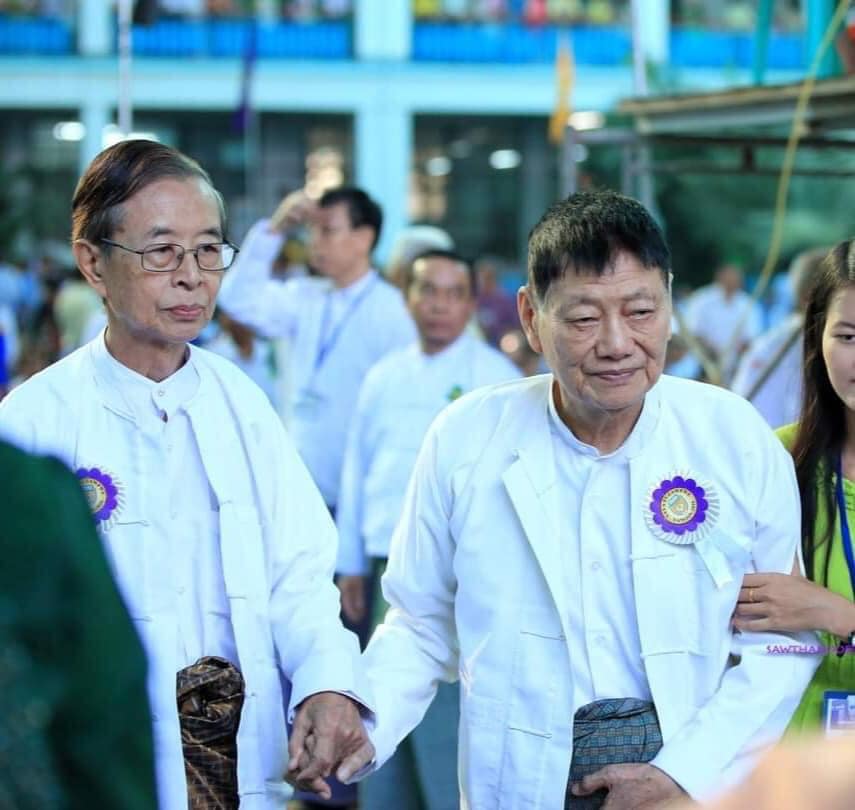
    Saya U Ba Than and U Aung Min

    Ko Tint Lwin (Daniel, M69) added :

    Thank you very much for your write-up about our 1999 “30th Anniversary of Graduation”. Actually. it all started in 1996 when I visited Burma and had dinner with a few of my close friends, including, Ko Shwe, Ko Win Mg, Ko Ye Pinn, Gabar Ko Myint Thein, etc. During dinner somebody mentioned that in 3 years time it would be 30 years since we graduated. Out of the blues I suggested to have a reunion in 1999. Everybody laughed as it was so far away. When I came back to Singapore and told Ko Sein Myint and Dickie they also laughed and told me that I must be crazy to think about so far away. However, time flies and in either late 1998 or early 1999 at Ko Win Htein’s funeral wake, some of our friends remembered the reunion proposal. They quickly formed a committee and organised the very first reunion at ‘Sait Taing Kya Restaurant. After the event I wrote you a report, Alice sent you a few photos and the rest is history.

    Ko Ivan Lee (M69) wrote :

    Dear Classmates,

    Recently rather than optimistic good news, we heard spreading pessimistic health concern news mostly.

    It clearly indicates that we are aging higher and health is going down lower and lower.

    I can Imagine 5 years from now how many will be terribly survived.

    I am kind of depressed that sooner or later we will be meeting THERE.

    At this moment all I can express is to wish our classmates who are in sickness to recover ASAP.

    Ivan Lee (M69)

    Zau Lai (EP69) wrote :

    Thank you, Ko Hla Min, for your writings. If it’s not for you there will be no records and history of R I T. I am reading interestingly all your writings all the time. When we all are gone your writing will live on.

    Aung Min (M69) added :

    So thanks for your recordings.

    Appreciations.

    Related Posts

    • Education Systems
    • Memories of 69er, CHM, PBRS, RIT, RUBC, SPHS, SPZP, Toastmasters, UCC
    • My Beliefs
    • My Dreams
    • My Passion
    • My Writings
  • SF Bay Area RIT Alumni Group

    SF Bay Area RIT Alumni Group

    by Hla Min

    Updated : June 2025

    It seemed not long ago

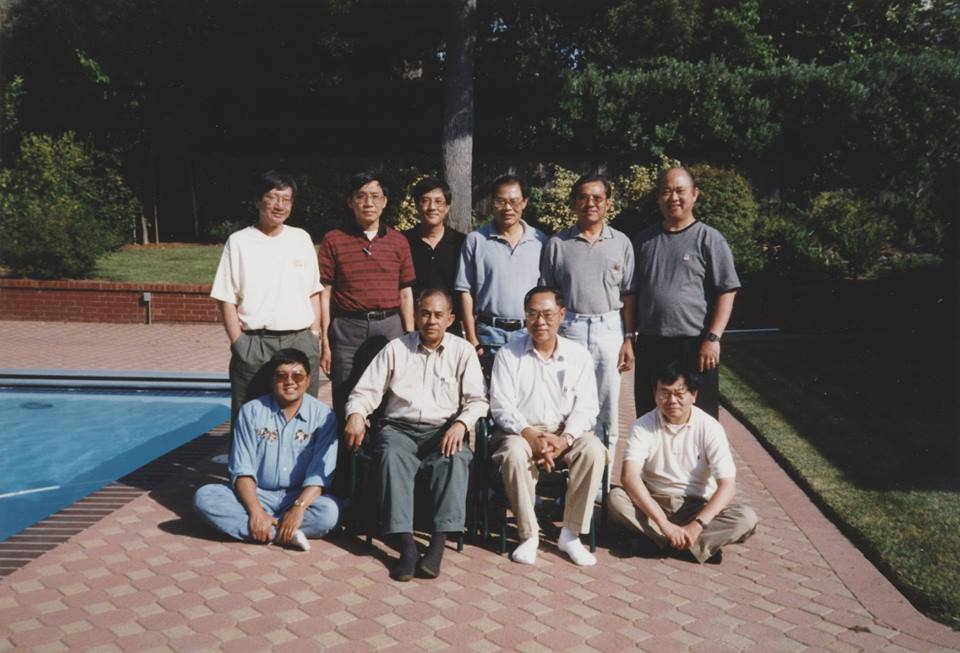
    • Standing:
      Saya U Maung Maung (George, ChE66), U Hla Min (EC69), Saya U Thein Aung (James, Met72), Saya Dr. Nyo Win (K H Chen, M65), Saya U Myat Htoo (C68), Benny Tan (Tan Yu Beng, M70)
    • Seated :
      U Kaung Kaung Oo (Gordon, M83), Saya Allen Htay (C58, GBNF), Saya Dr. Tin Aung (K C Chiu, ChE63), Maurice Chee (U Hla Myint Thein, M75)

    Founding Members

    The San Francisco Bay Area RIT Alumni met at the house of Benny Tan (Tan Yu Beng, M70) a couple of times to discuss the formation of “RIT Alumni International” to support the Newsletter and web site, and to consider the holding of a Grand Reunion and SPZP. They served as members of the Working Committee and Steering Committee for SPZP-2000.

    Saya Allen Htay (C58, GBNF)

    • Saya was the leader of the group. He served as President of “RIT Alumni International”, which organized the First RIT Grand Reunion and Saya Pu Zaw Pwe in San Francisco, California, USA in October 2000. His classic article, “Brother, can you afford US $500?” was partly responsible for five Golden Sponsors, and the generous donations by sayas and alumni.
    • He “retired” three times. His former students (U Thein Aung and U Myat Htoo) coaxed him to un-retire twice.
    • Saya did not recover from a debilitating stroke to spend time with his grand children. One grandson had “Allen” as his first name. Another had “Allen” as his middle name.

    Saya K C Chiu (Dr. Tin Aung, ChE63)

    Saya K C (Seated 3rd from Left)
    • He is the brother of Saya Dr. Aung Soe (C61).
    • He is a Past President of BEA.
    • After retirement, he relocated to Southern California.
    • Saya KC wrote : In early ‘80, Dr. Tin Win was working in Houston and came to the Bay Area on business trip. Dr. Tin Win was visiting me at home while Lily and I were discussing BEA matter. I believed they were meant for each other. The rest is history.
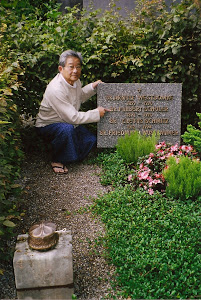
    Saya Dr. Nyo Win (K H Chen, M65)

    Dr. Nyo Win (Seated 3rd from Right)
    • He is a Past President of BAPS.
    • He was a Core Organizer for SPZP-2000.
    • He is a founding member of NorCal RITAA and served as a member BOD (Board of Directors.
    • He retired after working in high technology companies in the Silicon Valley and Taiwan.

    Saya U Maung Maung (George, ChE66)

    Saya George (Right)
    • He is a founding member of NorCal RITAA and served as the inaugural President.
    • He organized a fund raiser for the “Staff Training” component of “YTU Library Modernization”.

    Saya U Myat Htoo (C68)

    U Myat Htoo
    • He is a Past President of TBSA (Theravada Buddhist Society of America) and BADA (Burmese American Democratic Alliance).
    • He is a founding member of NorCal RITAA and served three terms as Chair, BOD of NorCal RITAA.
    • He was co-emcee of SPZP-2000.
    • He plays the ukelele and piano. One of his favorites is a parody of Sai Htee Saing’s song, “Lost Neikban”.

    U Hla Min (Life Long Learner, EC69)

    • He has completed 26 years as Founder and Chief Editor of “RIT Alumni International Newsletter“.
    • He served as Editor and Content Provider of RIT Alumni websites.
    • Per suggestion of U Thaung Sein (Steeve Kay, EC70), he chose to re-tire (re-thread) rather than retire.
    • Per suggestion of family members, sayas and friends, he decided to pay back to his alma mater(s): RIT and UCC.
    • He wrote 40+ postings of “Memories of UCC” in three days during his vacation to Myanmar.
    • He is Owner and Admin of hlamin.com web site and several Facebook groups.
    • He broadcast 220+ Educational Videos on selected topics.

    Benny Tan (Tan Eu Beng, M70)

    SPZP-2000 Orgsnizers
    • He succeeded Saya Dr. Nyo Win as President of BAPS.
    • He is a successful entrepreneur.
    • He is a multiple Golden Sponsor of SPZPs.
    • He designed the banner and mementos for SPZP-2000.
    • He is now having quality time with his six grand children and also taking trips and cruises around the world.

    Saya U Thein Aung (James, Met72)

    • He won Mr. RIT in 1968. His mentor was Commander Maung Maung, who won Mr. Burma in 1947. A few years back, he handed over the “Sa-Lwe” (for Mr. RIT68) to U Wynn Htain Oo (M72).
    • He was co-emcee of SPZP-2000.
    • He served as Contributing Editor for BAPS Newsletter and as Associate Editor of the Commemorative Issue of RIT Alumni Newsletter.

    Maurice Chee (Hla Myint Thein, M75)

    Maurice (Right)
    • He succeeded Benny as President of BAPS.
    • He wore multiple hats for SPZP-2000. He was the Co-Chair of the Working Committee (with Benny). He was the Financial Controller. He was the Publisher of the commemorative issue of “RIT Alumni International Newsletter”. He did the name tags. He also coordinated the culinary experts for the follow-up lunch gathering.
    • He is a founding member and Past Vice President of NorCal RITAA.
    • In August 2016, he organized the Soon Kway gathering at Dhammananda Vihara, Half Moon Bay for my birthday and to recognize my volunteer work.

    U Khin Maung Zaw (KMZ, EC76)

    UCC-RIT gathering
    • He belongs to three circles — St. Paul’s High School, RIT and and UCC — like Saya U Soe Paing and me.
    • He took the group photo.
    • He designed and implemented http://www.ex-rit.org website, which contributed to the planning and implementation of SPZP-2000. Many contributed to “Count down to the Reunion” and “Post Reunion” pages. I wrote 64 posts for “Count down to the Reunion” and 36 posts for “Post Reunion”.
    • He was then an eligible bachelor. He worked four 10-hour days and had a three day weekend.
    • He designed and implemented the first RIT web site, which was largely responsible for the success of SPZP-2000.
    • He promised to have Version 2.0 of the web (with better features).
    • Luckily for him, he moved to the challenging and lucrative job at Microsoft, and also became blessed with a wonderful family.

    U Kaung Kaung Oo (Gordon Kaung, M83)

    iNapa Winery
    • He was the youngest member of the group.
    • He founded “Mechanical Solutions” in San Francisco.
    • He and his spouse Lillian Kaung (EC83) later set up iNapa Winery and hosted several RIT-related gatherings.
    • He is a founding member of NorCal RITAA. He succeeded Saya U Maung Maung as President.
    • They also donated Premium Wine bottles for several events (e.g. the Annul Dinner and Summer Picnic for NorCal RITAA, 2005 RIT Alumni Reunion in Los Angeles). Their winery survived two fires.

    Related Posts

    • BAPS
    • NorCal RIT Alumni Association
    • RIT Alumni International
    • RIT Sayas & Alumni
    • SPZPs
  • Thein Han

    Thein Han

    by Hla Min

    Updated : June 2025

    Uncle & Aunt

    U Thein Han & Daw Khin Khin Htway

    Uncle

    • My youngest maternal uncle
    • Matriculated from St. John’s Dio
    • Graduated from Rangoon University
    • Worked for IBM Burma as System Engineer before moving to USA.
    • Still has a good memory
    • Has shared some stories.

    Aunt

    • Younger sister of Dr. Pe Nyun (Pediatric Surgeon)
    • Taught Psychology at Rangoon University
    • Studied Library Science in USA
    • Headed Burmese Section of the Library of Congress

    Selected Stories

    From March 1, 1929

    U Thein Han

    It’s been a long journey. I’ve passed the aged barrier of 90. From now on everyday is a bonus for me. My health is the same, no problem. Blood tests results are good. Memory is still sharp. I can drive my car for grocery shopping. I think I will be with you all this year.

    I’m living proof that Exercise and Healthy food will keep you in good health and prolong your life. I’ve been doing exercise since I retired in 1994 after I joined HP Senior Center using the Physical Equipment and having lunch at the center. I use light weights (30, 40 lbs) for arm, leg, thigh exercise and walk fast for 1/2 mile (10 minutes) on a Treadmill.

    At night before I go to bed, I do Balance exercise 3 times a week given to me by my Physical Therapist.

    So Folks, “It’s your life, Exercise, Eat Healthy Food, No Smoking and Drinking, Travel and Enjoy your good life”.

    A True Story

    When I was working at Montgomery County, Division Of Parking, during my lunch break I took a cab to go to a Chinese Restaurant in Silver Spring [Maryland, USA]. The driver was an African-American from Jamaica. On the way I had a conversation with him and came to know he had a daughter studying at Howard University (African-American University) to be a Lawyer. It happened that my wife was working as a Librarian at Howard University at Washington D.C. so I had a good chat with him. When we arrived at the restaurant I asked him if he had his lunch. He said, “No”. I invited him to have lunch with me. He accepted. I had a long talk with him about Jamaica. After lunch he dropped me at my work.

    A few days later while I was walking back from lunch in Silver Spring, it rained heavily. I did not have an umbrella. All of a sudden a car stopped beside me. It was James the Taxi driver that I gave lunch. He told me to hop in and took me to my office. When I asked him, “What is the fare?”, he said, “It’s on the house. No problem”.

    When you do a good deed to a person, you will be rewarded back one day with a good deed. This is my true story.

    I believe in luck

    It was in 1948 during my Rangoon University days I did Nation Newspaper Crossword Puzzle and won 2000 Kyats. At that time the value of Kyat was very good. With the money I won I bought a Jeep costing 3000 Kyats.

    My next luck was also during my University days when I went to a movie with my friend Ko Sein Lwin. On the return while I was driving my Jeep with my friend beside me, at the corner of Prome Road and Medical College I, we picked up 800 Kyats which was lying on the Road.

    When I arrived in Maryland (USA), I went to Safeway Grocery to buy bread. When I took the bread from the shelf I found $20 on the shelf. It was a great help to me when I was penniless.

    Another time was when I was walking on Wheaton Avenue with my son, we found $40 on the street.

    During our Burmese Christmas Party I won the door prize which was a Television.

    At the Thai King’s Birthday party given by our Thai friend, I won Thai Airways luggage for the door prize.

    At our Senior Center I won a Cup as a door prize.

    While working at Montgomery County, in 1977, I won 2nd prize of the Maryland Lottery which was $2000, because I hit five numbers out of six numbers. At that time $2000 was a lot of money. The 2nd prize is now one million Dollars.

    The 1st prize then was one million Dollars. On 25 August 2018 the 1st prize went up to 522 Million and it was won by 11 employees of a bank because they were lucky.

    The 13 Thai Cave Footballers survived because of their luck.

    My University friend Billy Wu From Maymyo went back home during a holiday, the UBA Dakota plane crashed due to bad weather, but he was lucky and he survived.

    Everyone has luck, but we don’t know when we will be lucky.

    My Barber

    Ko Aye Pe has been my barber since my University days in 1947 till 1971. He also cut the hair of my two sons. He worked at Varsity Hair Dressing Salon in Bogyoke Aung San Market. We were friends till I left for USA in 1971. He was a kind and obliging person and whenever I travel abroad I brought a shirt for him.

    On my first visit back to Myanmar in 2005. I wanted to see him and asked my friend U Hla Soe if he knew Ko Aye Pe’s whereabouts. U Hla Soe told me that he has retired and cuts people hair at his home and gave me his address.

    Ko San Aung (Sydney Tin, Ko Pyu) and I took a taxi and went to search for him. We found him living in an apartment near the Old Central Jail behind Medical College 1. He was very happy to see me. He told me he’s retired and he’s working at home and the barber chair that I’m sitting on was given by U Hla Soe. I had a long chat with him and returned back to Winner Inn Hotel.

    On my next visit to Myanmar two years later, we went to his apartment but was told by his neighbor that he had moved to Ahlone and gave us the address. We went there and found him living with his niece’s family. When we met him he was BLIND. His niece told him there’s someone to see him but did not tell who we were. I sat down next to him and asked him if he knew who I was. He touched my face with his hand to find out who I was. I then told him that I was Ko Charlie and came back to Myanmar for a visit. When he touched my face with his hand my eyes became wet and I was very sad to see him blind, he must be about 75 years then.

    It must have been Cataract which could have been treated and cured, maybe no one told him to see an Eye Doctor or that he may not have the cash for the surgery.

    Before we left I gave him Kyats 100,000 for being a good friend who was always willing to cut hair for my kids at home. We then said goodbye to him and returned back to Winner Inn Hotel.

    Ko Aye Pe was kind to me when I needed his services and his METTA to me. In return I was able to share what I can with him when he needed it.

    Related Posts

    • Demonetization
    • Stories
  • The (hidden) power of Kabyar

    The (hidden) power of Kabyar

    by Tekkatho Moe War & Hla Min

    Updated : June 2025

    Saya U Moe Aung (Tekkatho Moe War)

    U Moe Aung (Left)
    • Distinguished poet, writer, editor and publisher
    • Wrote for newspapers, magazines and journals
    • Compiled and published collections of his works
    • His mentor was Daung Nwe Swe (Laureate Poet)
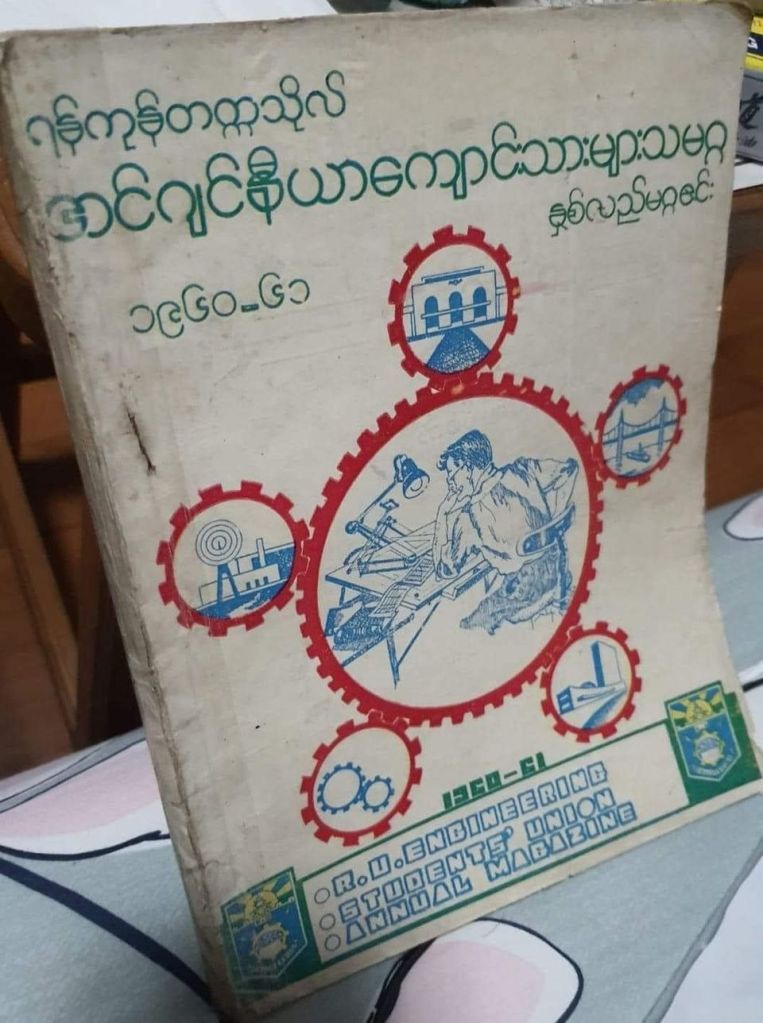
    • Served as an all-round volunteer for the publication of the Annual Magazine of RUESU (Rangoon University Engineering Students Union).

    Chief Editor and/or Publisher

    • RIT Annual Magazines
    • Hlyat Sit Sar Saung (for RIT EE Association)
    • Commemorative issues of Swel Daw Yeik Sar Saung for SPZP-2002, SPZP-2007, and SPZP-2010
    • Commemorative issues of Swel Daw Yeik Magazine for Swe YaDu and SPZP-2016

    The (hidden) power of Kabyar

    Kabyar is animate

    But [it’s life is] not just a [fleeting] morn

    Kabyar is a weapon

    But not for destroying the world

    Kabyar is key

    For liberation and independence

    But not devoid of principles [and morals]

    Kabyar has power

    Hidden but efficient & effective

    Like sharp-pointed spear-head

    Can thrust into [the heart of] a power-maniac

    Cause trembling, shivering, throbbing & anguished pain

    Poem in Burmese by Tekkatho Moe War (Saya U Moe Aung)

    Translated by Hla Min

    Related Posts

    • Poems
    • Poetic Art Series
    • Publications
    • Tekkatho Moe War’s Writings
    • Translation
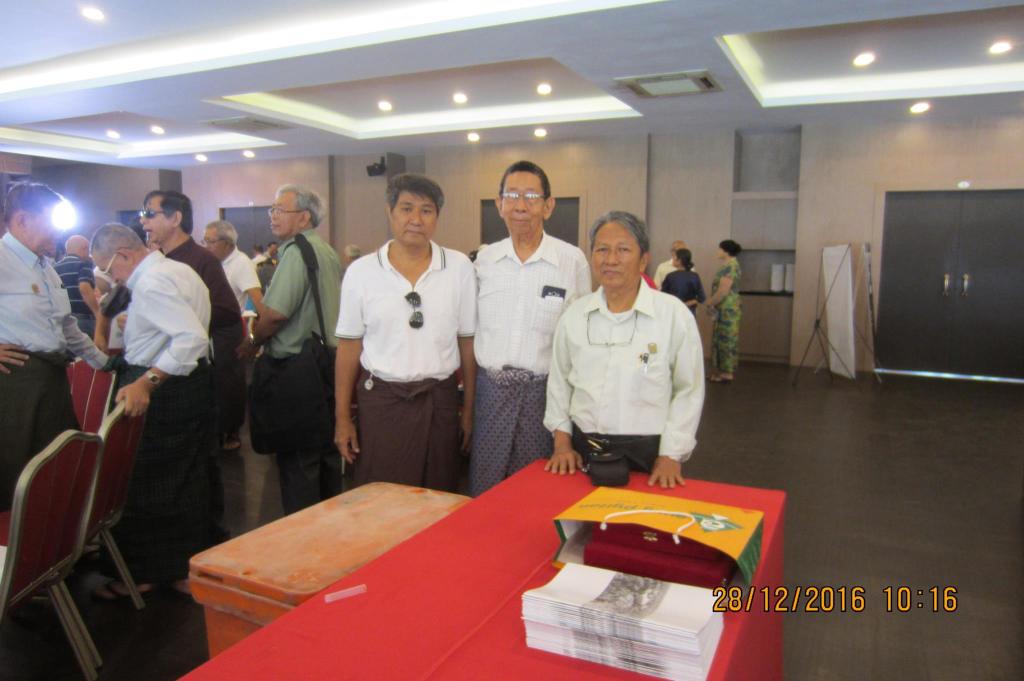
  • 64/65 Intake Gathering (Dec 28, 2016)

    64/65 Intake Gathering (Dec 28, 2016)

    by Hla Min

    Updated : June 2025

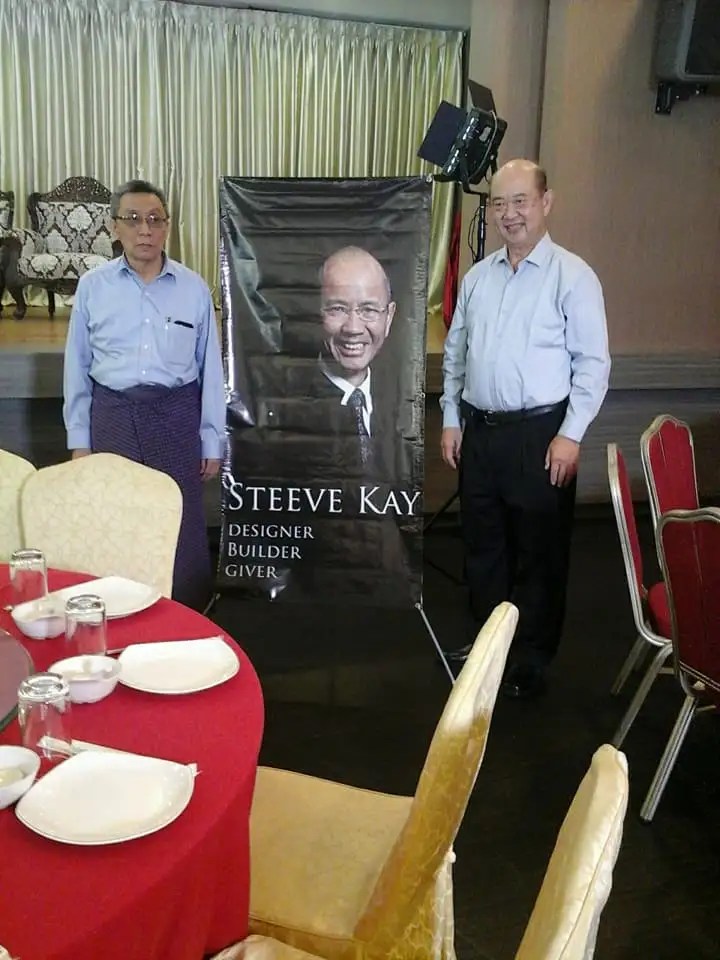
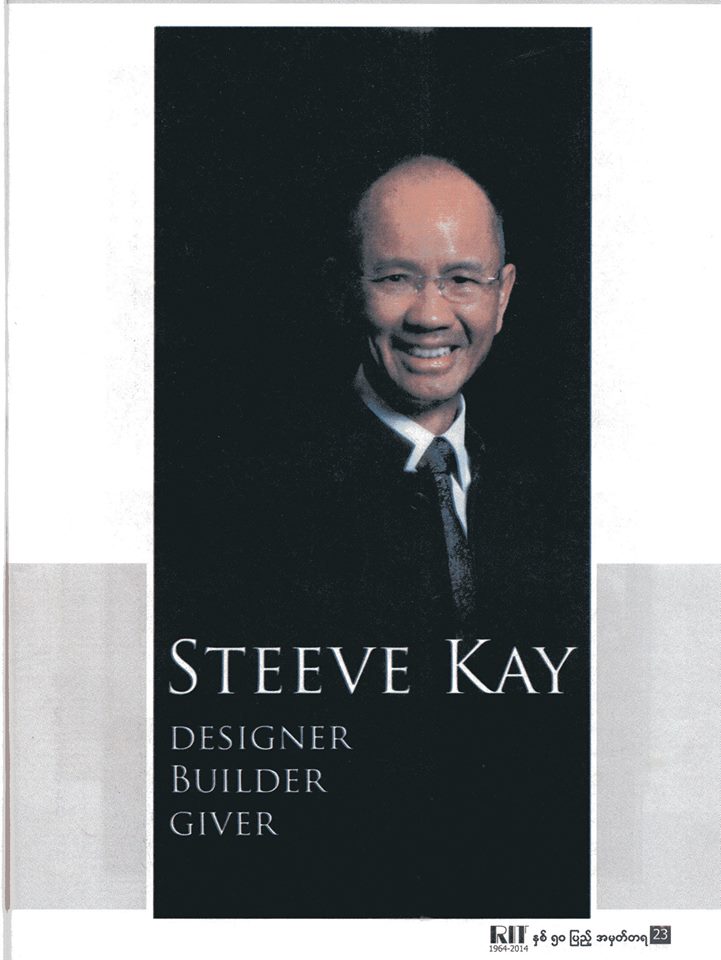
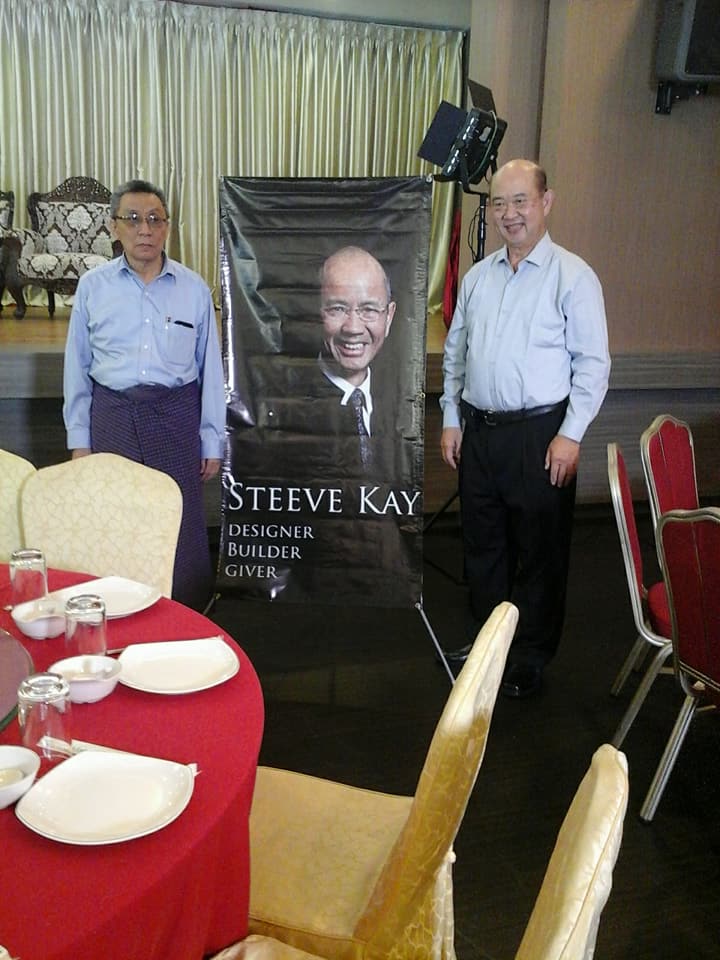
    Steeve Kay

    Designer, Builder, Giver
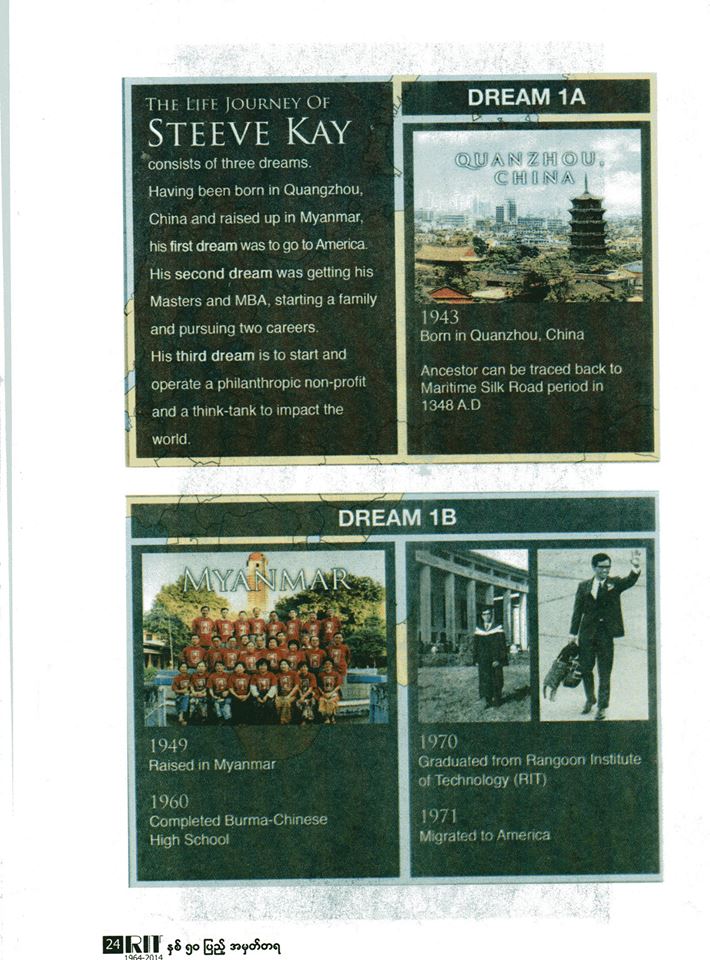
    • Admitted to 1st BE as a top student along with Zaw Min, Tommy Shwe, Cho Aye and Peter Pe.
    • Graduated with B.E (Electrical Comminication) in 1970.
    • Migrated to USA.
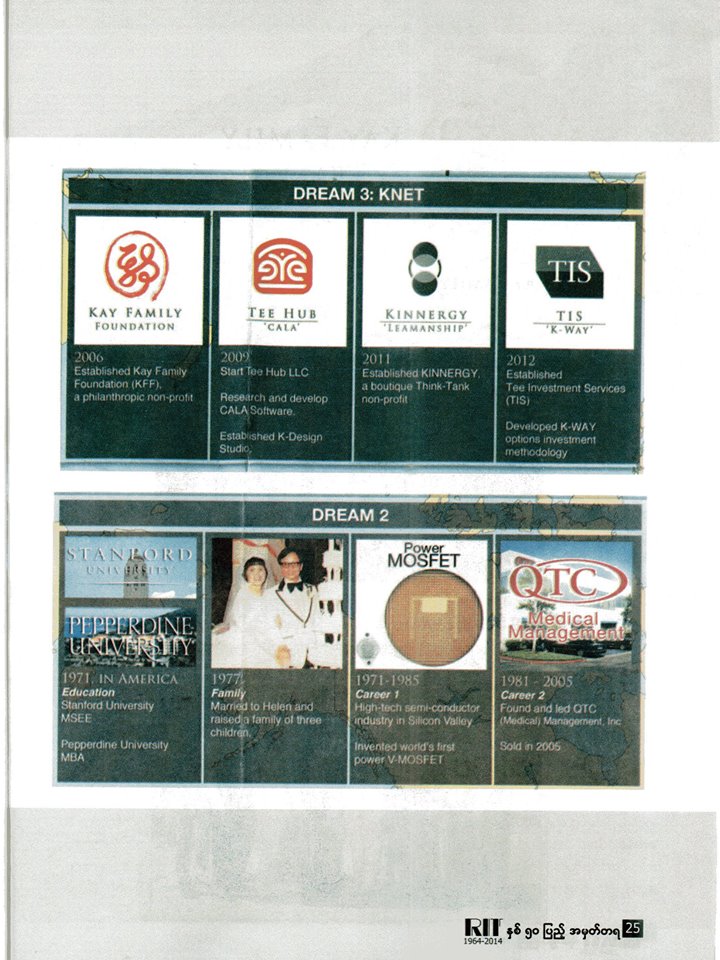
    • Received MS from Stanford University and MBA from Pepperdine University.
    • Had successful careers as IC Designer, Co-founder & CEO of QTC Management, Entrepreneur & Philanthropist.

    Steeve’s Dreams

    Dream 1A & 1B
    Dream 2 & 3

    Special Reunion & PZP

    • The Combined 1st BE intake of 64 & 65 hosted annually at least one Reunion and Acariya Pu Zaw Pwe.
    • Steeve Kay (EC70), Benny Tan (M70) and U Tha Htay (M70) were major Donors / Sponsors.
    • In 2006, Steeve requested Benny Tan and me to organize the event on his behalf. Due to his health, he could not travel to Yangon to host the event.
    • U Ohn Khine took me to U Win Htay’s office to meet the volunteers / organizers of “Combined 1st BE Intake of 64 & 65”. I asked the group to help realize Steeve’s request. U Win Htay & team agreed to copy the SPZP-2000 DVD & the commemorative issue of the RIT Alumni Newsletter to be provided in the Gift Package.
    • We requested U Khin Maung Kay (Mutu) to serve as Master of Ceremonies.
    • We requested Benny and Saya U Win Mra (English) to speak
    • I gave the Keynote at the event.
    • Sayas and Sayamas were offered mementos and Garawa money.
    Thant Zin, Ohn Khine, Zaw Win

    Special Gathering

    U Hla Min and Benny spoke at the event

    Greetings

    Welcome to this gathering! Today is a special gathering organized by the 64/65 intakes and sponsored by the Steeve and Helen Kay Saya Health Fund. Today’s event complements last month’s 64/65 intake held an Acariya Pu Zaw Pwe and tomorrow’s seventh RIT Grad Reunion and Saya Pu Zaw Pwe.

    Appreciation

    In addition to paying our respect to the sayas and sayamas, today we would also like to present to Ko Thaung Sein (Steeve Kay, EC70) an appreciation award for his continued support. Although Steeve Kay migrated to the US in 1971 to pursue his dreams, he never forgot his roots, his alma mater and his friends. Over the past 17 years, Steeve has made various contributions totaling $200,000. Highlights of those contributions are as follows:

    Golden Sponsor for SPZPs

    Steeve

    As you recall, the first ever RIT Grad Reunion and Saya Pu Zaw Pwe was held in the year 2000. It was started by a group of RIT students in San Francisco, among them Ko Benny Tan and me. I remember when I sent out the invitation flyers, we received a $1,000 check from Steeve. Later, he donated $3,000 as seed money to assist with fundraising efforts. Throughout the years, Steeve has supported multiple world-wide reunions and SPZP as a golden sponsor.

    Health Care Fund

    In June 2005, Steeve set-up a $50,000 Saya Health Care Fund administered by U Win Khaing of MES and his administrative committee. Many saya/sayamas attending today have benefited from that fund. Steeve Kay also helped to set-up a second fund, administered by the 64/65 intakes, as a supplemental retirement fund for the sayas and sayamas.

    Kay Family Foundation

    In May 2013, Kay Family Foundation, a philanthropic foundation set-up by Steeve Kay, sponsored the MoST (Ministry of Science and Technology) delegation to visit Centers of Excellence in California. The delegation was headed by the late Dr. Ko Ko Oo and Professor Nyi Hla Nge.

    2015 Alumni Reunion in Los Angeles

    2015 Alumni Reunion in Los Angeles

    Last year, in October 2015, Steeve Kay donated $30,000 in matched funds to hold the RIT in Southern California, Los Angeles. During the gathering, he sang a Burmese folk song ‘Shwe Me’ to express his feeling towards Myanmar, the land where he spent his youth growing up.

    Health concerns

    This year, Steeve Kay’s own health fell ill. We wish him good health. Instead of attending the RIT Grad Reunion himself, he asked Ko Benny to hold a gathering and Pu Zwe Pwe this year. Ko Benny consulted with his classmates and decided that December 28, 2016 – the day preceding the Seventh RIT Grand Reunion and Saya Pu Zaw Pwe – seemed to be the right time. The classmates, in turn, would like to honor their life-long friend and sponsor of numerous RIT-related activities.

    History and Philanthropy of Steeve

    The history of Steeve and his philanthropic work should be recorded and preserved for posterity.

    Every saya and sayama will be presented with a gift package from Steeve. It will include:

    • A short biography of Steeve
    • The commemorative issue of the RIT Alumni Newsletter for SPZP-2000
    • A two-set DVD of SPZP-2000
    • A CD of photos and articles related to SPZP and RIT-related activities
    • A monetary gift of K1 lakh for each saya and sayama, and an additional K1 lakh for sayagyis

    Agenda

    Today’s event covers three parts:

    • Paying respect to the sayas and sayamas who taught the Combined Intake of 64 and 65 students
    • A mini-gathering of the Combined Intake of 64 and 65 students
    • Appreciation award to be presented to Ko Thaung Sein (Steeve Kay, EC70)

    Ko Khin Maung Lay will be the emcee.

    Selected sayas and alumni will recall Steeve’s work and their importance and impact to the RIT community.

  • Dr. Nandamalabhivamsa

    Dr. Nandamalabhivamsa

    by Hla Min

    Updated : June 2025

    Dr. Nandamalabhivansa
    • Succeeded U Silanandavhivamsa as Rector of ITBMU (International Theravada Buddhist Missionary University).
    • Gave courses and sermons.
      Many are available as MP3.
    • Taught Abhidhamma in Myanmar and beyond.
    • Fundamental Abhidhamma Part I was first taught in 1997 at Maryland, USA. The book was edited by Dr. Khin Maung U (First in Burma in the Matric exam of 1963). The second edition was published by the Center of Buddhist Studies (CBS), Sagaing Hills in 2005.
    • Fundamental Abhidhamma Part II was published by the Center of Buddhist Studies (CBS), Sagaing Hills in 2007.

    Fundamental Abhidhamma Part I

    • By Dr. Nandamalabhivamsa
    • First edition : June 1997
    • Editor : Dr. Khin Maung U
    • Myanmar-Buddhist Meditation Society, Baltimore, Maryland, USA
    • Second, extended edition : January 2005
    • revised : November 2005
    • Center for Buddhist Studies (CBS), Sagaing Hills, Sagaing, Myanmar

    Contents

    The History of Abhidhamma

    (1) Why is it called Abhidhamma?
    (2) Who is the author?

    (8) The role of Abhidhammattha sangaha
    (9) The role of Vibhavani
    (10) Ledi Sayadaw
    (11) Paramatthadipani, the critic of Vibhavani

    This image has an empty alt attribute; its file name is abhidhamma-1.jpg
    Part One

    The Fundamental of Abhidhamma

    Chapter 1 : Citta
    Chapter 2 : Cetasika
    Chapter 3 : Rup (Matter)
    Chapter 4 : Pikinnaka (Miscellaneous)
    Chapter 5 : Vithi : Mental Process

    Fundamental Abhidhamma Part II

    This image has an empty alt attribute; its file name is abhidhmma-2.jpg
    Part Two
    • By Dr. Nandamalabhivamsa
    • Version Dec 2007
    • Center for Buddhist Studies (CBS)
    • Mahadubodhayon Monastery, Sagaing Hills, Sagaing, Myanmar

    Contents

    • Chapter 5 : Vithi
      Mental Process
    • Chapter 6 : Vithimutta
      Passive Mental Process
    • Chapter 7 : Paccayasangaha
      Compendium of Causality
    • Chapter 8 : Kammatthana Sangaha
      Meditation Subject

    Pathan Myat Dethana

    This image has an empty alt attribute; its file name is book-4.jpg
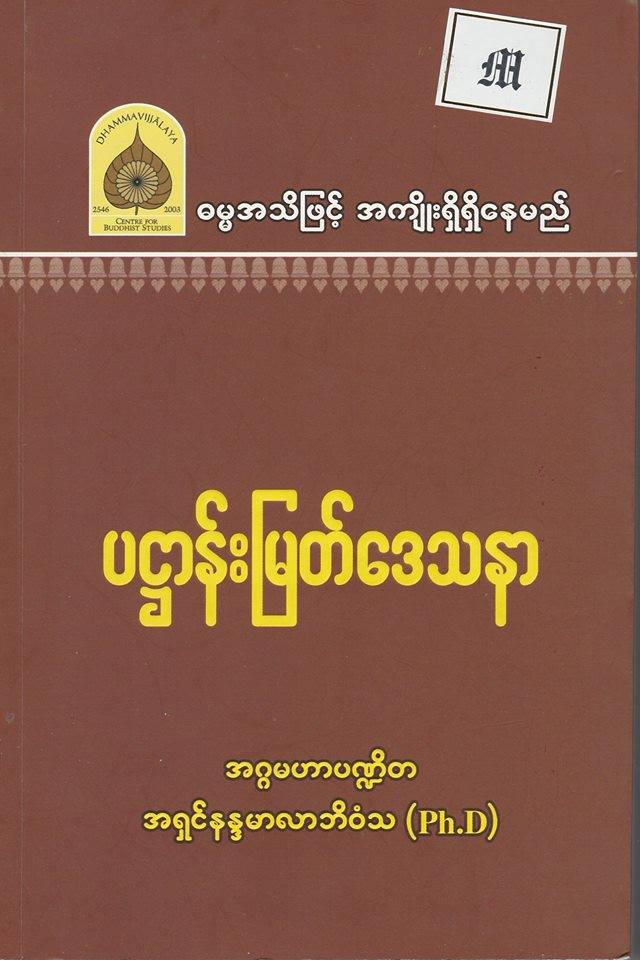
    • “Pathan Myat Dethana” by Dr. Nandamalabhivamsa (Rector of ITBMU).
    • U Ye Sint gave me the book as Dhamma Dana.
  • Visits with Bros. Charles and Felix, July 2007

    By Thongwa Kyaw Win

    Updated : July 2025

    Brother Charles with U Kyaw Win

    Yo Salleans, Paulians, and all other BOBs:

    This is a belated report of my wife Gandasari’s (“Riri”) and my visits with Brother Charles Everard in Liss (Hampshire, England) and Brother Felix (Albert Gissler) in Illertissen (Germany). Technical and other problems got in the way, delaying this report.

    Saturday, 7 July 2007

    After attending Dora Than E’s funeral in Oxford, followed by a reception at St. Hugh’s College (Aung San Suu Kyi’s alma mater), our friends Ken & Marion Freeman of Pershore, drove us through the English countryside to Liss, Hampshire. It was a pleasant 2.5-hour drive on uncrowded roadways. (Some of you may recall Aunty Dora as the recording artiste of yesteryear whose professional name was Beelat-pyan Than. She later worked for the United Nations, beginning at its founding in 1948 at Lake Success, New York. Had she survived her final fall, she would have turned 100 on 16 February 2008.)

    Clayton Court, the De La Salle Brothers retirement community at Liss, is a beautiful 22-acre estate with gently manicured lawns, gardens, and gorgeous views of the rolling hills. There are three large structures on the gated property. It is a place with spirit, where one’s soul is rejuvenated. The Fratres Scholarum Christianarum, (Christian Brothers), acquired this estate, once owned by a wealthy gentry, in 1974. The other FSC retirement home in England is located in Manchester.

    We arrived at Clayton Court about 5:45 P.M. The place was abuzz with staff, volunteers, and neighbors who were preparing for a party for one of the brothers’ 70th birthday. The brothers were in the chapel doing devotions. Becky, a staffer, who was my contact, was most gracious. There was another staffer whose forearms were heavily tattooed. “Were you in the royal navy?” I asked. “Yes,” he said with a glint in his eyes. “I was a cook on the aircraft carrier Ark Royal,” he answered with pride. The two were most welcoming and amiable. From them, I took comfort that the brothers were living and eating well.

    When prayers were over, Brother Director Joseph Hendron wheeled Brother Charles out of the chapel. I recognized the former right away even though I had not seen him since 1979 when my De La Salle, and later St. Paul’s classmate, Brother Patrick Minus, and I visited him at the Brothers’ Mother House in Rome. I do not know whether Brother Charles recognized me, but he broke out in a big smile when I greeted him in Burmese. At 89, dementia has diminished much of his memory and affected his speech. I helped him eat some of the goodies that were generously spread out on the table. He uttered a few words in Burmese: “taw bee, …yay ne ne thauk chin de,” (တော်ပြီ။ ရေနည်း နည်း သောက်ချင်တယ် enough.., want to drink a little water), etc. I spent the rest of the afternoon with Brother Charles and the other party goers until the celebrants faded away.

    Brother Director Joseph is truly a personification of tremendous love and patience. He was most gracious. He made us feel very welcome. We were accommodated in comfortable guest rooms which commanded beautiful views of the estate.

    Sunday, 8 July 2007

    Riri and I took a leisurely stroll on the estate as the sun shone over the countryside. At breakfast, I sat on Brother Charles’ left while Brother Joseph occupied the end seat on the right. Both Brother Joseph and I helped Brother Charles with his breakfast. His appetite was good.

    Breakfast over, I wheeled Brother Charles back to his room. The room was nicely decorated with Burmese and other memorabilia. There was a large framed photograph of a much younger Brother Charles of his Burma days. (I recall seeing him in 1959 at the Kalaw Railway Station as he hopped on to the steam locomotive. “I always ride in the gaung dwe (locomotive),” he harked, as the train pulled away towards Thazi. He was happy as a lark. (Riri and I were teachers at Kalaw’s Kingswood School that year).

    Bidding Brother Charles adieu was difficult. I had known him when we were both young long years ago at a place so far away.

    We took leave of Brother Joseph and the other Brothers later that morning. Ken and Marion drove us to Liphook from where we boarded the National Express coach for London’s Victoria Station. (Marion and I began our friendship as pen pals when we were both 16. I was then at Woodstock School in the Himalayan town Mussoorie, India, in 1950).

    Brother Charles with U Kyaw Win
    Clayton Court, Liss, Hampshire, England

    Monday, 9 July 2007

    After spending the night in London, we flew to Frankfurt, arriving there in the evening. We bedded down at Hotel Manhattan, conveniently located across the street from the Frankfurt bahnhoff (railway station).

    Tuesday, 10 July 2007

    The train from Frankfurt took us to Ulm where we changed for Illertissen. It was raining when we got there in the afternoon. We started to walk towards Kolleg der Schulburder. A kind gentleman picked us up along the way and drove us to the Kolleg, sparing us from getting wetter. (He did not speak English. We did not speak German. But the language of the heart transcends all tongues).
    Brother Felix, who is known as Brother Albert at the retirement home, was brought out to a waiting room. He walked with the help of a stick, and a walker, alternately. He was as happy to see us as we were to see him. (I had last seen him, and Brother Peter, over thirty years ago, in Germany). His first words were: “You look like your father.” What a compliment!

    Once he got warmed up after muttering a few words in German, the talk gushed out. He talked and talked, recalling his days in Burma; as a prisoner in Dehru Dun (India) and Insein Jail; De La Salle, St. Paul’s.Dinner that evening was at a restaurant. When Brother Felix noticed a paunchy man sitting at the next table, he remarked: “Baik pu gyi,” (ဗိုက်ပူကြီး paunchy fellow), a mischievous glint in his eyes.

    Because guest accommodations at the Kolleg der Schulbruder were occupied by a visitor from Rome, we lodged at Hotel Vogt for the next two nights.

    This was also Riri’s birthday. I snuck out of the hotel quietly and walked the streets of tiny Illertissen in search of a bakery. But it had shut down for the night. I was fortunate to get a cake from a restaurant just as it was closing. With the help of the hotel’s staff, I was able to surprise her.

    Wednesday, 11 July 2007

    In the morning, we were fetched and taken to Kolleg der Schulbruder where Brother Felix was waiting for us at the breakfast table. But we had just eaten at the hotel. So we nibbled a bit while he ate. After breakfast, he showed us the chapel, grounds, gymnasium, and gardens at the school. There are only lay teachers at the school. The numbers of those entering the FSC are getting thinner and thinner. A section of the campus is partitioned off as a retirement home for the brothers.

    A sumptuous lunch prepared by the kitchen staff was served. When he saw the generous fare spread over the table, Brother Felix remarked, “Do they think we are starving?” That was typical of him, wit fully intact.

    At 93, Brother Felix is the most senior retiree at the home. He has a comfortable room with an attached bath. “When I die, everything I own can be cleared out of this room in ten minutes,” he said.

    After a brief rest, another non-English speaking brother drove us around that charming Bavarian town. Sightseeing ended after visiting the graves of Brothers Fulbert and Peter in the well maintained cemetery. A section of the cemetery is reserved for brothers and priests. The graves were well tended, a profusion of flowers growing on them.

    Afterwards, we were driven back to the hotel where a teary Brother Felix hugged and kissed us before he was driven back to the retirement home. “Pray for me,” he asked. “I pray for all the people of Burma,” were his parting words.

    Bidding Brother Charles and Brother Felix at their respective retirement homes was very difficult. Brother Felix was only 18 when he left his family and country to go to Burma as a missionary with the (French) Christian Brothers Order of the Roman Catholic Church to serve a lifetime as a teacher. But it gave me joy that I could honor these two teachers in the sunset of their days. “Parting is such sweet sorrow…”

    If there is one word that comes to mind which describes these two brothers retirement communities, it is COMPASSION, of which there was an abundance.

    Brother Felix at Kolleg der Schulbruder_1, Illertissen, Germany, July 2007
    Brother Felix at Kolleg der Schulbruder_3, Illertissen, Germany, July 2007
    Brother Felix with U Kyaw Win_1, Illertissen, Germany
    Brother Felix with U Kyaw Win_2, Illertissen, Germany
    Brother Felix at Kolleg der Schulbruder_2, Illertissen, Germany, July 2007
    Brother Felix with Gandasari and U Kyaw Win, Illertissen, Germany, July 2007
    U Kyaw Win at Bro. Fulbert’s grave, Illertissen, Germany, July 2007
    U Kyaw Win at Bro. Peter’s grave, Illertissen, Germany, July 2007


    I thank Margaretha Sudarsih (“Menuk”) for blogging this report for me.

    The holy season of Christmas is upon us. May peace, joy, and good health of both body and mind be yours. UPDATE: Brother Charles passed away on 28 December 2007. May “flights of angels sing thee to thy rest.”

    I am yours sincerely, a grateful product of the Christian Brothers schools,

    U Kyaw Win
    8566 Flagstaff Road
    Boulder, CO 80302-9531, USA

  • East Coast Reunion 2009

    East Coast Reunion 2009

    by Hla Min

    Updated : June 2025

    East Coast Reunion

    Organizers

    The first East Coast Reunion took place in Virginia in 2009.

    U Nyein Min (C79), Dr. L Sein Myint (M73) and the alumni in East Coast organized the Reunion.

    Attendees

    Most attendees were from the East Coast (Virginia, W Virginia, New York, New Jersey, Maryland, Connecticut).

    Some sayas and alumni who are not from the East Coast include

    • U Hla Min (EC69) from Northern California
    • Saya U Tin Htut (M69) from Southern California
    • U San Myint Thane (Sammy, EC79) from Texas
    • U Kyaw Than (ex-UBA, GBNF) & Daw Rosemary Than, U Tha Aung (M) & Daw Kinsa Maw Naing (ChE) from Canada

    Hosts

    During my trip, Dr. L Sein Myint, U Wynn Myint Aung (EC76, GBNF), U Htin Linn (ex-PTC) and my uncle U Thein Han hosted me.

    Dr. Win Aung (M62, iNEER) and spouse hosted a dinner for us.

    Memories

    U Min Han (ChE77) took most of the pictures.

    East Coast 8
    East Coast 7
    East Coast 6
    East Coast 5
    East Coast 4
    East Coast 3
    East Coast 2
    East Coast 1
  • Tekkatho

    Tekkatho

    by Hla Min

    Updated : June 2025

    • Less than 10 percent passed the Matriculation exam in the early days.
    • It was an honor to prefix one’s name with Tekkatho တက္ကသိုလ် or University.
    • Khin Nyo wrote: Absolutely right. I think in 1957 only 2% Passed and the total is 20000.
      Even dancer AmarSein was conferred with the title Thekkatho Amar Sein by the Rector Dr Tha Hla.

    Tekaktho Moe War (U Moe Aung)

    U Moe Aung
    • Matriculated from St. John’s Dio.
    • EC of RU Kalaung Shin Ah Thin
    RU Association
    • Editor, RUESU Annual Magazine
    RUESU Magazine
    • Taught Electrical Engineering at RIT.
    EE Sayas
    U Moe Aung & U Sein Maung
    • Chief Editor, RIT Annual Magazine
    • Editor, Hlyat Sit Sar Saung
    • Worked in Singapore
    • Chair, SPZP-2002 and SPZP-2010
    • After retirement, moved back to Myanmar
    • Taught refresher courses (e.g. Electrical Saftey) at Electrical Inspectorate.

    Publications

    • Kept mind alert by writing poems and articles in the weekly publications.
    • Distinguished Writer, Poet, Editor and Publisher.
    • Editor, RUESU Annual Magazine
    • Chief Editor, RIT Annual Magazines for more than a decade.
    • Chief Editor, Hlyat Sit Sar Saung
    • Chief Editor, Commemorative issues of Swel Daw Yeik Sar Saung for SPZP-2002, SPZP-2007 and SPZP-2010 in Singapore
    • Chief Editor, Commemorative issues of “Swel Daw Yeik Magazine” for Shwe YaDu in 2014 and SPZP-2016 in Yangon
    • Published Kabyars (one book for solo, another book by RIT poets and another by former EC members of Tekkatho Kalaung Ah Thinn)
    • Published book (Collection of articles)