Category: UCC

  • Memories of UCC (0 – 8)

    Memories of UCC (0)

    Prolog

    In the early days, there were no computers in Burma.

    IBM (International Business Machines) based in the USA and ICL (International Computers Limited, formerly ICT) based in the UK had presence in Burma, but both companies were not ready to introduce computers to Burma. They were contented with leasing unit-record equipment (calculators, tabulators, …) using punched cards (which were “reused” as wrappers of ” zee thee htokes “). The companies maintained the machines with their staff. U Aung Khin was the IBM representative in Burma. U Kyaw Tha was the ICL representative in Burma. They were highly paid compared to the Government employees. Due to the policies then in place, IBM might not have incentives to introduce computers and computing technology to Burma.

    In the early sixties, Saw McCarthy Gyaw (Burma Railways) wanted to upgrade the unit record systems to an ICL computer, but the Coup d’etat in 1962 and subsequent restriction of foreign currency exchange (and budget planning rules) effectively derailed the idea of “computerization in Burma”.

    In the mid sixties, Dr. Chit Swe (Saya Chit) was Head of the Mathematics Department at the Institute  of Economics. Saya proposed the need of a computer for teaching and research to Dr. Nyi Nyi, then Secretary [Deputy Minister] of Education. Saya Nyi Nyi suggested the scope to be extended for a computer to serve the staff and selected students of the Universities and Institutes. Thus, the UCC (Universities’ Computer Center) Project was born.

    Saya Chit became Professor at Mathematics at RASU (Rangoon Arts and Science University). He offered space at the Mathematics Department for the early volunteers of the UCC Project. He later obtained permission to use Mandalay Hall for use by the UCC Project before the UCC Building could be completed in Thamaing College Campus .

    Saya served as the Founder/Director of UCC. He initiated the academic and training programs. He stressed the importance of technology transfer, leapfrogging technology, knowledge sharing (internally and externally), and challenging the staff and students to try their best.

    Saya Chit requested U Soe Paing (Saya Paing) to help design and implement the UCC project. Saya Chit also inquired the mother of U Myo Min (Saya Myo), who was working at IBM UK after completing his CA (Chartered Accountant) if Saya Myo would be interested to come back to Burma and help with the UCC project. Saya Paing recruited his friend U Ko Ko Lay (Saya Lay) to help with the UCC project in general and with the UCC Building Design and Implementation in particular. Saya U Shwe Hlaing, who initially helped the UCC project, received a promotion as Lecturer and had to relocate.

    As Saya Paing mentioned in “Computer ah sa UCC ga“, it took a long time to get UCC up and running. UN finally approved the UCC project with UNDP (United Nations Development Program) as the Funding Agency and UNESCO (United Nations Educational, Scientific and Cultural Organization) as the Executing Agency.

    Notes

    For several years, Saya Paing tried to recruit his top students — including my cousin U Thaung Lwin (EC66) — to help with the project and become the pioneer computer engineers. U Thaung Lwin, who was Top of his class, received an offer to join IBM Burma. It was good news and bad news. The good news was that he was offered a high salary (compared to the then salary of engineers joining the Government Departments). The bad news was that he would have to wait a long time until the first computer was purchased and installed at the CSO Computer Section. He had to maintain the “leased” Unit Record Machines for several years.

    Dr. Tun Aung Gyaw (U TAG, EC69) was the first and longest volunteer for the UCC Project.

    Saya Paing transferred from the Department of Electrical Engineering (EE) at the Rangoon Institute of Technology (RIT) to UCC as Manager of the Systems Division.

    Saya Lay transferred from PWD to UCC as Manager of the Operations Division.

    Saya Myo joined UCC as Manager of the Applications Division.

    Saya Paing left UCC in the eighties to pursue a career as Technical Adviser and Consultant for the UN (United Nations) projects in several countries. He has documented his experiences from the early States Scholarship to the UN assignments. They are available in SCRIB-D

    I was fortunate enough to be a member of Generation Zero along with my mentors and Saya TAG.

    Since there are blanks to be filled in the history of UCC, DCS (Department of Computer Science), ICST (Institute of Computer Science and Technology) and UCSY (University of Computer Studies Yangon), several people asked me to take the challenge or at the very least motivate others to share their experience and journey regarding IT in Burma.

    I am relying on

    (a) my memory, which is reasonably good but imperfect,
    (b) my story telling skills which I inherited from my father, “Thin Saya“, “Myin Saya” and “Kyar Saya”,
    (c) my training in “Communication and Leadership” from Toastmasters International to become a DTM (Distinguished Toastmaster),
    (d) my experience as a freelance writer, editor, translator, editor, coach, mentor

    to prepare material in the form of readable chunks.

    I request sayas and alumni to enhance the document with photos and anecdotes.

    Memories of UCC (1)

    The Early Days Of Computerization In Burma

    • UCC was founded in 1971 with Saya Chit as Director, Saya Paing as Systems Division Manager, Saya Myo as Applications Division Manager, and Saya Lay as Operations Divisions Manager.
    • The UCC Project was started by Saya Chit (then Head of Mathematics Department at the Institute of Economics) with the help of Saya Paing (then Assistant Lecturer of Electrical Engineering at the Rangoon Institute of Technology) and several others.
    • The early days of Computing in Burma/Myanmar has been presented in several articles in Burmese and English by Saya Paing including “Computer ah sa UCC ga”. 
    • U Aung Zaw (Saya Zaw) has also recorded his memories about UCC in his book “Bawa and Dhamma“. The book was published and distributed by his elder sister.

    Early Departments At UCC

    The early Departments and sub-departments at UCC include the following :

    (a) Office Of The Director

    The Office is used to hold meetings with Board of Directors & Advisers. It also provided service for the Experts including Dr. S. I. Saleeb (Project Director) and Professor Harry D. Huskey (GBNF)

    (b) Administration

    U Myint Aung (GBNF) was the Superintendent. He was healthy and passed away lately in his eighties. He was succeed by U San Win. He unfortunately suffered a stroke.

    There were several Clerks : UDC (Upper Division Clerk) and LDC (Lower Division Clerk). e.g. Ko Ba Than Chein, Ko Than Aye, Ko Tun Myint, Ko Khin Maung Lwin, Ma Than Aye.

    There were several Peons. The four Sayagyis had a Peon each as their PA (Personal Assistant).

    There were three Secretaries (for preparing reports and teaching materials). Daw Khin Lay Myint (GBNF), U Win Myint (U Win Myint Gyi, Bo Waing, High School Luyechun), and Daw Khin Khin Su). All later made career changes. Daw Khin Lay Myint became an Admin Officer. U Win Myint became a Programmer and later worked (taught, translated …) at Winner Computer Group. Daw Khin Khin Su moved to Total (Oil Company owned by the French).

    There were several Security Personnel (for the day, evening and night shifts). U Tun Kywe, an army Veteran, usually guarded the entrance to the Computer Room (on the Ground Floor of the UCC Building). He also vetted the visitors climbing up the stairs to meet the staff.

    There were several Maintenance Personnel. They include Daw Ngwe Tin, Maung Myint, Aye Aye Myint, Hla .Hla Myint, U Hla Pe Maung Myint

    There were a couple of Drivers. Sad to note that Saya Chit’s driver (who moonlighted as a Side Car Operator) was hit by a train at a railroad crossing.

    There were volunteer drivers including U Myint Aung, Ko Win Hlaing, and Ko Soe Myint Gyi.

    (c) Systems Division

    Saya Paing, as Systems Division Manager, managed

    • Engineers
      U Tun Aung Gyaw (Saya TAG), U Hla Min (Systems) and U Soe Win.
    • Technicians
      U Aung Myint (AM), U Ngwe Soe (Silver) and U Myint Soe (Byte)
    • System Programmers
      U Aung Zaw (Saya Zaw), U Maung Maung Htay (Bo Htay), U Than Lwin …
    • System Librarian

    Ko Soe Myint (KSM, UN Retiree) wrote :

    Also included in Systems Division before I left UCC were Saya U Mg Mg Htay, U Than Lwin, Rafi (Rafiul Ahad), U Tin Win, U Soe Win, KSM, KZ (Ko Khin Zaw), KMZ (Ko Khin Mg Zaw), Silver (Ko Ngwe Soe), Ko Mg Mg Tun, Ko Win Mg, Tin Tin Pyone. Later Eng U Tin Win and Tin Tin Pyone moved to FRI (Forestry Reserve Inventory).

    Notes

    I was a Hardware Engineer before becoming Senior Systems Programmer, Business Applications Manager (all at UCC), Lecturer at DCS (Department of Computer Science) and Associate Professor of Software Technology at ICST (Institute of Computer Science and Technology).

    Saya Zaw and U Than Lwin transferred to CSO (Central Statistical Organization).

    U Soe Win transferred to PTC (Post & Telecommunications). KMZ moved to Singapore and then to the US. Rafi moved to Thailand and then to the US. Silver moved to Singapore. Saya TAG, U Mg Mg Htay and Ko Mg Mg Tun moved to the US. Ko Win Mg moved to Australia.

    (d) Applications Division

    Saya Myo, as Applications Division Manager, managed Application Programmers & Analysts for business applications, scientific & engineering applications. Later, the Applications Division was restructured in Business Applications Division (with Saya Myo as Manager) and Scientific Applications Division (with Saya Lay as Manager).

    Notes

    Saya Paing subsequently managed both Systems Division and Operations Division. Bo Shoke (U Mya Thein, GBNF) was the most vocal among the application programmers.

    Application Programmers include Ah Thay Lay (U Thein Oo), Mra (U Mra Tun), Kyein (U Kyaw Nyein, GBNF), Htaw Kyin (U Htin Kyaw), Saya Maung (U Tun Shwe), Japan Sayagyi (U Aung Hlaing), Joe Than (Dr. Soe Than), U Myint Oo, U Win Naing, Ju Ju (Daw Tin May Lwin), Daw Thin Thin Aung, Judy (Daw Nwe Nwe Win), Ma Nge (Daw Nge Ma Ma Than, GBNF), Daw Than Than Tint, Daw Gilmour Hole, Boe (U Boe Ba Shan), Daw Hpyu Hpyu Aung, Gary (U Sein Myint Maung), and Ma Mu (Daw Khin Aye Mu).

    (e) Operations Division

    Saya Lay originally managed the Operations Division. After the restructuring, Saya Lay managed the Scientific Applications Division. The Operations Division was handed over to Saya Paing.

    Pauk Si (U Hla Min, GBNF) was CO (Chief Operator). There were several Operators. They include MMG (U Mg Mg Gyi), Ah Ba (U Maung Maung Lay), Ah Leong (U Kyaw Swar), Dobat Sayagyi (U Win Hlaing), Sunlun Kappiya (U Soe Myint, M72, GBNF), U Myint Swe, U Hla Aung, U Kyi Win, U Tun Kyi, U Tin Win, U Than Tun, and Charlie (U Myint Lwin, Burma Judo Champion). Several later made career changes as Programmers and Teaching Staff. U Soe Myint retired as Pro-Rector.

    In the early days, CO, MMG, Ah Leong, Dobat Sayagyi, Sunlun Kappiya … served as Shift Leaders. There were three Shifts. The Morning Shift was run for staff, students and general users. The Evening and Night Shifts were run for selected user departments. The Population Census Data Project had a high priority.

    There were several operators for card punch, manual punches, punched card verifiers, and sorter. Some did double duty as Job Controllers. They include Daw Nyunt Nyunt Tin, Daw Thi Thi Aye, Daw Hla Hla Win (GBNF), Daw Win May Thaung (GBNF), Daw Kyu Kyu Lwin (GBNF), and Busibaung (Daw Khin Si Thaung). Several later changed their careers or went overseas. There was also a Librarian in charge of the Magnetic Disks and Magnetic Tapes.

    (f) Volunteers

    Kudos to the many unsung heroes who volunteered for gratis or for a per diem of Three Kyats and Fifteen Pyas. They worked for various divisions. Without them, the introduction of Computer Technology to Burma would not have been smooth and successful.

    Memories of UCC (2)

    CO U Hla Min (Pauk Si, GBNF)

    Grape vine says that CO (Chief Operator) U Hla Min was named Pauk Si by his classmates at SPHS (St. Paul’s High School). His father had lent money to a Pauk Si vendor, but the vendor could not pay back the loan. So, at break time, he would go to claim one Pauk Si or more depending on his appetite. He matriculated in 1964 and received his B.E. (Electrical) in 1970. He joined UCC in 1970 as CO. Under the UCC program, he studied for a year in UK and also found his soulmate Daw Tin Win who was undergoing advanced nursing training.

    He was afraid of getting hospitalized. He was healthy. He would rarely wear the “coat/jacket” that was mandated for those working in the “air conditioned” Computer Room. He would often wear a sports shirt. So, it was a surprise to learn that CO, after returning from spending as a temporary monk at Taung Pu Lu monastery, fell ill. He was admitted to RGH (Rangoon General Hospital) where Dr. Min Lwin (Maurice Hla Kyi, Fifth in Burma in 1964 from SPHS, Roll Number 2 at IM2, cousin of “Lake” Win Maung, and CO’s classmate) examined CO and found out that CO had a serious problem. CO’s voice had lost intensity during his stay in the hospital. He told us to be good towards the sayas, colleagues, friends and family members. We sensed that it was his farewell message. Sad to say, he passed away in his mid-thirties. He did not drink or smoke, but he ate (may be a little bit indiscriminately). He presumably had Hepatitis and later “cirrhosis”.

    Tone Kyaw

    When CO passed away at the tender age (may be 35), I became a Tone Kyaw. Some people were not aware that there were two HLA MIN who attended SPHS & RIT & worked at UCC. They both have spouses from the medical profession. So it was not surprising when two government departments where I had given guest lectures inquired UCC where and when they could send wreaths (Lwan Thu Pan Khwe) for me. A representative from one department said, “It is said that people laugh a lot before they die. U Hla Min was telling us jokes.” A person from the second department said, “U Hla Min looks frail and unsteady when he walks. No wonder he passed away.” To top it all, Ko Moe Hein (Ajala, ChE69) took a day off to send me off. He was RIT Selected for Swimming and Water Polo. He had a loud voice that can drown the voices of ten or so “normal” people. So he became the de facto cheerleader for the RIT Sports Teams. He was working at HI (Heavy Industries), where my older brother was in charge. At Kyandaw Cemetery. he came down from a bus. When he saw me, he stared at me as if I was a ghost. He explained, “Your brother seemed so calm when we learned that you had passed away. So I look a day off to give you last respects thinking that ‘If your brother does not care about you there will not be many people at last journey’”. That’s how I became a Tone Kyaw.

    Relationship With Kaba Aye Sun Lun Gu Kyaung

    CO was partly responsible for the UCC staff members visiting Kaba Aye Sun Lun Gu Kyaung and then later participating in the Thingyan Su Paung Yahan Khan Pwes. He and Saya Paing were temporary monks at the monastery where Sayadaw U Wara (Win Paing, ChE70, SPHS 64, younger brother of Saya Paing) was Taik Oke (second in command). Ko Soe Myint (M72, GBNF) and his family (parents, siblings, …) are devotees. I visited CO and Saya Paing and later became a devotee and a Donlaba monk in the Thingyan period.

    Notes

    One year, several UCC employees and students became Donlaba (temporary monks) at Kaba Aye Sun Lun Kyaung. The tradition of “UCC Su Paung Yahan Khan” carried on at the various monasteries (Chan Myei Yeiktha, Mingun Kyaung, …).

    RIP (Rest in Peace) my dear friend and my name sake. We remember you saying, “Sayas, You will realize my values when I am gone.” AM and MMG are his classmates from SPHS. Ko Soe Win is his classmate from RIT.

    Memories of UCC (3)

    U Mya Thein (Bo Shoke, GBNF)

    Grapevine says that U Mya Thein earned the nickname “Bo Shoke” at the Institute of Economics. His first nickname was “Bo Gyoke” because he had his hair cut like Bogyoke Aung San. He was a brilliant and talented student. He would explain the lectures in a class room to his fellow students. Grapevine says that the turn out to his free tuition was larger than that at the regular classes given by the sayas.

    He had a vast array of General Knowledge. He would read books on religion, medicine, engineering … and would get involved in lots of activities thereby earning the name “Bo Shoke” (One who gets his hands wet in things that are of no concern to him). He joined the Commerce Department at the Institute of Economics as a tutor.

    When UCC was formed, it needed people with diverse skills. U Mya Thein, U Thein Oo, U Htin Kyaw and U Tun Shwe transferred from the Institute of Economics to UCC. U Mya Thein and U Thein Oo majored in Commerce. U Htin Kyaw and U Tun Shwe majored in Statistics. They all became Application Programmers, and went for further studies to the United Kingdom.

    Bo Shoke was outspoken. During a visit to UCC, VIPs (ministers, deputy ministers, …) were standing and waiting for U San Yu. Bo Shoke entered the room and shouted, “Sit down”. All complied. (What a surprise!)

    Bo Shoke not only taught at UCC, but he also lectured to the monks at ITBMU (International Theravada Buddhist Missionary University).

    Like Father, Like Son

    One day Bo Shoke’s father came to UCC. He carried a bunch of bananas to UCC. He asked U Tun Kywe , an army veteran serving as security, the office of Saya Myo (Bo Shoke’s manager). When he found out Saya Myo was not much older than Bo Shoke, he went downstairs and then handed the bunch of bananas to the elderly U Tun Kywe. Like father, like son.

    Notes

    I succeeded Saya U Myo Min, and later Bo Shoke succeeded me as Business Application Manager. Fortunately or unfortunately, one who could “contest” Bo Shoke appeared. It was his sister-in-law.

    Memories of UCC (4)

    Still So Young And Passionate: Saya Chit

    At the time of the original post, Saya Chit was 88 years young, but still had an active mind.

    Until a few years ago, Saya was “supervising” Burmese students in Australia with their research and theses. Saya studied at Mandalay University. His contemporaries include Saya Di (Dr. Maung Di) and Saya U Khin Maung Tint (Tekkatho Phone Naing), who supposedly based his characters on his friends.

    Saya did his studies in UK : B.Sc. (Special) from the Imperial College (London University), M.Sc. from the University of Glasgow and Ph.D in Mathematical Statistics from the University of Liverpool.

    At Imperial College, Saya U Ba Than (Retired Professor of Mechanical Engineering, RIT) was his room mate. Saya was Head of Mathematics Department at the Institute of Economics when he proposed to the Ministry of Education to acquire a computer for research and teaching. Saya Dr. Nyi Nyi requested Saya Chit to extend the scope of his proposal to cover selected universities and institutes. The UCC project was born.

    It would take several years before UNDP (United Nations Development Program) would approve to fund the UCC project. UNESCO (United Nations Educational, Scientific and Cultural Organization) would act as the Executing Agency.

    Mandalay Hall (Temporary Home for UCC)

    When Saya U Ba Toke was promoted to Rector at Mandalay Arts and Science Univeristy (MASU), Saya Chit succeeded Saya U Ba Toke as Professor of Mathematics Department at Rangoon Arts and Science University (RASU).

    Saya recruited volunteers to help plan for the implementation of UCC. Saya received permission to use Mandalay Hall as the temporary home for UCC.

    Saya Dr. Chit Swe, Saya U Soe Paing, Saya U Myo Min, Saya U Ko Ko Lay, Saya U Shwe Hlaing, Saya Dr, Kyaw Nyunt and several others conducted courses such as Computer Fundamentals & Programming, Systems Analysis and Design, Numerical Methods.

    Thamaing College Campus (Permanent Home for UCC)

    UCC moved over to Thamaing College Campus as a neighbor to RC2 (Regional College Two). Saya Chit became the Founder/Director. Saya Paing, Saya Myo and Saya Lay became Managers in charge of Systems Division, Applications Division, and Operations Division.

    Saya’s Vision

    Saya was a pioneer and an advocate of “Technology Transfer”, “Leapfrogging Technology”, “Knowledge Sharing”, TOSS (Team of System Specialists) …

    Saya is modest. During a trip to Chauk Htat Yone (Six Storey Office) , the admin would “ignore” Saya Chit and would pay respect to U Myint Oo (his student and volunteer assistant), who was well dressed and was carrying a suitcase.

    Saya insisted a Component in the UCC Project Plan to invite the elite Computer Scientists and Practitioners including two Past Presidents of the prestigious ACM (Association Of Computing Machinery), a future ACM Turing Award Winner (considered as the Nobel Prize for Computing) to UCC and jump start courses in Computer Science and Applications.

    Notes

    • Saya thought that I had served as an Editor for a newspaper.
    • I had written articles, poems and translations for Guardian and WPD (Working People’s Daily) newspapers and Forward Magazine.
    • Maung Thaw Ka (Bohmu Ba Thaw, Chief Editor of Forward Magazine, GBNF) suggested that I should join his staff (upon learning that I was an RIT alumni volunteering for the UCC Project).
    • In my 3rd BE, editors from NAB (News Agency Burma) headed by Tet Toe (U Ohn Pe, Chief Editor) invited me to join their staff.
    • My parents supported my hobbies, but they wanted to make sure that I have a good education and a decent job.
    • I became a write and/or editor for Saya’s numerous projects:
      High School Mathematics Curriculum Development,
      Children’s Treasury of Knowledge (CTK),
      Planning for computerization of Government Departments, and
      Team of System Specialists (TOSS).

    Life After UCC

    After UCC, Saya served as Rector of RASU, but his passion for his “Dream Child” and his care for his former students never diminished. After retirement, Saya taught at ABAC (Assumption Business and Accounting College in Bangkok, Thailand). Saya later relocated to Sydney, Australia. Several Burmese there completed their post graduate studies under his supervision.

    Reunion With Saya In Australia

    In June 2006, I visited Sydney, Australia to attend several gatherings:
    (a) RIT alumni gathering headed by Saya U Hla Myint (Charlie, M65) and Saya U Myo Win (Melvin, M65, GBNF)
    (b) UCC alumni gathering at Saya Zaw’s house where we paid homage to Saya Chit and Saya Dr. Freddie Ba Hli (National Planning Adviser & Board Member of UCC)
    (c) Old Paulians gathering at Olympic Park organized by Dr. Thann Naing (Bonnie Kywe, SPHS, Geology)

    Saya’s Present

    Saya asked me to give a lecture or seminar to interested young people in Sydney. He then presented me with his hat. I hope that Saya’s hat can “transfer” his brilliant thinking into my head.

    Update

    In the past years, Saya visited Singapore and Myanmar and shared his wisdom, knowledge and experience. He has minor health problems, but his mind is sharp as ever.

    Saya passed away peacefully in November 2019.

    I posted several articles about Saya’s Life and Achievements.

    Saya, thanks for believing in us and for giving us opportunity to take challenges.

    Memories of UCC (5)

    Saya U Soe Paing and Saya Ko Ko Lay (GBNF)

    Saya Paing

    One day, the people on the UCC ferry shouted, “Saya Paing”. To their amazement, ICS U Paing (Saya’s father) came out. U Paing’s spouse Daw Oo Yin is the daughter of Sir Po Tha .

    Saya U Soe Paing is the second son of U Paing. Saya and his siblings Dr. Myo Paing, U Win Paing (Sayadaw U Wara, ChE70) and U Kyaw Paing (Putra Cup Player) are excellent golfers and Champions at RGC (Rangoon Golf Club) and BGC (Burma Golf Club).

    Saya matriculated from SPHS (St. Paul’s High School) in 1956 along with U Ko Ko Lay (GBNF), U Win Htein (PWD, GBNF). Bohmu Percy Maung Maung (Navy, GBNF), U Richard Than Se (ChE62, USA), and U Ba Min (Astronomy & Maths).

    Saya Paing stood 13th in Matriculation and was awarded Collegiate Scholarship. Saya was joint 1st in I.Sc. examination for the highest marks in Mathematics and was awarded a Gold Medal. Saya rowed and coxed at RUBC. Saya won prizes including the Inter-Hall Fours. Saya was selected as a States Scholar to attend Stanford University along with Saya Lay and Bohmu Percy. Saya received his BS and MS in EE (Electrical Engineering). Saya did programming for his studies and also worked part-time as computer operator. Upon his return to Burma, Saya joined the EE Department as Assistant Lecturer. His sponsor supposedly was UBARI (Union of Burma Applied Research Institute). At a research congress held in the Main Campus, Saya presented a paper covering Digital Logic and Circuits. Saya Chit was impressed. Through Saya U Nyi Nyi (EE saya, now in UK), Saya Paing gained contact with Saya Chit. The rest is history.

    Saya Paing “promised” to recruit his “top students” to join the UCC Project, but the long delay of the Project to get funded made the task difficult. Saya Paing did another Masters (this time in Computer Science) at Southampton University in UK. For a detailed story of Saya’s life and work at RIT, UCC and overseas as a UN Advisor, read his articles in English and Burmese. Saya was my mentor at RIT and UCC. Sayagadaw Alice (Saw Yu Tint, T69) was my classmate at RIT. They have hosted several UCC mini-gatherings at their house. At one of the gatherings in 2007, Ko Po (U Htin Kyaw) not only attended the gathering, but also gave me a ride back home. Saya used to meditate and play golf. Recently he had a minor ailment (hurting his back and leg). Saya had a surgery in Singapore.

    Notes

    Bohmu Percy is a nephew of U Robert Hole , who served as English Editor of RUESU (Rangoon University Engineering Students Union) Annual Magazine. Daw Gilmore Hole and her younger sister (daughters of U Robert Hole) are sayamas at ICST/UCSY.

    Saya Lay

    Saya matriculated from SPHS in 1956 along with Saya Paing and U Win Htein.

    He studied BSCE and MSCE at Stanford University in the US. Saya joined PWD as AE (Assistant Engineer). He was recruited by Saya Paing to help with the UCC Project in general and the design and implementation of UCC Building in particular.

    Saya transferred to UCC as Operations Division Manager. He then served as Scientific Applications Division Manager.

    Saya studied Systems Engineering at the University of Lancaster in the UK.

    Saya served as Professor of DCS. Saya later served as Professor of IS at ICST.

    He had the longest tenure among the four Co-founders of UCC.

    Sadly, he passed away in the 1990s.

    Saya’s hobbies include tennis, soccer and volleyball. Saya has an excellent command of English.

    Memories of UCC (6)

    U Myo Min (Saya Myo)

    He matriculated from SPHS (St. Paul’s High School) in 1958.

    Saya is my double first cousin. His father is my maternal uncle. He passed away in his fifties. His mother is my paternal aunt. She lived to be 94.

    He won a medal for standing first in I.Com and another medal for standing first in B.Com. (Accounting).

    He completed CA (Chartered Accountant) in the United Kingdom and worked for IBM UK for four (or more) years.

    One day, he had a call from his mother. She asked Saya if he wanted to come back to Burma to help Saya Chit & team with the UCC Project. Saya was studying and working in UK when his father passed away. Saya returned to Burma and joined UCC as Applications Division Manager.

    After the reorganization at UCC, he gracefully allowed Saya Lay to manage the Scientific Applications Division. Saya was contented to be the Business Application Manager.

    Saya taught not only at UCC but also at the Institute of Economics and other Departments. During his spare time, Saya studied and completed Abhidhamma “Thingyo” course at Mingalar Byuha. Saya did his Masters in Systems Engineering at the University of Lancaster in UK.

    Life After UCC

    Saya taught at Nan Yang Technogical University in Singapore.

    In the USA, he worked for Seagate Technology and Connor.

    He is an avid reader and an accomplished conversationalist. His spouse is Daw Khin Khin (RIT English, UNESCO, aunt of Kyaw Thu). They attend several meditation retreats every year (in San Jose, California & at Hse Mile Gone monastery).

    Notes

    I succeeded Saya Myo as Business Applications Manager. Bo Shoke was my successor.

    Memories of UCC (7)

    True Love Story : Saya U Aung Zaw And Ma Kyawt

    Saya Zaw (“Aung Daing”, “Ye Baw Gyi”, U Aung Zaw) experienced a “True Love Storyseveral years back. He found out that both his kidneys were not good, but one was bad enough to need a transplant. Saya tried to get a donor for kidney. His beloved spouse Ma Kyawt offered to donate her kidney as a sign of unwavering love, companionship and trust. Tears of joy fell from Saya’s eyes. For details, please read his book “Bawa and Dhamma”.

    He was born in Bogale and is a nephew of Bogale U Kywe (a renowned palmist, GBNF), who both predicted the successful careers of Saya Chit and Bo Htay.

    He met his soul mate in Pathein [Bassein] College.

    He joined the Department of Mathematics, RASU. One day, Saya Chit asked him if he would like to join UCC. If Saya Zaw remained in the Mathematics Department, he would have a chance to do Ph.D. As for UCC, Saya Zaw would learn new technology, but a Ph.D is not guaranteed.

    He studied Masters in Computer Science at Southampton University along with Saya Paing who would do double-duty as a mentor. The Department Head was Professor D. W. Barron , who worked for the Computer Pioneer Maurice V. Wilkes at CUML (Cambridge University Mathematical Laboratory, later CU Computing Lab) and also wrote a CS monograph.

    Upon return to Burma, he taught M.Sc . and DAC (Diploma in Automatic Computing) courses. He is one of the “sayas of UCC sayas”. He led the Systems Programming team (managed by Saya Paing). Saya had training at UCSC (University of California at Santa Cruz) to have in-depth knowledge of Unix.

    Life After UCC

    Saya transferred to CSO (Central Statistical Organization) Department (which had installed an IBM computer). Saya went for IBM Training in Thailand.

    After retirement from CSO, Saya tried to find a new career and life overseas. Saya cared a lot about his children and their future. Saya was met in Bangkok by Ko Myint Oo (DAC, Co-op), who took him to ABAC (aka Assumption University). Ko Myint Oo requested the Brother Director (Principal) and his staff to “interview” Saya Zaw. To Saya’s surprise, he was offered a job to start that very day. His first assignment was to teach Pascal (a language designed by Nicklaus Wirth ). Saya mentioned that he used the ” Pascal Programming Guide ” prepared by me at UCC.

    His next stop was Sydney, Australia. He continued teaching at a University until his health conditions “worsened”. Saya had a kidney transplant. The kidney was donated by his beloved spouse. Saya recovered, but he still have to face some side effects.

    Knowledge Sharing

    Saya wrote three books : one for private and two for public.

    The first book was for his grandchildren and covers the culture and religious teachings. Saya said, “It does not matter if they choose to profess another religion or belief. It matters that they should know their heritage and culture before making life decisions”.

    Saya wanted to share his life experience, poems, satires & articles, and the Dhamma discussions (weekly discussions with seniors including Saya Chit). He compiled them into a book called ” Bawa And Dhamma “. Saya’s older sister printed, published and distributed the book in Myanmar. I have a copy of the book. I was editor and reviewer of both books. I was honored to write the Preface  for “Bawa and Dhamma“.

    He wrote another book “Cetana Thi Thar Kan“. I contributed a section (sers of English articles based on his ideas.

    He has donated several books as Dhamma Dana,

    Notes

    Saya Zaw’s smiles, jokes and his Thingyan Sar covered up the “physical” pain. In 2006, during my visit to Sydney, he said solemnly, “Only 30% of my kidney is working.”

    Few people would know his noble nature. I had first hand experience when I decided to move from Hardware to Software. Saya Zaw told the management that he would happily let me become the Senior Systems Programmer, even though it would be blockin” his career advancement. I salute you, Saya Zaw. Thanks to Saya Paing for letting Saya Zaw and I co-author Guide books and Publications used at UCC.

    Memories of UCC (8)

    U Tun Aung Gyaw (Saya TAG)

    He is a member of Generation Zero of UCC, DCS and ICST. In fact, he is the earliest and longest volunteer of the UCC Project.

    Apart from the four sayas who founded UCC, Saya TAG is the most senior (not by age) of the UCC employees. His father (U Tun Hlaing) ran a private school and later practiced law. He is an expert in astrology.

    Notes

    Let DOW stand for Day of Week

    0 => Saturday (Ta Group)
    1 => Sunday (Ah Group)
    2 => Monday (Ka Group)
    3 => Tuesday (Sa Group)
    4 => Wednesday (La & Wa)
    5 => Thursday (Pa Group)
    6 => Friday (Tha & Ha)

    His name is based on the naming convention
    (DOW – 1) followed by DOW followed by (DOW + 1).
    Since he was born on Sunday (DOW = 1), his name starts with Saturday and followed by Monday.

    Most Burmese names use a variant :
    DOW followed by (DOW + 1).
    e.g Aung Khin

    There are other variants :
    DOW followed by (DOW + 3)
    e.g. Aung Hla

    DOW followed by (DOW + 4).
    e.g. Aung Myint

    • He was from Ma Hlaing, Meiktila.
    • Matriculated in 1963 and received a Collegiate Scholarship.
    • Studied I.Sc.(A) at Mandalay University.
    • Under the then new Education System, he was admitted to the first ever 2nd BE (Bachelor of Engineering) class at RIT with 300+ fellow students.
    • Received B.E. (EC) in 1969.
    • He was among the Top Students for all the classes.
    • He could have chosen to join several departments : RIT, MOC (Myanmar Oil Corporation), PTC (Post & Telecommunications), BBS (Burma Broadcasting Service) and more.
    • Like some of his classmates (Ko Toung, EC69), he could have tried to migrate to the United States.
    • Instead, he decided to be a volunteer (unpaid initially, and a “small” daily allowance of Three Kyats and 15 pyas) for the UCC Project.
    • He studied several Computer subjects.
    • Taught the course “A First Course in Computer Science” based on the book by Forsythe et. al.
      The course used Flowcharts and Programming.

    Saya was determined to excel in Computer Science and complete Ph.D. (if and when an opportunity arises). He joined UCC as one of the earliest employees and headed the Engineering team (under the tutelage of Saya Paing). Saya Chit offered 24+ months of UN Fellowship : first for Hardware Training at ICLETC (International Computers Limited Engineering Training Center) and then study for M.Sc.  (Computer Science) at the now defunct ICS (Institute of Computer Science), University of London. He bought a typewriter and several CS books and studied them. He borrowed notes from U Htin Kyaw, who was attending ICS.

    The higher authorities deemed that the Hardware Engineers must be present at the installation and commissioning of the ICL Computer System and then stay on to maintain the system.

    U TAG must have felt an intense pain about the broken promise despite his  sacrifices.

    He served as Senior Engineer, Systems Division Manager, Associate Professor at DCS and ICST.

    He wanted to pursue his academic dream, but again the higher authorities deemed that he must go for a higher paying fellowship, thereby forgoing his academic dreams.

    His perseverance paid off with a doctorate in CS from UIUC (University of Illinois at Urbana Champaign). He is still working full time (often on multiple projects). Instead of driving, he car pools or telecommutes.

     Notes

    Stanford University was the second among the US Universities to have a Computer Science(CS) Department. Under the supervision of Professor George Forsythe, four educators developed the classic book to introduce CS.

    Other Universities offer CS under Mathematics Department or EE (Electrical Engineering Department).

  • Users & Associates

    U Tin Swe (GBNF)

    Saya U Tin Swe (3rd left, seated)
    • Power User at UCC.
      Supervised Ko Aung Kyaw Pe (EP69) for his Master’s thesis.
      Worked on Power Distribution & Analysis programs
      Collaborated with former students including Dr. San Oo (EP67).
    • Wrongly called as U Tint Swe, U Tin Shwe and U Tin Shwe Gyi
    • Brother : U Nan Wai (famous Painter)
    • Member of the Prome Hall Football (Soccer) team which won the Inter-Hall Soccer Tournament for three consecutive years.
    • Played Tennis
    • Graduated with EE in 1953.
    • MS from University of Michigan studies in the USA.
    • Upon his return, he became a Lecturer.
    • In the early days, there were few Professorships.
      Passed away before the creation of EC and EP Departments.

    Saya Allen Htay (GBNF)

    Saya Allen Htay
    • Saya Allen Htay (C58) joined the Faculty of Engineering, Rangoon University as an Assistant Lecturer.
    • Masters from Harvard University.
      On the return journey by an ocean liner, he played Bridge with Saya U Soe Paing, Saya U Tin Maung Nyunt and Saya U Ko Ko Lay. They became close friends.
    • Loves RPN (Reverse Polish Notation) and Scheme (Lexically scoped LISP).
    • Supervised the Final Year Thesis for U Kyaw Thu (Dennis Mackey, C73) and George Peters.
      Program for the Thesis was run on ICL1902S Computer at UCC.

    U Myint Sein (GBNF)

    • Attended PPBRS (Private Primary Boundary Road School), SPHS (St. Paul’s High School) and IE (Institute of Economics)
    • Cousin : U Nyunt Tin (M70, RIT Table Tennis)
    • Served as Principal of BARB (Burma Astro Research Bureau).
    • Taught Medical Astrology at the School of Indigenous Medicine (Taing Yin Saya Pyinnya) in Mandalay.
    • Later founded “Idea Astrology”.
    • He is my childhood friend.
      As Principal at BARB, he asked me if I can help him to speed up some Veda processes (e.g. generation of a Natal Horoscope).
      I assigned two students Ko Win Latt and Ko Zaw Tun to develop computer programs for the Veda projects.
    • He is GBNF.
      It was good news and bad news for his son, who was back in Yangon to take examination for Master Mariner.
      He lost his father, but was present at his father’s last journey.

    Ko Win Latt

    Ko Win Latt owned a computer and was also an excellent programmer. Under my supervision and with the guidance of U Myint Sein, Ko Win Latt came up with three versions. He named then WinHoro V3, V6 and V9.

    V3 produces the “basic” horoscope with Yathi (Rasi), Bawa and Nawin (Navamsa). It is also known as “Tri Cekka Zatar” referring to the three parts. It takes some time (a few minutes to an hour) if done manually.

    V6 produces a “better” horoscope.

    V9 produces the “best” horoscope.

    WinHoro was implemented using BASIC.

    He worked in Myanmar, Nepal, Singapore and Thailand.

    Ko Zaw Tun

    One needs expert knowledge to “interpret” a Zartar. Ko Zaw Tun used Prolog (language for Logic Programming) to implement the Bedin Rules. He tested his program with several sets of data. He was surprised when his program said that “the Two Year Old is a rich person (possibly a Millionaire)”. He thought that there must be a bug. It turned out that the Two Year Old is the grand son of a wealthy Sawbwa, who decided that his grand son should inherit his wealth.

    He worked in Myanmar and Singapore

    Ko San Myint Thane (Sammy, EC79)

    Sammy asked his brother Dr. Thein Toe Thane in the USA to send him some books and a Microprocessor tool kit for use in his Final Year Project. Sammy and Kelvin used the microprocessor tool kit and ran demo on the assembled microprocessor.

    Sammy spent some time at UCC while waiting to migrate to the USA.

    Duality

    • The concept of Duality can be found in Mathematics and Logic.
    • The “Line-Point Duality” says that “Two intersecting lines determine a point. Two points determine a line [which passes through both]”. In this Geometric aspect, Line and Point are duals.
    • De Morgan’s Theorems in “Set Theory” and “Boolean Algebra” are duals.
    • The book by Klingman discussed “Hardware Software Duality”. He said that “Any hardware can be implemented in software. Any software can be implemented in hardware.”
    • There are trade-offs to consider whether to use hardware, software, firmware or a combination.

    Great Expectations and Relaxation Techniques

    Sammy’s mother wanted Sammy to get married and was willing to find suitable candidates, but Sammy set the requirements too high. She must be young, intelligent, and able to play Classical and Modern music.

    Finally, by applying some “Relaxation Techniques”, Sammy became a loving spouse and a caring father of twins.

    Charlie Tseng (EC70)

    • Saya U Soe Paing had recruited him, but he managed to migrate to the USA before the UCC employees were “selected and validated” by PSC (Public Services Commission).
    • Formed a company called VersaSoft (somewhat similar to the D-Base software).
    • Spouse : Diana (ChE71) is a Chemical Engineer and worked as Manager of a Division of IBM (International Business Machines).
    • Pays respect to Saya U Soe Paing whenever Saya visits the San Francisco Bay Area.

    Ko Khin Maung Zaw

    • Worked for Systems Division
    • Moved to Singapore and US)

    Miscellaneous

    There are several who volunteered and/or worked for the UCC project. They include

    • U Myint Oo (Later worked at Phaung Gyi Training School)
    • U Ba Than Aye (Myo Myint Lay, GBNF) joined the Army and died in a car accident
    • U Sein Tin (moved to Australia)
    • U Wynn Myint Aung (moved to US)
    • Lucas Lee (Sein Tun, moved to US)
    • U Tauk Tun (Mickey)
  • UCC Old Timers

    U Khin Maung Zaw (KMZ, SPHS70, EC76, UCC) lives in Seattle, USA. He visited Yangon several times.

    U Than Tun spends his time between Yangon and Northern California.

    U Ngwe Soe / Silver spends his time between Yangon and Singapore.

    U Tun Shwe worked for UN assignments abroad.

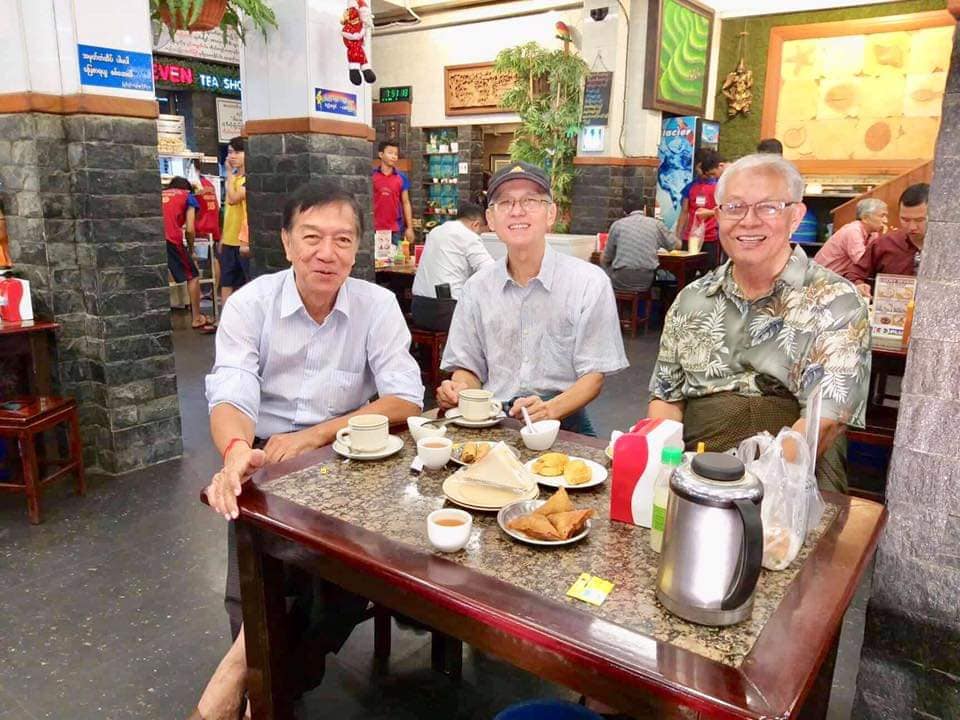
    U Thet Lwin used to work in Thailand and Singapore. He hosted a breakfast gathering for the UCC Old Timers.

    KMZ wrote :

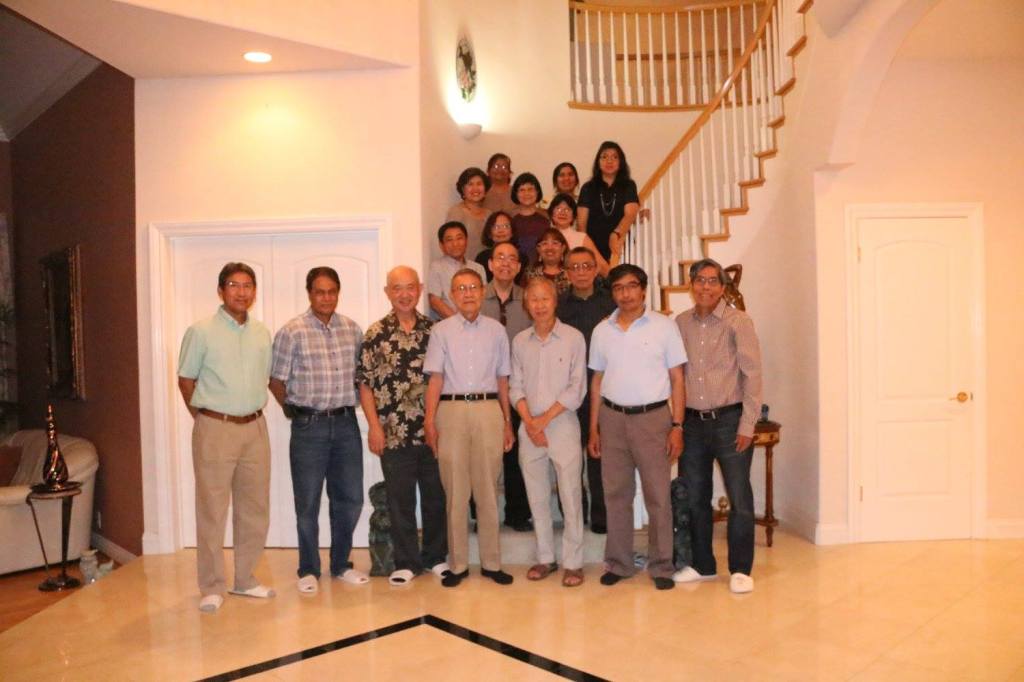
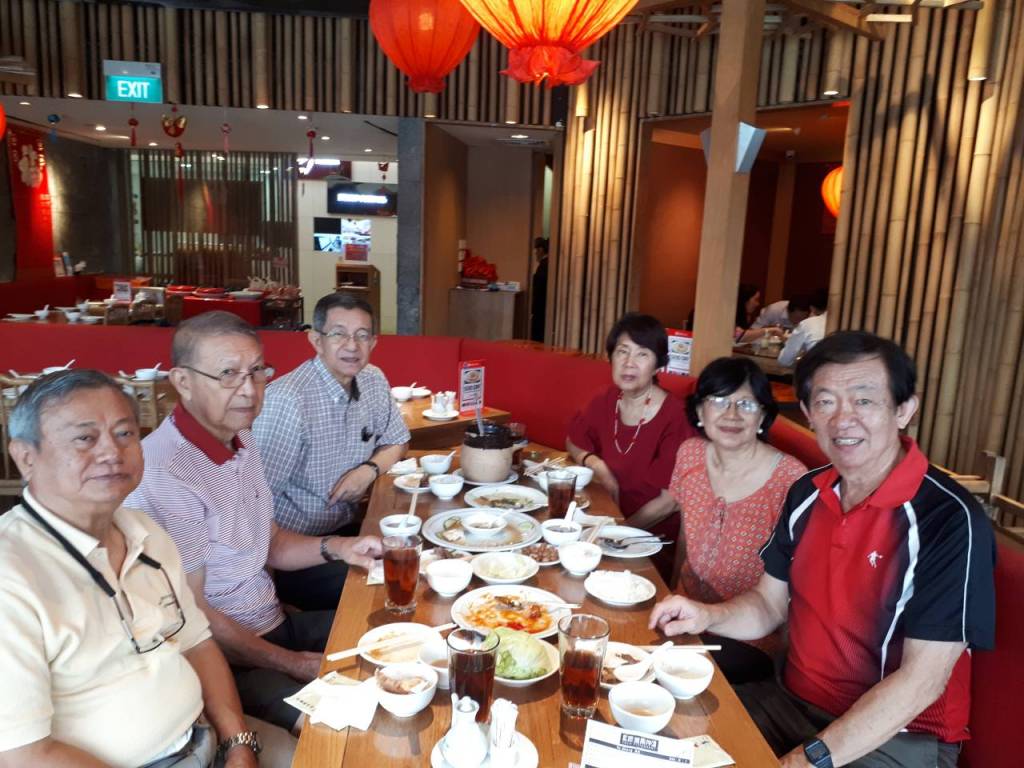
    Another UCC old-timers, a. k. a. Ah Pho Gyi’s, Ah Pho Lats & Ah Pho Lay’s, met for breakfast at Halpin Feel, 17th Dec 2018. Treat by U Thet Lwin

    U Maung Maung Gyi, U Than Tun, U Tun Shwe (TS), U Thet Lwin, U Khin Maung Zaw (KMZ) , U Myint Swe, U Myint Oo, U Ngwe Soe (Silver), U Aung Myint (AM).

    I happened to be flanked by two long time friends since their days at SPHS – St. Paul’s High School. Sadly, both of them are now GBNF, may their beautiful souls rest in peace, looking down on us from somewhere above.

  • GBNF from UCC

    Dr. Chit Swe

    • See several of my posts

    Dr. Tin Maung

    • Father : Saya U Kar (former Minister in Caretaker Government in 1958).
    • Received his doctorate in Mathematics from Queen Mary College.
    • Succeeded Saya Dr. Chit Swe as Director of UCC.
    • During his tenure, the Department of Computer Science (DCS) and the Institute of Computer Science and Technology (ICST) were established.
    • Served as the first Rector of ICST.
    U Ko Ko Lay

    U Ko Ko Lay

    • Saya Dr. Chit Swe founded UCC with the help of Saya U Soe Paing, Saya U Myo Min and Saya U Ko Ko Lay.
    • Received his BSCE and MSCE from Stanford University.
    • Joined PWD
    • Transferred to UCC as Operations Manager.
    • Served as Scientific Applications Manager, Professor of Computer Science at DCS, and Professor of Information Technology at ICST.

    CO U Hla Min

    • He is my namesake.
      Those outside UCC were not aware that he was one year junior to me at St. Paul’s High School and RIT.
    • Graduated from RIT with Electrical Power in 1970.
    • Joined UCC as Chief Operator (CO).
    • Attended post-graduate course in UK
      Met his beloved one doing Advanced Nurse Training in UK
    • I became a “Tone Kyaw” when he passed away at the tender age of 30+.
      Two government training centers (where I had given guest lecturers) planned to send “Lwan Thu Pann Chway” to me.
      My classmate U Moe Hein (Ajala) took leave to attend my “funeral” at the Kyandaw Cemetery.

    U Mya Thein

    • Joined the Department of Commerce, Institute of Economics.
    • Transferred to UCC as Business Applications Programmer along with U Thein Oo.
    • Succeeded me as Business Applications Manager.
    • Taught not only at UCC, DCS and ICST, but also at the International Theravada Buddhist Missionary University (ITBMU).

    U Kyaw Nyein

    • Joined UCC as Scientific Applications Manager.
    • Taught Numerical Methods and/or Numerical Analysis.
    • Played soccer and volleyball at UCC.
    • Served as a UNV in the Middle East . During an assignment, he and his team had to be “relocated” due to “war/conflict” in the area.

    U Maung Maung Gyi

    • Joined UCC as Operator
    • Served as Shift Leader.
    • Succeeded CO U Hla Min as Chief Operator.

    U Soe Myint

    • Graduated from RIT with Mechanical Engineering in 1972.
      His M72 friends called him “Phone Gyi” since there were four Soe Myint in their class.
    • Joined UCC as Operator.
    • Since there was a M.Sc. (CS) student with the same name, he is called as “Sunlun Soe Myint” and “Soe Myint Gyi”.
    • Attended DAC.
    • Had training in US (on graphics …)
    • Taught Mechanical Drawing and AutoCAD to ICST students.
    • Retired as Pro-Rector of ICST.

    U Myint Aung

    • Served as Office Superintendent in the Admin Division of UCC.
    • Would often volunteer to drive the E-2000 ferry.
    • Close friend of Ko Khin Maung Zaw’s father.

    Daw Khin Lay Myint

    • Joined UCC as Secretary.
    • Became a Branch Clerk.

    Daw Nge Ma Ma Than

    • Younger daughter of U Aung Than (brother of Bogyoke Aung San).
    • Prisoner of Conscience.
    • During the Adhamma era, she was detained along with her husband U Myint Swe (UCC) and her brother.

    U Win Naing

    • Science Scholar.
    • Attended the 1st batch of M.Sc. (CS) with the Systems Option.
    Shein Soe Myint

    Miscellaneous

    U Shein Soe Myint

    • EC83 batch.
    • Served in various capacities at UCC (Engineering, Teaching …)
    • Passed away in Singapore while doing his Ph.D.

    U Aung Aung Thein

    • Colleague of U Kyaw Zwar Soe.
    • Served in various capacities at UCC (Engineering, Teaching)
    • Younger brother U Kyaw Kyaw Thein is also ex-UCC.

    U Thein Tan

    • Close friend of U Zaw Tun.

    Daw Hla Hla Win

    • Worked for Operations Division.
    • Attended DAC.
    • Spouse : U Than Tun.

    Daw Khin San Hlaing Aung (Cynthia)

    • Joined UCC as Librarian.
    • Attended M.Sc. (CS).
    • Was at Asian Institute of Technology (AIT)
    • Migrated to Australia.

    Daw Kyu Kyu Lwin

    • Served as “ad hoc” Tutor for Mathematics Department.
    • Worked for the Operations Division.
    • She attended DAC.
    • She transferred to Social Security Board (SSB) Computer Section.

    Daw Win May Thaung

    • Worked for the Operations Division.
    • Cousin : Ronnie Hla Maung (my middle school class mate)

    Daw Khin Mya Swe

    • M.Sc. (CS)
    • Passed away in Lesotho.

    Daw Khin Toe Nyein

    • M.Sc. (CS)
    • Classmates : Pale Shein, Thet Htar Su.

    Daw Thida Aung

    • M.Sc. (CS)
    • Classmates : Thida Khin, Mu Mu Myint, Mar Mar Soe

    Daw Aye Aye Kyi

    • Served as Librarian.
    • Passed away around 2013.
    • Spouse : U Han Nyunt (SPHS63)
  • PDP

    DEC Computers

    • Ken Olson and several other MIT alumni founded DEC (Digital Equipment Corporate).
    • Grapevine says that there was a protocol in government departments to “purchase computer”.
      In order to circumvent that, DEC named their mini-computers as PDP (Programmable Digital Processors).
    • CHM (Computer History Museum) has a PDP-1 on display. Retired DEC engineers “restored” a PDP-1. The exhibit has demos :
      one for play a “primitive” Space War game,
      another for “playing” music …
    • PDP-8 is a 12-bit mini-computer used in many universities of that period.
    • PDP-11 is a 16-bit mini-computer.
      UCC acquired PDP11/70
    • VT-101 (or similar) terminals became the “new” mode of entering and running programs.
    • DEC later introduced VAX (Virtual Address eXtended) series.
    • Gordon Bell was the VAX architect and co-author of the book using CMS (Computer Memory System) and “formal” methods to describe and evaluate computer systems.
      The artifacts that he collected for the book project were displayed in DEC as BCM (Boston Computer Museum) with Gwen Bell as the Curator.
      It later became CHM (Computer History Museum) in Mountain View, California.

    CHM (Computer History Museum)

    • I volunteered as a Docent for CHM for a couple of years.
      I had to give guided tours (for 45 minutes to an hour).
    • One child asked his father how fast the 10 Million Dollar computer (Cray 1) was.
      The reply, “It’s slower than your PC and your smart phone”.

    Feedback

    KMZ wrote :

    It was a shame that DEC/VAX/VMS did not take off well as some people hoped. Fortunately, Bill Gates hired VAX/VMS main architect Dave Cutler in 1988, who brought many of his team from DEC, 20+ as reported, as part of the hiring agreement of Dave Cutler.

    Dave Cutler and his team developed Windows NT, New Technology – a 64bit OS, and the rest is history. He has his hands on RedDot, which be came Microsoft Azure.

    Dr. Mark Russinovich, received his doctorate in 1989 from Carnegie Mellon, developed a very popular Windows utility suite called ‘SysInternals’ with his partner. This was a godsend for all Windows Systems Engineers, a Swiss Army Knife, if you will. He also had a short stint at IBM, he also wrote a series of articles comparing Windows NT with VMS?? in Windows Internals magazine. Microsoft eventually acquired the SysInternals, Mark included. Mark is now CTO of Microsoft Azure.

  • CO U Hla Min

    He earned the nickname Pauk Si at SPHS (St. Paul’s High School). His father had lent money to a Pauk Si vendor, but the vendor could not pay back the loan. So, at break time, he would go to claim one Pauk Si (or more depending on his appetite).

    Since there were two Hla Min, he was called CO (Chief Operator).

    He is an Alumni of SPHS, RIT and UCC.

    He matriculated in 1964 along with Ko Aung Myint and Ko Maung Maung Gyi (GBNF).

    He received his B.E. (EP) in 1970.

    He volunteered for the UCC Project, and later joined UCC as CO.

    Under the UCC program, he studied for a year in UK and also found his soul mate (Ma Tin Win), who was undergoing “advanced” nursing training.

    CO was afraid of getting hospitalized.

    CO was healthy. He would rarely wear the “coat/jacket” that is mandated for those working in the “air conditioned” Computer Room. He would often wear a sports shirt.

    So, it was a surprise to learn that CO, after returning from spending as a temporary monk at Taung Pu Lu monastery, fell ill. He was admitted to RGH (Rangoon General Hospital) where Dr. Min Lwin (Maurice Hla Kyi, 5th in Burma in 1964, Roll Number Two at IM(2), cousin of “Lake” Win Maung) examined and found out that his friend had a serious problem.

    CO’s voice had lost intensity during his stay in the hospital. He told us to be good towards the sayas, colleagues, friends and family members. We sensed that it was his farewell message. Sad to say, he passed away in his mid-thirties. He did not drink or smoke, but he ate (may be a little bit indiscriminately). He presumably had Hepatitis and later “cirrhosis”.

    Some people were not aware that there were two Hla Min who attended SPHS & RIT & worked at UCC. They both have spouses from the medical profession.

    So it was not surprising when two government departments where I had given guest lectures inquired UCC where and when they could send wreaths (Lwan Thu Pann Khwe) for me.

    A representative from the first department said, “It is said that people laugh a lot before they die. U Hla Min was telling us jokes.”

    A person from the second department said, “U Hla Min looked frail and unsteady when he walks. No wonder he passed away.”

    To top it all, Ko Moe Hein (Ajala, ChE69) stared at me like a ghost at the Kyandaw Cemetery. He was RIT Selected for Swimming and Water Polo. He had a loud voice that can drown the voices of ten or so “normal” people. So he became the de facto “Cheer Leader” for the RIT Sports Teams. He was working at HI (Heavy Industries). At Kyan Daw Cemetery, he came down from a bus. When he saw me, he appeared “staring at a ghost”. He explained, “Your brother seemed so calm when we learned that you had passed away. So I look a day off to give you last respects thinking that ‘If your brother does not care about you, there will not be many people at last journey’”.

    That’s how I became a TONE KYAW.

    CO was partly responsible for the UCC staff members visiting Kaba Aye Sun Lun Gu Kyaung and then later participating in the Thingyan Su Paung Yahan Khan Pwes.

    He and Saya U Soe Paing were temporary monks at the monastery where U Wara (Win Paing, ChE70, younger brother of Saya Paing, GBNF) was Taik Oak Sayadaw.

    Ko Soe Myint (M72, GBNF) and his family (parents, asiblings, …) are devotees.

    I visited CO and Saya Paing and later became a devotee.

    CO, we miss you.

    We remember you saying, “Sayas and colleagues will realize my values when I am gone.”

    RIP, my dear friend and name sake.

    With metta,

    Hla Min

    Comments

    My best recollection of CO is as follows.

    After we started working there, we hanged around the beautiful & attractive ladies in the machine room, like bee to the honey. CO didn’t like us there and issued a verbal warning not to talk to the ladies there, he’s the king/chief of the machine room, unless it’s work related.

    He got really mad when we removed the covers of some of the machines there, pretending we were working on fixing those, while having good chitchat with the ladies there.

    Some of them are now GBNF, several are still kicking, I mean alive and well. Those were the days, we really miss those old days.

    Heartfelt love and thanks to those who had nothing but forgiveness to many of our shenanigans there.

    And of course, we all miss our CO.

    In order of raw marks :

    Cherry Hlaing (St. John’s Convent) and Lyn Aung Thet (Methodist English High School)
    Has same total marks.
    Using the ILA system, Cherry was admitted as Roll Number One to IM(1).

    Aung Win Chiong (SPHS)
    Based on ILA, he was admitted as Roll Number One to IM(2).

    Indian lady
    Probably moved overseas

    Min Lwin (SPHS)
    Based o ILA, he was admitted as Roll Number Two to IM(2).

    • Was a Golf Champion.
    • Became a monk after taking the final examination for Chemical Engineering in 1970.
    • Served as Taik Oke Sayadaw for nearly four decades.
    • Succeeded Sayadaw U Vinaya as Chief Resident Monk of Kaba Aye Sunlun Gu Kyaung
      and Patron of several Sunlun Kyaung (Maymyo, Mogok, Kyauk Padaung).
    • Passed away a few years back
  • UCC Project

    • UCC was founded in 1971 with Saya Chit (Dr. Chit Swe, GBNF) as Director, Saya Paing (U Soe Paing) as Systems Manager, Saya Myo (U Myo Min) as Applications Manager, and Saya Lay (U Ko Ko Lay, GBNF) as Operations Manager.
    • The UCC Project was started by Saya Chit (then Head of Mathematics Department at the Institute of Economics) with the help of Saya Paing (then Assistant Lecturer of Electrical Engineering at the Rangoon Institute of Technology) and several others.
    • It took a long time before the UCC Project was approved by UNDP.
      UNDP was the Funding Agency.
      UNESCO was assigned as the Executing Agency.
    • ICL won the contract to provide ICL 1902S Computer System, Software, Training and Support.
    • Dr. Harry D Huskey (UCSC) won the sub-contract for offering expertise in Academics & Research for UCC.
    • The early days of Computing in Burma/Myanmar has been presented in several articles in Burmese and English by Saya Paing including “Computer ah sa UCC ga”.
    • Saya U Aung Zaw (GBNF) has also recorded his memories about UCC in his book “Ba Wa and Dhamma”.
    • ICST/UCSY published a commemorative magazine for the 30th Anniversary of UCC.

    The following are the early departments and sub-departments at UCC.

    • For holding meetings with Board of Directors and Advisors.
    • Also provided service for the Experts)
    • Superintendent (U Myint Aung)
    • UDC (Upper Division Clerks)
    • LDC (Lower Division Clerks)
    • Peons
    • Secretaries (for preparing reports and teaching materials)
    • Security Personnel
    • Maintenance Personnel
    • Drivers
    • Manager (Saya U Soe Paing)
    • Engineers (U Tun Aung Gyaw, U Hla Min, U Soe Win)
    • Maintenance technicians (U Aung Myint, U Ngwe Soe, U Myint Soe, U Khin Zaw …)
    • System Programmers (U Aung Zaw, U Maung Maung Htay, U Than Lwin, Rafiul Ahad, U Soe Myint …)
    • System Librarian (U Hla Aung …)
    • Trainees and/or Volunteers
    • In the beginning Saya U Myo Min managed all application programmers.
    • After the reorganization, Saya U Myo Min managed the business applications.and Saya U Ko Ko Lay managed the scientific & engineering applications
    • Application Programmers include U Mya Thein (Bo Shoke, GBNF), U Thein Oo, U Tun Shwe, U Htin Kyaw, U Soe Than, U Kyaw Nyein, U Boe Ba Shan, U Myint Oo, U Sein Myint Maung, U Win Myint, U Soe Thein (GBNF), U Aung Hlaing, Daw Tin May Lwin, Daw Nwe Nwe Win, Daw Nge Ma Ma Than (GBNF), …
    • In the beginning Saya U Ko Ko Lay managed the Operations Division.
    • After the reorganization, Saya U Soe Paing managed the Operations Division and Systems Division.
    • Chief Operator (CO U Hla Min / Pauk Si)
    • Computer Operators (3 for each shift)
    • Shift Leaders (U Maung Maung Gyi (GBNF), U Win Hlaing, U Kyaw Zwar, U Soe Myint (GBNF) …)
    • Operators for card punch, manual punches, punched card verifier, sorter …
    • Job Controllers
    • The Morning Shift is run for staff, students and general users.
    • The Evening and Night Shifts were run for selected user departments.
      The Population Census Data Project had a high priority.
    • Kudos to the many unsung heroes who volunteered for gratis or for a per diem of Three Kyats and Fifteen Pyas.
    • Several DAC and M.Sc. students volunteered
    • Without them, the introduction of Computer Technology would not have been smooth and successful.

  • Advisors

    Dr. F Ba Hli (GBNF)

    Saya Dr F Ba Hli (GBNF) received Sc.D. (Doctor of Science) from MIT (Massachusetts Institute of Technology). At MIT, Saya helped “fresh” scholars including Saya Dr. Aung Gyi and Saya U Min Wun acclimatize with the environment and studies.

    Saya served as DG (Director General) of UBARI (Union of Burma Applied Research Institute) and Advisor for the Ministry of National Planning. Saya was a supporter of UCC Project and served as a member of the Board of Directors and as an External Examiner for the Computer Science graduates.

    Daw Myint Thwe (Saya’s spouse) is the sister of Saya U Tin U (C), Saya U Ba Than (M), Dr. Myo Tint, U Tin Htoon (A60), Saya U Myo Min (UCC) and U Thaung Lwin (EC66).

    Saya’s children Daw Tin Tin Hlaing and U Tha Hlaing (EC83) are UCC Alumni. U Htay Aung (EC80, spouse of Daw Tin Tin Hlaing and nephew of Saya U Sein Hlaing) and team “programmed” a PROM (Programmable Read Only Memory) to print Burmese characters on the Cromemco System Three micro-computer. He worked on Burmese Word Processing for Wang Computers. He migrated to Australia. For the past few years, U Htay Aung came back to Yangon to volunteer as an interpreter for the “10-day Mediation Retreat for Foreign Yogis” at the Mahasi Sasana Yeik Tha.

    During my visit to Sydney in 2006, Saya U Aung Zaw hosted a UCC reunion and mini-PZP (Pu Zaw Pwe) for Saya F Ba Hli and Saya Chit.

    U Sein Win (GBNF)

    Saya U Sein Win (GBNF) is the younger brother of Dr. Tin U (Medical Superintendent, Rangoon Children’s Hospital) and Dr. Saw Lwin.

    Saya served as Technical Advisor for UCC. Saya worked closely with U Win Htein (Purdue University, EE at PWD, GBNF) for the design and maintenance of the Electrical Systems (including Motor Alternator, Diesel Generator, Air conditioning) at UCC.

    Saya was a top student at the University of Michigan. His friends jokingly called him “Khone Swa Khone Swa” referring to his brisk walking style.

    Saya served as Lecturer in the Department of Electrical Engineering. When the EE Department was formally reorganized into EC (Electrical Communications, also known as EcE and Electronics Engineering) and EP (Electrical Power), Saya U Sein Win served as Professor of EP. Saya Dr. San Tint served as Professor of EC.

    Grapevine says that Saya is an absent minded Professor. Saya married late. One day, Saya drove Sayagadaw to Bogyoke Market. He taught (or discussed with) his students for quite some time and almost forgot to pick up Sayagadaw. There are variations on this anecdote regarding the place (e.g. Hledan Zay).

    Saya served as Line Judge at the RUBC (Rangoon University Boat Club) Regattas. Saya managed the RIT Swimming and Water Polo team.

    Saya stays fit by swimming regularly (even when he was visiting Singapore on a business trip).

    Saya has a vast knowledge. Saya Dr. San Hla Aung (C58) remembers Saya U Sein Win discussing about Civil Engineering and other subjects.

    U Win Htein (GBNF)

    U Win Htein matriculated from SPHS in 1956 with Saya U Soe Paing and Saya U Ko Ko Lay.

    They were selected as State Scholars to study in the USA. U Win Htein studied at Purdue University. Saya Paing and Saya Lay studied at Stanford University.

    Upon his return, he joined PWD.

    He was EE during our UCC days.

    For the UCC project, U Win Htein and his team maintained the Electrical Systems (including Motor Alternator, Diesel Generator, Air conditioning) at UCC.

    U Win Htein is the elder brother of U Myo Myint (EC67) and Daw Myint Myint Thein (Susan, FERD).

    Dr. San Tint (GBNF)

    Saya Dr. San Tint (GBNF) graduated in 1961 and joined the EE (Electrical Engineering) Department at RIT. He later served as Professor of EC (Electrical Communications AKA Electronics Engineering).

    Saya served as External Examiner at UCC.

    He played on the RIT Saya Soccer team with U Soe Paing (EE), Dr. Tin Win (M), Dr. Aung Soe (C), U Aung Soe (Maths), U Tin Maung Nyunt (M) and Des Rodgers (English).

    Saya suffered stroke and his right hand was paralyzed. He practiced writing with his left hand hoping that he will recover and continue teaching.

    Saya spent four decades teaching and passing the torch to the younger generation.

    His nephew U Hlaing Myint (UCC) was with Saya in Saya’s final days.

    Saya U Sein Win and Saya Dr. San Tint
  • UCC & Veda

    U Myint Sein (GBNF) is my childhood friend. He became the Principal at BARB (Burmese Astro Research Bureau). He asked me if I can help him to speed up some Veda processes (e.g. generation of a Natal Horoscope).

    I assigned two students Ko Win Latt and Ko Zaw Tun and supervised them for the Veda projects.

    Ko Win Latt owned a computer and was also an excellent programmer. Under my supervision and with the guidance of Ko Myint Sein, Ko Win Latt came up with three versions. He named them WinHoro V3, V6 and V9.

    V3 produces the “basic” horoscope with Yathi (Rasi), Bawa and Nawin (Navamsa). It is also known as “Tri Cekka Zatar” referring to the three parts. It takes some time (a few minutes to an hour) if done manually.

    V6 produces a better horoscope.

    V9 produces the best horoscope.

    WinHoro was implemented using BASIC (an interpretive language).

    BASIC (Beginner’s All-purpose Symbolic Instruction Code) was designed by Professors Kemeny & Kurtz for use with the Dartmouth College Time Sharing System (CSS).

    Bill Gates and Paul Allen implemented “Tiny BASIC” for the MITS Altair. They co-founded Microsoft.

    BASICA, GWBASIC and variants became a popular language for microcomputers and PCs.

    One needs expert knowledge to “interpret” a Zartar. Ko Zaw Tun used Prolog (language for Logic Programming) to implement the Bedin Rules. He tested his program with several sets of data. He was surprised when his program said that “the Two Year Old is a rich person (possibly a Millionaire)”. He thought that there must be a bug. It turned out that the Two Year Old is a grand son of a wealthy Sawbwa, who decided that his grand son should inherit his wealth.

    Sad to note that my good friend Ko Myint Sein is now GBNF. It was good news and bad news for his son, who was back in Yangon to take examination for Master Mariner. He was present at Ko Myint Sein’s last journey.

    0 comments

    U Myint Sein (GBNF) is my childhood friend. He became the Principal at BARB (Burmese Astro Research Bureau). He asked me if I can help him to speed up some Veda processes (e.g. generation of a Natal Horoscope).

    I assigned two students Ko Win Latt and Ko Zaw Tun and supervised them for the Veda projects.

    Ko Win Latt owned a computer and was also an excellent programmer. Under my supervision and with the guidance of Ko Myint Sein, Ko Win Latt came up with three versions. He named them WinHoro V3, V6 and V9.

    V3 produces the “basic” horoscope with Yathi (Rasi), Bawa and Nawin (Navamsa). It is also known as “Tri Cekka Zatar” referring to the three parts. It takes some time (a few minutes to an hour) if done manually.

    V6 produces a better horoscope.

    V9 produces the best horoscope.

    WinHoro was implemented using BASIC (an interpretive language).

    BASIC (Beginner’s All-purpose Symbolic Instruction Code) was designed by Professors Kemeny & Kurtz for use with the Dartmouth College Time Sharing System (CSS).

    Bill Gates and Paul Allen implemented “Tiny BASIC” for the MITS Altair. They co-founded Microsoft.

    BASICA, GWBASIC and variants became a popular language for microcomputers and PCs.

    One needs expert knowledge to “interpret” a Zartar. Ko Zaw Tun used Prolog (language for Logic Programming) to implement the Bedin Rules. He tested his program with several sets of data. He was surprised when his program said that “the Two Year Old is a rich person (possibly a Millionaire)”. He thought that there must be a bug. It turned out that the Two Year Old is a grand son of a wealthy Sawbwa, who decided that his grand son should inherit his wealth.

    Sad to note that my good friend Ko Myint Sein is now GBNF. It was good news and bad news for his son, who was back in Yangon to take examination for Master Mariner. He was present at Ko Myint Sein’s last journey.

  • Knowledge Transfer

    To help speed up the computerization in Burma, Saya Dr. Chit Swe (Founder / Director) mandated the “training & knowledge transfer” component in the UCC project.

    • The component was awarded to Professor Harry D. Huskey (Past ACM President), who taught at University of California Berkeley (UCB) and University of California Santa Cruz (UCSC).
    • Dr, Huskey is a computer pioneer, ACM (Association of Computing Machinery) Fellow, and CHM (Computer History Museum) Fellow.
    • Dr. Huskey persuaded several top Computer Scientists and Educators to transfer their knowledge and expertise.

    Experts for UCC Project

    The following is a partial list of the experts provided by Dr. Huskey.

    • Professor Anthony Ralston (SUNY Buffalo & Past President of ACM)
      Structured Programming
    • Professor Peter Wegner (Brown University, Providence, Rhode Island)
      Programming Languages, Compilers
    • Dr. Malcolm P. Atkinson (Cambridge University Mathematics & Computer Lab)
      Supervised M.Sc. (Computer Science) students
    • Professor Foreman Acton
      Numerical Methods, Author of “Algorithms that [almost] work”
    • Professor Michael Stonebraker (UC Berkeley)
      Ingres (early Relational Data Base Management System)

    RDBMS

    • At UCB, Michael Stonebraker, Eugene Wong and Gerald Held designed and implemented INGRES (Relational Database Management System).
      They went on to found INGRES and several other DB companies (e.g. Postgres).
    • Stonebraker won the prestigious ACM Turing Award (“Nobel Prize” for Computer Professionals) a few years ago.
    • Dr. Htay Lwin Nyo, Sai Aung Thurein, Ko Kyaw Zwar Than, Ko Sein Myint, … implemented projects (based on INGRES and other Databases) on ICL under the supervision of Saya Paing and several other sayas.

    Feedback

    KMZ wrote :

    In my line of work, prior to my retirement, Knowledge Transfer is one of the several criteria for the success of the Organization/Company. The others are “Documentation” and some mechanism to transfer/document “Tribal Knowledge”.

    It was a major challenge for all of us, it was, and still is, a thankless catch up process in the very fast changing Internet. When someone from the management and/or product wanted some new features, the timeline always was ‘yesterday’. They almost always wanted it done ‘yesterday’ as we jokingly called it.

    There are innumerable projects/processes we spent so much time could get shelved due to whatever reasons. Documentation and Knowledge Transfer became after thought. And when the key people moved on to other projects it became a nightmare for people who took over.

    KMZ added :

    There was a story told by Dr. Stonebraker where he learnt of the amazement on our faces when we saw his gigantic shoe. It was about the tough drill sergeant Stone and a small recruit called Stonebraker at the boot-camp. Since I was not a good story teller, I googled/binged Internet but none came up yet.

    I believe Rafiul went to work for Stonebraker at Ingres when he moved to California. Htay Lwin Nyo told me about it when I met him. Ingres was eventually sold to CA, Computer Associates.

    Editor’s Note :

    One of my early assignments was to work with developers from Fujitsu and some subsidiaries, Computer Associates and some subsidiaries (including Ingres).