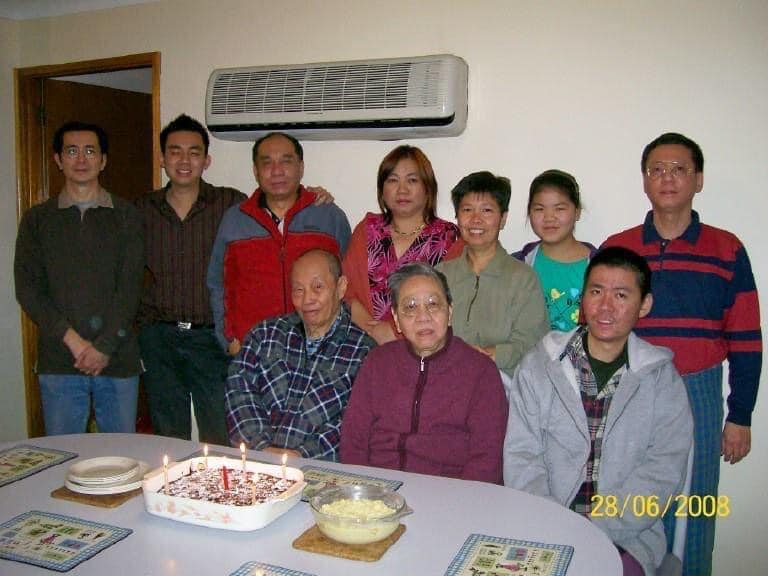
Founded SysMagic with branches in Thailand & Singapore.
He was host during my first visit to Singapore.
He later moved to Yangon & Thailand.
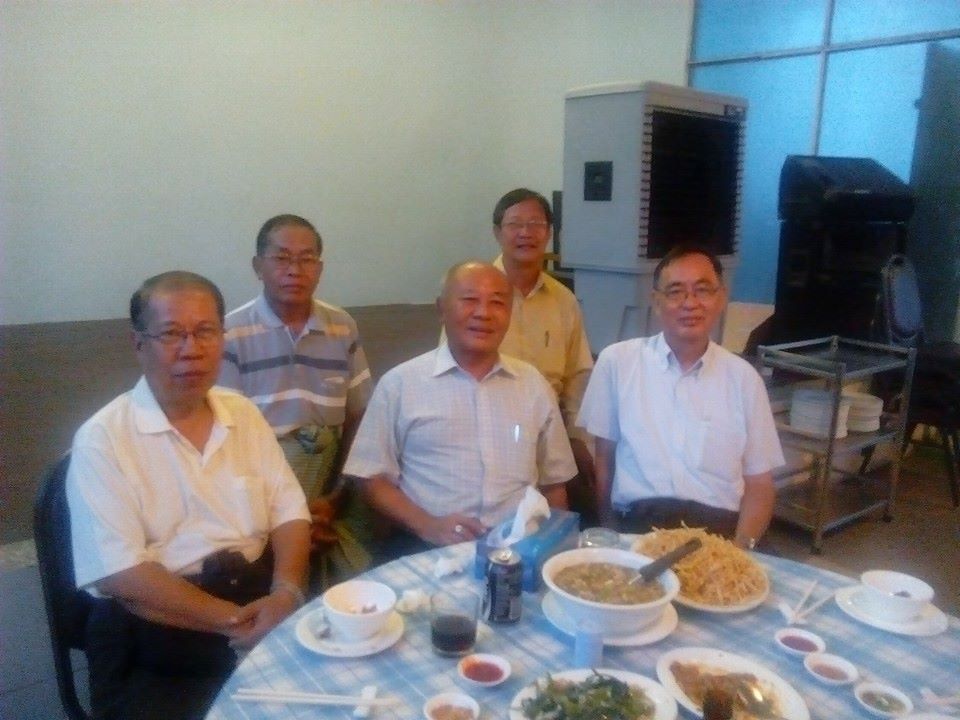
U Ngwe Soe / Silver
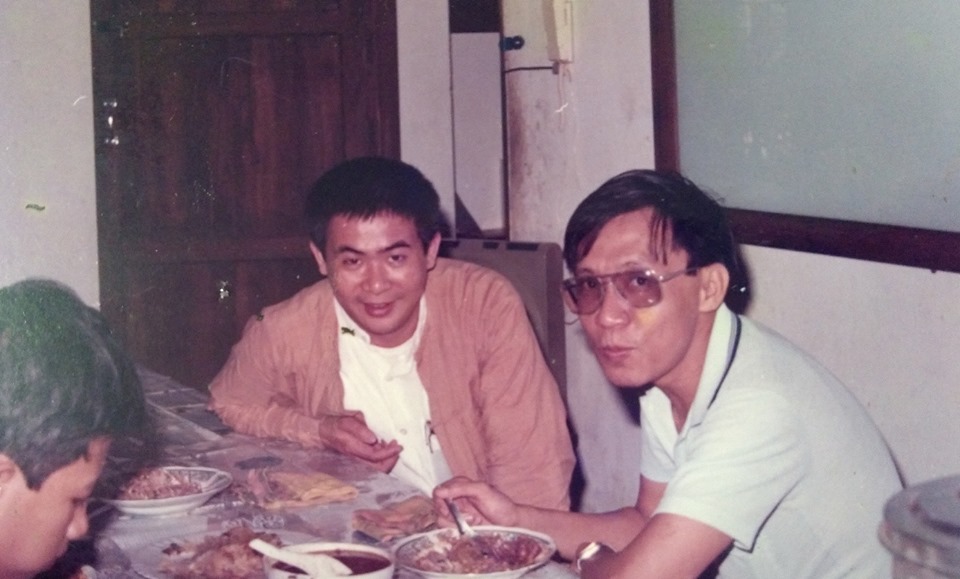
Ngwe Soe (Right)
Worked for Systems Division at UCC.
After a brief stint as seafarer, he joined Siemens in Singapore.
He hosted me during my first and a later visit.
He & Nu Nu Yee (sister of U Khin Maung Thwe EE69er) took us to their home in Jahore. He drove us to Melecca.
He retired after working for various projects overseas.
Ngwe Soe (Center)
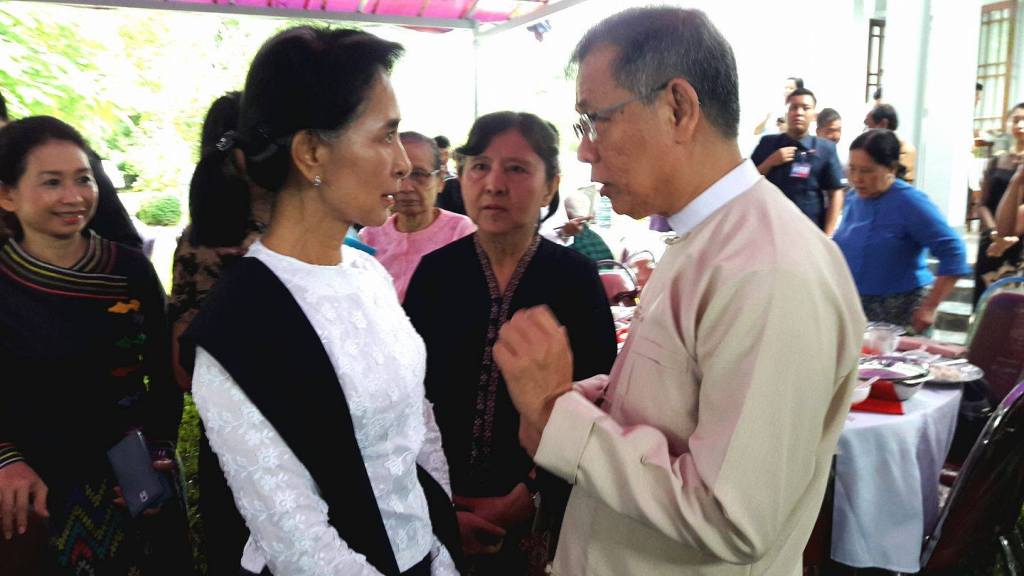
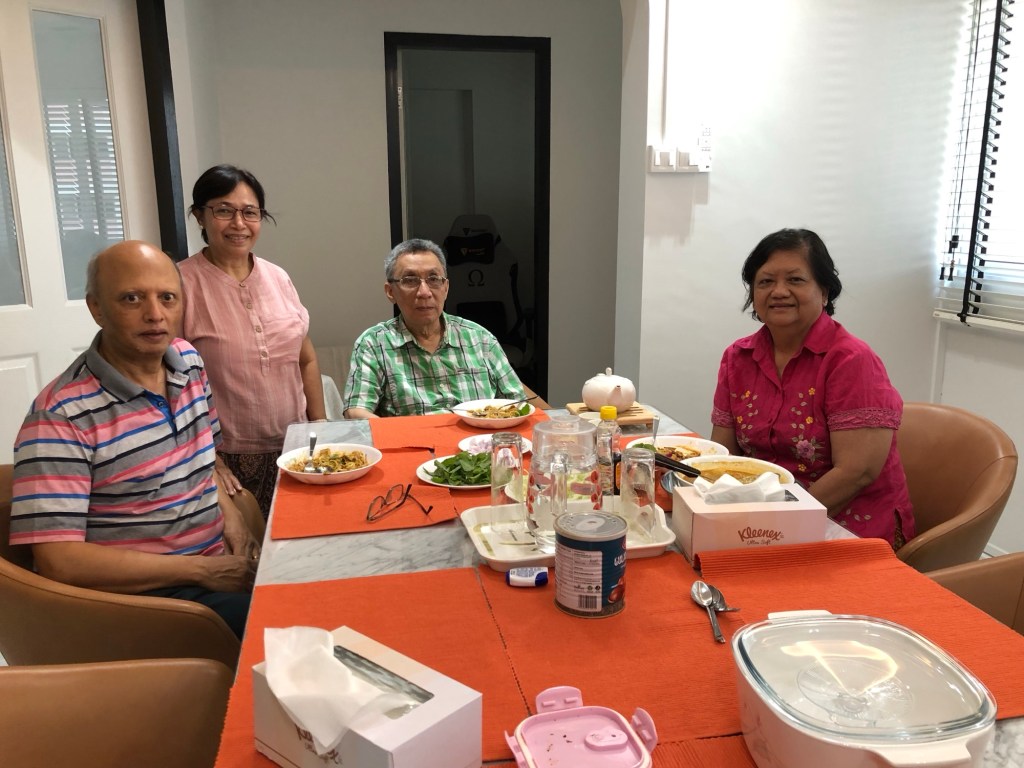
U Tin Aung Wynn
Ko TAW (Left)
Studied Masters in Computer Science at UCC.
Taught courses at UCC.
Moved to Singapore.
Taught Multi-media and other subjects at a Polytechnic.
Spouse Ma Wah is a doctor.
They hosted me in April 2007, when I attended SPZP-2007.
He co-organized lunch gatherings during my visits.
The photo was taken in 2019 when he took us to his home for home-cooked lunch.
U Zaw Tun
U Zaw Tun
Studied Masters in Computer Science at UCC
He & spouse Kyu Kyu Hlaing hosted us during our visits.
Rretired after managing Programming Projects for a shipping company.
Gawpaka of Singapore Chan Myei Yeiktha.
Daw Pale Shein
Seated : Pale, Kyu Kyu Hlaing & Pale’s GK
Studied Masters in Computer Science at UCC
Hosted me for part of my last trip. The stay was cut short when Covid hit some of her family members.
Organized sightseeing & gatherings
Ying (Sree Wunna Mangrai)
Studied Masters in Computer Science at UCC
She & her spouse invited us to a lunch gathering. We were joined by Ko Aye Kyaw.
UCC & ICST alumni
Met them at the gatherings (e.g Ko Zaw Tun’s house, Indian & Chinese restaurants, West Coast)
Some may have moved out of Singapore
In Alphabetical Order
Ko Aung Aung & Ma Kyin Mya
Ko Aung Khine Cho
Ma Aye Aye Than
Ko Aye Kyaw
U Boe Ba Shan & Daw Phyu Phyu Win
Ko Hla Min (Lay)
Ma Hpyu Hpyu Aung
Ko Khin Maung Aye
Ma Khin Myint Cho
Ko Kyaw Htay
Ma Myint Myint Thein
Ko Nay Myo Aung
Ma Nilar Thein
U Ngwe Soe & Daw Nu Nu Yee
Ma Pale Shein
Ma San Yi
Ko Shein Soe Myint (GBNF)
U Than Lwin & Daw Khin Swe Oo
Ko Tin Aung Win
Ko Tin Htun Saing
Ko Win Latt
Ying (Sree Wunna Mangrai)
Ko Zaw Tun
Veda
U Myint Sein (Principal of BARB, GBNF) requested me to develop computer programs for Veda.
I supervised the Veda projects by Ko Win Latt and Ko Zaw Tun.
Myint Sein
Ko Win Latt wrote Win Horo. The lowest version was used to generate natal horoscope. The higher versions were used by BARB sayas for advanced astrological calculations.
Ko Zaw Tun wrote a Prolog program for evaluating the Zartars. He was surprised when the zartar of a young (may be 2 year old) resulted in the prediction of a very person. He later learned that the child was a recipient of wealth from his Sawbwa grand father.
After receiving their M.Sc.(Computer Science), both taught computing at their private schools. They later moved overseas.
During my initial visit to Singapore, I stayed at Ko Win Latt’s apartment. He later spent in time in Bangkok and Yangon.
During my later visits, Ko Zaw Tun and Ma Kyu hosted us. They also organized ex-UCC gatherings.
Khin Maung Zaw (KMZ)
KMZ
Attended St. Paul’s High School. In 1965, SPHS was nationalized and became No. (6) Botathaung State High School. He matriculated in 1970.
Joined RIT and graduated with Electrical Communication. The option is known as EC, EcE & Electronics Engineering. Due to school closure, there were two convocations in 1977. Those from March 77 are called “Class of 76” (the intended year of graduation).
Played Hockey for “All Institutes” team.
Rowed for RIT at RUBC.
Spent a few years at UCC before moving to Singapore and then USA.
In 1999, he designed and implemented the first ex-RIT web site & served as its webmaster.
Alumnus of SPHS, RIT and UCC
KMZ wrote :
KJ, thanks much for posting these old stories, sharing with the rest. We really had many interesting and amazing characters there in those days. We, the three so-called musketeers, made things much more interesting, pushed the envelope so to speak. But thanks to all the Sayas – Saya Paing, Saya Myo, Saya Lay and seniors like you, UTAG etc, we were able to do whatever we felt like it there. I know for sure that we offended many people there, but with the great rapport and support from many of you, our mischievous acts, intentionally or not, were pretty much forgiven.Like I said a few times here, those were the good old days.I would like to thank all of you for what we did there, and sincerely ask for your forgiveness if we, especially myself, indeed offended any of you. I am indebted to all of you. Sayas, seniors, contemporaries, as well as some juniors, as I learned a lot while I was there.
U Tin Win
U Tin Win (Seated Right)
Taught at RIT EE before to Systems Division at UCC
Worked at Forest Reserve Inventory
U Tin Win wrote :
In my days in UCC, U TAG was CE and ICL computer’s printer was line printer and it could print only 120 char/line. To get 160 char/line, UTAG modified the line printer by joining the original plastic printer shaft with another short shaft. One day, he came to the engineering workshop and said he would modify it. First he cleaned the desk workplace where he would join the shafts. At that time, an apprentice engineer (Ko Khin Maung) came into the room and saw U TAG cleaning the desk. Then, KKM, shouted, “Whoo! .. actually modification of printer is just Cleaning the desk”.
Myint Myint Thein (Susan)
Susan & Ma Nge
Younger sister of U Win Htein (PWD, GBNF), who was in charge of the maintenance of electrical equipment at UCC
Early DAC (Diploma in Automatic Computing)
Worked at FERD at National Planning before moving to Singapore
After retirement, she moved back to Yangon.
Myint Myint Thein wrote :
I felt young again reading about the good old days at UCC.
During our lifetime, we have witnessed many examples of “Technical Obsolescence” and “Disruptive Technologies”.
Typewriters
English Typewriter
Remington produced typewriters for English. There are other typewriter manufacturers, but Remington typewriters were widely used in Burma.
Sholes designed the QWERTY keyboard. The two most common letters in the English alphabet are “e” (for vowel) and “t” (for consonant). The frequency distribution of the characters in a given language is used to break “simple substitution” codes in that language. Several people complained that the QWERTY keyboard is not ergonomic, because it requires one to use the left hand (the weaker hand for most people) and to move the finger up to type “e” and “t”. Some, however, believe that Sholes deliberately placed “e” and “t” so that they minimize the chance of keys being stuck (when one hits keys in rapid succession).
The alternate Keyboard designs (Dvorak …) did not have much support. The key issue is the retraining cost of typists.
Burmese Typewriter
Olympia was commissioned to produce Burmese typewriters. The characters in the Burmese alphabet are non-linear. A word often has ascenders and descenders.
The Burmese typewriter have red and black keys.
Red keys are used to type vowels; the carriage is prevented from going forward.
Black keys are used to type consonants.
Backspacing for half a step is necessary on the standard edition to type “tha gyee”. Manual dexterity is needed to type some “pa sint” characters. the office edition has extra keys.
Note :
In my younger days, we had an old Remington typewriter for typing English documents. My parents gave me a brand new portable Olympic typewriter for typing Burmese documents. I could do touch typing.
Evolution of Typewriters and Word Processors
IBM produced Selectric typewriters. Golf ball-like character sets had to be installed and/or replaced. Hence, a variety of characters (including APL, a language developed by Kenneth Iverson and uses Mathematical Symbols).
Iverson is the thesis supervisor of Brooks, Architect for S/360 & OS/360. He described APL in a book, and explained the use with examples. IBM implemented APL/360 on the System S/360.
Wang Computers provided word processors for various languages. Ko Htay Aung worked at Wang for a while on the Burmese language project. He migrated to Australia.
Burma Research Society (BRS) used transliteration for its publications. For example, “k-o-l” combination represents “ko”. The scheme was used on Macintosh.
Note :
I joined BRS as a student member. I received BRS journals. Sad to say, BRS was “shut down” in the BSPP era. John O’Kell (student of Saya Dr. Hla Pelater Professor at the School of Asian and Oriental Studies) and team used the “BRS Transliteration Style” to implement a Burmese Word Processor on the Macintosh.
Input Techniques
There are various ways to handle characters of non-English languages.
Chinese characters were input on the early systems using (a) large tablets (b) three corner method (c) Romaji, …
UCC Projects
UCC had projects to do Burmese word processing.
Saya U Myo Min supervised a project for Ma San Yu Hlaing for collation (needed for sorting).
Saya TAG and his team (Ko Htay Aung, Ko Soe Myint, …) worked on Cromenco System Three for printing and processing. An EPROM (Erasable Programmable Read Only Memory) was burned/programmed to support the Burmese Character Set.
U Soe Win and team worked on Calcomp graph plotter to draw Burmese characters on the plotter.
Skill Sets
The evolution of Word Processing Systems has seen the proliferation of typeface/font families, keyboard layouts, and Unicode support.
We miss the days when we had type perfectly or reasonably well on typewriters using messy carbons.
Also, planning to cyclostyle double-sided printing (odd numbered pages first, then repeat with even-numbered pages) was a skill.
Changes to Burmese Spelling
Burmese Language Commission bowed to higher authorities to revise the spelling at least two times.
TIT တစ် versus TA တ
The then Number One sent a condolence message for Chou En Lai. The message had “TIT” instead of the more commonly used “TA”.
In English, “TIT” corresponds to one and “TA” corresponds to the indefinite article “a” (before a consonant) and “an” (before a vowel).
The higher authorities “deemed” that “TIT” must be used all the time, and not “TA”. Fines were “imposed” on authors and publishers spelling the “established” way. (e.g. “ta”) instead of the “preferred” way (e.g. “tit”) despite the scholars pointing out the old inscriptions at “Bo ta htaung ဗိုလ်တထောင်” not “Bo tit htaung”) pagoda.
CTK (Children’s Treasury of Knowledge) project was “delayed” to “correct” the spellings.
Censorship
It was not easy to write in those days without facing censorship.
I was requested to contribute a poem or article for the Special Issue of SarSoDaw Nay (Day honoring Poets and Writers). The editor showed me a block (type set of my work), but sadly my work did not appear in the Special Issue. The editor said that some one above ruled that my work quoted “Dhammata” poem (by Ananda Thuriya [A man of infinite valor]). It was a taboo.
It was a crime to write about the setting sun or to use ambiguous terms and references.
MMT (Maung Myint Thein) was the pen name of U Myint Thein (Former Chief Justice of the Union of Burma). His poem was censored, because it had a bird beside a river gazing afar. The higher authorities thought that there was a hidden meaning.
Memories of UCC (39)
UCC Gatherings
Over the years, I attended several mini-gatherings and gatherings hosted by UCC sayas and alumni. They took place in Yangon, Singapore, Australia, and the US.
Gatherings in Yangon Saya Paing and Sayagadaw regular hosts gatherings (usually dinner meeting) at their house in Yangon. Sayagadaw was my classmate at RIT. She is a Textile engineer, but she also drew the design for their house. She also attended CPC course. Ko Thein Oo, Ma Tin May Lwin and several others help organize the gatherings. Ko Thein Oo, Ko Htin Kyaw, Aung Aung (who worked for Microsoft in the US) and several others provide transportation to or from Saya Paing’s house.
Recently, KMD bosses (Ko Thaung Tin & Ma Tin Tin Aye) hosted a surprise gathering at MICT Park for UCC sayas, sayamas and alumni. I missed that event.
There was fun, laughter, songs and dances at UCC’s 40th Anniversary Gathering held a few years back. Dr. Tin Maung (GBNF) was represented by Sayagadaw and daughter. Daw Ngwe Tin, Aye Aye Myint and sisters, … reminded us of the good old days at UCC.
On January 14, 2018, I attended the 5th UCSY Acariya Pu Zaw Pwe as “Generation Zero” representative and the “Most Senior” (not by age). Several attendees started their studies and/or careers at UCC. Glad to know Mu Mu Myint is a senior (Shay Hmee Nauk Hmee) Professor at UCSY. Sad to know that she had a senior moment. When I visited UCSY on January 18, 2018 at the invitation of Bo Htay, she told me that she did not have time at the Acariya Pu Zaw Pwe and felt sorry not to have taken a picture with me. She was surprised when I showed the picture of her, another sayama and me.
Gatherings in the US
Dr. Rafiul, Ko Khin Zaw, Ko Aung Myint Oo & Ma Thida Khin, Ko Sein Myint & Cindy hosted UCC gatherings (especially to welcome sayas and alumni visiting US).
Ivan (M69) hosts joint UCC & RIT Gatherings at his house in New Jersey, USA. He timed the gatherings to coincide with the visits by Saya Dr. Aung Gyi and Saya U Soe Paing to the East Coast of USA.
Gatherings in Singapore
In Singapore, Ko Tin Aung Win, Ko Zaw Tun, Ma Pale … organized buffet gathering. Ko Aung Aung & Ma Kyin Mya are regulars at the gatherings.
Some (e.g. Myint Myint Thein [Susan]) have moved back to Yangon.
Ko Win Latt hosted me while he was working in Singapore. He now lives in Bangkok.
Gatherings in Australia
In Australia, Ko Aung Zaw, Ko Sein Myint Maung & Ma Khin Aye Mu Ko Htay Aung & Ma Tin Tin Hlaing organized the gatherings.
I met Ma Thanda Htwe and “Pha Yaung Daing” (one of the Trio of Candles at UCC).
Ko Sein Tin (who used to bring lunch not only for him but also for his UCC buddies) created a short music video during my visit to Sydney, Australia in 2006.
Final Remarks
I belong to several circles. In addition to the UCC Gathering and mini-PZP (Pu Zaw Pwe for Saya Chit and Saya Ba Hli), I attended the RIT Alumni Annual Dinner and the Old Paulians Lunch Gathering in Olympic Park (used for the 2000 Summer Olympic Games) during my visit to Sydney, Australia in 2006.
Memories of UCC (40)
Museum
Saya U Soe Paing e-mailed me some photos of the historic ICL computer system and mentioned that Ko Thein Oo is willing to contribute to the ICL Museum project.
BCM and CHM
At an ACM (Association of Computing Machinery) meeting in Silicon Valley, I met Gwen Bell (then spouse of Gordon Bell, VAX architect), who founded BCM (Boston Computer Museum).
Gordon brought back artifacts that he had collected while co-authoring the book “Computer Structures” with Alan Newell (known for his contributions to Multi-disciplinary research) during his sabbatical at CMU (Carnegie Mellon University). Gwen developed an exhibit at the DEC office in Boston, Massachusetts. It became known as BCM.
Gwen introduced me to Karen, then Vice President of CHM (Computer History Museum). I volunteered to be a Docent.
When Microsoft bought the division of DEC (where Gordon & his team worked), Gwen had to think fast. Only a limited number of artifacts were accepted for display at the Science Museum. The rest of the artifacts were air-freighted to Moffett Field in Mountain View, California with the hope that the “Computer Museum” will be revived. For several years, the artifacts were displayed at the makeshift Museum in Moffett Field. A group of enthusiasts bought a building on Shoreline Boulevard, Mountain View that was owned by SGI (Silicon Graphics Incorporated, which under-estimated the challenge of reasonably priced GPUs [Graphical Processing Units]) and offered it to be a permanent home for CHM.
In the early days, only ten per cent or so of the artifacts could be displayed at a given time for public viewing. The display items had to be moved back from the Visible Storage to the storage house.
As a Docent, I had to show the visitors and explain [if requested] about the artifacts displayed in Visible Storage. In those days, only ten percent (or so) could be displayed for a period before rolling them out.
Thanks in part to the “Melinda and Bill Gates Foundation”, CHM could now exhibit 20 sections (from pre-computer era to the Internet age).
In addition, there are special exhibits (e.g. autonomous vehicles, computer chess, Charles Babbage’s Difference Engine, …)
Retired engineers from IBM, DEC … worked on the “Restoration of Computers” Project.
They restored three old computers using the original specifications and genuine parts (as much as possible). They are on display in working order.
Final Remarks
Having “ICL Museum” will be a significant step towards recording and preserving the History of IT (Information Technology).
Memories of UCC (41)
History
I am glad to learn that several people felt young and remembered the Good Old Days at UCC.
Some read all my posts and even commented on some of them.
I love history (History of Computing, History of University Engineering Education in Burma/Myanmar, …).
Professor Harry D. Huskey used us as beta testers of his draft on the History of Computing. I became hooked and later volunteered as Docent at the Computer History Museum in Mountain View, California, USA.
I was a member of the team that compiled and published “History of Myanmar Engineering Education” in December, 2012 just before the celebration of SPZP-2012. Ko Ohn Khine (M70) and I compiled a CD for the book supplement.
Why should we study History? Dr. Than Tun said, “So that one would not be stupid or dumb.” There’s an old adage, “History repeats itself”.
A historian presents facts. He should not give his opinion. The historian from Smithsonian said, “There is no single correct history. There are often multiple competing histories.”
Meeting Sayas and Librarians
I first met Dr. Than Tun at the Recreation Center of Rangoon University. I was in High School, but my uncle Eric Than Lwin (Lecturer in Economics & Librarian for Social Science Library) took me to the Main Campus many times. Daw Myint Myint Khin was an Assistant Librarian. She later transferred to RIT as Librarian. U Thaw Kaung, another Assistant Librarian, became Chief Librarian of the Rangoon University Central Library (RUCL).
The early librarians of RUCL include BBS U Khin Zaw (“K”, father of Ko Wint Khin Zaw) and U Thein Han (Saya Zaw Gyi, co-founder of “Khit Sann Sar Pay”).
Sayagyi U Ba Than, Saya U Soe Paing, and Saya U Thaw Kaung supported the HMEE Project.
Thanks
I am grateful to my spouse, who said “You should pay back to your alma mater and your country.”
Saya U Tin Maung Nyunt (M60) said that I should record my oral stories and put them to print for posterity. Sayamagyi Dr. Mie Mie Thet Thwin (Rector of UCSY) asked me if I could help for a commemorative issue of the 30th Anniversary of ICST/UCSY.
My beloved parents said, “Anything that’s worth doing is worth doing well”.
I hope that the readers can help “fill in the blanks” with details and correct errors and inconsistencies in my posts. Collectively, we can turn the posts into a reasonably good document worthy of printing (or at least publish as an eBook). The readers can suggest topics that I should add or elaborate.
Memories of UCC (42)
Epilog
Computer Science & Technology is continually evolving.
There are two (or more) early definitions of Computer Science. (1) It is the study of phenomena surrounding Computing. (2) It is the study of Algorithms and Data Structures.
The first definition has the same flavor as a definition of Physics. It says, “Physics is the study of natural phenomena.” It is general.
The second definition sounds restrictive, but it covers a lot of topics and application.
There is a book called “Program = Algorithms + Data Structures”. Professor Donald Knuth (Stanford University) thought that he could finish his 7-volume book “The Art Of Computer Programming” in a couple of years. It was an underestimate of the growth of Computers, Computer Science and Applications. It took over two decades to complete and revise the first three volumes and part of the fourth volume. One reason was that his book contributed to the growth of the Design and Analysis of Algorithms.
I Am Imperfectly Perfect
I have covered some topics in the early days of Computing in general and UCC in particular.
I missed out several people in my original posts. I have added names of the staff and students in my revised posts, but it would not be exhaustive.
I did not cover in-depth the PDP-11 configuration and use, the introduction of PCs (e.g. Cromemco System Thee, IBM PCs, Osborne Portable Computer), and robots (e.g. Hero).
It would take a long time and I would not be able to fill in all the blanks.
Jules Verne is attributed for the saying, “If one can dream, others can fulfill”.
I have a personal experience. In 1999, I started “RIT International Newsletter” and dreamed that Sayas and alumni will get reconnected electronically and physically. With the help of five Golden Sponsors, donors, volunteers, supporters and well-wishers, the First RIT Grand Reunion and SPZP (Saya Pu Zaw Pwe) was held in San Francisco in October 2000. The world-wide SPZPs were subsequently held in Singapore in 2002, 2007 and 2010, and in Yangon in 2004, 2012 and 2016. I havepaid back to RIT . I am now paying back to UCC.
Thanks to my family members for supporting me in the endeavors to pay back to the institutions and my mentors that helped me develop to where I am today.
I am confident that sayas and alumni of UCC, ICST & UCSY will enhance my posts into a reference document that historians will envy.
In the early days, there were no computers in Burma. IBM (International Business Machines) based in the USA and ICL (International Computers Limited) based in the UK had presence in Burma. Both companies were not ready to introduce computers to Burma. They were supposedly content with leasing unit-record equipment (calculators, tabulators, …) using punched cards. The managers (U Aung Khin and U Kyaw Tha) and their staff were highly paid compared to the Government employees.
In the early sixties, Burma Railways wanted to upgrade to an ICL computer, but the Coup d’etat in 1962 and subsequent restriction of foreign currency exchange (and budget planning rules) effectively derailed the project.
Project
Dr. Chit Swe
In the mid sixties, Dr. Chit Swe (Head of the Maths Department at the Institute of Economics) proposed the need of a computer for teaching and research to Dr. Nyi Nyi (Deputy Minister of Education). Dr. Nyi Nyi suggested the scope to be extended for a computer to serve the staff and selected students of the Universities and Institutes. Thus, the UCC Project was conceived. It was approved in 1970 with UNDP as the Funding Agency and UNESCO as the Execution Agency.
Dr. Chit Swe later became Professor at Maths at RASU (Rangoon Arts and Science University). He offered space at the Maths Department for the early volunteers of the UCC Project. He then obtained permission to use Mandalay Hall for use by the UCC Project before the UCC Building could be completed in Thamaing College Campus.
UCC Founders
Dr. Chit Swe, U Soe Paing, U Myo Min and U Ko Ko Lay founded UCC.
Dr. Chit Swe served as the Founder/Director of UCC. He initiated the academic and training programs. He stressed the importance of technology transfer, leapfrogging technology, knowledge sharing (internally and externally), and challenging the staff and students to try their best.
He requested U Soe Paing (RIT Electrical Engineering) to help design and implement the UCC project.
He inquired the mother of U Myo Min (Chartered Accountant working as Systems Analyst at IBM UK) if U Myo Min would be interested to come back to Burma and help with the UCC project.
U Soe Paing recruited his friend U Ko Ko Lay (PWD, GBNF) to help with the UCC project in general and with the UCC Building Design and Implementation in particular.
April 1, 1971
U Soe Paing transferred to UCC as Manager of Systems Division.
U Myo Min joined UCC as Manager of Applications Divison.
U Ko Ko Lay transferred to UCC as Manager of Operations Division,
I was a member of Generation Zero along with my mentors and U Tun Aung Gyaw (EC69), who was the earliest and longest volunteer of the UCC Project.
Tenure
Dr. Chit Swe retired as Rector of RASU. He moved to Bangkok and Sydney. He passed away in 2019.
U Soe Paing left UCC in the eighties to pursue a career as Technical Adviser and Consultant for the UN projects in several countries.
U Myo Min migrated to USA. He taught briefly at the Nanyang Technical Institute in Singapore. He retired after serving as a Principal for Seagate Technology and Conner.
U Ko Ko Lay had the longest tenure among the UCC Founders. He served as Manager of Operations, Manager of Scientific Applications, Professor at the Department of Computer Science, and Professor of Information Technology. Sadly, he was the first to pass away among the four Founders.
Dr. Tin Maung
He succeeded Dr. Chit Swe as Director of UCC.
DCS
During his tenure, the Department of Computer Science was established at RASU. U Ko Ko Lay served as Professor & Head of the Department. U Tun Aung Gyaw was Associate Professor. I was Lecturer.
ICST
Subsequently, the Institute of Computer Science and Technology (ICST) was established with Dr. Tin Maung as Rector.
U Ko Ko Lay served as Professor and Head of Information Technology.
U Tun Aung Gyaw served as Associate Professor and Head of Hardware Technology.
I served as Associate Professor and Head of Software Technology.
Some sayas from UCC and RASU taught Computational Mathematics.
Gone But Not Forgotten
Dr. Chit Swe (Founder)
U Ko Ko Lay (Founder)
Dr. Tin Maung (UCC Director, ICST Rector)
Dr. Kyaw Thein (ICST)
U Hla Min (SPHS64, EP70) : Initial Chief Operator
U Maung Maung Gyi (SPHS64, Phy68) : Chief Operator
U Maung Maung Lay (St. Albert’s, Ah Ba) : Operator
U Aung Myint (SPHS64, Phy68) Maintenance Engineer
U Soe Myint (M72, DAC) : Pro-Rector, ICST
U Shein Soe Myint (EC83, MSc(CS)) : Passed away in Singapore while doing Ph.D
U Mya Thein : 3rd Business Applications Manager; Visiting lecturer at ITBMU
Daw Kyu Kyu Lwin : Job controller; transferred to Social Security Board Computer Section
Daw Win May Thaung : Offline operator
Daw Khin Mya Swe (M.Sc. (CS)) : Programmer; Passed away in Lesotho
Daw Khin Toe Nyein (M.Sc. (CS)) : Programmer
Daw Thida Aung (M.Sc. (CS)) : Programmer
Daw Khin San Hlaing (Cynthia) Librarian; attended M.Sc. (CS); worked at AIT; Passed away in Australia
Daw Nge Ma Ma Than (DAC) : Taught at UCC, DCS and ICST; Prisoner of Conscience.
Courses at UCC
Dr. Chit Swe was Founder/Director of UCC and Professor of Maths at RASU.
He arranged UCC to conduct degree and post-graduate diploma courses under the aegis of RASU Maths Department.
UCC also conducted training courses for computer users.
Dr. Chit Swe was succeeded as UCC Director by Dr. Tin Maung.
Several distinguished Professors from US, UK and Europe lectured at UCC.
The postgraduate degree and diploma courses given under the aegis of Maths Department include M.Sc. (CS) and DAC
The Courses for computer users include
Computer Orientation Course (COC)
Computer Programming Course (CPC)
Elective for Honors and Post-graduate in other disciplines
Intensive training (e.g. for Population Census Data Processing)
Special training (e.g. for those selected as State Scholars)
Planning (e.g. for departments intending to purchase computers)
UCC Courses
Win Myint’s
There were three people at UCC named Win Myint.
Win Myint (1)
U Win Myint and U Maung Maung Lay
He was a High School Luyechun from Beik (Mergui). He was caught off guard when the then new Education System used ILA (Intelligence Level Aggregate) to determine the admission to the Universities & Institutes. He found himself studying Philosophy along with others who had low ILA scores.
Instead of using the marks directly, the ILA uses distribution of the marks for each subject and gives a score from 1 to 20. The ILA system helped students with balanced marks. By having marks in the top tier for each subject, a student can get reasonably good score.
But a student with low marks in one or two subjects (e.g. Burmese and English) would be penalized by the ILA system.
Philosophy is derived from Phil (love of) and Sophy (Wisdom). The highest degree is called Ph.D (Doctorate of Philosophy). It is ironic that students with low ILA scores were forced to major in Philosophy.
Ko Win Myint Gyi is an exception. He was determined to pursue a challenging career. Since he wanted to learn and work with computers, he enhanced his typing skills for both English and Burmese. It was a requirement for the position of Secretary at the newly formed UCC.
Ko Win Myint’s interview at PSC (Public Services Commission) was fast and smooth. When he said, “I am Bet Thar (or similar) meaning ‘I am from Beik (Mergui)’”, the PSC Chairman who was from Beik validated Ko Win Myint’s appointment as Secretary.
He not only typed very fast, but he learned Computer Science and Applications quickly and proficiently. He became a programmer.
Win Myint (2)
He majored in Mathematics and received Masters.
He worked for SLR (Settlement and Land Record) department.
He got appointment in UCC as programmer.
He was initially UNV at PG.
After working on UN projects, he returned home.
Win Myint (3)
He operated the cyclostyle (Gestener). The lecture guides were printed mostly on Sittaung (Sittang paper) and some on the Ye Ni paper.
Lecture Guides
Some may remember “Introduction to Computers”, “Introduction to Computer Programming” and several Guide Books by Saya U Soe Paing, Saya U Aung Zaw and me. We thank Ko Win Myint (1) and Ko Win Myint (3) for the production.
Dr. Thane Oke Kyaw Myint wrote :
I had a different story about getting a job. I had only done 8 month internship, one of the tutors in medicine was transferred out. When Saya U Ba Than asked whom the professors wanted to replace her, they asked for me. I was called in by the Rector about posting me as tutor. When I told him I could not join not having finished my internship, he was so upset that “You want to erase with your feet, what I has written by hand”. I was made to report for duty. I went back and with the professor’s permission, I returned to finish my internship to get my medical registration.
Soon, my friends and I had to go for interview with PSC. The Chairman of PSC was U Khin Maung Phyu. Both he and Dr U Ba Than were classmates with my father. As I went in U Ba Than said to U Khin Maung Phyu, “Ko Khin Maung Phyu, he is Ko Kyaw Myint’s son and I have already posted him to Department of Medicine.” U Khin Maung Phyu said, “How is your father?” I replied that my father was good. Then he said that I could go !!! Must be the shortest interview in PSC.
History
I Love History
I was a Docent at Computer History Museum.
I was a member of the History of Myanmar Engineering Education project. I and U Ohn Khine (M70) compiled the CD Supplement for the HMEE book.
Why study History?
Dr. Than Tun said, “So that one would not be stupid or dumb.”
There’s an old adage, “History repeats itself”.
The historian from Smithsonian said, “There is no single correct history. There are often multiple competing histories.”
A historian should present facts and not give opinions.
My spouse said “You should pay back to your alma mater and your country.”
Saya U Tin Maung Nyunt (M60) said that I should record my oral stories and put them to print for posterity.
UCSY sayamas requested me to help with the commemorative issue for the 30th Anniversary of ICST/UCSY.
My beloved parents said, “Any thing that’s worth doing is worth doing well”.
I have shared my memories about the early days of Computing in Burma.
I revise the posts as time and energy permit.
I hope that the readers will help “fill in the blanks” and correct errors and inconsistencies.
We can transform the posts into a historical document worthy of printing (or at least publish as an e-book).
Dr. Thane Oke Kyaw Myint wrote :
When we conducted the Perinatal Morbidity and Mortality Study, the data analysis was from me at UCC. Ko Ronnie Myo Min and many UCC staff helped us with the data analysis.
Dr. TOKM added :
The next project we did was “Risk Approach in Delivery of MCH Care”. We did a prospective study on the risk of mothers dying during pregnancy and child birth. As the outcome was measured by “relative risk” and “absolute risk” it was much easier to analyse the data.
Our team used 1MB handheld Sinclair computer for our study. Our team did not have monitors nor printers. Your nephew Peter (Khin Tun) worked out RR and AR on Sinclair, read the result on Saya U Tin U’s old TV and copied out the results by hand. Peter still had a copy of the final report. I left my copy at home and got lost.
Gatherings
Over the years, I attended several mini-gatherings and gatherings hosted by UCC sayas and alumni.
Yangon
Saya U Soe Paing regular hosts gatherings (usually dinner meeting) at his house. Sayagadaw Daw Saw Yu Tint (Alice, T69) was my class mate. She also attended CPC course.
U Thein Oo, Daw Than Than Tint, Daw Tin May Lwin and several others help organize the gatherings.
U Thein Oo, U Htin Kyaw, U Aung Aung and several others provided us transportation to or from Saya Paing’s house.
UCC 40th Anniversary Gathering
The “40th Anniversary of UCC” was the Reunion of Staff, Teachers (Past and Present) and Students.
Daw Ngwe Tin, Aye Aye Myint and sisters, Maung Myint, who maintained the UCC building rooms were among the attendees.
Saya Dr. Tin Maung (GBNF) was represented by Sayagadaw and Saya’s daughter.
There was fun and laughter, music and dances, and good old memories.
Daw Khin Lay Myint joined UCC as Secretary and then worked as Administrator Officer. She is now GBNF.
U Soe Myint (M72) joined UCC as Operator. He served as Shift Lead, expert in Mechanical Drawing and AutoCAD, and retired as Pro-Rector of ICST. He is also GBNF.
UCSY Gathering
In January 14, 2018, I attended the 5th UCSY Acariya Pu Zaw Pwe as “Generation Zero” representative and the “Most Senior” (not by age). Several attendees started their studies and/or careers at UCC.
Sao Yan Naing, son of Dr. Saw Naing (Wesley, SPHS59), gave me a ride to the Pu Zaw Pwe. SYN is a nephew of Dr Myo Khin. He is a cousin of Soe Lin Maung (UCC).
Sydney in 2006
During my visit to Sydney, Australia in 2006, I met several UCC alumni.
Saya U Aung Zaw and Ma Kyawt organized a Reunion and mini-PZP for Saya Dr. F Ba Hla and Saya Dr. Chit Swe. They were helped by U Sein Myint Maung and Daw Khin Aye Mu, U Htay Aung (Victor) and Daw Tin Tin Hlaing to name a few. I met Daw Thanda Htwe and “UCC Pha Yaung Daing”.
U Sein Tin hosted a dinner and also created a short music video.
USA
Dr. Raiful Ahad (Fremont, California), U Khin Zaw (Cupertino, California), U Aung Myint Oo (EC84) and Daw Thida Khin (Fremont, California), U Sein Myint (EC76) and Daw Sao Mon Sint (New Jersey) and U Toung (EC69, Connecticut) hosted UCC gatherings (especially to welcome and alumni visiting US).
U Khin Maung Oo (Ivan Lee, M69) hosts an annual joint gathering for UCC and RIT sayas and alumni at his home in New Jersey.
Singapore
U Tin Aung Win (C80), U Zaw Tun and Daw Pale Shein organized buffet gathering. U Aung Aung, and Daw Kyin Mya are regulars at the gatherings.
U Shein Soe Myint (EC83) is GBNF.
Some (e.g. U Win Latt, Daw Myint Myint Thein) have moved (temporarily or permanently) to Myanmar.
Activities
Table Tennis (Ping Pong)
U Saung Tin (CSO) and U Thein Oo are excellent players.
Volleyball
Rafiul Ahad (who was 3rd in Burma in Hurdles) hurt his knee. Daw Nwe Nwe Win (Judy) is often the sixth member of an all-male team.
Soccer (Football)
UCC team (including Saya U Ko Ko Lay and U Kyaw Nyein) played ad hoc match against other teams (in and around Hlaing Campus).
UCC Dobat
U Win Hlaing played the Dobat. Others (e.g. Maung Myint, U Hla Pe) would play Wah Let Khote (bamboo clapper) and Ya Gwin.
Donlaba
UCC used to celebrate Thingyan and Su Paung Donlaba.
Dr. Chit Swe, Win Maung, Hla Min, Tun Aung Gyaw, Soe Myint, Khin Maung Aye, Daw Khin Khin Latt
UCC had a Su Paung Donlaba for several years at Kaba Aye Sun Lun Gu Kyaung and other monasteries.
The Donlaba monks would be offered Soon at the UCC Thingyan.
There would also be Water Throwing and occasionally “Ye Pet Khan” to selected mandats.
Ad Hoc Trips
U Aung Zaw led some trips (e.g. to Maw Tin Zun).
Soul Mates
Some found their soul mates while working or studying at UCC.
Aung Aung & Kyin Mya
Aung Myint Oo & Thida Khin
Boe Ba Shan & Phyu Phyu Win
Kyaw Zwa Than (Jaws) & Khin Khin Kyu (K-cube)
Htay Aung & Tin Tin Hlaing
Myint Oo & Tin Tin Hla
Myint Swe & Nge Ma Ma Than
Myint Zaw & Nwe Nwe Win (Judy)
Sein Myint (Bei Gyi) & Sao Mon Sint (Cindy)
Sein Myint Maung & Khin Aye Mu
Soe Than & Wai Wai Than
Than Maung Maung & Khin Si Thoung
Thaung Tin & Tin Tin Aye
Thein Oo & Than Than Tint
Win Hlaing & Thida Kyi
Win Myint & Nu Nu Aung
U Soe Myint (M72, GBNF)
The M72 friends call him “Phone Gyi Soe Myint”.
At UCC, he is known as “Sunlun Soe Myint”.
His father U Thein Nyunt (Retired Secretary of Religious Affairs) was a friend and an early devotee of Sayadaw U Vinaya. U Soe Myint also served as Kappiya from his younger days.
He came to see me during my last visit and shared his knowledge about U Lokanatha (Italian American monk) and how he provided financial support to buy the land for Kaba Aye Sun Lun Gu Kyaung.
He gave me a “Chone Hte” (for monk) to take back to the US.
On a subsequent visit to Yangon, we were sad to learn of his untimely demise.
On the fateful day, he made two trips to the Kaba Aye Sunlun Gu Kyaung monastery, because he forgot his donation on his first trip. He also visited his nephew and niece who were having dialysis treatment. May be because of his karma or because of the trips he took that day, he passed away around 3 AM.
Khin Maung Zaw (KMZ) wrote :
Ko Soe Myint Gyi was one of the very humble people I have ever known. He spoke very soft, never see him angry nor heard him raise his voice. Even though I am some years junior to him (he’s M72 and me EC76) he always treated me with dignity and respect. I really miss him, may his beautiful soul rest in peace.
Anniversary Soon Kway
U Thein Oo and Daw Than Than Tint Soon Kway at Yaw Sayadaw’s Kayung Daik.
Attendees include
Saya U Soe Paing and Daw Saw Yu Tint (Alice, T69)
U Myint Swe
Daw Tin Moe We (Sweetie)
Daw Myint Myint Thein (Susan)
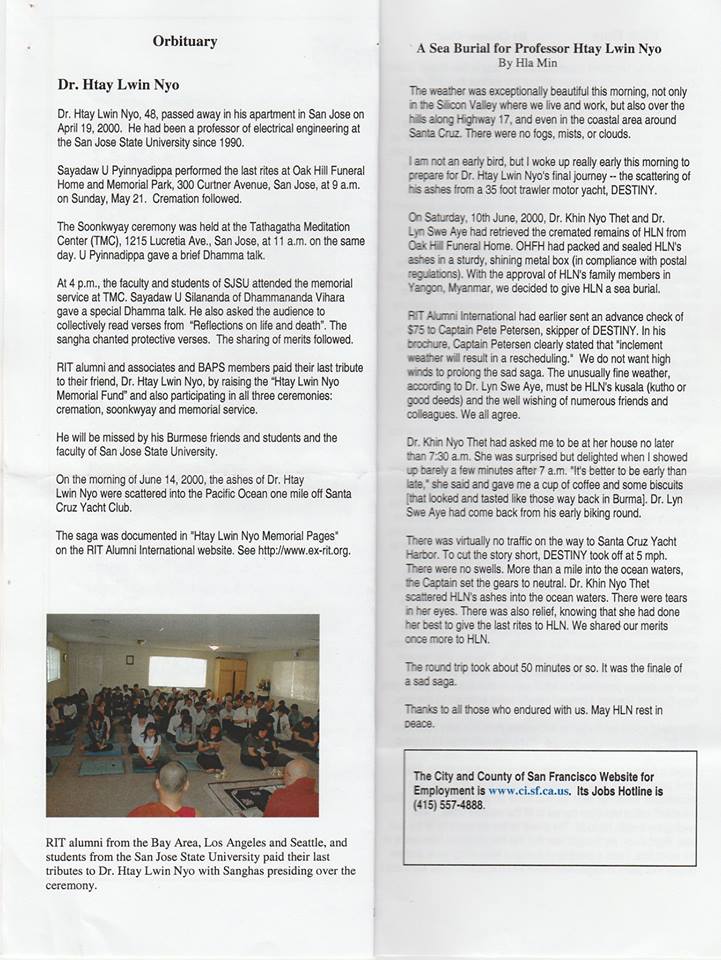
Dr. Htay Lwin Nyo
He matriculated from SPHS in 1968.
He was admitted as Roll Number One to 1st BE. He graduated among the top of the EP74 class.
He studied Computer Science at UCC.
He received a Ph.D. in EE from Syaracuse University, New York.
His final job was as Part Time Professor at San Jose State University (SJSU).
He used the spare time for his hobbies : (a) Tinkering old cars (b) Painting (c) Cooking (d) Stock Market (e) Writing movie scripts
He did not miss a class. When he did not show up for a few classes, the students were alarmed and requested SJSU authorities to check his home. They found the doors locked. After a few days, they broke in to find Dr. Htay Lwin Nyo lifeless on his bed. Postmortem indicated an aneurysm.
Since Dr. Htay Lwin Nyo was single and had no next-o-kin in the USA, SJSU asked the Burmese Community to help. Members of the “RIT Alumni International” and BAPS helped with the fund raising for the final journey of HLN.
I was honored to push the incinerator, and later to scatter the ashes in the ocean. There was no next-of-kin of HLN in the USA. KMZ remembered that Kyaw Swa Than (Jaws, UCC) was HLN’s cousin. The missing link was supplied by some alumni (including Ko Ko Kyi). KMZ set up special web page for HLN. My poem was also posted there. I wrote about HLN’s Sea Burial for BAPS Newsletter.
Memorial Pages
U Khin Maung Zaw (EC76, KMZ) set up the “HLN Memorial Pages” in the ex-RIT web site (which is now defunct). I wrote a poem “HTAY LWIN NYO“.
BAPS Newsletter
I also wrote “A Sea Burial for Professor Htay Lwin Nyo” for the BAPS Newsletter and the RIT web site.
Ko Ko Kyi (EC72) wrote :
Ko Hla Min, sad to read about Htay Lwin Nyo’s sea burial. I played a small part in notifying his first cousin Myo San Than in Toronto, when my brother called me from Birmingham, UK and informed me about HLN’s demise. Apparently, someone from California had contacted a friend of my brother’s and asked him to inform me, as he knew that HLN had a cousin living in Toronto. I informed HLN’s cousin Myo San Than, who called his elder brother living in Winnipeg, Canada. Subsequently, this cousin went to the US for HLN’s funeral. HLN was a good friend of mine, although he was two years my junior at RIT.
Khin Maung Zaw (KMZ, EC76) wrote :
I was actually a former classmate of HLN’s younger brother Aung Lwin Nyo in St. Paul’s High School [SPHS (6) Botataung]. All their brothers were OPs, HLN was 2 years senior to us, Old Paulians. I did not know HLN that well until we met again, the third time, at UCC. Of course he was part of our rival group while at RIT. Both of us ended up in US, he was several years earlier than me.
We met again when he moved to West Coast, namely San Jose, California while I was in Seattle. We visited him in San Jose, went Yosemite among other places, he visited us in Seattle, went up to Vancouver, Canada. Couple of years moved, he became upset with me for a reason unknown to me at the time, refused to take my calls. I eventually met him on one of my visits to California, forced him to tell me why he did not want to talk to me any longer. According to him, there were some rumors back in Yangon about his demise, his parents were very upset and he surmise that it could have been me who spread these rumors. I had to swear to him that those were nothing to do with me at all, as I lost contact with everyone, family and friends, back in Burma at that time.
So one could imagine my despair when I received a call, a year or so later, from Maurice Chee (M75) that HLN was found dead in his apartment, asking me if I knew him and also requested me to make an announcement on www,ex-rit,org site. I had to explain Maurice the background story, told him I would not do so until I have a solid information. I ended up calling HLN’s head of department at SJSU, San Jose State University. She assured me that they went to HLN’s apartment, broke it inside with the help of the Police. Sad news indeed. While Maurice Chee, Ko Banny Tan (M70), U Hla Min and RIT Alumni at BAPS, Bay Area alumni group, started working on the funeral, I called a friend, HLN’s cousin, in Manitoba, Canada, Kyaw Zwa Than (ex-UCC), to get the contact of HLN’s family back in Rangoon. I finally spoke with the elder brother, Ko Kyaw Lwin Nyo, who requested us to proceed with the funeral.
PS: I met HLN’s elder brother for the first time, this passed November 2018, at the OPA, Old Paulians’ Association, dinner. My OP friends told me that Aung Lwin Nyo met similar fate, passed away while in his bed some years back. Myo San Than (as mentioned in U Ko Ko Kyi’s comment) is the younger brother of Kyaw Zwa Than. KZT’s family : KZT, his wife KCube (Khin Khin Kyi) and their two sons, Alex and Nicholas, have since moved to Denver, Colorado, USA.
Daw Nge Ma Ma Than (GBNF)
Ma Nge (Nge Ma Ma Than, Theresa, GBNF) is the youngest child of U Aung Than (brother of Boyoke Aung San and Arzanee U Ba Win).
She matriculated from MEHS.
She graduated from RASU.
She studied and taught at UCC, DCS and ICST.
At UCC, she and Judy (Nwe Nwe Win) were considered as “UCC Twins”. Grapevine says that some guy approached them and gave each a copy of his “Yee Zar Sar” (love letter).
She found her love life U Myint Swe (ex-UCC).
During the Adhamma Era, she, her brother and U Myint Swe were detained by the higher authorities.
She became a Prisoner of Conscience.
I last met her at the 5th Acariya Puzaw Pwe of ICST.
Her health declined, but she kept on smiling. She did not complain about the aches and pains.
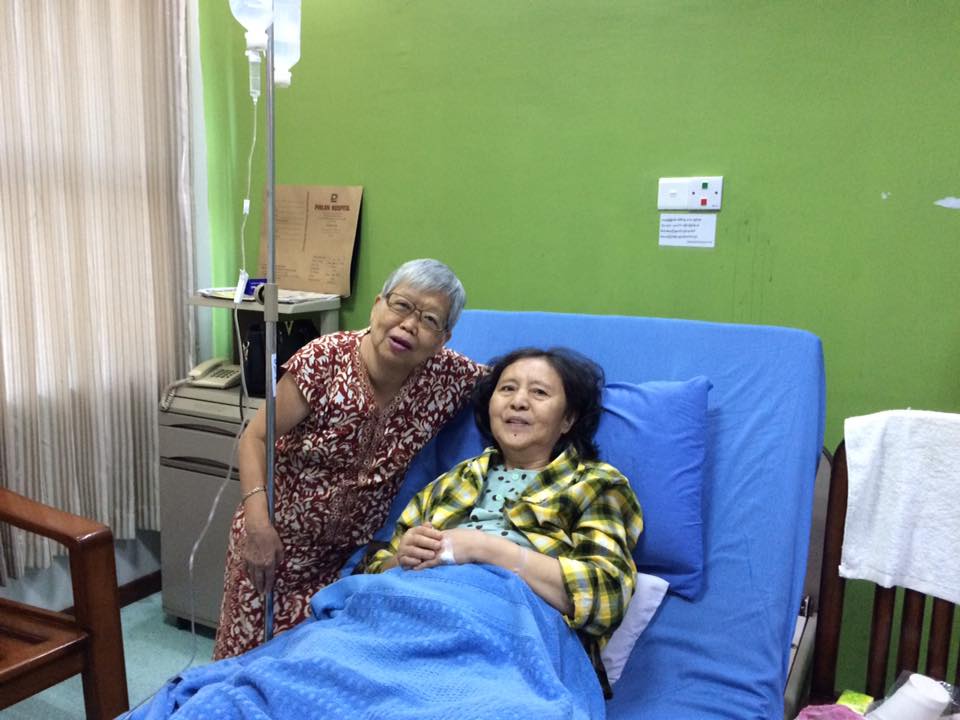
U Myint Swe reported the journal of Ma Nge’s hospitalization and medical treatment.
Even in her final days, her thoughts were with former Prisoners of Conscience.
Ma Nge at the hospitalMa Nge and her cousin
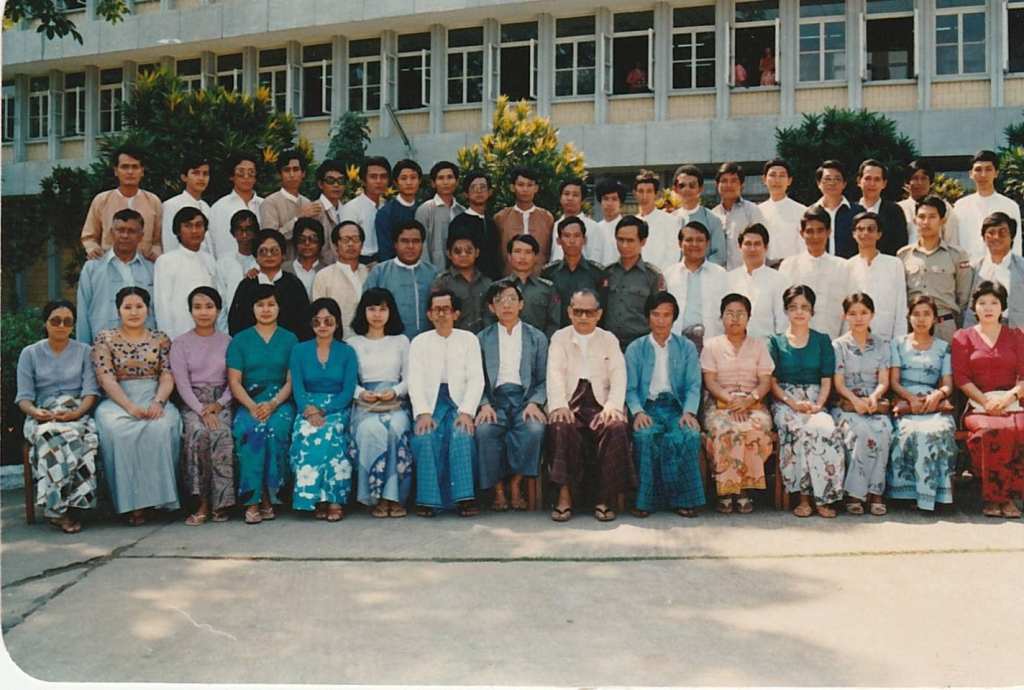
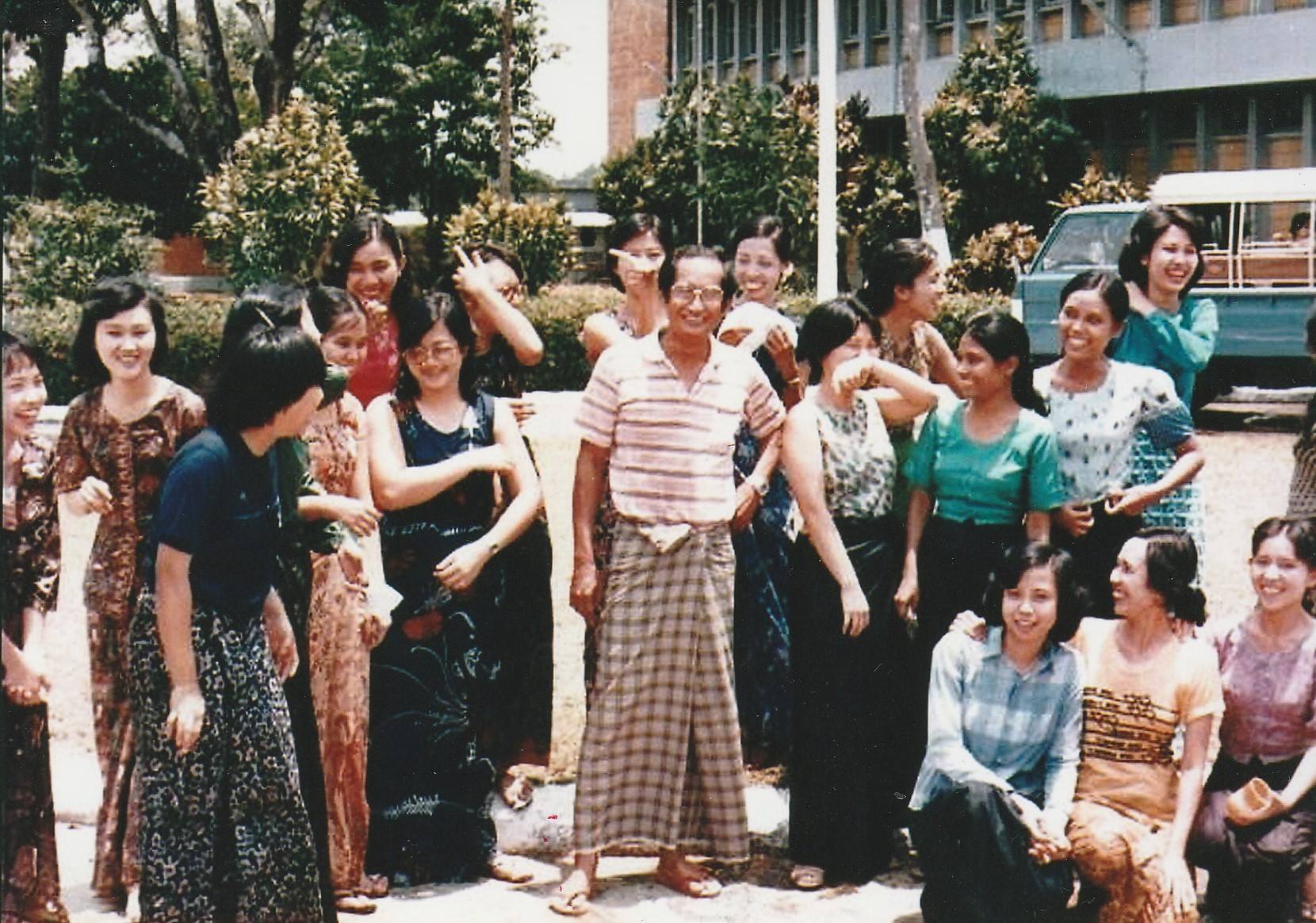
Four Decade Old Photo
Win Hlaing
Henry Maung Maung (Census, GBNF)
Kyu Kyu Lwin (GBNF)
Khin Si Thoung (Busi Baung – USA)
Khin Khin Win (Five Star Line – USA)
Phyu Phyu Win (Singapore)
Win May Thaung (GBNF)
Tin Tin Yi (Port Authority)
Hla Hla Win (Wa, GBNF)
Aung Myint (AM, GBNF)
Soe Myint (Sunlun, M72, GBNF)
Seven of the eleven in the photo are Gone But Not Forgotten.
DAC Grads
Epilog
Computer Science and Technology is continually evolving.
There are two (or more) early definitions of Computer Science.
Computer Science is the study of phenomena surrounding Computing.
Computer Science is the study of Algorithms and Data Structures.
The first definition has the same flavor as a definition of Physics. It is general to say, “Physics is the study of natural phenomena.”
The second definition might sound restrictive, but it still covers a lot of topics and application.
There is a book called “PROGRAM = ALGORITHMS + DATA STRUCTURES”.
Professor Donald Knuth (Stanford University) thought that he could finish his 7-volume book “THE ART OF COMPUTER PROGRAMMING” in a couple of years. It was an under-estimate of the growth of Computers, Computer Science and Applications. It took over two decades to complete and revise the first three volumes and part of the fourth volume. One reason was that his book contributed to the growth of the Design and Analysis of Algorithms.
I have covered some topics in the early days of Computing in general and UCC in particular.
I missed out several people. I mentioned many names, but did not elaborate on some of them.
I did not cover in-depth the PDP configuration and use, the introduction of PCs, and robots.
It would take a long time and I would not be able to fill in all the blanks.
I believe an idea that characterizes Jules Verne. “If one can dream, others can fulfill”.
I had a personal experience to support that idea. In 1999, I started “RIT International Newsletter” and dreamed that sayas and alumni will get reconnected electronically and physically. With the help of sponsors (including five Golden Sponsors), able and dedicated sayas and alumni, volunteers, supporters and well-wishers, the First RIT Grand Reunion and SPZP (Saya Pu Zaw Pwe) was held in San Francisco in October 2000. The world-wide SPZPs were subsequently held in Singapore in 2002, 2007 and 2010, and in Yangon in 2004, 2012 and 2016.
I had paid back to RIT.
I now have a chance to pay back to UCC, DCS and ICST.
Thanks to my family members for supporting me in the endeavors to pay back to the institutions and my mentors that helped me develop to where I am today.
I dream that sayas and alumni of UCC and ICST/UCSY will enhance my document into one that professional historians will envy.
Kyaw Myint (T) : President of MARB, Indigenous Medicine
Thein Aung (Met) : Mr. RIT, Co-emcee of SPZP-2000
Munich Olympics
Gymnastics : Olga Kolbert (USSR) got Perfect Tens
Swimming : Mark Sptiz (USA) won Seven Gold Medals with Seven World Records — 100 m (Freestyle), 100 m (Butterfly), 200 m (Freestyle), 200 m (Butterfly), 4 x 100 m Freestyle Relay, 4 x 200 m Freestyle Relay, 4 x 100m Medley Relay
Soccer : Burma won a match in the first round, but lost to the power houses
Dark Moment : 11 Israeli athletes were taken hostage and killed by “Black September”
UCC
Several posts were filled after approval from PSC
UCC Courses in Computer Systems & Applications
State scholars for Academic Studies in UK
UCC Engineers sent to ICL ETC, Letchworth, UK
UCC was helped by unpaid and minimum-wage Volunteers
UCC was founded by Sayas Dr. Chit Swe, U Soe Paing, U Myo Min and U Ko Ko Lay.
They are also known as Saya Chit (ချစ်), Saya Paing (ပိုင်), Saya Myo (မျိုး) and Saya Lay (လေး).
Among the founders, Saya Lay has the longest tenure at UCC, DCS and ICST, but he was the earliest to pass away.
Dr. Chit Swe(GBNF)
Dr. Chit Swe
Pioneer of Computer Systems, Applications & Education in Burma
Founder & Director of UCC
Former Rector, RASU
Taught & Supervised Maths in Rangoon, Mandalay, Bangkok & Sydney
Visiting Professor, Macquarie University, Australia
I have written several posts about Saya. See Posts
U Soe Paing
U Soe Paing
One day, the people on the UCC ferry shouted, “Saya Paing”. To their amazement, ICS U Paing (Saya’s father) came out. U Paing’s spouse Daw Oo Yin is the daughter of Sir Po Tha.
He is the second son of U Paing. He and his siblings Dr. Myo Paing, U Win Paing (Sayadaw U Wara, ChE70) and U Kyaw Paing (Putra Cup Player) are excellent golfers and Champions at RGC (Rangoon Golf Club) and BGC (Burma Golf Club).
Hevmatriculated from SPHS (St. Paul’s High School) in 1956 along with Saya U Ko Ko Lay (GBNF), U Win Htein (PWD, GBNF). Bohmu Percy (Navy), U Richard Than Se (ChE), and U Ba Min (Astronomy & Maths).
He stood 13th in Matriculation and was awarded Collegiate Scholarship.
In 1958, he received two Gold Medals. One was for highest Total Marks in I.Sc exams. Another was for joint highest marks in Maths in I.Sc exams.
He rowed and coxed at RUBC. He won prizes including the Inter-Hall Fours.
He was selected as a States Scholar to attend Stanford University along with U Ko Ko Lay and Bohmu Percy. He received his BS and MS in EE (Electrical Engineering). He did programming for his studies and also worked part-time as computer operator.
Upon his return to Burma, he joined the EE Department as Assistant Lecturer. His sponsor was UBARI (Union of Burma Applied Research Institute).
At a research congress held in the Main Campus, he presented a paper covering Digital Logic and Circuits. Dr. Chit Swe was impressed. Through U Nyi Nyi (EE saya, who moved to the UK), Saya Paing gained contact with Dr. Chit Swe. The rest is history.
He promised Saya Chit to recruit his top students to join the UCC Project, but the long delay of the Project to get funded made the task difficult.
He did another Masters (this time in Computer Science) at Southampton University in UK.
For a detailed story of Saya’s life and work at RIT, UCC and overseas as a UN Advisor, read his articles in English and Burmese. They are available in SCRIB_D.
Sayagadaw & Classmate
Saya U Soe Paing in CaliforniaSaya U Soe Paing in New Jersey (2018)Saya U Soe Paing in 2009
Sayagadaw Daw Saw Yu Tint (Alice, T69) was my classmate at RIT.
She and Saya have hosted several UCC mini-gatherings at their house.At one of the gatherings in 2007, Ko Po (U Htin Kyaw, Peter Wun) not only attended the gathering, but gave me a ride back home. He also briefly mentioned about his four-month detention.
After retirement
After retiring from the UN, Saya visited UK and USA to spend time with his children & grandchildren.
During his trips to New Jersey, there would be several UCC-RIT gatherings.
Saya meditates and plays golf (for specific days of the week). He paused both activities when he had a minor ailment (hurting his back and leg).
Per advice of Sayagadaw’s medical friends, Saya had a surgery in Singapore.
Saya has resumed playing golf. He now uses a golf cart ant the Seniors’ Tee.
U Myo Min
U Myo Min
He matriculated from SPHS in 1958. He is a class mate of Dr. Soe Win (Retired Rector, YUFL)
He is the younger brother of Saya U Tin U (C), Saya U Ba Than (M), Dr. Daw Win Hlaing, Daw Myint Thwe, Dr. Myo Tint, U Tin Htoon (A60). He is the elder brother of U Thaung Lwin (EC66) and Daw Cho Cho Hlaing.
He is my cousin. His father is my maternal uncle, who passed away in his fifties. His mother is my paternal aunt, who lived to be 94.
He won medals for standing first in I.Com (Intermediate of Commerce) and B.Com (Bachelor of Commerce). He majored in Accounting.
He completed CA (Chartered Accountant) in the UK and worked as Computer Systems Analyst for IBM UK for 4+ years.
One day, he had a call from his mother. She asked Saya if he wanted to come back to Burma to help Dr. Chit Swe the UCC Project.
Saya was studying and working in UK when his father passed away.
He returned to Burma and joined UCC as Applications Division Manager.
Later, he gracefully allowed U Ko Ko Lay to manage the Scientific Applications Division. He was contented to be the Business Application Manager.
He taught not only at UCC but also at the Institute of Economics and other Departments.
He studied and passed the Abhidhamma “Thingyo” course.
He did his Masters in Systems Engineering at the University of Lancaster in UK.
Life After UCC
He moved to Singapore and US. He retired after working for Seagate Technology and Connor.
He is an avid reader and an accomplished conversationalist.
His spouse is Daw Kin Kin Chit Maung (RIT English, UNESCO, sister of Saya U Tin Htut (M60). They attend several meditation retreats every year (in San Jose, California and at Hse Mile Gone monastery).
Dr. Soe Win wrote :
In addition to being a classmate at matriculation (St Paul’s), Ko Myo Min and his roommate Ko Mya Maung (another Paulian) welcomed me in London and took me to the flat in the same house, which they had kindly rented for me (and Ko Tin Maung Thein, another Paulian and electrical engineer). Ko Mya Maung later became his brother-in-law. Ko Myo Min is a super-likeable person who has now immersed himself in Vipassana practice.
KMZ wrote :
One episode stood out every time I thought about Saya Myo and Ma Ma Kin.
Some point in my life at UCC, I became a Passport expert, a complex process those days. I learned of all the processes including where to go for what, how much ‘tea money’ to pay to who at what point etc. This knowledge was acquired following many friends went through those processes.
Ma Ma Kin was working at UNICEF, and one day Saya Myo summoned me to help with the passport for her as she needed it to go to BKK. Some of you might remember the forms, “ကိုယ် ရေး ရာဇဝင်” to be filled out 7 copies. Saya Myo and Ma Ma Kin came from very large family, so was both sides of their parents. Saya Myo has 9 siblings. Ma Ma Kin has 8 siblings. I do not exactly recall who filled in these forms, it could have been me, 6 sets of all names, work, addresses in 7 copies.
U Ko Ko Lay (GBNF)
Saya U Ko Ko Lay
He matriculated from SPHS in 1956 along with U Soe Paing, U Win Htein, Bohmu Percy Maung Maung, U Ba Min and U Than Se (Richard).
He is the elder brother of U Than Htut (M67, RUBC Gold), Maw and Zaw (RUBC Gold, GBNF).
He studied BSCE and MSCE at Stanford University in the US.
Upon his return to Burma, he joined PWD as Assistant Engineer.
He was recruited by his friend U Soe Paing to help with the UCC Project in general and the design and implementation of UCC Building in particular.
He transferred to UCC as Operations Division Manager and later served as Scientific Applications Division Manager.
At UCC, he is fondly called as Saya Lay.
He studied Systems Engineering at the University of Lancaster in the UK.
He was Professor at the Department of Computer Science.
He was Professor of Information Systems at the Institute of Computer Science and Technology (ICST).
He told attendees of the 5th Acariya Pu Zaw (ICST/UCSY) that I was Generation Zero, Bo Htay was Generation One, and he was Generation Two.
He was a fledgling tutor in the Mathematics Department in 1963. He was a top student in his Honors Class (1958 – 1962). He held Tutorial for the topics taught by U Khin Zaw, Mr. Choudry and Daw Khin Ma Ma. He encouraged me. I was top of I.Sc. (A).
We crossed our paths again when we (U TAG, U Soe Win (EC70) and I) visited Southampton University to see Saya U Soe Paing and U Aung Zaw. He was doing his Ph.D. He is an expert on Differentiable Manifold (and related topics). He and U Aung Zaw joined us to see Stonehenge, Salisbury Cathedral, and a Safari.
As Dr. Chit Swe’s assistant and general hand, I worked on several projects with the Maths sayas (including Dr. Kyaw Thein).
He became Principal of Sittwe College.
He succeeded Saya Dr. Tin Maung as Rector of ICST.
PDP-8 had limitations, but it was affordable to universities and users.
UCC bought PDP11/70.
Gordon Bell was the architect of VAX.
Microsoft bought a part of DEC.
PDP11/70
Khin Maung Zaw wrote :
It’s kind of sad that DEC failed to keep up with their lead beyond PDP.
I don’t know why Ken Olsen was pushed out, my limited understanding was that he was not high on Unix (he had been attributed to calling Unix a ‘snake oil’), for some reason his attempts to push VAX/VMS didn’t take off as he might have liked. I’ve read it somewhere that he didn’t get much support within DEC on the VAX/VMS endeavor.
At the time, there was a talented group of DEC engineers in Seattle area (across the lake from Seattle, matter of fact we here called East Side – Bellevue/Redmond). If I recall correctly, the first Microsoft Data Center at Canyon Park, several miles north of Redmond, was ran by DEC folks in the late 80s, early 90s.
A brilliant OS architect, Dave Cutler, part of a triumvirate led DEC’s Star project, a virtual 32-bit extension on PDP 11/70. Star and its cousin Starlet became precursor to VAX/VMS among others. The triumvirate were working at the DECWEST facilities in Bellevue, next to the city of Redmond.
Around late 1980s, some events – of which I’m no clue whatsoever, Canyon Park Data Center staff as well as many of the DECWEST team became part of Microsoft.
As the saying goes, “The Rest Is History”. Dave Cutler and his team led the development of Windows NT, New Technology” and beyond. Some folks attributed Billg who manged to extract most of the DEC VAX team into MSFT.
[A titbit on VAX and NT] Mark Russinovich, received his PhD from Carnegie Mellon in 1994, wrote series of articles in the Windows magazine, comparing the deep down internals of vms and NT. He even discovered the names of the internal variables have the identical names between them.
He co-founded a company called “Winternals”, developed a set of Windows tools which quickly became a Swiss knife for every Windows engineer. Needless to say, Microsoft bought his company, the tools became part of Windows. Mark became Technical Fellow, and now he is the CTO of Azure.












 HlaMin