Category: UCC

  • Systems Division

    • U Aung Zaw
    • Dr. Maung Maung Htay
    • Dr. Rafil Ahad
    • U Soe Myint
    • U Than Lwin

    U Aung Zaw

    U Aung Zaw was born in Bogale. He is also known as Yebaw Gyi and Saya Zaw.

    He is a nephew of Bogale U Kywe (a renowned palmist, GBNF), who both predicted the successful careers of Saya Chit (Dr. Chit Swe), and Bo Htay (Dr. Maung Maung Htay).

    He met his soul mate Daw Nan Tint Tint We (Ma Kyawt) at Pathein [Bassein] College. He joined the Department of Mathematics, RASU.

    One day, Saya Chit asked him if he would like to join UCC. If Saya Zaw remained in the Mathematics Department, he would have a chance to do Ph.D. As for UCC, Saya Zaw would learn new technology, but a Ph.D is not guaranteed.

    Saya Zaw studied Masters in Computer Science at Southampton University along with Saya Paing (U Soe Paing) who would do double-duty as a mentor. The Department Head was Professor D. W. Barron, who worked for the Computer Pioneer Maurice V. Wilkes at CUML (Cambridge University Mathematical Laboratory, later CU Computing Lab) and also wrote a CS monograph.

    Upon return to Burma, Saya Zaw taught M.Sc . and DAC courses. He is one of the “sayas of UCC sayas”.

    He led the Systems Programming team (managed by Saya Paing).

    He had training at UCSC to have an in-depth knowledge of Unix.

    Saya Paing, Saya Zaw and I wrote several Guide books and Publications used at UCC.

    Life After UCC

    He transferred to CSO Department (which had installed an IBM computer). He went for IBM Training in Thailand.

    After retirement from CSO, he tried to find a new career and life overseas. He cared a lot about his children and their future.

    He was met in Bangkok by U Myint Oo (DAC, Co-op), who took him to ABAC (also known as Assumption University). U Myint Oo requested the Brother Director (Principal) and his staff to interview Saya Zaw. To Saya Zaw’s surprise, he was offered a job to start that very day.

    His first assignment was to teach Pascal (a language designed by Nicklaus Wirth ). He mentioned that he used the “Pascal Programming Guide” prepared by me at UCC.

    His next stop was Sydney, Australia. He continued teaching at a University until his health conditions “worsened”.

    True Love Story

    Saya Zaw experienced a “True Love Story” about five years ago. He found out that both his kidneys were not good, but one was bad enough to need a transplant.

    Saya tried to get a donor for kidney. His beloved spouse offered to donate her kidney as a sign of unwavering love, companionship and trust. Tears of joy fell from Saya’s eyes.

    The kidney transplant was successful, but he still have to face some side effects

    The details are provide in his first book “Bawa and Dhamma”.

    Knowledge Sharing

    Saya Zaw wrote two books. He wanted to share his life experience, poems, satires & articles, and the Dhamma discussions (weekly discussions with seniors including Saya Chit). He compiled them into a book called ” Bawa And Dhamma “.

    Another book was written for his grandchildren and covers the culture and religious teachings. Saya said, “It does not matter if they choose to profess another religion or belief. It matters that they should know their heritage and culture before making life decisions”. The book contains some chapters written by me based on Saya Zaw’s ideas. It also contains poems and articles that were not printed in the first book, or written after Saya Zaw’s operation.

    Saya has also done DHAMMA DANA and donated several books.

    Smiles Despite Intense Pain

    Saya Zaw’s smiles, jokes and his THINGYAN SAR covered up the “physical” pain. In 2006, during my visit to Sydney, Saya said solemnly, “Only 30% of my kidney is working.”

    Saya Zaw has a noble nature

    I had first hand experience when I decided to move from “Hardware” to “Software”. Saya Zaw told the management that he would happily let me become the Senior Systems Programmer, even though it would be “blocking” his career advancement. I salute you, Saya Zaw.

    Dr. Maung Maung Htay

    • Bo Htay (Maung Maung Htay) studied at Imperial College in the United Kingdom and received his Ph.D from LSU (Louisiana State University), Baton Rouge in the United States.
    • He worked at VMI (Virginia Military Institute).
    • He is currently working at Radford University in Virginia.
    • He served as Chair of the Regional ACM Programming Contest.
    • He offered his expertise (for curriculum development …) at UCSY (University of Computer Science Yangon) for three months each in 2018 and 2019.

    Dr. Rafiul Ahad

    • Rafi (Rafiul Ahad) studied at UCC, AIT (Asian Institute of Technology) in Thailand and USC (University of Southern California) in the United States.
    • He worked at University of Maryland, Hewlett Packard, Ingres and Oracle USA.
    • He is currently Vice President managing Oracle Cloud Computing Project.
    • He gave Key Note speech at an AIT Commencement Ceremony.

    U Soe Myint

    Dr. Maung Thein (Professor, Geology) advised U Soe Myint to study M.Sc. (Computer Science) at UCC.

    He volunteered during his study days and joined UCC after graduation.

    He is known as KSM (short for Ko Soe Myint) to differentiate from U Soe Myint (Operator, also known as Sunlun Soe Myint or Soe Myint Gyi).

    After UCC, he was assigned to various UN projects. He retired from UNOPS.

    He is presently in New York, USA.

    U Than Lwin

    U Than Lwin has two Masters : one in Mathematics from RASU and one in Computer Science from the UK.

    He moved to CSO.

    After retirement, he and his spouse Daw Khin Swe Oo (EC74) relocated to Singapore.
  • Dr. Chit Swe (2)

    • Saya Chit (Dr. Chit Swe) is a Computing Pioneer in Burma.
    • He is a proponent of Life Long Learning, Knowledge and Technology Transfer, Leapfrogging Technology, Team of System Specialists (TOSS) to name a few
    • Sadly, Saya passed away in Sydney, Australia in November 2019
    • He had medical problems in his late 80s, but still had an active mind.
    • Until a few years ago, Saya was still “supervising” Burmese students in Australia with their research and theses.
    • Saya is an Alumnus of Mandalay University, Imperial College (University of London), University of Glasgow and University of Liverpool.
    • His contemporaries include Dr. Maung Di and U Khin Maung Tint (Tekkatho Phone Naing , who supposedly based his characters on his friends).
    • Saya U Ba Than (Retired Professor of Mechanical Engineering) was his room mate when he they were studying at Imperial College.
    • Saya was Head of Mathematics Department at the Institute of Economics when he proposed to the Ministry of Education to acquire a computer for research and teaching.
    • Dr. Nyi Nyi requested Saya Chit to extend the scope of his proposal to cover selected universities and institutes.
    • The UCC project was born.
    • It would take several years before UNDP (United Nations Development Program) approved to fund the project. UNESCO would act as the Executing Agency.
    • Saya Chit succeeded U Ba Toke as Professor of Mathematics Department.
      Saya U Ba Toke was promoted as Rector of MASU.
    • Saya recruited volunteers to help plan for the implementation of UCC.
    • Saya received permission to use an upper floor of Mandalay Hall as the “temporary home” for UCC.
    • Saya Chit, Saya Paing, Saya Myo, Saya Lay and several others (U Shwe Hlaing, Dr. Kyaw Nyunt) conducted courses on Computer Fundamentals & Programming, Systems Analysis and Design, …
    • UCC moved over to Thamaing College Campus as a neighbor to Regional College Two (RC2).
    • Saya Chit became the Founder/Director.
    • Saya Paing, Saya Myo and Saya Lay became Managers in charge of Computer Systems, Computer Applications, and Computer Operations.
    • Saya is modest.
      During a trip to Chauk Htut Yone, the admin would ignore Saya Chit and would pay respect to Ko Myint Oo (later Phaung Gyi), who was well dressed and carrying a suit case).
    • Sayagadaw inivited Ko Myint Oo and me to join Saya at the Yahan Khan in Sagaing Hills.
      The Preceptor took more than two hours exhorting the three Donlabas (after learning that Saya was a prominent Professor).
    • Saya Chit insisted a component to invite the elite Computer Scientists and Practitioners to UCC and jump start courses in Computer Science and Applications.
      The list includes :
      Harry D. Huskey and Anthony Ralston (two Past Presidents of the prestigious ACM),
      Peter Wegner (expert in Programming Languages and Systems),
      Michael Stonebraker (Expert in Relational Database Technology).
    • Saya thought that I had served as an Editor for a newspaper.
      I had written articles, poems and translations for Guardian, WPD (Working People’s Daily) and Forward Magazine.
      Maung Thaw Ka (Bohmu Ba Thaw) “suggested” me to join his staff (upon learning that I was then a volunteer (“Loke Arr Pay”) for the UCC Project).
      In my 3rd BE, editors from NAB (News Agency Burma) “invited” me to join their staff.
      My parents supported my hobbies, but they wanted to make sure that I have a good education and a decent job. I became a writer (real and ghost) for Saya’s numerous projects: High School Mathematics Curriculum Development, CTK (Children’s Treasury of Knowledge), PERT …
    • Saya served as Rector of RASU, but his passion for UCC and his care for his former students never dimmed.
    • Saya taught at ABAC before moving to Sydney, Australia.
      Several Burmese there completed their doctorates under his supervision.
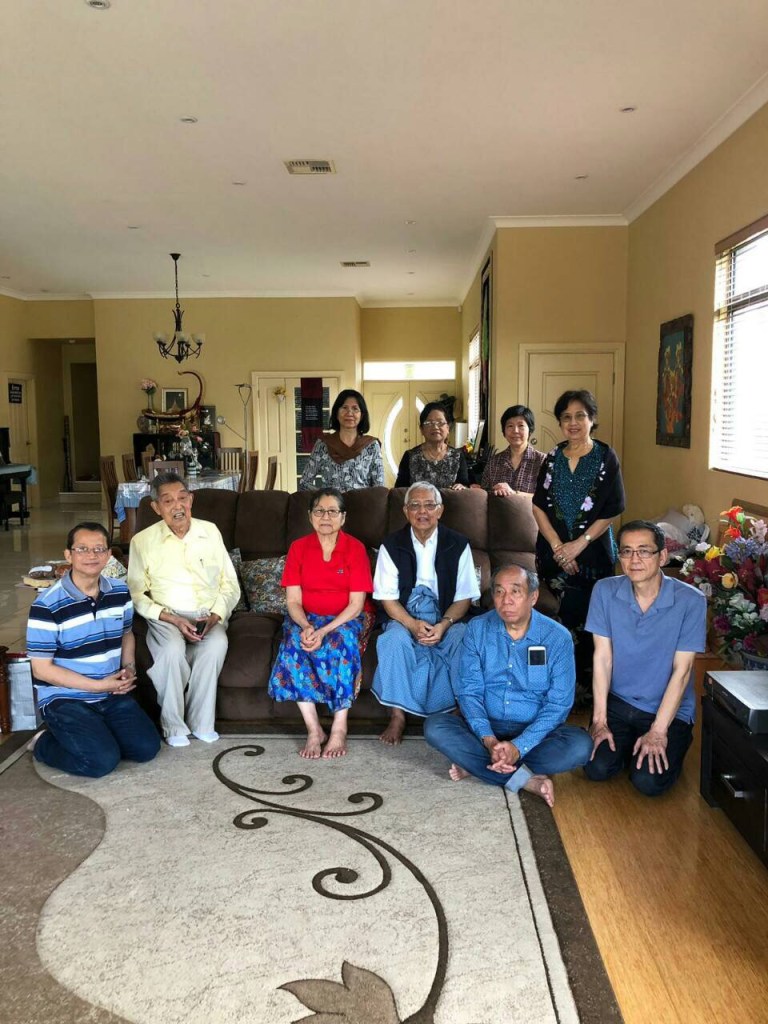
    • In June 2006, I attended mini-gatherings in Sydney:
      (a) RIT Alumni Dinner Gathering (co-chaired by Saya U Myo Win (GBNF) and Saya U Hla Myint
      (b) UCC alumni gathering at Saya U Aung Zaw’s house
      (c) Old Paulians Lunch Gathering at Olympic Park (organized by Dr. Thann Naing / Bonnie Kywe)
    • We paid homage to Saya Chit and Saya Dr. Freddie Ba Hli (National Planning Adviser & Board Member of UCC).
    • Saya later asked me to give a lecture or seminar for interested youths.
      He then presented me with his hat.
      I hope that Saya’s hat can “transfer” his brilliant thinking into my head.
    • Saya visited Singapore and Myanmar and shared his wisdom, knowledge and experience.
    • I managed to call Saya Chit a few months before he passed away.
      He told me that in the early 70s, both UCC and most Australian Universities were using ICL Computers. He said Burma should make strides in Computer Science and Applications like other countries in general and Australia in particular.
    • Saya’s Biography (provided by his family)
    • Pioneers
    • Memories of UCC (series)
    • Articles by U Soe Paing, U Aung Zaw …
  • U Aung Zaw

    Brief Background

    • Joined Mathematics Department, RASU
    • Transferred to UCC as Systems Programmer
    • M.Sc. (Computer Science) from Southampton University in the UK.
    • Managed a team of System Programmers at UCC and CSO.
    • Taught Computer Science at UCC, ABAC and in Australia.
    • Co-authored Lecture Guides for use at UCC with Saya U Soe Paing and U Hla Min.
    • Wrote articles and poems.
    • His elder sister in Myanmar published them as two books.
    • I edited part of the first book “Dhamma and Bawa” and also wrote the Preface.
    • Based on his ideas, I wrote “A grandfather’s advice for a fruitful life & peace of mind” for a section of the second book “Cetana Thi Thar Kan“.

    Dhamma and Bawa (First Book)

    This image has an empty alt attribute; its file name is dhamma-and-bawa.jpg

    Cetana Thi Thar Kan (Second Book)

    This image has an empty alt attribute; its file name is az-book-2.jpg
    This image has an empty alt attribute; its file name is az-book-1.jpg
  • UCC

    It seems like only yesterday when Computer Science, Technology and Applications were introduced to Burma/Myanmar.

    Saya Chit (Dr. Chit Swe) founded Universities Computer Center (UCC) with the help of Saya U Soe Paing, Saya U Myo Min and Saya U Ko Ko Lay (GBNF).

    Saya Chit firmly believed in

    • Technology Transfer
    • Leapfrogging Technology
    • Lifelong Learning
    • the ability, passion and work ethics of fledgling Burmese/Myanmar professionals and students.

    Saya Chit, who was Head of the Mathematics Department at the Institute of Economics, proposed to the Ministry of Education to have a Computer at the Institute for Teaching and Research. Dr. Nyi Nyi asked Saya Chit to expand the scope to have a Computer for use by the Universities and Institutes.

    The project to establish the first Computer Center in Burma took a long time to get approved by the United Nations Development Program (UNDP). UNESCO was designated as the Executing Agency.

    Saya Chit was determined that the UCC project should nurture Burmese Computer Professionals and trigger the Computerization of Government Departments.

    Saya ensured that the UNDP/UNESCO Grant will have a component to invite outstanding Computer Scientists and educators to Burma.

    Professor Harry D. Huskey, computer pioneer and Past ACM President, was offered a subcontract for education and training. Professor Huskey convinced Professor Anthony Ralston (another Past ACM President), Professor Peter Wegner (expert in systems software, programming languages), Professor Michael Stonebraker (expert in data base systems, founder/implementer of Ingres, winner of ACM Turing Award a few years back) and other distinguished academics to share their knowledge and expertise in Burma.

    Saya Chit wanted to establish academic departments and institutions to teach and research Computer Science, Technology and Applications.

    To head in that direction, Saya Chit allowed UCC (where he was the Founder and Director) to conduct Computer Science programs under the aegis of the Department of Mathematics, Rangoon University (where he was Professor and Head of the Department).

    Details of the early days of Computing in Burma has been documented in part by Saya U Soe Paing in “Computer ah sa; UCC ga” and other related articles. Saya was my mentor at RIT and UCC.

    From UCC to DCS and ICST

    Saya Chit was succeeded by Saya Dr. Tin Maung (GBNF), a senior Lecturer at the Deparment of Mathematics and a son of Sayagyi U Kar (Minister of Education in the Caretaker Government).

    During Dr. Tin Maung’s tenure, the Department of Computer Science (DCS) was founded under Rangoon University. U Ko Ko Lay served as the Professor of DCS.

    The Institute of Computer Science and Technology (ICST) was then established with Saya Dr. Tin Maung as Rector.

    Saya U Ko Ko Lay served as Professor and Head of the Information Systems Department.

    Saya U Tun Aung Gyaw served as Associate Professor and Head of the Hardware Technology Department.

    I was appointed as Associate Professor and Head of the Software Technology Department.

    Senior sayas from the Mathematics Department would later head the Computational Mathematics Department.

    The Bachelor of Science degree programs was established. Thirty students were selected for the first year B.Sc (Computer Science) class. Fifteen students were chosen for the Computer Technology class.

    Among the students were Ma Aye Aye Kyaw Zin, daughter of my classmate U Kyaw Zin (EP69). She is now a senior computer professional in Sydney, Australia. Another female student Mi Thinn Hnin Myaing left ICST to join her mother (my I.Sc.(A) classmate) in the USA. A few years back, I met both the mother and daughter, who is a Commander (Lt. Colonel, Dental Surgeon) in the US Navy.

    Micro-gatherings

    Ma Aye Aye Kyaw Zin, Ma Su Su Hlaing and Ko Win Pe hosted a dinner during my visit to Sydney in 2006.

    Ma San Yin Myint (Samantha, cousin of U Maurice Chee) took me to a dinner to meet her classmates from the second batch. Some of them are Entrepreneurs.

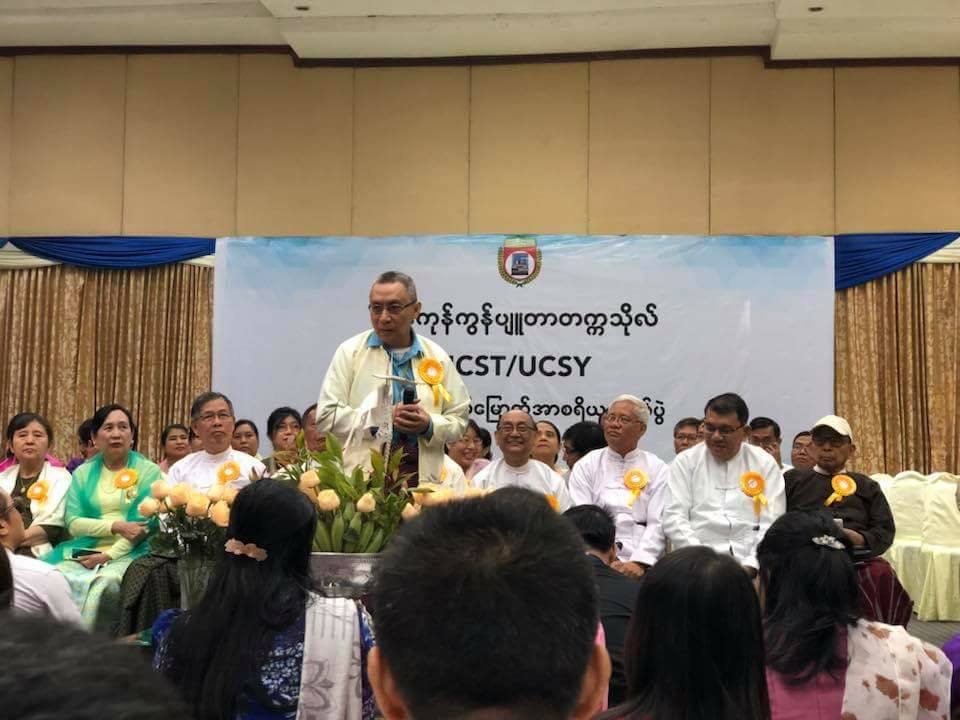
    Ko Saw Yan Naing (son of Dr. Wesley Saw Naing, and nephew of Dr. Myo Khin) gave me a ride to the 5th Acariya Pu Zaw Pwe of ICST and UCSY (University of Computer Studies in Yangon).

    I had a good time at the 40th Anniversary of UCC.

    A UCC Reunion of former staff, sayas and students will be held at MICT Park on December 29, 2018. My spouse has agreed to attend on my behalf.

    Saya U Soe Paing and Daw Saw Yu Tint (Alice) hosted us during my visits to Yangon. We requested them not to host the last time when Saya Paing was having back pain and the doctor friends of Alice strongly suggested Saya to have a check up and operation in Singapore.

    There are several informal gatherings, e.g. Christmas party at Daw Gilmore Hole’s house, lunch gathering at Koke Kine Bone Kyaung and Kone Myint Tha.

  • Computer Systems at UCC

    • Introduction
    • ICL Computer Systems
    • ICL Software
    • ICL Museum
    • PDP
    • Calcomp
    • Cromemco
    • IBM Computer Systems

    Introduction

    The UCC Project was funded by UNDP and executed by UNESCO.

    ICL submitted the winning bid for the UCC Project.

    The ICL 1902S System became the first mainframe computer in Burma.

    Calcomp Flat bed Graph Plotter was used off-line.

    PDP11/70 System was later acquired.

    Cromemco System3 and the PCs were the latest additions to UCC.

    ICL Computer System

    ICT (International Calculators and Tabulators) evolved into ICL (International Computers Limited). The British Government was partly responsible for the merger of several British Companies such as ICT and LEO.

    ICL Burma

    • ICL has a presence in Burma with U Kyaw Tha as Manager.
    • ICL leased Unit Record Machines.
    • ICL was among the four computer companies that submitted tender for the UCC Project. funded by UNDP and executed by UNESCO. It submitted a model of S/360. IBM did not win the bid.
    • ICL (International Computers Limited) won the tender for the UCC project.
    • In the early 60s, Burma Railways requested a budget to lease ICL Computers, but it did not materialize due to the Coup D’etat and subsequent policies by the Revolutionary Council and Government.

    1900 Series

    The ICL 1900 series consist of

    • ICL 1901
    • ICL 1902
    • ICL 1903
    • ICL 1904
    • ICL 1905
    • ICL 1906
    • ICL 1907

    The “basic” machines have “A” in the name, e.g. ICL 1901A

    The “enhanced” machines have “S” in the name, e.g. ICL 1902S (the one used at UCC).

    System Configuration at UCC

    The following configuration was used at UCC. Some upgrades were made using the budget for “Population Census Data Processing” Project.

    • ICL 1902S computer with 2.5 D (dimensional) core memory and a console typewriter
    • Two ICL 2101 Card Readers
    • ICL 1933 Line Printer
    • Two ICL 2802 EDS (Exchangeable Disk Store)
    • Each controller controls two EDS 8 disks
    • Four ICL 2506 Magnetic Tape 9 track NRZI (Non Return to Zero Inverted)

    The computer has piano-like keys for “bootstrapping” and for “testing”.

    Media

    Some ICL computers use a 5-track Paper Tape Reader. There are pros and cons for using “punched cards” versus “punched paper tape”.

    Punched cards were used in the early looms and in the Hollerith Machines used for processing US Population Census Data. Hollerith founded a company, which evolved into IBM.

    Punched paper tape were used in the early transmission systems.

    For frequently used program and data, magnetic tapes and disks are used.

    Training and Support

    Three UCC engineers — U Tun Aung Gyaw, U Hla Min and U Soe Win — attended training at the ICLETC (ICL Engineering Training Center) in Letchworth, UK.

    The trouble shooting requires the use of diagnostic tests and associated guides.

    ICL provided a resident engineer to maintain the computer system.

    ICL also provided a resident programmer/analyst to guide the system programmers and selected application programmers.

    KMZ wrote :

    I believe I still have a key chain from Ko Soe Myint Gyi. He had a “ဆြမ္းအုပ္” drawn on Calcomp and laminated it to create the key chain. He gave it to me when I met him and KZ at Wynn Myint Aung’s house. They were on some tour visiting Washington DC area in the mid-80s.

    ICL Software

    Computer systems require

    • Systems Software
    • Applications Software

    Systems Software

    Operating System is the main Systems Software.

    • The ICL 1900 series machines use GEORGE (General Organization Environment) Operating System.
    • ICL1902S uses GEORGE-2.
    • Some other models use GEORGE-3.

    ICL1902S comes with several systems and application software packages.

    Saya Zaw (U Aung Zaw) and team install the software and the patches during the period reserved for them.

    ICL1902S used the following Programming Languages

    • PLAN (Programming Language for Nineteen hundred series) is the Assembly Language.
    • FORTRAN (Formula Translator) is the programming language used for Scientific Computing.
    • COBOL (Common Business Oriented Language) is the programming languages used for Business Applications.

    The language compilers detect syntax and semantic errors of the submitted program. For programs that are free of “serious” errors, the compilers output a form that can be read by a “consolidator” or “linking loader”.

    Application Software

    ICL provided several application software packages.

    Examples include :

    FILAN (File Analysis) is used for the processing of Population Census data.

    CSL (Control and Simulation Language) is available for discrete event simulation.

    ICL Museum

    Saya U Soe Paing e-mailed me with photos of the “historic” ICL computer system.

    Saya mentioned that U Thein Oo is willing to support the “ICL Museum” project.

    At an ACM (Association of Computing Machinery) meeting, I met Gwen Bell (spouse of Gordon Bell, VAX architect). Gordon brought back artifacts that he had collected while co-authoring the book “Computer Structures” with Alan Newell during his sabbatical at CMU (Carnegie Mellon University). She introduced me to Karen, VP (Vice President of CHM). I volunteered to be a Docent.

    Gwen developed an exhibit at the DEC office in Boston, Massachusetts. It became known as BCM (Boston Computer Museum).

    When Microsoft bought the division of DEC (where Gordon & his team worked), Gwen had to think fast.

    Only a limited number of artifacts were accepted for display at the Science Museum.

    The rest of the artifacts were air-freighted to Moffet Field with the hope that the “Computer Museum” will be revived. For several years, the artifacts were displayed at the Make-shift Museum in Moffet Field. A group of enthusiasts bought a building owned by SGI (Silicon Graphics Incorporated) and moved some there. The rest was placed in a storage house.

    As a Docent, I had to show the visitors and explain [if requested] about the artifacts displayed in “Visible Storage”. In those days, only ten percent (or so) could be displayed for a period before rolling them out.

    Thanks in part to the “Melinda and Bill Gates Foundation”, CHM could now exhibit 20 sections (from pre-computer era to the Internet age). In addition, there are special exhibits (e.g. autonomous vehicles, computer chess, …)

    Having “ICL Museum” will be a significant step towards recording and preserving the History of IT (Information Technology).

    PDP

    Ken Olson and several other MIT alumni founded DEC (Digital Equipment Corporate).

    Grape vine says that there was a “protocol” in government departments to “purchase computer”. In order to circumvent that, DEC named their mini-computers as PDP (Programmable Digital Processors).

    CHM (Computer History Museum) has a PDP-1 on display. Retired DEC engineers “restored” a PDP-1. The exhibit has demos : one for play a “primitive” Space War game, another for “playing” music …

    PDP-8 is a 12-bit mini-computer used in many universities of that period.

    PDP-11 is a 16-bit mini-computer (that was acquired by UCC).

    VT-101 (or similar) terminals became the “new” mode of entering and running programs.

    DEC later introduced VAX (Virtual Address eXtended) series.

    Gordon Bell was the VAX architect and co-author of the book using CMS (Computer Memory System) and “formal” methods to describe and evaluate computer systems. The artifacts that he collected for the book project were displayed in DEC as BCM (Boston Computer Museum) with Gwen Bell as the Curator. It later became CHM (Computer History Museum) in Mountain View, California.

    I volunteered as a Docent for CHM for a couple of years. I had to give guided tours (for 45 minutes to an hour). One child asked his father how fast the 10 Million Dollar computer (Cray 1) was. The reply, “It’s slower than your PC and your smart phone”.

    KMZ wrote :

    It was a shame that DEC/VAX/VMS did not take off well as some people hoped. Fortunately, Bill Gates hired VAX/VMS main architect Dave Cutler in 1988, who brought many of his team from DEC, 20+ as reported, as part of the hiring agreement of Dave Cutler.

    Dave Cutler and his team developed Windows NT, New Technology – a 64bit OS, and the rest is history. He has his hands on RedDot, which be came Microsoft Azure.

    Dr. Mark Russinovich, received his doctorate in 1989 from Carnegie Mellon, developed a very popular Windows utility suite called ‘SysInternals’ with his partner. This was a godsend for all Windows Systems Engineers, a Swiss Army Knife, if you will. He also had a short stint at IBM, he also wrote a series of articles comparing Windows NT with VMS?? in Windows Internals magazine. Microsoft eventually acquired the SysInternals, Mark included. Mark is now CTO of Microsoft Azure.

    Calcomp

    A flat bed CalComp Graph Plotter was added.

    Calcomp sent Robert Boyle to provide on-site training for the graph plotter. Trouble shooting for Calcomp is based on Venn Diagrams.

    At the dinner, Saya U Ko Ko Lay asked Robert if he wanted to try Nga Yoke Thee. Saya explained that there is “Moe Hmaw (Look for the sky)” and “Ka La Aw (Indian Scream)”.

    Cromemco

    Cromemco System 3 was a micro-computer.

    UCC staff members burned PROM (Programmable Read Only Memory) to support Burmese characters.

    IBM Computer Systems

    IBM Burma

    • IBM has a presence in Burma with U Aung Khin as Manager.
    • IBM leased Unit Record Machines.
    • IBM was among the four computer companies that submitted tender for the UCC Project. funded by UNDP and executed by UNESCO. It submitted a model of S/360. IBM did not win the bid.
    • ICL (International Computers Limited) won the tender for the UCC project.
    • IBM later won the bid for the CSO project.

    IBM 360

    Hollerith Machines which processed the US Population Census in 1890 with its Unit Record Machines evolved into IBM (International Business Machines).

    • IBM designed and implemented System360.
    • 360 supposedly refers to the number of degrees in a circle.
    • It uses the same architecture with a common instruction set (IS).
    • The high end models implement the IS using the best available hardware.
    • The low end models implement the IS using firmware.

    Blauuw and Brooks explain the then new concepts in their reference guides. They include

    • Architecture
    • Implementation
    • Realization
    • Brooks led the development of both the computer systems and the operating system OS/360.
    • He wrote a book, “The Mythical Man Month” (which became a classic).

    I attended a lecture at CHM (Computer History Museum) and asked some members of the S/360 development team to autograph the S/360 reference card.

    IBM 370

    • IBM later introduced the System 370.
    • Amdahl left IBM to form his company and produced Amdahl 470, which is compatible with S/370 and supposedly much better than the IBM S/370.
  • Early Departments at UCC

    • Office of the Director
    • Administration
    • Systems Division
    • Applications Division
    • Operations Division
    • Volunteers

    Office Of The Director

    Saya Chit (Dr. Chit Swe) was the Founder and Director of UCC. Saya Chit was Professor of the Mathematics Department at RASU. Saya has an office at RASU.

    The Office is used to hold meetings with Board of Directors & Advisers.

    It also provided service for the Experts including Dr. S. I. Saleeb (Project Director for the UCC Project) and Professor Harry D. Huskey (in charge of the “Knowlege Transfer” component).

    Saya Dr. Tin Maung (Lecturer, Mathematics) succeeded Saya Chit as Director. He would spend full-time at UCC.

    Administration

    Superintendent

    U Myint Aung (GBNF) was the Superintendent. He was healthy and passed away lately in his eighties.

    U Myint Aung was succeeded by U San Win. U San Win was not so healthy and suffered a stroke.

    Clerks

    There were Branch Clerks (BC), Upper Division Clerks (UDC) and Lower Division Clerks (LDC), Office Assistants (including Peons).

    Some early Clerks include U Ba Than Chein, U Than Aye, U Tun Myint, U Khin Maung Lwin, and Daw Phyu Phyu Win.

    The four Sayagyis (Saya Chit, Saya Paing, Saya Myo and Saya Lay) had a Peon as their Office Assistant.

    Secretaries

    In the beginning, there were three Secretaries (for preparing reports and teaching materials). They were

    • Daw Khin Lay Myint
    • U Win Myint (1)
    • Daw Khin Khin Su.

    All later made career changes.

    Daw Khin Kay Myint later became a BC. I met her at the 40th Anniversary UCC gathering. She is GBNF.

    U Win Myint (1) was a High School Luyechun. He was caught by surprise when the new Education System used the controversial ILA system and assigned him to study Philosophy. With determination, he took courses at UCC and became a Programmer. He later worked (taught, translated …) at Winner Computer Group.

    Daw Khin Khin Su moved to Total (Oil Company owned by the French).

    Security

    There were Security Personnel (for the day, evening and night shifts).

    U Tun Kywe, an army Veteran, usually “guards” the entrance to the Computer Room (on the Ground Floor of the UCC Building). He also vets the visitors climbing up the stairs to meet the staff.

    Maintenance

    There were several Maintenance Personnel. They include Daw Ngwe Tin, Maung Myint, Aye Aye Myint, Hla Hla Myint, San San Myint and U Hla Pe.

    Drivers

    There were a couple of Drivers. Sad to note that Saya Chit’s driver (who moonlighted as a Side Car Operator) was hit by a train at a railroad crossing. There were “volunteer” drivers including U Myint Aung, U Win Hlaing, and U Soe Myint (Operations).

    Systems Division

    Saya U Soe Paing was Manager of the Systems Division.

    Maintenance Engineers

    The early engineers include U Tun Aung Gyaw (EC69), U Hla Min (EC69) and U Soe Win (EC70).

    U Tun Aung Gyaw later served as Manager of Systems Division and Associate Professor at the Department of Computer Science (DCS) and Associate Professor of Hardware Technology at the Institute of Computer Science and Technology (ICST).

    U Hla Min later served as Senior Systems Programmer, Manager of Business Applications Division, Lecturer at DCS and Associate Professor of Software Technology at ICST.

    U Soe Win later transferred to PTC.

    U Tin Win (Saya at RIT) joined UCC. He later moved to FRI.

    Maintenance Technicians

    The early technicians include U Aung Myint (who transferred from the RIT EE Lab), U Ngwe Soe (Silver), U Myint Soe (Byte) and U Khin Zaw.

    U Aung Myint later became Maintenance Engineer.

    U Ngwe Soe and U Khin Zaw moved overseas.

    System Programmers

    The early system programmers include U Aung Zaw, U Maung Maung Htay, U Than Lwin, U Soe Myint (KSM) and Rafiul Ahad.

    U Aung Zaw moved to CSO, and later to Thailand and Australia.

    U Maung Maung Htay taught at DCS and ICST before moving to the USA.

    U Than Lwin moved to CSO, and later to Singapore.

    KSM later joined the UN. He is now in the USA.

    Rafiul studied at AIT and at USC (University of Southern California). He taught at the University of Maryland before joining HP, Ingres and Oracle. He is a Vice President of Cloud Computing at Oracle.

    Others

    There were some volunteers and some (mostly graduate students) trainees. They include U Khin Maung Zaw (KMZ), U Sein Tin, U Maung Maung Tun, U Win Maung, U Htay Aung and Daw Tin Tin Pyone.

    Later Eng U Tin Win and Daw Tin Tin Pyone moved to FRI (Forestry Reserve Inventory). Saya Zaw and U Than Lwin transferred to CSO (Central Statistical Organization). U Soe Win and Byte (U Myint Soe) transferred to PTC. KMZ moved to Singapore and then to the US. Rafi moved to Thailand and then to the US. Silver moved to Singapore. Saya TAG, U Mg Mg Htay and U Mg Mg Tun moved to the US. U Win Mg moved to Australia.

    Applications Division

    Saya U Myo Min was Manager of the Applications Division.

    Saya Myo managed Application Programmers & Analysts for business applications, scientific & engineering applications.

    Later, the Applications Division was restructured in Business Applications Division (with Saya Myo as Manager) and Scientific Applications Division (with Saya U Ko Ko Lay as Manager).

    Saya U Soe Paing subsequently managed both Systems Division and Operations Division.

    Application Programmers

    • U Mya Thein (GBNF)
    • U Thein Oo
    • U Mra Tun
    • U Kyaw Nyein (GBNF)
    • U Htin Kyaw
    • U Tun Shwe
    • U Aung Hlaing
    • Dr. Soe Than
    • U Myint Oo
    • U Win Naing (GBNF)
    • Daw Tin May Lwin
    • Daw Thin Thin Aung
    • Daw Nwe Nwe Win
    • Daw Nge Ma Ma Than (GBNF)
    • Daw Than Than Tin
    • Daw Gilmour Hole
    • U Boe Ba Shan
    • Daw Hpyu Hpyu Aung
    • U Sein Myint Maung
    • Daw Khin Aye Mu

    Operations Division

    Saya U Ko Ko Lay originally managed the Operations Division. After the restructuring, Saya Lay managed the Scientific Applications Division.

    The Operations Division was handed over to Saya Paing.

    Operators

    • U Hla Min (CO, GBNF)
    • U Mg Mg Gyi
    • U Maung Maung Lay
    • U Kyaw Swar
    • U Win Hlaing
    • U Soe Myint (M72, GBNF)
    • U Myint Swe
    • U Hla Aung
    • U Kyi Win
    • U Tun Kyi
    • U Tin Win
    • U Than Tun
    • U Myint Lwin (Charlie)

    Several later made career changes as Programmers and Teaching Staff.

    U Soe Myint (GBNF) retired as Pro-Rector of ICST.

    In the early days, U Hla Min was the Chief Operator.

    There were shift leaders (e.g. U Maung Maung Gyi, U Kyaw Swar, U Soe Myint).

    There were three Shifts. The Morning Shift was run for staff, students and general users. The Evening and Night Shifts were run for selected user departments. The Population Census Data Project had a high priority.

    There were several operators for card punch, manual punches, punched card verifier, and sorter.

    Some did double duty as Job Controllers. They include

    • Daw Nyunt Nyunt Tin
    • Daw Thi Thi Aye
    • Daw Hla Hla Win (GBNF)
    • Daw Win May Thaung (GBNF)
    • Daw Kyu Kyu Lwin (GBNF)
    • Daw Khin Si Thaung.

    Several later changed their careers or went overseas.

    There was also a Librarian in charge of the Magnetic Disks and Magnetic Tapes.

    Volunteers

    • Kudos to the many unsung heroes who volunteered for gratis or for a per Diem of Three Kyats and Fifteen Pyas.
    • They worked for various divisions.
    • Without them, the introduction of Computer Technology to Burma would not have been smooth and successful.
  • Computer Pioneers in Burma

    Universities’ Computer Center (UCC)

    • UCC was founded by Sayagyi Dr. Chit Swe (GBNF) with the help of Saya U Soe Paing, Saya U Myo Min and Saya U Ko Ko Lay (GBNF).
      GBNF stands for “Gone But Not Forgotten”.
    • I have posted “Memories of UCC” in my web site hlamin.com and selected Facebook pages.
      A summary was published in the ICST/UCSY Magazine commemorating the 30th Anniversary of ICST.

    Sayagyi Dr. Chit Swe

    NATIVITY : Born on May 25, 1931 as the Third child of Lawyer U Han Tin and Daw Than in ELA (Aye Lar), Pyinmana Township.

    ETHNICITY : Myanmar Shan

    SIBLINGS : Daw Hla May, Captain Tin Aung, Myint Thein, Sein Lwin, Thet Oo, Khin Ma Ma

    SPOUSE : Daw Khin Khin Latt (Ma Ma Mi)

    CHILDREN : Moe Thu (Merle Chitswe), Thuta, Kyaw Thu (Kinsey Chitswe), Swe Latt (Cyril), Chit Khin

    EDUCATION

    • Ph. D (Mathematical Statistics) Liverpool
    • M. Sc (Mathematical Statistics) Glasgow
      Started self-study of Computers and Programming for the development of future Burma
    • B. Sc. (Special) : 1954 Imperial College of London
    • B. Sc : 1951 Mandalay College, University of Rangoon
    • Matriculation : 1947 Pyinmana High School
    • Primary and Secondary Education : ELA Monastery School (Aye Lar Gaing Htauk Kyaung)

    WORK HISTORY

    In Myanmar

    • Rector : 1986 – 88 University of Rangoon
    • Chair : 1971 – 86 Department of Computer Science
    • Founder and Director: 1971 – 76 Universities’ Computer Center (Introduced Computers and Computer Education to Burma)
    • Professor and Chair : 1966 – 86 Department of Mathematics University of Rangoon (Supervised 200+ M. Sc and Ph. D theses)
    • Lecturer and Head of Department : 1964 – 66 Department of Mathematics Institute of Economics
    • Lecturer : 1957 – 64 Department of Mathematics Mandalay College, University of Rangoon
    • Assistant Lecturer : 1955 – 57 Department of Mathematics Mandalay College, University of Rangoon
    • Tutor : 1952 – 55 Department of Mathematics Mandalay College, University of Rangoon

    In Thailand

    • Senior Faculty Assumption University, Bangkok
    • Consultant : 1990 – 94 ESCAP

    In Australia

    • Senior Research Fellow Macquarie University, Sydney

    Editor’s Notes

    • Sayagyi studied at Mandalay, London, Glasgow and Liverpool.
    • Proponent of Lifelong learning, Knowledge sharing, Leapfrogging technology, Mentoring, Building trust, Establishing high quality Computer Education, Training and Applications, UTC (where he served as Commanding Officer)
    • Founder/Director of UCC and Professor of Mathematics at RASU.
      Graduate degree and diploma courses were offered at UCC under the aegis of the Department of Mathematics before the Department of Computer Science (DCS) and the Institute of Computer Science and Technology (ICST) were established.
    • Sayagyi is my mentor.
      He allowed me to participate in numerous projects (e.g. Team of System Specialists, High School Mathematics, Children’s Treasury of Knowledge, PERT for implementation of UCC).
    • Retired as Rector of RASU.
    • Continued teaching and supervising research in Thailand and Australia.
    • In November 2019, Sayagyi passed away at the tender age of 89 in Sydney, Australia.
      Former students all over the world sent condolences and Garawa money for Sayagyi’s last journey.
    Saya U Soe Paing

    Saya U Soe Paing

    • Studied at SPHS, Faculty of Engineering (briefly), Stanford University and Southampton University.
    • Stood 13th in the Matriculation of 1956 and won Collegiate Scholarship
    • Won two Gold Medals for I.Sc. Combined (Highest total score, Highest Mathematics score) at the Convocation of 1958
    • Received BSEE and MSEE from Standford University
    • Joined RIT EE Department as Assistant Lecturer
    • Transferred to UCC as Manager of Systems Division
    • Recevied M.Sc. (Computer Science) from the University of Southampton in the U.K.
    • Helped Sayagyi Dr. Chit Swe found UCC.
    • Recruited the early members (including Saya U Tun Aung Gyaw and me — also known as members of UCC Generation Zero).
    • Allowed Saya U Aung Zaw and me to co-author lecture notes, reference / guides for use at UCC courses.
    • Requested Ko Khin Maung Zaw and me to set up systems for getting the ex-RIT and ex-UCC get reconnected electronically and physically.
    • With the help of Sayagyi U Ba Than (M) and Saya U Thaw Kaung, he and his team accessed the Archives of Rangoon University Central Library and scanned documents related to Engineering Education.
    • Prepared the draft for HMEE (History of Myanmar Engineering Education) Project.
      Ko Ohn Khine and I compiled the CD supplement for the book
    • Retired after working for UN Projects in several countries.
    • Hobbies include Golfing, Meditation and Hosting parties for ex-UCC visiting Myanmar
    • Wrote “Computer Ah Sa UCC Ga” and memoirs.
      They can be read from SCRIB-D.
    Saya U Myo Min visiting family and friends in Texas

    Saya U Myo Min

    • Studied at SPHS, Faculty of Social Science and Lancaster University.
    • Matriculated from St. Paul’s High School in 1958
    • Stood first in I.Com in 1960
    • Stood first in B.Com (with Accounting as Specialization) in 1962
    • Became a Chartered Account in U.K.
    • Worked as Systems Analyst for IBM UK.
    • Sayagyi Dr. Chit Swe contacted Saya’s mother if Saya would like to help with the UCC project.
    • Helped Saya Dr. Chit Swe found UCC and served as Applications Manager.
    • Helped government departments with computerizing business applications.
    • Taught at UCC, Institute of Economics and at several training courses (for Government departments).
    • Received Masters in Systems Engineering from the University of Lancaster in the UK.
    • Taught at Nan Yang Institute in Singapore.
    • Retired after working for high tech companies (Sea Gate, Connor) in the USA.
    • Passed Abhidhamma / Thingyo Examination.
    • Saya’s interests include Abhidhamma, Meditation, Online courses and Technology Updates
    Saya U Ko Ko Lay at UCC Thingyan

    Saya U Ko Ko Lay (GBNF)

    • Studied at SPHS, Faculty of Engineering (briefly), Stanford University and Lancaster University.
    • Classmate of Saya U Soe Paing at SPHS and Stanford University.
    • Matriculated from St. Paul’s High School in 1956.
    • Received BSCE and MSCE from Stanford University.
    • Joined PWD as Assistant Engineer.
    • Helped Saya Dr. Chit Swe found UCC and served as Operations Manager.
    • Later served as Manager of the Scientific Applications Division.
    • Saya had the longest tenure at UCC among the four founders.
    • Saya received Masters in Systems Engineering from the University of Lancaster in the UK.
    • Served as Professor at the Department of Computer Science, University of Rangoon.
    • Served as Professor of Information Science and Technology at ICST (Institute of Computer Science and Technology)
    • Played volleyball, soccer, ping pong and tennis with UCC staff and students.
    • Excellent English and Editing
    • Passed away in the early 1990s.
    • Earliest GBNF among the four UCC Founders.
  • ICST Rectors

    ICST Rectors

    by Hla Min

    Updated : May 2025

    Dr. Tin Maung (GBNF)

    Dr. Tin Maung

    Saya is the son of Saya Kar, who served as Minister of Education in the Caretaker Government.

    He joined the Department of Mathematics as Tutor. He went for further studies in UK. Upon his return, he was promoted to Lecturer.

    He succeeded Saya Dr. Chit Swe as Director of UCC.

    During his tenure, DCS (Department of Computer Science) was established with Saya U Ko Ko Lay as Professor and Saya U Tun Aung Gyaw as Associate Professor.

    In 1987, ICST (Institute of Computer Science and Technology) was established with Saya as Rector.

    There were four Departments :

    • Hardware Technology
    • Software Technology
    • Information Systems
    • Computational Mathematics

    U Ko Ko Lay was Professor and Head of Information Systems.
    U Tun Aung Gyaw was Associate Professor and Head of Hardware Technology.
    U Hla Min was Associate Professor and Head of Software Technology.

    Bachelor degree courses in CS and CT were given. In the first batch, there were 30 CS and 15 CT students.

    Saya continued to implement the Vision and Mission set by the UCC Founders, and managed to go further.

    Saya did not live long enough to see 26 batches (from ICST and UCSY) host the 5th Acariya Pu Zaw Pwe on January 14, 2018.

    Dr. Kyaw Thein (GBNF)

    Dr. Kyaw Thein succeeded Dr. Tin Maung as ICST Rector. He is also known as Saya Thein.

    Saya Thein told the attendees of the 5th Acariya Pu Zaw that I (U Hla Min) was Generation Zero, Bo Htay (Dr. Maung Maung Htay) was Generation One, and he was Generation Two.

    Saya was a fledgling tutor in the Mathematics Department in 1963. He was a top student in his Honors Class (1958 – 1962). He held Tutorial for the topics taught by Saya U Khin Zaw, Saya Choudry and Sayama Daw Khin Ma Ma in our I.Sc.(A) class at Leik Khone in 1963.

    I was top of I.Sc. (A) and joined the first ever 2nd BE class at RIT in Gyogone.

    We crossed our paths again when U Tun Aung Gyaw, U Soe Win and I drove down to Southampton University to see Saya U Soe Paing and U Aung Zaw.

    Saya was doing his Ph.D. Saya is an expert on Differentiable Manifold (and related topics).

    Saya and U Aung Zaw joined us to see Stonehenge, Salisbury Cathedral, and a Safari.

    As Saya Chit’s assistant and general hand, I worked on several projects (e.g. High School Mathematics, Children’s Treasury of Knowledge) with the Mathematics sayas.

    Saya became Principal of Sittwe College.

    Saya succeeded Dr. Tin Maung as Rector of ICST.

    Dr. Pyke Tin

    Dr. Pyke Tin succeeded Dr. Kyaw Thein as ICST Rector. He is also known as Saya Pyke.

    Saya’s name literally “remain on a net”. Saya’s mother had a few miscarriages. When Saya was conceived, his mother wanted to make sure that Saya would be born safe and sound. She performed a Yadaya requiring someone close to her hold a net and catch Saya.

    He received his Ph.D from Monash University, Australia. He is an expert on Stochastic Processes and related topics. He served as Reviewer for research papers.

    I had the opportunity to audit the “Linear Programming” course by Saya and learn his teaching style.

    I also worked with Saya and others (Dr. Khin Maung Win, U Sein Min and U Soe Nyunt) on the “new” High School Mathematics Project.

  • Institute of Computer Science and Technology

    by Hla Min

    Updated : May 2025

    1987

    • Institute of Computer Science and Technology (ICST) was established in 1987.
    • Started with four Academic Departments.
    • Also departments for Administrative and Support.

    Dr. Tin Maung (GBNF)

    • Son of Saya U Kar
    • Succeeded Sayagyi Dr. Chit Swe as Director of Universities Computer Center (UCC)
    • During his tenure, the Department of Computer Science (DCS) and ICST were established
    • Retired as Rector of ICST

    U Ko Ko Lay (GBNF)

    • Helped Sayagyi Dr. Chit Swe found UCC along with Saya U Soe Paing and Saya U Myo Min.
    • Transferred from PWD to UCC as Operations Manager.
    • Later served as Scientific and Applications Manager.
    • When the Department of Computer Science (DCS) was established, he served as Professor and Head of the Department.
    • When ICST opened, he served as Professor and Head of Information Technology Department.

    U Tun Aung Gyaw

    • Most senior volunteer among the “Generation Zero” members who worked on the UCC project before it was finally funded by UNDP and executed by UNESCO
    • Joined UCC as the first batch of employees.
    • Succeeded Saya U Soe Paing as Systems Manager
    • Associate Professor at DCS
    • Associate Professor and Head of Hardware Technology Department at ICST
    • He later received his doctorate from UIUC.

    U Hla Min

    • Senior volunteer among the “Generation Zero” members who worked on the UCC project before it was finally funded by UNDP and executed by UNESCO
    • Joined UCC along with U Tun Aung Gyaw as the first batch of employees
    • Succeeded Saya U Myo Min as Business Applications Manager.
    • Lecturer at DCS
    • Associate Professor and Head of Software Technology Department at ICST

    Computational Mathematics Department

    Several senior sayas (e.g. Saya Dr. Pyke Tin) taught at the Computational Mathematics Department.

    Students from first batch

    • There were 45 students studying for the CS (Computer Science) and CT (Computer Technology) options for B.Sc.
    • Thirty students chose to study Computer Science.
    • Fifteen students chose to study Computer Technology.

    The reunion photo was posted by Ma Min Thu.

    Sad News in 2017

    • Cho Mar Nyunt passed away on July 12, 2017.
    • In her memory, UCS.ICST Alumni in Singapore donated to the Burmese Buddhist Temple (BBT).
    • The photo and news were posted by Kyaw Zeya.

    ICST SPZP in 2018

    Saw Yan Naing (son of Dr. Saw Naing and nephew of Saya Dr. Myo Khin (C70)) gave me a ride to the SPZP in January 2018.

    The SPZP was held in five batches. As a member of “Generation Zero of UCC”, I covered some milestones of the Introduction of Computers to Burma under the leadership of Sayagyi Dr. Chit Swe.

    Daw Nge Ma Ma Than (Ma Nge, GBNF) attended the SPZP.

    ICST/UCSY published a commemorative magazine for the 30th Anniversary of the founding of UCC. I wrote “Paying Back to My Alma Mater” (a summary of the 30+ posts about UCC) for the issue.

    San Yin Myint (Samantha), one of the organizers for the Pu Zaw Pwe, is a niece of Saya U Win Kyaing (GBNF) and a cousin of U Hla Myint Thein (Maurice Chee, M75).

    This image has an empty alt attribute; its file name is icst-pzp.jpg

    ICST SPZP in 2019

    Daw Mar Mar Soe gave me a ride to attend the SPZP in December 2019.

    Attendees include Saya U Soe Paing, Saya Dr. Kyaw Thein (GBNF), Saya Dr. Pyke Tin, and Saya U Thein Oo.

  • Visit to UCSY

    Visit to UCSY

    by Hla Min

    Updated : May 2025

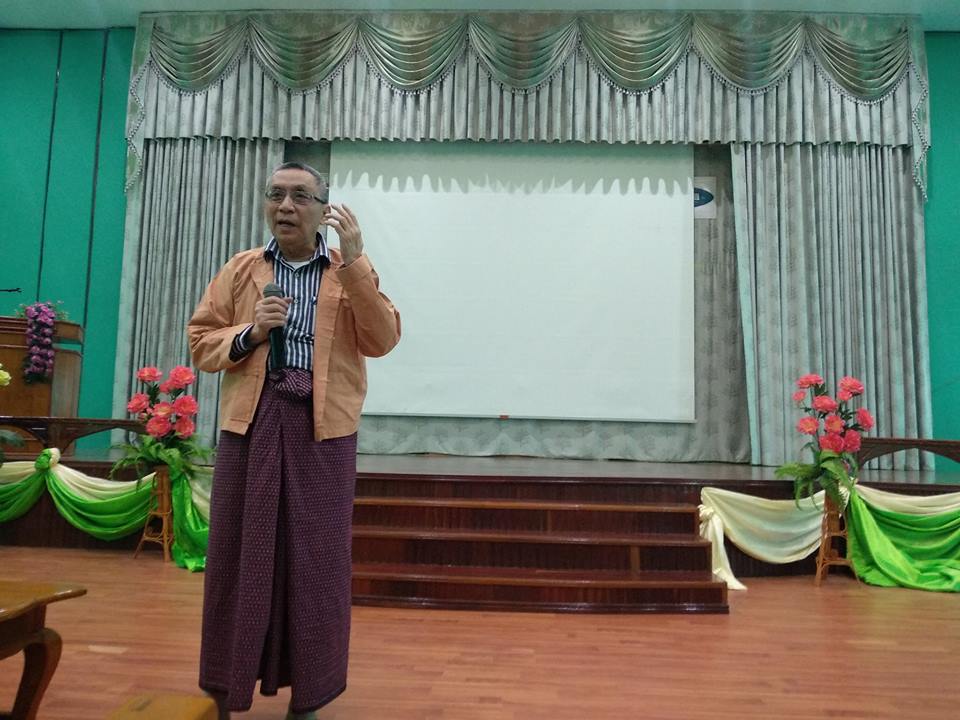
    Lecture at UCSY
    UCSY Lecture
    UCSY Staff
    UCSY Lecture Hall

    I worked at

    • Universities’ Computer Center (UCC)
    • Department of Computer Science (DCS)
    • Institute of Computer Science and Technology (ICST)

    In January, 2018 I visited University of Computer Studies Yangon (UCSY).

    I was greeted by

    • Daw Mu Mu Myint (senior sayama and Professor)
    • Dr. Khin Mar Soe (Professor)
    • Dr. Mie Mie Thet Thwin (Rector, GBNF)