I have created 30+ albums using the photos from the posts (with credit given to the source where ever possible) and the photos from my archives.
The Primary sources include Newspapers (e.g. Kyemon), Encyclopedias (e.g. Myanmar Swel Sone Kyan), Biographies (e.g. by Maung Aung Mon (a) Win Aung Gyi), Books (e.g. Collection of Kabyars), Brochures (e.g. Convocation), Magazines (e.g. Annual Magazines), Sar Saungs.
I have added relevant comments from the posts, and have added additional information.
With the help of specialist volunteers (e.g. Subject Matter Experts), they can be transformed into “Photo Essays” or articles in a digital book or e-books.
I have covered several subjects and departments.
The albums are not exhaustive and may not be mutually exclusive. e.g. The photos of Saya U Pe Maung Tin, Saya Dr. Htin Aung, Saya U Thein Han (Zawgyi) and Saya U Wun (Minthuwun) appear in several albums.
Geography
L. D. Stamp
Professor Laurence Dudley Stamp taught Geography at Rangoon University and the University of London.
He authored several books and articles (e.g. Land Use).
One book was a prescribed text in Burma in the early days.
He lectured to the first year students at LSE (London School of Economics) instead of delegating to his assistants. His rationale : “A major subject can be taught by any qualified teacher, but a minor subject should be introduced by a motivated, senior teacher. The class could be the sole exposure in their academic career; so it is important to give the students an excellent overview of the subject.”
Geography learned at school
We had to take World Geography and Burmese Geography in Middle School (then 5th to 7th standard). We sat for the last ever Government examination for 7th standard in 1960.
In 8th standard, we learned about Contouring and Climatic Interpretation.
Geography Teachers
Dr. Daw Thin Kyi is the first native Professor of Geography. She is also one of the early female Professors at Rangoon University.
Dr. Daw Thin Kyi
U Kyaw moved to Workers’ College as Principal.
Dr. Tin Htoo was a senior lecturer. .
I worked as a volunteer assistant for Saya U Hla Htun Aung, who was in charge of the “Zay Nay Yar Cha Htar Yee Committee” for the Rangoon University Golden Jubilee Celebrations in 1970. Among those who applied for permits include U Maung Maung Tar (Academy winning actor, trying to sell his line of make up) and the Playboys (Than Naing, Thein Tan, …)
Saya Dr. U Win attended UCC before going for his graduate studies in the US. He is an expert on Geographical Information Systems (GIS). He was the last speaker for the conferences held by Burma Research Society (BRS). The higher authorities entered the room and announced that “BRS has been disbanded”.
U Win blogged about his former sayas and sayamas.
After the Education System changes in 1964 and post-1988, there are many more Rectors and Professors.
Myint Myint Khine and her friends have posted photos of the senior sayamas and sayas.
Honor
I am trying to honor Outstanding Burmese in general, and RU Alumni in particular.
Enhanced the list compiled by Saya U Wun (Minthuwun) of “Outstanding Burmese who are First in their field”.
Enhanced another list “Early Female Scholars who did post-graduate degrees (mainly in the UK)” with those who studied in USA and elsewhere (using information and feedback from my sayas and friends).
Continually updated the list of Top Matriculates (from the Old System).
Wrote about outstanding athletes (in Soccer, Swimming, Rowing, Tennis, Table Tennis, Badminton, …)
Need Subject Matter Experts (SME) to help payback to our alma mater: Photo Exhibitions / Photo Essays Books / Kabyars / Cartoons / Movies / Songs related to RU Digital books (PDF files, e-books) Commemorative Magazines and Sar Saungs
Pat Tin-Win had the courage to request Sayagyi Dr. Ba Than (who was Medical Superintendent of the Japan Khit Say Yone Gyi, Rector of IM(1) and founder of the Zwe Ah Nyeint) to play Myamangiri on the harp, and allow the recording to be used for her friend Rosie to dance at the 1964 Chemistry Fresher Welcome. Sayagyi complied.
Related posts Gatherings
Extracurricular Activities
Saing Waing
Those who chose to stay in hostels have fond memories of the various functions (e.g. by Thahaya and Sar Phutt Ah Thinn — Social and Reading Clubs), the Inter-Hall and Inter-Institute Sporting Events (e.g. at Aung San Stadium).
Per Daw Nyunt Nyunt Tin, she was a Day Scholar, but she spent a lot of time at Marlar Hall (known not just for beauties but for the excellent sports teams).
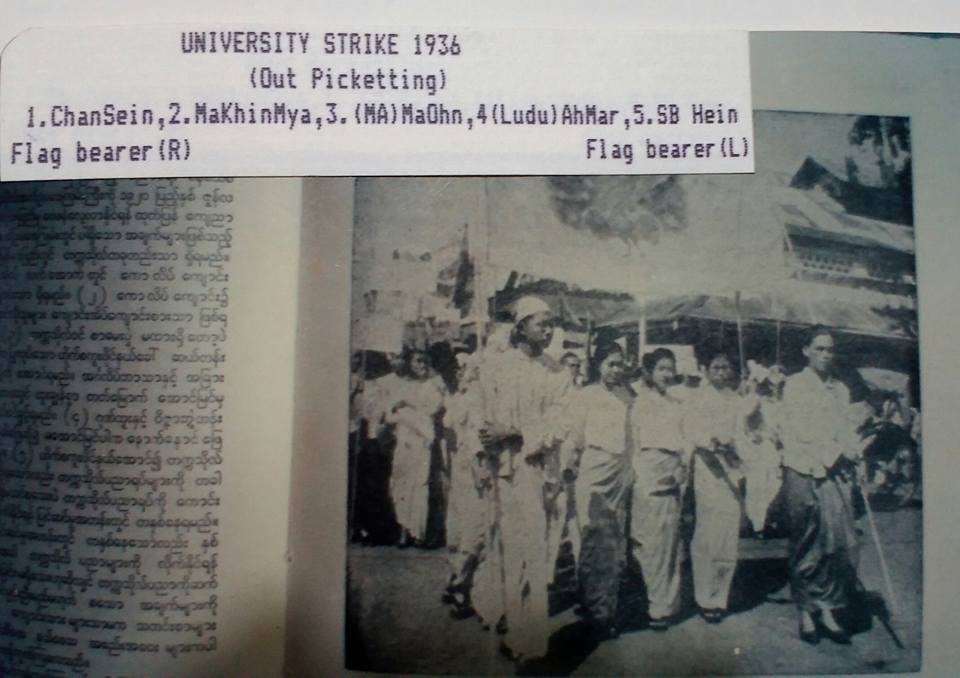
Some tried Rowing at the Rangoon University Boat Club (RUBC). The pioneer female rowers were from the Institute of Economics and RASU (partly because they are close to RUBC). They were later joined from other Institutes (e.g. RIT, IM(1), Education). RUBC was founded by Sir Arthur Eggar (Law Professor) in 1923. Details of RUBC can be found in the 90th Anniversary Issue (published in 2013). RUBC allowed female members in the mid 1960s. Pioneer female members were mostly from Institute of Economics (e.g. Ma Khin Mya), RASU (e.g. Jill Gaudoin /Aye) and some from other institutes.
Some remember the musical evenings and nights by Pho So Chins. Tekkatho Tun Naung (then a Dental College Student, Luyechun for the Summer Camp of 1965 at Inlay) would play mandolin in front of the Ladies’ Halls (e.g. Inya Hall). He would later co-found the Stereo Khit.
Related posts Ah Nu Pyinnya Shins RUBC Social and Reading Club
There are several ways to help navigate the large repository of topics.
The Admin can pin a post as an announcement. The announcement can be updated with “What’s new?” or similar messages.
The posts can be classified into appropriate topics. Then, a reader can view posts related to a selected topic.
One may search posts using an appropriate keyword.
One may save a post. One can later access the saved post. Note, however that Facebook will send reminder of unopened saved posts.
One may share a post. One can add additional information about the shared post.
Some posts
Thann Htutt Aung wrote some posts (e.g. landmarks including buildings and roads) and shared several posts (including the Hostels and their notable occupants, victorious RU soccer team from the prewar days, memories of former Soccer Selection U Aung Khin, logo from the RU Golden Jubilee).
Some remembered their classmates who were denied admission to the professional institutes because of the 3-NRC rule.
Several took three more years to complete their studies. The schools were closed following the 8-8-88. There were no convocations for 1988, 1989 and 1990.
Some remembered attending Thabawa Theikpan (Natural Science) Campus in Thamaing. The name fell out of use. It was later known as RC(2), one of the three Regional Colleges in Yangon.
The admission procedures change with the several “New Education System”. The controversial ILA (Intelligence Level Aggregate) was used to admit matriculates in 1964. The three year performance (Matriculation and Two years in Regional College) was used to decide the study of the students.
“Special” Honors courses took five years (Intermediate followed by three years of specialization in a subject).
“General” Honors courses took four years (Intermediate followed by two years of specialization in a subject).
General Honors (Options : Physics, Chemistry, Mathematics)
Physics Honors
Saya Mehm Than Thoung was top in 1960 – 61.
Sayama Daw May Than Nwe was top in 1961 – 62. Her classmates include Sayama Daw Khin Swe Aye, Sayama Daw Khin Than Nwe, Saya Dr. Sein Tun and Robert Sein.
Dr. Hla Ngwe Tin (Frankie Ohn, First in Burma in the Matriculation of 1959), Dr. Tun Than, Dr. Soe Yin and U Kyaw Kyaw Shein were from the final batch 1962 – 63.
Mathematics Honors
Need info for 1960 – 61.
Saya Dr. Kyaw Thein was top in 1961 – 62.
Sayama Daw Myint Myint Khaing (daughter of Arzani Mahn Ba Khaing), Sayama Daw Kyi Kyi Aung, Saya Dr. Sein Win and U Oo Tha were from the final batch 1962 – 63.
Chemistry Honors
Need info for 1960 – 61.
Saya Dr. Soe Win was top in 1961 – 62.
Need info for 1962 – 63.
Sein YaDu (Diamond Jubilee in 1995)
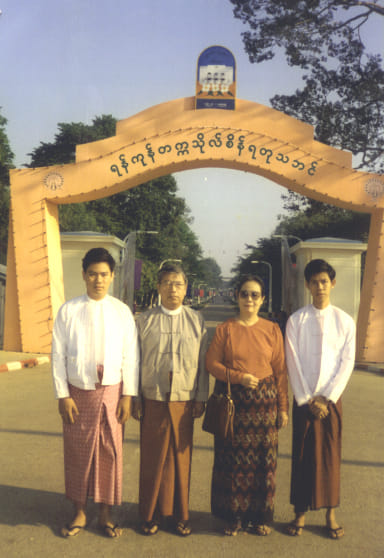
Aung Mon, Saya Dr. Soe Win, Sayama May Saw Lwin, Nyi Thet Lwin
At that time, the four family members were affiliated with different Universities and Institutes.
Saya Dr. Soe Win (YUFL)
Sayama Daw May Saw Lwin (Chemistry, RASU)
Ko Aung Mon (EC, YTU)
Ko Nyi Thet Lwin (IM 1)
At present, Saya and Sayama are retired. They will celebrate their Golden Jubilee soon. Ko Aung Mon did graduate studies in IT and works in Singapore. Ko Nyi Thet Lwin is a surgeon in UK.
Saya U Khin Maung Thint (Jimmy Tin) taught the early batches.
The first batch of Architects including Saya U Myo Myint Sein graduated in 1958. Saya did Masters postgraduate studies in the US. U Myo Myint Sein (Raymond) succeeded Saya U Tha Tun as Head of the Architecture Department. After retirement from RIT as Professor, he moved to the USA.
The second batch including Saya Dr. Lwin Aung and U Bo Gyi graduated in 1959. Dr. Lwin Aung worked in the industry for several years before joining the Faculty. Saya Dr. Lwin Aung (A59) served as Professor of Architecture, and Pro-Rector of YTU (Yangon Technological University). After retirement, he became a monk.
The third batch including Koon Yin Chu (Phillip), U Tin Htoon, U Aung Kyee Myint and U Kin Maung Yin graduated in 1960.
Koon Yin Chu (Phillip Chu, SPHS54) stood First in Burma in the Matriculation of 1954. He stood First again in the graduating class of Architects in 1960.
U Bo Gyi (A59), U Tin Htoon (A60) and U Aung Kyee Myint (A60) founded Architects Incorporated.
U Bo Gyi was an accomplished pianist and modeller (e.g. sculpture) and was the senior of the three partners. He designed the Daw Khin Kyi Mausoleum., and was “set aside” by higher authorities for his work. After retirement, he become a monk.
U Tin Htoon (Past Captain and Gold of RUBC) is an ARAE Champion. He and Dr. Harry Saing won the Venables Bowl for coxless pairs at the 1958 ARAE Regatta in Calcutta. He, Dr. Harry Saing, Victor Htun Shein, Sunny Teng and U Sein Htoon won the Willingdon Trophy for coxed fours at the 1960 ARAE Regatta in Colombo. He and U Hla Khin (Navy / Defense) won Silver medal for Yatching at the SEAP Games. U Tin Htoon retired after working in Myanmar, Singapore and USA.
A few years later, the company was folded. The three Amigos joined PWD (Public Works Department).
U Aung Kyee Myint retired as Chief Architect of PWD.
U Kin Maung Yin (Modern Art, Director of “Hna Ma Let Shor Nay Lay Dawt”), Paw Oo Thet, Director Win Pe and several artists frequented Architects Incorporated.
U Kin Maung Yin used Black and White imagery, Classical Music and minimal dialog in his movie “Hna Ma Let Shawt Ney Lay Dawt” (which attracted some Westerners), but it was the first occurrence where the “First Day First Show” did not sell out.
According to a Historian from Smithsonian, “There is no single correct history. There are often competing and contradicting histories.”
The duty of a historian is to present facts and not opinions.
It is up to the reader to read the historical documents critically and make his/her judgement.
Authenticity
During the Adhamma Era, sayas sayamas and students were forced to “Let Oak Chi” to visiting Taing Hmus and Higher.
One exception was Saya U Hla Shwe (Textile 69) who continued teaching saying, “This is my duty. I can only come when the class is done.”
When U Hla Shwe fell ill, a blogger recounted the episode, and several who did not know U Hla Shwe donated for his medical expenses.
Censorship
At one period, there was excessive censorship.
My story and translation “A Man of Infinite Valor” about Ananda Thuriya was censored. “Dhammata” poem was a taboo. The Higher Authorities did not like the line “One [person] must face destruction for another to prosper”.
No publication (e.g. poem) must refer to the “sun” and “sun set”.
I wrote computer articles for the Guardian. The articles had to be approved by a group of three Chief Editors (U Soe Myint, Chief Editor of Guardian and Chief Editors of two Myanmar newspapers).
With the “Pwint Linn” Era, several books and photos (which would not pass censorship) are available.
Htein Win (Dat Pone) had to wait several decades before he could publish two books : one about “U Thant Ah Yay Ah Khinn” and another about “8-8-88 Ah Yay Ah Khin”.
Stipend may stand for Financial Aid. There may be terms (e.g. agree to work for a specified period after getting the degree).
In the 50’s, Military Stipends were given to eligible students studying Medicine and Engineering. The graduates join the Military as Commissioned Officers.
During our University days, Stipend holders receive 75 Kyats per month. The amount is the same as received by the Collegiate Scholarship winners. The net is 60 Kyats per month since the Tuition fees is 15 Kyats per month.
The stipend was sufficient even for students who have to live in hostels. The hostel fees was 57 Kyats.
Several US universities provide “Free Tuition” to eligible students. A few US universities provide Free Board and Lodging & Free Tuition to eligible students.
Dr. Yan Naing Lwin wrote :
When I started teaching at WIU in 1965, a few Burmese students started to arrive in Illinois. They were graduate students of RU, RIT & IM (Institute of Medicine).
They pursued their graduate study as GA (Graduate Teaching Assistant) or RA (Research Assistant). Their tuition was free & their stipends varied from $ 300/- to $ 600/- per month. Many hundreds have passed through WIU (Western Illinois University) & all of them are very successful. I think it was their previous background, their hard work, their ambitions, & camaraderie that existed among them!
Pat Tin-Win had the courage to request Sayagyi Dr. Ba Than (who was Medical Superintendent of the Japan Khit Say Yone Gyi, Rector of IM(1) and founder of the Zwe Ah Nyeint) to play Myamangiri on the harp, and allow the recording to be used for her friend Rosie to dance at the 1964 Chemistry Fresher Welcome.
Sayagyi complied.
Extracurricular Activities
Saing Waing
Those who chose to stay in hostels have fond memories of the various functions (e.g. by Thahaya and Sar Phutt Ah Thinn — Social and Reading Clubs), the Inter-Hall and Inter-Institute Sporting Events (e.g. at Aung San Stadium).
Per Daw Nyunt Nyunt Tin, she was a Day Scholar, but she spent a lot of time at Marlar Hall (known not just for beauties but for the excellent sports teams).
Some tried Rowing at the Rangoon University Boat Club (RUBC). The pioneer female rowers were from the Institute of Economics and RASU (partly because they are close to RUBC). They were later joined from other Institutes (e.g. RIT, IM(1), Education). RUBC was founded by Sir Arthur Eggar (Law Professor) in 1923. Details of RUBC can be found in the 90th Anniversary Issue (published in 2013). RUBC allowed female members in the mid 1960s. Pioneer female members were mostly from Institute of Economics (e.g. Ma Khin Mya), RASU (e.g. Jill Gaudoin /Aye) and some from other institutes.
Some remember the musical evenings and nights by Pho So Chins. Tekkatho Tun Naung (then a Dental College Student, Luyechun for the Summer Camp of 1965 at Inlay) would play mandolin in front of the Ladies’ Halls (e.g. Inya Hall). He would later co-found the Stereo Khit.
A University is usually a collection of colleges or schools.
Oxford University and Cambridge University have constituent colleges (e.g. King’s College, Trinity College)
Harvard University have constituent schools (e.g. Law School, Business School, Divinity School)
In the early Colonial era, educators and politicians requested to have an independent university in Burma, but to no avail.
The colleges had to be affiliated with a university (e.g. Calcutta University).
The colleges could not offer disciplines such as Medicine and Engineering.
Dr. Tin Wa wrote :
Before the colleges and universities, the British offered what is called First Arts (FA) which is an equivalent of Intermediate Part B. That is a two year college degree. My grandfather U Ohn Pe, was one of those who was awarded with First Arts who later became the Chief Translator at the British High Court for the cases that came before it.
Rangoon University
On December 1st, 1920, a law was enacted to establish Rangoon University with two constituent colleges : Rangoon College and Judson College.
RU Golden Jubilee in 1970
The Golden Jubilee was celebrated in 1970.
I had a small part as a volunteer member of the “Zay Nay Yar Cha Htar Yay Ah Phwe”.
I remember Academy Maung Maung Tar (actor) reserving a booth to promote and sell cosmetics.
Play Boys (then an amateur band) wanted to have a high stage and give a public performance.
There were several committees : one with Saya Dr. Aung Gyi as Chair and Saya U Thet Lwin as Secretary.
RIT Ah Nu Pyinnya Shins took part in the Entertainment Program. RIT belles performed the “Htee Yein”. Swel Daw Yeik Ah Nyeint featured Minthamees and Lu Shwin Daws. Saya U Moe Aung (Tekkatho Moe War) and Saya U Saw Tun (Burmese, now in NIU) were Patrons.
There was a commemorative issue.
It had a reprint of Bogyoke Aung San’s rendition of “Invictus”.
It also had an article on the early days at the Faculty of Engineering by U Hla Maung (who graduated in 1928). It was a source for the “History of Myanmar Engineering Education (HMEE)” book published in 2012.
First RU Strike
Several students did not like the limitations of the Rangoon University Act of 1920.
They decided to protest on December 7, 1920.
The news was leaked to the authorities.
The core members decided to start the strike on the evening of December 5, 1920.
On Shwe Dagon pagoda, there is an inscription honoring the students in the strike.
Mr. Matthew Hunter, Principal, met the students and requested them to end the strike.
One student said, “We are not striking against you. We are asking for changes to the education system.”
The strike resulted in the establishment of national schools and national college.
It also caused enhancements to the Act to provide “greater” autonomy and “better” education system.
The event is celebrated as “Ah Myo Tha Aung Bwe Nay” (National Day).
Thakin Ko Daw Hmaing, Ah Myo Thar Pyinnya Wun U Po Kyar, Arzani U Razak, U Nu (first and last Prime Minister of the Union of Burma) and U Thant (3rd UNSG, first among the Asians) are some outstanding teachers and administrators from the national schools.
Education Systems
In November, 1964 a “new” Education System was established.
Several Faculties from Rangoon University became Institutes. For example,
Institute of Medicine
Rangoon Institute of Technology
Institute of Economics
Institute of Education
A few faculties (e.g. Arts, Science) were placed under the “Arts and Science University”. For example,
RASU (Rangoon Arts and Science University)
MASU (Mandalay Arts and Science University)
Subsequent changes to the education system saw a proliferation of Universities.
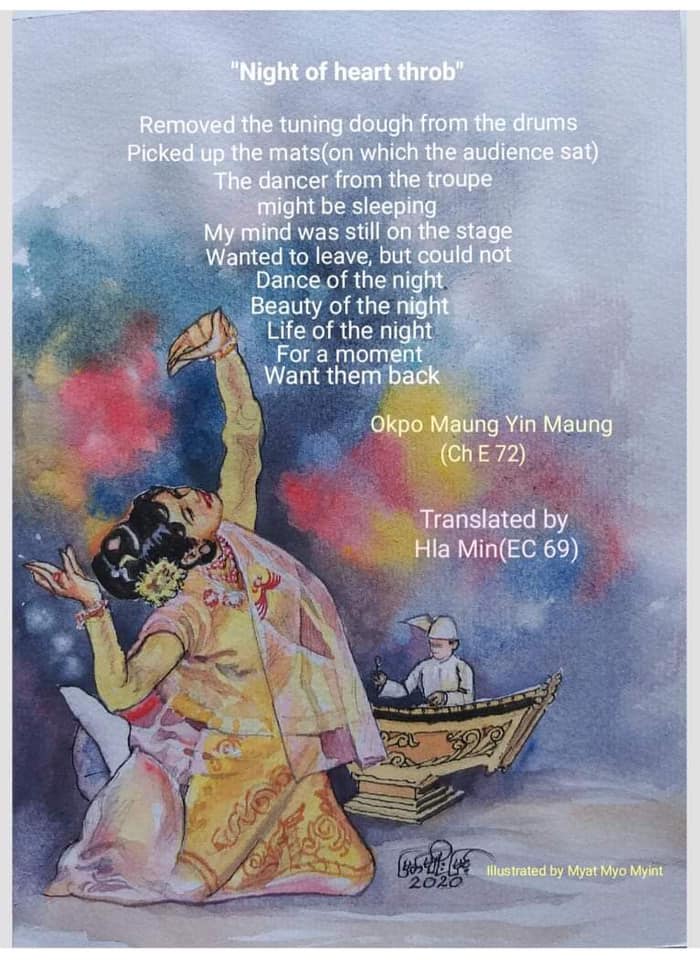
6th Poetic Art of a group of Alumni of the well-known RIT ( Rangoon Institute of Technology), Myanmar. They are engineers with remarkabe career on the one hand, but on the other hand, they are trying to disseminate innate nature and life style of Myanmar by poetic art depicting short but complete poems.
Please enjoy this poetic art about how the poet had an unforgettable heartfelt night by watching the dancing of a beautiful dancer of a traditional dancing troupe.