(1) Saya Des Rodgers and Saya U Khin were Scrabble Champions at the tournaments held at Guardian premises and YMCA.
Chambers Dictionary and Jones Pronouncing Dictionary were used to confirm/deny the word challenges. They were always present on Saya U Khin’s desk.
Saya Des moved to UK and Canada. Saya U Khin moved to Taiwan.
(2) Saya U Win Mra was a Pole Vaulter before he was asked to “retire” by the doctors. Saya U Win Mra and Saya Des are excellent guitarists and singers. Saya joined the Foreign Service. He was Myanmar’s Ambassador to the United Nations. He is chair of Myanmar Human Rights Commission.
U Khin Maung Lay (“Mutu”, M70) is a member of the Commission.
(3) Saya Joe Ba Maung (GBNF) was Burma’s Tennis Champion in Singles and Doubles (with U Than Lwin). Saya joined Burma Railways. He served as Advisor for Burma Railways Sports Program.
(4) Saya Sao Kangyi (Tony, GBNF) wrote as Khemarat. He is the brother-in-law of Sao Hso Holm (“Sawbwalay”, son of Arzani Sao San Htun).
(5) Saya U Kyaw Lwin Hla transferred to UNDP.
(6) Sayama Daw Yin Yin Mya (Terry) was Head of Department. She migrated to Australia. She was a Beauty Queen in her college days.
(7) Sayama Daw Sheila Saing was Deputy Head. She moved to Thailand.
(8) Sayama Naw Charity Sein U later became Head of the RIT English Department. Met her briefly at SPZP-2012.
(9) I met Sayama Muriel when she and Saya U Aung (Alphoso) visited Saya U Tin Maung Nyunt. We had a couple of lunch gatherings.
(10) Sayama Toni is a cousin of Ko Thet Tun (Henry, M 75). Their aunt Dr. Khin Kyi Nyunt (GBNF) is the spouse of Saya U Tin U. Met her briefly at SPZP-2012 and again in late 2019. Sayama is a Khamee Khamet of Saya U Win Mra.
(11) Sayama Daw Khin Saw Tint (Ann, GBNF) published several books. She is the daughter of ICS U Ba Tint and Daw Khin Saw Mu (“Khit San Sar Pay”). Her mon’s siblings are ICS U Tin Tut, U Kyaw Myint (Head of Tribunal for Galon U Saw’s case), U Myint Thein (former Chief Justice and writer/translator “MMT”), Dr. Htin Aung (former Rector and author of several books about Burma and Burmans), Daw Khin Mya Mu (Inscription Expert) and Sayama Daw Tin Saw Mu.
Saya recruited his students to join UCC. Some early students could not wait long for the UCC project to get established. A few left for overseas.
Won Collegiate Scholarship in 1956.
Won two Medals for I.Sc. (A) and (B) exams. Highest total score for both exams combined. Highest marks in Mathematics in I.Sc. examination. Saya Dr. Tin Win (M62) and another student were co-winners.
Received a scholarship to study BSEE and MSEE at Stanford University. Saya U Ko Ko Lay (UCC) received a scholarship to study BSCE and MSCE at Stanford University.
On their return journey to Burma by an ocean liner, Saya U Soe Paing and Saya U Ko Ko Lay were joined by Saya Allen Htay (C58) and Saya U Tin Maung Nyunt (M60) who had finished their graduate studies in the US. They spent the evenings playing Bridge. They became close friends.
Joined the EE Department as Assistant Lecturer. Helped Sayagyi Dr. Chit Swe found UCC along with Saya U Myo Min and Saya U Ko Ko Lay.
Transferred to UCC as Systems Manager.
Did his M.Sc. (Computer Science) at the University of Southampton in the UK.
Retired after working as UN Consultant in several countries.
Wrote a brief bio for the SPZPs.
Described more details in his articles about his studies and work at UCC and beyond.
Saya U Soe Paing in Yangon
Saya’s writings and contributions
Student days at Rangoon University
RIT Saya Soccer Team
RIT-UCC Connection
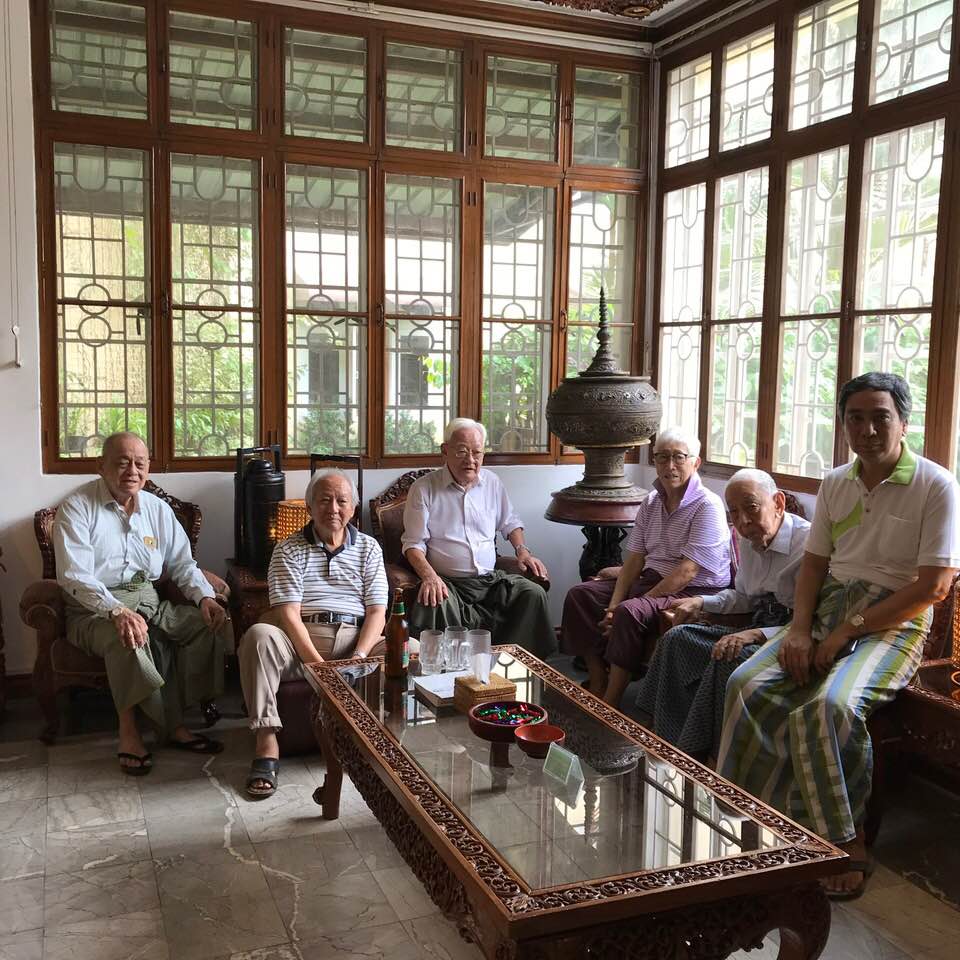
Three sayas attending SPZP
“Computer Ah Sa UCC Ga” and articles can be read from SCRIB-D
With the help of Sayagyi U Ba Than and Saya U Thaw Kaung, Saya compiled artifacts at the Universities Central Library. Saya prepared a draft version for of HMEE-2012.
Saya revised the translation by U Ohn Khine (Section One in full, Section Two in Summary).
Saya hosted several gatherings for RIT-UCC alumni visiting Myanmar.
His younger siblings are Dr. Daw Win Hlaing (Ruby), Daw Myint Thwe (Betty), Dr. Myo Tint (GBNF), U Tin Htoon (A60), Saya U Myo Min (UCC),U Thaung Lwin (EC66) and Daw Cho Cho Hlaing.
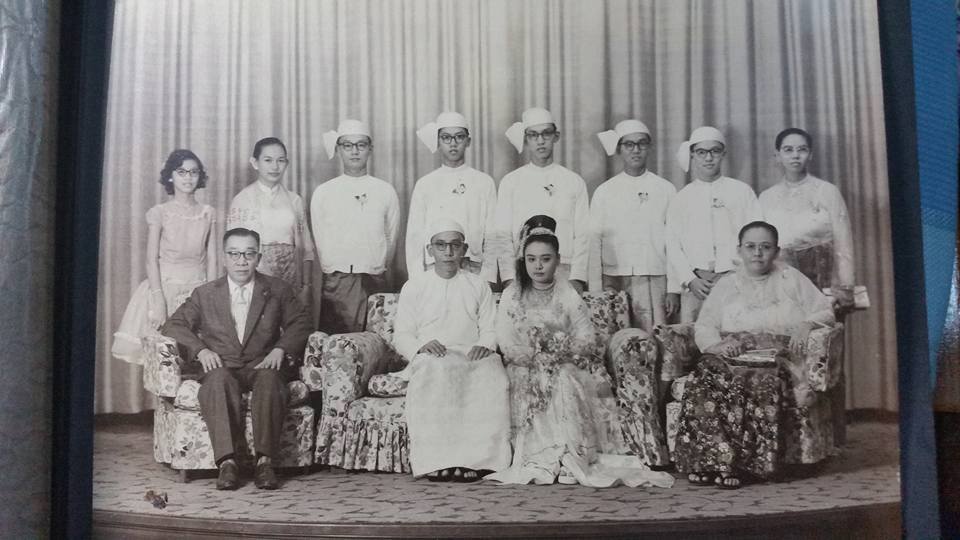
Wedding ReceptionU Ba Than, Daw Mya Mya and Ye ThanU Ba Than, Lwin Mar Oo, Ye Than, Aung Myo Myint, Ei Khine
Spouse : Daw Mya Mya (GBNF)
Son : U Ye Than (Winner Inn)
Daughter-in-law : Daw Lwin Mar Oo
Grand children : Ko Aung Myo Myint and Ma Ei Khine
U Ba Than, Dr. Myo Tint, U Myo Min, U Thaung Lwin, U Tin Htoon, U Tin UWith son’s family
Brief Bio
Matriculated from St. John’s Diocesan Boys High School and won Collegiate Scholarship in 1947.
Gold Medal for placing first among the I.Sc. and all Intermediate students in 1948 and 1949.
Studied Mechanical Engineering at Imperial College, University of London.
Upon return to Burma, he joined the Faculty of Engineering as Assistant Lecturer.
As a requirement for promotion, he studied Masters at Imperial College, University of London.
Upon his return, he became Lecturer.
Succeeded Saya U Aung Khin as Professor and Head of the Mechanical Engineering Department.
Taught at RIT until retirement.
Per request from Saya Dr. Maung Maung Kha (then Interim Dean, Faculty of Engineering), he served as Advisor for the Engineering Library.
Taught “Strength of Materials” and “Mechanical Drawing” for most years, and “Engineering Mechanics” for a few years.
Early supporter of the HMEE (History of Myanmar Engineering Education) project
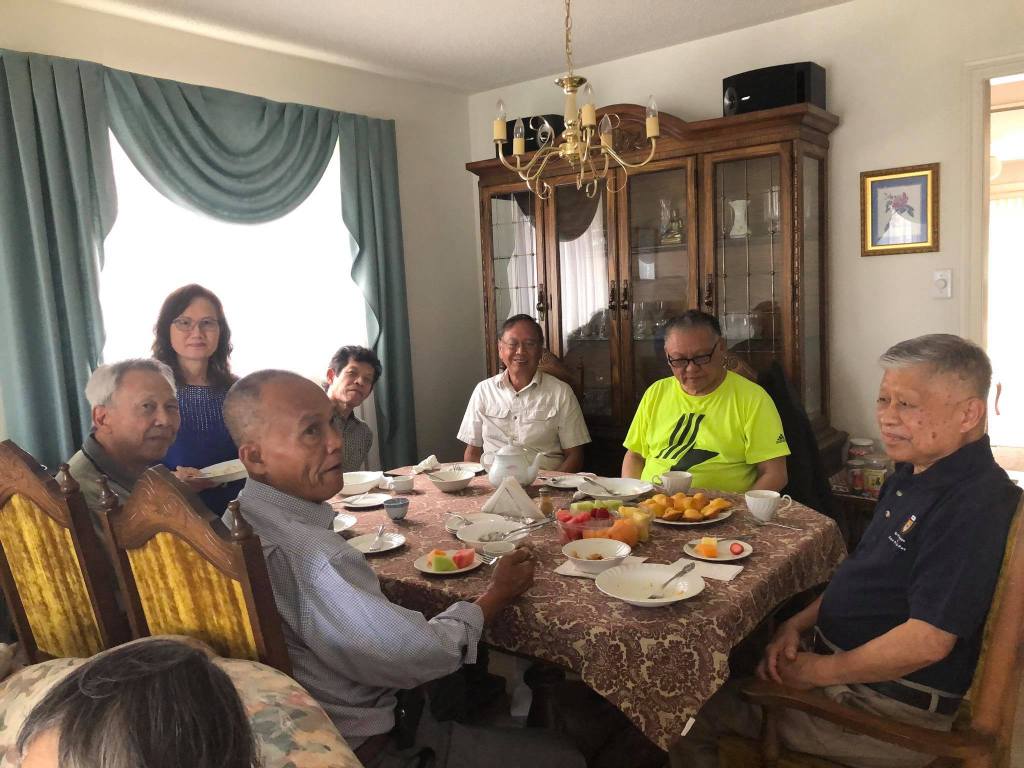
Hosted several HMEE meetings at Winner Inn (run by his son, daughter-in-law and grand children).
Provided precious photos from his albums for display at MES and for inclusion in the HMEE book.
Arranged with Saya U Thaw Kaung (former Chief Librarian of Rangoon University Central Library) to give access of the Library Archives to Saya U Soe Paing (EE, UCC) and his team. Saya U Soe Paing and team scanned old magazines and documents. Saya U Soe Paing also prepared an initial summary of his findings and handed over to Saya U Aung Hla Tun and team.
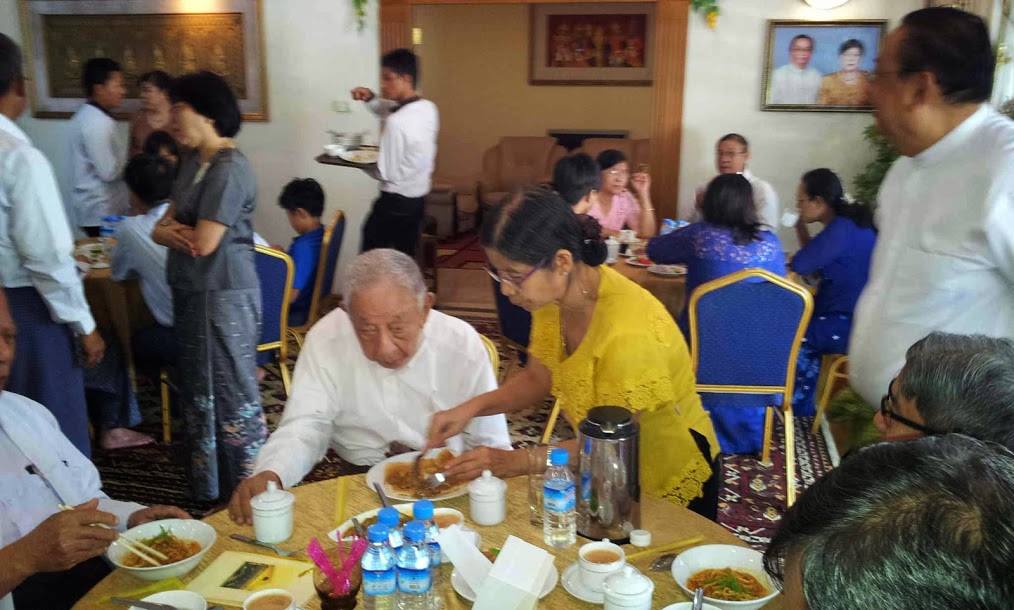
Celebrated his birthdays by offering soon to the sayadaws at monasteries (e.g. Yaw Sayadaw’s Kyaung) and inviting his former colleagues and students to the soon kyway.
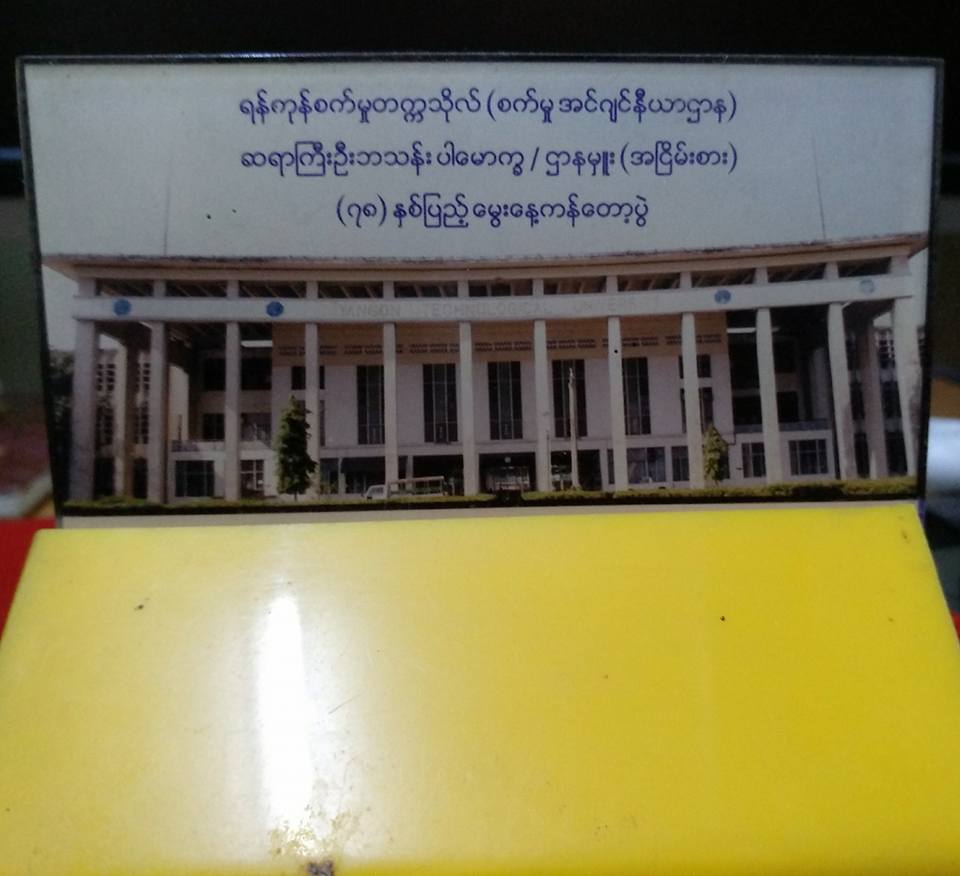
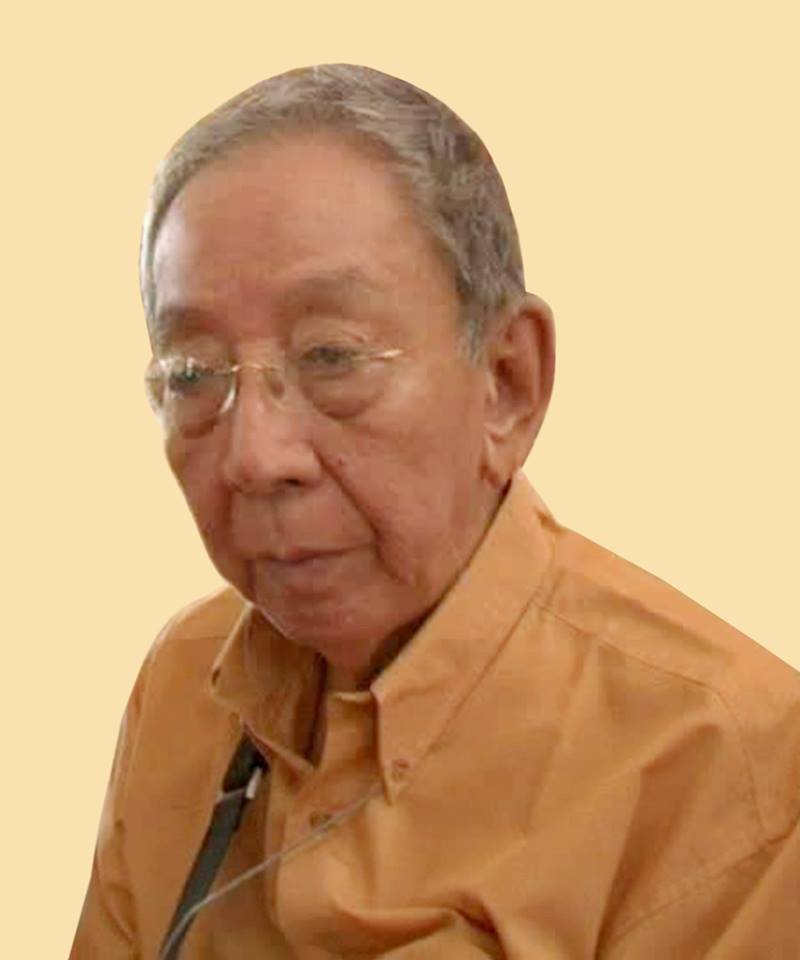
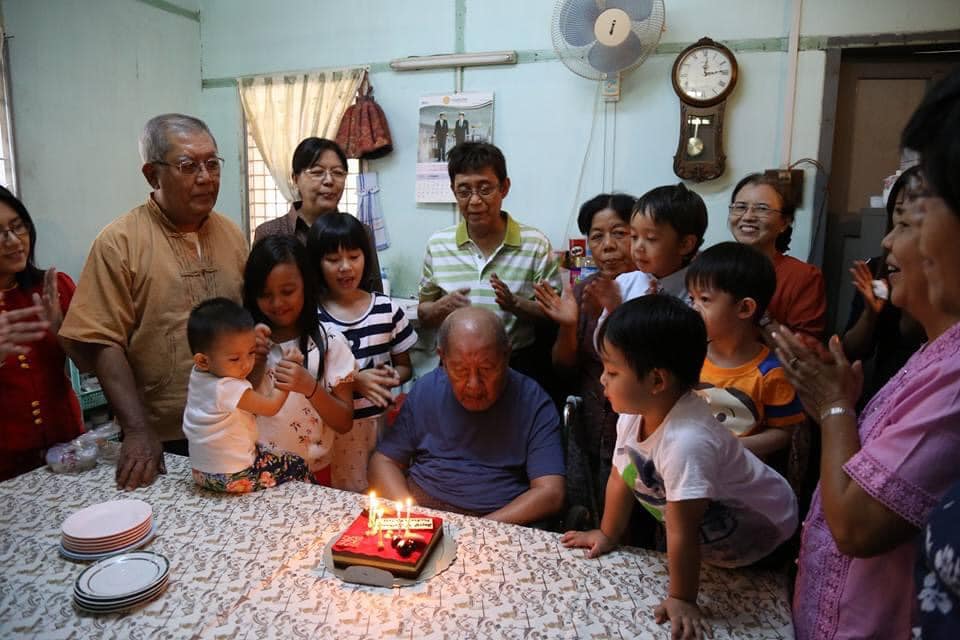
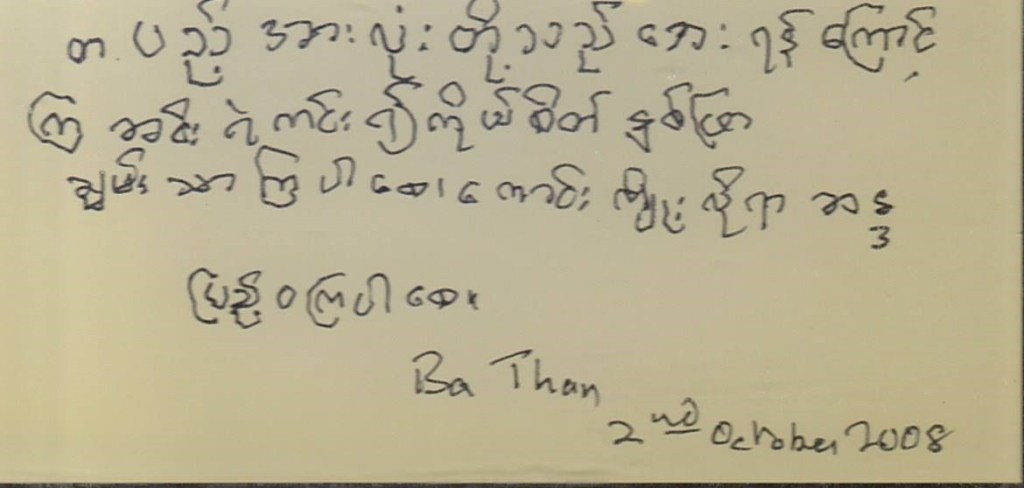
On October 2, 2008, the former students of Sayagyi U Ba Than (Retired Professor of Mechanical Engineering) was honored with a special Birthday and Garawa ceremony. It was special because it was a Thursday. Sayagyi was born on Thursday, October 2, 1930.
Per request from his grand children, he wrote memoirs and shared them with the attendees of birthday gathering.
Cousin Brother
My saya at RIT. Gave me rides to RIT in his white Zephyr. Many thought that he was my uncle.
He is my cousin. In fact, he is my Double First Cousin. His father is my mom’s older brother. Hid mother is my dad’s older sister.
Strict teacher. Never received hints or clues from him. Would not even know whether I did well in his subject until I received the official transcript.
Dio Classmates from 1941
Dr. Kyaw Aung and Bohmu Lynn Thein Maung were his classmates in 2nd Standard at Diocesan Boys High School.
U Ba Than, U Tin U (elder brother), Dr. Kyaw Aung and Bohmu Lynn Thein Maung would meet over a monthly lunch (usually at Winner Inn). They would take turns to host the event.
Classmates from 1941
Visit by Dr. San Hla Aung
Saya Dr. San Hla Aung, Saya U Tin Htut, Saya Mao Toon Siong and several other sayas would pay respect to Saya U Ba Than during their visits to Myanmar.
With Dr. San Hla Aung
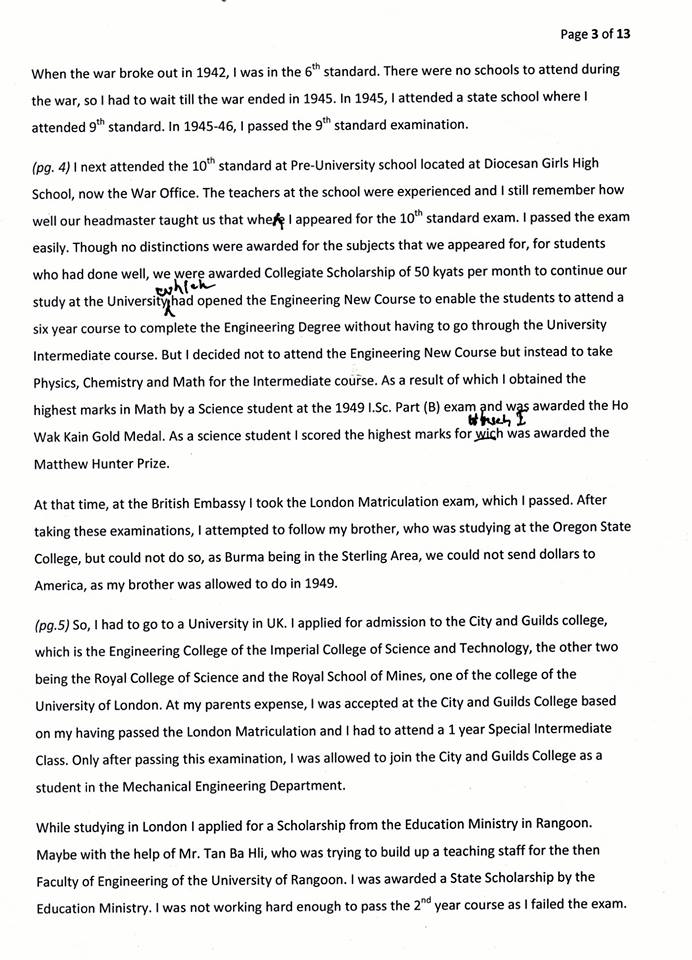
Memoirs (excerpt)
Saya wrote his memoirs at the request of his grand son. The booklet was given to the attendees at Saya’s birthday in October 2008. Excerpts of Pages 3 – 5 (which described his school days) are shown below.
Excerpts from U Ba Than’s Memoirs
Soon Kyways
Ye Than (son) booked “Yar Thet Pan Annual Soon Kwyay” for his father Saya U Ba Than at Yaw Sayadaw Kyaung.
Saya would invite relatives, former colleagues and students to the Soon Kwyay.
Mementos
For the special Soon Kyway in October 2008, Maung Sein Win (Padeegone) wrote a “Garawa” poem.
Saya provided mementos to the attendees.
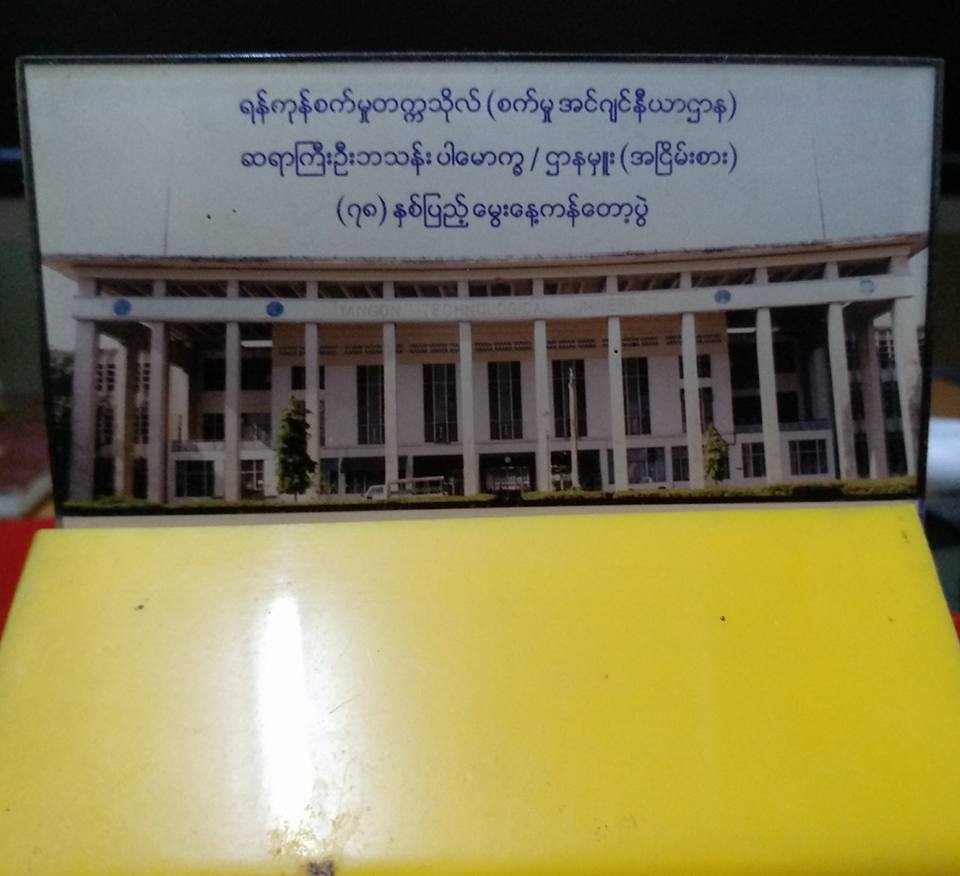
Memento from U Ba Than’s 78th birthdayMessage from U Ba Than
Gold Medal for Highest Score for Combined I.Sc. in 1949
Alumnus of Imperial College, London University
Retired Professor of Mechanical Engineering
Siblings : U Tin U, Dr. Daw “Ruby” Win Hlaing, Daw Myint Myint Thwe, Dr. Myo Tint, U Tin Htoon, U Myo Min, U Thaung Lwin, Daw Cho Cho Hlaing
Spouse : Daw Mya Mya (GBNF)
Son and Daughter-in-law : U Ye Than, Daw Lwin Mar Oo
Grandchildren : Ko Aung Myo Myint, Ma Ei Khine
Celebrated 90th Birthday on October 2, 2020
U Tin Htoon and Henry Kao compiled a Special “Photo Album Book”
Give back “Garawa Money” from Saya Pu Zaw Pwes to Charity
For many years, offered “Birthday Soon Dana” at Yaw Sayadaw’s Monastery and invited former colleagues and students to the Soon Kyway
Early supporter of HMEE (History of Myanmar Engineering Education) Project Held co-ordination meeting to kick off the Project Donated Class Photos (and more) for use in the HMEE-2012 Book
After attending the 2nd year engineering class from June 1952 to September 1952, I went straight to MIT on a state scholarship to continue my studies . Saya U Min Wun and I went together to MIT and joined the academic session, starting from September 1952. We met Dr Freddie Ba Hli at MIT, who was already studying for his Ph.D in electronics or electrical engineering. He was one of the nicest and helpful persons that I have ever met in my life. He gave us briefings and guidance so that we were able to assimilate into the American education system and American way of life without any difficulty He also helped us with our home works when we had some difficulties in the beginning. I am forever grateful to him for his kind help. I am sure U Min Wun feels the same. Saya U Khin Aung Kyi, Saya U Sein Hlaing, U Percy Lao, U Win Htein, U Kyaw Min, Robin Aw, U Kyaw Thein, U Aung Kywe, U Aung Myint and U Sein Hla came to MIT for further studies at a later date. U Percy Lao later became Rangoon City Engineer (water and sanitation), U Win Htein who is an architect became a Rangoon City Building Engineer, and the late U Kyaw Min became a free lance architect [and also taught part-time at the Architecture department for some time]. All these three professionals taught some time at RIT. I do not know what happened to Robin Aw. The late U Kyaw Thein was an engineer at the Construction Corporation and later became a lecturer at the Civil Engineering Department at RIT. U Aung Kywe was a Director (water and sanitation) at the Construction Corporation. U Aung Myint became the Chief Architect at the Construction Corporation. U Sein Hla was an engineer at the Construction Corporation and later became the Registrar at RIT under Rector U Yone Moe. Later more batches of Burmese students came to MIT when I was no longer there. I am describing all these things to point out the fact that the standard of engineering education in Burma at that time was quite good. None of us had to go through the entrance examination to get into MIT. They trusted our grades and our education standard. Maybe the visiting Professor Horwood from MIT was quite impressed with the Faculty of Engineering and put a good word for us to the MIT admission authorities.
I will not go into details of the activities of all the various students’ associations, societies and clubs, as there were so many of them. But I would like to mention briefly about the hostel life, that I had experienced at that time. Every hostel had what we called a social and reading club . There was an adequate room reserved for this club at the ground floor of the hostel. In general, newspapers, popular magazines, a chess board, a carom board and a table tennis were provided so that the hostel students could read, play chess, play carom board, and play table tennis and socialize to get to know each other well. Even without the social and reading club, all the hostel students ended up knowing each other well sooner or later, as they met each other almost everyday at the hostel and at the dining hall. The hostel students were in general well behaved. I hardly saw the Warden or Hall Tutors at Ava Hall and Prome Hall, as there were very few student problems which needed attention of the Warden or Hall Tutors.
Based upon my experience, I feel that these extra-curricular activities and hostel life gave the opportunities to the students to broaden the knowledge of the different parts of Myanmar; and they also created a better understanding of the different culture, food, habit, dresses, dialects etc of the country. Most of the students developed life-long friendships through these activities which contributed to well-beings of these students throughout their lives. Sport activities also taught the students about hard work, cooperation, team work, competition, winning and losing. The extra-curricular activities also triggered, developed and enhanced the hidden talents of some of the students. These activities therefore formed part of the University education of the students, in addition to the education that they received from the classrooms. Another benefit of these activities was the bonding and a better understanding, which developed between the students and the teachers who were involved in these activities.
After getting my Bachelor degree in Cvil Engineering in 1955 and my Master degree in Civil Engineering in 1956 from MIT, I worked for Engineering Companies for a year, which involved both design and fieldwork in engineering construction projects. I then came back to Rangoon in 1957 to join the Civil Engineering Department as an Assistant Lecturer. I was promoted to become a Lecturer in 1958 and became also more or less Head of the Civil Engineering Department. The policy in place at the University of Rangoon under the Ministry of Education at that time stated that a teacher/ any person could become a lecturer / professor only if he/ she had a post graduate degree. Sayagyi U Ba Hli was the Professor of Civil Engineering and Dean of the Faculty at the same time. U Aung Khin was Head of the Mechanical Engineering Department, U Sein Hlaing was Head of the Electrical Engineering Department, U Khin Aung Kyi was Head of the Chemical Engineering Department, U Soon Sein was Head of the Mining Engineering Department, U Thit was Head of the Metallurgy Department, and U Maung Maung Than was Head of the Textile Engineering Department. I think Mr Johnson was Head of the Architecture Department. I do not remember who was the Workshop Superintendent at that time. We were quite happy as we had new facilities near the Prome road in addition to the B.O.C College of Engineering building. These new facilities comprised of a tall administrative building (with offices, conference/meeting rooms, library), classrooms, lecture theaters, laboratories , offices for the teaching staff and a small assembly place under the copper dome roof in the corner of the campus. The dome roof looked like a turtle back, and pretty soon this new campus became known as “turtle dome /leik khone” campus. After our arrival from USA, UK etc, the foreign teachers under contract were let go, as we gradually replaced them, except for a few teachers from UK or USA. I could recall Prof. Neale? in Electrical Engineering Department, Mr Redpath and Mr Skelton in Mechanical Engineering Department and Mr Johnson and Mr Nagler in Architecture Department.
As a young teacher I was surprised and pleased to see a few pioneering female engineering students (not more than ten) at the Leik Khone campus. They and their parents overcame the social uneasiness and they decided to study engineering/architecture to become lady engineers /architects. I do not know exactly when they first joined the 1st year engineering class; but It was one of the important turning points in the history of engineering education.
As young teachers, most of us were struggling to learn how to teach effectively at the beginning. I noticed that we were teaching about 15 to 20 hours per week which included lectures, laboratory and drawing classes. The contact hours of learning for the students remained the same as the time when I was an engineering student i.e. about 30 hours per week. The passing grade for the students also remained the same. i.e. 40% for each subject and 50% average for all the subjects combined. The medium of teaching was still in English. The laboratory and workshop facilities were quite good and adequate for the student population that we had. But the library looked quite small when I compared it with the library that they had in MIT, although it had a few good engineering books and journals. I felt that it needed a lot of investment to become a top notch engineering library.
It was with enthusiasm and hope that most of us were busy trying to build up our respective departments and trying to improve the engineering education in general. While we were busy, Professor and Dean U Ba Hli retired some time around 1961, and in place of U Ba Hli we had a succession of temporary Deans, Professor of Chemistry U Po Tha, Professor of Geology Dr Tha Hla, and Professor of Physics Dr Maung Maung Kha for about 6 months. The Faculty of Engineering also had to move to a new campus in Gyogone in 1961. Before our relocation to Gyogone, the Faculty of Engineering was one of the Faculties of the University of Rangoon. The academic and administrative related policy decisions were made by the Senate and Administrative Council of the University of Rangoon respectively so as to maintain and improve the standard of education of all its Faculties, including the Faculty of Engineering.
As you all know, Gyogone campus was built with the aid of Russia; and I understood that the Government of Burma paid back the cost in rice. I do not know whether it was true or not. In any case it was and still is an impressive looking campus. The buildings accommodated classrooms, laboratories and workshop, big assembly hall with a movie projector, library, offices for the administrative and teaching staff,and student hostels. There were also houses for all the staff, dining and kitchen facilities, small medical clinic, and open space for sport activities. All the buildings, houses etc occupied and still occupy a large area in a compound.
Phwa Bet Taw of RU (Rangoon University) and the First RU Students’ Strike (which led to the amendment of RU Act, and the establishment of National Schools and National College.
Studied at Mandalay University and Harvard University.
Professor and Head of Mathematics at Rangoon University
Rector, Mandalay Arts and Science University
Voluntary transfer to Rangoon Institute of Technology as Professor and Head of Mathematics
Associate Dean, Assumption University, Bangkok
More information can be found in the Book by Dr. Khin Maung Swe (Tekkatho Maung Thin Char)
95th Birthday Celebration
Memories
Sayagyi U Ba Toke passed away on Dec 2, 2020 (the day following RU Centennial, and a few days short of his Centennial Birthday).
The photos (shown above) were taken on Sayagyi’s 95th birthday with his children, grandchildren and great grandchildren.
Sayagyi was pre-deceased by his beloved spouse, son (Soe Win) and daughter (Kitty).
Ma Betty, Ye Myint, Nellie, Pansy, Tammy and Deborah have posted photos and articles about their loving father.
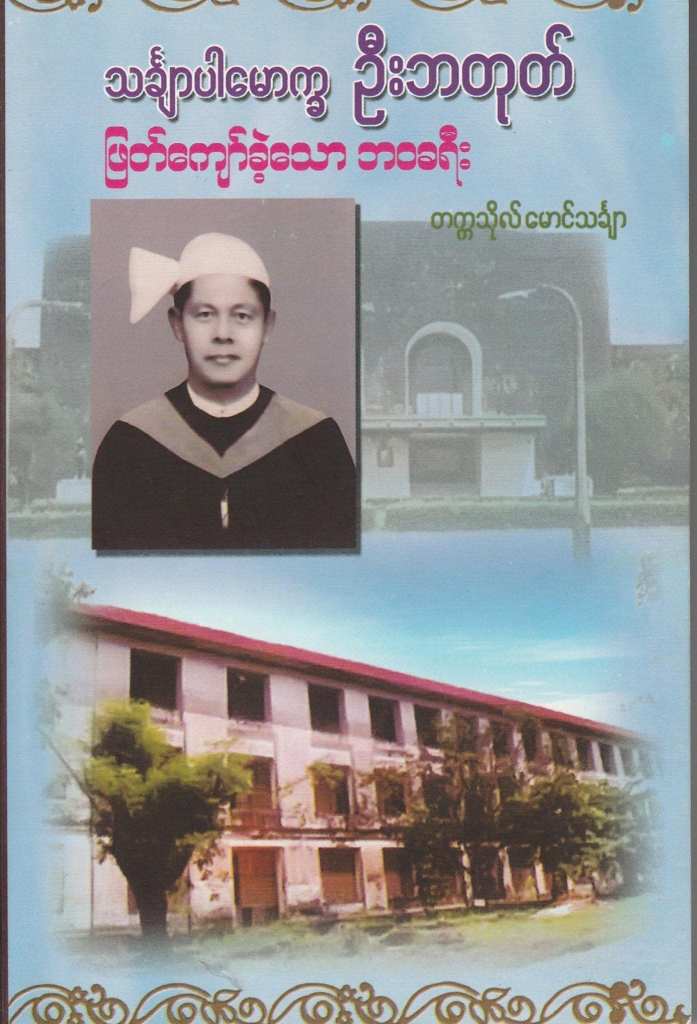
Saya Dr. Khin Maung Swe (Tekkatho Maung Thin Char, GBNF) wrote a book about the “Life Journey of Sayagyi U Ba Toke” and published with the sponsorship of Tekkatho Thin Char Mi Thar Su.
Sayagyi attended SPZP-2000, but skipped SPZP-2002 due to Sayagadaw’s health.
He attended subsequent SPZPs in Yangon and Singapore.
The attendees of SPZP-2007 appreciated Sayagyi’s anecdote about a 100+ year young Soviet guy quarreling with his 4th wife (and making amends soon after).
Sayagyi played soccer in his younger days.
Even in his 70s and 80s, he took weekly hikes to Shwe Dagon Pagoda with younger neighbors.
Sayagyi served on the RU Sports Council and as Leader of the Burma Olympic Team to Tokyo Olympics.
Sayagyi served as Commandant of the Tekkatho Luyechun Camp.
During my early visits, Sayagyi gave me an autographed copy of the Book and also took us down memory lane.
Sadly, aging caught up and Sayagyi lost mobility and his vision and hearing were impaired (as apparent on my later visits).
Many were planning for his Centennial Birthday, but …
Garawa To & By Sayagyi
On behalf of the Classes of 70 and 71 (also known as the 1st BE Intake of 64 and 65), Ko Khin Maung Myint (ChE71) offered Garawa money to Sayagyi.
Sayagyi offered Soon to Sangha and listened to the dhamma talk
Per invitation from his former students, Sayagyi attended the First RIT Grand Reunion and Saya Pu Zaw Pwe (also known as SPZP-2000), San Francisco, California, USA in October 2000. On behalf of the sayas, Sayagyi gave blessings to the SPZP-2000 attendees. He was accompanied by Ko Ye Myint (eldest son) and spouse.
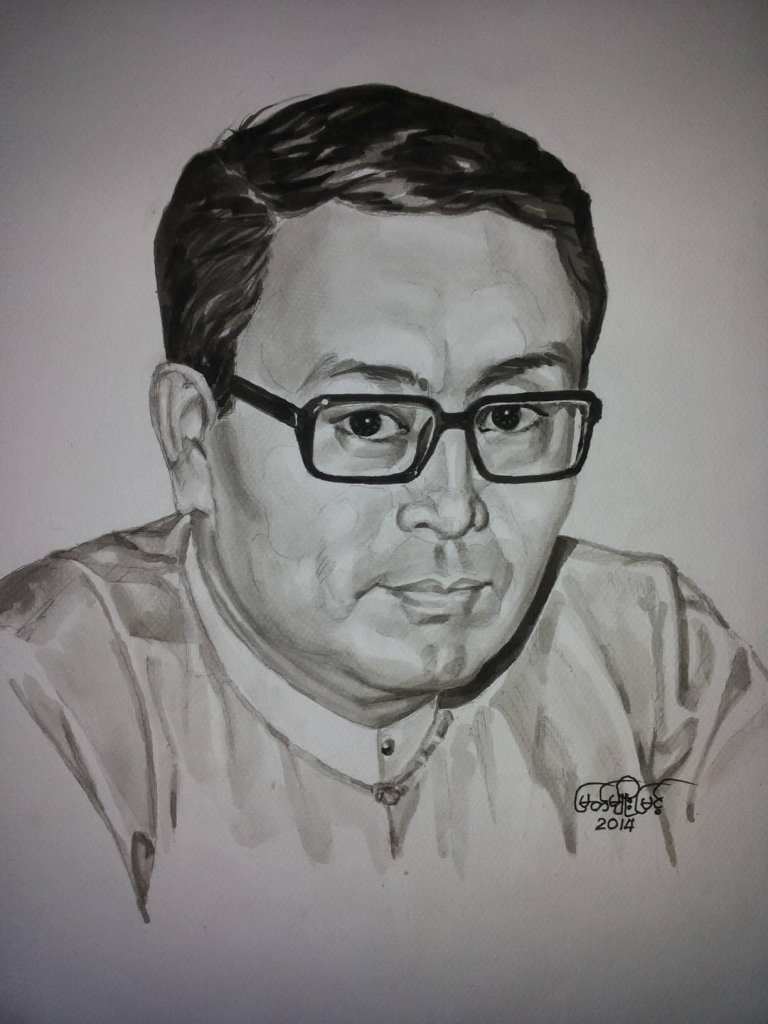
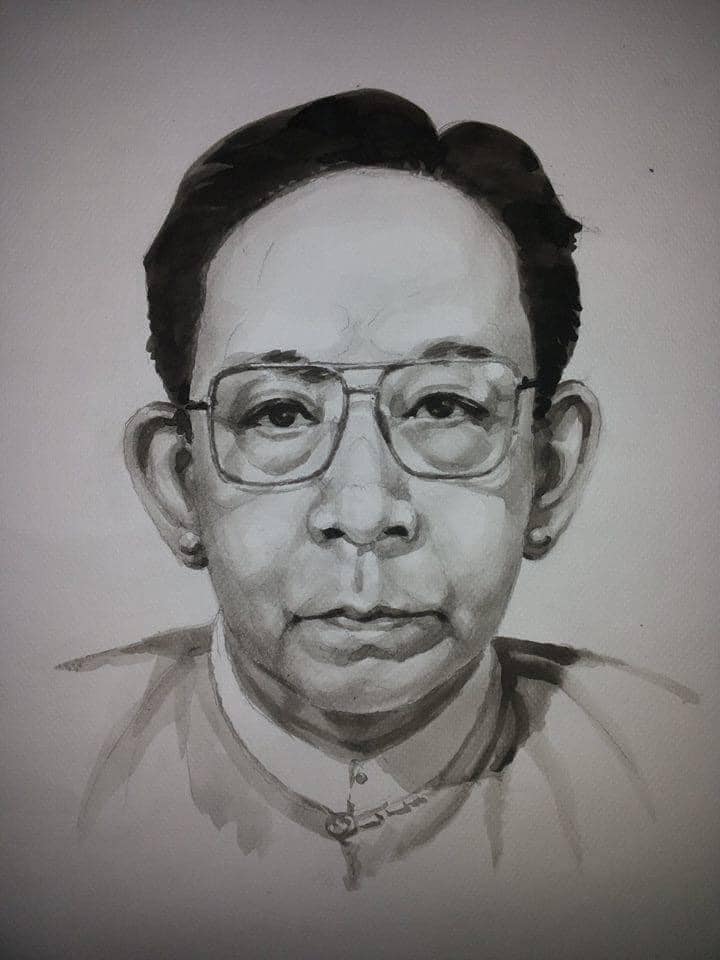
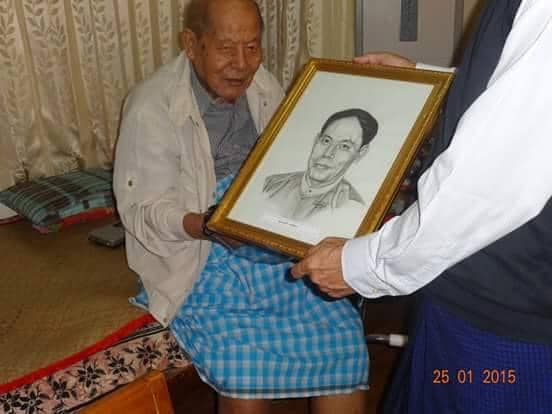
Bagyee Myat Myo Myint (Ko Myo Myint, Retired Dy Chief Engineer, Burma Railways) drew a Pon Tu of Sayagyi.
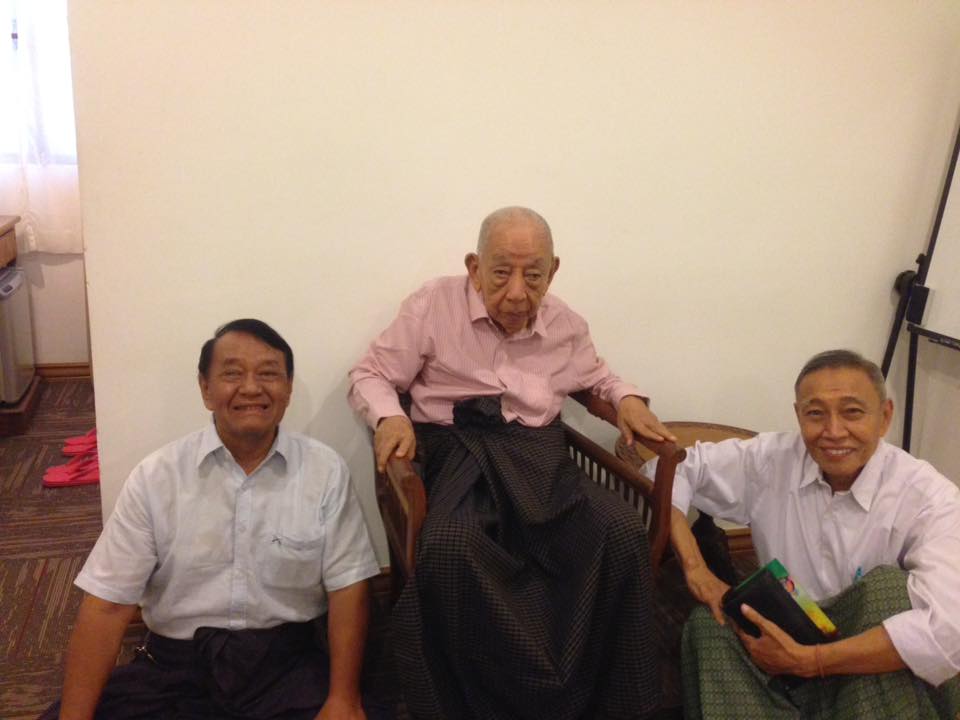
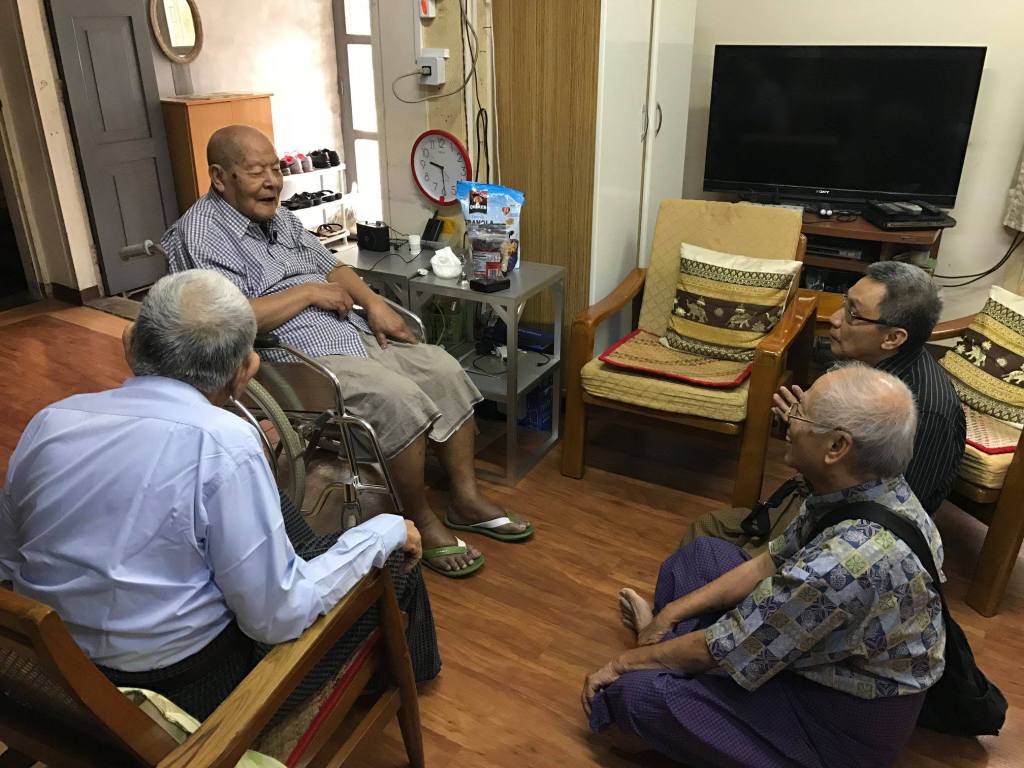
Pansy sent a car and driver to pick up Saya U Ba Than, Saya U Tin Htut and me at Winner Inn. Saya U Ba Than pays respect to Sayagyi at least once every year. Saya U Tin Htut also paid visit to Sayagyi during most of his visits to Yangon. I visited Sayagyi during my trips to Yangon. Ko Ye Myint, Pansy, Debbie and Ko Ohn Khine (M70) provided transport on different occasions.
Taught us Surveying in our 2nd BE. He enforced a seating plan starting with Roll Number One at the back of the class. Since I could read his notes on the Blackboard, I became Four Eyes.
Founding member of BARB
Member of Myanmar Pyeikkadein Ah Phwe
Saya jokingly said that he was assigned as the Last Speaker to prevent overrun of the SPZP-2000 program.
Wrote several articles for RIT Alumni International.





















 HlaMin