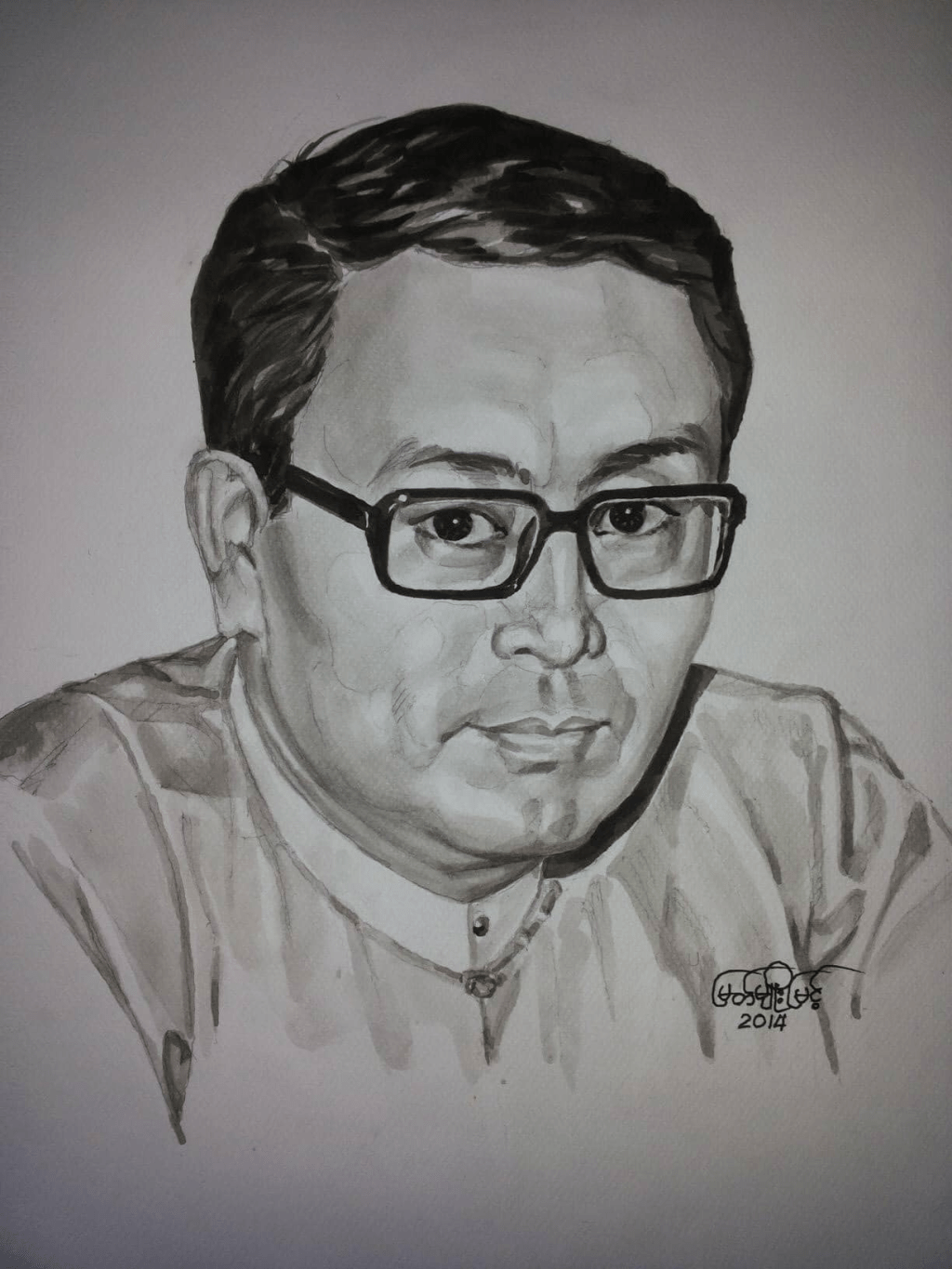
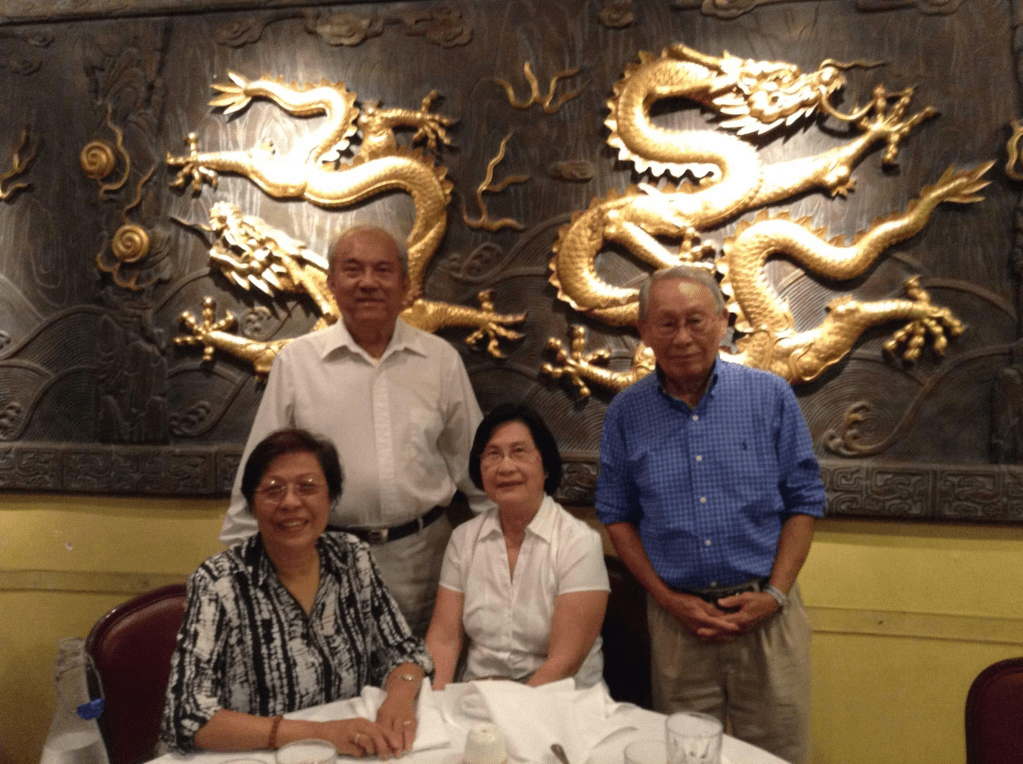
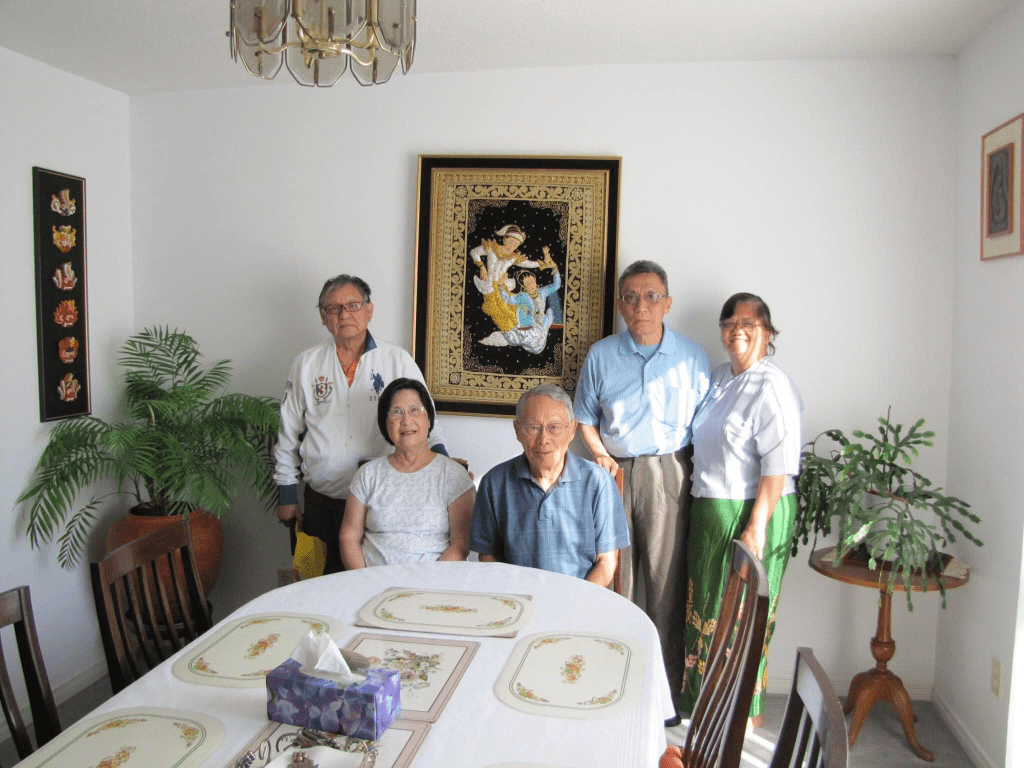
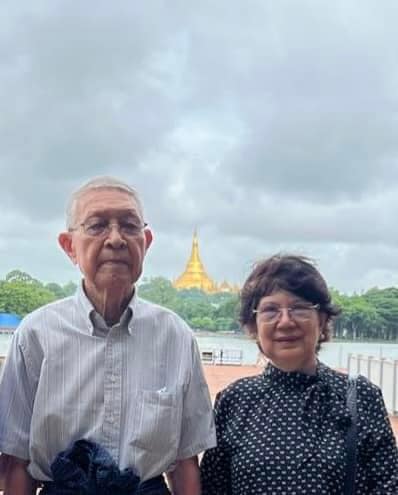
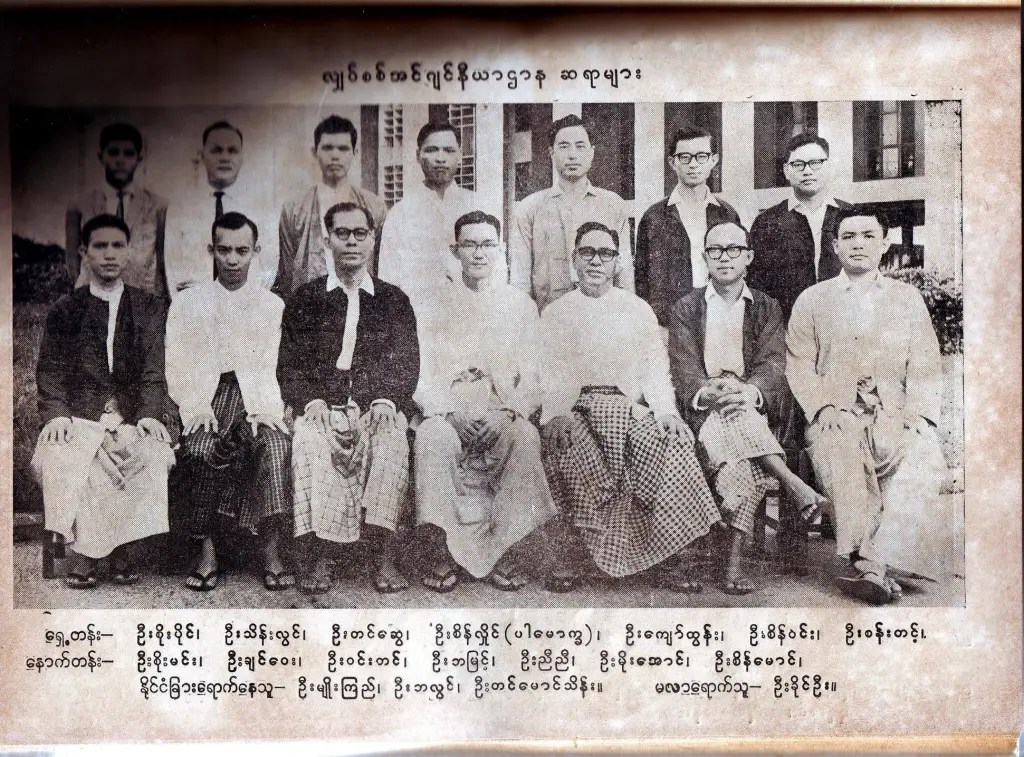
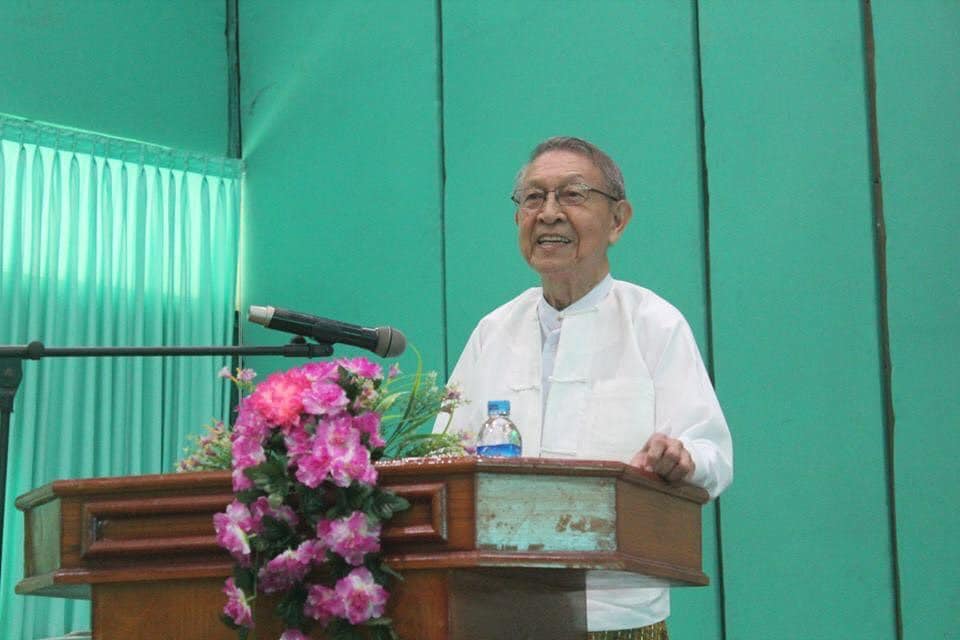
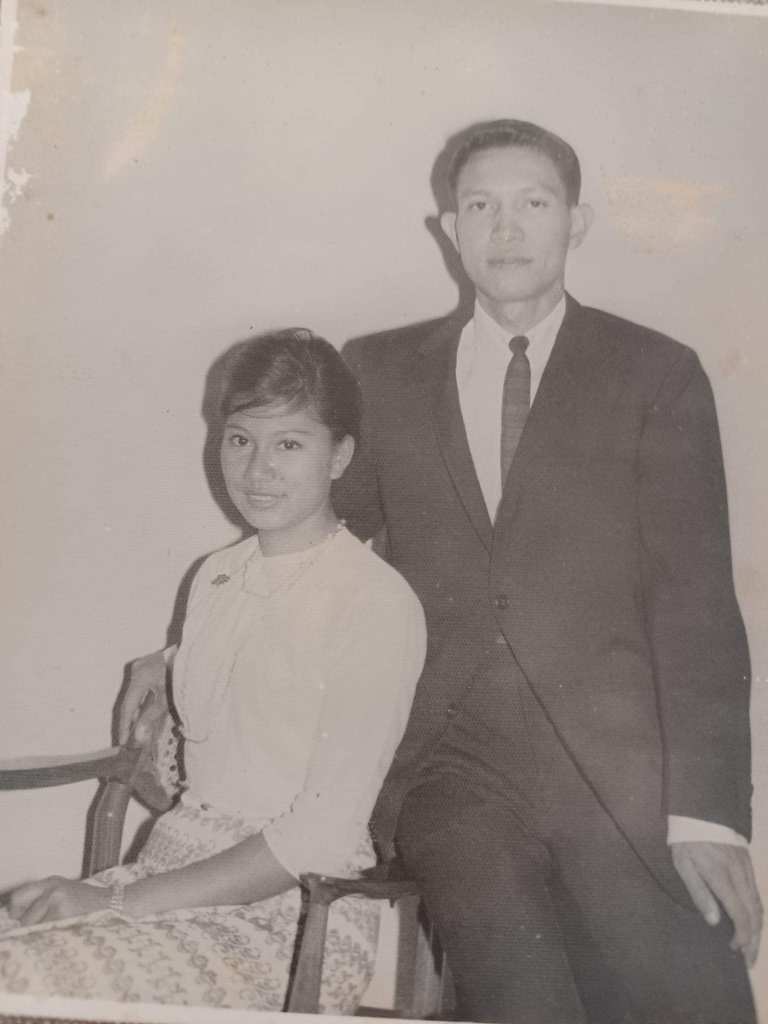
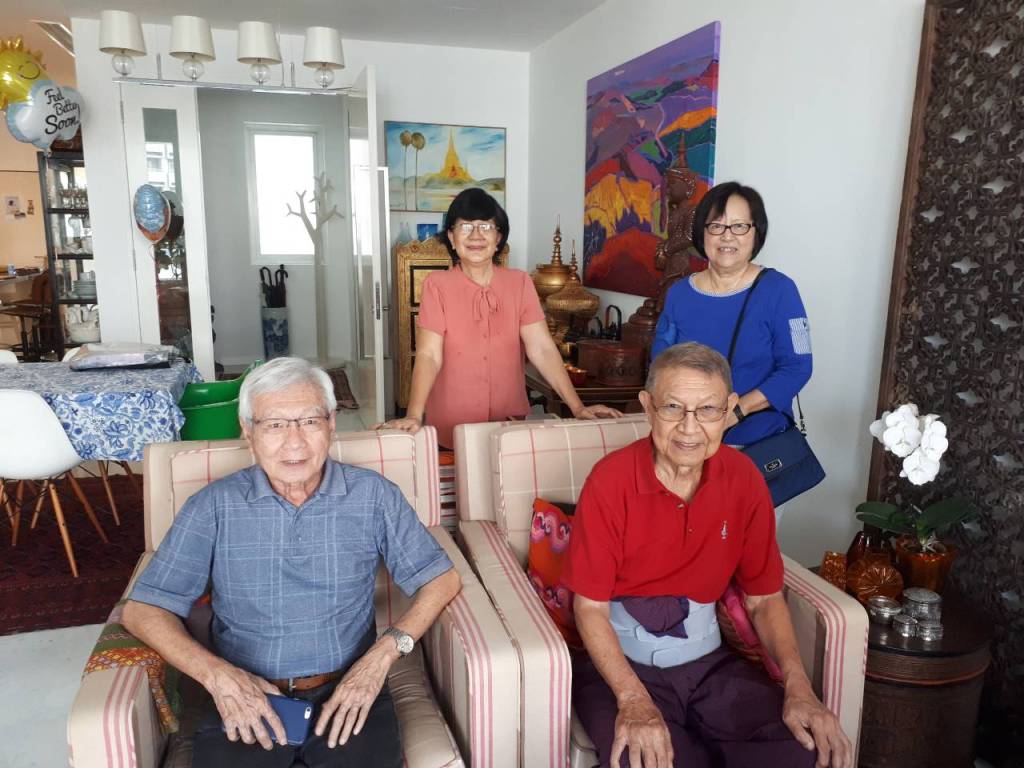
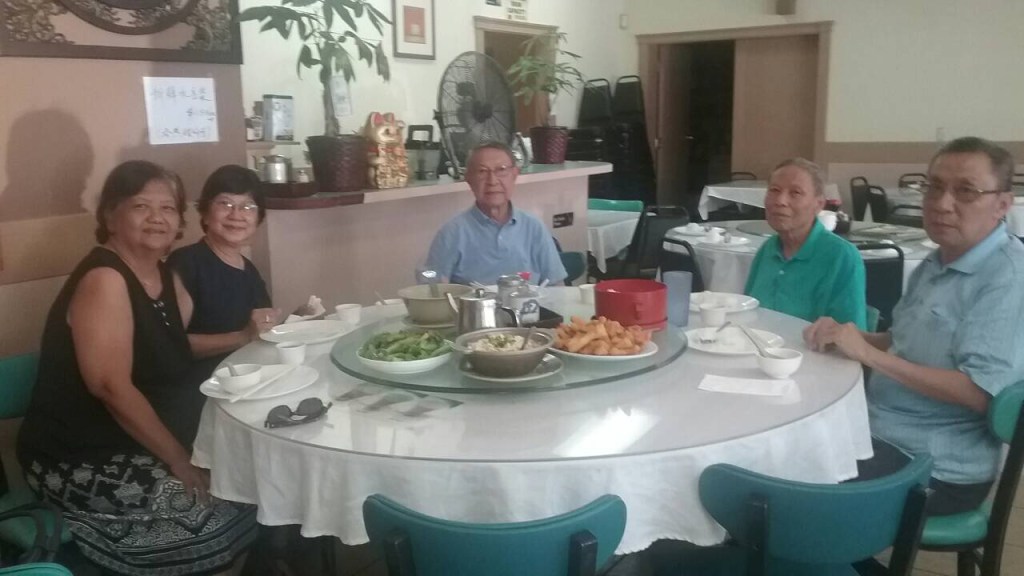
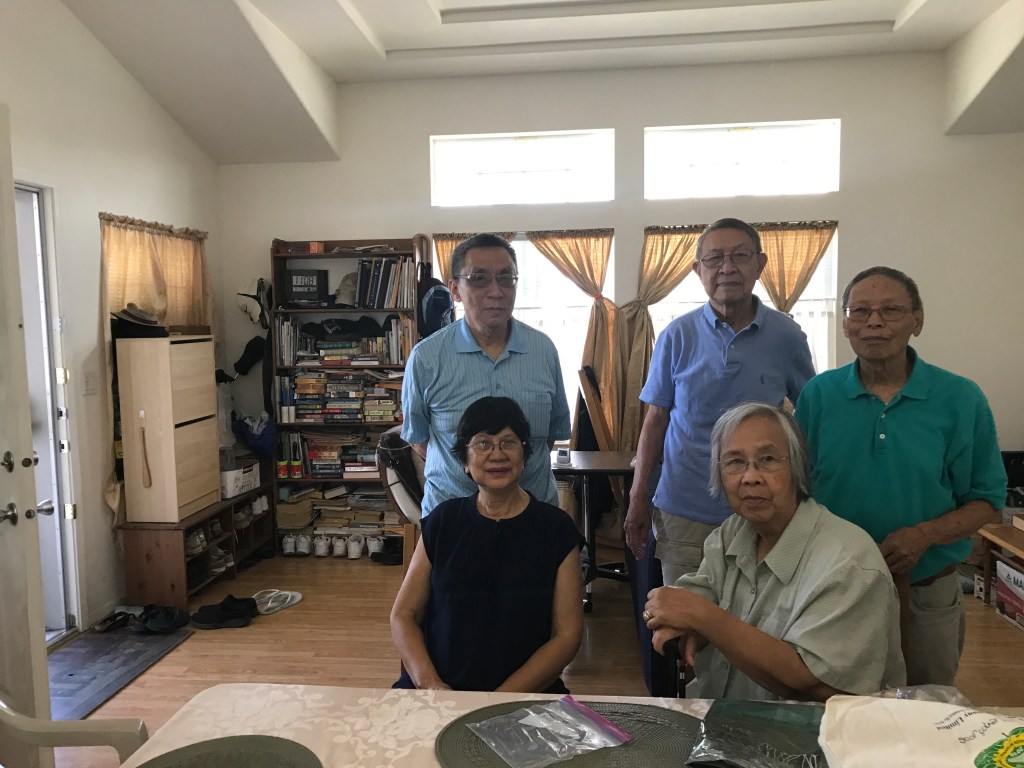
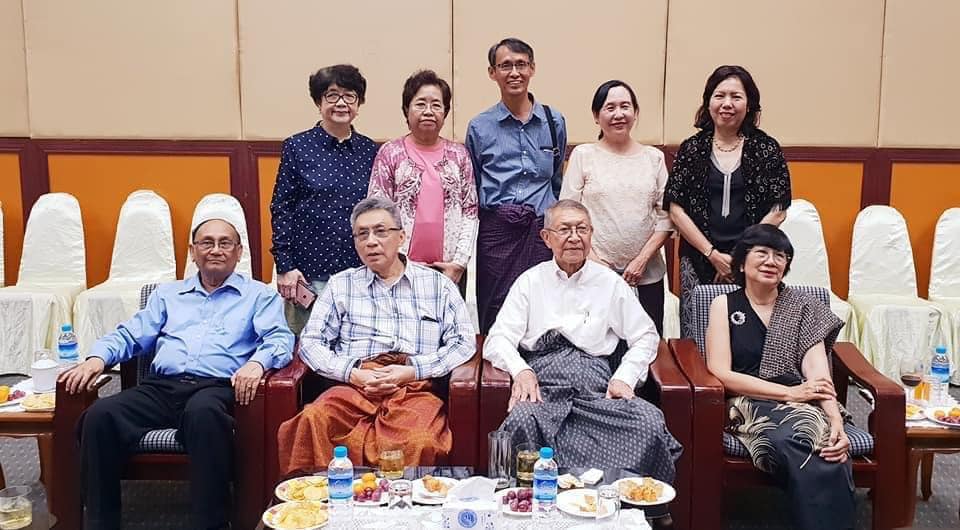
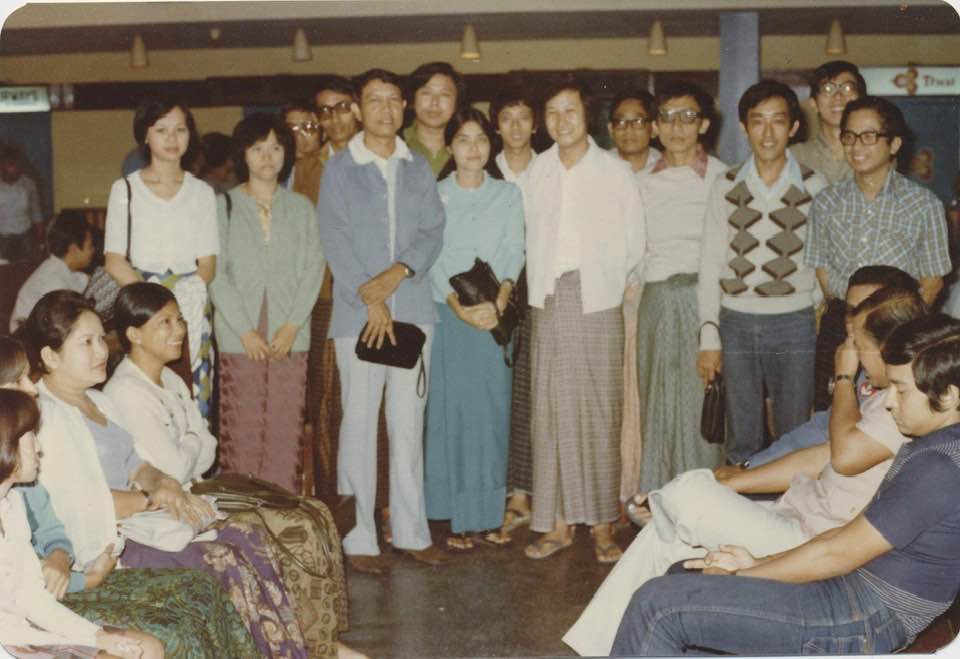
Joined the Mechanical Engineering Department in 1965
Moved to USA
Received PhD from UC Berkeley
Worked for Hewlett Packard, Agilent and several US companies before moving to Taiwan to work there.
After retirement, Saya spent time in California and Taiwan.
Activities
Past President, BAPS
Founding Member, RIT Alumni International
Co-chair, Steering Committee for SPZP-2000
Proposed “U Nyo Win Act“. If there are less than the guaranteed number of attendees at SPZP-2000, the core organizers will chip in the costs. Thanks in part to the five Golden Sponsors of SPZP-2000, the Act did not need to be enforced.
Wrote about SPZP-2000 in the Post Reunion series.
Founding Member, NorCal RITAA
Served as BOD (Board of Director).
BAPS
Past President, BAPS
Editor, BAPS Newsletter
Honoring U Nyo Win, Ko Benny and Ko Henry
by Hla Min
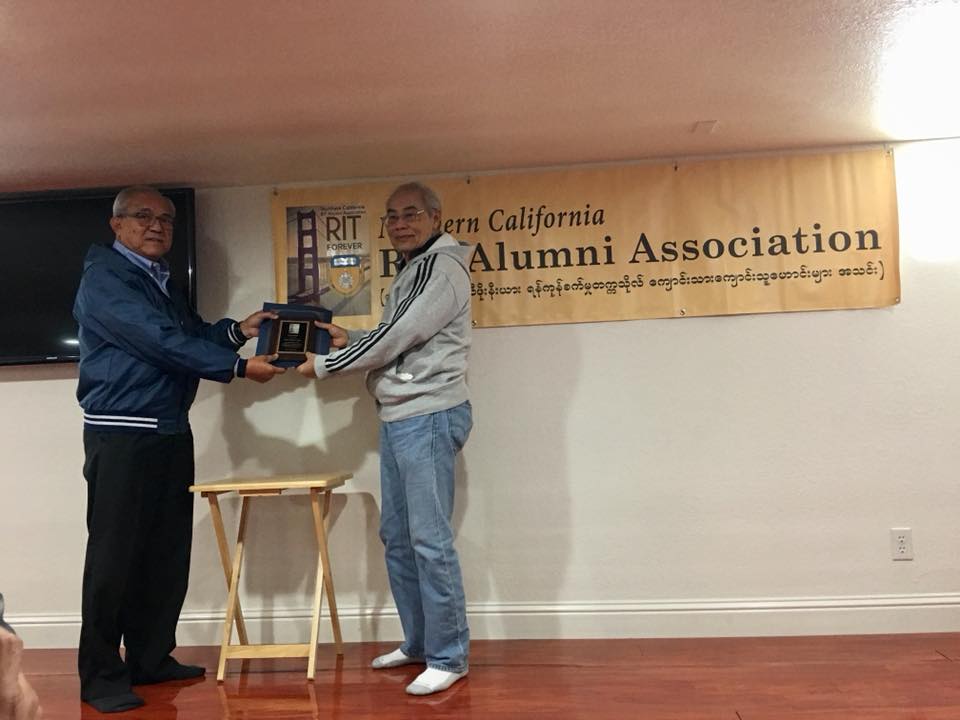
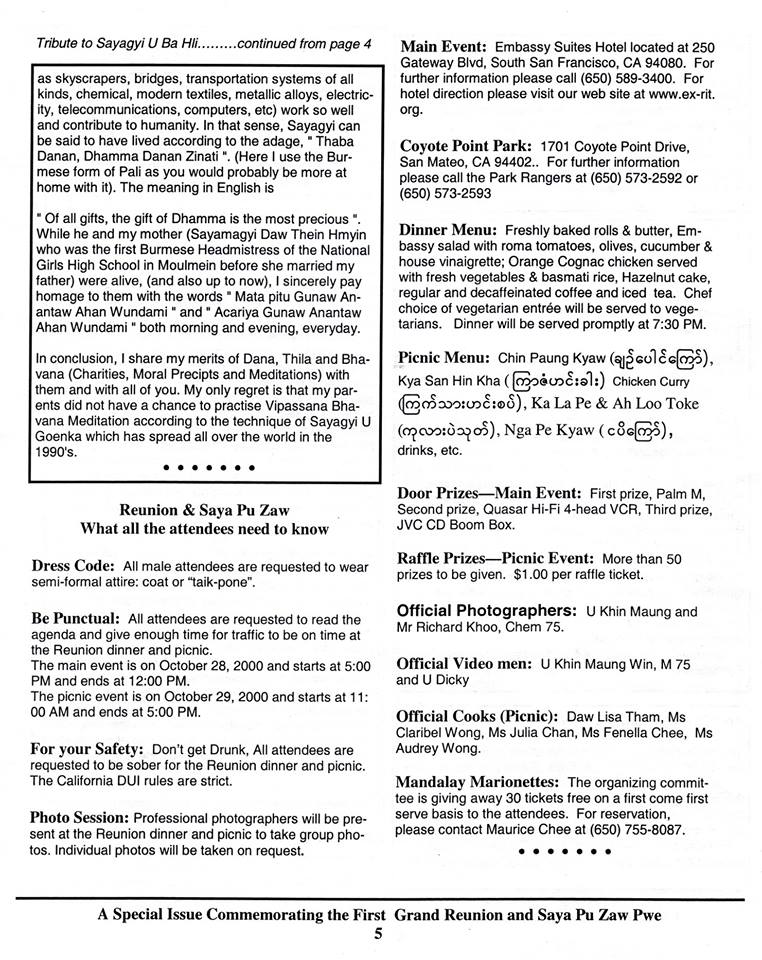
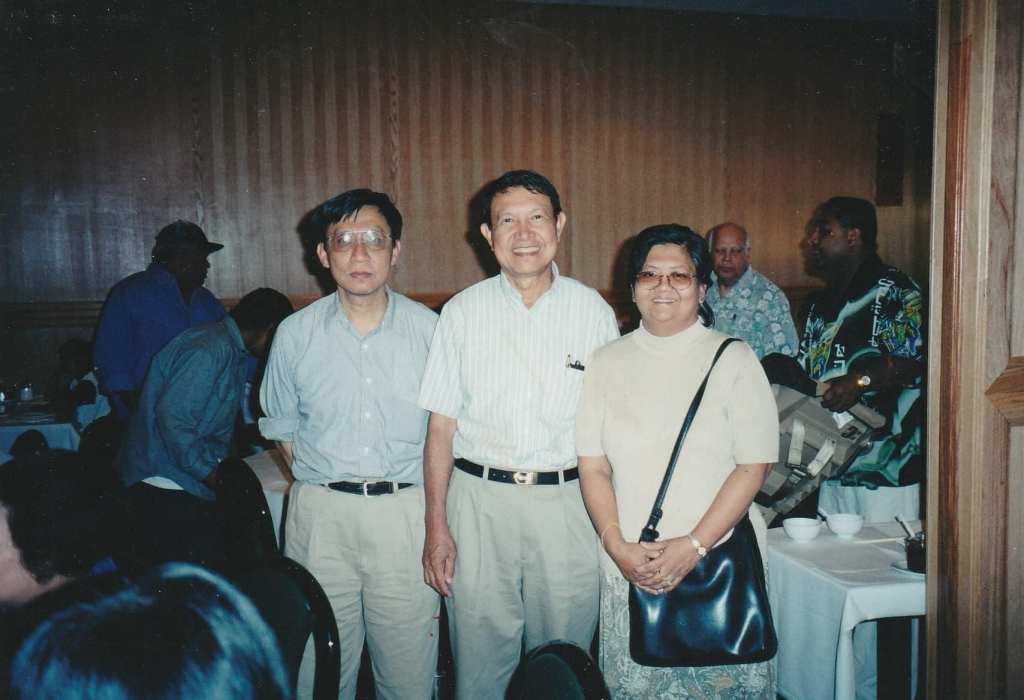
On November 9, 2000, there was a special dinner at Ming’s seafood restaurant in Sunset, San Francisco to honor Saya U Nyo Win (M65), out-going president of BAPS and to welcome Ko Benny Tan (M70), the in-coming president. There were 30+ attendees. Saya U Nyo Win was presented a plaque in recognition of his leadership and services to BAPS.
A plaque was also awarded to Henry Lim (RIT Alumni) for his services as Editor of the BAPS newsletter. It grew from a 4 pager to a 20 pager.
BEA to BAPS
The first ever RIT Grand Reunion and SPZP did not happen out of the blue. One of the first seeds was sown with the founding of Burmese Engineers Association (BEA). The presidents Saya U Htin Paw (EE58), Saya U San Tun (M59) and Saya U KC Chiu (ChE63) — with the able support of Daw Khin Hta Yee (Lily Win, T72) — organized mini-reunions and reunions in the Bay Area. At the welcome party for Saya U Aung Khin, the idea of merging BEA with a younger association BASTS to become BAPS (Burmese American Professional Society) was proposed and overwhelmingly approved.
BAPS Picnic to RIT Alumni International
At one of the BAPS picnics, several EC members — Saya Allen Htay, Saya U Nyo Win, Saya KC Chiu, Saya U Maung Maung, Ko Benny Tan, Ko Maurice Chee, — held an impromptu meeting with me and asked how they could support Ko Khin Maung Zaw (KMZ) and me regarding the ex-rit web site in general and other activities [such as Grand Reunion] in general.
Later, at Ko Benny’s house, the Bay Area Alumni Group was formed. The rest is history.
Prez for two terms
According to the bye-laws of BAPS, a President can serve for at most two terms. Saya U Nyo Win served two terms. Saya also chaired the meetings by the Organizing Committee of the RIT Reunion and SPZP. His colorful meeting minutes are enjoyable to read.
He is an outstanding writer and an excellent speech giver. Saya wears two hats: BAPS for the Bay Area activities and RIT Alumni International for activities related to his alma mater world-wide. Our kudos to you, Saya.
After Dinner
We went to Ko Aye Tun (Anthony Ng, M76)’s house, which is within walking distance from the restaurant. A preview of the raw / semi-edited copy of the video taken at the RIT Reunion dinner and SPZP took place. The 2+ hour footage caught several viewers by surprise. The “Waing gyi putt putt du way way” dance — started by Diana (Myint Myint Sein, M70) and Richard Chao (Htin Aung, M70) — was joined by Saya U Khin Aung Kyi, Saya U Min Wun, and several alums.
It was close to two o’clock in the morning when I got back home.
RIT Alumni International
Founding Member
Core Organizer, SPZP-2000
Wrote “Appreciation of SPZP-2000” for Post Reunion
Article for Post Reunion (SPZP-2000)
by U Nyo Win
SPZP-2000 Orgsnizers
After the Grand Reunion and Saya Pu Zaw Pu (SPZP), I feel like most of us still excited but completely deflated. I just have enough energy left to think about it and talk about it, but not enough to write about it. But with Ko Hla Min’s call for the end of the post reunion article at number 36, I want to catch this last chance to write a few words before the close of the book, so to say.
First, as the one of the co-chairmen of the Steering Committee, I’d like to add a few words to U Myat Htoo’s article on the apology and thanks to the all the sayagyis, sayas, and fellow alumni. We’d planned and tried to make the Reunion and SPZP a success. I agree with U Myat Htoo that there were areas of deficiencies that we overlooked and were unable to cover. Let me mention a few that we could have done better to run the program more smoothly. It may also be helpful hindsight to pass on to 2002 reunion team.
The reception area was too crowded. We expected 300 plus people would be converging on to the narrow aisle at about 5 O’clock. We tried to arrange two tables in parallel to allow more people to check-in, sign the book, receive the gifts and be directed to the appropriate tables. The crowd was larger than expected. Our seating plan didn’t help. It was designed to group people according to their requests of having close friends together. Unfortunately, the attendees’ names were not listed in alphabetical order with table number assigned. It was very time consuming to locate the table number for the guest. This resulted in people congregating in the check-in area in spite of the ushers’ effort to help.
We under estimated the time for picture taking. It turned out it was the most exciting event. We had group photos of every combination one could imagine. Getting everyone to follow the program for the number of pictures taken was not possible. It ended up a half hour photo session was three times longer. The good thing was, everyone liked it and everyone wanted it. In order to keep the program moving in a reasonable time, our MC U Myat Htoo had to exercise some crowd control. I hope everyone share U Myat Htoo’s difficulty for so doing.
The program was overloaded. Our program called for speeches from sayagyis, sayas, and the alums; opportunity for the audience to contribute to fun, entertainments, singing and jokes. Everyone appeared to be so happy and excited. All of us had so much to talk about, so much fun to have and so much joy to share that hardly anyone could concentrate and follow the program allocated time. But, isn’t that the expectation everyone had of the reunion and SPZP?
We did not allocate sufficient time to meet and thank everybody. Of course, it was not easy to walk around and talk to everybody throughout the event. Again, in hindsight, one possibility would have been to have Organizing Committee representatives go around the tables during dinner time to meet and thank everybody.
I want to reiterate, like everyone else, that this great event was a resounding success in spite of a few glitches. The success was due to the support given to the event from all those who attended and from those who were unable to attend but whole-heartedly supporting and encouraging us. The success was due to those who generously donated to the SPZP Fund so that we could make the best use of it for the event. The success was due to those who helped out with the event, and most of all, due to the hard working Executive Committee members under the leadership of Co-chairmen Benny Tan and Maurice Chee.
I would like to give a couple of examples of how dedicated the two co-chairs, Benny and Maurice, were. In the morning on the day of the Reunion, I was at Benny’s house. Benny showed me the 25-foot RIT Reunion and SPZP banner undergoing the final touch. I learned from Benny that the contractor was unable to deliver the banner on time as promised. But we must have it for the great event! Benny, with the help of his nephew, decided to make one themselves just the night before the Grand Reunion. They bought the canvas, the paint, and the brush; they designed the RIT logo and the characters; they rolled up their sleeves and succeeded in finishing the banner in time for the great event.
In the afternoon when I was at the Embassy Suite making the final arrangement for the arrival of the guests, I got a call from Maurice. He told me that he would be a little late coming to the hotel. I learned from him that, not being able to get a print shop to do the job on time and as desired, he was printing the name tags for the guests with his own computer.
This very special event brought us excitement and great emotion. We shared the joy and the happy moment. But I would think that the feelings of each of us must be different and unique. For me, at time I felt that I was back in the good old days of teaching at RIT. I saw Rector Dr. Aung Gyi, Mechanical Engineering Department Head Saya U Aung Khin, Chemical Engineering Department Head [and Rector] U Khin Aung Kyi, Saya U Nam Kock, other sayas, colleagues and students. At time I felt that I was still one of the students attending the classes.
My most memorable year at RIT was actually the first and the only BIT year, 1962. We had very few students in First Year. In fact, there weren’t that many engineering students altogether at BIT that year. Among my contemporaries were U Kyaw Aye (Shakoor), who is still in Burma and U Hla Myint (Charlie), who is now in Australia. We were the lucky ones who survived First Year Heat Engine taught by Saya U Aung Khin. I can assure you for those who’d never taken Heat Engine from Saya U Aung Khin how low the yield was from that class. Decades later, in the mid of this great reunion, seeing all the sayagyis, former colleagues, former students and new RIT graduates whom I had never met, I felt like I was in a dream.
Now that the great event is over, we are looking forward to meeting again in Singapore, Year 2002. I agree with Saya U Aung Khin, and let me quote from his article, that “we keep up with the changing situation in our home country regarding secondary technical education and decide on how inclusive we should be so that continuity can be maintained by embracing an expanding fraternity of engineers.” We all witnessed the group with exceptional talent gathering at the night of the reunion. Benny Tan in his article suggested the idea of harnessing the brainpower and energy of the group. I would think that the Year 2000 reunion was reminiscing of the past and sharing of the present, the Year 2002 reunion should in large part be the bridging of the present and the future. As to how, let’s start tapping on our talent pool now.
Professor Emeritus & Head of Civil Engineering at Rangoon Institute of Technology
Nativity
Born, brought up, and schooled in Taungdwingyi, Magwe Division, Myanmar, by my parents Saw Boon Koke (aka) U Win Myint and Daw Kyin Toke.
Family
Named as Maung Kyit Ing, the eldest son of six, three younger brothers (two Medical Doctors and one Head Master of State High School) and two younger sisters (one Medical Doctor and one Director of Education).
Married to Daw Khin Myint Myint.
Have two sons (Nicholas, a Medical Doctor and Daniel, a Computer Analyst) and one daughter (Penthea, a Medical Doctor), and three grand daughters.
Residence
Currently living with my spouse at 5947 Loma Avenue, Temple City, California 91780-1924, U.S.A.
Academic Career
School Leaving Certificate from Taungdwingyi State High School and Matriculated, 1948
University of Rangoon: Intermediate of Science, 1950
B.O.C. College: 1st Year B.Sc. Engineering, 1951
Massachusetts Institute of Technology (MIT): BS (Civil Engineering), 1955
Cornell University: MS (Civil Engineering) with Major in Geodesy and Photogrammetry, 1956
Faculty of Engineering, University of Rangoon, 1957-1961
Colombo Plan Professor, University College, London, 1974-1975
Rangoon Institute of Technology (RIT), once also known as Burma Institute of Technology (BIT), Department of Civil Engineering, 1961-1988
Accomplishments
Professor & Head of Department of Civil Engineering, more than 31 years of service as educator and administrator at RIT, (1957-1988)
Director of Regional Colleges Development Project (Burmese Counterpart to Foreign Experts) (1978-1982), helped establish 20 Regional Colleges all over Burma
Chairman of Civil Engineering Construction Cooperative (CECC) (1976-1982), created job opportunity and On-the-Job-Training (OJT) for RIT and University Graduates, a Consultant Firm engaging the expertise of Faculty and Laboratory Staffs
Consultant Member of the Myanmar National Calendar Advisory Committee (1972-1988), helped revise and update Traditional Calendar Computation and Compilation Methods
Member of the Advisory Committee for Restoration of Bagan (1975-1988), helped strengthen Bagan Monuments (Stupas & Pagodas) and establish Photogrammetric Resources for rapid and precise mapping of Bagan Monuments.
Editor’s notes
Saya taught “Surveying” in my 2nd B.E. course in 1964 – 65
He is an expert in both Western & Eastern Astronomy, Western & Eastern Astrology.
He was Vice President, BARB
He served on the “Myanmar Calendar Advisory Board” for many years.
He wrote an article, which complements/augments Kogyi Koung’s narrative of the “Kyaikhtiyo ကျိုက်ထီးရိုးProject”.
He also wrote about “Bagan restoration” and “Civil Engineering Department”.
He retired from Caltrans when he was about 80 years young.
He passed away in Southern California.
Memories
Attended SPZP-2000 & gave speech
Welcome Dinner for SPZP-2000
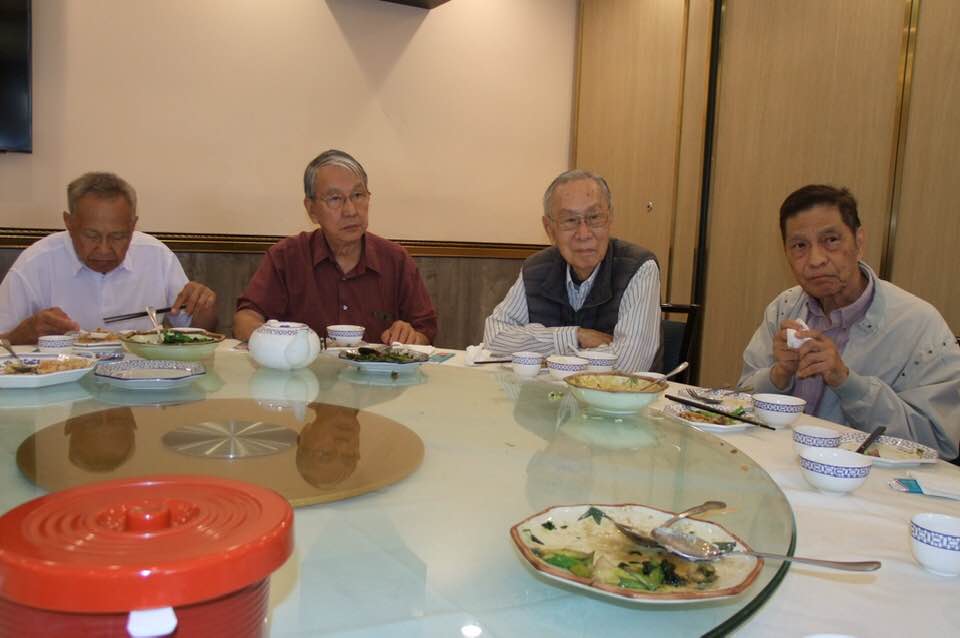
Alumni mostly from SoCal meet annually for Lunch gathering with Saya. Dr. San Lin invited us to one gathering.
Lunch gathering
Dr. Aung Soe led the practical for Saya’s course on Surveying.
Saya 3U Min WunLunch gathering in Southern California
First native Dean to head the Faculty of Engineering of Rangoon University
Transferred to the Faculty of Engineering, RU from GTI (Government Technical Institute) where he was Principal and Professor of Civil Engineering
Credited for the “Twinning Program” between the Faculty of Engineering, RU and the prestigious universities in the USA
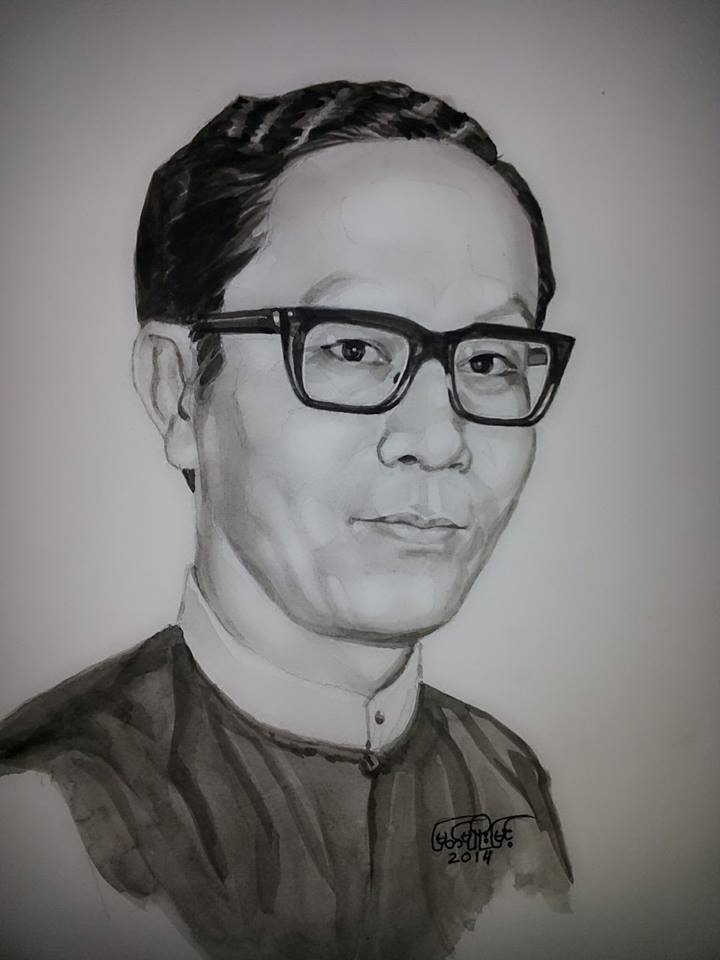
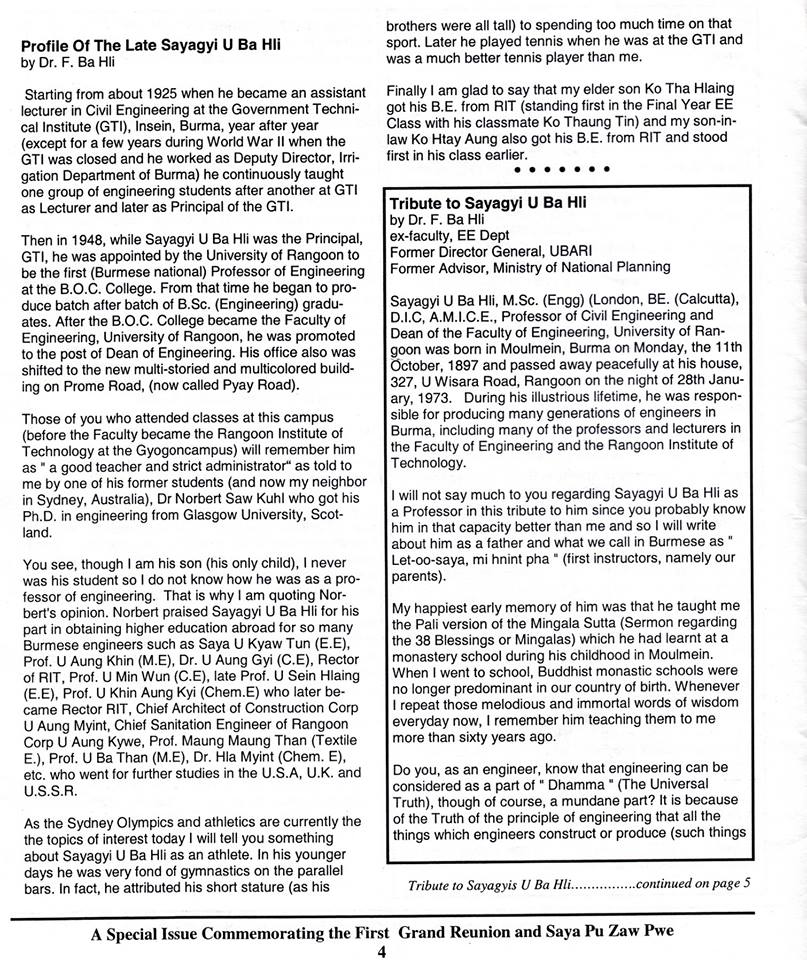
Per request from U Aung Khin (retired Professor & Head of Mechanical Engineering), Dr. Freddie Ba Hli (EE) — the only son — wrote about his beloved father for the commemorative issue of “RIT Alumni International Newsletter” for SPZP-2000. It has been re-posted in the newsletter updates and in the RIT Alumni Facebook Pages. Sayagyi passed away in his house on U Wisara Road in Rangoon.
Tribute to U Ba HliTribute
Interim Deans
Dr. Htin Aung
Dr. Maung Maung Kha
Dr. Tha Hla
U Po Tha
Dr. Htin Aung
Dr. Htin Aung
Principal, Rangoon College
Rector, Rangoon University
Vice Chancellor, Rangoon University
Interim Dean, Faculty of Engineering
Burmese Ambassador to Ceylon
Folklorist / Historian
Dr. Maung Maung Kha
Dr. Maung Maung Kha and family
Doctorate in Meteorological Physics from Imperial College, London University
Professor & Head of Physics Department at Rangoon University
Interim Dean of the Faculty of Engineering, Rangoon University
Longest tenured Rector
Rector of Rangoon University
Rector of RASU
Rector of University of Distance Learning
Plays the violin well
Accompanied U Ba Kyi (Artist, translator/composer of songs”) singing “Hne Yauk Hte Nay Chin De” in Burmese and English
Passed away in Yangon in 2005.
Centennial celebrations for his birthday were held in 2015.
Early Rectors
Dr. Htin Aung (RU)
Dr. Hla Myint (RU)
Dr. Tha Hla (RU)
U Kar (RU)
Dr. Maung Maung Kha (RU, RASU)
U Yone Mo (RIT)
Dr. Aung Gyi (RIT)
U Khin Aung Kyi (RIT)
U Maung Maung Than (RIT)
U Yone Mo
U Yone Mo
Retired Chief Engineer, Burma Railways
In 1961, the Faculty of Engineering, Rangoon University moved to Gyogone and had a new name Burma Institute of Technology (BIT).
Appointed Dean of Engineering at the BIT Gyogone Campus
Under the new Education System, BIT became an autonomous Institute with the name Rangoon Institute of Technology (RIT). He became the Rector.
Proponent of taking power naps
U Wynn Htain Oo (M72) remembers how his friends were having fun with the “Ye Punn ရေပန်း” (Water Foundation). Saya saw them, but did not scold them. He said with a smile, “Young men, you can go to the University Swimming Pool or to the Inya Kan ကန် (Lake)”.
Established the weekly “Yoke Shin ရုပ်ရှင်” at the Assembly Hall.
Dr. Aung Gyi (Professor of Civil Engineering) remembered seeing a letter from U Yone Mo (Rector) sent to U Yone Mo (Parent of a son who happened to visit his gambling friends at the hostel). Dr. Aung Gyi told the Admin to stow away the letter.
Ko Zaw Min Nawaday knows Sayagyi & his spouse (Daw Elizabeth Yone Mo, High Ranking Nurse at RGH and a close friend of Daw Khin May Than) very well. Sayagyi and Dr. Aung Gyi were in May Myo during one summer. Sayagyi asked Dr. Aung Gyi and Ko Zaw Min to accompany him. They ate Khauk Swe. Sayagyi reminded them not to tell about his “Khauk Swe” appetite to Sayagadaw.
Dr. Aung Gyi
Dr. Aung Gyi
Succeeded U Yone Mo as Rector
Rector (1971 – 1977)
See Posts
Memories of Dr. Aung Gyi
Speech at SPZP-2000
Coconut Episode
U Khin Aung Kyi
U Khin Aung Kyi
Stood 7th in Burma in the Matriculation of 1949
He did his B S and M S at MIT
Professor of Chemical Engineering at RIT
Succeeded Dr. Aung Gyi as Rector
Taught at Rengsit University in Bangkok, Thailand
Provided interview for HMEE-2012 Project
U Maung Maung Than
U Maung Maung Than
BS in Textile Engineering from Clemson University and MS from Lowell University
Professor & Head of Textile Engineering Department, RIT
Rector, YIT
DG, DHE
Chair, RIT Sports Council
Hobbies : Chinlon, Music
Helped establish Engineering at Defense Services Academy
Dr. Henry Cho Tun (Myint Tun) wrote:
I’m going to add a few things about Saya U Mg Mg Than. I’m very close to him and the family and the son is my student. We are all golfers and both of them are very good. Saya MM Than is as good as Saya Soe Paing and plays with clubs that are custom made for him. Hope the following would be useful additions. Thank you
He did his B S at Clemson and M S at Lowell.
He joined BIT in 1957 as lecturer -Head of Textile Engineering Department at BOC college
1964 was appointed Professor at RIT
Served as Rector, 1990-1992
Director General of The Department of Higher Education 1992-1994 and retired
Served as Director of Studies at DSTA (Defense Services Technical Academy)
Born from my parents U Ba Pu and Daw Aye Kyi in Namtu, Northern Shan States, Burma.
Education
Matriculated in 1949 from Myoma High School in Rangoon.
After passing the 1st year engineering, BOC College of Engineering, Rangoon University in 1952, went to Massachusetts Institute of Technology (MIT), Cambridge, Mass., USA as a State scholar to join the second year engineering classes there.
Was in Dean’s list during the studies in MIT; and obtained B.S.(Civil Engineering) in 1955 and M.S.(Civil Engineering) in 1956.
Work
After working as a junior engineer in Tippetts- Abbett-MacCarthy- Stratton Engineers, New York and Green Engineering Co., Boston for a year, returned to Burma in 1957.
Joined the Civil Engineering Department, Faculty of Engineering, Rangoon University as an Assistant Lecturer.
Promoted to Lecturer and Head of the Department of Civil Engineering in 1958.
Marriage
Got married to Daw Mya Mya Mue in 1959. (Have a daughter and a son and two grand children from daughter who all live in Canada now.)
Doctorate
Went to the University of Alberta in Edmonton, Alberta, Canada on Colombo Plan Scholarship in 1963 for further studies. Obtained Ph.D (Civil Engineering) specializing in structural engineering in 1965 from the University of Alberta in Edmonton.
Promotions
Returned to Burma in 1965 and promoted to Professor and Head of Civil Engineering Department in 1966.
Promoted to Rector of Rangoon Institute of Technology in 1971.
UNESCO
Left Burma to join UNESCO as Programme Specialist in Applied Sciences in 1977 in Unesco Regional Office in New Delhi, India.
IDRC
Migrated to Ottawa, Canada to join the International Development Research Centre (IDRC), Canadian Research funding Agency in Ottawa as an Associate Director in 1981.
Was then assigned to IDRC Regional Office in Singapore as Principal Program Officer from 1989 to 1992.
Was transferred to IDRC Regional Office in New Delhi as Principal Program Officer in 1992.
Was promoted to Regional Representative for IDRC Regional Office in New Delhi in 1995.
Retired from IDRC in June 1997 and now settled down in Nepean, Ontario, Canada with wife.
I look forward to seeing you all soon.
With Metta, Aung Gyi
Updates (by Hla Min)
Welcome dinner for SPZP-2000
U Thein Aung (Met72, Saya) was Associate Editor for the commemorative issue of RIT Alumni Newsletter for SPZP-2000. He compiled the biographies of the sayas and sayamas attending SPZP-2000. He also served as co-emcee.
Saya has four grandchildren.
I was a guest on two occasions (around SPZPs) hosted by Ko Wai Lwin in Yangon (a) one for Ma Ma Emma’s birthday (b) another for welcoming Sayagyi DAG and other sayas at U Nyan Tun U’s residence.
Met Saya during his trips to California
Asian Heritage Museum
We spent a few nights at Ivan’s house. Saya & Ma Ma were also there to attend the RIT-UCC gathering hosted by Ivan
NJ Gathering
Ko Ivan, Ko Fred, my spouse and I stayed at Saya’s house for two nights in 2015. Thanks.
Saya’s house
iNapa Winery
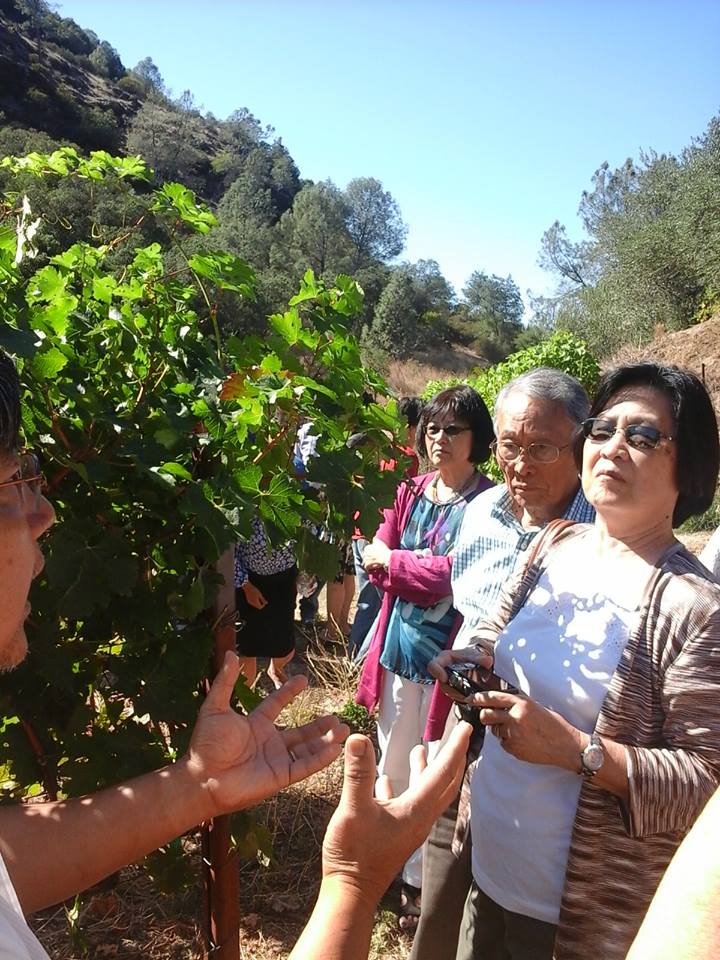
iNapa 1iNapa 2iNapa 3
Group Photos
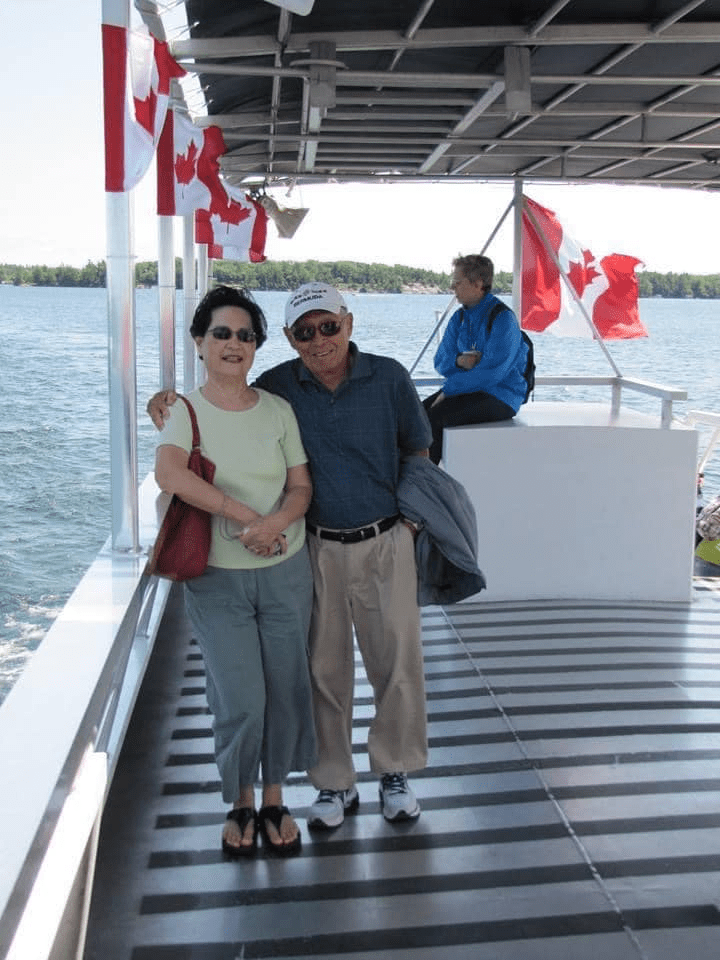
With U Moe Aung At PZPBirthday for Daw EmmaThousand Islands FerryWith Ivan and HM
Worked for Hewlett Packard, Agilent and several US companies before moving to Taiwan to work there.
Saya is retired. He is back in the USA
Activities
Past President, BAPS
Editor, BAPS Newsletter
Founding Member, RIT Alumni International
Co-chair, Steering Committee for SPZP-2000
Proposed “U Nyo Win Act — If there are less than the guaranteed number of attendees at SPZP-2000, the core organizers must chip in the costs.” Thanks in part to the five Golden Sponsors of SPZP-2000, the Act did not need to be enforced.
Wrote about SPZP-2000 in the Post Reunion series.
Founding Member, NorCal RITAA
Served as BOD (Board of Director).
BAPS
Past President, BAPS
Editor, BAPS Newsletter
BAPS Newsletter
Honoring U Nyo Win, Ko Benny and Ko Henry
by Hla Min
On November 9, 2000, there was a special dinner at Ming’s seafood restaurant in Sunset, San Francisco to honor Saya U Nyo Win (M65), out-going president of BAPS and to welcome Ko Benny Tan (M70), the in-coming president. There were 30+ attendees. Saya U Nyo Win was presented a plaque in recognition of his leadership and services to BAPS.
A plaque was also awarded to Henry Lim (RIT Alumni) for his services as Editor of the BAPS newsletter. It grew from a 4 pager to a 20 pager.
BEA to BAPS
The first ever RIT Grand Reunion and SPZP did not happen out of the blue. One of the first seeds was sown with the founding of Burmese Engineers Association (BEA). The presidents Saya U Htin Paw (EE58), Saya U San Tun (M59) and Saya U KC Chiu (ChE63) — with the able support of Daw Khin Hta Yee (Lily Win, T72) — organized mini-reunions and reunions in the Bay Area. At the welcome party for Saya U Aung Khin, the idea of merging BEA with a younger association BASTS to become BAPS (Burmese American Professional Society) was proposed and overwhelmingly approved.
BAPS Picnic to RIT Alumni International
At one of the BAPS picnics, several EC members — Saya Allen Htay, Saya U Nyo Win, Saya KC Chiu, Saya U Maung Maung, Ko Benny Tan, Ko Maurice Chee, — held an impromptu meeting with me and asked how they could support Ko Khin Maung Zaw (KMZ) and me regarding the ex-rit web site in general and other activities [such as Grand Reunion] in general.
Later, at Ko Benny’s house, the Bay Area Alumni Group was formed. The rest is history.
U Nyo Win
According to the bye-laws of BAPS, a President can serve for at most two terms. Saya U Nyo Win served two terms. Saya also chaired the meetings by the Organizing Committee of the RIT Reunion and SPZP. His colorful meeting minutes are enjoyable to read.
He is an outstanding writer and an excellent speech giver. Saya wears two hats: BAPS for the Bay Area activities and RIT Alumni International for activities related to his alma mater world-wide. Our kudos to you, Saya.
After Dinner
We went to Ko Aye Tun (Anthony Ng, M76)’s house, which is within walking distance from the restaurant. A preview of the raw / semi-edited copy of the video taken at the RIT Reunion dinner and SPZP took place. The 2+ hour footage caught several viewers by surprise. The “Waing gyi putt putt du way way” dance — started by Diana (Myint Myint Sein, M70) and Richard Chao (Htin Aung, M70) — was joined by Saya U Khin Aung Kyi, Saya U Min Wun, and several alums.
It was close to two o’clock in the morning when I got back home.
RIT Alumni International
SF Bay Area RIT Alumni Advisory Group
Founding Member
Core Organizer, SPZP-2000
Wrote “Appreciation of SPZP-2000” for Post Reunion
SPZP-2000 Organizers
Article for Post Reunion (SPZP-2000)
After the Grand Reunion and Saya Pu Zaw Pu (SPZP), I feel like most of us still excited but completely deflated. I just have enough energy left to think about it and talk about it, but not enough to write about it. But with Ko Hla Min’s call for the end of the post reunion article at number 36, I want to catch this last chance to write a few words before the close of the book, so to say.
First, as the one of the co-chairmen of the Steering Committee, I’d like to add a few words to U Myat Htoo’s article on the apology and thanks to the all the sayagyis, sayas, and fellow alumni. We’d planned and tried to make the Reunion and SPZP a success. I agree with U Myat Htoo that there were areas of deficiencies that we overlooked and were unable to cover. Let me mention a few that we could have done better to run the program more smoothly. It may also be helpful hindsight to pass on to 2002 reunion team.
The reception area was too crowded. We expected 300 plus people would be converging on to the narrow aisle at about 5 O’clock. We tried to arrange two tables in parallel to allow more people to check-in, sign the book, receive the gifts and be directed to the appropriate tables. The crowd was larger than expected. Our seating plan didn’t help. It was designed to group people according to their requests of having close friends together. Unfortunately, the attendees’ names were not listed in alphabetical order with table number assigned. It was very time consuming to locate the table number for the guest. This resulted in people congregating in the check-in area in spite of the ushers’ effort to help.
We under estimated the time for picture taking. It turned out it was the most exciting event. We had group photos of every combination one could imagine. Getting everyone to follow the program for the number of pictures taken was not possible. It ended up a half hour photo session was three times longer. The good thing was, everyone liked it and everyone wanted it. In order to keep the program moving in a reasonable time, our MC U Myat Htoo had to exercise some crowd control. I hope everyone share U Myat Htoo’s difficulty for so doing.
The program was overloaded. Our program called for speeches from sayagyis, sayas, and the alums; opportunity for the audience to contribute to fun, entertainments, singing and jokes. Everyone appeared to be so happy and excited. All of us had so much to talk about, so much fun to have and so much joy to share that hardly anyone could concentrate and follow the program allocated time. But, isn’t that the expectation everyone had of the reunion and SPZP?
We did not allocate sufficient time to meet and thank everybody. Of course, it was not easy to walk around and talk to everybody throughout the event. Again, in hindsight, one possibility would have been to have Organizing Committee representatives go around the tables during dinner time to meet and thank everybody.
I want to reiterate, like everyone else, that this great event was a resounding success in spite of a few glitches. The success was due to the support given to the event from all those who attended and from those who were unable to attend but whole-heartedly supporting and encouraging us. The success was due to those who generously donated to the SPZP Fund so that we could make the best use of it for the event. The success was due to those who helped out with the event, and most of all, due to the hard working Executive Committee members under the leadership of Co-chairmen Benny Tan and Maurice Chee.
I would like to give a couple of examples of how dedicated the two co-chairs, Benny and Maurice, were. In the morning on the day of the Reunion, I was at Benny’s house. Benny showed me the 25-foot RIT Reunion and SPZP banner undergoing the final touch. I learned from Benny that the contractor was unable to deliver the banner on time as promised. But we must have it for the great event! Benny, with the help of his nephew, decided to make one themselves just the night before the Grand Reunion. They bought the canvas, the paint, and the brush; they designed the RIT logo and the characters; they rolled up their sleeves and succeeded in finishing the banner in time for the great event.
In the afternoon when I was at the Embassy Suite making the final arrangement for the arrival of the guests, I got a call from Maurice. He told me that he would be a little late coming to the hotel. I learned from him that, not being able to get a print shop to do the job on time and as desired, he was printing the name tags for the guests with his own computer.
This very special event brought us excitement and great emotion. We shared the joy and the happy moment. But I would think that the feelings of each of us must be different and unique. For me, at time I felt that I was back in the good old days of teaching at RIT. I saw Rector Dr. Aung Gyi, Mechanical Engineering Department Head Saya U Aung Khin, Chemical Engineering Department Head [and Rector] U Khin Aung Kyi, Saya U Nam Kock, other sayas, colleagues and students. At time I felt that I was still one of the students attending the classes.
My most memorable year at RIT was actually the first and the only BIT year, 1962. We had very few students in First Year. In fact, there weren’t that many engineering students altogether at BIT that year. Among my contemporaries were U Kyaw Aye (Shakoor), who is still in Burma and U Hla Myint (Charlie), who is now in Australia. We were the lucky ones who survived First Year Heat Engine taught by Saya U Aung Khin. I can assure you for those who’d never taken Heat Engine from Saya U Aung Khin how low the yield was from that class. Decades later, in the mid of this great reunion, seeing all the sayagyis, former colleagues, former students and new RIT graduates whom I had never met, I felt like I was in a dream.
Now that the great event is over, we are looking forward to meeting again in Singapore, Year 2002. I agree with Saya U Aung Khin, and let me quote from his article, that “we keep up with the changing situation in our home country regarding secondary technical education and decide on how inclusive we should be so that continuity can be maintained by embracing an expanding fraternity of engineers.” We all witnessed the group with exceptional talent gathering at the night of the reunion. Benny Tan in his article suggested the idea of harnessing the brainpower and energy of the group. I would think that the Year 2000 reunion was reminiscing of the past and sharing of the present, the Year 2002 reunion should in large part be the bridging of the present and the future. As to how, let’s start tapping on our talent pool now.
U Soe Paing, U Win Paing (U Wara), Dr. Myo Paing, U Kyaw Paing
Family
Parents : ICS U Paing & Daw Oo Yin
Siblings : Dr. Myo Paing, U Win Paing (Sayadaw U Wara, GBNF), U Kyaw Paing
Spouse : Daw Saw Yu Tint (T69)
U & Mrs. Soe Paing
Children : Two sons & One daughter
Grandchildren : 3
Education & Work
He matriculated from St. Paul’s High School in 1956. He stood 13th in Burma and won the Collegiate Scholarship.
At the Convocation of 1958, he won two Gold Medals — one for the Highest Total Marks in I.Sc.(A) and I.Sc.(B); and another for Joint Highest Marks in Mathematics for I.Sc.(A) and I.Sc.(B).
He received a States Scholarship to study BSEE and MSEE at Stanford University.
He joined the RIT Electrical Engineering Department as Assistant Lecturer.
RIT EE
He helped Sayagyi Dr. Chit Swe found Universities’ Computer Center. He transferred to UCC as Systems Manager in charge of Systems Division. He later also managed the Operations Division.
He received M.Sc.(Computer Science) from Southampton University in UK.
He worked for UNDP Projects in several countries.
Mentor
He was my mentor at RIT and UCC. He allowed U Aung Zaw (GBNF) and me to co-author Texts, User Guides and Manuals for use at UCC.
HMEE
He was an early supporter of the HMEE project. He prepared a draft for the HMEE book and handed it to Saya U Aung Hla Tun (GBNF) & team. He and U Ohn Khine (M70) translated Section 1 of the HMEE Book and summarized Section 2 of the book.
Posts
Post from March 2011
I went to the University Central Library and managed to get scanned photos from the Engg Student Annual Magazines 51-52, 52-53, 56-57 and 60-61. Photos include photos of Sayas, students of that year. From these when can know about the Sayas at that year. We can also identify the students at that year.
U Sein Hlaing (Prof EE) was a final year student in 1951-52 and became an A/L starting 1952-53. Saya U Tin Swe was a student in 1951-52 and 52-53. He was a member of the Eng Student Union and the victorious Prome Hall football team. Ex-Burma Selected Footballer U Chan Tha (Chief Engineer, Roads, Rangoon Municipal) was the Captain. U Khin Si (husband of RIT Finance Officer Daw Yin Yin Htway and part time lecturer Textile) and U Tin Si (U Khin Si’s brother and tennis doubles partnership that won RU as well as national championships) were members of the Prome hall team.
The 1956-57 magazine contains photos when the new Leik Khone Engineering Buildings were inaugurated in 1956 Nov by the Prime Minister at that time U Ba Swe.
In the 1952-53 magazine I found out that Mr. Robert Hole (ex-EE, Highways, PWD, PWC, CC; uncle of Percy Maung Maung and uncle Bobby to me) was the English editor. I called Uncle Bobby and requested him to write something about his engineering student days, his teachers and fellow students. He agreed and asked for about three weeks time.
I need to go back and to the UCL to get more info from the RIT handbook 1966-67 and photos from the Hlyat Sit Sar Saung.
U Ba Than has donated some of his Engineering College photos to the MES library and I need to go there to check up on the photos.
Post from May 2000
The mention of RIT, BIT, and BOC college in the first newsletter bring back memories of our good old days in Rangoon University. Although we did not graduate from Rangoon University, we had a really great two and a half years there before we went for studies aroad under government scholarship.
Our first year 1956-1957 was in Yankin College. Yankin was a campus of RU for first year science students. It is now Yankin State High School No. XX? Hteedan was for the 1st year arts students. Our second year I.Sc. was at the RU campus itself which we refer to as Main. The Arts students have classes at Judson. That time the new Social Science Building (now Institute of Economics) was completed. We had our second year ISc exams in that new building.
Then it is our 1st year B.Sc. Engineering course at the new Faculty of Engineering in Prome Road (now Institute of Medicine I). We attended for six months till December 1958. That campus was designed and built especially for the Faculty of Engineering. Civil, Electrical, Mechanical Departments were there but Chemical, Textile, etc. were in the old BOC building at the back.
The 1st year classes were from 7 to 9 a.m. for Mathematics. We then have a one hour break and we start the engineering courses at 10 a.m. We usually have a snack during the break at a small cafe between Tagaung and Prome Halls. Those halls were only for engineering students then. The mathematics (Pure & Applied) lecturers were from India hired under contract. We had three engineering courses: Building Materials taught by Mr. Tan Ba Hli (the Dean of Engineering himself). Heat Engines taught by U Aung Khin. Principles of Electrical Engineering taught by U Kyaw Tun. We had EE lab with Ko Htin Paw and Ko Ba Nyunt as lab instructors. We also had engineering drawing with Ko San Hla Aung and Allen Htay (for Chem, Tex, etc.) as instructors.
Those were the days when Rangoon University was one of the best universities in SE Asia and Asia. It also had a really nice campus.
RIT Saya Soccer Team
Reading about the communications from Richard Khoo (Dr. Aung Soe, C61) and seeing the list of Sayas in the 1966-67 handbook brings back memories of our soccer team.
As I remember it was from 1964 to 1968 or 1969. We played against (i) the senior students of different majors Civil, Mechanical, Electrical etc. (ii) the sayas at GTI and Natmauk Technical Institute (iii) the Burma Air Force officers.
We also played in the annual tournament for RIT Staff. The staff teams are the Sayas, Workshop staff, Lab staff, Hostel staff and the youth team from the RIT compound.
As I remember (other Sayas & graduates may correct me) these were the people in the team.
Goalkeepers :
Richard Khoo (Civil)
Maurice Kyaw Zaw (Chemistry),
Sein Myint/Ah Sein (Petroleum)
Defenders :
Ko Maung Maung Than (Textile)
Ko Aung Soe (Math)
Ko Aung Hla Tun (Met)
Ko Sann Tint (Elect)
Christopher Maung (Civil)
U Tin Swe (Elect)
Ko Tin Win (Mech)
Midfielders :
Ko Tin Maung Nyunt (Agri)
Desmond Rogers (English)
Ko Khine Oo (Elect)
Ko Maung Maung Win (Mech)
Ko Tin Hlaing II (Mech)
Forwards :
Ko Pike Htwe (Chemistry)
Ko Aung (Math)
Ko Tin Hlaing I (Agri)
Ko Soe Min (Elect)
Ko Kyin Soe (Auto)
myself (Elect)
We rarely practiced but we enjoyed playing the games. We split games with the GTI sayas & the Air Force officers. We beat the Natmauk sayas and we won more than we lost in the RIT staff tournament. But I am sure we lost more than we won against the final year students. Would appreciate comments on this; especially on the names I missed in the team.
Qualification: BS (Stanford), MS (Stanford), MSc. Computer Science (Southampton)
Department: Electrical Communications Position: Assistant Lecturer, (Jan 1964 to March 1971) Reason for Leaving: Joined Universities’ Computer Center in April 1971.
Engineering Alumni: Attended First Year Faculty of Engineering, Rangoon University from June to December, 1958. Reason for Leaving: Awarded State Scholarship to study in USA.
Occupation: Data Processing Adviser (Retired)
Organization: United Nations
Updates
Saya was my mentor at RIT and UCC.
He offered me and Saya U Aung Zaw (UCC, GBNF) to be his co-authors. We wrote programming texts, manuals and guides.
Saya was a prime mover to get the “RIT Alumni International Newsletters” and http://www-ex-rit.org started.
Saya would mention that I am a “Shay Hmi; Nauk Hmi. ရှေ့မှီ၊ နောက်မှီ”
Sayagadaw added: “Bay Hmi ဘေးမှီ as well’.
Saya wrote articles for the RIT Newsletter and selected journals & magazines. They can be accessed via SCRIB-D
He also gave an interview for MASTAA
UCC Gathering at Saya’s House
SP 2
Lovely Couple
SP 3
Acariya Pu Zaw Pwe
SP 4
RIT alumni in Singapore
With U Tu Myint, Daniel Tint Lwin, James Than With U Tint Swe & Vilma Khaing
Visit to California
With Saya U Tin Mg Nyunt, U & Mrs. Hla MinWith U & Mrs. Tin Mg Nyunt
UCC Gathering at MICT Park
With UCC Alumni
Leaving for UN Assignment
At Mingalardon airport
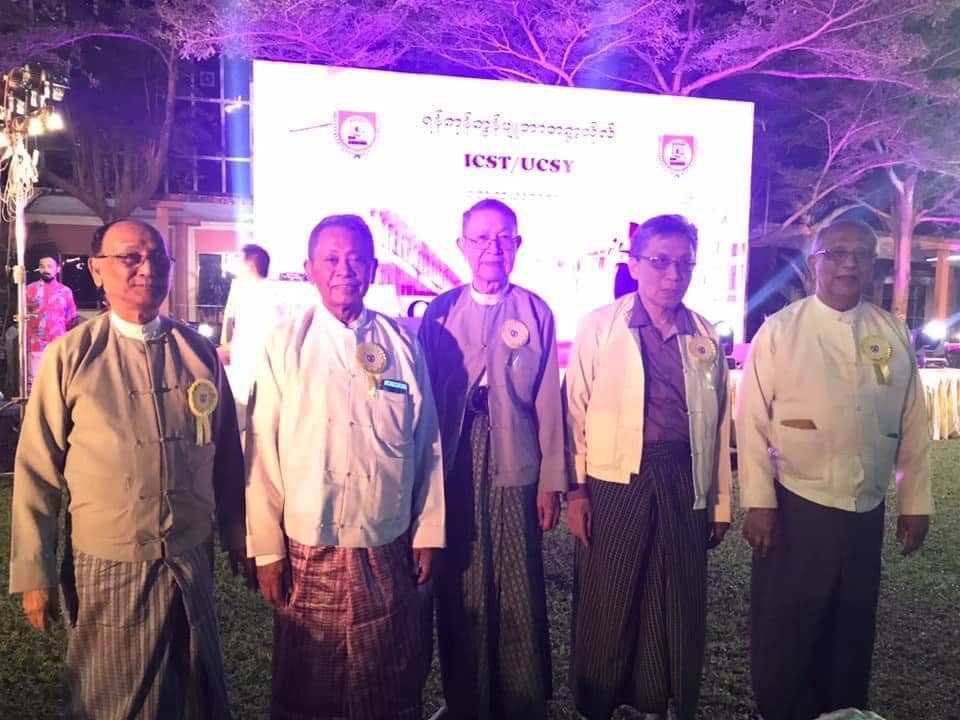
ICST Pu Zaw Pwe
U Thein Oo, Dr. Pike Tin, Saya U Soe Paing, U Hla Min, Dr. Kyaw Thein
Presidential Fellowship in Teaching Innovation, Lamar University, 2015
Presidential Fellowship in Teaching Innovation, Lamar University, 2014
Presidential Fellowship in Research, Lamar University, 2014
Tim Kendall Memorial Prize, Asian Institute of Technology, Bangkok, Thailand, 1991
Pi Tau Sigma, Honors Society of Mechanical Engineers
Ivan Lee (M69, co-Founder and Patron of MASTAA) wrote
Kendrick has been with MASTAA, USA since June 2019.
He was an invaluable member of our team.
He was the heart and soul of our team in promoting Myanmar students who want to study abroad. His information was vital to our organization’s Students Info page. His contribution to MASTAA can be seen on Students Info page at MASTAA.ORG website.
He left his beloved wife Khin Khin Hla and two adult sons. Khin Khin Hla is also an RIT Alumni 1984 B.Engg Civil as well as AIT Alumni 1991 M. Engg Water Resources
The funeral service will take place on January 20, 2021.
Our condolences for this tragic loss and wish Dr. Kendrick Aung, RIP.
Phyu Phyu Kyaw (ex-UCC) wrote :
KTA came & joined us (Methodist English High School / No. 1 Dagon SHS : K Class) when Ye Myat Soe (ex-UCC), his wife Ohnmar Aung (our classmate) & daughter visited Los Angeles in September, 2019.
We had the Class Gathering in Las Vegas. All were from K Class (starting from Lower KG to High School).
KTA was a Top Student since he was young.
Learnt that KTA is a cousin of Ko Aung Zaw Myint (ex-UCC). Both have the nick name “Gaung Gyi”.
Ko Soe Myint (President, MASTAA) wrote :
I will offer Soon and three sets of robes to Sayadaws (in New York) in memory of Dr. Kyaw Than Aung, and share merits with him.
Ko Wint Khin Zaw (Sydney, Australia) wrote :
I felt unjustifiable by the shocking news of a very untimely loss of our AIT contemporary Burmese Engineering Scholar, Prof. Dr Kyaw Than Aung. He was our academic idol and the pride of Burmese students body at the time as the first Burmese Awardee at AIT, the first chess champion and a runner-up table tennis champ. He also helped any Burmese students who found difficulty academically. He was a good friend and one of the smartest Burmese persons I have ever met. I could recall our table tennis games and watching World Cup Soccer matches together at the Student Union parlour. We lost contact since 1990s then a few years ago he and family visited Sydney so we met again as a pleasant reunion. He said he will come again but ….
So long Ko Kyaw Than Aung …
Our heartfelt condolences and sympathy to Ma Khin Khin Hla and sons. Our metta and prayers are with you at this difficult time.
Ko Maw Lin, President of AMA (Association of Myanmar Architects) and Chief Editor of ‘Pyithu Ayay’ journal wrote :
Dr. Kendrick Aung, 60, passed away on 01/13/2021 in Seabrook, TX, USA. He was born on June 5th, 1961 in Yangon, Myanmar to U Than Aung and Daw Nyunt Nyunt. Dr. Kendrick Aung is survived by: his wife, Khin-Khin Hla Aung; sons, Raymond Aung and Andrew Aung; brothers, Dr. Khin Zaw Aung and Dr. Min Zaw Aung; sisters-in-law, Daw Theingi Swe and Dr. Aye Aye Yee, and numerous family members and friends. He earned a Ph.D (Aerospace) from University of Michigan, M.Eng (Energy Tech) from Asian Institute of Technology, B.Eng (Mechanical) from Rangoon Institute of Technology, and matriculated from No. (1) Dagon State High School in Yangon. Dr. Kendrick Aung worked as an Interim Department Chair & Professor for Lamar University located in Beaumont, TX. He had a passion for teaching, books, Chess and loved to travel with family and friends.
There will be a Visitation for Dr. Kendrick on Wednesday, January 20, 2021 from 2:00 pm to 3:00 pm followed by a Memorial Service at 3:00 pm at Crowder Funeral Home, 111 E Medical Center Blvd Webster, TX 77598. Those wishing to send flowers in Dr. Kendrick Aung’s memory should be directed https://www.kemahflorist.com or by calling 281-532-6933 and having them sent to the Crowder Funeral Home – Webster, TX.
Condolences
Daddy (Ko Ko Gyi) I love you and will miss you forever. Whatever I do, I am thinking you are next to me. you will be always with me in my heart. I greatly appreciated the time we were together. Don’t want to let you go but please go freely. Share all the merit we did with you. Amya-amya-amya, sadu sadu sadu Khin Khin Hla
Dad We love you and miss you, thank you for everything you have done for us and the community. Aung family
We understand that we own nothing in this world. Everything surrounding us are only temporary. Only the love we have in our hearts will remain forever. Those we Love don’t go away, they Walk beside us Every Day. Unseen, Unheard, but Always Near, So Loved, So Missed, So Very Dear. So Thar Thar, you may be gone prematurely, but you are going to be with us forever! Your eldest brother Ko Ko Ni, Ma Theingi & Chan (Khin ZawAung)
Please take care Thar Thar wherever you are Hope to see you again in next life. You left so early…………… Amya-amya-amya Your elder brother Ko Latt (Dr. Min Zaw Aung)
I am totally broken hearted my baby brother. I didn’t know that our last Zoom in December was your way of saying good-bye. Want to remember you as someone who was full of motivation inspiration and a brilliant mind. I am sure you knew that you were very much loved by all of us. . You are in my prayers sweetheart and may you look down from heaven to share the merits. amya amya amya.. thar thar yay Your big sister Ma Ma Aye xxx (Aye Aye Yee)
Though I got to know you very briefly , just for a span of 3 years or so when you came to stay with us, you were like a younger brother that we never had ; for ma ma aye and I. I will not forget you. You will be sadly missed thar thar. Than Than Yee
Compiled information from people close to Dr. Aung and shared it to selected Facebook groups. The original post is archived in my web site hlamin.com and updated periodically. Sad to lose a young all-round (academic, athletic and community services) star who had brightened the lives of many. May Dr. Aung rest in peace. Hla Min (Life Long Learner)
May you be peaceful at much higher realm Ko Kyaw Than Aung. You will be dearly missed by all of us. Our deepest condolences and sympathy to Khin Khin, Raymond and Andrew at Seabrook, Texas and all the bereaved family members elsewhere. With metta Wint Thanda & Tharlon (Wint Khin Zaw)
Our condolences to you and your family. Our thoughts and prayers are with you. The Boyce family (Mee Mee)
So sad your early departure my friend (our high school class mate @ Dagon 1) Please accept my sincere condolences to my friend family. You will be missed. Rest in Peach my friend. Sincerely Phyu Phyu Kyaw (Los Angeles)
So sorry for your loss. I know this must be a very difficult and demanding time for you all. Our thoughts and prayers are with you. Please accept my condolences. Ohnmar nyunt (SHS1 Dagon)
So sorry for your loss. I was saddened to hear my friend kyaw Than Aung Passed away. My thoughts and prayers are with you and your family. Please accept my condolences. Ohn Mar Nyunt
I am so sorry and saddened by the news of losing my friend from Dagon 1. Please accept my sincere condolences. I will remember the great time we all had with our childhood friends in Las Vegas in October 2019. Rest In Peace my friend. 🙏🙏🙏🙏🙏 Zaw Lwin
Dear Ko Kyaw Than Aung, Recently we met you at San Francisco after the graduation (1983 -Mech). You are talented, honest and having beautiful mind and so lovely. When I heard about you, I was shocked and very sad. Please accept my condolence . Where ever you go, May you be healthy, happy, wealthy, peaceful and attain the highest wisdom! You will be always in our heart! With All the Best Wishes, Kyi Shein (83-Mechanical)
I am grateful to have shared memorable-days with Saya Ko Kyaw Than Aung while studying in RIT and AIT. Will always remember you Saya! Engshwe
It’s so hard saying goodbye to you. Our condolences and prayers to you and your family. You will deeply be missed, rest in peace. Chu family from LA
To Uncle Ken, My heart is heavy, there are no words to describe how sad I am. I still can’t believe that you are no longer here with us, you will always be in our hearts and thoughts. You are like second father to me growing up with Raymond. Thank you for always caring for me and teaching me. You inspired me with all of your achievements. I will always cherish and remember the time that I had with you from growing up as a kid and the family vacations we had together. You are gone too soon.. My family and I will miss you so much, Rest in Peace Stephanie Chu
Dear Aung Family, We are very sorry to hear of the lose of Dr. Aung. He’s a brilliant Professor whom will be missed by many hear at Lamar University. I wish to thank him for sharing his knowledge with my students. Praying for overwhelming peace during this difficult time for all of your family. LU Family and friends
Dr Kendrick Aung We never forget you. Shu & Sue Chin family
No man is an island, Entire of itself. Each is a piece of the continent, A part of the main. If a clod be washed away by the sea, Europe is the less. As well as if a promontory were. As well as if a manor of thine own Or of thine friend’s were. Each man’s death diminishes me, For I am involved in mankind. Therefore, send not to know For whom the bell tolls, It tolls for thee. [John Donne]
So sorry to hear of Ken’s passing, he was kind, intelligent, caring and a wonderful colleague who will be missed. Taken far too soon. Love and condolences to the family. Harley Myler
We are all deeply shocked and saddened to hear the terrible news, and are so sorry for wife and sons’ loss. Kendrick’s untimely departure will be felt very keenly by everyone; not least his students, his colleagues , us and all his friends . Kendrick had so much more to give in this life, and such a beautiful family to enjoy. His premature departure is cruel. May Kendrick rest in peace. With our sincere condolences, Kyaw Thu Ya, Jacqueline, Shan and Thazin (London)
You can shed tears that he is gone, Or you can smile because he lived, You can close your eyes and pray that he will come back, Or you can open your eyes and see all that he has left. Your heart can be empty because you can’t see him Or you can be full of the love that you shared, You can turn your back on tomorrow and live yesterday, Or you can be happy for tomorrow because of yesterday. You can remember him and only that he is gone Or you can cherish his memory and let it live on, You can cry and close your mind be empty and turn your back, Or you can do what he would want: smile, open your eyes, love and go on. Khin Sabai
The Department of Computer Science from Lamar University is deeply saddened of the untimely passing of Dr. Aung. He was a dedicated leader who cared about his students and colleagues. Sincere condolences to Dr. Aung’s family and friends. Stefan Andrei
Dr. Aung Family, My condolences on the passing of Dr. Aung. I’ve had the opportunity to work with him at Lamar University for more than 14 years. He was truly an exceptional person, a great colleague, a favorite teacher, and a true friend! Dr. Aung was a founding member of the Office of Undergraduate Research Advisory Council and played an instrumental role in the development of the program at Lamar. He touched so many lives for the good. I’m honored and blessed to have known Ken! He will be missed badly! With deepest sympathy, Kumer Das (University of Louisiana at Lafayette, Lafayette, Louisiana)
My condolences to the Aung family on the passing of Ken. He was an exceptional colleague and a genuinely good person who cared for his students. I have fond memories of the many times we met in the dining hall and discussed how our program offerings could be improved. He was taken too early and will be missed a lot. Srinivas Palanki
Dear Dr. Aung: I am blessed to have a great friend and colleague like you! Thank you very much again for all your kindly help and support at Lamar! You will be always be remembered. RIP!! Qiang Xu
No words can describe my great sadness. Dr. Aung had always been a trusted colleague and true friend for the past 17 years. He was such a brilliant and knowledgeable person. I thought we’d have so many more years and so much more time to talk about curriculums, course contents, travelling, martial-art novels and other books … It just ended too early and too suddenly! My deepest sympathies to Dr. Aung’s family. My heart goes out to you all. Jenny Zhou (Dept. of Mechanical Engineering, Lamar University)
Rest In Peace Dr. Aung I will miss you Justin Ho (Hung Ho), Lamar University – Mechanical Engineering Student
My condolences to the Dr. Aung’s family. I have had the opportunity to work with him in Mechanical Engineering at Lamar University for 3 years. He was truly a great colleague, a favorite adviser, and an exceptional person who cared for his students and colleagues. I have lots of good memories with him as we met each other in his office where he advised me how my teaching could be improved. He will be deeply missed, rest in peace. Monayem H. Mazumder (Saginaw Valley State University, Saginaw, Michigan)
I am so sorry to hear about Dr. Aung’s passing. He was one of my favorite professors and definitely the most generous with his time. Not sure I would have made it through with his help. Tim Dwyer
My most sincere condolences. Much Love and Prayer for the Family! Dr. Aung was a great mentor. As we grieve him let’s also remember to Celebrate his Life! Carlos A. Caballero (Mechanical Engineering, Lamar University – Class of May 2018)
I am at a loss for words with hearing of the passing of Dr. Aung. He was such a great person and a terrific influence for so many at Lamar. He would always take the time to help his students, and he has helped so many to become successful in their endeavors. My deepest condolences to his family and all the Lamar family as well who will truly miss this great man. Eli Clark
Received his doctorate from Japan. Also found his love life “Moe Moe”.
Due to the immigration laws in Myanmar and Japan, the family finally decided to move to Auckland, New Zealand.
Organizer for RIT events in New Zealand.
Wrote articles for RIT Alumni International Newsletter
One article is about two Forgotten Songs from RIT. One song is a favorite of Saya U Tha Tun (Head of Department). Another song is about a Belle Ma Ma Q & her fans (sayas and alumni).
Wrote a photo essay on Kyaik Hti Yo Development. Saya U Min Wun wrote a supplement article for the Project.
Wrote a letter to the Thagyar Min to second his favorable opinion on Naw Louisa Benson (Miss Burma & movie actress).
Wrote about some paintings.
Quoted Reverend F Lutvig (Ashin Ananda, Laureate Poet) in his articles.
He passed away, but “Moe Moe” kept contact with Daw Phyu Phyu Latt (Christine, A70) and other alumni in Australia.
Forgotten Songs of RIT
by Kogyi Koung
First Song
It was one afternoon in the early May of 1963. Someone was singing a prewar semi-classic song from the second floor of RIT main building. In 1963, RIT buildings were relatively new and that semi-classic song caused a little bit of discomfort for the freshmen [equivalent to 3rd BE] located on the first floor. The song continued as, (. hmain: njou. njou. sain: lou. je . njou pja ji hmaung che . to: dan: kalei: nanbei: ga swe . e:di jwa be: kwe…)
The meaning is: Dull and gloomy cloud override at the horizon; Indistinct brown and dim bluish vision of a wood jetting out from that end is my village … *Note: The title of the song is ‘Htamin: mjein mjein sa: me’ i.e., “Enjoying the meal with relish” . The duet song was first performed by prewar famous singers Ou’ O: Ba Thaung and Sein Party. Later many other singers have rendered their own versions of the song.
We saw an old man singing the song while he was painting watercolor on a huge art paper. He was painting the landscape described in the song. Amazingly the picture was full of life and the song was telling the story. Everybody stopped in front of his office on the second floor and looking with wonder and singing with him.
After a while we asked him, “Sayagyi, who are you and which department do you belong to?” He replied, “I am U Tha Tun, Head of the Department of Architecture”. Oh, my God! How stupid that we, the freshmen of Architecture, don’t even know the head of our department. As time passed, we learned more about ‘The Great U Tha Tun’.
When we became senior students, U Tha Tun’s health deteriorated so much that Saya U Myo Myint Sein (Raymond, A58) stepped up as a ‘Kagemusha’ [Japanese for “shadow-warrior”]. UMMS, as acting head, took care of everything about the department. Young and energetic Saya UMMS found that it was not easy to steer the department as Captain of Architecture’s Flag Ship. There were lots of problems for a relatively young department in RIT.
One such problem occurred during our final year. Two of the most experienced Sayas of architecture left the department and went abroad [for enhancing their careers]. They were (a) Saya U Sein Maung (with elegant moustache) has long experience in Rangoon City Development Corporation. He taught each and every detail of the development of Rangoon. (b) Saya M.B. Raschid (son of U Raschid, minister of many affairs under Prime Minister U Nu). He taught with all his professional experience and perfect pronunciation of King’s Burmese with ‘zagaboun’ proverbs. Sometimes he corrected our broken Burmese.
Saya UMMS, Head of the department, not only had lost his right and left hand men, but also there was a danger that the notorious Koung Nyunt and Kyaw Thein (both A67) might not finish their Architecture degrees.
After a long struggle, Saya UMMS stabilized the flagship of Architecture and its direction. A pioneer of the Architecture of RIT, Professor U Myo Myint Sein handed over the headship to Dr. Maung Kyaw in early 80’s. In the late 80’s Dr. Lwin Aung (A59) took over.
Second Song
For creative and original works, Architects cannot design during the office hours. It is also true [to a lesser degree] for the students of architecture. During the lectures and tutorial hours we [as students] have to follow what they have taught. After school hours [mostly after 4 or 5 pm], we start to create and test our design ideas. Note that for other students and staff of RIT, such periods are the pleasure and relaxation time.
There were only a few girls in Architecture, but the one in our studio is especially alluring beauty and glamorous face. She was so popular that she became known as the queen of the student-architects. We called her Ma Ma Q.
Most of the evenings many senior students and young eligible bachelors and/or sayas visit our studio. Some stay late into the evenings. At that time we sang a song named ‘Saga: ta’ kathou’ i.e., Language University, by Khin Yu May.
Because in the song, one part said ‘dage lar te. Ko Ko. kwe ja hmar ba lou lou’ i.e., really coming Ko Ko, out of sight he is sth in the air.
Ma Ma Q didn’t know the meaning, but the visiting Ko Kos were annoyed by our song. They politely requested us to stop singing. At that time the notorious KN and KT asked ‘hse’ kjei:’ i.e., extortion money about 2-3 kyats from the Ko Kos and went to U Chit tea shop. This continued for days and weeks.
When the Ko Kos are not visiting our studio, we sang the following song, instead of Ma Ma Q. i.e., Third Song. (Note. Extract from Shwe Kyi: nyo song by Daw Ngwe Myaing) ‘Diga nei. nya hpjin. lar ma te. so: joun ya hmar lar: akou Kja.ma ne. ne: te. Shwe kyi: nyo Shwe kyi: nyo Shwe kyi: nyo’ “To-night coming you said so, may I believe Ako.. Near the blessed golden crow, golden crow, golden crow…”
Article (Sept/Nov 2000)
With all of those excellent works and flying colours for Saya Pu Zaw Pwe, your organizing committee is a living history of RIT. Our Sayas, Sayamas and Saya-Gyis have contributed their unlimited knowledge to affect and benefit our lives. Many of our Sayas and colleagues have sent their thanksgiving letters to your web site.
I feel guilty in staying quietly at a corner of the Southern Hemisphere. Actually I am busy, because of my article ‘Wanna Migrate to New Zealand, 3/15/00’ that you published on the ex-rit web site. After that article, I got many inquires/contacts by e-mail and direct phone calls, especially from SE Asia. In July there are 133 migrants and in September 28 migrants are now in Auckland, and expecting another over 50 in November 2000. All speak the common language “Burmese” with their own native accents. Now I know our Sayas and colleagues speak “King’s Burmese” in RIT.
I would like to honor my Sayas with a poem from our forefathers-cum-engineers how they had built a city.
Title: ‘SHWE PYI GYI’ (Golden Capital City)
Sweet sound of drums and silver bells Coming from the Palace Can be heard reverberating in the air And I can see the palace roofs, The graduated turrets and buildings Encompassed by haze. And, my dear girl, I can still faintly see The silhouettes of a high pagoda Reaching nearly to the clouds And of super-imposed roofs (i.e., pyathat) Oh my dear, don’t you hear A melodious sound of small bells Coming from the golden monastery? Our golden capital city must be near. (By U Ku: 1827-1895 Translated by Rev. Friedrich V. Lustig)
Dear Sayas and colleagues,
We see not only the Panoramic Photo of golden capital city of our ancient time, but can hear the sound-scape with audio-visual scene. Silhouettes effect of high pagoda in the haze has shown the air perspective of city skyline. We try to sketch the imaginary scene of ancient city in the architectural studios of RIT in the middle of 60’s. The discussion topic of ‘Ancient City Skyline’ is not only interested by the architectural students, but also from various students of other departments from RIT.
This is the starting point to form the ‘RIT Photographic Club’. According to my diary, first general meeting was chaired by Saya U Myo Myint Sein on Saturday, 1 May 1965 at the Department of Architecture. The general meeting selected Professor U Myo Myint Sein as President of RIT Photographic Club and the author as the secretary.
After forming the executive committee, the club took part in various activities and many outstanding photographers from the club took major prizes from Burma Photographic Society and Myawadi Magazine. e.g., Ko San Aung, M74 is the owner of the famous ‘Photo Lab USA’, (i.e., initials for U San Aung) in Yangon is originally from this club. Kjei: zu: tin: bar-de, many thanks for my Sayas and colleagues
Koung Nyunt (Auckland, New Zealand).
Letter to Tha-gyar-min
by Kogyi Koung
Date: Thursday, 14 April 2011 (3:40pm. Thin-gyan Akya-ne.) P.O. Box; Top of the never used RIT water tower Ashe. Jo. Koun (East Gyogone): RIT Compound, Insein, Rangoon, Burma
Dear Your Majesty the Sovereign of Tawadein dha တာဝတိံသာ
As from the beginning of 1960’s our RIT is like the last paradise on earth, with all enjoyments, teachings, preaching, learning, playing sports and friendship never sails away. Kogyi Koung recollects the stories at the time of 60’s RIT and retold the fairy-tales to our Bushido-Burmans at gatherings in Auckland, NZ. However, the young generations of Maha Bandoola do not believe the stories, and they whispered by themselves that Kogyi Koung is now ‘Yin yin galay Yuu-nay-pyi-de’ ယဉ်ယဉ်ကလေး ရူးနေ ပြီတဲ့
Your Majesty the Tha-gyar-min-gyi please take this message to Tawadein dha and explain to my late Sayas and colleagues there, that my stories are not fabricated.
I have the evidences. For example, I have sent a message to RIT alumni update (February 6, 2010) as follows,
Dear U Hla Min,
It is sad news for our elder brothers at RIT, especially those who reside at E and F block during the beginning of 60’s.
A term called “Ma-pyo: mashi.ja ne he.” မပြောမရှိကြနဲ့ဟေ့ was coined at that time. When I visited my elder brother [U Than Soe, M63] at E block (when I was at Leik-khone I.Sc). I heard somebody shout “Ma-pyo: mashi.ja ne he.” Then I looked outside. Everybody lined up at corridor and they were looking at a far side on top of the entrance hall that is attached to a two story house.
I could not believe my eyes. She was a beauty queen, who had Miss Burma two times excising physical training on the porch. I noted down in my diary and the rallying cry “Ma-pyo: mashi.ja ne he.” She is Naw Louisa Benson Craig. Now she has left our brothers’ heart at age 69.
Yours etc. (“Ma-pyo: mashi.ja ne he.”)
When I retold that story here at Auckland, everybody laughed like ‘Wa:lone kwe:aung ye kya de”. I said it is not a joke. I have evidence.
Also, Kogyi Koung explained about the following, written by Maung Maung Hla, a Karen pastor in Rangoon who was close to Naw Louisa during her youth, remembered her aloud : “She had a little mole on her cheek and she had a kind heart. She was also a very good singer.”
This statement has no evidence.
However, Tha-gyar-min-gyi if you find Naw Louisa at Tawadein dha, please ask if what I wrote is true?
Architecture Students and Staff
I have an old group photo taken about the end of 1963, and all the known information are printed. Inside the brackets are where about of the person [at the time of the post].
Top of the photo:
Department of Architecture Rangoon Institute of Technology 1963 ~ 64
Bottom of the photo:
Front row, L to R
Jim Lim (3rd. Year) [?]
Ma Khin Khin Kyu (Ann, 1st.Year) [San Francisco, California, US]
U Myo Myint Sein B.Arch (Rgn) M. Arch (Mch) [Los Angeles, California, US]
U Tha Tun B.Sc, F.R.I.B.A. (Fellowship of Royal Institute of British Architects), A.A. Dip (Lond.), A.M.T.P.I.(Associate Member of Town Planning Institute), F.I.B.A., Head of Department [Deceased on 13 September 1974]
U Yone Mo B.Sc (Hon) Rgn, B.Sc (Engg)Lond, A.C.G.I, A.M.I. Mech.E, A.M.I.Loco.E, Principal [Deceased]
Mr. S. Ozhegov, Cand. Of Arch, Master of Fine Arts, UZBEK, U.S.S.R [Moscow]
Miss Rosalind Maung (Ma Pyi Aye, 2nd Year) [Rangoon]
Htin Myaing (Ben, 2nd Year) [New York, US]
2nd. Row, L to R
Tun Thein (1st Year) [Los Angeles, California, US]
Tin Aung (2nd Year) [Melbourne, Australia]
Yaco B.E. Mayet (3rd Year) [?]
Than Tun (3rd Year) [Rangoon]
Sonny Chin (2nd Year) [?]
Hla Thein (1st Year) [New York, US]
E. I. Jeewa (3rd Year) [?]
Aung Pa Win (1st Year) [Chicago, Illinois, US]
Back Row, L to R
Aung Kyaw Min (3rd Year) [Rangoon]
M. (Ku?) hlgh (2nd Year) [?]
Than Htike (3rd Year) [Warsaw, Poland]
William Chen (2nd Year) [?]
C. E. Munnee (1st Year) [?]
Koung Nyunt (1st Year) [Auckland, New Zealand, GBNF]
Kyaw Thein (1st Year) [Deceased 22 April 2001]
Absentees:
Win Myint (1st Year) [Rangoon]
Win Naing (1st Year) [?]
Note:
1st Year B. Arch, 10 students (8 passed and 2 failed) 2nd Year B. Arch, 5 students (3 passed and 2 failed) 3rd Year B. Arch, 6 students (3 passed and 3 failed) Several Architecture students failed in of a subject from other departments. There was no moderation. If one gets 49% or less of the grade, the student has to repeat all subjects next year.No block selected.
Editor’s Note :
I cannot find the photo mentioned by Kogyi Koung.
The early sayas and sayamas of the Architecture Department include :
U Thar Tun (GBNF)
Pi-thu-kar Kyaw Min (GBNF)
U Myo Myint Sein (USA)
U Bilal Raschid (USA)
Dr. Maung Kyaw (GBNF)
Dr. Lwin Aung (Retired as Pro-Rector)
Artist/Bagyee Aung Soe
U Maung Maung
U Sein Maung (Stanley Ba Pe)
U Maung Maung Phone Myint
Dr. Koung Nyunt (GBNF)
U Hla Than (Retired as Rector)
Daw Min Thet Mon (Pamela Myo Min, Retired Professor)