Many years ago, I asked a journalist how he could write a weekly column. He replied, “As long as one have friends and there are things to see, it’s not difficult to write even daily.”
I started “RIT Alumni International Newsletter” in 1989. I asked at least three times if someone wanted to take over as the volunteer messenger, writer and editor. Even my fiercest critics would not step up.
I have completed 22 years of my service to my alma mater, mentors and colleagues. The smiles on the faces of my former teachers, and occasional pat on the back by my colleagues give me “second wind” and the energy to “go the extra mile.”
During a visit to Yangon, I spent three days writing “Memories of UCC.” My former student called, “You should take time off and enjoy your stay in Burma. You can continue writing when you get back to the USA. I suggest that you should spend two nights and three days in Bagan. She pledged air ticket and hotel stay as Garawa.” It was my second trip to the ancient city. Things have changed a lot since my quick trip to Bagan and Nyaung Oo many years ago.
Upon my return to the USA, I started writing Trivia posts based on what I learned from my Thin Saya, Myin Saya and Kyar Saya.
I was happy when I hit the 100 mark, then 500, 1000 and 1500.
Dr. Thane Oke Kyaw Myint (SPHS60, Sixth in Burma) added memories of his father, uncles and aunts. I learned more about the seven siblings : U Tin Tut, U Kyaw Myint, U Myint Thein, Dr Htin Aung, Daw Khin Mya Mu, Daw Khin Saw Mu and Daw Tin Saw Mu. I also learned about Dr. TOKM’s former students who are Professors and talented writers.
Dr. Nyunt Wai (SPHS63, Fourth in Burma) added many entries to the “Names” series. He added the names of medical professionals, artists, writers, and statesmen.
Dr. Khin Maung U (SPHS63, First in Burma) shared his writings on Dhamma teachings and Medical Research.
Dr. Richard Yu Khin (MEHS61, SEAP Gold Medalist) wrote about swimmers and the Japanese coach. He also shared photos : MEHS 61, University Athletes who represented Burma in 2nd SEAP Games RU Pagan Road Residents. He has two FB pages. One is about Sailing. He won Gold for Yachting. Another is about his former classmates, neighbors, Economics, …
I paraphrased several posts from RITAA, NorCal RITAA, SDYF.
The GBNF posts — old and new — have the most hits.
Dr. Thane Oke Kyaw Myint wrote : Please keep on writing
Thein Swe (GBNF, RIT 3rd BE Luyechun) wrote : I appreciate your writing and thanks a lot for it.
by Ko Zaw Min and Ko Ohn Khine Edited by Ko Hla Min
Ko Zaw Min (EP70) matriculated from St. Albert’s High School, Maymyo in 1964.
Had a very high ILA (Intelligence Level Aggregate) and was admitted to the first ever 1st BE as Roll Number One.
Selected RIT Luyechun for the 1965 Summer Camp at Inlay.
His outspoken remarks about the Camp drew the ire of higher authorities.
Graduated with EP (Electrical Power) in 1970.
After working in the industry, he moved to the USA.
Studied Electronics in the USA
Added “Nawaday” to his name.
Several years ago, he shared his memories of RIT to the Google group of “the Combined Intake of 1st BE for 1964 and 1965”.
Ko Ohn Khine (M70) matriculated from St. Peter’s High School, Mandalay in 1964.
Took a combination of Science and Arts subjects and had good ILA score to be admitted to RIT.
Graduated with Mechanical Engineering in 1970
Worked for HI (Heavy Industries).
Created and maintained the the Google group of “the Combined Intake of 1st BE for 1964 and 1965”.
Volunteered for SPZP-2012 and SPZP-2016, HMEE-2012 and HMEE-2018, Swel Daw Yeik Foundation and several RIT-related activities.
Gave me rides during my visits to Yangon.
Filled the “missing pieces” in Ko Zaw Min’s accounts.
Ko Hla Min matriculated from St. Paul’s High School in 1963.
Received Collegiate Scholarship for standing 7th in the whole of Burma.
Finished Top in the Science Option of I.Sc.(A) examination
Admitted to the first ever 2nd BE in November 1964 as Roll Number One.
Selected Luyechun for the Inlay Khaung Daing Camp in the Summer of 1965
Graduated with Electrical Communications in 1969.
Started the “RIT Alumni International Newsletter” in 1989 and have maintained it for 21 years.
Administrator or Moderator of selected Facebook pages.
Maintain two web sites hlamin.com and lifelonglearning140.wordpress.com
Had the honor to edit the draft versions “Memories by Ko Zaw Min Nawaday (EP70) and Ko Ohn Khine (M70)”, which was first posted as Google Docs for the Combined 1st BE Intake of 64 and 65.
Published the edited document as a series of articles in “RIT Alumni International Newsletter and Updates”.
Three Intakes in 1964
There were three intakes at the Rangoon Institute of Technology (RIT) when the new education system started in 1964. Eligible students were admitted to the first ever 1st BE, 2nd BE and 3rd BE classes. They are also known as
the Class of ’70 (1st BE Intake in 1964) Matriculates were admitted using the ILA
the Class of ’69 (2nd BE Intake in 1964) Those who had passed I.Sc.(A) with Science Option were admitted in order of merit
the Class of ’68 (rd BE Intake in 1964) Those who had passed I.Sc.(B) with Science Option were admitted in order of merit
The RIT Rector was U Yone Mo and the Registrar was U Soe Thein.
The Class of ’70
The Class of ‘70 comprised of the first year intake students in 1964. There were 494 registered students, of which 67 were female. Most graduated in 1970. Some took sabbatical for a year or two. A few left RIT before graduation. The GBNF (Gone But Not Forgotten) reached 61 at the end of 2011. The number is growing towards 100.
The matriculates entered the first ever 1st BE classes. The controversial ILA (Intelligence Level Aggregate) was used for the vetting of applicants. In the system, a score of 1 to 20 was assigned to “map” the marks for each subject. The ILA score (rather than the”raw” marks) was used to determine the eligibility of the students admitted to an institute.
Under the old education system, the matriculates had to attend I.Sc. (A) classes. There were restrictions on the subjects taken at Inter classes to be eligible for Faculty of Engineering, Faculty of Medicine, etc. For example, one must pass the I.Sc. with at least 50 marks in Mathematics, Physics and Chemistry to attend the 1st Year Engineering Classes (3rd BE in the new system).
Under the new education system, there were no restrictions on the subjects taken in Matriculation exam. As such, many students who passed Matriculation with combined Science and Arts subjects and even those with pure Arts subjects were able to attend RIT. For example, Ko Ohn Khine passed the Matriculation examination with an odd combination of Mathematics, Chemistry and Geography.
He is an RIT Associate. He left before graduation to the US. After volunteering as BAPS Newsletter Editor for several years, he founded and published “Shwe Padauk” magazine in Northern California. He later published “Dawinthee (Durian)” magazine. His doctors advised him to rest. Luckily, he had a transplant donor and is now in good health. The two publications are just memories for him.
Dr. Maung Maung Kyi
He is a classmate of my cousin sister at IM(1).
He has undergone three phases
Swimmer
Doctor
Journalist
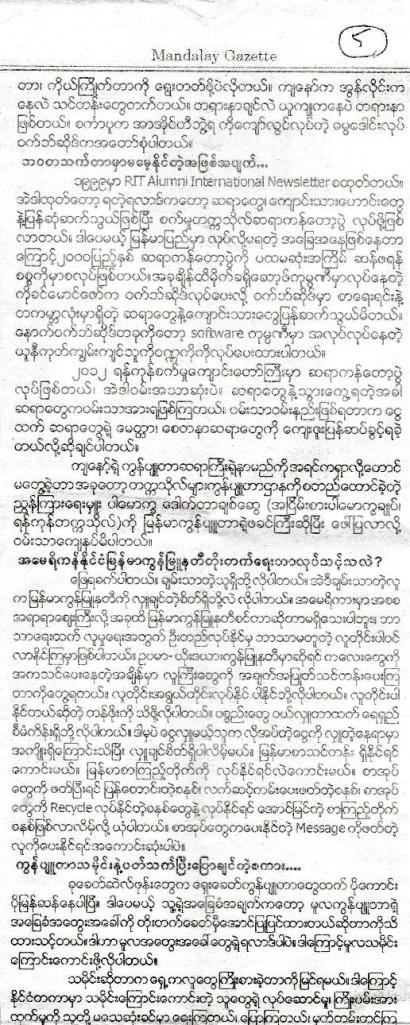
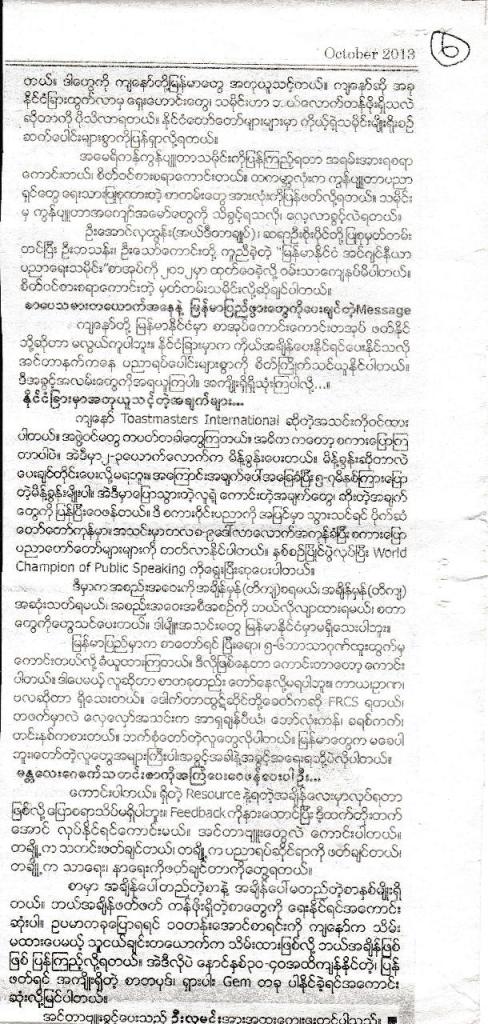
He founded Mandalay Gazette in Southern California. A column in that publication is an interview with a well-known or distinguished Myanmar.
For ease of readability, the three columns of two half-pages are posted as six segments.
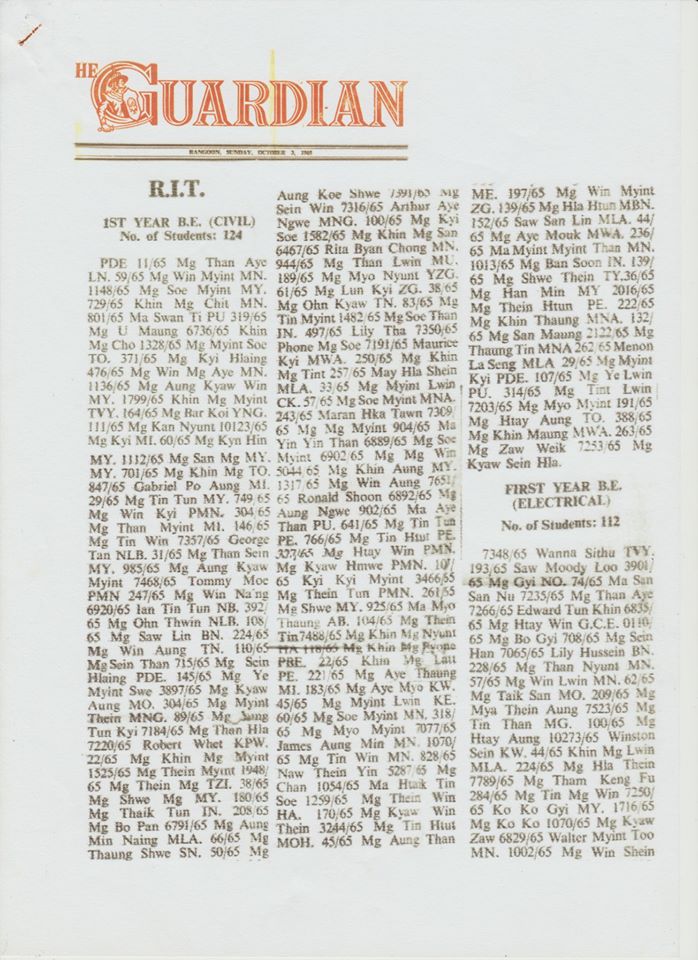
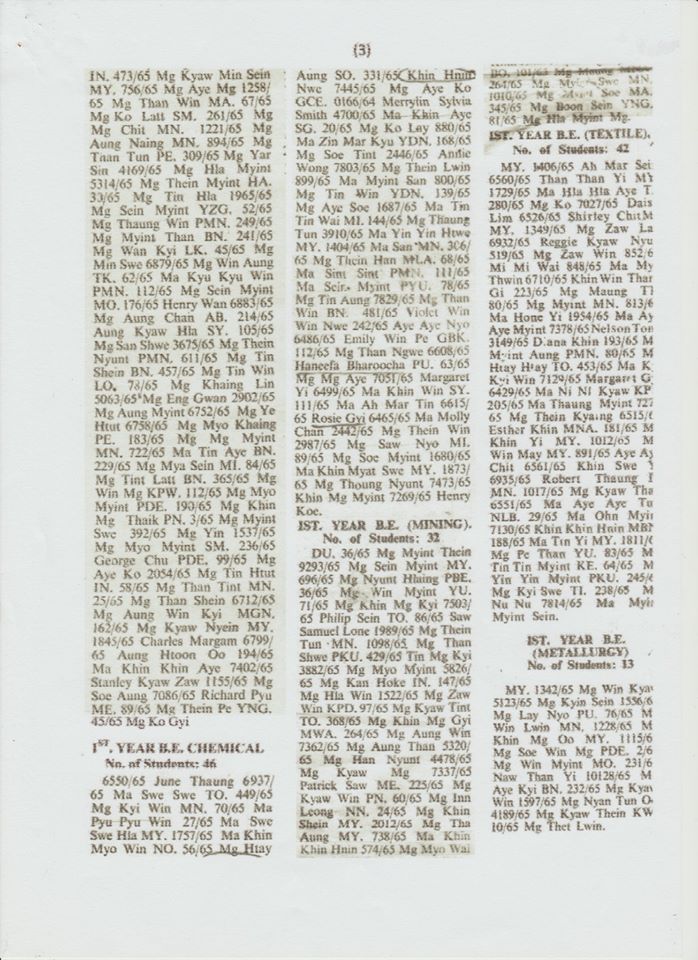
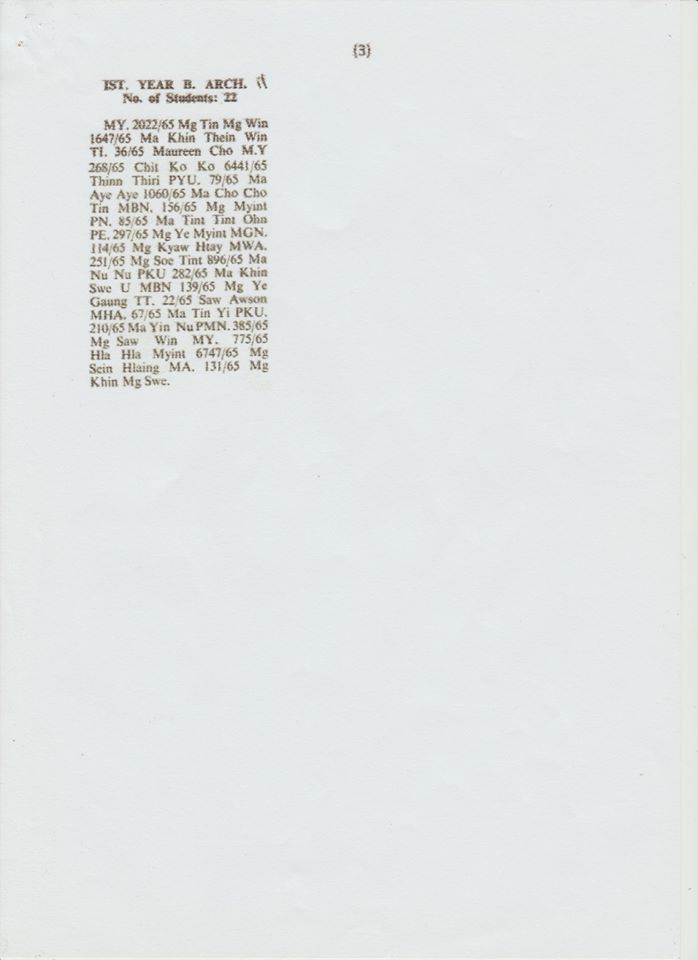
U Khin Maung Myint (ChE71) and Daw Mai Khin Nyunt (Rosie Gyi, ChE71) were among the students admitted to 1st BE class at the Rangoon Institute of Technology.
They have shared the list published in the Guardian Newspaper.
The list showed admission to Architecture Chemical Civil Electrical Mechanical Metallurgy Mining Textile
U Wunna Sithu (EC71) represented RIT in Rowing, Swimming and Water Polo. He was admitted as Roll No. (1) for 1st BE (Electrical). He started rowing at Marine Youth and then joined RUBC. He is an RUBC Gold. He worked for DCA. After retirement, he moved to the USA.
U Myint Thin (M71) represented RIT in Rowing. He was admitted as Roll No. (1) for 1st BE (Mechanical). He was selected Luyechun. He worked in Singapore and Malaysia.
RU was founded in 1920 with Rangoon College and Judson College as its constituent colleges. RU celebrated the Golden Jubilee in 1970, the Diamond Jubilee in 1995, and the Centennial in 2020.
Engineering courses were first offered in 1924. The first courses were for Civil Engineering. Mechanical and Electrical Engineering courses were offered in the 1940s. Mining, Chemical, Textile, Metallurgy and Architecture courses were offered in the 1950s.
Intermediate courses were initially offered in the Main Campus. Later, Yankin College was opened for Science students. Hteedan College was opened for Arts and Social Science students.
Intermediate Colleges were opened in Mandalay, Taunggyi, Moulmein (Mawlamyine), Bassein (Pathein), Myitkyina, Kyauk Phyu and Sittwe.
In some years (probably due to the insurgency in some parts of Burma), students have to sit the “combined” Intermediate examination. Otherwise, they have to sit for Inter (A) and Inter (B) exams separately. Even then, there were two chances to pass the exam. The first exam was usually held in March. The second (aka supplementary) exam was usually held in June. The compartmental system requires a student to re-take only the subjects they have failed. Stipends and awards (Gold and Silver medals, …) are eligible only for students who pass all subjects in the first exam.
Those who aspire to become engineers must pass I.Sc. with 50+ marks in Mathematics, Physics and Chemistry.
According to U Aw Taik Moh (C54) and Saya Dr. San Hla Aung (C58), the engineering students had to take a bike or walk to the Main Campus to attend Mathematics and Geology classes. U Ba Toke taught Mathematics to several engineering students (who later became sayas).
The Second Year of Engineering (equivalent to 4th BE) and 2nd MBBS were the filters (or stumbling blocks) for engineering and medical students. Some had to change their study to Pure Science or Arts.
Leik Khone was attended by engineering students from 1957 to 1960. From 1961 – 1964, Leik Khone became the Intermediate College of Rangoon University. From 1965 onward, Leik Khone was home of the lower level classes of the Institute of Medicine (1). The Faculty of Engineering relocated in 1961 to Gyogone as BIT (Burma Institute of Technology).
Matriculated from St. Peter’s High School, Mandalay in 1964
Admitted to the first ever 1st BE in November 1964
Joined Heavy Industries Corporation) HIC after graduation
History of Myanmar Engineering Education (HMEE)
Member of HMEE-2012 and HMEE-2018 projects
Compiled CD Supplement for HMEE book with U Hla Min (EC69)
Translated Section 1 of HMEE book
Summarized Section 2 of HMEE book
Activities
Moderator of Google group for 1st BE Intake of 1964
Secondary author of the long article “RIT Days (1964 – 1970)”
Organizer, Combined 1st BE Intake of 1964 and 1965
Volunteer for Saya Pu Zaw Pwe (SPZP), Swel Daw Yeik Foundation (SDYF) and RIT-YIT-YTU Alumni Association
Alternative Version
U Ohn Khine (M70) offered me rides during my visits to Yangon especially to attend meetings for SPZP-2012, SPZP-2016, HMEE-2012, and to selected 69er Breakfast Gatherings.
His spouse is Sayama Daw Khin Swe Aye (ChE70), younger sister of U Win Maung (“Lake”). His younger sister is Sayama Dr. Khin Swe Myint (Physics).
His friends called him “Gaing Gyi”. A few would say “Ohn Gaing”.
He matriculated in 1964 from St. Peter’s High School in Mandalay. He was admitted to 1st BE at the Rangoon Institute of Technology (RIT) in November 1964.
He is the founder and moderator of the Google Group “Combined 1st BE Intake of 64 and 65”. He and his group maintain the Gone But Not Forgotten (GBNF) list for the Class of 70.
After graduation, he joined HIC (Heavy Industries Corporation).
He is a volunteer for
Saya Pu Zaw Pwes in Rangoon in 2012 and 2016
Swel Daw Yeik Foundation (SDYF)
Shwe YaDu (RIT Golden Jubilee)
History of Myanmar Engineering Education projects (HMEE-2012 and HMEE-2018)
Reunion and Acariya Pu Zaw Pwe for the Combined 1st BE Intake of 64 and 65
Publication
U Ohn Khine and U Hla Min compiled the CD Supplement for the HMEE Book. He translated Section One of the book into English, and summarized Section Two.
He co-authored the “RIT Days (1964 – 1970)” article with U Zaw Min Nawaday (EP70). U Hla Min edited the joint article and published in “RIT Alumni International Newsletter”. The article was also reprinted in the Golden Jubilee magazine by the Combined 1st BE Intake of 64 and 65.
Photos
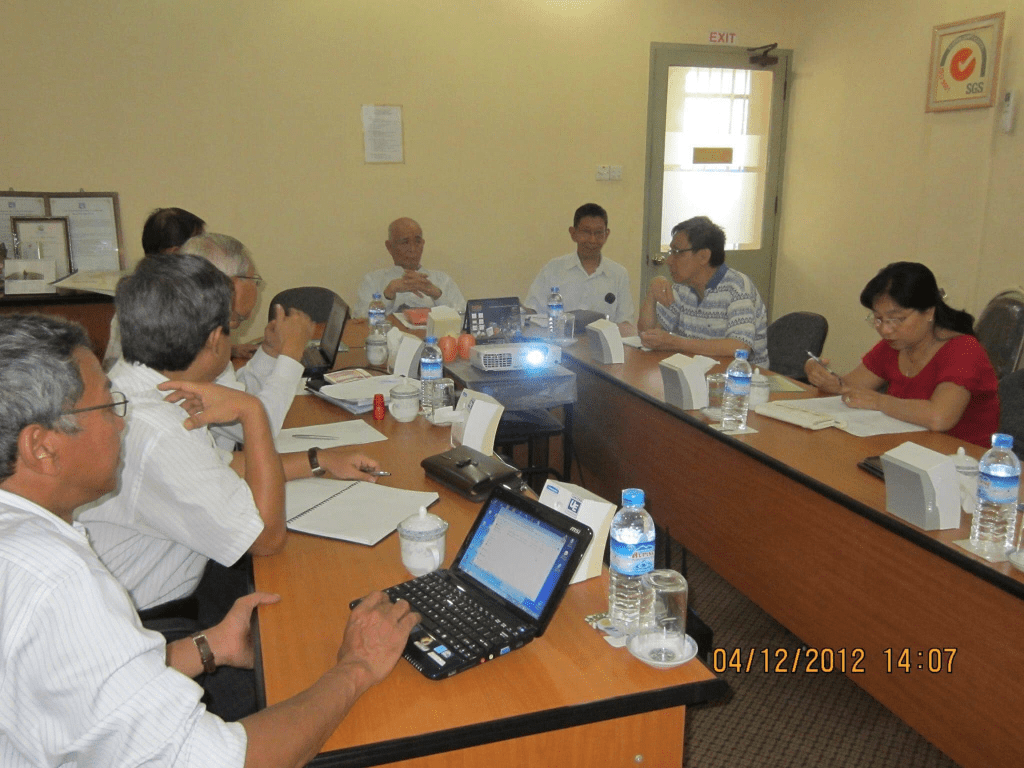
HMEE Members
HMEE Meetings
HMEE Book
CD Supplement for HMEE Book
Welcoming U Win Htay (Walter, M70, USA)
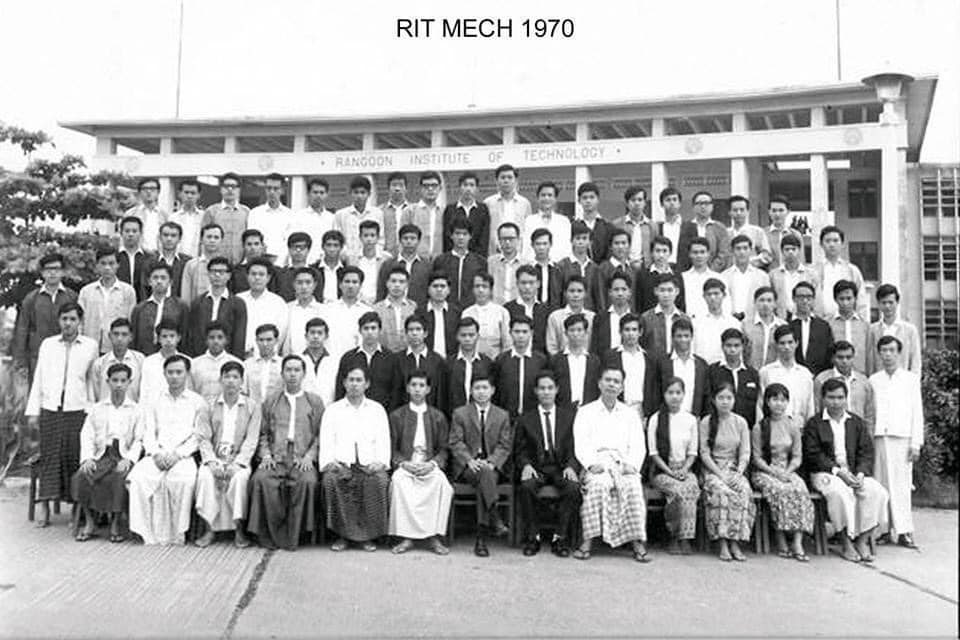
Mechanical Class of 1970
Saya U Ba Than’s Soon Kyway
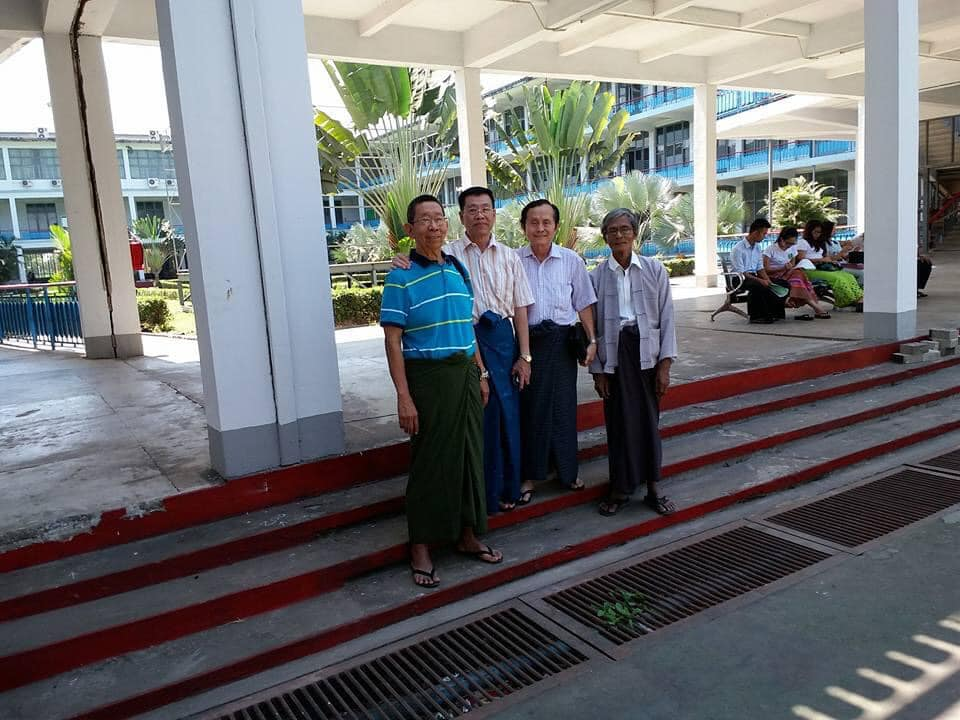
HMEE-2012 Project membersHMEE-2012 MeetingHMEE bookCD Supplement for HMEE bookHMEE-2018 meetingHMEE-2018 meetingWelcoming Walter (U Win Htay, USA)With WalterMechanical Engineering 1970With Saya U Ba ThanWith Dr. Win Thein (GBNF)Saya U Ba Than’s Soon KywayBirthday Soon Kyway by U Ba Than
Worked for Hewlett Packard, Agilent and several US companies before moving to Taiwan to work there.
After retirement, Saya is spending time in California and Taiwan.
Past President, BAPS
Founding Member, RIT Alumni International
Co-chair, Steering Committee for SPZP-2000
Proposed “U Nyo Win Act“. If there are less than the guaranteed number of attendees at SPZP-2000, the core organizers will chip in the costs. Thanks in part to the five Golden Sponsors of SPZP-2000, the Act did not need to be enforced.
Wrote about SPZP-2000 in the Post Reunion series.
Founding Member, NorCal RITAA
Served as BOD (Board of Director).
BAPS
Past President, BAPS
Editor, BAPS Newsletter
Honoring U Nyo Win, Ko Benny and Ko Henry
On November 9, 2000, there was a special dinner at Ming’s seafood restaurant in Sunset, San Francisco to honor Saya U Nyo Win (M65), out-going president of BAPS and to welcome Ko Benny Tan (M70), the in-coming president. There were 30+ attendees. Saya U Nyo Win was presented a plaque in recognition of his leadership and services to BAPS.
A plaque was also awarded to Henry Lim (RIT Alumni) for his services as Editor of the BAPS newsletter. It grew from a 4 pager to a 20 pager.
BEA to BAPS
The first ever RIT Grand Reunion and SPZP did not happen out of the blue. One of the first seeds was sown with the founding of Burmese Engineers Association (BEA). The presidents Saya U Htin Paw (EE58), Saya U San Tun (M59) and Saya U KC Chiu (ChE63) — with the able support of Daw Khin Hta Yee (Lily Win, T72) — organized mini-reunions and reunions in the Bay Area. At the welcome party for Saya U Aung Khin, the idea of merging BEA with a younger association BASTS to become BAPS (Burmese American Professional Society) was proposed and overwhelmingly approved.
BAPS Picnic to RIT Alumni International
At one of the BAPS picnics, several EC members — Saya Allen Htay, Saya U Nyo Win, Saya KC Chiu, Saya U Maung Maung, Ko Benny Tan, Ko Maurice Chee, — held an impromptu meeting with me and asked how they could support Ko Khin Maung Zaw (KMZ) and me regarding the ex-rit web site in general and other activities [such as Grand Reunion] in general.
Later, at Ko Benny’s house, the Bay Area Alumni Group was formed. The rest is history.
U Nyo Win
According to the bye-laws of BAPS, a President can serve for at most two terms. Saya U Nyo Win served two terms. Saya also chaired the meetings by the Organizing Committee of the RIT Reunion and SPZP. His colorful meeting minutes are enjoyable to read.
He is an outstanding writer and an excellent speech giver. Saya wears two hats: BAPS for the Bay Area activities and RIT Alumni International for activities related to his alma mater world-wide. Our kudos to you, Saya.
After Dinner
We went to Ko Aye Tun (Anthony Ng, M76)’s house, which is within walking distance from the restaurant. A preview of the raw / semi-edited copy of the video taken at the RIT Reunion dinner and SPZP took place. The 2+ hour footage caught several viewers by surprise. The “Waing gyi putt putt du way way” dance — started by Diana (Myint Myint Sein, M70) and Richard Chao (Htin Aung, M70) — was joined by Saya U Khin Aung Kyi, Saya U Min Wun, and several alums.
It was close to two o’clock in the morning when I got back home.
RIT Alumni International __________________________________________________
Founding Member
Core Organizer, SPZP-2000
Wrote “Appreciation of SPZP-2000” for Post Reunion
Article for Post Reunion (SPZP-2000)
After the Grand Reunion and Saya Pu Zaw Pu (SPZP), I feel like most of us still excited but completely deflated. I just have enough energy left to think about it and talk about it, but not enough to write about it. But with Ko Hla Min’s call for the end of the post reunion article at number 36, I want to catch this last chance to write a few words before the close of the book, so to say.
First, as the one of the co-chairmen of the Steering Committee, I’d like to add a few words to U Myat Htoo’s article on the apology and thanks to the all the sayagyis, sayas, and fellow alumni. We’d planned and tried to make the Reunion and SPZP a success. I agree with U Myat Htoo that there were areas of deficiencies that we overlooked and were unable to cover. Let me mention a few that we could have done better to run the program more smoothly. It may also be helpful hindsight to pass on to 2002 reunion team.
The reception area was too crowded. We expected 300 plus people would be converging on to the narrow aisle at about 5 O’clock. We tried to arrange two tables in parallel to allow more people to check-in, sign the book, receive the gifts and be directed to the appropriate tables. The crowd was larger than expected. Our seating plan didn’t help. It was designed to group people according to their requests of having close friends together. Unfortunately, the attendees’ names were not listed in alphabetical order with table number assigned. It was very time consuming to locate the table number for the guest. This resulted in people congregating in the check-in area in spite of the ushers’ effort to help.
We under estimated the time for picture taking. It turned out it was the most exciting event. We had group photos of every combination one could imagine. Getting everyone to follow the program for the number of pictures taken was not possible. It ended up a half hour photo session was three times longer. The good thing was, everyone liked it and everyone wanted it. In order to keep the program moving in a reasonable time, our MC U Myat Htoo had to exercise some crowd control. I hope everyone share U Myat Htoo’s difficulty for so doing.
The program was overloaded. Our program called for speeches from sayagyis, sayas, and the alums; opportunity for the audience to contribute to fun, entertainments, singing and jokes. Everyone appeared to be so happy and excited. All of us had so much to talk about, so much fun to have and so much joy to share that hardly anyone could concentrate and follow the program allocated time. But, isn’t that the expectation everyone had of the reunion and SPZP?
We did not allocate sufficient time to meet and thank everybody. Of course, it was not easy to walk around and talk to everybody throughout the event. Again, in hindsight, one possibility would have been to have Organizing Committee representatives go around the tables during dinner time to meet and thank everybody.
I want to reiterate, like everyone else, that this great event was a resounding success in spite of a few glitches. The success was due to the support given to the event from all those who attended and from those who were unable to attend but whole-heartedly supporting and encouraging us. The success was due to those who generously donated to the SPZP Fund so that we could make the best use of it for the event. The success was due to those who helped out with the event, and most of all, due to the hard working Executive Committee members under the leadership of Co-chairmen Benny Tan and Maurice Chee.
I would like to give a couple of examples of how dedicated the two co-chairs, Benny and Maurice, were. In the morning on the day of the Reunion, I was at Benny’s house. Benny showed me the 25-foot RIT Reunion and SPZP banner undergoing the final touch. I learned from Benny that the contractor was unable to deliver the banner on time as promised. But we must have it for the great event! Benny, with the help of his nephew, decided to make one themselves just the night before the Grand Reunion. They bought the canvas, the paint, and the brush; they designed the RIT logo and the characters; they rolled up their sleeves and succeeded in finishing the banner in time for the great event.
In the afternoon when I was at the Embassy Suite making the final arrangement for the arrival of the guests, I got a call from Maurice. He told me that he would be a little late coming to the hotel. I learned from him that, not being able to get a print shop to do the job on time and as desired, he was printing the name tags for the guests with his own computer.
This very special event brought us excitement and great emotion. We shared the joy and the happy moment. But I would think that the feelings of each of us must be different and unique. For me, at time I felt that I was back in the good old days of teaching at RIT. I saw Rector Dr. Aung Gyi, Mechanical Engineering Department Head Saya U Aung Khin, Chemical Engineering Department Head [and Rector] U Khin Aung Kyi, Saya U Nam Kock, other sayas, colleagues and students. At time I felt that I was still one of the students attending the classes.
My most memorable year at RIT was actually the first and the only BIT year, 1962. We had very few students in First Year. In fact, there weren’t that many engineering students altogether at BIT that year. Among my contemporaries were U Kyaw Aye (Shakoor), who is still in Burma and U Hla Myint (Charlie), who is now in Australia. We were the lucky ones who survived First Year Heat Engine taught by Saya U Aung Khin. I can assure you for those who’d never taken Heat Engine from Saya U Aung Khin how low the yield was from that class. Decades later, in the mid of this great reunion, seeing all the sayagyis, former colleagues, former students and new RIT graduates whom I had never met, I felt like I was in a dream.
Now that the great event is over, we are looking forward to meeting again in Singapore, Year 2002. I agree with Saya U Aung Khin, and let me quote from his article, that “we keep up with the changing situation in our home country regarding secondary technical education and decide on how inclusive we should be so that continuity can be maintained by embracing an expanding fraternity of engineers.” We all witnessed the group with exceptional talent gathering at the night of the reunion. Benny Tan in his article suggested the idea of harnessing the brainpower and energy of the group. I would think that the Year 2000 reunion was reminiscing of the past and sharing of the present, the Year 2002 reunion should in large part be the bridging of the present and the future. As to how, let’s start tapping on our talent pool now.
Sayagyi is the father of Saya Dr. Freddie Ba Hli (GBNF) and grandfather of Daw Tin Tin Hlaing (UCC), U Tha Hlaing (EC83) and Ko Min Thet Tun (GBNF). He was the first Burmese native to serve as Dean of the Faculty of Engineering. He is credited for proposing the “Twinning” of Rangoon University with prestigious universities in the US.
Saya Dr. Freddie Ba Hli wrote about his father in the commemorative issue of “RIT Alumni International Newsletter” for the First RIT Grand Reunion and SPZP. Sayagyi U Aung Khin wrote the introduction.
U Tha Tun
Saya U Tha Tun served as Acting Head of Architecture at BIT/RIT.
He was described by Saya Dr. Koung Nyunt in his article, “Two famous songs from RIT Architecture”. U Than Tun was the co-author.
Early students
Architecture courses were first offered at the Faculty of Engineering, Rangoon University in 1954.
The first batch including Saya U Myo Myint Sein graduated in 1958.
The second batch including Saya Dr. Lwin Aung and U Bo Gyi in 1959. Both entered monkhood after retirement.
The third batch which graduated in 1960 included
U Khin Maung Yin (Modern art proponent, film director, GBNF)
U Aung Kyee Myint (Retired head of architecture at PWD)
U Tin Htoon (A 60, RUBC Captain/Gold, ARAE Champion, SEAP medallist in yachting, co-founder, Triple Gem Publications)
U Victor Pe Win (Retired in Texas)
U Koon Yin Chu (First in Burma in 54 Matriculation, gold medalist in Final Year Architecture) …
Miss S. Begum was the earliest known female engineering/architecture student, but she left for India before graduation. Her classmates are from the third batch.
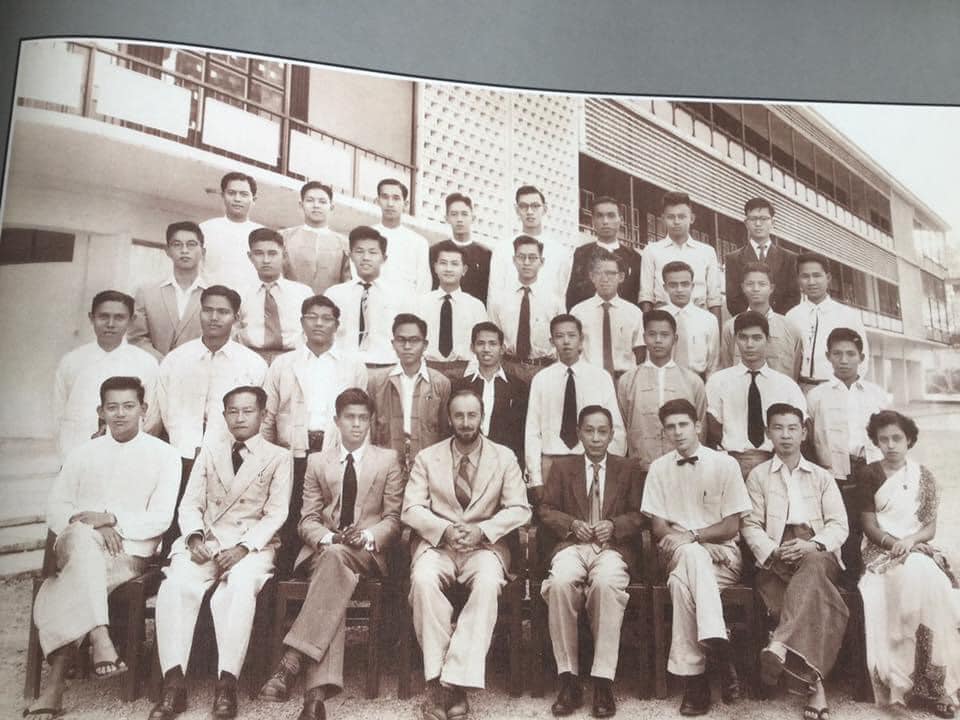
Group Picture
Architecture
The Group Picture shows Architecture Students (who were then in the 2nd, 3rd and 4th/Final years of the old system). In the new Education system, they would be from the 4th to 6th B.Arch.
The picture without captions was first sent by U Victor Pe Win to U Tin Htoon, who asked his dhamma friend Ko “Henry” Htaik San ( RUBC Gold, Secretary of Southern California Burmese Associations, photographer, videographer, …) to touch up the picture.
Per U Tin Htoon’s request, U Victor Pe Win annotated the “touched-up” photo as follows:
First Row L to R:- U Kin Mg Tint, U Tha Tun, Mr. H. A. Eswara, Mr. R. K. H. Johnson (Head of Arch. Dept.), U Ba Hli (Dean of Faculty of Engineering), Mr. O. Nagler, U Aung Myint, Miss S. Begum (2nd Yr)
Second Row:- Myint San (Final), Htun Lwin (3rd), Kyaw Zaw (Final), Bo Gyi (3rd), Tin Tun Kin (Final), T. T. Kiat (2nd), Mg Mg Gyi (Final), Mg Mg Ohn (2rd), Myint Tun (3rd)
Third Row:– Jack Min (3rd), Htay Ngwe (Final), Pe Win (2nd), V. Leong (3rd), Tham.T.Yu (2nd), K.Y.Chu (2nd), H.Hla Myint (2nd), Aung Kyee Myint (2nd), S.Hsiang Wu (2nd)
Fourth Row:- Myo Myint Sein (Final), Tin Mg Yin (Final), Aung Thin (Final), Myint Thein (Final), Tin Htoon (2nd ), Tun Than (Final), Kin Mg Yin (2nd) Hla Kyi (2nd)
Absentee:– Lwin Aung (3rd.)
Editor’s Notes:
If someone has a copy of the photo, please share it with me. Since many photos in my album do not have recognizable names, it takes some time to find them. Right now, I am in the process of updating the contents.











 HlaMin