He is a classmate of U Tin Htoon and U Aung Kyee Myint.
He is a fellow artist of U Paw Oo Thet and Director Win Pe.
He loves Classical Music and Modern Art.
He directed the movie “Hna Ma Let Shawt Nay Lay Dawt”. The movie was hard to appreciate by most Burmese. Grapevine says that some foreigners tried to purchase the movie.
Another movie produced by Daw Khin Mar Lar (spouse of Collegian Nay Win) was traditional
U Naung Tun Lwin (M75, GBNF)
He directed several movies.
He is a classmate of Daw Mar Mar Yee, U Hla Myint Thein (Maurice), …
Thamankyar
U Aung Myint (Min70) and U Than Win (T70) are close friends and cousin brothers-in-law.
The former became known as “Thamankyar Ko Myint”.
Thamankyar Ko Myint
The latter wrote the script for the movie “Thamankyar”.
The movie was directed by A1 Than Htut and A1 Thein Htut (twin brothers).
Grapevine says that there are the reincarnation of two Japanese pilots.
The movie was produced by the studio of U Nyi Pu, Ko Myint’s grand uncle.
U Nyi Pu is considered to be the first Burmese movie actor.
Myanmar Ah Swe / A1
Daw Khin Myint, A1 U Tin Nwe, U Nyi Pu, U Maung Maung Soe (U Tin Pe), A1 U Tin Maung (winner of two Academy awards) and their extended family members had several film companies.
Notes
According to Ko San Lin (M87), YIT/YTU produced some movie stars including the following :
Ko Htin Lin , B.E (EP)1993 batch (aka) Dway ( GBNF )
Ko Aye Thein , B.E (EC) 1987 batch (aka) Min Oo.
Feedback
Aung Win (C87) wrote : Pyi Ti Oo also is an actor. Civil.
Nang Khaming (A70) wrote : Most of the people did’nt like the movie Hna ma let shawt nay lay dawt because of no dialog in the movie except ‘ pea pyout’. Mostly can’t appreciate that kind of movie,but I like that movie and appreciate .
Wint Khin Zaw (A79) wrote : Architect UKMY must be too advanced for the period. I think he directed another movie called Ba Hman Ba Zan Akyaung which was appreciated a bit more by some audience.
Uzin Bobby Myo Tun (A69) wrote : Today, 21-04-2018 happens to be Thamankyar Ko Myint’s 71st birthday! Happy birthday, Ko Myint
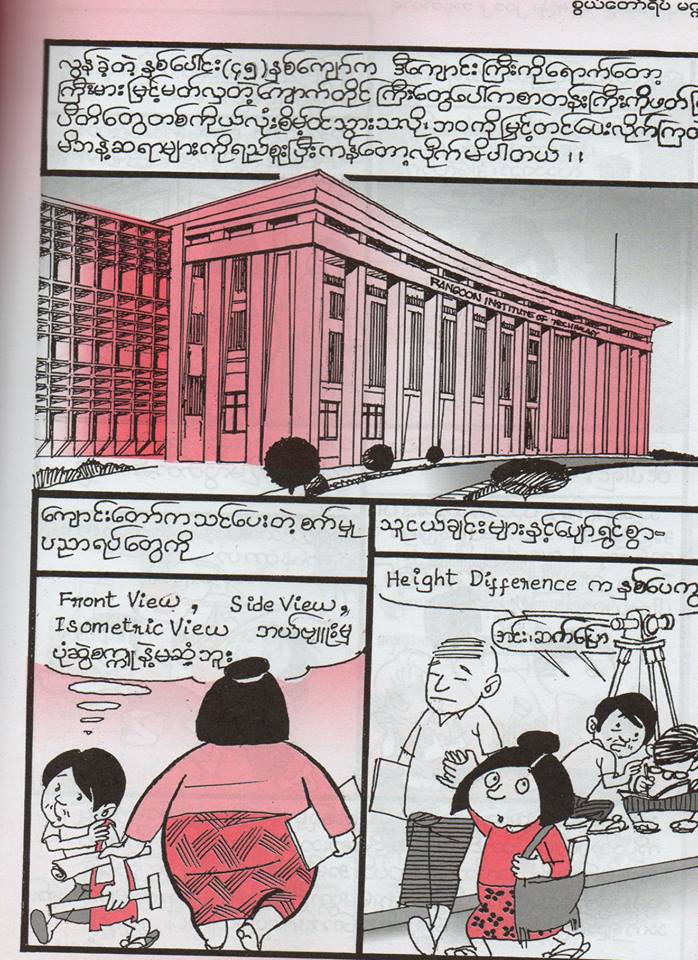
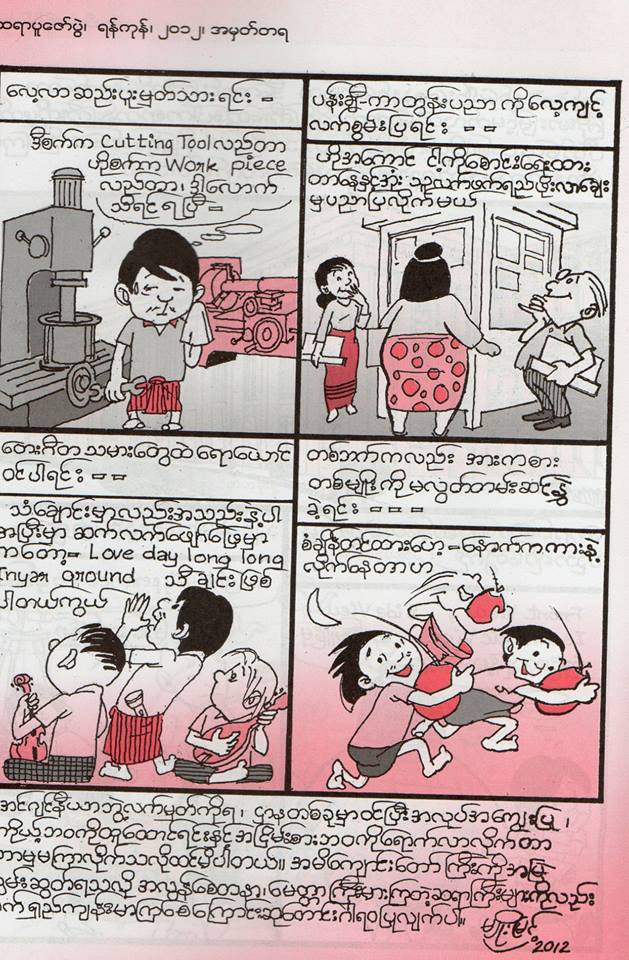
U Myo Myint (M73) has designed covers for the RIT Annual Magazines and the commemorative Swel Daw Yeik Magazines. He is an expert in “Pon Tu” (Portrait) and “Oil Paintings”.
U Myint Pe (M72) has posted cartoons by U Myo Myint.
The cartoons remind me of the following :
Three female friends who were known as Half Size, Full Size and Double Size
Several “Pho So Chin” and “Mike Khe” in the USA, Australia, Singapore and Myanmar
Some classmates and schoolmates who excel in extra curricular activities so much that they bade farewell to RIT before graduation
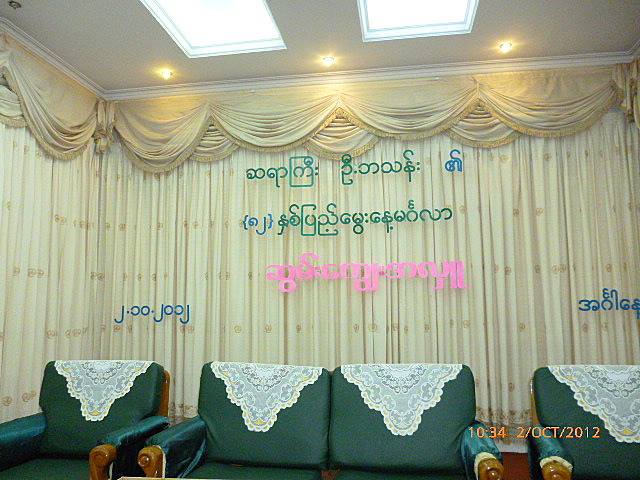
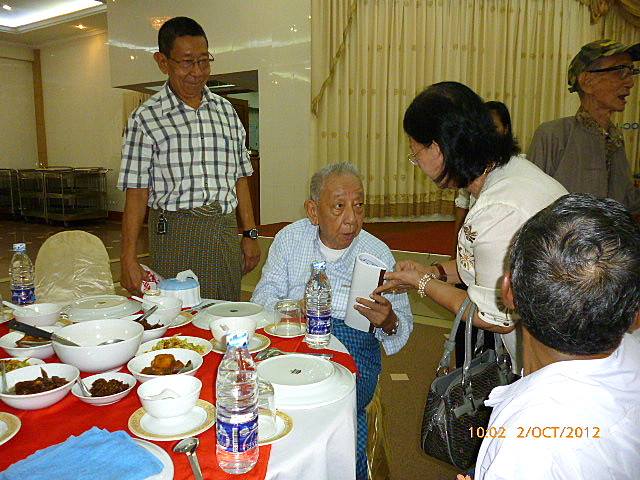
U Ba Than celebrated his birthdays with meritorious deeds. He usually offered soon to the monks at Tipitaka Yaw Sayadaw. He would invite his colleagues and former students to the Soon Kwyay.
The Class of 69 — mostly M69ers — would pay respect to Saya around his birthday.
78th Birthday in 2008
There was a special Gathering for Saya’s 78th Birthday (which fell on a Thursday).
Maung Sein Win (Padeegone) paid respect with a Kabyar.
Saya handed out his Memoirs to the attendees.
82nd Birthday in 2012
The following photos are from the Soon Kyway.
88th Birthday in 2018
He offered the Birthday Soon Kyway at Tipitaka Yaw Sayadaw’s Kyaung.
He also donated the Garawa money that he had received (e.g. from the SPZPs and his former students) to charities.
The charities include : Jivitadana, Little Sisters for the Poor, Mary Chapman’s school for Deaf & Dumb, …
90th Birthday in 2020
Due to the pandemic, Soon Kyway was scaled down.
Birthday celebrations were done via Zoom Meetings.
U Tin Htoon (A60) and U Htaik San (Henry Kao, M80) compiled a Photo Book as the Birthday Present.
91st Birthday in 2021
Due to the pandemic and security issues, the public celebrations were put on hold.
Miscellaneous
Saya enjoys the company of his colleagues, friends and former students. U Wynn Htain Oo remembered Saya’s “Kha Na Nay Bar Ohn” requests.
Saya U Win, U Hla Win, and U Aung Moung (GBNF) offered Transportation to attend the SPZPs and Gatherings.
U Tha Htay organized Mechanical Sayas a trip (around the SPZP-2012).
Saya U Tun Shwe took extra care of Saya U Ba Than for the Singapore SPZPs.
Sayas and alumni in Singapore helped Saya U Ba Than during his trips for medical check up and treatment.
Saya was a Core Supporter of the HMEE project. He donated many photos. He also coordinated with U Thaw Kaung to provide Saya U Soe Paing & team access to the Archives of Rangoon University Central Library.
See related posts.
Comments
Aung Min : I talked with Saya on 25/11/21. He is fine , now 92
U Hla Tun (Japan Gyi, T69, GBNF) was known for punctuating his speech with ***
His spouse Dolly (PPBRS) is the sister of U Khin Maung Oo (Robert, EC66, USA).
U Tun Oo Khine (EP69, GBNF) served as an Editor for Hlyat Sit Sar Saung.
U Kyaw Zan Hein (Shwee, C69, GBNF) was admitted to 2nd BE as Roll No. (14). He jokingly said that the intended one did not join RIT and the Admission Office assigned the Roll No to him.
U Kyaw Than (Met69, GBNF) was an organizer for the early 69er gatherings.
Some (e.g Sein Win, Soe Win, Khin Maung Win, Khin Maung Gyi) share names, so we have to differentiate them with discipline and/or nickname.
U Sein Win (C69, GBNF) studied Palmistry and married a Palmist. He changed him name to Win Kyaw.
** Notes
* Need photos (e.g Japan Gyi, Shwee, Palmist Sein Win)
From the 7th standard to Matriculation I remember the following:
Saya Ba Myaing (Physics), Saya Tun Shwe and Saya Sein (Burmese), Bro Hubert (Chemistry), Bro Felix, Bro Charles, and Bro Gerald (English). Mr Machado and Saya Dawson (Math), Mr Barker and Mr Illife (Physics).
Editor’s Notes:
The Paing siblings — Dr. Myo Paing (SPHS54), U Soe Paing (SPHS56), U Win Paing (Sayadaw U Wara, SPHS64) and U Kyaw Paing — attended SPHS.
U Aung Win (Owen) wrote :
I read many articles about the old staff of SPHS but I never came across anyone mentioning Bro. Charles. During our KG days in SP, we had one Bro. Charles, if you all remember him. He was a very kind-hearted Bro. and he loved the school kids and treated us well. Whatever happened to him, I wonder, after we left SPHS.
Owen Khoo (Aung Win, M71, SPHS 1953 – 1957)
Editor’s notes :
Three siblings — U Than Win (Alan Khoo, SPHS54), U Kyi Win (Eddie Khoo, SPHS57) and U Aung Win (Owen Khoo) — attended SPHS. Owen also attended Darjeeling.
I joined SPHS in Std. IV.
I do not know the sayas and sayamas who taught KG and Stds I – III.
Boarders can add the names of the Brothers and sayas that I have missed.
Brother Benedict (who taught a younger class) was a good soccer player.
Brother Gerald was the SPHS Band Master. He often rode a horse.
There was a Brother in charge of the SPHS Book Shop, and several Brothers in charge of the Boarders.
Some Brothers went on “rotation duty” to St. Peter’s (Mandalay), St. Albert’s (Maymyo), St. Patrick’s (Moulmein), …
Brother Clementian
Brother Clementian “retired” as Brother Director, but kept on teaching Mathematics until he passed away. The funeral cortege spanned from SPHS to Tamwe Christian Cemetery. Some cars had not left SPHS when the service began at the Cemetery.
Brother Austin
In addition to having a class library, Brother Austin (our Class teacher for Std. X A, “the carrot”) would take us to the SPHS library (with books donated by Ford Foundation, Asia Foundation …). Everyone has to borrow a book and write a critique. In addition to teaching English, he also taught the “Morals and Manners” class. Anyone who can recite the selected poems is free to “skip the remainder of the class”. The top reciters were rewarded: an 8 mm movie of a soccer match from UK, or a ticket to “1960 Rome Olympics” (special show at Thamada Cinema). He abhors plagiarism and unprofessional work. “Don’t waste my time and your time”. After nationalization, he moved to Malaysia to continue teaching at a De La Salle School.
Brother Xavier
Brother Xavier (our Class Teacher for Std IX A, and English teacher for Std VIII and IX, “the stick”) would penalize students for making grammatical mistakes. For the dictation test, he would start with 100 marks and then subtract 10 marks for each mistake. A classmate ended with -230 (minus 230) marks shown “in red” in his report card. According to Ko Zaw Min, Brother Xavier would not continue his “brash style” at St. Albert’s. After nationalization, he moved to UK and supposedly “left the order”.
Brother Felix
Brother Felix moved back to Germany. He had e-mail communications with some Old Paulians (notably Richard G. Boudville, Australia, son of Sayama V. Boudville).
Two Sibling Brothers
After nationalization, the native Brothers remained in Burma.
Brother Joseph decided to become Father Joseph.
His younger brother remained Brother Anthony and was one of the “senior sayas” at SPHS Saya Pu Zaw Pwes along with Saya U San Thein and Saya Beatson.
Authors
Saya George Chapman published notes for English.
Saya U Htay Myint (Patheda) published notes for History.
Distinguished Paulians
Sayagyi U Ba Khin stood first in his Matriculation class. He is known as an outstanding Vissapana teacher. His dhamma lineage starts with Ledi Sayadaw and Saya Thet. His dhamma students include Saya S. N. Goenka.
ICS U Tin Tut, Dr. Ba Han, Dr, Ba Maw, and U Chan Tun are Old Paulians.
According to Dr. Win Aung (M62), his father Saya C. Ping Lee (EE, GBNF) was a Paulian and a student of Saya U Than Aung (father of Saya Alphonso [Mg Nge, Mg Aung] and Charlie [Ko Cho]). When U Than Aung became Minister of Education in the AFPFL Government, he recruited his former student Saya C. Ping Lee to head the Technical & Vocational Department.
Saya Pu Zaw Pwes
After nationalization, SPHS became No. (6) SHS Botathaung.
There are two SPZPs: one for the “Paulians” and another for SHS(6).
Some (e.g. Eddie Ba Oo [Tin Aung Moe]) who were in the lower classes when SPHS was nationalized would attend both gatherings.
by U Zaw Min (EP70) and U Ohn Khine (M70) Edited by U Hla Min(EC69)
Note : Ko and U, Ma and Daw are used in the articles. The prefixes may sometimes be omitted.
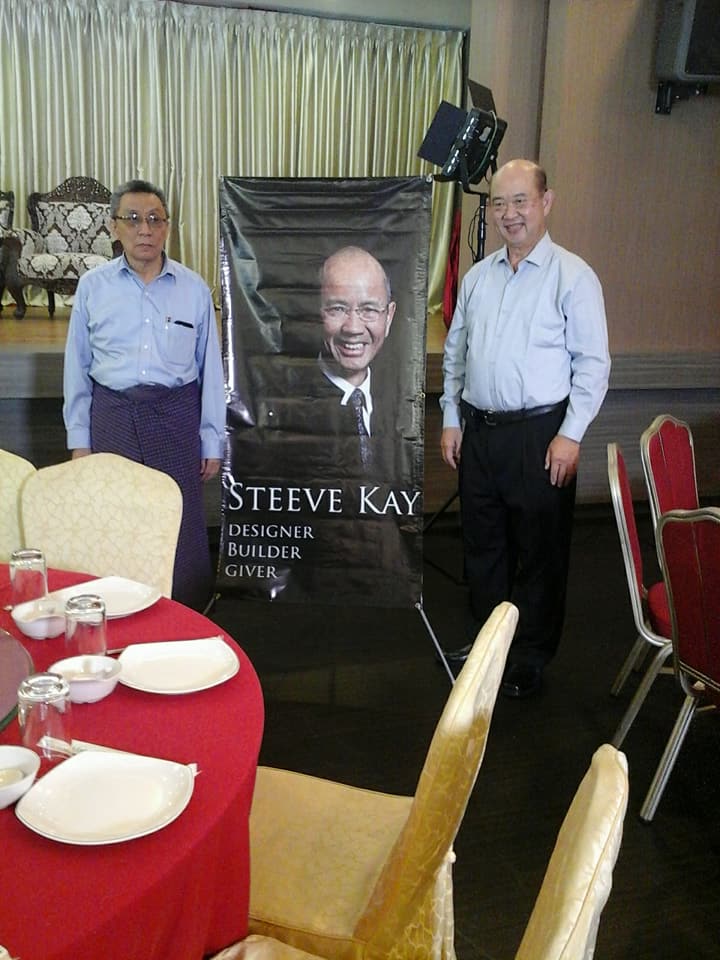
Hla Min (EC69) and Benny (M70) beside picture of Steeve (EC70)
Introduction
Authors
U Zaw Min (EP70) matriculated from St, Albert’s High School, Maymyo in 1964.
Had a very high ILA (Intelligence Level Aggregate) and was admitted to the first ever 1st BE as Roll Number One.
Selected RIT Luyechun for the 1965 Summer Camp at Inlay. His outspoken remarks about the Camp drew the ire of higher authorities.
Graduated with EP (Electrical Power) in 1970.
After working in the industry, he moved to the USA.
Studied Electronics in the USA
Added “Nawaday” to his name.
Several years ago, he shared his memories of RIT to the Google group of “the Combined Intake of 1st BE for 1964 and 1965”.
U Ohn Khine (M70) matriculated from St. Peter’s High School, Mandalay in 1964.
Took a combination of Science and Arts subjects and had good ILA score to be admitted to RIT.
Graduated with Mechanical Engineering in 1970
Worked for HI (Heavy Industries).
Created and maintained the the Google group of “the Combined Intake of 1st BE for 1964 and 1965”.
Volunteered for SPZP-2012 and SPZP-2016, HMEE-2012 and HMEE-2018, Swel Daw Yeik Foundation and several RIT-related activities.
Gave me rides during my visits to Yangon.
Filled the “missing pieces” in U Zaw Min’s accounts.
Editor
U Hla Min matriculated from St. Paul’s High School. Received Collegiate Scholarship for standing 7th in the whole of Burma.
Finished top in the Science Option of I.Sc.(A) examination
Admitted to the first ever 2nd BE in November 1964 as Roll Number One.
Selected Luyechun for the Inlay Khaung Daing Camp.
Graduated with Electrical Communications in 1969.
Started the “RIT Alumni International Newsletter” in 1989 and have maintained it for 22 years.
Administrator or Moderator of selected Facebook pages.
Personal website : hlamin.com
Edited the draft versions “Memories by Ko Zaw Min Nawaday (EP70) and Ko Ohn Khine (M70)”, which was first posted as Google Docs for the Combined 1st BE Intake of 64 and 65.
Published the edited document as a series of articles in “RIT Alumni International Newsletter and Updates”.
Three Intakes in 1964
There were three intakes at the Rangoon Institute of Technology (RIT) when the new education system started in 1964. Eligible students were admitted to the first ever 1st BE, 2nd BE and 3rd BE classes. They are also known as
Class of 70 (1st BE Intake in 1964) Matriculates were admitted using the ILA
Class of 69 (2nd BE Intake in 1964) Those who had passed I.Sc.(A) with Science Option were admitted in order of merit
Class of 68 (3rd BE Intake in 1964) Those who had passed I.Sc.(B) with Science Option were admitted in order of merit
The RIT Rector was U Yone Mo and the Registrar was U Soe Thein.
Class of 70
The Class of ‘70 comprised of the first year intake students in 1964. There were 494 registered students, of which 67 were female. Most graduated in 1970. Some took sabbatical for a year or two. A few left RIT before graduation.
The GBNF (Gone But Not Forgotten) reached 111 in September 2021.
The matriculates entered the first ever 1st BE classes. The controversial ILA (Intelligence Level Aggregate) was used for the vetting of applicants. In the system, a score of 1 to 10 was assigned to “map” the marks for each subject. The ILA score (rather than the”raw” marks) was used to determine the eligibility of the students admitted to an institute.
Under the old education system, the matriculates had to attend I.Sc. (A) classes. There were restrictions on the subjects taken at Inter classes to be eligible for Faculty of Engineering, Faculty of Medicine, etc. For example, one must pass the I.Sc. with at least 50 marks in Mathematics, Physics and Chemistry to attend the 1st Year Engineering Classes (3rd BE in the new system).
Under the new education system, there were no restrictions on the subjects taken in Matriculation exam. As such, many students who passed Matriculation with combined Science and Arts subjects and even those with pure Arts subjects were able to attend RIT. For example, Ko Ohn Khine passed the Matriculation examination with an odd combination of Mathematics, Chemistry and Geography.
First BE (1964 – 65)
The first year students were divided into four sections : A, B, C and D. The majority of students of Sections A and B had passed matriculation with pure science subjects. Most of the students of Sections C & D had passed with either Science and Arts Combination or pure Arts. There were some late joiners to RIT.
Male students from districts and states were boarded in hostels, in the ground floor rooms of B, D and E Blocks and “Inlay Hall” in Thamaing.
A building named “G Hall” was assigned to board female students from districts and states. Local female students who applied were also allowed to board in G Hall.
Engineering was not considered appropriate livelihood for women hence there were only a few female students studying Engineering before our 1964 intakes. With the new system, there was an influx of girls. It was quite a pleasant feast to the seniors who were not used to seeing those many female students. So when our ‘64 intake started attending classes, it was a thrill for the senior students to watch a great number of female students strolling in the corridors, coming in and out of class rooms,in canteen, in the food shops, in the library and everywhere on the campus grounds. We were also thrilled to get in company with a lot of female classmates. (It was exciting for me to have female classmates as I [Ohn Khine] was sent to all boys school, St. Peter’s High School in Mandalay since Kindergarten till I matriculated in 1964.) It is fair to note that the girls were somewhat intimidated and somewhat amused by the loud remarks of a few rowdy students or even feeling stared at while having to move from one classroom to another. Girls spent time during breaks in an area of a corridor surrounded by shaded blinds which was known as LCR (Ladies’ Common Room) where the day students usually ate home-brought snacks and rest. Ladies residing at G Hall would have lunch at the canteen and were able to rest in their rooms. The first LCR was a little room on the third floor before a section of the corridor on the third floor was made as the LCR before the start of our 2nd year at RIT. When the bell rang for the next class, it was customary to peek through the blinds to check whether the boys had gone inside the theatre for the timid girls to come out of the LCR.
Outstanding athletes from our class
The list was compiled by Ko Ohn Khine. Comments were provided by Ko Zaw Min Nawaday. Organization / presentation (with corrections) was done by Ko Hla Min
Badminton
Tommy Shwe
Kyi Kyi Sein
Basketball
Tin Aung (E)
Tin Aye (M)
Kevin Law
Soe Aung (Auto)
Body Building / Weightlifting
Than Htike (M)
Boxing
Maung Maung Thaw (E)
Chinlon
Soe Tint (C)
Mya Daung (M) GBNF
Football / Soccer
Sai Thein Maung (C)
Khin Maung Lay (Mutu, M)
Win Zaw (A)
Myint Sein (Ja Pu Sein, GBNF)
Kenneth (Khin Maung Shwe, GBNF)
Htun Myint (M)
Hla Kyi
Sai Aung San (Met)
Judo / Aikido
Sein Myo (C)
Kyaw Soe Win
Soe Aung (Auto)
Thaung Lwin (M)
Soe Myint (Agri)
Sai Loke Khan (Mn)
Rowing
Htein Win (M)
Aung Lwin (Jasper Wu) (C)
Swimming / Water Polo
Peter Pe GNBF
Htein Win (M)
Win Aung (M)
Mg Mg Swe (M)
Tin Tin Myint (Ch)
Tennis
Aung Kyaw Soe (James Than) (Ep)
Khin Mg Shwe (Ep)
Wai Lwin (Agri)
Rosie Tin Maung (Ch)
Track and Field
Sai Thein Maung (C)
Shein Kee Gae (GBNF)
Saw Mg Mg Htwe
Oo Myint (Mn)
Win Naing
Lei Lei Chit (Ch)
Nan Kham Ing (A)
Maung Maung Thaw (E)
UTC Marksman
Tan Yu Beng (Benny) (M) Let Pyaunk Tat Thar, twice, both UTC 1st & 2nd yr.
Volleyball
Kyaw Sein (M)
Salai Myo Myint (C)
Additional Information by Ko Zaw Min Nawaday
Sai Thein Maung (C), was a great RIT goalkeeper for 6 years. He also won gold medals in 100 meters and Hop Step and Jump in the Inter Institute track and field competition almost every year.
Tin Tin Myint (Emma) (Ch) bravely competed in the inter-institute swimming meet. I believe she also practiced throwing the Javelin and played volleyball.
Khin Mg Shwe (Ep), won the”Novice” tennis competition at RIT. He represented RIT in the 2nd year and we cheered him as he played a nationally known played from RASU (at the courts across from the Universities football field) during our 2nd yr at RIT.
My good friend Tan Yu Beng (Benny, M) took the best marksman trophy at both 1st and 2nd yr UTC camps. He competed against not only RIT but UTC students from RASU, Institute of Medicine, and Institute of Economics.
Hla Kyi (nickname Sut Kaw) played center right back for RIT selected football team. Most RIT students that watched the game between RIT and Loke Thar during our first year will remember the flying kick he took at the head of the left winger of Loke Thar when Ko Myint Sein (M) GBNF and that left winger got into a fracas. The Universities team coach Saya Nyein, who was the referee for this game, promptly told Ko Hla Kyi to leave the field.
There were also unsung heroes (e.g. The RIT B football team). I did not know about them until the third year, when Sai Aung San, my room mate for that year, told me about it. He was the goalkeeper, Yan Shin played in the back line and Kyaw Min Aung was the reserve goalkeeper.
Ah Nu Pyinnya Shins from our class
Myint Swe Win (M) Mandolin virtuoso, vocalist. Participated in every concert.and pwe
Mo Mo Yi (E) Announcer
Tin Tin Myint (Emma Myint) (Ch) Myanmar Dance
Tin Myint Oo (Rosie Tin Maung) (Ch) acted as “Tha Gyar Min” in the musical performance of the song “Sanda Kein Da Yi”. Vocalist and instrument (Don Minn) by Ko Yu Swan (M 68).
George Ko Ko Gyi (Ch) played the part of Ten Headed Ogre (Dat Tha Gi Ri) in the short opera of Chasing the Deer (Rammayana play)
Than Myint (M) Vocalist & All-round instrument player
Soe Aung (Auto) Clarinet
Tin Win (Tex) Burmese Harp (Don Minn)
Aung Myint (a) “Thaman Kyar” Ko Myint (Mn) co-starred in the movie “Thaman Kyar”
Than Win (Tex) wrote the script of “Thaman Kyar”.
Universities’ Training Corps (UTC)
Some of us entered the UTC.
We had two camps the first year we were at RIT :
Summer camp at KyeDaw, Toungoo
October camp at Meikthila.
First UTC Camp
At the Toungoo camp, our platoon was the only RIT platoon stationed with RASU students. So we were 30 or so RIT students among 500 plus RASU students at the 10th Buregt. The main body of RIT students were at a little school. They were the lucky ones. They had the instructors from UTC in charge while we at the 10th Buregt. were assigned a grouchy sadistic corporal from the regular infantry to drive us. He has a mustache so we nicknamed him “Nga Khu”. Ko Win Htut (C), Ko Khin Mg Lay (M), Ahmed Soorma (Ch), Ko Kyaw Min Aung, John Krasu, Ko Htwe Myint (C), Ko Htain Win (M, Chauk Pe) were among those in this platoon.
It was here that Ko Htwe Myint got his nickname “Bo Hmu” because of the military bags he had on him.
We slept on a long bamboo platform, next to each other. We had to stand guard duty at night, one hour each and sign off on the duty sheet. If our duty hour fell on 8pm-9pm, it was great. If it were from 1pm to 2pm, it was the graveyard hour. One time, my duty was from 1pm to 2pm, Ko Khin Mg Lay (M), who slept next to me was from 12-1pm. He tried to wake me up to give the duty sheet but I refused to get up since I was so sleepy. He finally said “Min Tar Wun You Mea So Yin Ngar Ate Pi”. I finally got up and took over the duty sheet. Standing guard duty during graveyard hours had its benefits. I saw the Big Dipper, Khun Na Sin Kyea, turn and point its tail upwards. (Khun Na Sin Kyea Pyong ah mee thoung, than goun chain tho youk.)
We had to get up at 5pm and run PT, guzzle a cup of tea and swallow down bein moun at 6.30am. At 7am, we were on the parade ground doing marching drills. One time, our sadistic corporal made us run for 45 minutes with our rifles in our hands because he was unhappy with our performance. That event also brought out the best in the RASU students. When the whistle blew for a 10 minute break, in a rare display of camaraderie, some RASU students came over with water for us to drink.
Lunch was a little meat dish and great Pe Hin.
In the afternoons, we had to go to a Phone Gyi Kyaung about half a mile away so that we can sit in the shade while we were taught small arms. We were not allowed to use the water in the well at the Kyaung, so four persons from each platoon had to take 2 Ye Oes full of water. Although it meant carrying the heavy Ye Oe, in addition to my rifle, I always volunteered for that duty since we got to leave about 20 minutes earlier for the Phone Gyi Kyaung. That way, we got to rest and enjoy the tranquility of the Kyaung Win before the rest of the students arrived and the lessons started. I remember laying under the trees while waiting for the rest to come over, looking at the Toddy (Htan) trees and wondering if King Tabinshwethi had one time spent his days near this place drinking Htan Ye .
I remember the incident about Ko Win Htut being punished harshly one time. I don’t remember exactly what it was about. We all know that Ko Win Htut liked to have fun and his happy go lucky come attitude got him into trouble with our party pooper instructor Nga Khu. He was ordered to jump from a squatting position while having his rifle held above his head until he fell exhausted. After 3 weeks, training was ending and we decided to give the Corporal a longyi as present and all of us Ka Daw to him. For the first time, tears rolled down this tough Corporal’s cheeks.
The next day was the graduation parade. It was a proud moment for all RIT students when Tan Yu Beng (Benny) (M), stepped up to receive the award for Let Pyaunt Tat Thar, standing first in marksmanship among 800 UTC students from all Institutes and RASU.
Second UTC Camp
To attend the second UTC camp, we left for Meikthila on the 3rd week of September. The train travel ed at night, but we had trouble sleeping on the train. We were sent to the 3rd BATD. Beautiful barracks with wood flooring. But horror of horrors. Hundreds of bed bugs came out from between the wooden planks. That night, there was no way I could sleep with the bugs biting me. so, even though there was a slight drizzle of rain falling, I decided to sleep on the ground outside. Since I did not get any sleep the night before, I slept through the morning PT before waking up. Ko Khin Mg Lay told me that the instructor came to kick me while I was sleeping in the morning, but I just kept on sleeping. The instructor was overheard saying something like “Mway Pauk Tay Mae” before walking away. My official place in the barracks was next to Ko Sein Win (EC). Ko Sein Win was very neat and had the best prepped bed for daily inspection. Next to him, mine looked like crap. Points were given daily for how good you had prepared your bed. Ko Sein Win always got the best comments and mine was in the pits. Actually I did not sleep a single night in my bed place. I used my blanket as a cot by tying it to two posts out in the veranda and slept there.
Life at Meikthila camp was more pleasant than Toungoo camp. For one thing, all of us RIT 1st year students were in one company. We had our share of funny incidents. One day, the RSM of UTC chided all of us for soiling the side of the toilet holes in the outhouses. His words were, “Nya Kya Ah Pauk Te Te Ko Min Doe Win Aung Htet Naing Dae. De Louk Ah Pauk Gyi Kya Win Aung Ma Par Naing Bu.”
As it happened, that evening, the RSM was kicking the ball to the goal and it went wide. Bohmu Htwe Myint shouted “De Louk Gyi Dae Ah Pouk Win Aung Ma Kan Naing Bu Lar?” The RSM walked away with his head bowed.
Sometimes, we drove the instructors hopping mad. One time the instructor told us “Ngar So Dar Lite So”. In one voice, we all shouted “Ngar So Dar Lite So”.
After two weeks, we were told to give our kit bags to be taken by truck to Taung Pulu, while we would have to march 18 miles to that place the next day. Without a kit bag, no blanket to make my cot, I spent the night just walking around in the veranda since it was raining outside and there was no way I could sleep inside with the bed bugs. The next day we marched to Taung Pulu, carrying our rifles. It was tough for me since I did not sleep a wink the night before. The sun was beating down on us the whole day. Where was the rain when we needed it? Worse was the rocky road made of Gawoon rocks. It made the nails in my boots hurt my feet. I must have pulled out over half a dozen nails from each boot.
We finally made it to Taung Pulu in the evening. We were given rice to cook for ourselves and were assigned 4 persons to a tent. That night, there was a tremendous storm. Water gushed into the tents. The next day, someone told me that everyone was sitting in their tents except me. He said I was asleep with my head in the mud. I did remember waking up during the storm, looking up at my tent mates who were sitting, and going back to sleep.The next day, we were told to move into a Zayat on a hill. It was so crowded in the Zayat, I refused to sleep there. Instead, I went up the Phaya Yin Pyin and slept alone on the brickwork with a blanket tucked around my body to prevent the winds from blowing it away.
Time came for graduation and our Tan Yu Beng (Benny, M) again got the Let Pyaunk Tat Tar award.
Ko Win Htut, I and others that I don’t remember, took a bus to Mandalay from Meikthila. We arrived in Mandalay, near 33rd and Zeygyo (84th) around 6 pm. Ko Win Htut was home since his house was around the corner. For myself and a couple of others, we just kept on walking towards the direction of the clock tower, hoping we would run into something. It was seeming more and more likely we might have to sleep on someone else’S doorstep.
Then, we saw a jeep come down 84th street and stop. It was a MMTA taxi with Saw Mg Mg Htwe sitting in the front seat! (MMTA stood for Maymyo-Mandalay Taxi Association).
He told us that he figured there might still be some UTC students that wanted to go to Maymyo coming this way and had asked the taxi driver to drive along 84th street before turning towards “A” road to take the car out of Mandalay to the Maymyo road.
History of Myanmar Engineering Education by U Ohn Khine (M 70)
Implementation to improve Engineering Education
To improve the university education as a whole, including
engineering, the government laid down plans for the enhancement of
engineering education. The Burmese government approached Technical
Co-operation Administration (TCA) of the United States of America (USA)
in the 50’s to get aid for the development of engineering education.
At the same time, efforts were made to offer more engineering
disciplines at the faculty, to have more local qualified teachers, to
have more buildings to accommodate the increasing number of students,
and to get up to date and complete machinery and equipment for the test
laboratories. Most of the teaching staff at that time were British and
contract lecturers from India.
After Burma gained
independence, Professor Davies who was Dean and other foreign teaching
staffs left the Faculty in 1950. U Ba Hli, Principal of Insein
Government Technical Institute (GTI), was appointed as the first local
Dean of the Faculty. U Ba Hli, a far-sighted educator, did a lot to
develop the engineering education during his tenure as Dean from 1950 to
1958.
The program to increase the teaching staff at the
Faculty of Engineering started in 1952. Under the twinning program with
TCA, two visiting professors from Massachusetts Institute of Technology
(MIT) arrived in 1952. They were later followed by others. At the same
time, to have more qualified local teaching staff, outstanding students
from the 2nd year engineering class were selected and sent to MIT,
Lehigh University, etc., for further studies to attain Masters degrees.
Those selected were to be appointed as assistant lecturers when they
came back.
Furthermore those who graduated from the Faculty
with flying colors were also appointed as teachers. There were instances
of appointing some locals who had graduated from foreign universities.
Requirement of teaching staff at the Faculty during 1952 to 1959
was fulfilled by the visiting professors and lecturers from UK and USA
under TCA program and by hiring Indian nationals from India on contract
basis as teaching staff.
Nurturing of Local Teaching Staff with Post-graduate Degrees
When the Rangoon University Engineering Department opened, there
were very few teaching staff and the department had to be run with
British and Indian teachers. This situation continued up till the Second
World War, when the department had to close down.
When the
department reopened after the war in 1947, the situation at first was
the same as in pre-war era. After the Independence, teaching staff from
UK and India, including Dean Prof. D. Pindri Davies went back in 1950.
U Ba Hli, Principal of Insein GTI, became Dean of the Faculty of
Engineering in 1950. As he was a far–sighted person, he laid down plans
to improve the quality of engineering education. One of the plans was a
twinning program under TCA to get more teaching staff. He contacted UK
universities and MIT to get help for the recruitment of qualified
teaching staff. At the same time, some outstanding students were sent
abroad for further studies with the aim of appointing them as teaching
staff upon their return. Dean U Ba Hli jointly acted as Professor of
Civil Engineering and taught Sanitary Engineering.
Sayagyi U
Ba Hli played a major part in the offering of more engineering
disciplines besides the existing civil, electrical and mechanical
engineering. From the 1953-54 academic year, Mining, Chemical,
Metallurgy and Textile engineering courses could be offered.
Architecture was offered later. Sending student scholars to UK and USA
was also a part of U Ba Hli’s plans to recruit qualified teaching staff.
We had to acknowledge and record these efforts of our Sayagyi to
develop and improve the engineering education system in Burma.
According to the photo in the 1951-52 academic year RUESU Annual
Magazine, there were about 200 students from 1st to 4th year. There were
63, 55, 44 and 34 students in the 1st, 2nd, 3rd and 4th year
respectively. Number of teaching staff including Dean was 11. (Appendix 2
F), with 5 Indian and 6 (including Workshop Superintendent) local staff
members. The ratio of student to staff was 18:1 at that time. In
1952-53 academic year, the number of students was 163 and teaching staff
was 12. Among the teaching staff, five were local staff. There was a
workshop superintendent, four Indian lecturers, and two visiting
professors from MIT. The student teacher ratio was 13.6 :1. It can be
seen that there were not enough teachers. The ratio of local to foreign
teachers was nearly one.
Ko Aung Gyi, a second year
student was awarded a scholarship in June 1953, and went to MIT in
September 1953 to get graduate as well as post graduate studies in Civil
Engineering. Ko Kyit In (later named U Min Wun) was also sent to MIT
with Ko Aung Gyi to study Civil Engineering. Ko Maung Maung Than was
sent to Lowell University to study Textile Engineering. They were
allowed to work one year after graduation so as to have exposure and
experience, before coming back and joining the Faculty as Assistant
Lecturers. U Freddie Ba Hli, son of Dean U Ba Hli was in MIT for his
doctorate in Electrical Engineering when Ko Aung Gyi and other scholars
arrived there. Because of his generous help, the newcomers could study
at MIT without any inconveniences. Ko Khin Aung Kyi (Chemical), Ko Sein
Hlaing (Electrical) were sent to MIT also. The other scholars who
studied later at MIT were Ko Percy Lau, Ko Win Htein, Ko Kyaw Min, Ko
Kyaw Thein, Ko Aung Kywe and Ko Sein Hla.
U Win Htein, U
Kyaw Min both architects were part-time lecturers at Architecture
department of RIT. U Kyaw Thein worked as an engineer at Construction
Corporation after obtaining the masters degree and later transferred to
Civil Engineering department at RIT as a lecturer. U Sein Hla joined CC
and later became Registrar of RIT during the time when U Yone Moe was
Rector.
Two visiting professors from MIT, Mr. Daniel
D.Streeter Jr., S.B., S.M., (MIT) for Mechanical Engineering department
and Dr. Murray P. Horwood, Director, MIT Education Project, Professor of
Sanitary Engineering, arrived in 1952-53 to help solve the shortage of
teachers at the Faculty. Dean U Ba Hli put his utmost efforts to achieve
Education Project aids and resulted in the arrival of two visiting
professors. More visiting professors and lecturers came in the following
years.
At the same time graduates from the Faculty were
also recruited as teaching staff. U Sein Hlaing was the first to be
appointed. As there were plans to offer more engineering disciplines in
the near future, some outstanding students sent to MIT and Lehigh
University for further studies. The aim was to appoint these scholars as
teaching staff at the Faculty when they come back, thus fulfilling the
requirement of local teaching staffs.
Ko Aung Khin a
mechanical engineering student was sent to Lehigh in 1951. Ko Aung Gyi
and Ko Kyit In both civil engineering students were sent to MIT and Ko
Maung Maung Than was sent to Lowell University in 1952.
The standard of engineering education at that time was quite high and was recognized by MIT.
Following is an excerpt from Dr. Aung Gyi’s article
I am describing all these things to point out the fact that the
standard of engineering education in Burma at that time was quite good.
None of us had to go through the entrance examination to get into MIT.
They trusted our grades and our education standard. Maybe the visiting
Professor Horwood from MIT was quite impressed with the Faculty of
Engineering and put a good word for us to the MIT admission authorities.
Ko Thit, a second year student was also sent to Lehigh University in US to study Metallurgy Engineering. U Tin Swe, assistant lecturer at the Faculty was sent to Michigan University for a masters degree in electrical engineering.
Mining, Chemical, Metallurgy,
Textile Engineering and Architecture departments were opened at the
Faculty in 1953, 1954 and 1955. The number of engineering students
increased substantially during these years. There were more than 400
first year engineering students in 1955-56 academic year. Due to these
increase in students, it was inevitable to have more teaching staffs.
To solve this, teaching staff from India were hired on contract basis.
Visiting professors and lecturers from US and UK were called in to help
solve this shortage. Even those who obtained degrees from abroad on
their own were also appointed.
According to the photos of
the 1956-57 annual magazine, there were 29 teaching staff at the
Faculty. Among them 14 were Indian nationals, and 6 locals who obtained
their degrees from abroad. They were U Ba Than (Mechanical), U Kyaw Tun
(Electrical), U Soon Sein (Mining), U Percy Lau (Civil), and U Ngwe
Thein (Geology). U Than Tin (Metallurgy) and U Win Kyaing (Mining) were
appointed after 1958.
Visiting lecturers from UK and US at
that time were Mr. R.D.Neale (B.E., M.I.e.E. (Men), A.I.E.E.,
M.N.Z.I.E., Senior lecturer Electrical ), Mr. Redpath ( B.Sc. (Engg)
(London). A.M.I.Mech.E. Senior lecturer in Mechanical), Mr. G.H. Calder
(B.S. M.B.A. Harvard, D.C.S., D.B.A. India) Visiting professor in
Business administration. Mr. Skelton (Mech) and Mr. Johnson (Architect)
also joined as visiting lecturers later.
U Aung Khin, U
Sein Hlaing and U Tin Swe came back in 1956 and were appointed as
assistant lecturers. U Aung Gyi, U Min Wun (U Kyit In), U Khin Aung Kyi,
U Maung Maung Than and U Thit came back in 1957 and joined the Faculty
as assistant lecturers. All of them except U Thit were promoted to
lecturers in 1958.
A considerable number of B.Sc.(Engg.)
graduates were appointed as assistant lecturers starting from the end of
1959.. State scholars under Colombo Plan were also sent abroad for
further studies up till 1964. U Ba Than (Mech) to UK, U Thit (Met) to
Australia, U San Hla Aung (Civil) to MIT, U Tin Hlaing (Mech) to US, U
Mung Maung Win (Chem) to US, U Allen Htay (Civil) to US, U Soe Paing
(Elec) to US and Daw Julie Han (Tex) to US. U Aung Gyi went to Alberta
University, Canada, for his doctorate in Civil Engineering.
When the new Burma Institute of Technology was opened at Gyogone
campus in 1961, visiting professors and lecturers from USSR came and
helped the teaching at most of the departments lasting about two to
three years.
There were a total of 55 teaching staff at
the Faculty according to the list published by the Education department
in September 1964. (Appendix 2-G)
Editor’s notes:
With the support of Sayagyi U Ba Than and Saya U Thaw Kaung, Chief Librarian of the Rangoon University Central Library, Saya U Soe Paing compiled materials. Most articles and correspondences from the early periods were in English. Based on Saya U Soe Paing’s work, the editorial team headed by Saya U Aung Hla Tun, former Editor-in-chief of RIT Annual Magazines and also a National Literary Award winner, wrote the book in Myanmar/Burmese. U Ohn Khine and I prepared the companion CD for the book. It included photos (too many to be incorporated into the book), bio of Sayas and sayamas, articles for the SPZPs, and excerpts from my Updates.
Born of parents U San Shwe and Daw Than Tin in 1933,
Attended the East Rangoon Methodist School in Rangoon.
Matriculated in 1949 from East Rangoon Methodist achieving a seventh position in the first division and received the Collegiate Scholarship awarded by the Government.
Attended I.Sc (A) and I.Sc(B) in (49-50).
Continued to study in BOC College of Engineering and took Mechanical Engineering.
Upon completion of second year Mechanical Engineering, he was selected as a Government sponsored Scholar in the Spring of 1954 at the Massachusetts Institute of Technology, USA.
Completed the Bachelor of Science Degree in Chemical Engineering in 1956
Got Masters of Science Degree also in Chemical Engineering in 1957. In his Masters course he was enrolled in the coveted Chemical Engineering Practice School.
Went back to Burma in 1957 and was appointed Lecturer and Head of Department in Chemical Engineering.
In 1959 he married Daw Mya Mya Than daughter of U Sein Nyo and Daw Than Yin.
Appointed full Professorship in 1966
Promoted to Rectorship in 1977.
He was also very active as a consultant from the academia in the design and construction of the two fertilizer plants (Sale and Kyun Chaung); the Sittang Paper Mill and other various state owned chemical plants.
Retired from the Rector’s position in 1988.
Because of his passion for teaching he could not stay retired for long and worked in Thailand at the Rangsit University as a Professor. He was the only foreigner accepted in the Thai Institute of Chemical Engineering.
Gave an interview for SPZP-2012.
Chemical Engineering courses were initially offered with contract sayas from India.
When he taught as a newly minted Saya taught, there was “testing of nerves” by some students. He told the class that an Indian saya would be brought in if the noisy atmosphere persisted. That solved the problem.
U Tu Myint, son of U Tu Maung and Daw Hla Myint, graduated with a Mechanical Engineering Degree from University of Strathclyde, Glasgow in 1966. He then obtained a Masters Degree from the same University in 1967, and joined RIT as an Instructor.
He supervised the M73 Hovercraft project.
He left RIT as an Assistant Lecturer in 1976. He joined Singapore Polytechnic as a lecturer in 1977 and later promoted to Head of Mechanical and Manufacturing Department in 1988. In 1997, he became a Director of Industry Services, a department responsible for Students Industrial Training, Continuing Education, Consultancy Services and R&D.
His hobbies are tennis and radio controlled modeling. He is married to Daw Mya Myitzu. One of her hobbies is puppet dancing and she performed the Burmese Puppet (Yoke Thay) show during the Year 2000 Singapore Polytechnic Thingyan Festival.
Their daughter, Hla Thazin, followed the father’s footsteps and has become an electronics engineer. She has graduated with a Masters degree in Communication and Information Technology and presently working for Creative Technologies in Singapore.
Update in 2020
Met Saya in Singapore in December, 2019 at the mini-gathering organized by M73 (John Rao, Ko Hla Win …)


 HlaMin