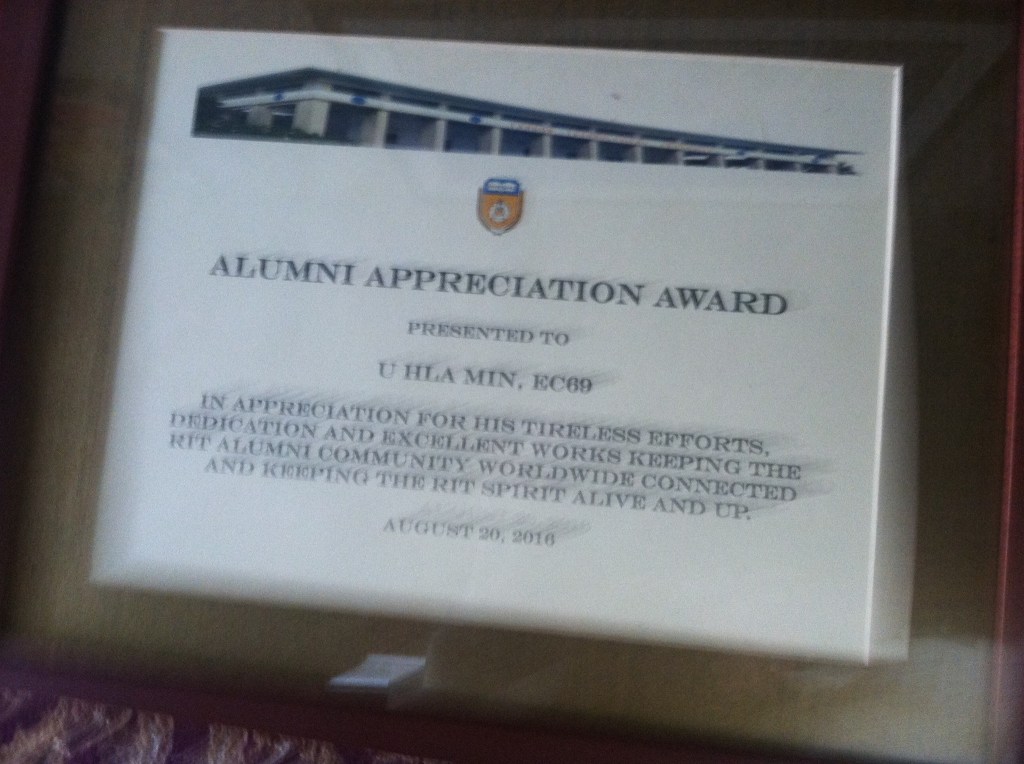
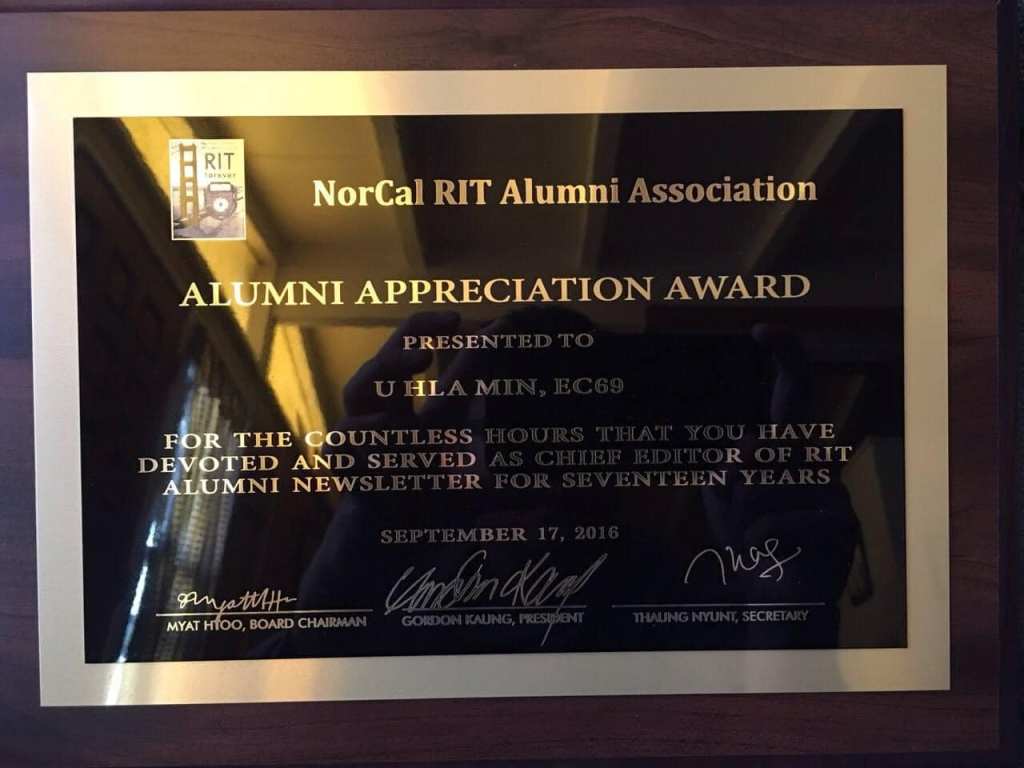
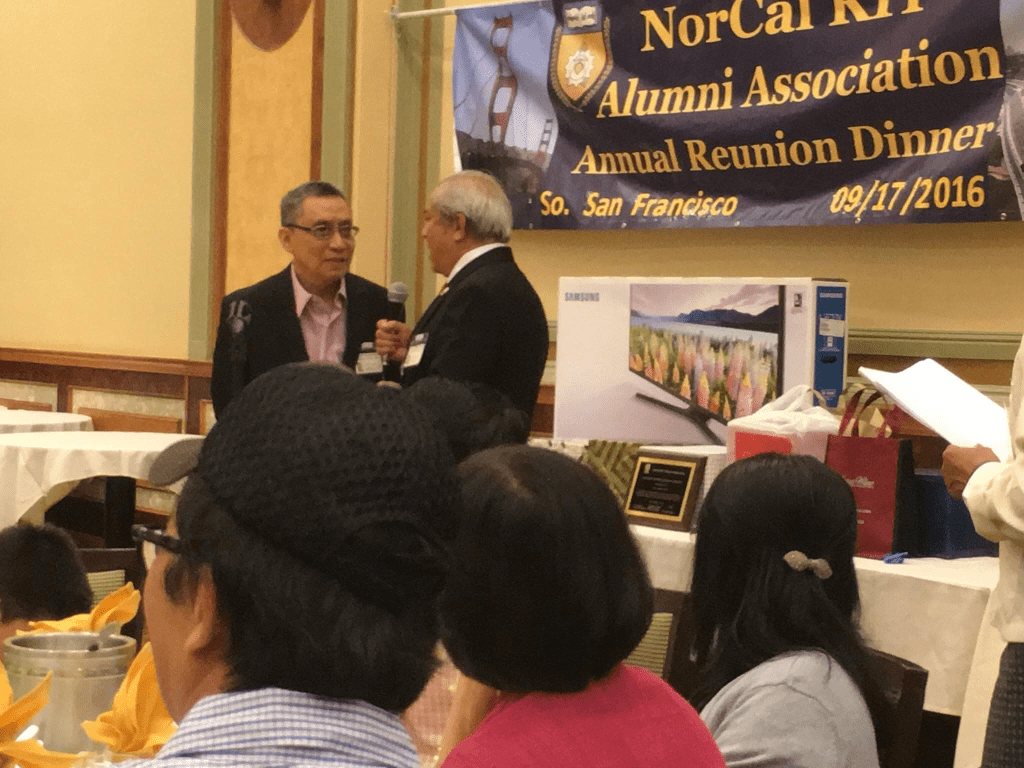
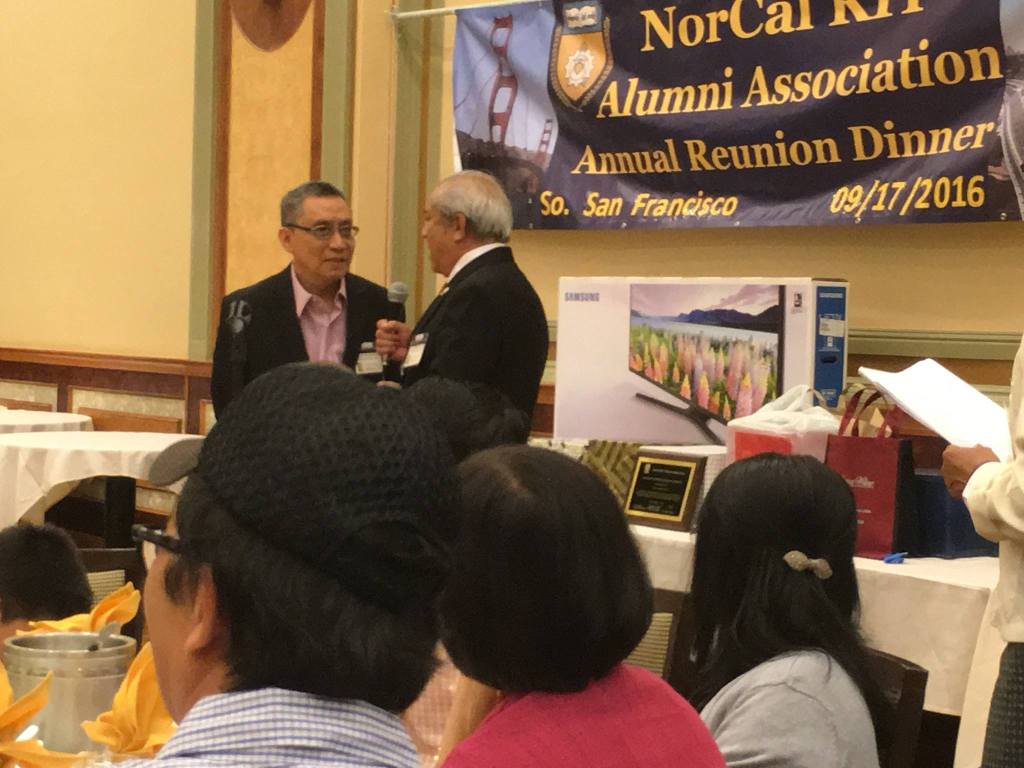
Saya U Myat Htoo (Chair, BOD, Norcal RITAA) presented the award to U Hla Min (EC69) at the Annual Dinner
Alumni Appreciation AwardAward presented by U Myat Htoo
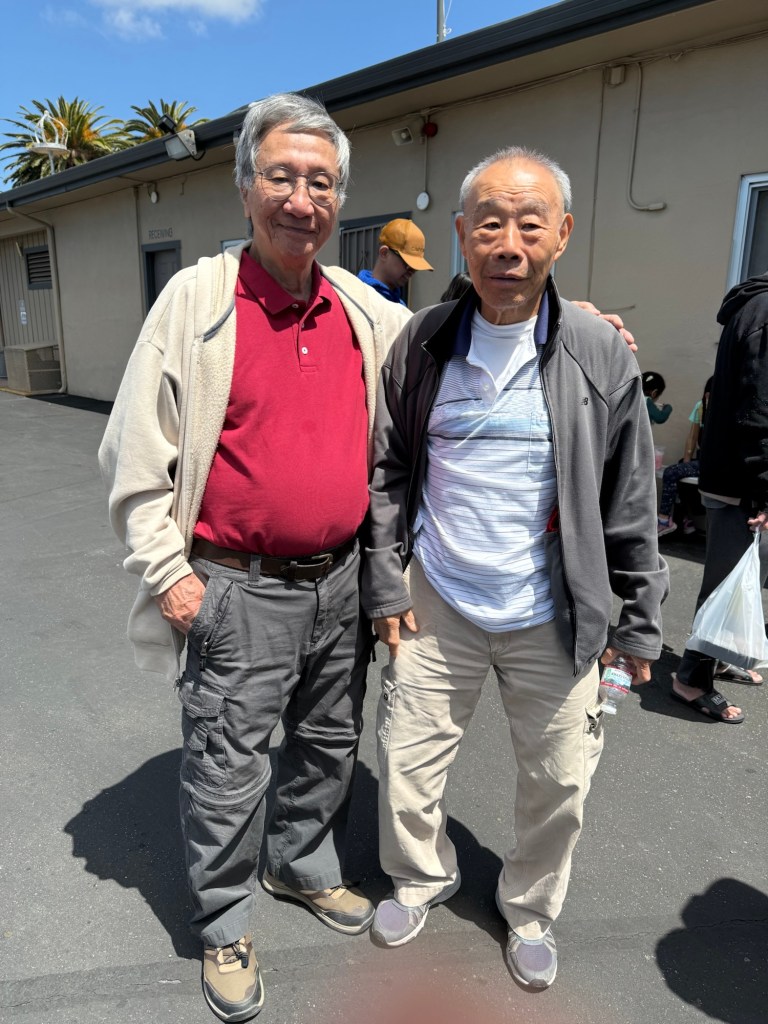
U Han Sein / A Pho Gyi (GBNF)
Represented RIT in Swimming, Water Polo, Diving and Basketball
Became a Tone Kyaw when he was inadvertently listed as GBNF in the 69er Contact List (in 1999).
He was sentenced to 20 years by a kangaroo court (along with Dr. Aung Khin Sint and Ma Thidar – Sanchaung). He was released after 17 years.
He was a Thet Kyee of Latha Township.
He took photos at the 69er gatherings and distributed them to selected attendees.
He succumbed to Covid
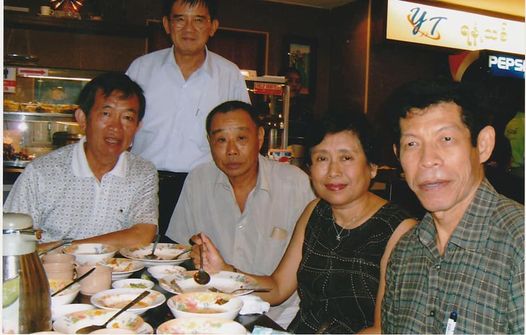
U Han Sein (GBNF), U Ngwe Tun, Roland (U Khin Maung Win), U Sein Myint (K K Wong), Cyril (U Than Hla), Oscar (U Tin Aung Win) at 69er Breakfast Gathering
U Ngwe Tun / Tun Tun
Every month, he offers Garawa money to Ashin Ukkamsa (Victor Aung Chaw) and Ashin Pannagavesaka (Bobby Myo Tun) in memory of his beloved spouse.
He offered to host the 69er breakfast gathering for Sept 2022, but the gathering did not take place. Apology was offered by U Aung Min and team.
U Khin Maung Win / Roland Thein
He was known for his debating skills.
He also competed in Scrabble tournaments.
U Sein Myint / K K Wong
He represented RIT in Swimming, Water Polo and Rowing.
He is a major Donor for 69er HCF and EE69er HCF.
He spends time in Singapore, California and Myanmar.
U Than Hla / Cyril Ba Than
Son of U Ba Than
Also known as Cyril or Cyril Than Hla
He took Training / Studies abroad.
U Tin Aung Win / Oscar Than Nyunt
He is a Moderator of RIT Updates FB group.
He uses Zoom to keep in touch with selected 69ers and HIC Colleagues.
He gave me rides to attend 69er gatherings.
U Tin Htut / Harry / Mon Yu
Hobbies (old and new)
Writing (Hmu Tin encouraged him)
Music
Tai Chi
Very Senior 69er
Harry Tin Htut
Albert Kyaw Min
Founder & President, Myanmar Pulp & Paper
Current President (AFPPI) Meeting (of 8 countries) in Thailand
Guitarist & Vocalist along with Daniel Tint Lwin (Singapore) & Robert Win Boh (Australia)
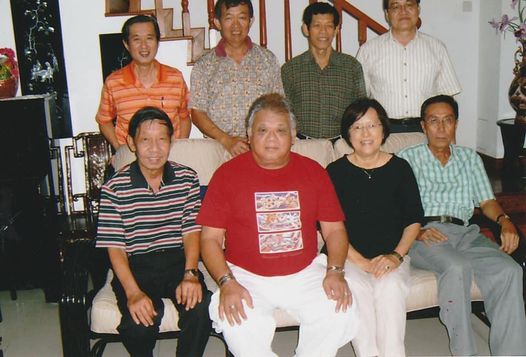
Seated : Nay Win (GBNF), Win Boh (Robert), Yi Yi Khaing (Vilma), Minn Aung (Hla Thaung) Standing: Win Naing (Dicky), Tint Lwin (Daniel), Aung Myint, Kyaw Min (Ei Kun)
Notes
U Chit Po Po’s father is U Ba Than (co-founder of Burma Chamber of Commerce). U Chit Po Po (GBNF) represented RIT in Rowing. He is an expert Harpist.
Many 69ers have less or no time for their hobbies. e.g U Tin Maung Aye (Accordion)
119 members (about a third of the Class) are GBNF. 20+ passed away (within the past two years; mostly due to Covid)
U Aung Min (M69) is Chair of the 69er HCF (Health Care Fund). He regularly sends out monthly and quarterly reports including the list of GBNF.
U Aung Min
The major donors of the 69er HCF include
Ivan Lee (U Khin Maung Oo (M69, New Jersey)
U Sein Myint (EP69, Singapore)
Daw Myint Myint (C69)
There is also EE69er HCF. U Sein Myint is a major donor of the fund. The donors’ list is maintained by Sa Maung Maung (EP69) with the help of U Shwe (EP69).
Gatherings
There are gatherings mostly for breakfast, but occasionally for lunch and dinner.
69ers (mostly M69ers but also friends from other disciplines) usually have a Monthly Breakfast Gathering at Taw Win Hnin Si (Royal Rose). The gatherings also celebrate Birthdays and Anniversaries.
Burma Selected Couple
EE69ers tried to meet once every two months.
Lunch Gatherings have been held at
Crystal Jade
Shwe Bei
Westin Royal
Breakfast Gatherings include
All Disciplines
M69ers
EE69ers
Ad hoc Gatherings include
Welcoming 69ers from overseas
Hosted by visiting 69ers
Garawa to Sayagyi U Ba Than (around his birthday : October 2)
U Aung Min (M69) is Chair of the 69er HCF (Health Care Fund). He regularly sends out monthly and quarterly reports including the list of GBNF.
U Aung Min
The major donors of the 69er HCF include
Ivan Lee (U Khin Maung Oo (M69, New Jersey)
U Sein Myint (EP69, Singapore)
Daw Myint Myint (C69)
There is also EE69er HCF. U Sein Myint is a major donor of the fund. The donors’ list is maintained by Sa Maung Maung (EP69) with the help of U Shwe (EP69).
Gatherings
There are gatherings mostly for breakfast, but occasionally for lunch and dinner.
69ers (mostly M69ers but also friends from other disciplines) usually have a Monthly Breakfast Gathering at Taw Win Hnin Si (Royal Rose). The gatherings also celebrate Birthdays and Anniversaries.
EE69ers tried to meet once every two months.
Lunch Gatherings have been held at
Crystal Jade
Shwe Bei
Westin Royal
Breakfast Gatherings include
All Disciplines
M69ers
EE69ers
Ad hoc Gatherings include
Welcoming 69ers from overseas
Hosted by visiting 69ers
Garawa to Sayagyi U Ba Than (around his birthday : October 2)
The first batch (A58) included Saya U Myo Myint Sein (Retired Professor and Head).
The second batch (A59) included U Bo Gyi (Uzin, GBNF, Designer of Mausoleum for Daw Khin Kyi) and Saya Dr. Lwin Aung (Uzin, Retired Pro-Rector).
The third batch (A60) included U Tin Htoon (Past Captain and Gold of RUBC, ARAE Champion in 1958 and 1960), U Aung Kyee Myint (Retired Chief Architect, PWD) and U Kin Maung Yin (GBNF, Modern Art, Director).
U Tha Tun (GBNF)
Saya is remembered in the articles by Saya Dr. Koung Nyunt (A67, GBNF) and U Than Tun (A65, GBNF). He served as Head of Architecture Department.
U Kyaw Min (GBNF)
Saya is an MIT alumnus. He taught part time. His pen name is Pi Thu Kar Kyaw Min. He is a founding member and EC of BARB.
U Myo Myint Sein
Saya graduated in 1958 from RaU. He did his Masters at Michigan University. He succeeded U Tha Tun as Head of Department. After retirement as Professor and Head, he moved to US. He published books. He wrote articles for RIT Alumni International Newsletter and Swel Daw Yeik Magazine.
Class of A68, A69 and A70
Saya Sai Yee Laik (A68, GBNF) stood first and last in his class.
U Kyaw Kyaw, U Thet Tun, U Aung Khin, U Myo Tun (Uzin, Bobby), Saw Tobias Kittim Ku (GBNF), Daw Thwin Thwin Aye Hmi and U Tin Maung Hla (GBNF) are from A69.
U Khin Maung Maung (A70) is an organizer for Arch Alumni gatherings.
Miscellaneous
One female student (from A60) left for India before graduation. She was the first female engineering student at RU.
Five female students — four Textile and one Chemical — graduated in 1961. They were the first batch of female engineering graduates.
EDUCATION B.S., Mining Engineering, University of California, Berkeley, California, U.S.A. 1950
Honors: Tau Beta Pi engineering honor society. M.S., Mining
Engineering, Missouri School of Mines, University of Missouri, Rolla,
Missouri 1952.
EXPERIENCE 1953 – 1964 Service with the
Ministry of Mines, Govt of Burma. Entry as Asst. Inspector of Mines,
then promoted to Inspector, Chief Inspector, Director of Mines, and
Deputy Dir. General PMDC 1954 – 1955 As Visiting Lecturer taught Mining Courses at the BOC Engineering College, Rangoon University **
1971 – 1984 Service with United Nations ESCAP in Bangkok as Economic
Affairs Officer (P-4) and rising to Chief of Mineral Resources Section
(p-5).
Note: (**) In 1954, BOC Engineering College campus
was located south of the Rangoon University estate between Prome Hall
and the Teachers Training College on Prome Road. It consisted of modest
single storied buildings. In addition to degree courses in Civil,
Electrical and Mechanical engineering, Mining courses were offered for
the first time during that year. At Dean Sayagyi Tan Ba Hli’s
request, Ministry of Mines assigned me as part time Lecturer to teach
Mining Engineering courses. U Soon Sein was later transferred from the
Mines Department to the University and taught mining courses full time.
Warm regards, U Soe Khaw
Editor’s Note:
Saya U Soe Khaw passed away about two years ago at the tender age of 90+ He is a cousin of Sayama Sheila Saing (RIT English) and Dr. Harry Saing (ARAE Champion in 1958 and 1960).
The early Engineering departments have (a) Professor (b) Lecturers (c) Assistant Lecturers
The then new Education System created (d) Instructor(s)
The newer Education System created (e) Associate Professor (s)
Typical pay scales in the early days are
Professor : 1300+ Kyats
Lecturer : 800 – 50 – 1200 Kyats for minimum, annual increment and maximum
Assistant Lecturer : 350 (and CLA) – 25 -700 Kyats and CLA (Cost of Living Allowance) was 89 Kyats (or so) The “adjusted” pay was 439 Kyats (or so) The CLA was later dropped. So, AL : 450 – 25 – 700 Kyats
Instructor : 450 – 25 – 700 Kyats The pay scale is the same as AL It takes longer to become a Lecturer
Some terminology
Selection Grade : Those who earn 800+ Kyats Entitled to buy 10% of salary at “Staff Shop”
Gazetted Officer : Those who earn 350 (and CLA) or higher 450 (Base Pay) in the newer system Promotion, deputation, transfer, leave … are published in the [Burma] Gazette
Head of Department : Large departments are headed by a Professor Sub-departments are headed by a Lecturer Supporting departments may be headed by an AL
Demonstrator / Tutor : Early days : 200 (and CLA) => 297 Kyats (or so) Later : 320 Scale Supervises lab and/or tutorials
Architecture was introduced for the very first time in 1954 at BOC, University of Rangoon. U Myo Myint Sein belongs to this first batch. One of his classmates, Ko Myint Thein retired as Chief Architect of Public Works Department in Yangon. We were the “third batch” and were fortunate to study at the brand new “Faculty of Engineering” campus, commonly known as “Leik-khone” at Pyay [Prome] Road. There were nine of us in the first year, (1956). One of them was Shajahan, an Indian lady who became the first female to join the male dominated Engineering campus. However, she was unfortunate to be the victim of the “2F” system of our days. She left for India and later graduated as an Architect from there.
In our second year, three guys from the second batch joined us. One from the first batch joined us in the final year. Two of the old-timers became the victims of the “2F” system.
One very unique and interesting aspect of being an architecture student is doing design work. We were trained to solve design problems within a stipulated time and because of that we use to spend most of our time in our studio class. Eventually, the studio became our second home. We practically eat and sleep there and we spent our break times in the studio as well.
Only when attending related Engineering subjects, we join together with other Engineering students. Otherwise, we normally confined ourselves within the Department of Architecture block and among our own group. Thus, the reason that most of the Engineering students came to know us because we were like “caged animals” in the zoo; being watched by people from outside and in our case by our friends as they walked along the corridors. Although the majority of us were day students, we were better off than those staying in the hostels as we didn’t have to pay extra to live in the studios. It was fun spending our time in the studios and as we were able to come up with fantastic ideas and designs and draw them as and whenever desired and complete the project within the stipulated time. For us, we didn’t had “days” and “nights”. The nights were more peaceful and productive for us. Only the studios in the architecture block were lit up at night. Sometimes, we even walk over to Hledan, Kamayut to have our break and supper.
When architecture was introduced at BOC in 1954, there were one British and two Indian architects as full time staff assisted by their Myanmar counterparts. They were still teaching us during our first year. Roger Johnson, also a British architect became head of Department when we got to the second year. He was assisted by Nagler, an American architect and Saya U Kyaw Min (GBNF) and Saya U Win Htain in the later years. Sayagyi U Tha Tun (GBNF), Saya U Maung Maung, Saya U Aung Myint, Saya U Khin Mg Thint and Saya U San Tun Aung were part time staff. All the architectural subjects and the studio design work were taught by them except the freehand drawing class which was taught by an artist. We were fortunate that there were no changes in the staff and they all taught us till we graduated in 1960.
Apart from the architectural staff, our years at the University will not be complete without mentioning some of our Engineering Faculty staff who taught us some of the related Engineering subjects.
The first person I wish to mention is Sayagyi Num Kock. He taught us structure and we sometimes didn’t attend his class due to our studio design assignments. Since the class was meant only for architectural students, and since he knew where to find us, he used to come straight to our studio and requested us to come and attend his class. He was very good natured, humble, and led a simple life carrying a shan bag instead of a leather brief case. We always saw him with a smiling face and was very soft spoken.
Another Saya I remembered well was Saya U Kyit In (later known as U Min Wun). He taught us survey and he was just back from the United States at that time. Whenever I had problem with the survey readings, he came over and nudged me out and checked the readings himself. He used to wear khaki long pants with a single buckle at the rear, which was the fashion of those days.
Then I remember my Strength of Materials saya, Saya U Ba Than, who happens to be my brother. He was very strict and didn’t give any special favors even to his own brother. He was famous in setting questions for the exam as he never repeated the same ones that were given and worked out in the class.
The list won’t be complete without mentioning Saya U Kyaw Tun(GBNF) who taught us Electro Technology. Since his classes were immediately after the lunch break, we had a hard time to overcome sleepiness and be attentive to his lectures.
Last, but not least, I wish to mention about Saya Solomon and Saya Wein Choung. Their metal and wood work classes were always enjoyable and plenty of fun. We were in a totally different environment, not like those of lecture theaters or studio rooms. It was in these classes that we learnt the practical aspect of transforming design drawings into finished products.
My wonderful six years at the Rangoon University will not be complete without mentioning about my rowing activities. Since I came from a rowing family starting from my uncle Chan Cheng Hock who was Captain (1940-41) and the present oldest surviving Captain, I also became Captain (1959-60) after my two brothers U Tin U (ex-faculty member of BOC) and Dr. Myo Tint. I earned my “Gold” in 1956 by competing in the Inter-varsity regatta at Calcutta. I had the opportunity to represent RUBC seven times in regattas abroad and several times in Yangon.
Although we started with nine students in the first year in 1956, ten of us graduated in 1960 due to the circumstances explained earlier. Philip Koon Ying Chu, who is now retired after being a very successful restaurant businessman in the Bay area, stood first. It was not the first time for him to have this academic achievement as he got first in the matriculation (in the whole of Burma) and was able to maintain the same position for the Intermediate of Science as well. Out of these ten graduates, six are now residing in the States. Among these six, Tan Teong Kiat (aka) Wai Lwin is the most successful professionally. He is doing consultancy work specializing in conceptual design. S. Hsiang Wu, Victor Pe Win and Jack Min continue to practice architecture in the private sector. Aung Kyee Myint became the Chief Architect of Public Works Department in Yangon and is now serving as an Advisor after his retirement. Khin Maung Yin excels in design and eventually became a well known artist in Myanmar. Later, he spent most of his time giving tuition to children. H. Hla Myint was unfortunate not to live long and passed away a few years ago.
As for me, I had to be contented with being a Managing Partner of Architects Incorporated after graduating and running my own business. It was challenging, exciting and rewarding compared to being in the Government service. However, in 1962, we had to close down our business. I joined the Industrial Development Corporation (IDC) to open a new architectural division with my two partners Aung Kyee Myint and Bo Gyi in 1964. IDC, together with Housing Board and other Civil Engineering organizations were amalgamated to form Public Works Corporation. While working with Public Works, I had the opportunity to design Thiripyitsayar Hotel in Pagan (Bagan). Now, it is the only hotel complex left within the archaeological zone of Pagan and I am proud to be associated with it. I left Myanmar in 1980 and worked as Sr. Architect with one of the well known architectural firms in Singapore. I had a wonderful and memorable time for over ten years designing multi-story hotels, aerospace exhibition pavilions, commercial complexes, restoration projects and luxurious bungalows. In the beginning I had to work very hard to get acquainted with building codes, bye-laws and local regulations as we never had such standards and regulations to abide by at home. It was wonderful to discharge the duties of an architect properly as “Prime Consultant”. It was like a “Commander-in-Chief”, coordinating with other Engineering disciplines and the related fields like interior decorators and landscape architects, chairing site meetings etc.
Now that I have settled down in Los Angeles and working for Design Division of L.A. County Dept. of Public works, I am devoting most of my time more in assisting those who are deeply involved in the propagation and perpetuation of Buddha Sasana.
In conclusion, I wish to pay my tribute to all my Sayas and wish to thank them for educating and equipping us with proper tools in order to be able to face any type of situation in this world. And to my classmates, I salute all of you for your lifetime achievements and hope that this article will throw some light about our wonderful days at “Leik-khone”.