Category: Sutta

  • Ratana Sutta ရတနာ့သုတ်

    Ratana Sutta ရတနာ့သုတ်

    by Hla Min

    Update : 6th October 2026

    Ratana / Yadanar

    Ratana ရတနာ means Gem (precious jewel)

    Ratana Sutta

    • Second Sutta in “Paritta Pali”
    • Ashin Ananda အရှင်အာနန္ဒာ recited the Sutta at Vesali ဝေသာလီ
    • Assertion of truth
    • To overcome three calamities ကပ်ကြီးသုံးပါး — massive losses due to famine, diseases, and
      [destructive] weapons

    Triple Gems

    • Buddha ဗုဒ္ဓ
      The Blessed One, the Worthy One, the Enlightened One
    • Dhamma ဓမ္မ
      Teachings of the Buddha
    • Sangha သံဃာ
      Monastic Order of the Buddha; Congregation of [paramatta] monks

    Three Refuges သရဏဂုံ

    • I take refuge in the Buddha
    • I take refuge in the Dhamma
    • I take refuge in the Sangha

    Sutta သုတ္တန်

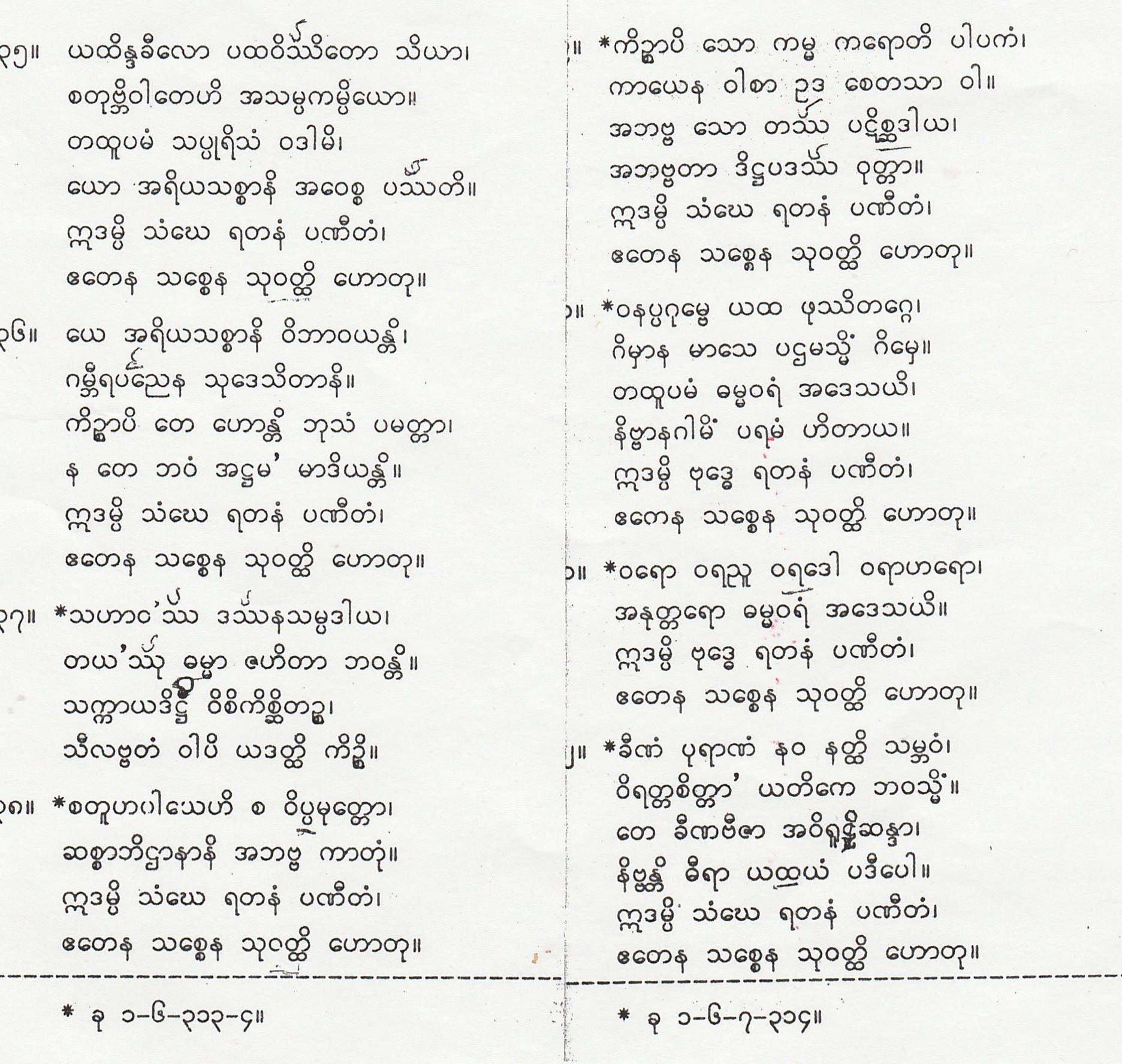
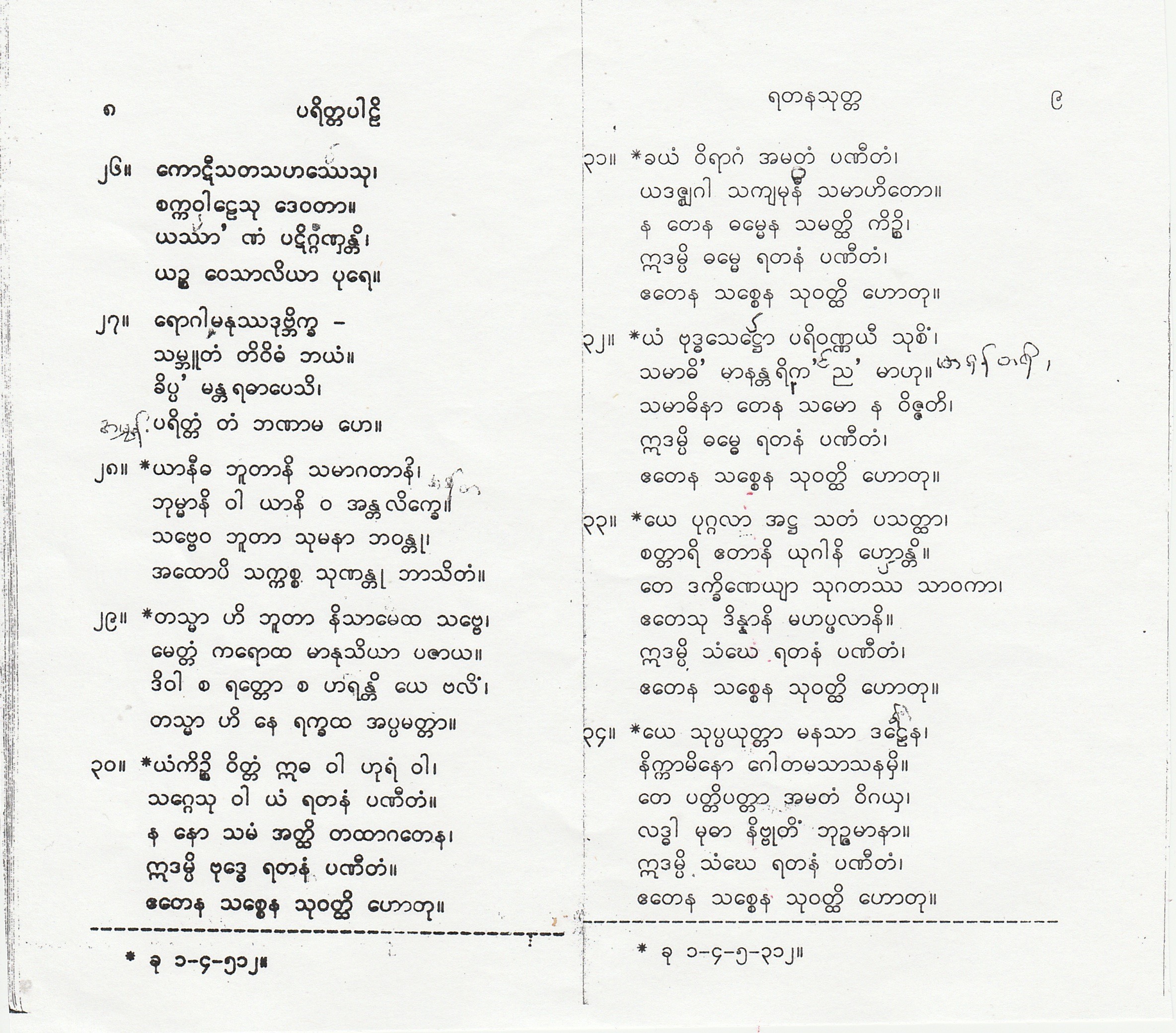
    Pali in Burmese script

    This image has an empty alt attribute; its file name is pp-6-7.jpg
    Sutta 1
    This image has an empty alt attribute; its file name is pp-8-9.jpg
    Sutta 2
    This image has an empty alt attribute; its file name is pp-10-11.jpg
    Sutta 3
    This image has an empty alt attribute; its file name is pp-12-13.jpg
    Sutta 4

    Pali Text & English Translation

    This image has an empty alt attribute; its file name is p12-13-1.jpg
    Sutta 5
    This image has an empty alt attribute; its file name is p14-15.jpg
    Sutta 5
    Paritta Pali
    Payeik Kyee
  • Vipassana Q & A

    Excerpts from
    “Introduction to Vipassana Meditation”
    by Venerable U Silananda


    Where does the practice of Vipassana come from?

    Vipassana meditation chiefly comes from the tradition of Theravada Buddhism. There are two major divisions of Buddhism in the world today – Mahayana and Theravada. Mahayana tradition developed as Buddhism spread to the Northern Asian countries of Tibet, China, Japan, etc. Theravada tradition stay in Southern Asia and spread to Sri Lanka, Burma (Myanmar), Thailand, Cambodia and Laos.

    What does Vipassana mean?

    The word Vipassana is composed of two parts — vi which means “in various ways” and passana which means “seeing”. So, Vipassana means seeing in various ways.

    What can Vipassana meditation do for me?

    The ultimate purpose of Vipassana is to eradicate mental impurities from your mind altogether. Before that stage, there are the benefits of tranquility, peace of mind and the ability to accept things as they come. Vipassana helps you to see things as they truly are, not as they appear to be. Things appear to be permanent, desirable and substantial, but actually they are not. When you practice Vipassana meditation, you will see for yourself the arising and disappearing of mental and physical phenomena. And you will have clearer comprehension of what is going on in your mind and body. You will be able to accept things as they come to you with less agitation and deal with situations in a more positive way.

    Can Vipassana be applied to daily life?

    You can have awareness of whatever you do whether you are working, walking, doing, etc. It will not be as intense as in a meditation or during a retreat, but a more general awareness. And when you apply mindfulness to problems in your life, you will be able to deal with them more effectively.

    Why should I go to a meditation retreat?

    The intensive practice of a retreat is very beneficial for developing good concentration and quieting the mind. Since concentration is essential for penetrative wisdom to arise, a meditation retreat gives you the best possible opportunity to be able to experience for yourself the true nature of reality.

  • Bojjhanga Sutta

    Seven Factors of Enlightenment

    • Mindfulness
    • Investigation of dhammas
    • Effort (or energy)
    • Zest
    • Tranquility
    • Concentration
    • Equanimity

    Bojjhanga Sutta

    • 10th Sutta in “Paritta Pali”
    • Gatha (Pali Verse)
    • For protection against and getting free from sickness and disease
    • Reference the three occasions when Venerable Mogallana, Venerable Kassapa, and Lord Buddha felt sick but were cured after listening to and contemplating on the “Seven factors of Enlightenment”
    • This is one of the Suttas that is not only for chanting but also for practice

    Bojjhanga Suttas (in Pali Prose) in the Scriptures

    • Mogallana Bhojjhanga Sutta
      Recited by Lord Buddha
    • Kasapa Bojjahanga Sutta
      Recited by Lord Buddha
    • Buddha Bojjhanga Sutta
      Recited by Venerable Cunda

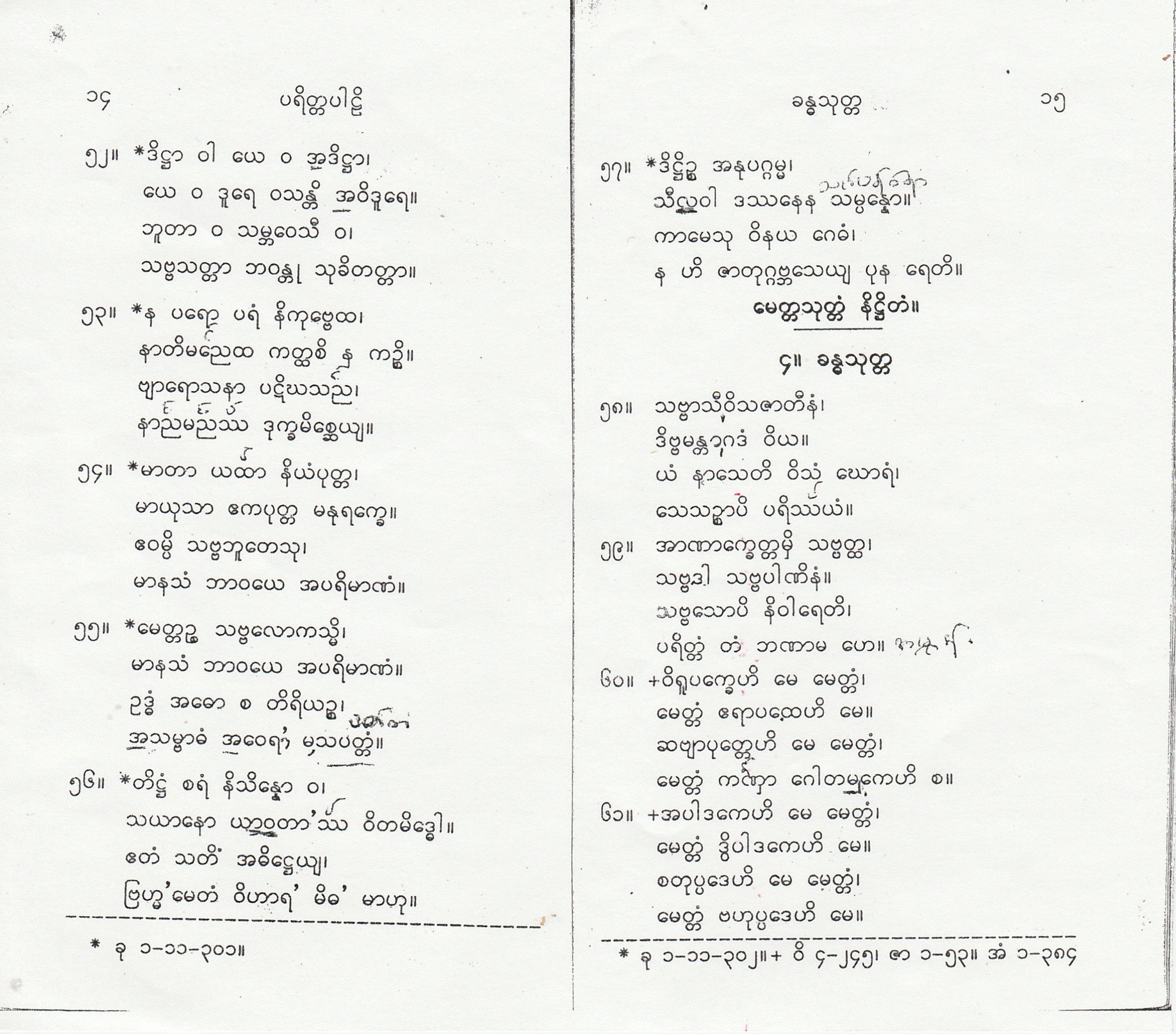
    Pali (in Burmese Script)

    This image has an empty alt attribute; its file name is pp-34-35-1.jpg
    This image has an empty alt attribute; its file name is pp-36-37.jpg
  • Mangala Sutta

    Mangala

    • Mangala is usually rendered as Auspices or Blessings.
      Myanmar call it Mingalar
    • Mangala Sutta describes 38 Blessings, which are related to both Loki (mundane) and Lokotra (supramundane).
      First of the 11 Suttas covered in Paritta Pali / Protective Verses.

    For lay persons

    • U Thu Kha wrote a book discussing the Mangala Sutta (using lay people’s terms).
    • At PPBRS, we had to study “Mingalar Kabyar” (poem) by Saya Dagon U Tun Myint.
      Received a Thermos flask for successfully reciting the Kabyar.
    • Cartoon U Pe Thein illustrated the 38 Blessings.

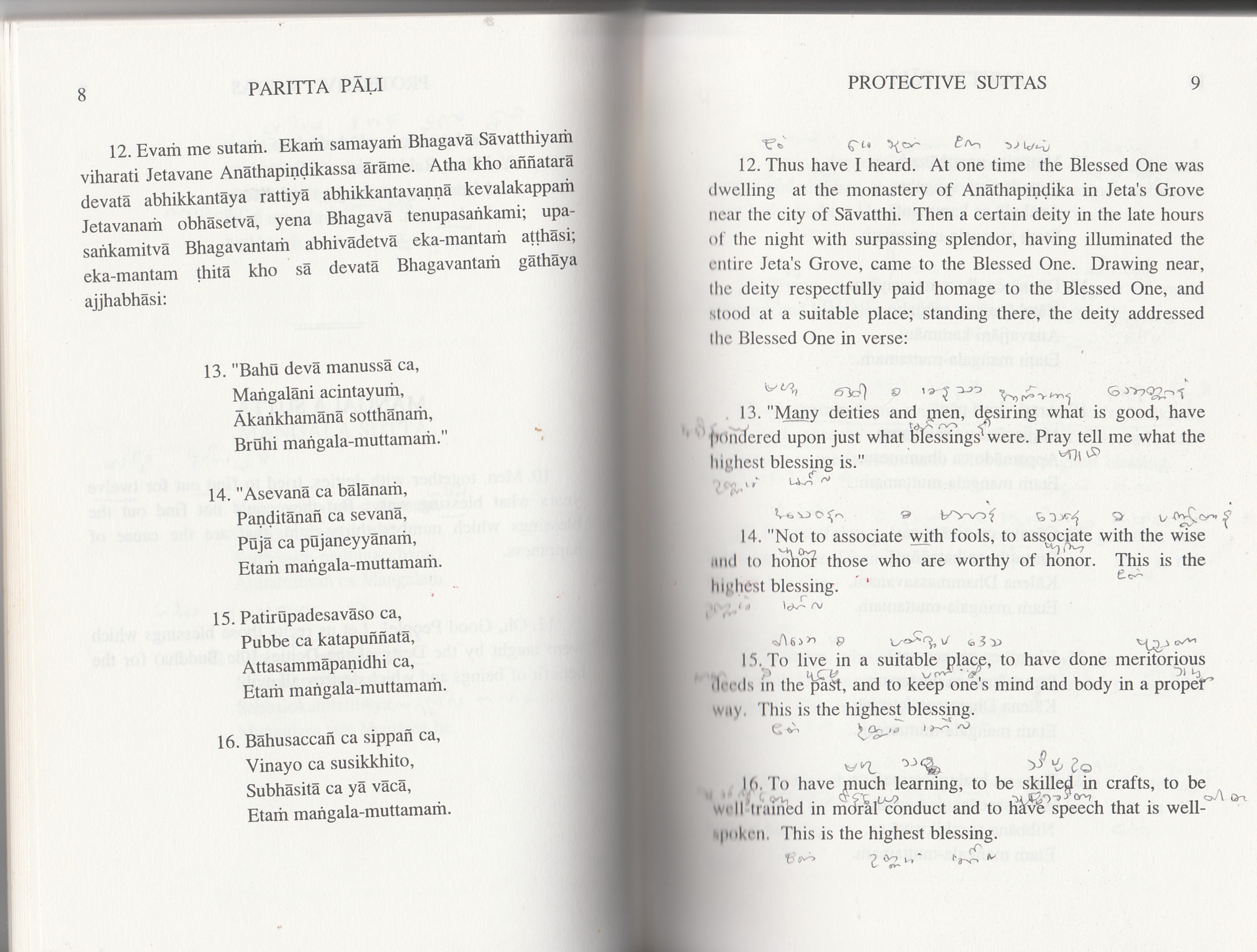
    Highest Blessing

    From Paritta Pali and Protective Suttas
    by Sayadaw U Silananda

    • Not to associate with fools,
      to associate with the wise and
      to honor those who are worth of honor.
    • To live in a suitable place,
      to have done meritorious deeds in the past, and
      to keep one’s mind and body in a proper way.
    • To have much learning,
      to be skilled in crafts,
      to be well-trained in moral conduct and
      to have speech that is well-spoken.
    • Caring for one’s mother and father,
      supporting one’s spouse and children and
      having work that causes no confusion.
    • Giving, practice of what is good,
      support of one’s relatives and
      blameless actions.
    • Abstention from evil in mind,
      abstention from evil in body and speech,
      abstention from intoxicants and
      non-negligence in meritorious acts.
    • Respectfulness,
      humbleness,
      contentment,
      gratitude and
      listening to the Dhamma on suitable occasions.
    • Practice that consumes evil states,
      a noble life,
      seeing the Noble Truths and
      realization of Nibbana.
    • The mind of a person (an Arahant) who is confronted with worldly conditions does not flutter,
      is sorrowless,
      stainless and
      secure.
    • Having fulfilled such things as these, beings are invincible everywhere and happiness everywhere.
    • This is the highest blessing for them.
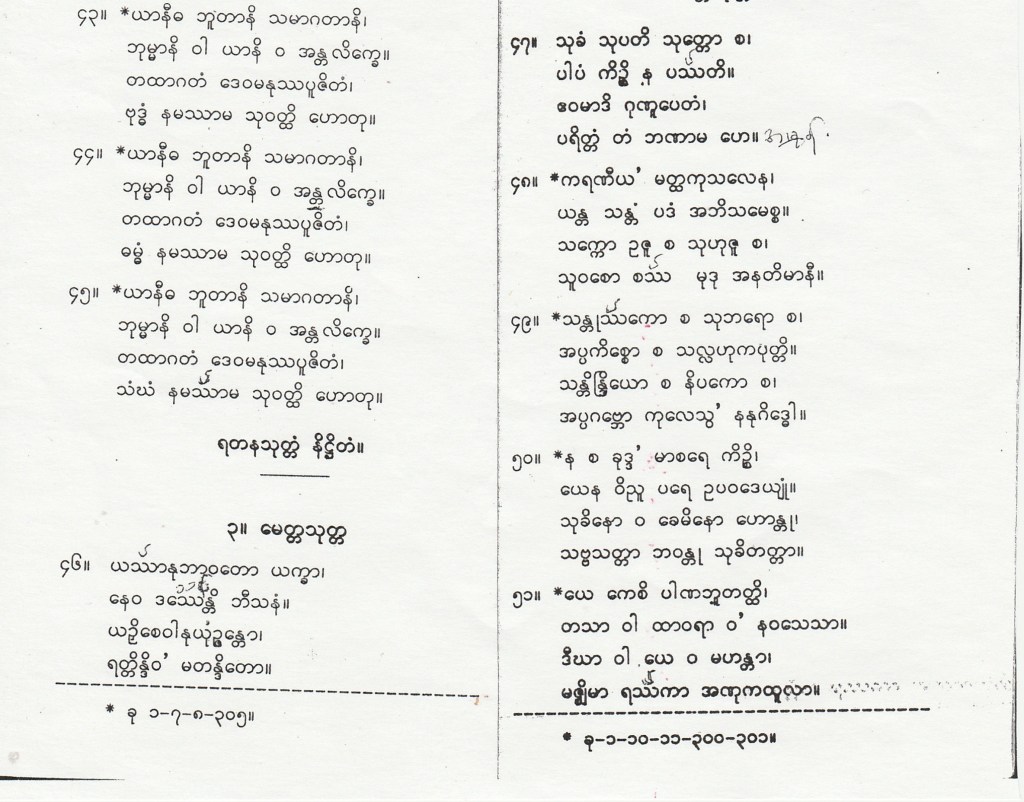
    This image has an empty alt attribute; its file name is paritta-pali-1.jpg
    Paritta

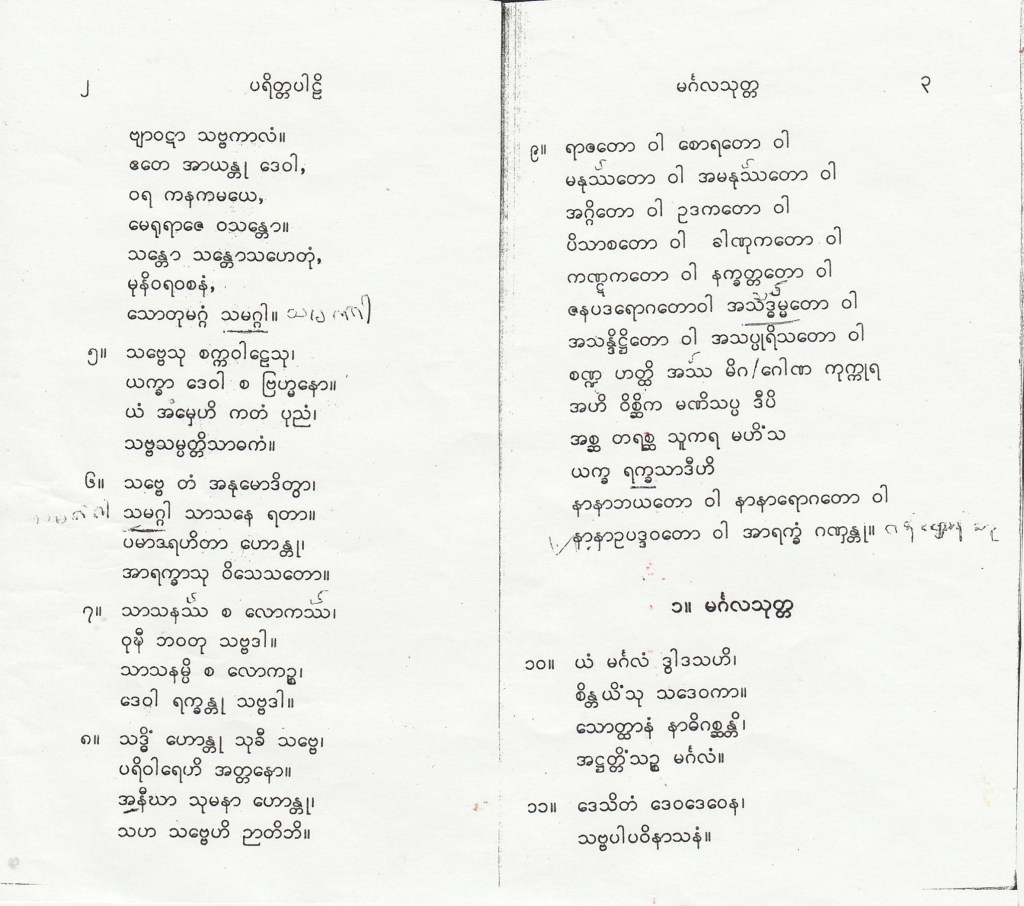
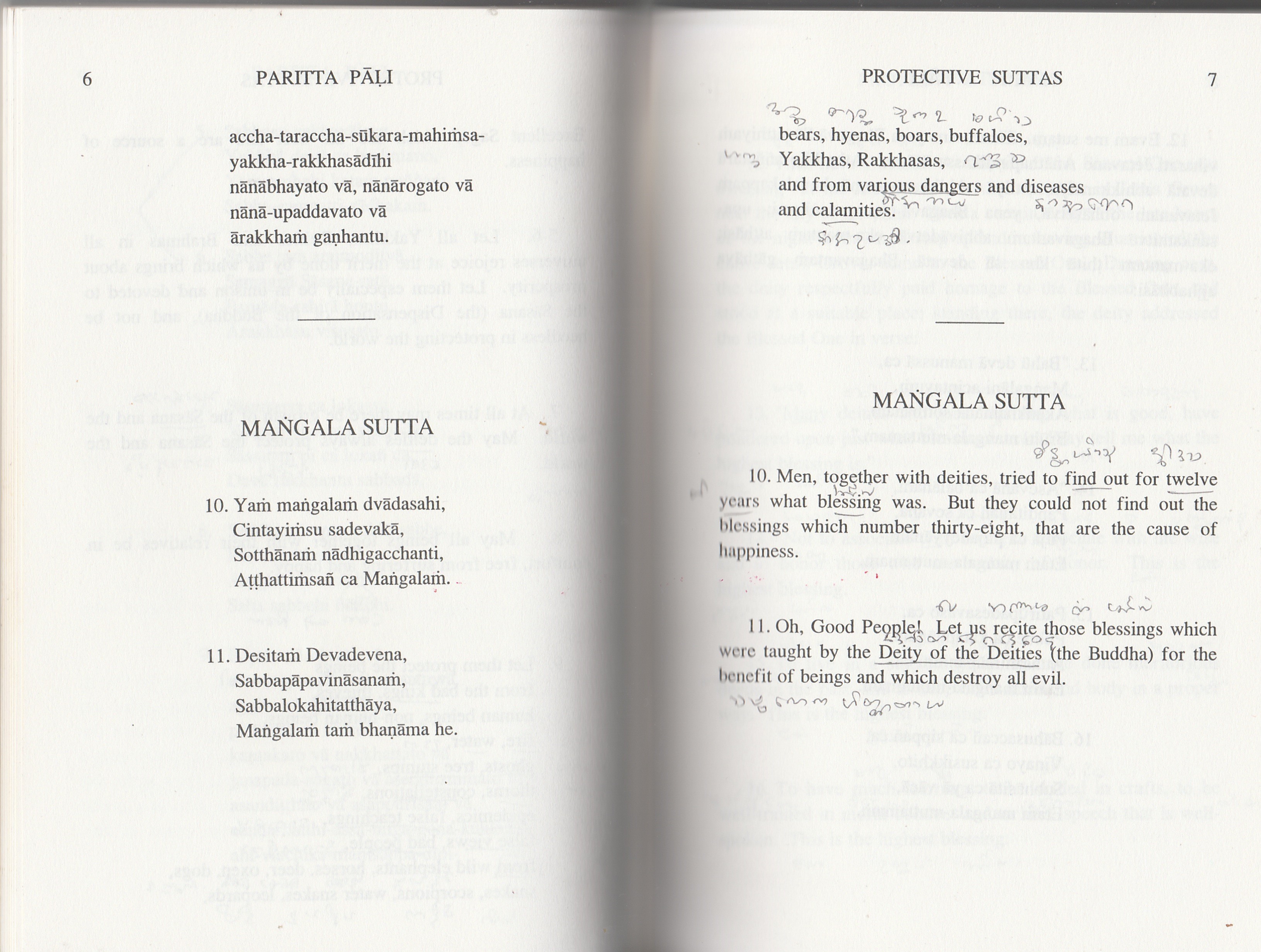
    Mangala Sutta Text

    This image has an empty alt attribute; its file name is pp-2-3.jpg
    This image has an empty alt attribute; its file name is pp-4-5.jpg
    This image has an empty alt attribute; its file name is pp-6-7.jpg
    This image has an empty alt attribute; its file name is p6-7-1.jpg
    This image has an empty alt attribute; its file name is p8-9.jpg
    This image has an empty alt attribute; its file name is p10-11.jpg
    This image has an empty alt attribute; its file name is p12-13.jpg
  • Metta Sutta

    METTA (“Myitta”)

    METTA => Unbounded love, Loving kindness

    METTA SUTTA => Third sutta in “Paritta Pail”
    also referred to as KARANIYA METTA SUTTA
    Desirable qualities of a “practitioner”
    Loving kindness “meditation”

    FORMAL => Translated from Pali into Burmese/Myanmar, English, …
    http://www.accesstoinsight.org/tipitaka/…/snp.1.08.than.html

    INFORMAL => Books by Saya U Thu Kha, Saya Dr. Mehm Tin Mon, …

    CHANTING => Two ways (as per Mingun Tipitaka Sayadawgyi)
    referred to in METTA SUTTA
    alternative: 528 “Metta” (13 x 4 x 12)

    This image has an empty alt attribute; its file name is pp-12-13.jpg
    This image has an empty alt attribute; its file name is pp-14-15.jpg
  • Paritta Pali and Protective Suttas

    by Hla Min

    Updated : May 2025

    U Silananda

    • Sayadaw wrote the book and also made recordings in Pali and English.
    • A Thai devotee published the book and CD as a present for Sayadaw’s birthday.

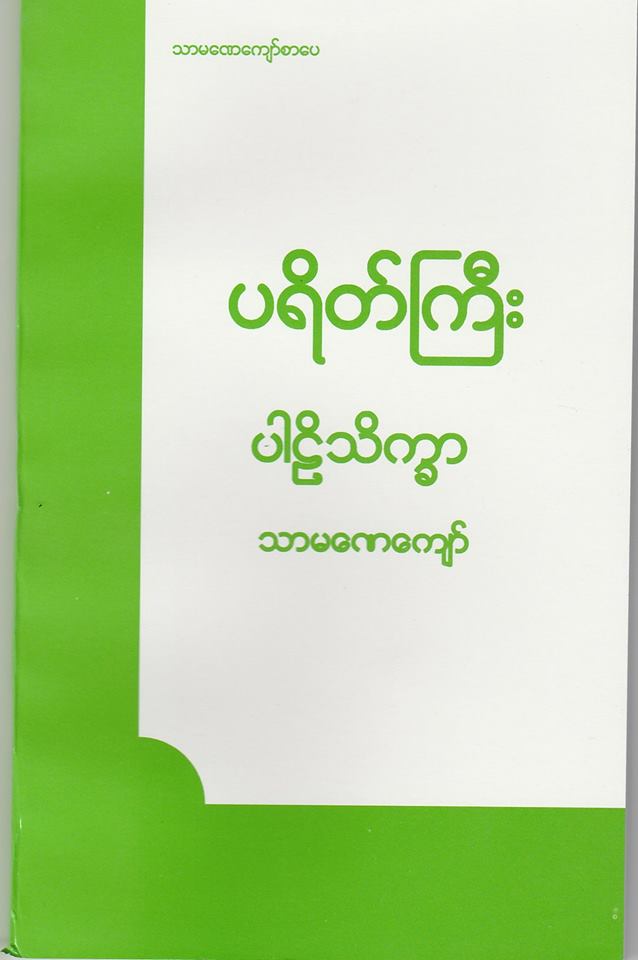
    Book

    This image has an empty alt attribute; its file name is paritta-pali.jpg
    Front cover
    Back cover
    This image has an empty alt attribute; its file name is p2-3-1.jpg
    Sample page
    This image has an empty alt attribute; its file name is p4-5.jpg
    Sample page
    This image has an empty alt attribute; its file name is p6-7.jpg
    Sample page

    Protective Suttas

    • Mangala Sutta
    • Ratana Sutta
    • Metta Sutta
    • Khanda Sutta
    • Mora Sutta
    • Vatta Sutta
    • Dhajagga Sutta
    • Atanatiya Sutta
    • Angulimala Sutta
    • Bhojjanga Sutta
    • Pubbhana Sutta

    Book (in Burmese Script for Pali)

    This image has an empty alt attribute; its file name is pp-contents.jpg
    This image has an empty alt attribute; its file name is pp-1.jpg
    This image has an empty alt attribute; its file name is pp-2-3.jpg