Category: Sutta

  • Buddhist Councils

    Buddhist Councils

    by Hla Min

    Updated : June 2025

    According to the Theravada Buddhist tradition, there are six Buddhist Councils. The last two were held in Burma.

    Mandalay

    Ripley’s “Believe it or not” named U Khanti Kyauksar (inscriptions) of the Fifth Buddhist Council (Synod) held in Mandalay as the “Largest Book” in the world.

    The Council was held to celebrate the 2400th Year in Sasana Era.

    King Mindon was the Sponsor.

    Kaba Aye

    U Nu & Sir U Thwin were prime movers for the Sixth Buddhist Council, which was held to celebrate the 2500th Year in Sasana Era.

    Mahasi Sayadaw မဟာစည်ဆရာတော် acted as the Questioner.

    Mingun Sayadaw မင်းကွန်းတရာတော် acted as the Reciter & Responder.
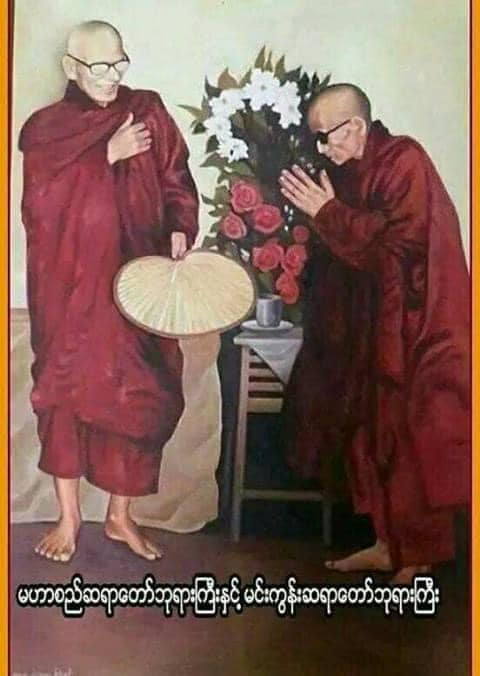
    Mahasi & Mingun Sayadaws

    The Guinness Book of World Records listed Tipialkadara Sayadaw Ashin Vicittathara as having an outstanding memory — the best at that time [in 1954]. Sayadaw served as the Chief Reciter (a la Ashin Upali and Ashin Ananda at the First Buddhist Council) at the Sixth Buddhist Council held at KabaAye (World Peace) Pagoda in Rangoon, Burma from 1954 – 1956.

    Sayadaw could memorize, recall, and give exposition on 8027 pages of the Buddhist Scriptures known as Tipitaka [“Three Baskets”] :

    • Vinaya – Rules of monastic conduct
    • Sutta – Buddha’s discourses
    • Abhidhamma – Ultimate reality)

    He took the 2nd – 5th Tipitakadara examinations and passed with distinction in both oral and written parts. Sayadaw served as an examiner for the first Tipikadara examination. Sir U Thwin requested him to take the examination. The rest is history.
  • Anattalekhana Sutta

    Anattalekhana Sutta

    by Hla Min

    Updated : June 2025

    Atta and Anatta

    Some early religions talked about reincarnation (transmigration of atta, atman, soul). In contrast, Buddhism discusses rebirth and no-soul (anatta).

    Sutta

    The Buddha delivered “Anattalakkhana Sutta” as a follow-up sermon to the “Taya Oo” to his five disciples led by Ashin Kondanna. The Sutta’s title literally means “No-self characteristic discourse”.

    Buddha taught that “each of the five khandas (aggregates) are subject to impermanence (anicca), and suffering, unsatisfactoriness, or misery (dukkha) and thus unfit for identification with a self”.

    The five disciples became enlightened after listening to the Sutta. They became members of the (Paramatta) Sangha, the third of the Triple Gems.

    Books

    Book

    There are many books on the Sutta including the one by Mahasi Sayadaw explaining the relevance of the Sutta to Vipassana meditation.

    There is also an English translation of the Sutta by Saya U Pe Maung Tin.

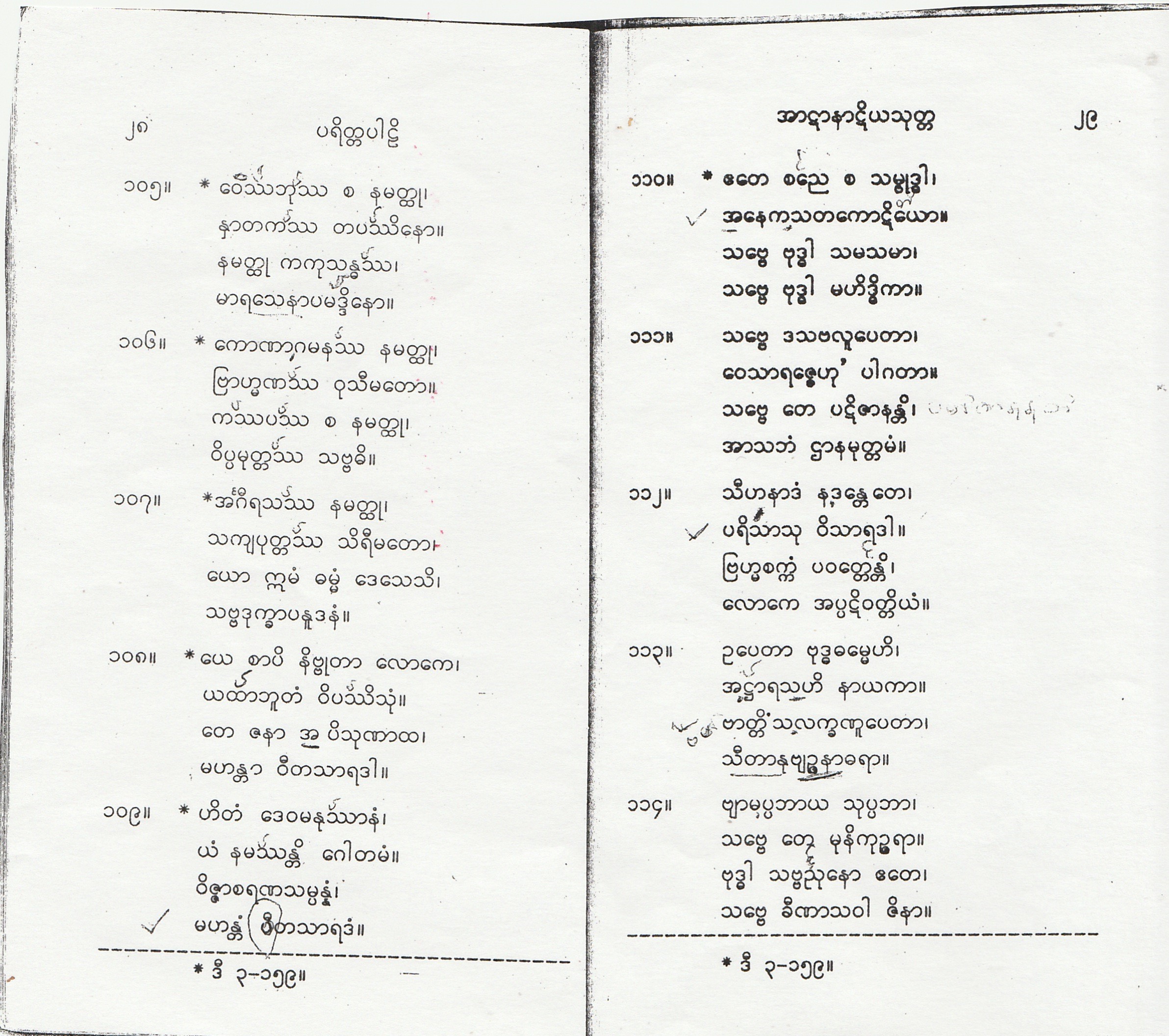
  • Dhajagga Sutta

    Dhajagga Sutta

    by Hla Min

    Updated : June 2025

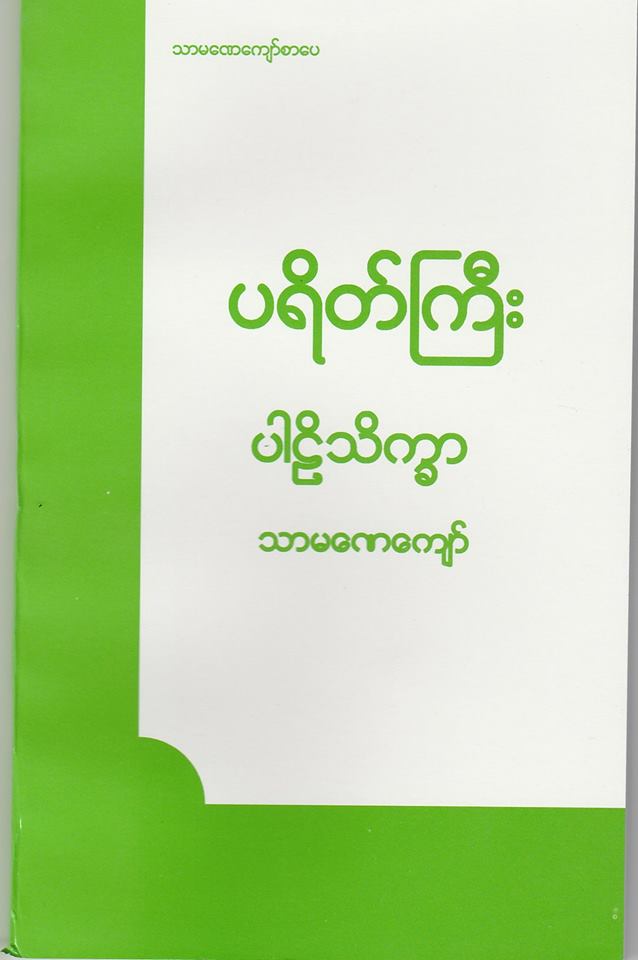
    Paritta

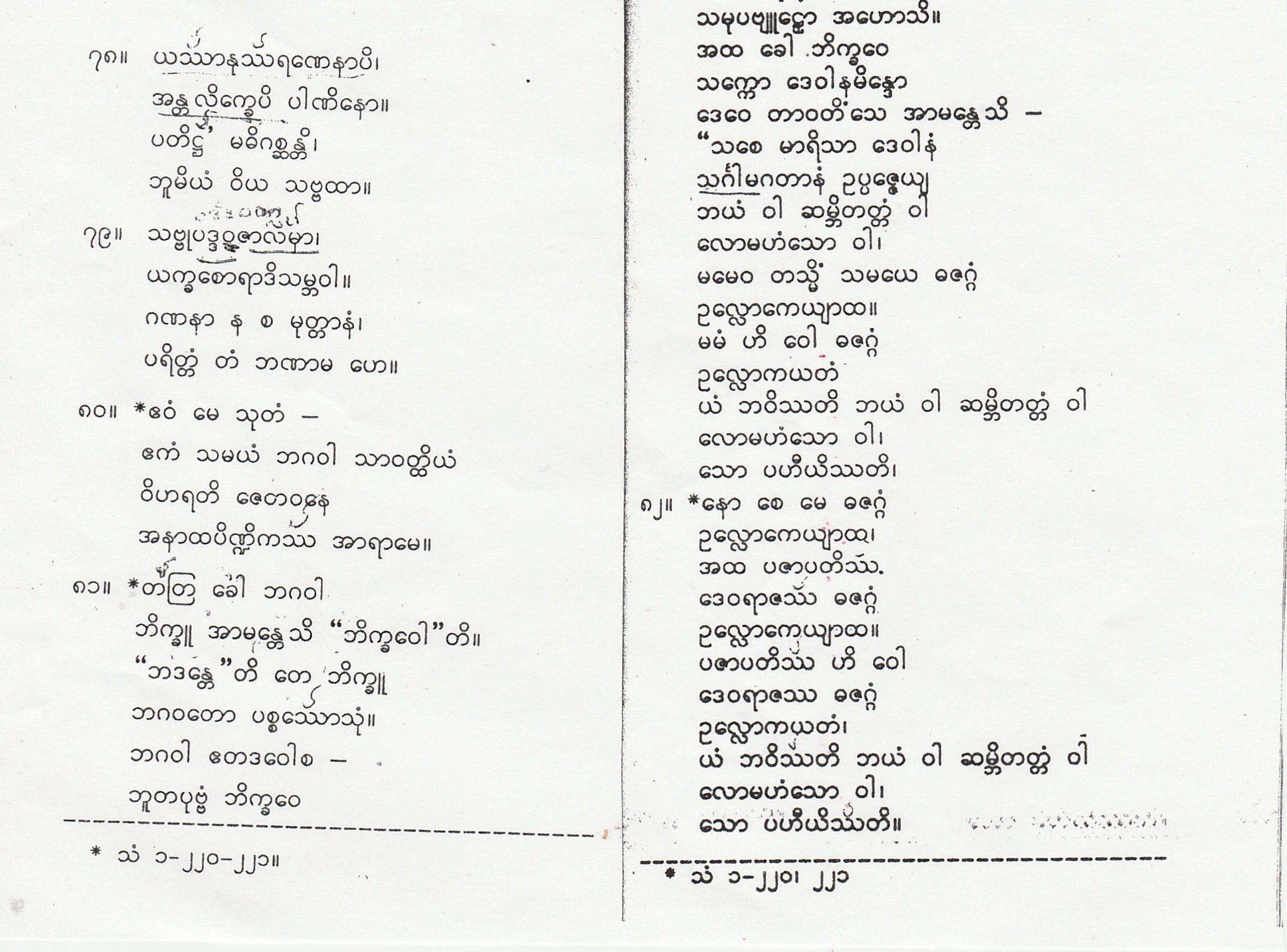
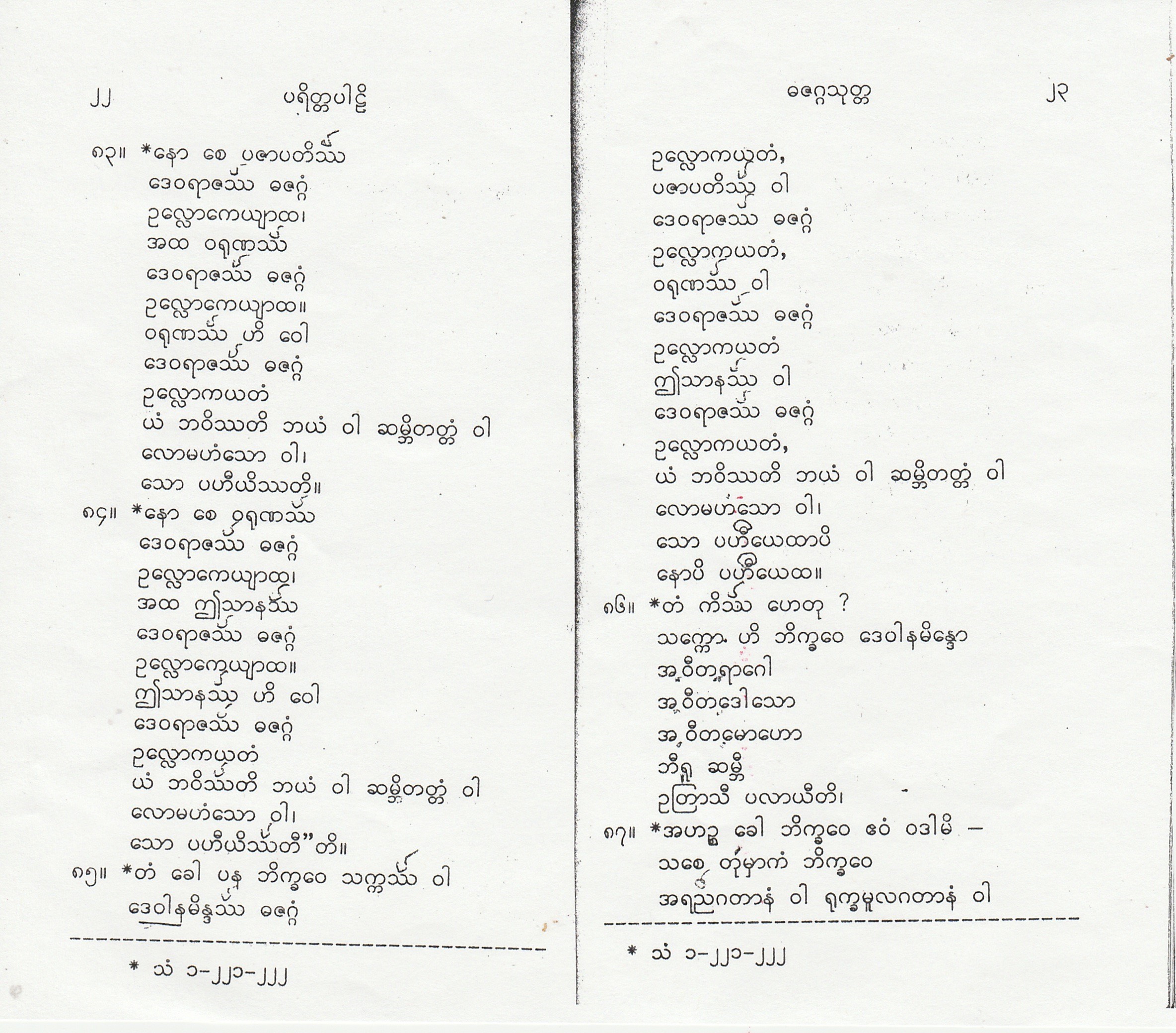
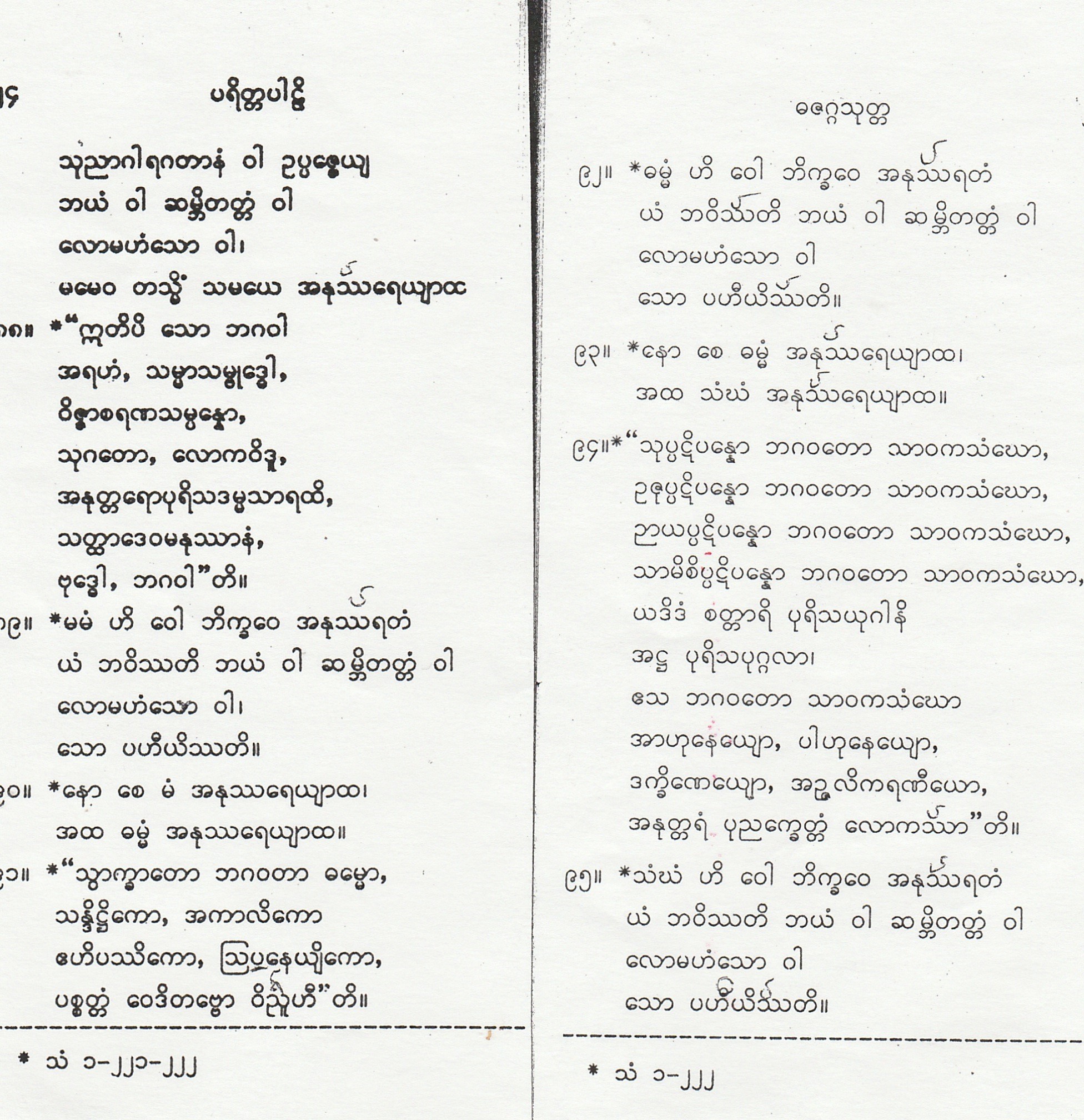
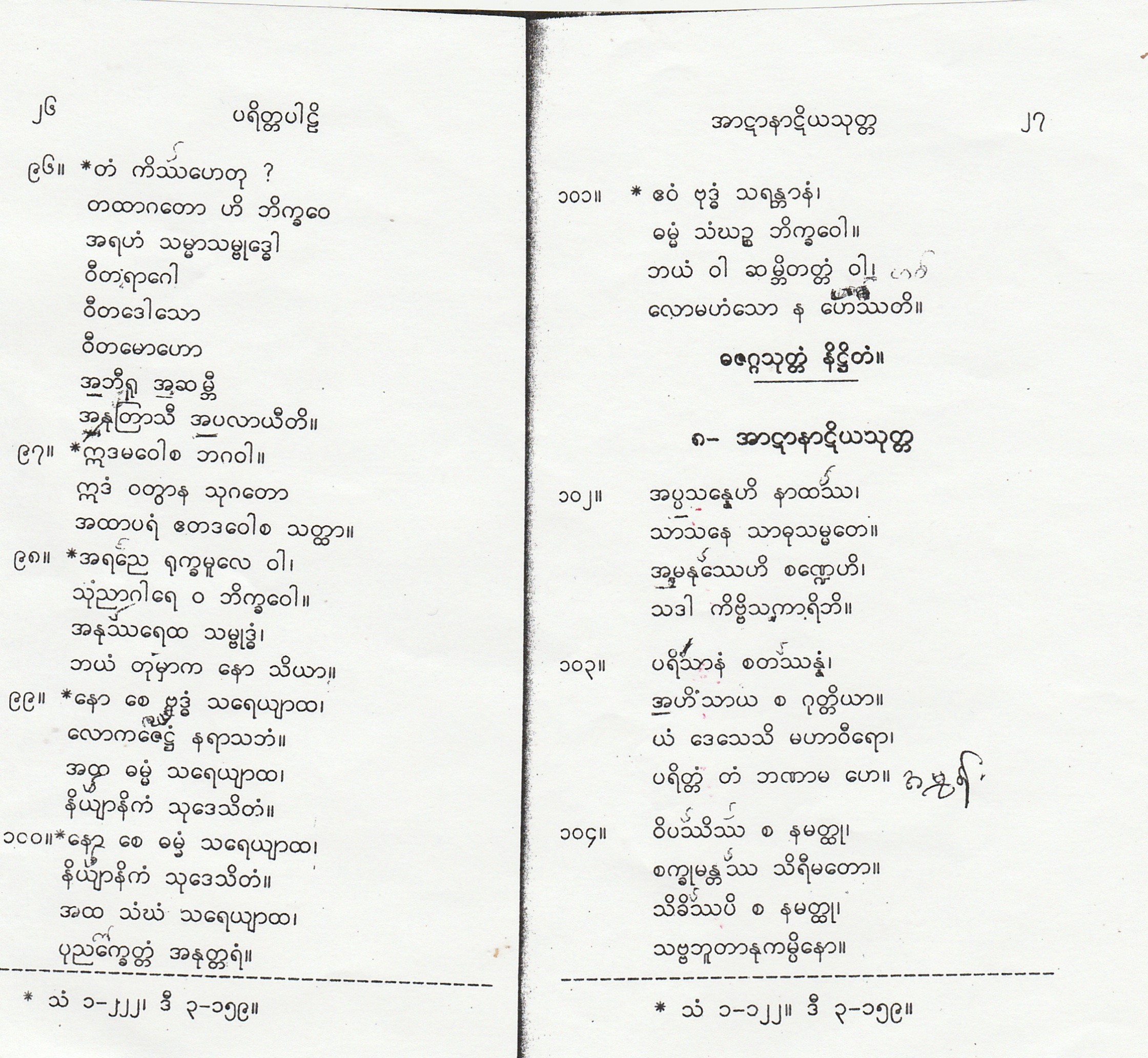
    Dhajagga ဓဇဂ္ဂ

    Dhajagga stands for Banner / “Ta Gun”

    Dhajagga Sutta ဓဇဂ်သုတ်

    • 7th Sutta in Paritta Pali (Protective Verses)
    • Exhortation from Cakka (“Thakyar Min” သိကြားမင်း) to his soldiers preparing for the battle with the Asuras အသူရာ
      “If you have fear or trepidation, try to catch the sight of my banner (if that’s possible) or that of the other Deva-Kings: Pajapati, Varuna, and Isana. For when you have caught sight of the banners, whatever fear, or trepidation there is will disappear.”
    • Buddha ဗုဒ္ဓ said,
      “Because of the Lobha လောဘ Dosa ဒေါသ and Moha မောဟ in the Deva-Kings, fear or trepidation may not disappear. So, monks, if you feel fear and trepidation in the wilderness, … or an empty building, you should recollect the following: Nine qualities of the Buddha, Six qualities of the Dhamma, Nine qualities of the Sangha

    Pali (in Burmese Script)

    This image has an empty alt attribute; its file name is pp-20-21.jpg
    Script 1
    This image has an empty alt attribute; its file name is pp-22-23.jpg
    Script 2
    This image has an empty alt attribute; its file name is pp-24-25.jpg
    Script 3
    This image has an empty alt attribute; its file name is pp-26-27.jpg
    Script 4
  • Vipassana Q & A

    Excerpts from
    “Introduction to Vipassana Meditation”
    by Venerable U Silananda


    Where does the practice of Vipassana come from?

    Vipassana meditation chiefly comes from the tradition of Theravada Buddhism. There are two major divisions of Buddhism in the world today – Mahayana and Theravada. Mahayana tradition developed as Buddhism spread to the Northern Asian countries of Tibet, China, Japan, etc. Theravada tradition stay in Southern Asia and spread to Sri Lanka, Burma (Myanmar), Thailand, Cambodia and Laos.

    What does Vipassana mean?

    The word Vipassana is composed of two parts — vi which means “in various ways” and passana which means “seeing”. So, Vipassana means seeing in various ways.

    What can Vipassana meditation do for me?

    The ultimate purpose of Vipassana is to eradicate mental impurities from your mind altogether. Before that stage, there are the benefits of tranquility, peace of mind and the ability to accept things as they come. Vipassana helps you to see things as they truly are, not as they appear to be. Things appear to be permanent, desirable and substantial, but actually they are not. When you practice Vipassana meditation, you will see for yourself the arising and disappearing of mental and physical phenomena. And you will have clearer comprehension of what is going on in your mind and body. You will be able to accept things as they come to you with less agitation and deal with situations in a more positive way.

    Can Vipassana be applied to daily life?

    You can have awareness of whatever you do whether you are working, walking, doing, etc. It will not be as intense as in a meditation or during a retreat, but a more general awareness. And when you apply mindfulness to problems in your life, you will be able to deal with them more effectively.

    Why should I go to a meditation retreat?

    The intensive practice of a retreat is very beneficial for developing good concentration and quieting the mind. Since concentration is essential for penetrative wisdom to arise, a meditation retreat gives you the best possible opportunity to be able to experience for yourself the true nature of reality.

  • Dhammacakkappavatttana Sutta

    The Great Discourse on the Wheel of Dhamma

    • Teacher : The Venerable Mahasi Sayadaw
    • Translator : U Ko Lay
    • Sukhi Hotu Dhamma Publication 1998

    PART I

    • Preface to the Discourse
    • The Date of the Discourse
    • Three Kinds of Introduction

    PART II

    • Sensuous gratification is base and vulgar
    • Dittadhamma Nibbana Vada
    • A low, common practice

    PART III

    • Elaboration of the Eight-fold Path

    PART IV

    • Truth of Suffering (Dukka Sacca)

    PART V

    • Samudaya Sacca

    PART VI

    • Nirodha Sacca

    PART VII

    • Sacca Nana with regard to Dukka Sacca
    • Kicca Nana with regard to Dukka Sacca
    • Kata Nana with regard to Dukka Sacca

    PART VIII

    • When the Buddha did not admit Enlightenment
    • Acknowledgement of Buddhahood
    • Concluding statement
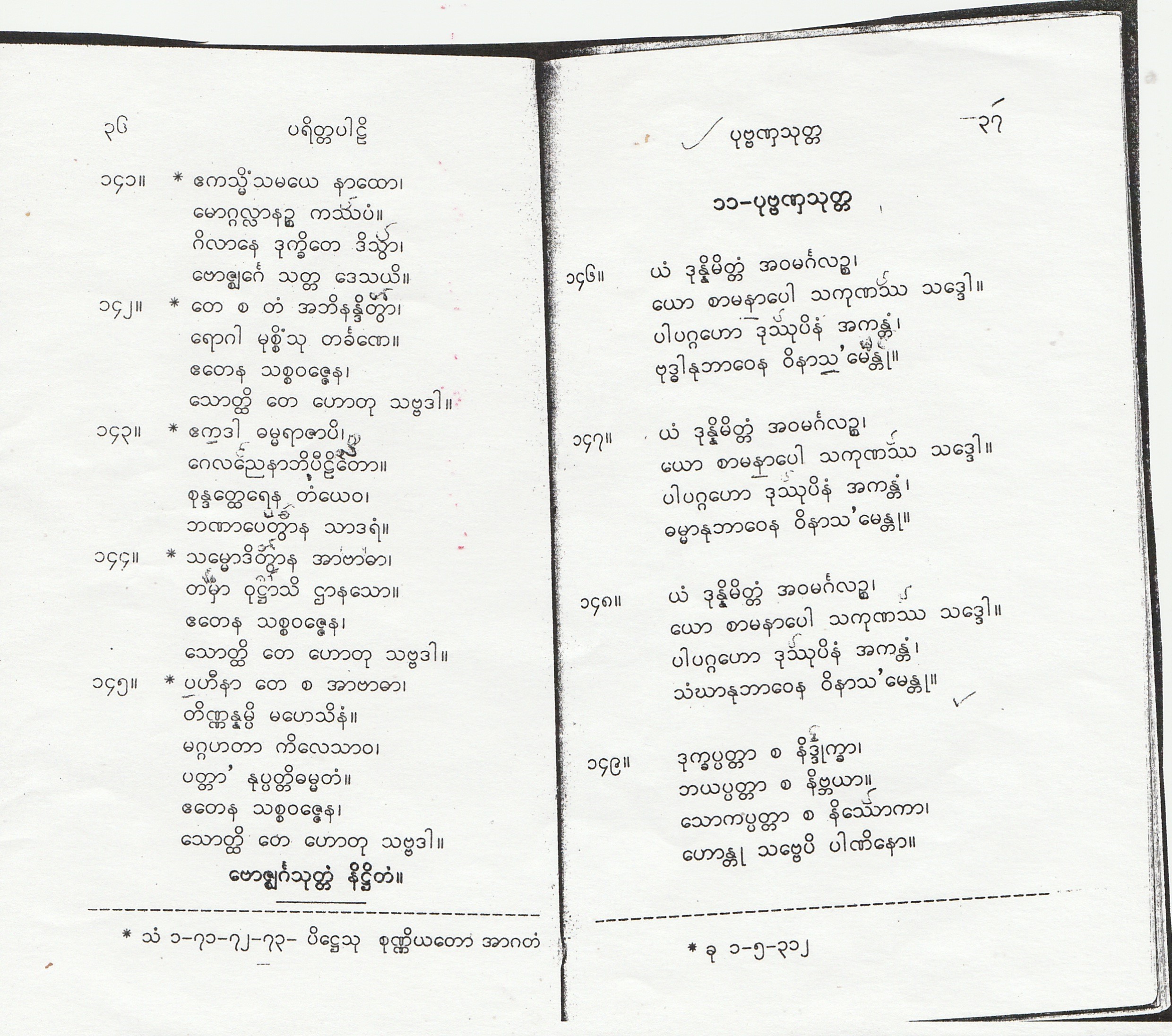
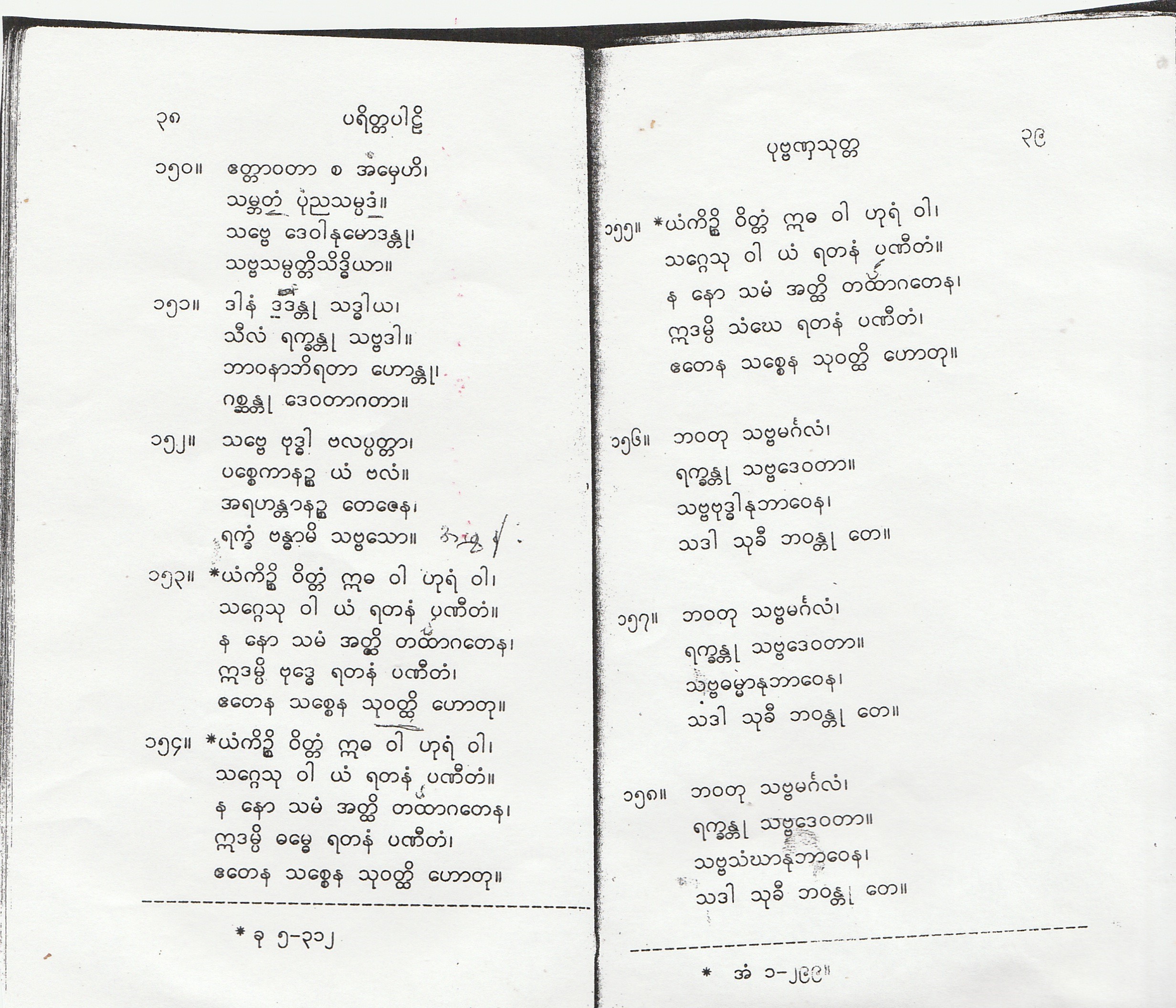
  • Pubbhana Sutta

    Paritta
    U Silananda
    Pa Yeik Kyee

    No need to wait for lucky stars

    • 11th Sutta in “Paritta Pali
    • For protection against bad omens, etc. and gaining happiness

    Four verses from the Scriptures
    Verse numbering per Sayadaw U Silanandabhivamsa

    • Verse 153 (of “Paritta Pali”)
      Assertion of truth about the “Accomplished One”
    • Verse 162 (of “Paritta Pali”)
      “every day can be auspicious day”
      On the day meritorious deeds are performed, the stars are auspicious, blessings are suspicious, … , the time is auspicious. Offerings made to the holy ones on such a day are well-offered.
    • Verse 163 (of “Paritta Pali”)
      three kinds of felicitous actions : bodily, verbal, mental
    • Verse 164 (of “Paritta Pali”)
      Good deeds
      Good results
      (a) Growth in the Dispensation of Buddha
      (b) have bliss
      (c) free from diseases
      (d) happy together with your relatives
    • The rest composed by compilers

    Pali (in Burmese Script)

    This image has an empty alt attribute; its file name is pp-36-37-1.jpg
    This image has an empty alt attribute; its file name is pp-38-39.jpg
    This image has an empty alt attribute; its file name is pp-40-41.jpg
  • Angulima Sutta

    Angulima Sutta

    by Hla Min

    Updated : May 2025

    Paritta Pali
    • Sayadaw U Silananda recorded the Protective Suttas in Pali and English.
    • The book was published for Sayadaw’s birthday by a Thai Devotee.
    Pa Yeik Kyee
    • Sayadaw U Dhammika (Thamanay Kyaw) wrote a booklet to study the Protective Verses.
    • Theik Kha stands for Training / Practice.

    Angulimala Sutta

    • 9th Sutta in “Paritta Pali”
    • Short but effective
    • Asseveration of truth by an Arahant (formerly notorious or his “garland of [human] fingers”)
    • For easy delivery of expectant mothers
    • Contents: “Oh, sister! Ever since I was reborn in this Noble Birth, I do not remember intentionally taking the life of a being. By this utterance of truth, may there be comfort to you and to the child in your womb.”

    Pali (in Burmese Script)

    This image has an empty alt attribute; its file name is pp-32-33-1.jpg
  • Atanatiya Sutta

    Atanatiya Sutta

    by Hla Min

    Updated : May 2025

    Paritta Pali
    • Sayadaw U Silananda recorded the Protective Suttas in Pali and English
    • The book was published for Sayadaw’s birthday by a Thai Devotee.
    Pa Yeik Kyee
    • Sayadaw U Dhammika (Thamanay Kyaw) wrote a booklet to study the Protective Verses.
    • Theik Kha stands for Training / Practice.

    Atanatiya Sutta

    • 8th Sutta in “Paritta Pali”
    • For protection against evil spirits, and gaining health and happiness

    Homage to seven Buddhas

    • Vipassi
    • Sikhi
    • Vessabhu
    • Kakausandha
    • Konagamana
    • Kassapa
    • Gautama

    Ask four Deities for protection

    • Dharatha (Lord of Gandhabhas)
    • Virulaka (Lord of Kumbhandas)
    • Virupakkha (Lord of Nagas, or divine serpents)
    • Kuvera (Lord of Yakkhas)

    Ask other Deities for protection

    • in the sky
    • on the earth
    • living in the Dispensation / Sasana

    The unabridged version from the Digha Nikhaya is chanted by some Sayadaws in their “Paritta” tapes/CDs.

    Pali (in Burmese Script)

    This image has an empty alt attribute; its file name is pp-26-27-1.jpg
    This image has an empty alt attribute; its file name is pp-28-29.jpg
    This image has an empty alt attribute; its file name is pp-30-31.jpg
    This image has an empty alt attribute; its file name is pp-32-33.jpg
  • Bojjhanga Sutta

    Seven Factors of Enlightenment

    • Mindfulness
    • Investigation of dhammas
    • Effort (or energy)
    • Zest
    • Tranquility
    • Concentration
    • Equanimity

    Bojjhanga Sutta

    • 10th Sutta in “Paritta Pali”
    • Gatha (Pali Verse)
    • For protection against and getting free from sickness and disease
    • Reference the three occasions when Venerable Mogallana, Venerable Kassapa, and Lord Buddha felt sick but were cured after listening to and contemplating on the “Seven factors of Enlightenment”
    • This is one of the Suttas that is not only for chanting but also for practice

    Bojjhanga Suttas (in Pali Prose) in the Scriptures

    • Mogallana Bhojjhanga Sutta
      Recited by Lord Buddha
    • Kasapa Bojjahanga Sutta
      Recited by Lord Buddha
    • Buddha Bojjhanga Sutta
      Recited by Venerable Cunda

    Pali (in Burmese Script)

    This image has an empty alt attribute; its file name is pp-34-35-1.jpg
    This image has an empty alt attribute; its file name is pp-36-37.jpg
  • Mangala Sutta

    Mangala

    • Mangala is usually rendered as Auspices or Blessings.
      Myanmar call it Mingalar
    • Mangala Sutta describes 38 Blessings, which are related to both Loki (mundane) and Lokotra (supramundane).
      First of the 11 Suttas covered in Paritta Pali / Protective Verses.

    For lay persons

    • U Thu Kha wrote a book discussing the Mangala Sutta (using lay people’s terms).
    • At PPBRS, we had to study “Mingalar Kabyar” (poem) by Saya Dagon U Tun Myint.
      Received a Thermos flask for successfully reciting the Kabyar.
    • Cartoon U Pe Thein illustrated the 38 Blessings.

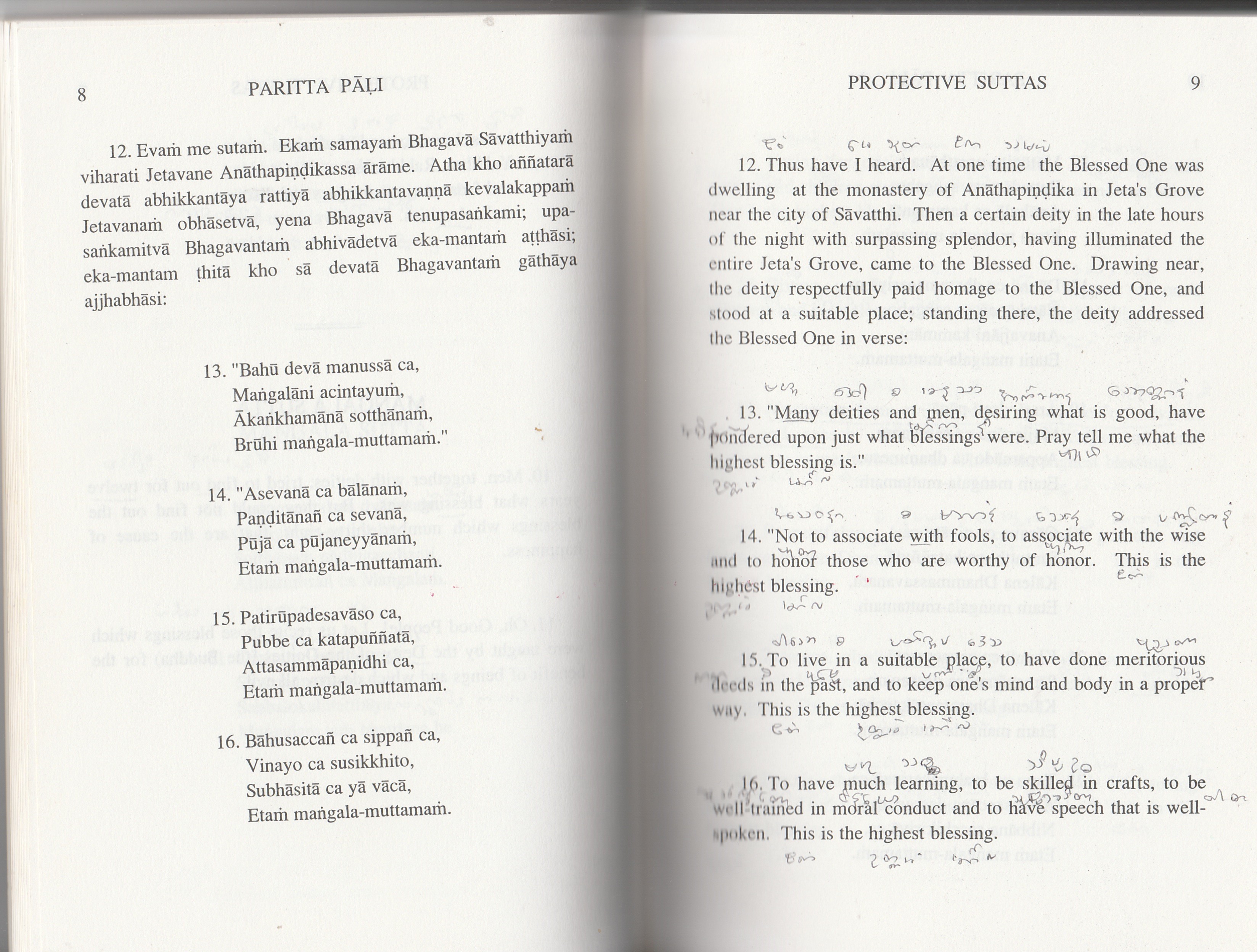
    Highest Blessing

    From Paritta Pali and Protective Suttas
    by Sayadaw U Silananda

    • Not to associate with fools,
      to associate with the wise and
      to honor those who are worth of honor.
    • To live in a suitable place,
      to have done meritorious deeds in the past, and
      to keep one’s mind and body in a proper way.
    • To have much learning,
      to be skilled in crafts,
      to be well-trained in moral conduct and
      to have speech that is well-spoken.
    • Caring for one’s mother and father,
      supporting one’s spouse and children and
      having work that causes no confusion.
    • Giving, practice of what is good,
      support of one’s relatives and
      blameless actions.
    • Abstention from evil in mind,
      abstention from evil in body and speech,
      abstention from intoxicants and
      non-negligence in meritorious acts.
    • Respectfulness,
      humbleness,
      contentment,
      gratitude and
      listening to the Dhamma on suitable occasions.
    • Practice that consumes evil states,
      a noble life,
      seeing the Noble Truths and
      realization of Nibbana.
    • The mind of a person (an Arahant) who is confronted with worldly conditions does not flutter,
      is sorrowless,
      stainless and
      secure.
    • Having fulfilled such things as these, beings are invincible everywhere and happiness everywhere.
    • This is the highest blessing for them.
    This image has an empty alt attribute; its file name is paritta-pali-1.jpg
    Paritta

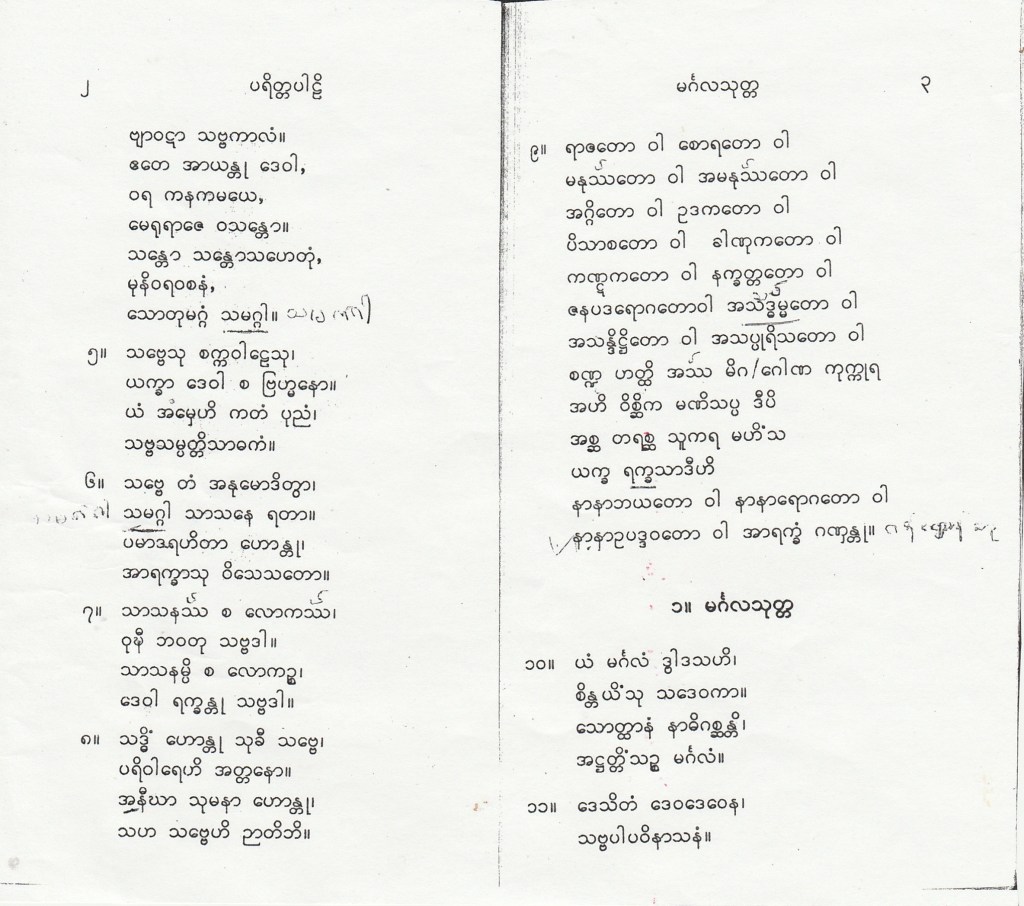
    Mangala Sutta Text

    This image has an empty alt attribute; its file name is pp-2-3.jpg
    This image has an empty alt attribute; its file name is pp-4-5.jpg
    This image has an empty alt attribute; its file name is pp-6-7.jpg
    This image has an empty alt attribute; its file name is p6-7-1.jpg
    This image has an empty alt attribute; its file name is p8-9.jpg
    This image has an empty alt attribute; its file name is p10-11.jpg
    This image has an empty alt attribute; its file name is p12-13.jpg