The 1969 RIT Graduates Reunion was held in Rangoon/Yangon,
Burma/Myanmar on Saturday, 20 February 1999 at Sait-Teng-Kya Restaurant near Kandawgyi lake.
The idea was mooted three years ago when a few of us were having dinner together and thought of having a gathering in 1999. After that most of us have forgotten about the idea until around the end of November 1998 when a group of our friends led by Ko Yee Pinn (Tavoy), Ko Myint Maung (aka “Bu”, RIT Volleyball selected), Ko Shwe, Ko Win Lwin, etc. decided to have a grand re-union in February 1999. They also decided that to be more meaningful we should invite our Sayas to pay them respect as well and, hence, it became the reunion cum Saya-ga-daw-pwe.
On that very day the guest trickled in starting from about 4.00 p.m at the restaurant. The guests were required to fill in their names and contact numbers. The organizers promised to compile the name list and send to everybody who attended. By 6.00 p.m. about 30 Sayas and about 120 of our graduates were in the restaurant. The master-of-ceremony, Ko Win Lwin, announced the start of the ceremony.
The programme started off with a few speeches, led by Nyi Hla Nge, representing the graduates in Rangoon, followed by Danny, representing the graduates overseas, Sai Aung Win, representing graduates outside Rangoon and last but not the least, by Saya U Kyin Soe, representing all the Sayas.
After that we gave respect to the Sayas. All the Sayas were seated on the stage and all of us sat on the floor. Some gifts were distributed to the Sayas followed by photo taking session and then the sumptuous dinner began. About 9 to 10 dishes were served but, most of us were too excited to notice what we were eating. Halfway through the dinner some of us went up the stage and sang some songs for entertainment. Even all the ladies, led by Alice and Naw Mu Mu Aye were on the stage as well. The crowd went wild.
The party ended at about 9.30 p.m. with some of the graduates not so sober. It was indeed a memorable gathering and we all vowed to meet again in December 2000 at place and date to be announced early next year. Three cheers to the organizers and those who have one way or the other help in making this event a great success.
In the beginning, there was no RIT and of course no BEs. There was only the BOC College [of Engineering], Rangoon University. Saya Ba Hli was the Dean of Engineering. The degree conferred was B.Sc. (Engg).
Saya Allen Htay remembers that the Dean wanted every engineering student to attend at least one common course with his/her senior batch. Thus, by the time one graduates, everyone will be familiar with three batches: one’s own, one senior, and one junior.
Then, for a brief period, there was BIT (B for Burma). In anticipation for the opening of more engineering institutes the name was changed to RIT R for Rangoon).
Feedback (by Saya Dr. Aung Soe): In the summer of 1961 BIT/RIT was born. It was also the time that I started my teaching career.
Several years back, RIT became YIT (Y for Yangon). Now, there’s an MIT (M for Mandalay) and an engineering branch of DSA. The latest name for RIT is YTU (Yangon Technological University).
It’s been a looong time since I had to sit at the last row [according to the seating plan — you cannot take the exams unless you have 75% attendance] of the “Surveying” course taught by Saya U Min Wun; the field work was supervised by Saya U Aung Soe. I noticed that I could no longer read the blackboard and became “four eyes”.
I started compiling a list of RIT alumni and ex-faculty after I received emails from Saya U Soe Paing (from UK, after his four month visit to Burma). See “Saya’s corner”.
I received encouraging words. Better still, a lot of people including Saya K C Chiu (ChE63), Saya U Myat Htoo (C68), Ko Aung Khin (EP68), Ko Tint Lwin (Danny, M69), Saw Yu Tint (Alice, T69), Lei Lei Myaing (Amy, T70), Than Than Yi (T71). Saya Ko Thein Aung (James, Met 72), Ko San Lin (Robert, (EC 73), Ko Maurice Chee (M75), Ko Khin Maung Zaw (EC76), Ko Hla Kyi (EC77), Ko San Myint Thane (Sammy, EC79), Ko Aung Win Myint (Kevin, EC80), Ko Aung Myint Oo (EC84), Ko Yu Ket (Edward, EC85), Ko Nyunt Than (M86) contributed to the list. They have also become the de facto class reps.
On most Internet newsgroups, there are 20 – 100 readers for every writer. In our case, we have more contributors and active readers who provide useful feedback. The list has grown to 250+, and still growing.
I gained (or re-gained) contact with my Sayas (including Sayagyi U Min Wun and Saya Dr. Aung Soe), classmates, and schoolmates. Also, I learned that there have been semi-reunions and reunions in California, Singapore, Sydney, and Yangon.
I hope this newsletter will serve as a starting point for a “Virtual (world-wide) reunion” and also bring back fond memories. Saya U Soe Paing, Saya U Myat Htoo and Ko Tint Lwin (Danny) have promised to write in the forthcoming newsletters.
Feedback: The list has grown, within a day, to 280+.
SAYA’S CORNER
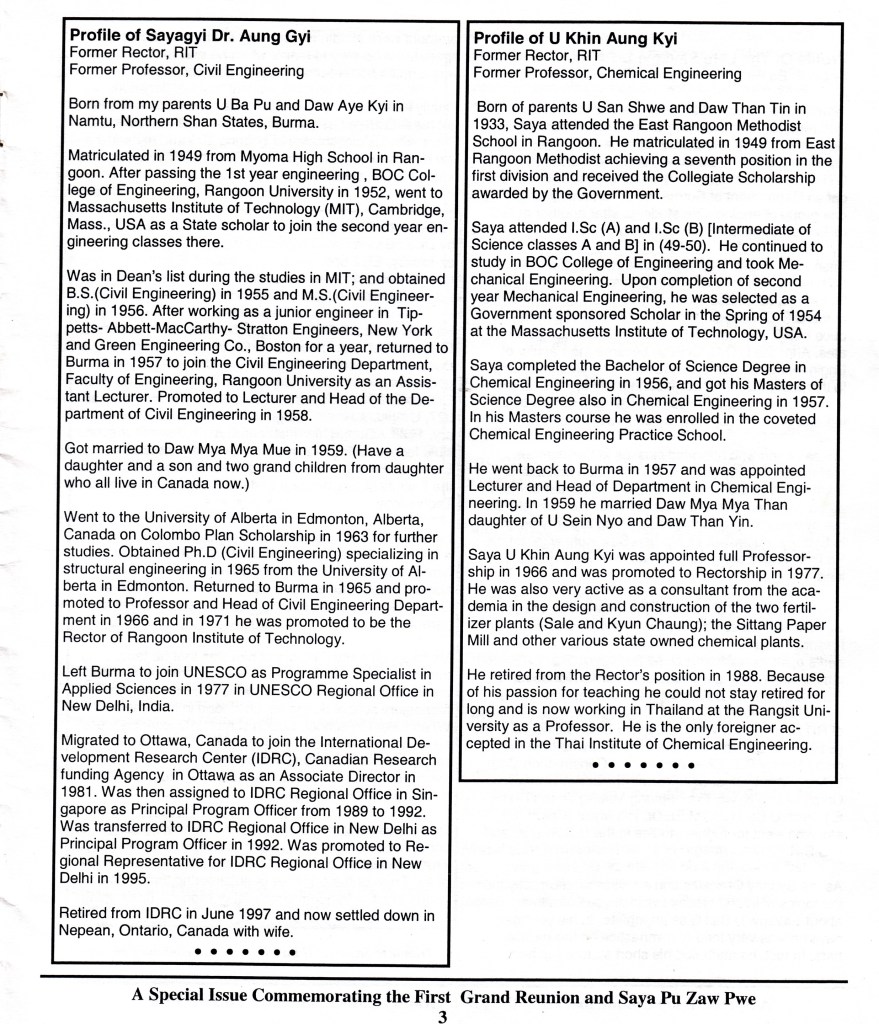
From UK, Saya U Soe Paing (EC) writes: During our recent visit to Burma, I saw Ko Tin Htut in Rangoon. He told us that Dr Aung Gyi would be visiting Burma. We managed to contact Dr Aung Gyi and we had a small get together at our house. The following came. Dr Aung Gyi and Ma Emma, Dr Khin Maung Win (Metallurgy) and Margaret, Ko Kyin Soe & Chit Chit, Ko Sein Win (Electrical Power), Soe Min (my classmate and ex Instructor in RIT) and Dr. Than Htaike (Chemical Engineering). Han Tin (Rector of the Institute of Education) was also there.
Played golf with Ko Maung Maung Than. He is now the advisor at the DSA Engineering college in Maymyo. They have appointed retired RIT sayas. S. Arya is one of them and I met him in town. Also saw Ko Thein Lwin in Rangoon and Ko Tu Myint & Myitzu in Singapore.
From Singapore, Saya U Tu Myint (Mech) writes: Thanks for the info. Nice to talk about the good old days. I think it’s a good idea to keep Old RIT Colleagues informed, especially when we are getting old. Awaiting for more news. Perhaps scan in some photos.
From Los Angeles (California), Sayagyi U Min Wun (Civil) writes: Ko Hla Min, what a surprise to get in touch with you again after such a long time. Sorry for this late response. My pc was disconnected from the Network after Y2K Remediation. Anyhow, my name has already been included in the Ex-RIT listing. Thanks for the long list. Please keep in touch.
From Chicago (Illinois), Saya Dr. Aung Soe (Civil) writes: Ko Hla Min: Thanks for the list. U Chin Way from LA passed away a few years ago. Aung Myint Thwin, one of my students, is in Singapore. I was told Aye Win Kyaw, ex civil staff, is also in Singapore. … Thanks for the photo [of the RIT Sayas; photo credit: Saw Yu Tint (Alice)]. With certainty I can name the followings: U Ba Than, U Sein Win, U San Tint, U Tin Maung
Saya U Soe Paing (EC) adds: Here are the names of the RIT Sayas in the picture:
Front row L to R: Ko Kyaw Thein(C) {picture not really clear}, Ko Shwe Yi (Tex), Ko Myo Kyi (E), Ko Sann Tint (E), Ko Sein Win (E), U Ba Than (M), U Sein Shan (Math), Ko Khin Maung (M), Ko Kyin Soe (Auto/Mech), Ko Ba Myint (E).
Back row L to R: Christopher Maung (C), S. Arya (M), U Kyaw (A), Ko Phone Myint (Workshop), Ko Soe Minn (E), Ko Tin Maung (C), Ko S. Kyaw Aye (M), Ko Han Tun (M), Ko Kyaw Sein I (M), Ko Kyi (M), Ko Soe Lwin (M), Ko Tin Win(C), Ko Kyaw Win (Mining or Petroleum).
ALUMNI NOTES
From Danville (California), Saya U Myat Htoo (C68) writes: I would like to make a proposition that I hope you will agree. Why don’t we organize an “Old RIT Colleagues/Graduates” get-together sometime in this Summer? Saya Allen Htay and myself were talking about it a couple of weeks ago. Actually, we have done a similar gathering of Civil Engineers in San Francisco about twelve years ago while Dr. Aung Gyi and Mama Emma were visiting us. I think it’s about time to have a gathering for RIT graduates of all principles. My suggestion is to do it in San Francisco since I think it has a biggest concentration of RIT graduates. We could ask U Nyo Win and Maurice Chee for their help. This is just my thought.
From Japan, Saya Dr. Myo Khin (Ci70) writes: You have done a great job for the RIT old boys and teachers. I’ve been in Japan for ten years already and doing the same job as teaching at the University. This coming October 1999, I will be attending the ACI fall convention in Baltimore, Maryland. Please say hello to all our friends and Sayas in the states.
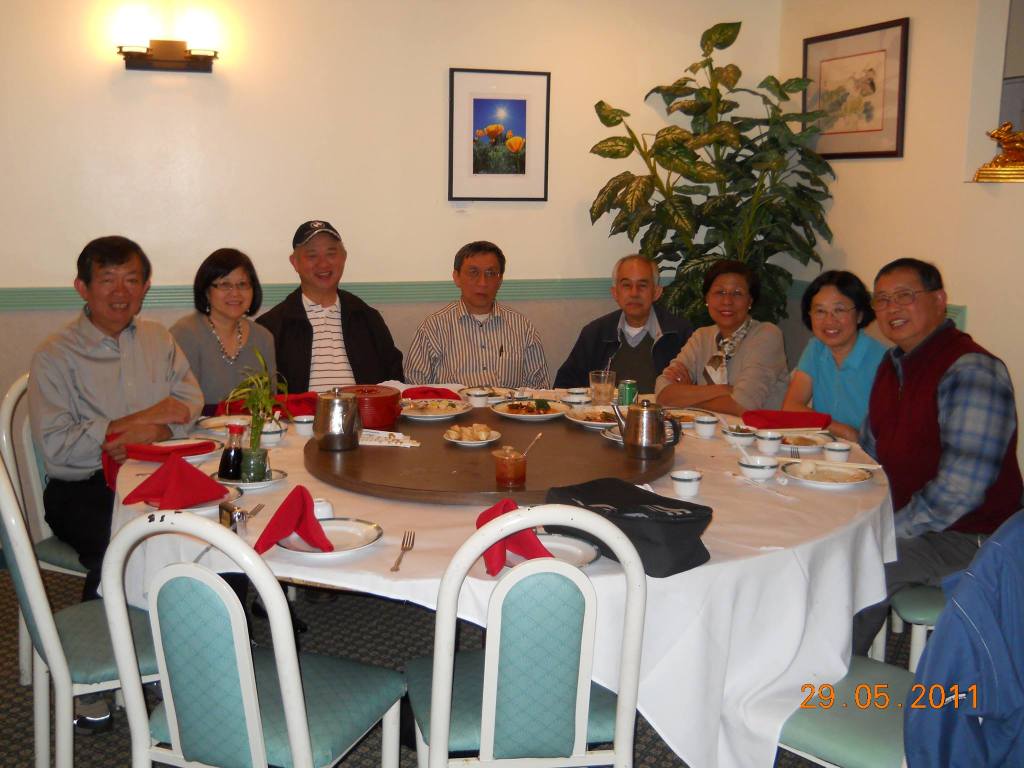
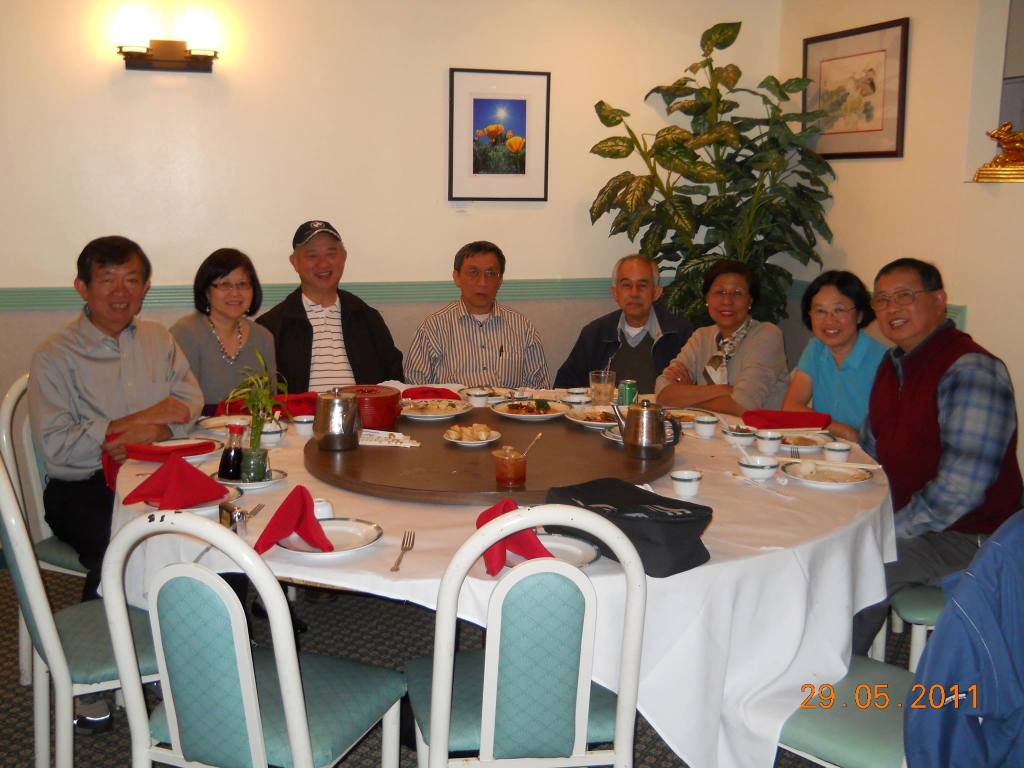
From Singapore, Ko Tint Lwin (Danny) (M69) writes: We had a great 30th re-union of our 1969 RIT Graduates in Rangoon, Burma on Feb. 20, 1999. About 120 of the graduates and about 30 lecturers attended. We really had a great time. The organizers told us that starting from year 2000, our 1969 graduates would have a re-union dinner every last Saturday in December every year. That’s a good idea and we can pass the word around and we could try to plan our holidays accordingly.
From UK, Saw Yu Tint (Alice, T69) adds: There was a saya ga daw pwe (paying respects to the teachers) by the 1969 RIT graduates. We have pictures of the sayas and of course the RIT graduates.
From Benicia (California), Saya Ko Thein Aung (Met72) writes: I am so glad to read the message about our old teachers get together party in Burma. KC Chiu (ex-faculty, Chem), brother of Dr Aung Soe (C), had actively organized Dr Aung Gyi’s welcome party back in 1986 in Bay area and Saya U Aung Khin party last year. He is a founding member of BEA (Burmese Engineers Association) and also a Past President. He is preparing a list to send it to you.
From Vallejo (California), Saya Dr. KC Chiu (ChE63) writes: Ko Hla Min: I am impressed by the list you have assembled. I would like to suggest the followings: – delete the name of the deceased alumni – delete the Type column and use an * to identify ex-faculty – list the official name and put the name used in RIT as alias – except for some sayas, confirm the year of graduation from RIT (include BOC college, BIT, etc.) Attached is a list of RIT alumni in the US that come to my mind. Naturally, it will have some repeat in your list. We used to have an old list of RIT alumni in the bay area, I will try to find it. Thanks.
From UK, Ko Nyunt Aung (C73) writes: Dear U Hla Min, Thank you for sending me the list. It will be more helpful if you can provide us with more detail (i.e. full address, telephone nos & email address) so we can contact to those we knew. I do not know about the rest, but I am willing to include me details.
From Daly City (California), Gordon Kaung (M83) writes: I heard that you are compiling the e-mail info. of former RIT colleagues. It is very good idea and a clever way to keep in-touch one another. We can also discuss via e-mail to do good for our former school RIT including donating technical books and so on.
From Potomac (Maryland), Lei Lei Myaing (T70) writes: Special thanks to Ko Johnny for the compiling all information. I had the opportunity to take Sayas U Khin Maung Win and U Maung Maung Than sightseeing in Washington, D.C. when they visited the U.S. a few years ago. I also met Saya U Min Wun at a friend’s place in Virginia. Saya looked the same as before! I enjoyed seeing the former RIT list growing and getting to see the Sayas’ picture that Alice and Saya U Soe Paing sent. I am fortunate to see my former Textile and Chemical engineer friends whenever I visit Rangoon; the last gathering was at the Bon-Kyaung restaurant in Kokine. I also happened to bump into Alice at the Mingaladon airport!
Gone but not forgotten (GBNF)
Faculty U Sein Hlaing (Professor, Electrical) U Chin Way (Electrical) Alumni Ko Kyaw Oo (Mech 67) Duga Raj (Civil 68)
With metta, Hla Min
Editor’s Note:
I have completed 20 years as a volunteer editor of “RIT Alumni International Newsletter & Updates”. While I still have a reasonably good memory and good health, I am sharing my experience, knowledge and memories (especially of the Good Old Days). My postings can be found in (a) e-mails (b) Lifelonglearning140.wordpress.com (web site) (c) hlamin.com (web site) (d) RIT-update@Googlegroups (d) FB pages for (i) RIT Updates (ii) Swel Daw Yeik Foundation (iii) NorCal RITAA (iv) RIT69ers (v) Team Old School IT (vi) PBRS Group Special thanks to my family members who wholehearted support “Paying Back to my Alma Mater”.
Received his Ph.D. from Georgia Institute of Technology in Atlanta
Writings
Pen name is Ba Thein (Altanta)
Wrote articles for RIT Alumni International Newsletter and Swel Daw Yeik Sar Saung for Singapore SPZPs.
The topics cover
An Apology to Sayagyi U Ba Toke
Saya S. Arya : Some poked fun at his pronunciation; He complained to Sayagyi U Ba Than
An Echo from RIT
Hovercraft : M73 project
IDC Kerosene Stove : Call for donation to SPZP
GBNF Frequency
Spouse
He found his life love in his old school mate Daw Nyo Nyo Win (T73).
They wed around SPZP-2000.
Present
He gave me a book that he bought in Myanmar. The author Kyi Aye (Yamethin) wrote about Minthuwun, U Tin Aye (Shan Pyay), U Thein Pe Myint, and Daw Khin Kyi.
(1) My Apology to Sayagyi U Ba Toke, Sayas & Sayamas of RIT
Sayas and Sayamas are truly the unsung heroes of our lives. For them, it is hard to know the fruits of their formidable efforts. They have made a positive difference to our lives. However, often they are overlooked in nowadays society. Now, due to the invaluable efforts initiated by a group of people, we have a great opportunity to praise show our gratitude.
I have learned that Sayagyi U Ba Toke will come to the Pu Zaw Pwe, 2000. I am writing this article to apologize for my silly act that I did about some 25 years ago at RIT.
An early afternoon in the beginning of a summer at the RIT. My 6 years of study was close to completion. I was waiting for a mathematics class and standing on the breeze-way which connect the second-floors of the Building 1 and Building 2. The sun was shining well, and as usual, the wind was blowing so strong that the yellow leaves were floating in the turbulent air. The “Kha Yay” trees at the end of the Textile Department are swaying back and forth in the gusty winds. They were reminding me of the unstable, impermanent nature of human life.
I was thinking deeply of the future. “I don’t want to leave the RIT yet. I have enjoyed here very much. What I should do? ” I could not find out any decent means to lengthen my happy student-life at RIT.
The next class at 1 p.m. would be “Selected Topics in Mathematics” taught by Sayagyi U Ba Toke at Room 1/3-16. It was a large lecture theater with about 200 foldable seats, located on the third floor, north-east corner of Building 1, adjacent to Chemistry laboratories.
The bell rang and I went into the class. I took a seat in the rear section of the class. In our class, there were about 120 students. There were only 2 female students in the class so that no much reasons for distractions from paying attention to the teachings. However, I was still thinking deep. Through the wide glass window panes, I could see the F-27 Fokker Friendship airplanes flying in and out of the Mingaladon Airport.
Sayagyi U Ba Toke entered into the class, stepped onto the stage, and immediately started to teach. He said, “Today, I am going to teach ‘Functions and Relations’”. I thought it was a boring topic and would not be much useful in the future. My mind was wandering all over the universe.
Sayagyi’s solid profile standing firmly before the students and his commanding voice were dominating the entire class. I was able to see his joy and enthusiasm on his face. Skillfully using the blackboard, he was explaining articulately about the mathematical functions and its indispensable applications to every discipline of engineering.
Sayagyi continued to talk about the ‘Domain and Range’. A friend sitting next to me made an unfavorable comment, “What is this DOMAIN about? For what use?” I supported his comments by a nod. Just a nod. The disrespectful act returned its reactions about 10 years later.
U Ba Toke
I got a rare and invaluable opportunity to pursue further study in the United States. I was taking a course ‘Viscous Flow Theory’ taught by a well-known professor. There were about 30 students from different parts of the world. About half of them were from Germany, Switzerland, and east-European countries. On that day the professor was talking about the Navier Stokes Equation and its solutions. At one point, he talked about using the ‘time-space DOMAINS’ in the numerical methods to solve the second order – nonlinear partial differential equations.
The word ‘DOMAIN’ shocked me like a thunder. Enormous fear pushed out sweats all over my body. I realized that my bad deed had finally rewarded me the bad result. I didn’t know anything about DOMAIN, except its name. Sayagyi U Ba Toke’s solid figure and his distinctive face appeared on my mind. “Yes, obviously, I did a big mistake. Now, at this place, at this time, who would kindly teach me ‘DOMAINS’. In Rangoon, while Sayagyi U Ba Toke was teaching with great and pure ‘Cetana’, I didn’t take it with respect”. I felt an unforgettable remorse. After this incident, although I paid the price for my bad deed by spending long late-night hours for the whole semester with nightmares to understand the subject, I did not do well at the exam.
Now, welcoming the noble occasion “Saya Pu Zaw Pwe of 2000 at San Francisco”, I do apologize for my unintentional bad deeds to all the Sayas and Sayamas who taught me generously with pure ‘Cetana’. Physically, verbally, and mentally, from the deep bottom of my heart, I do beg your kind pardon.
For any failure or obstacle in my studies in the past, present, and future, it is entirely due to my incompetence, NOT because of the teachings of my Sayas and Sayamas at RIT were inferior.
The primary reason why I am surviving today is the invaluable-unparalleled teachings of my Sayas and Sayamas of RIT. I would like to exclaim that “What our Sayas and Sayamas taught at RIT is ‘Absolutely Superior’ to the teachings at all over the other engineering universities in the world.”
Yours Respectfully, Ba Thein Atlanta, GA
(2) Saya S. Arya and Sayagyi U Ba Than
U Ba Than
Under the leadership of Ko Maurice Chee (M75), a group of RIT alumni is planning to honor Ko Hla Min. To keep RIT alumni connected and informed, since 1999 Ko Hla Min has voluntarily tirelessly posted weekly RIT-Updates. While reading his recent RIT-Updates, I remembered an event happened in our third year 1970.
During our six years at RIT, most of Mechanical students have almost never seen laughing or smiles of our Sayagyi U Ba Than and Sayagyi U Aung Khin. In third year Sayagyi U Ba Than taught us a major engineering subject “Strength of Materials”. Then, the typical class format was a 50-minute lecture followed by 50-minute tutorial classes comprised of 30-35 students.
Saya Arya
Saya Arya was one of the tutorial teachers. Since his parents are Indian descendants, Saya Arya’s accent on Strength of Materials terminologies and vocabularies were unique and distinctive.
In the class of 1966-1972 Mechanical, there were some life-is-so-good die-hard native-Rangoon day-students included. They were neither quiet nor strictly-obedient students. Since they were one year senior to us, we learned and inherited a lot of extra-curricular activities, trades, and tricks from them.
One day, news went viral. The event took place in the tutorial class room on the third floor, near the English Department. In the tutorial class, while Saya Arya was writing differential equations on the blackboard, students were teasing and playing each other behind him. One of them threw a ZeeThee to his friend sitting in the front row. It missed him – hit the desk – bounced and hit the blackboard. Without delay, Saya Arya asked the class: “ZeeThee pauk tar Bu Thu Le ?”
One or two students answered promptly: “Bu Thee Booo”.
Saya Arya rushed to Sayagyi U Ba Than’s office. A group of students were summoned and questioned. They explained and appealed. Sayagyi U Ba Than could not hold his straight tight face and broke into laugh. Only a few students would know the exact true story what happened.
After the incident, there were floating quotes in the RIT campus for a while. Questions and Answers. If somebody threw paper-arrows from behind, then asked:
. . . Bu Thoo Le ? . . . . Bu Thee Booo !
It was 46+ years ago. In the evenings and weekends, yells and shouts occasionally roamed on the broad windy empty corridors of RIT. The clocks hanging overhead did not mind. Swel Daw trees were green and thrived and bloomed.
During the Adhamma era, our mother RIT was labelled “The Mother of The Rebels”. Swel Daw trees were also punished. With tears, we heard and read the news. Now, the situations of the mother country have been changed, generally. Mother RIT is welcoming back her sons and daughters coming back from the other side of the world. In this coming December last-week of 2016, mother RIT is going to celebrate Global RIT Reunion.
Last 17 years, in his weekly RIT Updates “Gone But Not Forgotten” (GBNF), U Hla Min has occasionally posted the short bios of RIT alums who have abruptly or unwillingly or unexpectedly left us. Gone with The Wind.
For some of 1960s and 1970s graduates mother RIT born, this Reunion may be the last one to meet and hug their classmates together at this very holy place.
Thanks,
May All You See Broad Smiles Again.
Myint Thein (M 73)
(3) An Echo from RIT
by Maung Ba Thein (Atlanta)
In October 1999, I visited my alma mater, RIT. I was very excited to see the campus totally green covered by grown trees. According to the newspapers, in 1999 the rainfall was the highest in Yangon since 1872, one year after the precipitation data were started to record at Kaba Aye station.
First I went to the main portico. Its splendid 12 columns were standing straight and firm in the morning sun. With dignity, they were still sustaining the weight of huge concrete roof. I suffered a sad feeling of having to leave them behind. I was standing still for a moment on its steps. From there, I saw the windy space right under the ‘Set Hmu Hall’. There used to be Registrar U Hla’s office on the left, a big bulletin board and the library on the right, and in the middle two English newspaper reading-stands (Guardian and Working People’s Daily provided by the registrar’s office). At this place every morning we would stand and explore the outside world’s events during the height of the Vietnam War. It used to be so windy at this place that while reading we had to use our both hands to hold down the newspaper.
I walked to the east of main building. I came across an old green Mazda pickup truck anchored in the car parking lot. It might be at least 35 years old and expired. It took me back to the days at RUBC. This old truck had served us as a ferry to RUBC at Inya Lake from RIT and Thazin Hall (Hlaing Campus), 3 afternoons a week for two years. Sometimes two trips a day. Because of its transportation, we successfully recruited female members to our RIT Rowing Club. At the 1972 RUBC Annual Regatta, RIT Rowing Club competed in full strength including (for the first time) 4 crew of Women’s Eight, breaking our RIT Rowing Club’s tradition of ‘All Guys’.
I walked to the north along the concrete driveway, made a pause between Buildings 1 and 2, and looked up. I saw the corridors where we used to stand, watch, shout, cheer, and laugh. On these corridors, our butts and the floors had kissed each other uncountable times during the rainy seasons.
I continued roaming down the road. The trees were still welcoming me. All were green and had grown well. On my left I could see the Building 2 where Departments of Textile, Electrical, Mining & Petroleum, Physics, and machine shops were located. On my right, in the lower triangular terrain, annexed Buildings 5, 6, 7, and 8 where housed the Architecture, Civil, and Mechanical Engineering Departments were sitting quietly under the blazing sun. I heard a jet flew out of the Mingaladon Airport making a loud roar.
At the Mechanical Engineering Department, I met Saya U Khin Mg Tin and Saya U Kyaw Aye. I was looking for Saya Arya (Strength of Materials) to apologize him. Instead of learning respectfully what he taught in the class, I made jokes with my classmates on his accent. For these silly acts, (in the past, present, everyday, everywhere) I was/am paying the price. Many people hardly understand my speaking. For me – frustrations, arguments, ridicule, shame, unconstrained anger, refusals for the service, etc. You name it. I had it. They were common for me.
At the Metallurgy Department, I met Saya U Tin Mg Nyunt and U Nyunt Htay. We went to the food court. The restaurants ‘Nway-Aye’ and Aung Theik Pan’ were still running. I assumed that the cafe owned by ‘U Chit of Blacksmith’ would be also doing well. In the courtyard the Padauk trees were growing well and providing the patrons a green canopy.
On the other side of the concrete driveway, I could see the soccer-field where we enjoyed crazily in the mud and rain like buffaloes. Our “loyal fans” of the G-Hall might be watching our games or might be suppressing their intense hunger watching the clock for dinner. In reality, they saw us as the reincarnations of the ‘Ah Yee Gyees’ (who faithfully practiced self-torturing exercises to purge their body from Kilesa (mental defilement) of the Bagan era before His Majesty King Anawrahta stripped them off, booted out from their dwellings, and sent to the elephant and horse stalls to pick up the animal-made fertilizers.
The trees had grown so well that I could hardly see our great sisters’ G-Hall. Next I saw were the infirmary and the resident quarter for the faculty and staff.
Then I went to the west of the main building to see the small entrance behind the BPI bus stop on Yangon-Insein Road. On Friday mornings, we used to buy the ‘Set Hmu Thadin Zin’ at this gate. I was surprised to see that the entrance had been widened to about 10 feet.
In our days, it was only about 3 feet wide. Two students could barely pass simultaneously this gate without touching each other. To emphasize the width of the entrance, one of my friends used to brag that “In this RIT campus, there were many female students who were Ma’ Loot Ma’ Kinn Phyit with me”.
I came back to the oval lawn in front of the main portico. There was no water rising into the air at the fountain as it was the same in our days. However, flowers were blooming. I learned that there was a graduation ceremony on that morning for completing a diploma program. I saw some young female students with brand-new crispy dresses moving to and fro in the oval garden. Some of them were standing / sitting / lying on the grass in a variety of postures for the zooming cameras. A great photo-opportunity for them at this age, time, and place. I stood gazing at their agility, youth, and smiles. I was thinking very deeply.
In the south, I could see the dormitories A, B, C, and D Halls sitting quietly at a distance waiting for my visit. Again, my mind took me back to the old days.
Suddenly, I thought I heard – from a 30-year distance – somebody from the top-floor corridor of hostel A-Hall roared like a lion at his highest volume: Ma’ Pyawwww Ma’ Sheee Ja Ne Byoooooooow !
A long echo followed. All residents of A-Hall came out of their rooms and joined their leader’s wake-up call by beating loudly nearby bathing-utensils, pots, and pans. And a trembling noise like a thunder.
Today, welcoming the upcoming noble occasion and recalling the echo and tremble which I used to hear often at RIT, let me hail again. Ma’ Pyaww Ma’ Sheee Ja Ne Byoooow !
We are going to have a once-in-a-life-time gathering at ‘Saya Pu Zaw Pwe and RIT Grand Reunion’ in San Francisco on October 28-29, 2000.
(4) GBNF Frequency
Once, I have learned:
Into the Highlands of The Mind, Let Me Go !
From U Hla Min’s RIT Updates, I read from time to time “Gone But Not Forgotten” (GBNF) news of our RIT brothers and sisters. Recently, I sadly noticed that frequency and recurrence of GBNF news is alarming. Generally, most of us have understood and accepted the occurrence of inevitable death. However, when we face the reality and imminent nearness or arrival of death, it is extremely hard (even to learn GBNF news) for us to cope with. Oh, he/she has gone. He/she did not even say goodbye. Probably, he/she might be so exhausted . . . wrestling tackling and defending the arrival of his/her last breath.
[Yours Truly Falsely (YTF) Notes:] In the not-very-olden days or socialist-shining-glorious days of 1970s of Burma, at funeral wakes and viewings . . friends and relatives used to gather, sit + talk + chew some seeds . . . kind of Kwar-Ce-Hlor or Ney-Gyar-Ce seeds (water melon seeds and sunflower seeds).
YTF doesn’t dare to let anybody near him knows, especially his nephews/nieces or any relatives friends, whenever suffer uncomfortable health problems. Because, YTF have surely noticed that . . .whenever he began just having some intermittent/continuous coughing . . . all of his nephews nieces of near and far associates went out and bought Kwar-Ce-Hlor and Nay-Gyar-Ce . . . make ready, unwaveringly sat and waited . . . anticipating willingly naively for YTF’s demise.
[Confidential, Top secret, bottom Open]. In reality, there may be nobody around him, IF they know YTF = “Naing-gan-jar-pyan RIT Alumni (Return form Abroad, RIT Descendant) has prepared a Will with Nothing for them. They do not know YTF’s regular contributions to Academy Minn Thar Gyi Ko Kyaw Thu + Associates’ Free Funeral Service Society (FFSS).
Am I prepared, Now ? None ! Nothing !
YTF is Still Extremely Greedy.
Wealth under his holy Mattress. Daily counting and re-counting.
At every AM and every PM.
The Guinness Book of World Records might keep my name on top in Greed category.
Yours Truly Falsely, Maung Ba Thein, Atlanta.
Myint Thein, 1973 Mechanical of RIT.
(5) M73 Hovercraft Project
Dear Saya U Kyaw Sein and U Hla Min,
With respect, regarding the Hovercraft built by mechanical RIT students, I would like to supplement a piece of information on Hovercraft of RIT.
I am not aware of any information about the thesis or papers existed before 1973, related to the Hovercraft. This Hovercraft physical-model, based on a lawn mower, was built by a team led by Saya U Tu Myint and a group of 1973 final-year Mechanical students. They include
Ko Hla Win (Mechanical One)
Ko Khin Maung Cho (Lu Ye Chun)
Don D Silver
Saxon Sein
They were among the top students of our class. The Hovercraft was successfully tested in the lake located near the Insein Locomotive yards. Ko Hla Win is now working in Singapore. On those days, many people wished to have a test drive of this craft.
While training hard in Inya Lake – Rangoon University Boat Club, (where we were dreaming under the scorching sun of becoming RUBC golds) sometimes we missed the classes. Ko Hla Win often kindly shared us his lecture-notes, learning, knowledge, and also, of course, his neatly completed solved home works. Our group, senior members of RIT Rowing Club of 1972-73, owe Ko Hla Win and his Hovercraft-group a lot for their precious kindness and help, which also contributed to our successful graduation from RIT.
In Saya U Kyaw Sein’s Facebook RIT photos (one posted by Ko Thura Thant Zin), 1972-73 RIT Rowing Club photo shows our group (none of us were physically big-tall Goliath). Two of our friends have prematurely – permanently left this world. I wish they should have waited to witness the revival of our Mother RIT and Mother country.
[Dr.] Myint Thein (M73)
(6) IDC Keresone Stove
Dear U Hla Min + RIT Brothers + Sisters:
.. who were/are tirelessly offering participating joining efforts, energy and time .. planning organizing implementing SPZP-2012 and Revitalization of our Mother-RIT.
In late 1960s, when I relocated to Rangoon, I used to read in newspapers that .. for kerosene stoves – manufactured by IDC (Industrial Development Corporation), Burma:
“Meeee-Hpo Pyet Yin – Pyitt Ma Htarr Par Ne. Kyune-Daw Arrrr Gyeee Ceit Soe De”. {Don’t leave Your Stove Broken – I am Extremely Annoyed. Advertisement by IDC Yay-Nan-Cee MeeePho}.
Recently, reliable news arrived. Under new Management – new Leaderships – new System .. our Mother-RIT has been re-opened. Naively, I am pleased. NOW, at least we see the dawn. Reclaiming the RIT Glorious status which we have held and enjoyed is not a quick and easy task. However, it is not an impossible dream. If we can realize our Mother-RIT’s recovery within a decade, I would claim “An Unbelievable Success”.
It took more than 60 years of precious intellectual investments for Mother-RIT to attain internationally recognized position and to stand up distinctly among Asia countries .. so that, again, it will take considerable time to successfully regain recover her strength and vigor.
I was not aware of, (also did not believe/accept) that our Mother-RIT was virtually closed. I assumed those news are rumors. I thought, there might have been a few undisclosed issues those I missed and should be aware of. I did not know that although it was a public university, it became a place of OFF-limits .. for general public and her alumni.
Once, at the entrance U Lu Paw gate, surprisingly I was denied – declined to see my alma mater. It was totally unexpected and I was well stranded. Fortunately, an abrupt heavy downpour of Rangoon’s monsoon rain came down in that early morning – (May be sofa couch of our Celestial King (Tha-Gyar-Minn) had abnormally become rigid-firm-tense) .. my former class-mate who was an RIT retired-professor suddenly emerged at the gate. I was very much elated. I strongly believed that savior has answered my call. He bailed me out. And then I was unconditionally allowed to enter and see my Mother-RIT.
My friend-professor gave me a short brisk tour in the rain. I observed the changes from a substantial distance. I saw our old RIT-Clinic which we often-refuge was still active and breathing well in good shape. Also, A – B – C – D – E- F halls for male students and their once always-busy noisy pots and pans .. open dining-hall .. all were still standing up, except no inhabitant. No smoke at-all.
From a distance, in the rain, I saw a pretty big rocket standing-tall in front of G-Hall. May be it was one of the latest RIT defense Surface to Air Missile systems .. promoting guarding our forever-young treasures RIT-Sisters.
Also, RIT football field was under fertile management by Ministry of Agriculture. We used to play in this holy field in non-negotiable mud .. like water-buffaloes .. under heavy rains. I saw all were green under thick vegetation. May be maintenance budget has been cut.
Across the soccer-field, RIT food-court. I was sure it was not a botanical garden. It used to be a pivotal place bee-hive in our days. It looked like an abandoned island ghost town. I did not see any moving-being any moving-species or moving-object in the food-court. It was totally closed and silent. It’s silence recalled a phrase in my mind. A sign posted at the entry of a food-stall. It read: Ya-Nay Ah-Kyway Loane-Wa Ma-Yaung Ber. (Today – Absolutely, No Credit-Sales). May be too-many student-debtors who no longer afford to pay their debts and declared bankrupt and left the school. National economy might be slightly down.
Not to blame anybody. Mother-RIT is 50 plus years old. In a tropical-season .. under intense wet-hot-dry cycle conditions. Her superstructure seems to be normal. Only inevitable normal wear and tear may be. However, if we don’t attend her (care and maintain), she may expire prematurely.
Now, I think, favorable Time and Tide have arrived. I do not know “How long it will be like under this situation?”.
Now, during this High Tide and Wind (impermanent, always changing),
Now, RIT able-bodied Brothers and Sisters are Tirelessly pushing/pulling .. our abandoned grounded Mother-ship RIT .. to get-off the ground .. Tow to the shore .. for immediate essential repairs.
And then . . resume Her Sails . . Her Heads High-Up in the prevailing Wind . . holding a Huge Genuine Smile on Her Face.
While we were Crocodiles, practicing rowing in Inya Lake Rangoon University Boat Club (RUBC, often . . we were prompted by the cox’s call, to move our oars forward-ready position,
Come Forward ! ! !
Please, don’t seek advice from your spouse.
Bring your Cash, Check-book or Genuine Cey-Ta-Nar.
Sincere Salutations to all my RIT Brothers and Sisters – – for your enormous efforts,
[Dr.] Myint Thein 1973 Mechanical, RIT. San Francisco, CA.
I read through your updates shown in hlamin.com and my suggestions are given below.
I feel that your book should reflect the love of RIT students for their alma mater, the respect and gratitude shown by RIT students towards their respective teachers, the attachment, bond and friendship among RIT students; and the love for their motherland by RIT students. In short, it should reflect what we call “RIT spirit”. You can base the preparation of the book, beginning from the establishment of Faculty of Engineering, Rangoon University, on your updates and other relevant sources. The word RIT includes all different names of Engineering Institutions in Myanmar, past and present.
Having said all of the above, the following headings come to my mind for your proposed book:
SPZPs/Reunions involving all disciplines which had taken place in Myanmar and abroad.
Establishment of alumni associations abroad and in Myanmar to help RIT and motherland.
Establishment of Swe Daw Yeik Foundation.
Establishment of healthcare fund for RIT teachers in Myanmar.
Fund drive and contributions to upgrade the RIT/YTU library.
Various activities/ mini-reunions / get-togethers among groups of RIT students/teachers which reflect the life and also bond among RIT students/teachers, established in the past ,during RIT days.
Other interesting episodes related to RIT.
The above gives you a few thoughts I have for your book. I would like to recommend that you also get suggestions from others for your book.
Good luck and best wishes. Aung Gyi
(2) Keynote from SPZP-2000
Mr. Chairman, my Sayas, my former colleagues, friends, RIT graduates, Ladies and Gentlemen,
Before I begin to say anything, I would like to request you to take the word “RIT” as to stand not only for Rangoon Institute of Technology but also BOC College of Engineering and Faculty of Engineering, Rangoon University. I am using RIT only, just for convenience sake.
Having said that, it is with a chestful of emotions that I am standing before you, trying to say a few words appropriate and befitting to this important and joyful occasion. My overwhelming emotion is, needless to say, happiness – happiness which results from seeing my Sayas, my friends, my former colleagues, and RIT graduates alive and well, after so many years. My happiness is also mingled with a certain amount of pride: pride arising from the knowledge that we have fond memories and a sense of belonging and attachment to the good old institution as well as to one another.
We are fortunate that we could all gather here to exchange our life experiences, both good and bad, and to reminisce about our past when we were at RIT. While we are doing that, we all must have noticed that all of us have changed quite a bit since we last saw one another, at least physically, some more so than other. We all now have a few gray and also less hair, we have a few wrinkles on our face; maybe we also lost a few teeth and cannot see or hear as well as we did before. Some of us also lost the memory a bit and become forgetful about lots of things such as forgetting names for example. This, as we all know, is life and nature of things. Everything changes and nothing is permanent. Bur fortunately we still have our values. Our values such as respect and gratitude for the elders and teachers, caring of our respective children and family members, helping our friends, and attachment, and gratitude to the institution which nurtured us to meet the challenges of life, are still with us. They have not changed. This Saya Pu Zaw Pwe and reunion is a testimony to those values.
I must now pause and thank and congratulate the Organizing Committee for their untiring and selfless efforts to make this event possible and successful. This Saya Pu Zaw Pwe and RIT Alumni reunion is, as far as I know, once-in-a-life-time event. As far as I am concerned it is already a resounding success with the cooperation and great enthusiasm that I have seen. I hope this will be the beginning and not the last of our get-togethers. When my wife and I paid visits to Myanmar in 1996, 1997 and 1999 we had mini get-togethers with RIT Alumni. When I was here a few years ago we also got together with a few RIT Alumni. I understood that Saya U Aung Khin also had one mini get-together here some years ago. But these get-togethers were not on a grand scale as the one that we are having here now. However the spirit of camaraderie and friendliness among RIT Alumni mini get-togethers, was the same as the one that we find here now. If you look around you, you will find that all of us came here from different parts of the world, indicating the great attachment and respect that we all have for our old institution and also for one another.
While I was preparing for this speech, fond memories of the years that I spent as a student, as a teacher and later as Rector at RIT came flashing through my mind. Without going into details, I remember that all my teachers, including Saya Num Kock and Saya U Ba Toke who are here with us, were good inspiring teachers with kind hearts. When I became a teacher and later the Rector at RIT, I noticed that my colleagues were good and dedicated people who tried their best to teach what they had learnt from good Universities and Institutions abroad.
They made conscious efforts to raise the level of education at RIT so much that the students were fully occupied with classes, studies, projects, and homework. I have to mention here that my Sayas and my former colleagues were, and still are honest, compassionate, gentle and kind people. Within this context I would now like to take this opportunity to offer my humble apologies to my Sayas and colleagues for the wrong things that I may have done or said which might have hurt them in any way in the past.
As for the students, I remember that they were good, intelligent, and energetic students in general. Since I was also involved in extracurricular activities of the students, I had more interaction and gained more understanding of their needs and feelings. Like most of the other teachers I tried my best to be helpful to them not only in their studies but also in any other problems that they needed my help. Because of the compassion that I had shown for them they became more communicative, and listened to what I had to say most of the time. Like a breath of fresh air, the first batch of female engineering students were among us, I believe in 1958. So far as I remember they did as well as or some even better than the male students in their studies. I remember that as a teacher I felt very good and satisfied whenever some students did well in their studies or did well in their careers after they left school. These are fond memories that I still have with me about the students at RIT.
As you probably know, I left RIT and Myanmar in 1977 to join UNESCO. I then migrated to Canada to join International Development Research Centre (IRDC) in 1981. For your information, IRDC is a Canadian Agency which funds research projects for development in the developing countries. I retired from IRDC in 1997. Looking back to the past, I must say that I spent the best years of my life at RIT, challenging and troubling at times, but on the whole happy and satisfied with the job that I was doing.
Now please let me take a few minutes of your time to share with you my thoughts, which I believe are some important elements of life. You might not agree with me to what I am going to say. At least, in that case, you might take them as food for your thoughts. If I sound like lecturing to you now, you must remember that the habit of a former teacher dies hard. When I was young and immature. I had great admiration for people with high I.Q. (Intelligence Quotient). I also tended to think in those days that I was quite intelligent. After going through life experiences with ups and downs I became to realize that high Emotional Quotient (E.Q.) or emotional mastery is more important in life than high I.Q., to cope with adversities, disappointments, failures and sometimes even tragedies. No one that I know of, escapes the negative impacts of life in one form or another. If you have emotional mastery you can deal with and overcome these negative impacts and still get ahead in life and be relatively happy. One thing that can help us is to have optimism, hope and courage in life and to minimize the negative thoughts and creeping pessimism. It will be wrong to classify anything in life in opposites either in black or white. One can neither be fully optimistic nor fully pessimistic all the time. There is a gray area which is neither black nor white, and so long as the dominant part of this gray area is optimism, things will turn alright in the end. I read in one of the books long time ago that the Chinese word for “crisis” denotes both risk and chance (opportunity). A pessimistic person would tend to look at the crisis as the big risk and will despair and do nothing, whereas an optimistic person will look at it as a challenge and opportunity and will do something with courage and determination and overcome the crisis. He or she might fail in doing something. But without failures one will not know success. In short, although we will not be able to master the circumstances, and situations in life, we sure can try to master our thoughts and emotions to meet the challenges of life. Here are the spiritual sides of us or our respective religions might be helpful.
Now that I am getting old and getting inflicted with aches and pains here and there, especially when I get up in the morning, I begin to realize that the important part of my life is to keep myself in good health. There are lots of books and doctors telling us how to keep ourselves in good health. The simple gist of the whole message is to have some form of physical exercise or activity to keep our weights down; and to eat nutritious food and avoid or cut down fatty, sweet, salty and high cholesterol food which are harmful to our health. As you know, it is easier said than done. What I know is we do need to make conscious efforts to keep ourselves in good health by taking physical exercises and by eating nutritious and non-fattening food. One thing is for sure, if we are not in food health we will not be able to enjoy our success or good things in life, and we will be, relatively speaking, unhappy.
When I was young, my grandmother used to tell me to get ahead in life I would need luck, brain, and industriousness. She was right of course. But one important element in life that she missed telling me was to develop and have good social relationships will all the people that I would come across in life, including family members. No one can live and get ahead in life alone. Each one of us at some stages of our respective lives needed and got help from someone to move on with our lives. From my personal experience, I noted that one must be non-egoistic, not too aggressive, be polite, be helpful, and tries to understand and respect other person’s points of view, needs and feeling, to develop good social relationships. Here I would like to add that each of us can judge who is good, who is bad, who is untrustworthy, etc. and avoid bad people and associate with good people to the extent that each of us can.
Each one of us had twenty four hours a day and the one who can budget and manage his/her time day by day, week by week, month by month, year by year according to his priorities and short term and long term goals will get ahead in life better. One should use the time and even manipulate it and not waste it to achieve one’s short term and long term goals. One must also be patient if the short term and long term goals are not achieved in budgeted time. So long as the time is used and not wasted, one will reach his/her goads in due course.
I hope everyone present here will agree with me the importance of financial management at the personal or family level as well as at the business level. At the business level there are of course financial plans and budgets for the present as well as for the future. One should likewise have financial plans and budgets at personal/family level for the present and future, to spend, save and invest within one’s available means. As you know money is neutral. If you are wise, money will treat you well; and if you are foolish it will not stay with you for long. Like time, one’s hard-earned money should be used and not wasted.
The last thing that I would like to point out to you is the danger of complacency. If you own a business and if you are complacent after a certain level of success, your business will suffer, simply because you fail to keep up with the changes in the market conditions and because of the intense competition one faces nowadays. Likewise at the personal level we should be wary of complacency. We should try not to be complacent by improving ourselves and keeping ourselves busy mentally and physically. Life thrives on activity and activity is the proof of our existence. No one is perfect and there is always something that each of us can improve upon. If we do that, at least we will not be bored, and may achieve some fulfillment in life.
With these remarks I now conclude my speech. May you all be successful and happy in life. May you have a pleasant stay in SF.
(3) Memories
After attending the 2nd year engineering class from June 1952 to September 1952, I went straight to MIT on a state scholarship to continue my studies. Saya U Min Wun and I went together to MIT and joined the academic session, starting from September 1952. We met Dr Freddie Ba Hli at MIT, who was already studying for his Ph.D in electronics or electrical engineering. He was one of the nicest and helpful persons that I have ever met in my life. He gave us briefings and guidance so that we were able to assimilate into the American education system and American way of life without any difficulty He also helped us with our home works when we had some difficulties in the beginning. I am forever grateful to him for his kind help. I am sure U Min Wun feels the same. Saya U Khin Aung Kyi, Saya U Sein Hlaing, U Percy Lao, U Win Htein, U Kyaw Min, Robin Aw, U Kyaw Thein, U Aung Kywe, U Aung Myint and U Sein Hla came to MIT for further studies at a later date. U Percy Lao later became Rangoon City Engineer (water and sanitation), U Win Htein who is an architect became a Rangoon City Building Engineer, and the late U Kyaw Min became a free lance architect [and also taught part-time at the Architecture department for some time]. All these three professionals taught some time at RIT. I do not know what happened to Robin Aw. The late U Kyaw Thein was an engineer at the Construction Corporation and later became a lecturer at the Civil Engineering Department at RIT. U Aung Kywe was a Director (water and sanitation) at the Construction Corporation. U Aung Myint became the Chief Architect at the Construction Corporation. U Sein Hla was an engineer at the Construction Corporation and later became the Registrar at RIT under Rector U Yone Moe. Later more batches of Burmese students came to MIT when I was no longer there. I am describing all these things to point out the fact that the standard of engineering education in Burma at that time was quite good. None of us had to go through the entrance examination to get into MIT. They trusted our grades and our education standard. Maybe the visiting Professor Horwood from MIT was quite impressed with the Faculty of Engineering and put a good word for us to the MIT admission authorities.
I will not go into details of the activities of all the various students’ associations, societies and clubs, as there were so many of them. But I would like to mention briefly about the hostel life, that I had experienced at that time. Every hostel had what we called a social and reading club . There was an adequate room reserved for this club at the ground floor of the hostel. In general, newspapers, popular magazines, a chess board, a carom board and a table tennis were provided so that the hostel students could read, play chess, play carom board, and play table tennis and socialize to get to know each other well. Even without the social and reading club, all the hostel students ended up knowing each other well sooner or later, as they met each other almost everyday at the hostel and at the dining hall. The hostel students were in general well behaved. I hardly saw the Warden or Hall Tutors at Ava Hall and Prome Hall, as there were very few student problems which needed attention of the Warden or Hall Tutors.
Based upon my experience, I feel that these extra-curricular activities and hostel life gave the opportunities to the students to broaden the knowledge of the different parts of Myanmar; and they also created a better understanding of the different culture, food, habit, dresses, dialects etc of the country. Most of the students developed life-long friendships through these activities which contributed to well-beings of these students throughout their lives. Sport activities also taught the students about hard work, cooperation, team work, competition, winning and losing. The extra-curricular activities also triggered, developed and enhanced the hidden talents of some of the students. These activities therefore formed part of the University education of the students, in addition to the education that they received from the classrooms. Another benefit of these activities was the bonding and a better understanding, which developed between the students and the teachers who were involved in these activities.
After getting my Bachelor degree in Cvil Engineering in 1955 and my Master degree in Civil Engineering in 1956 from MIT, I worked for Engineering Companies for a year, which involved both design and fieldwork in engineering construction projects. I then came back to Rangoon in 1957 to join the Civil Engineering Department as an Assistant Lecturer. I was promoted to become a Lecturer in 1958 and became also more or less Head of the Civil Engineering Department. The policy in place at the University of Rangoon under the Ministry of Education at that time stated that a teacher/ any person could become a lecturer / professor only if he/ she had a post graduate degree. Sayagyi U Ba Hli was the Professor of Civil Engineering and Dean of the Faculty at the same time. U Aung Khin was Head of the Mechanical Engineering Department, U Sein Hlaing was Head of the Electrical Engineering Department, U Khin Aung Kyi was Head of the Chemical Engineering Department, U Soon Sein was Head of the Mining Engineering Department, U Thit was Head of the Metallurgy Department, and U Maung Maung Than was Head of the Textile Engineering Department. I think Mr Johnson was Head of the Architecture Department. I do not remember who was the Workshop Superintendent at that time. We were quite happy as we had new facilities near the Prome road in addition to the B.O.C College of Engineering building. These new facilities comprised of a tall administrative building (with offices, conference/meeting rooms, library), classrooms, lecture theaters, laboratories , offices for the teaching staff and a small assembly place under the copper dome roof in the corner of the campus. The dome roof looked like a turtle back, and pretty soon this new campus became known as “turtle dome /leik khone” campus. After our arrival from USA, UK etc, the foreign teachers under contract were let go, as we gradually replaced them, except for a few teachers from UK or USA. I could recall Prof. Neale? in Electrical Engineering Department, Mr Redpath and Mr Skelton in Mechanical Engineering Department and Mr Johnson and Mr Nagler in Architecture Department.
As a young teacher I was surprised and pleased to see a few pioneering female engineering students (not more than ten) at the Leik Khone campus. They and their parents overcame the social uneasiness and they decided to study engineering/architecture to become lady engineers /architects. I do not know exactly when they first joined the 1st year engineering class; but It was one of the important turning points in the history of engineering education.
As young teachers, most of us were struggling to learn how to teach effectively at the beginning. I noticed that we were teaching about 15 to 20 hours per week which included lectures, laboratory and drawing classes. The contact hours of learning for the students remained the same as the time when I was an engineering student i.e. about 30 hours per week. The passing grade for the students also remained the same. i.e. 40% for each subject and 50% average for all the subjects combined. The medium of teaching was still in English. The laboratory and workshop facilities were quite good and adequate for the student population that we had. But the library looked quite small when I compared it with the library that they had in MIT, although it had a few good engineering books and journals. I felt that it needed a lot of investment to become a top notch engineering library.
It was with enthusiasm and hope that most of us were busy trying to build up our respective departments and trying to improve the engineering education in general. While we were busy, Professor and Dean U Ba Hli retired some time around 1961, and in place of U Ba Hli we had a succession of temporary Deans, Professor of Chemistry U Po Tha, Professor of Geology Dr Tha Hla, and Professor of Physics Dr Maung Maung Kha for about 6 months. The Faculty of Engineering also had to move to a new campus in Gyogone in 1961. Before our relocation to Gyogone, the Faculty of Engineering was one of the Faculties of the University of Rangoon. The academic and administrative related policy decisions were made by the Senate and Administrative Council of the University of Rangoon respectively so as to maintain and improve the standard of education of all its Faculties, including the Faculty of Engineering.
As you all know, Gyogone campus was built with the aid of Russia; and I understood that the Government of Burma paid back the cost in rice. I do not know whether it was true or not. In any case it was and still is an impressive looking campus. The buildings accommodated classrooms, laboratories and workshop, big assembly hall with a movie projector, library, offices for the administrative and teaching staff,and student hostels. There were also houses for all the staff, dining and kitchen facilities, small medical clinic, and open space for sport activities. All the buildings, houses etc occupied and still occupy a large area in a compound.
His father passed away when he was a few years old.
His mother raised the family, and also lived long to have great grand children.
He e-mailed us when his mother turned 100. It showed the birthday card sent to his mother from the 43rd US President George W. Bush.
He e-mailed again when his mother turned 101. It showed the birthday card sent to his mother from the 44th US President Barack Obama.
His mother passed away at the tender age of 102. She was alert until the final days. It could be because she played two hours of Mah Jong daily.
On a bright note, he has two loving daughters and six grandchildren.
Timothy Hla’s Post on June 21, 2020
Dr. PR Mohan & Dr. Daw Hnin Yee
Tribute to his parents Dr. PR Mohan and Dr. Daw Hnin Yee
Today is a special day for me and my family. First and foremost, we celebrate my Mom’s birthday. Even though we cannot be with her physically in Seattle, she enjoys the company and excellent care by my sister Mona T. Han and is showered by love from all family members and her friends and former students in the Institute of Medicine 1, University of Rangoon. In addition to raising four children, taking care of her husband and running a busy household, she was a career woman who was able to balance a successful career (she became the Professor and Head of the Department of Medicine) and a busy life with grace and charm.
Second, today is father’s day. I am enjoying my family (wife Jeanne Wadsworth-Hla, and grown children Hilary May, Jon Matthew and Audrey Hla who will be here to have dinner. Very grateful for them to be here to celebrate my fatherhood. It is one of the happiest aspects of my life and I am most grateful. I also remember and honor the memory of my Dad (PR Mohan) who passed away over 15 years ago. He was an orphan who grew up in poverty with 9 siblings in Burma, overcame lots of obstacles to get an MBBS degree in 1939, worked as a military doctor during the WW2 with the allied forces for which received many medals and citations, used his pension from the army to get trained as a Cardiologist in London (Royal Brompton Hospital and National Heart Institute) with the famous Cardiologist Paul Wood, returned to Burma to give back to his native land despite various lucrative job offers in the UK, and served honorably by establishing the first Cardiac Department at the Rangoon General Hospital, established the first coronary care unit and brought cutting edge cardiology care to Burma. He also trained a cadre of younger physicians. I even came across an article he wrote about congenital heart diseases in the local medical journal in 1955 in PubMed. Many of his colleagues and students remember him as a no-nonsense Physician with a rough exterior but with a kind heart. My fondest memories of him were his love and dedication to his family and friends. He also introduced me to his love of various music genres of the world, and appreciation of fine food and libations.
Me
My beloved parentsMy fatherGrandkids
I am fortunate to have parents who lived beyond 80.
I am not fortunate enough to have them around to see my Hmees, who are excellent in their studies and in their hobbies.
They would have smiled to hear my grand daughter say, “Are you at home? Who’s your doctor? What happened?” after I returned from the colonoscopy screening. She added, “I’ll take care of you. I love you.” She must have inherited the loving kindness of her great grand parents.
They would be delighted to see her awards including “Super Reader” and a top student of her class.
They would be impressed to see my grand son dribbling a standard basketball for 30+ seconds, scoring goals in a competitive tournament and learn that he is also a top student of his class.
Some are unfortunate to lose one or both parents in their youth.
Some are fortunate to have one or both parents in their 90’s and beyond.
A few had a parent over 100.
Mother of Ivan Lee (M69)
Ivan is a Golden Sponsor for SPZP-2000 & SPZP-2007. He is an early supporter of the first RIT web site. He is a major donor for the 69er Health Care Fund.
He lost his father when he was young. His mother raised the children and also managed to stay healthy beyond the Century mark.
Ivan e-mailed us when his mother turned 100. It had the birthday card sent to his mother from the 43rd US President George W. Bush.
Ivan e-mailed again when his mother turned 101. It had the birthday card sent to his mother from the 44th US President Barack Obama.
We heard sad news from Ivan the following year. His mother passed away at the age of 102. She was alert until the final days. She played two hours of Mah Jong daily.
Let Oo Saya လက်ဦးဆရာ
I am fortunate to have parents who lived beyond 80, but not fortunate enough to have them around to see and appreciate my posts.
My Parents
My beloved mother
She lost her mom a few days after her birth. She made up for her loss by giving her metta (unbounded love) and cetana to the children and grandchildren. She kept a list of all the birthdays and anniversaries, and would be usually the first to wish. Even though she had maids, she would get up early & prepare breakfast for us. She also supervised the homework of her children, nephews and nieces.
I paid homage to her in my Newsletter & Updates for SPZP-2000.
My beloved father
My beloved father
He was a youth when he was given only three months more to live by the then best doctors in Rangoon. He had a Near Death Experience. His younger brothers cried thinking that he had died.
My dad told his brothers : “I was walking happily along a bund when a holy man stopped me and said, “Young man, you have to do sasana work. Do not go beyond this point.” Sensing that I was reluctant to end my walk, the man pushed me.”
Luckily, an indigenous medicine man named “Ga Doke Saya Gyi” treated my dad and even parted some of his medical knowledge.
He built pagodas starting with Dat Paung Zon Aung Min Gaung Pagoda (ဓာတ်ပေါင်းစုံအောင်မင်းခေါင်စေတီ). His photo hangs in the Hall along with his grandparents who who bought the land where the pagoda was built.
He also helped renovate pagodas.
I paid homage to him in my Newsletter & Updates for SPZP-2000.
My parents
During my school days, they gave me 25 pyas as pocket money. They wanted to make sure that I study hard. They would give bonus prizes only when I excelled in the exams.
They provided us :
Remington English typewriter
Olympia Burmese typewriter
Dictionaries
Myanmar Swel Sone Kyan (Encyclopedia)
Reader’s Digest Magazine & Books
Student’s Companion
A book for Idioms
Grammar : Wren and Martin
King’s English : Fowler & Fowler
How and Why
Fun with Mathematics
Classics Illustrated
Junior Classics Illustrated
Bedin : Saya Maukဆရာမောက်
Palmistry : Cheiro
History : Second World War
Sports equipment
Bicycle
Scooter
Car
My beloved parents would have smiled to hear my grand daughter say, “Who’s your doctor? What happened?” after I returned from a clinic. She added, “Don’t worry. I’ll take care of you. I love you.”
Two lovely grand children
She must have inherited the loving kindness of her great grand parents.
She won the Super Reader and Scholastic Achievement Awards. She loves Swimming, Soccer, Basketball, Singing, Playing music, Dancing and Painting.
My grand son is athletic. He plays competitive Soccer. He loves Cycling, Kung Fu, Basketball, Swimming, Piano and Video Games. He is sociable.
Poem and Song
I would like to share a poem and a variant of a song that I learnt in my youth.
Father (Poem)
Be kind to your father For when you were young Who loved you as friendly as he He caught the first accent That fell from your tongue And joined in the heavenly glee.
Be kind to your father For now he is old His hair intermingled with grey His footsteps are feeble Once fearless and bold Your father is passing away.
The version that we learned at school use archaic words like Thee, Thou, Thy and Locks. I have replaced them by the current usage : You, You, Your and Hair.
Mother (Song)
M is for the mercy she possesses O means only that she’s growing old T is for her tender sweet caresses H is for her heart of purest gold E means every thing she’s done to save me R means right and right she’ll always be
Put them all together They spell MOTHER A word that means a world to me.
M is for the million things she gave me O means that I owe her all I owe T is for the tears she shed to raise me H is for the hands that touch and hold E means every thing she taught me R means rare and special she’ll always be
Put them all together They spell MOTHER A word that means a world to me.
In some countries, there is Mother’s Day and Father’s Day.
For us, everyday is Mother’s Day, Father’s Day and Parent’s Day.
Dear beloved parents, I’m sure you will be in the good abodes. I want to thank you for your unbounded love and for your belief “Every thing that’s worth doing is worth doing well”.
Dr. Nyunt Wai wrote : I’m no painter or a poet. Just occasional excursions to these fields. And I’m not a visiting Professor. Had to apply for this job in Malaysia just like any other expatriate from India or Bangladesh. So I’m no 3 “P”s. This reminds me of “No 3 P policy” of the now extinct Yahoo group Alumni-Myanmar-medical-institutes founded by Saya Johnny Thane Oke Kyaw-Myint, which served well as a lively forum for us until the advent of Facebook.
Dr. Thane Oke Kyaw Myint wrote : Yes AMIM was a tight small group of us. Those who became friends then remain now as close friends. On FB, there is short attention as well as being bombarded by posts that we have no interest in.
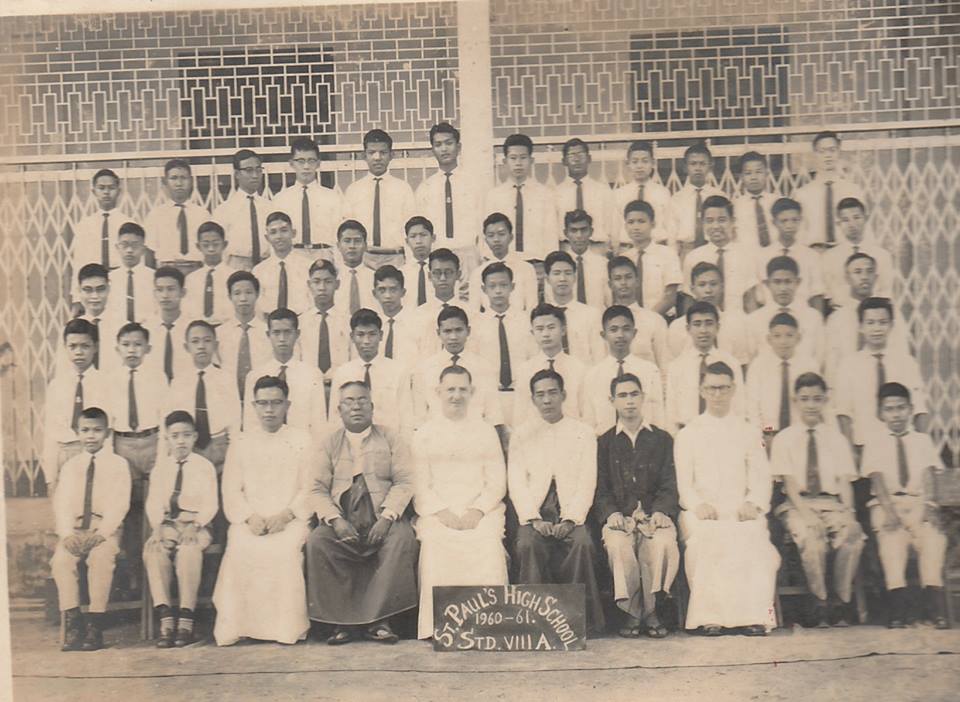
Classmates in Standards VIII A, IX A and X A at St. Paul’s HS
Myo San (3rd row, 5th from left)
Stood third in Burma in the Matric of 1963 and won Collegiate Scholarship.
Myo San (Seated right)
Mastered phonetics and read lots of English books.
One would not be surprised that he scored distinctions in English, Maths, Physics and Chemistry.
A little bit older than me and that might have given him an advantage.
Gave me a quiz. “How do you pronounce GHOTI?” I gave an answer which he corrected as “FISH”. He had read George Bernard Shaw, who posed the quiz as a lesson on the eccentricity of English.
GH is phonetically equivalent to F as in ROUGH. O is phonetically equivalent to I as in WOMAN. TI is phonetically equivalent to SH as in ATTENTION. Thus, GHOTI is phonetically equivalent to FISH.
Became a surgeon
Stress caused him to take early retirement.
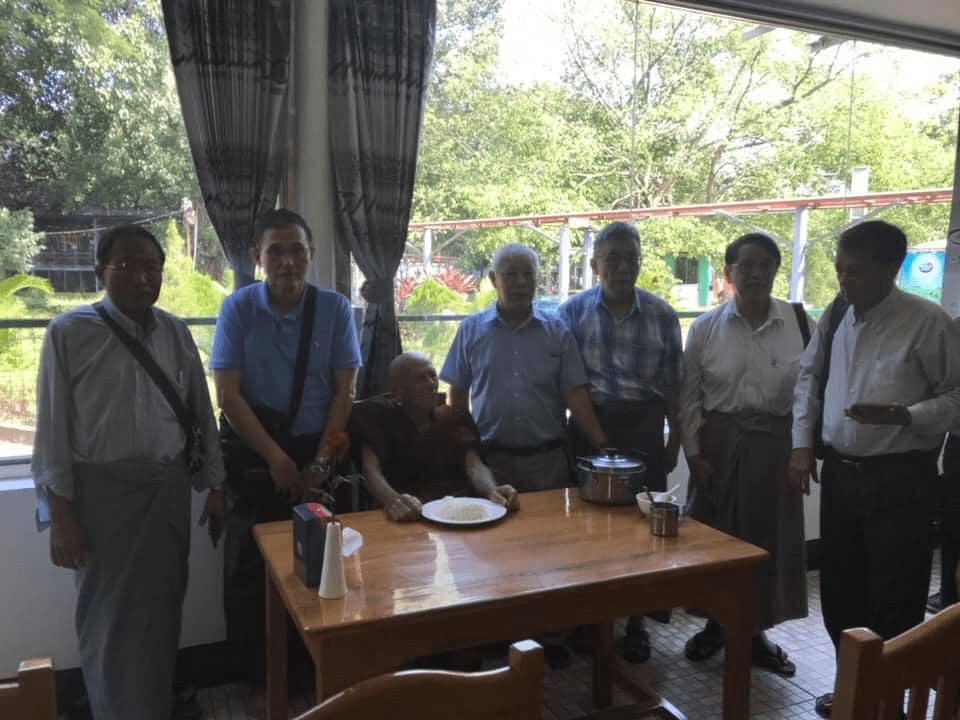
He had mini-reunion with SPHS63 classmates. In the photo, the three (seated) — Freddie, Alan and Tin Tun — are now GBNF.











 HlaMin