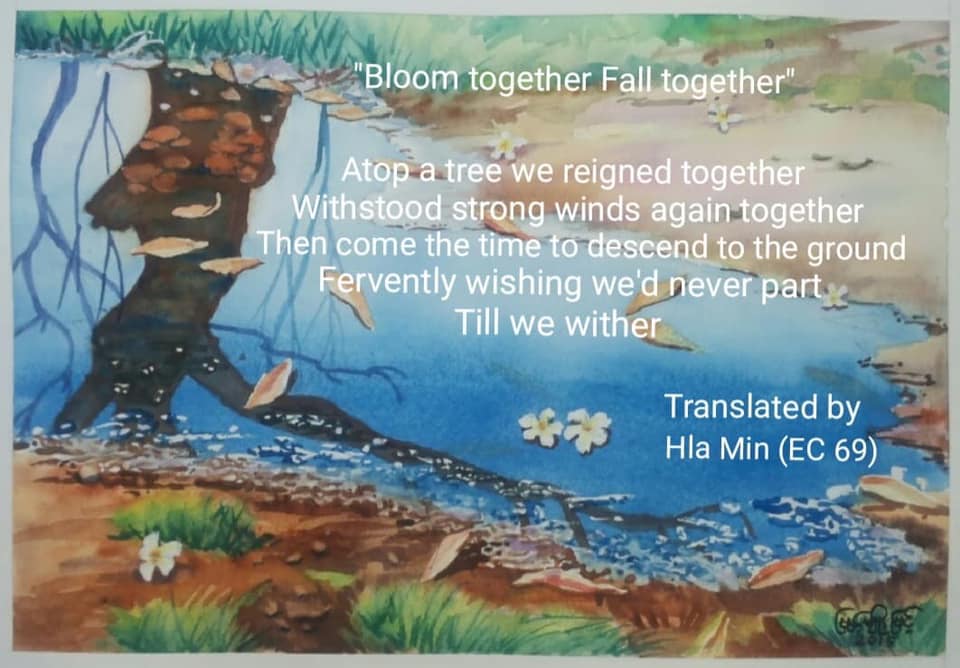
နိုင်ငံရေး စီးပွားရေး အတ္တဘီလူးများကို RIT ကျောင်းသားဟောင်းတစုက သနားကြင်နာစွာ သတိပေးလိုက်တဲ့ ကဗျာသရုပ်ဖေါ် တစ်ခုပါ။
Here is a clear and kind reminder to “every politically and economically greedy giant-headed monster” from a group of alumni of Rangoon Institute of Technology, Myanmar.
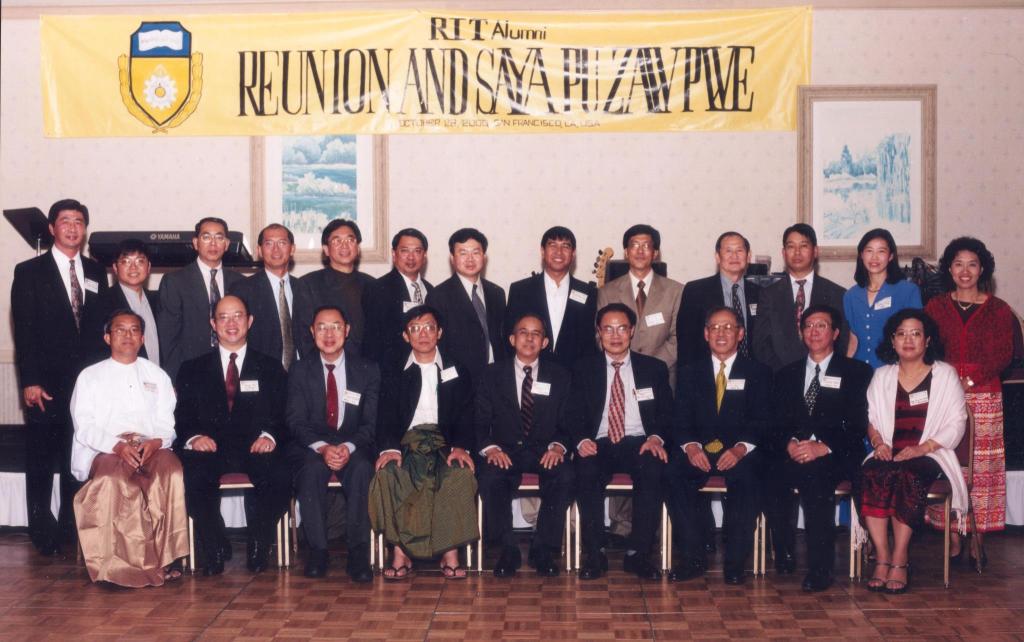
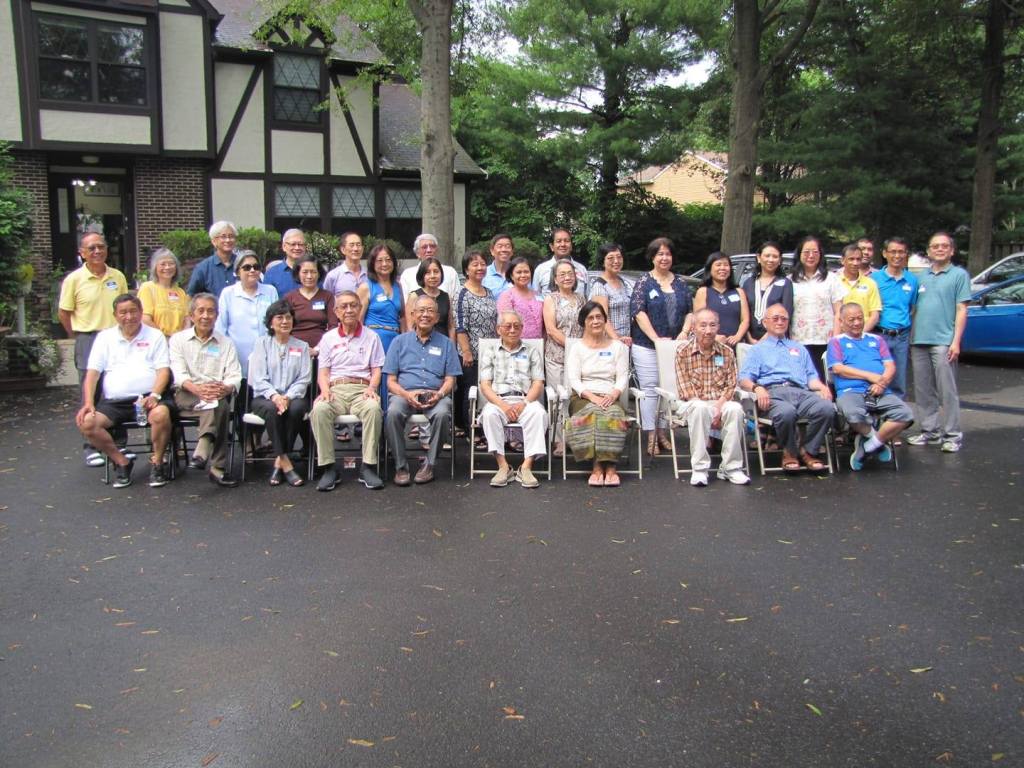
Thank you very much to all of you (Organizing members and the participants) for the unforgettable grand event “SPZP and RIT Reunion 2000” at San Francisco.
Let me express the most exciting moment for me at the event. Earlier, I have learned from your “Countdown to the Reunion” articles that there were some questions about the agenda, especially about the Saya Ga Daw Pwe which is a tradition/practice for the Buddhists. Later the organizing committee members arranged it as an optional for the attendees.
On that great evening of October 28, I arrived just in time from the other hall into the main hall to participate in my most anticipated moment. I jumped into the event from behind the other participants. For a few seconds, all of us struggled willingly with joy for a tiny spot to pay homage to our Sayagyis. Each of us did it successfully in a thrilling moment. To pay homage all my Sayagyis together in this place and time was an extraordinary opportunity for all of us. It does not matter for me – their religion – whether they directly taught me, indirectly, or did not – whether I have seen them before or not. Sayas are Sayas. Whoever they were/are. There is no problem. Our Sayas and Sayamas have done a grand – unparalleled accomplishments to our Mother “Rangoon Institute of Technology”, to our Mother Country , and to our lives.
One more special excitement for me was, I noticed that there were non-Buddhists not only on the stage among the Sayas but also on the floor among the engineers who were proudly paying homage with strong eagerness to our Sayagyis. Immediately after we paid homage, I saw many of us ‘Great Engineers’, some with tears of joy, bowing their heads, rushed to the Sayagyis sitting on the stage, touched, and held their Saya’s hands with excitement. I guessed that some of these fore-rushers were in their 60’s and trembling with exultation. I learned that SPZP is not only for young engineers.
The event was very enthusiastic and swift. [Let me say,] it was also a little chaotic and informal. However, this kind of chaotic atmosphere was the real unforgettable “Unique Essence” of our once-in-a-life-time SPZP and Reunion, 2000.
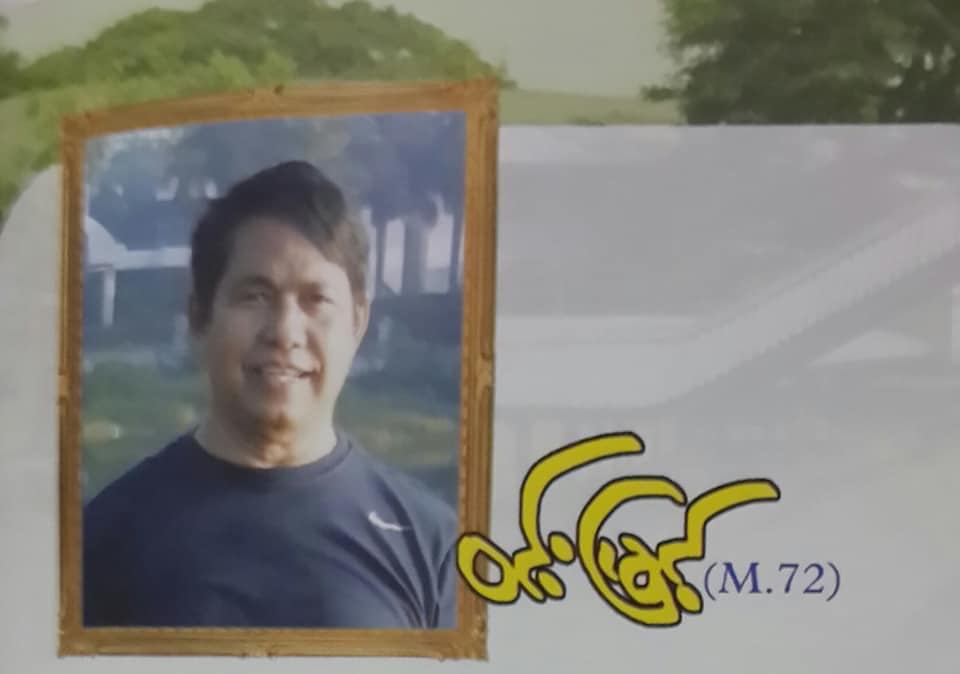
“Ba Thein, Atlanta” is the pen name of Dr. Myint Thein (M73), who studied at Georgia Tech in Atlanta.
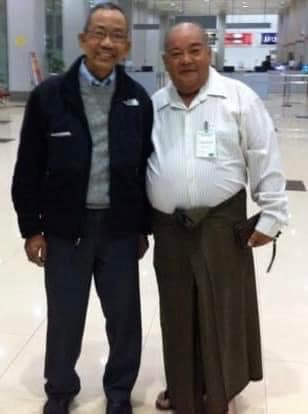
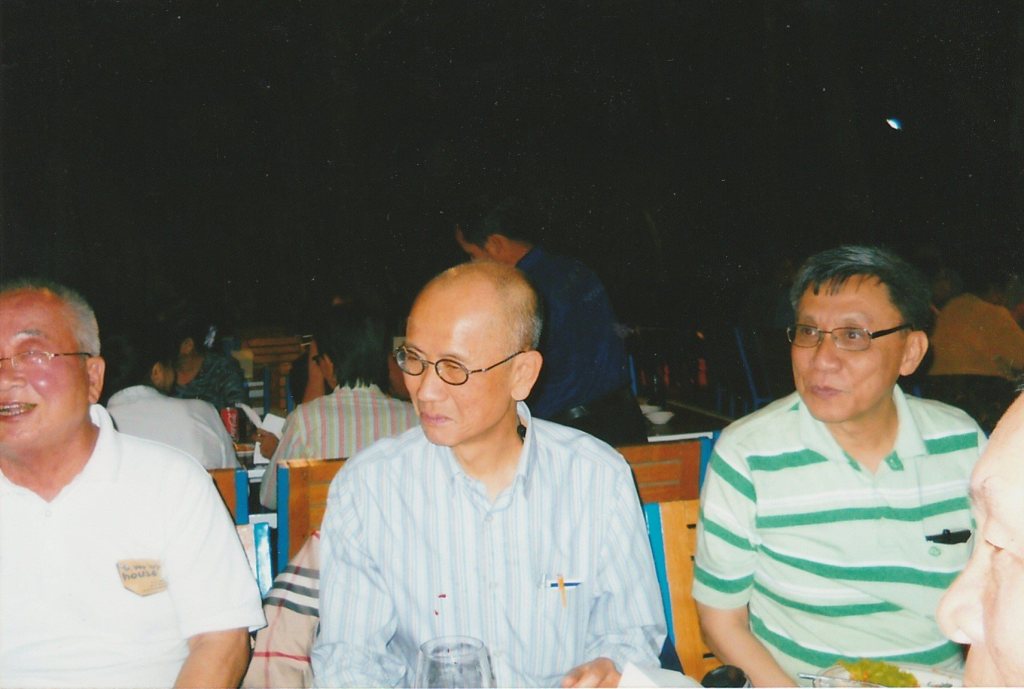
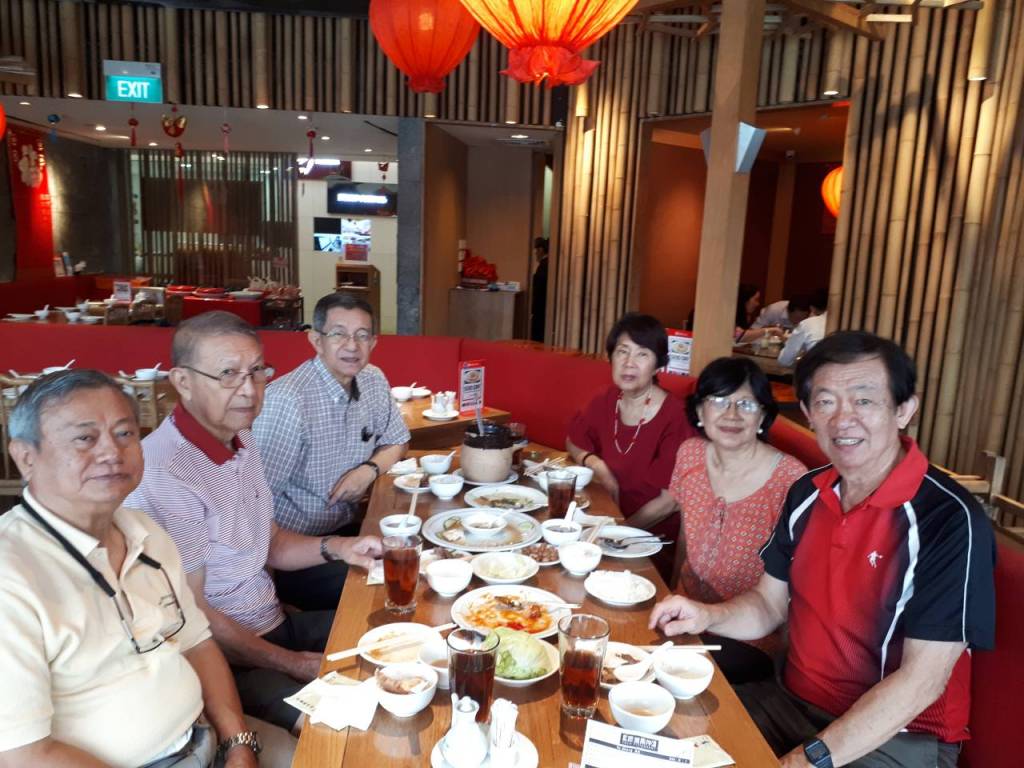
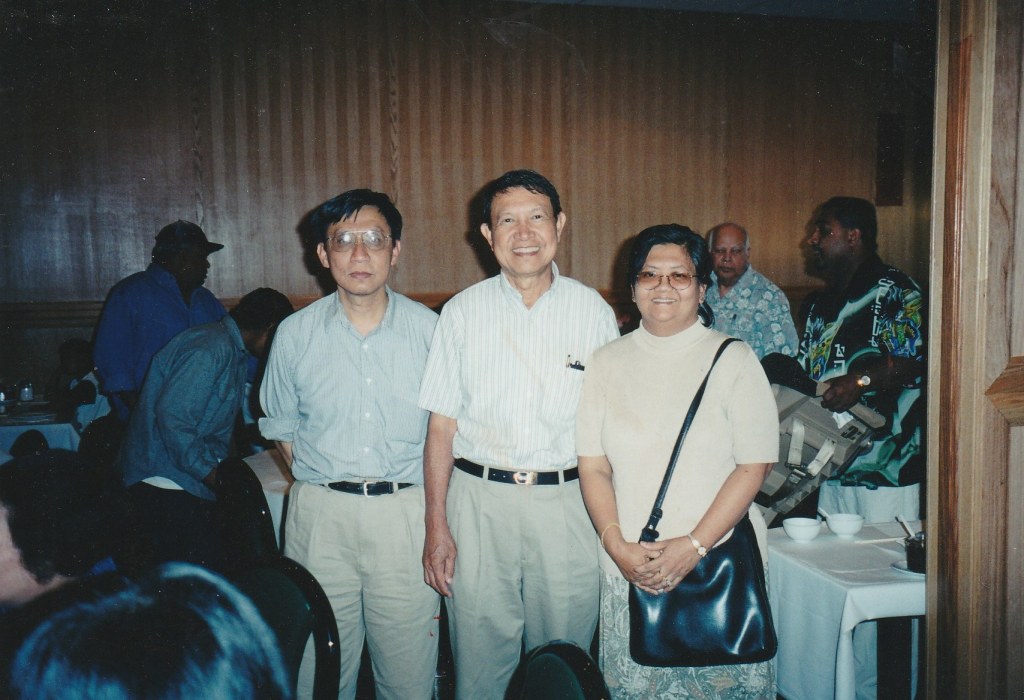
On the eve, we had an informal gathering at an “all you can Japanese, Korean and Chinese buffet”. We saw some of our Sayas (e.g. Dr. San Hla Aung) revering their Sayas (e.g. Dr. Aung Gyi).
Dr. San Hla AungU Ba Toke, Dr. Aung Gyi, U Min Wun
At the Reunion dinner (Main Event) and the Family Picnic the following day, we saw more instances. Saya U Khin Aung Kyi paying respect to his Sayas — U Ba Toke (Maths) and U Num Kok (Civil) — is awesome and inspiring.
EE Sayas & AlumniU Num KokU Khin Aung Kyi
Earlier I received e-mails telling me the difference of Asian and Western cultures, e.g. how one calls one’s professors by their first name, and hinting that “it would be awkward for non-Asian spouses to witness/understand the SPZP”. Fortunately, we did not hear any complaints at the event.
We appreciate the cetana of the following alumni who felt that the RIT Alumni International should have activities beyond the First ever RIT Grand Reunion and Saya Pu Zaw Pwe.
They are honored as “Golden Sponsors” of SPZP-2000.
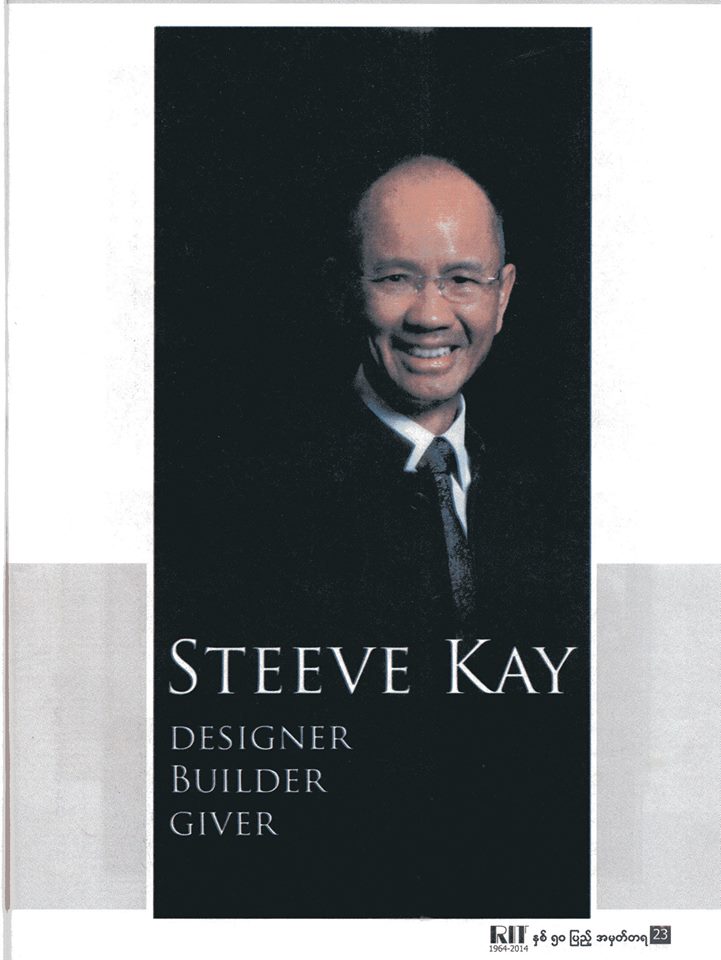
Steeve Kay (U Thaung Sein, EC70, Southern California) Donated $1000 initially and later gave an additional $1800.
Steeve Kay 1Steeve Kay 2
Ivan Lee (U Khin Maung Oo, M69, New Jersey) Donated $1200 for the General Fund of RIT Alumni International (and for SPZP-2000). Earlier donated $360 for one year’s operating expense of the ex-rit.or web site
Ivan Lee 1Ivan Lee 2
David Ko (U Tin Myint, M67, Northern California) Donated $1000 for SPZP-2000
Benny Tan (Tan Eu Beng, M70) Donated in cash and kind. Designed the memorabilia (Banner, Mug, Calculator/Clock and Tee-shirt). Since he had gift shops, he obtained most of the memorabilia from his vendors at discount prices.
Benny Tan 1Benny Tan 2
U Maung Maung Than (M79, Texas) Donated a Round-trip ticket to Myanmar By popular acclaim, the ticket was given to Sayagyi U Ba Toke.
Update
Steeve Kay
Multiple Golden Sponsor for SPZPs.
Established the “Steeve and Helen Kay Health Care Fund for RIT Sayas and Sayamas. In 2019, the balance of the Fund was handed over to Swel Daw Yeik Foundation.
Donated $200,000+ over the years to RIT-related activities.
He is now GBNF.
Ivan Lee
Hosted the annual RIT-UCC Gathering in New Jersey
Golden Sponsor for SPZP-2007 Sponsored ayama Naw Mu Mu Aye to attend the SPZP
David Ko
Donated US $3000 to SPZP-2012
Sponsored Dinner Tables at NorCal RITAA Dinner
He is now GBNF.
Benny Tan
Multiple Golden Sponsor for SPZPs
For SPZP-2000, Ko Benny used Steeve’s donation as seed money to raise funds. He designed memorabilia to give to sayas, sayamas and selected organizers / volunteers. Some memorabilia were put on sale for attendees at SPZP-2000.
U Maung Maung Than
Could not attend SPZP-2000, but he comunicated with Saya Allen Htay
Supported Saya Dr. Tin Win’s “Run LA Marathon to raise fund for SPZP-2007”
Sponsors for Sayagyi U Ba Toke
U Maung Maung Than donated the round trip ticket
U Zaw Min Nawaday (EP70) hosted Sayagyi U Ba Toke and his son U Ye Myint (EP72) at his then new house in Hayward, California.
Saya Allen Htay, Saya U Tin Htut, Saya Mao Toon Siong and several sayas and alumni took care of Sayagyi’s stay.
Saya U Maung Maung Than (Tex, GBNF) was Chairman of RIT Sports Committee.
U Maung Maung Than
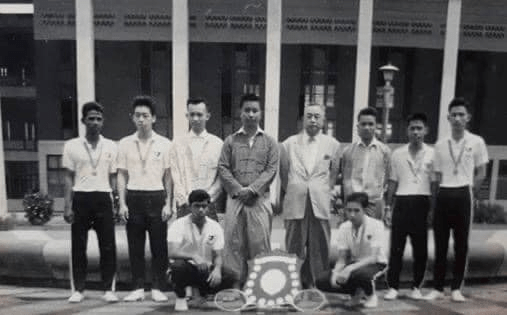
Saya U Thein Lwin (EE, GBNF) was President of RIT Badminton Association.
U Thein Lwin (Seated 3rd)
Inter-Institute Tournament
RIT won the trophy
RIT Badminton 1RIT Badminton 2
Sai Kham Pan (EC69) was Burma Selected. He would bring back shuttle cocks, which were “still good” but discarded at the Training Camp, for his hostel mates. He was then Number Two in Singles, and Number One in Doubles with Kyi Nyunt (Sagaing, Burma Champion). Due to tight schedules for some tournaments overseas, he had to take books along to study for the examinations.
He had excellent foot work and strong wrists. He needed training partners at RIT. Ko Myint Sein (M69, GBNF) was his partner in training and in competition. Ko Khin Maung Win (Sargalay, EP69, GBNF) was his “reliable” training partner. SKP would give Sargalay 10+ bonus points for the 15 point game.
Bishnu Shasi (EE69er, GBNF) was also a good Badminton player.
Tommy Shwe (1st BE Intake of 64, GBNF) was also a good player. He left RIT before graduation to Taiwan and later moved to USA.
There was another student, couple of years behind, who played badminton and also a long distance runner. I believe he’s from Textile. Unfortunately, I could not recall his name. We used to hand out at Athletic officer Ko Maung Maung’s office in those days.
Rafiul studied at UCC, AIT and USC. He taught at the University of Maryland before moving to Silicon Valley. He retired as Vice President of Oracle USA. He was a Commencement Speaker at AIT.
UCC and RIT alumni attended the welcome party for Saya U Soe Paing (co-founder of UCC).
Party at Rafiul’s house
CPC
UCC conducted Computer Programming Classes.
Dr. Tin Maung (GBNF) succeeded Dr. Chit Swe as Director of UCC.
Teaching staff : U Hla Min, U Win Myint (1), U Win Myint (2), Daw Tin May Lwin, Daw Nge Ma Ma Than (GBNF), Daw Than Than Tint, Daw Thi Thi Aye, Daw Thida Kyi, Daw Thandar Htwe
CPC
UCC Group in front of Convocation Hall
Dress rehearsal for the Convocation
UCC conducted post-graduate diploma called DAC
Ko Win Hlaing, Ko Henry Maung Maung (GBNF), Ma Kyu Kyu Lwin (GBNF), Ma Khin Si Thaung, Ma Khin Khin Win, Ma Phyu Phyu Win, Ma Win May Thaung (GBNF), Ma Tin Tin Yee, Ma Hla Win (GBNF), Ko Aung Myint (GBNF), Ko Soe Myint (GBNF)
Their Departments : UCC, Census / CSO, Social Security Board, Five Star Line
Some worked at RIT and UCC. e.g U Aung Myint (GBNF).
Some RIT alumni worked at UCC.
Some RIT alumni attended UCC courses.
Some are alumni of UCC but not RIT.
UCC RIT 1UCC RIT 2UCC RIT 3UCC RIT 4UCC RIT 5UCC RIT 6UCC RIT 7UCC RIT 8UCC RIT 9UCC RIT 10UCC RIT 11UCC RIT 12UCC RIT 13UCC RIT 14UCC RIT 15UCC RIT 16UCC RIT 17UCC RIT 18UCC RIT 19UCC RIT 20UCC RIT 21
UCC (Universities’ Computer Center) was founded by Sayagyi Dr. Chit Swe (GBNF) with the help of Saya U Soe Paing, Saya U Myo Min and Saya U Ko Ko Lay (GBNF).
Dr. Chit Swe
He matriculated from Ela and studied Mathematics at Mandalay University.
He joined the Faculty.
He received B.Sc (Special) from Imperial College, London University.
He did postgraduate studies in Mathematical Statistics at Glasgow University and University of Liverpool.
He was Lecturer and Head of the Mathematics Department when he started the UCC Project.
He succeeded U Ba Toke as Professor of Mathematics at RASU (Rangoon University).
Dr. Chit Swe 1
In 1971, he became Founder / Director of UCC in addition to his duty as Professor of Mathematics, RASU.
He believed in Knowledge Transfer & Leapfrogging Technology. With the help of Dr. Harry Huskey (pioneer in Computer Hardware & Software, Past ACM President), he developed Computer Science, Technology and Application at UCC.
The higher authorities request him to resume full-time teaching & research at RASU.
He became Rector of RASU.
Saya served as Commanding Officer of University Training Corp (UTC). He also served as Chair of Burma Judo Federation.
After retirement, he moved to Thailand and Australia. He advised Burmese students in Thailand and Australia for their research.
Dr. Chit Swe 2
Saya passed away in late 2019.
Dr. Chit Swe 3
Spouse : Daw Khin Khin Latt Children : Four sons and a daughter Siblings : Eight
Dr. Chit Swe 4
U Soe Paing
He matriculated from St. Paul’s High School in 1956. He stood 13th in the Whole of Burma and was awarded Collegiate Scholarship.
In 1958, he won two Gold medals. He had the Highest marks for I.Sc.(A) & (B) combined. He had the Joint Highest Marks in Mathematics for I.Sc.(A) & (B) combined.
U Soe Paing 1
He received BSEE and MSEE from Stanford University. He joined the RIT Electrical Engineering Department as Assistant Lecturer. He helped Dr. Chit Swe design and implement the UCC project.
U Soe Paing 2
In April 1971, he transferred to UCC as Manager of Systems Division. He managed Computer Engineers & Technicians and Systems Programmers.
He received M.Sc (Computer Science) from Southampton University.
He published Lecture Guides & Manuals for use at UCC. U Aung Zaw (GBNF) and I helped Saya with the publications.
He later also managed the Operations Division.
He worked for UN Projects in several countries.
After retirement, he spends his time in Myanmar, UK and US.
U Soe Paing 3
Spouse : Daw Saw Yu Tint (Alice)
Children : Two sons and a daughter
Siblings : Dr. Myo Paing, U Win Paing (Sayadaw U Wara, GBNF), U Kyaw Paing
U Myo Min
U Myo Min 1
He matriculated from St. Paul’s High School in 1958.
He won medals for having the highest marks in I.Com in 1960, and B.Com (Accounting) in 1962.
He became a Chartered Accountant. He worked for IBM UK as a Systems Analyst.
His mother relayed Dr. Chit Swe’s request to return to Burma to help with the UCC Project.
In April 1971, he joined UCC as Manager of the Applications Division.
After the restructuring of UCC, he served as Business Applications Manager.
He received Masters in System Engineering from Lancaster Univetsity, UK.
He passed the Abhidhamma / Thingyo exam.
He taught courses at the Institute of Economics and Government departments wishing to computerize their applications.
He moved to Singapore and USA. He taught at Nanyang Institute in Singapore. He was a Principal at Seagate Technology and Connors in the USA.
U Myo Min 2
After retirement, he spent time doing meditation and mentoring.
U Myo Min 3
Spouse : Daw Kin Kin Chit Maung Children : A son and a daughter Siblings : U Tin U, U Ba Than (GBNF), Dr. “Ruby” Win Hlaing, Daw Myint Thwe, Dr. Myo Tint (GBNF), U Tin Htoon (A60), U Thaung Lwin (EC66) and Daw Cho Cho Hlaing
U Ko Ko Lay
U Ko Ko Lay
He matriculated from St. Paul’s High School in 1956.
He received BSCE and MSCE from Stanford University.
He joined PWD as Assistant Engineer.
His former classmate (U Soe Paing) asked him to help the UCC Project.
In April 1971, he transferred to UCC as Manager of Operations Division.
After the reorganization of UCC, he became Manager of the Scientific Applications Division.
He received Masters in Systems Engineering from Lancaster University, UK.
He later became Professor and Head of the Computer Science Department at Rangoon University.
In 1987, he became Professor and Head of Information Technology at the Institute of Computer Science and Technogy.
He had the longest tenure at UCC among the UCC Founders. He was also the first to pass away.
Spouse : Daw Betty Tun Aung Children : Two sons and a daughter Siblings: U Than Htut (M67, RUBC Gold), Maw (BDS), Zaw (GBNF, RUBC Gold, IM (1)) and three sisters.
The ever smiling Saya U Ko Ko Lay is missed by his former colleagues and students. He used to play Soccer, Tennis and Table Tennis at UCC with his colleagues and students.
UCC Thingyan
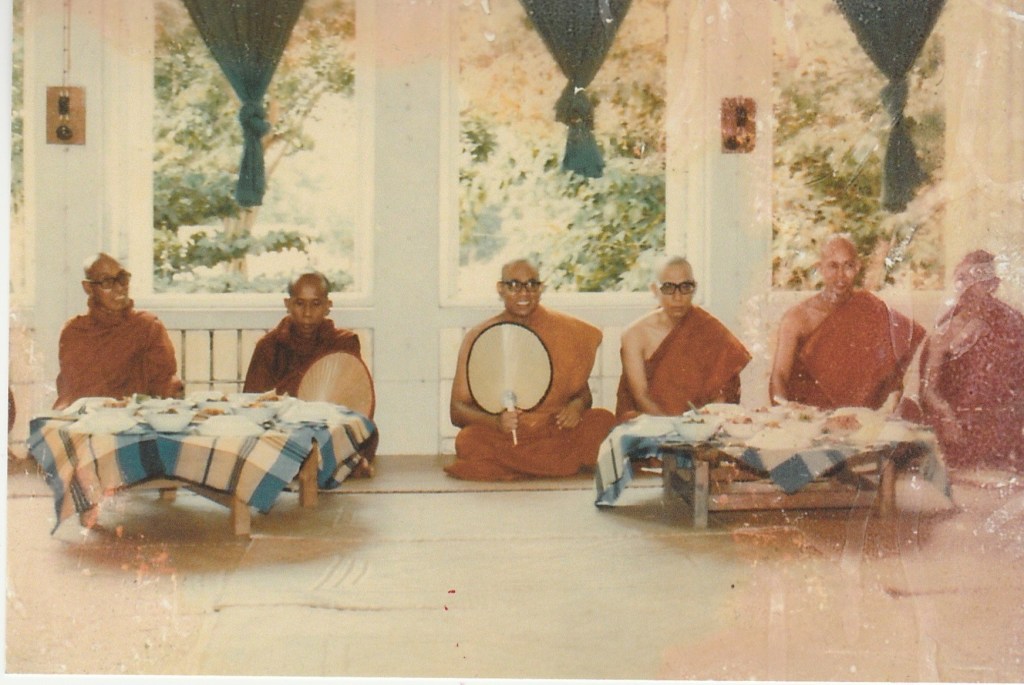
For several years, UCC sponsored “Su Paung Donlaba Yahan Khan” for its staff and students.
The temporary monks are offered soon at UCC.
UCC monks
UCC had Culinary Experts and Dobat Troupe
Culinary expertsDobat
Dr. Tin Maung
He joined the RU Department of Mathematics as Assistant Lecturer.
After receiving his Masters from UK, he was promoted to Lecturer.
Dr. Tin Maung
He succeeded Saya Dr. Chit Swe as Director of UCC.
Under his tenure, the Department of Computer Science (DCS) was established. U Ko Ko Lay served as Professor and Head. U Tun Aung Gyaw was Associate Professor. I and a few others were Lecturers.
Later, the Institute of Computer Science and Technology (ICST) was established. Dr. Tin Maung served as Rector. U Ko Ko Lay was Professor and Head of Information Technology. U Tun Aung Gyaw was Associate Professor and Head of Hardware Technology. I was Associate Professor and Head of Software Technology.
UCC Courses
Degree / Diploma Courses
M.Sc. (Computer Science)
DAC (Diploma in Automatic Computing)
Programming / Training Courses
Six months course (Part time)
Four months course (Full time)
Special orientation and training for sayas and sayamas chosen as State Scholars, and for government departments (with computer sections and/or applications)