Ken Olson and several other MIT alumni founded DEC (Digital Equipment Corporate).
Grapevine says that there was a protocol in government departments to “purchase computer”. In order to circumvent that, DEC named their mini-computers as PDP (Programmable Digital Processors).
CHM (Computer History Museum) has a PDP-1 on display. Retired DEC engineers “restored” a PDP-1. The exhibit has demos : one for play a “primitive” Space War game, another for “playing” music …
PDP-8 is a 12-bit mini-computer used in many universities of that period.
PDP-11 is a 16-bit mini-computer. UCC acquired PDP11/70
VT-101 (or similar) terminals became the “new” mode of entering and running programs.
DEC later introduced VAX (Virtual Address eXtended) series.
Gordon Bell was the VAX architect and co-author of the book using CMS (Computer Memory System) and “formal” methods to describe and evaluate computer systems. The artifacts that he collected for the book project were displayed in DEC as BCM (Boston Computer Museum) with Gwen Bell as the Curator. It later became CHM (Computer History Museum) in Mountain View, California.
CHM (Computer History Museum)
I volunteered as a Docent for CHM for a couple of years. I had to give guided tours (for 45 minutes to an hour).
One child asked his father how fast the 10 Million Dollar computer (Cray 1) was. The reply, “It’s slower than your PC and your smart phone”.
Feedback
KMZ wrote :
It was a shame that DEC/VAX/VMS did not take off well as some people hoped. Fortunately, Bill Gates hired VAX/VMS main architect Dave Cutler in 1988, who brought many of his team from DEC, 20+ as reported, as part of the hiring agreement of Dave Cutler.
Dave Cutler and his team developed Windows NT, New Technology – a 64bit OS, and the rest is history. He has his hands on RedDot, which be came Microsoft Azure.
Dr. Mark Russinovich, received his doctorate in 1989 from Carnegie Mellon, developed a very popular Windows utility suite called ‘SysInternals’ with his partner. This was a godsend for all Windows Systems Engineers, a Swiss Army Knife, if you will. He also had a short stint at IBM, he also wrote a series of articles comparing Windows NT with VMS?? in Windows Internals magazine. Microsoft eventually acquired the SysInternals, Mark included. Mark is now CTO of Microsoft Azure.
He earned the nickname Pauk Si at SPHS (St. Paul’s High School). His father had lent money to a Pauk Si vendor, but the vendor could not pay back the loan. So, at break time, he would go to claim one Pauk Si (or more depending on his appetite).
Since there were two Hla Min, he was called CO (Chief Operator).
Under the UCC program, he studied for a year in UK and also found his soul mate (Ma Tin Win), who was undergoing “advanced” nursing training.
CO was afraid of getting hospitalized.
CO was healthy. He would rarely wear the “coat/jacket” that is mandated for those working in the “air conditioned” Computer Room. He would often wear a sports shirt.
So, it was a surprise to learn that CO, after returning from spending as a temporary monk at Taung Pu Lu monastery, fell ill. He was admitted to RGH (Rangoon General Hospital) where Dr. Min Lwin (Maurice Hla Kyi, 5th in Burma in 1964, Roll Number Two at IM(2), cousin of “Lake” Win Maung) examined and found out that his friend had a serious problem.
CO’s voice had lost intensity during his stay in the hospital. He told us to be good towards the sayas, colleagues, friends and family members. We sensed that it was his farewell message. Sad to say, he passed away in his mid-thirties. He did not drink or smoke, but he ate (may be a little bit indiscriminately). He presumably had Hepatitis and later “cirrhosis”.
Some people were not aware that there were two Hla Min who attended SPHS & RIT & worked at UCC. They both have spouses from the medical profession.
So it was not surprising when two government departments where I had given guest lectures inquired UCC where and when they could send wreaths (Lwan Thu Pann Khwe) for me.
A representative from the first department said, “It is said that people laugh a lot before they die. U Hla Min was telling us jokes.”
A person from the second department said, “U Hla Min looked frail and unsteady when he walks. No wonder he passed away.”
To top it all, Ko Moe Hein (Ajala, ChE69) stared at me like a ghost at the Kyandaw Cemetery. He was RIT Selected for Swimming and Water Polo. He had a loud voice that can drown the voices of ten or so “normal” people. So he became the de facto “Cheer Leader” for the RIT Sports Teams. He was working at HI (Heavy Industries). At Kyan Daw Cemetery, he came down from a bus. When he saw me, he appeared “staring at a ghost”. He explained, “Your brother seemed so calm when we learned that you had passed away. So I look a day off to give you last respects thinking that ‘If your brother does not care about you, there will not be many people at last journey’”.
CO was partly responsible for the UCC staff members visiting Kaba Aye Sun Lun Gu Kyaung and then later participating in the Thingyan Su Paung Yahan Khan Pwes.
He and Saya U Soe Paing were temporary monks at the monastery where U Wara (Win Paing, ChE70, younger brother of Saya Paing, GBNF) was Taik Oak Sayadaw.
Ko Soe Myint (M72, GBNF) and his family (parents, asiblings, …) are devotees.
I visited CO and Saya Paing and later became a devotee.
After we started working there, we hanged around the beautiful & attractive ladies in the machine room, like bee to the honey. CO didn’t like us there and issued a verbal warning not to talk to the ladies there, he’s the king/chief of the machine room, unless it’s work related.
He got really mad when we removed the covers of some of the machines there, pretending we were working on fixing those, while having good chitchat with the ladies there.
Some of them are now GBNF, several are still kicking, I mean alive and well. Those were the days, we really miss those old days.
Heartfelt love and thanks to those who had nothing but forgiveness to many of our shenanigans there.
Cherry Hlaing (St. John’s Convent) and Lyn Aung Thet (Methodist English High School) Has same total marks. Using the ILA system, Cherry was admitted as Roll Number One to IM(1).
Aung Win Chiong (SPHS) Based on ILA, he was admitted as Roll Number One to IM(2).
Indian lady Probably moved overseas
Min Lwin (SPHS) Based o ILA, he was admitted as Roll Number Two to IM(2).
UCC was founded in 1971 with Saya Chit (Dr. Chit Swe, GBNF) as Director, Saya Paing (U Soe Paing) as Systems Manager, Saya Myo (U Myo Min) as Applications Manager, and Saya Lay (U Ko Ko Lay, GBNF) as Operations Manager.
The UCC Project was started by Saya Chit (then Head of Mathematics Department at the Institute of Economics) with the help of Saya Paing (then Assistant Lecturer of Electrical Engineering at the Rangoon Institute of Technology) and several others.
It took a long time before the UCC Project was approved by UNDP. UNDP was the Funding Agency. UNESCO was assigned as the Executing Agency.
ICL won the contract to provide ICL 1902S Computer System, Software, Training and Support.
Dr. Harry D Huskey (UCSC) won the sub-contract for offering expertise in Academics & Research for UCC.
The early days of Computing in Burma/Myanmar has been presented in several articles in Burmese and English by Saya Paing including “Computer ah sa UCC ga”.
Saya U Aung Zaw (GBNF) has also recorded his memories about UCC in his book “Ba Wa and Dhamma”.
ICST/UCSY published a commemorative magazine for the 30th Anniversary of UCC.
In the beginning Saya U Myo Min managed all application programmers.
After the reorganization, Saya U Myo Min managed the business applications.and Saya U Ko Ko Lay managed the scientific & engineering applications
Application Programmers include U Mya Thein (Bo Shoke, GBNF), U Thein Oo, U Tun Shwe, U Htin Kyaw, U Soe Than, U Kyaw Nyein, U Boe Ba Shan, U Myint Oo, U Sein Myint Maung, U Win Myint, U Soe Thein (GBNF), U Aung Hlaing, Daw Tin May Lwin, Daw Nwe Nwe Win, Daw Nge Ma Ma Than (GBNF), …
Saya Dr F Ba Hli (GBNF) received Sc.D. (Doctor of Science) from MIT (Massachusetts Institute of Technology). At MIT, Saya helped “fresh” scholars including Saya Dr. Aung Gyi and Saya U Min Wun acclimatize with the environment and studies.
Saya served as DG (Director General) of UBARI (Union of Burma Applied Research Institute) and Advisor for the Ministry of National Planning. Saya was a supporter of UCC Project and served as a member of the Board of Directors and as an External Examiner for the Computer Science graduates.
Daw Myint Thwe (Saya’s spouse) is the sister of Saya U Tin U (C), Saya U Ba Than (M), Dr. Myo Tint, U Tin Htoon (A60), Saya U Myo Min (UCC) and U Thaung Lwin (EC66).
Saya’s children Daw Tin Tin Hlaing and U Tha Hlaing (EC83) are UCC Alumni. U Htay Aung (EC80, spouse of Daw Tin Tin Hlaing and nephew of Saya U Sein Hlaing) and team “programmed” a PROM (Programmable Read Only Memory) to print Burmese characters on the Cromemco System Three micro-computer. He worked on Burmese Word Processing for Wang Computers. He migrated to Australia. For the past few years, U Htay Aung came back to Yangon to volunteer as an interpreter for the “10-day Mediation Retreat for Foreign Yogis” at the Mahasi Sasana Yeik Tha.
During my visit to Sydney in 2006, Saya U Aung Zaw hosted a UCC reunion and mini-PZP (Pu Zaw Pwe) for Saya F Ba Hli and Saya Chit.
U Sein Win (GBNF)
Saya U Sein Win (GBNF) is the younger brother of Dr. Tin U (Medical Superintendent, Rangoon Children’s Hospital) and Dr. Saw Lwin.
Saya served as Technical Advisor for UCC. Saya worked closely with U Win Htein (Purdue University, EE at PWD, GBNF) for the design and maintenance of the Electrical Systems (including Motor Alternator, Diesel Generator, Air conditioning) at UCC.
Saya was a top student at the University of Michigan. His friends jokingly called him “Khone Swa Khone Swa” referring to his brisk walking style.
Saya served as Lecturer in the Department of Electrical Engineering. When the EE Department was formally reorganized into EC (Electrical Communications, also known as EcE and Electronics Engineering) and EP (Electrical Power), Saya U Sein Win served as Professor of EP. Saya Dr. San Tint served as Professor of EC.
Grapevine says that Saya is an absent minded Professor. Saya married late. One day, Saya drove Sayagadaw to Bogyoke Market. He taught (or discussed with) his students for quite some time and almost forgot to pick up Sayagadaw. There are variations on this anecdote regarding the place (e.g. Hledan Zay).
Saya served as Line Judge at the RUBC (Rangoon University Boat Club) Regattas. Saya managed the RIT Swimming and Water Polo team.
Saya stays fit by swimming regularly (even when he was visiting Singapore on a business trip).
Saya has a vast knowledge. Saya Dr. San Hla Aung (C58) remembers Saya U Sein Win discussing about Civil Engineering and other subjects.
U Win Htein (GBNF)
U Win Htein matriculated from SPHS in 1956 with Saya U Soe Paing and Saya U Ko Ko Lay.
They were selected as State Scholars to study in the USA. U Win Htein studied at Purdue University. Saya Paing and Saya Lay studied at Stanford University.
Upon his return, he joined PWD.
He was EE during our UCC days.
For the UCC project, U Win Htein and his team maintained the Electrical Systems (including Motor Alternator, Diesel Generator, Air conditioning) at UCC.
U Win Htein is the elder brother of U Myo Myint (EC67) and Daw Myint Myint Thein (Susan, FERD).
Dr. San Tint (GBNF)
Saya Dr. San Tint (GBNF) graduated in 1961 and joined the EE (Electrical Engineering) Department at RIT. He later served as Professor of EC (Electrical Communications AKA Electronics Engineering).
Saya served as External Examiner at UCC.
He played on the RIT Saya Soccer team with U Soe Paing (EE), Dr. Tin Win (M), Dr. Aung Soe (C), U Aung Soe (Maths), U Tin Maung Nyunt (M) and Des Rodgers (English).
Saya suffered stroke and his right hand was paralyzed. He practiced writing with his left hand hoping that he will recover and continue teaching.
Saya spent four decades teaching and passing the torch to the younger generation.
His nephew U Hlaing Myint (UCC) was with Saya in Saya’s final days.
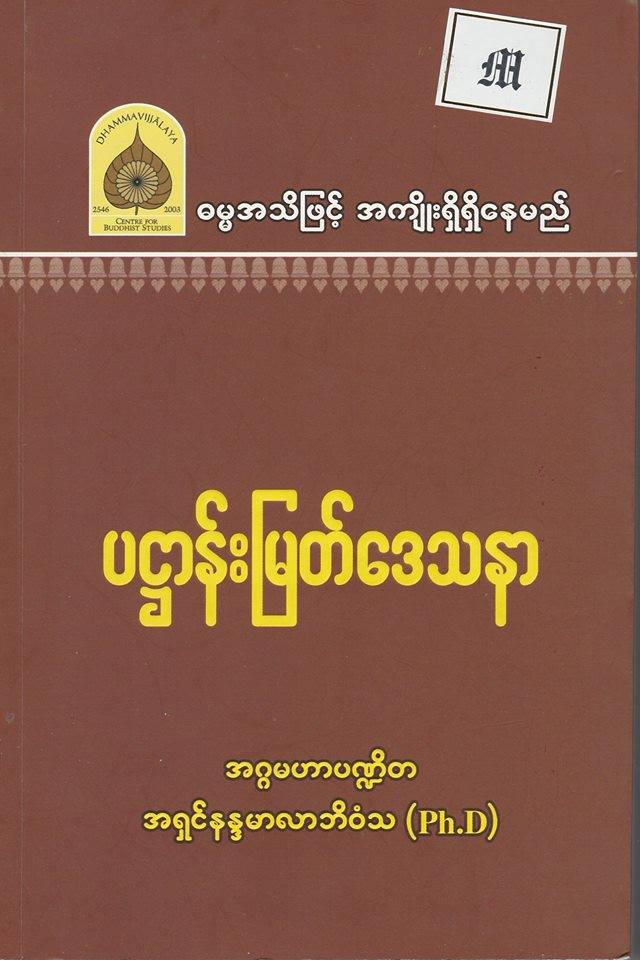
Author : Ashin Kundalabhivamsa Mahasi Nayaka, Kamatthanacariya Sadhhammaramsi Center Sayadaw
Translator and Publisher: [Dr. Daw] Khin Mya Mya [Ph.D] Singapore later relocated to US
CONTENTS
Biography of Sayadaw U Kundalabhivamsa Preface
Chapter 1 : The Vipassana Bhavana (a) Vipassana meditation (b) How to note the Kaya … (i) How to note the mind objects
Chapter 2 : First Factor Which Strengthen the Indiriya of a Vipassana Meditating Yogi (a) The benefits of Vipassana meditation (b) How difficult it is to have a chance to practise Vipassana meditation (c) The ability of the yogi to direct his mind on the nature of cessation of phenomena
Chapter 3 : Second Factor Which Strengthen the Indiriya of a Vipassana Meditating Yogi (a) How to note respectfully and penetratively (b) How to note to be right at the present … (g) How to note to overcome the Upekkha Vedana
Chapter 4 : Third Factor Which Strengthen the Indiriya of a Vipassana Meditating Yogi (Part 1) (a) The ability of the yogi to note continuously (b) The first Samphajhana instruction (c) The second Samphajhana instruction (d) The third Samphajhana instruction
Chapter 5 : Third Factor Which Strengthen the Indiriya of a Vipassana Meditating Yogi (Part 2) (a) The fourth Samphajhana instruction (b) The fifth Samphajhana instruction (c) The sixth Samphajhana instruction (d) The seventh Samphajhana instruction
Chapter 6 : Fourth Factor Which Strengthen the Indiriya of a Vipassana Meditating Yogi (a) The suitable meditation center … (g) The suitable posture
Chapter 7 : Fifth Factor Which Strengthen the Indiriya of a Vipassana Meditating Yogi (a) The causes of his attaining the Samadhi … (d) Two types of individuals whose finding of Dhamma is slow
Subtitle : On the Practice of Vipassana Satipatthana by Sayadaw U Lakkhana (of Sagaing Hills)
Translator : U Mya Thaung Editor : Gregory Pai, Ph.D. Publisher : Sukhavati Dhamma dana publication, 2002
Contents
Four Foundations of Mindfulness
Basic Satipatthana Instructions
The Hindrances (1) The Hindrances (2) The Hindrances (3) Effort, Mindfulness, and Concentration Right Aim Right Effort Insight Knowledge The Home Object and Walking Meditation Walking Meditation and Insight Knowledge Walking Meditation Clear Comprehension (1) Clear Comprehension (2) The Three Characteristics Discerning Mind and Body Contemplation of Feelings Painful Bodily Feelings The Truth of Suffering Conclusion
Poems of Nature
Dr. Lyn Swe Aye (Lynston Than Maung, MEHS 63, IM2 70) gave me an autographed copy.
Two of his poems appear in the collection.
His translation of Saya Zaw Gyi’s “Beda Lann” appeared in a PBS Documentary.
He is a member of the Editorial Board for selected publications by University of California at Berkeley.
Dr. Swe Aye and Dr. Khin Nyo Thet founded the Aye-Thet Scholarship, which is administered by TBSA and extended by the devotees of Sayadaw U Silananda.
Pa Yeik Kyee Theik Kha
Practice Book on Protective Verses
By “Thamane Kyaw” / Sayadaw U Dhammika
“Pa Yeik Kyee” (Paritta Pali, or Protective Verses)” is recited in part or full by monks, novices, and lay people
Sayadaw wrote a “Work book” to learn and practice Pali terms, phrases & grammar from “Paritta Pali”.
Nga Kyan Pyan Kyaung Centennial
The first Resident Sayadaw was from Dawei (Tavoy). He successfully recited five Dhamma Texts (Kyan). A book was published to celebrate the Centennial of the founding of the “Nga Kyan Pyan (Dawei) Sasana Yeiktha“.
I was asked to contribute an article. I stressed the importance of time.
I received a copy of the book. I was sad to see some typos and errors that should have been caught by the proof reader and the type setter.