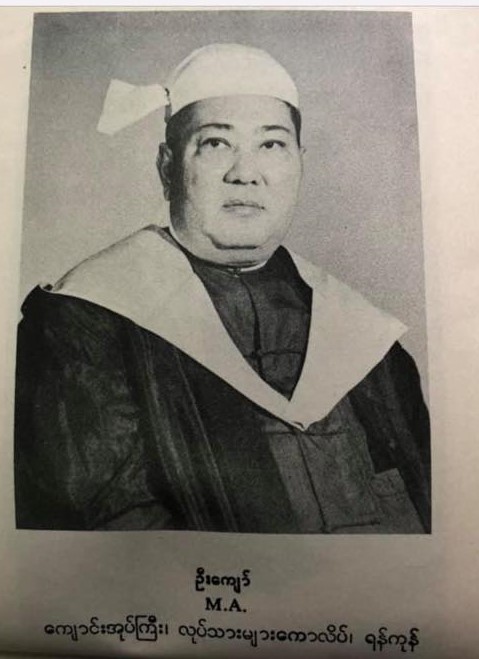
Studied Chemistry at Rangoon University and Imperial College, University of London
Retired as Rector of Yangon University Foreign Languages (YUFL)
Earlier served as Principal of Pyay College (now Pyay University) and Administrator of Institute of Computer Science and Technology (ICST)
Spouse : Daw May Saw Lwin (Retired Professor of Chemistry) Married in 1970 around the RU Golden Jubilee They will celebrate their Golden Jubilee in 2020 around the RU Centennial
Father : Saya U Sein (SPHS)
Sons : U Aung Mon and Dr. Nyi Thet Lwin
Related Posts : Old Paulians Top Matriculates (1951 – 1965) Chemistry
Daw May Saw Lwin
Attended Methodist English High School (MEHS)
Matriculated in 1957
Studied Chemistry at Rangoon University
Retired as Professor of Chemistry
Parents : U Saw Lwin and Daw Su
Siblings : Dr. Hazel Saw Lwin and Olive Saw Lwin
Spouse : Dr. Soe Win (Retired Rector of YUFL) Married in 1970 around the RU Golden Jubilee They will celebrate their Golden Jubilee in 2020 around the RU Centennial
Sons : U Aung Mon and Dr. Nyi Thet Lwin
Related Posts A Triumphant Return Top Matriculates (1951 – 1965)
UAung Mon
Founding member and Moderator of the Yar Pyay Group
Fondly known as “Aung“
Elder son of Dr. Soe Win and Daw May Saw Lwin
Studied EcE (Electronics Engineering) at YTU and IT in Singapore
Works in Singapore.
Was an organizer for EcE (Electronics Engineering) Reunion and SPZP
Spouse : Dr. Lay May Yin
Related posts Dana for Saya Dr. San Tint
Dr. Nyi Thet Lwin
Founding member and Admin of the Yar Pyay Group
Fondly known as “Nyi Nyi“
He was brought up on the RU Main Campus.
He wanted to learn first hand accounts about the University of Rangoon and its descendants.
Works as a Surgeon in UK
Parents : Saya Dr. Soe Win and Sayama Daw May Saw Lwin
Spouse : Dr. Swe Khin Tun
Daughter : Ei Lwin achieved grade 9 in all of the nine subjects that she sat in the 2019 GCSE exams in the UK. Following grandpa’s footsteps almost sixty years later!
Related posts RU Diamond Jubilee
SayaU Sein
Son : Dr. Soe Win
Taught Burmese at SPHS
He was our Burmese teacher in High School
Healso taught Burmese to Saya U Thet Lwin (Ngwe Hlinne, Composer of “Mya Kyun Nyo Nyo Kun Yeik Kho”).
Related posts SPHS Sayas
SayaU Kyaw Sein
Nephew : Dr. Soe Win
Taught several subjects (including Mathematics) in Middle School at SPHS
He was Class Teacher for a different section in Std. VII
He also taught us as a Relieving Teacher.
Win Myint (Myeik) mentioned that Saya is his father-in-law.
Related Posts SPHS Sayas
Daw Su
First resident of Inya Hall
Performed several roles in the Fund raising Concert for Tekkatho Dhammyone
Honoree of the Thet Kyee Pu Zaw Pwes of Inya Hall and Tekkatho Dhammayone
Spouse : U Saw Lwin
Daughters : Dr. Hazel Saw Lwin, Olive Saw Lwin, and May Saw Lwin
Wanted her daughters to stay at Inya Hall. Olive Saw Lwin and May Saw Lwin spent a year at Inya Hall. Hazel Saw Lwin (medical student) had to stay at the specified hostel.
Tipitaka comprises of Vinaya / Monastic rules of conduct Sutta / Discourses Abhidhamma / Ultimate reality
Buddhist Councils
According to the Theravada tradition, there are six Buddhist Councils.
The First, Second and Third Councils were held in India.
The Fourth Council (which recorded the teachings on palm leaves) was held in Ceylon.
The Fifth Council was held in Mandalay, Burma. U Khanti inscribed the Tipitaka on marble slabs. It was featured as the World’s Largest Book in Ripley’s “Believe it or not”.
The Sixth Council was held in Rangoon, Burma. Tipitaka was reconfirmed and published as printed texts. Selected Pali texts were also translated into Burmese.
First Buddhist Council
Source : U Silananda
Date : 3 months and 5 days (Sasana Era)
Place : Rajagaha (India)
King : Ajasattha
Leader : Mahakassapa Thera
Number of Monks : 500
Duration : 7 months
Accomplishment : Collected, examined, classified, and recorded orally the Buddha’s Teachings
MERB was formerly known as BERB (Burma Education Research Bureau). I attended meetings at BERB. Saya Jimmy (Dr. Khin Maung Kyawe) was the Director General. I first met him as a colleague of my cousin uncle U Than Lwin at the Faculty of Social Science.
After the mandatory name change, BERB became MERB. Old books (e.g. by Maurice Collis, BBS U Khin Zaw, Daw Khin Myo Chit) were forced to rename their titles before they could be reprinted. There was no Grandfather’s clause for the name change. “Trials in Burma” became “Trials in Myanmar”.
MERB produced Educational TV programs. U Tin Nyo directed the video highlighting University Sports.
U Tin Nyo shared the video ” တကၠသိုလ္အားကစား ပံုရိပ္မ်ား” directed by him and produced by ETV team (MERB) in1996 to mark the “Yangon University Diamond Jubilee”. Narrator : Saya U Nyein (RU Soccer Coach) Short Interviews with U Ngwe Gaing (Soccer), U Tun Mra (Athlete),U Myo Nyunt (Weight Lifting) and Haymar Nay Win.
Saya U Nyein was Coach of the Rangoon University First Eleven. Two of his players Collegian Nay Win and Aung Tin became movie actors. Several players (e.g. U Ngwe Gaing) became Burma Selected. Saya Nyein was a regular at the birthday gatherings of my uncle U Thet Toe (Past Captain and Gold of RUBC). They were classmates at Diocesan Boys High School.
U Tun Mra (eldest of the Mra brothers) won the Gold as a member of the 4 x 100 meters relay team anchored by U Soe Aung (then Burma Champion) at the 2nd SEAP Games held in Burma in December 1961. His younger brothers U Kyaw Mra (Hurdles, later National Coach) won Silver and U Soe Mra (Pole Vault) won Gold at the 2nd SEAP Games.
The three Mra brothers also competed in the 1st SEAP Games held in Bangkok in 1959. Three more younger brothers (Win Mra, Maung Maung Mra, Aung Mra) are also Burma Selected.
Met U Tun Mra, U Khin Maung Latt and U Tin Myint at the YUBC Annual Regatta in 2019. U Tun Mra and U Khin Maung Latt were members of the 4 x 100m relay team that set the RU record. U Tin Myint was cox of two Senior Novices Winning crews in the 1960s.
Hemar Nay Win (Vocalist) is the daughter of Collegian Nay Win and Daw Khin Marlar (daughter of Bo Ze Ya). Hemar gave an interview about her father. She inherited Ah Nu Pyinnar (but not Sports skills) from her father.
U Myo Nyunt was Burma Selected for Weightlifting.
For your reading pleasure
Photos
Acid, Base and Alkali Myar Chemistry alumni
Mother and Daughter (Both alumni) e.g. daughter and grand daughter of Saya U Aung Khin (Chemistry)
Fresher Welcome (and Fresher Queen)
Sports Selections (e.g. Marlar, RASU)
Kabyars
both originals and reprints (e.g. from the Philosophy Magazine and Pu Zaw Pwes)
Memories
First-hand accounts of the various closures of the schools
Some had to walk a long way back to the hostels. One was invited to stay at his friend’s house for the night.
One practiced for three months for the 3-day performance, but actually performed for a day.
One worked for daily wages at the Library in 1988 and saw many cartoons and posters for the 8-8-88 movement.
One remembers taking the examinations back in the home town.
Status
Some sayas, sayamas and alumni cannot spare the time to take part in gatherings. For example, Sayama Dr. Than Than Nyein (Chemistry) told the organizers not to send her invitations to the Pu Zaw Pwes.
Some have passed away, but without obituary notices and confirmation from the bereaved family, we cannot list them as GBNF (Gone But Not Forgotten).
After retirement, Saya U Aung Khin moved to Malaysia. He is GBNF.
Professor U Aung Khin (Chemistry)
Many of our sayas and sayamas are GBNF. Three most senior sayas and sayamas who passed away around 100 years of age are Daw Hla May (Anne, English) Daw Khin Kyi Kyi (Physics) U Ba Toke (Mathematics, Former Rector of MASU)
A few are 90+ years old. U Tin U (Part-time Civil Engineering saya) U Ba Than (Retired Professor of Mechanical Engineering)
Professor of Geography and Geology at Rangoon University (1923 – 26)
Professor, Geography Economics, London School of Economics
Chairman, Social Geography, LSE
Land Use Survey (of Britain with student volunteers)
Authored several books and research papers
One book was a prescribed text in Burma in the early days.
Lectured to the first year students at LSE (London School of Economics) instead of delegating to his assistants. His rationale : “A major subject can be taught by any qualified teacher, but a minor subject should be introduced by a motivated, senior teacher. The class could be the sole exposure in their academic career; so it is important to give the students an excellent overview of the subject.”
Geography learned at school
Took World Geography and Burmese Geography in Middle School and a year in High School.
Studied Contouring and Climatic Interpretation.
Padetha U Htay Myint taught us Geography and History.
Geography Department
Dr. Daw Thin Kyi is the first native Professor of Geography. She is also one of the early female Professors at Rangoon University. Expert in Land Use
Dr. Tin Htoo Senior Lecturer Retired as Professor
U Kyaw transferred as Principal of Worker’s College.
RU Geography
I worked as a volunteer assistant for Saya U Hla Tun Aung, who was in charge of the “Zay Nay Yar Cha Htar Yee Committee” for the Rangoon University Golden Jubilee Celebrations in 1970. Among those who applied for permits include U Maung Maung Tar (Academy winning actor, trying to sell his line of make up) and the Playboys (Than Naing, Thein Tan). Saya proposed new course requiring statistical analysis.
Saya Dr. U Win attended UCC courses before going for his graduate studies in the US. Collaboration with sayas from the Institute of Economics. Doctorate in Water Resource Management He later specialized in Geographical Information Systems (GIS). He was the last speaker for the conferences held by Burma Research Society (BRS). The higher authorities entered the room and announced that “BRS would be dismantled the following day”.
Attended regular and monastic schools while serving as an Assistant Teacher.
Completed a Teachers Training Certificate.
Worked as a Tally Clerk, but his intense desire to have higher education led him to become a “Kyaung Tha Gyi” at Judson College in his late 20s.
On November 30, 1920 there were two meetings. At one meeting, Mr. Matthew Hunter, Principal of Rangoon College, announced that the Rangoon University Act of 1920 will be implemented the following day (on December 1, 1920). At another meeting at the Jubilee Hall, College students proposed to protest the Act. The “Kyaung Tha Gyis” tried to soften the stand of their young energetic colleagues, but they finally gave in and lead the protests. The Strike was scheduled for December 7, 1920, but the news leaked out to the higher authorities. So, the Strike was rescheduled for December 5, 1920. U Po Kya was not only a member of the strike, but he went on to support the National Schools and serve as “Amyotha Pyinnya Wun“.
During his College days, he studied under the outstanding Burmese and Pali Scholars. Received his BA degree in 1922. Wrote several books including “Myanmar Gon Yi” and a collection of short stories (e.g. Volunteer Coolie for a Kyaung Tha). Some were prescribed as text book for schools.
Sad to learn that he passed away at the tender age of 51 due to malaria.
Many years ago, I met U Zaw Win Kya (son of U Po Kya) at Ava House where he was in charge of text books and publications.
Amyotha Aung Pwe Nay (National Day) uses the Burmese date (10th waning day of Tazaungmon).
A marble stone on Shwe Dagon Pagoda has the names of the 11 students who led the First RU Students’ Strike.
1920s and 1930s
Dr. Saw Mra Aung’s account of “Rangoon University in the 1920s” can be Googled on the Internet.
The early hostels were not inside the Campus. Took time and money to transform the “Nar Nat Taw” and its vicinity into hostels and additional class rooms. Hostel students had to guard themselves against mosquitoes and intruders (from nearby quarters).
Students in the early days include “Chit Dukkha” U Ba Nyunt (later Professor of History, father of Win Oo), U Thein Han (Zawgyi) and U Wun (Minthuwun).
U Nyo (Chauk Htutt Kyee Phaya Daga) was a philanthropist. His donations funded the Rangoon University Student Union Building and several buildings in the RU Estate. He also helped build the Club House for RUBC (Rangoon University Boat Club, which was founded by Law Professor Sir Arthur Eggar).
Chan Mah Phee and Daw Aye Mya were philanthropists. Their donations include a hospital (Chan Mah Phee Say Yone in Ahlone), Hwa Kyone school, and a Tazaung in Shwe Dagon. Their second son, Chan Chor Khine served as a member of the RU Council, and helped build the RU Gymnasium in memory of his beloved parents.
In 1936, U Nu was elected as President of Ta Ka Ta (Tekkatho Kyaung Tha Thumagga), M.A. Raschid (father of Saya Bilal) as Vice President and Bogyoke Aung San as Secretary.
Bogyoke Aung SanBoygyoke’s Translation of “Invictus”
In 1936, the Second RU Student Strike took place. The post has a photo showing U Saw Ba Hein (father of Dr. Daisy and Dr. Edwin), Ludu Daw Amar (Ah Mar), MA Daw Ohn and several more carrying the Banner.
In 1937, M.A. Raschid became President of Ta Ka Tha and also Ba Ka Tha. He would later serve as Minister in the Cabinets led by Prime Minister U Nu.
In 1938, Bogyoke Aung San (Editor of Oway) was expelled, because he refused to disclose the identity of the author of “Hell Hound at large”. The Third RU Student Strike took place. Ko Aung Kyaw was struck by a baton and perished. He was named Bo Aung Kyaw and the Sparks Street was renamed as Bo Aung Kyaw Street.
The Student Union nurtured many students to lead the Independence Movement and to run the democratic Union of Burma.
Dark Moments
There were many Dark Moments during the Adhamma regime starting with indiscriminate shooting on July 7, 1962 and the demolition of the RU Student Union Building on July 8, 1962.
The anniversary of July 7 (in 1963) saw posters and publications condemning the atrocities.
The authorities decided to close the universities (with the exception of Medicine and Engineering).
A new Education System was established in November 1964.
The Universities and Institutes were closed several times citing Security Concerns. Several students lost their lives in U Thant Ah Yay Ah Khin and 8-8-88
It took only a few years (if not a few months) to transform the “Rice Bowl of Asia” into LDC (Least Developed Country) and a highly revered Education System into one that promotes rote learning instead of rational and creative thinking (as implied by the term Tekkatho (Tekkathila or Tekka Sila).
Students were dispersed (some to remote places without proper facilities). Some teachers and students had to commute daily for two hours (or so). Many have to arrange for their transportation.
Resilience
RU and its children are resilient.
They survived to usher in the “Pwint Linn” Era.
Untold stories and hitherto unseen photos can now be seen in the posts.
Many can forgive but not forget the dark moments in history.
Khun Sai (founding member of the RU Centennial Group) was a medical student during the “U Thant Ah Yay Ah Khin”. For his involvement, he was debarred. He has posted memories of the Ah Yay Ah Khin.
For three years (1988 – 1990), RU and the Institutes were closed. There were no Convocations after 1987 and before 1991.
Saya Pu Zaw Pwe
Saya Pu Zaw Pwe (SPZP) is a noble tradition.
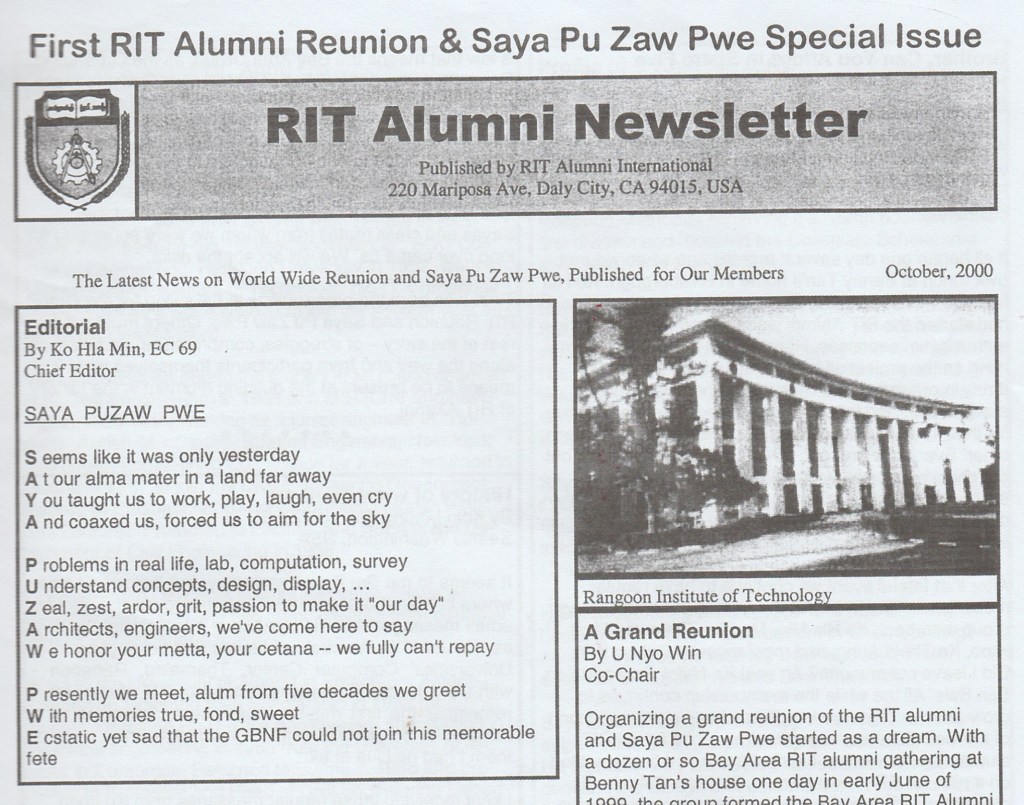
In October 2000, I was honored to be an organizer for a SPZP (in a land far away).
I wrote “SAYA PUZAW PWE”.
Each line starts with corresponding letter from “SAYA PUZAW PWE”.
Sponsors include BADA, BAWA, Citizen of Burma Award, …
Date : September 15, 2018
Time : 5pm – 9+ pm
Place : Swiss Park, Newark, CA
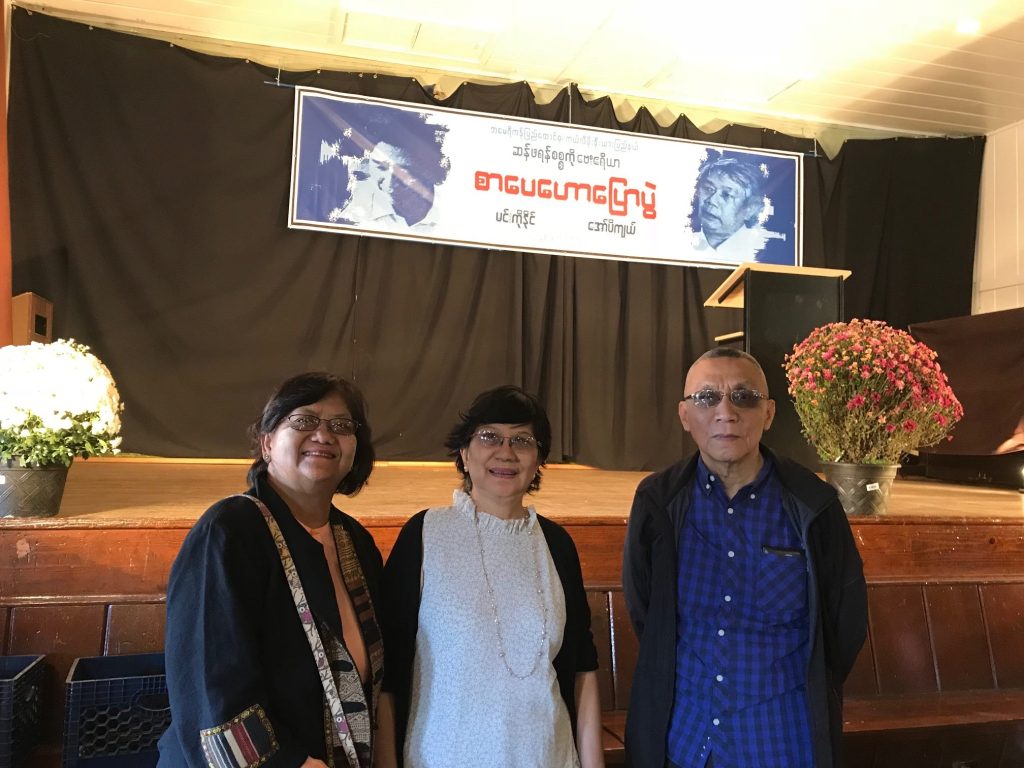
Aw Pi Kyeh
Aw Pi Kyeh is from the Class of 81 and 82. As “Mann Bei”, he contributed and managed the RIT Cartoon Box. He served as Secretary of the RIT Cartoon Association. He spoke about “Made in Myanmar”. He pointed out that his dress sadly is made from neighboring countries. He lamented the loss of countless lives in Cyclone Nargis due to “insufficient knowledge” (e.g. about Disaster Recovery). His talk combines wit, and philosophy.
During his study at Harvard, he proudly spent US$30 to buy a backpack labeled “Made in Myanmar”. His friend bought a similar backpack but labeled “Made in Sri Lanka”. The seam of his back pack broke after a week. Before his return to Myanmar, his friend gave him his backpack. He felt somewhat mad, but accepted it. He went on to use the backpack in Myanmar until it got discolored and his spouse asked him to stop using it. The message is that one not only needs Cetana but also the skills to provide “added advantage”. He gave examples of how others (nations and their companies) used our natural resources and our local talents to create products (and often sell them back at profit). He also requested those overseas to use “conversion” to understand the “thinking” of those living in Myanmar (possibly most of their lives) as a baby step to help making “Made in Myanmar” proud and reliable.
Min Ko Naing
Min Ko Naing is the pen name of Paw Oo Tun (author, artist, student activist …). He was a 3rd year student at RASU, when he became a student leader of the 8-8-88 movement.
He visited the San Francisco Bay Area a few years ago with Ko Ko Gyi. They talked mainly about the injustice system and the brutal regimes.
He gave a talk for the SF Bay Area Annual Talks 2018 along with Aw Pi Kyeh.
There were some anecdotes about their prison life. One political prisoner begged his prison mates to give him a pain reliever. Most people did not have courage to provide one. One had cetana and courage, but lacked medical knowledge. He gave Buspro to the wailing prisoner, who was relieved of pain forever.
He recounted his observations of the educational and social systems of the countries that he had visited. He was impressed with some systems which take the nursery children out into the open and teach lessons from nature, and those that allow students to pursue any combination of subjects provided they envision a problem to solve using the mix.
He lamented about how most parents and students in Myanmar prepare at all costs for that “all important Matriculation examination” to pursue two or three high profile professions.
The talk is more suitable for the general audience in Myanmar.
Kudos to the activist turned “evangelist for critical thinking and social change”.
Dr. Thynn Thynn wrote : Good observations Ko Hla Min…. I think he was trying to convince that the children in Burma deserve the benefits of open education system the children of the expat audience whom he had tried to seek support for the help of expat Burmese youth community to go in to Burma to help or some sort of set an example for those underprivileged kids in side the country. The talk was only half of what he came to say I think.
Dr. Nyunt Wai wrote : Good to know two of you are good friends. Converging point for technical and medical streams?
Literary Talk in Los Angeles
The hosts choose the first talk to be held in Northern California and the final talk to be held in Southern California.
By coincidence, I had the chance to meet Aw Pi Kyeh twice and to meet Min Ko Naing three times.
U Yu Ket (Edward Saw, EC85) gave me a ride to Los Angeles and Saya U Tin Htut hosted me and took me to two events :
Annual dinner of BASES (as Saya’s guest)
La Peunte monastery which had a festival in the morning and the literary talk by Aw Pi Kyeh and Min Ko Naing in the afternoon.
Saya U Tin Htut bought a book and received an autographed copy.
Aw Pi Kyeh told us that he did not drink during the Waso, but that he would resume drinking in a few days (at the end of the Buddhist Lent).
Literary Talk at the YSE Fund raiser
The Youth Society of Education (YSE) invited two guest speakers at their Fund Raiser.
Myinmu Naing Moe
Myinmu Naing Moe is a poet, vocalist, author, publisher)
Born as Ohn Maung, he became a poet and won the National Literary Award seven times.
He gave a literary talk on “His life and his Kabyas (Poems)”.
He talked about “Su-Tu-Pyu” paradigm proposed by Sayagyi Minthuwun.
He gave the background of his early school life, the sacrifice of his beloved mother, a story from Buddha’s time, Saya Zawgyi’s poems … and then recited relevant poems.
Since the talks were done in the hall where the fund raising was ongoing, the Master of Ceremonies had to request some who forgot the etiquette.
May Kyawt Shin
May Kyawt Shin is a broadcaster, vocalist, and author.
Founding member of RIT Alumni International and first President
Wrote a classic article for SPZP-2000 to raise awareness of the First RIT Grand Reunion and Saya Pu Zaw Pwe
Saya passed away several years back
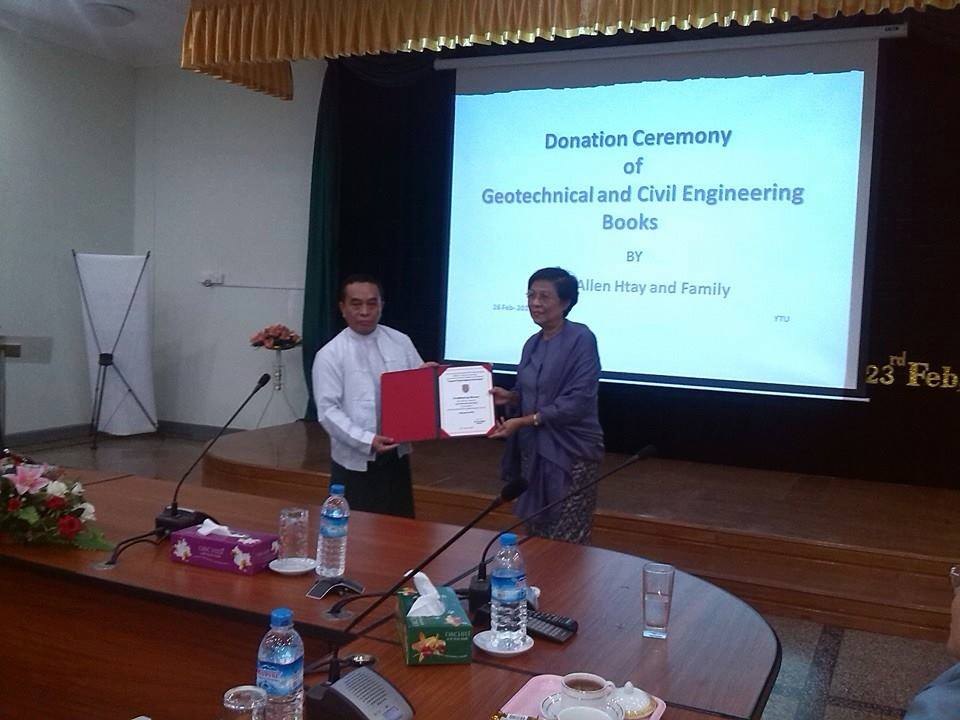
In Saya’s memory, Daw Mu Mu Khin donated Saya’s books to YTU Library provided financial support for eligible YTU students
Donation of Saya Allen’s Books
Brother, can you afford US $500?
by Allen Htay
And many weekends spent away from your family as well? If you can then you probably are a member of the RIT Grand Reunion and Saya Pu Zaw Pwe organizing committee.
It all began one day several months ago when we met over lunch at Benny Tan’s home in Hillsborough. Ko Hla Min and Ko Khin Maung Zaw among the lunch party had started the RIT Alumni website and were receiving enthusiastic responses. Hearing that the duo were carrying on the project all by themselves we decided to throw in our moral and financial support to assure its survival, realizing that it was providing a needed service for the RIT alumni to locate and communicate with each other. Every one present, ten of us at that time, took out our checkbooks and wrote out one hundred dollars each, with promises of more as needed. We informally called ourselves the RIT Alumni Bay Area Group. I was asked to be the group leader.
After that fateful event we continue to have regular meetings, hosted in turn at the homes of some among group members: Ko Hla Min, Maurice Chee, Ko Myat Htoo, Ko Thein Aung, and most recently Dr Nyo Win. Did I leave out any one? Ah yes! Ko Myint Swe and San San Swe. All the while the membership continues to grow and our objective keeps on changing from support of the website to some vague dream of a future RIT alumni organization on a global scale and finally settled on a plan for RIT Alumni Grand Reunion at the beginning of the 21st Century. Ko Hla Min broached the idea to include Saya Pu Zaw Pwe as part of the Grand Reunion in keeping with the Myanmar custom of honoring one’s teachers. As our plan jelled we got carried away by our own excitement and started talking about holding the reunion before the end of the Year 2000. After all, ending one millennium successfully augers well for success in the next millennium.
Before we fully realized what we were up to we have found an ideal site, the Embassy Suites Hotel conference hall near the San Francisco International Airport, and found ourselves making a commitment for a definite date, 28 October 2000 and a attendance fee of fifty dollars, a modest amount to encourage maximum number of Alumni to participate. The minimum capacity of the conference hall is 200 seats and we were required to make down payment and sign a rental and service agreement based on 200 seatings. Our most optimistic estimate at the time was 100 attendees. If the attendance is low that means the Bay Area Group, as the Organizing Committee was not in force at the time, will have to make up the short fall. Which could amount to as much as five thousand dollars, or five hundred dollar from each group member. We hesitated a moment to reflect on what that means to us individually in terms of diminished spending power. But, in the end our attachment to RIT and the engineering profession, our sincere desire to meet the Sayas and class mates from whom we were separated for long over came us. We will accept the risks.
Thus was born the preparations in full swing for the Grand RIT Reunion and Saya Pu Zaw Pwe. Others must tell the rest of the story – of struggles, compromises, and elations along the way and from participants themselves what it means to be present at the defining moment in the history of RIT Alumni.
Allen Htay, RIT Alumni International – Bay Area Group RIT Grand Reunion and Saya Pu Zaw Pwe Organizing Committee
Saya Allen, Dr, San Lin and Hla MinClass of C58SF Bay Area RIT Alumni Group
Attended GTI for a while before joining the first ever 1st BE class in 1964.
MS from Stanford University
MBA from Pepperdine University
First career : Electronics Designer
Second career : Co-founder and CEO, QTC Management His sister (a medical doctor who had patents for processing “disability” claims) requested him to co-found QTC.
After private investors showed interest in his company, he “retired
Continued to lead a multiple-purpose career: (a) visiting the places of the world’s leading religions (b) incubating the projects of young professionals (c) supporting education (e.g. as trustee of University of California at Irvine) via Kay Family Foundation (d) maintaining [diverse] business portfolio (e) helping those in need (via Charitable Alliance of Burmese Americans) (f) continue paying back the metta and cetana of his mentors — as Golden Sponsor of RIT Grand Reunion and Saya Pu Zaw Pwes, Helen and Steeve Kay Health Care Fund for the RIT Sayas and Sayamas.
From the SPZP-2000 Archives
RIT Poet Laureate Ko Hla Min:
I must admit that I was suffering from a Monday morning “hangover”, having been intoxicated with emotional overdose over the reunion weekend [in October 2000].
Judging from the post-reunion emails I read, I am not alone. What a reunion!
By all measures, it was a success and did satisfy the alumni’s tremendous pent-up desire to reconnect with each other after many decades of separation. The dedication of the members of the organizing committee is second to none.
With the assistance of his lovely wife, Benny Tan devoted practically full-time to this project for several months. I had a first-hand experience to see how meticulous he was when he was designing the RIT T-shirt. It came out a winner!
I do appreciate the sensitivity the organizing committee displayed in making this event non-religious and non-political. Otherwise, it would have been very difficult for me to attend. The only regret is that I failed to locate the whereabouts of my buddy Ko Aung Min of Taunggyi (ME 70). I heard he went to Singapore, but so far my search has ended in “no find”.
Now that the grand reunion is over, everybody is slowly recovering from the “hangover”. The big question is who would go to Singapore in 2002, and how do we go about doing it?
Daw Khin Khin Aye taught us Chemistry in I.Sc (A) class at Leik Khone in 1963.
Rangoon Institute of Technology
We joined 2nd BE at RIT in November 1964. We had to take nine subjects including Chemistry.
RIT Chemistry
U Kyaw Tun was an early saya who taught Chemistry (e.g Paper Chemistry) at the Chemical Engineering Department. When RIT Chemistry was opened, Saya helped manage it.
Daw Thaung Khin taught us in 2nd BE. She left for Canada on a scholarship to pursue Doctorate.
Some Sayas and Sayamas
Daw Than Than (Spouse of U Kyaw Tun, GBNF)
Daw Win Win (later Professor at Magwe)
Daw May Chit
Daw Amar Sein
…
U Maurice Kyaw Zaw
U Pike Htwe
U Khin Maung Nyo (later Ph. D & author)
…
SPHS
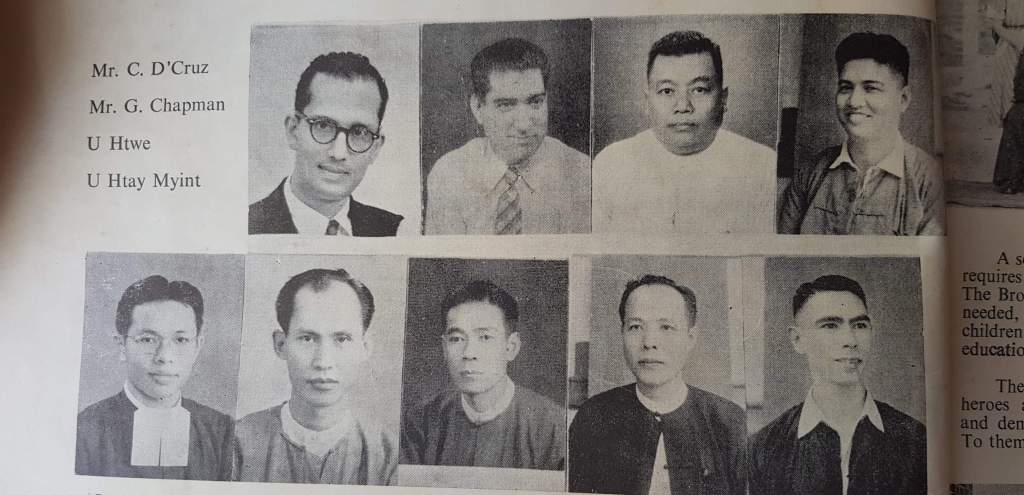
Saya Cecil D’Cruz (GBNF) taught us Chemistry at St. Paul’s High School.
Brother Joseph (later Father Joseph, GBNF) showed some Chemistry experiments in the school laboratory.
Miscellaneous
Early native Professors at RU
U Po Tha (Uncle of Mech Professor U Aung Khin)
U Aung Khin (Passed away in Malaysia)
Dr. Ko Ko Gyi
Senior Sayas & Sayamas
U Khin Maung Myint & Daw Than Than (Passed away in US)










 HlaMin