During a period, students at the University of Rangoon [and Mandalay] attended Intermediate (A) classes for a year, but they did not have to take the examination.
They then attended Intermediate (B) classes for a year. They then take the examination for both courses.
Compart System
There used to be two examinations for a class. The students have two chances to pass.
The first examination was usually held in March. Those who pass all subjects are eligible to apply for stipends and grants.
Those who pass at least three subjects have to take the remaining subjects in the second examination, which was usually held in June.
Saya U Ba Toke
Saya was born in December, 1920.
He attended Mandalay University.
He joined the Students’ Strike Camp, and missed the first examination held in March.
The strike ended, and Saya took all the subjects in the second examination and passed.
He wanted to attend the Faculty of Engineering in Rangoon, but he needed a stipend. He could not get the stipend because he did not take the first examination.
Saya’s teachers persuaded him to take Mathematics Honors in Mandalay.
Dr. Tint Lwin
He took the Pure Science option for I.Sc.
He attended engineering classes for a while, but he changed his mind to study Medicine. He took the classes needed to study medicine (e.g. Biology) and the supplementary exams. Finally, he was admitted to the MBBS classes.
During his university days, he was Goalkeeper for the University First Eleven. He team mates include Collegian Nay Win, Tun Kyi and Kenneth Shein.
There were two Sayas named Hunter at the University of Rangoon.
Matthew Hunter taught Physics and Chemistry, and also studied Geology. He served as Principal of Rangoon College. He tried to persuade the student leaders of the 1936 RU Strike. The students explained, “We are not protesting you. We are protesting to have changes to the University Act.” He loved the students very much. Tears fell when he had to bid farewell after retiring from Rangoon University.
Some awards (given out at the early Convocations) are named after “Matthew Hunter”.
Mark Hunter (John Mark Hunter) taught and wrote on English Literature. He was a member of the Commission responsible for the implementation of the Rangoon University Act of 1920. He later served as Professor at RU.
Judson
Andoniram Judson Jr. (1788 – 1850) was the most significant American Baptist Missionary to Burma.
His supervisors told him that it would be a tough task.
There were a few ABMs before him, but they did not stay long.
Judson and his team (which included some former dhamma teachers) compiled the English-Burmese and Burmese-English Dictionaries (see photos of two editions).
Judson published the Burmese translation of the Bible.
He helped found the association for Baptists.
He is honored by having a church and a college named after him.
In 1920, Judson Collegeand Rangoon College became constituent colleges of the newly established University of Rangoon.
Two buildings for Judson College were donated by the American Baptists.
The Willington Hall was built in memory of two families — the Vintons and the Johnsons — of the Church of Willington for their missionary work in Burma. It was later known as Dagon Hall.
The Benton Hall was donated by Ms. Benton (Treasurer of the Judson Church and/or Judson College). It was later known as Thiri Hall.
Note: Depending on the period, a Hall may house classrooms or may be used as a hostel. There was also a building named North Hall (which later became Shwebo Hall).
Examples of evolution of halls
Mandalay Hall was a Residence Hall.
After the “Dark Days” (7th July and 8th July 1962), several Residence Halls were converted into Admin Offices and/or Classrooms.
Mandalay Hall was a temporary home for the UCC project before moving to Thamaing College Campus.
Geology majors had most of their classes at Mandalay Hall.
G-Hall in the Gyogone Campus initially housed single sayas.
In November 1964, G-Hall became a resident hall for female students. Madan Chand (C70) was inadvertently listed to reside at G-Hall. Lyo Kyin Sein (T69) was inadvertently listed to attend at a men’s Hall (e.g. C-Block)
Burmese
In the early days, several languages (e.g. Pali) were taught by the Department of Oriental Studies.
Sayagyi U Pe Maung Tin (Pali and Burmese Scholar) proposed to have a separate Burmese Department.
Sayagyi translated Pali books (e.g. Visuddhi Magga) and Suttas (e.g. Dhammacakka and Anattalekkhana) into English.
ICS U Sein Tin (Theikpan Maung Wa), U Thein Han (Zawgyi) and U Wun (Minthuwun) were the early Burmese (Honors) students of Sayagyi. The trio is also known as co-founders of the Khit San Sar Pay movement.
U Sein Tin was a victim of a bungled burglary or the case of mistaken identity.
U Thein Han was offered to do Masters by both the Burmese Department and the English Department, but he chose to study Library Science in the UK. He succeeded U Khin Zaw as Chief Librarian of the Rangoon University Central Library.
U Wun studied Linguistics and Literature in the UK. He headed the Translation Department at the University of Rangoon. He later served as Professor of the Burmese Department, and as Visiting Professor at the University of Osaka (at the invitation of Professor Harada (pen name : Chit Mann Nwe). He is the father of U Htin Kyaw (former President).
In December 2019, the Myanmar Sar Htar Na (Burmese Department) will unveil a statue honoring Sayagyi.
Met Daw Tin Tin Myaing (Brenda Pe Maung Tin, Sayagyi’s daughter) at Winner Inn. She attended the unveiling of Sayagyi’s statue. She was also a guest at the Fund Raising Concert for RU Centennial. Two friends mentioned that his spouse (an Old Paulian) passed away in UK during the COVID-19 pandemic.
There is an album called Burmese (Myanmar Sar).
Some Posts
Per Hlaing Bwa : According to a “Shay Hmi Nauk Hmi” Saya, U Chit was detained for “providing food to the University Student Protesters”. He was questioned repeatedly for the rationale of his work. He wrote, “The students are my benefactors. I therefore need to repay their kindness in times of need.” Finally, a relative with connections managed to secure the release of U Chit. Sadly, he passed away 8 months later. He is an “unsung hero.”
Per Myo Thaik : He witnessed the “Tha Dar Phyu” (later referred to as “Tha Dar Ni”) incident and endured a tear gas bomb. His posts are based not only on his experience (recorded as dairy entries), but also on other sources : Gabriel (Thet Tun) and a post from the on-line forum.
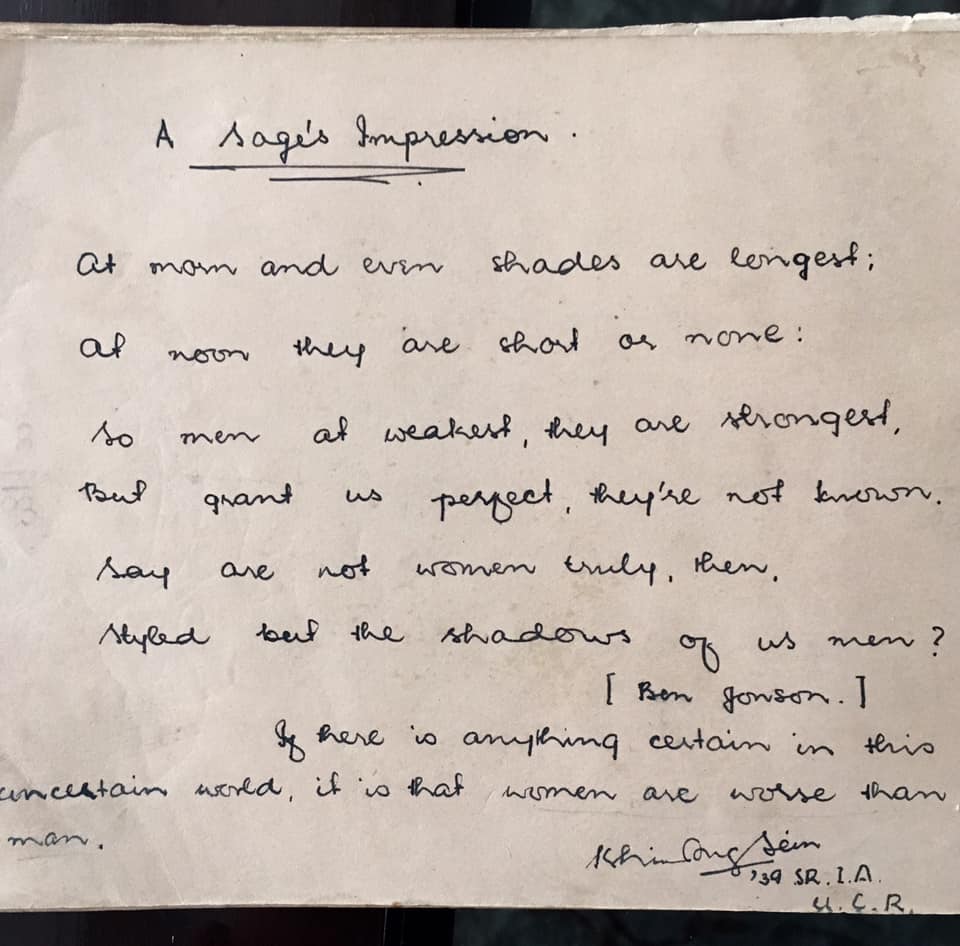
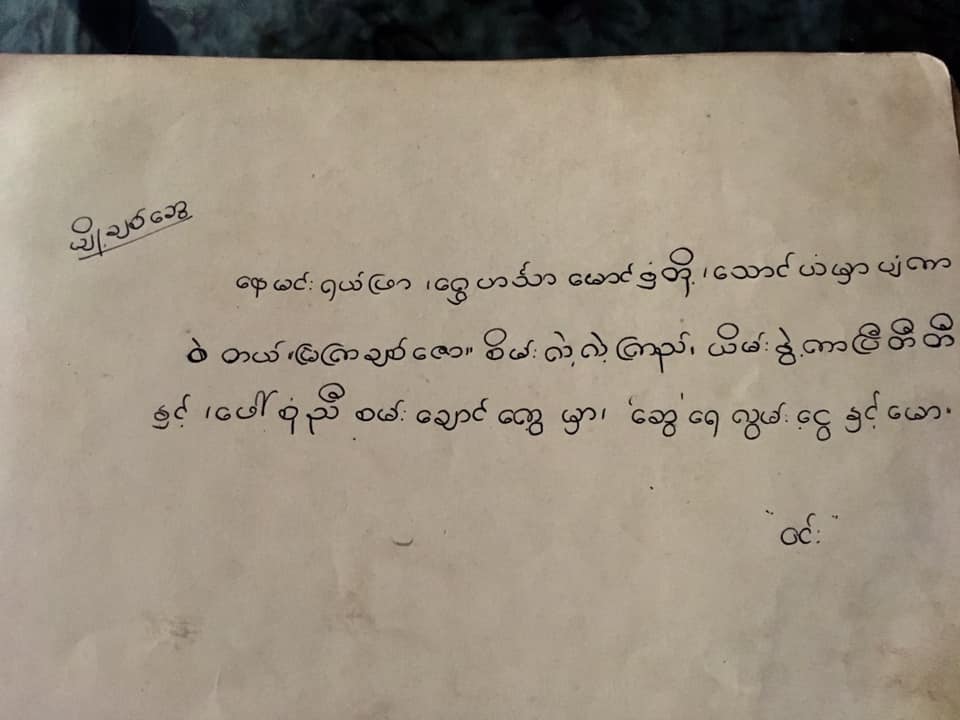
Hazel Kyaw Zaw has posted some more messages from her mother’s autograph (from 1939). It reinforced the concept of “Six degrees of separation” (in the early days) and “Four (or less) degrees of separation” (in the Internet age). Many of her mother’s friends had children who became schoolmates (some senior, a few classmates and some junior) of Hazel.
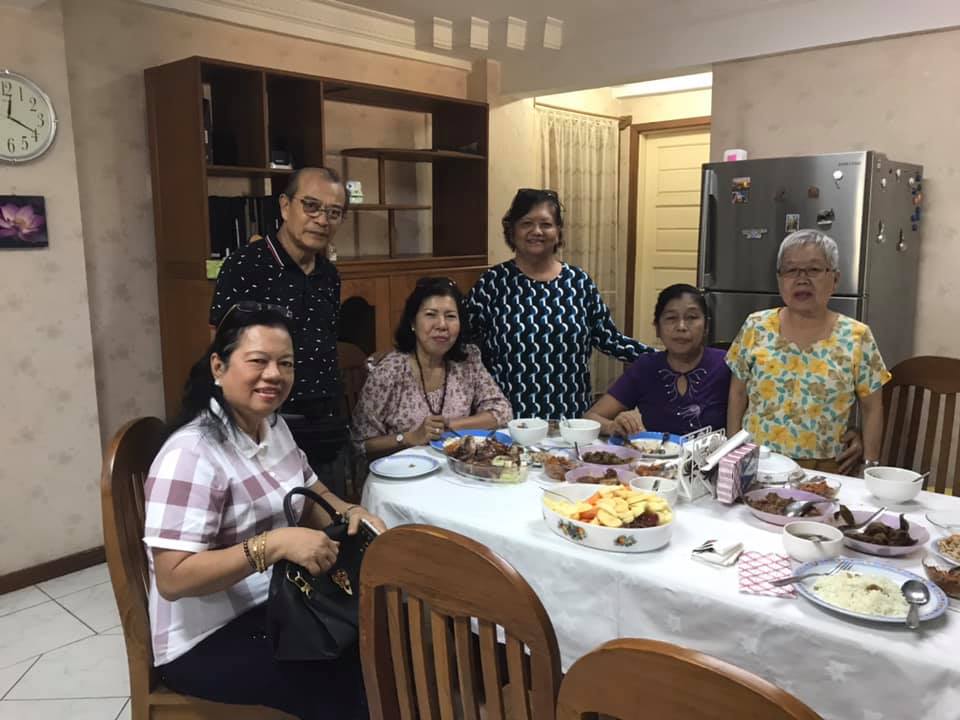
Hazel invited me to a mini-gathering with Saya Dr. Soe Win, Sayama Daw May Saw Lwin, and her friends. We met again at the lunch given by Saya and Sayama to celebrate their 49th Anniversary.
Ma Chit Swe’s autograph
Several sayas — Two U Khin Zaw (one from Mathematics and one from Chemistry), U Kyaw (Geography, Principal), Daw Khin Aye, Dr. Aung Myint, Dr. Tin Win (Alan), U Aung Zaw (UCC) — taught at Worker’s College.
Saya U Kyaw (Principal, Worker’s College) is the father of Ko Myo Nyunt (Harry Kyaw, SPHS63) and Ma San San Kyaw (UCC). During my visits to Yangon, Dr. Kyaw Min (SPHS65) would take to me the OPA mini-gatherings where Ko Harry is the de facto senior / leader. Recently, the group donated to the Molecular Laboratory Workforce and Mobile Swab Collection Team (for COVID-19 testing) of DMR.
U Khin Zaw (Chemistry) has shared his memories (good, bad, funny, sad) about the school, teachers, friends and the decline of the Education System.
Even in the early days, several sayas (including Sayagyi U Ba Toke) told the story of a star athlete who spelled KAWPHY for COFFEE and failed the interview even though he was guaranteed a pass if he could get one letter correct.
There are several poets and writers.
Min Oo wrote a long kabyar covering events and activities during his stay at RU.
Yadanar Thu posted some kabyars that she had published for the reunions and Pu Zaw Pwes.
Than Than Mu recounted her memories as a student at Education, and later as “Sar Sit Sayama”.
Some posted mementos. They include an old post card and a key chain that were bought at a store inside the Recreation Center.
A few attended the make-shift Convocation at the Kyaikkasan Ground.
Those who graduated in 1962 attended the Convocation at Kyaikkasan in 1963.
Some refused to attend because the Convocation held outside the Campus.
There were some who had to wait for several years after graduation to attend the Convocation. They were then married and had to beg for extra tickets for the family members (spouse, children, in-laws).
Some wrote about their friends who were scared of Practical examination and Viva, and how some fellow students helped them.
Many early members taught or studied Chemistry.
A reason may be that the group was founded by Dr. Nyi Thet Lwin and U Aung Mon, who are sons of Saya Dr. Soe Win and Sayama Daw May Saw Lwin.
The membership is quite diverse.
Sayama Daw Khin May (English) is one of the recent GBNF (Gone But Not Forgotten). Her siblings/relatives include Sayama Daw Phwa Yin (Former Head of English), Saya U Tin Lwin (Pali) and Sayama Daw Sein Sein (Registrar, Director).
The GBNF has grown. Some recent casualties include U Myat Hla Sein (Movie Technology) and Dr. Khin Maung Swe (Tekkatho Maung Thin Char).
Suggestion
There are 1000+ posts and many of them has invaluable photos.
There are tens of thousands of posts.
It’ll be nice if the photos can be organized into albums with relevant titles. It will help if the group or some sponsors decide to compile the posts into digital and printed books to commemorate the Centennial of the University of Rangoon in 2020. It will be an excellent pay back to the alma mater and the mentors.
I created albums in the group last year, but have not updated them. Some photos need to have proper credits (especially if they are to be used in publications).
There are 3000+ articles in my web site hlamin.com
It is difficult if not impossible to revise all the articles.
Note that the events described here mostly cover my personal journey as a University Student.
Other events (e.g. from 1946 to 1970s) are covered in other Posts.
I have honored Outstanding Matriculates (e.g. from 1951 to 1965) in other Posts.
1963
Guinea Pigs
We took the first ever Matriculation Only examination in 1963.
Paulians took 5 places among the Top Five, 7 places among the Top Ten, and 10 places among the Top Twenty.
Khin Maung U (1st)
Min Oo (2nd)
Myo San (3rd, GBNF)
Nyunt Wai (4th)
Thein Wai (5th)
Hla Min (7th)
Johnny Maung Maung (Aung Kyaw Zaw, 9th)
Maung Maung Kyi (11th)
Aung Thu Yein (13th, GBNF)
Frank Gale (Khin Maung Zaw, 17th)
We attended the last ever I.Sc.(A) class at Leik Khone.
Following the “Anniversary of 7th July, 1962” events, the major parts of the Universities (in Rangoon, Mandalay, …) were closed “for an unspecified period”.
Engineering and Medical Classes were spared at that time.
Subsequently, those who were only one year senior to us in High School graduated 2.5 years ahead of us (the Guinea Pigs of the Education Systems).
RUBC
We joined Rangoon University Boat Club (RUBC).
We — the Paulians Crew — were Runners-up for Senior Novices. Maung Maung Kyi (Bow) Hla Min (2) Kyaw Wynn (3) Willie Soe Maung (Myint Soe, Stroke, GBNF) Myint Thein (Cox)
We were awarded Full Green.
40th AnniversaryGathering
Sithu U Tin, U Po Zon and U Tin Htoon (A60) compiled the Souvenir Magazine for the 40th Anniversary of the Founding of RUBC.
Due to Security Concerns, the 40th Anniversary Annual Regatta was cancelled.
President Sithu U Tin and the Patrons decided to hold the “40th Anniversary of the founding of RUBC” at a hotel in Kandawgyi.
Burma Institute of Technology
My elder brother and several of my sayas graduated from the Burma Institute of Technology (BIT) in 1963.
They were from the second batch of BIT.
The degree conferred was B.Sc. (Engg).
1964
Education System
The New Education System was implemented in November, 1964.
Most Faculties of the University of Rangoon became autonomous Institutes with their own Rectors.
The Youth Affairs Department implemented Luyechun (Outstanding Students) Program in the Summer of 1964.
Eligible students from 7th, 8th, 9th and 10th Standards were chosen to attend the Ngapali Shwe Wah Gyaing Camp in the Summer of 1964.
Rangoon Institute of Technology
In November 1964, three batches of students entered RIT (Rangoon Institute of Technology).
400+ were admitted to the first ever 1st BE using the controversial ILA (Intelligence Level Aggregate) Ko Zaw Min was admitted as Roll Number One.
300+ who had passed the last ever I.Sc.(A) examination were chosen by merit to attend the first ever 2nd BE. Ko Hla Min was admitted as Roll Number One.
About 200 students who had passed the last ever I.Sc.(B) examination were admitted to the 3rd BE (formerly 1st year Engineering).
RUBC
Elected as Honorary Treasurer of RUBC (Rangoon University Boat Club). I had to report to Professor William Paw (President of RUBC).
Last Executive Committee member to be elected at the Annual General Meeting.
Served as Vice Captain the following year.
However, the higher authorities prevented me from becoming RUBC Captain by throwing away the Bye Laws and implementing their ad-hoc rules (e.g. selecting instead of electing Captain)
Matriculation
Cherry Hlaing (Than Than Tin, St. John’s Convent) stood First in Burma. She would be admitted as Roll Number One to IM(1). She would be selected Luyechun for the Inlay Camp in the summer of 1965.
Her grand father U Hoke Sein and her father U Saw Hlaing were also First in Burma.
Her two children would also be First in Family.
The record of five family members (spanning four generations) standing First in Burma is an enviable record that will not be broken.
Lyn Aung Thet (MEHS64) had four distinctions and the same “raw” score, but his performance in Burmese caused him a lower ILA than Cherry.
Aung Win Chiong (SPHS64) has the next best “raw” score. He had a perfect ILA score of 50, and was admitted to IM(2) as Roll Number One.
Maurice Hla Kyi (Min Lwin, SPHS64) was admitted to IM(2) as Roll Number Two.
1965 – 1969
Matriculationin 1965
Bernard Khaw (SPHS65) had four distinctions (with 80+ marks in English) and stood First in Burma. Due to the revised policy (e.g. 3 NRC requirement), he could not apply for professional courses. He moved to USA and/or Canada.
Aung Myint (SPHS65) had the second best “raw” marks. He and his twin brother Maung Aye moved to USA.
Winston Sein Maung (SPHS65, GBNF) had the third best “raw” marks.
Cherry Than Tin had the fourth best “raw” marks. She was admitted as Roll No (1) to MC (2).
Yi Thwe (SPHS65) was admitted as Roll No (1) to MC (1).
Paing Soe (Freddie, SPHS65) had same marks as Yi Thwe. He was admitted as Roll No (2) to MC (1).
Forty four Paulians were admitted to MC in 1965. They are from the Last Batch of True Paulians.
After Nationalization, St. Paul’s High School was renamed as No. (6) Botathaung State High School.
Nationalization
The consequences of the Coup d’etat include
Disappearance of Democracy
Nationalization of industry and schools
Indiscriminate demonetization
Increased censorship
With every turmoil (effecting “National Security”), the universities, institutes and schools were suspended.
After the schools were nationalized, St. Paul’s High School became No. (6) Botathaung State High School. Some Brothers left Burma. A few indigenous Brothers remained in Ady Road. Brother Joseph was ordained as Father Joseph.
Luyechun
The Luyechun Program was extended to include Universitites and Institutes in the Summer of 1965.
I attended the Inlay Khaung Daing Lu Ye Camp in the summer of 1965 along with U Sein Shwe, Daw Khin Than Myint Tin and U Zaw Min Nawaday.
MC(1) sent Cherry Hlaing, Khin Maung U, Anita Aye Pe and Kyaw Sein Koe (Victor, GBNF).
RIT
There were eight engineering departments
Architecture
Chemical
Civil
Electrical
Mechanical
Metallurgy
Mining
Textile
Most departments have associations. The RIT Mechanical Engineering Association was active. U Win Thein (M67, GBNF) was a Prime Mover. He co-founded Set Hmu Thadinzin and Mechanical Magazine. He co-organized activities.
The RIT Sports Council was headed by Saya U Maung Maung Than. U Maung Maung (Burma Selected in soccer) was Sports Officer. The associations for the various sports was headed by a saya.
Several RIT students were Burma Selected. They include Sai Kham Pan (Badminton) and Htay Aung (Swimming and Water Polo).
Saya Mao Toon Siong (former Burma Champion) was National Coach for Table Tennis. He also coached the RIT team which won the Inter-Institute Championship.
Electrical Sayas
In those days, the Electrical Engineering was headed by Saya U Sein Hlaing (Professor and Head).
The senior sayas included U Kyaw Tun (saya of our sayas), U Tin Swe and U Sein Win.
There were about 20 sayas. Five (or so) were on deputation for further studies abroad.
For details, see “A Sad and Short Clip : EE Sayas“
EC and EP
There were two options : EC (Electrical Communications) and EP (Electrical Power). Per advice in the industry, only a quarter of the students were accepted for EC.
There were 80+ EE students in the beginning. Tin Tin (Anne) was the lone female EE student.
At the end, there were 40+ EE students left.
The EP students outnumbered the EC students 3 by 1.
Several bright students played safe by choosing EP (which provided a job guarantee).
We studied EC (Electrical Communications).
Eleven of us graduated in 1969.
Three (Kyaw Soe, Aung Thu Yein, Chit Tin) are now GBNF (Gone But Not Forgotten) at this time.
A few years later, EC became Electronics Engineering.
A few decades later, Electronics Engineering and Electrical Power became full-fledged departments.
Khin Maung Zaw (KMZ, EC76) wrote :
AFAIK, EC was the hardest and strictest discipline at the RIT in those days as we’ve been told. Some even asked us why we had to go there. Of course, I am not going to mention the easiest discipline there, but we joked like, “they had 109 students and 110 passed the exam”. I do not mean any disrespect to Sayas and friends from other majors!! At times, it made us wonder why were we there for god’s sake. CRAZY TIMES!!! Indeed.
Volunteer
I served as
Treasurer & Vice Captain of RUBC (Rangoon University Boat Club)
Class Representative, Joint Secretary & Secretary of RITEE (Rangoon Institute of Technology Electrical Engineering Association)
Member of Committee for “Hlyat Sit Sar Saung”
Editor of the Bulletin published by RIT English Association
Member of UTC, Rowing, Scrabble, and Chess Assocations /Clubs
Free lance writer (articles, poems, translations) My poem “Men on the Moon” was sent to NASA by USIS, and it was published in the Guardian newspaper in July 1969
Five are GBNF : Soe Win M69, Aye Lwin M69, Han Sein C69, Ye Pinn M69, Aung Gyi Shwe EP69.Saya U Moe Aung and 69ersDanny and Albert (Great Musicians)Sad to note that Thein Maung, Myint Pe, Khin Maung Gyi and Maung Tun passed away in 2021.
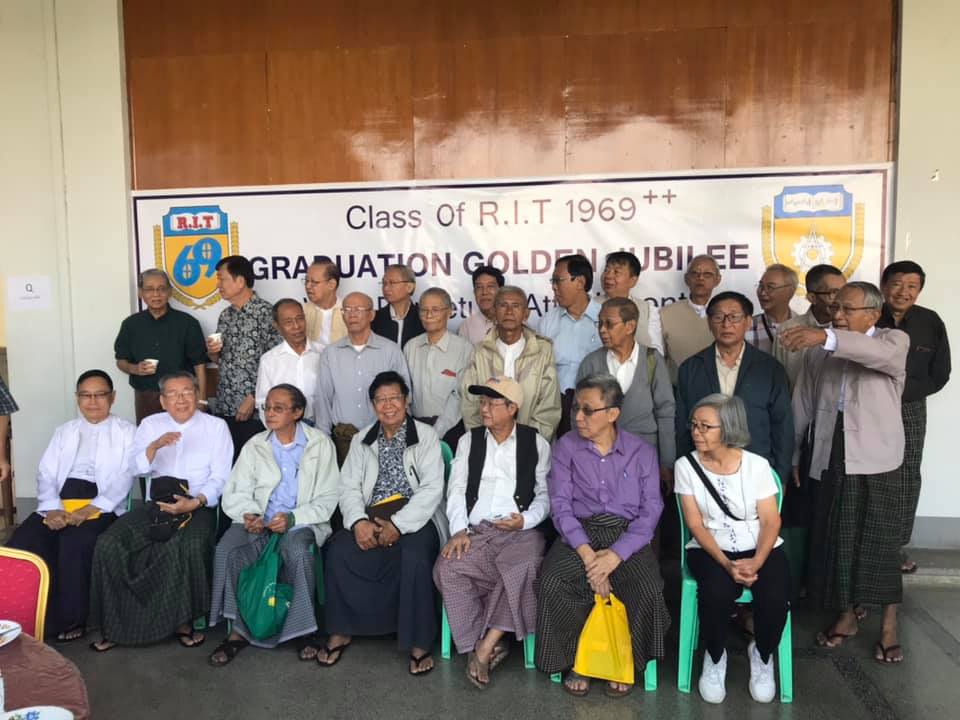
The Class graduated in 1969
69er Golden Jubilee (GJ) of Graduation Held at the Assembly Hall on Gyogone Campus Tin Tin (Anne, EC69, USA) — lone female EE69er –had her first Home Coming since Graduation. She donated to the GJ Celebration
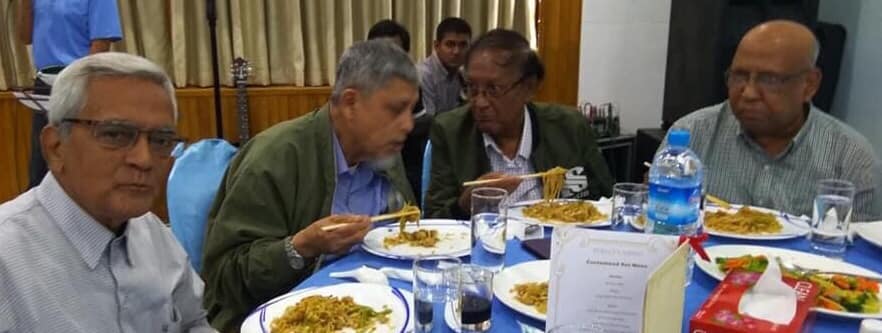
Reunion Dinner Former Colleagues of U Aung Min helped with the Catering Daniel Tint Lwin and Albert Kyaw Min led the Entertainment Program
The GBNF list now has 116 members. About a third of the Class have passed away.
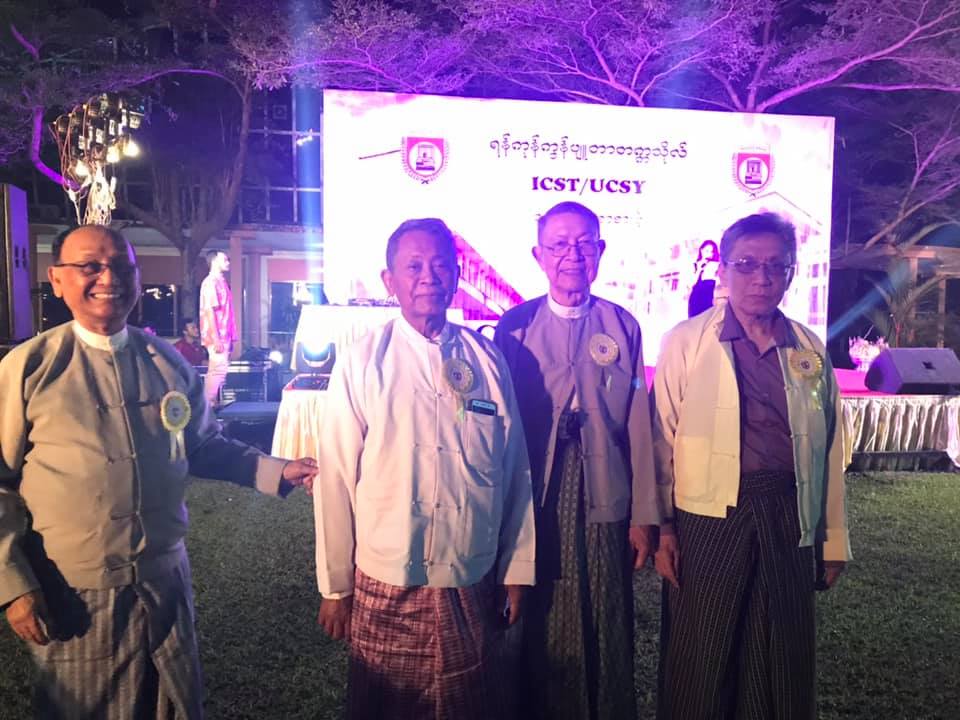
December 15, 2019 ICST / UCSY
U Thein Oo, Dr. Pyke Tin, U Soe Paing, U Hla Min, Dr. Kyaw Thein (GBNF)U Thein Oo, Dr. Pyke Tin, U Soe Paing, U Hla Min
6th Acariya Pu Zaw Pwe of ICST/UCSY
Reunion Dinner
Daw Mar Mar Soe gave me a ride
Saya U Soe Paing (Co-founder of UCC) gave a speech.
Saya Dr. Kyaw Thein (GBNF) succeeded Saya Dr. Tin Maung (GBNF) as Rector of ICST.
Saya Dr. Pyke Tin succeeded Dr. Kyaw Thein as Rector of ICST.
Saya U Thein Oo is a successful entrepreneur.
There are 25 (or so) batches.
Photo shoot for each batch
Entertainment by sayas, sayamas, alumni and invited guests
It is a Pali word meaning means “good looking” (handsome, pretty, …). It is one of the good karmic results along with Aryu (Longevity), Sukha (Happiness, pleasure, joy, bliss) and Bala (Strength) for doing meritorious deeds.
Sao Wunna
He was a Kayah Sawbwa. He was a Minister in an AFPFL Government.
Sree Wunna Mangrai
She is a member of the Keng Tung Sawbwa family. She is a niece of Saya Sao Kan Gyi (RIT English, GBNF), Sao Biddy (spouse of Sao Hso Holm), Sao Yan Naing and Sao Yan Paing. She studied M.Sc. (Computer Science) at UCC. She worked in Singapore.
U Wunna Sithu (SPHS65, EC71)
He rowed for Ye Kyaung Lu Nge during his high school days. He rowed for RIT and RUBC during his RIT days. He also swam and played water polo for RIT. He worked for DCA before moving to Thailand and USA. He attended the first East Coast Reunion.
U Wunna Ko Ko (EC96)
He is the son of Daw Khin Mar Mar (Physics, UCC) and the grand son of Saya U Net, Professor of Mathematics at the University of Mandalay. He did further studies in Japan and the USA. He created and maintained the second RIT web site.
Wunna
He is the son of U Nyein Min (C79), who named his company as “Wunna Construction”.










 HlaMin