Author: Hla Min (Lifelong Learner)

  • U Pe Maung Tin

    Sayagyi U Pe Maung Tin was Professor of Pali and Burmese. He proposed to have Burmese as a separate department. His students include

    • ICS U Sein Tin (Theikpan Maung Wa)
    • U Thein Han (Zawgyi)
    • U Wun (Minthuwun) 

    Myanmar Sar Mi Thar Su had unveiled Sayagyi’s bust in the RU Main Campus.

    He also served Principal of Rangoon College.

    Two Sermons

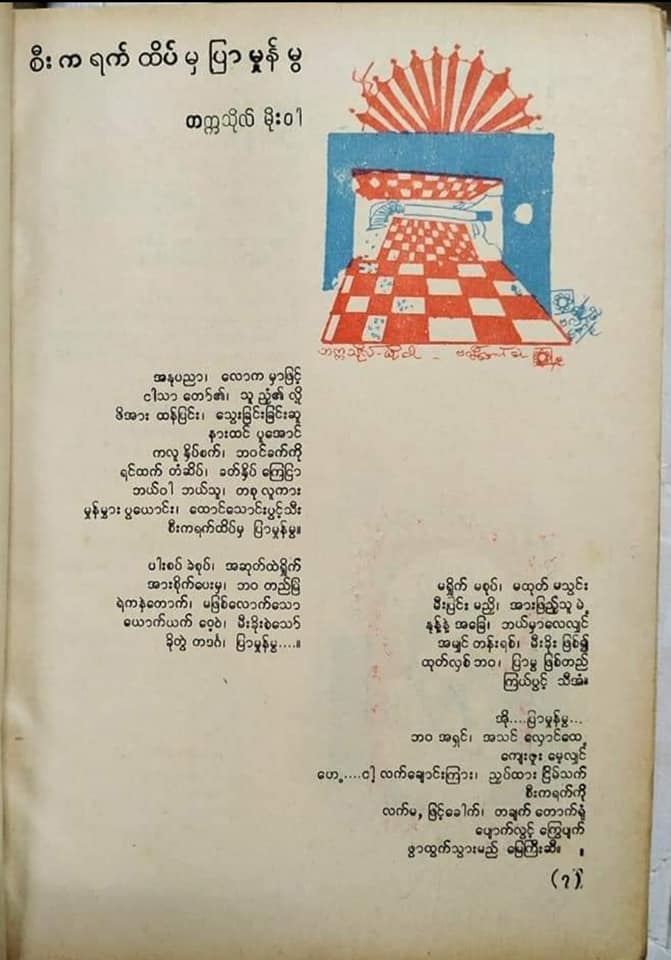
    U Tha Win requested Sayagyi to translate into English the two sermons that Buddha gave to his five disciples at the Deer Sanctuary.

    • Dhammacakkapavattna Sutta is the first sermon delivered to the five disciples.
    • Anatta Lekhanna Sutta is the follow up sermon given to the five disciples.

    Note : Hemanwunta Sutta given to a celestial is considered as Buddha’s second sermon.

    Saya U Aung Zaw (UCC) sent me an early version of the book. It has three columns :

    • Pali
    • Burmese
    • English (translated by Sayagyi).

    Dr. Kyaw Tint (Science Scholar for Physicshas an old worn-out copy of the book. He had typed a few verses and posted on his time line. Hope some reader has a good copy that is easy to scan.

  • Qualifiers

    To differentiate people with the same name, qualifiersprefixes and suffixes — are used.

    Some in the government service has a serial number as the suffix. e.g. U Maung Maung (6)

    One singer called himself “Twante Thein Tan”. Another had a bigger name “Myanmar Pyay Thein Tan.”

    U Zaw Min (EP70) decided to have a career change and a name change after he arrived in the USA. He is now known as Zaw Min Nawaday or Zaw Nawaday.

    Some did not know why Saya U Thein Aung (Met72) was called “Myodaw Thein Aung”. They were not aware of the Zat Mintha.

    One wonders if having long names would resolve the name conflict. e.g. Cartoon character named Khin Maung Thet Cho Oo.
    What happens if a name is too long to spell or pronounce?

    • My boss was named Surapol Dasananda, but most called him “Dr. Das”.
    • My colleague was named Suttipong Kanakakorn, but most called him “Nick”.

    Some have several qualifiers e.g. Mingun Sayadaw & Tipitaka Sayadaw

  • Character Codes

    A character in a specified language can be coded as a string of bits (binary digits).

    In the early days, English was the primary language used for communications in most parts of the world. The English alphabet consists of 26 letters. 5-bits (which can represent 32 symbols) are need to represent (a) upper case characters (b) lower case characters.

    5-bit, 6-bit, 7-bit and 8-bit character codes were developed and used. Some early standards include (a) 7-bit ASCII (American Standard Code for Information Interchange) (b) 8-bit EBCDIC (Extended Binary Coded Decimal Interchange Code).

    With the wide spread use of computer technology, Character sets for the various languages were developed. Some languages (notably Chinese) require long bit strings.

    Fixed length coding gave way to Variable length coding. The most used characters in a language are represented as one byte and the lesser used characters are represented as two or more bytes.

    Unicode aims to have standard character codes for the languages. There are formal and informal institutions to help develop, propose and approve new Unicode character sets.

    UTF is a Unicode Transformation Format to transform Unicode characters to fit the specified length (e.g. UTF-8, UTF-16).

    Standards may be (a) De Jure (set by law) (b) De Facto (set by common usage). Standards must be followed for Compliance.

    Recommendations, which should be followed, can cause variations in the implementations.

  • BE Intake of 1964

    Three Intakes

    In November 1964, there were three intakes under the New Education System :

    • 1st BE (Class of 70) : corresponds to I.Sc.(A) in the Old System
      The controversial ILA (Intelligence Level Aggregate) was used for admission
      400+ students (probably 450) joined.
      Zaw Min (Nawaday) was admitted as Roll Number One.
    • 2nd BE (Class of 69) : corresponds to I.Sc.(B) in the Old System
      Total Marks were used for admission
      300+ students (probably 325) joined.
      Hla Min was admitted as Roll Number One.
    • 3rd BE (Class of 68) : corresponds to First Year Engineering in the Old System
      About 200 joined 3rd BE.

    Update

    • Some students left before graduation.
    • Some took Sabbatical and took slightly longer to graduate.
    • Most are now retired or semi-retired.
    • Sad to not that several have passed away.
    • Recent GBNF from the Class of 68 include U Saw Win, U Zaw Win (Cyril) and Sayama Daw Mya Mya Than.
    • U Aung Min (M69) and team provide updates for the Class of 69.
      As of September 2021, the GBNF list has 113 members.
    Thein Maung (M69, GBNF)
    • U Ohn Khine (M70) and team provide updates for the Class of 70.
      As of September 2021, the GBNF list has 111 members.
    U Wara (Win Paing, ChE70, GBNF)
  • U Pe Maung Tin

    U Pe Maung Tin
    • Pali and Burmese Scholar.
    • Proposed to have a separate Burmese Department.
    • First native Principal of Rangoon College.
    • Executive Committee member of Burma Research Society.
    • The Myanmar Sar Community honored Sayagyi with a bust in December 2019.
      Daw Tin Tin Myaing (Brenda, Sayagyi’s daughter) attended the ceremony.
      Met her at the Winner Inn.
      Sad to learn that her spouse succumbed to COVID-19 in UK in 2020.
    • In our middle school we had to study “Myanmar Thadda / Burmese Grammar” written by Sayagyi.
    • Sayagyi translated two early Sermons :
      Dhammacakkapavatana Sutta and Anatta Lekkhana Suttana into English.
      The three-language edition of the Suttas was published by U Tha Win.
    • Saya’s early students include
      ICS U Sein Tin (Theikpan Maung Wa)
      U Thein Han (Zawgyi)
      U Wun (Minthuwun)
  • Saya U Moe Aung’s Letter

    March 2011

    Dear Ko Hla Min,

    Thanks to Saya U Soe Paing for his great endeavour in visiting the UCL (Universities’ Central Library) numerous times to gather and record invaluable information relating to RIT (and BOC college of Engineering as well). And thanks to you for archiving all through your emails and keeping all RITians gelled together.

    Only when Saya U Soe Paing mentioned Engineering Students’ Magazines, I happen to recall one Engineering Students’ Magazine in which I was part of it. That was in Academic Year 1960-1961. I was still an Electrical Engineering Student at that time (2nd year, or, by the present calling, 4th year). At Rangoon University (Main University) they had a University Students’ Union (in Burmese, Thud Meg-ga is translated as Union), and we had correspondingly an Engineering Students’ Union as well at our Faculty of Engineering at Leik-Khone (Dome), Prome Road.

    At that time I met one Ko Hla Tin (Civil) who was my senior and several years older than me, staying at Prome Hall which was adjacent to Leik Khone, only separated by a fence. He was an avid poet (pen name Kay-tu Win Tint, from Taunggoo) and I used to visit his room at Prome Hall to talk about poems and literature during lunch or break times. I also met one senior (can’t recall his name, I think Ko Sein Hlaing) who was the Secretary of the Students’ Union. After some lively discussions, we decided to issue an Engineering Students’ Union Annual Magazine and they made me the Chief Editor. The Magazine consisted of two sections, Burmese and English, of which Saya U Aung Khin (Mech) was the English Editor.

    I still have the 1960-61 issue neatly tucked in a cupboard in Yangon.

    Now I remember that Ko Sein Hlaing (EE?) is still in Yangon, helping to look after his grand children, but not in good health. Ko Sein Hlaing’s daughter was my daughter’s very close friend since their childhood days. We met once in Singapore about 12 years back.

    Dear Ko Hla Min, this is the time to reminisce and be happy about the good old days and try to fly back with whatever time machine we could get hold of. Time really flies and we should realize that our days are numbered.

    Moe Aung

  • Examination Systems

    Intermediate College

    • During a period, students at the University of Rangoon [and Mandalay] attended Intermediate (A) classes for a year, but they did not have to take the examination.
    • They then attended Intermediate (B) classes for a year. They then take the examination for both courses.

    Compart System

    • There used to be two examinations for a class.
      The students have two chances to pass.
    • The first examination was usually held in March.
      Those who pass all subjects are eligible to apply for stipends and grants.
    • Those who pass at least three subjects have to take the remaining subjects in the second examination, which was usually held in June.

    Saya U Ba Toke

    • Saya was born in December, 1920.
    • He attended Mandalay University.
    • He joined the Students’ Strike Camp, and missed the first examination held in March.
    • The strike ended, and Saya took all the subjects in the second examination and passed.
    • He wanted to attend the Faculty of Engineering in Rangoon, but he needed a stipend. He could not get the stipend because he did not take the first examination.
    • Saya’s teachers persuaded him to take Mathematics Honors in Mandalay.

    Dr. Tint Lwin

    • He took the Pure Science option for I.Sc.
    • He attended engineering classes for a while, but he changed his mind to study Medicine.
    • He took the classes needed to study medicine (e.g. Biology) and the supplementary exams.
    • Finally, he was admitted to the MBBS classes.
    • During his university days, he was a University Goalkeeper. He played with Collegian Nay Win, Tun Kyi and Kenneth Shein.
    • After retirement, he moved to the USA.
  • Education Systems

    • A US professor was startled when a Burmese student proudly claimed that he had all-round Ds (for distinctions) back in Burma. In USA schools, “D” means grade 1 (lowest), and “A” means grade 4 (highest).
    • In the initial stages of the new education system, a student must have at least 75% attendance; otherwise one cannot take the examinations.
    • Getting a grade 1 in any subject means failing the whole examination.
    • To pass the examination, each paper must have at least a grade 2, and the average grade must be at least 2.5.
    • Some professors are not keen on making too many moderation.
      Some students got penalized for “not taking minor subjects seriously”.
    • In ’64, there were three intakes.
    • About 500 students were admitted to the first ever 1st B.E. Also, their admission was based not on total marks, but on the controversial ILA (Intelligence Level Aggregate), using the “distribution curve” for each subject.
    • About 320 students were admitted to the first ever 2nd B.E.
    • About 200 students were admitted to the first ever 3rd. B.E.
      Saya U Myo Myint Sein (A) would say that Saya Sai Yee Laik (A 68) stood “first and last in his class”.
    • In the “newer” education system, a student needs 5 years to get a B.E.
      One gets an AGTI after the first two years, and a B.Tech after another two years.
    • The terms “old” and “new” are relative.
    • We took the last ever 7th std Government exam in 1960.
    • The “new” system had 8th std Government exam.
    • We took the first ever High School Final /HSF only (9th std Government exam) in March ’62 with the security forces patrolling the city.
      The exam results were annulled, and we were asked to take another exam a few months later.
    • In the “old” system, the students take the HSF & Matriculation combined exam.
    • We took the first ever Matriculation only (10th std Government exam) in May ’63.
    • Consequently, those who were one year senior to us in High School graduated two (or even 2.5) years ahead of us.
    • In an “old, old” system [following second world war], anyone who is confident can [take “jump promotions’ and] take the HSF & Matriculation exam.
    • When Rangoon University reopened in 1946, three siblings Dr. Pe Nyun, Dr. Pe Thein and their sister — joined entered the University together.
    • The “old” Rangoon University allowed “compartmental” system.
      One needs to re-sit only the subjects that one failed (in the first exam – usually in March) in the “supplementary” exam – usually in June.
      Note however that those who apply for scholarships/stipends must pass all subjects in the first exam.
    • Sayagyi U Ba Toke did not take the first exam because he was in a college strike camp.
      He was the sole student to take and pass all subjects in the supplementary exam, but without access to scholarship/stipend and with persuasion from the Mathematics teachers, he struck off the choice of becoming an engineer.
      For details, read the book by Saya Dr. Khin Maung Swe (“Maung Thinchar”, GBNF).
  • Employment

    by Maung Maung Win

    Updated : May 2025

    by U Maung Maung Win (M61)

    I passed the final examination in April 1961 and was among the top five. Even with that result and an excellent resume, I found it very hard to get a job. I applied to many departments, but because Burma was not an industrialized country but based on agriculture and forest, engineering jobs were very scarce. At that time we would not have a clue and idea to apply for overseas jobs, e.g. in Singapore and many overseas shipping companies. We were the last graduates from the BOC College, as a matter of fact from a new complex, three storey with one on the left side of the building facing Prome Road. The ground floor was used as administration and office for clerical staff; the second floor for library; and the third for staff conference/meeting room. The adjacent extension also had three storeys. The ground floor of the first extension being used for car-park, the second and third floors being for lecture-theatres and offices for staff. The remaining two behind — used for lecture-theatres including T1, T2 and T3 and laboratories — were built not long ago in front of the BOC College building which was one storey building where some teaching staff and lecture-rooms and also engineering work shop with office for work shop superintendent and employees. The new complex was behind the Dome (Leik Khone) and also there was a rectangular shape pool of water in the front precinct including the Old BOC College that everything inclusive was the Faculty of Engineering, under the University of Rangoon.

    I think in 1961 the whole faculty was moved to the new larger complex, a gift from Russia in Gyogone, Insein township and also because the scope of engineering education became more extensive the Faculty of Engineering was shifted to Gyogone in 1961 and it was named the Burma Institute of Technology (BIT) but still under the Rangoon University. That time Dr Maung Maung Kha was the dean of BIT as well as professor of the Department of Physics, Rangoon University and U Sein Hla was the registrar. Both were very friendly and generous in dealing with staff and students. But the Burma Institute of Technology was still under the Rangoon University without any autonomy and independent entity yet. With the introduction of the new education system in 1964 the Burma Institute of Technology was renamed again as the Rangoon Institute of Technology with its own rector and independent authority as an independent technological university status until July 1, 1988.

    One day I was fortunate that I was called by Sayagyi U Aung Khin, head of the Mechanical through a friend U Aye (Mech. Retd. CE), my next door neighbour of my home town Moulmein and one year junior to me. Next day I went and saw him who asked me, whether I had an aptitude for teaching. As I was desperate to get a job I told him then and there that I was and on the same day 19 June 61 after writing an application, I got appointed as Assistant Lecturer through Sayagyi U Aung Khin’s generosity after the university senate approval. I will never ever forget Sayagyi U Aung Khin for his timely help to get a job for me when I was desperate after the job for which I appreciate, recognise and acknowledge his generosity, honesty and integrity as long as I live, I promise.

    Medium of Teaching

    When I got the job I had a pretty hard time in delivering my teaching of subjects and explanation in English because we were supposed to explain in English medium. Yes I tried a lot before I went into the class with a lot of practice in my room in front of the mirror; slow and steady I got the confidence and courage and I remember those four years from 61 to 64, it was a success that I could deal with the subject as well as the students. I felt quite satisfied because I enjoyed the company of students and their cooperation. Thank God for helping me out because I was educated not from a good grammar school but from an ordinary mission school where every subject was explained and taught in Burmese language and English speaking was not compulsory like Saint schools run by Catholic Mission.

    Involvement with Students

    A year later in 62 when U Aung Than (Mining) resigned to join the Mining industry, I got his job as a hall tutor in F-Block where only final year students were housed for two years until I got married in 64. Let me say something about the nature of hostels in Gyogone which was different from other hostels in Kamayut because there are only six adjacent 3 storey blocks namely A, B, C, D, E and F under three wardens who controlled and administered from their own residence on the campus for lodging, food, safety and security etc of students and each block had its own hall-tutor.

    Only in C-Block we had hair salon, reading room and student recreation such as table tennis on the ground floor. Many students played Chin Lone the Burmese traditional sport a sort of soccer made of cane usually any number of players can take part and play. Also many students played soccer in front of the blocks between lanes after their class for relaxation before dinner and many other took stroll after their dinner around Gyogone area. It was really fun and game for all students during their stay in the campus. Most of them were very friendly, obedient and co-operative which are the assets to become law abiding and responsible citizens and leaders of tomorrow.

    Before I forget let me say how generous was Sayagyi Rector U Yone Mo (I remember him as rector not as principal even though the Institute was still under Rangoon University) because he invited six hall tutors, U Tun Shwe (A-Block), U Myo Kyi (B-Block), U San Tint (C-Block), U Shwe Yi (D-Block), U San Tun (E-Block) and myself (F-Block) but U San Tun could not make it because he spent most of the weekends with his family in the city, to his residence in 8th Miles monthly to dinner with him over friendly conversation. I worked in that capacity for two years until I got married in April 64 and also U San Tun quit when he got married, so also U Shwe Yi got married and the rest three moved out and lived in A/L quarters like us slowly one by one. I moved out to live in the assistant lecturer quarters 16C (Upper East) being 4-units two storey building meant for four assistant lecturers and their families.

    Also I like to add something about Sayar U Tha Tun, B.Sc, F.R.I.B.A. (Fellowship of Royal Institute of British Architects), A.A. Dip (Lond.), A.M.T.P.I. (Associate Member of Town Planning Institute), F.I.B.A., officiating head of Arch Dept, who came along with me sometimes to the hostels, ate and chat with me because we were best of pals.

  • 1960 – 1962

    1960

    Matriculation

    • The Brothers at SPHS (St. Paul’s High School) were disappointed when the Paulians could not take the top positions in the Matriculation examination in 1960.
    • Dr. Thane Oke Kyaw Myint lost by a mark each to Austin Kyan (Myint Htoo), “Sanjay” Nyan Win, Arthur Hla Maung, a Chinese girl and Marie Nyunt. He only claimed the sixth spot.
    • Many Paulians won the Collegiate Scholarship award.
      They include U Thaung Lwin, U Myo Myint, U Than Htut, and Dr. Myint Tun.

    [Per TOKM] : There was a Chinese girl in the 4th position. Could not recall her name. Unfortunately she could not attend university due to the citizen status of her parents and she left Burma.

    Guinea Pigs

    • We took the last Government examination for Seventh Standard.
    • We would become Guinea Pigs for the changes in the Education System.
      We had to take the first HSF Only examination in 1962 in Burmese.
      We had to take the first Matriculation Only examination in 1963 in English.
      We had to take the last I.Sc.(A) examination.
      We had to attend the first ever 2nd BE at RIT.
      Our group is unique to have studied five years at RIT. Those senior to us studied four years after completing their I.Sc.(B). Those junior to use studied six years starting from 1st B.E.

    Olympics

    • Abibi Bikili (Ethopia) won the 26-mile 2-furlong Marathon barefooted at the Rome Olympics in 1960.
      He would win the Marathon at the next Olympics, but would be wearing shoes.
      He met a tragic accident, but continued to participate at the Paraplegic Games.
    • Cassius Marcellus Clay Jr. won the Light Heavyweight title at Rome Olympics. He turned professional and became World Heavyweight Champion for three times. He changed his name to “Mohammad Ali”. He is associated with the phrases : “I am the Greatest”, “Float like a butterfly, Sting like a bee”.
    • We did not have access to see Olympics live.
      We had to wait some time to to see the “Rome Olympics” documentary at the President (Thamada) Cinema. Brother Austin (SPHS) gave us a few tickets for doing well in the tests.

    ARAE

    RUBC team won the Willingdon Trophy for Coxed Fours at the ARAE (Amateur Rowing Association of the East) Regatta held in Colombo in 1960.
    Harry Saing (Bow, GBNF)
    Victor Htun Shein (2, GBNF)
    Sunny Teng (3)
    Tin Htoon (A60, Stroke)
    Sein Htoon (M63, Cox)

    RUBC

    Senior Novice Winners
    Kyin Tun (Bow)
    Nyan Win (Sanjay, 2)
    Micky Tan (3, GBNF)
    P Chabbra (Stroke)
    Frankie Ohn (Cox)

    • Saya U Thein Aung (Micky, SPHS59) became RUBC Gold. He also served as Administrator.
    • U Kyin Tun rowed for RIT.

    1961

    Matriculation

    • Robin Ban (Dr. Kyaw Win, SPHS61) placed Second in the Matriculation examination in 1961.
      His classmates include Saya U Htun Aung Kyaw (ChE67), Dr. Thein Tun (EP67)and U Sein Shwe (M67,Fourth BE Luyechun).
    • Lina Ong (GBNF) stood First.
    • It would be the last examination for the combined HSF and Matriculation examination.
    • In the following years, the students have to sit
      (a) HSF [High School Final] Only
      (b) Matriculation Only.

    SEAP Games

    Burma hosted the Second SEAP games.

    Burma dominated in several events :

    • Track and Field
    • Swimming and Diving
    • Boxing
    • Yachting

    1962

    Politics

    • Coup D’etat took place on March 2, 1962.
    • Sao Shwe Thaike’s son (Mie Mie Thaike) was a casualty, but the official reports stated that “It was a bloodless takeover”.
    • A 17-man Revolutionary Council was formed.
      According to Kyemon U Thaung, seven members did not know of the decision.
      Brigadier General T. Clift (Air Force) resigned.
      Commodore Than Pe (Navy, President of RUBC) passed away.

    Guinea Pigs

    • We had to take the first ever HSF (High School Final) Only examination with armored cars and security forces patrolling the street.
    • The examination was annulled for the Rangoon Division (claiming that the questions had been leaked).
    • We had to retake the HSF Only examination.
    • We were the guinea pigs of the “ever changing” Education System.
    • We would be the elite group to take Government examinations four times (without ever failing) : 7th, 9th (twice), 10th

    Two State Funerals

    • One was for Commodore Than Pe (Navy), Revolutionary Council Member & Ta Wun Khan (Minister) of Health and Education.
      He succeeded Sir Arthur Eggar as President of RUBC (Rangoon University Boat Club).
    • Another was for U Tin Maung Thant (“Ah Phyo Gyi”, alumni of Private Primary Boundary Road School), son of U Thant (Secretary General of the United Nations).

    Two Dark Moments

    • Official records said that there were 17 victims on 7th July, 1962.
    • Ko Aung Khin, who was returning home from RUBC, was hit by a stray bullet.
    • The Students Union was demolished on 8th July, 1962.