Computer Science (CS) and Computer Technology (CT) evolve.
Definitions
The following are two early definitions of CS.
CS is the study of phenomena surrounding Computing.
CS is the study of Algorithms and Data Structures.
The first definition has the same flavor as a definition of Physics. It is general to say, “Physics is the study of natural phenomena.”
The second definition might sound restrictive, but it still covers a lot of topics and application.
There is a book called “Program = Algorithms + Data Structures”.
Professor Donald Knuth (Stanford University) thought that he could finish his 7-volume book “The Art of Computer Programming” in a couple of years. It was an under-estimate of the growth of Computers, Computer Science and Applications. It took over two decades to complete and revise the first three volumes and part of the fourth volume. One reason was that his book contributed to the growth of the Design and Analysis of Algorithms.
Final Thoughts
I have covered some topics in the early days of Computing in general and UCC in particular.
I missed out several people. I mentioned many names, but did not elaborate on some of them.
I did not cover in-depth the PDP configuration and use, the introduction of PCs, and robots.
It would take a long time and I would not be able to fill in all the blanks.
I believe in an idea that characterizes Jules Verne. “If one can dream, others can fulfill”.
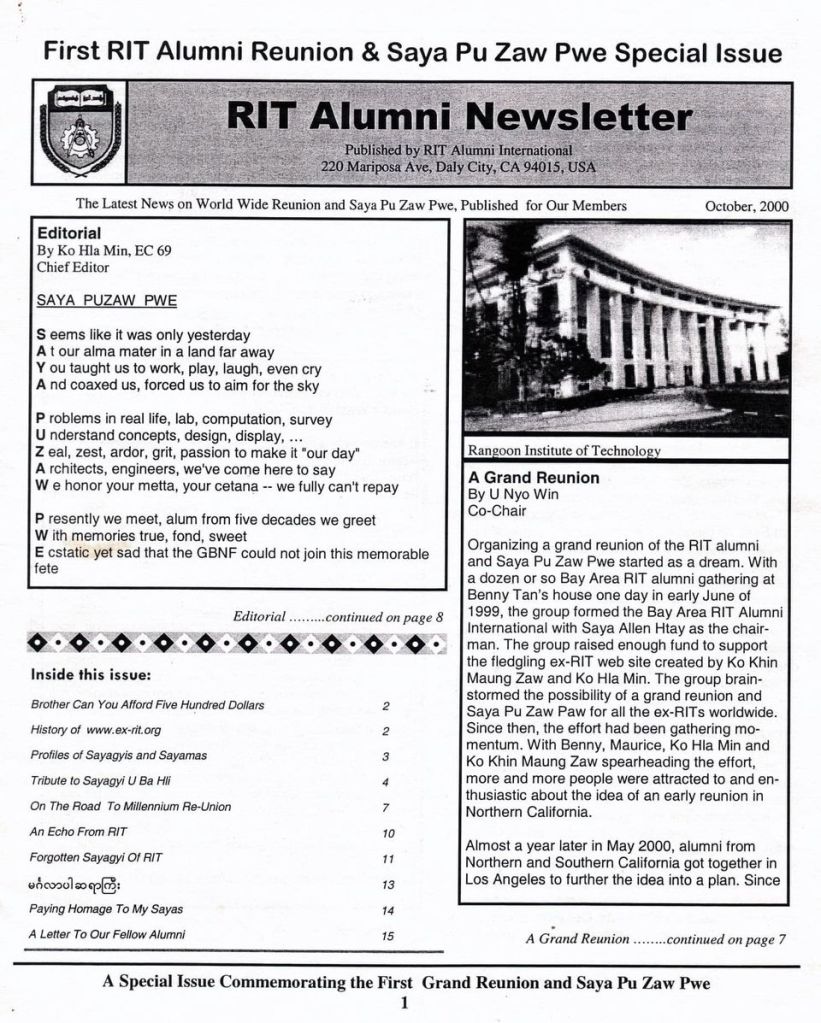
I had a personal experience to support that idea. In 1999, I started “RIT International Newsletter” and dreamed that sayas and alumni will get reconnected electronically and physically. With the help of sponsors (including five Golden Sponsors), able and dedicated sayas and alumni, volunteers, supporters and well-wishers, the First RIT Grand Reunion and SPZP (Saya Pu Zaw Pwe) was held in San Francisco in October 2000. The world-wide SPZPs were subsequently held in Singapore in 2002, 2007 and 2010, and in Yangon in 2004, 2012 and 2016.
NewsletterSPZP-2000 Organizers
I had paid back to RIT.
I now have a chance to pay back to UCC.
Thanks to my family members for supporting me in the endeavors to pay back to the institutions and my mentors that helped me develop to where I am today.
I hope that sayas and alumni of UCC, ICST and UCSY will enhance my document into one that professional historians will envy.
My introduction to teaching at RIT began as a team member of the English Department. Besides Daw Yin Yin Mya (Head of the English and known to us as Terry), and Daw Sheila Saing (Asst. Head), there were 10 tutors including myself.
Nicknames
In his own inimitable and affectionate way, Saya U Khin, also one of the new tutors, decided to spice up our group by giving us nicknames. I’m sure my former colleagues will forgive me for revealing these juicy tidbits as this generous gesture of U Khin’s served to bind and give our departmental community a semblance of togetherness.
Daw Yin Yin Mya was complimented with the name Shwe Man Mé (in honor of her previous beauty pageant title). I wouldn’t want to reveal Daw Sheila Saing’s nickname. Despite its not being slanderous or derogatory, it was a typical humorous expression of what we Burmese immediately notice about anyone’s appearance. U Win Mra was known as Rakhine gyi, Saya Tony (Sao Kan Gyi) as Shan gyi (sadly gone, but he must be smiling down on us from his abode of eternal rest), Sayama Toni as Byaing ma gyi, Sayama Muriel – a name I don’t recall, but which I think reflected her sweet innocence and being the object of Saya U Khin’s “secret” admiration, Sayama Khin Saw Tint, ungallantly nicknamed Ahnaik té gyi, and Sayama Charity who was inexplicably called Shwe nga.
For some strange reason, U Khin spared me, perhaps out of intimidation or deference for my scrabble prowess, as he often challenged but rarely ever beat me in games involving money bets.
Both Saya Joe Ba Maung, and Saya Kyaw Lwin Hla, easy targets, were also excepted by U Khin, perhaps to portray a side of his that reminded him of having some good social graces. These intimate nicknames, characteristic of us Burmese helped with the bonding process more closely, and nobody took offense at their liberal use. It certainly seemed that despite our different ethnic backgrounds, we enjoyed a far greater measure of coexistence, cooperation, and friendship in our department than the Burmese government of the day did, in their efforts to co-opt and mold the various ethnic groups of the country into a unified whole.
Classes and Examinations
Those were halcyon days for us at RIT, teaching classes of 20 to 25 respectful and committed students, who basically went along with what we decided was appropriate to teach, and in the manner we decided was best for them to learn. Saya U Khin and I usually had Sayama Terry’s ear, so to speak, and we got to make considerable input into the curriculum and test instruments. At exam time, I was given the duty of conducting the Listening tests over a loudspeaker system across a few wooden framed classrooms (not unlike large zayats), likely due to my previous stint as a radio entertainer with the BBS.
Students
I got to love my work and I became very attached to the students. In particular, I remember one student. In my classes, he was almost habitually slouched over his desk in the last row of the class, seemingly half asleep on one bent elbow with glasses barely supported on his nose, and seldom looking up or towards the front of the classroom. His seeming indifference belied a very active, bright, and absorbing mind, one which on facing a problem or engaging in conversation requiring close concentration manifested its ability to ably comprehend sophisticated concepts or language use. Usually indulging in his pastime of doodling, I’m sure he was immersed in daydreams of one day becoming an editor of a successful newspaper or a widely popular and eagerly-read newsletter.
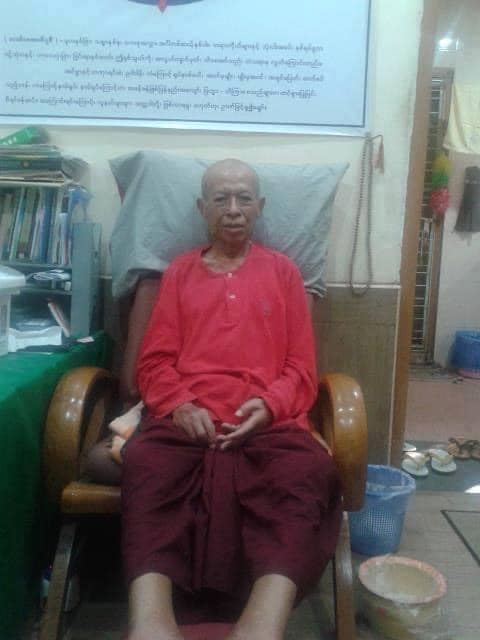
When I wasn’t teaching, I was either playing scrabble with Saya U Khin, Roland Thein, Sayama Anne, or Bobby Myo Tun, now respectfully addressed as Bhikku Pannagavesaka, who undoubtedly must now be spending some time apart from his meditation in his monastery in Mawlamyine to reminisce on some of the earthly pleasures RIT once had to offer.
Our teaching staff was a friendly bunch. We had a regular stream of students, and some members of other departments visiting with us either to exchange pleasantries or to “check out the scenery” from our vantage point on the 3rd floor. Regulars such as Roland Thein and the Rev. Bobby Myo Tun (no disrespect intended), were often joined by Johnny Hla Min, Kenny Wong, Robert Win Boh, La La, George Tun Pe, D.S. Saluja, Toby Kittim Ku, Zaw Min Nawaday, Walter Tan, Gregory Win Htut, Reggie Kyaw Nyunt, etc., and their delightful female counterparts viz., Christine Phyu Phyu Latt, Emma Myint (later an RIT sayama), and Pamela Myo Min (now Head of Architecture) etc.,. Others, one year junior were Merrylin Smith (now Mrs. Zaw Mon with a very successful career in the US government’s EPA), Than Than Yi (at whose house I played tennis a few doors from Daw Aung San Su Kyi’s residence on University Avenue), Amy Lei Lei Myaing (Tex), Rosie Gyi, Annie (?), and Merlin Vaz, etc., Many of these students not only strolled into our “English Corner”, but unstintingly gave of their time to help me set up the RIT scrabble group, which later even involved the participation of Sayagyis Dr. Aung Gyi, U Min Wun, and perhaps Saya Bilal Raschid in competition games in the institute. The students’ help also extended to organizing the department’s debates and carol singing at Christmas time – an interesting seasonal Christian celebratory event, where racism and religious discrimination played no part in the thinking of our community. We were just happy to be one, and to do things and enjoy each other’s company in whatever manner we could, all in true Burmese fashion.
Sayas from other departments
On other fronts, I thoroughly enjoyed socializing and cultivating friendships with faculty members from other departments. Saya U Sein Shan (Math) was a consistently friendly and jovial presence, as were Saya U Maung Maung Win (Mech) with his flashing smile worthy of any CNN news anchor, Saya Maurice Kyaw Zaw, and Saya U Soe Paing, whom I called “the involver and the motivator”. I had frequent stimulating conversations with Sayas Christopher, U Thein Dan, and U Allen Htay of the Civil department. And of course, I was not only very friendly with Saya Bilal Rachid of the Architecture Dept., but was, and will always continue to be deeply grateful to him for helping me get my Canadian visa. He did much to introduce me to the international diplomatic circuit where the foreign ambassadors often engaged in discussing topical issues, a pastime close to my heart. We now keep in close contact by email, and I plan to visit him and others in the Washington [D.C.] area in the near future.
In the same way that I had learned to smoke from some RIT seniors in 1959, I also learned to drink from socializing and playing tennis with the Russian Architectural and Mining lecturers. Interestingly, Viktor, the head of the Russian group took me aside when I went on my rounds to wish my various colleagues “Good-bye”, and asked if I would mind keeping in touch with him as he wanted to immigrate to Canada. When asked, “Why Canada?” his answer was a simple, “They have excellent fishing there!”
Rector and Registrar
Despite my very cordial relations with Sayagyi U Yone Moe through my occasional visits to his office, there was one person in the administration who seemed to consider me anathema to the institution, with no apparent justifiable reason. Whenever I happened to see U Soe Thein the Registrar, which was practically everyday, he would always stare or glare at me with thinly disguised feelings of dislike.
Anecdote
I know I’m fast forwarding a bit here, but I’d like to narrate an interesting and illuminating anecdote that happened towards the end of my teaching career at RIT.
One day, a brilliant student of mine – who shall remain anonymous, returned from the government’s annual Lu Ye Chun summer camp for outstanding achievers. At the usual meeting of students, faculty and administration in the RIT Assembly Hall, instead of going along meekly with the official policy line of praising the program to the skies, and using the occasion to encourage other students to strive for higher ideals within the government’s philosophical purview, he delivered a critical unflattering message labeling the program as nothing less than an attempt to indoctrinate the students with questionable socialist ideals!
We sat in stunned silence, not for one moment expecting such a tirade. I never quite got around to asking him what chastisement was meted out to him, but within an hour of his outburst, I was “requested” to see U Soe Thein in his office. There, I was pointedly accused of imbuing this student of mine with harmful western liberal thinking that was detrimental to the Burmese Way to Socialism. Despite my protests to the contrary, I was roundly castigated on the grounds that I was a natural suspect due to my westernized manner of dressing, my behavior, and outlook. Well, so much for U Soe Thein – himself a suspected front man for the party, and his heavy-handed attitude.
There was no love lost between us, but I very sadly had to conclude that after this, my first experience of discrimination in my life, and a few other misgivings about the systemic failure I was witnessing, including the plight of the working class people at large, I would sooner or later have to leave the land of my birth, as it was becoming extremely constricting and taxing for me to exist in such a stifling political system. I have since moved on, preferring to relegate the “U Soe Thein fiasco” to a footnote in my teaching career at RIT.
And as for my student? I was left with an absolute sense of admiration for this young, conscientious, and courageous person who had had enough gumption to speak truth to power!
Editor’s notes
Sayama Terry moved to Australia.
Daw Yin Yin Mya
Sayama Sheila moved to Thailand. Her spouse Dr. Zin Aung taught at Assumption University (formerly ABAC).
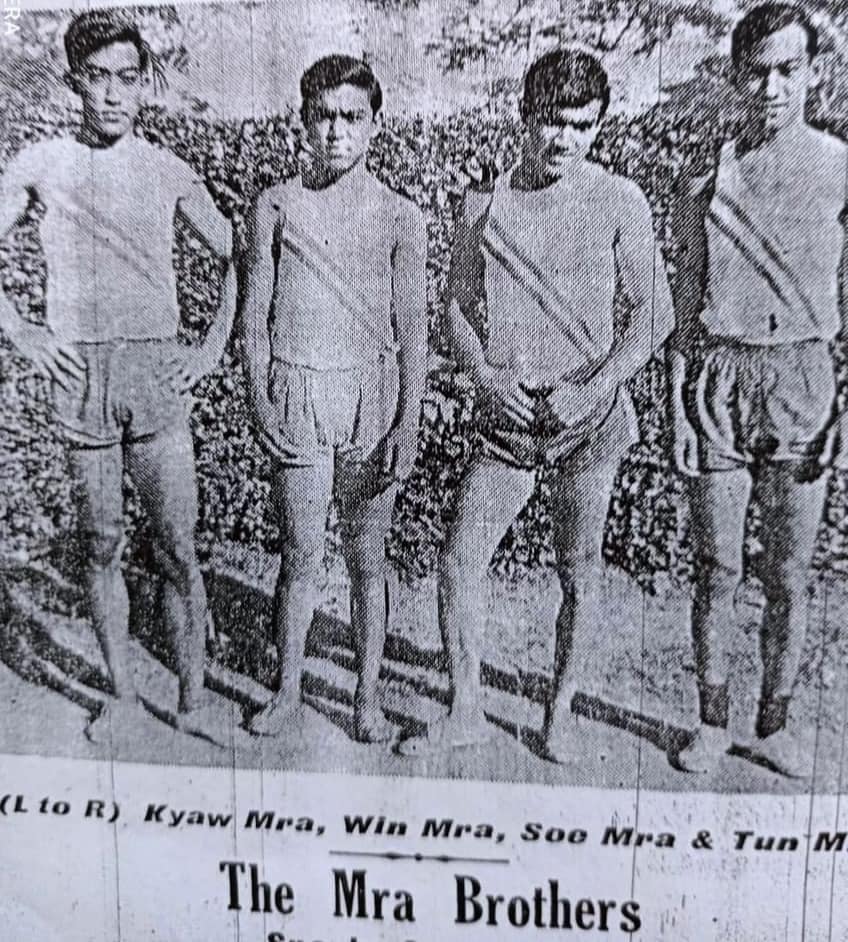
U Win Mra retired from Pole Vault Competition and became Burma’s Elvis Presley. He joined the Foreign Office. He served as Ambassador to the UN. Upon his return, he chaired the Burma Human Rights Commission. He is a Khamee Khamet of Sayama Toni .
Win Mra
Sao Kan Gyi (GBNF) wrote with the pen name “Khemerat”. His sister Biddy (spouse of Mawn Pong Sawbwa Lay) published a book in Australia.
Daw Khin Saw Tint is a bilingual author and a happy great grand mother. Her younger brother U Nay Oke Tint (St. Paul’s) gave a TEDx talk about their mother Daw Khin Saw Mu and her role in the Khit San Sar Pay.
Sayama Muriel (spouse of Saya U Aung @ Alphonso Rivers @ Ko Nge) moved to Thailand. I met them at Saya U Tin Maung Nyunt’s house in Milpitas. They were visiting their daughter in Southern California and made a short trip to Northern California.
Sayama Charity retired as Professor. I met her at SPZP-2012.
Saya Des sent me his book. He had back pain, which limited his traveling. For some time, he taught English on-line to students far and wide.
Joe Ba Maung (GBNF) was Burma’s Tennis Champion in both Singles and Doubles. He joined Burma Railways and also managed the Sports Program. He lost his job after 8-8-88.
U Kyaw Lwin Hla joined UNDP and had a long UN career.
U Khin also won some Scrabble tournaments, but the awards are less that those of Saya Des. He moved to Taiwan. He sent me a long e-mail in 2016 when Ko Maurice Chee (M75) organized a Birthday & Appreciation Soon Kway at Dhammananda Vihara, Half Moon Bay, California.
Maurice Chee (U Hla Myint Thein, M75) is a founding member of RIT Alumni International, which hosted the First RIT Grand Reunion and Saya Pu Zaw Pwe in October 2000.
He wore multiple hats: co-Chair of the Working Committee, Financial Controller, Publisher of the Commemorative Issue of “RIT Alumni International Newsletter” for SPZP-2000.
He is also a founding member of Northern California RIT Alumni Association and served as Vice President.
He is a Past President of BASES.
He coordinated and also donated books for the YTU Library.
He gave presentations at YTU Mechanical Engineering Department.
Saya was Assistant Workshop Superintendent. U Phone Myint was the Superintendent.
Spouse : Daw Thida Swe
U Tin Maung Oo & Daw Thida
He passed away on July, 2016.
Message from Sayagyi Dr. Aung Gyi
Ko Hla Min.
I am sad to know that Ko Tin Maung Oo had passed away. He seemed to be OK when I met him at RIT Reunion in. LA. He was a nice and good person. I will miss him. Please convey my condolences to Daw Thida Swe.
Aung Gyi
Message from Saya U Phone Myint
Dear Thida Swe
Very sad to hear the news about U Tin Maung Oo’s passing away from U Hla Min. We worked together at RIT Workshops Dept. I and my family offer our sincere condolences to you and your family.
I called you this evening but I couldn’t reach you.
With best regards, Phone Myint
Editor’s notes
U Phone Myint succeeded Saya Simon as Workshop Superintendent.
U Tin Maung Oo served as the Assistant Superintendent. He later moved to Southern California, USA.
The RIT Buddhist Association published two books for SPZP-2012.
One is a collection of the Ovada (Exhortations) of the sayas and sayamas [mostly Professor and/or Head of Departments or their representatives] given at the “Arcariya Pu Zaw Pwes” at RIT/YIT.
Another details the history and the activities of the RIT Buddhist Association. Contributors include Saya Dr. Thein Hlyne, Saya U Sein Maung, Saya U Lin, Saya U Soe Myint, and several EC members (notably U Maung Maung Lay and spouse).
Dr. Thein HlyneU Sein MaungU Lin
SPZP-2016
The RIT Buddhist Association published Ovada (Exhortations) of the sayas and sayamas invited to SPZP-2016.
Served as President of the RIT Badminton Association.
U Thein Lwin 1U Thein Lwin 2
He is the elder brother of Ko Kyi Lwin (George, C67), Ko Tint Lwin (Daniel, M69), Ko Thet Lwin (Henry, EE72), Ko Myo Myint (ChE from US), Nellie, Peggy, …
He passed away in June, 2017
Daw May Than Nwe (Physics)
Daw May Than Nwe & U Thein Lwin
Sayama stood first in her Honors Class in 1962.
She is the spouse of Saya U Thein Lwin.
She passed away in April, 2017
69ers
U Myint Thein (Kabar, M69) Core organizer from the Class of 69
KabarKabar & Chit Tin
U Chit Tin (EC69) Third GBNF of the 12 EC69ers. Ko Kyaw Soe and Ko Aung Thu Yein (Brownie) are other EC69ers who are GBNF.
Chit Tin
U Saw Yan Naing (Bo Bo, C69) He was from Meikhtila. He settled in Mandalay.We had not seen him after graduation. He is the spouse of U Tun Aung Gyaw (EC69)’s cousin.
U Tin Myint (L. Tan Choy, John T Lee, M69, US) : He was from Taunggyi. He settled in Union City, California. He was Luyecun for 4th BE. He represented RIT in Table Tennis. Spouse : Lyo Kyin Sein (Mabel, T69)
Tin Myint 1Tin Myint 2
Paulians
Dr. Myo San (Freddie Ba San, SPHS63, IM1 70) : He stood 3rd in Burma in Matriculation. He became a surgeon, but had to take early retirement.
Freddie
U Myint Sein (alumni of Boundary Road School, St. Paul’s and Institute of Economics) : Past Principal, BARB (Burma Astro Research Bureau); Principal, IDEAL Astro
Myint Sein
RIT
U Aung Myint (M67, USA) : Worked with Unicef; Moved to California, USA; Helped Ko Win Thein (M67, GBNF) on “Set Hmu Thadin Zin” and Mechanical Magazine
Saya U Myo Win (Melivn, M65, Australia) : Rowed for RIT; Co-managed RIT Auto Club; He and Saya U Charlie, M65 led RIT Gathering in Sydney in 2006. His spouse is the elder sister of U Tin Aung Win (Tom Aung Gyaw).
U Myo Win & Auto ClubU Myo Win
Others
Sayama Daw Than Than : Spouse of Saya U Khin Maung Myint (Chemistry, GBNF); Mother of Ko Wynn Myint Aung (EC76, GBNF); She was healthy, but unexpectedly succumbed to pneumonia. She passed away EXACTLY one year after her younger son died.
U Kyaw Zaw : Spouse of Daw Khin Khin Aye (Principal, PBRS); He was States Scholar in the early 50s to study about Motion Pictures Technology in the USA. His elder son Thane Myint married Ma Khin Than Nu (Glory, EC70).
U Kyaw Zaw
Dr. Barry Paw (MD, Ph.D) : He is the only child of Saya U Htin Paw (EE58, GBNF). He is a nephew of U Tun Thein (A) and a cousin of Ko Robert Hla Thein (M72). He is Harvard medical school Professor, Boston children Hospital co-founder. He succumbed to a heart attack.on Dec 29, 2017 in Denver when he came back from Australia.
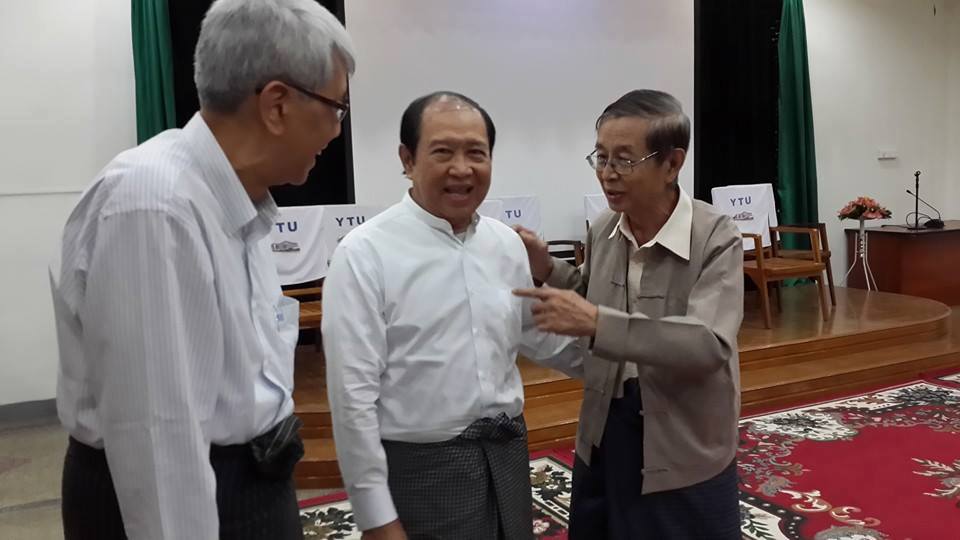
During his tenure as Minister of Science and Technology, he initiated programs to restore RIT to its former glory and to allow “True Home Coming” at the Gyogone Campus in December 2012.
U Aye Myint 2
He was transferred to another Ministry before he could help his alma mater more (e.g. get accredited at the ASEAN level and beyond).
He and fellow EE72 students paid respect to the EE Sayas in December, 2017.

















 HlaMin