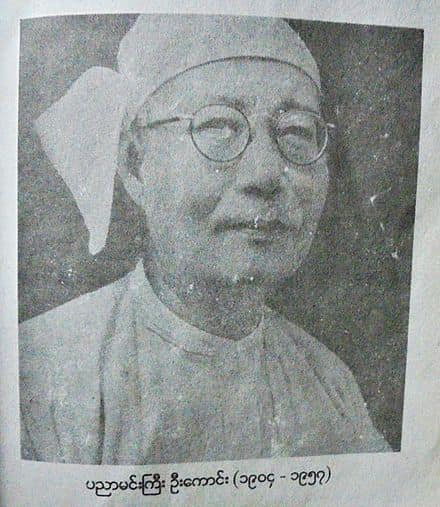
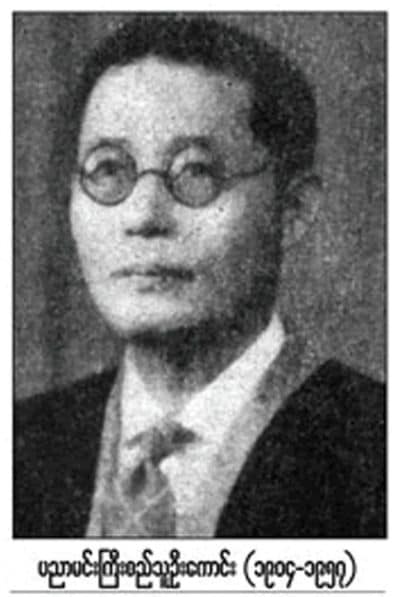
He is a saya of our sayas (including Sayas U Aung Khin, Dr. Aung Gyi, U Min Wun and U Khin Aung Kyi).
He started teaching at Rangoon University before the war.
After retirement, he moved to USA.
He passed away in Portland, Oregon in his late 90s.
Activities
He served as President of RIT Track and Field Association. U Khin Maung Lay (Henry, T68) was Secretary. U Myo Nyunt (C69) was Joint Secretary.
He served as Line Judge at RUBC Regattas along with Saya U Sein Win and Saya Dr. San Hla Aung.
He attended SPZP-2000. U Khin Aung Kyi paid respect to him and Saya U Ba Toke.
Saya and spouse
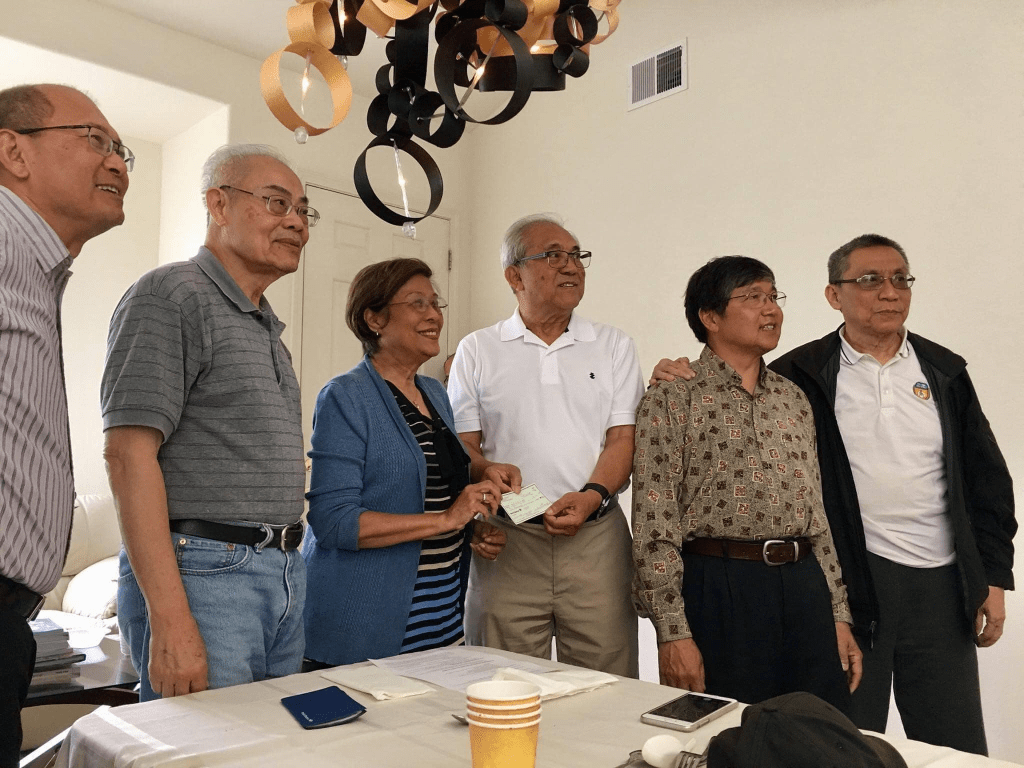
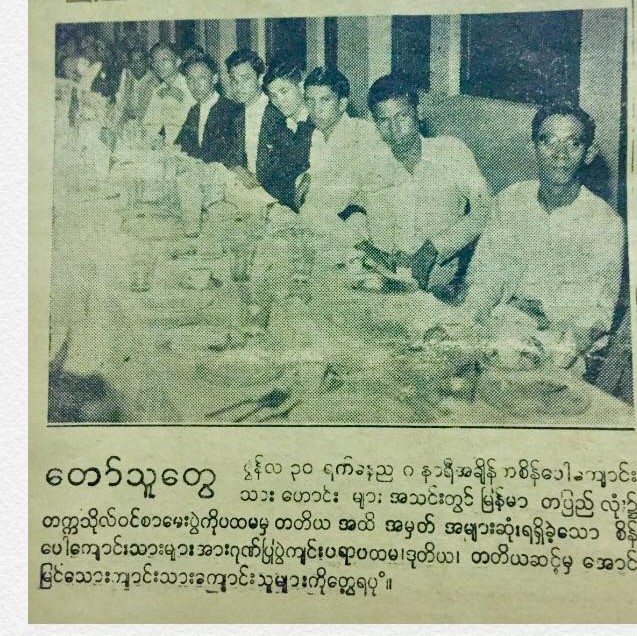
He visited Yangon in 2013. Former students hosted a Welcome party at a restaurant for him. They gave him presents including a Banner. U Myo Nyunt saw that Banner when he visited Saya in Portland.
Brothers
His younger brothers H Num Fatt (EE60, Australia) and H Num Pon (Saya U Myint Lwin, C61, USA) are Engineering alumni.
U Myint Lwin rowed for Engineering. He attended SPZP-2000. He was working in SF Bay Area at the time. He later moved to East Coast.
He retired as Professor and Head of Electrical Power EngineeringDepartment.
Before the reorganization of EE Department into EC and EP Departments, he was a Senior Lecturer of the EE Department.
He was a Top Student at Michigan University, where he received his MSEE.
Since the Scholarship’s sponsor was UBARI, he worked there before he transferred to the EE Department at RIT.
His friends called him “Khone Swa Khone Swa” based on his walking style.
EE Sayas
He was President of RIT Swimming Association. He swam even during his business trips to Singapore.
He was also President of RIT Rowing Association. He served as Line Judge at RUBC Regattas along with Saya H Num Kok (GBNF) and Saya Dr. San Hla Aung.
He was Technical Advisor for UCC.
He is an Absent Minded Professor who left behind his spouse at a market. A variant of the ”U Sein Win Joke” was provided by U Aung Myint (RIT, UCC, GBNF).
Saya Dr. San Hla Aung fondly remembers U Sein Win and his extensive knowledge.
His hobbies include Tinkering and repairing equipment, Rowing, Swimming, Snorkeling, Discussing and arguing about selected subjects, and Western Classical Music.
EE Association
Several former students offered to sponsor Saya to attend the First RIT Grand Reunion and Saya Pu Zaw Pwe in October 2000. He politely declined the offer saying, “I have studied in the USA. Please choose another saya who has not been to the USA.”
Absent Minded Professor
Saya left his brand new spouse at a Zay (presumably Scott Market / Bogyoke Zay). He went back to RIT, and had a long discussion with his students. The students asked, “How is Sayagadaw?” Saya’s reply : “Let’s end the discussion. It’s past time I should have picked her up at the Zay”.
U Aung Myint (SPHS64, UCC, GBNF) wrote :
I heard about that (absent mindedness of Sayar U Sein Win) from some of the students or from the Lab staffs while I was working at the EC lab. What I heard was a little different. What I heard was “He parked at Hledan Zay. His wife went for buying. He was waiting inside the car. Suddenly he got an idea of taking a Hair cut nearby instead of waiting for a long time. After hair cutting, he drove back the car alone [leaving his wife behind].”
Saya’s visits to the Bay Area had tremendous impact.
One visit resulted in the formation of BAPS (Burmese American Professional Society) — a merger of BEA (Burmese Engineers Association) and BASTS (Burmese American Science and Technology Society).
SPZP-2000
Another visit resulted in a dinner meeting where the Bay Area Alumni Group led by Saya Allen Htay decided unanimously to hold the First Ever Grand Reunion and Saya Pu Zaw Pwe on October 28-29 week end. For details, see the articles by Saya Allen Htay, Saya U Nyo Win and U Myat Htoo, Ko Benny Tan and Ko Maurice, and Ko Thein Aung.
Saya wrote the Introduction to the article by Dr. Freddie Ba Hli about his father Sayagyi U Ba Hli.
Saya wrote several articles for RIT Alumni Newspaper : His student days at RU; Tribute to Saya U Tin Hlaing (M59); On the Road to the Millennium; Brief history of Mechanical Engineering Department.
Newsletter
Brief Bio
He enrolled in the Faculty of Engineering, University of Rangoon in 1950. (At that time, one must pass the I.Sc. (Intermediate of Science) with good grades to pursue engineering courses.)
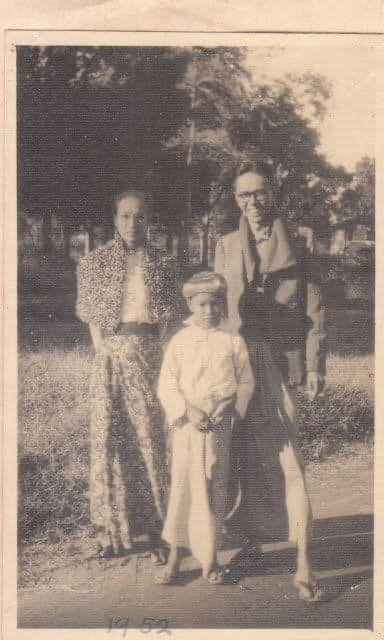
He left the Third Year B.Sc.(Engg) class in 1952 upon being selected as a State’s Scholar to continue the undergraduate studies at Lehigh University.
He received the B.S.M.E. and M.S.M.E. degrees and returned in 1956 to join the staff at the Faculty of Engineering as an Assistant Lecturer.
Saya was awarded the Colombo Scholarship in 1962 to pursue post-graduate studies at Toronto University. He received the M.A.Sc. degree and returned in 1967 to continue teaching at Rangoon Institute of Technology.
Saya served as Professor and Head of Mechanical Engineering.
In 1976, he resigned from the Institute in 1976 and emigrated to Canada.
He retired in 1998 after working for twenty one years in Canada.
His post-retirement sojourns can be found in his excellent article written specially for the Reunion and Saya Pu Zaw Pwe (Special Issue).
Health
Saya stays fit.
He regularly plays golf and tennis.
Saya & daughter
He attended several SPZPs, but now prefers not to travel far except for occasional family gatherings.
Paying respect in 2015
In 2015, Ivan Lee (M69) provided his Mercedes and gas for a whirl wind trip to Canada and the East Coast.
Frederick Thet Gyi (M69) manned the wheels for the major part of the trip.
Sayagyi U Aung Khin hosted me and my spouse for a night’s stay at his house.
Ivan and Fred stayed at a nearby hotel, but spent time chatting with Sayagyi.
We enjoyed the Mohinga and Ah Kyaw prepared by Sayagyi.
He also asked each of us to pick a souvenir from Windsor, Canada.
I read through your updates shown in hlamin.com and my suggestions are given below.
I feel that your book should reflect the love of RIT students for their alma mater, the respect and gratitude shown by RIT students towards their respective teachers, the attachment, bond and friendship among RIT students; and the love for their motherland by RIT students. In short, it should reflect what we call “RIT spirit”. You can base the preparation of the book, beginning from the establishment of Faculty of Engineering, Rangoon University, on your updates and other relevant sources. The word RIT includes all different names of Engineering Institutions in Myanmar, past and present.
Having said all of the above, the following headings come to my mind for your proposed book:
SPZPs/Reunions involving all disciplines which had taken place in Myanmar and abroad.
Establishment of alumni associations abroad and in Myanmar to help RIT and motherland.
Establishment of Swe Daw Yeik Foundation.
Establishment of healthcare fund for RIT teachers in Myanmar.
Fund drive and contributions to upgrade the RIT/YTU library.
Various activities/ mini-reunions / get-togethers among groups of RIT students/teachers which reflect the life and also bond among RIT students/teachers, established in the past ,during RIT days.
Other interesting episodes related to RIT.
The above gives you a few thoughts I have for your book. I would like to recommend that you also get suggestions from others for your book.
Good luck and best wishes. Aung Gyi
Dr. Aung Gyi
Memories
After attending the 2nd year engineering class from June 1952 to September 1952, I went straight to MIT on a state scholarship to continue my studies . Saya U Min Wun and I went together to MIT and joined the academic session, starting from September 1952. We met Dr Freddie Ba Hli at MIT, who was already studying for his Ph.D in electronics or electrical engineering. He was one of the nicest and helpful persons that I have ever met in my life. He gave us briefings and guidance so that we were able to assimilate into the American education system and American way of life without any difficulty He also helped us with our home works when we had some difficulties in the beginning. I am forever grateful to him for his kind help. I am sure U Min Wun feels the same. Saya U Khin Aung Kyi, Saya U Sein Hlaing, U Percy Lao, U Win Htein, U Kyaw Min, Robin Aw, U Kyaw Thein, U Aung Kywe, U Aung Myint and U Sein Hla came to MIT for further studies at a later date. U Percy Lao later became Rangoon City Engineer (water and sanitation), U Win Htein who is an architect became a Rangoon City Building Engineer, and the late U Kyaw Min became a free lance architect [and also taught part-time at the Architecture department for some time]. All these three professionals taught some time at RIT. I do not know what happened to Robin Aw. The late U Kyaw Thein was an engineer at the Construction Corporation and later became a lecturer at the Civil Engineering Department at RIT. U Aung Kywe was a Director (water and sanitation) at the Construction Corporation. U Aung Myint became the Chief Architect at the Construction Corporation. U Sein Hla was an engineer at the Construction Corporation and later became the Registrar at RIT under Rector U Yone Moe. Later more batches of Burmese students came to MIT when I was no longer there. I am describing all these things to point out the fact that the standard of engineering education in Burma at that time was quite good. None of us had to go through the entrance examination to get into MIT. They trusted our grades and our education standard. Maybe the visiting Professor Horwood from MIT was quite impressed with the Faculty of Engineering and put a good word for us to the MIT admission authorities.
I will not go into details of the activities of all the various students’ associations, societies and clubs, as there were so many of them. But I would like to mention briefly about the hostel life, that I had experienced at that time. Every hostel had what we called a social and reading club . There was an adequate room reserved for this club at the ground floor of the hostel. In general, newspapers, popular magazines, a chess board, a carom board and a table tennis were provided so that the hostel students could read, play chess, play carom board, and play table tennis and socialize to get to know each other well. Even without the social and reading club, all the hostel students ended up knowing each other well sooner or later, as they met each other almost everyday at the hostel and at the dining hall. The hostel students were in general well behaved. I hardly saw the Warden or Hall Tutors at Ava Hall and Prome Hall, as there were very few student problems which needed attention of the Warden or Hall Tutors.
Based upon my experience, I feel that these extra-curricular activities and hostel life gave the opportunities to the students to broaden the knowledge of the different parts of Myanmar; and they also created a better understanding of the different culture, food, habit, dresses, dialects etc of the country. Most of the students developed life-long friendships through these activities which contributed to well-beings of these students throughout their lives. Sport activities also taught the students about hard work, cooperation, team work, competition, winning and losing. The extra-curricular activities also triggered, developed and enhanced the hidden talents of some of the students. These activities therefore formed part of the University education of the students, in addition to the education that they received from the classrooms. Another benefit of these activities was the bonding and a better understanding, which developed between the students and the teachers who were involved in these activities.
After getting my Bachelor degree in Cvil Engineering in 1955 and my Master degree in Civil Engineering in 1956 from MIT, I worked for Engineering Companies for a year, which involved both design and fieldwork in engineering construction projects. I then came back to Rangoon in 1957 to join the Civil Engineering Department as an Assistant Lecturer. I was promoted to become a Lecturer in 1958 and became also more or less Head of the Civil Engineering Department. The policy in place at the University of Rangoon under the Ministry of Education at that time stated that a teacher/ any person could become a lecturer / professor only if he/ she had a post graduate degree. Sayagyi U Ba Hli was the Professor of Civil Engineering and Dean of the Faculty at the same time. U Aung Khin was Head of the Mechanical Engineering Department, U Sein Hlaing was Head of the Electrical Engineering Department, U Khin Aung Kyi was Head of the Chemical Engineering Department, U Soon Sein was Head of the Mining Engineering Department, U Thit was Head of the Metallurgy Department, and U Maung Maung Than was Head of the Textile Engineering Department. I think Mr Johnson was Head of the Architecture Department. I do not remember who was the Workshop Superintendent at that time. We were quite happy as we had new facilities near the Prome road in addition to the B.O.C College of Engineering building. These new facilities comprised of a tall administrative building (with offices, conference/meeting rooms, library), classrooms, lecture theaters, laboratories , offices for the teaching staff and a small assembly place under the copper dome roof in the corner of the campus. The dome roof looked like a turtle back, and pretty soon this new campus became known as “turtle dome /leik khone” campus. After our arrival from USA, UK etc, the foreign teachers under contract were let go, as we gradually replaced them, except for a few teachers from UK or USA. I could recall Prof. Neale? in Electrical Engineering Department, Mr Redpath and Mr Skelton in Mechanical Engineering Department and Mr Johnson and Mr Nagler in Architecture Department.
As a young teacher I was surprised and pleased to see a few pioneering female engineering students (not more than ten) at the Leik Khone campus. They and their parents overcame the social uneasiness and they decided to study engineering/architecture to become lady engineers /architects. I do not know exactly when they first joined the 1st year engineering class; but It was one of the important turning points in the history of engineering education.
As young teachers, most of us were struggling to learn how to teach effectively at the beginning. I noticed that we were teaching about 15 to 20 hours per week which included lectures, laboratory and drawing classes. The contact hours of learning for the students remained the same as the time when I was an engineering student i.e. about 30 hours per week. The passing grade for the students also remained the same. i.e. 40% for each subject and 50% average for all the subjects combined. The medium of teaching was still in English. The laboratory and workshop facilities were quite good and adequate for the student population that we had. But the library looked quite small when I compared it with the library that they had in MIT, although it had a few good engineering books and journals. I felt that it needed a lot of investment to become a top notch engineering library.
It was with enthusiasm and hope that most of us were busy trying to build up our respective departments and trying to improve the engineering education in general. While we were busy, Professor and Dean U Ba Hli retired some time around 1961, and in place of U Ba Hli we had a succession of temporary Deans, Professor of Chemistry U Po Tha, Professor of Geology Dr Tha Hla, and Professor of Physics Dr Maung Maung Kha for about 6 months. The Faculty of Engineering also had to move to a new campus in Gyogone in 1961. Before our relocation to Gyogone, the Faculty of Engineering was one of the Faculties of the University of Rangoon. The academic and administrative related policy decisions were made by the Senate and Administrative Council of the University of Rangoon respectively so as to maintain and improve the standard of education of all its Faculties, including the Faculty of Engineering.
As you all know, Gyogone campus was built with the aid of Russia; and I understood that the Government of Burma paid back the cost in rice. I do not know whether it was true or not. In any case it was and still is an impressive looking campus. The buildings accommodated classrooms, laboratories and workshop, big assembly hall with a movie projector, library, offices for the administrative and teaching staff,and student hostels. There were also houses for all the staff, dining and kitchen facilities, small medical clinic, and open space for sport activities. All the buildings, houses etc occupied and still occupy a large area in a compound.
Hla (လှ) means “handsome” and Min (မင်း) means “king”.
Misspelled & Mispronounced
My name has two words and six letters.
It is interesting to note that my name has been misspelled and mispronounced in several ways.
They include
HAL It is an American name. It is also the name of a rouge computer in science fiction. The letters precede those of IBM (International Business Machines) by a position.
HALAL It means “clean food” for Muslims.
LA It is a musical tone.
LAH It is Singlish (Singaporean English)
MINH It is a common name for Vietnamese.
MING It is a Chinese name (e.g. Ming Dynasty)
Speeches on names
I gave a series of speeches:
Meaning of names
Naming conventions
Names of people
Names of places
Names of companies
…
At Toastmasters meetings, I asked the attendees if they know the meaning of their names. Several tried to Google their names.
Remembering names
One way to remember names is to register them with an association.
Examples:
Stein means a rock. Einstein means “one rock”.
Peter means “the rock”. Variations include Bedr, Pedro and Peta.
Deep means “light” and “wisdom”. Deepavali (or Diwali) is the Festival of Lights. Deepak is an Indian name.
San is a prefix for male saints. San Francisco and San Jose are the Spanish names for St. Francis and St. Joseph.
Santa is a prefix for female saints. Examples include Santa Anna, Santa Barbara and Santa Clara.
Santa Cruz (Holy Cross) and Corpus Christi (Body of Christ) are names of cities in California and Texas.