Month: May 2025

  • Libraries

    Rangoon University Library
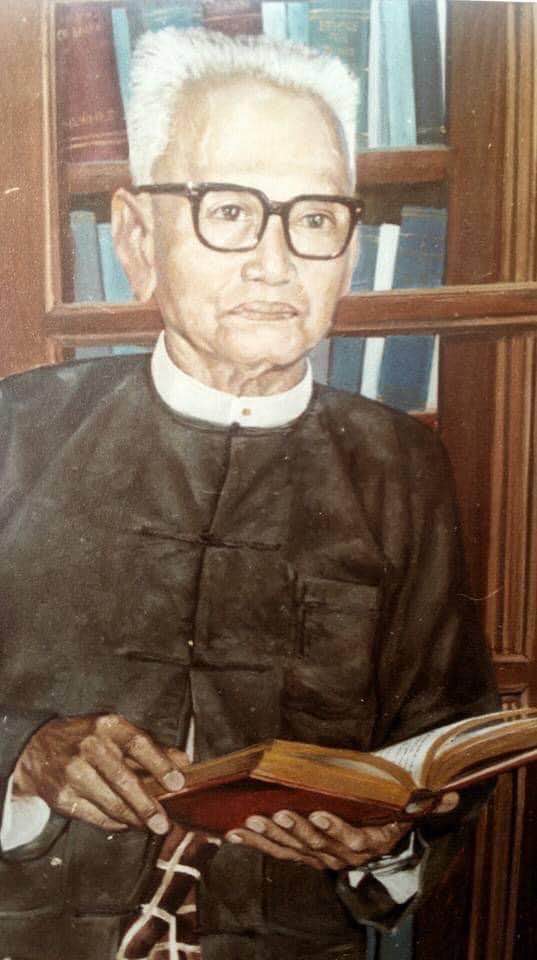
    Chief Librarians include

    • “K” (BBS U Khin Zaw, GBNF)
    • “Zawgyi” (U Thein Han, GBNF
    • U Thaw Kaung

    There were also libraries for some faculties.

    Social Science Library

    While I was still a high school student, my uncle Saya U Than Lwin (Eric, GBNF) took me to the Social Science Library. He was a Lecturer in the Economics Department and also served as Librarian for the Social Science Library. Daw Myint Myint Khin (Hazel, GBNF) was an assistant librarian. She was later promoted to Librarian for the Rangoon Institute of Technology.

    Most sayas (from the Economics, Commerce and Statistics Departments) would not remember the “Char Taik”. My uncle gave rides to Saya Dr. Maung Shein and several sayas. My uncle introduced me to Saya Dr. Than Tun (History, GBNF) at the Recreation Center.

    Selected Libraries

    Engineering

    Saya Dr. Maung Maung Kha (GBNF) then Interim Dean of Engineering, requested Saya U Ba Than (GBNF) to help the engineering library by compiling and/or recommending journals and text books.

    Medicine

    U Tun Aung (GBNF), Librarian for IM(2) passed away due to a stroke after taking several baths on a hot day in Mandalay.

    Northern Illinois

    Daw May Kyi Win (GBNF), Assistant Librarian for the Central Library, took courses at UCC. She won a DV (Diversity Visa) to migrate to the US. She worked at NIU (Northern Illinois University), which has an “Asian Collection”. She maintained the “Burma” section of that collection.

    Saya Dr. Than Tun (GBNF) wrote some of his books during his stay at NIU.

    Saya U Saw Tun (former Head of RIT Burmese Department) was active with RIT Ah Nyu Pyinna Athin (Saya U Moe Aung and team). For a commemorative Swel Daw Yeik Sar Saung, he recounted how he and Saya U Moe Aung were summoned to the Ministry and told to “stop” Swel Daw Yeik troupe activities. Saya was and may be still at NIU teaching and researching Burmese.

    Ko Wunna Ko Ko, designer of the second RIT web site, studied and also worked as a research associate at NIU. He is an expert of NLP (Natural Language Processing).

    St. Paul’s High School

    I was admitted to Section (D) of IVth Standard at SPHS (St. Paul’s High School). There was a theory that students who did not join SPHS from KG could/should be tested by placing them in Section (D) instead of the elite Section (A). Dr. Thane Oke Kyaw Myint had a similar experience. Only after proving our worth for four years, we were finally transferred to Section (A) of VIII Standard.

    Brother Canice picked me from among the IV standard students to volunteer at the School Library. That was my first hands on experience working with a Librarian.

    In High School, we had a Class Library. Brother Austin, our teacher for English and “Morals and Manners”, would allow us to borrow books not only from the Class Library but also from the School Library (where he served as a Librarian). We were asked to review the book that we had borrowed. Brother Austin would also reward those who do well in the tests with a book from the Class Library. I won “History and Atlas of North America”.

    RUCL

    I joined BRS (Burma Research Society) as a student member. I would go to the RUCL every three or six months to pick up my copy of the BRS journal. The journal uses transcription for the Burmese words.

    RIT

    Ko Mya, Assistant Librarian at RIT, was friendly and helped the students looking for journals …

    USIS / USIA

    In July 1969, I wrote a poem “Men on the Moon”. My mentor, who is the Buddhist Archbishop of Latvia and a Laureate Poet, submitted my poem to the Guardian newspaper and to Mr. Hall, an officer with USIS/USIA. The poem was sent to NASA.

    Mr. Hall registered me as a user of USIS publications (Lin Yaung Chi and monthly or bi-monthly translations).

    Daw Rita Tin Aung, Librarian for USIS, provided access to UCC staff. She would also photocopy articles that we requested.

    Family & Relatives

    My parents and uncles have their personal libraries. Collectively, we have access to encyclopedias (in English and Burmese), dictionaries (of various sizes) and books (on science, technology, religion, history, fine arts …)

    Internet

    With the advent of Internet, I had access to e-libraries.

    We hope that the “YTU Modernization Project” would be implemented successfully and that YTU will get accredited from ASEAN and beyond.

  • Dean of Engineering

    Saya U Ba Hli

    Saya U Ba Hli was the first native Dean of Engineering at the University of Rangoon. He also served as Professor of Civil Engineering.

    Interim Deans

    Four Interim Deans succeeded Saya U Ba Hli.

    • Dr. Htin Aung, Vice-Chancellor, University of Rangoon
    • Dr. Tha Hla, Professor of Geology
    • Dr. Maung Maung Kha, Professor of Physics
    • U Po Tha, Professor of Chemistry

    U Yone Mo

    U Yone Mo was appointed as Dean (in charge of BIT). He then became Rector of RIT.

  • Colleges & examinations

    Colleges

    Rangoon University was founded in 1920 with Rangoon College and Judson College as its constituents.

    Intermediate courses were initially offered in the Main Campus.

    Later, Yankin College was opened for Science students. Hteedan College was opened for Arts [and Social Science] students.

    Colleges were opened in Mandalay, Taunggyi, Moulmein (Mawlamyine), Bassein (Pathein), Kyauk Phyu, Myitkyina, …

    Examinations

    In some years (probably due to the insurgency in some parts of Burma), students have to sit the “combined” Intermediate examination.

    Otherwise, they have to sit for Inter (A) and Inter (B) exams separately.

    Even then, there were two chances to pass the exam. The first exam was usually held in March. The second (aka supplementary) exam was usually held in June. The compartmental system requires a student to re-take only the subjects they have failed.

    Stipends and awards (Gold and Silver medals, …) are eligible only for students who pass all subjects in the first exam.

    Those who aspire to become engineers have to pass I.Sc. with 50+ marks in Mathematics, Physics and Chemistry.

    According to U Aw Taik Moh (C54) and Saya Dr. San Hla Aung (C58), they had to take a bike or walk to the Main Campus to attend Mathematics [and Geology] classes.

    Saya U Ba Toke taught Mathematics to several engineering students (who later became sayas).

    Grapevine says that the Second Year of Engineering (equivalent to 4th BE) and 2nd MBBS were the “filters” (or “stumbling blocks”) for engineering and medical students. Some decided to change their study to Pure Science or Arts.

    Leik Khone

    Leik Khone was attended by engineering students until the school relocated in 1961 to Gyogone as BIT (Burma Institute of Technology).

    We were the last batch to attend Leik Khone as an I.Sc.(A) student.

    My spouse attended Leik Khone for 1st MBBS (and more).

  • Admission Requirements to study engineering

    Requirements

    In 1924, eligible B.Sc. graduates are admitted to the “accelerated” program (3 year course)

    Common in the old system

    Students who passed the I.Sc. (Intermediate of Science) with Science Option and scored 50+ points in Mathematics, Physics and Chemistry are admitted to the four year course

    Short-lived in the old system

    Eligible students who passed the Matriculation are admitted to the “special” six year course. Due to resources (logistics …), the students were transferred” before they graduated to the “default” program

    New Education System in 1964

    69ers

    In November 1964, three batches of students were admitted to RIT under the then new Education System.

    • 200 (or so) students joined the first ever 3rd BE Class.
      Most of them completed their I.Sc.(B) with the Science Option
    • 320 (or so) students joined the first ever 2nd BE Class.
      Most of them completed their I.Sc.(A) with the Science Option
    • 450 (or so) students joined the first ever 1st BE Class.
      The controversial ILA (Intelligence Level Aggregate) system was used for admission.
      There were students with (a) all Science (b) all Arts (c) Hybrid

    Regional College Era

    After finishing two years at a Regional College, eligible students were admitted to 3rd BE classes.

    Items (needing input from sayas and alumni)

    • When was ILA discontinued?
    • Policies for 3F, External Students, Readmission as regular student
    • “Newer” systems involving 30+ TUs

    Aung Kyaw Min wrote:

    The controversial ILA scheme was discontinued in 1969. Sudents who passed matriculation in 1969 were admitted based on total marks. If I remember correctly lowest marks admitted to medical was 400 while RIT was 378. There were many students who chose RIT (or other majors) though they were qualified (i.e. scored more than 400) to go for medical.

  • Government Technical Institute

    GTI & AGTI

    GTI stands for Government Technical Institute

    Provided man power to run the engineering departments and projects in Burma.

    AGTI => Associate of GTI

    Workshop Practice

    In the early days, engineering students have to do Workshop Practice at Insein GTI

    • BOC (Burma Oil Company) funded the establishment of the BOC College [of Engineering]
    • Workshops were set up at BOC College [and RIT]

    Connections with GTI

    Saya U Ba Hli

    U Ba Hli was Principal of GTI. He also headed the Civil Engineering Department.
    He transferred to Rangoon University as the first native Dean of the Faculty of Engineering.
    He is credited for the “Twinning Program” with the prestigious universities in the USA.

    Saya U Ba Hli

    Saya C Ping Lee

    Saya U Kyaw Tun (GBNF) asked his friend Saya C Ping Lee, father of Dr. Win Aung (M62), to join the EE (Electrical Engineering) Department. H.E. U Than Aung, Minister of Education, asked Saya C Ping Lee, his former student at St. Paul’s High School, to transfer to the Directorate of Technical & Vocational Training as the Director General. An assignment was to upgrade GTI and technical schools.

    The GTI-RIT “Bridge” Program

    It enabled eligible GTI alumni to join RIT.

    • Ko Yin Sein (Caesar Yang), my classmate at SPHS, has an excellent command of English. He attended GTI and later joined the “Bridge” program as an early participant. He studied EC (Electrical Communications) and worked at BBS (Burma Broadcasting Service) after graduation.
    • Ko Myint Soe (Henry, M79), Ko Hla Maw Tun (M82), Ko Kaung Kaung Oo (Gordon, M83), KKZ (Ko Ko Zin, M84), AMO (Aung Myint Oo, EC84) and Ko Myo Aung (85) are some who attended GTI and RIT/YIT.
    • Ko Ba Than Nyunt provided the following list of AGTI BE’s :

    Kyaw Win(Mandalay GTI, RIT) EC76

    Kyi Mg Aye(I GTI,RIT) EP77

    Khin Ma Htay(M GTI,RIT) C76

    Oo Khin Mg(I GTI,RIT) C76

    Ma Po Myint(M GTI,RIT) C76

    Hlaing Myint(I GTI,RIT) M76

    Thant Sin(I GTI,RIT) M76

    Saw Samuel(I GTI,RIT) M76

    Mg Htike(Kalaw GTI,RIT) Mn76 GBNF

    Sit Thein(Kalaw GTI,RIT) Mn76 GBNF

    Than Aung(I GTI,RIT) M76

    Mya San(M GTI,RIT) M76

    Tin Win(I GTI,RIT) M76

    Kyaw Myint(K GTI) Mn 76

    Lay Nyunt(I GTI,RIT) C76

    Myint Sein(M GTI,RIT) C76

    Mg Thaung(M GTI,RIT) C76

    Soe Tint(I GTI,RIT) C76

    Aye Kyi(I GTI,RIT) EP77

  • Architecture, Chemical, Metallurgy, Mining and Textile

    RIT Sayas

    Mining Engineering

    U Soe Khaw (GBNF) served as Part-time Lecturer and Head of the Mining Department in 1954.

    U Soon Sein (GBNF) succeeded him as Full-time Lecturer and Head. He retired as Professor.

    Architecture

    Architecture courses were introduced in 1954.

    The first batch of graduates in 1958 include U Myo Myint Sein and U Tun Thein.

    U Khin Maung Thint and several foreign sayas taught the early courses.

    A Group photo of the first three batches (A58, A59, A60) was posted in an early update.

    U Tha Tun (GBNF) served as the native Head of Department.

    U Myo Myint Sein succeeded him as Head. He retired as Professor.

    Chemical Engineering

    Chemical Engineering courses were introduced around 1953.

    Several foreign sayas taught the early courses.

    The first batch of graduates in 1957 include Dr Hla Myint.

    U Khin Aung Kyi (GBNF) served as the first native Head of Department. He later served as Professor and Rector.

    Textile Engineering

    U Maung Maung Than (GBNF) served as the first native Head of Textile Department. He later served as Professor and Rector.

    The first batch of graduates include U Shwe Yi.

    There were four female graduates (Daw Julie Han, Daw Tin Tin Ohn, Daw Yin Yin Kyi & Daw Mi Mi) in 1961 and a lone female graduate (Daw Khin Than Nwe) in 1962.

    Metallurgical Engineering

    U Thit (GBNF) served as the first native Head of Metallurgy Department.

    Dr. Saw Pru (GBNF), U Than Tin and Dr. Khin Maung Win (GBNF) are some early sayas.

    U Aung Hla Tun (GBNF) served as Chief Editor of RIT Annual Magazine. He later won the National Literary award. He and his HMEE (History of Myanmar Engineering Education) team published a book in 2012.

  • Changes in Education System

    Matriculation in 1963

    Examples of Changes

    Old Education System

    Matriculation students

    can take

    • Lower Burmese (for a restricted time)
    • Optional Burmese
    • Optional English
    • Additional Mathematics
    • One extra subject (as insurance)

    University students

    can

    • [easily] switch from one discipline to another
      e.g. Engineering back to Medicine, Pure Science, Arts …
    • take Double Maths and Triple Maths (Pure, Applied, Statistics)
    • join B.L, B.ED, … (after their Bachelors)
    • 3-year Honors (after Intermediate)
    • 2-year General Honors (after Intermediate)

    New Education System

    Matriculation students

    take six prescribed subjects based on Science or Arts option
    e.g. Burmese, English, Mathematics, Physics, Chemistry, Biology (for Science option)

    University students

    • 5-year Law degree
    • 5-year Education degree
    • can apply for SS (Science Scholarship)
    • bypass the Intermediate and are admitted directly to the Institutes
      for some time, admitted using the controversial ILA (Intelligence Level Aggregate)

    Newer Education Systems

    tried

    • Regional College
    • Moving some disciplines to the Ministry of Science and Technology
    • “Compressed” academic terms [to make up for the school closure]
    • Proliferation of Colleges and TUs
    • Hybrid nomenclature :
      Professor, Associate Professor, Lecturer (instead of Assistant Professor), …