Tag: Language

  • Languages & Grammar

    Languages & Grammar

    by Hla Min

    Update : July 2025

    English

    Parts of Speech

    There are eight parts of speech in the English language.

    (1) Noun

    • A noun is a name of a person, place, thing, or concept.
    • It may be classified as (a) Proper noun (b) Common noun (c) Collective noun (d) Abstract noun.

    (2) Verb

    • A verb usually describes an action or a process.
    • It may be classified as (a) Transitive verb (b) Intransitive verb.

    (3) Pronoun

    • A pronoun stands for a noun. Associated with a pronoun is person and number.
    • When we speak, the first person is the one who speaks. The second person is the one being spoken two. The third person is some other being referenced.
    • Number may be Singular or Plural. If there is only one person, we say it is singular. If there is more than one, we say it is plural. In English, the term “You” may be singular or plural.

    (4) Adjective

    • It is a Modifier
    • An Adjective usually modifies a Noun or Pronoun.

    (5) Adverb

    • It is a Modifier
    • An Adverb usually modifies a Verb.

    (6) Conjunction

    • It is a Connector
    • A Conjunction (such as And or But) connects two parts of a Sentence

    (7) Preposition

    • It is a Connector
    • A Preposition adds information such as position (e.g. in, on, upon, under) and time (e.g. before, after).

    (8) Expression of Mood

    • There are words to express Mood (e.g. surprise).
    • They are called Exclamation or an Interjection.

    Techniques

    In a Grammar class, we had to learn two techniques :

    • Synthesis
      combining the parts of speech
    • Analysis
      breaking down into the parts of speech.

    Need for Grammar

    Many native speakers read and write fluently without caring much for grammar.

    Knowledge of grammar is needed in

    • Formal Languages
    • Automata Theory
    • Compilers
    • Translation
    • Natural Language Understanding and Processing

    Burmese

    In middle school, we had to study မြန်မာသဒ္ဒါ based on the text by Saya U Pe Maung Tin.

    Parts of Speech

    • နာမ် — noun
    • ကြိယာ — verb
    • နာမ်စား — pronoun
    • နာမဝိသေသန — adjective
    • ကြိယာဝိသေသန — adverb
    • သမ္ဗန္ဒ။ — conjunction
    • ဝိဘတ် — preposition
    • အာမေဋိတ် — interjection

    Pali

    Parts of Speech

    Pali has only four parts of speech.

    • Noun
    • Pronoun
    • Verb
    • Clitics (which are equivalent to conjunctions and interjections).

    Resources for studying Pali

    TMC

    • Tathagata Meditation Center
    • Offers meditation retreats & online courses (including Pali)
    • Publishes Dhamma literature
    • Has a website

    Beelin Sayadaw

    Beelin Sayadaw
    • He was Chief Resident Monk at Tathagata Meditation Center (TMC), San Jose.
    • I interpreted some of Sayadaw’s dhamma talks.
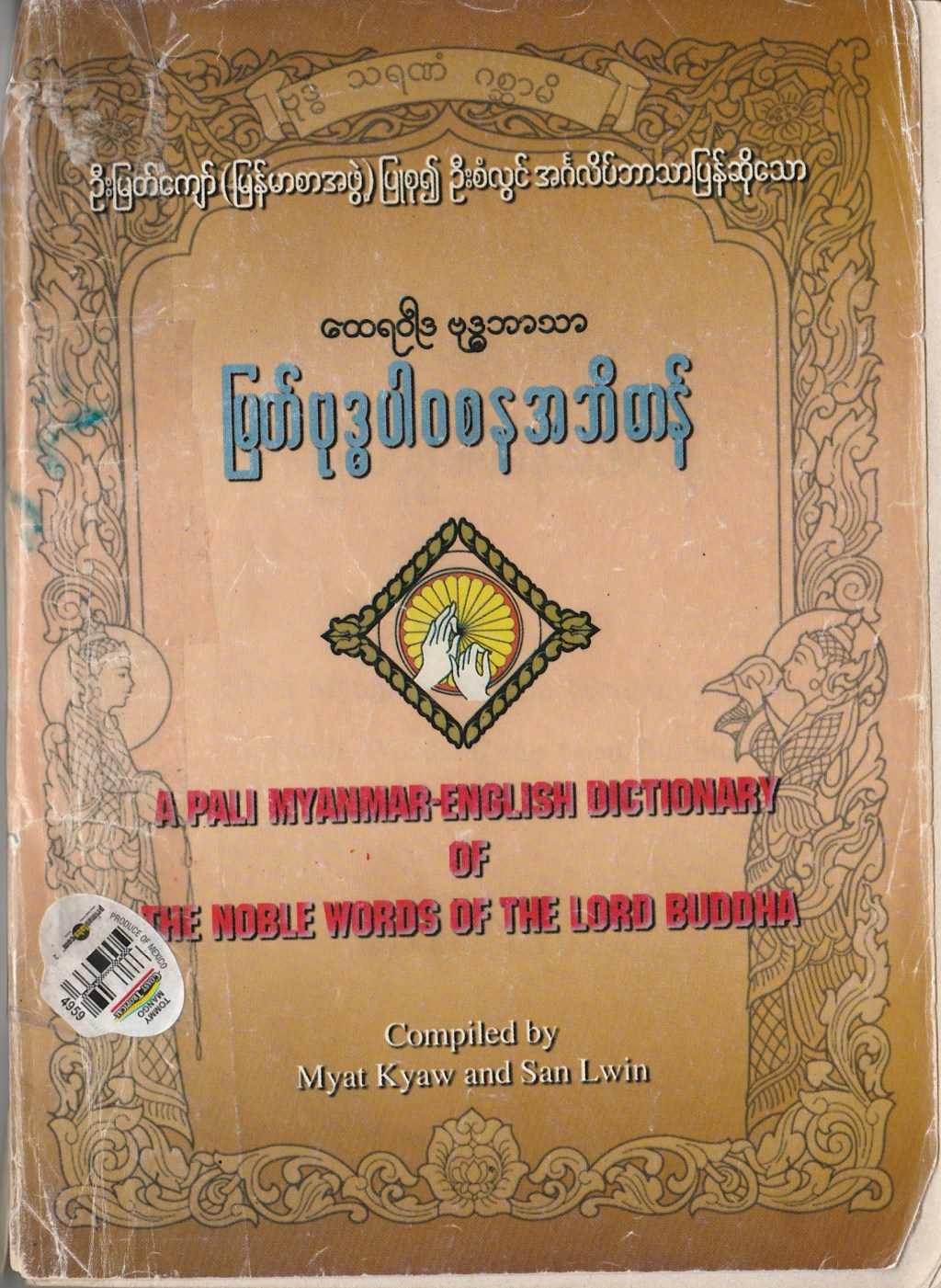
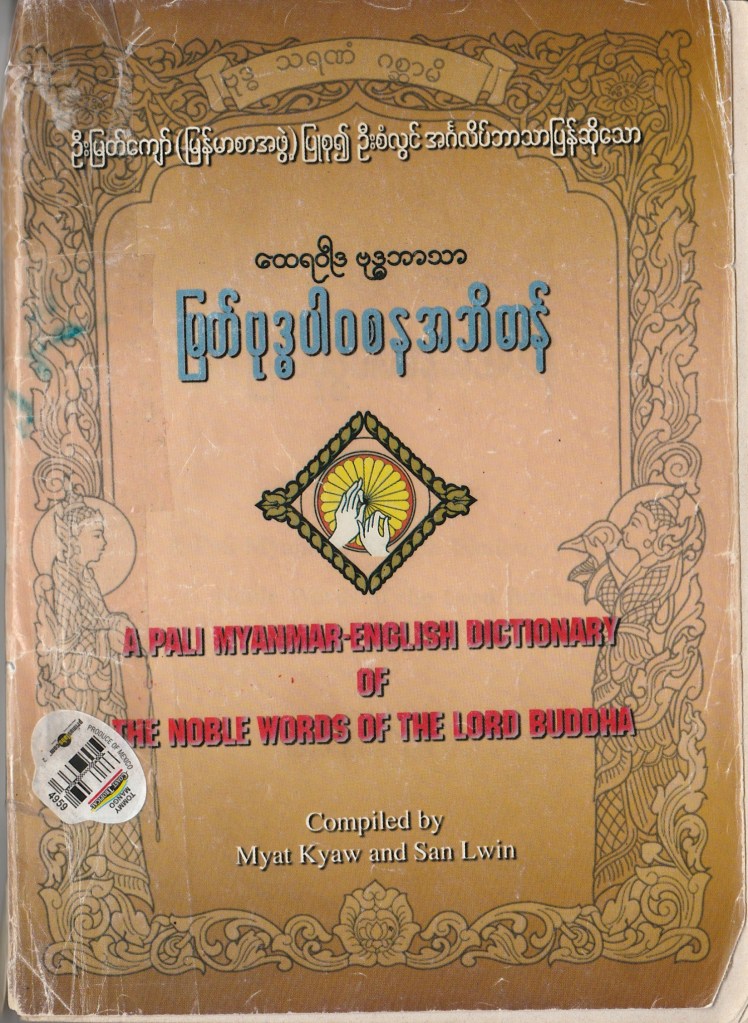
    • Sayadaw gave me a book by U Myat Kyaw & U San Lwin.
    • U Myat Kyaw described Pali terms in Burmese.
    • U San Lwin translated U Myat Kyaw’s work into English.
    Dictionary

    U Hla Myint

    • He is a former Sayadaw, who passed several monastic exams.
    • He helped with some of TMC Publications.
    • I received his book as a present.
    Book

    Tharmanay Kyaw သာမဏေကျော်

    • Pen name of Sayadaw U Dhammika.
    • Received the title when he finished Top as a Novice in a prestigious monastic exam
    • During his visits to TMC, he taught Pali based on selected texts.
    Course notes
  • Idiom

    Idiom

    by Hla Min

    Updated : May 2025

    Characteristics

    An idiom

    • is usually a phrase whose meaning is not obvious
    • gets the meaning accepted due to usage over time
    • is a linguistic device

    Advanced dictionaries may list idioms and their usage.

    Examples

    During my middle school days, one of my uncles gave me books (including “A Book of Idioms”) .

    From the book, I learned that “the hand that rocks the cradle” stands for “a mother”.

    Rain cats and dogs” is an idiom which means “Rain heavily”.
    In this example, the idiom uses a metaphor.

    No one knows the root of the idiom “kick the bucket” meaning “dies”. Someone guessed that a man being hanged by a rope might kick a bucket.

    Idioms should be used sparingly.

    If you combine two idioms mentioned above and say “The hand that rocked the cradle kicked the bucket” you might receive LOL (Laughing Out Loud) for the illogical construct.

    U Khin Maung Zaw (KMZ, EC76) added :

    Believe it or not, this subject is one of the many we learned from U Hla Min (KJ to some of us) while we were at the UCC. As some of us were preparing for TOEFL, KJ prepared us by teaching the ins and outs of the language.

    Some of these idioms are regional in nature, after some time living here, I tend to use many idioms as they come naturally. Well, that’s until a childhood friend of mine kindly reminded me that many of them were having hard time fully understanding what I meant in the posts.

    As of now, I am trying my best to use US idioms as little as possible, at times I feel like I have to write more as if I could not communicate to get my point across. I did it again, bad of me.

    “to get my point across” is an idiom meaning “to make people understand what one is saying” (per Merriam Webster).

  • Quotes

    Quotes

    by Hla Min

    Updated : May 2025

    Book of Quotations

    • In our younger days, we rely on Bartlett’s “Book of familiar quotations“.
    • The Bible and Shakespeare provided the major number of quotes in the classic book.
    • Several quotes were marked “Anon.” for anonymous (or unknown author).

    Misquotes and Wrong attribution

    • If people do not check the source, they may misquote or attribute a quote to the wrong person.
    • Many wrongly believe that Sherlock Holmes said, “Elementary, my dear Watson”.

    Autographs

    • We used to have autograph books.
    • I remember a quote:
      Worry is like sand in an oyster.
      A little produces a pearl.
      Too much kills the animal.”