I picked her up this morning. She’s home now. She’s missing PePe but in good spirit all things considered. The hospital gave us a wheelchair to keep for a while in case she needs it. She’s eating as well which is good. Aunty Theingi ordered some delicious food for May May. I’m dealing with pensions and other major admin at the moment. Ye Lay is home and I will go back later this afternoon also.
Mezaligone Days
Peter spent eleven years at Mezaligone.
He opened a clinic and treated the villagers often free of charge.
He even paid a few to have surgery at a hospital.
He shared the water from his 180-ft deep well with his neighbors.
He invited them once a month to have Mohinga or some other treat.
He had to order tablets to purify the drinking water. Still he head to treat patients for dysentery and diarrhea.
Miscellaneous
We hear about : Quarantine, Lock down, Shelter / Stay at home, Circuit breaker, Social distancing, Cancelled events and flights, …
During the Pandemic, several health workers lost their lives in the line of duty. Not so young people with underlying medical conditions passed away with or without COVID-19 infections.
U Kyaw Sein (former saya at RIT Mechanical Department) passed away in Singapore.
Daw Molly Khoo (former sayama at St. Philomena’s convent, co-founder of TBSA) passed away in California.
Brenda Gyi (retiree from UN) passed away in New York.
Dr. Myint Win (65 Matriculate) and Dr. Soe Aung (SPHS67) passed away in UK.
The Burmese Calendar is a luni-solar-socio-religious calendar.
The Burmese New Year falls on or around April 16. The three (or sometimes four) days preceding the New Year is celebrated as Thingyan (similar to Songkran festival in Thailand).
It is a lunar calendar with 12 lunar months in most years. An intercalary month called “Second Waso” is added every three years. There are 12 religious and/or social festivals (one for each Burmese month).
Most religious festivals are celebrated on the Full Moon Day.
The following is a brief description of the 12 Burmese months and the associated festivals.
1. Month of Tagu
Name of the auspicious event: Ushering in the Burmese New Year by the Buddhists
Associated festival: A Ta Thingyan Water Festival (generally held from April 13 – 15 or 16)
Details for the celebration: (a) Invite guests for special treat. (b) Take eight precepts and practice Sila (morality). (c) Listen attentively to the “38 Blessings” by the sangha. (d) Chant Paritta (protective verses) and Pathana (“relations”) (e) Pay homage to the elderly people as if they were one’s own parents (f) All the above are performed (by the Burmese Buddhist) to accumulate kusala (wholesome deeds) (g) Most younger people usher in the Burmese New Year by throwing water (h) Thingyan festival is the most prominent among the 12 (monthly) festivals.
Objectives: To cleanse akusala (unwholesome deeds) from the past year (a) symbolically by throwing water (b) practically by performing meritorious deeds such as dana (charity), sila (mrality), and bhavana (meditation)
2. Full Moon Day of Kason
Name of the auspicious event: Buddha’s Day. It is the most prominent day for the (Theravada) Buddhists celebrating four milestones (a) the proclamation that the Bodhisatta Sumeda would become Buddha in four incalculables and 100,000 worlds (b) birth of the Boddhisatta Sidartha (c) enlightenment of Gautama Buddha (d) Mahaparinibbna (final passing away of Buddha)
Associated festival: Kason Nyaung Ye Thun Pwe (pouring water on the Bodhi tree)
Details for the celebration: (a) Invite guests for special treat. (b) Invite sangha and offer requisites (c) Take (five or eight) precepts and practice Sila (morality) (d) Listen to the dhamma talks (e) Practice metta (loving kindness meditation) (f) Share merits (g) Pour water on the Bodhi tree
Objectives: (a) To acknowledge the practice of parami (perfection) for four incalculables in order to become a Buddha (b) To realize that Buddha’s teachings are for our own good (c) To make a determination that we should practice Buddha’s teachings to the fullest extent
3. Full Moon Day of Nayone
Name of the auspicious event: Mahasamaya (“Great Occasion”) A Kha Daw Nay (a) Commemorating truce between Kapilavutta and Koliya countries (b) Assembly of devas, brahmas, galons, nagas, and sanghas expressing their metta (unbounded love) (c) Ordination of 500 princes from the Sakya clan (d) In sum, distinguished and outstanding day of love and peace
Associated festival: Recitation of Mahasamaya Sutta
Details for the celebration: (a) Invite guests for special treat. (b) Invite sangha and offer requisites (c) Take (five or eight) precepts and practice Sila (morality) (d) Listen to the dhamma talks (e) Recite Mahasamaya Sutta (f) Practice metta (loving kindness meditation) (g) Share merits
Objectives: (a) To advocate love and peace among nations with diverse cultures and beliefs (b) To practice metta (unbounded love) not only for humans but for all beings
4. Month of Waso
Name of the auspicious event: (a) Offering of Waso robes (b) Recitation of Dhammacakkapavutna Sutta (“Turning the Wheel of Dhamma”)
Associated festival: There is no specific date for the offering of Waso robes to the sangha. Full Moon Day of Waso is a prominent day for (Theravada) Buddhists celebrating three milestones (a) the day when Boddhisatta was conceived in the womb of Queen Mahamaya (b) the day when Prince Sidharta renounced his worldly pleasures (c) the day when the First Sermon Dhammacakkapavutna Sutta was delivered to his five disciples
Details for the celebration: (a) Invite guests for special treat. (b) Invite sangha and offer requisites (c) Take (five or eight) precepts and practice Sila (morality) (d) Listen to the dhamma talks about Magga (Noble Eight-fold Path) (e) Collectively recite Dhammacakkapavutna Sutta (f) Practice metta (loving kindness meditation) (g) Share merits
Objectives: (a) To avoid the two extremes of sensual pleasure and self-mortification (b) To practice the Noble Eight-fold Path
5. Full Moon Day of Wa Khaung
Name of the auspicious event: Metta (“Unbounded Love”) A Kha Daw Nay 500 monks who were practicing meditation in the forest were intimidated by nats (guardian spirits) and returned to Buddha’s monastery. Buddha preached them Metta Sutta and exhorted them to practice loving kindness meditation to the nats before meditating. The monks returned to the forest and practiced per Buddha’s exhortation. The nats no longer obstructed the practice of the monks, thereby allowing them to progress and get enlightened. Thus, Metta A Kha Daw Nay came into being.
Associated festival: Recitation of Metta Sutta & Sar Ye Tan Mei (deciding the donation to a monk based on a “raffle” [letter written on a stick, in ancient times]
Details for the celebration: (a) Invite guests for special treat. (b) Invite sangha and offer requisites (c) Take (five or eight) precepts and practice Sila (morality) (d) Collectively recite Metta Sutta (e) Offer requisites to the monks based on the Sar Ye Tan Mei “raffle” (f) Dhamma talk on metta and the virtues of practicing metta (g) Share merits
Objectives: To practice metta (unbounded love), karuna (compassion), mudita (altruistic joy), & uppekha (equinamity)
6. Full Moon Day of Tawthalin
Name of the auspicious event: Garudhamma (“Five precepts”) A Kha Daw Nay A brief history is as follows. Bodhisatta was (once) born in Kuru Taing (province), where the king and his people practiced Garudhamma. They refrain from (a) killing (b) stealing (c) sexual misconduct (d) lying (e) taking intoxicants. So, the weather was fine and wealth was amassed. Kawlinga Taing (province) suffered from (a) war (b) famine (c) disease. Many perished. The king and people of Kawlinga Taing decided to emulate the king and people of Kuru Taing. Soon, the weather became fine and wealth was amassed. The three sufferings disappeared. The Full Moon Day of Tawthalin, which is part of the rainy season, was named Garudhamma (“Five precepts”) A Kha Daw Nay.
Associated festival: Competition for reciting poems about the merits of taking five precepts.
Details for the celebration: Host competitions for reciting poems about the merits of taking five precepts.
Objectives: (a) To make people aware of the merits of taking five precepts (b) To have a peaceful community (c) To promote world peace
7. Full Moon Day of Thadinkyut
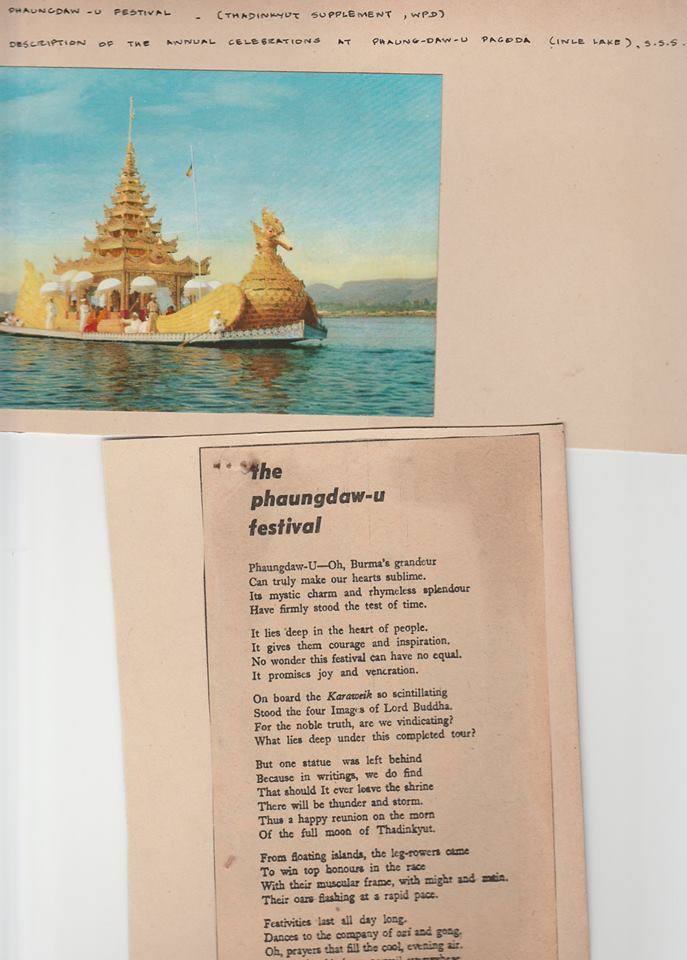
Phaungdaw-u Festival
Name of the auspicious event: Abhidhamma (“Ultimate Reality”) A Kha Daw Nay & Mahapavayana Nay Buddha taught Abhidhamma to the devas in Savateinsa (during the Buddhist Lent) and returned to earth on the Full Moon Day of Thadinkyut
Associated festival (1): Festival of Light
Details for the celebration: (a) Light candles (b) Light incandescent bulbs Objectives: Emulate the scene where the devas and the people paid homage with candles and lights to the Buddha upon his return from Savateinsa
Associated festival (2): Pavayana Pwe
Details for the celebration: (a) Monks assemble in a sima hall (b) Each monk invites other monks to give advice. He says, “If you have seen me commit a misdeed, you may reprimand me. If you hear that I have committed a misdeed, you may reprimand me. If you doubt me, you may reprimand me. I will try not to commit that misdeed in the future.” (c) Lay people might also invite their fellow people to give advice.
Objectives: (a) To practice Nivata Mangala — blessing where one displays humility (b) For monks to practice Sovacasatta Mangala — blessing where one takes constructive critism (c) For lay people to become good & wise people
8. Full Moon Day of Tazaungdaing
Name of the auspicious event: Samyannaphala (“Virtues of monkhood”) A Kha Daw Nay Buddha gave the sermon to King Ajjasathat on the Full Moon Day of Tazaungdaing
Associated festival: Tazaungdaing Festival
Details for the celebration: (a) Light candles (b) Take (eight) precepts and practice Sila (morality) (c) Dhamma talks based on Samyannaphala Sutta (d) Practice metta (loving kindness meditation) (e) Share merits
Objectives: (a) Make people aware of the virtues of monkhood and the qualities of sangha (b) If one has conducted misdeeds like King Ajjasathat, one should acknowledge the fact, but be determined to be good by doing meritorious deeds.
9. Full Moon Day of Nadaw
Name of the auspicious event: Dhamma Sarsodaw Myar Nay In Burmese History, Full Moon Day of Nadaw honors the literary giants (writers, poets). In modern days, the Department of Religious Affairs designated the day to honor writers for the dissemination of dhamma
Associated festival: Sar Pyan Pwe (Oral and written examination for the monks)
Details for the celebration: (a) Hold religious examinations (b) Written examination about Tipitaka (“Three Baskets”) : Vinaya (Monastic rules of conduct), Sutta (Discourses), Abhidhamma (Ultimate Reality) (c) Oral examination about Tipitaka (d) Lay people may visit libraries and borrow religious books (e) Lay people may hold discussions about dhamma
Objectives: (a) Preservation and propagation of Tipitaka (b) Encourage youths to be highly literate and have good moral character
10. Month of Pyatho
Name of the auspicious event: Shin Ta Htaung (1000 ascetics) A Kha Daw Nay During Buddha’s time, 1000 ascetics in Uruvela forest led by the Kassappa brothers renounced their wrong beliefs and become arahants.
Associated festival: Ordination of monks and novices
Details for the celebration: (a) Hold ceremonies for higher ordination of monks (b) Allow youths to become novices
Objectives: (a) To reinforce the importance of practicing morality (b) To familiarize people with religious ceremonies & the performing of meritorious deeds
11. Full Moon Day of Tabodwe
Name of the auspicious event: Ovada Patimauk (Buddha’s exhortation to avoid akusala, to perform kusala, and to purify one’s mind) A Kha Daw Nay
The Full Moon Day of Tabodwe is significant for several reasons. (a) Venerable Sariputta became an arahant (b) Both Venerable Sariputta and Venerable Mogallana were proclaimed by Buddha as the Best in their specialties (c) Without any explicit notice, Ehi Bhikkhu Calabinna Patisambidapatta arahants (elite monks who do not need explicit ordination, who possess six divine powers, and who easily became enlightened) convened for the Ovada Patimauk ceremony.
Associated festival: Ovadaha Partimauk & Htamane Pwe (Sticky rice) festival
Details for the celebration: (a) Collectively prepare Htamane (b) Offer htamane to monks and devotees (c) Listen to dhamma talks
Objectives: (a) Emphasize the strength of unity (b) Perform meritorious deeds collectively (c) Understand Buddha’s exhortation to avoid akusala, to perform kusala, and to purify one’s mind & practice accordingly
12. Full Moon Day of Tabaung
Name of the auspicious event: Myat Buddha Pyi Daw Win A Kha Daw Nay At the request of his father’s emissary Kaludayi, Buddha accompanied by 20000 arahants returned to Kapilavutta from Rajagaha. The return trip commenced on the 1st waning day of Tabaung in year 103 of Mahatheikarit (calendar used in Buddha’s time)
Associated festival: Buddha Pujaniya Tabaung Festival (paying homage to Buddha)
Details for the celebration: (a) Invite as many sangha as possible (b) Offer requisites to the sangha
Objectives: To remember the Triple Gems: Buddha , Dhamma, and Sangha
In February 2014, Daw Helen Lim, 88+ years young passed away. She is the mother of Margaret Lim and Daisy Lim. She is the aunt of Saya U “Charlie” Hla Myint (M 65), U Michael Lim (C74), Daw Kyu Kyu Lin (T75) and Dr. San Lwin Lin (EC77).
Another matriarch Daw Kyin Shwe, 98+ years young, passed away at 7 am on February 8, 2014. She is the mother of U Nyunt Tin (M 70, RIT table tennis), Daw May Win Kyi (my primary school classmate), the late Daw Khin Pa Pa (Mrs. Sein Yaung, M 67), and U Nyunt Tun (Khamee khamet of Daw Kyu Kyu Lin).
U Soe Win Thaw Mechanical 1987 ( 1991 ) passed away on 7th Feb, 2014
June 2014
Daw Khin Khin Aye Her elder sister Daw Tin Tin Aye founded Private Primary Boundary Road School (PPBRS). She taught at PPBRS and later became the Principal. She extended the school to teach Middle School and High School. The school was renamed PBRS. After nationalization, she worked as Township Education Officer for Bahan.
Sayadaw U Ottara Nyana likened the pandemic as the 21st Century World War against an invisible enemy.
Memories by Ye Lay (Live)
“Pe Pe Ko Chit Tae“. [ I love Dad]
Ye Lay thanked his father Peter for the wonderful things that he had learned. In particular, the chanting “I take refuge in the Triple Gems”. He recited to Peter at the hospital.
He sang an old Scottish ballad “Loch Lomond“. He remembered Peter taking Chan Myei Sayadaw to Loch Lomond.
By yon bonnie banks and by yon bonnie braes Where the sun shines bright on Loch Lomond Where we two have passed so many blithesome days On the bonnie, bonnie banks of Loch Lomond
[Refrain] O ye’ll take the high road and I’ll take the low road And I’ll be in Scotland afore ye But me and my true love will never meet again On the bonnie, bonnie banks of Loch Lomond
I mind where we parted on yon shady glen On the steep, steep side o’ Ben Lomond Where in purple hue, the Heiland hills we view And the moon shinin’ out from the gloamin’
Ye Lay studied at St Andrew’s in Scotland for his second Masters. His parents attended his graduation.
He ended by reciting
“Buddham saranam gaccha mi. [I take refuge in the Buddha]. Dhammam saranan gaccha mi. [I take refuge in the Dhamma]. Sangham saranam gaccha mi. [I take refuge in the Sangha].
Memories by Dr. Ye Myint (Recording)
Dr. Ye Myint & Dr. Peter Tun
Firstly I would like to thank you all for being here.
Thanks to all those who shared their good memories of my beloved brother. The family appreciates your kind thoughts and prayers.
It is a great honour to be able to share my memories, and talk about my big brother Peter, who will forever remain in our hearts.
My kindhearted brother spent his life caring not only for patients, but relatives, friends and acquaintances. He gave up his life in the line of duty. He will be missed by all.
Peter, my sister and I were very privileged to grow up together in one large family estate. We were very close sharing the same room and being together daily.
He set a high bar for us intellectually and socially. Due to his high intellect, he got double promotion twice and skipped 2 years.
He matriculated with four distinctions. He stood 23rd in the whole of Burma and was awarded a University Scholarship. He was admitted to the Rangoon University of Medicine, which I also attended. He supported me to become a good compassionate doctor like himself.
He stayed fit by taking part in many sports : football, badminton, cycling and rowing. He was the university selected athlete for Shot put and Discus throwing.
He started cooking as a teenager and learnt many recipes from our mother and continued this lifelong hobby. He was a very good artist and created large paintings as well as water coloured Christmas cards. He was also a very keen gardener and read various books. He had great general knowledge and many called him a walking encyclopaedia.
After he qualified as a doctor, he worked as a UNICEF research officer for mother and child health in Hlegu where he met his future wife Ma Win Mar. After they fell in love he decided to move to Mezligone. I accompanied him on this trip there and helped to set up a new medical clinic. He worked there daily for 11 years where he was relied upon by his patients even out of hours.
I sponsored him to move to UK in 1994 to help progress his medical career. He lived with us until he got his first job in Burton-on-Trent. He got his second job in Pontefract and arranged for his family to relocate to the UK to join him. We were lucky to live only 20 minutes drive away so had nice weekly reunions which made our families even closer.
He then moved to London for rehabilitation medicine training after he passed his MRCP examinations and then moved to Reading 21 years ago working as an associate specialist. Peter has helped many Doctors coming to the UK for further studies where he gave valuable advice and treated them to his home cooking. He always enjoyed entertaining and cooking for family and friends.
We had regular family reunions and memorable family holidays together in Devon, Italy, Burma and most recently in New Zealand. We will cherish these lovely memories together. He had such a great sense of humour and always made those around him happy with his personality and big smiles. He was remarkable in many different ways. He lived an enjoyable successful life and treated all family members, relatives and friends with loving kindness. He touched so many people as evident by the countless tributes, messages, cards and donations.
I am sure you are in a much better place, Ko Ko, after doing so many good deeds throughout your life. We will miss you greatly and always remember you with love. Thank you so much for being a loving big brother, a great Uncle to Aye Sanda, a best friend, mentor and teacher.
Lighting six candles followed by Reflection
Six candles were lit : One for Peter Three for attendees of the service near and far One for Doctors and Nurses One for people around the world
All stood up for a moment of Reflection.
Reflection following the Candle Lighting
Memories of Min Ko
Min Ko shared Dr. Peter’s wonderful, precious life in Meizaligone, a village in Henzada District, Irrawaddy Division.
Since the clinic was at the house, the family members were woken up early by villagers lining up to get water from the tube well.
Peter’s clinic opened from 6AM to late at night seven days a week.
Peter treated sick villagers with CETANA, some free of charge, and some were given cash assistance to go to Hospital in Big Towns.
Once a month Peter invited neighbors to have meals in the house. Peter had an old car and learned how to do repairs.
Min Ko then read a letter written to his father and had to pause occasionally to wipe the tears. He promised to take care of the family.
Song before closing the curtain
“What a wonderful world” by Louis Armstrong
Message by relatives
Dr. Myo Tint (uncle) wrote :
Dear Win Mar, Min Ko and Ye Lay, The Funeral Service. was very touching. The speeches bring out what a wonderful, philanthropic, generous, well learned gentleman Peter was. May he Rest In Peace.
In April 1999, I started sharing news of selected Alumni and Gatherings via e-mail.
It was called RIT Alumni (Abroad) Newsletter.
Several readers suggested a more inclusive name : RIT Alumni International Newsletter.
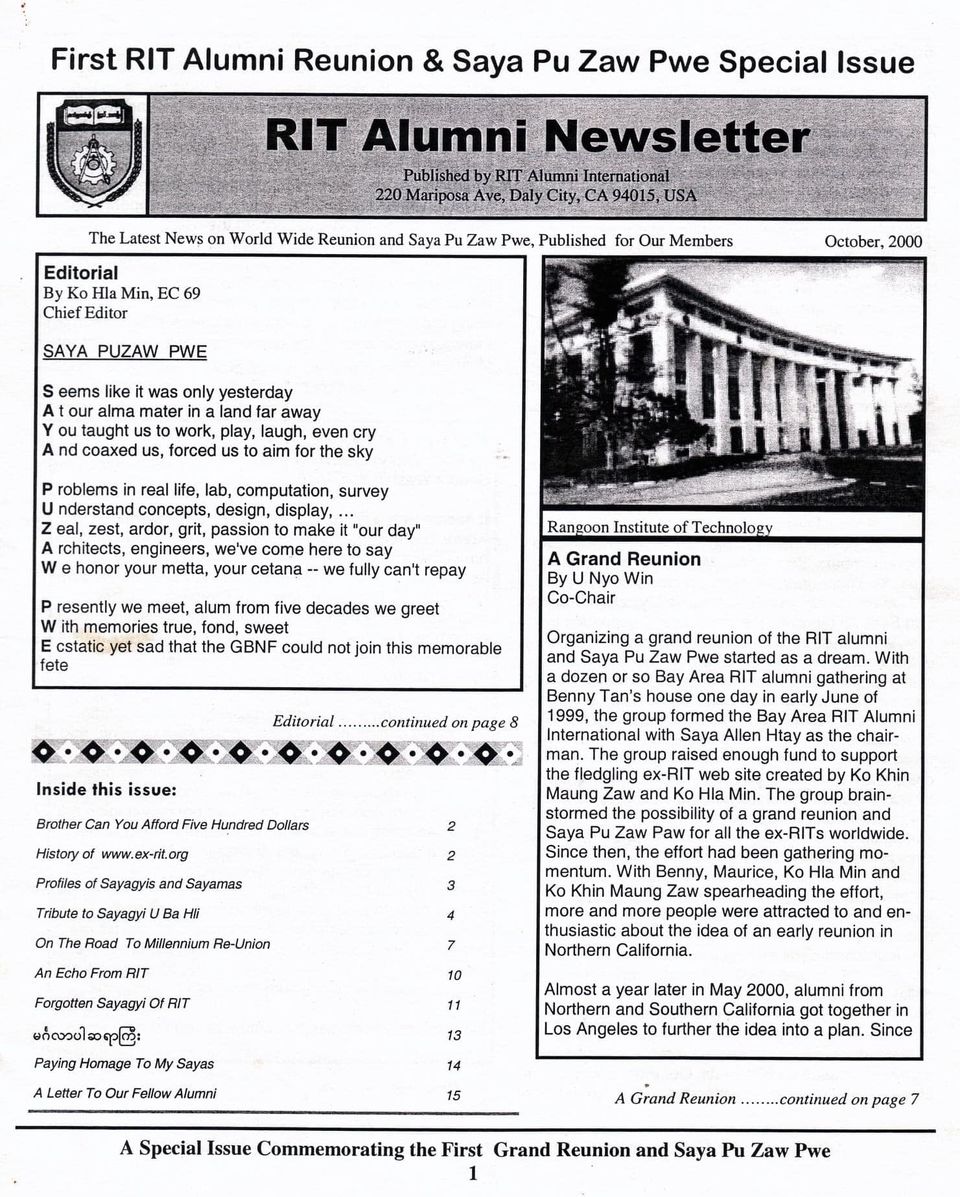
Special Issue for
SPZP-2000
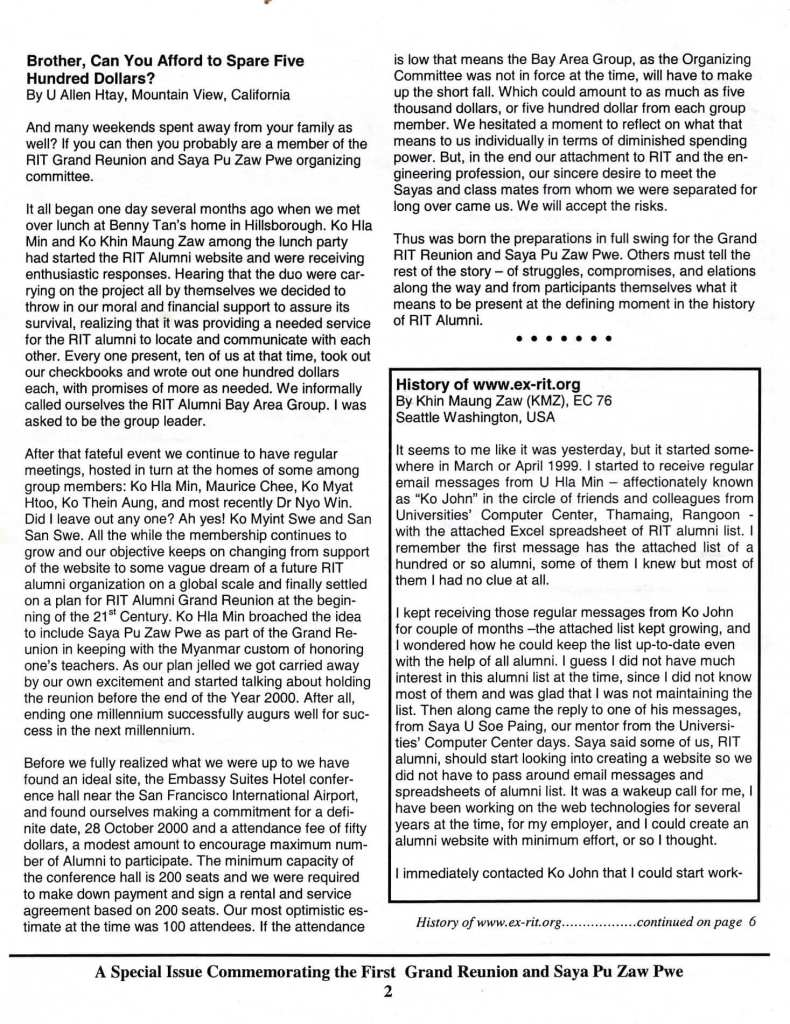
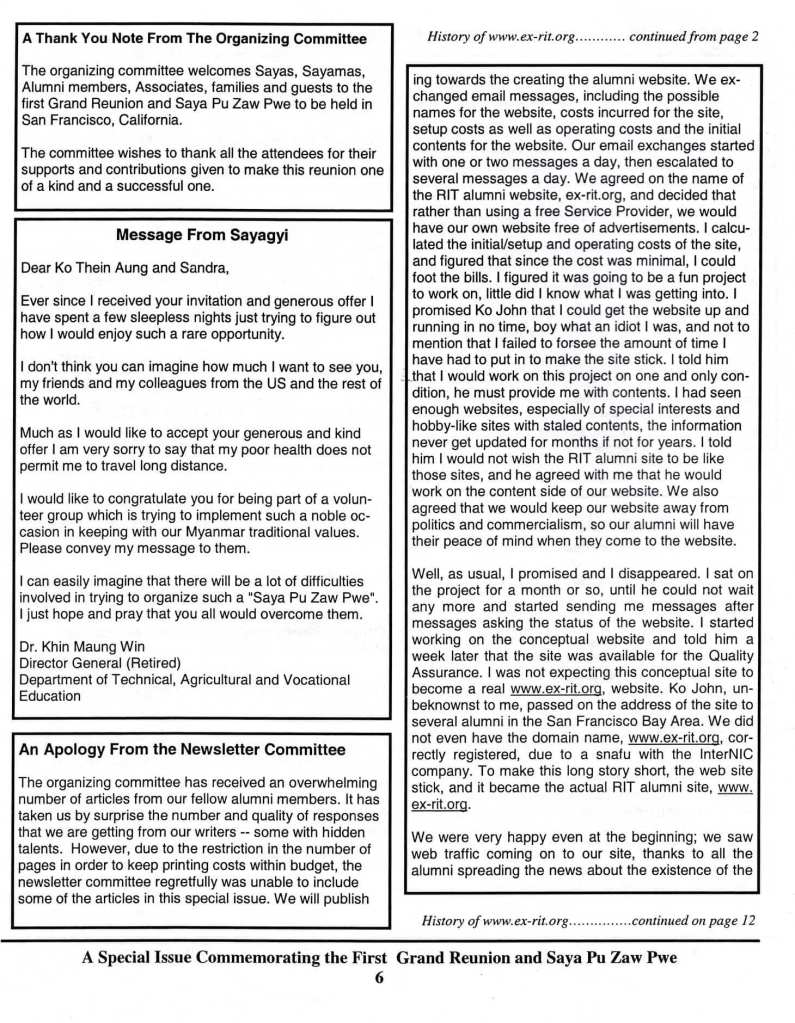
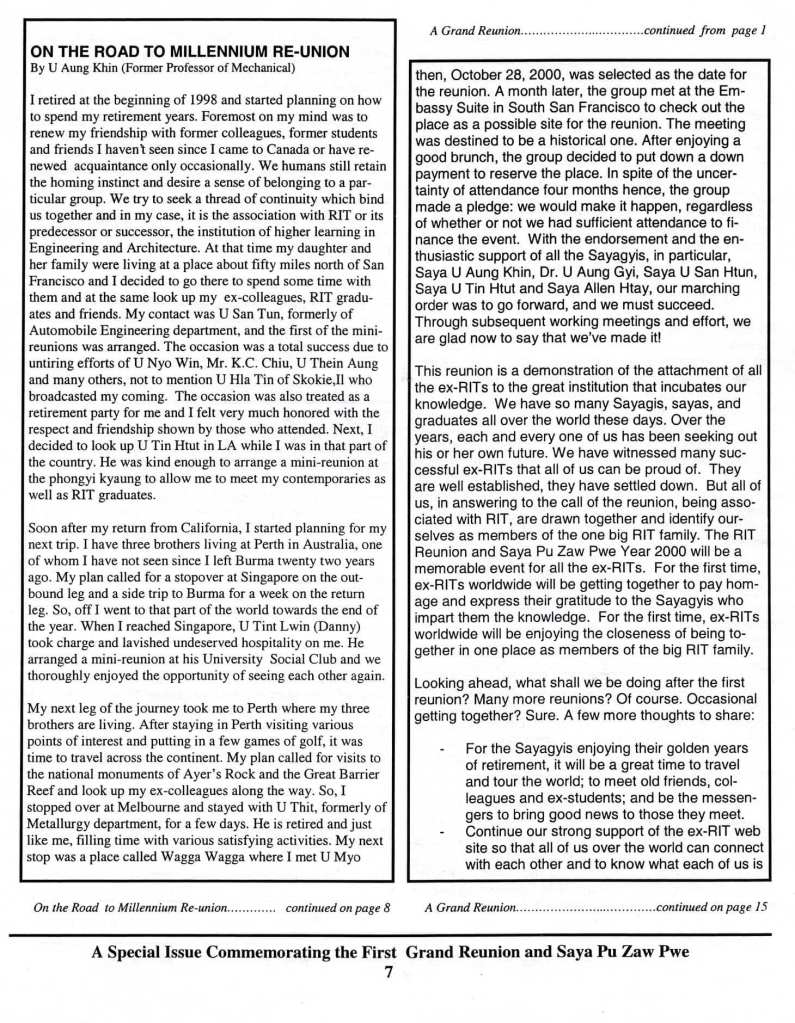
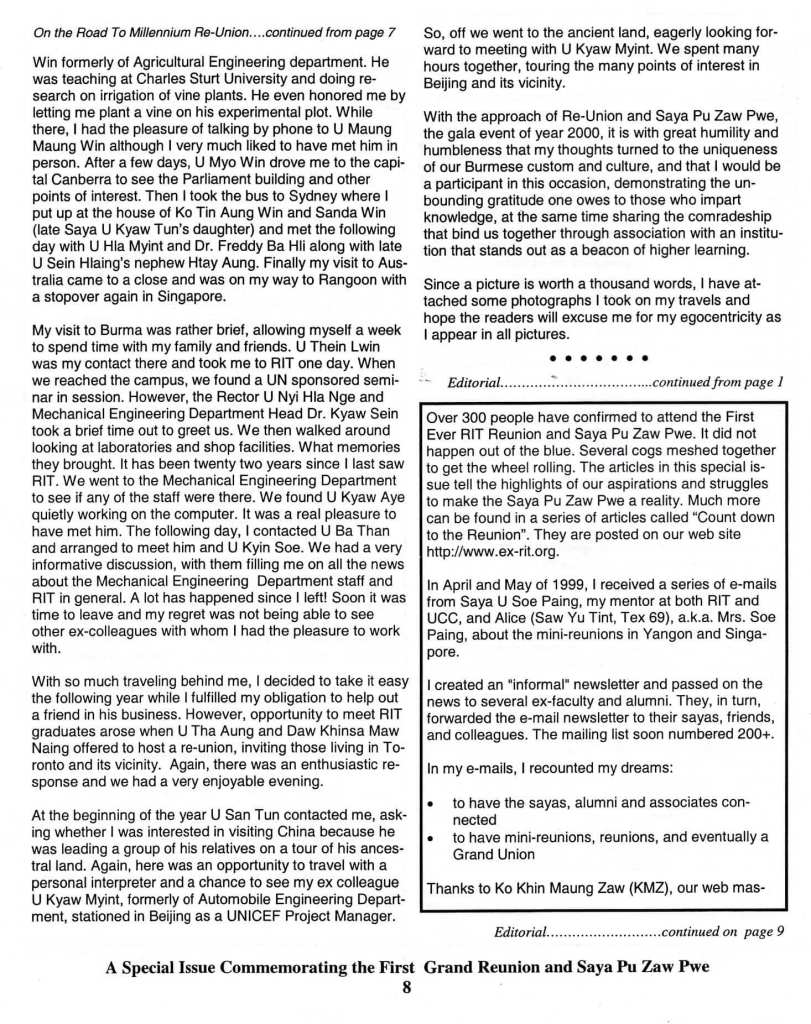
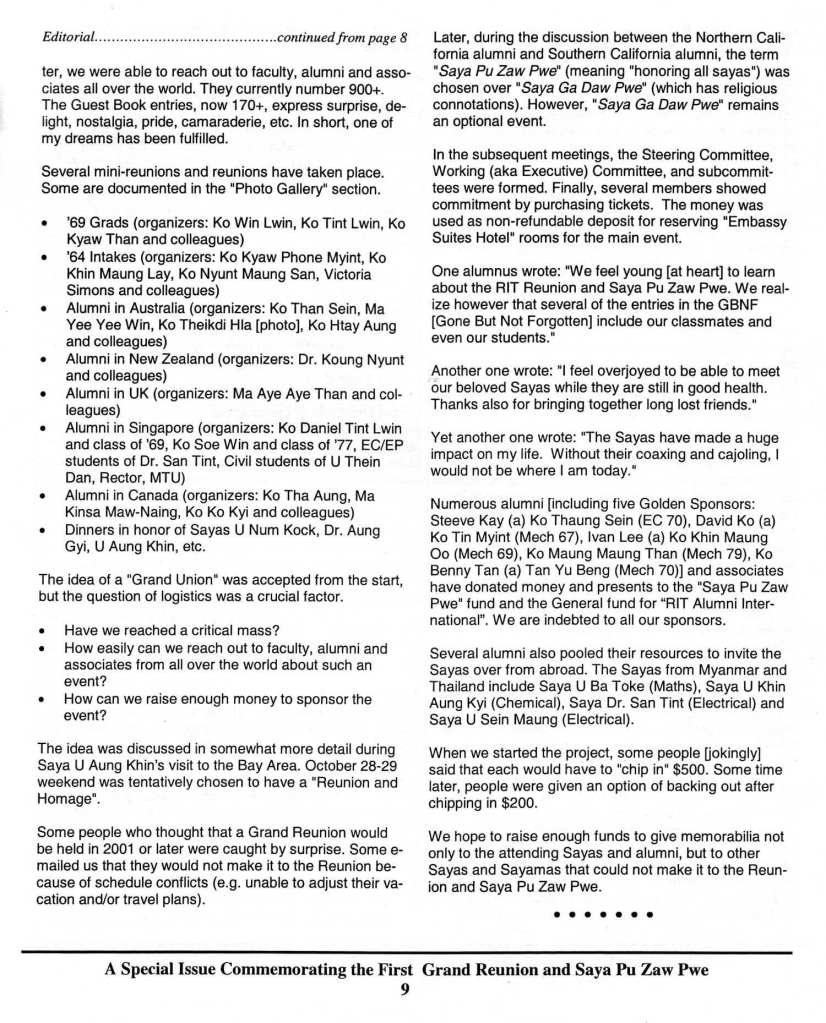
Page 1 of Special Issue
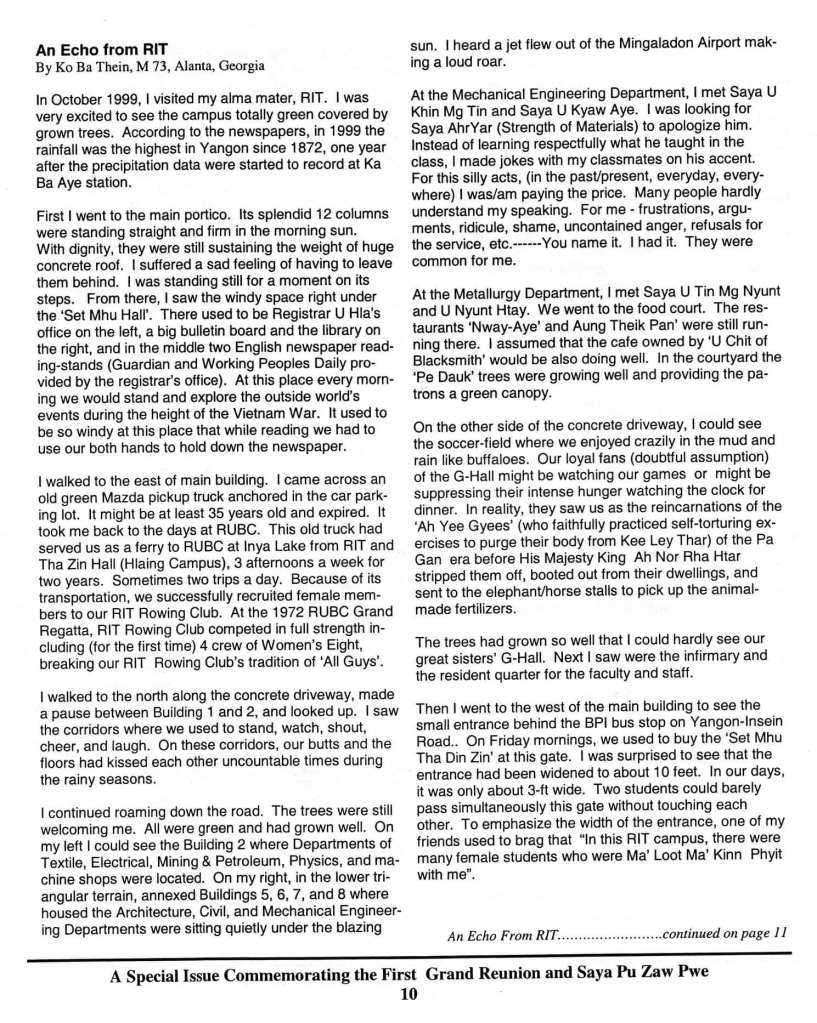
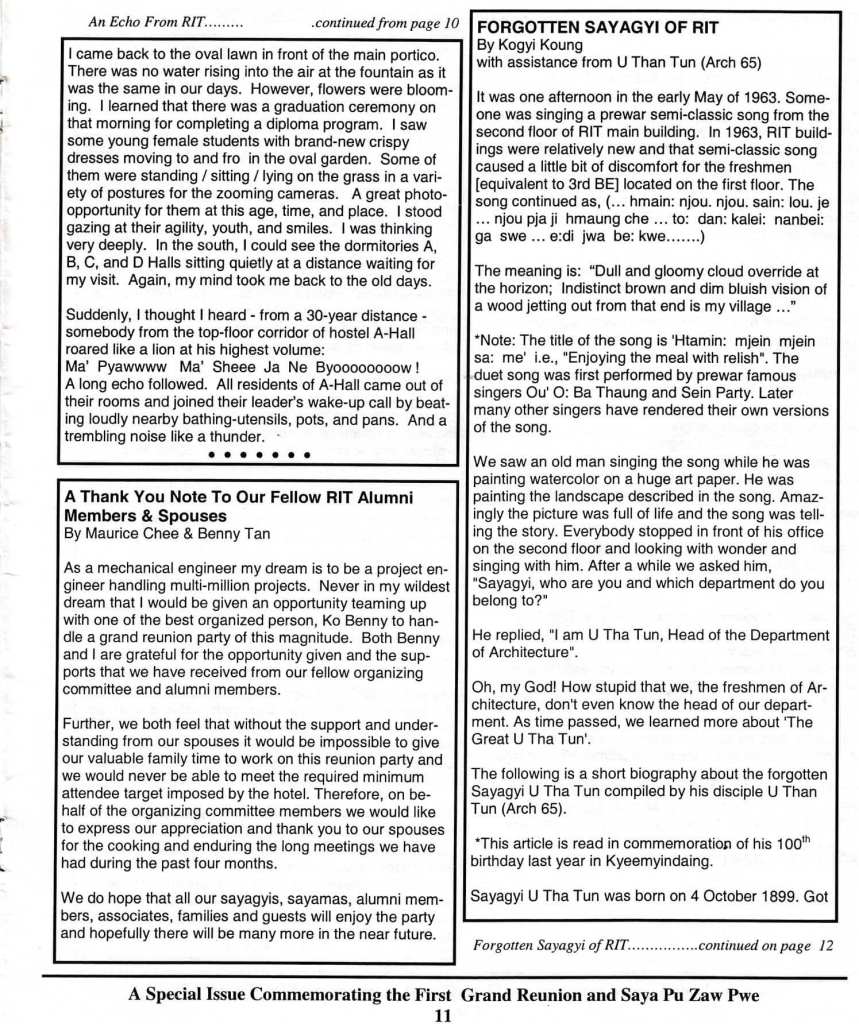
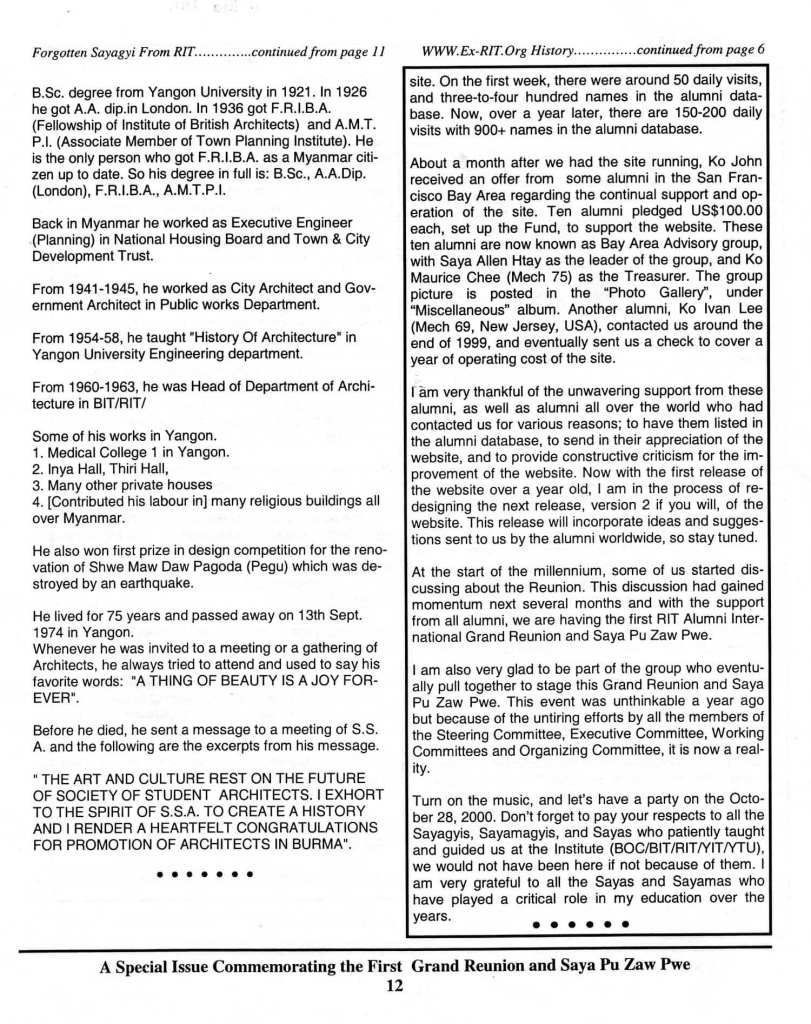
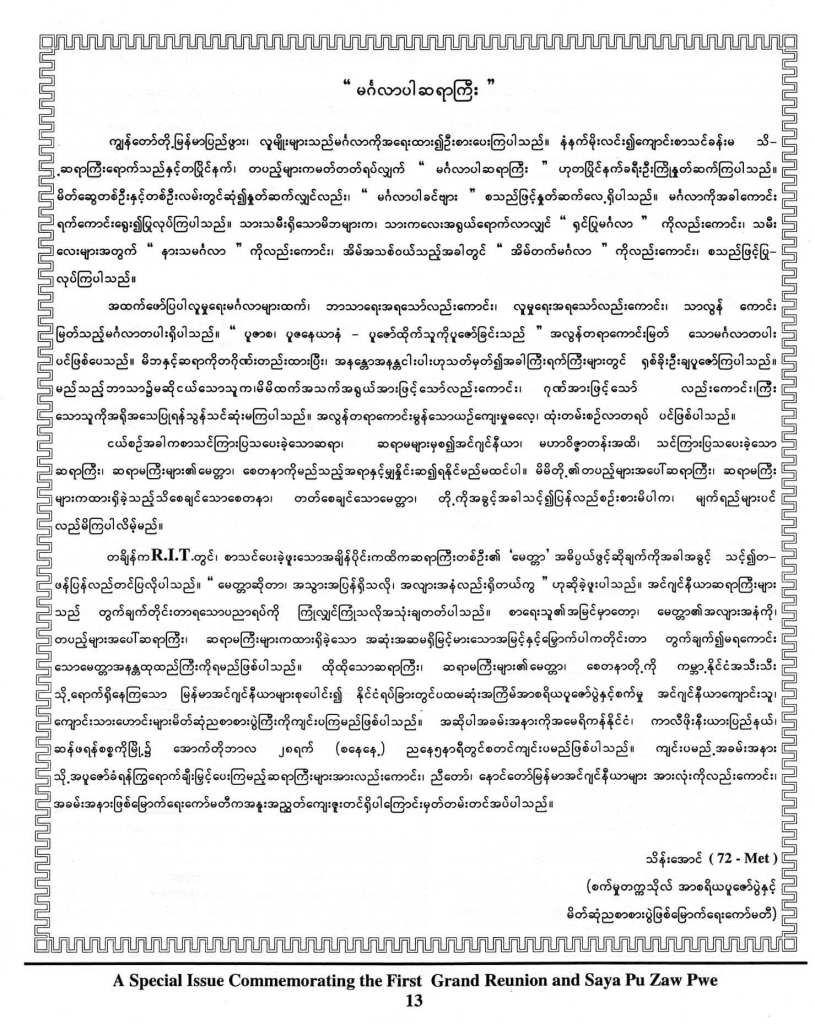
In October 2000, the First RIT Alumni Reunion & Saya Pu Zaw Pwe (SPZP-2000) was held in the San Francisco Bay Area.
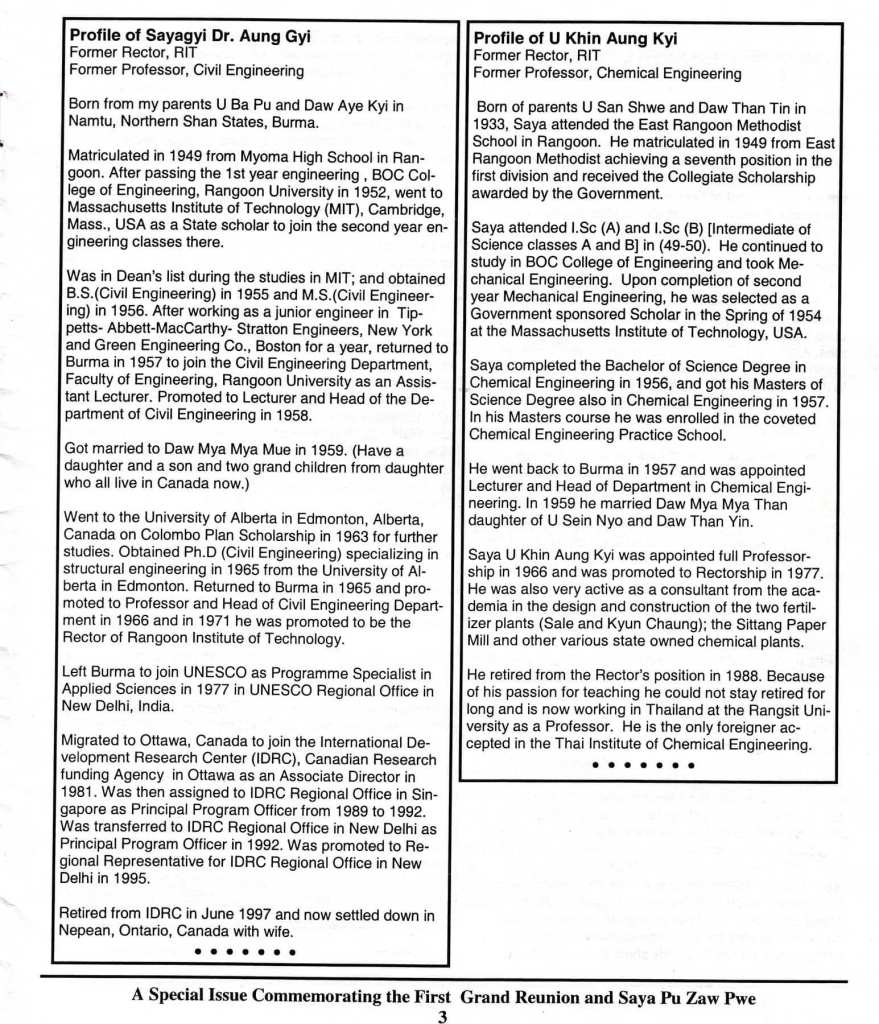
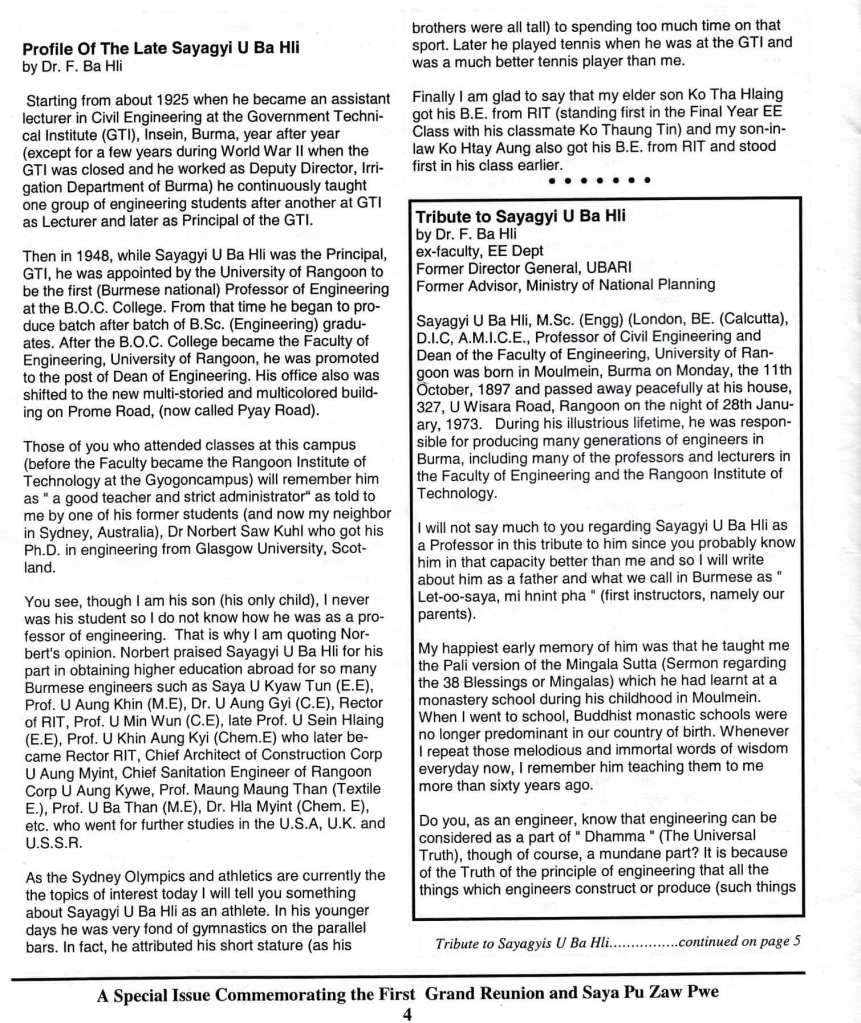
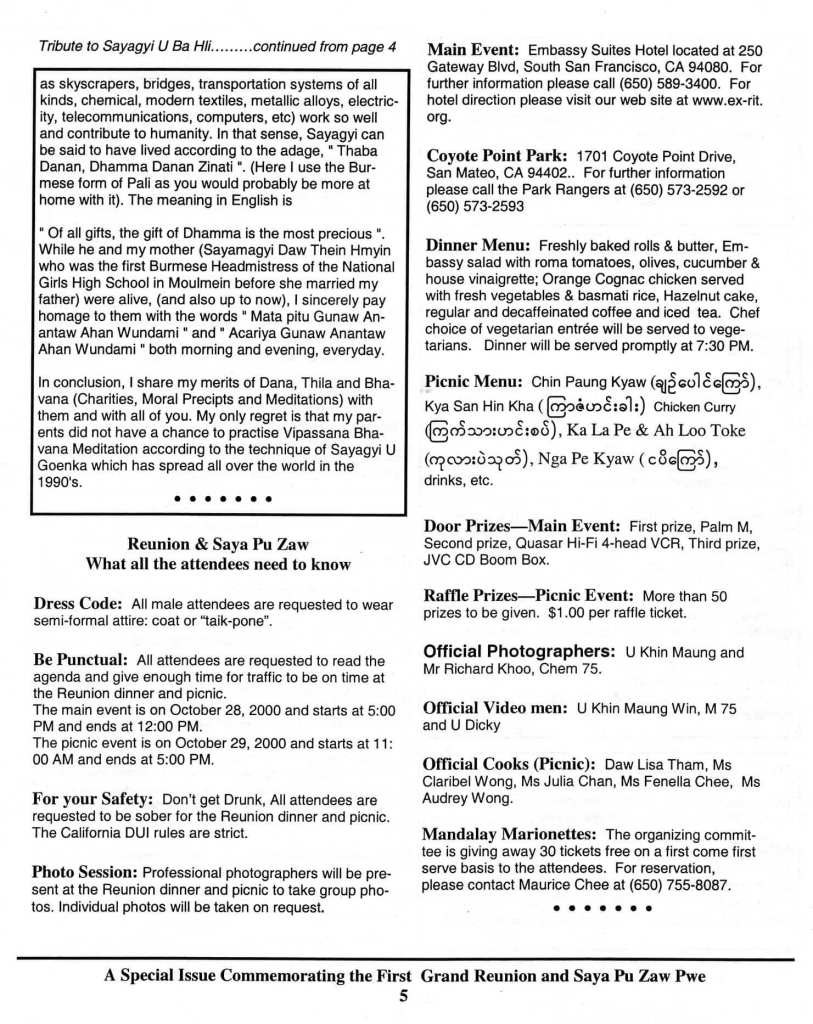
We published a Special Issue of RIT Alumni Newsletter for SPZP-2000.
Editors
I was the Chief Editor. Saya U Thein Aung (Met72) and Henry Lim (U Aung Myint) were Editors.
I wrote “SAYA PU ZAW PWE” poem and the Editorial.
Authors authors
Saya Dr. Freddie Ba Hli (GBNF)
Saya U Aung Khin
Saya Allen Htay (C58, GBNF)
Saya Dr. Nyo Win (M65)
Saya U Myo Win (M/Ag65, GBNF)
Saya Dr. Koung Nyunt (A67, GBNF)
U Hla Min (EC69)
Benny Tan (M70)
Saya U Thein Aung (Met72)
Dr. Myint Thein (M73)
Maurice Chee (M75)
U Khin Maung Zaw (EC76)
Contents
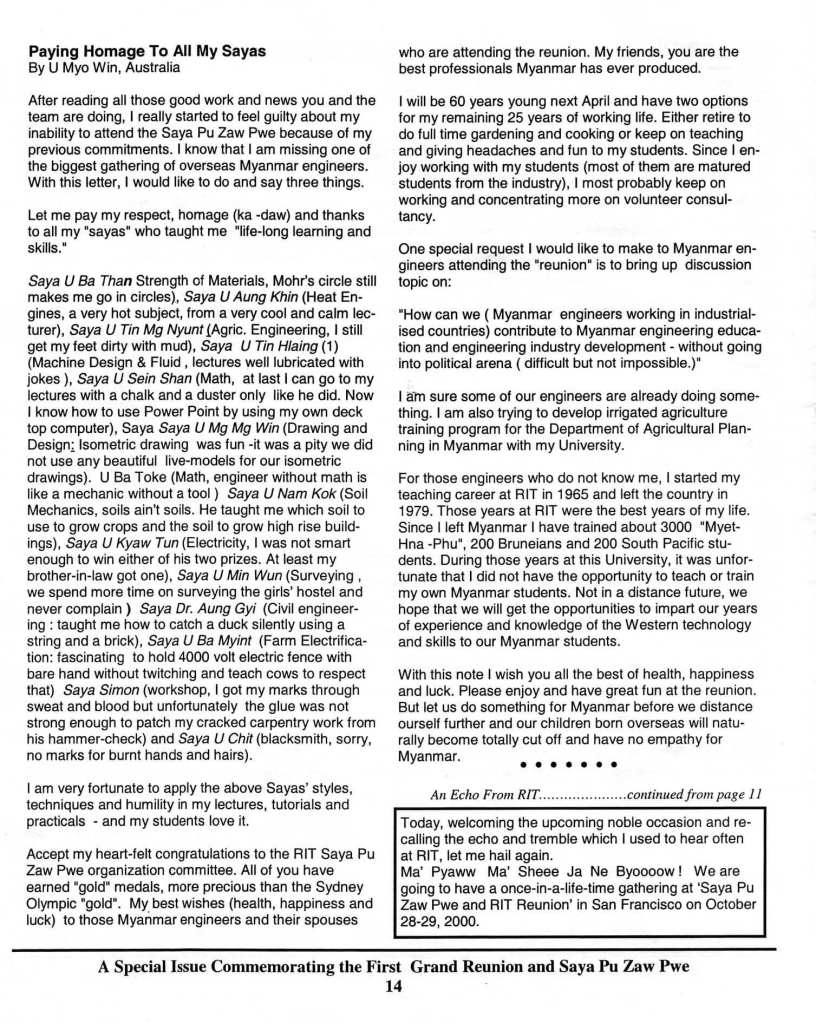
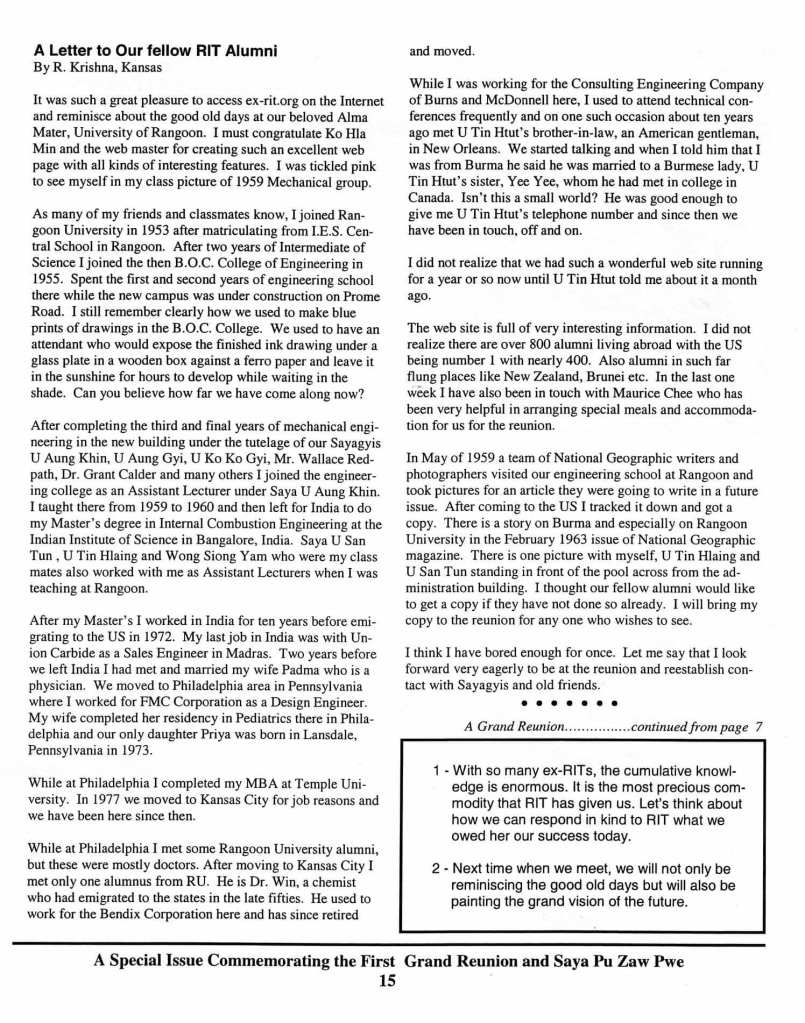
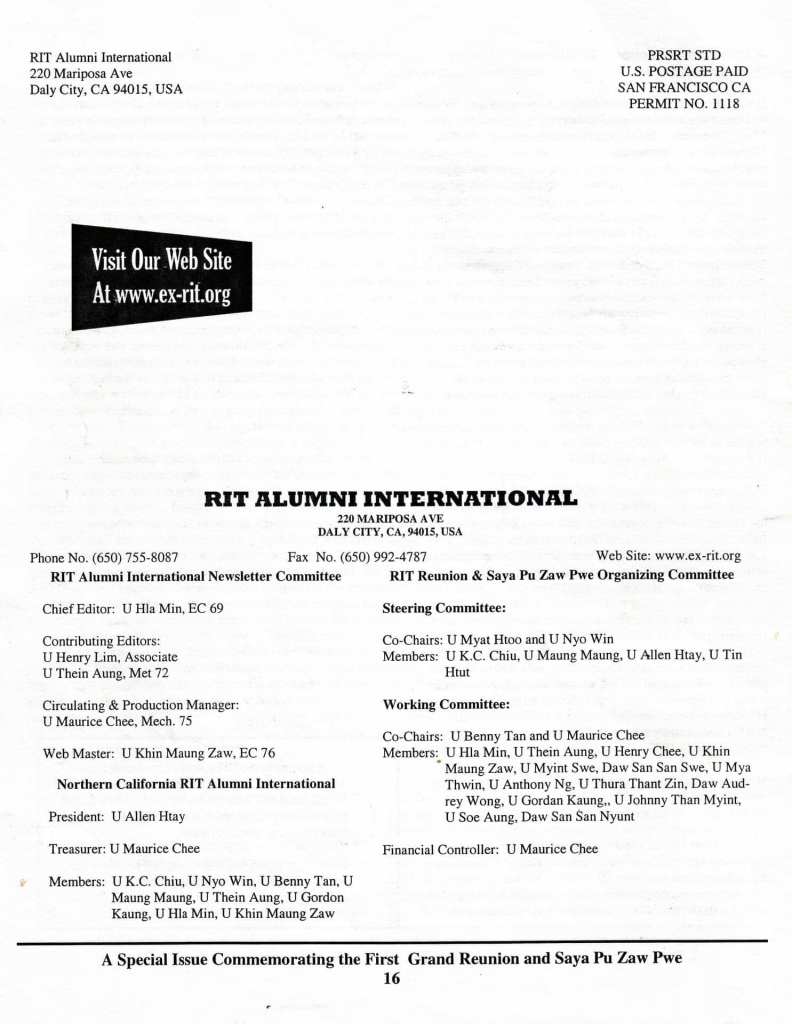
Page 2 of Special IssuePage 3 of Special IssuePage 4 of Special IssuePage 5 of Special IssuePage 6 of Special IssuePage 7 of Special IssuePage 8 of Special IssuePage 9 of Special IssuePage 10 of Special IssuePage 11 of Special IssuePage 12 of Special IssuePage 13 of Special IssuePage 14 of Special IssuePage 15 of Special IssuePage 16 of Special Issue
Archives
U Khin Maung Zaw archived the early newsletters in ex-rit org website.
U Wunna Ko Ko archived the later newsletters in RitAlumniInfo website.
Both websites are no longer active.
Contributing Editor
I volunteered as a Contributing Editor for the following newsletters
RIT English Association Newsletter
BAPS (Burmese American Professional Society) Newsletter
Dhammananda Newsletter published by TBSA (Theravada Buddhist Society of America)
U Boon Pin : 19th Mar 2017 — father of San Lin (Robert, EC73, UCC)
Boon Pin
Dr. Aung Thwin (Alfred, SPHS63, USA) : Mar 2017
Aung Thwin
Kyaw Swe Thet (M)
Saya U Myo Win (Melvyn, M65, Australia)
Myo Win (3rd)
U Aung Myint (M67, USA)
U Tin Myint (M69, USA)
Tin Myint
U Myint Thein (Kabar, M69)
Kabar
U Chit Tin (EC69)
Saya U Thein Lwin (EE, Singapore)
Sayama Daw May Than Nwe (Phy, Singapore)
Dr. Myo San (Freddie, SPHS63)
U Myint Sein (Bobby, SPHS64)
Saw Yan Naing (C68) : 3rd Dec 2017
U Boon Pin (Class of 48/49)
U Boon Pin (Class of 48/49), father of San Lin (Robert, EC73), passed away peacefully in Taiwan on March 19, 2017. Graduated with combined Mechanical & Electrical Option. Retired as Deputy Chief Engineer of Railways.
Dr. Aung Thwin (SPHS63)
Matriculated from SPHS in 1963. Member of Hiking & Mountaineering Club.
Graduated from Institute of Medicine (2). Member of Rangoon University Boat Club.
Successful OG in Southern California.
U Myo Win (M/Ag65)
U Myo Win & members of the RIT Auto Club
Saya rowed for RIT. Co-managed RIT Auto Club. He & Saya U Hla Myint (Charlie, M65) oversaw RIT Gathering in Sydney in 2006 (and more).
U Aung Myint (M67)
Worked with U Win Thein (M67, GBNF) on “Set Hmu Thadin Zin” and Mechanical Magazine. He passed away in Northern California, USA.
U Myint Thein (Kabar, M69)
Yet Lei Invitation for Kabar
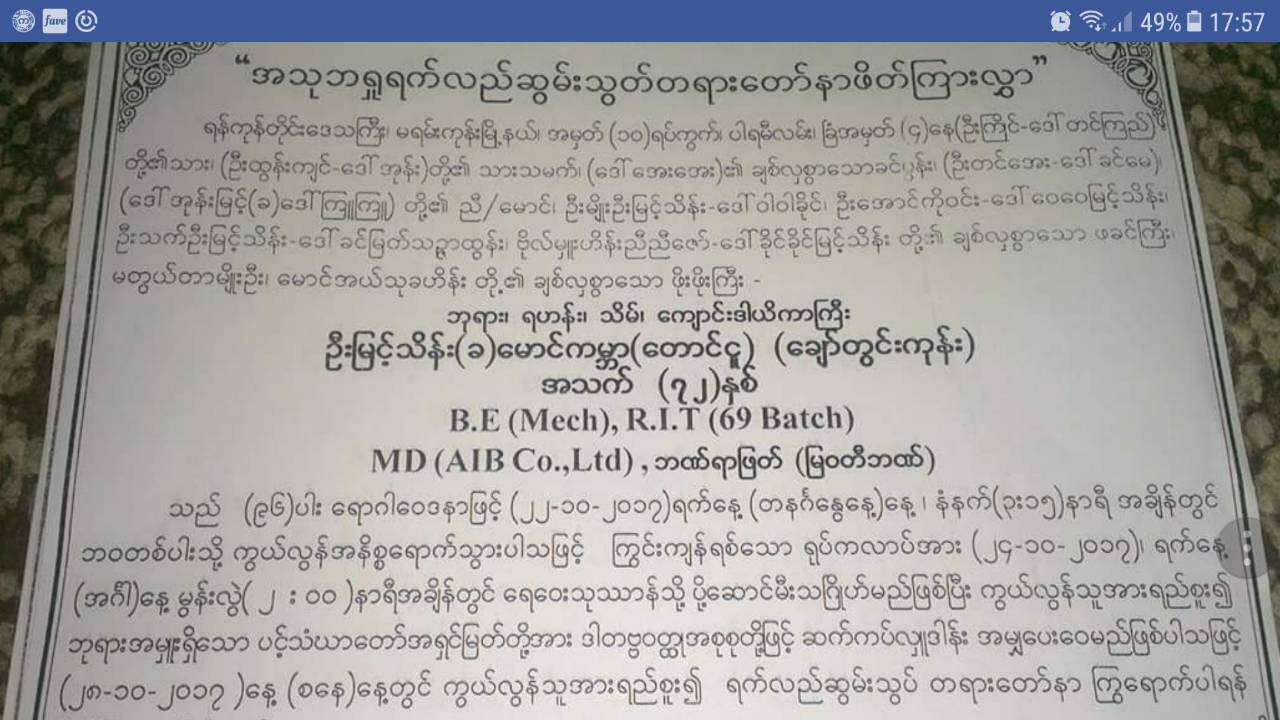
Core organizer for 69ers. Found his health deteriorating while doing medical check up and treatment in Singapore, India and Yangon. Passed away on 24th Oct 2017
U Chit Tin (Bo Chit, EC69)
U Myint Thein & U Chit Tin
Moved back to Yangon after working in Singapore for several years.
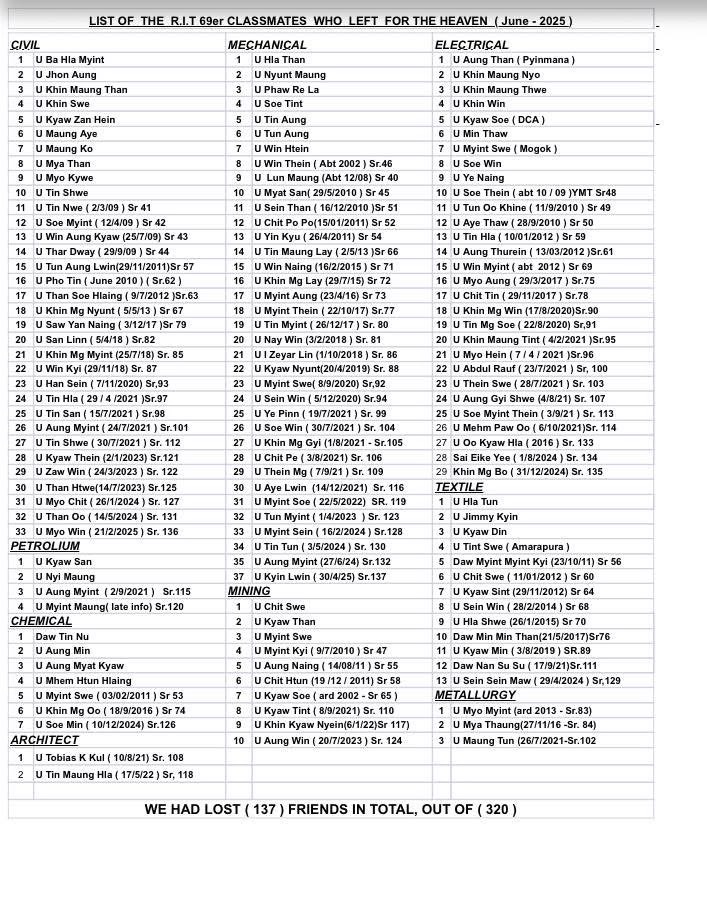
There were only 12 who graduated with Electrical Communications in 1969. Four are now GBNF. U Kyaw Soe, U Aung Thu Yein (Brownie), U Oo Kyaw Hla and U Chit Tin have left us.
Succumbed to liver cancer on (9 November, 2017) 1:30 pm at his home. Per his wish, the services were performed the same day.
Two Fallen Comrades (Ko Chit Tin and Ko Myint Thein)
Ko Chit Tin and Ko Myint Thein (Kabar) are remembered by their 69er classmates. They passed away within five weeks.
From Ashin Pannagavesaka
GBNF. We are also bound to follow our dear friends, sooner or later.
From David Myint Thein
We can’t say when, but, definitely, we have to follow Maung Kabar and Bo Chit one day.
From Tobias Ku
Just a matter of time. Sooner or later we’ll be seeing each other again. Come heaven or hell. RIP KCT.
From Zau Lai
What will be will be. After 20 years the most we all (RIT 69ers) will be gone. From dust to dust. Care one another while we are still here on this earth. My father and my mother were gone. I also must be gone when the time comes. I have no plan to say “No”.
From Ngwe Tun Tun
It is a universal truth my friend KAGS. We must follow this path now and then.
From Ko Thein Swe (EP69)
We (Saw Aung (Rakhine), Zaw Win M69, Nyaung Oo, now Thailand, Ko Chit Tin and I) were together studying in I.Sc A in Mandalay university before joining RIT.
From Ko Aung Khin (EP68)
Please convey my condolences to the family of U Chit Tin.
From Ko Aung Kyaw Pe (EP69)
Very sad to hear the demise of our friend, Ko Chit Tin. It was a shocking news.
From Ma Saw Yu Tint (Alice, T69)
To meet, to love and to part, c’est la vie!!!
So my dear friends do send me flowers when I leave.
From Ko Aung Myint (M69)
Saddened to hear the demise of our friend Ko Chit Tin. I met him a few times in Singapore when he was working there.
My heartfelt condolences to his bereaved family. May his soul rest in peace.
U Saw Yan Naing (C69)
U Saw Yan Naing (Bo Bo, C69) was a room mate of Ko Tun Aung Gyaw (EC69) at RIT. Both were from Meikhtila. After graduation, he moved to Mandalay. We had not seen him after graduation. He married a cousin of Ko Tun Aung Gyaw.
U Tin Myint (M69)
U Tin Myint hosted U Tint Lwin (Singapore)
U Tin Myint (L. Tan Choy, John T Lee, M69, USA) matriculated from Taunggyi. He was Luyecun for 4th BE. He represented RIT in Table Tennis.
Married Lyo Kyin Sein (Mabel, T69), who played basketball for RIT. They settled in Union City, California. Their daughter (a medical doctor) asked me to give a short address at the funeral service of Ko Tin Myint.
Dr. Myo San (Freddie, SPHS63)
Myo San (Seated right)
Dr. Myo San (Freddie Ba San, SPHS63, IM1 70) stood 3rd in Burma in Matric of 1963. He became a surgeon, but had to take early retirement.
U Myint Sein (SPHS64)
U Myint Sein
Attended Private Primary Boundary Road School (PPBRS) before moving to St. Paul’s High School (SPHS). Matriculated in 1964 and studied B.Com at the Institute of Economics. He is a cousin brother of U Nyunt Tin (M70, RIT Table Tennis).
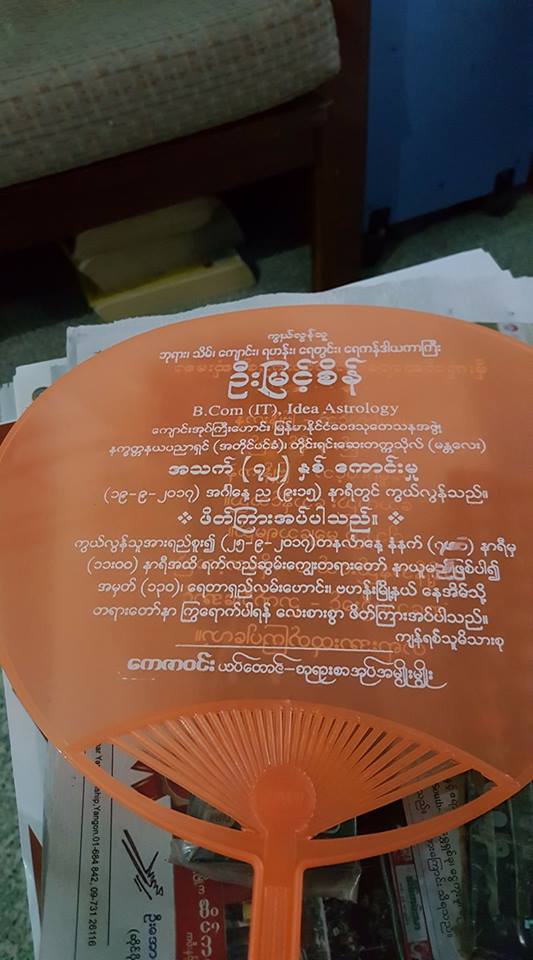
Served as Principal of BARB (Burma Astro Research Bureau). He taught Medical Astrology at the School of Indigenous Medicine (Taing Yin Saya Pyinnya) in Mandalay. Later founded “Idea Astrology”.
He is GBNF.
Daw Than Than
Sayama Daw Than Than (Chemisty) is the spouse of Saya U Khin Maung Myint (Chemistry, GBNF) and the mother of Ko Wynn Myint Aung (EC76). She was healthy, but unexpectedly succumbed to pneumonia. She passed away exactly one year after her younger son died.
U Kyaw Zaw
U Kyaw Zaw is the spouse of Sayama Daw Khin Khin Aye (Past Principal, Boundary Road School). He was States Scholar in the early 50s. He studied Motion Pictures (technology …) in the USA. He is the father of Bohmu Thane Myint (spouse of Ma Khin Than Nu (Glory, EC70)).
Kyaw ZawU Htin Paw
Dr. Barry Paw (MD, Ph.D)
Only child of Saya U Htin Paw (EE58, GBNF, Past President of BEA, Past President of TBSA). Dr. Barry is Harvard medical school Professor, Boston children Hospital co founder. Succumbed to a heart attack on Dec 29 in Denver when he flew back from Australia after visiting his aunt and her spouse who passed away unexpectedly. Dr. Barry had to arrange the funeral services of his uncle.













 HlaMin