The article was published in the RUESU (Rangoon University Engineering Student Union) Annual Magazine.
It was scanned by Saya U Soe Paing and volunteers for the “History of Myanmar Engineering Education (HMEE) prject.
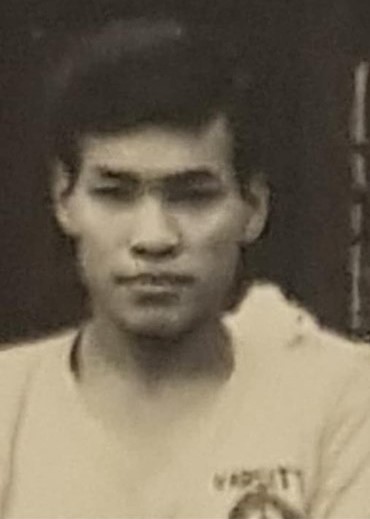
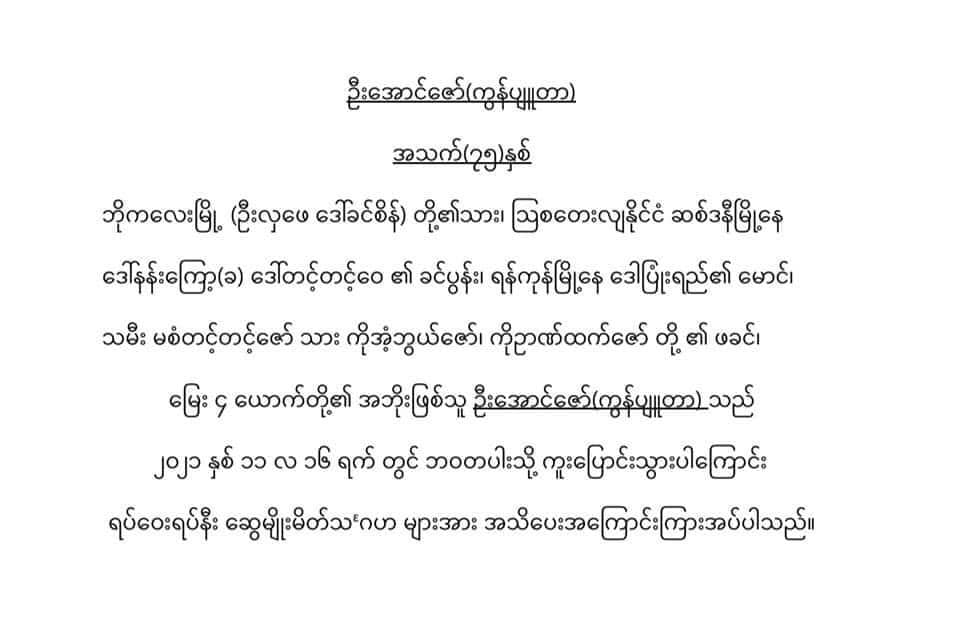
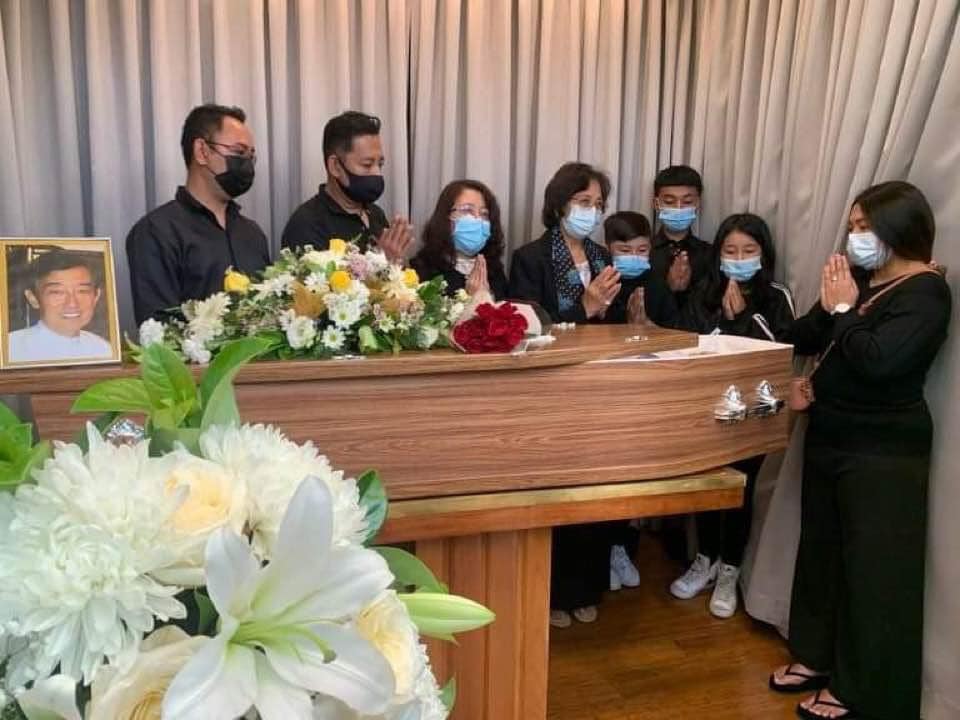
Saya U Kyit In (U Min Wun) received BSCE from MIT and MSCE from Cornell University. He retired as Professor and Head of Civil Engineering, and moved to USA.
Article from RUESU Annual Magazine Article from RUESU Annual Magazine
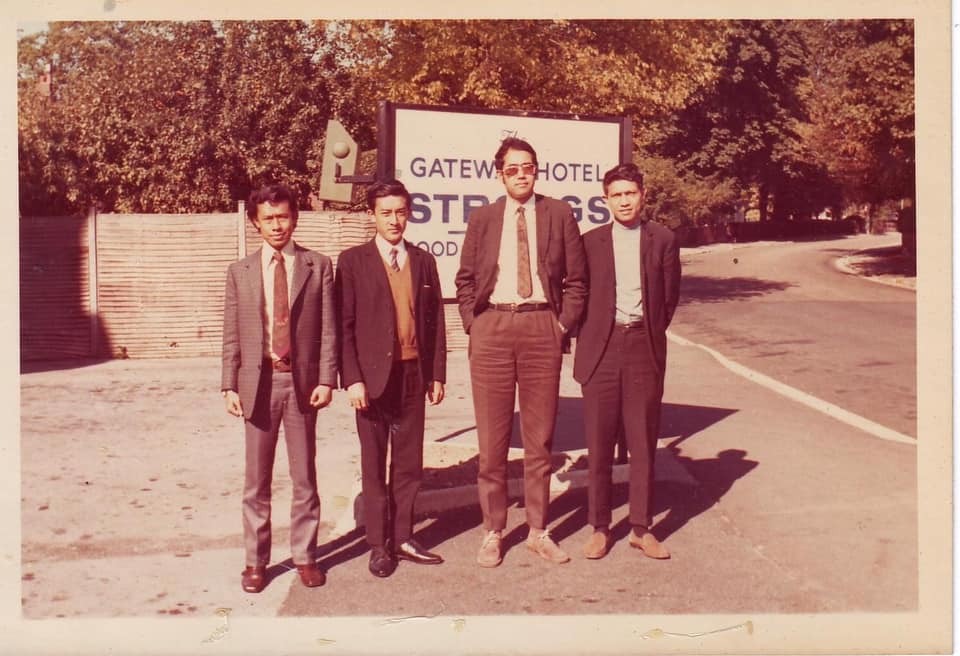
Three brilliant Engineering students — U Min Wun, U Aung Gyi and U Maung Maung Than — from Rangoon University were sent as the first batch of State Scholars to study in the prestigious universities in the USA under the “Twinning Program” proposed by Sayagyi U Ba Hli and supported by Professor Horowitz (MIT).
Upon return from the USA, U Min Wun was appointed Assistant Lecturer along with U Aung Gyi.
They became Lecturers a year later.
Saya retired from RIT as Professor and Head of Civil Engineering.
Saya moved to the USA.
He worked at CalTrans (California Transportation) till he reached the age of 80.
My hearty congratulation to members of the Northern California RIT Alumni International, the Steering Committee, and the Working Committee, for successfully organizing the Grand Reunion and ‘Saya Pu Zaw Pwe’ in San Francisco on October 28, 2000. I was extremely happy to be part of a huge gathering of more than 300 people at the Embassy Suite Hotel, where former Rectors, Head of Departments, Professors, Lecturers, Assistant Lecturers, were there together with alumni members, associates, families and guests.
Although I graduated as an Architect (40) years
ago, it seems only like yesterday to be back with them again. I thank
the organizers and the participants for having this wonderful and
memorable opportunity of a life time and I will never forget this
historical event. It won’t be wrong for me to say that the vision and
foresight of the pioneers, knowing the values and importance of
organizational works, established ‘BASES’ and ‘BAPS’ in California, did
the ground work for many years and thus also assisted in having this
historical gathering. However, the turning point was the wise and timely
suggestion made by Saya U Soe Paing and the decision taken the “Bay
area Advisory Group” led by Saya Allen Htay, in taking advantage and
making good use of the information technology. This resulted in getting
connected internationally with RIT alumni around the world within a
short period of time, and eventually culminated into this premier
Myanmar Architects and Engineers reunion of the millennium. For this, I
wish to congratulate Johnny Hla Min and Khin Maung Zaw for their
“cetena”, dedication and concerted effort in starting with a seemingly
causal e-mail service, that led to the birth of website. Without this, I
really don’t know how all of us can get connected within such a short
span of time, and be able to communicate and pass on crucial information
like we have been doing. Thus, I sincerely wish to express my special
thanks to both of you for the valuable services rendered in spite of the
busy work schedule and personal sacrifices. I do hope that you all will
continue to nurture this valuable tool for the benefit and convenience
of our group in particular and that of the Myanmar community in general.
My list won’t be complete without mentioning Benny Tan and Maurice Chee
for their valuable services and contributions made. Lastly, a big thank
you to all those who were actively involved in this great event and
hope that you will understand for being unable to thank individually by
name. Because of your sincere efforts and hard work, the good seeds that
have been sown has started to bear some good fruits. As the seed is, so
the fruit will be. As the action is, so the result will be.
When we all left our motherland looking for a greener pasture, you all
will concur that we do share a common goal, i.e. to have a better way of
life. Because of this event and through the e-mails and the website, I
am glad to know that majority of us have (had) good jobs, good education
for the children and a comfortable life, thus fulfilling our goals.
Some of us have even retired. Some are preparing to retire. The good
seeds sown decades ago have bear fruits which we all have been enjoying.
Thus, it is obvious that we need to keep on sowing good seeds in order
to continue enjoying the fruits of our labor. However, every one of us
might not be fully aware of how this process works. Especially when we
have a Myanmar saying “Pyinnar – shi – ta – di – phyit – khe’ ” (learned
persons tend to lack awareness).
May all beings be happy.
Tin Htoon (A60) California, USA
Editor’s note:
U Tin Htoon’s pastime is reading Buddhist literature and help publish some of them via Triple Gems Publication, and practicing vipassana meditation in the tradition of Ledi Sayadaw, Saya Thet, Saya U Ba Khin and Saya Mr. Goenka.
30 Doctors are among the victims of COVID-19. They are hailed as “Heroes”, but many family members felt that their loved ones paid a high price behind [misguided and rigid] “Guidelines and Policies”.
Peter Khin Tun is #56 in the list published by NHS.
Some unanswered questions
Origin of COVID-19 (the disease caused by Coronavirus) and how it spread From the wet market? From eating exotic animals / food? From a lab? (some say the virus is not man-made; some speculate that the virus could have “escaped” leading to conspiracy theories) Blame game (by countries and organizations)
Why the early reports downplayed the damaging power of COVID-19 Some early reports did not mention that the virus can be transmitted by humans (Later reports show how a single infected person can unknowingly spread the virus to masses attending gatherings, taking cruises) Some said that washing hands is “good enough” (The hand is only one source of infection.) Initial reports say the virus attacks the respiratory system. Later reports report damage of organs (kidney, brain, …) and the nervous system.
Why several countries reacted slowly to the Pandemic Some pointed the fingers to WHO (for declaring the Pandemic late) Some dismissed the virus as a “Myth” or a “Kind of flu that will go away easily”.
Why front line health workers in some countries were not provided with PPE Some said the policies were guided not by science, but by the availability of resources (Some guidelines were relaxed too much). Some said that it was to save cost (not realizing that the medical equipment may not be easy to purchase or order during a Pandemic).
The impact on economy The Bull market has disappeared Millions got laid off
The impact of social behavior Some people cannot even visit their close relatives On-line teaching / learning (need reasonably good Internet connection and devices) Tele-conferencing (to see loved ones for the last time’ cannot attend funeral services)
The safe distance Most guidelines say 6 feet, but some experiments show that the virus can travel farther (some up to 20 feet)
Why asymptomatic cases were ignored in the initial reports To have good statistical reports Many that were infected did not display symptoms (upgraded to six in later reports) but they contributed to the spread of virus They could “carry” / “spread” COVID-19 (and not easy to “trace” the 0-person / originator of hot spots)
Why COVID-19 has different impact on Men (60% of cases in UK) Asian and Blacks (were hit more in UK) Age groups (80 year olds are the hardest hit; Nursing home fatalities are high) Countries (some “poor” nations fare better than “rich” nations) Many factors (e.g. genetic make up, health condition, blood type) are being studied, but no conclusive results yet.
Most new medicine /cure take 5 – 10 years of development, testing and approval Can a “truly safe” vaccine or a cure be found / developed in a few months?
Why many “miraculous cures” were promoted by people who have no medical knowledge Ingesting disinfectants
Why some do not seem to have compassion A few politicians say that “economy and liberty” are much more important than the loss of lives (particularly the “seniors”)
Due to pandemic, SPZP-2020 (scheduled for December 26, 2020) has been postponed.
Eligible sayas and sayamas will be offered “Garawa money” (probably around Thadingyut).
Saya Dr. Myo Khin
Good news
Just talked briefly to Saya Dr. Myo Khin. He got special permission from his doctor to talk to me.
He walked to the hospital to have a medical checkup. He apparently suffered a minor stroke and was admitted to the ICU.
He can now walk using a cane. He thanked all who wished him well.
U Khin Maung Win (EP69)
He is recuperating after a successful operation at Grand Han Tha Hospital to fight against his food intake track CA.
He was a top student. He was a training partner for Sai Kham Pan (Burma Selected). He also played badminton at the Township level.
RU Centennial Group
Nice to read posts and comments by sayas and alumni who are 80 years young.
Saya Dr. Maung Maung Nyo (82 years) has shared his memories in both Myanmar (published as books) and in English (as poems). Some articles are new. A few are revisions / updates.
Dr. Maung Maung Nyo’s birthday is on July 21st. He is a prolific writer. He published over 100 books and won literary awards.
Dr. Tin Wa (SPHS57) was Captain of Rangoon University Boat Club (RUBC) and Rangoon University Boxing Club, and a member of Rangoon Sailing Club. He recently turned 80. He stays fit by sculling / rowing with his spouse. He enjoys painting (and teasing old friends like Sayama Daw May Saw Lwin).
Dr. Tin Wa was interviewed by BBC Burmese for a program related to Arzani Nay. His father (U Tin Ohn) was present in an adjoining room at the Secretariat on July 19, 1947.
In the early days of the group, there were comments by Thit Yine, Po Kyu and some Oldies.
Those who matriculated in 1955 or earlier are likely to be Octogenarians. Hope they can share their memories.
Sad News
Uzin Kyaw Hein (Actor, Director, Vocalist)
U Myo Win (Michael, M76, son of Bo Tun Hla / Tekkatho Nay Win)
Daw Khin Khin Win (spouse of U Htay Aung, ChE66)
MASTAA
On July 12, 2020 at 10 PM EST (morning in Myanmar of July 13),Myanmar American Science and Technology Alumni Association (MASTAA) presented Sayagyi Dr. Aung Gyi (former Rector of RIT) to members and interested attendees world wide in a Zoom meeting. U Soe Myint (President) and U Sein Myint (Vice President) were co-hosts. Saya Dr. Tun Aung Gyaw (who was the earliest and longest volunteer at UCC and taught at UCC, DCS and ICST) interviewed Sayagyi Dr. Aung Gyi.
On July 26, 2020 at 10 PM EST (morning in Myanmar on July 27), Saya U Soe Paing (co-founder of UCC) will be interviewed by U Hla Min.
A University is usually a collection of colleges or schools.
Oxford University and Cambridge University have constituent colleges (e.g. King’s College, Trinity College)
Harvard University have constituent schools (e.g. Law School, Business School, Divinity School)
In the early Colonial era, educators and politicians requested to have an independent university in Burma, but to no avail.
The colleges had to be affiliated with a university (e.g. Calcutta University).
The colleges could not offer disciplines such as Medicine and Engineering.
Dr. Tin Wa wrote :
Before the colleges and universities, the British offered what is called First Arts (FA) which is an equivalent of Intermediate Part B. That is a two year college degree. My grandfather U Ohn Pe, was one of those who was awarded with First Arts who later became the Chief Translator at the British High Court for the cases that came before it.
Rangoon University
On December 1st, 1920, a law was enacted to establish Rangoon University with two constituent colleges : Rangoon College and Judson College.
RU Golden Jubilee in 1970
The Golden Jubilee was celebrated in 1970.
I had a small part as a volunteer member of the “Zay Nay Yar Cha Htar Yay Ah Phwe”.
I remember Academy Maung Maung Tar (actor) reserving a booth to promote and sell cosmetics.
Play Boys (then an amateur band) wanted to have a high stage and give a public performance.
There were several committees : one with Saya Dr. Aung Gyi as Chair and Saya U Thet Lwin as Secretary.
RIT Ah Nu Pyinnya Shins took part in the Entertainment Program. RIT belles performed the “Htee Yein”. Swel Daw Yeik Ah Nyeint featured Minthamees and Lu Shwin Daws. Saya U Moe Aung (Tekkatho Moe War) and Saya U Saw Tun (Burmese, now in NIU) were Patrons.
There was a commemorative issue.
It had a reprint of Bogyoke Aung San’s rendition of “Invictus”.
It also had an article on the early days at the Faculty of Engineering by U Hla Maung (who graduated in 1928). It was a source for the “History of Myanmar Engineering Education (HMEE)” book published in 2012.
First RU Strike
Several students did not like the limitations of the Rangoon University Act of 1920.
They decided to protest on December 7, 1920.
The news was leaked to the authorities.
The core members decided to start the strike on the evening of December 5, 1920.
On Shwe Dagon pagoda, there is an inscription honoring the students in the strike.
Mr. Matthew Hunter, Principal, met the students and requested them to end the strike.
One student said, “We are not striking against you. We are asking for changes to the education system.”
The strike resulted in the establishment of national schools and national college.
It also caused enhancements to the Act to provide “greater” autonomy and “better” education system.
The event is celebrated as “Ah Myo Tha Aung Bwe Nay” (National Day).
Thakin Ko Daw Hmaing, Ah Myo Thar Pyinnya Wun U Po Kyar, Arzani U Razak, U Nu (first and last Prime Minister of the Union of Burma) and U Thant (3rd UNSG, first among the Asians) are some outstanding teachers and administrators from the national schools.
Education Systems
In November, 1964 a “new” Education System was established.
Several Faculties from Rangoon University became Institutes. For example,
Institute of Medicine
Rangoon Institute of Technology
Institute of Economics
Institute of Education
A few faculties (e.g. Arts, Science) were placed under the “Arts and Science University”. For example,
RASU (Rangoon Arts and Science University)
MASU (Mandalay Arts and Science University)
Subsequent changes to the education system saw a proliferation of Universities.
The first East Coast Reunion took place in Virginia in 2009.
U Kyaw Than (M58, ex-UBA, Canada) was one of the senior alumni.
His spouse Rosemary Than was a sister of Veronica (my primary school classmate, Gangaw Travel)
Sometime back Rosemary messaged me with a request for the contact information of a common friend.
She then added that U Kyaw Than has passed away.
U Nyein Min (C79, Virginia) operated “Wunna Construction” (named after his son). He is the cousin of U Thura Thant Zin (M76, Southern California). He invited his classmate friend U San Myint Than (Sammy, EC79, Texas) to come and help organize the gathering.
Dr. L. Sein Myint (M73, Maryland) is one of the organizers. He is the younger brother of U L. Kyee Myint (early Chartered Accountant) and U L. Than Myint (M63, RUBC Gold). He studied in UK and worked in several places (including Alaska and Malaysia). He told me that he would pick me up at the airport and host me.
Most of the attendees were from East Coast (e.g. New York, Virginia, West Virginia, Maryland, New Jersey) and Canada
I flew in from Northern California
Saya U Tin Htut (M69) flew in from Southern California
U Tha Aung (M), Daw Kinsa Maw Naing (ChE) and several others were from Canada
During my trip, Dr. L Sein Myint, U Wynn Myint Aung (EC76, Frederick, Maryland), U Htin Linn (ex-PTC, Washington, D.C. ) and my uncle U Thein Han (Silver Spring, Maryland) hosted me.
Dr. Win Aung (M62, iNeer) and spouse hosted a dinner for us. His father Saya C Ping Lee joined Saya U Kyaw Tun as the early EE sayas. H.E. U Than Aung (Education) asked his former student C. Ping Lee to head the Directorate of Technical and Vocational Education. Dr. Win Aung wrote an article about his father for SPZP-2000.
6th Poetic Art of a group of Alumni of the well-known RIT ( Rangoon Institute of Technology), Myanmar. They are engineers with remarkabe career on the one hand, but on the other hand, they are trying to disseminate innate nature and life style of Myanmar by poetic art depicting short but complete poems.
Please enjoy this poetic art about how the poet had an unforgettable heartfelt night by watching the dancing of a beautiful dancer of a traditional dancing troupe.